Author: DFID

  • How NPR Lets You Know Which Political Philosophies Are Acceptable

    Michael F. Cannon

    NPR asked libertarian, vegan, author, and Whole Foods CEO John Mackey whether ObamaCare is a form of socialism. Mackey responded, thoughtfully:

    Technically speaking, it’s more like fascism. Socialism is where the government owns the means of production. In fascism, the government doesn’t own the means of production, but they do control it — and that’s what’s happening with our health care programs and these reforms.

    Mackey then discussed how Whole Foods is working with Michelle Obama to improve Americans’ diets. The story on NPR’s web site closes with this paragraph:

    So our question to you, dear readers, is this: How big a role does a business leader’s personal philosophy play in your decision to buy products from his or her company? Tell us in the comments section below.

    That’s funny. NPR didn’t ask its dear readers to comment on the politics of health insurance giant CIGNA’s CEO after he praised the Supreme Court’s decision not to strike down the law, or said, “I don’t believe focusing on repeal right now is in anybody’s best interest.” Or on Aetna’s CEO after he advocated tax increases and gobbling up as many ObamaCare subsidies as his company could. Hmm.
  • Dollars Per Vote in the Presidential Election

    David Boaz

    There’s been a lot of talk about the high cost of the 2012 election, with both major candidates spending more than a billion of dollars once affiliated groups are included. Some people find that too much. Others point out that Americans spend that much every year on potato chips, and surely deciding who will lead the United States government is at least that important.

    And of course the bigger amounts are government spending. When politicians vote to give money to students, the elderly, farmers, automobile companies, defense contractors, and other voting blocs, political considerations are certainly part of the decision-making process. When Republicans vote for $60 billion in “Hurricane Sandy recovery aid,” including money for Alaskan fisheries and activist groups, aren’t they buying votes? 

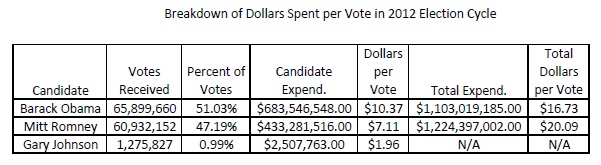
    But for the moment, let’s take a look at how much the candidates did spend, and how much they got for it. I’ve added Libertarian nominee Gary Johnson to the usual Obama-Romney comparison to get some perspective.


    The vote totals are from Wikipedia. Spending figures for the Democratic and Republican candidates and for Johnson are from OpenSecrets.org. 

    So the first thing we notice is that Obama and Romney spent respectively $10 and $7 per vote, while Johnson spent less than $2. But party and outside groups roughly doubled spending for the major candidates. More money was spent on behalf of Romney, but presumably money spent by groups other than the official campaign is less efficient, so that their total expenditures were effectively similar. And we can only wonder how much of “the libertarian vote” a Libertarian Party candidate might pick up if he had enough money to be heard.


  • A Constrained Gun Control Agenda

    Caleb O. Brown

    We didn’t get the “Andrew Shepherd moment,” a neat parallel between Obama’s gun-control newser and Michael Douglas in The American President confidently declaring that he’s going to “get the guns.” That the faux President made that pledge just moments after confidently affirming his membership in the ACLU (!) shows just how much the Second Amendment debate has changed since the Heller decision in 2010.

    The President’s proposed gun restrictions show some recongition that his agenda is constrained by the Constitution. Tim Lynch and I discuss President Obama’s gun control agenda in this short video:

    More analysis from Ilya Shapiro here. Audio-only version of the above video available here.

  • Obama’s Executive Actions on Guns Better Than His Legislative Proposals

    Ilya Shapiro

    We’re all still digesting what it is the White House’s plan on gun policy is, but here’s my initial assessment, not having gone through what technical language is available.

    President Obama’s 23 executive actions generally take positive steps towards stopping gun violence – such as improving the background check system and increasing enforcement of gun crime – though I have federalism or privacy concerns about a few of them.

    His legislative proposals, however – banning “assault weapons” and restricting magazines to 10 rounds – are feel-good measures that fail to abide by the principle that should guide any lawmaking in this area: keeping guns out of the hands of those who would do ill while protecting law-abiding citizens’ constitutional rights to armed self-defense.  The guns that the Newtown shooter used, for example, complied with Connecticut’s extremely strict “assault weapon” ban and, in any event, the vast majority of murders are committed with handguns.

    On both sets of actions, the devil will be in the details:  How will the relevant executive branch officials and agencies implement the new actions?  Will the proposed “assault weapon” restrictions ban ordinary rifles that simply come with a pistol grip or other cosmetic feature (like the New York law that Gov. Cuomo signed earlier in the week)?  And that’s before we even get to the feasibility of getting anything through Congress or whether the president is willing to negotiate to get at least some of what he wants.

    Finally, this national action isn’t the end of the story: our constitutional structure leaves to states most of the power to regulate in this area.  On that score, and befitting a federal system meant to reflect different political preferences, states have been moving in different directions – from allowing concealed-carry to increasing tort liability to posting armed guards in schools.  So long as states and local authorities don’t violate individual Second Amendment rights, the federal government ought to encourage that kind of policy innovation.

    See also Tim Lynch’s podcast on Obama’s gun control agenda.