Author: Discover Main Feed

  • NCBI ROFL: It’s dogs…it’s dogs in tights (TIGHT tights!) | Discoblog

    subadogEffects of a whole-body spandex garment on rectal temperature and oxygen consumption in healthy dogs.

    “OBJECTIVE: To determine whether a full-body spandex garment would alter rectal temperatures of healthy dogs at rest in cool and warm environments… …PROCEDURES: Each dog was evaluated at a low (20 degrees to 25 degrees C [68 degrees to 77 degrees F]) or high (30 degrees to 35 degrees C [86 degrees to 95 degrees F]) ambient temperature while wearing or not wearing a commercially available whole-body spandex garment designed for dogs. Oxygen consumption was measured by placing dogs in a flow-through indirect calorimeter for 90 to 120 minutes. Rectal temperature was measured before dogs were placed in the calorimeter and after they were removed. RESULTS: Rectal temperature increased significantly more at the higher ambient temperature than at the lower temperature and when dogs were not wearing the garment than when they were wearing it. The specific rate of oxygen consumption was significantly higher at the lower ambient temperature than at the higher temperature. CONCLUSIONS AND CLINICAL RELEVANCE: Results suggest that wearing a snug spandex body garment does not increase the possibility that dogs will overheat while in moderate ambient temperatures. Instead, wearing such a garment may enable dogs to better maintain body temperature during moderate heat loading. These results suggest that such garments might be used for purposes such as wound or suture protection without causing dogs to overheat.”

    spandex

    Photo: flickr/zebedee.zebedee

    Related content:
    Discoblog: NCBI ROFL: What kind of panties should I put on my bitch?
    Discoblog: NCBI ROFL: Static cling reduces rat virility: how shocking!
    Discoblog: NCBI ROFL: Finding the frequency of Fido’s farts

    WTF is NCBI ROFL? Read our FAQ!


  • Spring Cleaning in Everest’s “Death Zone” to Sweep up Oxygen Bottles & Corpses | Discoblog

    STS058-101-12_2The next time someone asks you to take the trash out, don’t make a big deal about it. Because, as Namgyal Sherpa will tell you, at least you don’t have to climb a mountain to take out the garbage. Namgyal is leading a team of 20 sherpas who, come May 1st, will be climbing up to the world’s highest garbage dump–on Mount Everest.

    The Nepalese mountain climbers will trek to above 26,000 feet to an area known as the “death zone” due to its lack of oxygen, Reuters reports. Once there, they’ll gather up the trash left behind by previous expeditions.

    The Mount Everest spring cleaning trip is expected to yield tons of garbage like food wrappings, torn tents, and discarded oxygen bottles left between an area called South Col at 26,000 feet and the summit at 29,035 feet. The sherpas also hope to bring back the dead bodies of three mountaineers who were killed in the death zone, and plan to cremate them near the base camp.

    Namgyal Sherpa has already scaled the summit seven times and will be with a team comprised of equally expert mountaineers, including one teammate who has made the trip up Everest 14 times. They’ll all be toting empty sacks to haul the trash back in.

    Namgyal, who goes by one name only, says some of the rubbish has been lying around since Edmund Hillary and Tenzing Norgay first scaled the world’s highest peak in 1953; he says that the trash creates problems for other climbers as they trek through the treacherous terrain. He told Reuters:

    “This is the first time we are cleaning at that height, the death zone. It is very difficult and dangerous…. The garbage was buried under snow in the past. But now it has come out on the surface because of the melting of snow due to global warming.”

    Many climbers leave their gear and trash behind as they descend due to exhaustion and lack of oxygen, Reuters adds. And garbage left behind on the mountain has become a source of environmental concern for the Nepalese government, which started imposing strict rules 15 years ago requiring climbers to bring back all their trash. But there are still no estimates on how much trash remains on the mountain.

    Related Content:
    80beats: EXTREME SCIENCE: Doctors Drop Their Pants on Everest for a Blood Oxygen Test
    80beats: Why Climbers Die on Everest: It’s Not the Avalanches (or the Yeti)
    80beats: Tiny Soot Particles May Be Melting Mighty Himalayan Glaciers
    NCBI ROFL: High Altitude Flatus Expulsion (HAFE)

    Image: Wikimedia


  • Gallery: Marine Census Finds the Beautiful Wee Beasties of the Deep Sea | 80beats

    NEXT>

    Ch

    Kaleidoscopic. Delightfully odd. And too numerous to truly grasp.

    There are many more words one could deploy to describe the worlds unknown under the sea. An international group of scientists has been scouring them for life for the last decade, and later this year, on October 4, the Census of Marine Life will release it catalog of marine inhabitants. “The number could be astonishingly large, perhaps a million or more, if all small animals and protists are included,” the organization says.

    Octopuses, jellyfish, and other sprawling sea creatures dominated the census’ prior reports. But this time they’ve dived even deeper, surveying tiny life. Remotely operated deep-sea vehicles discovered that roundworms dominate the deepest, darkest abyss. Sometimes, more than 500,000 can exist in just over a square yard of soft clay [AP].

    And then there are the microbes. The scientists conservatively estimate that there must be at least 20 million kinds of microbe in the oceans. The true number may even be billions or trillions [Nature]. Individual microbes reach even more astronomical number. There are probably a nonillion of them in the sea, the scientists estimate. That’s a billion cubed, and then times 1,000. Or, if you prefer your measurements given in the weight of African elephants, it’d be 240 billion of them.

    Take a peek through this quick slideshow of some of the weirdest ocean life seen so far.

    Image: David Patterson et. al.


    NEXT>


  • So, a Guy Walks Into a Bar… and Discovers Apple’s Latest iPhone | Discoblog

    A guy walks into a bar, but instead of the customary lame joke or flat beer, this guy actually finds the next, unreleased generation of the iPhone, according to Gizmodo.

    The phone, apparently retrieved from a bar in Redwood City, California was camouflaged to look like a regular 3GS phone. Since reports later surfaced that Apple was indeed missing an experimental iPhone 4 from its offices, Gizmodo is now convinced that this is the missing prototype.

    Tinkering around with the prototype, Gizmodo found a lot of new and improved features. The happy investigators report that the prototype not only sports a front-facing camera for video chats, but also boasts an improved regular back camera with a flash and larger lens. The display is reported to be better, and the unit pops out a Micro-SIM instead of a standard SIM card. Gizmodo adds that there are split buttons for volume, and notes that the power, mute, and volume buttons are all metallic in color.

    Sadly, they didn’t get a chance to suss the operating system out, as Apple remotely disconnected the phone.

    So, what else can you expect from the new iPhone? Gizmodo describes:

    The back is entirely flat, made of either glass (more likely) or ceramic or shiny plastic in order for the cell signal to poke through. Tapping on the back makes a more hollow and higher pitched sound compared to tapping on the glass on the front/screen, but that could just be the orientation of components inside making for a different sound
    • An aluminum border going completely around the outside
    • Slightly smaller screen than the 3GS (but seemingly higher resolution)
    • Everything is more squared off
    • 3 grams heavier
    • 16% Larger battery
    • Internals components are shrunken, miniaturized and reduced to make room for the larger battery

    Gizmodo says it is confident that the lost and found phone is the 2010 model of the new iPhone, as the device behaves like an iPhone when connected to a computer, but has obvious hardware differences from existing iPhones. What’s more, when the tinkerers disassembled the phone, they found “multiple components that were clearly labeled APPLE.” And they believe this to be the 2010 model because they say it’s too early for Apple to be testing out its 2011 model in such a finished form.

    With its sleek looks, flash, better back camera, and another microphone for superior voice clarity, Gizmodo’s final verdict was that the upgraded phone is a winner.

    People who bought the 3G two years ago and are now in the perfect position to upgrade and get a dramatically different, and better, phone.

    Related Content:
    80beats: iPad Arrives—Some Worship It, Some Critique It, HP Tries to Kill It
    Discoblog: Apple App Store Backs Off Rejection of Pulitzer-Winning Political Cartoonist
    Discoblog: Is Apple Taking Sexy Back? Raunchy Apps Vanish From the App Store
    80beats: Apple’s “iPad” Tablet: It’s Here, It’s Cool, and It’s Slightly Cheaper Than Expected
    80beats: Sorry, Australian iPhone Users: You’ve Been Rickrolled
    Discoblog: Weird iPhone Apps (our growing compendium of the oddest apps out there)


  • Daily Data Dump (Monday) | Gene Expression

    Why religion can lead to racism. I think the correlations are real, but am skeptical of the causation because I think think the correlation is cultural-specific. For example, my personal experience with Muslims is that those who espouse the most “Fundamentalist” world views are the least racist. The contrast with white American Protestants probably emerges from the fact that white American Protestants and Arab Muslims have had very different recent histories (if Arab Muslims want a racial ideology, they had a good candidate in secular Baathism. Some of the same applies to Turks and Persians, who got on the 20th century racial-nationalist bandwagon, as evident in the attempt by the Shah to emphasize Iran’s Aryan antecedents, while Ataturk funded research on the racial characteristics of the Turkish people which allowed them to be a conquering race).

    Air Travel Crisis Deepens as Europe Fears Wider Impact. This shows the downside of a JIT world, where we squeeze efficiencies by pushing everything to the margin and assuming stable background conditions. I worry that as the world economy becomes more interdependent, and squeezes efficiencies out through complementation via comparative advantages, there emerge problems whenever we get buffeted by a big “exogenous shock.” I think there’s some evidence that we as a species have cognitive biases toward focus on near-term conditions and discounting volatility toward the tails of the distribution. Such is nature.

    S.E. Cupp On Being An Atheist & A Conservative. Some of her arguments strike me as surprisingly superficial, and I think it’s likely that she’ll convert to Roman Catholicism at some point in the next 20 years. My minimal experience with atheists who want to be religious is that they generally get their wish if they don’t die too early. Also, apparently she’s getting her masters in Religious Studies, which is a field that is often suspicious of unvarnished naturalism in the study of religion. Warning: I suspect some readers of this weblog will find her responses & viewpoints somewhat cringe-worthy. A young Heather Mac Donald she’s not, take a look at this clip, who does she remind you of? Can’t wait until she’s firmly in the Christian column.

    For Goldman, a Bet’s Stakes Keep Growing. Some people are saying that investors will now be cautious of making recourse to Goldman’s services for fear that they’ll be screwed. But remember that it is assumed that many of Bernie Madoff’s investors suspected that he was front running. In other words, as long as it’s someone else being screwed they should be fine with it. The people at Goldman are the best tools you have out there, but a tool is a tool and can be used for good or ill. In any case I thought Goldman was making most of its money by trading with its own capital, leveraging the ability to get cash cheaply via the Fed window and also taking advantage of the guaranteed implicit backing of the government. I do believe that capitalism needs virtue, but I also believe that the revolution of morals has to start up top. I’m not holding my breath. Cultures go through cycles, and we’re probably due for a “correction.”

    Where Paris Chefs, Not Prices, Rise. If you’re going through Paris, worth a read.

  • Comic BANG! | Bad Astronomy

    bangcoverI get a lot of books and such sent to me, and I rarely have time to look them over. It’s a blessing and a curse, I guess. I want to see what everyone else is doing, but I’m doing too much to look!

    But I got an email from James Dunbar, asking if I’d look over his rhyming verse comic book called BANG! The Universe Verse. He made it easy, since there’s a small version online I could look through.

    I like it! It describes the Big Bang model using simple terms, and goes through the timeline breezily, making it easy to read. Someone unfamiliar with the science will get a passing familiarity with it from reading this, and enough info to go online and find out more.

    And if you are familiar with the science, you might get a kick out of the drawings anyway. I really liked this one:

    bang_page

    Clever use of visual similes, with the iris resembling an explosion.

    BANG! is freely available as an e-book, and you can ping him if you want a PDF. He also sells a bound copy for $10, which is pretty reasonable given he’s self-publishing it.

    He’s a talented guy, and I hope he can do more stuff like this. I wonder how many kids he can inspire to get more interested in science?


  • ResearchBlogCast #3 | Gene Expression

    Can Changing Diet Improve Real-World Health? I defend salt! Remember you can subscribe via iTunes (or search for “ResearchBlogCast” in iTunes store).

  • Ever since there have been whales, there have been Osedax worms eating their bones | Not Exactly Rocket Science

    Osedax_roseusWhen whales die, their massive bodies slowly sink to the ocean deaths where they provide a feast of riches for bottom-dwelling scavengers. These “whalefalls” are ecosystems unto themselves with thriving communities of living things all eking out an existence on the giant carcasses. These scavengers even include a group of worms called Osedax or “bone-eaters” that live and feed solely on the bones of fallen animals. They were discovered by humans in 2002, but their relationship with whales is an ancient one. Two new 30-million-year-old fossils suggest that as long as there have been whales, there have been Osedax worms feeding off their bones.

    Osedax worms have neither stomach nor mouth. They feed by sending a system of “roots” into the bones of its fallen meals. These roots are full of bacterial partners that digest whale fat and collagen proteins, releasing nutrients that the worms can then absorb. At the centre of these roots is the worm itself, which sticks feathery gills out of a hole in the bone. Take out the worm and you’d see a central hole with a connected tangle of thin tunnels. And that’s exactly what Steffen Kiel from Christian-Albrechts University found in a pair of new fossils.

    Kiel unearthed the specimens in Washington State, USA. They were small, toothed whales, no more than 4 metres in length. Time hasn’t been kind to the remains. Not only did Osedax worms corrode them but sharks clearly had a go at the carcasses too, as evidenced by small teeth that are still lodged there today.

    But among the fragments that have been reasonably preserved, Kiel found the tell-tale signs of Osedax activity. The bones contain boreholes at their surface, each leading to an excavated inner chamber with a network of finer tubes branching off it that are distinct from the channels carved by the whales’ own blood vessels.

    Osedax_frankpressiCould other culprits be behind these hollows? Kiel thinks not. Bone diseases can create large cavities in bones but they don’t create circular holes at the surface. Other deep-sea creatures, including various shellfish, sponges, and other worms, can bore into hard substances, but they leave behind holes that are very differently shaped to those of Osedax. And at the very least, no other living animal bores into whale bones. When scientists studied six whale carcasses that had sunk in Monterey Bay, they found no other bone-drilling species apart from Osedax.

    Kiel dated the fossils to the Oligocene period around 30 million years ago, a time when the whale dynasty truly started to take off, diversifying into new species that would ultimately spread throughout the world’s oceans. It’s tempting to suggest that the evolution of new Osedax species tied into the spread of its food source. Indeed, the corrosive power of these worms means that uncovering good, undamaged whale fossils might be a daunting task for modern palaeontologists, something that Kiel called the “Osedax effect”.

    However, the group may be even earlier than the whales. Differences between the DNA of Osedax worms suggest that the group first evolved either during the Oligocene, which coincides with the rise of the whales, or the earlier Cretaceous period, when the oceans were dominated by giant reptiles. Perhaps the bone-eaters were feasting on the remains of the long-necked plesiosaurs or the crocodile-like mosasaurs long before the whales provided them with an even more substantial banquet. That’s Kiel’s next challenge: to investigate the bones of ancient marine reptiles to see if any of them bear the traces of hungry Osedax.

    Reference: PNAS http://dx.doi.org/10.1073/pnas.1002014107

    Twitter.jpg Facebook.jpg Feed.jpg Book.jpg

  • 1980-2000, the age of death & feticide | Gene Expression

    Poking around the GSS for another reason I stumbled onto something weird. Something which I’d seen hints of, or seen referred to before, but never followed up myself. It seems that support for abortion-on-demand and the death penalty peaked concurrently in the span between 1980-2000. This is evident in two GSS variables, ABANY and CAPPUN, which ask if you support a woman’s right to an abortion for any reason and the death penalty for murder. Additionally, I decided to look at attitudes toward homosexuality using HOMOSEX as a reference as a point of contrast. Unlike abortion or the death penalty attitudes toward homosexuality have been changing in the same direction for the past 30 years. Additionally, the magnitude of the change seems to be much greater than in regards to the other two controversial social issues, and especially abortion, which has exhibited notable stability.

    I was particularly interested in differences by religion, so I limited the sample to whites and broke it down by Protestant, Catholic, Jew and None. To reduce sample size volatility I clustered by decade, so that “1970s” is inclusive of every year in the 1970s that the GSS asked the question for that variable.


    aboany

    oppdeath

    homoany

    The only thing I note beyond the concurrency is that the more socially liberal groups, Jews for example, seem to exhibit more fluctuation by decade. Conservatives are conservative in part because they reflect older norms on issues where they are conservative. The issues which defined liberal vs. conservative in the 1960s, for example attitudes toward desegregation, are no longer salient because conservatives how now aligned themselves with liberals (there are other issues where the reverse may be true, especially when it comes to the failure of Great Society. I suspect that many, though not all, 1960s liberals would admit that AFDC as it was implemented before the Clinton era reform was not a success in defeating the culture of poverty). It is also notable that in the 1980s Jews were more pro-death penalty than Catholics or those with no religion. I think this might have to do with the massive urban crime wave which was peaking back then. I remember how much preparation for street crime people went through in the 1980s when visiting New York City. Jewish concentration in large urban centers where violent street crime was common might explain the shift toward the death penalty.

    Next, I wanted to compare the relationship of support for death penalty and abortion rights. The columns below indicate those who favor or oppose capital punishment for murder, and the rows indicate support for or opposition to abortion on demand. At the bottom you also see a ratio of those who are pro-choice and pro-life among those who support to the death penalty.

    Protestant
    Favor Oppose
    Yes 30% 7%
    No 51% 12%
    Catholic
    Favor Oppose
    Yes 31% 6%
    No 45% 19%
    Jew
    Favor Oppose
    Yes 55% 23%
    No 21% 2%

    None
    Favor Oppose
    Yes 44% 23%
    No 28% 6%
    (Pro-choice support death penalty)/(Pro-life support death penalty)
    Protestant 1
    Catholic 1.16
    Jew 0.87
    None 0.89

    So first, it seems that among Roman Catholics being pro-life suggests a small but significant tendency to oppose capital punishment above expectation. The seamless garment isn’t a total illusion, though do note that pro-choice and pro-death penalty Catholics still outnumber anti-death penalty anti-abortion Catholics. The death penalty for murderers is really popular. Among Protestants the two views seem independent, as there wasn’t a correlation in either direction. In contrast, Jews and those with no religion go the other direction as Catholics. Those who are pro-choice are more likely to oppose the death penalty, and those who are pro-life are more likely to support the death penalty. Also, look at the really huge ratio between the proportion of Jews who support the death penalty and abortion rights, over half, and those who oppose both, around 1 in 50!

    Note: I limited the data to the year 2000 and after, and there isn’t much of a change in direction, though the magnitude is tweaked a bit.

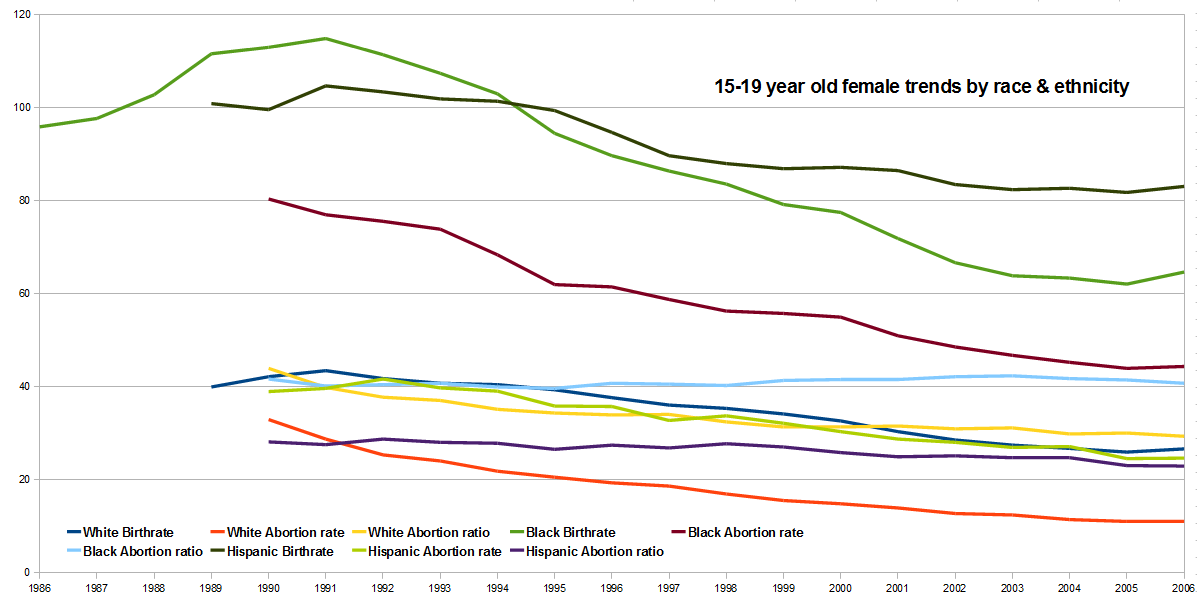
    Addendum: Abortion rates have been dropping since 1990.

  • Beavers Sign up to Fight Effects of Climate Change

    Once hunted for their pelts, beavers are back in demand, not for their bodies but for their minds—specifically, for their engineering skills. As changing climate leaves streams short on water in the summer, researchers are betting that the industrious rodents could provide a natural solution.

    Based on a survey of how dams store water, the Lands Council in Washington State predicts that reintroducing beavers to 10,000 miles of suitable habitat in the state could help retain more than 650 trillion gallons of spring runoff, which would slowly be released by the animals’ naturally leaky dams…

  • In a Warmer World, Iceland’s Volcanoes May Get Even Livelier | 80beats

    Eyjafjallajökull_glacier_inThe volcanic eruption in Iceland that has disrupted air traffic in Europe is also a reminder that other volcanoes in the region could wake up if global warming continues unabated, experts say.

    Scientists say that if large icecaps on the island melt, they’ll ease the pressure on the rocks beneath the surface. Lifting the weight off the rocks would allow for more magma production, which could set off other eruptions. Says volcanologist Freysteinn Sigmundsson: “Our work suggests that eventually there will be either somewhat larger eruptions or more frequent eruptions in Iceland in coming decades” [Scientific American].

    Scientists clarified that while the current Eyjafjallajokull eruption occurred beneath a small glacier in Iceland, the explosion was not caused by global warming. The Eyjafjallajokull glacier is too small and light to have an impact on local geology, they say.

    Sigmundsson and his colleague Carolina Pagli published research in 2008 estimating that the melting of about a tenth of Iceland’s biggest icecap, Vatnajokull, over the last century had caused the land to rise about an inch a year and led to the growth of a vast mass of magma, measuring about a third of a cubic mile, underground [The Telegraph]. The researchers explain that heated rocks can’t melt into magma when they’re under high pressure–for example, when they’re squashed underneath the weight of an icecap. But when the ice melts, the water trickles away, and the pressure eases off, the rocks can then melt into magma, creating prime conditions for volcanic eruptions. The researchers note that the end of the Ice Age 10,000 years ago was marked by an increase in volcanic activity in Iceland.

    They warn that if ice sheets shrink, we can expect to see more eruptions in other frozen places like Alaska, Patagonia, and Antarctica. Says Pagli: “The effects would be biggest with ice-capped volcanoes…. If you remove a load that is big enough you will also have an effect at depths on magma production” [Scientific American].

    Related Content:
    Visual Science: Up Close and Personal With Iceland’s Volcanic Eruption
    80beats:Icelandic Volcanoes–Disrupting Weather & History Since 1783
    80beats: Volcanic Eruption in Iceland Causes Floods, Shuts Down European Air Travel
    Bad Astronomy: Iceland Volcano Eruption Making an Ash of Itself
    DISCOVER: Disaster! The Most Destructive Volcanic Eruptions in History (photo gallery)

    Image: Wikimedia/Chris 73


  • Mike The Mad Biologist: ‘the gloves are coming off’ | The Intersection

    Last week I posted an invitation that arrived from the Heritage Foundation for an anti-science briefing that was about to take place directed at Capitol Hill staffers. My purpose was simple:
    I’ve reposted the text because I don’t think most scientists understand the way policy decisions are influenced. We may have a more scientific Washington than when I worked in DC, but science and its allies must fight harder than ever before. Some groups are already effective. Some of us are trying new initiatives. I’m optimistic and realize that change happens slowly, but I hope those working in policy-related areas will take note and become more involved making sure that sound science moves beyond the lab. Because when we’re not explaining what we do and why it matters, someone else is telling the story for us. And we often won’t like the result.
    An interesting dialog followed in comments and around the internet. It also seems to have struck a nerve with a Mike The Mad Biologist, although I’m not clear why. He accuses me of ‘blaming the scientists’ as ‘a professional science communicator.’ Thing is, I never signed up to be a ‘professional science communicator.’ Or at least no more so …


  • Movie & Music Trade Groups Suggest Orwellian Measures to Stop Piracy | Discoblog

    computers-networkOnline piracy has plagued the music and movie industry for years, with copyright infringement causing millions of dollars in loss each year. So when the U.S. Intellectual Property Enforcement Coordinator (the copyright czar) asked the entertainment industry to submit proposals to the government for ways to protect intellectual property, the industry came out all guns blazing.

    The Motion Picture Association of America (MPAA) and the Recording Industry Association of America (RIAA) came out with a set of proposals (pdf) that would combat piracy by invading the privacy of consumers and putting the federal government to work for the entertainment industry.

    For example, the trade groups suggest that spyware could be installed on home computers across the land. This special software would identify and block content that violates fair use, block certain keywords that might lead to sites with illegally obtained content, and monitor social networks for the promotion of infringing Web sites.

    The industry also wants border authorities to educate everyone entering the United States about piracy issues, suggesting that customs forms should be amended to require the disclosure of pirate or counterfeit items being brought into the United States. The Electronic Frontier Foundation reports:

    Does that iPod in your hand luggage contain copies of songs extracted from friends’ CDs? Is your computer storing movies ripped from DVD (handy for conserving battery life on long trips)? Was that book you bought overseas “licensed” for use in the United States? These are the kinds of questions the industry would like you to answer on your customs form when you cross borders or return home from abroad.

    In another proposal involving the federal government, the trade groups suggest that the U.S. Department of Justice and the Department of Homeland Security should form an inter-agency task force that would be poised to strike whenever a big blockbuster film is about to be released. The task force should “work with industry to coordinate and make advance plans to try to interdict these most damaging forms of copyright theft, and to react swiftly with enforcement actions where necessary,” the industry suggests.

    Many experts described these proposals as “draconian,” “totally insane,” and a dystopian vision of an “intellectual property police state.” Geekosystem writes:

    The joint proposal from the MPAA and RIAA is, as one might suspect, the sort of thing that wouldn’t seem amiss coming out of the mouth of a black clad man with one cataract-filled eye, who sits in a swivel chair at one end of a glossy conference table and strokes a white Persian cat. Once he finishes speaking, his henchmen drag you away from your computer, screaming.

    Of course, these are just proposals made by the industry and nowhere close to being actual law. But Geekosystem adds that the proposals are an informative look at what the MPAA and RIAA would like to get with, if they could.

    Related Content:
    80beats: Italian Court Convicts Google Execs for Hosting Illegal Video
    Discoblog: Sweet Blogger O’ Mine, You’re Under Arrest
    DISCOVER: The Intellectual Property Fight That Could Kill Millions

    Image: iStockphoto


  • “Green Nobel Prize” Winners Fought Shark Finning & Investigated Megafarms | 80beats

    earth-horizon-webCall it the green Nobels: Tonight in the San Francisco Opera House, six people will each receive a $150,000 Goldman Environmental Prize for their efforts to protect sharks and elephants, to promote sustainable agriculture, and to fight for other green causes.

    The awards go out by region. Here in North America, the winner was Michigan’s Lynn Henning, a self-described “redneck from Michigan” who investigated huge factory farms there. Henning, 52, began testing water herself to track discharges from the farms into local waters. She has been threatened and sued and had dead animals dumped on her porch. But her tireless detective work has contributed to the state closing one factory farm and fining others more than $400,000 for 1,077 violations since 2000 [Detroit Free Press]. As Michigan’s Department of Environmental Quality suffered staff cuts, Henning’s determination kept regulators focused, former department head Steve Chester says.

    South and Central America’s winner, Randall Arauz of Costa Rica, turned his attention to stopping the wasteful practice of shark finning. Arauz used a secretly recorded video to expose a ship illegally landing 30 tons of shark fins, which led to the death of an estimated 30,000 sharks. The video caused outrage in Costa Rica, which Arauz used to mobilize opposition [San Francisco Chronicle]. The Costa Rican government banned the practice, and its rules are now the model for those trying to work up international agreements against shark finning. (Worldwide restrictions were just shot down at the Convention on International Trade in Endangered Species.)

    The other winners:

    In Europe, Malgorzata Gorska of Poland, who stopped a highway project that would have cut through a forest.

    In Asia, Sereivathana Tuy of Cambodia, who taught farmers how to ward of wandering Asian elephants rather than kill them.

    In Africa, Thuli Brilliance Makama of Swaziland. This environmental lawyer won a fight for local residents to have more say in environmental decisions by the government, especially those regarding the expansions of game parks that would force people off the land.

    And for island nations, Cuban Humberto Rios Labrada, who pushed for more crop diversity and less pesticide use in Cuban agriculture.

    Related Content:
    DISCOVER: Man’s Greatest Crimes Against Earth, in Pictures
    80beats: Proposal to Regulate De-Finning of Sharks De-feated
    80beats: Endangered Species Meeting Brings Good News for Elephants, Bad News for Coral
    80beats: 9 Eco-Rules Humans Shouldn’t Break if We Want To Survive

    80beats: Winners of the “Environmental Nobel Prizes” Fought for a Cleaner Planet (2009)

    Image: NASA


  • Cape Coloureds: an instance of a generality | Gene Expression

    cape1Several months ago I put up a post which reviewed the geographical connections within the total genome content of the Cape Coloureds of South Africa. These peoples (plural because distinctive ethnic groups such as the Griqua were subsumed into this category in the 20th century) are of diverse origin, though generally their African and European ancestry has been highlighted. To the left I’ve reedited a plot which illustrates the inferred proportion of ancestry from various groups in modern Cape Coloured populations. Note that there is a substantial proportion of Asian ancestry, both South and East Asian. This makes historical sense as during the period of the founding of the Cape Colony a substantial number of Southeast and South Asian slaves were transferred from the Dutch East Indies, as well as from Madagascar, which itself has a Southeast Asian component in its population. Additionally, observe that the Bushmen & Khoikhoi element has been separated from the Bantu element. Archaeologists assume that the former are indigenous to South Africa, while the latter arrived within the last 2,000 years as the edge of the Bantu expansion which swept out of Nigeria east and south. These two populations are obviously both African, but their common ancestry is very deep. In some phylogenies Bushmen may be represented as the outgroup to all other human lineages, implying that one has to go very far back indeed for a common ancestor. In other words, the Bushmen are not the “oldest” human population, but have the oldest point of common ancestry with other human populations (e.g., the last common ancestor between a European and an East Asian may be ~30,000 years ago, but that between a Bushmen and a European may be ~80,000 years ago).

    But these studies do not tell us everything about the demographic history behind the ethnogenesis of the Cape Coloureds. In this case uniparental lineages, mtDNA which traces the matriline and and nonrecombinant Y chromosomes (NRY) which trace the patriline may offer some value. Unfortunately too often because of methodological considerations we have looked at the uniparental lineages first, and then the total genome content, which I think inverts the optimal order in terms of putting genetic findings in context. A new study focuses on the Cape Coloured mtDNA and NRY lineages, with the previous findings in mind, Strong maternal Khoisan contribution to the South African coloured population: a case of gender-biased admixture:

    The study of recently admixed populations provides unique tools for understanding recent population dynamics, socio-cultural factors associated with the founding of emerging populations, and the genetic basis of disease by means of admixture mapping. Historical records and recent autosomal data indicate that the South African Coloured population forms a unique highly admixed population, resulting from the encounter of different peoples from Africa, Europe, and Asia. However, little is known about the mode by which this admixed population was recently founded. Here we show, through detailed phylogeographic analyses of mitochondrial DNA and Y-chromosome variation in a large sample of South African Coloured individuals, that this population derives from at least five different parental populations (Khoisan, Bantus, Europeans, Indians, and Southeast Asians), who have differently contributed to the foundation of the South African Coloured. In addition, our analyses reveal extraordinarily unbalanced gender-specific contributions of the various population genetic components, the most striking being the massive maternal contribution of Khoisan peoples (more than 60%) and the almost negligible maternal contribution of Europeans with respect to their paternal counterparts. The overall picture of gender-biased admixture depicted in this study indicates that the modern South African Coloured population results mainly from the early encounter of European and African males with autochthonous Khoisan females of the Cape of Good Hope around 350 years ago.

    The main results are in figure 2 & 3. The top left panel shows the mtDNA variation on an MDS chart in relation to other populations, “SAC” = South African Coloureds. The bottom left panel shows NRY variation. And the right panel shows the estimated admixture for mtDNA and NRY by population.

    cape4

    The results are rather clear, excepting the difference between the MDS and admixture estimates which seem to place less weight on the Bantu component in the second than the former. The authors chalk this up to difficulties distinguishing the Khoisan from the “pan-African” component. Contemporary Khoisan show substantial overlap with Bantu groups (just as some Bantu groups in South Africa such as the Xhosa show a great deal of Khoisan ancestry), so there are some ambiguities in assigning a haplogroup to one population or the other (the overlap seems a product of recent admixture).

    But be as that may be, it is clear that a major dynamic in the founding of the Cape Coloureds had to be the pairing of Khoisan females with non-Khoisan males. The disjunction between European ancestry on the male and female lineages is stark, but should not be surprising in light of what we know from colonial history. And perhaps not just the colonial history of South Africa. The same pattern is evident in Latin America. Even societies which have transitioned from Mestizo to white, such as Argentina, seem to have done so through generations of male biased migration so that the indigenous mtDNA remains. And the same pattern can be found in some cases where we have no historical documentation because ethnogenesis occurred during the prehistorical period. In particular this seems the case in India, where male lineages show a strong West Eurasian bias, while female lineages do not (they are more closely related to East Eurasian lineages, though that connection is much more distant than Indian West Eurasia lineages have with other West Eurasian lineages).

    A little over 10 years ago L. L. Cavalli-Sforza was coauthor on a paper titled Genetic evidence for a higher female migration rate in humans. The logic behind the results are simple, most human societies are patrilocal, so one presumes that gene flow would be mediated by the movement of women between local groups. Cavalli-Sforza found that female lineages seemed to be less localized than male lineages, implying greater gene flow. The literature since then seems rather muddled, and has not confirmed this original finding in a solid manner. I suspect that this is because one general dynamic can not capture the varied events which have characterized human genetic history. That is, there were periodic “shocks” to the basic patterns of worldwide genetic variation, but after those shocks passed then the dynamics which Cavalli-Sforza saw would come to the fore. Exploring the details of the balance between these varied forces is going to be where the future avenues of research lay. I predict that it is going to be in regions and populations which have gone through great cultural ferment since the last Ice Age that you will see this palimpsest whereby variation emerged as a synthesis of shocks interleaved between long periods of stasis and more conventional deme-to-deme gene flow. By contrast, isolated hunter-gatherer populations such as the Andaman Islanders may have missed out on the shocks, the period of “genetic revolutions” (though as I imply above, most hunter-gatherer populations show a great deal of admixture with the far more numerous agricultures who marginalize them and push up against their range, as is in the case among the Bushmen).

    Finally, going back to South Africa one major issue is going to be the nature of the Afrikaners. Tentative earlier genetic and genealogical work suggests that ~5% of their ancestry is non-European, probably reflecting the movement of Cape Coloureds who could pass as white into the Afrikaner population (Cape Coloureds usually share language and religion with Afrikaners, so the cultural move would not have been insurmountable). Yet I have seen very few papers such as this, Deconstructing Jaco: genetic heritage of an Afrikaner. The author concludes that ~6% of his ancestry is from non-white slaves, in line with prior expectations. Though white Americans often take pride in their Native American ancestry (often genealogically attested, as with the descendants of Pocahontas) the total proportions are actually rather small, probably on the order of ~1% at most. In contrast the Afrikaners likely have more non-white ancestry because their founding population did not receive as much migration from Europe to dilute the original non-European element.

    Addendum: The Cape Coloureds seem a real interesting population in light of admixture mapping, no?

    Citation: Quintana-Murci, L., Harmant, C., Quach, H., Balanovsky, O., Zaporozhchenko, V., Bormans, C., van Helden, P., Hoal, E., & Behar, D. (2010). Strong Maternal Khoisan Contribution to the South African Coloured Population: A Case of Gender-Biased Admixture The American Journal of Human Genetics, 86 (4), 611-620 DOI: 10.1016/j.ajhg.2010.02.014

  • School Spying Case: School Accused of Taking Thousands of Webcam Photos | 80beats

    MacBook_Pro_17It’s been two months since we last heard from the court case engulfing Lower Merion School District in Pennsylvania, but the circumstances there keep getting stranger.
    Back in February, the family of sophomore Blake Robbins filed suit against the school, charging that administrators had remotely accessed the webcams on Apple laptops loaned out to students to take pictures of students in their homes. Now, after two months of investigation, the family’s lawyers have expanded the case by claiming the school actually took thousands of photos. Some of the images included pictures of youths at home, in bed or even “partially dressed,” according to a Thursday filing in the case [Wired.com].

    School board president David Ebby called the motion “a vehicle to attack the District,” but he also acknowledged “mistakes and misguided actions that have led us to this situation.” Ebby conceded that the school-issued laptops had taken a “substantial number of webcam photos,” and said it had proposed to Judge DuBois that families of students who appear in those photographs be notified and given the chance to view the images [Computer World]. To that end, DuBois on Wednesday ordered people involved in the case to stop any further dissemination of the photos or screen shots until the parents whose children had been photographed are notified. Ebby promised to begin the process shortly.

    In the Robbins’ newest motion, their attorney Mark Haltzman took aim in particular at Carol Cafiero, the school district’s technology coordinator, calling her a possible “voyeur” and asking for access to her personal computers to hunt for further evidence. To support the charge, he cited her response to an e-mail from a colleague who said viewing the webcam pictures was like watching “a little LMSD soap opera.” “I know, I love it!” Cafiero allegedly replied [PC World]. Cafiero’s representatives maintain that she turned on the remote access to student laptops only when ordered by school administrators. However, Haltzman says that Cafiero invoked the Fifth Amendment in response to every question in her deposition.

    The Lower Merion saga started when school administrators tried to discipline Blake Robbins on accusations of undisclosed bad behavior. That “behavior” turned out to be pill popping. The family said their son was eating Mike and Ike candy [Wired.com]. A few days later the school admitted to activating the webcams 42 times, but only in response to possibly lost or stolen computers. This new motion alleges that the school’s secret surveillance went far beyond that.

    Related Content:
    80beats: Lawsuit: Webcams in School-Issued Laptops Used to Spy on Students at Home
    80beats: School Spying Update: District Used Webcams 42 Times; FBI on the Case

    Image: Wikimedia Commons / Andrew Plumb


  • Announcing my Next Point of Inquiry Guest: Deb Blum, Author of The Poisoner’s Handbook | The Intersection

    In the next installment of Point of Inquiry, I’m going to be cutting back on the heavy science policy stuff for a moment, and instead exploring a recent, dramatic success in the realm of science popularization. That success is science writer Deb Blum’s marvelous The Poisoner’s Handbook: Murder and the Birth of Forensic Medicine in Jazz Age New York. There is no better way, I think, to get a chemistry lesson and not feel bored by it….and of course, Blum’s book has been selling like hotcakes thanks to the power of her narrative. You can get Blum’s book online here; and of course, as usual I will be taking questions for Blum both here on the blog and also at the Point of Inquiry forums. So send them in now…and we’ll get some of them on the air. The show records Wednesday, to air Friday, so questions received after Wednesday early am won’t be in the running….


  • Man describes finding a piece of the Wisconsin meteorite | Bad Astronomy

    A man who, along with his sons, found a piece of the meteorite from last week’s huge fireball describes it for the local news.

    Very cool, and his piece is really nice! Since it’s from a known fall, it’ll be worth something, too. I imagine there could be more than 100 kilos of rocks around, but they’ll be extremely difficult to find. I hope they can recover a lot of this one.

    Tip o’ the Whipple Shield to John Draeger.


  • Love By The Numbers [Science Tattoo] | The Loom

    heart curve440Josephine writes, “My mother was diagnosed with breast cancer on Valentine’s Day. Happy V-Day, right?? She, being the eternal matriarch of the family, called each child individually and told us the news. She is VERY upbeat and positive, and so we are, too. I am a mathematics major in college and when she told me the news, my sister and I both wanted tattoos in her honor. At first I wanted a blue whale, it being her favorite animal, but I went with a heart curve. In mathematics, as I’m sure you know, there are 6 heart curves. This is just one of them, and the least ‘busy.’ I am proud to display it on my right forearm for my mother through this trying time.”

    Click here to go to the full Science Tattoo Emporium.


  • Eyjafjallajokull! | Cosmic Variance

    Okay, I have tried, but pronouncing this one eludes me…I think it needs a new name. (Simply “Kull” might do.) This eruption, though not the largest volcanic event in recent history, has certainly had a huge impact on air travel. Initially, there were even fears of (I’ve always wanted to use this word in a sentence) pneumonoultramicroscopicsilicavolcanoconiosis from breathing the silica dust. But the last I heard was that not that much was making it to the ground in high enough concentrations to worry about.

    The New York Times has some amazing video, relayed from British TV 4, which is absolutely a must-see. It is some of the closest scenes yet, though the video clearly shows some crazies in a helicopter very close to the plume. I want to see night shots, with the lightning!

    Will they resume flights soon? I guess it’s too early to say, but what if it keeps spewing for a long time, like it did from 1821-1823? (After which nearby Katla went off.)

    Could it disrupt the climate? I am going to guess that this is a possibility, given that Mt. Pinatubo’s eruption in 1991 cooled the planet by a fraction of a degree.