Author: Discover Main Feed

  • Paireidolia | Bad Astronomy

    On Twitter today geographile linked to some pareidolia that I simply have to keep you abreast of. I won’t post the picture; instead I’ll just send you to the article and note that it is very mildly NSFW and NSF people with grown up sensibilities.

    But it made me smile.

    Oh– keep the comments clean, folks!


  • Tomorrow: A Day of Science in Boston | The Loom

    A reminder to Bostonites: I’ll be speaking tomorrow at 4 at the Museum of Science as part of an all-day bash put on by the Massachusetts Academy of Sciences. The weather outside is going to be frightful, or at least dreadful, so why not enjoy some indoor entertainment? More information and registration here.


  • Returning to the Internet Cave | The Loom

    I’ve been away visiting relatives who somehow survive without WiFi. So now I’ll be catching up with a series of quick posts over the course of the day.


  • Obama to Hospitals: Grant Visiting Rights to Gay Couples | 80beats

    Hospital emergencyLast night, President Obama issued a memo that will change hospital visitation rights around the country. The administration will draft new rules declaring that any hospital participating in the government’s Medicare and Medicaid programs—which is most of them—will no longer be allowed to bar visitors that patients desire to have access to them.

    This has been a particular hardship for gay Americans, who have been turned away from visiting sick loved ones because of policies that allow visiting rights solely to spouses or family members. They aren’t the only ones, either, Obama argues. He cited widows or widowers without children, members of religious orders as examples of people who have been unable to choose the people they want to be at their side [Reuters].

    The changes won’t take effect right away. The Department of Health and Human Services must draft the new rules, then put them in place and police them. But in addition to expanding visitation rights, the order also requires that documents granting power of attorney and healthcare proxies be honored, regardless of sexual orientation. The language could apply to unmarried heterosexual couples too [Los Angeles Times]. You can read Obama’s memo here.

    The President was particularly inspired by the case of a Florida couple, Janice Langbehn and Lisa Pond. When Pond suffered an aneurysm, Langbehn was denied visiting access at the hospital, despite the fact that she carried power-of-attorney and the couple had adopted four children. Pond died before Langbehn was allowed access. On Thursday night, Mr. Obama called her from Air Force One to say that he had been moved by her case. “I was so humbled that he would know Lisa’s name and know our story,” Ms. Langbehn said in a telephone interview. “He apologized for how we were treated. For the last three years, that’s what I’ve been asking the hospital to do” [The New York Times].

    Related Content:
    80beats: Health-Care Reform Passed. So What Does It Mean?
    80beats: Should You Avoid Hospitals in August, When the Rookie Docs Arrive?
    80beats: Familial Rejection of Gay Teens Can Lead to Mental Health Problems Later
    Discoblog: In Hospitals, If Your Disease Doesn’t Kill You, a Cell Phone Might

    Image: iStockphoto


  • Space: The Big Picture | Bad Astronomy

    Magnificent: The Big Picture has a series of incredible pictures from the latest Soyuz and Shuttle missions to the International Space Station.

    They are all amazing, but I think I like this one the best:

    astro_soichi_cupola

    I know, it’s not what you’d think I’d pick, is it? But it shows astronaut Soichi Noguchi in the station’s cupola, taking one of his astonishing photographs that he posts on Twitter. Looking at this picture of him, and thinking of his incredible photos, really brings home the fact that humans are in space right now, circling the Earth over your head.


  • ResearchBlogCast on iTunes | Gene Expression

    resblogResearchBlogCast is now on iTunes. You can search for it under “ResearchBlogCast” in the iTunes store and subscribe, or, just subscribe via this web page. We’re talking about the DASH diet next. Feel free to suggest ideas if you have anything clever, or want to hear our opinions on a specific topic. Just not something weird like Calvinist soteriology where there’s no chance that any of us are going to be able to follow the lingo.

  • Science only feed | Gene Expression

    I decided to create “science only” feed. Specifically, a feed which has only the posts which directly and primarily address natural science topics (obviously mostly genetics). I just added the category “Science” to all the posts which I thought were appropriate. Note that I exclude topics such as Creationism, or surveys of scientists, from this category, as well as my link roundups which mix science and non-science. It’s more like stuff I’d put into Research Blogging, though not always. Anyway, here’s the address:

    http://feeds.feedburner.com/GeneExpressionScience

    Also, if you don’t like RSS, this is the category address:

    http://blogs.discovermagazine.com/gnxp/category/science/

  • NCBI ROFL: Gee, I wonder why guys don’t like lipstick? | Discoblog

    2869514792_1714f29d83

    Do cosmetics enhance female Caucasian facial attractiveness?

    “This study sought to investigate whether cosmetics do improve female facial attractiveness, and to determine whether the contribution of different cosmetic products are separable, or whether they function synergistically to enhance female beauty. Ten volunteers were made up by a beautician under five cosmetics conditions: (i) no make-up; (ii) foundation only; (iii) eye make-up only; (iv) lip make-up only; and (v) full facial make-up. Male and female participants were asked to view the 10 sets of five photographs, and rank each set from most attractive to least attractive. As predicted, faces with full make-up were judged more attractive than the same faces with no make-up. Sex differences within the results were also apparent. Women judged eye make-up as contributing most to the attractiveness. Men rated eye make-up and foundation as having a significant impact on the attractiveness of a full facial makeover. Surprisingly, lipstick did not appear to contribute to attractiveness independently.”

    make_up

    Image: flickr/cliff1066™

    Related content:
    Discoblog: NCBI ROFL: Beer goggles proven to exist; “beer before liquor, get sick quicker” hypothesis remains untested.
    Discoblog: NCBI ROFL: Eye Tracking of Men’s Preferences for Female Breast Size and Areola Pigmentation.
    Discoblog: NCBI ROFL: Uh, no. Aunt Flo means no ho, bro!


  • Obama’s Space Speech: We’ll Go to Mars in This Lifetime | 80beats

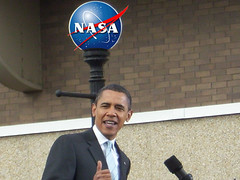
    444867main_201004150004HQ_fAmericans will go to asteroids, to Mars, and maybe beyond–and all in this lifetime, stated President Obama at Cape Canaveral this afternoon as he reassured Americans that space exploration will continue. Speaking at the Kennedy Space Center, where America launched its moon mission decades ago, Obama said he was “100 percent committed to the mission of NASA and its future.”

    Obama’s proposed space policy (pdf) would increase NASA’s budget by $6 billion over the next 5 years, which he says will create 2,500 additional jobs at the Kennedy Space Center by 2012. Acknowledging criticism for some of his changes to NASA’s missions, Obama stated that the country must “leap into the future” and not “continue on the same path as before,” saying: “The bottom line is: Nobody is more committed to manned space flight, the human exploration of space, than I am. But we’ve got to do it in a smart way; we can’t keep doing the same old things as before” [The New York Times].

    In his speech, the President declared that by 2025 the nation would have a new spacecraft designed to carry humans “beyond the moon into deep space.” He added that by the mid-2030’s America would also be able to send humans to orbit Mars and return them safely to Earth, adding “a landing on Mars will soon follow.” President Obama stated: “Space exploration is not a luxury, not an afterthought in America’s brighter future…. It is an essential part of that quest” [The New York Times].

    For more details on Obama’s new space policy and what it means for NASA and the future of space exploration, head over to Bad Astronomy for Phil Plait’s post, “Obama lays out bold and visionary revised space policy.”

    Related Content:
    Bad Astronomy: Obama lays out bold and visionary revised space policy
    80beats: Neil Armstrong Slams Obama’s Space Plan; President Will Defend It Tomorrow
    80beats: Obama’s NASA Plan Draws Furious Fire; The Prez Promises To Defend His Vision
    80beats: Obama’s NASA Budget: So Long, Moon Missions; Hello, Private Spaceflight
    Bad Astronomy: Neil Tyson Sounds Off on NASA

    Image: NASA/Bill Ingalls


  • Meta News: Coverage of the ClimateGate Inquiry Reveals Partisan Passions | Discoblog

    computer-code-2A second independent inquiry in Britain has cleared climate scientists at the University of East Anglia of any wrongdoing. In the ClimateGate scandal last year, thousands of emails from the university’s Climatic Research Unit were hacked into and released, after which climate change skeptics mined the emails for evidence that the researchers were distorting scientific evidence related to global warming.

    The independent inquiry into “ClimateGate,” however, found such allegations to be baseless. But it seems not everyone was convinced.

    Here’s a roundup of headlines from some news outlets that covered the inquiries findings: Can you spot the newsroom with an ax to grind?

    The New York Times: Britain: Inquiry Finds No Distortion of Climate Data

    LA Times: Panel clears researchers in ‘Climategate‘ controversy

    Huffington Post: Second expert panel shows “ClimateGate” was a ClimateSham

    The Wall Street Journal: Panel Says Scientists Didn’t Act Improperly

    Fox News: Top Climate Scientist Under Fire for ‘Exaggerating’

    Image: iStockphoto


  • Obama lays out bold and visionary revised space policy | Bad Astronomy

    President Obama gave a speech at NASA’s Kennedy Space Center today to outline his new, revamped space policy.

    You may remember that his last revamping caused quite a stir, with people screaming that it would doom NASA. I disagree. Canceling Constellation still strikes me as the right thing to do, because it was becoming an albatross around NASA’s neck. Mind you, this was also the recommendation of the blue ribbon Augustine panel. You may also note that NASA astronauts are split over all this, with Buzz Aldrin, for example, supporting Obama, and Neil Armstrong and many others disagreeing.

    It’s a mess, and hard to disentangle what everyone’s saying. There’s been a huge amount of misinformation about it (with — shocking — Fox news leading the way; they spout so much disingenuousness, nonsense, self-contradiction, and outright stupidity that it makes me want to fly to their studios just to slap them). But Obama’s plan seems pretty clear.


    The New Space Policy Plan

    1) As before, NASA’s budget will be increased in the new plan. Let me repeat that: NASA’s overall budget will go up. And not just a little; we’re talking $6 billion over the next five years. A lot of that goes into scientific research. So far from it being doom and gloom, that’s good news.

    2) A new heavy-lift rocket will be developed. Let me repeat that as well: funding is provided for NASA to create a new heavy-lift vehicle. So yes, Constellation will be canceled, but a new system will be developed that (hopefully) will be within budget and time constraints.

    nasa_orion3) The Orion capsule, based on Apollo capsule legacy, will still be built. Initially it will be for space station operations as an escape module, but can be adapted later for crewed space missions.

    4) He wants NASA to plan manned missions to near-Earth asteroids in the 2020s, and to Mars in 2030s, but no return to the Moon.

    OK, so what do I think of all this?


    My opinion on the new space policy

    1) The increase in NASA’s budget is most welcome. Some of this goes to climate change studies (which the denialists will rant and scream about, but too bad). Some goes to science, some to education. All in all, given NASA’s minuscule budget, any increase rocks. And a lot of this goes into space science.


    2) This new rocket proposal makes me very happy. As I have stated repeatedly, NASA keeps going from one project to another without a clear goal or a streamlined system of attaining it. The Shuttle, as amazing as it is, was a terrible project once it was realized — hugely over budget, hobbled massively from what it should have been able to do, and unable to provide cheap and easy access to space with a fast turnaround. Ditto for the Space Station; it became a political pork barrel project and instead of a sleek engineering wonder it became another bloated project with no clear goal.

    Some people are complaining that we’ve already sunk $10 billion into Constellation, and we shouldn’t throw that money away. I think that’s a red herring. If Constellation was a waste of money, then we need to staunch that flow. I’m not saying it was, but I’m pointing out that you need to show me that the system was not a waste of money first before complaining that we can’t cancel it after spending that much.

    As Elon Musk, head of Space X, said in a press release:

    The President quite reasonably concluded that spending $50 billion to develop a vehicle that would cost 50% more to operate, but carry 50% less payload was perhaps not the best possible use of funds. To quote a member of the Augustine Commission, which was convened by the President to analyze Ares/Orion, “If Santa Claus brought us the system tomorrow, fully developed, and the budget didn’t change, our next action would have to be to cancel it,” because we can’t afford the annual operating costs.

    Mind you as well that this money already spent won’t be wasted. It’s not like we have a lot of rockets sitting around gathering dust. That money was spent on developing technology, knowledge, and experience that will go into any new system created.

    I’ll note that the cancellation of Constellation means a loss of many jobs. This new plan should restore a lot of them. I’d be interested in seeing a balance sheet for that.

    Another complaint with little or no merit (coming from a lot of folks, including the insipid talking heads on that Fox link above) is that once the Shuttle is over, we need to borrow a lift from the Russians to get to space. As much as I’d like to see us with our own, independent, and healthy space program, I don’t see riding with the Russians as entirely a bad thing. It’s cheaper than the Shuttle, by a large amount. The bad political decisions involving NASA for the past forty years have put us in this predicament, not anything Obama has done over the past 15 months.

    And I’ll remind you that this predicament really started rolling when the Bush Administration and NASA decided to stop the Shuttle program with no replacement possible for at least four to five years after the last Shuttle flight. Even if Obama had done nothing; we’d still need the Russians’ help to get into space.

    And it’s only temporary. Under Obama’s plan we’ll have a new rocket system around the same time Constellation would’ve gotten going anyway.

    As far as relying on private space, I have been clear about that: NASA should not be doing the routine, like going to low Earth orbit. Let private companies do that now that the technology has become attainable by them. NASA needs to innovate. And I’ll note that NASA has relied on private space venture — Boeing, Lockheed, and many others — for decades. This is hardly new.


    3) As an adjunct to everything I just wrote above, the Orion legacy capsule project will continue, underscoring my point. We’re taking the knowledge gained over the past few years and applying it to new technology. I rather like Orion, and I’m glad it’s not going away.


    4) Well, here’s where I think the new policy falls short. I strongly support missions to near-Earth asteroids. These rocks are areal threat to life on Earth, and the more we know about them the better. Getting to them via rocket is actually easier in many ways than getting to the Moon, so these kinds of missions are cost-effective, and we can learn vast amounts from them. And we would also gain critical experience in visiting asteroids that could come in handy if one has our name on it.

    I’m not as gung-ho on getting to Mars because I think the engineering and knowledge needed to put humans on such a long trip is not where it needs to be yet. So how do we get that knowledge? By going back to the Moon.

    Obama specifically downplayed a return to the Moon, and it seems he said that we won’t be doing that. I think that’s a huge mistake. Yes, we’ve been there before, but that was a totally different set of missions. That was a race to win, not to stay. A lot of science was planned and obtained for the Apollo missions, but it wasn’t sustainable. Stopping now — especially with a heavy-lift vehicle on the horizon — is a tremendous waste of an opportunity.

    Going to Mars depends critically on knowledge learned on going back to the Moon and staying there. So on this point I disagree with Obama’s new plan.


    Conclusion

    Obama has clearly been listening to both supporters and critics (imagine that!). It almost sounds like he’s been reading my blog (I wish). Bill Nelson, a Democratic Senator from Florida, was vocally opposed to Obama’s initial plan, but accompanied him to this speech. That indicates to me that they have been talking — certainly about the politics, but also about the nuts and bolts — about all this. Obama’s change in plans to continue Orion and more concrete plans for a heavy-lift vehicle clearly come from listening to his critics.

    Certainly, this revamped policy the right political move for him; Congresscritters from NASA centers were pretty unhappy about that first policy of privatization. But it’s also the right thing to do.

    Obama, in this speech, stated specifically he wants us to be the dominant world power in space. He says that under this new plan, we will actually be sending more astronauts into space in the next decade than we otherwise would have. If his plans are accepted by Congress, if they are funded at the levels requested, and if NASA can implement them, then I think the President is correct.

    My overarching desire: that NASA have a clear goal, an actual set of specific, visionary destinations that will inspire the public and make us proud of our space program once again. Part of that desire is for this to have political support and funding to make it possible. Too often, NASA has been told to go do something but not given the money to do it, and that’s a major factor that we’re where we are right now.

    Obama’s new policy, with one exception, will give NASA what it needs to be visionary again. That one exception — not returning to the Moon — is a strong one for me, and I will see what I can do to get it put back in. I’m just one guy, but I’ll talk to folks and see what trouble I can stir up.

    In the meantime, I’ll also caution that at this moment, these are just words from the President. Good words, and hopeful ones, but just words. It will take deeds to see this through: a clear plan by the White House, cooperation from Congress, and a commitment from NASA to see this policy through.

    If those things can happen, then for NASA, for America, and for humanity, then the sky is no longer the limit.

    Per ardua, ad astra.


  • ClimateGate Inquiry: No Scientific Misconduct From “Squeaky Clean” Researchers | 80beats

    Planet earthMonths after the hack heard ’round the world, the independent review is finished. A panel of 11 led by the University of Oxford’s Lord Oxburgh investigated the Climatic Research Unit at the University of East Anglia, whose researchers were accused of manipulating data based on information gleaned from thousands of stolen emails. The panel’s conclusion: The scientists did not intentionally distort the truth, though their statistical rigor leaves something to be desired.

    “We saw no evidence of any deliberate scientific malpractice in any of the work of the Climatic Research Unit and had it been there we believe that it is likely that we would have detected it,” says the Oxburgh report. “Rather we found a small group of dedicated if slightly disorganised researchers who were ill-prepared for being the focus of public attention” [Nature]. This conclusion came after interviewing people within the organization and combing through the data in 11 of the center’s peer-reviewed papers published over the span of 22 years.

    Oxburgh found the researchers “squeaky clean” in terms of their intentions—and that’s what this was, an investigation of the scientist’s integrity, not their results. But, the panel found their methods to be somewhat lacking. Specifically, the report says, “We cannot help remarking that it is very surprising that research in an area that depends so heavily on statistical methods has not been carried out in close collaboration with professional statisticians.” The university issued its own statement after the Oxburgh report’s release, including this response to the charge that they didn’t use the best statistical methods available:

    Specialists in many areas of research acquire and develop the statistical skills pertinent to their own particular data analysis requirements. However, we do see the sense in engaging more fully with the wider statistics community to ensure that the most effective and up-to-date statistical techniques are adopted and will now consider further how best to achieve this.

    Another area for suggested improvement is in the archiving of data and algorithms, and in recording exactly what was done. Although no-one predicted the import of this pioneering research when it started in the mid-1980’s, it is now clear that more effort needs to be put into this activity.

    However, some of the panelists noted, even adjusting for newer statistical models didn’t alter the conclusions. David Hand, who is the president of Britain’s Royal Statistical Society and sat on the Oxburgh panel, dug into the infamous “hockey stick” chart of global temperatures by Penn State’s Michael Mann during his investigations. Hand agrees with Mann: he too says that the hockey stick – showing an above-average rise in temperatures during the 20th century – is there. The upward incline is just shorter than Mann’s original graphic suggests. “More like a field-hockey stick than an ice-hockey stick” [New Scientist], he says.

    Related Content:
    DISCOVER: It’s Getting Hot In Here, our interview with climate rivals Michael Mann and Judith Curry
    80beats: Climatologist Steps Down As “ClimateGate” Furor Continues
    Cosmic Variance: ClimateGate, Sean Carroll on the controversy
    Bad Astronomy: The Global Warming E-mails Non-Event

    Image: iStockphoto


  • Ice Fishing For Neutrinos From the Middle of the Galaxy

    For more than two dec­ades now, Russian and German physicists have camped on the frozen surface of Lake Baikal from February to April, installing and maintaining instruments to search for the elusive subatomic particles called neutrinos. Artificial eyes deep below the surface of the lake look for dim flashes of blue light caused by a rare collision between a neutrino and a molecule of water. I was told that human eyes would be able to see these flashes too—if our eyes were the size of watermelons. Indeed, each artificial eye is more than a foot in diameter, and the Baikal neutrino telescope, the first instrument of its kind in the world, has 228 eyes patiently watching for these messengers from outer space.

    The telescope, which is located a few miles offshore, operates underwater all year round. Cables run from it to a shore station where data are collected and analyzed. It is a project on a shoestring budget. Without the luxury of expensive ships and remote-controlled submersibles, scientists wait for the winter ice to provide a stable platform for their cranes and winches. Each year they set up an ice camp, haul the telescope up from a depth of 0.7 mile, carry out routine maintenance, and lower it back into the water. And each year they race against time to complete their work before the sprigs of spring begin to brush away the Siberian winter and the lake’s frozen surface starts to crack.

    What is it about the neutrino that makes scientists brave such conditions? Neutrinos—some of them dating back to right after the Big Bang—go through matter, traveling unscathed from the time they are created and carrying information in a way no other particle can. The universe is opaque to ultraenergetic photons, or gamma rays, which are absorbed by the matter and radiation that lie between their source and Earth. But neutrinos, produced by the same astrophysical processes that generate high-energy photons, barely interact with anything along the way. For instance, neutrinos stream out from the center of the sun as soon as they are produced, whereas a photon needs thousands of years to work its way out from the core to the sun’s brilliant surface.

    Neutrinos therefore represent a unique window into an otherwise invisible universe, even offering clues about the missing mass called dark matter, whose presence can be inferred only by its gravitational influence on stars and galaxies. Theory suggests that over time the gravity wells created by Earth, the sun, and the Milky Way would have sucked in an enormous number of dark-matter particles. Wherever they gather in great concentrations, these particles should collide with one another, spewing out (among other things) neutrinos. It is as if a giant particle accelerator at our galaxy’s center were smashing dark-matter particles together, generating neutrinos and beaming them outward, some toward us…

  • Will the Pentagon Build the Jetsons’ Flying Car? | 80beats

    jetsonsDARPA, the Pentagon’s mad-scientist research agency, has unveiled new ambitious plans for a flying car called the Transformer (TX). DARPA has already started soliciting proposals from companies to develop a TX prototype and have it ready for testing by 2015.

    The military’s plan for a flying car goes several steps beyond previous commercial designs like the Terrafugia Transition. That “roadable aircraft” was designed by a startup company as a lightweight plane that would fold up its wings on landing, and then zoom off on the roads. But DARPA’s proposed vehicle could overcome flaws that have hampered the Terrafugia–including its inability to navigate through bad weather. The agency wants to create a sturdier vehicle that would not just take off and land vertically, but could also carry four people and zip across 250 miles on a single tank of gas.

    In its proposal, DARPA states the TX should be both a robust ground and air vehicle, enabling soldiers to avoid water, difficult terrain, and road obstructions–to say nothing of IEDs and ambush threats. It should be no bigger than 30 feet long by 8.5′ wide and 9′ high in ground configuration — on the order of two Hummers nose-to-tail — and should have wheels and suspension giving “road performance similar to an SUV” and “capable of handling light off-road travel” [The Register].

    The vehicle’s capacity for vertical takeoff and landing would mean that it won’t need to taxi down a runway. DARPA wants the vehicle to be large enough to carry “four fully suited” soldiers, or a medic and a stretcher, which suggests that the vehicles could serve as flying ambulances. The agency expects the TX to attain an altitude of 10,000 feet and to cover 250 miles on a single tank of gas. That means less Humvee, more Prius: The agency suggests that proposals would be wise to include ideas like “hybrid electric drive, advanced batteries, adaptive wing structures, ducted-fan propulsion systems [and] advanced lightweight heavy fuel engines” [Wired.com]. However, despite all the sophisticated machinery, DARPA wants to keep flying/driving the vehicle pretty simple, saying that any soldier who can drive a Humvee should be able to fly a TX with its “automated takeoff and landing” options.

    In one of its mission plans, DARPA suggests that a TX could lift off from a base in Afghanistan, fly 60 miles to skip over the IEDs and landmines littering the roadsides, and then set down to conduct a 100-mile patrol on the ground. Another mission plan calls for the vehicle lifting off from an aircraft carrier, flying to shore, and then driving the rest of the way to its destination. DARPA’s guidelines require that the TX be no louder than a helicopter in flight mode and as quiet as a conventional automobile in car mode, suggesting that soldiers wishing to avoid unwanted attention could bring the TX down to the ground to drive to covert ops spots.

    While the flying car is still confined to the realm of a DARPA dream, technophiles raised on The Jetsons can’t resist pointing out that the TX would be awesome for civilian use, too. It would genuinely be able to lift off and set down in rooftops and streets, and quiet enough to do so without violating noise ordinances. It would be able to drive properly on the ground. Its robotic autopilot would remove the need for expensive, perishable piloting and instrument-rating skills which is such a burden for today’s private pilots [The Register].

    Related Content:
    80beats: A Chitty Chitty Bang Bang For Everyone! New Flying Car Takes to the Sky
    80beats: Meet the “Puffin,” NASA’s One-Man Electric Plane
    80beats: DARPA Wants a Biofuel Jet, While Germany Works on a Hydrogen Plane
    Discoblog: Back to The Future: The First Green Flying Car Is Ready For Takeoff
    DISCOVER: 6 Blue-Sky Ideas for Revolutionizing the Automobile (photo gallery)


  • Iceland volcano eruption making an ash of itself | Bad Astronomy

    The Icelandic volcano Eyjafjallajökull has erupted for the second time this month, sending a long plume of ash across the north Atlantic into the UK, enough to disrupt air traffic there!

    NASA’s Terra satellite caught the plume:

    terra_iceland_volcano

    You can easily see the plume extending from Iceland across the ocean. Boston.com’s The Big Picture has dramatic and beautiful shots of the volcano as well.

    I’ve seen a few volcanoes in my time, but I’ve never witnessed an actual eruption. I’d really like to… from a safe distance. This particular eruption is likely to be a big pain to a lot of people for quite some time; there have already been floods and evacuations due to the activity. I feel badly for those folks affected, but I also can’t help but gasp in awe at the beauty of events like these. It always amazes me that violence on such a large scale — volcanoes, solar flares, supernovae, galactic collisions — can also be so beautiful.


  • When multi-tasking, each half of the brain focuses on different goals | Not Exactly Rocket Science

    MultitaskingIn the digital age, many of us are compulsive multi-taskers. As I type this, I’m listening to some gentle music and my laptop has several programs open including Adobe Reader, Word, Firefox and Tweetdeck. I’ve always wondered what goes on in my brain as I flit between these multiple tasks, and I now have some answers thanks to a new study by Parisian scientists Sylvain Charron and Etienne Koechlin.

    They have found that the part of our brain that controls out motivation to pursue our goals can divide its attention between two tasks. The left half devotes itself to one task and the right half to the other. This division of labour allows us to multi-task, but it also puts an upper limit on our abilities.

    Koechlin has previously suggested that the frontopolar cortex, an area at the very front of our brains, drives our ability to do more than one thing at a time. It allows us to simultaneously pursue two different goals, holding one in the ready while we work on the other. Just behind the frontopolar cortex lies the medial frontal cortex (MFC), an area that’s involved in motivation. It drives our pursuit of multiple goals, according to the rewards we expect from them. Koechlin wanted to understand how these two areas cope with multi-tasking.

    To do that, he used a brain-scanning technique called functional magnetic resonance imaging (fMRI) to study the brain activity of 32 volunteers, as they carried out a challenging task. They saw a steady stream of letters, all from the word “tablet”. For every block of three letters, they had to say if the first one was a “t” and if the other two appeared in the same order that they would in “tablet” (e.g. TAB rather than TEB). If the letters were red, they would get a sizeable cash reward but if they were green, the reward would be smaller.

    Based on this same set-up, they had to cope with two slightly different tests. In the “branching” tests, they had to deal with two separate streams of triplets, a primary one indicated by normal letters and a secondary one indicated by italics. The primary stream was continuous and the volunteers had to revert back to it every time they finished a secondary triplet. They had to hold the primary stream in mind so that they could return to it after their interruption. In the simpler “switching” tests, they started afresh with every new triplet, so they only had to cope with a single stream of information.

    Multitasking-experimentCharron and Koechlin found that in the switching tests, when the volunteers were only faced with a single task, both halves of their MFC were active, particularly the dorsal anterior cingulated cortex (dACC) and the presupplementary motor area (PMA). The more money was at stake, the stronger the activity in these regions.

    In the branching tests, both halves of the MFC were also active, but they were split between the two tasks. The right dACC took control of the secondary task; when the volunteers could earn more money from these triplets, only the right dACC became more active. The left half took control of the primary task; its activity matched the rewards associated with the primary triplets but not the secondary ones.

    The frontopolar part of the brain also became active during the branching tests, which fits with its established role in multi-tasking. However, its attentions weren’t divided by the two tasks and it only became more active when both the primary and secondary rewards were higher. This suggests that the frontopolar cortex plays the role of coordinator. While each half of the MFC encodes the incentives of pursuing each separate goal, the frontopolar cortex encodes the incentives of pursuing both goals together.

    It also suggests that we might not be able to cope with more than two tasks at the same time. Charron and Koechlin tested this with an even more fiendish “double branching” test, where the two streams of triplets in their original experiment were interrupted by a third stream. To succeed in this task, they had to retain three separate lanes of information at the same time. They couldn’t. When they tried to return to the first stream from the second, or the second from the third, their answers were no better than guesswork.

    Despite what some psychologists have suggested, it seems that the human brain is capable of multi-tasking although to a far lesser extent than a computer can. While my laptop is running several different programs at once with nary a hint of discomfort, Charron and Koechkin’s work suggests that my brain can’t handle any more than two tasks at once.

    Reference: Science http://dx.doi.org/10.1126/science.1183614

    More on multi-tasking: Information overload? Heavy multimedia users are more easily distracted by irrelevant information

    Twitter.jpg Facebook.jpg Feed.jpg Book.jpg

  • Census Day Looms | Cosmic Variance

    Groups of people with whom I disagree (so many, many groups…) should not hand in their census forms. That way they will be under-represented in official figures and basically count less. And do you really want to be in the government’s database when the black helicopters come?

    4522932177_7afa4a7170_o

    Just kidding. Only two days left, hand in your census forms! Even people I don’t like.


  • The Picasso of DNA

    dna illustration

    This is a preview of this article. Full text of features from DISCOVER magazine are available only to subscribers.

    Here is how to get an appointment with George M. Church, professor of genetics at Harvard Medical School, director of four organizations devoted to genomics, cofounder of four biotech firms within the past four years, scientific adviser to 17 ultralow-cost genome sequencing companies, and founder of the Personal Genome Project:

    First, you send him an e-mail requesting a meeting. He will reply with the URL for a Web site that lists his current schedule. This, when printed out, proves to be a 10-page, single-spaced document in very small type that starts with “January 1, 2009: Holiday, New Year’s Day” and ends with “September 17, 2010: International Steven Hoogendijk Award 2010 for G. Church, Rotterdam, Netherlands.” Searching through hundreds of entries—as many as nine falling on a single day—you try to find an uncommitted hour. If successful, you contact either of Church’s two administrative assistants to propose a date, time, and place. Then you hope for the best.

    When the magical day arrives, the first question I ask Church is how he can possibly direct, create, advise, and mastermind so many projects (as well as teach classes and supervise Ph.D. dissertations) without going crazy. “Well, I think it’s an assumption that I’m not crazy,” he says. “They all seem pretty much the same to me. They’re all integrated, and I guess what we try to do is—we try to do integration.”

    If Church’s career has a single integrating theme, it is finding ways to apply the machinery of automation to the molecular basis of life, the genome. His infatuation with computers goes back to grammar school in Clearwater, Florida, when, at age 9, he built an electronic computer for a science fair. Genetics entered the picture in the spring of 1974. Then an undergraduate at Duke, Church typed into a computer all the transfer RNA sequences that were available at the time and folded each one into a three-dimensional structure, as RNA molecules were known to do. “I became obsessed with sequencing,” he says. The obsession never faded. Today his myriad projects all emerge from his impulse to know, unravel, depict, use, and—better yet—tinker with and even create the RNA and DNA codes that constitute the software of living systems.

  • BREAKING: BCA drops libel case against Simon Singh! | Bad Astronomy

    london_fireworksGreat news: the BCA has dropped its ill-conceived lawsuit against journalist and skeptic Simon Singh!

    WooHOO! My huge and hearty CONGRATS to Simon!

    The British Chiropractic Association, an umbrella organization for chiropractors in Britain, had sued Simon for libel because he had written in a newspaper article that they “happily promote bogus remedies”.

    They said this was defamatory, and that Singh meant they knew that they were lying about the remedies. If you read what Simon wrote that’s clearly not true; he was obviously saying that they were happy to promote remedies that happened to be bogus, not that they necessarily knew what they were promoting was bogus. What Simon certainly was saying is that a lot of the so-called “remedies” chiropractors claim to work simply don’t, and have no evidence at all to support them. But he never said the BCA was knowingly lying to the public to promote quackery.

    Simon SinghThey sued anyway, in what was a very clear attempt to silence critics. They didn’t try to defend their practices, or show how what they claim really does have medicinal value. Instead, they sued someone to shut him up and create a chilling effect in journalism.

    That, as it now turns out, was a bogus remedy for the problem.

    Like many alt-med placebos, it did seem to work for a while. In an initial hearing, a judge ruled that the BCA had a case, agreeing with the BCA that Simon’s words could be interpreted as them knowing they were quacks. This set the skeptic community in an uproar, and we made quite a stink about it. A group in the UK called Sense About Science set up an effort for libel reform to help support Simon and to get the word out about the atrocious and draconian libel laws in the UK.

    As the case became more public, the BCA reacted. Eventually, they did make a lame attempt to defend their practices, but that was soundly torn to shreds by real doctors and skeptics. It read an awful lot like the kind of garbage astrologers, antivaxxers, homeopaths, and other nonsense-peddlers try to push on people when trying to defend their evidence-free claims.

    Then things got worse when chiropractors all over Britain started panicking about the way they advertise. Again, instead of actually doing something useful, or defending their practice, an association of chiropractors warned practitioners to take down their websites. Isn’t that odd? Instead of fixing any mistakes, they were told to stop advertising by their own umbrella group. Hmmm.

    Finally, last week, a wise judge ruled that Simon actually did have a defense, and could argue that his words were an opinion, and not a statement of fact as narrowly defined by the previous judge. That meant that not only could the case continue, but that Simon could mount an actual and strong defense.

    We skeptics held our breaths, but we were pretty sure what would happen next, and we were right: the BCA caved. Folded. Bent. Dislocated, you might say.

    They dropped the case, and it’s over.

    Well, kinda. Actually, there are a lot of unresolved things here. One is that Simon is out over £100,000 of his own money. Had this gone to court and he won, the BCA would have had to pay his expenses. That’s a pretty strong incentive on their part to have dropped the case, not-so-incidentally. I’ll note that fellow skeptic Ben Goldacre says Simon may go after the BCA for costs, something I would dearly love to see.

    Second, the libel laws in the UK are still truly awful. I hope that the libel reform groups there keep the pressure on the government to look over those laws and drag them from the 17th into the 21st century. Don’t forget to show your support (even if you’re not from the UK)!

    And third, I wonder how this will affect the BCA. Will they be more careful? Will they review their practices, going over them carefully to see which ones are backed by scientific reviews and testing, and which ones may be nothing more than thinly-veiled nonsense that not only do not help but can in fact harm or even kill patients?

    Right. Given that after this long, humiliating episode they still have the gall to claim they were even partially vindicated should tell you just how far removed from reality they are.

    Given the craven nature of this entire episode by the BCA, and how it exposed them for who they are, and how it put chiropractors who promote bogus treatments on the defense all over England, and how it raised so much awareness about all this, I think Nelson sums things up best.

    And as a final note… we have won here, and won big. Have no doubts this was a huge victory for science, for skepticism, and for free speech. But the purveyors of nonsense are still out there, still promoting their wares that are harmful and even deadly. This event will put wind under our wings, and we must use that to continue the fight. The anti-reality forces will never rest, and neither must we.

    Fireworks over London image used under Creative Commons license from wobble-san’s Flickr photostream.


  • Disastrous China Earthquake Not Related to 2008 Sichuan Quake, Geologists Say | 80beats

    China_Qinghai.svgA magnitude 6.9 earthquake struck China’s southern Qinghai Province this week. The death toll now stand at more than 600, and rescuers pulled more than 1,000 people from the rubble alive. But, geologists say, this quake doesn’t seem linked to the massive one that shook the nearby province of Sichuan two years ago.

    “It’s not the same fault, it’s a consequence of the same bit of global tectonics, which is the collision of India with Asia. That’s the only link I’d make,” said Dr David Rothery [BBC News]. The May 2008 Sichuan earthquake resulted from a thrust fault, which happens frequently in the region near the Himalayas where India and Asia collided long ago. But although this week’s quake happened not far from there, Rothery says it was a strike-slip event, which happens when there is sideways movement along a fault line. That’s the type of event that caused the January earthquake in Haiti.

    The results have been devastating in the rural region of Qinghai. As many as 70 Buddhist monks were reported dead in the collapse of one monastery, Thrangu, about six miles outside of Jiegu. Some of the worst casualties occurred at local schools, where Xinhua reported at least 66 students and 10 teachers dead, including 32 at an elementary school and 22, 20 of them girls, at Yushu Vocational School [The New York Times]. As in Haiti, poorly built structures worsened the death toll. And rescuers continue to be hampered by a number of difficulties: Qinghai is difficult to reach, cold, and at an altitude of approximately 13,000 feet.

    With so much shaking going on in 2010—including major earthquakes already in Haiti, Chile, Japan, and elsewhere—the question on many minds is whether the planet is becoming more prone to earthquakes. For geologists, a few months are less than the blink of an eye compared to the timescales with which they work. But, they say, there is natural variation in seismic activity. “Relative to the 20-year period from the mid-1970’s to the mid 1990’s, the Earth has been more active over the past 15 or so years,” said Stephen S. Gao, a geophysicist at Missouri University of Science & Technology. “We still do not know the reason for this yet” [LiveScience].

    2010’s quakes aren’t “unusual” activity, the U.S. Geological Survey says. But, they have been so clustered and so deadly that they’ve created the unshakable impression of an increasingly-shaky planet. “What happens is when a lot of people get killed there’s a lot of reporting of it, and if an equally big event occurs somewhere out in the middle of nowhere it doesn’t attract the attention,” said G. Randy Keller, professor of geophysics at the University of Oklahoma [LiveScience].

    Related Content:
    Discoblog: Chile Quake Shifted Earth’s Axis, Shortened the Length of a Day
    80beats: The Earth *Really* Moved: Chilean Quake Shifted a City 10 Feet to the West
    80beats: Where in the World Will the Next Big Earthquake Strike?
    80beats: Haiti Earthquake May Have Released 250 Years of Seismic Stress
    80beats: Science Via Twitter: Post-Earthquake Tweets Can Provide Seismic Data
    80beats: China Earthquake Increased Stress on Other Faults

    Image: Wikimedia Commons