Author: Discover Main Feed

  • Robot Wil Wheaton takes over the Universe | Bad Astronomy

    Like astronomy? Like The Guild? Like Fwhil Fwheaton? Then you’ll love this:


    This is the latest in a series of pretty funny videos from Spitzer Science Center called IRrelevant Astronomy. They’ve had lots of great folks on them, including Felicia Day, Sean Astin, and Betty White! Awesome.

    In this one, Amy Okuda (Tinkerballa from The Guild) is the actor, and Wil voices the robot as well as a slightly more cheesy (not evil) version of himself. These are great videos, fun to watch, and also edumacational. I highly recommend them. Watch this one through all the way to the end…


  • Something to Sneeze at: Scientist Catches Computer Virus | Discoblog

    computer-virusMark Gasson, at the University of Reading, just caught something. A computer virus. Gasson claims to be the first man in the world to become infected with a computer virus.

    But by “caught,” we mean he gave the virus to himself, and by “virus,” we mean a program that he designed.

    Gasson put the virus in an RFID tag that was then implanted in Gasson’s hand. The tag—like the microchips used to track down missing dogs and cats—had allowed Gasson to open security doors and unlock his cell phone automatically. When infected, the tag spread its virus to other devices, for example, that door-opening system. If other people then used their own hand tags to open the door they could, hypothetically, also catch the virus.

    As the BBC reports , the test was meant as a “proof of principle.” Gasson wonders, given the increasing use of implanted technologies like pacemakers, if such infections could threaten our cybernetic futures.

    But did Gasson really transmit a virus? Couldn’t we as accurately call his test a novel way to share data? Instead of “scientist infected with computer virus,” couldn’t we call him a cyborg bee, pollinating computer flowers? He picked up something and spread it around, in a system he designed for spreading. Instead of a virus meant to cause harm, perhaps we could call it a helpful program… meant to create, well, publicity.

    The Register compares the virus to a similar experiment by Kevin Warwick, a self-proclaimed cyborg who implanted an RFID tag in his arm. From the Register article, an interview with Graham Cluley, senior technology consultant at the security software company Sophos:

    “The way they are presenting their research is scaremongering nonsense that doesn’t present the true nature of this, frankly, non-threat.”

    Related content:
    80beats: Mystery of the Conficker Worm Continues: Does It Want to Scam or Spam?
    80beats: Computer Virus Travels Into Orbit, Lands on the Space Station
    80beats: Sorry, Australian iPhone Users: You’ve Been Rickrolled
    DISCOVER: Iris ID

    Image: flickr / VanessaO


  • To Cope With the Chaos of Swarming, Locusts Enlarge Their Brains | 80beats

    locustsThe single-mindedness that drives a swarm of locusts to rampage through the countryside and devour everything in its path might not seem like it would require a great deal of brainpower. However, biologists in Britain have found that the brain of a swarming locust swells up to 30 percent larger than the brain of its solitary counterparts.

    These crazed grasshoppers aren’t geniuses, says lead researcher Swidbert Ott. According to his study forthcoming in the Proceedings of the Royal Society B, swarming locusts simply need enlarged brains to cope with the assault on their senses that comes with being caught up in an insect mob:

    Locust brains are quite simple: on each side of the head is an optic lobe taking in information from the eyes and performing basic processing, and these lobes feed into the central midbrain, which carries out higher-level processing.

    In swarming locusts, the midbrain grew more than the optic lobes. This, and other subtle changes, suggest that because swarming locusts are constantly surrounded by wild activity, they do not need to worry about having particularly sensitive vision. However, they do need extra high-level processing power to cope with the extremely complex patterns of motion that they see [New Scientist].

    Locusts need this improved brainpower to survive, because despite the fact that they travel in these legendary hordes like a plague ordered from on high, the truth is that they don’t much care for each other. In good times, locusts are solitary; they gather into swarms when they need to seek out new vegetation to survive. Says Ott:

    ”Their bigger and profoundly different brains may help swarming locusts to survive in the cut-throat environment of a locust swarm…. Who gets to the food first wins, and if they don’t watch out, they themselves become food for other locusts” [The Telegraph].

    The suddenness with which locusts change behavior and even appearance when they go on the march has long fascinated Ott and his team.

    Dr Ott and his team had previously shown that a signalling chemical in the brain, called serotonin, was crucial in this sudden change in the insects’ behaviour – causing a solitary creature to become part of this frenzied swarm. When this sudden behavioural change happens, the locusts also (much more gradually) change in colour and even body shape [BBC News].

    Related Content:
    DISCOVER: Cannibalism: The Animal Kingdom’s Dirty Little Secret (photo gallery)
    DISCOVER: Locust Plague Sweeps Across Africa
    DISCOVER: Hunger on the Wing
    80beats: Serotonin Changes Locusts from Shy Loners to Swarming Pests

    Image: Tom Fayle


  • Two solar ISS transits! | Bad Astronomy

    I have two more amazing images for you! Both show the same thing — the International Space Station crossing the Sun — but in different ways.

    The first is, once again, from Thierry Legault:

    thierry_transit_iss

    Wow! You can clearly see the station (with Atlantis docked on the left!) as it crosses the Sun. Here’s a slight closeup:

    thierry_transit_iss2

    There’s a nice sunspot pair there in the upper right; the one on the right looks like a face, actually. Cute. This shot was taken at 1/8000th of a second, which froze the action nicely. He has higher resolution pictures on his webpage for this event.

    The second picture is slightly different:

    heiko_iss_transit

    It was taken by Heiko Mehring and obviously shows a series of silhouettes as the ISS and Atlantis crossed the Sun. You can clearly see the same sunspots, but the path of the spacecraft is slightly different, and the spots look a bit different as well. The equipment Heiko used was less fancy than what Thierry has, but you can still see a lot of detail in the image. It really is amazing that we can see such detail on the station from the ground!

    I suspect the atmosphere was steadier at Thierry’s observing site too; in the images on his page you can see the granulation on the surface of the Sun. Those granules are vast columns of hot gas rising to the Sun’s surface, cooling off, then sinking again. It’s a grand version of the convection that happens when you boil water in your teapot!

    [Update: A third site with a great shot of the transit was pointed out in the comments below. I wonder how many more are out there?]

    These kinds of shots take a lot of planning, a lot of experience, and a bit of good fortune (or whatever politically correct term skeptics are supposed to use these days). When I was younger I shot a LOT of film of the Moon, and got maybe a 10% success rate if I was doing well. Digital cameras and the Internet make it a whole lot easier to get spectacular shots like these. I’m glad to see more people tackling these difficult shots, and expect that we’ll be seeing lots more like these as time goes on.

    Tip o’ the dew cap to Thierry Legault and Jan Sorg for sending these to me.


  • NCBI ROFL: Study proves chocolate bars different from bones. | Discoblog

    Accuracy of comparing bone quality to chocolate bars for patient information purposes: observational study

    “Within our area of practice relating to osteoporosis and fragility fracture we have noticed a tendency to compare normal, healthy bone to the finely honeycombed structure of a Crunchie (Cadbury Trebor Bassett; Bournville, Birmingham) chocolate bar and to compare abnormal, osteoporotic bone to the coarser structure of an Aero (Nestle UK; York) bar. Although this explanation is readily appreciated by patients and clinicians it struck us that the comparison may not be completely valid as no work has been published on the fracture potential of each bar… To enable us to provide accurate data to our patients we studied the fracture risk for each chocolate bar.

    choco_bar_dropped_bone


    We randomly purchased 20 chocolate bars (10 Crunchie and 10 Aero) from a reputable high street confectioner; the number of bars was limited by research funds and our rural environment…

    The end point of the study was fracture. Firstly, we allowed each bar to topple from its standing height in the centre of a tile. We then dropped each bar horizontally on to the centre of the tile from increasing heights until fracture, defined as a break in the cortex; we did not regard mild deformity as a fracture. The tests were carried out at a temperature of 22oC after the bars had had eight hours to reach a steady state temperature. We used a bone densitometer (Discovery-C; Hologic, Bedford, MA) to carry out dual energy x ray absorptiometry (whole body) on one Aero and one Crunchie, with bone mineral density being used as a surrogate for measuring chocolate density. Height was measured with a tape measure (Olympia (5 m/16 ft) Power Return Tape; Olympia (UK); Reading, Berks)…

    Our data provide evidence of the disparity between chocolate density and fracture rates. The use of Crunchie and Aero bars to explain bone health and fracture risk to patients, although palatable, is not justified. In practical terms we believe that the findings should contribute to the provision of improved patient information and education by enlightened healthcare professionals. The study serves to remind clinicians that both chocolate density and bone mineral density form but one component of fracture risk. The accurate assessment of fracture risk should ideally take into account other measurable indices that contribute to fracture risk in addition to that provided by chocolate density and bone mineral density.”

    bone_candy_bar_comparison
    Read the full article here.

    Image: BMJ

    Related content:
    Discoblog: NCBI ROFL: Parachute use to prevent death and major trauma related to gravitational challenge.
    Discoblog: NCBI ROFL: Acronym win: the CHUMP study
    Discoblog: NCBI ROFL: The nature of navel fluff.

    WTF is NCBI ROFL? Read our FAQ!


  • Back From the Future

    Jeff Tollaksen may well believe he was destined to be here at this point in time. We’re on a boat in the Atlantic, and it’s not a pleasant trip. The torrential rain obscures the otherwise majestic backdrop of the volcanic Azorean islands, and the choppy waters are causing the boat to lurch. The rough sea has little effect on Tollaksen, barely bringing color to his Nordic complexion. This is second nature to him; he grew up around boats. Everyone would agree that events in his past have prepared him for today’s excursion. But Tollaksen and his colleagues are investigating a far stranger possibility: It may be not only his past that has led him here today, but his future as well.

    Tollaksen’s group is looking into the notion that time might flow backward, allowing the future to influence the past. By extension, the universe might have a destiny that reaches back and conspires with the past to bring the present into view. On a cosmic scale, this idea could help explain how life arose in the universe against tremendous odds. On a personal scale, it may make us question whether fate is pulling us forward and whether we have free will.

    The boat trip has been organized as part of a conference sponsored by the Foundational Questions Institute to highlight some of the most controversial areas in physics. Tollaksen’s idea certainly meets that criterion. And yet, as crazy as it sounds, this notion of reverse causality is gaining ground. A succession of quantum experiments confirm its predictions—showing, bafflingly, that measurements performed in the future can influence results that happened before those measurements were ever made.

    As the waves pound, it’s tough to decide what is more unsettling: the boat’s incessant rocking or the mounting evidence that the arrow of time—the flow that defines the essential narrative of our lives—may be not just an illusion but a lie…

    The full text of this article is only available to DISCOVER subscribers. Click through to see how you can subscribe or log in.

  • Where To Find Me At the American Society for Microbiology | The Loom

    If you’re at ASM, I just want to let you know I’ll be at the ASM Press Bookstore from 1 pm to 2 pm on Wednesday. The bookstore is on the far right end of the lobby as you’re standing in front of the convention center. If you want to talk about the things I’ll be discussing this afternoon at 5:30 pm, come by. Also, ASM Press has signed copies of Microcosm for sale. See you there!


  • Being Dead Is No Excuse for Not Being Environmentally Conscious | Discoblog

    No one dreams of leaving a lasting carbon footprint on the world when they depart. But if it’s a choice between that and being reduced to a brown soupy liquid and a pile of bones, which option would you take? The California legislature is considering allowing funeral homes to provide a third alternative to burial or cremation. Instead of hauling out the backhoe or firing up an incinerator to dispose of human remains, funeral directors could offer a method called alkaline hydrolysis or “bio-cremation.” This technique uses hot water, pressure, and potassium-sulfate (the strongly basic chemical often referred to as lye) to break down the body’s tissues into simple molecules in a matter of a few hours. Proponents of bio-cremation say it’s the eco-friendly death option. They note that cremation produces air pollution and greenhouse gases, while burials use tons of wood for caskets and involve treating bodies with hazardous embalming chemicals. Four other states have already approved bio-cremation, but before funeral homes can offer the service, they have to figure out what to do with the environmentally friendly liquid remains. Last week, an undertaking service in Minnesota asked its local city council for permission to pour it down the drain. Out of respect …


  • ResearchBlogCast #7 | Gene Expression

    Here. The paper is Coordinated Punishment of Defectors Sustains Cooperation and Can Proliferate When Rare. The blog post highlighted is Punishing Cheaters Promotes the Evolution of Cooperation.

    It is probably obvious that I’m not on the internet as much right now. But I’ve been thinking on the topic of this paper for a few days, and plan on putting together a post when I have something interesting to say, and nothing interesting to do off-net.

    P.S. We decided to bring Kevin Zelnio back on.

  • Royal Ontario Musuem dips deep(ak)ly into nonsense | Bad Astronomy

    I received an email that appalled me: the Royal Ontario Museum, an otherwise excellent establishment, has invited new age nonsense guru Deepak Chopra to speak there!

    Here’s part of the announcement:

    World renowned teacher, author and philosopher Deepak Chopra presents his latest concepts in the field of mind-body medicine bridging the technological miracles of the West with the wisdom of the East. He will show you how your highest vision of yourself can be turned into physical reality and discuss how you can become a living cell within the body of a living universe. You don’t join the cosmic dance – you become the dance.

    If that doesn’t make sense to you, there’s a good reason for it: it doesn’t make sense.

    Chopra is perhaps the largest purveyor of pseudoscientific piffling pablum on the planet, and here is a museum — a science museum — paying him to speak. Non-ironically! Worse, check out how much they’re charging: $25 to $175! You can guess how much they’re lining Chopra’s pockets.

    <gag>

    The Center for Inquiry (Canada) has written an open letter to the museum, and I think they have handled the situation well. I hope they can distribute a lot of flyers at the event. Of course, people who pay that kind of money to hear such nonsense are unlikely to want to hear arguments against it, but we’ll see.


    Related posts:

    What a week for alt-med smackdowns
    Deepak Chopra: redefining wrong
    Deepak Chopra followup
    Deepak impact


  • Physicists Achieve Quantum Teleportation Across a Distance of 10 Miles | 80beats

    QTeleportHow far can you beam information instantaneously? Try 10 miles, according to a study in Nature Photonics that pushes the limits of quantum teleportation to its greatest distance yet. At that distance, the scientists say, one can begin to consider the possibility of someday using quantum teleportation to communicate between the ground and a satellite in orbit.

    As stories about quantum teleportation usually note, this isn’t the Starship Enterprise’s transporter: The weird quantum phenomenon makes it possible to send information, not matter, across a distance.

    It works by entangling two objects, like photons or ions. The first teleportation experiments involved beams of light. Once the objects are entangled, they’re connected by an invisible wave, like a thread or umbilical cord. That means when something is done to one object, it immediately happens to the other object, too. Einstein called this “spooky action at a distance.” [Popular Science]

    Previous experiments achieved this phenomenon in photons separated by a distance of hundreds of yards, connected by fiber channels. But the physicists in China blew that distance away, and with 89 percent integrity for the information.

    In this particular experiment, researchers maximally entangled two photons using both spatial and polarization modes and sent the one with higher energy through a ten-mile-long free space channel. They found that the distant photon was still able to respond to changes in state of the photon they held onto even at this unprecedented distance. [Ars Technica]

    More recent developments in the strange quantum world:

    Cryptography: Last month researchers announced a way to make quantum cryptography, a way to encode information that relies on the Heisenberg Uncertainty Principle, 100 times faster than previous experiments could.

    Coherence: In quantum coherence, photons can enter a multi-state existence in which they simultaneously travel multiple paths, but then at the end choose only the fastest route (a counter-intuitive talent I wish I possessed). Researchers have found this happens in plants, which helps make photosynthesis so efficient.

    Entanglement: This month physicists in Israel managed to entangle five separate photons. That’s not the overall record (which is six). But the scientists say their five entangled electrons could only choose one of two paths, and that’s the kind of system that would someday be used in quantum communication or computing.

    The quantum state: We don’t witness the oddball behaviors of the quantum world on the scale our naked eyes can see, but in March physicists put the largest object ever into a quantum state.

    Follow DISCOVER on Twitter.

    Image: Jian-Wei Pan et. al


  • Ultramarathon blogging! | The Loom

    Stuart Pimm, a leading conservation biologist, is turning out to be a blogger to follow. He’s down in the Delaware Bay right now, studying some of the birds that are migrating unbelievable distances (see my story in today’s Times). Unfortunately, the birds are having a rough time because we’re taking away the food they need to power their long-haul flights: horseshoe crab eggs. Check it out.


  • DARPA’s New Sniper Rifle Offers a Perfect Shot Across 12 Football Fields | 80beats

    sniper“Don’t shoot until you see the whites of their eyes,” American revolutionaries supposedly yelled at the Battle of Bunker Hill. Legend has it that the rebels were trying to conserve ammunition, given the inaccuracy of their 18th century guns.
    But things have come a long way since 1775. With DARPA’s new “One Shot” sniper system [PDF], scheduled to be in soldier’s hands by the fall of 2011, the U.S. military will give snipers the ability to take out an enemy at a distance of .7 miles in winds around 10 to 20 miles per hour. Military brass hopes the system will give snipers a perfect shot at least six times out of ten.

    The One Shot system still wouldn’t come close to matching the record for shooting accuracy: In November of last year, British Army sniper Corporal Craig Harrison made two shots at a distance of 1.53 miles in Helmand Province, Afghanistan. But Harrison modestly thanked perfect shooting conditions: no wind, great visibility, and mild weather. The DARPA program aims to give soldiers the technology to hit a target despite adverse conditions.

    To meet that goal, engineers first had to figure out what to do about wind. The prototype gun can’t get rid of the wind, but it needs to correct for it. Otherwise, over long distances, the bullets will veer off course; DARPA notes that a 10 mph crosswind can produce a miss even at a distance of a quarter of a mile.

    The One Shot sniper scope has a computer system that uses lasers to track not only distance, but also the wind turbulence in the path of the bullet. A set of crosshairs appears not in direct line with the gun’s barrel, but instead where the bullet will actually hit, and also displays the confidence of that shot.

    US military trials have found that a laser beam shone on the target can do more than just determine the range: it can also be used to “measure the average down range crosswind profile”. The laser information can be combined with automatic readings of temperature, humidity etc and a “ballistic solution” computed. [The Register]

    But there’s more work to be done on the One Shot system before it arrives in combat zones. These high-tech systems can’t require a lot of training or give off a lot of heat.

    What the agency really wants is a battle-ready system that doesn’t require tricky in-field optical alignment and fiddling with lasers. Night and day accuracy also means that the laser, which is used to help calculate and subtract wind turbulence between the predator and his prey, can’t be infrared. Enemies with night-vision goggles would see that from a mile away. [Wired]

    DARPA has just finished its first phases of the project, developing and testing the computer targeting system. Among other things, the next steps include making the system the right size and weight for battle, and completing some tweaks to the target crosshairs. With these improvements, according to a DARPA announcement this month, the Agency will ask for 15 “fully operational and field hardened systems” for field testing.

    Related content:
    80beats: Police May Soon Use Pain Guns That Heat Skin With Microwaves
    80beats: DARPA Loses Contact with Mach 20 “Hypersonic Glider” During Test Flight
    80beats: MIT Team Uses 4,600 Informants to Win DARPA Scavenger Hunt
    Science Not Fiction: District 9: Smart Guns That Read Your DNA

    Image: flickr / The U.S. Army


  • Munster galaxy | Bad Astronomy

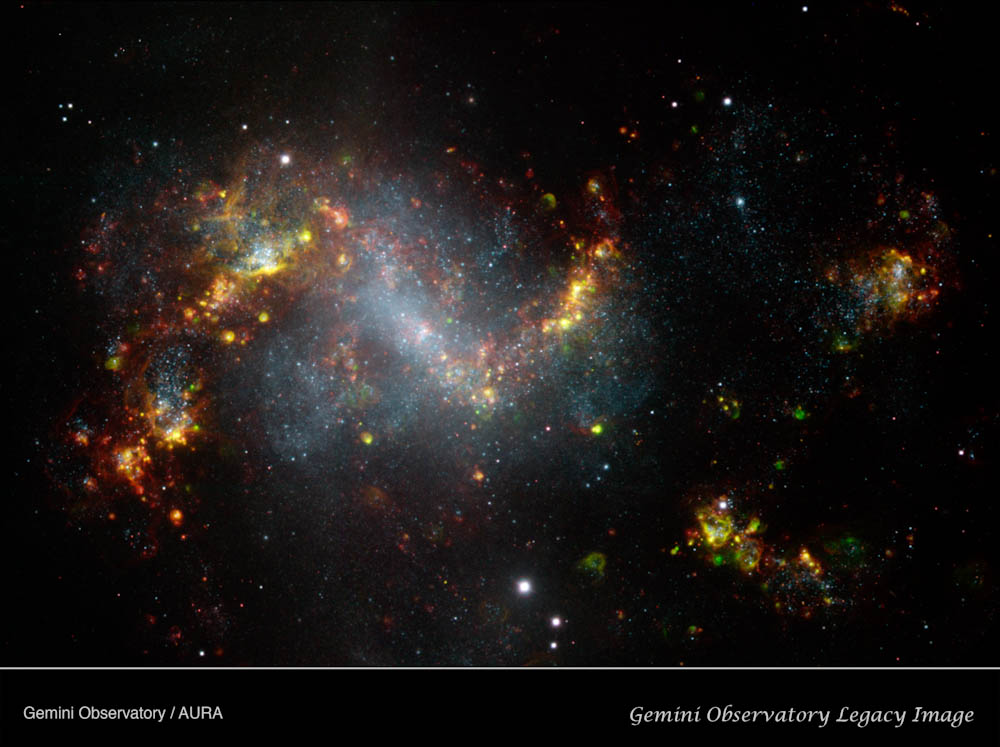
    No, that title is not a typo. Here’s the galaxy:

    gemini_ngc1313

    This is an irregular galaxy about 15 million light years away that’s undergoing a “starburst” — a massive wave of star formation. I won’t go into details like I usually do (the press release for the image is pretty good, so go read that)… but I just wanted to make the joke.

    The name of the galaxy? NGC 1313.


    Image credit: my buddy, Travis Rector of the University of Alaska, Anchorage


  • Atlantis set to land Wednesday morning at 08:48 EDT. | Bad Astronomy

    atlantis_issThe Space Shuttle Atlantis is due to land — for the last time — at Kennedy Space Center on Wednesday morning at 08:48 Eastern time (12:48 UT). If she gets waved off, the next landing opportunity is at 10:22 EDT (14:22 UT). If that doesn’t happen, it’ll be Thursday at 09:13 and 10:48 (and more chances on Friday if needed as well).

    This is it for Atlantis. It’ll be fixed up and kept active in case it’s needed for a rescue mission for Discovery in September, but if not, that’s the last flight. You can watch the landing live on NASA TV, follow NASA on Twitter, and get more info at the NASA shuttle website.


    Image credit: NASA


  • Best Name For A Disease? | The Loom

    I’m at the American Society for Microbiology Annual Meeting, swimming in a lot of excellent new research. I also just learned about a disease I never heard of before, with a truly awesome name: Burning Mouth Syndrome.

    When I posted this on Twitter, the writer Michael Paul Mason immediately responded with his own favorite: Smoking Stool Syndrome.

    So what’s your favorite?


  • Will Venter’s “Synthetic Cell” Patents Give Him a Research Monopoly? | 80beats

    VenterHere in the United States, people are all atwitter about Craig Venter’s announcement last week of a new “synthetic cell,” and whether it constitutes creating life or simply a nifty new step in genetic engineering. Across the pond in the U.K., however, there are increasing rumblings of a more practical matter: Whether the patents that Venter is seeking to protect his work will bring a chill to genetic engineering research elsewhere.

    Dr Venter’s [team] has applied for patents on the methods it used to create the new organism, nicknamed Synthia, by transferring a bacterial genome built from scratch into the shell of another bacterium. Synthia’s genetic code contains four DNA “watermarks”, including famous quotations and the names of the scientists behind the research, that could be used to detect cases of unauthorised copying [The Times].

    Nobel winner John Sulston is the main man sounding the alarm (pdf); he argues that Venter is trying to obtain a “monopoly” on a range of genetic engineering techniques, which would prevent other researchers from freely experimenting with those methods. He’s also a familiar adversary to Venter. The two butted heads a decade ago when scientists were rushing to sequence the human genome.

    Craig Venter led a private sector effort which was to have seen charges for access to the information. John Sulston was part of a government and charity-backed effort to make the genome freely available to all scientists [BBC News].

    Venter found himself in another intellectual property vs. public domain flare-up in 2007, when a Canadian organization called the ETC Group challenged patents that Venter’s company, Synthetic Genomics, tried to file on the artificial microbe his lab had in development. After that public fight, Nature Biotechnology recognized the need for commercial biotech firms to protect their work, but called on national organizations and non-profits to continue putting as much DNA information as possible into the public domain so that research doesn’t get bogged down in a sea of legal battles.

    This time around, the response from Venter’s organization is much the same as before: Relax, everybody.

    In response to Sulston’s latest broadside, a spokesman for the J Craig Venter Institute told the BBC, “There are a number of companies working in the synthetic genomic/biology space and also many academic labs. Most if not all of these have likely filed some degree of patent protection on a variety of aspects of their work so it would seem unlikely that any one group, academic centre or company would be able to hold a ‘monopoly’ on anything” [Nature].

    These fights will go on, and that’s a good thing: We need innovators, and we need agitators. While Venter’s work will push genetic engineering forward, and will likely make oodles of cash in the process, Sulston and others can keep questioning the balance of information power so it doesn’t all end up in once place.

    Related Content:
    80beats: Did Craig Venter Just Create Synthetic Life? The Jury Is Decidedly Out
    80beats: Court Strikes Down Patents on Two Human Genes; Biotech Industry Trembles
    DISCOVER: The Intellectual Property Fight That Could Kill Millions
    DISCOVER: Discover Dialogue with Craig Venter
    DISCOVER: The 10 Most Influential People in Science

    Image: Amy Eckert


  • Which world? | Bad Astronomy

    Quick: of all the worlds in our solar system, which one is this?

    akatsuki_firstlight

    Stumped? Go to Emily Lakdawalla’s post at The Planetary Society blog for the answer.


  • Does Infinity in the Sky Mean Limitless Energy? | Visual Science

    I got pretty excited when Makani Power staff photographer Andrea Dunlap showed me this photograph. For my purposes, it doesn’t get much better than this: sustainable energy, technology, the future, all rolled into a beautiful photograph. Pick up our June issue for a gander at the double-page spread.

    This photograph is 30-second exposure taken during a test of a 10-kilowatt-scale prototype of an airborne wind turbine in Maui, Hawaii. The mobile turbine has a span of about 16 feet and is tethered to the ground using a long, flexible cable. A computer controls the flight pattern. These tests show that a flying generator can sweep through a bigger wind window than a traditional turbine, and without the massive supporting towers. Makani Power plans to have a functional megawatt version of the tethered turbine ready by 2011. Makani Power is partially funded by Google.org as a potential source of renewable energy. Google’s server farms and the Internet in general have ever increasing demands for power, which is in turn burning ever more coal.

    Photograph courtesy Makani Power

  • Did Google Pac-Man Destroy Worker Productivity? We’re Unconvinced. | Discoblog

    Expletives and MIDI music rose from office cubicles this past Friday: Pac-Man had returned. On May 21, Google replaced its usual blue, yellow, red, and green title with what the company calls a “doodle.” But unlike previous replacements, which have celebrated everything from Pi day to Norman Rockwell’s birthday, for Pac-Man’s special day (the 30th Anniversary of the game’s Japan release) Google pulled out the big guns, er, ghost-eaters. This time, the doodle was an animated and playable version of the 1980s Namco video game, complete with our pie-shaped hero and his multicolored ghost foes: Blinky (red), Pinky (pink), Inky (cyan), and Clyde (orange). But some kill-joys complain that Friday’s Pac-Man play hindered productivity, and set out to determine just how much money had been frittered away as employees avoided their work. The BBC reports that the firm Rescue Time tracked 11,ooo users’ online activity and noticed that Pac-Man kept them on Google’s site about 36 seconds longer than usual. Multiplying those 36 seconds by Google’s 504 million users, that means over 500 years worth of work time spent playing. The firm estimates an average worker’s salary at $25 an hour for a grand total of about $120 million in lost productivity. How Rescue Time …