Author: Discover Main Feed

  • Video: Comet Caught Crashing into the Sun | 80beats

    CometCrashSun
    Its doom was sealed six years ago.

    In 2004, UC Berkeley researchers say, this comet was tugged by Jupiter’s gravity into a path bound for destruction in the cauldron of the sun. And when its end finally came this March, astronomers captured the comet plunging deep into the sun on video (see below), watching it go farther into the light than any suicide comet seen before.

    Seeing comets and other small objects approach the sun is difficult because the objects are overwhelmed by the sun’s brightness. Scientists were able to track this one closer to the sun than ever, before it it burned up in the sun’s lower atmosphere [Wired.com].

    The team watched the comet with NASA’s STEREO (Solar TErrestrial RElations Observatory), launched in 2006 and using satellites on opposites sides of the planet to survey the sun in 3D. The comet plunged through the corona and was tough enough to survive until it crossed into the chromosphere and met its final end.

    Based on the comet’s relatively short tail, about 1.9 million miles long, the researchers believe that the comet contained heavier elements that do not evaporate readily. This would also explain how it penetrated so deeply into the chromosphere, surviving the strong solar wind as well as the extreme temperatures, before evaporating [Daily Mail].

    The astronomers think this now-deceased comet was a Kreutz sungrazer. This is a group of comets that are the remnants of a single large comet that broke up, and periodically they graze too close for comfort and make death dives into the sun. The teams presented the findings yesterday at the American Astronomical Meeting in Miami.

    Check out DISCOVER’s page on Facebook.

    Related Content:
    DISCOVER: Seeing Sun Storms in Stereo
    80beats: Spacecraft-Collected Comet Dust Reveals Surprises from the Solar System’s Boondocks
    80beats: Dust Collected From Comet Contains a Key Ingredient For Life
    Bad Astronomy: 10 Things You Don’t Know About Comets

    Image: NASA


  • The Reasons For Sci Comm Training | The Intersection

    When I blogged the other day about the media training I was doing at MIT, the first comment read as follows:
    Frauds at work. Science is not about PR, Mooney. You and your ilk make me feel both ill, and embarassed to say I am a scientist. You should go crawl back under your rock.
    To which Aileen Pincus, who also does media training, ably replied:
    There’s no question that science is losing the public relations battle, so it’s interesting to me to still find scientists like the poster above who obviously believe that learning to communicate the science somehow harms the science. Yes, those who apply science commercially don’t suffer from such delusions, and they’re a good many of my clients. Others however, come to understand the real world of how science in funded only after long, losing struggles. Public support for science, essential to that funding, isn’t something to be scorned–and that can only happen when scientists learn how to talk to non-scientists.
    Indeed–and that is only one of the reasons that many scientists are interested in having such trainings. I believe a lot of it has to do with the nastiness of the evolution and climate wars, and the sense that we have been …


  • Money weakens ability to savour life’s little pleasures | Not Exactly Rocket Science

    Chocolate_coins

    Today is Towel Day, where fans around the world celebrate the works of beloved author Douglas Adams, a master of witty prose and observational humour. Consider his description of money:

    “This planet has – or rather had – a problem, which was this: most of the people living on it were unhappy for pretty much of the time. Many solutions were suggested for this problem, but most of these were largely concerned with the movements of small green pieces of paper, which is odd because on the whole it wasn’t the small green pieces of paper that were unhappy.”

    Adams was right to highlight the perceived link between money and happiness. Many people dream of the life they could lead if they won the lottery, a world of mansions, fine restaurants, and first-class travel. But few consider the costs. These fineries could lead to enjoyment overload, compromising our ability to savour life’s simpler pleasures, whether it’s a walk on a sunny day or the taste of a bar of chocolate. This idea of wealth as a double-edged sword is widely held and while it’s easy to suggest that it springs from jealousy, a new set of experiments supports the idea.

    Jordi Quoidbach from the University of Liege showed that richer people aren’t as good as savouring everyday pleasures than their poorer counterparts. Even the mere thought of money can make us take mundane joys for granted. Normal people who were reminded about wealth spent less time appreciating a humble bar of chocolate and derived less enjoyment from it.

    Quoidbach’s study helps to make sense of a trend in psychological research, where money has an incredibly weak effect on happiness. Once people have enough to buy basic needs and rise out of abject poverty, having extra cash has little bearing on their enjoyment of life. Perhaps this is because money both gives and takes away: it opens doors to new pleasures, while making delights that were already accessible seem less enticing. Obsessing over wealth is like being on a hedonic treadmill – continuously running to stay in the same emotional place.

    To begin with, Quoidbach asked 351 university employees, from cleaners to senior staff, to complete a test that measures their ability to savour positive emotions. Each recruit was asked to put themselves in a detailed pleasant scenario, from finishing an important task to discovering an amazing waterfall on a hike. Afterwards, they were quizzed in detail about how they would react to the scenarios, to see how strongly they savoured the experiences.

    Using other questionnaires, Quoidbach also assessed how happy they were, how much money it would take to live their dream life, how much money they earned and how much they had saved. And as a final twist, half of the questionnaires included picture of a large stack of euros, while the other half saw the same picture that had been blurred beyond recognition.

    He found that the more money the recruits had, the worse they were at savouring their positive emotions. Of course, it’s possible that people who appreciate their lot in life are less eager to chase after wealth. But Quoidbach found that a person’s savouring ability was unrelated to their desire for money. And even suggesting the thought of money, by showing them the euro picture, had the same negative effect, dampening their to the happy imaginings.

    Regardless, the recruits also tended to be slightly happier the more money they had. Other studies have found the same trend, but Quoidbach’s important result is the money would have had a far greater impact on the volunteers’ happiness were it not for its negative effect on their savouring ability.

    Of course, there’s only so far you can take the results of the questionnaires. A more objective experiment would be better, and that’s exactly what Quoidbach did. He asked 40 students to volunteer for a taste test. They were given a binder that included a questionnaire about their attitudes toward chocolate. On the opposite page, marked as material for an unrelated study, was a picture of either money or a neutral object. Afterwards, all they had to do was eat a chocolate.

    Two researchers kept an eye on them and not only timed their munching, but rated how much enjoyment they were showing. The results were clear – the recruits who saw the money took 32 seconds to eat the chocolate, significantly less than the 45 seconds spent by the others. And on average, their happiness rating, as judged by the observers, was 3.6 out of 7, compared to a higher score of 5 for their peers. (Incidentally, the observers didn’t know which group their subjects belonged to, and their scores strongly agreed with one another’s).

    These studies are part of a growing body of research showing that the link between money and happiness is more complicated than we might imagine. Elizabeth Dunn, who also worked with Quoidback, has previously shown that money can buy happiness if it’s spent on others, but that having money reduces the odds that people will actually spend it in this way! Dunn has also found that money is better used to buy happiness if it’s spent on experiences rather than goods. And here we see that wealth can undercut the very happiness that it boosts.

    In both experiments, a simple reminder of wealth undermined people’s ability to appreciate life’s little pleasures, be they imagined ones or the very physical joys of chocolate. That’s a striking result and Quoidbach explains it best himself. “One need not actually visit the pyramids of Egypt or spend a week at the legendary Banff spas in Canada for one’s savouring ability to be impaired,” he writes. “Simply knowing that these peak experiences are readily available may increase one’s tendency to take the small pleasures of daily life for granted.”

    Reference: Psychological Science http://dx.doi.org/10.1177/0956797610371963 or here

    Image from Muffet on Flickr

    More on happiness or money:

    Twitter.jpg Facebook.jpg Feed.jpg Book.jpg

  • Crazy violent explosion shoots out two cosmic bullets | Bad Astronomy

    I deal with superginormously ridiculous energies, velocities, and sizes all the time as an astronomer. You get used to it after a while… then something like this’ll slap you upside the head: a star that exploded more than 5000 years ago launched two epic bullets. One is a cloud of gas screaming away at thousands of kilometers per second, and the other is the cinder of the star itself, an octillion-ton cannonball blasting through space in a totally different direction.

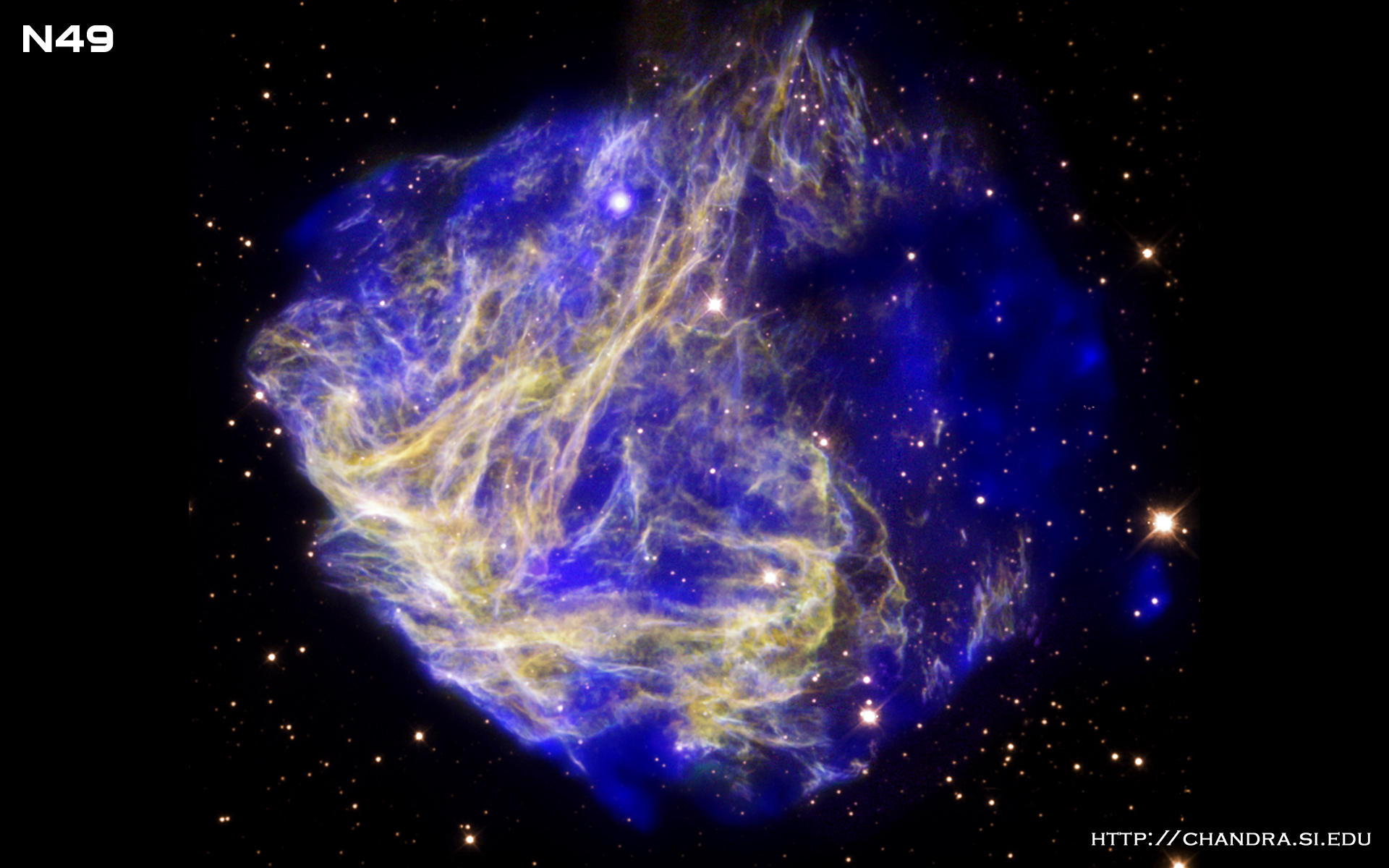
    chandra_n49

    This is a composite picture of the supernova remnant N49: an expanding lumpy sphere of gas about 30 light years across (300 trillion kilometers, or 180 trillion miles)*, located in the Large Magellanic Cloud, a satellite galaxy to our Milky Way. The blue in the picture is the emission from gas heated to millions of degrees, and shows X-rays detected by the Chandra observatory. The yellow and purple are from Hubble data, showing gas being whipped and beaten by shock waves slamming around insides the remnant.

    Turn your attention to the little blue blob to the right, marked by the red arrow. It’s outside the main bubble of the nebula, meaning that it must be moving faster than the gas in general. This is seen sometimes in supernovae remnants: a bullet or focused blob of gas screaming away. It may be caused by magnetic fields in the expanding gas just after the star explodes, launching the octillions of tons of matter away in all directions, or it may be due to focusing from shock waves, which can sculpt the gas and create little pockets of denser knots.

    Either way, this bullet is moving away from the nebula at speeds of more than 2200 km/sec (1300 miles per second) — fast enough to cross the United States in less than 3 seconds. The mass of the blob is unclear, but to give you an idea of the energies involved, it emits 10 times the Sun’s total energy in just X-rays alone. Incredible.

    Now focus your attention to the star-like point source indicated by the other red arrow, near the top of the remnant. The astronomers took a good look at that object, which was previously known to be an object called SGR 0526−66. SGR stands for Soft Gamma ray Repeater, an object that periodically blasts out flashes of super-high-energy gamma rays. SGRs are neutron stars, the ultra-compact and überdense (I know, I’m running out of adjectives.. but just you wait…) leftover cores of stars that have exploded. They can have more than the mass of the Sun compressed down into a ball just a few kilometers across! A cubic centimeter of neutron star material (usually called neutronium, a word I love love love) weighs about as much as the combined weight of all the cars in the United States. So there’s that.

    The astronomers found the age of the SGR to be a few thousand years, which matches the age of the nebula! That means it’s very likely this is the leftover core of the star that exploded and created N49 itself. But what’s it doing way off center?

    Astronomers think that sometimes the explosion can be off-center in the star, so that things don’t quite expand the same in all directions. Given the energies involved (hint: a LOT) this can give the neutron star a kick, sending it caroming through space at high velocity. If SGR 0526-66 is indeed the leftover cinder from the explosion, to get where it is in the time since the explosion it has to be moving at a velocity of at least 790 km/sec (490 miles/second). Think about that: this is an object with the mass of the Sun and it got kicked so hard it went shooting off hundreds of times faster than a rifle bullet.

    Yeah, you might want to sit for a moment and soak that in.

    It gets worse! Since it’s seen in the Chandra data, that means it’s hot. Glowing at several million degrees, the energy it gives off in just X-rays is a hundred times the Sun’s total energy production! If you replaced the Sun with SGR 0526-66, you’d barely be able to see it since it’s so small, but it would hardly matter: the X-rays it gives off would cook the Earth like a marshmallow in a furnace. If that’s not enough awesome for you, the magnetic field at the surface of the neutron star is about 100 trillion times stronger than the Earth’s!

    Neutron stars are small in stature, but nothing else about them is.

    Studying supernovae remnants is interesting scientifically for lots of reasons, not the least of which is that they create the heavy elements in the Universe, so we literally owe our lives to them. That would be enough… but I know that secretly, astronomers study them because they are simply so frakkin’ cool.

    Or maybe it’s not so secret.


    * A lot of these remnants look like mammograms to me. Make of that what you will.

    Image credit: X-ray: (NASA/CXC/Penn State/S.Park et al.); Optical: NASA/STScI/UIUC/Y.H.Chu & R.Williams et al


  • Discover Your Inner Godwit | The Loom

    scottOn March 29, 1912, Robert Scott and two fellow explorers huddled in a tent during a fierce Antarctic blizzard. They had landed on the edge of Antarctica five months earlier, hoping to be the first people in history to reach the South Pole. They succeeded in reaching the Pole, but it was a bitter success. They discovered that another team, led by Roald Amundsen, had gotten there first. So Scott and his team turned back and began the 800-mile journey back to the sea. They hauled sledges themselves, without the help of dogs. The plunging temperatures increased the friction of the snow, so that they had to put in as much effort as they would to haul the sledges through sand. On February 4, Edgar Evans dropped dead. On March 16, Laurence Oates, barely able to walk, simply left the camp and never came back. A blizzard on March 20 left them unable to leave their tent.

    “I do not think we can hope for any better things now,” Scott wrote in his diary nine days later. “We shall stick it out to the end, but we are getting weaker, of course, and the end cannot be far.” And indeed he likely died that day. Scott and his crew were finally discovered eight months later.

    Scott may not have been the first person to reach the South Pole, but he did earn a different kind of distinction: “the greatest human performances of sustained physical endurance of all time,” in the words of University of Cape Town sports scientist Timothy Noakes. All told, Scott probably burned about million calories. Each day he and his fellow explorers burned around 7,000 calories, about four times the rate of a man at rest.

    Scott’s accomplishment was exceptional not just for a human, but for any animal. Animals rarely push their metabolism beyond about four times their resting rate for any length of time. A cheetah may explode into a sixty-mile-an-hour sprint, but for only a few seconds. Most animals that push themselves hard–birds racing around to find food for their chicks for days on end, for example–only push themselves about four times above their resting metabolic rate.

    godwit440In 2007, however, a small bird left Scott in the dust. Scientists discovered that bar-tailed godwits could fly from Alaska to New Zealand, non-stop. Their metabolism, scientists found, rose to about eight times their resting rate. And it stayed there, 24 hours a day, for nine days. And while Scott could refuel on his journey by eating horse meat and pemmican, the bar-tailed godwits fasted for their entire 7,000 miles journey.

    As I report in the lead story of the Science Times in tomorrow’s New York Times, research now shows that the bar-tailed godwit has some company. Using sophisticated new location-tracking devices, scientists have discovered other species several travel several thousand miles without a break.

    I also write about the deeper significance of these new results. How do these birds achieve these awesome treks. And why? In a new paper, the Swedish biologist Anders Hederstrom argues that birds like bar-tailed godwits aren’t all that unusual. Lots of birds that go on much shorter migrations have many of the same adaptations as the champions–the ability to store up fat, an ability to navigate long distances, an efficient body shape, and so on.

    Theunis Piersma, a Dutch biologist, offered up a provocative idea for the evolution of ultramarathoning birds. Their migrations may be able to shift quickly from short to long. Birds have a huge potential to work hard, without the need for long-term physical evolutionary changes coming first. All they need is a change in behavior, and their bodies will meet the challenge. Once they shift their behavior, natural selection may well favor physical changes that help them go long distances. (Piersma will write about this at length in his upcoming book, The Flexible Phenotype.)

    For Piersma, what’s really interesting is why godwits and some other birds push so hard, while most other animals don’t. Piersma thinks that laziness is, for the most part, adaptive. If animals push themselves beyond about four times their resting metabolic rate, they usually have to pay dearly. They become vulnerable to predators and disease, for example. When scientists have added extra chicks to the nests of kestrel hawks, for example, the parents have to work harder to feed them. As a result, the scientists found, the parents became more likely to die. When scientists add little weights to bees that are buzzing around gathering nectar, the bees are also more likely to die. And Scott himself is a grisly illustration of Piersma’s tradeoff. His foot became infected so badly, he wrote, that “amputation is the best I can hope for.”

    Flying over open seas, however, may allow some birds to escape this trade-off. Predators and parasites can’t catch them when they’re hundreds of miles from the nearest land. When bar-tailed godwits land after flying 7,000 miles, they can just take a long nap without worrying about being eaten. The very things that might make exhaustion more dangerous are missing from their migration.

    For more, check out my story.

    Update: And be sure to check out the great interactive maps.

    [Images: Scott, Wikipedia/Godwits, Robert E. Gill]


  • NCBI ROFL: A long time ago in a galaxy far, far away, Jar Jar Binks had a fungal infection. | Discoblog

    It’s BMJ week (again) on NCBI ROFL! After the success of our first BMJ week, we decided to devote another week to fun articles from holiday issues of the British Medical Journal. Enjoy! Tokelau on Naboo “Tinea imbricata, a superficial fungal infection of man, has an ornate appearance composed of concentric circles and polycyclic or serpiginous scaly plaques. The condition is common in several humid tropical regions, especially in parts of Polynesia and Melanesia. It is also reported occasionally in the Amazon basin and other tropical areas in both hemispheres. The precise distribution of tinea imbricata, however, has been poorly defined ever since the disease was named by Sir Patrick Manson, the father of tropical medicine. I report the possible presence of tinea imbricata outside its previously known geographic and taxonomic distribution. Several Gungan inhabitants of Naboo, a planet of the Galactic Republic depicted in Star Wars Episode 1: The Phantom Menace, have skin with the distinctive annular and polycyclic pattern of tinea imbricata. Jar Jar Binks, a Gungan who figures prominently in this movie, shows this eruption in figure ​2. Manson wrote of the infection, “Again, tinea imbricata, if it has been in existence any length of time, involves a very large surface, as …


  • Does a Dose of Testosterone Make Trusting Women More Skeptical? | 80beats

    face-collageAll it takes for some people to be a little less trusting of their fellow humans is a little more testosterone, according to a new study in the Proceedings of the National Academy of Sciences.

    Researchers led by Jack van Honk of the Netherlands used a sample of 24 women in their study. The team showed photos of 150 strangers’ faces to the women and asked them to rate the faces for trustworthiness, using a scale from -100 to +100. The scores women gave after receiving a placebo became their “baseline” score. The women also completed a trustworthiness survey after being given an increase in testosterone instead of placebo (they weren’t told when they received which).

    Scientists found that women were not so easily taken in by a stranger’s face after receiving a dose of the hormone…. Women who appeared the most trusting after receiving the “dummy” placebo reduced their scores by an average of 10 points when their testosterone was boosted [Press Association].

    Why? The researchers point to the social advantages testosterone can confer:

    The study also adds support to the idea that testosterone influences human behavior, not necessarily by increasing aggression, but by motivating people to raise their status in the social hierarchy or become more socially dominant. Testosterone might boost social watchfulness, making those who are most trusting a little more vigilant and better prepared for competition over rank and resources, the researchers say [LiveScience].

    This sample size isn’t terribly large and the explanation is something of a just-so story, but it’s at least a plausible one. The study authors say that testosterone’s effects specifically could balance out those of oxytocin, the “love hormone,” which previous studies have suggested could increase feelings of trust, or make men want to cuddle.

    One curious detail of this study, though, is that the skepticism effect showed up only in the most trusting women. The ones who scored as the least trusting after the placebo test didn’t drop their scores lower and become extremely distrusting after a testosterone dose; they just stayed the same. Why should they stand pat instead of descending into testosterone-induced misanthropy?

    Related Content:
    80beats: Does Testosterone Cause Greedy Behavior? Or Do We Just Think It Does?
    80beats: Men With High Testosterone Levels Make Riskier Financial Decisions
    Discoblog: Turn a Man Into Mush with a Nasal Spray of Pure Oxytocin
    Not Exactly Rocket Science: Can a Sniff of Oxytocin Improve the Social Skills of Autistic People?

    Image: flickr / luc legay


  • Cripes. Another rambling interview. | Bad Astronomy

    kenplumeI met Ken Plume last year at Dragon*Con. Our mutual Close Personal Friend Adam Savage™ introduced us, of all things. He runs a site called ASiteCalledFred and has lots of podcast interviews with interesting people, and he decided to break that streak and talk to me.

    His chats are pretty free-form; he asks questions but lets things go where they may. He learned a lesson with me, no doubt. He let me ramble about The Monkees, my daughter’s first word, NASA, constellations, NASA, and I think NASA. We really did bop around from topic to topic, making it a Faulkneresque rapids ride of skepticism and science and some mild stabs at humor (on my part). I do talk at length about where I think NASA is, was, will be, and should be, so you might get a kick out of that. Give it a listen.

    He does have a long list of interviews with some pretty cool people (Stephen Colbert! Tom Kenny! Julie Gardner! John Hodgman! Dave Foley! Olivia Wilde!), so check those out as well.


  • Photo: Heart and Soul Nebulae Reveal Star Birth in the Cold Dust | 80beats

    heartsoul

    What do you see in this image?

    “One is a Valentine’s Day heart, and the other is a surgical heart that you have in your body,” said Ned Wright of the University of California, Los Angeles, who presented the image May 24 at a meeting of the American Astronomical Society. [Wired]

    This infrared image is from WISE, more technically known as the Wide-field Infrared Survey Explorer, a NASA space telescope launched on December 14, 2009. Orbiting Earth at an altitude of 326 miles, WISE snaps an infrared picture every eleven seconds. This one, of the so-called Heart and Soul nebulae, is made from 1,147 of these images stitched together.

    The Heart and Soul nebulae are over 6,000 light years away, in the constellation Cassiopeia. To capture beauties like these, WISE needs to stay cool enough that its own heat doesn’t distort the infrared images. For this reason, it carries a chunk of solid hydrogen, cryogen, that keeps the on-board telescope at about 17 degrees Kelvin (minus 429 degrees Fahrenheit). With its sensitive infrared vision, WISE can see the cool and dusty crevices of nebulae, where gas and dust are beginning to clump together to form new stars.

    Having already taken about 960,000 images, the mission promises more pics like these for about four more months, until its cryogen supply runs out. Though this isn’t the first time we’ve seen these nebulae, WISE certainly has a unique perspective.

    “WISE is the first survey capable of observing the two clouds in a uniform way, and this will provide valuable insight into the early solar system,” said astronomer Tommy Grav of Johns Hopkins University in Baltimore, Md., who presented the information at today’s meeting. [SPACE.com]

    Related content:
    80beats: A Hot Piece of Hardware: NASA’s New Orbiter Will Map the Entire Sky in Infrared
    Bad Astronomy: A WISE flower blooms in space
    Bad Astronomy: When a star struggles to be free of its chrysalis
    Bad Astronomy: What does a nebula look like up close?

    Image: NASA/JPL-Caltech/UCLA


  • Should Dolphins and Whales Have “Human Rights”? | Discoblog

    From the heroic Flipper to the charismatic Willy, dolphins and whales have made some splashy supporting actors. And since they often seem almost as smart and interesting as their human costars, perhaps it’s not surprising that a new movement is afoot to grant these animals “human rights.” Research on everything from whale communication to “trans-species psychology” hints that the glowing portrayals of these fictional animal friends have some basis in reality. If cetaceans—marine mammals including whales, dolphins, and porpoises—can act like humans, even using tools and recognizing themselves in a mirror, shouldn’t they have the same basic rights as people? That’s what attendees of a meeting organized by the Whale and Dolphin Conservation Society (WDCS) said yesterday, where a multidisciplinary panel agreed on a “Declaration of Rights for Cetaceans: Whales and Dolphins.” “We affirm that all cetaceans as persons have the right to life, liberty and well being,” says the Declaration, meant in part to stop current whaling practices. Thomas White, director of the Center for Ethics and Business at Loyola Marymount University in California, told Reuters:
    “Whaling is ethically unacceptable…. They have a sense of self that we used to think that only human beings have.”
    This declaration conflicts with ongoing negotiations within the International Whaling …


  • Did Phoenix lose a wing? | Bad Astronomy

    The Mars Phoenix lander touched down near the Red Planet’s north pole in May of 2008. It was designed to investigate the history of water on Mars, digging into the surface soil and examining the chemistry there. It had a limited design lifetime of only a few months, since the onset of Martian winter in the north made weather conditions too severe to continue operations.

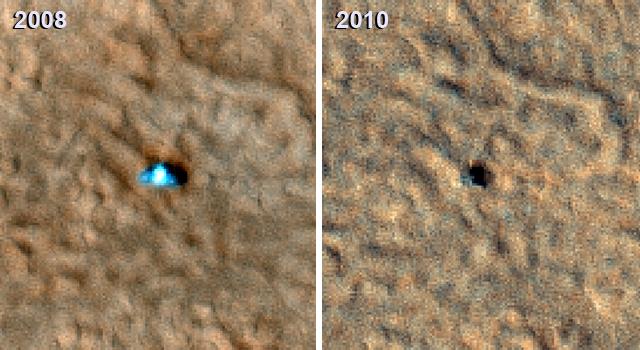
    The hope was that NASA would be able to revive the lander once spring had sprung. Many such attempts have failed, and we may now know why: new images show the lander may be damaged.

    phoenix_damage

    The image on the left was taken in July 2008 with the HiRISE camera on the Mars Reconnaissance Orbiter, and shows the lander in blue. The image on the right was taken just a few days ago, on May 7, 2010. The illumination is similar in the two shots — note the landscapes are very similar looking — but the shadow cast by the lander looks different now. My first thought was that dust built up on the lander, making it look different, but scientists have shown this not to be the case.

    More likely, carbon dioxide buildup on the solar panels bent or even broke one of the panels. There were predictions that this might happen, so while this isn’t a total surprise, it’s disappointing. This means that Phoenix will not be able to soak up enough solar energy to restart its operations, which in turn, sadly, means it really is dead.

    The good news is it did a tremendous job in its mission, returning important data about the properties of the Martian surface. Although it appears the mission is now over, it was a raging success and I’m happy for the team.

    It’s funny: Mars missions tend to fail catastrophically before they even get there, or they get to Mars and seem to last forever. Spirit and Opportunity have long outlasted their warranties, and we have several orbiters still going strong. And even though Phoenix made it down to the surface and exceeded its planned lifetime, it’s still a little weird to find out it’s dead. It shows me that we get used to ESA, NASA, and JPL’s superhuman efforts when it comes to their missions.

    Space exploration is hard, damn hard. But we continue to do it, and we continue to get better at it. So while this specific news is disappointing, it’s also a reminder that we can’t take anything for granted. My hat’s off to the scientists and engineers who made Phoenix work, and work beyond expectations.

    Image Credit: NASA/JPL-Caltech/University of Arizona


  • How Male Antelopes Lie to Get More Sex: With False Alarm Calls | 80beats

    Topi“There are lions and cheetahs and leopards out there, my dear. You’d be better off staying here with me.”

    This is how male topi antelope lie for sex.

    The area of Kenya where they live, Masai Mara National Reserve, is indeed filled with large predators that find antelopes to be just delicious, and so the topi have developed warning calls that they sound when it’s time to scurry away or else be eaten. But, according to an American Naturalist study, the devious topi males have figured out how to use their calls to fake the threat of immediate danger and keep females around, according to research leader Jakob Bro-Jørgensen.

    From February to March, male topi hold small territories through which receptive females pass to assess each male’s mating potential. The authors noticed that, while a female in estrus was on a male’s territory, the male would sometimes emit alarm calls, even in the complete absence of a predator. These false alarms are acoustically indistinguishable from true alarm snorts [Ars Technica].

    The motivation is easy to see: Normally, during the one day a year that a female topi is sexually receptive, she’ll have sex 11 times with four separate males, on average. However, if a male cries “wolf”—or in this case, perhaps “hyena”—she might stick around his territory, which improves his reproductive odds. Indeed, the researchers found that the males almost never made false predator calls unless there was a lady around and he didn’t want her to wander.

    “In fact, males quite frequently pull the trick on females in heat and one may ask why females keep responding to alarms at all,” Bro-Jørgensen said. “The answer seems to be that females are better off erring on the side of caution, because failing to react to a true alarm could easily mean death in a place like the Masai Mara, where it’s literally crawling with large predators” [MSNBC].

    The mating game is full of liars and cheaters, or course—just check out DISCOVER’s gallery of the worst offenders. Because their prevarication employs the fear of death, topi are among the most successful, too. After a fake snort of alarm the males, on average, got to have sex nearly three more times. So expect the lying to continue.

    Check out DISCOVER’s page on Facebook.

    Related Content:
    Not Exactly Rocket Science: Eland Antelopes Click Their Heels To Prove Their Dominance
    DISCOVER: The Best Ways To Sell Sex
    DISCOVER: The Mating Game’s Biggest Cheaters (photo gallery)

    Image: Wikimedia Commons


  • Dogs, Bonobos, and You | The Loom

    The World Science Festival is running a blog in conjunction with this year’s festivities. Today I’ve written a post about one of the sessions, where scientists will talk about how we can understand our own minds by studying animal minds. Check it out here or here.


  • Protect biodiversity, alleviate poverty: the surprise benefits of protected areas | Not Exactly Rocket Science

    Costa_Rica_rainforest

    Last Saturday, on the United Nation’s International Day for Biodiversity, an open letter from hundreds of British organisations warned of the importance of our rapidly eroding biodiversity, while a UN report discussed the economic consequences of this erosion. The general principle of conserving biodiversity has inarguable value but there’s much more debate about how best to do it.

    Take national parks and reserves –these protected areas save wildlife but they stop local people from using the land for farming and from using its resources. The argument that such limitations prioritise “cuddly animals” over “poor people” is particularly sharp in developing countries, where rural communities are said to bear the costs of protected areas without reaping their benefits.

    But a new study in Costa Rica and Thailand says that such objections are unfounded. By actually comparing similar communities on a small scale, Kwaw Andam from Washington’s International Food Policy Research Institute has shown that protected areas actually help to alleviate poverty.

    In 2003, the so-called Durban Accord from the World Congress on Protected Areas urged commitments to “protected area management that strives to reduce, and in no way exacerbates, poverty”. Well and easily said, but studying the link between poverty and protection is quite difficult. The two seem to go hand in hand, but protected areas are often set up in far-flung areas where poverty if rife. How can you actually tell if they worsen the situation?

    Andam did it by focusing on protected areas in Costa Rica and Thailand. These developing nations have very different cultures and histories but they are both hotspots of biodiversity that set up protected areas a long time ago. And importantly, they both have good sources national statistics.

    Using these data, Andam’s team compared communities where at least 10% of the land had been protected with those where less than 1% had been. This difference aside, they compared like for like, matching the various communities in terms of their forest cover, their access to transportation, the productivity of their land, and how poor they were before protected zones were set up. The analysis was very detailed, zooming in at a fine regional level and taking data about poverty from household surveys. The team also focused on protected areas that had been around for 15 years or more, to get a sense of their long-term impact.

    On the surface, the link between poverty and protection seemed clear. As with many other countries, the Costa Rican and Thai communities with high levels of protected biodiversity were much poorer than those with little protection. But these areas were already among the poorest parts of the two countries before the protected zones were set up.

    Taking this into account, Andam’s matched comparisons revealed that protected areas don’t exacerbate the economic shortfalls of local communities. If anything, they actually make things better. Put it another way, if the protected areas hadn’t been set up, the local people would probably be even worse off than they actually are.

    Costa_Rica_Thailand

    Could there be other explanations? Certainly, but Andam systematically ruled them out. Andam showed that the genesis of the protected areas didn’t affect the population growth of the relevant areas, which shows that poor people weren’t being pushed out into neighbouring regions. Andam also considered the possibility that the costs of protected areas were spilling over into neighbouring communities, affecting a far wider catchment area than he suspected. But when he left out control regions that were within 10km of a protected area and re-ran his analysis, he got the same result.

    This is an important study, which provides some much needed evidence in the area of conservation policy. It’s also very encouraging. Previously, Andam has shown that the networks of protected areas have slowed the pace of deforestation and his latest results show that this success hasn’t come at the cost of local development. If anything, things have improved for local people as a result. It’s not clear how, but it could be that protected areas bring opportunities from business and investments, promote tourism, or improve local infrastructure.

    However, Andam is rightly cautious. He notes that his results present an average trend over several decades. In the short term, things may get worse before they get better, and not all districts would benefit equally. Poverty is also only one aspect of a community’s wellbeing and there’s no data on their ability to maintain their cultural traditions, or to feel in control of their fates.

    And, obviously, Costa Rica and Thailand are but two countries. Both have enjoyed a lot of investment in their protected areas and in eco-tourism so the same trends may not apply in other parts of the world. (Andam also writes that they had “relatively stable political systems” but the current Thai situation probably doesn’t support that statement!)

    Andam calls for other researchers to do a similar analysis in other parts of the world to get a global picture of the impact of protected areas. For now, we have a restricted view of this picture, albeit a positive one. As he writes, “Our results… suggest that protecting biodiversity can contribute to both environmental sustainability and poverty alleviation, two of the United Nations Millennium Development Goals.”

    Reference: PNAS http://dx.doi.org/10.1073/pnas.0914177107 If this link isn’t working, read why here

    Image: by Haakon S. Krohn

    More on conservation:

    Twitter.jpg Facebook.jpg Feed.jpg Book.jpg

  • Nearby planetary system is seriously screwed up | Bad Astronomy

    Our solar system is pretty neat and orderly. Yeah, it has some issues, but in general we can make some broad statements about it: the planets all orbit the Sun in the same direction, for one thing, and they also orbit pretty much in the same plane. If you look at the system from the side, the orbits would all look flat, like a DVD seen from the side.

    That’s left over from the formation of the solar system itself, which happened when a cloud of dust and gas collapsed into a disk. The planets formed from that disk, so they all orbit in roughly the same plane. We see other systems forming in the same way, so we assume that when we look at those planets, they’ll also have all their planets in a plane.

    Oops. Maybe not so much. Astronomers have just announced that they’ve confirmed a system where the planets are not all aligned this way, and in fact the planets are titled relative to each other by as much as 30°!

    hst_upsand

    Ironically, the parent star is Upsilon Andromedae — that made me chuckle, because it was one of the very first stars found to have planets orbiting it, back in 1996. It’s actually a binary star, two stars orbiting each other; one is a star slightly more massive and hotter than the Sun, and the other a dinky red dwarf orbiting pretty far out (well outside the frame of that illustration of the system above). Three planets (called Upsilon Andromedae b, c, and d) at least are known to orbit the primary star. The planets were initially detected by their gravitational pull on the star; as they orbit they move the star in a mutual tug-of-war. We can’t (usually) see that motion directly, but it can be detected as a Doppler shift in the star’s light.

    Due to the physics of the situation, that method only gives us a minimum mass for a planet. The actual mass might be much higher. It also doesn’t tell us the tilt of the orbit of the planet, or of any of the other planets in the system.

    hst_upsand2What’s new here is that astronomers used telescopes on Hubble called the Fine Guidance Sensors, which are incredibly accurate and highly precise. The FGSs are so accurate that they could see the physical motion of the star on the sky, the wobbling as the planets tugged on it this way and that. Think of it like a harried parent at a mall with two little kids holding her hand. As the kids see one store or another they want to visit, they pull on her in different directions as she walks with them, so her path down the mall corridor shifts left and right.

    Combining the new Hubble data with the older Doppler data has revealed a wealth of information about the planets in that system. For one thing, it nailed the masses. Instead of lower limits, we now have accurate masses for planets: Ups And c is 14 times the mass of Jupiter, and Ups And d is 10 times Jupiter’s mass*. Mind you, Jupiter is a bit of a bruiser, so these are hefty planets. These masses are far larger than thought before, so the new observations really changed our thinking here.

    But the amazing thing is that it looks like Ups And c and d are in wildly different orbits: instead of being almost exactly in the same plane as expected, they are tilted relative to one another by 30°! The illustration on the right compared those orbits with those of planets in our own solar system, and you can see how weird this is.

    But does this mean astronomers are wrong about how planets form?

    Probably not. We’re pretty sure we understand how planets form, at least in general terms. What this does mean is that something happened to the planets after they formed, something that tossed one or both of these planets into different orbits than the ones they were born in.

    This isn’t a huge surprise. Pluto may or may not be a planet by your definition, but it orbits the Sun at an angle of 17° with respect to the Earth. Sedna, an object about the same size as Pluto in the outer solar system, also has a large tilt. We know there is some mechanism that can change the orbits of big objects in the solar system, so why not in other systems, too?

    In the case of Upsilon Andromedae, we have some culprits. The data hint that there may be a fourth planet orbiting the star. It’s not clear if it’s there or not, but if it has an elliptical orbit it could gravitationally affect the inner planets. There’s also the red dwarf star orbiting farther out. Far more massive than a planet, its gravity may have some effect on the system as well. It’s also certainly possible that there are other influences we haven’t seen or thought of yet. [Update: I just got off the phone with the team who did this research, and Rory Barnes told me that a strong possibility as well is that there were more planets in the system initially. They would have interacted via gravity, and affected each others’ orbits. A likely scenario is that a planet with about ten times the mass of Jupiter could have messed up the orbits of the other two, then been ejected out of the system. This is a common outcome when you have lots of massive objects in one system.]

    The point here is that in general, our theories of how planets form is pretty good. As we study more of these systems, we’ll get more and more data under our belts that will help us catalog and understand where these systems follow our theories, and where they seem to diverge. That’s all good news! Theories only go so far in explaining everything, and as we observe more we modify those ideas, add to them, so they better represent the Universe around us. That’s how science works, and that’s how we learn.


    * Unfortunately, Ups And b orbits too close to its parent star to get an accurate mass for it. That’ll have to wait for the future, with new techniques and better instruments.


    Related posts:

    Wrong way planets screw up our perfectly good theories
    A tiny wobble reveals a massive planet


    Image credit: NASA, ESA, and A. Feild (STScI)


  • Andrew Wakefield, martyr | Bad Astronomy

    [Note: I expect antivaxxers to flood the comments below with their typical spin and distortions. I urge everyone to read my comments policy. I also note that the article here is extensively linked to other sources backing up my claims about Wakefield and the antivax movement. The debunking of the vast majority of antivax claims can be found in those links.]

    Andrew_WakefieldAndrew Wakefield, the man who more than anyone started the modern antivaccination movement that has led to the rise of measles, pertussis, and other preventable diseases, has been struck off the UK General Medical Council’s register. The GMC registers doctors in the UK, and oversees their conduct. To be struck off is essentially the same as being disbarred.

    This is indeed good news, but forgive me if I don’t dance in the streets. It hardly makes any difference, and is years too late.

    In 1998, Wakefield published a paper which led to people thinking vaccines caused autism. His research was shoddy, poorly done, unethical, and, frankly, wrong. Eventually the original paper was withdrawn by the medical journal in which it was published.

    Syringe, from http://www.flickr.com/photos/8499561@N02/2756332192/That’s all great, in that eventually truth won out. But has it, really? Sure, he’s disbarred, and reality-based people understand he’s totally wrong. But the antivax movement still rolls on. Wakefield moved to Texas where he still spreads his antivax propaganda; he was on NBC’s TODAY show just this morning — what a coincidence! — still proclaiming his innocence, and still spreading falsehoods about vaccines.

    And falsehoods they are. From the NBC page:

    When [host Matt] Lauer asked Wakefield whether it’s dangerous to continue promoting an MMR-autism link when it causes many families to shy away from vaccinating their children, Wakefield answered, “Matt, you’re missing the point.

    “The point is that despite denying it, in the public relations campaign they’ve used against me and against the parents, they are conceding these in vaccine court.”

    Actually, that’s completely wrong, and he should know better. For one thing, courts have ruled over and again that there is no evidence to link vaccines and autism. What Wakefield is most likely referring to is the Hannah Poling case, which can be twisted and spun into making it sound like it connects vaccines and autism, but it doesn’t. Read Steve Novella’s entry on that case to see how once again the truth eludes Wakefield.

    For another, Lauer was not missing the point at all. Wakefield was dodging the point. Lauer was precisely correct; it is dangerous to promote a link that doesn’t exist between autism and vaccines, for exactly the reason Lauer stated.

    It would’ve been interesting indeed to see Matt Lauer following up that question with asking Wakefield about his huge financial conflict of interest in all this, since Wakefield was developing an alternative to vaccines when he wrote that paper. Or if he had anything to say about investigative journalist Brian Deer — a man who has been at the forefront of exposing Wakefield all along — and the evidence he found that alleges Wakefield was paid by lawyers to start a vaccine scare?

    Anyway, for years Wakefield has been claiming he’s the victim here. This news won’t change that, and will in fact make him a martyr to his reality-impaired followers.

    He’s not the victim here. The real victims are people who get measles, people who get rubella, people who get pertussis. Most of the time these folks recover and are fine, though miserable. But sometimes it’s not such a happy ending. Dana McCaffery, a four month old girl in Australia, died last year because the herd immunity was too low where she lived. Because people chose not to vaccinate — and the antivax movement was strong there — that little girl died.

    We’re seeing outbreaks of vaccine-preventable diseases all over the world, and in many of those regions the voices of Wakefield and the antivaxxers are strong. I’m glad the GMC finally took action and did the right thing, but this does not mean we must rest in our fight against those zealots who believe — without any evidence, and plenty of evidence against them — that vaccines cause autism.

    They don’t. But how many kids will get sick before everyone finally realizes that?

    Syringe picture from ZaldyImg’s Flickr photostream, used under the Creative Commons license.


  • Amateur Sky-Watchers Track the Air Force’s Super-Secret Space Plane | 80beats

    X37BYou can’t slip much past dedicated amateur astronomers. A month after the United States Air Force launched its space plane, the X-37B, under a veil of secrecy, backyard sky-watchers say they’ve found it, along with clues to its mission.
    Though the military still won’t open up about what the classified X-37B actually is, officers have been insistent about what it isn’t: a space weapon. Indeed, defense experts have guessed recently that the craft is testing next-generation spy satellite tech, and the observations back that up.

    The amateur sky watchers have succeeded in tracking the stealthy object for the first time and uncovering clues that could back up the surveillance theory. Ted Molczan, a team member in Toronto, said the military spacecraft was passing over the same region on the ground once every four days, a pattern he called “a common feature of U.S. imaging reconnaissance satellites.” In six sightings, the team has found that the craft orbits as far north as 40 degrees latitude, just below New York City. In theory, on a clear night, an observer in the suburbs might see the X-37B as a bright star moving across the southern sky [The New York Times].

    In addition, the plane’s path would carry it over places the U.S. is interested in watching, like Iran, Pakistan, and North Korea, according to Greg Roberts, one of the astronomers to track the X-37B. More than uncovering its secret mission, he was interested in finding the plane because it was difficult. Said Roberts:

    “If the data were freely available, we would probably not have bothered with it. I see little sense in tracking objects for which data is freely available. It’s like reinventing the wheel. So as long as there are missions with little or no information, I personally will be interested in the challenge of finding them” [MSNBC].

    For more about the Air Force in space, check out DISCOVER blogger Phil Plait’s post at Bad Astronomy.

    Related Content:
    Bad Astronomy: What Is the Air Force Doing with Space?
    80beats: Air Force to Launch Secret Space Plane Tomorrow—But Don’t Ask What It’s For
    80beats: DARPA Loses Contact with Mach-20 “Hypersonic Glider” During Test Flight

    Image: U.S. Air Force


  • Copernicus Gets a New Grave, Belated Respect From the Catholic Church | Discoblog

    Over four hundred years after his death, the man known for moving the sun to the center of the solar system made a move himself. On Saturday, at a medieval cathedral at Frombork on Poland’s Baltic coast, the astronomer Nicolaus Copernicus—whose ideas were once declared heresy by the Vatican—was reburied with full religious honors. After a stint in city of Olsztyn, Copernicus’s remains returned to his original resting location (under the cathedral’s floor), but his grave got an upgrade. After his death in 1543 he lay for centuries in an unmarked grave, but his new plot has a black tombstone with six planets orbiting a golden sun. The ceremony concluded a several week tour of a wooden casket with the astronomer’s remains. The ceremony included shows of respect from the Catholic Church, which eventually had to admit that Copernicus was right about the whole planets-moving-around-the-sun thing. According to The Times, a local archbishop praised Copernicus for his hard work and scientific genius, while Archbishop Jozef Kowalczyk, the Primate of Poland, said that he regretted the “excesses of zeal” that led the Church to brand Copernicus a heretic. But Copernicus didn’t dig himself into his former grave with his treatise De Revolutionibus Orbium Coelestium (On …


  • Lunar boulder hits a hole in one! | Bad Astronomy

    Y’know, I see a gazillion pictures of astronomical objects all the time, and I never get tired of them. But every now and again a picture comes along that’s so wonderful I just have to share it.

    This is one such piece of wonderfulness: a lunar hole in one!

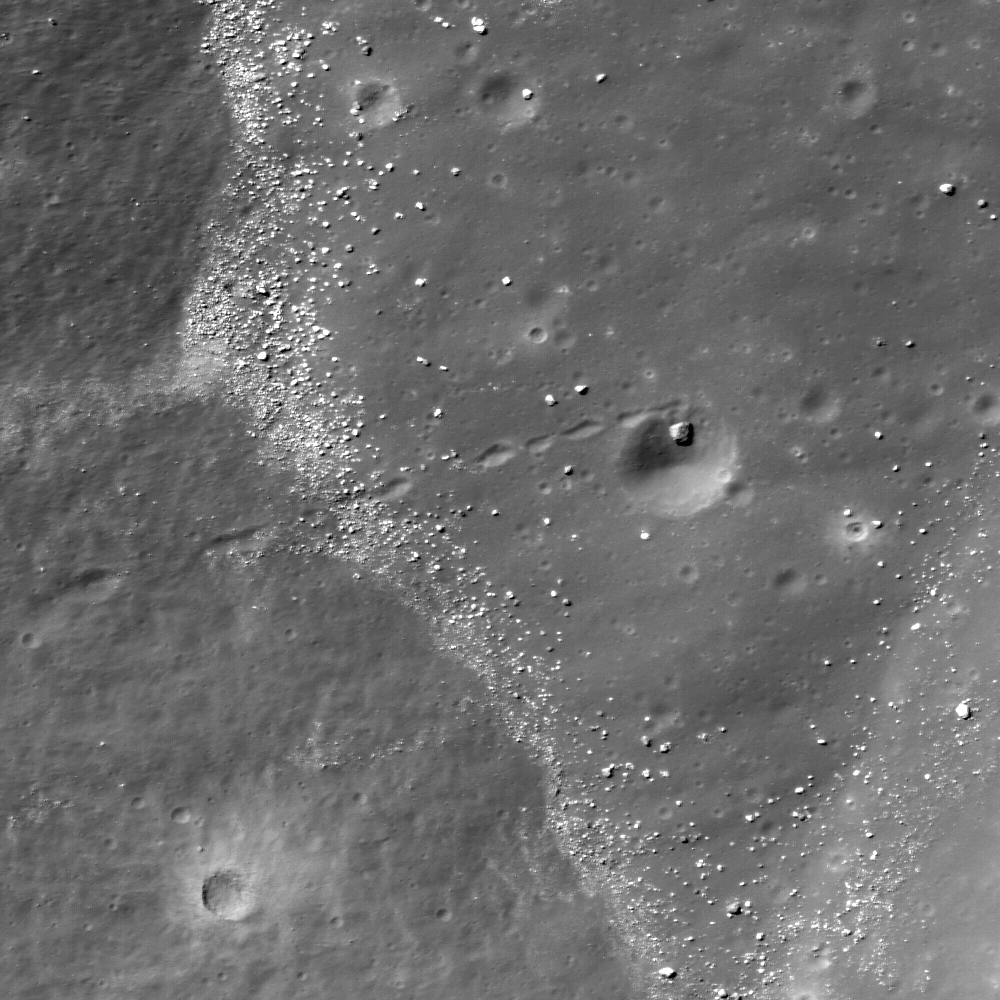
    lro_holeinone

    And you thought the windmill at the end of putt putt golf was hard.

    This picture — click to enlunanate — is from the Lunar Reconnaissance Orbiter, and shows a region of the Moon inside the crater Henry Frères. Taken on March 7, 2010, the image shows an area just 500 meters (550 yards) across — if it were Earth, you could easily walk across it in less than ten minutes — and shows objects down to less than a meter in size.

    lro_holeinone_zoomAnd it’s just so cool! Look at the dashed trail going from left to right. See how it ends at the little crater, and even — if you look closely — can be seen to turn downwards? It suspiciously points right to the 10-meter (30+ foot) boulder sitting just inside the crater wall.

    Suspicious indeed. In fact, what you’re seeing is the trail left by that boulder as it rolled and bounced downhill and stopped inside the crater! Look at the big picture. From the debris (small rocks) running up and down, you can tell that the terrain on the left side of the picture slopes down to the middle (in other words, if you started on the left side and walked to the center of the picture you’d be going downhill). The middle of the picture is relatively level ground.

    In my mind’s eye, what happened here is clear. The boulder starts off at the left, and something — perhaps a minor moonquake, or a nearby impact — shakes the ground. The house-sized rock gets dislodged, and in the gentle gravity begins to roll downhill. It hits something and bounces, coming back down, skidding and rolling, only to be launched into the sky again and again. It slows a bit each time — the ruts it digs get shorter as it moves left-to-right — and by the time it gets to the end of the track it’s barely moving, just enough to feel the change of slope due to the crater wall. It even rolled past the crater a bit (you can see the last groove is actually along the path a little beyond the crater), and almost slows to a stop… but then slowwwwwwly teeters backwards, back along the path it came. Just as it’s about to come to a rest, it goes over the lip of the crater, slides into it, and lumbers to a halt halfway down the 60-meter (200 foot) crater’s wall.

    I would give a lot to be able to see video of something like this happening on the Moon in real time. Wow!

    And that boulder’s flight is just one of many scenes depicted here, which you can see if you let yourself explore. Just above the bouncing boulder’s path is a trail of what looks like a dustslide, a bit more brightly colored than the moonscape around it. It slid downhill to the right as well, and partially buried some of the bigger debris. Obviously, this happened after the bigger rocks already slid down, since it buried some of them. And above that in the picture you can see fainter trails from other rocks sliding down. Those trails are harder to see, meaning they’re older (millions of years of micrometeorite impacts and thermal flexing from the Moon’s day/night cycle gradually erase features like that), which again is consistent with the picture I’m painting here.

    sloped_plumeTake a look at the crater at the bottom left. It’s surrounded by a light-colored apron of ejected material. See how there’s more of that ejecta to the right than to the left? That’s what you’d expect if the slope goes downhill to the right; the material spreads out more as it falls downslope (the diagram here will help). And hmmm, there’s a small crater about 10 meters across just to the right and below the big crater with the boulder in it. That crater is fresher; it still has a light apron as well. But what’s that dark spot in the center? Beats me. Cool though, ain’t it?

    There’s so much to see and investigate, and this image is only about the size of a city block! It’s a slice of a much longer 2.5 x 15 km strip, which you can interactively browse, too. WARNING: be prepared to lose a lot of your day if you click that link, but it’s worth it, just like exploring the thousands of other pictures LRO has sent back is worth it as well.

    The LRO mission cost roughly $600 million. There are 300 million people living in the US right now… so play with those images for a few minutes, and then let me know if you got your two bucks’ worth out of this mission.

    Image credit: NASA/GSFC/Arizona State University