Author: Discover Main Feed

  • Tiny Island, Fought Over by India & Bangladesh, Vanishes Into the Sea | 80beats

    Bay_of_bengalRemember that time you and your sibling couldn’t stop fighting over a toy, so your mom wouldn’t let either one of you have it? It seems the same thing happens to unhappy neighboring countries and Mother Nature.

    The island in the Bay of Bengal that Bangladesh called South Talpatti and India called New Moore or Purbasha appeared after a devastating cyclone, and it appeared right near the territorial boundary between the two. Decades of fighting over the uninhabited speck of land led to no political resolution. But now there’s a perfectly clear geographical resolution: The sea has reclaimed the island, scientists say.

    According to oceanographer Sugata Hazra, the island was never very big, peaking at around 1.3 miles by 1.1 miles. The island began shrinking in the 1990s, part of an 81-square-mile decline in land mass in the Bay of Bengal’s Sunderbans mudflats over the last 40 years, Hazra said. And 27 square miles more has been lost to erosion. In the 1990s, the island was only 2 meters above sea level [Los Angeles Times]. Some experts say that in addition to erosion, rising sea levels caused by global warming are also to blame. Oceanographer Sugata Hazra, who discovered the island’s disappearance while looking at satellite photos, argues that sea-level rise caused by climate change was ‘’surely” a factor in the island’s inundation…. ‘The rate of sea-level rise in this part of the northern Bay of Bengal is definitely attributable to climate change,” he said [Sydney Morning Herald].

    And this island is hardly alone in its shrinkage; people have already abandoned other isles in the bay. The island of Lohachara was abandoned in 1996, while 48 per cent of Ghoramara is reportedly underwater. Thousands of so-called climate-change refugees have already fled. At least 10 other islands are said to be immediately at risk [The Independent].

    So why did the two nations spend so much time fighting over a tiny island with no future? Location, location, location. It sits right in the mouth of the Hariabhanga River, the boundary between India and Bangladesh. Technically, possession of the island depends on which side of the island the main channel of the river flows. That has never been agreed by the two countries [The Independent]. The island’s strategic importance, then, has led to some unusual gambits. In 1981 India dispatched navy ships to plant its flag on the island and try to cement its claim. Says Sanjoy Hazarika, a policy analyst based in New Delhi, “This didn’t go down as a great moment of Indian diplomacy” [Los Angeles Times].

    The rising seas in the Bay of Bengal are cause for concern, especially with the low-lying Bangladesh mainland home to so many people. But with South Talpatti/New Moore, it’s hard not to feel at least a small satisfaction at seeing the hubris of nations earn its just reward: nothing.

    Related Content:
    DISCOVER: A Perfect Storm Forecast, looking at the Bay of Bengal
    80beats: “Catastrophic” Sea Level Rise Is a Real Threat, Coral Records Suggest
    80beats: A Rising Tide Swamps All Coasts: New Estimates of Sea Level Rise Spell Global Trouble
    80beats: Maldives President Says His Country Must Save Up for a New Homeland

    Image: Wikimedia Commons / Nafis Ahmed Kuntal

  • Is the Mysterious Siberian “X-Woman” a New Hominid Species? | 80beats

    Denisova_cave_exterior_smIn 2008, archeologists working at the Denisova Cave in Siberia’s Altai Mountains discovered a tiny piece of a finger bone, believed to be a pinky, buried with ornaments in the cave. Scientists extracted the mitochondrial DNA (genetic material from the mother’s side) from the ancient bone and checked to see if its genetic code matched with the other two known forms of early hominids–Neanderthals and the ancestors of modern humans. What they found was a real surprise. The team, led by geneticist Svaante Paabo of the Max Planck Institute, discovered that the mtDNA from the finger bone matched neither–suggesting there might have been an entirely different hominid species that roamed the planet about 50,000 years ago.

    Looking back at the region and the cave, where scientists earlier discovered artifacts from humans and Neanderthals, Paabo thinks that it is possible that all the three species (modern humans, Neanderthals and the mystery hominids) could have possibly met and interacted with each other. The findings, which were published in journal Nature, present an unexpected twist in the story of human evolution and migration.

    Scientists say the DNA analysis also suggests that this hominid left Africa one million years ago, in a previously unsuspected migration. Anthropologists generally believe that the exodus from Africa took place in waves, starting with Homo erectus leaving 1.9 million years ago, followed by the Neanderthals between 500,000 and 300,000 years ago, and then by the modern humans who exited about 50,000 years ago. With X-woman, as the Denisova specimen has been nicknamed, the divergence date of one million years is too young to have descended from Homo erectus and too old to have been a descendant of Homo heidelbergensis, another ancient human thought to have originated around 650,000 [BBC]. Paabo and his team are now working to extract nuclear DNA from the Denisova fossil to verify their suspicion that X-woman is indeed from another species.

    Physical anthropologist Ian Tattersall, who was not involved in the research, called the Denisova hominid a “significant addition” to our understanding of human evolution. “We are the only hominin around today, so we tend to think that’s how it’s always been. But the evidence is accumulating that the human evolutionary tree is quite luxuriantly branching. There were multiple species that competed in the evolutionary arena, rather than a single lineage that was honed from primitiveness to perfection” [Time].

    For an in-depth look at the science and the implications of this discovery, check out Carl Zimmer’s post on the DISCOVER blog, The Loom.

    Related Content:
    The Loom: The X-Woman’s Fingerbone
    DISCOVER: Out of Africa, All of Us
    80beats:A Fossil Named Ardi Shakes Up Humanity’s Family Tree
    The Loom: Ardipithecus: We Meet At Last
    80beats: Did a Strangely Human-Like Primate Give Rise to Monkeys, Apes, and Us?
    DISCOVER: The 2% Difference examines what sets us apart from chimpanzees

    Image: Johannes Krause

  • Another Update to X-Woman’s Fingerbone | The Loom

    I’ve added comments from biologist Laurent Excoffier to my X-woman post. His verdict: probably another species of hominid.


  • Health Care Lies Will Last for Years | The Intersection

    Brendan Nyhan, an old friend of mine who’s now at the University of Michigan, has a must-read oped in theNew York Times today:
    For Democrats nervous about political fallout from the bill in the November midterm elections, it’s reassuring to imagine that the myths about the legislation — that it provides free coverage to illegal immigrants, uses taxpayer money to subsidize abortions and mandates end-of-life counseling for the elderly — will be dispelled by its passage.
    But public knowledge of the plan’s contents may not improve as quickly as Democrats hope. While some of the more outlandish rumors may dissipate, it is likely that misperceptions will linger for years, hindering substantive debate over the merits of the country’s new health care system. The reasons are rooted in human psychology. Nyhan goes on to talk about how we ideologically filter information to support our political presuppositions–e.g., conservatives will hold on to lies about “death panels” long after the bill’s passage. It’s a great piece, but it is missing, I think, an important angle. I believe the Internet makes this problem of misinformation and ideological filtering a lot, a lot worse. I wonder what Nyhan would say to that. Furthermore, we know well around here which blogs …

  • The Milky Way erupts with cold dust | Bad Astronomy

    One of my favorite things about astronomy is that it opens our eyes to things those eyes literally cannot see.

    I have been to dark sites countless times and gazed up at the Milky Way; that dim and fuzzy path of light that represents the combined glow of billions of stars, gas clouds, and dust. To my eyes, it’s bright enough to see some details, and it’s lovely… but what we see is a facade, the barest skin draped thinly over depth and grandeur we can hardly perceive.

    That is, until we look at our galaxy with new eyes: ones tuned to the far, far infrared. Then we see magnificence on a scale so breathtaking we can hardly comprehend it. Behold!

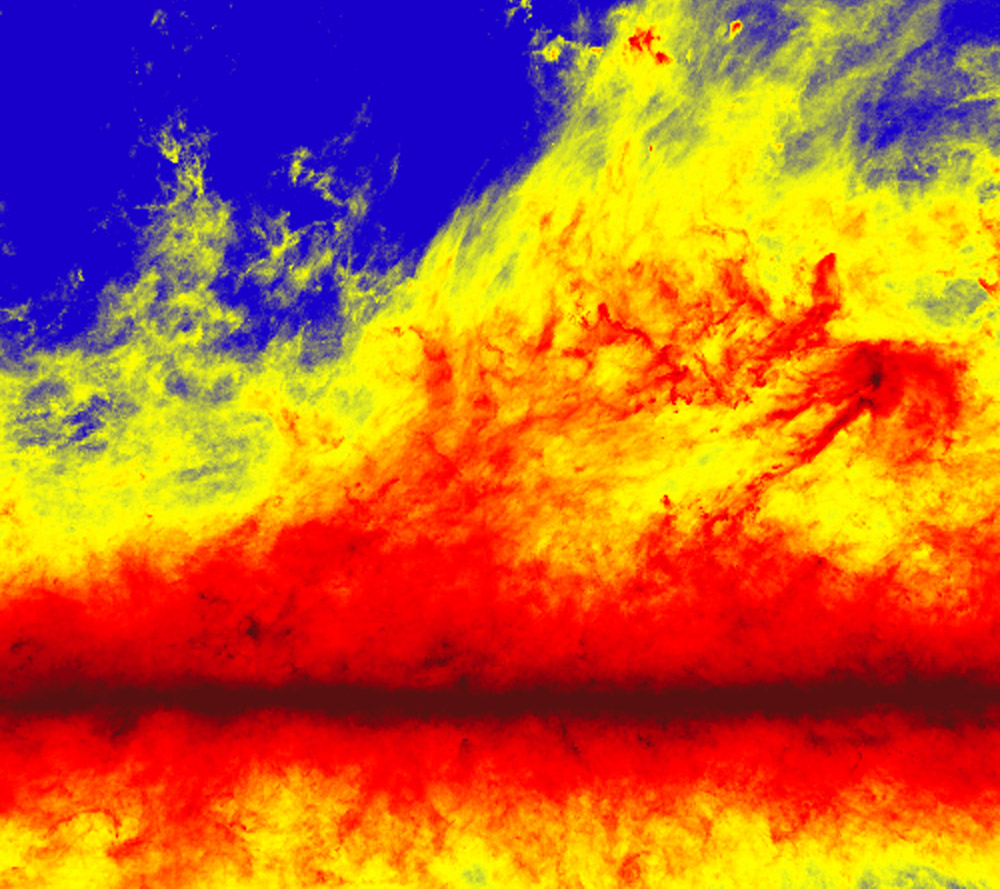
    planck_milkyway

    That is what lurks beneath the dim view our eyes collect! It’s what the European Space Agency’s Planck observatory sees when it looks at the Milky Way.

    Wow! This image is a whopping 55 square degrees of sky — 280 times the area of the full Moon on the sky — centered near the constellation of Aquila the Eagle. The resolution of the data is about 5 arcminutes, meaning objects as small as 1/6th the size of the Moon on the sky can be distinguished; that’s very high-res for images in this region of the electromagnetic spectrum. And as an astronomer who is pretty familiar with the night sky, I have to say it’s very weird to see an image like this and have almost no idea what’s in it.

    I mean, I know a lot of what I’m seeing in general, but specific objects are totally impossible to identify. That’s because this image is hugely removed from visible light. It’s a three-color image composed of separate shots in the wavelengths (think of them as colors) of 100, 350, and 540 microns. For comparison, the longest wavelength of light our eyes can see is about 0.7 microns or so; these Planck images are therefore way the heck and gone in the infrared.

    What we’re seeing is very cold dust, and by very cold I mean very cold: much of it is a frigid 12 Celsius above absolute zero. In Fahrenheit, that’s -438°. Yes, four hundred thirty eight degrees below zero.

    This represents dust far away from the warming light of stars, dust that is sitting in deep space, radiating away feebly in the far infrared. Mapping this dust tells us much about it, like how stars make dust and fling it into space, and how the dust behaves when it’s out there.

    See that bright line right down the middle? That’s the dust located in the disk of the Milky Way galaxy itself. Our galaxy is a flat disk 100,000 light years across, but maybe only 1% of that in thickness. We’re located inside that disk, so that when we look in that direction we see it projected as a line across the sky. That’s where most of the gas and stars in the galaxy are located, so that’s where most of the dust is as well.

    But I’m fascinated by the structure of the dust above the galactic plane. There are swoops and swirls, filaments and ribbons. I’m drawn to the long thin line on the right that must be dozens or hundreds of light years long; it appears to end in a swirl of dust. What the heck could be causing that? I’m not sure. There’s so much going on here that it’ll be some time before astronomers can sort it all out.

    planck_milkyway_350micronsOne thing I want to point out is the one component of that image taken at 350 microns, seen here on the left. This is extremely cold dust, and as a major geek I can’t help wonder if the structure seen here was diverted by Malcolm McDowell to swing past Veridian III.

    And if you’re looking for irony, you’ve found it: Planck is designed to investigate the Cosmic Microwave Background, the faint glow leftover from the Big Bang. As far as Planck is concerned, the Milky Way is a foreground object blocking the view! It has to map our local space very carefully so that emission can be removed from the actual target data, and reveal what the far more distant background Universe can tell us.

    It’s true in astronomy as well as so many other aspects of life: what’s signal to one is noise to another.


    Credit: ESA and the HFI Consortium


  • Update to the X-Woman’s Fingerbone | The Loom

    I’ve updated my X-woman post with an interpretation from John Hawks: there was no X-woman species.


  • NCBI ROFL: Oh, snap! You got burned! | Discoblog

    fireTop 4 ridiculous ways to get burned:

    Bouncy castle burns.
    “The bouncy castle has become a de rigeur garden accessory for children’s parties. The premise is a simple one, to contain and entertain the masses. A large and sturdy construction of a tough polymer, normally PVC, is inflated by a large air pump. The floor is the key section of the castle. Despite the appearance of being a multi-panel affair, air flows freely throughout the floor, consequently landing on one side will assist take off on the other. Any ensuing injuries would typically be the result of either colliding with fellow bouncers or awkward landings. None to date have been reported to in the peer reviewed literature. We report the case of a friction burn sustained following an afternoon in a bouncy castle.”

    Face burns caused by flambé drinks.
    “This study was conducted to identify the epidemiology of face burns in Korean adults caused by flambé drinks in the hope of developing preventive programs. We reviewed the medical records of 25 patients with burns caused by flame drinks that were admitted to the Hallym Burn Centre, Hangang Sacred Heart Hospital, Seoul, Korea, during the 30-month period of July 2002 to December 2004. The injuries occurred while drinking and spilling the whisky on the flame (68%) during the hours of social gathering and festivity.”

    Wild water rapid burns.
    “Swimming pool water slides are becoming increasingly long and adventurous. This case report and survey suggest that they may carry with them a notable risk of friction burns.”

    Pavement temperature and burns: streets of fire.
    “STUDY OBJECTIVE: To measure pavement temperatures over a 24-hour period to determine when patients are at risk for burns and to report cases of pavement burns with predisposing factors… …CONCLUSION: During summer days in the desert, pavement is often hot enough to cause burns and does so with regularity in the southwestern United States. No one should be allowed to remain in contact with hot pavement, even transiently.”

    Photo: flickr/Foxtongue

    Related content:
    Discoblog: NCBI ROFL: Managing the blue man.
    Discoblog: NCBI ROFL: Top 10 absurd papers of 2009.
    Discoblog: NCBI ROFL: Top 5 insensitive titles!

  • The Periodic Table of Science Blogging | Bad Astronomy

    This is a clever: the Periodic Table of Science Bloggers!

    periodic_bloggersDavid Bradley at Sciencebase took the periodic table of elements and associated each element symbol with a science blog. I’ve read quite a few of them, and they’re pretty good — though I wonder about using Jack of Kent; it’s a great blog (he has been terrific about explaining the Simon Singh libel case), but it’s about legal issues, not science ones! Still, lots of good blogs there.

    Of course, being the egomaniacal monster that I am, my first thought was, “Hey, I wonder what he used for barium?”, since my encyclopedic knowledge of the elements informs me that barium’s symbol is, haha, Ba. And guess what?

    Hey, wait a sec! I got robbed.


  • Gates Goes Nuclear: Billionaire Backs Fledgling Mini-Reactor Technology | 80beats

    Bill_GatesLet’s give Bill Gates some credit: Retiring from Microsoft with all the free time and money in the world, Gates could have launched any number of Montgomery Burns-ian schemes for world domination. Instead, the multi-billionaire went the philanthropist route, becoming one of DISCOVER’s 10 most influential people in science through the health work his foundation funds. But a tinkerer is never done tinkering: In the last year Gates has patented an anti-hurricane device, given a few million dollars to fund geoengineering research, and then this week went public with his newest project: small-scale nuclear power.

    A Gates-backed start-up company called TerraPower in talks with Toshiba to develop traveling-wave reactors (TWRs), which are designed to use depleted uranium as fuel and thought to hold the promise of running up to 100 years without refueling [FoxNews.com]. TWRs, which scientists have been playing with on and off for decades, need enriched uranium to get going, but are advantageous because they can use normal or even depleted uranium once the fission reaction is underway (and depleted uranium is something the United States has in great quantity). The technique requires bombarding uranium with a neutron to convert it to an unstable form of the element, which decays into neptunium and then fissile plutonium.

    Toshiba’s already been working on mini reactors that run for about 30-40 years, and they believe that about 80% of the technology used in those can be used in the traveling-wave reactors [DVICE]. One of the challenges, though, is that if you’re that efficient at burning fuel, you need materials that can withstand that many years of constant radiation. TerraPower has completed the conceptual designs for both small units that produce electricity in the hundreds of megawatts, and a gigawatt-sized reactors that could power a city. But that’s the drawing board. In other words, this is very early days. And as with any new energy technology, expectations that energy supplies will be transformed in the near future should … take a rest [Financial Times].

    Related Content:
    DISCOVER: The 10 Most Influential People in Science
    80beats: Bill Gates Patents a Device Aimed at Halting Hurricanes
    80beats: With $4.5 Million in Pocket Change, Bill Gates Funds Geoengineering Research
    Bad Astronomy: Bill Gates Gives $10 Billion for Vaccines!

    Image: Archive of the Chancellery of the President of the Republic of Poland


  • Center for Inquiry Conference in Los Angeles, October 2010 | The Intersection

    The Council for Secular Humanism is proud to announce its 30th anniversary subscribers’ conference. “Setting the Agenda: Secular Humanism’s Next 30 Years” will be held October 7 – 10, 2010, at the Millennium Biltmore Hotel in downtown Los Angeles, California. Scheduled speakers include Richard Dawkins, who will accept a very special award (to be announced); authors Sam Harris and Robert Wright, who will dialogue on humanist stances toward faith; and a glittering roster of speakers, including James Randi, P. Z. Myers, Eugenie Scott, Paul Kurtz, Lawrence Kruass, Chris Mooney, Jennifer Michael Hecht, Victor Stenger, Shadia Drury, Mark Johnson, Barry Kosmin, Ibn Warraq, and many more. Sounds like a rumble. Details here….


  • Welcome to Your Viral World | The Loom

    mtsitunes220Line up all the viruses on Earth end to end (go ahead, I’ll wait), and they’ll stretch over 10 million light years. In my new podcast, I talk to Curtis Suttle of the University of British Columbia about what it means to live on a virus-dominated planet.

  • Found: 90% of the distant Universe | Bad Astronomy

    This is fascinating news: 90% of the distant Universe was thought to be missing, but it was recently found. And what’s weird is, it was found to be in the red. Quite literally.

    [Note: before you ask, this has nothing to do with dark matter. See below!]

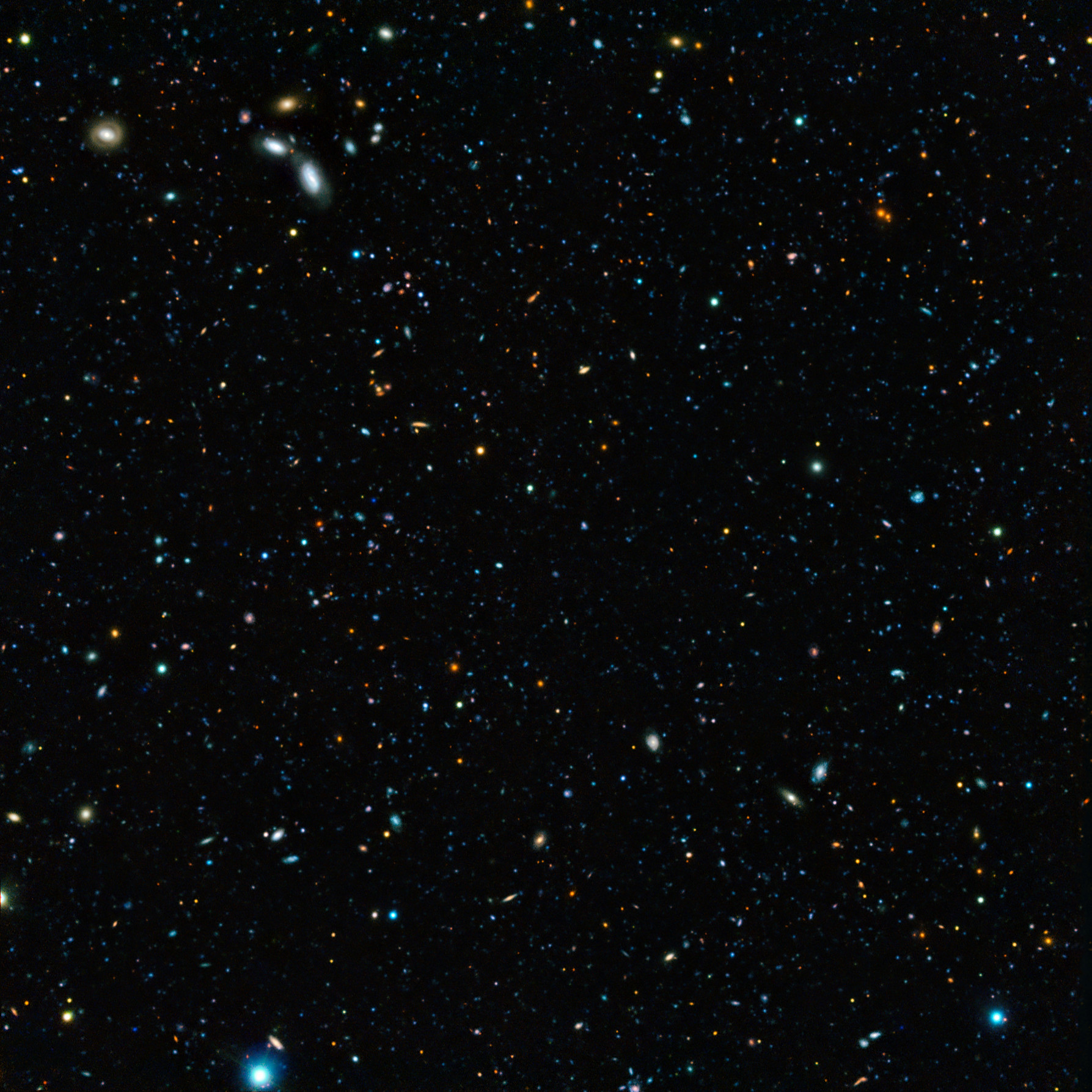
    GOODS_deepfield

    First, a bit of background. Galaxies are filled with hydrogen gas, and that gas is a major component of the clouds that collapse to form stars. When that happens, the hot stars ionize the gas: the flood of ultraviolet light strips the electron away from the proton, freeing both. If the electron gets near the proton again, they can recombine. Because of quantum mechanics, the electron can only exists in certain energy states, which are a bit like steps in a staircase. You can jump from the third step down to the second, but there is no second-and-a-halfth step.

    So it is with electrons. It used to be taught that this levels were like orbits, but that’s not a great analogy; the staircase is better. So if the electron is on the second level and drops to the first, it gives off energy in the form of light (just like when you step down you lose a bit of energy too, and it takes energy to go up a step). For the 2 to 1 step in hydrogen, the photon emitted is in the ultraviolet, and has a special name: Lyman alpha.

    Ionized hydrogen gas clouds tend to blast out lots of Lyman alpha. This makes it a good way to search for distant star forming regions; just look for that wonderful wavelength of light associated with the 2 – 1 transition of hydrogen.

    As it happens, we know that when the Universe was young, about a quarter the age it is now, star formation was going on at a much higher rate on average than it does now. So astronomers figured, hey, why not do searches for distant galaxies using Lyman alpha? They should pump it out, and make them easy to see.

    So they looked. And to their surprise, they only found about 10% of the galaxies they predicted they should!

    Uh oh.

    This has been a problem for some time. But it’s not anymore: a recent experiment by astronomers shows that the galaxies are there, but they’re hidden!

    What they did is look in one part of the sky, using the GOODS South field (part of which is pictured above), trying to find Lyman alpha emitting galaxies. Then they looked at the same region, but looked instead for H alpha, the line emitted when an electron jumps down from the third energy level to the second. And guess what they found: tons of galaxies!

    The problem, they surmised, is that the galaxies are actually there and emitting Lyman alpha. But before that ultraviolet light can get out of one of those galaxies, it gets reabsorbed by gas inside the galaxy itself. We never see it.

    But H alpha can more easily escape the galaxies once it’s produced. For one thing, it’s red light, and that can penetrate the gas and dust better than the ultraviolet Lyman alpha light can. There are other more complicated reasons as well, but the point is, the galaxies were simply hidden from us before, but not anymore. By extrapolating their results, it looks like they found 90% of the distant Universe!

    I’ll note: this has nothing to do with dark matter. As it happens, 90% of the matter in the Universe is in a form that emits no light, but affects other matter through gravity. We know it exists, and you can find out why here. We know it exists locally, in nearby galaxies and clusters of galaxies, too. This new result doesn’t affect that, since the now un-hidden galaxies are very far away, like many billions of light years away. They can’t possibly affect nearby galaxies, so they don’t account for dark matter.

    I love this study. It’s a great application of simple logic, though it wasn’t so simple to do: they had to use a lot of time on a monster 8 meter telescope to do it! But they were able to answer a question that has been around for some time, and it really does look like they’ve solved it.

    And, as always, it makes me wonder what else is lurking out there in space, hidden but for a leap of logic and technology that will allow us to unveil it. Science is all about thinking around problems, and peeking into dusty corners. Sometimes the most interesting things are found there… including, in this case, the vast majority of the Universe!

  • 5 Questions: He Put Three D’s in DNA

    A few years back, Erez Lieberman-Aiden got a sobering lesson in how difficult it still is to understand the code of life: His professor had spent six long months just trying to calculate the distance between two pieces of a genome. Lieberman-Aiden envisioned a quicker way, and one night in March 2008 he started sketching some ideas. When he woke up the next morning, he had a plan. Last October, while completing a joint Ph.D. in math and bioengineering at Harvard and MIT, he led a team that published a three-dimensional model of the human genome, a major advance in deciphering how DNA actually regulates the machinery of life.

    What is special about your 3-D model?
    One of the central mysteries of biology is why the genome is largely identical from cell to cell, even though cells do different things. We showed that regulation of these cells is associated with the three-dimensional remodeling of the genome, which turns genes on and off…

  • Proposal to Regulate De-Finning of Sharks De-feated | 80beats

    Shark_finsIn a victory for East Asian nations that consume sharkfin soup, the Convention on International Trade in Endangered Species (CITES) has shot down three of four proposals to protect sharks. Member nations of CITES who gathered in Doha, Qatar, rejected proposals that would have required countries to strictly regulate — but not ban — trade in several species of scalloped hammerhead, oceanic whitetip and spiny dogfish sharks [The New York Times]. Japan also lobbied against the protections, because it strongly opposes extending the convention’s protections to any marine species (including the bluefin tuna that is so beloved by Japan’s sushi connoisseurs).

    The only proposal that managed to get through was a proposal from the European Union and the island nation of Palau to protect the porbeagle shark, which is prized for its meat. But even this victory is a shallow one, as the proposal passed by a margin of just one vote, and could be overturned at the conference’s final session on Thursday.

    Marine biologists have long warned that hammerhead and whitefin sharks are being overfished, particularly by countries like China where sharkfin soup is a prestigious delicacy. Fishermen harvest the fins and typically throw the sharks back into the sea to die. The rate of species decline in some areas is an astounding 90 percent. Japan led opposition to the four measures, arguing that management of shark populations should be left to regional fisheries groups, not CITES [Sydney Morning Herald].

    The current CITES meeting has been seen by some conservation experts as a dispiriting sign that the convention isn’t making its decisions about endangered species based on scientific findings, but is instead bowing to politics and economic interests. “It appears that science no longer matters,” said Elizabeth Griffin of wildlife conservation group Oceana, based in Washington. “CITES is not fulfilling its obligation to protect species threatened by international trade” [Sydney Morning Herald].

    Stuart Beck, Palau’s ambassador to the United Nations, neatly summed up the anger felt by conservationists after the shark protections failed, saying in a statement: “I am sure that, properly prepared, bald eagle is delicious. But, as civilized people, we simply do not eat it” [The New York Times].

    Related Content:
    80beats: Endangered Species Meeting Brings Good News for Elephants, Bad News for Coral
    80beats: Bluefin Tuna is Still on the Menu: Trade Ban Fails at International Summit
    80beats: DNA Forensics Traces Sharks Killed for Their Fins
    80beats: Human Appetite for Sharks Pushes Many Toward Extinction

    Image: Wikimedia


  • Will Watching Videos of the Great Outdoors Make Cows “Happy and Productive”? | Discoblog

    russian_cowsSome people play Mozart to unborn babies in hopes of increasing their brain power, or talk to their plants in hopes of making them grow faster, so will subjecting cows to hours of video footage of the verdant Swiss Alps make them more productive?

    Well, we don’t know yet. But a Russian farmer has invested the time and the LCD TV’s to find out.

    News reports indicate that the farmer has rigged one side of his shed with 40-inch LCD TVs so that one row of cows can watch footage of the Swiss Alps, where the grass is green and the skies are blue. The cows on the other side are afforded no such diversion.

    The farmer is monitoring his cattle to see if the TV-watching cows are more “happy and productive.”

    TV is great, but you know what might be even greater? Letting the cows out of the shed once in a while to let them get a taste of the real green stuff.

    Related Content:
    80beats: Cows Can Feel the Pull of Magnetic North
    Discoblog: Want More Milk? Then Name Your Cows
    DISCOVER: Fighting Cow Methane With Food
    DISCOVER: All Aboard The Cow Train
    Discoblog: Scientists Build Fake Burping Cows

    Image: Gizmodo/Ecorazzi


  • Study: Massive Lava Flows Allowed Dinosaurs to Conquer the Planet | 80beats

    TriassicExEventEarlier this month, a study in the journal Science tried to put to bed for good the question of dinosaur extinction: It was an impact from space, not large-scale volcanic activity, that wiped them out 65 million years ago, the study argued. That’s all well and good for the dinosaur’s end, but what about their beginning?

    This week in the Proceedings of the National Academy of Sciences, paleontologists say they’ve studied the period about 200 million years ago when dinosaurs first came to power, and found that while catastrophic volcanic activity may not explain dinosaur extinction, it could have explained why dinosaurs’ competitors disappeared and the terrible lizards took over the planet.

    Around the time of dino emergence, the continents were all locked up in the supercontinent Pangaea. As it pulled apart, researchers say the seismic activity gave rise to hundreds of thousands of years of volcanic activity, creating lava fields on the surface of the Earth the size of the continental United States. For this study, Jessica Whiteside and colleagues surveyed wood remnants, wax from ancient leaves, and whatever else they could extract from the volcanic flow’s remains to reconstruct what was happening in the climate of this period.

    The scientists examined how two different isotopes (or forms) of carbon fluctuated during these volcanic eruptions. They found that the “heavy” form of carbon was depleted relative to the “light” form. They say this reflects disturbances in the carbon cycle at this time, including a spike in atmospheric carbon dioxide (CO2) and aerosols (fine solid particles) [BBC News].

    That finding, Whiteside says, reinforces the connection between volcano-induced runaway global warming and the great extinction 200 million years ago, which marks the boundary between the Triassic and Jurassic periods and the ascendancy of the dinosaurs. Before the rise of the dinosaurs, the animal world was dominated by crurotarsans, ancient relatives of modern crocodiles. But as their populations crashed, early therapods, the group of dinosaurs that includes all meat-eating species from Velociraptor to Tyrannosaurus rex, gained ground and thrived [The Guardian].

    This leaves at least one burning question, though: If raging volcanoes and lava flows the size of the United States made the planet hot and inhospitable, why did the dinosaurs survive while their competitors vanished? Scientists who study the crurotarsans found that they evolved at a similar rate as dinosaurs, who were not superior except for having evolved slightly more rapidly. The researchers also found that there were more varieties of crurotarsans, who were also more numerous and more adapted than dinosaurs, and thus had greater chances of prospering and ruling on Earth [AFP]. Thus, Whiteside says, it might have been no more than dumb luck that permitted dinosaur survival—and world domination.

    Related Content:
    80beats: Rock-Solid Science: A 6-Mile-Wide Space Rock Did Wipe Out the Dinosaurs, Experts Say
    80beats: Forget “The Asteroid”: Could Supervolcanoes Have Killed the Dinosaurs?
    80beats: In the Permian Period, Erupting Super-Volcanoes May Have Killed Half the Planet
    80beats: Dinosaurs Ruled the World Because They “Got Lucky,” Say Scientists

    Image: Jessica H. Whiteside (Site in Nova Scotia, Canada. The end-Triassic layer is in white.)


  • For a High-Tech Easter Egg Hunt, Let GPS Be Your Guide | Discoblog

    Geocache_near_Špilberk_CastSince our entire lives have moved online and we’re all as wired as someone who has just gulped down ten cups of coffee, why should our Easter egg hunts be old-fashioned? This year, give your egg hunt an upgrade and embark on a high tech search with “geocaching.” Geocaching is a craze sweeping the great outdoors in which people use GPS coordinates to look for hidden treasures.

    The organizer gives the participants GPS coordinates of the first stash, or cache. Using a GPS-enabled device, the hunters look for the cache–which could be a simple weatherproof container like a Tupperware box or thermos–hidden somewhere outdoors. A container typically contains a log book for the finder to sign, a few trinkets, and the coordinates for the next stash. This ensures the treasure hunt keeps going on till the seeker finds all the caches. For the Easter variant of geocaching, event organizers are planning to hide the stash coordinates in plastic Easter eggs.

    According to enthusiasts, this high-tech treasure hunt is good fun and can also be exhausting, as GPS coordinates only take the hunter to within six to 20 feet of where the treasure is buried. Once the GPS has done its best to get a seeker to the desired location, it’s anyone’s guess which rock or tree hides the cache.

    Naturalist Jill Snyder, who is organizing one such geocaching event this Easter, told the Associated Press that these hunts can reveal the searcher’s inner child:

    “If you loved looking for Easter eggs as a kid then geocaching definitely is for you…. You approach finding caches in the same way that you would an Easter egg except that you have a GPS to guide you.”

    Related Content:
    Discoblog: Afraid of Losing a Lady Friend? Give Her GPS Lingerie
    80beats: GPS Tracks Brutus the Wolf on Marathon Hunts Around the Arctic
    80beats: Lost People Really Do Walk Around in Circles!
    80beats: Lost in Space: GPS System May Soon Begin Deteriorating

    Image:Wikimedia


  • The Moral Equivalent of the Parallel Postulate | Cosmic Variance

    Sam Harris gave a TED talk, in which he claims that science can tell us what to value, or how to be moral. Unfortunately I completely disagree with his major point. (Via Jerry Coyne and 3 Quarks Daily.)

    He starts by admitting that most people are skeptical that science can lead us to certain values; science can tell us what is, but not what ought to be. There is a old saying, going back to David Hume, that you can’t derive ought from is. And Hume was right! You can’t derive ought from is. Yet people insist on trying.

    Harris uses an ancient strategy to slip morality into what starts out as description. He says:

    Values are a certain kind of fact. They are facts about the well-being of conscious creatures… If we’re more concerned about our fellow primates than we are about insects, as indeed we are, it’s because we think they are exposed to a greater range of potential happiness and suffering. The crucial thing to notice here is that this is a factual claim.

    Let’s grant the factual nature of the claim that primates are exposed to a greater range of happiness and suffering than insects or rocks. So what? That doesn’t mean we should care about their suffering or happiness; it doesn’t imply anything at all about morality, how we ought to feel, or how to draw the line between right and wrong.

    Morality and science operate in very different ways. In science, our judgments are ultimately grounded in data; when it comes to values we have no such recourse. If I believe in the Big Bang model and you believe in the Steady State cosmology, I can point to the successful predictions of the cosmic background radiation, light element nucleosynthesis, evolution of large-scale structure, and so on. Eventually you would either agree or be relegated to crackpot status. But what if I believe that the highest moral good is to be found in the autonomy of the individual, while you believe that the highest good is to maximize the utility of some societal group? What are the data we can point to in order to adjudicate this disagreement? We might use empirical means to measure whether one preference or the other leads to systems that give people more successful lives on some particular scale — but that’s presuming the answer, not deriving it. Who decides what is a successful life? It’s ultimately a personal choice, not an objective truth to be found simply by looking closely at the world. How are we to balance individual rights against the collective good? You can do all the experiments you like and never find an answer to that question.

    Harris is doing exactly what Hume warned against, in a move that is at least as old as Plato: he’s noticing that most people are, as a matter of empirical fact, more concerned about the fate of primates than the fate of insects, and taking that as evidence that we ought to be more concerned about them; that it is morally correct to have those feelings. But that’s a non sequitur. After all, not everyone is all that concerned about the happiness and suffering of primates, or even of other human beings; some people take pleasure in torturing them. And even if they didn’t, again, so what? We are simply stating facts about how human beings feel, from which we have no warrant whatsoever to conclude things about how they should feel.

    Attempts to derive ought from is are like attempts to reach an odd number by adding together even numbers. If someone claims that they’ve done it, you don’t have to check their math; you know that they’ve made a mistake. Or, to choose a different mathematical analogy, any particular judgment about right and wrong is like Euclid’s parallel postulate in geometry; there is not a unique choice that is compatible with the other axioms, and different choices could in principle give different interesting moral philosophies.

    A big part of the temptation to insist that moral judgments are objectively true is that we would like to have justification for arguing against what we see as moral outrages when they occur. But there’s no reason why we can’t be judgmental and firm in our personal convictions, even if we are honest that those convictions don’t have the same status as objective laws of nature. In the real world, when we disagree with someone else’s moral judgments, we try to persuade them to see things our way; if that fails, we may (as a society) resort to more dramatic measures like throwing them in jail. But our ability to persuade others that they are being immoral is completely unaffected — and indeed, may even be hindered — by pretending that our version of morality is objectively true. In the end, we will always be appealing to their own moral senses, which may or may not coincide with ours.

    The unfortunate part of this is that Harris says a lot of true and interesting things, and threatens to undermine the power of his argument by insisting on the objectivity of moral judgments. There are not objective moral truths (where “objective” means “existing independently of human invention”), but there are real human beings with complex sets of preferences. What we call “morality” is an outgrowth of the interplay of those preferences with the world around us, and in particular with other human beings. The project of moral philosophy is to make sense of our preferences, to try to make them logically consistent, to reconcile them with the preferences of others and the realities of our environments, and to discover how to fulfill them most efficiently. Science can be extremely helpful, even crucial, in that task. We live in a universe governed by natural laws, and it makes all the sense in the world to think that a clear understanding of those laws will be useful in helping us live our lives — for example, when it comes to abortion or gay marriage. When Harris talks about how people can reach different states of happiness, or how societies can become more successful, the relevance of science to these goals is absolutely real and worth stressing.

    Which is why it’s a shame to get the whole thing off on the wrong foot by insisting that values are simply a particular version of empirical facts. When people share values, facts can be very helpful to them in advancing their goals. But when they don’t share values, there’s no way to show that one of the parties is “objectively wrong.” And when you start thinking that there is, a whole set of dangerous mistakes begins to threaten. It’s okay to admit that values can’t be derived from facts — science is great, but it’s not the only thing in the world.


  • A Blazing Hot Helium Rain Falls on Jupiter | 80beats

    JupiterNASAWe silly humans tend to think of rain just in our own terms, the falling water tainted with various toxins that draws out our umbrellas and cancels our baseball games. But across the solar system, it rains on other worlds with thick atmospheres–it’s just not rain we would recognize. On Saturn’s moon Titan, for instance, it rains methane. And now, a group of scientists says in Physical Review Letters, computer simulations have confirmed that it rains helium on Jupiter.

    The term “rain” applies loosely here, because the hellfire precipitation happening on Jupiter isn’t much like a pleasant afternoon shower here on Earth. Droplets of helium form thousands of miles below the tops of hydrogen clouds, at temperatures around 9,000 degrees Fahrenheit–the helium stays in its liquid phase because of the planet’s high atmospheric pressure. Pressures and temperatures on Jupiter are so high that the droplets of liquid helium are falling through a fluid of metallic hydrogen [Space.com].

    Curiously, the key to figuring out Jupiter’s helium rain was the mystery surrounding the element neon. Since neon is a noble gas that doesn’t react much with other elements, researchers expected to see concentrations of it in the gas giant planet’s atmosphere. But the Galileo probe that plunged into Jupiter’s upper atmosphere Dec. 7, 1995, found only about one-ninth the amount of neon that should have been there. There was also less helium than expected, even though helium and hydrogen are the two main constituents of the planet [Los Angeles Times]. Hugh Wilson and colleagues had suspected that the answer to this puzzle might be helium rain falling out of the atmosphere to the lower depths of the planet, carrying neon with it. And, they say, their simulation of the mixing of gases inside our solar system’s largest planet showed a layer of helium would be formed that would cause this “rain” effect.

    HeliumRainJupiterThat explains the dearth of helium and neon. Unlike rain, fog and other weather systems on Earth, helium droplets on Jupiter don’t cycle through the atmosphere, but instead are being deposited deep into the planet [Discovery News]. The scientists say the effect might not be limited to Jupiter, either. Because Saturn is smaller and colder than Jupiter, the physics suggest that helium rain could be even more widespread there. However, despite Cassini’s continued surveillance of the planet, no probe has dived into Saturn’s atmosphere to take the kind of measurements Galileo took of Jupiter.

    Train was wrong, then. Rather than “Drops of Jupiter,” the band should have written “Drops on Jupiter.”

    Related Content:
    DISCOVER: Spotted: Methane Rain on Titan
    80beats: Jupiter’s Great Red Spot Reveals Its Stormy Secrets
    80beats: Cassini Sends Back Ravishing New Photos of Saturn’s Rings
    80beats: 400 Years After Galileo Spotted Them, the Moons of Jupiter Are Looking Fly (slide show)
    80beats: Mysterious Smash on Jupiter Leaves an Earth-Sized Scar

    Image: NASA; Hugh F. Wilson and Burkhard Militzer, University of California, Berkeley


  • Wired Excerpts Hack the Planet | The Intersection

    We’re big fans here of Eli Kintisch’s new book Hack the Planet…and now you can read some of it, thanks to an exclusive online excerpt over at Wired.com. A brief excerpt of the excerpt: The idea of deliberately manipulating the weather or the climate is an especially powerful notion. We equate weather with mood because our bodies are so affected by temperature and moisture and light. Storms trouble our minds as well as threaten our coasts. Climate is our experience of the weather over time and space, the way weather shapes our summers or our neighborhoods. To control climate — especially now, at a time when it seems so unpredictable — promises stability and peace for us and our children. The seductive idea of weather and climate control has been a constant trope in the human imagination. The sorcerer Prospero in Shakespeare’s Tempest conjures bad weather to drive his enemy’s boat ashore. In the 1985 film Brewster’s Millions, Montgomery Brewster, played by Richard Pryor, invests in a scheme to haul icebergs to the Middle East to provide water. Advanced societies control the weather as a matter of course in the worlds of Star Trek and Dune. When it comes to our air …