Author: Discover Main Feed

  • Peering into Jupiter’s red eye | Bad Astronomy

    Jupiter’s Great Red Spot is perhaps its most iconic feature. It’s a vast storm, a bloody-colored hurricane that is at least four centuries old, and larger in size than several Earths. It can be seen easily even in a small telescope, and is one of the most studied features in the solar system.

    Yet for all that, it’s still poorly understood. How has it lasted so long? What is going on inside of it? How did it form in the first place?

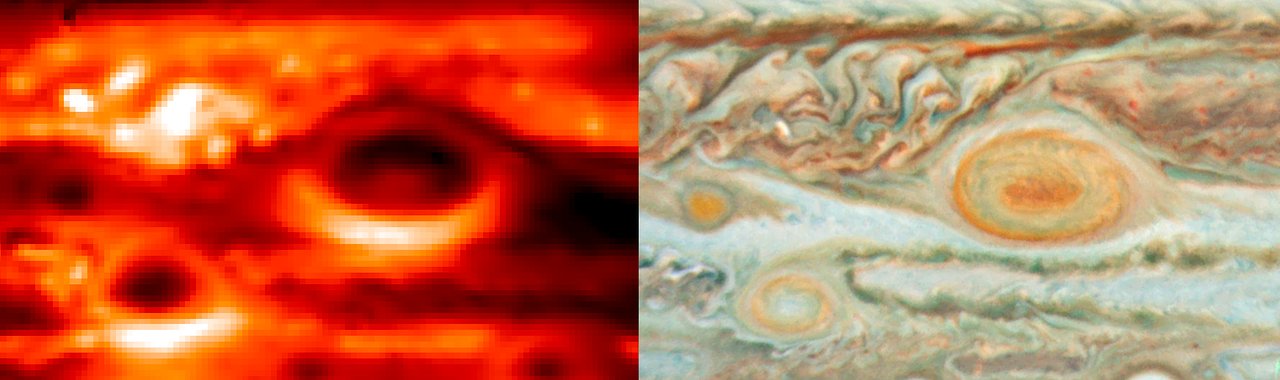
    New observations using the Very Large Telescope (together with data from the Gemini, Subaru, and IRTF observatories) have taken us a step closer to finding the answers:

    vlt_redspot

    Cooooool. On top is an infrared view of the Spot (as well as its little brother, Oval BA, on the left) from the VLT taken in 2008, and on bottom, for comparison, is the same view from Hubble taken just days earlier. The VLT image was taken at a wavelength of 10.8 microns, about 14 times the wavelength our eye can see. Objects at just about the freezing point of water emit IR at that wavelength. On Jupiter, the atmosphere at a pressure about half of Earth’s pressure at sea level emits at that temperature and wavelength.

    What these images show is how Jupiter’s atmosphere circulates up and down in the Spot. The core of the Spot, which appears red to our eye, is warm, and dark lanes are where the gas is being drawn down into Jupiter’s depths. Because the center is warmer — by just a few degrees — it provides an upwelling in the middle of the Spot. This upwelling creates a weak clockwise flow of air, despite the storm’s general counter-clockwise rotation.

    More importantly, these observations link the color of the Spot to temperature, even if the exact mechanism for this link is unknown. But any clues we can find will help us understand this incredible hurricane bigger than some planets. Mind you, studying them on Jupiter gives us insight into how storms behave on Earth as well. Scientific observations thrive on diversity, on comparing one set of conditions to another, and seeing how the outcome changes.

    Jupiter is vastly different than Earth, but by gazing at it we gaze back at ourselves. That’s the way science works.


  • Bioscience: A Fab Review of the Tangled Bank | The Loom

    zimmercover220.jpgAnother great review of the Tangled Bank, this time from Bioscience, the journal of the American Institute of Biological Sciences:

    “In the best of all worlds, every educated American could and should read this book, and as a result, would have a much richer understanding of evolution as a force directly affecting our lives.”

    (NB–Even if you don’t live in the U.S., you may want to check it out!)


  • The X-Woman’s Fingerbone | The Loom

    In a cave in Siberia, scientists have found a 40,000-year old pinky bone that could belong to an entirely new species of hominid. Or it may be yet another example of how hard it is to figure where one species stops and another begins–even when one of those species is our own. Big news, perhaps, or ambiguous news.

    In Nature today, Svante Paabo and his colleagues published a paper describing how their work in a place known as the Denisova Cave in the Altai Mountains of Siberia. There are lots of hominid bones and tools indicating people lived in the cave, off and on, for 125,000 years. There’s good evidence of Homo sapiens in the region for at least 40,000 years, and Paabo and his colleagues have also isolated 30,000-year old DNA from Siberian sites that is similar to the DNA from Neanderthals in Europe.

    The scientists succeeded in fishing out human-like DNA from the pinky bone, and so far they’ve sequenced its mitochondrial DNA–that is, the DNA that is housed in mitochondria, sausage-shaped, fuel-producing structures in our cells. The majority of our DNA, which sits in the nucleus of cells, comes from both our mother and father. But mitochondrial DNA comes all from Mom. When the scientists compared the pinky DNA to DNA of humans and Neanderthals, they got something of a shock. If you line up the mitochondrial DNA from any given living human to any other living human, you might expect to find a few dozen points at which they are different. Compare human mtDNA to Neanderthal DNA, and you’ll find about 200 differences. But when the scientists compared the Denisova DNA to a group of human mitochondrial genomes, they found nearly 400 differences. In other words, their DNA was about twice as different from ours than Neanderthal DNA.

    The scientists then used the DNA to draw a family tree. Here’s the figure from the paper, which you can also see here for full-size viewing.

    full xwoman tree600The Denisova mitochondrial DNA has been passed down, mother to child, on a lineage of hominids that’s separate from the one that produced mitochondria in Neanderthals and in living humans. Paabo and his colleagues estimated the age of common ancestor from which all the mitochondria evolved, based on the mutations in each branch. They concluded that common ancestor lived 1 million years ago. Below is a simple tree that shows the timing more clearly, from an accompanying commentary in Nature.

    simple xwoman treeNo matter how you slice it, this is very exciting. All the mitochondrial DNA from living humans is believed to date back just 150,ooo years. That doesn’t mean that we all descend from a single “Eve.” There were other woman around at the time, and they passed down their own mitochondria. But those lineages eventually hit dead ends. In some cases, women only had sons. In others, they never had children. Eventually, all the mitochondrial DNA in the human population could be traced to only one of the women alive at the time.

    All the Neanderthal mitochondrial DNA also shares a relatively recent common ancestor of its own–probably thanks to the same process. And now, for the first time, scientists have found hominid mitochondrial DNA that comes from a far more ancient split.

    So–how to explain this? A couple possibilities present themselves.

    1. The DNA belongs to a species of hominid that’s neither human nor Neanderthal.

    This is the most interesting, most science-fictionish possibility.

    Our hominid ancestors evolved into upright apes in Africa some six million years ago. By about 1.9 million years ago, some of those hominids had made their way out of Africa and strolled all the way to Indonesia. They go by the name of Homo erectus, and they stuck around Asia for quite a long time–some would argue they were still around 40,000 years ago. Neanderthals appear to have evolved from another wave out of Africa, which spread to Europe and Siberia several hundred thousand years ago. Meanwhile, our own ancestors appear to have stayed put in Africa. The oldest fossils of anatomically modern humans come from Africa 200,000 years ago, for example, and studies on human DNA find that African lineages are the oldest.

    The Denisova DNA split too recently from our own to have been carried by H. erectus, the first globe-trotting hominids. But paleoanthropologists have found a fair number of other hominid fossils in Europe and Asia that might belong to more recent waves out of Africa. (Here, for example, is a report on hominids in Europe 1.2 million years ago.) So perhaps there was at least one other wave aside from H. erectus, the expansion of Neanderthals, and the spread of modern humans. If that’s true, this new discovery also means that this wave produced a long lineage of hominids that survived long enough to live alongside humans. We coexisted with yet another species of hominid–along with Neanderthals, H. erectus, and those lovable hobbits, Homo floresiensisfor thousands of years. Our current solitude is a recent fluke.

    If #1 turns out to be true, then this DNA deserves a species name of its own. But for now, Paabo and his colleagues have refrained from giving it one. Instead, they’ve nicknamed the source of the DNA “X-woman.” Why the reticence? Probably because of possibility #2…

    2. The DNA comes from the finger of a Neanderthal or a human–thanks to a love that dare not speak its name. Imagine, if you will, that an early Neanderthal male takes a morning constitutional in search of woolly rhinos when, gadzooks, he meets up with a fetching X-woman hominid. For whatever reason, the two of them decide to have an interspecies tryst, and X-woman gets pregnant. She gives birth to a girl carrying Neanderthal and X-woman DNA in her nucleus–and nothing but X-woman DNA in her mitochondria. Somehow this girl becomes a part of Neanderthal society; she has Neanderthal children of her own, and they continue to carry the X-woman mitochondrial DNA.

    Remember that in every generation, nuclear DNA gets mixed up. Half of the DNA a child carries in the nucleus comes from its father, half from its mother. And with the generation of new eggs and sperm, chromosomes from each parent get chopped up and shuffled back into new combinations. So over generations, the X-woman DNA might gradually dwindle away from the Neanderthal gene pool–but some Neanderthals might still carry X-woman mitochondria, handed down from mother to daughter to grand-daughter.

    (It’s also possible that the interbreeding male in this scenario was a human–although just in terms of timing, that’s less likely, since Neanderthals were out of Africa sooner than we were.)

    One reason to take this possibility seriously is the fact that other primate species regularly mix up their DNA in just this way. Mongoose lemurs expanded into the range of brown lemurs, for example, and mitochondrial DNA ended up jumping the species barrier. In many cases, the species were separated by a million years or so, just like the Denisov DNA and human/Neanderthal DNA. (This is why it’s hard to use DNA-barcoding to tell closely related primates apart.) Another reason to take this possibility serious is lies in our own genomes. Some scientists have made a forceful case for the presence of ancient non-human DNA in the gene pool of living humans.

    Still, even if this scenario turned out to be right, it would mean that a previously unknown X-woman hominid line expanded out of Africa and lived in Asia until relatively recently. Whether that lineage could be rightly considered a separate species of its own is tricky. (For more on that trickiness, see my article, “What is a Species?” from Scientific American.)

    I can imagine other possible interpretations, but I’m not sure how plausible they really are. I’ve sent out some queries to some experts, and will add anything interesting I get back [Update: See the end of the post]. Fortunately, it may be possible to rule some possibilities out in just a few months. Paabo and company are busily churning out the sequence of the nuclear DNA from the Denisova pinky. It’s conceivable that the nuclear DNA will be a lot more like human DNA, or a lot more like Neanderthal DNA–making it likely that the fossil belongs to a hybrid. But if the nuclear DNA is just as exotic as the mitochondria, then perhaps the finger bone really does belong to a distinct species that lived 40,000 years ago–a species, it’s worth pointing out, that left its bones behind in the same layer of sediment where Russian scientists have dug up tools and ornaments made of stone and antler.

    The possibility of a highly intelligent Siberian Other will have to dance in our heads until more studies come out.

    Update: After I posted this, the paleoanthropologist John Hawks offers an alternative explanation on his blog. I followed up with a few questions via email, and based on his post and his reply, here’s my quick distillation:

    Maybe the X-woman was not a separate species at all.

    Wind back the clock to a million years ago. In Africa, there’s a population of hominids that will eventually give rise to Neanderthals and humans. The Neanderthal lineage expands out across Europe and Asia. They take with them a wide diversity of mitochondria. Most of the studies on Neanderthal DNA have focused on European Neanderthals–and have thus only captured a limited sample of that diversity. Now, in Siberia, Paabo and his colleagues have moved so far from the areas they had studied before that they’re finally getting to other branches of Neanderthal mitochondria.

    In this scenario, Neanderthals play a role similar to that of Africans in the diversity of living humans. In Africa, you can find people with genes belonging to very old lineages. The Khoisan bushmen of southern Africa, for example, have genes that branched off from all other human lineages long ago. In other words, the genes of other Africans share a closer ancestor with genes from people out of Africa. Likewise, some Neanderthal mitochondrial DNA is more like human DNA than it is to the Neanderthal DNA found in the Denisova pinky.

    I’ll post more replies as they come in.

    Reference: Krause et al., “The complete mitochondrial DNA genome of an unknown hominin from southern Siberia” Nature, doi:10.1038/nature08976


  • NCBI ROFL: The locomotion of dairy cows on concrete floors that are dry, wet, or covered with a slurry of excreta. | Discoblog

    2864838911_e0772dbabd“Six dairy cows were trained to individually walk down a concrete aisle for a food reward. Their locomotion was then examined in a switchback experiment as the floor surface of the aisle was changed from dry to wetted concrete or concrete covered by shallow (5 cm) or deep (12.5 cm) slurry from cattle excreta…  Cow locomotion was measured over the second half of the aisle, and limb angles recorded as the cow passed a video camera. Wetting the floor did not affect the walking or stepping rate, but it reduced the arc made by the joints of the hindlimb during the supporting phase. Slurry caused the cows to keep their legs more vertical at the end of the support phase, probably to aid lifting the limb out of the slurry. It also caused the cows to place their forelimbs down less vertically at the start of the support phase, probably because of the reduced risk of slip in the slurry. When the floor was covered with either the deep or, to a lesser extent, the shallow slurry, the cows’ walking and stepping rates were reduced, and on the floor covered with deep slurry their step length was increased. Therefore slurry reduces the cow’s walking speed and alters limb angles during the support phase, producing a different walking pattern from cows on dry or wetted concrete.”

    cow_slip_shit

    Photo: flickr/Arnoooo

    Related content:
    Discoblog: NCBI ROFL: Mummified cow fetus.
    Discoblog: NCBI ROFL: Salmonella excretion in joy-riding pigs.
    Discoblog: NCBI ROFL: fun with animals.


  • The very definition of awesome. Calloo callay! | Bad Astronomy

    If I had to define awesome, it would be: Sir Christopher Lee reads my favorite poem, “The Jabberwocky”.


    Yup. Awesome.

    Original link: Times Online Entertainment. Tip o’ the vorpal blade to Fark.


  • In Search of the Mind’s Eye | The Loom

    Writing about the brain can sometimes bring me amazingly close to my readers–so close that I feel like I’m inside their minds. Case in point: my new column for Discover, on the subject of the mind’s eye.

    Here’s how it begins:

    One day in 2005, a retired building surveyor in Edinburgh visited his doctor with a strange complaint: His mind’s eye had suddenly gone blind.

    The surveyor, referred to as MX by his doctors, was 65 at the time. He had always felt that he possessed an exceptional talent for picturing things in his mind. The skill had come in handy in his job, allowing MX to recall the fine details of the buildings he surveyed. Just before drifting off to sleep, he enjoyed running through recent events as if he were watching a movie. He could picture his family, his friends, and even characters in the books he read.

    Then these images all vanished. The change happened shortly after MX went to a hospital to have his blocked coronary arteries treated. As a cardiologist snaked a tube into the arteries and cleared out the obstructions, MX felt a “reverberation” in his head and a tingling in his left arm. He didn’t think to mention it to his doctors at the time. But four days later he realized that when he closed his eyes, all was darkness.

    I describe the singular case of MX, and what he tells scientists about our mind’s eye. The original paper that inspired the column compared MX to a group of normal men of his age and profession to figure out what was unique about him. But to my surprise–and to the surprise of the scientists I wrote about–a lot of readers felt a great kinship with MX.

    Discover is running a selection of letters to the editor about the column, and a response from the scientists. It won’t be available online, but I was so fascinated by the exchange that I’m reprinting it here.

    In March’s “The Brain” [page 28], Carl Zimmer assumes that having a mind’s eye is a normal function of the human senses. Yet I have never had a mind’s eye, and when I bring this up in conversation others often voice the same complaint. How common is this?
    Marshall Krause San Geronimo, CA

    Neuroscientists Adam Zeman and Sergio Della Sala reply:
    We have encountered people who report that they have never experienced imagery; they seem little if at all disabled by their deficiency. We hope to study this neglected phenomenon using psychological and brain imaging techniques like those with which we explored the case of MX. Such research may help explain both the basis of imagery production in the brain and how (if at all) imagery is useful to us.

    I enjoyed reading about MX and his mind’s-eye blindness. Were MX’s dream experiences also affected by this affliction?
    Arlene Barker Homer City, PA

    Zeman and Della Sala reply:
    For about a year after the loss of his mind’s eye, MX reported that he dreamed without visual imagery. But then his visual dreaming recovered at night, even though his mind’s eye remained blank by day. This suggests that the brain mechanisms involved in dreaming can be teased apart from those involved in deliberate imagery formation.

  • Stock Market Seems to Like ObamaCare | The Intersection

    A 100 point gain for the Dow. 18 month highs for all three indices. Maybe Democrats aren’t so bad for the economy after all?

  • In 1 Week, the LHC Will Try to Earn the Title, “Big Bang Machine” | 80beats

    lhc-tunnelAre you ready for some subatomic smash-ups? Good, because the Large Hadron Collider is about ready to get serious. Everyone’s favorite long-delayed particle collider fended off rumors of its demise earlier in the month, and last week it reached a new energy record for its circulating proton beams: 3.5 trillion electron volts (TeV). That marked the highest particle energy ever accomplished by humans. A week from today, March 30, the LHC will start trying to smash those two beams together for the highest energy collisions yet.

    “Just lining the beams up is a challenge in itself: it’s a bit like firing needles across the Atlantic and getting them to collide half way,” said CERN’s Director for Accelerators and Technology, Steve Myers [AFP]. So while the CERN scientists will fire up the machine and make their first attempt on March 30, they acknowledge that it could take a few hours or days to get everything set and start gathering data.

    Once the results begin to flood in (and it will be a deluge of data), these collisions will start the LHC on its physics program intended to investigate the conditions directly after the Big Bang and to look for subatomic particles like the hypothetical, elusive Higgs Boson. Running at 7 TeV, the LHC should have the best chance yet of confining the Higgs mass, being 3.5 times more energetic than the Tevatron collider at Fermilab in the US, which until December was the world’s most energetic collider [Physics World].

    At 7 TeV—the combination of those two 3.5 TeV beams—the LHC will reach half of its highest energy potential. CERN says it intends to run at 7 TeV for another 18 months or so before a scheduled maintenance shutdown. (This shutdown is the one that the BBC reported as an unexpected maintenance shutdown, drawing the ire of some LHC scientists). When the LHC comes back online in 2012, CERN aims to crank it up to its full power of 14 TeV.

    Related Content:
    Cosmic Variance: Highest Energy Ever
    80beats: Rumors of the LHC’s Demise Have Been Greatly Exaggerated
    80beats: LHC Beam Zooms Past 1 Trillion Electron Volts, Sets World Record
    80beats: Baguettes and Sabateurs from the Future Defeated: LHC Smashes Particles
    DISCOVER: A Tumultuous Year at the LHC

    Image: CERN

  • First Amphibious Insect Found Cruising Around Hawaii’s Streams and Shores | 80beats

    HawaiiCaterpillarAs if living in Hawaii weren’t a great enough life, scientists have found a kind of caterpillar there that lives the best of both worlds—in water and on land. In the Proceedings of the National Academy of Sciences, Daniel Rubinoff’s team found that 12 species in the Hawaiian moth genus Hyposmocoma are amphibious in their caterpillar stage, the first amphibious insects ever found.

    While most caterpillars are terrestrial (living on land), there are a few—0.5 percent—that are aquatic. However, all of the caterpillars seen before preferred either one or the other. Even classical amphibians, like the toad, often live mainly in one environment and seldom return to the other, perhaps just to lay eggs. But the Hyposmocoma caterpillars seem to have adopted a chilled-out Hawaiian way of life, comfortable with whatever environment they might be in. “They can stay underwater for an indeterminate period of time, or out of the water,” said Rubinoff, an entomologist. “There’s no other animal that I’m aware of that can do that” [Honolulu Advertiser].

    Rubinoff was actually studying the moth because of a different quirk: In its caterpillar stage, the insect builds a sort of container for itself from silk and whatever base material might happen to be lying around. Researchers have also found cases in the shapes of cigars, candy wrappers, oyster shells, dog bones and bowties. “We’re running out of names to describe them,” Rubinoff says [Science News]. During an excursion to document this weirdness, a surprise shoved him in a different direction: Rubinoff saw caterpillars he previously thought to be landlubbers living happily in water.

    So he brought a bunch of specimens to the lab, first testing how they took to water. When the insects flourished, he stranded them in petri dishes with only a bit of carrot and no water. The caterpillars seemed equally at ease in both situations. Whether they’re under water or without a drop of moisture for the duration of their adolescence, “these guys don’t care,” says Rubinoff [ScienceNOW]. They do have a preference for faster-moving water rather than still pools, however. Rubinoff says the caterpillars don’t have gills, but rather breathe through their skins while underwater. Thus, a rushing, oxygen-laden stream in their best friend, and their strong silk anchors them against the current.

    You can always count on the isolation of islands to spur weird and cool examples of evolution. Hyposmocoma doesn’t disappoint. Rubinoff guesses from his genetic analysis that they’ve been evolving in Hawaii for 20 million years, and he guesses there are actually twice as many species as the 400 already discovered. In 2005, Rubinoff described a caterpillar that hunts down and eats snails. Other caterpillars in this genus feed mostly on rotting wood in the manner of termites, which are relative newcomers to Hawaii [Science News].

    Related Content:
    DISCOVER: The Clever Tricks That Let Caterpillars Reach Butterflyhood (photo gallery)
    80beats: A Gentleman Frog That Takes Monogamy & Parenting Seriously
    80beats: Tricky Caterpillars Impersonate Queen Ants to Get Worker Ant Protection
    Discoblog: Frogs Pee Away Scientists’ Attempts To Study Them

    Image: Patrick Schmitz and Daniel Rubinoff

  • The Brain: Look Deep Into the Mind’s Eye

    One day in 2005, a retired building surveyor in Edinburgh visited his doctor with a strange complaint: His mind’s eye had suddenly gone blind.

    The surveyor, referred to as MX by his doctors, was 65 at the time. He had always felt that he possessed an exceptional talent for picturing things in his mind. The skill had come in handy in his job, allowing MX to recall the fine details of the buildings he surveyed. Just before drifting off to sleep, he enjoyed running through recent events as if he were watching a movie. He could picture his family, his friends, and even characters in the books he read.

    Then these images all vanished. The change happened shortly after MX went to a hospital to have his blocked coronary arteries treated. As a cardiologist snaked a tube into the arteries and cleared out the obstructions, MX felt a “reverberation” in his head and a tingling in his left arm. He didn’t think to mention it to his doctors at the time. But four days later he realized that when he closed his eyes, all was darkness.

  • Tantric guru in India fails to kill skeptic | Bad Astronomy

    With all the religious nutbaggery going on in the US of A, it’s sometime easy to forget that there’s a whole planet of wackiness out there.

    The outspoken and hard-working Indian rationalist Sanal Edamaruku had enough. When the “guru” Pandit Surender Sharma claimed he could kill a man using nothing but magic powers, Edamaruku challenged Sharma to kill him on live TV in India.

    For some reason, Sharma eventually agreed, and what played out on the air is pretty funny to watch:


    Gee, this would’ve looked silly without the dramatic music. If any BABloggees in India would post a transcript in the comments, I’d be grateful!

    My favorite part is Edamaruku constantly smiling and shaking his head, giving Sharma exactly what he deserves: derision. Still, millions of people in India follow gurus like this purveyor of nonsense, so it’s serious business. I imagine that Sharma will lose exactly zero followers after this, given people’s ability to rationalize failure (not to be confused over being rational about failure).

    I’m very glad that this guy was exposed on national TV in India, but I have to think that Mr. Edamaruku could’ve saved quite a bit of time and effort had he pointed out one simple thing:

    If this guy is so powerful, why does he wear glasses?

    Tip o’ the turban to Mike Wagner.

  • Astronomers Discover 2 Shortcuts for Locating Earth-Like Planets

    Since the discovery of planets outside our solar system in the 1990s, astronomers have tallied more than 400 extrasolar worlds, many unlike anything known before. Two recent studies show that the formation of planets may leave detectable chemical signatures in their host stars, a finding that could help scientists zero in on planetary systems even more quickly and speed the search for worlds similar to Earth.

  • From Eternity to Book Club: Chapter Eleven | Cosmic Variance

    Welcome to this week’s installment of the From Eternity to Here book club. Part Three of the book concludes with Chapter Eleven, “Quantum Time.”

    Excerpt:

    This distinction between “incomplete knowledge” and “intrinsic quantum indeterminacy” is worth dwelling on. If the wave function tells us there is a 75 percent chance of observing the cat under the table and a 25 percent chance of observing her on the sofa, that does not mean there is a 75 percent chance that the cat is under the table and a 25 percent chance that she is on the sofa. There is no such thing as “where the cat is.” Her quantum state is described by a superposition of the two distinct possibilities we would have in classical mechanics. It’s not even that “they are both true at once”; it’s that there is no “true” place where the cat is. The wave function is the best description we have of the reality of the cat.

    It’s clear why this is hard to accept at first blush. To put it bluntly, the world doesn’t look anything like that. We see cats and planets and even electrons in particular positions when we look at them, not in superpositions of different possibilities described by wave functions. But that’s the true magic of quantum mechanics: What we see is not what there is. The wave function really exists, but we don’t see it when we look; we see things as if they were in particular ordinary classical configurations.

    Title notwithstanding, the point of the chapter is not that there’s some “quantum” version of time that we have to understand. Some people labor under the impression that the transition from classical mechanics to quantum mechanics ends up “quantizing” everything, and turning continuous parameters into discrete ones, perhaps even including time. It doesn’t work that way; the conventional formalism of quantum mechanics (such as the Schrödinger equation) implies that time should be a continuous parameter. Things could conceivably change when we eventually understand quantum gravity, but they just as conceivably might not. In fact, I’d argue that the smart money is on time remaining continuous once all is said and done. (As a small piece of evidence, the context in which we understand quantum gravity the best is probably the AdS/CFT correspondence, where the Schrödinger equation is completely conventional and time is perfectly continuous.)

    However, we still need to talk about quantum mechanics for the purposes of this book, for one very good reason: we’ve been making a big deal about how the fundamental laws of physics are reversible, but wave function collapse (under the textbook Copenhagen interpretation) is an apparent counterexample. Whether it’s a real counterexample, or simply an artifact of an inadequate interpretation of quantum mechanics, is a matter of much debate. I personally come down on the side that believes that there’s no fundamental irreversibility, only apparent irreversibility, in quantum mechanics. That’s basically the many-worlds interpretation, so I felt the book needed a chapter on what that was all about.

    Along the way, I get to give my own perspective on what quantum mechanics really means. Unlike certain parts of the book, I’m pretty happy with how this one came out — feel free to correct me if you don’t completely agree. Quantum mechanics can certainly be tricky to understand, for the basic reason that what we see isn’t the same as what there is. I’m firmly convinced that most expositions of the subject make it seem even more difficult than it should be, by speaking as if “what we see” really does reflect “what there is,” even if we should know better.

    Two-slit kitty

    So I present a number of colorful examples of two-state systems involving cats and dogs. Experts will recognize very standard treatments of the two-slit experiment and the EPR experiment, but in very different words. Things that seem very forbidding when phrased in terms of interference fringes and electron spins hopefully become a bit more accessible when we’re asking whether the cat is on the sofa or under the table. I did have to treat complicated macroscopic objects with many moving parts as if they could be described as very simple systems, but I judged that to be a worthwhile compromise in the interests of pedagogy. And no animals were harmed in the writing of this chapter! Let me know how you think the strategy worked.


  • How Antarctica’s Scientists Chill Out: With a Rugby Match on the Ice | Discoblog

    NEXT>

    rugby-1

    At the foot of an active volcano 900 miles from the South Pole, Tom Leard leads a fearless band of men and women over a battlefield of frozen sea, beneath a relentless sun. Ash billows out from the peak behind them as they approach their enemies, who stand staggered across the barren stretch of ice, clad in black from head to toe.

    “Don’t let them in your heads,” Leard tells his motley crew of carpenters, engineers, and service workers. “We’re the underdogs, but if we support each other, we can win.”

    Here, on a January day in Antarctica’s frozen McMurdo Sound, Leard and company have come for the latest installment of a decades-long tradition: A rugby match, played between the American and New Zealand research bases, on a field of sea ice 10 feet thick.

    Just a few miles away, scientists lead some of the world’s most exotic research projects, taking advantage of the extreme conditions on Earth’s coldest, driest and iciest continent. After a long week studying cold-adapted bacteria or the diving physiology of elephant seals, the scientists and staff take Sunday off to relax. But this is no ordinary Sunday.

    Today’s match is the 26th in the series—which New Zealand leads, 25-0. Zero is also the number of ‘tries’—rugby’s equivalent of touchdowns—the Americans have scored in the history of the rivalry, which is the southernmost rugby game in the world.

    Nearby McMurdo Station, operated by the United States, is home to over 1,000 summertime residents, a few dozen of whom have donned red, white and blue uniforms in support of their country. McMurdo is the largest station on the continent, far larger than neighboring Scott Base, which houses fewer than 100 New Zealanders—but that doesn’t stop New Zealand from fielding a winning team year after year.

    Text and photos by Chaz Firestone. Click through for more photos and the rest of the story.


    NEXT>


  • Google Defies China’s Censorship Rules; China Quickly Strikes Back | 80beats

    Google-ChinaIn the latest episode of the ongoing Google-Beijing dispute, Google’s attempt to bypass Chinese censors by sending Chinese users of its search engine to an uncensored Hong Kong-based site seems to have failed.

    Within 24 hours of the rerouting, Beijing has clamped down, restricting mainland users’ access to the uncensored content on the Hong Kong site. Mainland Chinese users on Tuesday could not see uncensored Hong Kong content because government computers either disabled searches for objectionable content completely or blocked links to certain results [The New York Times]. Earlier, the Chinese government described Google’s move to redirect users to the Hong Kong site as “totally wrong.”

    The clash comes two months after Google and China began a bitter standoff over internet censorship on the mainland. Instead of exiting the country entirely, Google has taken on Beijing by defying its censorship controls and sending mainland users to its Hong Kong site, where censorship rules are more lenient.

    While the move seemed provocative, Google’s founders at first seemed to think that this redirection would be acceptable to the Chinese government. “We got reasonable indications that this was O.K.,” Sergey Brin, a Google founder and its president of technology, said. “We can’t be completely confident” [The New York Times]. Google said that while the search operations were being redirected to Hong Kong, it would continue to host its maps and music search service in China. However, it now seems that the company misjudged the Chinese government’s mood.

    After Google’s big move yesterday, people visiting Google.cn were immediately rerouted to Google.hk. Within the Hong Kong site, there were links to Google’s search engine in simplified Chinese, most commonly used by mainland Chinese Internet users, as well as links in traditional Chinese, which is commonly used in Hong Kong. The simplified-Chinese service viewable in Hong Kong looked much like Google.cn, with links to products Google only offers in the mainland, such as its free music search service [The Wall Street Journal].

    Google’s current gamble is risky. Despite its size and global popularity, in China the search site is second in popularity to local search engine Baidu, whose stock has soared in the aftermath of the dispute. Google also has to consider whether it would be willing to run afoul of the Chinese authorities completely and turn its back on 400 million internet users and potentially billions of dollars in advertising revenue. Finally, analysts hope this tussle between a corporation fighting for its own interests and an authoritarian government doesn’t endanger already strained diplomatic relations between China and the United States.

    Governments on both sides chimed in on the latest developments. The White House said it was disappointed that China and Google could not agree on how to do business together, while Beijing rushed to declare that despite the current spat, China still welcomes foreign investors and businesses. Within Google’s China offices, employees said they were confident that the research and development office wasn’t going to be shut down anytime soon. However, they did say they were worried that the Chinese government would block Google.cn entirely, which would keep mainland Internet users from accessing features like Google video, music, and maps which all use that address.

    Beijing Internet entrepreneur and author of the technology blog digicha.com, Bill Bishop, called those fears well founded. He said on Tuesday that Google’s withdrawal amounted to “an amazing public slap in the face to the Chinese government.” “The Chinese are very serious about pushing their soft-power agenda,” he said. “Google just put a big hole in that sales pitch, and I think they know that. So the idea that Google can take out its search business and leave everything else, and China will just forgive and forget — that’s very much not how the Chinese government works” [The New York Times].

    Related Content:
    80beats: Iran Blocks Gmail; Will Offer Surveillance-Friendly National Email Instead
    80beats: Hillary Clinton to China: Internet Censorship Is an “Information Curtain”
    80beats: Google to China: No More Internet Censorship, or We Leave
    DISCOVER: Big Picture: 5 Reasons Science [Hearts] Google
    DISCOVER: Google Taught Me How to Cut My Own Hair
    DISCOVER: How Google Is Making Us Smarter

    Image: Flickr/ pamhule

  • On The Color of Hamburger | The Intersection

    Here at MIT, we’re doing a science journalism boot camp this week on food. And I’ve already picked up my first troublesome factoid: Hamburgers that look well done, observes J. Glenn Morris, Director of the Emerging Pathogens Institute at the University of Florida, aren’t necessarily safe. In his lecture this morning, Morris observed that while cooking meat at a temperature of 160 degrees kills pathogens like the dangerous E. coli 0157:H7, 25 percent of hamburger patties will appear cooked at lower temperatures than that. Therefore, not only are rare or medium rare patties not necessarily safe to eat, but even a brown color shouldn’t inspire full confidence. In truth, you need a food thermometer to be sure you’ve got a well cooked hamburger. And nobody whips those out before digging in at a fast food or pubby food restaurant. I know I don’t, and I eat a lot of hamburgers. Or at least, I used to. More technical details here.

  • Super-Size Me, Jesus: Last Suppers in Paintings Have Gotten Bigger | Discoblog

    The_Last_Supper_by_Vicente_Juan_MacipTo chart the rise in obesity over the last 1,000 years, look no further than artists’ depictions of the Last Supper.

    Researchers from Cornell University have found that as people began consuming more food over the centuries, more items have been added to the menu at the Last Supper. While the Bible says that Jesus and his disciples ate bread and drank wine, paintings of the meal over the last 1,000 years have varied wildly and have featured fruits, fish, and even a head of lamb in one case.

    And painters haven’t just added food items over the years; they’ve also increased the sizes of the plates and loaves of bread. Researchers say this points to a growing problem with portion size, which has contributed to the current obesity epidemic.

    The researchers arrived at their conclusions by studying 52 famous paintings depicting the Last Supper in the 2000 book Last Supper from Phaidon Press. The book includes works by such masters as El Greco, Leonardo da Vinci, Lucas Cranach the Elder, and Peter Paul Rubens.

    They then used computer-aided technology to analyze the size of the main meals, bread, and the plates relative to the average size of the disciples’ heads. Reuters reports on the results:

    The study found that, over the past 1,000 years, the size of the main meal has progressively grown 69 percent; plate size has increased 66 percent and bread size by about 23 percent.

    The study was published in the International Journey of Obesity. Lead researcher Brian Wansink told The Guardian that the heftier portions shown in the paintings in more recent centuries are congruent with the increased availability of food:

    “The last thousand years have witnessed dramatic increases in the production, availability, safety, abundance and affordability of food…. We think that as art imitates life, these changes have been reflected in paintings of history’s most famous dinner.”

    Related Content:
    Discoblog: What Kind of Peer-Review Would Jesus Want?
    Discoblog: The Science of Virgin Birth
    Discoblog: Man, Pronounced Dead, Spontaneously Comes Back to Life
    Discoblog: NCBI ROFL: That’s one miraculous conception.
    Discoblog: NCBI ROFL: References to the paraphilias and sexual crimes in the Bible.
    Discoblog: NCBI ROFL: The circumcision of Jesus Christ.

    Image: Wikimedia


  • Virgin Galactic’s Spaceship-for-Tourists Soars in a Successful Test Flight | 80beats

    Virgin Galactic’s newest spacecraft has taken to the skies in its first successful test flight. Billionaire founder Richard Branson unveiled and christened the VSS Enterprise (previously called SpaceShipTwo) in December, and yesterday it soared 45,000 feet for about three hours above the Mojave Desert in California.

    That altitude pales in comparison to Branson’s goal. When Virgin Galactic is ready for a true flight, the Enterprise and its carrier vehicle will fly to even higher heights, where the Enterprise will separate and blast off on its own. The craft will climb to about 60 miles above the Earth’s surface. At that suborbital altitude, passengers will experience weightlessness and see the curvature of the Earth. The price for the experience: $200,000 [Los Angeles Times]. Despite the steep price tag, more than 300 people have already signed up for their chance to reach space. CNN reports that 80,000 are on the waiting list, so even if you consider 200 grand a pittance, you might have to wait.

    Enterprise was designed and built by Burt Rutan, founder of Mojave-based Scaled Composites, now a wholly owned subsidiary of Northrop Grumman [Reuters]. Test flights continue through next year, and Branson wants to begin commercial operations in 2012.

    Related Content:
    80beats: Virgin Galactic Unveils New Rocket for (Super-Rich) Space Tourists
    80beats: Virgin Galactic Unveils Its New Space Tourism Rocket (Enterprise’s carrier vehicle)
    DISCOVER: SpaceShipOne Opens Private Rocket Era
    DISCOVER: Space Travel For Every Budget
    DISCOVER: 20 Things You Didn’t Know About… Living in Space
    Bad Astronomy: How Safe Is Space Tourism?

    Image: Virgin Galactic/Mark Greenberg

  • NASA spies on USSR hardware | Bad Astronomy

    I freely admit my headline is misleading, but I had to throw in a little Cold War propaganda given the pictures below. The Lunar Reconnaissance Orbiter has spotted Soviet lunar robots on the Moon, relics from the original Space Race.

    LRO_USSR_landers

    On the left is the LRO image of the Luna 17 lander, which touched down on the Moon’s surface in late 1970, delivering the Lunakhod 1 rover (which eventually traveled over 10 km (6 miles) across the Moon’s surface). The image on the right is of Luna 21, which set the Lunakhod 2 rover down in 1973. Note the higher scale, which clearly shows the tracks of the rover as it moved around its base station.

    That is so cool! And if you go to those links, there are closeups from the Soviet landers showing what the view looked like from the surface of the Moon all those decades ago.

    And for an added bit of coolness, Universe Today’s Nancy Atkinson dug up the story that both rovers were used by the Soviets to celebrate International Women’s Day. I’m old enough to remember how the Soviets were vilified by the American government… and while some of it may have been deserved, they were not the monsters they were portrayed as. I think Nancy’s story is an important one. We may have been opponents in the race to the Moon, and deadly enemies back on Earth, but we’re also all humans. At least in that respect, nothing has changed.

  • On The Move | The Intersection

    I’m back in Durham packing the house, office, and preparing for our move. This afternoon I’m also delighted to be speaking to the Duke Retirement Community about Unscientific America. Tomorrow, David and I are off to Austin, Texas for good. For the time being, I must concentrate on boxing up life in North Carolina, but you bet I’ll have a lot more to say about the American Physical Society conference and the terrific four other speakers on my panel–Jon Miller, Murray Peshkin, Judith Scotchmoor, and Art Hobson–who are involved in extremely interesting initiatives. And of course, I’ll begin addressing energy over the coming weeks too, so stay tuned!