Author: Grist – the Latest from Grist

  • Ask Umbra’s pearls of wisdom on sleeping

    by Umbra Fisk

    Dearest readers,

    Yawn. Goodness me, I could use a nap—perhaps a nice
    long eight-hour nap to celebrate National Sleep Awareness Week and prep for Daylight Saving Time starting on
    Sunday (don’t forget to spring forward!). While I go catch a few z’s, enjoy my
    troll through the archives to snag slumber-related suggestions. Got any tips
    for beating the spring-forward slump we’ll all be facing Monday? Hit me up in
    the comments below.

    Wood you rather?
    When scoping out a new frame to support your sleeping self, consider one made
    from sustainably harvested wood. If there is an environmental home-supply store
    near you, or perhaps a lumber-salvage outfit, it may have regional resources
    for low-impact furniture. Or opt for a bed constructed with lumber certified by
    the Forest
    Stewardship Council
    . And if you’re
    feeling particularly gung-ho, consider buying salvaged wood and hiring a carpenter
    to fashion the sustainable bed of your dreams (you have those dreams too,
    right?). Get the full Ask
    Umbra answer
    .

    Go to the mattresses.
    The important thing to look for when mattress shopping is that it’s free of
    polybromenated biphenyl ethers, or PBDEs. (Can we think of a rhyme for this
    one? Maybe, “PBDE-free is totes for me.”) These nasties have been linked to
    brain and thyroid problems in rodents and cats, and are especially dangerous to children. If you
    find a mattress you particularly like, it may be worth calling the manufacturer
    to find out if they do use PBDEs. Or maybe make your own mattress by buying
    three-inch-thick latex and thick wool mattress covers. Just pile up these cozy
    items until you reach the comfort you desire. Get the full Ask Umbra answer.

    Honey, I blew up the
    bed.

    Skip the PVC air mattresses for overnight guests—not only are they terribly
    uncomfortable, but they also negate my “no vinyl, that’s final” mantra. Instead, think about a rubber or latex model, a PBDE-free foam mattress
    (which can be rolled up for storage), or a thin, foldable, lightweight Japanese
    futon. Get the full Ask
    Umbra answer
    .

    In the heat of the
    night.

    Some people think it takes more energy to turn the thermostat up and down at
    various times than to just leave it running at the same temp all the time, so let me be crystal clear here: Turn down the thermostat at
    night and before you leave the house. Our heaters are fighting an incessant
    battle on our behalf, warming all the new air. If we are not there to be
    warmed, or are sleeping under a cozy
    duvet
    , we can turn down the thermostat. Programmable thermostats are very helpful and quite cheap. Get the full Ask Umbra answer.

    Goodnight Mac.
    You’re not the only one that could use some shuteye; your computer could too,
    but putting it into sleep mode isn’t the best way to give it a rest. Turning
    your machine off not only saves energy and money, but it also reduces heat and
    mechanical stress and prolongs the life of your computer. It is true, however,
    that you can save energy by encouraging your computer to sleep as often as
    possible. Change the settings so that it goes to sleep sooner, and use the
    sleep mode instead of a screen saver. But at the end of the day, turn the damn
    thing off. Get the full
    Ask Umbra answer
    .

    Melatoninly,
    Umbra

    Related Links:

    Ask Umbra on keyboard cleaners, automatic composters, and book club

    Garden Girl TV: Raised beds in the city

    Ask Umbra visits the Fixers’ Collective [VIDEO]


  • Democrats toughen up on finance reform. Could it work for clean energy?

    by Jonathan Hiskes

    A funny thing happened outside the twisted world of Congressional energy politics. Over at the Senate Banking Committee, Chairman Chris Dodd (D-Conn.) announced he’s going to push forward with finance reform and consumer protection bill, even if Republicans don’t want to help.

    This comes after weeks of negotiating between Dodd and Tennessee Republican Bob Corker, who showed more interest in protecting large banks and predatory lenders. (Payday lenders, as it happens, have a strong presence in Tennessee and have given Corker more than $31,000.) Now Dodd’s fed up and moving the bill. As a result, Congress may eventually get something done on the issue.

    On healthcare reform too, Harry Reid sent Mitch McConnell a letter saying he’s done playing games with Republicans who want to “start over.” Instead, he’s going to finish the job:

    Though we have tried to engage in a serious discussion, our efforts have been met by repeatedly debunked myths and outright lies. At the same time, Republicans have resorted to extraordinary legislative maneuvers in an effort not to improve the bill, but to delay and kill it. After watching these tactics for nearly a year, there is only one conclusion an objective observer could make: these Republican maneuvers are rooted less in substantive policy concerns and more in a partisan desire to discredit Democrats, bolster Republicans, and protect the status quo on behalf of the insurance industry.

    On healthcare, and possibly finance, Senate Democrats will have to pass bills through budget reconciliation to avoid Republican filibuster threats. They’ll face verbal attacks and they won’t have the comfort of Republicans voting with them. But, assuming the bills are any good, they’ll be doing the right thing.

    Back in energy world …

    Meantime, the engineers of a clean-energy bill are stuck playing the bipartisanship game. You have senators saying convoluted, nonsensical things about a hypothetical bill, as Dave Roberts notes. You have the lead trio—John Kerry, Lindsey Graham, Joe Lieberman—negotiating with fossil-fuel industry groups who are arguing in court that climate-change isn’t a threat to human welfare, as Brad Johnson notes. (“We don’t believe in the problem, but we’ve got the solution!”)

    Kate Sheppard asked Sen. Barbara Boxer if the new scheme is really the best method to create green jobs, promote energy independence, and curb climate pollution. Boxer didn’t even try to defend the plan on its actual merits. “I’m not going to make an argument that the [new] approach is better [than last fall’s Kerry-Boxer bill] … Is it better than doing nothing? Absolutely,” she said.

    So the question is, does it have to be this way? Can’t Democratic leaders grow a pair and muscle a bill through Congress?

    For Senate Democratic leaders, it’s not yet a question of balls or no balls, because it’s not clear they have 50 votes to use in reconciliation (or in a future when the filibuster is fixed). Energy politics don’t line up along the familiar red-blue divide—rural Democrats, especially from coal-rich states, have historically voted with their Republican counterparts in support of the status quo. So it’s not quite the same situation as with financial reform.

    But for individual senators, there is a question of toughness. Any plan to make polluters pay for the heat-trapping gasses they emit will be easy to demonize. Those lawmakers will have to explain to voters why it’s in the country’s interest. They won’t have the comfort of many Republicans voting with them. They’ll have to explain why it was the right vote anyway—why bipartisanship matters less to them than addressing an urgent threat. Several threats, actually—global warming, foreign-oil dependence, unemployment, and diminishing technological leadership.

    That’s the issue facing hesitant Democrats like Byron Dorgan, Ben Nelson, and Jim Webb.

    On that issue of toughness …

    Finally, the veterans’ group VoteVets.org provides some perspective on why making a vote for energy independence is considerably less “tough” than facing insurgencies funded by petrodictators in the Middle East.

    Related Links:

    Carly Fiorina said cap-and-trade ‘will both create jobs and lower the cost of energy’

    Climate legislation, science and activism

    Brian Baird: ‘This is not government mind control’


  • Dumb grids

    by Sean Casten

    The smart grid conversation is stupid. Policies to encourage smart grids are at best minor distractions, and at worst contrary to the public interest. Smart grids are also the key to cleaning up and modernizing the electric system.

    These sentences are not in conflict with one another.

    The smart grid is the cart, not the horse. There is no doubt that better access to real time data could facilitate a much more rational use of our electric infrastructure, shifting usage patterns (both in time and in space) to reduce the costs of grid construction and operation. But we don’t need new technologies.

    Don’t get me wrong—new technologies are great, and they’ll keep getting greater. But since when do we need to invent a way to share real time data? The internet is here—get used to it! I installed a biomass-CHP plant at a lumber mill in northern Vermont four years ago that included a $1000 bit of communication hardware to remotely monitor and control the unit through the ethernet. In so doing, that generator could participate in ISO-New England‘s Forward Capacity Market, getting paid for avoiding new central generation and transmission assets. In other words, that system did everything that the Smart Grid is promised to do, with pretty cheap, off-the-shelf technology.

    So why don’t I do that on every generator I build? Because there’s no money in it. ISO-NE created a regulatory structure where small loads had an economic incentive to reduce their peak demand, and folks like me went to Radio Shack, got the necessary bits and pieces installed and (pretty cheaply) provided a nice new service to the grid. You could cut the cost of that hardware package to $10 and I still wouldn’t do it on most of my installations, for the same reason I don’t send unsolicited $10 bills to utility executives. There’s no money in it.

    That, then, is the conversation we ought to be having. Not about communication protocols, data-by-wire and sophisticated new grid switching technologies, but about reforming the policies to make it economically beneficial for consumers to manage their load. As Lynne Kiesling has consistently pointed out, the challenges for Smart Grid policy are transactional, not technological. Other than Lynne, no one talks about that. Which means we’re all talking about the wrong thing.

    Some of this is the usual challenge of utility regulation—we don’t have a very good paradigm for electricity users to take on (however partially) grid management responsibilities. ISO-NE has shown the way, but it’s not coincidental that they are in one of the more deregulated parts of the electric system.

    But the larger challenge is at the consumer level. Alfred Kahn has noted that we create regulated monopolies in order to create subsidies. And therefore, the political challenges to deregulation relate primarily to the process of subsidy removal (and associated wealth-transfers). 

    We create electric monopolies because we know that without them, the farmer at the end of the road is never going to be able to pay for grid access—so the monopoly builds the wire and recovers the cost across all rate payers. Fixing the transactional problems necessary to unleash Smart Grids requires first sailing into that problem. If I want you to buy a dryer with a chip that shuts off when power prices are high, I have to first change your tariff so that you pay more for power during certain times of day. Consumers with high mid-day loads won’t like that, for rather obvious reasons. Similarly, if I want to encourage load curtailment on a particularly congested part of the grid, I have to first charge more for power at that point. 

    Which brings me back to my little project in Northern Vermont. ISO-NE’s program was originally conceived as the Locational Installed Capacity (or “LICAP”) program. They were going to create a charge for peak capacity at every node on the New England power grid so that folks like me would make investments and shift their load accordingly. That would have massively raised power prices in southwest Connecticut—far and away the most congested part of the New England power grid. Connecticut politicians didn’t much like that, and fought back. Hard. The ultimate compromise was the current program, where anyone in New England gets paid the same amount to reduce a kW of demand during peak periods, be they in Stamford, Conn. or the nether corners of Maine. In other words, that generator I put in Vermont probably doesn’t deserve the benefits it’s getting. Call that a political compromise, call that a good first step … but don’t call it Smart.

    Related Links:

    Challenging conventional wisdom on renewable energy’s limits

    Why Bill Gates is right

    On the one year anniversary of the Recovery Act, clean energy leaders celebrate jobs and savings


  • Streetfilms: Fixing the car-centric city [video]

    by Grist

    “Fixing the Great Mistake” is a new Streetfilms series that examines what went wrong in the early part of the 20th Century, when our cities began catering to the automobile, and how those decisions continue to affect our lives today.

    In this episode, Transportation Alternatives director Paul Steely White shows how planning for cars drastically altered Park Avenue. Watch and see what Park Avenue used to look like, how we ceded it to the automobile, and what we need to do to reclaim the street as a space where people take precedence over traffic.

    For more of this fantastic series, visit our friends over at Street Films.

    Related Links:

    What to do when haters diss livable communities

    Hand-made electric cars serve a niche market in Japan

    London’s transportation transformation for the 2012 Olympics [Video]


  • The Climate Post: Uptick in denialism halts glacier melt, lowers sea levels

    by Eric Roston

    First things first: “The absence of an actual bill” is one impediment to the Senate taking up climate legislation, The Hill reported earlier this week. The climate leadership troika of Sens. John Kerry (D-Mass.), Lindsey Graham (R-S.C.), and Joe Lieberman (I-Conn.) continue to work behind the scenes to steer the many interests toward a common framework. Key business leaders and allied politicians are reportedly encouraged by movement away from the comprehensive approach that passed the House of Representatives last summer. The oil industry, which found the House bill rather expensive, is listening cautiously to a policy that would require them to pay a “carbon fee” rather than buy into an economy-wide fix. President Barack Obama met with 14 senators for more than an hour Tuesday to talk about their shared goals for viable climate legislation, despite a lack of agreement on details or White House demands.

    Graham has threatened to walk away from climate (and immigration) legislation if the Democratic majority passes health care reform through a process called “reconciliation,” which circumambulates typical Senate procedure [CongressDaily, sub. req.].

    Two “actual bills” would slow or kill the Environmental Protection Agency’s new regulations to reduce greenhouse gas emissions. Two West Virginia Democrats, Sen. Jay Rockefeller and Rep. Nick Rahall, have co-authored a bill that would freeze the agency’s move for at least two years. Sen. Lisa Murkowski (R-Alaska) introduced a bill that would undo the EPA’s ruling that greenhouse gas emissions pose public harm.

    The international negotiation process stumbles forward, toward its year-end COP-16 meeting in cheery Cancun, Mexico. Please do check out the, uh, planned agenda, participants, and guiding documents, here. India and China this week formally signed up for the Copenhagen Accord, the non-binding, vague document to emerge from the Copenhagen COP-15 meeting in December. The developing giants agreed to be “listed” among the Accord countries, rather than “associated” with them, a lesser affiliation reflecting the current difficulties and confusion.

    Not dead yet: If there’s an enduring legislative metaphor from 20th century cinema, it’s the classic moment from the absurd comedy Monty Python and the Holy Grail, when a man wheels his cart through a Plague-stricken town, telling residents to “Bring out your dead!” The newest body on the cart suddenly exclaims, “I’m not dead yet,” to which he’s told, “You’ll be stone dead in a moment.” The farce ends when the near-deceased is knocked over the head with a club.

    In a hyper-partisan atmosphere, with an election approaching, with health care reform absorbing the Senate, and financial and immigration reform not far behind, conventional wisdom holds that climate legislation in the Senate this year is analogously “not dead yet.” (Disclaimer: The conventional wisdom says a lot of things.) The Chicago Tribune documents the rise of climate-science skepticism in the GOP. Read the story from the bottom-up, and you’ll learn that Sen. Scott Brown (R-Mass.) recently chatted with his new colleagues Sens. Maria Cantwell (D-Wash.) and Susan Collins (R-Maine) about their climate bill, which would limit national emissions, compel big polluters to purchase credits for each ton they’re allowed to emit, and dispatch all the proceeds back to consumers.

    The Nicholas Institute this week released a modeling study of Cantwell and Collins’ CLEAR Act. Senior Research Economist Eric Williams compares results to the Energy Information Administration’s analysis of the Waxman-Markey climate bill that passed the House of Representatives last summer. The synopsis: The Cantwell bill’s cost to emit a ton of carbon grows from $21 in 2012 to $55 in 2030, a 5.5 percent annual rise. Market demand for carbon credits pushes the price to the maximum allowed under the legislation—called a “price ceiling”—in every year of the program. Net greenhouse gas emissions, including a companion greenhouse gas-reduction program, might result by 2030 in a 16 percent to 19 percent drop below 2005 levels, far short of Cantwell’s target. That’s compared to EIA’s prediction of a 34 percent net drop under the (now politically dead) House climate bill.

    We have met the emitter, and he is us: Everything about climate change is hard. This week’s reminder came from the Proceedings of the National Academy of Sciences, which published an analysis of national responsibility for emissions based on trade, rather than emissions within borders. Steven Davis and Ken Caldeira of the Carnegie Institution for Science conclude that goods and services traded internationally account for nearly a quarter of industrial carbon emissions. Given the amount of manufacturing in and exporting from China, it’s no surprise that its trade partners are “responsible” for nearly as high a percentage of emissions from the world’s largest national polluter.

    Oh, scientific community… We know you’re trying: Never underestimate the incompatibility of traditional media and scientific discourse. The Washington Post this morning ran a slim article on an inside page that deserves full quotation by headline and lede:

    Is it fair to introduce the readers an ambitious new oversight project by saying what it will not do? Isn’t that a little bit like headlining the article, “Scientists Too Dim to Focus Review on What You and I Know the IPCC’s Problem Is”? It’s not that this is a particularly egregious article—it’s not like it’s the post-Murdoch-takeover Wall Street Journal’s news page—but what would be so terrible if conventional journalists added in more explanation into their stories? Regular Post readers are likelier to know that the Himalayas will still be there in 2036 than they are to know just how well-understood the basics of climate change are. If you posit the latter, this headline and lede are less than coherent.

    The Green Grok files this typically perspicacious account.

    Scientists and science writers have begun to fight back against the misinformation and disinformation campaigns against them. But they’re still bleeding. A new Gallop poll shows that half of Americans think climate change is overblown—48 percent, up from 41 percent last year. Recent work by the authors of last year’s “Six Americas” study, shows that the number of respondents who are “dismissive” of climate change is has jumped from 7 percent to 16 percent since 2008.

    Adaptation, already in progress: From Malawi comes this horrifying story of how extreme meteorological patterns can take individual lives. Unusually heavy rain on a house of unbaked mud brick caused a roof collapse that killed a mother, father, and two children in Lilongwe. A Malawi government report to the UN documented that in the last 20 years there have been enough droughts and floods to “clearly show that there are large temporal and spatial variables in the occurrence of climate-related disasters and calamities.”

    In Hampton Roads, Virginia, a planning director has the difficult political task of corralling 16 cities and counties into a discussion of adaptation to rising sea levels, when many constituents posit that climate change risk assessments are wrong, made-up, or overblown.

    Problem solved!: The Boston Globe takes up the “competitive conundrum” of clean energy technologies. That’s a snazzy way of saying that new technologies are more expensive than infrastructure from the last century, such as coal, oil, gas, and nuclear. Without a cost breakthrough—either in the form of a scalable energy invention or a functioning government policy—the 21st century energy economy can’t get started.

    I can’t help but wonder if the wrong companies are on the case. Shouldn’t Starbucks (which more than doubled the price of coffee), Apple (whose iPod delivers a tenth the sound quality of analog music at four times the cost), and AT&T (more dropped calls) get to work on making expensive-but-clean tech a style-driven phenomenon?

    Related Links:

    Adding iron to sea boosts deadly neurotoxin, study finds

    ‘South by Southwest’ crowd told to start saving the planet

    Seedy tactics in Iowa and Norway in the news this week


  • What’s the proper role of individuals and institutions in addressing climate change?

    by Robert Stavins

    This may seem like a trivial question with an obvious answer. But
    what really is the proper role for individuals and institutions in
    addressing climate change? An immediate and natural response may be
    that everyone should do their part. Let’s see what that really means.

    Decisions affecting carbon dioxide (CO2) emissions, for example, are made primarily by companies and consumers. This includes decisions by companies about
    how to produce electricity, as well as thousands of other goods and
    services; and decisions by consumers regarding what to buy, how to
    transport themselves, and how to keep their homes warm, cool, and light.

    However, despite the fact that these decisions are made by firms and individuals, government action is clearly key, because climate change is an externality,
    and it is rarely, if ever, in the self-interest of firms or individuals
    to take unilateral actions. That’s why the climate problem exists, in
    the first place. Voluntary initiatives – no matter how well-intended – will not only be insufficient, but insignificant relative to the magnitude of the problem.

    So, the question becomes how to shift decisions by firms
    and individuals in a climate-friendly direction, such as toward
    emissions reductions. Whether conventional standards or market-based
    instruments are used, meaningful government regulation will be required.

    But where does this leave the role and responsibility of individuals
    and institutions? Let me use as an example my employer, a university.
    A couple of years ago, I met with students advocating for a reduced
    “carbon foot-print” for the school. Here is what I told them.

    “I was asked by a major oil company to advise on the design of an internal, voluntary tradable permit systems for CO2 emissions. My response to the company was ‘fine, but the emissions
    from your production processes — largely refineries — are trivial
    compared with the emissions from the use of your products (combustion
    of fossil fuels). If you really want to do something meaningful about
    climate change, the focus should be on the use of your products, not
    your internal production process.’  (My response would have been
    different had they been a cement producer.) The oil company proceeded
    with its internal measures, which – as I anticipated – had trivial, if any impacts on the environment (and they subsequently used the existence of their voluntary program as an argument against government attempts to put in place a meaningful climate policy).”

    My view of a university’s responsibilities in the environmental
    realm is similar. Our direct impact on the natural environment — such
    as in terms of CO2 emissions from our heating plants — is
    absolutely trivial compared with the impacts on the environment
    (including climate change) of our products: knowledge
    produced through research, informed students produced through our
    teaching, and outreach to the policy world carried out by faculty.

    So, I suggested to the students that if they were really concerned
    with how the university affects climate change, then their greatest
    attention should be given to priorities and performance in the realms
    of teaching, research, and outreach.

    Of course, it is also true that work on the “greening of the
    university” can in some cases play a relevant role in research and
    teaching. And, more broadly — and more importantly — the university’s
    actions in regard to its “carbon footprint” can have symbolic value.
    And symbolic actions — even when they mean little in terms of real,
    direct impacts — can have effects in the larger political world. This
    is particularly true in the case of a prominent university, such as my
    own.

    But, overall, my institution’s greatest opportunity — indeed, its greatest responsibility — with regard to addressing global climate change is and will be through its research, teaching, and outreach to the policy community.

    Why not focus equally on reducing the university’s carbon foot-print while also working to increase and improve relevant research, teaching, and
    outreach? The answer brings up a phrase that will be familiar to
    readers of this blog – opportunity cost. Faculty, staff, and students all have limited time; indeed, as in many
    other professional settings, time is the scarcest of scarce resources. Giving more attention to one issue inevitably means – for some people – giving less time to another.

    So my advice to the students was to advocate for more
    faculty appointments in the environmental realm and to press for more
    and better courses. After all, it was student demand at my institution
    that resulted in the creation of the college’s highly successful
    concentration (major) in environmental science and public policy.

    My bottom line? Try to focus on actions that can make a real difference, as opposed to actions that may feel good or look good but have relatively little real-world impact, particularly when those feel-good/look-good actions
    have opportunity costs, that is, divert us from focusing on actions
    that would make a significant difference. Climate change is a real and pressing problem.
    Strong government actions will be required, as well as enlightened
    political leadership at the national and international levels.

    ——————————————————————-

    Epilogue: After I posted the above essay, I was reminded of an
    incident that took place many years ago (before I came to Harvard for
    graduate school, in fact) when I was working full-time for the
    Environmental Defense Fund in Berkeley, California, under the inspired
    leadership of the late (and truly great) Tom Graff, the long-time guru
    of progressive California water policy. EDF was very engaged at the
    time in promoting better water policies in California, including the
    use of trading mechanisms and appropriate pricing schemes for scarce
    water supplies. A prominent national newspaper which was not friendly
    to EDF’s work sent a reporter to EDF’s office to profile the group’s
    efforts on water policy in the State. A staff member found the
    reporter in the office bathroom examining whether EDF had voluntarily
    installed various kinds of water conservation devices. Our reaction at
    the time was that whether or not EDF had voluntarily installed water
    conservation devices was simply and purely an (intentional) distraction
    from the important work the group was carrying out. After several
    decades, my view of that incident has not changed.

    Related Links:

    Ending North Carolina’s dependence on dirty coal

    The Septical Environmentalist (sic) says 16 feet of sea level rise wouldn’t b

    A messy but practical strategy for phasing out the U.S. coal fleet


  • Know your solar

    by Lester Brown

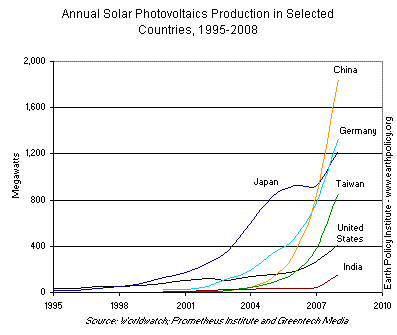
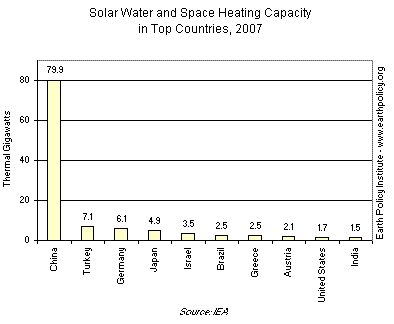
    Concerns about global warming, rising fossil fuel prices, and oil insecurity have prompted calls for a new energy economy, one that replaces fossil fuels with renewables. The sun is an enormous reservoir of energy; in fact, the sunlight reaching Earth in just one hour is enough to power the global economy for a whole year. Harnessing some of this energy is an essential component of Earth Policy Institute’s carbon cutting plan, as presented in chapter 5 of Plan B 4.0. Here are some highlights from the accompanying data on three types of solar energy: solar photovoltaics (PVs), concentrated solar thermal power (CSP), and solar water and space heating.

    Annual production of solar photovoltaics reached nearly 7,000 megawatts in 2008. Although this technology for converting sunlight into electricity was developed in the United States, Japan took an early lead in production, surpassed only in recent years by China and Germany. Chinese annual production skyrocketed from 40 megawatts in 2004 to 1,848 megawatts in 2008, nearly five times the output of the United States. Currently almost all of China’s production is for the export market, but several massive domestic installations are being planned.

    At the end of 2008, the world had a cumulative total of 15,000 megawatts in PV installations. Though Germany is far from the world’s sunniest country, government policies have made it the global PV leader, with an installed capacity of 5,308 megawatts. Other countries with large solar installations are Spain with 3,223 megawatts, Japan with 2,149 megawatts, and the United States with 1,173 megawatts.

    Rooftop solar water and space heaters that directly convert sunlight into heat have been embraced in a number of countries but nowhere as much as in China. With nearly 80,000 thermal megawatts of capacity (enough for 27 million homes), China accounts for two-thirds of the world’s 120,000 thermal megawatt capacity. Turkey comes in at a distant second with 7,100 thermal megawatts. In per capita terms, Cyprus and Israel lead the list with 0.9 and 0.7 square meters, respectively.

    New solar thermal power projects, which use mirrors to concentrate sunlight on a liquid-filled vessel to produce steam that drives a turbine, are coming online again after a 16-year hiatus. Since 2006, world capacity has grown by over 450 megawatts to a total of 820 megawatts, enough to power 156,000 American homes for one year. Scores of new projects are in the pipeline. When those currently under construction are completed, the world CSP capacity will increase almost 4-fold. There are an even greater number of projects in the contract or development stages. In the United States alone, projects under development exceed 10,000 megawatts, 20-times greater than the combined capacities of plants currently in operation and under construction. 

    Avoiding dangerous climate destabilization requires a Plan B: reducing global net carbon dioxide emissions 80 percent by 2020. Achieving this goal requires a transition from fossil fuels to renewable energy from wind, solar, and geothermal sources. Current trajectories, national targets, and available resources indicate that the 100-fold increase for PV and solar rooftop heaters and the 200-fold increase for CSP, as called for in Plan B, are within reach.

    You can download our datasets or read the book to learn more about solar power’s role in the plan to stabilize climate.

    Related Links:

    Why pricing emissions is the least important policy

    On rooftops worldwide, a solar water heating revolution

    Challenging conventional wisdom on renewable energy’s limits


  • How many Venezuelan soldiers does it take to change a lightbulb?

    by Ashley Braun

    An entire army, apparently.

    El Presidente of Venezuela, Hugo Chavez, put in big orders for energy efficiency when he commanded the country’s lightbulbs get swapped for CFLs. Why the power play? A drought of hydropower has the nation in energy crisis and the military armed with efficient lightbulbs, laying waste to every wasteful incandescent in their path. The troops are battling against the highest per capita energy use on the continent, but the spoils of war will ease the shift from years of being spoiled by oil.

    Viva efficiency!

    Via inhabitat

    Related Links:

    The other half of Kerry-Graham-Lieberman is weak too

    ‘South by Southwest’ crowd told to start saving the planet

    Home Star gets a hearing


  • Senators negotiate green economy bill with polluters who deny threat of global warming

    by Brad Johnson

    Cross-posted from the Wonk Room.

    As the Kerry-Graham-Lieberman triumvirate works to craft green economy legislation, they’re negotiating with industry lobbyists who deny the threat of global warming. After meeting with President Barack Obama and a dozen industry-friendly lawmakers, the trio of Senate negotiators sat down with representatives of the fossil-based economy:

    A cross section of industry power players met this afternoon in the Capitol with Kerry, Graham, and Lieberman. Groups represented at the meeting included the U.S. Chamber of Commerce, American Petroleum Institute, Edison Electric Institute, Nuclear Energy Institute, National Association of Manufacturers, Farm Bureau, American Forest and Paper Association, American Railroads, National Electric Manufacturers Association, and Portland Cement Association.

    It’s perfectly reasonable for senators to meet with industry stakeholders as they work to unleash the clean energy economy. However, half of the lobbyist groups mentioned are legally challenging the threat of manmade climate change, with court petitions against the U.S. Environmental Protection Agency’s greenhouse gas endangerment finding:

    – The Portland Cement Association, which has filed suit despite supposedly recognizing the need to reduce global warming pollution

    – The American Petroleum Institute,  which intends to blame climate policy for higher gas prices at every gas station in America

    – The U.S. Chamber of Commerce, which has repeatedly questioned climate science

    – The National Association of Manufacturers, which claims climate legislation is “anti-jobs, anti-energy

    – The American Farm Bureau Federation, which argues there is global cooling

    One has to wonder how productive it can be to negotiate with polluters who deny the scientific reality of global warming.

    On the other hand, the industry lobbyists thought the talks were “extraordinarily productive.” Tom Kuhn, president of Edison Electric Institute, the lead trade group for investor-owned electric utilities, told reporters:

    It was a positive, encouraging discussion. I think they want to try and find ways to make things work from the standpoint of all the participants in that room, from the standpoint of the industrials and the oil companies.

    John Shaw, the senior vice president of the Portland Cement Association, said:

    It was an extraordinarily productive meeting. I think it was unprecedented for three senators, arguably each from a different political background, if you will, to sit down at a table and invite leaders from all different sectors, to try to create another level of dialogue. They want to start delving into the details, and creating those details with greater industry input than we’ve seen in the past.

    Related Links:

    ‘South by Southwest’ crowd told to start saving the planet

    Seedy tactics in Iowa and Norway in the news this week

    The Climate Post: Uptick in denialism halts glacier melt, lowers sea levels


  • How the cap-and-trade controversy could lead to good clean energy policy

    by David Roberts

    On Wednesday, bipartisan groups of legislators from both houses of Congress joined together to support a bill: the Rural Energy Savings Program, which would make low-interest loans available to rural homeowners to fund efficiency retrofits. The loans would come with no upfront cost and would be paid off with a small surcharge on utility bills (so-called “on-bill financing”). The policy is a win-win-win: it would offer financial relief to a demographic that’s hurting badly, create thousands of jobs, and reduce CO2 emissions. The bill is fantastic in its own right, but unless I’m suffering from a bout of wishful thinking (possible!), it also seems indicative of some promising developments in today’s energy politics.

    First off, federal legislators are finally beginning to grasp the fact that efficiency can be a winner in every single congressional district. It is a bipartisan, or perhaps nonpartisan, opportunity. This realization has been delayed by years of partisan squabbling over more contentious climate/energy issues like carbon pricing and oil subsidies; lawmakers have become accustomed to energy being just as divisive as health care reform, yet another clash of well-worn, deeply entrenched positions. But if efficiency can be pulled out of that, unburdened of those other controversies, and looked at on its own merits, it becomes clear that it’s a no-brainer. Every district has inefficient buildings and every district could benefit from local jobs.

    The Senate Energy Committee held a hearing on energy efficiency on Wednesday to consider four bills that together would “enhance the standards program by establishing or updating efficiency standards for major energy consuming products such as air conditioners, furnaces, and outdoor lighting, as well as several smaller product classes.” (One of the bills is co-sponsored by committee co-chairs Jeff Bingaman (D-NM) and Lisa Murkowski (R-Alaska). Today they’re having another hearing to consider the Home Star program (“cash for caulkers”), which has been talked up by the president himself, and Building Star, the recently developed complement focused on commercial buildings. Both programs are expected to come to the floor as part of a jobs bill in the next couple of months.

    Small wins like these bills and the rural energy program build political capital in the fight for clean energy. No matter what happens with the big Senate climate bill, Dems should start thinking about putting forward—and publicizing!—more more of these small-bore measures. Each one cracks the door a little wider and broadens the constituency for smart energy policy.

    Secondly, I think that the current political climate is ripe for these kinds of small, smart bills. The Senate is under two opposing pressures. From one side, Obama (and the public) are pushing them to address climate and energy. Obama had a bipartisan group of senators to the White House the other day to talk about it. (Direct presidential intervention in negotiations like this is a huge deal.) And of course every poll under the sun shows that the public, including independents and voters in swing states, wants Washington to act.

    From the other side, the right wing and its teabagger vanguard have succeeded in completely demonizing cap-and-trade, which has been at the center of climate policy advocacy for years. Whatever senators do, they can’t touch that.

    So what do you get if you combine pressure to enact policy with an effective prohibition on enacting the main policy that’s been on the table? Answer: lots of interest in other climate/energy policies. You can see it in the Kerry-Graham-Lieberman proposal, which splits cap-and-trade up into multiple carbon pricing systems (which aren’t cap-and-trade, and don’t you dare call them that!). More interestingly, you can see it in the profusion of free-standing proposals like the efficiency bills discussed above and things like Bernie Sanders’ 10 Million Solar Roofs bill.

    Again, maybe I’m wishful thinking, but I hold out hope that this could lead to good things. I do think eventually the political system will have to choke down cap-and-trade (whatever it ends up being called), if for no other reason than to harmonize the regional C&T systems and hook up with the EU system as part of an international treaty.

    But as Gar Lipow has been arguing, carbon pricing isn’t the only, or even the most important, climate/energy policy. And it’s the least popular! If the short-term impetus to escape cap-and-trade drives legislators into the arms of these complementary policies—efficiency standards, renewable initiatives, an infrastructure bank, increased R&D funding, whatever—it could do good things for the climate and build popular support and momentum for more action.

    The question, of course, is how to keep these freestanding proposals from falling into the same partisan sausage grinder that’s afflicting the big climate bill. Right now, they have a shot at being the rare patch of common ground. But never underestimate the teabaggers’ will to divide. A delicate political dance lies ahead. Should be fun to watch!

    Related Links:

    The other half of Kerry-Graham-Lieberman is weak too

    Home Star gets a hearing

    Democrats toughen up on finance reform. Could it work for clean energy?


  • McMansion modular

    by Lisa Selin Davis

    Remember when modular homes were going to be part  of the “green” future?  In the post-Dwell, post-postmodern architecture era, pre-fab was going to be cheap, green, hot and hip.  Yes, finally, an antidote to McMansions and an affordable alternative to ballooning home prices.  As if that were not enough,  these stylish boxes were set to erase our previous connotations, where modular meant mobile home and pre-fab equaled Lubbock double-wide.

    Photo: Heather Lucille FlickrExcept it didn’t happen.  Modular homes, like all homes, suffered the housing crash, though as we reported last year, there never was quite enough demand to make modular modern homes tumble off the production line; they’re only affordable if they’re mass-produced.

    But apparently a new demand has sprung up for modular homes, only it’s not among the green set, or the young, or first-time homebuyers. And it’s not for the modestly sized versions of pre-fab. Rather, according to the Washington Post, mansions are increasingly going modular.

    In less than a day-and-a-half, a six-bedroom, six-plus bath, 7,200-square-foot home can appear on a slab of land in any number of charming styles: Prairie, Arts and Crafts, French Country. The one profiled in the Post ran the owners a cool $2.5 million, though an estimated 15 percent less than traditional stick-built homes of that size and level of luxury (replete with elevator shaft).  Nice for them.  And because these Lego-Mansions are raised so quickly, the  construction loans are shorter, and therefore cheaper.

    It’s true that  even pre-fab XXL can contain green features, like geothermal heat pumps and pre-cut walls that defend against mold and mildew.

    Yet their very size precludes these homes from being truly green;  it’s just plain environmentally unfriendly to build a home with 10 times as much living space as actually needed. That sentiment recently bubbled to a boil in Berkeley, where a software mogul is building a 10,000-square-foot mansion that is classified as green by the city’s standards; they measure things like water use and building materials for the designation, not size.

    The trend of modular mansions isn’t completely new; there’s a 2005 book on the subject that showcases 12,000-square-foot monstrosities.  Presciently, perhaps, even that book predicted these would be “the homes of the future.” While they account for only 3% of newly built homes, their popularity seems to be on the rise.  They are a recession-friendly luxury. 

    Don’t blink, the new “green” house next door could go up overnight, and it could be ginormous.


    Related Links:

    Modern modular done right

    Abu Dhabi bailed out Dubai—is the world next?

    San Francisco commits $150 million to green homes


  • Where do things stand on international efforts to address global warming?

    by Jake Schmidt

    It is almost three months after the Copenhagen Accord was hammered out by 28 of the world’s key countries that represent over 80 percent of the world’s global warming pollution and some of the most vulnerable to the impacts of climate change (as I discussed here). Given the state of the Accord just after Copenhagen with some calling it a failure, some outlining the foundations in the Accord for international efforts (as my colleague discussed here), and others … well not quite sure what to make of it, where do things stand on international efforts to address global warming?

    If you just picked up the paper, watched TV, listened to the radio, or read blogs you might think that things aren’t really moving as there is very little coverage of international global warming discussions (especially compared to last year when every 5 seconds some news story or analysis emerged). But that doesn’t mean that nothing is happening on the international front. In fact, despite the lack of regular coverage, things are moving forward—albeit tentatively, behind the scenes, and without a big splash.

    Here are four things that are occurring that are worth following:

    Over 108 countries have “associated with” the Copenhagen Accord (as summarized here).*  These countries account for over 80 percent of the emissions and 77 percent of the population of the world. The last two major pieces fell into place when China and India formally “associated with the Accord” in the last 2 days (as my colleagues discussed here and as covered by the New York Times). Basically these countries are saying: “we agree to international action on global warming and on the basis of the outlines agreed in the Accord.” Of course many of these countries have urged for deeper action than outlined in the Accord, but by Associating with the Accord they are signaling that they want to proceed internationally to address global warming.

    60 countries representing over 80 percent of the world’s emissions have formally recorded actions to reduce their global warming pollution (as I discussed here). Many of these countries aren’t simply waiting for some future international meeting or for the final international agreement to implement specific policies and programs to reduce their pollution. For example, as my colleagues have discussed, China and India have adopted new domestic policies since Copenhagen that will reduce their global warming pollution. Brazil signed a bilateral agreement with the U.S. (available here) and there are expectations that the U.S. will sign another one with Indonesia when President Obama goes there March 20-22 (hopefully with concrete near term actions).    

    Key countries will begin to coordinate efforts to address deforestation emissions. Over 15 percent of the world’s global warming pollution comes from deforestation and forest degradation, so the Copenhagen Accord agreed: “on the need to provide positive incentives to such actions [that reduce deforestation and forest degradation].” Key countries including the U.S., Australia, Germany, and France agreed to contribute $3.5 billion over 3 years to “prompt start” efforts to reduce deforestation emissions. It is critical to ensure that the flow of this early money goes to effective actions that reduce deforestation as every second a football field size of rainforest is lost (and it won’t return). So instead of waiting for the next international negotiating session or greater clarity on how things proceed (and more loss of the tropical forests), a group of key developed countries and deforesting countries are meeting as we speak to begin efforts to better coordinate global efforts to combat deforestation.

    High-level and influential set of policymakers will be discussing ways to generate sizeable funding to assist developing countries in deploying clean energy, reducing deforestation emissions, and adapting to the impacts of climate change. U.N. Secretary General Ban Ki-moon has created a High-level Advisory Group on Climate Change Financing to be chaired by U.K. Prime Minister Gordon Brown and Ethiopian Prime Minister Meles Zenawi, with representatives including George Soros, Nick Stern, and Lawrence Summers. The group is tentatively scheduled to meet March 29 and will provide an initial report to the May/June climate negotiating session and a final report to the climate meeting in Cancun, Mexico in December. Let’s hope some politically possible and specific proposals emerge that can be adopted by key countries.

    That is the positive momentum that has occurred post-Copenhagen. But of course not everything is all good news. The World Bank is still funding things that are taking us in the wrong direction by proposing to finance a coal plant in South Africa that isn’t capturing its carbon (and doesn’t put in place a real plan to capture it’s carbon in the future), and is barely investing in renewables and doesn’t have a real energy efficiency investment as a part of this proposal. Indonesia is proposing to classify its palm forests as “forests” in order to access money that is supposed to be set aside for deforestation reduction efforts—not exactly the aim of that funding as it is supposed to support things that are slowing deforestation, not actions that deforested rainforests in the first place. Critical actions by the U.S. gained a little momentum when President Obama met with key Senators and made clear his support for a comprehensive climate and energy bill this year, but uncertainty about U.S. action still clouds international prospects (let alone holding back the needed investments in job creation, energy independence, and clean energy technology leadership). 

    ——————

    So there is some uncertainty about how things proceed.  In many respects that is only natural as the Summit in Copenhagen wasn’t your normal climate negotiations and the process after the Summit was left unclear. So the world spent a couple of months sorting out what was achieved, how the Copenhagen Accord was to proceed, and what are the next steps for the U.N. climate negotiations. But while that “sorting” was occurring, things proceeded and countries moved forward with actions to reduce their emissions (with some hiccups along the way).

    The expectations for the climate meeting in Cancun, Mexico this December appear to be focused not on agreeing to the final treaty (as the European Commission just outlined is likely), but rather to making concrete progress to implement the actions that countries committed to reduce their emissions, the finance that is to be deployed in the near- and medium-term, the rules for the “transparency” provisions agreed in the Accord, and the guidelines for efforts to solve the loss of tropical rainforests. Those actions are critical and countries have made it clear that they want those things to proceed, even while they sort out exactly how things will progress this year. 

    Now is not the time to sit in a holding pattern and wait for exact clarity on how things proceed. We must plug ahead and implement key actions that will put the world closer to solving this critical challenge.

    —————-

    * This includes countries that have formally sent letters to the UNFCCC signaling their desire to be “associated with the Accord” and those that have submitted emissions reduction actions but may not have not clarified in their submission that they want to be “associated.” All values based upon data from the World Resources Institute Climate Analysis Indicator Tool. Emissions from 2005 and include deforestation; population data from 2006.

    Related Links:

    Jeff Goodell: “It’s a bad idea for geoengineering to be the equivalent of the Pompeii sex room”

    On rooftops worldwide, a solar water heating revolution

    India backs Copenhagen climate deal


  • Colbert grows a ‘crisis herb garden’

    by Tom Laskawy

    Funny how everything these days is circling back to the garden. Troubled (in every sense of the word) ex-Housemember Eric Massa went on Glenn Beck recently to … to … self-immolate. Many progressives tuned in, and thus were exposed to an ad for so-called “Survival Seeds”—a kit for helping you grow your own food in the upcoming apocalypse from precious “non-hybrid” seeds. First bloggers snarked about it. Then, Colbert joined in and brought the big-time funny.

    Inspired by the ad, Colbert has already started his “crisis herb garden.” I think there are many Grist readers who can agree with his logic:

    Because I may be ready for a world where the streets run with blood, and zombies rule the night and feast on human flesh. But I refuse to live in a world where I can’t garnish.

    That said, I recommend turning to Seed Savers or the Territorial Seed Company for supplies instead.

    Related Links:

    Colbert interviews Annie Leonard

    Garden Girl TV: Raised beds in the city

    Florida Everglades restoration now a bailout for U.S. Sugar


  • How to provide relief to rural Americans, create jobs, and lower emissions … all at once!

    by David Roberts

    Most homeowners in the U.S. would come out ahead if they invested in energy efficiency improvements—new insulation, sealed windows, more efficient boilers, and the like. So why don’t they do it? Simple: the upfront costs are steep and the paybacks can take a long time. Many homeowners don’t have access to the capital to cover the costs, or they worry that they will move before the the costs are repaid, thus leaving subsequent owners to reap gains they didn’t pay for.

    Given the substantial public good served by having these retrofits done—they save consumers money, create jobs, and reduce carbon pollution—how can public policy encourage them?

    If you can come up with half the upfront cost, you can use the “Cash for Caulkers” (i.e., Home Star) program that’s going to be passed into law soon. Or if you live in a town or city that can afford one, you can take advantage of a PACE program, which offers loans that cover the initial costs and are paid back over time from energy savings.

    Who does that leave out? Who doesn’t have upfront capital and doesn’t live in a city with money to spend on PACE? You guessed it: rural homeowners.

    This matters for several reasons. First off, rural homes—over 20 percent of which are manufactured homes—are substantially less efficient than their urban and suburban counterparts. That’s why, even though their homes are generally smaller and their electricity is generally cheaper, the average rural household pays $200-$400 more a year on energy bills than comparable urban households. And given that they make roughly $10,000 less per year, that’s not chump change.

    Second, rural Americans are precisely the ones most politically hostile to climate action, which they see as a liberal political program that primarily benefits cities and coastal elites. Direct energy benefits to rural homeowners could help change the political landscape and ease further action.

    Enter Third Way, which today released a fantastically clever idea for addressing this problem. You can read the details here, but in brief, it would effectively extend a PACE-like program to rural homeowners. Rather than being administered by cities, though, it would be run by utilities, specifically the customer-owned utility co-ops that serve rural areas. The co-ops would borrow money from the USDA’s Rural Utilities Service and then offer customers the option of having a qualified contractor come out, do an energy assessment, and install efficiency improvements. This would be paid for by a low-interest (no more than 3 percent) loan, paid back over ten years by a small surcharge on utility bills. The loan is attached to property taxes, so it would transfer with ownership. It’s painless, risk-free, and accessible to all homeowners, just like PACE in cities.

    The cost?

    According to USDA, the total program cost will be $995 million to issue $4.9 billion in zero-interest loans. That includes $755 million in loan subsidy costs, $200 million for a start-up grant fund, and $40 million for program overhead.

    That’s beans!

    The benefits?

    A loan volume of $5.6 billion dollars at these rates would spur the weatherization of up to 1.6 million rural homes in 47 states over the next ten years, eliminating the need for new generating capacity to power 625,000 homes in coal-dependent areas and creating 34,000 new jobs by 2020, including 20,000 new jobs created by the end of 2011.

    Jobs, consumer relief, and carbon pollution reduction—win win win. Not too shabby.

    The idea was introduced as legislation today, as the Rural Energy Savings Program. In the Senate the bill is co-sponsored by Sens Jeff Merkley (D-Ore.), Lindsey Graham (R-S.C.), Richard Lugar (R-Ind.), Jeanne Shaheen (D-N.H.), Tim Johnson (D-S.D), and Michael Bennett (D-Colo.). A counterpart was introduced in the House by Reps James Clyburn (D-S.C), Tom Perriello (D-Va.), Ed Whitfield (R-Ky.), and John Spratt (D-S.C.).

    Bipartisan and bicameral! How many legislative ideas can boast those qualities these days? Again: not too shabby.

    Said
    Graham
    : “I just thought it was a marvelous idea. This is great
    policy when you can take a relatively small amount of federal dollars,
    invest it in the economy and empower people to help themselves.” More on the politics of this in a subsequent post.

    Related Links:

    The other half of Kerry-Graham-Lieberman is weak too

    Home Star gets a hearing

    Democrats toughen up on finance reform. Could it work for clean energy?


  • Banana briefs are growing on us

    by Ashley Braun

    Gents, if the thought of pesticides on your privates bums you out, then start thinking outside the boxer. AussieBum has gone down under to pioneer briefs that put a banana in your pants.

    That’s right, these skivvies are a smoothie mix of banana tree-bark fibers, organic cotton, Lycra (cough), and an “eco friendly flavor that will keep you coming back for seconds.” Mmm … yeah.

    Hat tip to our friends at HuffPost Green. We just couldn’t pass up the op-pun-tunity.

    Related Links:

    How many Venezuelan soldiers does it take to change a lightbulb?

    A recipe for delish disaster: global warming hot apple pie

    Tasting five organic French roasts leads to buzzkill


  • Retooling green jobs for the next generation

    by Jesse Jenkins

    When
    you think “green jobs,” do you conjure images of green hard hats, caulk
    guns, and tool belts? Well it might be time to start thinking about “green” lab beakers, “green” drafting tables and “green” brief cases as
    well, because the careers needed to secure competitive clean energy
    industries will also run the gamut from cutting-edge researchers and
    high-tech engineers to innovative designers and fearless entrepreneurs,
    according to Dr. Henry Kelly, Principal Deputy Assistant Secretary at
    the U.S. Department of Energy’s Office of Renewable Energy and Energy
    Efficiency.

    Dr. Kelly spoke to an audience of Stanford University students Monday about the steps necessary to educate “the Energy Generation,” warning that it will take a generation of the nation’s best and
    brightest, working in dozens of diverse fields, to truly build a clean
    and prosperous American economy:

    So what is a green job? Well green jobs are architects and engineers that build buildings, design buildings that operate at extremely low energy use. They are people that design, manufacture, and install devices in buildings ranging from high-tech windows to lighting
    to sensors and controls and electronics. It means looking at radically new industrial processes which simply replace previous kinds of industrial manufacturing with sophisticated bionumetics and nanotech approaches, to cutting down the material intensity and energy intensity of production, this is the kind of thing you need to do to stay competitive in the modern world.

    If you look at what the nation’s transportation system is going to look like, Henry Ford looks like he’s toast, it’s going to be replaced with an entirely new generation of either extremely high efficiency fuel powered vehicles, electric vehicles, perhaps even hydrogen fuel cells—the people that make and maintain these are going to be operating in a different world that’s an enormously sophisticated operation.

    If you’re looking at where power comes from, of course you have the entire range of science and engineering involved, you mentioned we’re relying on geologists to tell us how to get geothermal energy, getting very sophisticate semiconductor manufacturers involved in the production of solar cells and CSP, if you look at biologically based fuels and materials, some of the most sophisticated biological processing techniques.

    So this is an enormous range of skills, but apart from the technical skills you also need people who really understand the economics of finance … behavioral economics, people who understand policy, all of these qualify as green jobs and it touches I think almost every academic discipline.

    The good news is that if we do this right we’re generating a lot of
    new interesting jobs, not just for sophisticated designers but for
    people who are manufacturing and operating these.

    “The bad news,” Dr. Kelly said, is that America’s competitors in
    Asia and Europe are surging ahead to develop competitive clean energy
    industries and investing in a highly-trained and technically competent
    workforce:

    If you’re looking at how the U.S. fairs competitively, we have far from the most highly trained workforce. In fact we’re the only country in the top 20 OECD countries where … the average high school graduation rate is going down. We’re static in university degrees and other countries are bypassing us, and they’re getting degrees increasingly in the sophisticated subjects we need to move forward, both in energy and rebuilding our economy.

    So we’re facing this tremendous dilemma, where we have these opportunities to rebuild the economy around sophisticated technology that’s clean, but the ability to turn out people who are able to actually take advantage of these opportunities is declining. It’s something we’re incredibly concerned about.

    While attention has been paid in recent years to funding new training programs for “green collar”
    technicians, building trades, and manufacturing positions, the federal
    government has only just begun to put resources towards training and empowering the wide variety of
    cutting-edge innovators, engineers, and entrepreneurs needed to stay
    competitive in the 21st century clean energy race.

    “The kind of things that you need to do make an economy that is
    clean and reducing its fossil fuel consumption is precisely the same
    thing you need to do to make the economy productive and competitive
    internationally, which means constantly transforming itself around new
    technology,” Dr. Kelly said. “If you look at the kind of technologies
    we’re talking about, it does touch virtually every part of the
    economy.”

    With Asian and European competitors pulling farther and farther ahead in competitive clean
    technology sectors, the economic stakes of these investments are high.

    “There’s little doubt we’re in a race for our lives to maintain our
    productivity and competitive edge to keep high tech manufacturing here
    in the U.S.” Dr. Kelly declared.

    In 2007, Congress passed the Green Jobs Act which authorized $125 million in annual funding to develop training
    programs for workers in a variety of renewable energy and energy
    efficiency industries. The program was first funded with a $500 million
    chunk of the American Recovery and Reinvestment Act (the stimulus
    bill), and further funds were allocated in the climate bills now
    struggling to secure passage in Congress.

    While the Green Jobs Act has advanced technical training programs at
    the nation’s community colleges and technical schools, funding to
    inspire and empower students at four-year institutions to enter a wide
    range of careers crucial to competition in the clean energy sector has
    languished in Congress.

    In 2009, President Obama’s FY2010 budget included a new Department of Energy and National Science Foundation-run program called RE-ENERGYSE,
    the nation’s first program aimed at strengthening America’s position in
    clean energy education. Despite the urgent need for such a program, Congressional appropriators rejected the $125 million funding request.

    The administration hasn’t relented, however, and RE-ENERGYSE is back in the new FY2011 budget request now on its way to Congress. The $74 million program would be the first
    small but critical step to re-energize a new generation of scientists,
    innovators, and entrepreneurs ready to tackle the United States’ energy
    and competitiveness challenges (see this fact sheet for more [PDF]).

    Ultimately, however, greater funding will be necessary to help the
    next generation of intrepid American innovators rise to the nation’s
    clean energy challenges.

    “In 1958, right after the Soviet Union launch Sputnik, the U.S.
    federal government authorized the National Defense Education Act, which
    invested billions of dollars over several years to try and regain our
    competitive edge in general science and engineering, and more
    specifically in the space race,” said Teryn Norris, the moderator of
    the panel, adviser at the Breakthrough Institute, and director of Americans for Energy Leadership, a student-led initiative campaigning across the country for investments in clean energy education and innovation.

    With Americans facing a new race to dominate the high-tech fields of
    the 21st century, the federal government will ultimately need to secure
    investments on the scale of the National Defense Education Act to keep the nation’s competitive edge.

    Dr. Kelly and Mr. Norris were joined on the panel by Dr. Lynn Orr, director of the Stanford Precourt Energy Institute and Camron Gorguinpour, director of Scientists and Engineers for America. You can watch a video of the panel here.

    Originally posted at the Breakthrough Institute and WattHead.org

    Related Links:

    Brian Baird: ‘This is not government mind control’

    The Maine Lesson of Cap and Trade

    The Climate Post: Uptick in denialism halts glacier melt, lowers sea levels


  • Breakthrough polymers promise versatile, immortal plastics—a good thing

    by Todd Woody

    If you want to build a sustainable street, neighborhood, city, or world, I have one word for you: plastics.

    The facts about plastic have become part of the green
    liturgy. More than 30 million tons of the stuff is dumped into the municipal
    waste stream each year in the United States. Disposable water bottles have
    become the Hummer of plastics—a petroleum-fueled symbol of extravagant waste,
    a F-You to the planet with some 13 billion of them ending up in landfills,
    littering landscapes and befouling oceans.

    But the reality is that even if you pried every Evian and
    Dasani bottle from every clammy sweaty hand, we’d still live in a plastic
    world. It’s a component in just about every product we use, hence the
    ever-expanding East Pacific Garbage Patch of non-biodegradable, indestructible
    plastic that will surely move up the food chain and return to us in one form or
    another.

    There’s been no shortage of innovation directed at the
    dilemma, from the development of biodegradable plant-based plastics to new
    approaches to recycling and attempts to ban shopping bags and bottles outright.

    But perhaps the most promising breakthrough emerged this
    week from a Silicon Valley lab where IBM and Stanford University scientists
    have been messing with the molecular composition of the polymers that form
    plastic. The result: a new kind of plastic that can be made endlessly
    recyclable or biodegradable.

    IBM scientist Jim Hedrick in the lab at the Almaden Research Center. Photo: NASA Marshall Space Flight Center CollectionWe’ll detour here for a brief science lesson.  To create plastic, you need three things—a
    molecule called a monomer, a solvent, and a catalyst to get the party going.
    Most plastics are made with metal oxide or hydroxide catalysts.

    The problem with such catalysts, as IBM’s Chandrasekhar “Spike”
    Narayan explained to me, is that they sentence plastics to but a single reincarnation.
    Once you’ve turned plastic bottles into, say, carpet you can’t transform the
    carpet into T-shirts. (If you really want to all the technical details—and you
    have a degree in chemistry—you can read the paper Narayan and his
    collaborators published Tuesday in the journal Macromolecules.)

    “These metal oxides are immortal catalysts,” says Narayan,
    who leads the science and technology team at IBM’s Almaden Research Center in
    San Jose. That means the metal catalyst
    continues to contaminate the plastic making it unsuitable for re-use. “But
    if you have a catalyst that dies,” he adds, “you don’t have that issue.”

    And what kind of catalysts die? Organic ones, of course. By
    substituting organic catalysts for metal oxides, Narayan’s team ended up
    creating polymers with new properties.

    Some plastics can be designed to biodegrade while others can
    be made so that they can be transformed into entirely new materials in their
    second lives. For instance, all those discarded water bottles might be reborn
    as body panels on electric cars or components of an iPad. And when those
    products reach the end of their useful lives—which could be a matter of
    months given the planned obsolescence of consumer electronics gadgets—they
    can be turned into something else.

    “It gives you a lot more knobs to turn—a path to polymer
    architectures that are quite different and that have properties plastics
    currently don’t have,” enthuses Narayan, who also works on developing smart
    city technology. “I think it’s going to revolutionize synthetic chemistry.”

    Here’s a video from IBM that helps to explain the new plastic breakthrough.

    Now, just to be clear, Big Blue’s scientists didn’t set out
    to save the world when they began their research. Rather they originally sought
    to develop new polymers to be used in microelectronics.

    “IBM Research partners with others to explore applications
    of that expertise to problems and applications beyond information technology,
    which is how we began to look at other novel applications” for the polymers,
    says Sara Delekta Galligan, a company spokeswoman.

    So far, this is all still being done inside the lab. But
    Narayan says IBM is talking to potential partners about commercializing the
    technology and expects to have a pilot project producing plastic within two
    years. (And if you think the rest of the world isn’t interested in this technology,
    consider that the King
    Abdulaziz City for Science and Technology
    in Saudi Arabia has already
    hooked up with IBM to develop recyclable polyethylene terephthalate, PET.)

    The Plastiki. Photo: Todd WoodyA few weeks ago, I had the chance to take a look at another
    innovative approach to plastic when I went onboard the Plastiki. In a few
    weeks, British banking heir and environmental adventurer David De Rothschild
    and his crew will set sail from San Francisco on the catamaran made of plastic
    and head to Sydney through the Eastern Pacific Garbage Patch, the Texas-size
    mass of plastic trash that sits in the middle of the ocean.

    Berthed in Sausalito, Calif., the boat’s hulls are composed of thousands of plastic bottles with the bulk of the boat made from panels of self-reinforcing polyethylene terephthalate that were produced in a process invented by the Plastiki team.

    The Plastiki’s mission is to raise awareness of plastic pollution but also to be a floating demo project of how plastic can be repurposed for novel uses, like building a boat. The message: Plastic isn’t going to disappear so the challenge is to how to minimize its production through recycling and reuse.

    “We had to look around and innovate,” says De Rothschild,standing on the Plastiki, next to a row of solar panels, a biodiesel-powered emergency motor and the boat’s masts made from old irrigation pipes. “We didn’t want to say plastic is the enemy. The question is, is it our inability to understand the material that’s to blame or is the material that’s to blame?”

    Or maybe we’re just the problem. As my Grist colleague David Roberts has pointed out, technological innovation needs to go hand-in-hand with getting people to change their behavior.

    For while IBM’s organic plastics and De Rothschild’s approach will help alleviate the poisoning of the planet by plastic, the best plastic bottle is, of course, the one you don’t buy.

    Related Links:

    A rich guy’s guide to saving the oceans

    Ask Umbra’s 6 video tips to green take-out food

    Ask Umbra on engagement rings, straws, and napkins


  • Big Oil uses fake ‘Americans’ to attack fake ‘energy taxes’

    by Brad Johnson

    Cross-posted from the Wonk Room.

    Big Oil is using fake “Americans” to defend billions in tax subsidies. The American Petroleum Institute is running full-page ads in Politico and Roll Call that attack Congress for “new energy taxes”:

    Congress will likely consider new taxes on America’s oil and natural gas industry. These new energy taxes will produce wide-reaching effects, and ripple through our economy when America — and Americans — can least afford it.

    These unprecedented taxes will serve to reduce investment in new energy supplies at a time when most Americans support developing our domestic oil and natural gas resources. That means less energy, thousands of American jobs being lost and further erosion of our energy security.

    Our economy is in crisis, and we need to get the nation on the road to economic recovery. This is no time to burden Americans with new energy costs.

    The target of this ad is the Obama administration’s effort to remove $36 billion in loopholes and subsidies for the oil industry. As it turns out, the “Americans” presented in the ad are stock photos from Getty Images:

    “Warehouse worker holding large wrench on shoulder”

    “Woman working in a distribution warehouse”

    “Man standing with hands in pocket”

    Americans are paying the price for these subsidies with our tax dollars, our health, and our national security. Removing these subsidies would “ripple through the economy” by unleashing a clean-energy future.

    This is just the latest in a stream of polluter front groups using stock photos in Astroturf campaigns against clean energy policy. API was recently caught trying to add diversity to its dirty ads by photoshopping minorities into stock photography. West Virginia’s “FACES of Coal” turned out to be from iStockPhoto.com. And Virginia’s “Coalition for American Jobs” is a stock-photo front group for the American Chemistry Council.

    Update: Found the last stock photo: “Blue collar worker leaning against forklift.”

    Related Links:

    American Petroleum tells lawmakers it supports carbon fee because it’s easier to demonize

    Stupid things senators are saying about the Kerry, Graham, and Lieberman proposal

    Lindsey Graham’s dilemma, part two: Trying to deal a winning hand without ACES


  • A recipe for delish disaster: global warming hot apple pie

    by Ashley Braun

    apocalypsecakes.wordpress.com

    Just because the planet is turning up the heat, doesn’t mean we should get out of the kitchen.

    If we’re going to be globally baking anyway, we might as well take a slice out of the life of pi pie of life while we’re at it. So go eat up this delectable recipe for Global Warming Hot Apple Pie from Apocalypse Cakes before the Senate tries something crazy … like addressing climate change.

    “Good news: it’s easy to keep your pie warm when it’s 140 degrees outside. Bad news: you’re decomposing from heat-rot.”

    And while that pie’s in the oven, the recipe recommends you start searching for those sea-level-rise pool floaties. Wheee!

    Related Links:

    How many Venezuelan soldiers does it take to change a lightbulb?

    Banana briefs are growing on us

    Cocaine addicts are snorting their way to a warmer world