Author: Grist – the Latest from Grist

  • Michelle Obama vows to ‘move the ball’ on kids’ diets

    by Tom Philpott

    White House flickr streamHer husband got dealt a difficult set of cards in taking over the post-Bush II presidency—and has arguably played them quite badly. He now finds himself in a tight political corner: caught between an emboldened Right, an angry Left, and a shrivelled middle.

    But Michelle Obama abides, as fabulous and beloved by the electorate as ever. She has built up a tidy store of political capital. She plans to spend it “by spearheading an initiative to reduce childhood obesity that, she hopes, will create a legacy by which she can be remembered,” reports Sheryl Gay Stolberg in The New York Times.

    Reducing childhood obesity is a goal that few could argue with. But really it’s an appealing way to frame a massive problem with powerful vested interests behind it: a food system that churns out low-quality, environmentally ruinous food and robust profits for a few companies.

    If the First Lady plans to confront the issue in a serious way, she’ll soon be knocking heads with those very companies. She has already gotten a taste of the coming pushback, just by planting an organic garden.

    It will take every iota of Ms. Obama’s considerable grace, smarts, and popular appeal to “move the ball” (as she puts it) on the diet-related maladies that confront the nation’s children. The sustainable food movement has never had a more appealing or high-profile champion.


    Related Links:

    Tales from a D.C. school kitchen: How foods that don’t occur in nature end up on your kid’s plate

    To address obesity, the First Lady will need to cast a wide net

    Tales from a D.C. school kitchen: What does ‘fresh-cooked’ really mean?


  • When it comes to energy, Mark Jacobsen thinks big

    by Osha Gray Davidson

    Mark Z. Jacobson, director of the Atmosphere/Energy Program at Stanford University, is an unusual figure in the field of climate change. He literally wrote the book on computer modeling for atmospheric changes, and he is a respected expert in the economics of energy production. But what truly sets Jacobson apart is his vision. He’s a “Big Picture” kind of thinker, focused on finding large scale, but practical, solutions to the problems of climate change. For example: a few months ago, Jacobson co-authored a cover-story in Scientific American sub-titled, “Wind, water and solar technologies can provide 100 percent of the world’s energy, eliminating all fossil fuels.”

    Large solutions make large targets, and Jacobson’s work is often controversial. The coal industry attacked his credibility in 2001 after he argued, in the journal Science, that electricity generated by wind power was cheaper than electricity generated by coal. More recently, some environmental groups got upset when Jacobson published evidence that substituting ethanol for gasoline would cause as many or more deaths from air pollution.

    Only 44, Jacobson is bound to prompt more controversies in the future. He is poised to play a crucial role in moving public opinion passed a tipping point where transformative ideas that were once thought impossible are considered not just conceivable, but doable, and necessary.

    Q. How did you get interested in climate change?

    A. I’ve always wanted to solve large scale problems. It probably began in high school when my tennis team went to Los Angeles for a match. The air quality in LA was so bad I that I couldn’t play. I was coughing, couldn’t catch my breath – it was terrible. So, air pollution was my introduction to climate change. You can’t separate the two.

    Q. You’re talking about more than just CO2 here?

    A. Yes, but they still connect in the end. The first thing to understand is that between two-and-a-half and three million people die each year because of air pollution. A lot of those deaths, particularly in the U.S., are caused by inhaling particles from vehicles and from coal-fired power plants.

    The real culprit is combustion itself. No matter what the source, combustion produces gases and some of them become particles – air pollution. How dangerous they are depends on all sorts of factors like size, constituents, concentration.

    We tend to focus on CO2, which is understandable because it’s the largest contributor to climate change. But I come to the issue from an air pollution perspective. I looked at the role of soot, a leading cause of air pollution mortality, and I found that it’s probably the second most important factor causing climate change.

    Q. When I hear “soot” the image that comes to mind is grimy 19th Century London with all the chimneys spewing smoke from coal furnaces.

    A. That’s right – definitely soot. But there are other sources and they share one thing: combustion. Soot is a byproduct of burning fossil fuel, bio-fuels or biomass. So soot comes from coal-fired power plants, tail-pipe emissions – anywhere material containing carbon is burned.

    The promising side of this discovery is that soot doesn’t stay in the atmosphere very long – especially compared to greenhouse gases. And because of that short lifespan, reducing and then eliminating soot emissions is the fastest way to slow global warming.

    Q. But that means eventually eliminating our reliance on combustion as a source of energy, right?

    A. We have to take drastic steps, right now, to reduce both particle and gas emissions. It’s something we can do, though. I’d argue that it’s both technically and economically possible to transform the world’s energy system to a sustainable one in two decades.

    Q. I think that qualifies as tackling a “large scale problem.”

    A. (Laughing) It does. In our Scientific American article we cited examples in which the United States made massive transformations before. In WWII, the U.S. converted auto factories to produce 300,000 aircraft in a short time. Starting in 1956, we started work on the Interstate Highway System which eventually covered 47,000 miles, completely transforming commerce and transportation.

    Our Wind, Water and Sun (WWS) plan is also ambitious. To complete the change to a sustainable energy society we’ll need 3.8 million wind turbines, 90,000 solar plants and many geothermal, tidal and rooftop photovoltaic installations around the world.

    But it has some advantages beyond the most important one, which is to stop global warming. The U.S. Energy Information Administration projects that by 2030 the U.S. will need 2.8 trillion watts (or terawatts, TW, of energy), and the world will need 16.9TW. If only WWS sources are used, the U.S. energy need drops to 1.8TW. The projected world total declines to 11.5TW.

    Q. To ask the obvious: how does that happen?

    A. For one thing, burning gasoline is an extremely inefficient way to power a car. As much as 80% of the energy produced escapes as heat. Running a car on electricity, only about 20% is wasted.

    Q. The Obama administration is investing billions of dollars in clean energy research, development and deployment. As someone who lives and breathes these issues, what do you think of their efforts?

    A.They’re moving in the right direction, but what the Obama administration is doing is not even close to what needs to be done.

    Q. What about Energy Secretary Stephen Chu? Do you get the sense that his efforts are hamstrung by politics?

    A. No. I think the problem of global warming is one or two orders of magnitude greater than what Secretary Chu thinks it is. They’re talking about making big changes within fifty years. But we need some of these changes to be in place within one or two years.

    I’ll give you an example: carbon capture and sequestration (CCS). The Department of Energy is pouring billions of dollars into a technology that even its backers admit won’t be online for another 20 years. First, I think that’s an optimistic assessment. But more important is the fact that we have proven, up-and-running technologies right now that could do the job. The money that could be used deploying wind turbines and solar power plants today, is being wasted on CCS. That’s a serious, serious mistake.

    Q. I know that you were a professional tennis player for a while, a teammate of Patrick McEnroe’s at one point. Are there any insights from playing competitive tennis that either helped you in your work or that could apply to how we need to address climate change?

    A. The key is to keep your eye on the ball. Don’t let distractions get in the way of your focus on the best strategy (or in the case of climate change, the best solutions). Also, don’t be intimidated by your opponent (or special interests). They will always try to knock you down. Finally, give it your best effort. Even if you lose in the end, you should always be able to say you gave 100%.

    Related Links:

    Upping the ante on climate

    Happier living that happens to be more sustainable

    India, Italy, Brazil can fill America’s blanks


  • When it comes to energy, Mark Jacobson thinks big

    by Osha Gray Davidson

    Mark Z. Jacobson, director of the Atmosphere/Energy Program at Stanford University, is an unusual figure in the field of climate change. He literally wrote the book on computer modeling for atmospheric changes, and he is a respected expert in the impacts of energy production and use. But what truly sets Jacobson apart is his vision. He’s a “Big Picture” kind of thinker, focused on finding large scale, but practical, solutions to the problems of climate change. For example: a few months ago, Jacobson co-authored a cover-story in Scientific American sub-titled, “Wind, water and solar technologies can provide 100 percent of the world’s energy, eliminating all fossil fuels.”

    Large solutions make large targets, and Jacobson’s work is often controversial. The coal industry attacked his credibility in 2001 after he argued, in the journal Science, that electricity generated by wind power in fast wind-speed locations was as cheap as electricity generated by coal. More recently, some environmental groups got upset when Jacobson published evidence that substituting ethanol for gasoline would cause as many or more deaths from air pollution.

    Only 44, Jacobson is bound to prompt more controversies in the future. He is poised to play a crucial role in moving public opinion passed a tipping point where transformative ideas that were once thought impossible are considered not just conceivable, but doable, and necessary.

    Q. How did you get interested in climate change?

    A. I’ve always wanted to solve large scale problems. It probably began in high school when I went to Los Angeles for a tennis tournament. The air quality in LA was so bad that I couldn’t play. I was coughing, couldn’t catch my breath – it was terrible. So, air pollution was my introduction to climate change. You can’t separate the two.

    Q. You’re talking about more than just CO2 here?

    A. Yes, but they still connect in the end. The first thing to understand is that between two-and-a-half and three million people die each year because of air pollution. A lot of those deaths, particularly in the U.S., are caused by inhaling particles from vehicles and from coal-fired power plants.

    The real culprit is combustion itself. No matter what the source, combustion produces gases and some of them become particles – air pollution. How dangerous they are depends on all sorts of factors like size, constituents, concentration.

    We tend to focus on CO2, which is understandable because it’s the largest contributor to climate change. But I come to the issue from an air pollution perspective. I looked at the role of soot, a leading cause of air pollution mortality, and I found that it’s probably the second most important factor causing climate change.

    Q. When I hear “soot” the image that comes to mind is grimy 19th Century London with all the chimneys spewing smoke from coal furnaces.

    A. That’s right – definitely soot. But there are other sources and they share one thing: combustion. Soot is a byproduct of burning fossil fuel, bio-fuels or biomass. So soot comes from coal-fired power plants, tail-pipe emissions – anywhere material containing carbon is burned.

    The promising side of this discovery is that soot doesn’t stay in the atmosphere very long – especially compared to greenhouse gases. And because of that short lifespan, reducing and then eliminating soot emissions is the fastest way to slow global warming.

    Q. But that means eventually eliminating our reliance on combustion as a source of energy, right?

    A. We have to take drastic steps, right now, to reduce both particle and gas emissions. It’s something we can do, though. I’d argue that it’s both technically and economically possible to transform the world’s energy system to a sustainable one in two decades.

    Q. I think that qualifies as tackling a “large scale problem.”

    A. (Laughing) It does. In our Scientific American article we cited examples in which the United States made massive transformations before. In WWII, the U.S. converted auto factories to produce 300,000 aircraft in a short time. Starting in 1956, we started work on the Interstate Highway System which eventually covered 47,000 miles, completely transforming commerce and transportation.

    Our Wind, Water and Sun (WWS) plan is also ambitious. To complete the change to a sustainable energy society we’ll need 3.8 million wind turbines, 90,000 solar plants and many geothermal, tidal and rooftop photovoltaic installations around the world.

    But it has some advantages beyond the most important one, which is to stop global warming. The U.S. Energy Information Administration projects that by 2030 the U.S. will need 2.8 trillion watts (or terawatts, TW, of energy), and the world will need 16.9TW. If only WWS sources are used, the U.S. energy need drops to 1.8TW. The projected world total declines to 11.5TW.

    Q. To ask the obvious: how does that happen?

    A. For one thing, burning gasoline is an extremely inefficient way to power a car. As much as 80% of the energy produced escapes as heat. Running a car on electricity, only about 20% is wasted.

    Q. The Obama administration is investing billions of dollars in clean energy research, development and deployment. As someone who lives and breathes these issues, what do you think of their efforts?

    A.They’re moving in the right direction, but what the Obama administration is doing is not even close to what needs to be done.

    Q. What about Energy Secretary Stephen Chu? Do you get the sense that his efforts are hamstrung by politics?

    A. No. I think the problem of global warming is one or two orders of magnitude greater than what Secretary Chu thinks it is. They’re talking about making big changes within fifty years. But we need some of these changes to be in place within one or two years.

    I’ll give you an example: carbon capture and sequestration (CCS). The Department of Energy is pouring billions of dollars into a technology that even its backers admit won’t be online for another 20 years. First, I think that’s an optimistic assessment. But more important is the fact that we have proven, up-and-running technologies right now that could do the job. The money that could be used deploying wind turbines and solar power plants today, is being wasted on CCS. That’s a serious, serious mistake.

    Q. I know that you were a professional tennis player for a while, a teammate of Patrick McEnroe’s at one point. Are there any insights from playing competitive tennis that either helped you in your work or that could apply to how we need to address climate change?

    A. The key is to keep your eye on the ball. Don’t let distractions get in the way of your focus on the best strategy (or in the case of climate change, the best solutions). Also, don’t be intimidated by your opponent (or special interests). They will always try to knock you down. Finally, give it your best effort. Even if you lose in the end, you should always be able to say you gave 100%.

    Related Links:

    It’s cold outside—What happened to global warming?

    Upping the ante on climate

    Happier living that happens to be more sustainable


  • Upping the ante on climate

    by Ted Glick

    Just about one year ago today, Barack Obama was inaugurated as President. Hopes were high among progressive-minded people, including climate activists. Finally, we had a President who got it on the need for action to address the deepening climate crisis.

    But here we are a year later and things look very different. The United States, including Obama, played a generally problematic role up to and at the Copenhagen climate conference, dismissing the widespread call by a big majority of the world’s countries for emissions reductions consistent with the climate science. The Obama administration played this role despite the bad-weather impacts and sea level rise already being seen and felt in Africa, small island nations and elsewhere.

    As far as the U.S. Congress, Obama has certainly not made it a priority so far to advance efforts to enact climate legislation in this session. It’s looking very possible, even likely, that no comprehensive climate legislation will be passed in 2010.

    Of course, what’s needed is not just any piece of comprehensive legislation. A bad or weak bill will be worse than nothing, given that it’s critical that we make the turn away from fossil fuels in the next several years. A bad bill described as an answer by politicians eager to point to a Congressional victory will be difficult to correct until it is given time to play itself out, time we don’t have.

    What are the key elements of a good bill? The Energy Action Coalition, at its huge, 12,000 person Power Shift conference last February, summarized their demands to Congress it this way:

    – Rebuild the Economy with Green Jobs
    – 100% Clean Energy, Not Coal
    – Cut Carbon 40% by 2020
    – Real Carbon Reductions, Not Offsets
    – No Giveaways to Polluters, 100% Auction

    So what should the climate movement be doing to advance these objectives? It may be time to take a page from the activist playbook of the late, great Dr. Martin Luther King, Jr.

    What about a spring campaign of sit-ins on Capitol Hill and at the offices of Senators obstructing progress on climate legislation? We can take up the call by Al Gore and others that Congress pass legislation by the 40th anniversary of Earth Day and give that call some real substance, make it more than just words.

    This would definitely be something new for the climate movement. Up to now, with a few exceptions, polite lobbying has been not just the tactic but the basic strategy of the vast majority of mainstream environmental and climate groups working for federal climate legislation. And where has the use of this tactic, alone, gotten us? Essentially nowhere, nowhere close to what we urgently need.

    It’s time, it’s past time, to try something different.

    But, some will say, isn’t it too late? Given all of the political energy expended on the health care battle, with the elections happening later this year, and with other important legislative priorities like unemployment and financial industry reform, what are the chances that a sit-in campaign can be effective?

    Here’s how I’d answer that.

    First, what climate and enviro groups have been doing up to now isn’t working. Not only is it uncertain if climate legislation will be up next after healthcare, but the currently-dominant Senate legislative alternative, centered around efforts taking place between Joe Lieberman, Lindsey Graham and John Kerry, will be even worse than the problematic Waxman-Markey bill passed by the House in late June of last year.*

    Secondly, given the urgency of the climate crisis, strategic and focused nonviolent direct action (nvda)  is very much called for, as widely and massively as possible, at a whole range of targets, not just Congress. A well-organized nvda campaign this spring focused on the Senate could well attract media attention and play a positive role as far as movement-building.

    Third, given the emphasis that so many groups have correctly put on trying to get climate legislation passed in this legislative session (really, in 2009), it would not be good for our movement’s morale for us to, in essence, give up prematurely on that objective. In the trite but true slogan, “quitters never win, winners never quit.”

    Finally, whatever happens as far as climate legislation this spring, a strong and broad campaign that includes organized sit-ins on Capitol Hill and in Senate offices will generate energy and momentum to keep bringing political pressure on candidates running for federal office to speak out on where they stand on climate issues. It will let both Republicans and Democrats know that they can expect to feel the heat if they take the wrong positions or waffle.

    Martin Luther King, Jr. understood that political movements, to be ultimately successful, need to stay active, need to keep pushing the envelope, need to up the ante. On this weekend when we remember his life and his death, we would do well to reflect on his personal willingness to do so and the impact that this life-decision, made by him and many others within the civil rights movement, had on human history.

    —————————————

    *Fortunately, there is a much better bill, the CLEAR Act, introduced by Maria Cantwell and Susan Collins a month ago, although it does need strengthening. The 2020 targets are too weak, and it mandates emissions reductions starting only in 2015, definitely too late.

    Ted Glick is a co-founder of the Climate Crisis Coalition and Policy Director of the Chesapeake Climate Action Network. He recently completed a book, “Love Refuses to Quit: Climate Change and Social Change in the 21st Century,” available on-line at http://www.tedglick.com.


    Related Links:

    When it comes to energy, Mark Jacobson thinks big

    Mom-powered politics

    The earth’s decade


  • Ask Umbra on perfume bottles, wax paper, and alternative beverage bottles

    by Umbra Fisk

    Send your question to Umbra!

    Q. Dear Umbra,

    I am a
    child of the consumer age, but I try to live by “reuse, recycle.” I have a lot
    of fancy perfume bottles that are now empty. They are very heavy glass, and it
    seems I read that the return on the energy spent to melt them down is not worth
    recycling them. Can you solve this conundrum?

    Patricia M.
    Seattle, Wash.

    A. Dearest
    Patricia,

    How
    fancy are we talking? Antiques Road Show fancy?
    How I would delight in watching one of my readers discover that her glass
    bottle was in fact a René Lalique bouchons
    mures bottle circa 1923. Assuming my PBS fantasy is just that (sigh), I’ll guess that your bottles are
    more contemporary.

    First
    things first: It’s definitely worth it to recycle glass. As we’ve discussed, recycling always
    wins
    . Glass doesn’t biodegrade, so we don’t want it in our landfills. And
    glass recycling actually saves energy compared with using new materials:
    crushed glass (known as cullet) melts at a lower temperature than virgin
    ingredients like sand. Perhaps
    it’ll also ease your mind to know that glass containers produced today are 40
    percent lighter than they were 20 years ago, making recycling even less
    energy-intensive. Your heaviest perfume bottle is probably still lighter than
    your mother’s were.

    However,
    there’s a pesky catch here: the pumps. I did a little hands-on research at a
    fragrance counter (perhaps to the chagrin of the salespeople and my sinuses),
    and sniffed out several different set-ups. Some of the pumps are screw-on,
    which means you could easily detach the top and refill or recycle the bottle
    (per my usual advice, check with your local authorities as to whether they’ll
    accept it). Some without pumps have those dainty little stoppers that pop right
    out, making for an easy refill or recycle. And then there are the pumps that
    neither screw off or pop out; after trying it myself, I cannot endorse attempts
    to pry the pumps off, for fear of ending up with your blood on my hands (a
    damned spot that even the best NPE-free detergent can’t oust). Instead, perhaps try channeling Martha
    Stewart by arranging those fancy glass bottles together on a windowsill or
    bathroom counter for some cheap and easy recycled décor.

    Also,
    while the nearest locale for you, Patricia, is in Portland,
    all spritzing readers should know: New
      York perfumer Bond No. 9 and Saks Fifth Avenue
    have a take-back program that accepts all perfume bottles for refurbishing and refilling or recycling.

    In the
    future, you might avoid perfume purchases altogether if you truly want to avoid
    the bottle conundrum (and the toxic risks hidden in so many
    of our cosmetics
    ). I think you smell just fine from
    here.

    Sniffily,
    Umbra

    Q. Dear Umbra,

    After
    reading your article about ways to store food without using
    plastic
    , I started to wonder if wax paper is recyclable. I know that you
    can’t recycle things with food waste on them, but what about a gently used
    piece of wax paper?

    Crinkle-y,
    Ariel
    Boston, Mass.

    A. Dearest Ariel,

    Thanks for the lovely little stroll
    down Ask Umbra archive lane.

    While I generally avoid the “Can I
    recycle this specific item?” dilemma—only your local recycling program can
    tell you for sure—I can say that, food stains or not, wax paper contains a
    generally unrecyclable culprit: wax, which is made from oil. Recovered
    fiber from regular paper is shredded and mixed with water to make pulp. But in
    the case of wax paper, oil and water mix about as well as, um, oil and water.

    That said, how gently has the wax
    paper been used? If it’s just looking a little crumb-ridden, by all means, wipe
    it down and reuse away. Or there
    could be some DIY-ing in your used wax paper’s future: perhaps a pressed-leaves
    placemat
    , book
    binding repair
    , or a stained
    glass butterfly
    .

    Craftily,
    Umbra

    Q. Hi Umbra,

    I just
    read your response
    on water bottles
    and liked the part at the end where you asked the reader
    if he really needs to buy a water bottle at all. If he does need to tote
    liquids around (I do), what do you think of this solution environmentally: I
    tote my water around in the glass jars that pasta sauce, peanut butter, jelly,
    or olives came in. After using up the product, I just wash them out, and they
    are a sparkling new water bottle. Most cafes will even fill them up if you stop
    for a smoothie. My boyfriend even uses these jars for buying hot coffee from
    cafés. I think this is a little hot to handle, but he swears it’s fine.

    Erin
    Sacramento, Calif.

    A. Dearest Erin,

    I like the cut of your jib. And props to your
    boyfriend for braving the potential for blisters in the name of reuse. Any
    other ideas for alternative beverage containers out there? Let me know in the
    comments section.

    Hydratedly,
    Umbra

    Related Links:

    India, Italy, Brazil can fill America’s blanks

    Ask Umbra on water bottles, gas dryers, and tea lights

    Ask Umbra on judging greenness


  • Happier living that happens to be more sustainable

    by Jonathan Hiskes

    U.K. Independent columnist Johann Hari has a post worth reading over the long weekend. If you’re too busy working to read it, well, that’s the point. Hari laments the American-style culture of overwork that he sees creeping into Britain, comparing it to an arms race. Everyone works harder and longer, or makes sure to look like they are, because everyone else is working harder and longer, because we’re all competing for jobs. Even though we know this pace isn’t good for us.

    “Work can be one of the richest and most rewarding experiences, but not like this,” Hari writes.

    He draws inspiration from the Utah state government, which adopted a 4/10 workweek two years ago. Most state employees now work 10-hour days Monday through Thursday and get three-day weekends. The shift saved money, as intended. It also reduced traffic and auto pollution. Keeping office lights and air-conditioning units off on Fridays cuts energy use.

    More importantly, people like it. Citizens like having state offices open an hour before and after the 8-5 work day. Eighty-two percent of state workers say they prefer the new schedule. And wait—there’s more:

    A whole series of unexpected benefits started to emerge. The number of sick days claimed by workers fell by 9 percent. Air pollution fell, since people were spending 20 percent less time in their cars. Some 17,000 tonnes of warming gases were kept out of the atmosphere. They have a new slogan in Utah—Thank God It’s Thursday.

    Of course the four-day workweek doesn’t work for every job, though employers such as General Motors are trying it out too.

    From an environmental standpoint, such programs result in real, measurable reductions in greenhouse-gas emissions and smog pollution. Yet they don’t have to be sold as “green” solutions if they stand on quality-of-life merits. That’s a lovely asset, since anything climatey is instantly politicized, and since there’s evidence that green is a worn-out brand.

    Related Links:

    When it comes to energy, Mark Jacobson thinks big

    Clean Energy Business Zones: A tool for economic growth

    How do I find a green job?


  • FDA on BPA: Our hands are tied

    by Tom Laskawy

    The FDA finally released its report on Bisphenol A. The good news is that the FDA now admits that BPA—the endocrine-disrupting, heart disease–causing ingredient in plastic food packaging and can linings—isn’t entirely safe (contradicting the agency’s statement from 2008 that it was), particularly for infants and children. The bad news? There’s not much the agency can do about it. Here are the immediate, limited steps the FDA feels it can take “to reduce human exposure to BPA in the food supply”:

    support the industry’s actions to stop producing BPA-containing baby bottles and infant feeding cups for the U.S. market;
    facilitate the development of alternatives to BPA for the linings of infant formula cans;
    and support efforts to replace BPA or minimize BPA levels in other food can linings.

    In short, BPA can continue to be legally used until further notice, even in baby bottles, and certainly in food and drink can linings. Not exactly the outcome some of us were hoping for. Oh, but don’t worry, the FDA assures us that more studies are forthcoming—as if we don’t have enough data already.

    And buried in the report summary is an excuse admission from the FDA that, in essence, its hands are tied:

    Current BPA food contact uses were approved under food additive
    regulations issued more than 40 years ago.  This regulatory structure
    limits the oversight and flexibility of FDA.  Once a food additive is
    approved, any manufacturer of food or food packaging may use the food
    additive in accordance with the regulation.  There is no requirement to
    notify FDA of that use. For example, today there exist hundreds of
    different formulations for BPA-containing epoxy linings, which have
    varying characteristics.  As currently regulated, manufacturers are not
    required to disclose to FDA the existence or nature of these
    formulations.  Furthermore, if FDA were to decide to revoke one or more
    approved uses, FDA would need to undertake what could be a lengthy
    process of rulemaking to accomplish this goal.

    Rulemaking, remember, can take years to complete—even a ban wouldn’t be immediate, the agency claims. There’s a different, more appropriate, law with different requirements—the Food Contact Notification Program of 2000—that the FDA would like to use to regulate BPA. But to do so, companies would need to re-submit BPA for approval. The FDA “will encourage manufacturers to voluntarily submit a food contact notification” for BPA which would then give the agency more leeway to regulate it. Industry has been so helpful to this point what with their authoring of the 2008 safety statement and their attempt to recruit a pregnant woman as a spokesperson for their endocrine-disrupting product that I’m sure they’ll oblige. Further, the agency is concerned that a rush to replace BPA with another chemical might have unintended consequences. And if the history of BPA is any guide, the FDA is probably right that industry can’t exactly be trusted to get it right the second time.

    Read a certain way, this report is a bureaucratic cry for help—Congress, after all, can solve this problem with a wave of the President’s pen by passing the Senate’s Feinstein-Schumer bill that would set a strict timeline for ending the use of BPA in food packaging. Alternately, someone could attach a rider to an unrelated bill requiring all companies using BPA to submit it for review under the 2000 food contact notification law.

    The takeaway here is that the FDA doesn’t think they really have the authority to ban BPA or even to meaningfully restrict its use. This is another symptom of the attenuated, outdated legal regime that the government must use to protect us from the witch’s brew of industrial chemicals in which we bubble. It seems that only Congress can provide the antidote.

    Related Links:

    To address obesity, the First Lady will need to cast a wide net

    Scientists confirm link between BPA and heart disease in humans

    Food giants pile on salt to tart up flavorless dreck


  • The Climate Post: The only good strategy is a dead strategy

    by Eric Roston

    First things first: The White House,
    senators, businesses, environmental NGOs, lobbying groups, and the
    international community conspired this week to shred any discernible
    central narrative in the climate story. While this situation might be
    easily recognized as a normal state of affairs—coming after the
    singular focus on Copenhagen, and then the singular focus on the
    holiday break—the diversity and scale of disagreements over how to
    respond to climate risk are striking. (Caveat: News media are biased
    toward reporting conflict).

    China, India, Brazil, and South Africa (the BASIC bloc) plan to meet in New Delhi this month, ahead of the Jan. 31 deadline to submit their “mitigating actions” to the U.N. climate change secretariat. The Obama
    administration and key senators reiterated their support for comprehensive legislation to set a market price for
    industrial dumping of carbon dioxide emissions. The Environmental
    Protection Agency found itself the target of criticism from the American Farm Bureau Federation over its new carbon-dioxide regulations. North Dakota is threatening to sue Minnesota over the latter’s new climate policy.

    Looking forward to Copenhagen was more fun than looking back is. And
    looking forward to Cancun (!) isn’t necessarily something everyone is
    looking forward to. Oh, how to make sense of it all?

    “Strategy” session: Good questions came in
    after last week’s ruminations, none more fundamental than this: What
    does “climate strategy” mean after Copenhagen? Let’s take a look.

    Abroad: Judging by the proliferation of
    tactical and other variety disputes this week, it’s clear that there is
    no dominant strategy at the moment. The UNFCC process had the veneer of
    dominance, but behind that it seems like it’s just every
    carbon-polluting entity for itself. What we’re looking at now is
    something of a reversion to (or progression toward!) the marketplace of
    ideas, where plans to address climate change will compete for attention
    from the politicians and policymakers who decide on courses of action.

    Say what you want about the Copenhagen Accord hammered out by the BASIC countries
    and the U.S.: It’s organic and lays bare observations whispered about
    for some time. Robert Stavins of Harvard’s Belfer Center for Science
    and International Affairs writes, “The two weeks of COP-15 illustrated four specific problems, most of which were apparent long before the Copenhagen meetings.”

    A snub to the European Union, the Accord was produced by a small group of
    nations self-selecting, on the spot, based on geopolitics and economic
    scale and perceived vulnerability. Perhaps this is a signal that the
    new strategy is “anyone who can work together should work together.”
    Perhaps this is a signal that China has enough influence to almost
    unilaterally dictate the terms of international agreement. The confusion is epitomized by
    U.S. deputy special envoy Jonathan Pershing and U.K. Energy and Climate
    Change Secretary Ed Miliband:

    Pershing: “It is impossible to imagine a global agreement in place that doesn’t
    essentially have a global buy-in. There aren’t other institutions
    beside the U.N. that have that … We are going to have a very, very
    difficult time moving forward and it will be a combination of small and
    larger processes.”

    Miliband: “I am confident we can get an agreement as we have made a lot of
    progress over the last year … We are trying to get consensus from 192
    countries from very different places to be part of an agreement. That
    is tough and that’s what Copenhagen showed.”

    At home: ­­ This week’s Senate intrigue
    concerned whether legislators might scoop the cap-and-trade system out
    of climate legislation and run with a scaled-down energy bill.
    Conflict-monger Politico glazes over the dispute and the Wall Street Journal‘s Environmental Capital blog concludes its “Scrap-and-Trade” post by saying that “[t]here’s reason to think a
    clean-energy future could still be in the offing even if Congress does
    take the path of least resistance and scraps plans for cap-and-trade
    this year.”

    The WSJ article looks at the Senate, but just down the street the EPA advances its plans to regulate carbon dioxide and other
    heat-trapping gases. The farm lobby’s vocal opposition was met by the
    U.S. Chamber of Commerce, which is threatening a lawsuit in language less incendiary than its call for climate science hearings last August. States are asking for more time and small businesses are opposing the policy. Sen. Lisa Murkowski (R-Alaska). put off introduction of an
    amendment that would nix the EPA’s regulation of carbon dioxide under
    the Clean Air Act. The move came after the Washington Post reported that two lobbyists “helped craft” the measure.

    Conventional wisdom holds that failure in the U.N. arena and
    potential failure on Capitol Hill will push market-based program out to
    the states. But if cash-strapped California is any indication, a cold
    economy can cool interest in climate policy. The LA Times reports a decline in public interest in air pollution and related issues.
    Republican gubernatorial candidate Meg Whitman has suggested the state
    hold off on implementing its new rules on the emission of heat-trapping
    gases. So much for carbon-credit auctions on eBay …

    The first big legal skirmish over a climate law could come between
    North Dakota and Minnesota. The latter has put in place regulations
    that could raise the cost of electricity in that state—even electrons
    transmitted from neighboring North Dakota. N.D. Attorney General Wayne
    Stenehjem threatened in late December to file a lawsuit, probably over
    the U.S. Constitution’s commerce clause. [Nicholas Institute Director
    Tim Profeta has written about the issues [PDF] involved in the Environmental Law Reporter.]

    Mailbag (Send your questions here!):
    Another reader asked last week, Can the USCAP model apply to the global
    climate framework? How do boundary-spanning entities like leading NGOs,
    global business, and religious communities engage in a meaningful,
    constructive way?

    Respondents essentially answered the question with another
    question: How has USCAP’s position emerged and evolved in the domestic
    debate? The U.S. Climate Action Partnership is the group of more than two dozen companies and several environmental
    NGOs. A year ago USCAP released an influential blueprint for climate
    legislation, which was largely adopted by Energy and Commerce Chairman
    Henry Waxman (D-Calif.) in what became the House climate bill. However,
    as debate over legislative details has become higher-pitched, there’s
    no public indication that USCAP ever re-reached its initial escape
    velocity.

    A USCAP-like group focused on an international climate agreement
    would likely experience similar pressures. The big ideas are hard, but
    easier than the fine print. Another issue appears to be the structure
    of the UNFCC events itself, which makes it difficult or impossible for
    corporations to register and take part. The Major Economies Forum may
    be a more receptive place for businesses who want to register their
    voices.

    The Haitian earthquake: There’s no direct
    tie-in to this week’s tragedy, except this: The climate debates are
    largely driven by our drives for lasting security and prosperity, and
    the avoidance of human suffering.

    Duke University President Richard H. Brodhead addressed students, faculty, and staff in a public letter, and directed attention to relief efforts posted here and here.

    Eric Roston is Senior Associate at the Nicholas Institute and author of The Carbon Age: How Life’s Core Element Has Become Civilization’s Greatest Threat. Prologue available at here.

    Related Links:

    Coal ash first real test of Obama commitment to health and safety regulation

    Copenhagen Accord is the priority, says U.S. climate envoy. But what about a binding treaty?

    Stopping the Murkowski Amendment


  • Drought drives Middle Eastern pepper farmers out of business, threatens prized heirloom chiles

    by Gary Nabhan

    Editor’s note: This marks the launch of Climate Change and Food Culture, a series of posts by Gary Nabhan about how climate change threatens to stamp out some of the globe’s most celebrated foodstuffs, and along with them the farming and cooking cultures that created them.

    ——————-

    Dazzling diversity under threat: a woman sells peppers in a Central Asian bazaar. Most Turks live on the water’s edge in the far western reaches of their vast country. But many of the spices that perfume the air in Turkey’s famous urban bazaars come from the nation’s southeastern farming areas of Sanliurfa and Kahramanmaras. In fact, spices from this region rank among the most highly prized condiments and herbs you can find in any spice emporium anywhere.

    As I wandered through the Misir Carsisi Spice Bazaar in Istanbul, and the Kemeralti Bazaar at the western terminus of the Silk Road in Izmir, I could see the chile powders, pastes and dried fruits from Sanliurfa and Kahramanmaras proudly and prominently displayed.

    Urfa and Maras peppers from Turkey have the same international fame that Aleppo (Halaby) peppers do from Syria, Tabascos do from Louisiana, or Habaneros do from the Yucatan. But their prices are soaring and supplies are becoming scarce—not merely because of international demand, but because of drought and agricultural water scarcity triggered by global climate change.

    The same climate-driven pressures are affecting the survival of the Halaby pepper and its traditional farmers near Aleppo, Syria. In the past three years, 160 Syrian farming villages have been abandoned near Aleppo as crop failures have forced over 200,000 rural Syrians to leave for the cities. This news is distressing enough, but when put into a long-term perspective, its implications are staggering: many of these villages have been continuously farmed for 8000 years. As one expert puts it, this may be the worst long-term drought and most severe set of crop failures since agricultural civilizations began in the Fertile Crescent many millennia ago.

    One of Turkey’s gifts to the globe’s cuisine: ground Maras pepper at the celebrated Misir Carsisi bazaar in IstanbulThe thousands of tourists and residents who purchase Urfa and Maras chiles in Istanbul’s Spice Bazaar may not yet realize it, but their access to these world class spices is being disrupted by climate change. Since 2007, rains in some forty Turkish provinces, northern Syria and eastern Iraq have been 30 percent to 40 percent of their normal levels. The drought in southeastern Anatolia has reduced harvests by 80 percent. In Syria, 60 percent of the agricultural lands have been affected by these droughts.

    In Iraq, 2 million rural residents have been left without water. Many irrigation canals remain dry, as the only water reaching rivers like the Euphrates is being usurped by cities upstream. Downstream on the Tigris-Euphrates delta, saltwater intrusion is making domestic water unpotable. Between the three countries, perhaps five million people have been directly affected.

    Peppers are perhaps the most widely-used spice, condiment and vegetable in the world, but the devil is in the details. Many folks cannot tolerate the heat of a Bhut Jolokia or Habanero, but prefer the milder, smokier aroma of a Urfa or Chilpotle. And yet, we can no longer take unrestricted globalized access to such culinary treasures for granted. Our own patterns of consumption and proliferation of greenhouse gases are endangering the very things that give us pleasure.

    Think about it. The loss of farmers from Saliurfa, Kahramanmaras and Aleppo—far away places you may have never heard of before—is our own plight. Our food security and access to treasures of world food culture are linked to their water and land security. One heirloom chile pepper blinking out may not be all that great of a loss, but the cumulative loss of food biodiversity driven by climate change will touch us all.


    Related Links:

    The Investor Game of Chicken

    Climate and Race

    A water perspective on Copenhagen and beyond


  • Dispatches from the Phoenix Green Building Conference

    by Auden Schendler

    Recently, an interior designer and massage therapist named Becky Anderson helped me certify an Aspen Skiing Company building (Sam’s Restaurant) to LEED Gold. As a reward for her remarkable work, we sent her to the U.S. Green Building Council’s enormous, happening-like, and increasingly burning-man scale annual conference, which took place in Phoenix this fall and attracted some 40,000 people into the teeth of a depression. Her dispatch is below.

    A few notes: on reading this, I worried that my overly-critical and sometimes cynnical take on the green building movement (which played out in Grist over the years) had tarnished Becky’s worldview, even though I personally have substantially changed my position over the years. But Becky isn’t completely jaded, despite some outrageous stuff she saw. And at the end, I was glad to see my old colleage and friend Bill Browning was one to provide some hope and inspiration. Go Bill!

    Green Building as Usual

    Instead of “Main Street Green,” a more apt name for the recent gigantic U.S. Green Buiding Council conference in Phoenix would have been “Green Building as Usual.”  Rather than being a formidable resource for the industry and a platform for transformational ideas, Green Build 2009 was an unfortunate lauding of the green building status quo. Educational sessions revolved around getting LEED points rather than the more pertinent discussion of how sustainable a project actually is and the even more pertinent sharing of lessons learned. Nearly every manufacturer in the building industry was praising the green qualities of their wares on the expo floor (including the Vinyl Institute!?). Time and again there was a DEFCON 2 disconnect between thought leaders (McKibben, Lovins, Brown, Hawkin, etc.) and the alleged action leaders in attendance.

    The most shocking session of the conference was the ‘Executive Round Table’ moderated by Roger Platt (Sr. VP Global Policy & Law – USGBC).  The participants were Arne Sorenson (President & COO Marriot), Robert Peck (Commissioner for Public Buildings – GSA), Mark Nicholls (Sr. VP Corporate Workplace – Bank of America), Michael Crow (President – ASU), Ray Anderson (Interface – Founder & Chairman), Mike Lafitte (President Americas – CB Richard Ellis). 

    The session was publicized as “ever wonder what was on your CEO’s mind when they were setting green and sustainable initiatives for your company?” From the discussion that ensued they were apparently thinking of fine dining and luxury automobiles (Which are sustainable because they last longer—thereby decreasing embedded energy according to Michael Crow.) WTF!?

    The moderator’s approach was distracting and produced lines of questioning that presented limited opportunity for an elevated discussion among the participants. He asked the (outrageously inappropriate and misdirected) question of what these execs do to green their personal lives.  A few months prior to this event I attended a lecture by Ray Anderson.  During Q & A when the same question was poised to him he delivered a well prepared quip about his Prius being more luxurious than the Jag he traded it in for. Then he quickly and effectively redirected the discussion, educating the audience about the necessity of demanding reform at institutional levels—where the revolution MUST happen. However, at the Green Build discussion, Anderson quickly delivered the Prius quip and passed the question on, seemingly resigned to a wasted hour. 

    It was a travesty that neither the moderator nor participants demanded a more rigorous and enlightening forum about the challenges and opportunities associated with implementing real world solutions to combat climate change. The most impressive (painfully seared into my mind) comment of the session was delivered by Mark Nicholls. When queried as to where he hoped to see sustainability in 5 years he replied that he hoped when he goes to a restaurant his waitress doesn’t ask if he wants a new glass when she refills his water. He hopes she knows its best to reuse the same glass. 

    The plus side of a tanked economy (no new construction) was rampant chatter about LEED-EBOM. USGBC’s rating system for Existing Buildings: Operations and Maintenance. The rating system is designed “to help building owners and operators measure operations, improvements and maintenance on a consistent scale, with the goal of maximizing operational efficiency while minimizing environmental impacts.” Simply, it’s a framework for fixing dud buildings and ensuring optimal performance of all structures.  Energy, ingenuity, and resources are being funneled into this area, resulting in brilliant innovation and swift progress. Highlights of EBOM sessions were the presentations of the retrofit projects at the Sears Tower and Empire State Building. Both projects are ambitious and compelling. They showcase advancements possible through collaboration between the private sector, government, and NGOs. 

    By the last day of the conference I’d resigned myself to frustration and horror at the state of the building industry. Even those who ‘get it’—that the revolution necessary in the building sector MUST be more than a green tinted overly on traditional blueprints—shrugged their shoulders as they cited myriad constraints of the system they’re obligated to work within. Yet, at the last session of the week the envelope pushing discussion I’d expected throughout the conference finally emerged. Bill Browning (Terrapin), Jason McLennan (Living Building Challenge), and Laura Lesniewski (BNIM Architects) presented to a packed house. The panel began to bridge the gap between thought leaders and the building industry. Browning kicked off the session introducing E.O.Wilson’s work on biophilia. Wilson’s pioneering research, unique thinking, and popular and scientific writing have altered the way we think of nature and our place in it. McLennan transitioned into how Wilson’s research impacted the rating system of the International Living Building Institute (These guys are total bad asses—follow them on Twitter and Facebook.) Lesniewski presented a completed project discussing its sustainable aspects (including the actualization of Wilson’s research in the built environment) while lightly brushing on it’s certification through ILBI. Though biophilia is diminutive in the pictures our thought leaders have painted, it’s consideration is an important step in the right direction.

    So here’s the hope. Eight years ago during Green Build’s inaugural year, the 700 individuals in attendance would have been knocked off their rockers to know that less than a decade later 27,000 people would attend and that it would in fact be possible to receive a critique of ‘green building as usual.’ Given the inertia of the movement, it’s difficult to imagine that such a response won’t be reproduced by the type of work represented by the Living Building Institute. In ten years, if I can consider myself a part of the construction generation that elicits frustration in the 20-somethings for having only taken design as far as the outlines of ILBI, I’ll consider us a success.

    Rebecca Anderson is a commercial interior designer, green building consultant, and holistic wellness practitioner based out of Aspen, Colorado. Since graduating from Arizona State in 2006 she has advanced individual, community, and global health though her work with SmithGroup in Phoenix, Arizona and the Aspen Skiing Company. She’s been a LEED accredited professional since 2006. She can be contacted at [email protected]

    Related Links:

    How do I find a green job?

    Dark winter days at the JP Green House

    Vindication edition: Obama declares insulation “sexy”


  • Anti–school garden campaigner Caitlin Flanagan, on Colbert back in ‘06

    by Tom Philpott

    The Colbert Report
    Mon – Thurs 11:30pm / 10:30c

    Caitlin Flanagan

    www.colbertnation.com

    Colbert Report Full Episodes
    Political Humor
    Economy

    Okay, this post means nothing in the grand scheme of things. I really should have my nose buried in a report on consolidation in the agriculture sector, or be working on a real article. But ever since I read Caitlin Flanagan’s oh-so-contrarian rant against school gardens and the women who volunteer for them (which I responded to here), I’ve become a bit (a very little bit) obsessed. Flanagan, as anyone who cares now knows, has made a career out of tweaking women for leaving home and hearth to work when they could be feathering some (presumably well-off) bloke’s nest. Above, bedecked in pink, she spars with Colbert back in 2006, promoting an anti-feminist book called To Hell With All That. Colbert demands to know precisely what pre-feminist golden age she pines for. She tentatively settles on the ‘50 and ‘60s, but seems much less than convinced. Then there’s this hilarious Gawker slam, also from ‘06, that offers insight into Flanagan’s rep in New York publishing circles. It refers to her as “the rich lady who’s made a career of telling you what a bad wife and mother you are for needing to work.”

    Related Links:

    Coal power plant timelapse

    Stephen Colbert on mountaintop-removal mining

    Raj Patel on Colbert


  • Raj Patel on Colbert

    by Tom Philpott

    Raj Patel, author of the food-politics tome Stuffed and Starved, has a new book out on the failure of neoliberal economics. It’s called The Value of Nothing, after the immortal Oscar Wilde quote about how “nowadays people know the price of everything and the value of nothing.” A couple of nights ago (above), Raj got the Colbert treatment, and handled himself pretty well. And from the Grist artchives, here’s Patel (more than) holding his own against another wacky interviewer (me).

    Related Links:

    Stephen Colbert on mountaintop-removal mining

    Anti–school garden campaigner Caitlin Flanagan, on Colbert back in ‘06

    Win a signed copy of ‘Antarctica 2041’! [updated]


  • Scientists cautiously optimistic as Doomsday Clock reset

    by Agence France-Presse

    NEW YORK—The minute hand of the Doomsday Clock was moved back slightly Thursday, indicating the world has inched away from nuclear or environmental catastrophe, but still is not out of danger.

    “It is six minutes to midnight,” the Bulletin of Atomic Scientists, which created the Doomsday Clock in 1947, said in a statement read out as the clock’s countdown to midnight was nudged back by one minute from where it has been since 2007.

    “For the first time since atomic bombs were dropped in 1945, leaders of nuclear weapons states are cooperating to vastly reduce their arsenals and secure all nuclear bomb-making material,” read the statement by the panel of international scientists, including 19 Nobel laureates.  “For the first time ever, industrialized and developing countries alike are pledging to limit climate-changing gas emissions that could render our planet nearly uninhabitable.  These unprecedented steps are signs of a growing political will to tackle the two gravest threats to civilization—the terror of nuclear weapons and runaway climate change,” the statement said.

    Since its creation, the Doomsday Clock has come to be seen as a barometer of what progress, if any, the world has made in moving away from the risk of nuclear, climate-caused, or bio-warfare catastrophe.  Midnight on the clock signifies the apocalypse, and the minute hand symbolizes the countdown to disaster.

    The last time the minute hand of the clock was moved was in 2007, when it was bumped two minutes closer to midnight.

    In resetting the clock this year, the scientists said they were encouraged by recent developments, but had put back the clock back by only one minute to show they were “mindful that the clock is ticking,” said Lawrence Krauss, a physicist and co-chair of BAS’s board of sponsors.  

    “We moved it back by just one minute and what that means is that there’s great potential for it to move again, in either direction,”  Krauss said. “We have a unique opportunity right now to begin to free ourselves from the terror of nuclear weapons and to slow drastic changes to our shared global environment.  We must take advantage of that opportunity now,” said Krauss, calling on world leaders, scientists, and ordinary people to work together to make the world safer.  “Let’s not blow it,” he urged.

    The Bulletin of Atomic Scientists was founded in 1945 by scientists from the University of Chicago who had helped to develop the first atomic weapons.

    Related Links:

    German solar industry faces subsidy cut

    U.N. climate panel will probe disputed Himalayan glacier forecast

    Small cars make it big at Detroit Auto Show [slideshow]


  • Everyone wants a piece of Belize

    by Andrew Sharpless

    One day in December, the residents of the seaside village of Punta Gorda in Belize looked out to the horizon and saw something unexpected: Jamaican fishing boats. They had arrived, unannounced and without permits, to fish in Belize’s diverse waters.

    Many of Punta Gorda’s local fishermen still work the shallow waters inside the Belize Barrier Reef from individual canoes using age-old methods to provide lobster, shellfish and reef fish for Belizeans, as well as a small but thriving export business. The Jamaican boats, with more sophisticated commercial gear, offered no such promise for the local economy or the continued sustainability of Belize’s fisheries.

    A few unpermitted Jamaican fishing boats may seem like a local hurly-burly, and after an uproar the boats were turned away by Belizean authorities. But the fight to protect Belize’s waters from exploitation has just begun.

    Other countries with larger fleets, namely Taiwan and Spain—Europe’s largest and most aggressive fishing nation—have already approached the government of Belize about moving into the deep waters beyond the Belize Barrier Reef.

    One of the ecological jewels of the Western Hemisphere is now clearly at risk. Belize has no policy in place to protect itself from foreign nations coming in and fishing out its waters, which are currently so untouched that we don’t really even know what kinds of seafood—or exotic wildlife or rare habitats—might be there. The same situation unfolded in the last half of the 20th century off the coast of West Africa when Asian and European fleets won agreements from local governments that allowed them to decimate both wildlife and local fishing economies. What was once a hotspot of marine diversity and a source of food for Africans was irreversibly damaged.

    You might not hear about the situation in Belize in the news because, for the most part, it hasn’t been made public. I know about it because my organization, Oceana, opened its Central American office in Belize City last year. I’ve been assured by Dean Barrow, the prime minister, that no Jamaican deal will move forward, and my Belizean colleagues are pushing for a comprehensive policy to protect the country’s waters from exploitation by foreign fleets.

    Belize’s reef system is part of the great Mesoamerican Barrier Reef, the largest after Australia’s Great Barrier Reef, and we must ensure a healthy future for the people and wildlife that depend on it.

    Related Links:

    A scientist chases penguins chased by climate change

    Pesticides loom large in animal die-offs

    The earth’s decade


  • Win a signed copy of ‘Antarctica 2041’! [updated]

    by Grist

    Update: The contest is over—congrats to our five winners! Look for more literary competitions and lots of great reading tips at our new books page.

    Welcome, dear readers, to Grist’s first book review contest. There are prizes to be won, so listen up. We’re giving away five autographed copies of explorer Robert Swan’s arresting new book Antarctica 2041. To nab one, all you have to do is submit your very own review of another terrific book: Crude World: The Twilight of Oil by Peter Maas. (Read more about both titles at our new books page.) To submit your review just click on Comments below and start writing. Puh-lease keep it under 400 words—and be quick. The winners will be the first five submissions. Happy reading! 


    Related Links:

    Raj Patel on Colbert

    ‘Water’ author Stephen Solomon talks resource intelligence

    The most inspiring climate and energy books of 2009


  • Past decade the hottest on record

    by Amy Heinzerling

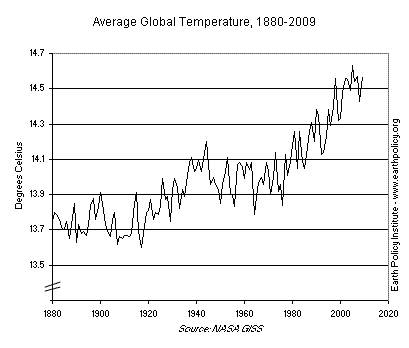
    The first decade of the twenty-first century was the hottest since recordkeeping began in 1880. With an average global temperature of 14.52 degrees C (58.1 degrees F), this decade was 0.2 degrees C (0.36 degrees F) warmer than any previous decade. The year 2005 was the hottest on record, while 2007 and 2009 tied for second hottest. In fact, 9 of the 10 warmest years on record occurred in the past decade.

    Temperature rise has accelerated in recent decades. The earth’s temperature is now 0.8 degrees C (1.4 degrees F) higher than it was in the first decade of the twentieth century, and two-thirds of that increase has taken place since 1970.

    Even with these seemingly small increases in global temperature, natural systems are already starting to respond, as evidenced by melting ice sheets and glaciers, shifting weather patterns, and changes in the timing of seasonal events. If temperatures continue to rise on their current trajectory, by the end of the century they will have left the narrow range in which human civilization has developed and flourished.

    Though temperatures are rising around the globe, some areas are warming faster than others, with the greatest warming taking place in the Arctic. Paleoclimate records from Arctic lakes, tree rings, and ice cores reveal that the past decade was the warmest of the past two millennia. Warming is amplified in the Arctic for a number of reasons, including the loss of the region’s extensive snow and ice cover: as temperatures rise and light-reflecting ice melts, it is replaced by darker water, which absorbs more energy from the sun, thereby accelerating warming. In parts of the Arctic, average annual temperatures have increased by as much as 2–3 degrees C (3.6–5.4 degrees F) since the 1950s. In 2007, Arctic summer sea ice shrank to its lowest extent on record, leaving the Northwest Passage completely ice-free for the first time in human memory. Then 2008 and 2009 brought the second and third lowest extent of Arctic summer ice on record.

    The earth’s temperature is determined by a number of factors. One major influence is the El Niño–Southern Oscillation (ENSO). This cycle, which involves large shifts in atmospheric and ocean temperatures over the tropical Pacific, has two phases: El Niño, which typically raises average global temperature, and La Niña, which lowers it. Year-to-year temperature variations are also influenced by the amount of energy the earth receives from the sun: increases in solar activity tend to raise global temperatures, while decreases in solar activity lower them.

    These natural cycles alone, however, fail to explain the temperature patterns of the last decade. While the strongest El Niño of the century pushed 1998 temperatures up to their then-record high, temperatures in the hottest year (2005) did not receive a boost from El Niño. And 2007 was tied for second hottest year on record, despite the development of a cooling La Niña. Furthermore, while global temperatures have been climbing to record heights, incoming solar energy has in fact been declining since the beginning of the decade. In early 2009, solar activity reached its lowest level in a century.

    Rather than ENSO cycles or variations in solar irradiance, human-induced warming from heat-trapping greenhouse gases has become the dominant climate influence. Carbon dioxide levels in the atmosphere have risen rapidly since the start of the Industrial Revolution, climbing from 280 parts per million (ppm) in the late eighteenth century to 387 ppm today. Researchers recently reported that the last time atmospheric carbon dioxide levels were this high was roughly 15 million years ago, when sea level was 25–40 meters (80 to 130 feet) higher, and temperatures were approximately 3–6 degrees Celsius warmer.

    The risks posed by rising global temperature are widespread. As the atmosphere warms, mountain glaciers that provide water to over a billion people are melting. Melting ice sheets and thermal expansion of oceans raise sea levels, threatening coastal populations. Increasing temperatures bring decreasing crop yields, putting world food supplies at risk. And ecosystems worldwide are irrevocably altered, placing large numbers of species at risk of extinction.

    Higher global temperatures also bring with them more frequent and severe extreme weather events. Over the past few decades, scientists have noted an increase in hot extremes and a decrease in cold extremes across the globe. As temperatures rise further, heat waves will become more frequent and intense. Longer and more severe droughts will take place over wider areas; an upsurge in global drought since the 1970s, associated with higher temperatures, has already been observed.  At the same time, as temperatures rise, the water-holding capacity of the atmosphere increases, leading to more intense storms and flooding in areas that are already wet.

    The past decade saw many record-breaking extreme weather events, providing examples of the kinds of incidents expected to become more frequent with global warming. In the summer of 2003, Europe experienced an intense heat wave that led to over 52,000 deaths. In the United States, where daily record high temperatures occurred twice as often as record lows over the last 10 years, persistent drought plagued parts of the South and West for much of the second half of the decade. A 2006 heat wave affecting the West and Midwest was blamed for 140 deaths in California.

    The combination of high temperatures and drought makes a dangerous recipe for wildfire; indeed, 2006 and 2007 saw the worst fire seasons on record in the United States. A similar combination led to disaster in southeastern Australia in early 2009: on what is now known as Black Saturday, intense, rapidly spreading bushfires killed 173 people and burned over a million acres.

    Other areas have experienced unusually heavy rains and flooding over the past decade. Record flooding hit Central Europe in 2002, causing over 100 deaths and forcing 450,000 people to evacuate. In summer 2007, the worst flooding in 60 years in England and Wales killed nine people and caused billions of dollars worth of damage; that May to July period was the wettest in the region since recordkeeping began in 1766. In 2008, extensive flooding occurred in several parts of the African continent; Algeria saw its worst floods in a century, while Zimbabwe’s floods were its worst on record.

    As temperatures rise, warmer oceans provide more energy to feed tropical storms. The past few decades have seen an increase in the frequency of the most severe hurricanes, and researchers have identified rising sea surface temperatures as the primary cause. The 2005 Atlantic hurricane season was the worst on record, with 27 named storms, 15 of which were classified as hurricanes—including Hurricane Katrina, which caused over 1,300 deaths and $125 billion in financial losses.

    In 2007, the Intergovernmental Panel on Climate Change (IPCC), an international body of over 2,500 scientists, released its Fourth Assessment Report, in which it called the recent warming of the globe “unequivocal.” The report projected a rise in average global temperature of 1.1–6.4 degrees C (2–11 degrees F) by the end of the century. Based on the most recent scientific assessments, if greenhouse gas emissions continue to grow at their current pace, the temperature rise by the end of the century will likely reach or exceed the upper end of these projections. Already, effects of increasing temperatures such as accelerating ice melt and sea level rise are outpacing the IPCC’s predictions of just three years ago.  Without significant cuts in greenhouse gas emissions, global temperature will rise dramatically by the end of the century, creating a world that looks vastly different from the one we know today.

     Data and additional resources available at www.earthpolicy.org.

    Related Links:

    The melting of America

    On the move: Species face race against climate change

    Ice Melting Faster Everywhere


  • From dominant Monsanto to ‘innovative Med-American,’ tasty morsels from around the web

    by Tom Philpott

    When my info-larder gets too packed, it’s time to serve up some choice nuggets from around the Web.

    ————————

    Get ‘em while they’re hot.  • NPR delivers a blunt report on Monsanto’s dominant position in the seed industry, complete with farmers complaining about monopoly pricing. With this sort of straight talk in mainstream media, one wonders if the Justice Department might really pursue an antitrust case against the monopolistic giant.

    • This Wall Street Journal infographic paints a devastating picture of the U.S. job market (the headline on the accompanying article says it all: “Even in a Recovery, Some Jobs Won’t Return.”) Look down at the bottom right corner along the margins, and you see one of the few growth areas in the U.S. growth landscape: “community food services.”

    That’s sad news—with unemployment stubbornly high, a growing number of people are hurting and in need of assistance at food banks. But look whom the Journal is highlighting as an example of a worker in that field: Sharon Thornberry of the Oregon Food Bank. Thornberry is an innovator in seeing that community food relief isn’t just about delivering emergency food, but also about creating alternative food systems that work for low-income residents. And alternative food systems can themselves generate meaningful jobs—thus bringing not just short-term hunger relief, but also real economic growth that can lift people out of hunger.

    • Speaking of jobs, check out this article on Yahoo Personal Finance, of all places (bear with me; food angle coming):

    Job satisfaction in America hit a record low in 2009, according to a survey released this week by the Conference Board—with only 45 percent of workers reporting contentment with their jobs.

    Clearly, the economic downturn is partly to blame. Workers have lost their jobs and taken less fulfilling, lower-paid positions. They’ve had to pick up the slack when colleagues were laid off, managing bigger workloads with no pay increase. They’ve had hours cut and benefits such as 401(k) matches dropped.

    The unhappiness-at-work trend didn’t start with the Great Recession:

    But job satisfaction among all age and income groups has been on a consistent downward trend since 1987, when the Conference Board began tracking the numbers.

    “What we’ve seen over last 22 years is that irrespective of whether the economy is boom or bust, the overall level of satisfaction expressed by U.S. workers has been steadily declining across every single aspect of the job,” says Lynn Franco, director of the Conference Board’s Consumer Research Center and author of the report.

    So happiness at work peaked more than 20 years ago (if this survey is accurate). I would call that a pretty damning indictment of the post-‘70s neoliberal era in U.S. economic policy (still lurching along, embodied in the Geithner/Summers White House economic team). We’ve lived through an age of outsourcing, a massive shift from manufacturing to services,  and the rise of Wal Mart-led consumerism. And evidently, we’ve thought it sucked all along, at least from a work persperctive.

    I’m wondering if emerging economies, based on the Jane Jacobs model of small, networked producers that I discussed here,  could provide an antidote to pervasive workplace gloom (and lack of work). Food is an everyday necessity that can be grown and processed damn near anywhere. Even in low-income areas, people spend $1000 per capita on food. Couldn’t food provide the fodder for such economies? The model seems to be working in Hardwick, Vermont.

    (For another look at the failure of recent economic policy, see BusinessWeek economist Michael Mandel’s devastating presentation (summarized here by Matt Yglesias.)

    I love this trend.

    • Speaking of amazing things to do with kimchi, check this out.

    • Over on my new favorite site Zester Daily, Clifford Wright, one of our most rigorous (and unheralded) authorities on Mediterranean cuisine, has an interesting piece on what he calls “innovative Med-American” cooking that “ironically can’t exist in the Mediterranean.”  He approves of the trend, declaring that …

    One of great attributes of American cooking is that Americans are less constrained by tradition than other cultures. There is an upside and a downside to that. The downside is often soulless international eclectic food ignorant of foundations inspired by extravagance, faux-dietetics, fads, gigantism, disrespect and foolishness. The upside is embryonic dishes laying a foundation for a new cuisine. Local American products and ingenuity tied to Mediterranean culinary sensibilities holds great promise.

    I think this is a spot-on reading of the potential and pitfalls of our cooking, and it applies also to beer, wine, and even coffee. (For example, to my mind, roasters/cafes like Intelligentsia of Chicago/L.A. and Blue Bottle of San Francisco are doing things with coffee never dreamed of in old-school coffee capitals like Rome, Vienna, and Ethiopia.)

    Related Links:

    Raj Patel on Colbert

    ‘Water’ author Stephen Solomon talks resource intelligence

    Economics as pathology, part two


  • Can a new USDA advisory committee make the dairy industry less pathetic?

    by David Gumpert

    Much as I’ve long been taken with the romanticism of dairy
    farming and the visions of grazing cows and nurturing fresh milk it conjures
    up, I tune out when the talk turns to “the dairy industry.”

    That subject stimulates
    images of commodity trading, price controls, feed lots, and perhaps most
    onerous—a rigged system akin to slavery in which the owners of small dairies
    nearly always lose. They have been losing for so many years the number of farms with dairy cows fell an astounding 88 percent, from 648,000 to 75,000 between 1960 and 2006, the U.S. Department of Agriculture reports.

    Those who control the dairy industry—the Dean Foods and
    other huge processors, along with so-called “dairy cooperatives”—don’t see a problem in all this since they continue to make big profits as “the industry” consolidates. They definitely don’t
    want to hear about opportunities for entrepreneurship and economic growth for dairy farms, such as in the emerging opportunity coming via growing demand for raw milk. Demand so strong it’s enabled California
    dairy Organic Pastures Dairy Co. to grow from an apple grower into the largest raw dairy in the
    country over the last seven years, with a reported 60,000 customers and fat profits reaped from fetching up
    to $17 a gallon for milk. Dozens of other smaller raw dairies in Pennsylvania,
    Ohio, and Michigan are thriving from similar growing demand, and a marketplace that
    rewards them with between $7 and $10 a gallon, versus about $1 a gallon for
    milk sold to Dean Foods and the dairy cooperatives.

    So when the U.S. Department of Agriculture secretary Tom
    Vilsack announced a few days ago the appointment of 17 members of a new Dairy
    Industry Advisory Committee to tell him how to deal with the dairy crisis, at first I tuned out. It sounded to me like more of the same—government officials talking sympathetically to the poor dairy farmers standing around hat-in-hand, while behind the scenes the same government officials continue tilting the system to benefit Dean Foods and other processors. Pathetic stuff, something like rearranging the deck chairs on the
    Titanic.

    Then I was listening to a New Hampshire Public Radio program Monday morning
    about, none other than “the dairy dilemma” and what to do about it. One of the guests on
    the call-in panel discussion was Deborah Erb, a New Hampshire dairy farmer
    appointed to serve on the committee for the next two years. She was on the program together
    with an official of a dairy cooperative, and the head of a Republican think
    tank.

    I decided to call in and see what Deborah might have to say about my
    idea to put state agriculture departments to work educating interested owners
    of smaller dairies on the fine art of producing safe and nutritious raw milk,
    as a way to fulfill their mandates to promote agriculture. Ag departments in a
    number of states like New York and Wisconsin spend much of their time harassing
    small dairies that seek to escape economic servitude by selling raw milk,
    rather than cooperating with them to help them succeed.

    As I waited about 45 minutes for my turn to speak, I
    listened to the discussion about the dairy industry’s dilemma, and tried hard
    not to tune out. It was just so pathetic.

    They talked about how more than 100 New England Dairy farms
    went out of business last year, which is possibly as many as 10 percent of the region’s 1,600 to
    1,800 remaining dairies. Someone mentioned that perhaps 30 percent of every consumer dollar spent on dairy products goes to the farmer, versus 50 percent in the 1960s, and nearly 100 percent at the turn of last century.

    The panelists also talked about how the federal government
    appropriated more than $300 million last year to artificially raise dairy
    prices paid to farmers, and how that amounted to three-and-a-half cents a gallon of milk, or
    maybe $6,000-$7,000 per dairy. “If you lost $60,000 or $70,000 last year, it
    helped,” one of the guests said hopefully. All I could think is that the dairy farmers
    need to find a Goldman Sachs big shot to get at some of those billions the government sent to the nation’s biggest banks last year.

    But my ears perked up when Deborah Erb was asked about the
    new USDA dairy advisory committee. “I hope to think outside the box,” she
    stated. Now there’s the seeds of change we can believe in.

    Finally, my turn as a caller came. I identified myself as the
    author of the new book, The Raw Milk Revolution, and briefly described
    my idea of encouraging small dairies to exploit the fast-growing raw
    milk market. Then I asked Deborah whether she would bring this idea up to the
    new committee.

    I was surprised at how knowledgeable she was about the
    subject. “Today’s milk supply is a lot cleaner than it once was,” she volunteered.
    One potential problem with raw milk, she said, was that it doesn’t travel real
    well. “As people get further from the farm, (raw milk) becomes problematic … ” Ah,
    but then she returned to her “box.” “I certainly am open to thinking outside
    the box.”

    Did that represent a commitment to give raw milk a hearing
    before the new committee? Unfortunately, I was cut off before I had a chance to
    follow up.

    But even “thinking outside the box”—forget about real
    action—would be progress among the dairy industry crowd that will be advising
    the USDA secretary. Slight progress, perhaps, since we’re not talking about an end to the servitude that marks the smaller dairy farmer’s current economic role. No, slaves need to fight for their freedom, and it’s not clear that a new USDA advisory committee is prepared to take on that role.

    Related Links:

    Johnny, Can You Spell Salmonella?

    Getting at the roots of unsustainable U.S. ag policy

    CAFOs: ‘Above the Law’ like Steven Seagal?


  • 2010 outlook for solar in California

    by Adam Browning

    Felix Kramer of Calcars thinks 2010 will be the year of the plug-in car.  He’s got a good case: after years of advocacy and technology development, 2010 is the year that major manufacturers will finally make plug-ins broadly available, and rapidly decreasing battery costs are helping the conversion industry reach new customers and help retrofit the existing fleet at scale. After years of work and promise, 2010 is the payoff year.

    I see a similar trend in solar in California, where years of policy and business development are all coming together to make 2010 an extraordinary year for solar development.

    There are four major market drivers:

    The California RPS

    California’s renewable portfolio statute requires the state’s utilities to include 20% renewables in their portfolio by 2010, and last year Governor Schwarzenegger issued an Executive Order increasing the requirement to 33%. To date, California investor-owned utilities have signed over 7 GW of contracts with solar companies, of which 4.9 GW are at prices below the Market Price Referent (that’s the 20-year levelized cost of energy for a combined cycle gas turbine, a proxy for the fossil fuel alternative). An Excel spreadsheet of the contracts, modified from the one found on the CPUC’s website, here.  This list will be expanding rapidly; by all accounts, the 2009 RPS solicitation garnered a tremendous response from solar (especially photovoltaic) developers, and as the utilities send contracts to the CPUC for approval, we are likely to see contracts for gigawatts more of mid-sized wholesale PV projects in the coming months. That’s what happens when solar gets cheap.

    Utility Wholesale Distributed Generation Programs

    California’s investor-owned utilities have all applied for significant investments in utility-owned solar projects, and 2010 is when these programs hit the street (or rooftop). Southern California Edison (SCE) wants to develop 250 MW of primarily rooftop solar projects; as a condition for approval, the California Public Utilities Commission is requiring SCE to buy an equivalent amount of solar, in 1-2 MW increments (90% of which have to be rooftop) from independent power producers through competitively-bid power purchase agreements. The details of how the auction mechanism is to work (including standard terms and conditions of the contract) were the subject of a workshop process last fall, and are to come before the CPUC for approval on Jan 21. Assuming approval, the first auction for PPAs could take place the following month or so. Details of the proceeding here and here.

    Pacific Gas and Electric (PG&E) has applied for a similar program: 250 MW of utility-owned generation (systems sized from 1-20 MW), and an equivalent amount to be purchased from independent power producers. For the IPP portion, PG&E’s initial application proposed to offer standard contracts at PG&E’s cost of development (initially estimated to be 29.5 cents/kWh, but would reset based on actual costs); this issue is being litigated before the CPUC, with resolution expected around February. As the CPUC forced SCE to competitively bid their IPP portion, it would be a good bet to speculate that they will decide on a similar requirement for PG&E, but who knows?

    Combined, these utility programs represent a gigawatt of wholesale distributed generation solar over the next 5 years.

    Feed-in Tariff Programs

    California has two feed-in tariff programs under development. The first is a proposed 1 GW market-based feed-in tariff, which would require the state’s investor-owned utilities to conduct multiple annual solicitations for 1-10 MW renewable projects. It’s different from a traditional feed-in tariff in that instead of guaranteeing a price, it guarantees a market and lets project developers set their own price. The proceeding to establish this program is inches from the goal-line—after over a year of work, we we are currently waiting on the Administrative Law Judge to issue a proposed resolution. We expect the process to be concluded in the next few months (knock wood), and the first auctions to begin before summer. The pilot program totals 1 GW over 4 years, though once the process gets moving and proves successful, it could easily be expanded. I believe that this program hits a sweet spot on several levels: 1) the 1-10 MW size targets projects that don’t need new transmission, and can thusly come on line quickly, and 2) the competitive pricing element, combined with solar’s dramatically lower costs, will finally bring on massive amounts of solar at politically palatable price-points.

    The second is SB 32, passed by the legislature last year. SB 32 requires the CPUC to develop a must-take standard-offer price for renewable contracts—essentially based on avoided cost. More details here, but as rulemaking will take awhile, it is unlikely that this program will be available in 2010.

    Customer-side of the meter

    The California Solar Initiative is the program that provides incentives for behind-the-meter generation—the owner of the system uses the production to offset purchases from the utility and reduce electric bills. Over 135 MW of photovoltaics, both residential and non-residential, were installed in 2009. We still have to raise the 2.5 % net metering cap, but if that’s accomplished, Jigar Shah (founder of SunEdison) told me he has a standing bet that the remaining incentives (all 1303 MW) will be reserved in 2010.  Here’s hoping he’s right. Also of note, just about every property owner in California will have access to a PACE financing program by the end of the year. As financing the high up-front costs of solar and energy efficiency is a long-standing hurdle to greater adoption, these new programs should help drive demand considerably.

    All told, we are looking at tremendous amounts of new solar development in the state. Here’s to more solar gen in two-thousand and ten …

    Related Links:

    China powers the global green tech revolution

    Everyone Poops – – and a few spin gold

    Copenhagen coal in the stocking?


  • Taking distributed energy seriously

    by David Roberts

    This week, in The New York Times’ Room for Debate, I was involved in a discussion on the brewing war among environmentalists over building large power plants on sensitive land—specifically, in this case, a solar thermal power plant in the Mojave desert. “Green Civil War: Projects vs. Preservation” saw contributions from:

    Randy Udall, energy analyst
    Vaclav Smil, professor, University of Manitoba
    Daniel M. Kammen, professor of energy, U.C. Berkeley
    Ileene Anderson, Center for Biological Diversity
    Winona LaDuke, Honor the Earth Fund

    And me! Turns out it’s very difficult to make a point in 300 words, at least for me, so I’m reposting my contribution below and will add a few additional comments at the bottom.

    ———

    Many folks are conflicted over the seeming clash between conserving America’s remaining wild landscapes and expanding clean energy supplies. What to do?

    To begin with, it seems prudent to postpone the conflict as long as possible, by making every effort to satisfy new energy demand with low-carbon resources on land that’s already developed. Senator Feinstein has gestured in that direction, but neither California or any other state has ever offered serious, sustained support to what’s loosely called distributed energy — energy generated, stored and managed at the local level.

    The U.S. power industry has always had a fondness for gigantism:  huge plants, remotely located, generating electricity that’s sold cheaply and used profligately. Wind farms on the Plains and solar plants in the Southwest desert, connected to cities by expensive new transmission lines, fit the familiar model. Regulations provide incentives for this development, which utilities know how to manage,  and which politicians understand.

    Yet the land and water problems facing solar plants should be a reminder that all large new industrial projects impose social costs.  Perhaps it’s time to take distributed energy seriously.

    What would a new model look like? Solar panels over every parking lot, brownfield, warehouse, and residential roof. Small-scale wind turbines on every bridge, microhydro in every stream and river,  advanced geothermal in every back yard, waste heat capture on every industrial plant. Batteries that store power to be used or sold when it’s worth most. An IT-infused grid that can manage complexity; devices that display real-time use and price information; variable power pricing. Every building sealed and weatherized, every appliance and electric car net-connected.

    In such a system, it’s not just energy that’s distributed, it’s social and economic power. The result is more democratic and resilient (though such benefits rarely find their way into conventional price comparisons). If “consumers” become producers, managers, and innovators, perhaps the desert tortoise and the world can be saved.

    ———

    A couple of ideas get tossed in here that deserve more mulling.

    First, “regulations provide incentives for this development.” Tomes could be written on how utility and power regulations encourage investment in large, remote power plants. Sean Casten is probably writing such a tome right now! The situation differs somewhat between the remaining regulated monopoly utilities and the ones that have been deregulated and/or “decoupled,” like those in California. But even the most enlightened utilities still tend to view distributed energy as a kind of curio, small beans done as much for PR purposes as for serious power.

    Part of the difficulty is that that utility regulations are mind-numbingly complex; part of it is that utilities have 50 years of deeply entrenched habits, models, and culture (in which innovation doesn’t play much of a role). But that’s the tip of the iceberg. As the second-to-last paragraph indicates, distributed energy requires not just different generation technology, it requires that cities be made into coherent quasi-organisms, that generation, distribution, storage, transportation, and administration systems be coordinated. Pushing all those systems forward together is a daunting task that will require, at least in the first few instances, a strong dose of central planning, to which Americans are (purportedly) averse.

    Third, the last paragraph is something that’s been an interest of mine for a long while: how will distributing the ability to generate, manage, and store power affect social dynamics? What will it look like when communities are more self-sufficient? What kind of innovations will spring up when everyone has access to the levers of energy, the way the internet gave everyone access to information infrastructure? What kind of lives will people live when their energy and gas bills are radically reduced or even eliminated? This is heady futurist sort of stuff, too much to get into in this post, but I suspect the changes will be far more sweeping than anyone can anticipate.

    Which leads to a final point:  cost comparisons between central-plant power and distributed power are woefully inadequate, typically focusing in on price-per-kWh. Of course rooftop solar fails by that comparison. But what happens when you factor in the saved cost of transmission lines that don’t have to be built? What happens when you factor in the efficiency gains made possible by smart appliances, smart vehicles, and smart grids? What happens when you factor in the fact that money spent on these systems will circulate almost entirely within a community rather than leaving it? What happens when you factor in energy independence, resilience, innovation,  jobs?

    There are “system of systems” benefits around distributed energy that we can’t yet predict, much yet place a dollar value on. As in so many areas, the question should not be how to save pennies, but how to construct the kind of lives, the kind of society, that reflects our highest aspirations.

    Related Links:

    Anti–school garden campaigner Caitlin Flanagan, on Colbert back in ‘06

    Raj Patel on Colbert

    Thoughts on The Atlantic’s attack on school gardens