Author: Grist – the Latest from Grist

  • Transportation bill could produce environmental and job benefits in 2010

    by Andrea Buffa

    As advocates for clean energy and good jobs evaluate opportunities to advance their issues in 2010—from a jobs bill that could include energy efficiency measures to a federal clean energy and climate bill—there is another oft-overlooked vehicle that advocates would be wise to consider.

    This year, Congress will likely pass a national transportation bill—legislation that comes up only about once every six years—through which the nation could reduce harmful greenhouse gas emissions from the transportation sector and significantly curtail petroleum use, thereby reducing U.S. dependence on foreign oil. The transportation bill also could deliver major economic benefits, including millions of new construction, operations and manufacturing jobs—just what the doctor ordered to fix what’s ailing the U.S. economy.

    “Transportation is the fastest growing sector in terms of greenhouse gas emissions,” said Jill Kubit, assistant director of the Cornell Global Labor Institute, which encourages labor unions to become actively engaged in climate policy. “But it’s often neglected in terms of the solutions side, so we feel a real need to engage unions and workers around this issue.”

    The Global Labor Institute isn’t the only organization that is planning to engage groups in the upcoming transportation debate. The coalition Transportation for America was created in 2008 by Smart Growth America, Reconnecting America, and the Surface Transportation Policy Partnership. T4America, as the coalition is called, now counts some 400 organizations that support its agenda to create “a new national transportation program that will take America into the 21st century by building a modernized infrastructure and healthy communities where people can live, work and play.”

    “It’s astonished and gratified us the range of organizations that have realized a connection to transportation,” said David Goldberg, communications director at T4America. He listed AARP as being a T4America member that is concerned that the U.S. transportation landscape is unfriendly to aging Americans; the American Public Health Association as a member that is troubled by the health impacts of pollution from the transportation sector and the lack of physical activity that has resulted from our transportation infrastructure; and PolicyLink as a member that wants to provide poor communities with access to high quality and affordable transportation options.

    Groups like Environmental Defense Fund and Natural Resources Defense Council are also part of the T4America coalition because of their focus on climate change. “If you’re talking about climate change, transportation is about a third of the emissions, and you’re not going to be able to put all new vehicles that run on cleaner fuels out there in time to deal with the problem. Liquid fuel is going to be the fuel source for a lot longer, but part of what we need to do is not drive so much,” Goldberg said.

    The transportation bill is so far-ranging that it touches many aspects of our lives. It addresses highways, bridges, highway safety, public transportation, railroads and high-speed rail, among other transportation issues. It includes the repair of existing transportation infrastructure as well as the financing of new highway and transit capacity. It targets metropolitan areas as well as rural areas. It regulates not only the movement of people, but also the movement of goods.

    Groups that seek reform of the transportation system also hope to address a wide diversity of issues through the transportation bill-climate change, health and safety, equity, smart growth and economic opportunity, among others.
    There is also a significant amount of money at stake, as well as the potential to create a large number of jobs. The last transportation bill was funded to the tune of $286 billion over six years; the current proposal by Minnesota Democrat James Oberstar, the chairman of the House Committee on Transportation and Infrastructure, would increase that amount to $500 billion over six years, including $50 billion for high-speed rail. Rep. Oberstar testified in July that the bill will “create or sustain approximately six million family-wage jobs.”

    Many economists consider the transportation sector to be rife with job creation potential. A recent study by the Economic Policy Institute (Transportation Investments and the Labor Market) found that a $250 billion investment in the U.S. transportation system would create more than 2.8 million direct and indirect jobs. The study also looked at the quality of the jobs that would be created by transportation investments and found that they were more likely to be unionized and less likely to require a college degree.

    “Across the board, it’s a pretty dense industry when it comes to unionization,” said Ed Wytkind, president of the Transportation Trades Department of the AFL-CIO. “This means you have higher wages, better benefits and better training. You probably have good quality health care, and you’re more likely to have a pension.”

    Although Wytkind’s organization does not represent workers in transportation manufacturing, he is very interested in the potential for increased transportation investment to create not only construction and operations jobs, but also domestic manufacturing jobs. “Most of our manufacturers are buying components and intellectual property from overseas. This [transportation bill] is a great opportunity to look at the next generation of locomotives and passenger rail cars and buses and make sure they’re not only more energy efficient, but that they also support American jobs,” Wytkind said.

    Currently, most U.S. transportation funding comes from the gasoline tax, which has not increased since 1993 and is not indexed to inflation. At 18.3 cents per gallon, the federal tax has lost 33 percent of its purchasing power over the last 15 years, according to Oberstar. If more funds are to be invested in transportation to create the jobs and other benefits for which many groups are advocating, the gasoline tax will need to be increased or a new and sustainable source of funding will need to be identified. However, with the economy still in a state of recession, most politicians are loath to support any tax increases. This is a key reason why the transportation bill, which expired in September 2009, has yet to be taken up by Congress and may not be seriously considered until fall 2010.

    Funding is not the only challenge for those who seek changes in the U.S. transportation system to address environmental, public health, equity and other critical issues. Many groups still differ on their priorities. For example, while most groups support increased transportation investment, there are divisions as to whether public transportation should be on a more equal footing with highways. There are also divisions between organizations that support fix-it-first policies that prioritize repair and maintenance work on roads over new road and bridge construction, and those which argue that new road construction is needed to address traffic congestion and other problems.

    These issues will be discussed and debated throughout 2010 as Congress deliberates the transportation and jobs bills. In December, the Obama administration proposed that the jobs bill include a $50 billion infrastructure investment to go mainly toward highways, transit, rail and aviation. The House jobs bill, which was passed on December 16, included approximately $37 billion in transportation investments.

    To the extent that these investments create well-paying jobs and move the country toward a cleaner and more sustainable transportation system, they represent progress. But the transportation bill is still the 800 pound gorilla. As T4America’s Goldberg put it, “By all rights, this [transportation bill] ought to be the best opportunity in a generation to create a bold new vision for our national transportation policy.”

    A longer version of this article is available at www.apolloalliance.org.

    Related Links:

    Q&A: what will happen with climate legislation in 2010?

    How do I find a green job?

    Richard “Dick” Pombo running for Congress again in California


  • World veterinary agency to probe link meat-climate link

    by Agence France-Presse

    PARIS—The world’s top authority in farm
    animal health announced on Thursday it would launch a study into the role
    of meat in climate change.

    The report,
    carried out by independent experts, is expected to be published “by the summer,” Bernard Vallat, head of the World
    Organization for Animal Health, known by its French acronym of OIE, said in
    Paris.

    It is the first
    time in its nearly 85-year history that the 175-nation OIE is to carry out an environmental
    investigation.

    The agency swaps
    information about diseases in farm animals and issues recommendations in veterinary scares such as H5N1 avian
    flu.

    The probe
    coincides with mounting interest in the role of meat-eating in stoking climate change.

    Farm animals are
    significant sources of greenhouse gases, either directly through methane emissions from digestion or indirectly, such
    as clearing forests for pasture and inputs used in raising
    cattle.

    Vallat, who is
    the OIE’s director general, said there had been a “very strong request” from member-states for the
    report.

    The
    investigation’s scope will be limited, and it will not seek
    to rival or replicate the work of the U.N.‘s global-warming scientists,
    the Intergovernmental Panel on Climate Change (IPCC), he
    said.

    By some
    estimates, there will be a 50 percent surge in demand for animal protein by 2020 in order to feed the world’s burgeoning
    population and demands from emerging economies, he said.

    “Whatever
    happens, we are going to have to produce more animals to feed the planet,” he told a press conference.

    Celebrity vegans
    such as Paul McCartney are urging consumers to boycott meat as a personal contribution to fighting climate
    change.

    A kilogram (2.2 pounds) of beef causes more greenhouse-gas and other pollution than driving for three hours while leaving all the lights on back home, according to a 2007 study led by Akifumi Ogino of the National Institute of Livestock and Grassland Science in Tsukuba,
    Japan.

    Related Links:

    Can GMO seeds be ‘sustainable’?

    Is the leaked draft a big deal or a non-issue?

    A global perspective on U.S. climate emissions


  • Q&A: what will happen with climate legislation in 2010?

    by The Guardian

    By Suzanne Goldenberg, The Guardian’s U.S. environment correspondent

    What is the state of play for climate change legislation in America?

    Barack Obama put his reputation on the line at Copenhagen by saying America would act on climate change. Now it’s up to Congress. The House of Representatives passed the Waxman-Markey bill last June which would set a price on carbon, and would put progressively tighter limits on greenhouse gas emissions with a 17 percent cut from 2005 levels by 2020, and 80 percent by 2050.

    Barbara Boxer, a California Democrat, passed a nearly identical version of the bill out of the Senate environment committee last November. But action in the Senate has stalled. Boxer stared down a Republican boycott to get a bill through her committee. But Democrats are deeply reluctant to throw themselves into another full-on confrontation with Republicans so soon after the bruising battle over health care reform.

    What happens next?

    U.S. environmental organizations say there is still a good chance the Senate will move ahead on a climate change bill this year.  A triumvirate of Senators—Democrat John Kerry, Republican Lindsey Graham, and Independent Joe Lieberman—are working to craft a climate change bill they think would have a good chance of getting support from Republican as well as Democratic Senators. Kerry had earlier promised a blueprint late last year. The newest deadline is at the end of this month. The Senate is then expected to begin its push in the spring.

    Did the Copenhagen climate summit hurt or help prospects for the bill?

    Obama’s 13 hours on the ground diplomacy at Copenhagen was seen as evidence of his commitment to action—which should help give momentum to the bill. The deal reached at Copenhagen by the biggest emitters—though it fell far short of hopes for the summit—also includes important concessions from China to begin curbing its rate of emissions, and to open its books on how it cuts emissions. That will help neutralize the argument that China is not doing its bit, and that America would give up competitive advantage if it took on energy reform.

    Will the Senate bill look just like Waxman-Markey?

    Not entirely. Kerry and Graham are determined to get Republican support, which means there will mean a number of hard compromises for environmentalists. One is an expansion of nuclear power, with Republicans pushing hard for more cheap government loans for new plants, plus streamlined regulations. There is also a push for offshore oil drilling. Other ideas include limiting the kinds of industries that would be compelled to begin reducing their emissions. One proposal under discussion would only put an emissions cap on power plants.

    What about the U.S. midterm elections?

    The Democrats anticipate losses in both the House of Representatives and the Senate in the 2010 elections which will further impair the prospects of getting climate change law. But even the approach of the 2010 elections are making an impact.

    Democratic leaders say the Senate must pass climate change bill by spring 2010, if there is to be any U.S. legislation at all. Democrats from coal and old industry states will be cautious about signing up to sweeping energy and climate laws in the run-up to midterm elections in November 2010. The oil, coal and manufacturing lobbies have been spending millions to frame the proposed laws as measures that will fuel unemployment and increase home heating bills.

    What if the Senate fails to act?

    Climate change legislation may stall in the Senate, but the federal government, and several states and cities are moving ahead. The business world is also coming on side. The Obama administration has raised fuel efficiency standards for cars. California, the biggest state, has ordered power companies to get one-third of its electricity from clean and renewable energy by 2020. Perhaps most importantly, the Environmental Protection Agency said last month that it would begin regulating greenhouse gas emissions. However, some Republicans want to keep the EPA out of that role. The Senate is due to vote on January 20 on whether to delay EPA regulatory action.

    How does this affect a global deal to curb carbon emissions?

    One of the key outcomes from Copenhagen is a commitment from industrialized countries to raise $100 billion a year from 2020 to help the most vulnerable countries adapt to climate change. But America’s promise to mobilize its share of the $100 billion depends on the establishment of a carbon market—which will be created through climate change legislation. Obama administration officials have said America will raise its share from a variety of sources—not just government funds. No climate change law means no U.S. carbon market and sharply reduced funds for poor countries.

    First published on The Guardian.

    Related Links:

    Reports of climate bill death are greatly exaggerated

    Transportation bill could produce environmental and job benefits in 2010

    What might Sen. Byron Dorgan’s retirement mean for climate legislation?


  • Russ Parsons on launching a civil, inclusive food-system debate

    by Tom Philpott

    Can we all just get along? Image: Tom Twigg for GristIn a recent article, the LA Times foodie pundit Russ Parsons attempted to start a “more constructive give-and-take, the start of a true conversation” on the food system. He argues the debate has congealed into a tedious battle between “hard-line aggies” who are “convinced that a bunch of know-nothing urbanites want to send them back to Stone Age farming techniques,” and reformers who “lump together all farms (or at least those that aren’t purely organic, hemp-clad mom-and-pop operations) as thoughtless ravagers of the environment.”

    For all I know, Parsons places me in the latter camp; but I think he makes good sense here, and the kind of conversation he’s attempting to start would be quite valuable. I am sympathetic with anyone who’s trying to scratch a living off of the land, and recoil when sustainable food advocates demonize large-scale farmers. In the past I’ve argued—to the chagrin of mainstream green groups—against taking a simplistic anti-subsidy stance on farm policy.

    And indeed, Parsons may have succeeded in starting just the kind cilvil conversation he set out to. The blog of the National Corn Grower’s Association, a group not normally open to criticisms of Big Ag, welcomed Parson’s piece: “You may not like all of the points made in his article, but there are some real gems that make it a worthy read.”

    I welcome a new, more civil conversation, too. But here’s something that Parsons didn’t mention—and that must be aired out: corporate dominance of the food system. From my view, the main problem faced by the nation’s large-scale farmers isn’t that Michael Pollan writes books critical of corn; it’s that just two buyers, ADM and Cargill, buy and process the great bulk of their product—and siphon off so much of its value. And a few input suppliers like seed giant Monsanto and fertilizer titan Mosaic (majority-owned by Cargill) siphon off much of what’s left.

    As long as that situation holds sway—large farms producing input-intensive monocrops for a few buyers with massive market power—the stewards of our nation’s best farmland will remain reliant on direct government payments and rigged up markets, like the one for ethanol. And they’ll face pressure to maximize gross output, to the detriment of soil, waterways, and flavor. We as a society have a stake in helping them get out of that trap—and I hope to participate in a civil conversation about how that can happen.

    Related Links:

    Seeking sustainability, finding skeptics at the American Farm Bureau meeting

    Industrial farming head just says ‘no’ to call for civility

    Gates Foundation throws its lot with agribusiness


  • U.S. breaks with ‘drill anywhere’ energy policy, Salazar announces

    by Agence France-Presse

    Interior Secretary Ken Salazar.Mike Disharoon via FlickrWASHINGTON—The United States is moving away from the “drill anywhere, whatever the cost” energy policy of the previous administration, officials said Wednesday as they announced reforms in the way oil and gas leases are attributed.

    “We don’t believe we have to be drilling everywhere and anywhere,” Interior Secretary Ken Salazar told a news conference where he and other officials announced changes to the way the U.S. government manages onshore oil and gas exploration leases.

    “We believe we have to have a balanced, thoughtful approach that allows for the development of oil and gas resources but at the same time protects the treasured landscapes of America,” Salazar said.

    The new approach was in line with President Barack Obama’s commitment to develop U.S. gas and oil stocks while also growing the country’s green energy capacity, Assistant Secretary of the Interior for Land and Minerals Management Wilma Lewis said.

    It also marked a break from the way the George W. Bush administration did oil and gas business, said Salazar. “The previous administration’s approach to oil and gas leasing … by and large was that leasing should happen almost anywhere, at whatever cost,” he said.

    He faulted the Bush administration for putting up for auction “highly controversial areas” in the western United States, including municipal watersheds, wildlife habitats, or lands close to national parks. “There seemed to be little rhyme or reason to which areas were leased. Western landscapes were being carved up and fragmented,” said Salazar, who is from Colorado.

    Nearly half of the leases offered under the Bush administration were contested by environmental and other groups in 2008, compared with “a little over 1 percent in 1998,” the secretary said.

    Court battles over leases are costing millions of dollars in litigation, tying up resources, and showing that the current lease system is flawed, he said.

    Under the proposed reforms to the onshore oil and gas leasing program, more environmental analyses will be conducted before leases are auctioned and the public will be engaged “earlier and more frequently in the process,” said Salazar.

    Related Links:

    The policy and politics of Obama’s $2.3 billion in clean energy tax credits

    EPA gets tough on smog

    U.S. car fleet shrank by four million in 2009


  • With new year comes second chance to save the world

    by Geoffrey Lean

    Just about exactly a year ago, patient readers with long memories may remember, I received a sobering New Year’s Day message. “Today,” it began arrestingly, “is arguably the first day of the most important year in human history.”

    Once again, the climate clock is ticking…The message—sent to a who’s who of top officials on both sides of the Atlantic, was from Prof. Tom Burke, a close adviser to three successive British Conservative environment secretaries in the 1990s, and one of Europe’s shrewdest observers of green politics.

    He was referring, of course, to the recent Copenhagen climate summit, which he told us “would do more to shape human history for longer” than any other meeting in world history. The reason? “Climate change is forever,” its nature such that “the future cannot redeem today’s mistakes.” He added: “We have one chance to reach a political agreement to reduce carbon emissions in time to stay safe. This is the year in which we take that chance.”

    Or not, as it turned out.

    Burke’s words stuck with me throughout the fiasco that the summit became. Indeed, on its last day I woke up thinking, “If Tom is right, this is the most important day ever.” In a sense, it lived up to that billing, with key world leaders—including President Obama, Britain’s Gordon Brown, Germany’s Angela Merkel, France’s Nicolas Sarkozy, Brazil’s Luiz Inácio Lula da Silva, and Mohammed Nasheed of the Maldives—personally negotiating an agreement line by line. But even they accepted that the “accord” that resulted fell far short of what is needed.

    So I kept a special eye on my inbox this new year to see if Burke would send another missive. It never came. Meanwhile,  I came across an article he recently published in ENDS, perhaps Britain’s most authoritative environmental journal. Its message was just as uncompromising. “It will take a while for the full magnitude of the calamity that has befallen the world to become clear,” he wrote. “But calamity it is.”

    He went on: “Not one of the 119 world leaders who attended the Copenhagen summit came intending to shatter a global climate regime so painfully built up over 20 years. But that is what they accomplished”

    The “core elements” of a deal that would have kept global warming beneath 2 degrees centigrade “were within view, if not within grasp, before the meeting began,” Burke added. “A little more movement on emissions reductions, a bit more money on the table, and a real foundation could have been laid. By the end, enough had moved on both those central issues for a deal to have been grasped, But so sour had the mood become, and so chaotic the process, that it slipped from the hand.”

    I agree with Burke about how close agreement was when the conference opened and that, even though the formal negotiations got nowhere, there was enough movement (not least in the Americans’ unexpected agreement to endorse a $100 billion-a-year fund for the poorest nations) to have made it possible to seal the deal. I agree, too, that the sour atmosphere at Copenhagen—founded on deep mistrust arising from decades of broken promises, enhanced by the poor chairmanship and chaotic organization of the summit, and exploited by a few countries to frustrate progress—was the principle reason for the summit’s failure.

    But I am not so gloomy about the outcome. I place some faith in the very readiness of the leaders to work painstakingly throughout an entire day to try to get a worthwhile agreement. Burke dismisses this as itself “a recipe for disaster” with “getting out of town with the right headline” being “the most urgent priority” for the Obamas and Merkels in attendance.

    Yet, far from contenting themselves with concocting a face saving press release, the leaders almost pulled something off. Had China not issued a last minute veto of the accord’s most important elements—notably a 50 percent global reduction in emissions by 2050, and a commitment to work on producing legally-binding treaty—there would have been something valuable to build on, an extraordinary achievement in the circumstances.

    Many of the leaders, including all those listed above, have demonstrated a personal commitment to tackling climate change that in almost every case goes beyond what either their political parties or their electorates are demanding (the exception is President Nasheed, but only because his people are just as desperate as he to prevent their country’s extinction at the hands of rising sea levels).

    All, too, have taken steps to reaffirm that commitment since Copenhagen. And, in another hopeful straw in the wind, China’s vice foreign minister, He Yafei—one of the main figures blocking progress at the summit—has just been pushed out, suggesting at least that his government is embarrassed by the blame it has attracted.

    Such experienced observers as David Doniger of the Natural Resources Defense Council, Jennifer Morgan of the World Resources Institute, and Alden Meyer of the Union of Concerned Scientists also take a more optimistic view. Burke dismisses such people as “shell-shocked survivors of a political hurricane, picking over the disaster site for any useful fragments of their past existence.”

    But these experienced NGO hands have realistic hopes for the next twelve months, ending in another attempt at finalizing a global climate agreement in Mexico.

    So maybe Burke’s message was off by a year, making 2010 is the “most important” year of all.

    Related Links:

    Thomas Friedman says greed can lead us to a new green economy

    Climate Post: Warming apparently takes extra time off for holidays

    A conversation with Indian youth activist Ruchi Jain


  • How do I find a green job?

    by Auden Schendler

    This is the time-honored question, one I get asked so frequently, from very qualified individuals, that I decided to answer it online. It is heartbreaking (and encouraging) how many skilled and interested people are looking for work in the sustainability field. The good news is the sector is growing exponentially.

    If you ask anyone in the field they’ll probably tell you they got there by luck. That’s certainly true for me. I’m less smart, strong, and fast than other candidates, and much less skilled. But I happened to be in the right place at the right time. That said, there are a few steps we can all follow to improve the odds. Luck is good, but as the mountaineers say, you make your own luck. (To a point.)

    The seven keys to one day finding a job in sustainable business:

    1) Be ruthlessly opportunistic, taking low paid jobs, internships, and volunteer positions in the field in which you want to work to get experience;

    2) Make your job a green job. Don’t take you eye off the ball even if you end up working in unrelated fields for a while to make ends meet; in fact, you might try to make your job in that unrelated field become the job you want. Several environmental directors I know have simply proposed that position with a company previously uninterested in such work.  In the end, EVERY job is going to have to become a job that focuses on climate change if we hope to solve this problem.

    3) Work the hell out of the network, i.e., constantly network with people and keep their contact info—few people ever got a good job by responding to a want ad. And don’t worry about pissing someone off by contacting them too much: you are just reminding them you’re around, and people can’t keep track of everyone;

    4) Don’t ever get discouraged, particularly if you’re currently doing something you don’t deem “environmental.”  We all have to survive. I cooked burgers, shoveled gravel, and drove a skid-steer.

    5) Get your foot in the door. Since these sorts of jobs that are really cool are rare, sometimes you have to get into an industry as something other than the sustainability person, then either work to create that position or work your way into that part of the company. In other words, just being in the tourism industry, for example, is a start if you want to work in sustainable tourism. The whole business world is moving towards sustainable practices, so opportunities will start appearing;. And once you get your foot in the door, work HARD! Show up early. Be friendly and talk to everyone. Volunteer to clean toilets. Propose new projects. Find funding for stuff nobody knew about. Eat lunch at your desk. Look people in the eye when you talk to them. Squeeze hard when you shake hands.

    6) Educate yourself constantly no matter what you’re doing. You should read every book on sustainable business you can get your hands on, so that when a good opportunity arises you can talk the talk, and know what people are talking about. Anyone who wants a job in this field MUST have read, and be able to discuss The Ecology of Commerce, Natural Capitalism, Power to the People, Cool Companies, Lean and Clean Management, Cradle to Cradle, Crimes Against Nature, Tom Friedman’s Hot, Flat and Crowded, Hell and High Water (Joe Romm’s book on climate change) and probably a dozen other related books by the likes of Bill McKibben, John Elkington, Gus Speth, Lester Brown, Herman Daly, etc. (Shameless self-promotional plug—you should also buy my book, written for people like you, called “Getting Green Done.” www.gettinggreendone.com.) You have to understand climate science and policy, green building design, and energy efficiency. It also doesn’t hurt to make sure you’ve read the background stuff: John Muir, Thoreau, Aldo Leopold, Rachel Carson, and philosophy, particularly ethics, including work by Peter Singer,  (“the Life you Can Save,” for context (the book “Mountains Beyond Mountains” by Tracy Kidder), as well as any work that answers the question: “how ought we to live?”  You should subscribe to Grist (www.grist.org) and read it daily to stay up to date on environmental issues.(And send them some money if you have it) You should also read www.climateprogress.org every day, like taking your vitamins.  You don’t have to agree with these books or websites, but you have to read them. In fact, you should listen to Limbaugh and Hannity as much as you can stand it, and read stuff that pisses you off and which you disagree with. Peter Schwartz from the Globl Business Network once said you should read everything—Bride magazine, techical manuals, even if you just skim that stuff, so you have a sense of what’s happening in a range of fields. I force myself to read, say, Redbook, at the dentist’s office. I hate it, but it gives me insight into other people’s lives and ideas.  Plus, you can do this because you have time-after all, you’re looking for work.

    7) Learn how to write. Writing is thinking and writing is communication, and you’ll use it every day. Most people I interview say they know how to write, and they are almost always wrong. I spent 20 years working hard on learning how to write, getting my ass kicked by editors, and I still underwhelm myself on a daily basis and marvel at good writers. You need to work on this your whole life.

    I’m sorry I can’t be more specific, but there’s nothing more specific out there, other than some cool internet green job sites. It’s a bewildering thing, trying to get into this, or any, field, and a lot of it is just random chance. Ask anyone with a dream job, and they’ll tell you that at one time, they were flipping burgers, or driving a skid-steer, wondering what the hell they were doing with their life. It was certainly true for me. And I bet it will be true again.

    Related Links:

    Clean Energy Business Zones: A tool for economic growth

    Transportation bill could produce environmental and job benefits in 2010

    Gregoire: ‘America is back in its rightful position’


  • TRIPping out: A first step in making the US-India climate dialogue real

    by Jonathan Zasloff

    Long ago, in a galaxy far, far away—well, no, actually two months ago in Washington, D.C., President Obama and Indian Prime Minister Singh inked something called the U.S.-India Climate Dialogue. It was a pretty transparent attempt to salvage something from the fact that India would never agree to binding emissions cuts (and probably the U.S. wouldn’t, either).

    And what was this Dialogue supposed to do? Your guess is as good as mine, but here’s one place to start: the Trade-Related Aspects of Intellectual Property Rights accord, better known as TRIPS.

    TRIPS intimately concerns climate change because intellectual property rights regimes might prevent developing countries from accessing the high technology that could reduce their emissions. For example, supercritical and ultra-supercritical coal technologies have significantly lower emissions than regular plants, and since India is going to rely on coal for a big chunk of its ongoing energy needs, it obviously makes sense for it to go with the best available supercritical technology.

    But maybe it won’t be able to, because various developed country firms own the patents to this technology, and might object even if Indians developed new processes utilizing this technology. Oh yes, they would sell: at an exhorbitant price.

    What to do? That’s where TRIPS comes in. Theoretically, American technology patent holders might argue that under TRIPS, India’s patent enforcement authority should enforce their U.S. patents. But here’s the catch: any objection to an Indian failure to enforce TRIPS must be made by the U.S. Government at the WTO, not the patent-holder in a private right of action.

    You can see where this is going. The Dialogue could establish protocols concerning:

    When the United States would bring such an action and when it would not;
    how negotiations for compensation should proceed and under what basis, and;
    anything that India might provide as emissions reductions in return for U.S. forbearance.

    The point is that there is a negotiating space here for the United States and India to achieve a win-win on climate outside the Kyoto/Copenhagen mosh pit. Essentially, the Dialogue could work toward some sort of compulsory licensing scheme that could compensate U.S. patent holders more quickly (although less lucratively), transfer key technology, and give New Delhi incentives to work on reducing their own emissions in other ways.

    These opportunities abound, about which more to come. But TRIPS is a good place to start.

    Related Links:

    A conversation with Indian youth activist Ruchi Jain

    Copenhagen coal in the stocking?

    Top green stories of the ‘00s


  • Solar energy’s dirty little secret

    by Todd Woody

    Solar energy has long been one of the great hopes for
    fighting climate change and liberating the world from fossil fuels. And it’s
    easy to see why solar has captured the collective imagination: All those
    photovoltaic panels look so shiny, futuristic, clean, and green.

    Producing solar PV modules involves a witch’s brew of toxic chemicals. And spooky fog for good measure.That’s not quite the case. Any form of energy production has
    its dirty side and solar is no exception. While its impact is nowhere near that
    of coal-fired power plants, photovoltaic modules are made from a witch’s brew
    of toxic chemicals. Arsenic, cadmium telluride, hexafluoroethane, lead, and polyvinyl fluoride are just some of the chemicals used to manufacture various types of
    solar cells.

    None of this poses much, if any, threat during a solar
    panel’s working life. Solar modules—which are linked together to form a solar
    panel—for instance, are solid state and encased in glass or other
    protective material to keep them dry. The problem, as the Silicon Valley Toxics Coalition pointed out in
    a 2009 report,
    comes at the beginning and end of a panel’s life. Toxins potentially can be
    released during the manufacturing process—putting workers at risk—and when
    panels finally hit the scrap heap decades later.

    “The solar PV industry has the potential to provide enormous
    environmental benefits,” according to the Silicon Valley Toxics report, “but
    the toxic materials contained in solar panels will present a serious danger to
    public health and the environment if they are not disposed of properly when
    they reach the end of their useful lives.”

    The report compared the nascent but fast-growing solar
    industry to the electronics industry of past decades, which left a legacy of
    toxic pollution in the 1970s and ‘80s. Unlike the early electronics industry—which in Silicon Valley was literally built on plumes of contaminated
    groundwater—solar companies are taking a more responsible approach, as any
    green business must.

    Companies such as thin-film module maker First Solar have
    implemented take-back and recycling programs from the get-go. In labs at the University of Washington and elsewhere
    and at startups such as German’s Heliatek, researchers are
    working on developing so-called organic solar cells that generate electricity—albeit very inefficiently so far—without using toxic chemicals.

    Then there are companies like BioSolar that aim to take the toxics out of solar by substituting environmentally
    friendly materials. The company, based in the Southern California city of Santa
    Clarita, is developing a plastic made from plant material—called bioplastic—that can be used as components in solar modules.

    “The solar industry will have some of the same problems the
    electronics industry had unless we plan now,” says David Lee, BioSolar’s chief
    executive. “The solar industry involves a lot of toxic chemicals and we have to
    look at the lifecycle of these materials, from mining to manufacturing.”

    That, of course, is easier said than done.

    Most bioplastics are used to make disposable things—cups,
    plates, and trash bags—and are designed to be biodegradable. A bioplastic used
    in a solar cell is built to last for the typical 25-year life of the cell. It
    must be able to withstand the high temperatures generated by photovolatic
    modules and be water tight to keep moisture at bay.

    BioSolar’s solution was to develop a proprietary process
    that strengthens petroleum- and toxin-free bioplastics so they can withstand
    temperature and moisture yet still be recycled or biodegrade in a landfill.

    The company’s first product is Bio Backsheet, a replacement
    for the the material that forms the protective back of a solar cell. Standard
    so-called backsheets are usually made of polyvinyl fluoride, a chemical
    compound that can contain lead, chromium, cadmium, selenium, arsenic, and
    antimony.

    “Existing backsheets are extremely hard to recycle,” says
    Lee, who holds a Ph.D. in electrical engineering. “The only way to get rid of
    them is by burying them in the ground.”

    According to Lee, BioSolar’s Bio Backsheet can be safely
    recycled at the end of a solar module’s life or disposed of in a landfill. It
    will degrade—eventually I’ll have to check but I suspect I’ll just get a
    vague estimate—but without causing environmental contamination.

    So far, BioSolar has only manufactured limited quantities of
    the Bio Backsheet, mainly so that solar module makers can test the product. Lee
    says BioSolar is working with several solar companies who are testing the
    product, which he declined to identify.

    BioSolar is also developing bioplastics that can be used to
    replace chemical-based substrates that form solar cells.

    [A customary word of caution about startups: It’s impossible
    at this stage to verify BioSolar’s claims or whether its products will live up
    to their billing. Founded in 2006, BioSolar was initially funded by family and
    funds before going public in 2007. It trades in the over-the-counter market and
    has accumulated losses of $2.6 million since its inception, according to
    financial filings.]

    While BioSolar talks about greening the solar industry, the
    company’s pitch to photovoltaic module makers is just as much about saving
    money as the world. “We all know that everyone loves green products,” says Lee,
    “but unless the cost is less, manufacturers don’t pay much attention.”

    Lee is aiming to produce bioplastic solar cell components at
    half the cost of their chemical-based counterparts. If he succeeds, solar power
    may finally start to live up to its clean, green billing.

    Related Links:

    Ask Umbra on water bottles, gas dryers, and tea lights

    Broken promises follow Tennessee coal ash disaster

    Ask Umbra on Christmas trees, broken lights, and naughty birds


  • U.S. car fleet shrank by four million in 2009

    by Lester Brown

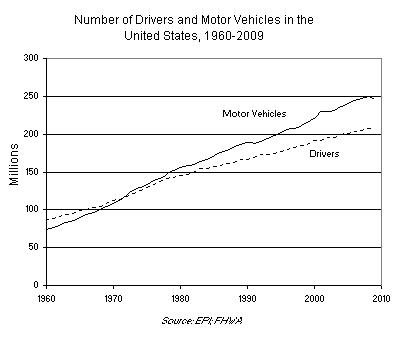
    America’s century-old love affair with the automobile may be coming to an end. The U.S. fleet has apparently peaked and started to decline. In 2009, the 14 million cars scrapped exceeded the 10 million new cars sold, shrinking the U.S. fleet by 4 million, or nearly 2 percent in one year. While this is widely associated with the recession, it is in fact caused by several converging forces. 

    Future U.S. fleet size will be determined by the relationship between two trends: new car sales and cars scrapped. Cars scrapped exceeded new car sales in 2009 for the first time since World War II, shrinking the U.S. vehicle fleet from the all-time high of 250 million to 246 million. It now appears that this new trend of scrappage exceeding sales could continue through at least 2020.

    Among the trends that are keeping sales well below the annual figure of 15–17 million that prevailed from 1994 through 2007 are market saturation, ongoing urbanization, economic uncertainty, oil insecurity, rising gasoline prices, frustration with traffic congestion, mounting concerns about climate change, and a declining interest in cars among young people.

    Market saturation may be the dominant contributor to the peaking of the U.S. fleet. The United States now has 246 million registered motor vehicles and 209 million licensed drivers—nearly 5 vehicles for every 4 drivers. When is enough enough?

    Japan may offer some clues to the U.S. future. Both more densely populated and highly urbanized than the United States, Japan apparently reached car saturation in 1990. Since then its annual car sales have shrunk by 21 percent. The United States appears set to follow suit.

    The car promised mobility, and in a largely rural United States it delivered. But with four out of five Americans now living in cities, the growth in urban car numbers at some point provides just the opposite: immobility. The Texas Transportation Institute reports that U.S. congestion costs, including fuel wasted and time lost, climbed from $17 billion in 1982 to $87 billion in 2007.

    Mayors across the country are waging a strong fight to save their cities from cars, trying to reduce traffic congestion and air pollution. Many are using a “carrot-and-stick” approach to reduce costly traffic congestion by simultaneously improving public transportation while imposing restrictions on the use of cars.

    Almost every U.S. city is either introducing new light rail lines, new subway lines, or express bus lines, or they are expanding and improving existing public transit systems in order to reduce dependence on cars. Among the cities following this path are Phoenix, Seattle, Houston, Nashville, and Washington, D.C. As urban transit systems expand and improve, commuters are turning to public transit as driving costs rise. Between 2005 and 2008, transit ridership climbed 9 percent in the United States. Many cities are also actively creating pedestrian and bicycle-friendly streets, making it easier to walk or bike to work.

    Forward-looking cities are also reconsidering parking requirements for new buildings. Washington, D.C., for example, has rewritten its 50-year-old codes, reducing the number of parking spaces required with the construction of both commercial and residential buildings. Earlier codes that once required four parking spaces for every 1,000 square feet of retail space now require only one.

    As parking fees rise, many cities are moving beyond coin-fed parking meters and replacing them with meters that use credit cards. The nation’s capital is making this shift in early 2010 as it raises street parking fees from 75¢ to $2 per hour.

    Economic uncertainty makes some consumers reluctant to undertake the long-term debt associated with buying new cars. In tight economic circumstances, families are living with two cars instead of three, or one car instead of two. Some are dispensing with the car altogether. In Washington, D.C., with a well-developed transit system, only 63 percent of households own a car.

    A more specific uncertainty is the future price of gasoline. Now that motorists know that gas prices can climb to $4 a gallon, they worry that it could go even higher in the future. Drivers are fully aware that much of the world’s oil comes from the politically volatile Middle East.

    Perhaps the most fundamental social trend affecting the future of the automobile is the declining interest in cars among young people. For those who grew up a half-century ago in a country that was still heavily rural, getting a driver’s license and a car or a pickup was a rite of passage. Getting other teenagers into a car and driving around was a popular pastime.

    In contrast, many of today’s young people living in a more urban society learn to live without cars. They socialize on the Internet and on smart phones, not in cars. Many do not even bother to get a driver’s license. This helps explain why, despite the largest U.S. teenage population ever, the number of teenagers with licenses, which peaked at 12 million in 1978, is now under 10 million. If this trend continues, the number of potential young car-buyers will continue to decline.

    Beyond their declining interest in cars, young people are facing a financial squeeze. Real incomes among a large segment of society are no longer increasing. College graduates already saddled with college loan debt may find it difficult to get the credit to buy a car. Young job market entrants are often more interested in getting health insurance than in buying a car.

    No one knows how many cars will be sold in the years ahead, but given the many forces at work, U.S. vehicle sales may never again reach the 17 million that were sold each year between 1999 and 2007. Sales seem more likely to remain between 10 million and 14 million per year.

    Scrappage rates are easier to project. If we assume an auto life expectancy of 15 years, scrappage rates will lag new sales by 15 years. This means that the cars sold in the earliest of the elevated sales years of 15–17 million vehicles from 1994 through 2007 are just now reaching retirement age. Even though newer cars are more durable than earlier models, and may thus stay on the road somewhat longer on average, scrappage rates seem likely to exceed new car sales through at least 2020. Given a decline of 1–2 percent a year in the fleet from 2009 through 2020, the U.S. fleet could easily shrink by 10 percent (25 million), dropping from the 2008 fleet peak of 250 million to 225 million by 2020.

    At the national level, shrinkage of the fleet combined with rising fuel efficiency will reinforce the trend of declining oil use that has been under way since 2007. This means reduced outlays for oil imports and thus more capital retained to invest in job creation within the United States. As people walk and bike more, it will mean less air pollution and fewer respiratory illnesses, more exercise and less obesity. This in turn will also reduce health care costs.

    The coming shrinkage of the U.S. car fleet also means that there will be little need to build new roads and highways. Fewer cars on the road reduces highway and street maintenance costs and lessens demand for parking lots and parking garages. It also sets the stage for greater investment in public transit and high-speed intercity rail.

    The United States is entering a new era, evolving from a car-dominated transport system to one that is much more diversified. As noted, this transition is driven by market saturation, economic trends, environmental concerns, and by a cultural shift away from cars that is most pronounced among young people. As this evolution proceeds, it will affect virtually every facet of life.


    For more information and data resources regarding this article, please visit the Earth Policy Institute website.

    Related Links:

    The policy and politics of Obama’s $2.3 billion in clean energy tax credits

    The melting of America

    EPA gets tough on smog


  • What might Sen. Byron Dorgan’s retirement mean for climate legislation?

    by Joseph Romm

    Sen.
    Byron Dorgan, a 18-year veteran Democrat, dropped a late-day bombshell,
    announcing he will retire when his term ends this year. Dorgan’s
    announcement represents an opportunity for Republicans: North Dakota is
    a Republican-leaning state, where President Obama got just 45 percent of the
    vote last year.

    What’s bad news for the Dems in the longer term could be good news
    for the climate bill in the short term. Nate Silver had given Dorgan a
    “Probability of Yes” vote of 22 percent.  He was certainly going to be among the 5 toughest Dem votes to get.

    But now he doesn’t face a tough reelection, and the Senator from the
    state he himself calls “the Saudi Arabia of wind” is free to vote his
    conscience. Indeed, all things being equal, I think he’d like to vote
    ‘yes’—see post “When Sen. Dorgan finds out what’s in the climate bill—hint, hint, White House—he might just support it,” which I’ll excerpt and update here:

    In July, Dorgan published an op-ed in The Bismarck Tribune with contents that mostly suggests he might actually be a real
    fence-sitter and filibuster buster if somebody actually explained the
    bill to him and worked to address his concerns—and if he didn’t have
    to worry about reelection.

    Indeed, the sole objections he raises to the bill—the potential
    for Wall Street to engage in questionable derivatives tradings and
    speculative bubbles that might drive the price of CO2 soaring—are
    actually addressed in Waxman-Markey by multiple provisions. As an important aside, it would be almost impossible to write a bill reducing CO2 emissions that would not lead to “derivatives,” which, after all, include futures contracts and options.

    If you are going to create a CO2 price—really the only way of
    reducing CO2 other than mandatory, command-and-control, sector-based
    emissions regulations (which it is impossible to believe Dorgan
    supports)—then Wall Street is going to create futures and options to
    allow companies to mitigate risk. And that’s a very good thing, as
    even conservative economists will tell you.

    The only question is whether you design a system
    with checks and balances against fraudulent derivatives and
    speculation, which the House bill does and which the Senate bill will
    no doubt improve.

    Now, you might say that Dorgan isn’t interested in a real bill, that
    he is just positioning himself for a “no” vote.  Well, if so, he has
    written a very strange op-ed. Let me excise all the “railing against
    Wall Street” stuff, and see for yourself:

    I’m in favor of taking action to reduce CO2 emissions and to protect our environment …

    I support capping carbon emissions. But it has to be done the right
    way, with targets and timelines that allow us to accomplish our goals
    without driving the cost of energy for homeowners and businesses out of
    sight …

    I’m willing to cap carbon to address the threat to our environment.
    But it has to be done right. I will support a plan that establishes
    workable caps, invests in technology to decarbonize fossil fuels, and
    sends the majority of the revenue raised to consumers to offset
    increases in the price of electricity resulting from the caps.

    Energy is an important part of our lives. We need to work to
    decarbonize the use of coal so that we can use our most abundant fossil
    energy resource. We have to maximize the development of renewable
    energy. Green, renewable energy protects our environment and it also
    makes us less dependent on foreign oil (70 percent of our oil comes
    from other countries).

    Here’s what we need to do to protect our environment and make us less dependent on foreign oil:

    1. Establish caps on carbon that are accompanied by both adequate
    research and development funding and reasonable timelines for
    implementation to develop and commercialize technologies that will
    greatly reduce the CO2 emissions from the burning of fossil fuels.

    Well, that’s certainly Waxman-Markey.  You can’t argue the targets
    are too tough or that the bill doesn’t spend tens of billions of
    dollars on technology development or deployment. In fact, as Waxman’s
    summary explains, the bill “Invest[s] in new clean energy technologies
    and energy efficiency, including energy efficiency and renewable energy
    ($90 billion in new investments by 2025), carbon capture and
    sequestration ($60 billion), electric and other advanced technology
    vehicles ($20 billion), and basic scientific research and development
    ($20 billion)”—see “A useful summary of Waxman-Markey.”

    2. Use the majority of the revenue from a plan that caps
    CO2 to provide refund payments to those who would otherwise experience
    increased energy costs.

    Again, that’s Waxman-Markey (see Robert
    Stavins: “The appropriate characterization of the Waxman-Markey
    allocation is that more than 80 percent of the value of allowances go to
    consumers and public purposes, and less than 20 percent to private industry.”
    and UPDATED
    exclusive report: Preventing windfalls for polluters but preserving
    prices—Waxman-Markey gets it right with its allocations to regulated
    utilities
    ).

    3. Even as we continue to decarbonize the use of fossil
    energy, we should maximize the production of renewable energy from
    wind, solar, geothermal, biomass, and more.

    4. Set an ambitious renewable electricity standard (RES)
    along with longer-term tax incentives for the wind, solar, biomass, and
    other renewable energy.

    5. To move this new energy, we need to build a transmission system
    to allow us to produce renewable energy where we can, and move it to
    the load centers where it is needed.

    Check, check, and check. Ironically, the Senate energy bill is
    weaker than the House on the RES, so presumably Dorgan will vote to
    strengthen it on the Floor. And yes, the House RES cannot be called
    “ambitious” anymore, but that’s in large part thanks to the huge push
    on renewable energy in the stimulus (see “EIA
    projects wind at 5 percent of U.S. electricity in 2012, all renewables at 14 percent,
    thanks to Obama stimulus! Now can we get a stronger renewable standard?
    ”).

    6. To reap the benefits of cleaner energy and reduced
    dependence on foreign oil, we need to move toward using electricity to
    fuel our transportation fleet.

    That’s already in Waxman-Markey (and was in the stimulus).  Love to do more, Senator.

    North Dakota and the nation have a lot at stake in this
    debate. We are a major energy-producing state, with our ability to
    produce large quantities of oil and our large deposits of coal, which
    is our country’s most abundant form of energy. We have the greatest
    wind energy potential of any state, and we have the ability to produce
    a large quantity of biofuels.

    It’s clear we are going to have to use energy differently in the
    future to protect our planet. And to do that I will support a plan that
    puts achievable caps on CO2 emissions – if it is done the right way.

    If that were his entire op-ed, you’d say he was at least 50-50 for
    the bill and certainly would be a realistic possibility for voting
    against a filibuster, like Sherrod Brown (D-Ohio). But he rails at length against Wall Street speculators and
    derivatives. Yet, his  concerns about speculators and market fraud—which Mississippi Governor (and global warming denier/delayer) Haley
    Barbour has been playing up, along with James Hansen and Robert Shapiro—are ones that the authors of Waxman-Markey were quite aware of when they wrote the bill.

    That’s why the bill has many provisions (and realities) that would
    stop “a financial meltdown from speculators trading frantically in the
    permits and their derivatives,” as Hansen put it, or someone cornering
    the market, as Barbour put it.

    First off, the permit market is huge.  Even purchasing 2 percent of the
    permits in, say, 2015, would probably cost $1 billion. And speculators
    would have to purchase several times that to significantly run up the
    price.

    Second, it will be so easy to meet the targets for at least the first decade (see here)
    that the “real” price of a permit will probably be slightly below the
    auction price (which has a floor). So it will be highly unprofitable
    to buy lots of permits, which would run up the price, in an effort to
    make money selling those permits sometime in the future. I can’t
    imagine a plausible scenario in which this would make economic sense
    for any entity even if they could get away with it, which they cannot.

    Third, the bill requires EPA to promulgate regulations to cover the auction.  As CQ‘s summary of the bill explains:

    Bidders must disclose all parties sponsoring their bids;
    Individual bidders would be limited to purchasing up to 5 percent of allowances sold at any quarterly auction;
    EPA would have to publish information about winning bidders

    So it would be very difficult to do any major purchasing in secret
    and virtually impossible to acquire a large fraction of the permits.

    Fourth, the bill has a whole section devoted to “Carbon Market Assurance.”  As the WRI summary describes it:

    The Federal Energy Regulatory Commission is given
    regulatory authority over allowance and offset markets and allowance
    derivative markets (Sec. 761, pg. 449). The President is also delegated
    authority to instruct agencies to take on pieces of market regulation
    based on existing authority as long as regulations are consistent with
    this section. The draft makes it a federal crime to commit fraud or manipulate any carbon market.
    In addition, the regulations facilitate and maintain market oversight
    and transparency and require market monitoring to prevent fraud,
    manipulation and excessive speculation.

    That section explicitly includes derivatives, with further oversight by the Commodity Futures Trading Commission.

    Fifth, the bill has a Strategic Reserve (with tons originally
    skimmed off from each year’s total target) that an entity can purchase
    permits from if the price sees a short-term run up of about 60 percent. So
    again the bill will is designed to prevent someone from cornering the
    market or running up the price.

    So these concerns, while potent from a populist perspective, are
    simply not a reason to oppose this bill if one supports the general
    goal of a shrinking cap that doesn’t force reductions down at an
    alarming pace, does mitigate most of the price risk to consumers, does
    spend many tens of billions of dollars on clean energy development,
    demonstration, and deployment, and promotes renewables (albeit not
    enough) and electrifying transportation system.

    I expect the Senate bill will be even tougher in this arena—perhaps aided by a new financial services oversight bill—since that
    will be needed to get the vote of other senators with similar concerns
    (see “Cantwell, Collins join bipartisan call for market-based carbon pricing to achieve shrinking cap on carbon”).

    So let’s say for now that Dorgan is 50-50 or better to vote for the
    final bill—and maybe higher for at least cloture. After all, what
    possible reason could he give to support a filibuster?

    Related Links:

    Community-Owned Clean Energy

    Reports of climate bill death are greatly exaggerated

    Q&A: what will happen with climate legislation in 2010?


  • Richard “Dick” Pombo running for Congress again in California

    by Lisa Hymas

    Pombo and an old pal.Enviros were thrilled when Richard Pombo,
    a Republican who represented California’s 11th congressional district for seven
    terms, was ousted from his seat by a renewable-energy geek in
    2006.  Pombo had been deemed Public Enemy
    No. 1 by the environmental community, which invested big bucks in the effort to
    beat him.

    Amanda Little reported at the time:

    As chair of the House Resources Committee, Pombo has enjoyed
    tremendous influence over environmental policy making in recent years. He
    spearheaded an effort to weaken the Endangered Species Act (which passed the
    House last year but got nowhere in the Senate), and pushed a bill that would
    lift a moratorium on offshore drilling (which also passed the House and also
    didn’t clear the Senate). Less successful have been Pombo’s attempts to
    green-light drilling in the Arctic National Wildlife Refuge; sell off more than
    a dozen national monuments, preserves, and historic sites; allow advertising in
    national parks; and open vast swaths of public land to development under the
    guise of mining-law reform.

    Pombo was also tainted by dealings with disgraced lobbyist
    Jack Abramoff and other unsavory characters. 
    As David Roberts wrote in a heartfelt tribute upon his defeat, Pombo “embodied the cozy corruption, utter fealty to big
    industry, and mendacious faux conservatism of the 109th Congress.” 

    Pombo and another old pal.Reports
    Greenwire
    , “Since leaving Congress, Pombo has worked for the Oregon-based
    public relations firm Pac/West Communications, which has worked to ease logging
    restrictions and at one time backed Pombo’s efforts to overhaul the Endangered
    Species Act.”

    But now Pombo is back, running to
    represent the 19th congressional district
    , right next door to his old
    district.  He seeks to replace Rep. George
    Radanovich (R), who’s retiring.

    Here’s reaction
    from Bruce Hamilton of the Sierra
    Club
    :

    When Pombo represented Dublin and Pleasanton he wanted to
    sell off the only national park that was in his district (Eugene O’Neill
    National Historic Site).  Now he wants to represent Yosemite. 
    National Parks were America’s best idea, film director Ken Burns reminds
    us.  Having Richard Pombo represent Yosemite may be America’s worst
    idea. 

    Pombo’s aim for a comeback is nothing but a shameless
    attempt to exploit the revolving door that remains all too common in
    Washington.  After doing the bidding of Big Oil and other special interests
    during his years in Congress, he literally went to work for the same lobbying
    firm that backed some his most egregious activities, and now he wants to be
    sent back to Congress to represent a district where he doesn’t even live. 
    Who does Pombo really want to represent in Congress—the voters of California’s
    19th district or his special interest supporters?

    After being dumped by voters in one district, it now appears
    that both Richard Pombo and his Big Oil backers are looking for a taxpayer-funded
    bail-out from another.

    And here’s the Sierra Club’s list of “Pombo’s Greatest Misses”:

    Proposed selling off our national parks,
    including the only national park in his former district
    Took more than $337,000 in campaign cash from
    Big Oil
    Tried to gut the Endangered Species Act
    Went on a taxpayer-funded cross-country family
    vacation
    Backed the George W. Bush administration’s
    misguided and disastrous effort to decimate our national forests, the so-called
    Healthy Forest Initiative
    Backed the George W. Bush administration’s
    efforts to gut the Clean Air Act
    Tried, repeatedly, to open the Arctic National
    Wildlife Refuge to drilling
    One of the most vocal proponents of disastrous
    Bush-Cheney energy policy, written by, and for, Big Oil, Dirty Coal, and the
    nuclear industry
    Named one of the “most corrupt members of
    Congress” by Citizens for Responsibility and Ethics in Washington, based
    on his ties to disgraced and convicted lobbyist Jack Abramoff and numerous
    other alleged violations of Congressional ethics rules and federal laws.

    Other
    enviro groups are also getting riled up
    and ready to battle Pombo
    again.

    “We’re not about to stand by and watch Pombo grab his
    carpetbag and return to Congress a mere four years after we worked so hard to
    oust him,” Defenders of Wildlife Action Fund President Rodger Schlickeisen
    said in a statement. “If he runs, we’ll be there to remind voters about
    his corrupt record and why he was booted out of Congress in the first
    place.”

    Related Links:

    The policy and politics of Obama’s $2.3 billion in clean energy tax credits

    EPA gets tough on smog

    Coal: Looking Back at 2009 & Ahead at 2010


  • It takes a community to sustain a small farm

    by Steph Larsen

    A local grocery store in Pleasantville, Iowa.Wikimedia Commons

    These days it seems the most popular person to be in the food system is the “local farmer.” Farmers markets are popping up everywhere, and their size and popularity grow all the time. Local food is trendy—even the First Family is in on it.

    But as anyone who has ever raised grain or livestock can tell you, the farmer is not the only person in the chain of players from her farm to your fork. In addition to producers, your food chain includes processors, distributors or transporters, and retailers.

    In other words, to have a truly local food system, we also need local butchers, bakers and millers, local truck drivers, local grocers, and a community that supports them in all their efforts.

    In the world of farm and food policy, we’ve paid a lot of attention to production end of the food system. It’s an obvious place to start. We have programs within the Farm Bill to develop new or “beginning” farmers, help them secure loans and down payments, and transition to organic agriculture. But most products aren’t made to eat directly out of the field. Even salad greens or apples, things we typically eat raw and straight from the field, must be washed and sorted before your local farmer will sell them.

    As Tom Philpott pointed out in early November, the infrastructure for small-scale processing is woefully inadequate, having suffered decades of atrophy and consolidation—to the point where an otherwise profitable farmer can be driven out of business because she has no where to take her pigs for slaughter, her grain to be milled, or her tomatoes to be “sauced.”

    Small-scale, certified community kitchens, like this one in Montana or this one in Tennessee, are beginning to fill some of this need. There are a few mobile slaughter facilities gaining traction, but not enough to meet demand and too new to measure their long term viability. Not many community colleges offer classes on how to humanely kill and butcher an animal anymore. In the Midwest where I live, there used to be a local “meat locker” in every small town—now there are hardly any. How will we supply the food system with local meat or local flour if there the nearest facility is too far away or doesn’t exist at all?

    I believe the answer lies in the example we have set for ourselves with beginning farmers. Society is beginning to see farming as a dignified and profitable profession again, and with that comes market demand for good farmers, respect for the profession, government programs to encourage new farmers, and training and educational opportunities. We need similar opportunities for small-scale butchers, millers, bakers, and other types of processors.

    Local food distribution has received even less attention than processing, and it is a complex piece of the food chain we’ll have to get creative about if local food will be available in grocery stores. In Nebraska, where I live, the distributor serving most of the rural grocery stores has a weekly buying minimum. A grocer won’t even consider buying produce from a local farmer if it will put them below their minimum because the distributor levies a fine.

    Challenges like buying minimums and aggregating products from multiple farms crop up when dealing with local foods. Some models are attempting to overcome these challenges, but we’ll need more ideas to fit the diversity of situations in which they arise.

    Retailing healthy, affordable food has also gained attention lately in the term “food desert,” but it’s an issue worth repeating. We all need a grocery store nearby, unless you are one of the few that produce all your own food. Without a grocery store, people will not want to live in our communities and neighborhoods, which makes them less vibrant and more vulnerable to failure. Grocery stores are more than food retail, however—they are often the focal point of a town or neighborhood where people go to see friends, swap recipes, and catch up on local gossip.

    Local ownership of a grocery is critical so that food dollars continue to circulate within the community. Additionally, a locally owned grocery store is more likely to purchase from a local farmer than a store owned by an impersonal, profit-driven corporation. In order to have more local grocers, we need to teach young people entrepreneurship in addition to community pride and loyalty. Again, our treatment of beginning farmers gives us a good example of policy solutions to encourage more young people to enter the grocery business.

    I used to think there were four distinct pieces to a local food system: production, processing, distribution, and retail. Now I realize there is a fifth: community. Without an involved community of customers who believe in what the local farmer, miller, distributor, and grocer is doing, none of them will last very long.

    Community is important in another sense as well. Most of the farmers who grow our food live in rural places, and they want to live in active, thriving communities too. Therefore, if we care about local food systems, we should all be concerned with the survival of rural communities regardless of where we live. Rural development is often the red-headed stepchild of the Farm Bill, receiving little attention and even less funding. For local food to expand, we need to give respect and resources to rural communities and their residents.

    If growing a local food system is our goal, it must begin with vibrant communities, then follow with genuine opportunities for careers everywhere in the food chain. Expanding our policy solutions beyond producers will help the idea of local food move forward from a trend to a permanent fixture of our food system.

    Related Links:

    Ask Umbra on water bottles, gas dryers, and tea lights

    Russ Parsons on launching a civil, inclusive food-system debate

    Ask Umbra on judging greenness


  • The world in 2020: China, the U.S., the global South, and the planet

    by Michael T. Klare

    This was originally published on TomDispatch and is republished here with Tom’s kind permission.

    As the second decade of the twenty-first century begins,
    we find ourselves at one of those relatively rare moments in history
    when major power shifts become visible to all. If the first decade of
    the century witnessed profound changes, the world of 2009 nonetheless
    looked at least somewhat like the world of 1999 in certain fundamental
    respects: the United States remained the world’s paramount military
    power, the dollar remained the world’s dominant currency, and NATO
    remained its foremost military alliance, to name just three.

    By the end of the second decade of this century, however, our world
    is likely to have a genuinely different look to it. Momentous shifts
    in global power relations and a changing of the imperial guard, just
    now becoming apparent, will be far more pronounced by 2020 as new
    actors, new trends, new concerns, and new institutions dominate the
    global space. Nonetheless, all of this is the norm of history, no
    matter how dramatic it may seem to us. 

    Less normal—and so the wild card of the second decade (and
    beyond)—is intervention by the planet itself.  Blowback, which we
    think of as a political phenomenon, will by 2020 have gained a natural
    component. Nature is poised to strike back in unpredictable ways whose
    effects could be unnerving and possibly devastating.   

    What, then, will be the dominant characteristics of the second
    decade of the twenty-first century?  Prediction of this sort is, of
    course, inherently risky, but extrapolating from current trends, four
    key aspects of second-decade life can be discerned: the rise of China;
    the (relative) decline of the United States; the expanding role of the
    global South; and finally, possibly most dramatically, the increasing
    impact of a roiling environment and growing resource scarcity.

    Let’s start with human history and then make our way into the unknown future history of the planet itself. 

    The ascendant dragon

    That China has become a leading world power is no longer a matter of
    dispute. That country’s new-found strength was on full display at the
    climate summit in Copenhagen in December where it became clear that no
    meaningful progress was possible on the issue of global warming without
    Beijing’s assent. Its growing prominence was also evident in the way
    it responded to the Great Recession, as it poured multi-billions of dollars into domestic recovery projects, thereby
    averting a significant slowdown in its economy. It spent many tens of
    billions more on raw materials and fresh investments in Africa, Latin America, and Southeast Asia, helping to ignite recovery in those regions, too. 

    If China is an economic giant today, it will be a powerhouse in 2020.  According to the U.S. Department of Energy (DoE), that country’s gross domestic
    product (GDP) will jump from an estimated $3.3 trillion in 2010 to $7.1
    trillion in 2020 (in constant 2005 dollars), at which time its economy
    will exceed all others save that of the United States. In fact, its
    GDP then should exceed those of all the nations in Africa, Latin
    America, and the Middle East combined. As the decade proceeds, China
    is expected to move steadily up the ladder of technological
    enhancement, producing ever more sophisticated products, including advanced green energy and transportation systems that will prove essential to future
    post-carbon economies. These gains, in turn, will give it increasing
    clout in international affairs.

    China will undoubtedly also use its growing wealth and technological
    prowess to enhance its military power. According to the Stockholm
    International Peace Research Institute (SIPRI), China is already the
    world’s second largest military spender, although the $85 billion it
    invested in its armed forces in 2008 was a pale shadow of the $607
    billion allocated by the United States. In addition, its forces remain
    technologically unsophisticated and its weapons are no match for the
    most modern U.S., Japanese, and European equipment. However, this gap
    will narrow significantly in the century’s second decade as China
    devotes more resources to military modernization.

    The critical question is: How will China use its added power to achieve its objectives?

    Until now, China’s leaders have wielded its growing strength
    cautiously, avoiding behavior that would arouse fear or suspicion on
    the part of neighbors and economic partners. It has instead employed
    the power of the purse and “soft power”—vigorous diplomacy, development aid, and cultural ties—to
    cultivate friends and allies. But will China continue to follow this
    “harmonious,” non-threatening approach as the risks of forcefully
    pursuing its national interests diminish? This appears unlikely.

    A more assertive China that showed what the Washington Post called “swagger” was already evident in the final months of 2009 at the summit meetings
    between presidents Barack Obama and Hu Jintao in Beijing and
    Copenhagen. In neither case did the Chinese side seek a “harmonious”
    outcome. In Beijing, it restricted Obama’s access to the media and refused to give any ground on Tibet or
    tougher sanctions on key energy-trading partner Iran. At a crucial
    moment in Copenhagen, it actually sent low-ranking officials to negotiate with Obama—an unmistakable slight—and forced a
    compromise that absolved China of binding restraints on carbon
    emissions. 

    If these summits are any indication, Chinese leaders are prepared to
    play global hard-ball, insisting on compliance with their core demands
    and giving up little—even on matters of secondary importance. China
    will find itself ever more capable of acting this way because the
    economic fortunes of so many countries are now tied to its consumption
    and investment patterns—a pivotal global role once played by the
    United States—and because its size and location gives it a
    commanding position in the planet’s most dynamic region. In addition,
    in the first decade of the twenty-first century Chinese leaders proved
    especially adept at nurturing ties with the leaders of large and small
    countries in Africa, Asia, and Latin America that will play an ever
    more important role in energy and other world affairs. 

    To
    what ends will China wield its growing power? For the top leadership
    in Beijing, three goals will undoubtedly be paramount: to ensure the
    continued political monopoly of the Chinese Communist Party (CCP), to
    sustain the fast-paced economic growth which justifies its dominance,
    and to restore the country’s historic greatness. All three are, in
    fact, related: The CCP will remain in power, senior leaders believe,
    only so long as it orchestrates continuing economic expansion and
    satisfies the nationalist aspirations of the public as well as the high
    command of the People’s Liberation Army. Everything Beijing does,
    domestically and internationally, is geared to these objectives. As
    the country grows stronger, it will use its enhanced powers to shape
    the global environment to its advantage just as the United States has
    done for so long. In China’s case, this will mean a world wide-open to
    imports of Chinese goods and to investments that allow Chinese firms to
    devour global resources, while placing ever less reliance on the U.S.
    dollar as the medium of international exchange.

    The question that remains unanswered: Will China begin flexing its
    growing military muscle? Certainly, Beijing will do so in at least an
    indirect manner. By supplying arms and military advisers to its
    growing network of allies abroad, it will establish a military presence
    in ever more areas. My suspicion is that China will continue to avoid
    the use of force in any situation that might lead to a confrontation
    with major Western powers, but may not hesitate to bring its military
    to bear in any clash of national wills involving neighboring
    countries. Such a situation could arise, for example, in a maritime
    dispute over control of the energy-rich South China Sea or in Central Asia, if one of the
    former Soviet republics became a haven for Uighur militants seeking to
    undermine Chinese control over Xinjiang Province.

    The eagle comes in for a landing

    Just as the rise of China is now taken for granted, so, too, is the
    decline of the United States. Much has been written about America’s
    inevitable loss of primacy as this country suffers the consequences of
    economic mismanagement and imperial overstretch. This perspective was present in Global Trends 2025,
    a strategic assessment of the coming decades prepared for the incoming
    Obama administration by the National Intelligence Council (NIC), an
    affiliate of the Central Intelligence Agency. “Although the United
    States is likely to remain the single most powerful actor [in 2025],”
    the NIC predicted, “the United States’ relative strength—even in the
    military realm—will decline and U.S. leverage will become more
    constrained.” 

    Some unforeseen catastrophe aside, however, the U.S. is not likely
    to be poorer in 2020 or more backward technologically. In fact,
    according to the most recent Department of Energy projections,
    America’s GDP in 2020 will be approximately $17.5 trillion (in 2005
    dollars), nearly one-third greater than today. Moreover, some of the
    initiatives already launched by President Obama to stimulate the
    development of advanced energy systems are likely to begin bearing
    fruit, possibly giving the United States an edge in certain green
    technologies. And don’t forget, the U.S. will remain the globe’s
    preeminent military power, with China lagging well behind, and no other
    potential rival able to mobilize even Chinese-level resources to
    challenge U.S. military advantages. 

    What will change is America’s position relative to China and other
    nations—and so, of course, its ability to dominate the global
    economy and the world political agenda. Again using DoE projections,
    we find that in 2005, America’s GDP of $12.4 trillion exceeded that of
    all the nations of Asia and South America combined, including Brazil,
    China, India, and Japan. By 2020, the combined GDP of Asia and South
    America will be about 40 percent greater than that of the U.S., and growing at
    a much faster rate.  By then, the United States will be deeply
    indebted to more solvent foreign nations, especially China, for the
    funds needed to pay for continuing budget deficits occasioned by the
    wars in Iraq and Afghanistan, the Pentagon budget, the federal stimulus
    package, and the absorption of “toxic assets” from troubled banks and
    corporations. 

    Count on this, though: in an increasingly competitive world economy
    in which U.S. firms enjoy ever diminishing advantages, the prospects
    for ordinary Americans will be distinctly dimmer. Some sectors of the
    economy, and some parts of the country, will certainly continue to
    thrive, but others will surely suffer Detroit’s fate, becoming
    economically hollowed out and experiencing wholesale impoverishment. For many—perhaps most—Americans, the world of 2020 may still
    provide a standard of living far superior to that enjoyed by a majority
    of the world; but the perks and advantages that most middle class folks
    once took for granted—college education, relatively accessible (and
    affordable) medical care, meals out, foreign travel—will prove
    significantly harder to come by.

    Even America’s military advantage will be much eroded. The colossal
    costs of the disastrous Iraq and Afghan wars will set limits on the
    nation’s ability to undertake significant military missions abroad. Keep in mind that, in the first decade of the twenty-first century, a
    significant proportion of the basic combat equipment of the Army and
    Marine Corps has been damaged or destroyed in these wars, while the fighting units themselves have been badly battered by multiple tours of duty. Repairing this damage would require at
    least a decade of relative quiescence, which is nowhere in sight.

    The growing constraints on American power were recently acknowledged by President Obama in an unusual setting: his West Point address announcing a troop surge in Afghanistan. Far from constituting a
    triumphalist expression of American power and preeminence, like
    President Bush’s speeches on the Iraq War, his was an implicit
    admission of decline. Alluding to the hubris of his predecessor, Obama
    noted, “We’ve failed to appreciate the connection between our national
    security and our economy. In the wake of the economic crisis, too many
    of our neighbors and friends are out of work and struggle to pay the
    bills … Meanwhile, competition in the global economy has grown more
    fierce. So we simply can’t afford to ignore the price of these
    wars.”   

    Many have chosen to interpret Obama’s Afghan surge decision as a
    typical twentieth-century-style expression of America’s readiness to
    intervene anywhere on the planet at a moment’s notice. I view it as a
    transitional move meant to prevent the utter collapse of an
    ill-conceived military venture at a time when the United States is
    increasingly being forced to rely on non-military means of persuasion
    and the cooperation, however tempered, of allies. President Obama said
    as much:  “We’ll have to be nimble and precise in our use of military
    power … And we can’t count on military might alone.” Increasingly,
    this will be the mantra of strategic planning that will govern the
    American eagle in decline. 

    The rising South

    The second decade of the century will also witness the growing
    importance of the global South: the formerly-colonized,
    still-developing areas of Africa, Asia, and Latin America. Once
    playing a relatively marginal role in world affairs, they were
    considered open territory, there to be invaded, plundered, and
    dominated by the major powers of Europe, North America, and (for a
    time) Japan. To some degree, the global South, a.k.a. the “Third
    World,” still plays a marginal role, but that is changing. 

    Once a member in good standing of the global South, China is now an
    economic superpower and India is well on its way to earning this
    status. Second-tier states of the South, including Brazil, Indonesia,
    South Africa, and Turkey, are on the rise economically, and even the
    smallest and least well-off nations of the South have begun to attract
    international attention as providers of crucial raw materials or as
    sites of intractable problems including endemic terrorism and crime
    syndicates.

    To some degree, this is a product of numbers—growing populations and growing wealth. In 2000, the population of the global South stood at an estimated 4.9 billion people; by 2020,
    that number is expected to hit 6.4 billion. Many of these new
    inhabitants of planet Earth will be poor and disenfranchised, but most
    will be workers (in either the formal or informal economy), many will
    participate in the political process in some way, and some will be
    entrepreneurs, labor leaders, teachers, criminals, or militants. Whatever the case, they will make their presence felt.

    The nations of the South will also play a growing economic role as
    sources of raw materials in an era of increasing scarcity and founts of
    entrepreneurial vitality. By one estimate,
    the combined GDP of the global South (excluding China) will jump from
    $7.8 trillion in 2005 to $15.8 trillion in 2020, an increase of more
    than 100 percent. In particular, many of the prime deposits of oil, natural
    gas, and the key minerals needed in the global North to keep the
    industrial system going are facing wholesale depletion after decades of
    hyper-intensive extraction, leaving only the deposits in the South to
    be exploited. 

    Take oil: In 1990, 43 percent of world daily oil output was supplied by members of the Organization of Petroleum Exporting
    Countries (the major Persian Gulf producers plus Algeria, Angola,
    Ecuador, Libya, Nigeria, and Venezuela), other African and Latin
    American producers, and the Caspian Sea countries; by 2020, their share
    will rise to 58 percent. A similar shift in the center of gravity of world
    mineral production will take place, with unexpected countries like
    Afghanistan, Kazakhstan, Mongolia, Niger (a major uranium supplier),
    and the Democratic Republic of Congo taking on potentially crucial
    roles.

    Inevitably, the global South will also play a conspicuous role in a
    series of potentially devastating developments. Combine persistent
    deep poverty, economic desperation, population growth, and intensifying
    climate degradation and you have a recipe for political unrest,
    insurgency, religious extremism, increased criminality, mass
    migrations, and the spread of disease. The global North will seek to
    immunize itself from these disorders by building fences of every sort,
    but through sheer numbers alone, the inhabitants of the South will make
    their presence felt, one way or another. 

    The planet strikes back

    All of this might represent nothing more than the normal changing of
    the imperial guard on planet Earth, if that planet itself weren’t
    undergoing far more profound changes than any individual power or set
    of powers, no matter how strong. The ever more intrusive realities of
    global warming, resource scarcity, and food insufficiency will, by the
    end of this century’s second decade, be undeniable and, if not by 2020,
    then in the decades to come, have the capacity to put normal military
    and economic power, no matter how impressive, in the shade. 

    “There is little doubt about the main trends,” Professor Ole Danbolt Mjøs, Chairman of the Norwegian Nobel Committee, said in awarding the Peace Prize to the Intergovernmental Panel on Climate
    Change (IPCC) and Al Gore in December 2007: “More and more scientists
    have reached ever closer agreement concerning the increasingly dramatic
    consequences that will follow from global warming.” Likewise, a
    growing body of energy experts has concluded that the global production of conventional oil will soon reach a peak
    (if it hasn’t already) and decline, producing a worldwide energy
    shortage. Meanwhile, fears of future food emergencies, prompted in
    part by global warming and high energy prices, are becoming more
    widespread.

    All of this was apparent when world leaders met in Copenhagen and
    failed to establish an effective international regime for reducing the
    emission of climate-altering greenhouse gases (GHGs). Even though they
    did agree to keep talking and comply with a non-binding, aspirational
    scheme to cut back on GHGs, observers believe that such efforts are
    unlikely to lead to meaningful progress in controlling global warming
    in the near future. What few doubt is that the pace of climate change
    will accelerate destructively in the second decade of this century,
    that conventional (liquid) petroleum and other key resources will
    become scarcer and more difficult to extract, and that food supplies
    will diminish in many poor, environmentally vulnerable areas.

    Scientists do not agree on the precise nature, timing, and
    geographical impact of climate-change effects, but they do generally
    agree that, as we move deeper into the century, we will be seeing an
    exponential increase in the density of the heat-trapping greenhouse-gas
    layer in the atmosphere as the consumption of fossil fuels grows and
    past smokestack emissions migrate to the outer atmosphere. DoE data
    indicates, for example, that between 1990 and 2005, world carbon
    dioxide emissions grew by 32 percent, from 21.5 to 31.0 billion metric tons. It can take as much as 50 years for GHGs to reach the greenhouse layer,
    which means that their effect will increase even if—as appears
    unlikely—the nations of the world soon begin to reduce their future
    emissions.

    In other words, the early manifestations of global warming in the
    first decade of this century—intensifying hurricanes and typhoons,
    torrential rains followed by severe flooding in some areas and
    prolonged, even record-breaking droughts in others, melting ice-caps
    and glaciers, and rising sea levels—will all become more pronounced
    in the second. As suggested by the IPCC in its 2007 report,
    uninhabitable dust bowls are likely to emerge in large areas of Central
    and Northeast Asia, Mexico and the American Southwest, and the
    Mediterranean basin. Significant parts of Africa are likely to be
    devastated by rising temperatures and diminished rainfall. More cities
    are likely to undergo the sort of flooding and destruction experienced
    by New Orleans after Hurricane Katrina in 2005. And blistering
    summers, as well as infrequent or negligible rainfall, will limit crop
    production in key food-producing regions.

    Progress will be evident in the development of renewable energy
    systems, such as wind, solar, and biofuels. Despite the vast sums now
    being devoted to their development, however, they will still provide
    only a relatively small share of world energy in 2020. According to DoE projections,
    renewables will take care of only 10.5 percent of world energy needs in 2020,
    while oil and other petroleum liquids will still make up 32.6 percent of
    global supplies; coal, 27.1 percent; and natural gas, 23.8 percent.  In other words,
    greenhouse gas production will rage on—and, ironically, should it
    not, thanks to expected shortfalls in the supply of oil, that in itself
    will likely prove another kind of disaster, pushing up the prices of all energy sources and endangering economic stability. Most industry experts, including those at the International Energy Agency (IEA) in Paris, believe that it will be nearly impossible to continue
    increasing the output of conventional and unconventional petroleum
    (including tough to harvest Arctic oil, Canadian tar sands, and shale
    oil) without increasingly implausible fresh investments of trillions of
    dollars, much of which would have to go into war-torn, unstable areas
    like Iraq or corrupt, unreliable states like Russia. 

    In the latest hit movie Avatar, the lush, mineral-rich moon
    Pandora is under assault by human intruders seeking to extract a
    fabulously valuable mineral called “unobtainium.” Opposing them are
    not only a humanoid race called the Na’vi, loosely modeled on Native
    Americans and Amazonian jungle dwellers, but also the semi-sentient
    flora and fauna of Pandora itself. While our own planet may not
    possess such extraordinary capabilities, it is clear that the
    environmental damage caused by humans since the onset of the Industrial
    Revolution is producing a natural blowback effect which will become
    increasingly visible in the coming decade.

    These, then, are the four trends most likely to dominate the second
    decade of this century. Perhaps others will eventually prove more
    significant, or some set of catastrophic events will further alter the
    global landscape, but for now expect the dragon ascendant, the eagle
    descending, the South rising, and the planet possibly trumping all of
    these.

    Related Links:

    Is the Obama administration about to eat the foodies’ lunch?

    The melting of America

    The earth’s decade


  • Economics as pathology, part two

    by David Roberts

    The other day I complained about an article by Brookings economist Ted Gayer. So did Brad DeLong, Paul Krugman, Ryan Avent, and Ezra Klein. As I am a nobody writing on an obscure website, I was roundly ignored by all parties, but Gayer has responded to the others. His response only reinforces the impression that he sees the world entirely in terms of platitudes from Economics 101.

    Gayer’s basic shtick in his response is to set up a dichotomy: either people and businesses behave rationally or they don’t; either “firms are better at identifying profit-making abatements” or “regulators are better at identifying profit-making abatements”; either people do what economists predict or we might as well abandon capitalism. There are, after all, no gray areas in matters of faith.

    When DeLong points out that McKinsey gets paid lots of money to identify profit-making abatements for businesses (which, by definition, hadn’t identified the profit-making abatements prior to hiring McKinsey), Gayer responds that it isn’t “evidence against the profit-maximizing assumption” because … the companies paid McKinsey to help them maximize profits. Those who haven’t hired McKinsey presumably know, in advance of hiring McKinsey, that there are no profit-making abatements available to them. Efficiency consulting, like all resources, is optimally distributed in this best of all possible worlds!

    It’s handy: if your definition “what businesses do” is “profit-maximizing,” and your definition of “profit-maximizing” is “what businesses do,” then yes, it’s hard to find counter-evidence. Businesses do in fact do what they do, and not something else.

    Even better: Responding to Avent’s point about the housing bubble, Gayer warns against “abandoning economic principles” just because people mechanically applying those principles have been spectacularly wrong in the recent past at the cost of widespread suffering. Let’s not be hasty!

    What Gayer’s really concerned with, however, is nestled in this self-referential argument: If we accept that sometimes people and businesses don’t rationally maximize profit, then we must abandon the dogma that “market mechanisms” are always and everywhere more efficient than “prescriptive command-and-control regulations.” But we can’t abandon it; we know it’s true, because people and businesses always maximize profit. The assumption justifies the dogma, the dogma justifies the assumption, and around we go.

    There are two responses to this closed loop of an argument:

    1. Command-and-control regulations are sometimes more effective. In a perfect market peopled by Vulcans, market mechanisms … well, still wouldn’t be sufficient to capture public goods, but would be the best tool for most purposes. But as much as it may break Gayer’s heart, we do not live in perfect markets peopled by Vulcans. We live in flawed, distorted markets peopled by human beings. Sometimes to achieve our collective goals, we can’t rely on market mechanisms alone.

    2. The division between market mechanisms and command-and-control regulations is itself a false dichotomy. The government, alone or in partnership with the private sector, can help reduce the transaction and administrative costs of efficiency investments by spreading information, properly aligning incentives, scaling up fledgling markets, reducing the cost of efficiency technology, etc., etc. There are a panoply of means to this end: R&D, direct investment, tax incentives, performance standards, education/communication programs, innovative financing mechanisms, government procurement policies, removal of perverse regulations, and on and on. There are more policies in heaven and earth, Gayer, than are dreamt of in your economics.

    The thing is, when you’re living in the world of perfect markets and rational actors—the world of “basic principles of economics,” where human life behaves like the ideal gas of physics lore—intervention in the market is a net cost by definition. (That this neatly dovetails with conservative ideology and the interests of powerful industries is, um, worth noting.) You can point out ways that human life isn’t like an ideal gas, but some economists are religious believers: if facts contradict faith, it is facts that must give way.

    Related Links:

    Rationality, welfare, and public policy

    Economics as pathology

    Is the ‘climate debt’ discussion helpful?


  • Lessons on the food system from the ammonia-hamburger fiasco

    by Tom Philpott

    How much “pink slime” was in your last burger?

    In case you missed it last week, The New York Times ran an excellent article on a South Dakota company called Beef Products Inc., which makes a hamburger filler product that ends up in 70 percent of burgers in the United States.

    To make a long story short: Beef Products buys the cheapest, least desirable beef on offer—fatty sweepings from the slaughterhouse floor, which are notoriously rife with pathogens like E. coli 0157 and antibiotic-resistant salmonella. It sends the scraps through a series of machines, grinds them into a paste, separates out the fat, and laces the substance with ammonia to kill pathogens.

    The result, known by some in the industry as “pink slime,” is marketed widely to hamburger makers. The product has three selling points, from what I can tell: 1) it’s really, really cheap; 2) unlike conventional ground beef, which routinely carries E. coli, etc, pink slime is sterilized by the addition of ammonia; and 3) it’s so full of ammonia that it will kill pathogens in the ground beef it’s mixed with.

    In short, Beef Products’ is peddling a solution—and a cheap one at that—to the beef industry’s embarrassing food-borne-illness problem (see my Meat Wagon series of posts for more on this topic). No wonder that burger purveyors from agribusiness giant Cargill to McDonald’s, from Burger King to your kid’s public-school cafeteria, snap up 60 pound blocks of pink slime and mix it into conventional ground beef at doses of up to 15 percent.

    But as the Times story shows, the ammonia doesn’t always kill the pathogens in pink slime. Indeed, far from sterilizing a batch of burger mix, pink slime can actually add to the pathogen cocktail:

    School lunch officials said that in some years Beef Products testing results were worse than many of the program’s two dozen other suppliers, which use traditional meat processing methods. From 2005 to 2009, Beef Products had a rate of 36 positive results for salmonella per 1,000 tests, compared to a rate of nine positive results per 1,000 tests for the other suppliers, according to statistics from the program.

    Thus, of pink slime’s three chief selling points, only one holds up to scrutiny: it’s cheap.

    Note that the information unearthed in this important Times is new only to the public; the fast-food industry, the USDA, and the school-lunch program have long known about pink slime’s less than stellar food-safety performance. Indeed, pressure from buyers may have contributed to the pathogen load—as The Times reports, complaints about an overpowering ammonia aroma forced the company to ramp down the dose of the sterilizing agent, which may have upped its susceptibility to salmonella, etc.

    The pink-slime episode teaches us hard lessons about a food system that hinges on a few big companies churning out loads of cheap food. In a brilliant chapter in his book 2007 book The End of Food, Paul Roberts demonstrates how the profitability of large food companies depends completely on keeping costs as low as possible.

    As companies scramble to slash costs, you get the rise of vast environmental calamities, like massive, feces-concentrating hog factories. Yet get human atrocities, like slavery in Florida tomato fields and systematic worker abuse in factory slaughterhouses. And you get public-health nightmares, like soaring diabetes rates tied to the rise of cheap, highly subsidized sweeteners.

    The National School Lunch Program, which forces cafeteria administrators to feed students lunch for $2.68 per student per day, is a microcosm of our cheap food system. Two-thirds of that outlay goes to overhead and labor, leaving much less than a buck to spend on ingredients. No wonder the lunch program is such a massive buyer of pink slime—3.5 million pounds last year alone, the Times reports.

    School lunch officials said they ultimately agreed to use the treated meat because it shaved about 3 cents off the cost of making a pound of ground beef…. In 2004, lunch officials increased the amount of Beef Products meat allowed in its hamburgers to 15 percent, from 10 percent, to increase savings.

    Three cents off the cost of making a pound of ground beef. Under the severe fiscal austerity that school cafeteria administrators operate under, pinching those three pennies is a rational decision, even if it means subjecting children to ammonia-ridden slime that may contain pathogens.

    For its part, the fast-food industry has reacted to the Times revelations, not by renouncing the use of pink slime but rather defending it. Accroding to Associated Press, “Fast-food chains McDonald’s Corp. and Burger King Holdings Inc. and agricultural conglomerate Cargill Inc. all use the [Beef Products] meat in their hamburgers. All said they’ll keep using the meat and that their products are safe.”

    For them, billions of dollars in profits depend on pinching a few pennies per pound on inputs. As long as that economic structure remains in place, we can count on continued pathologies in the food system.

    Related Links:

    Russ Parsons on launching a civil, inclusive food-system debate

    Pollan on ‘The Daily Show’

    Ammonia-treated burgers, tainted with E. coli!


  • Pollan on ‘The Daily Show’

    by Tom Philpott

    As health care, finance, and climate bills lurch through Congress, buffeted and compromised by the very industries they seek to rein in, the question of whether our political system is actually capable of real reform arises. Could it be that corporate lobbies are so powerful that current dysfunctions are entrenched? Are we doomed to be a society that lets its sick suffer and its bankers create the effective equivalent of Ponzi schemes, while fossil fuel industries pump greenhouse gases into a warming atmosphere?

    These questions are critically relevant to the food system. True, the next farm bill doesn’t fall until 2013; but early this year, Congress and the President will have to reauthorize the school-lunch program. Will they continue to fund it at current miserly levels, dooming public school children to consume stuff like hamburgers adulterated with an ammonia-laced filler known in some industry quarters as “pink slime”? If the past year’s legislative battles have taught us anything, it’s that true school-lunch reform, under current conditions, will be difficult to achieve.

    Michael Pollan has for a while now been pointing to a way out of the reform stalemate caused by the power of lobbies: that space for reform opens when powerful lobbies turn against one another. Pollan appeared last night on the Daily Show, promoting his new book Food Rules. He made a point he has made before: if even a modicum of health care reform passes, one that bars insurers from denying coverage to sick people or purging them when they get sick, than the interests of the mighty insurance industry will turn against those of the mighty agribusiness/processed-food industry. The insurance industry, forced at least on some level to deal with the chronic illnesses caused by the U.S. diet, will join the food-reform movement, Pollan predicts. Backed by a well-heeled industry lobby, the movement will be empowered to create real change.

    It’s a path to reform that owes more to the ideas of Machiavelli than to those of Thomas Paine, but if it works …

    Related Links:

    Russ Parsons on launching a civil, inclusive food-system debate

    Lessons on the food system from the ammonia-hamburger fiasco

    Ask Umbra on judging greenness


  • Electric car Think to be assembled in U.S. in 2011

    by Agence France-Presse

    OSLO—Think, an electric car maker based in Norway, will assemble its vehicles in the United States next year and hopes to roll out more than 20,000 units a year, the Wall Street Journal said on Tuesday, quoting the group’s chief executive.

    The Think City. Photo courtesy Think“Nothing has been finalized yet but a decision is expected today,” a Think spokesman, James Andrew, told AFP.

    Think, which will receive local and state incentives, is expected to invest $43.5 million to modernize an assembly plant in Elkhart, Indiana, the Wall Street Journal said.

    Several U.S. states had been in competition for the investment.

    The newspaper reported that the project was to be officially announced in Indiana on Tuesday.

    The plant would have an assembly capacity of more than 20,000 cars a year, but production would be “in the low thousands” in 2011, chief executive Richard Canny said.

    The Think City, a small plastic vehicle that seats two adults and two children, is expected to sell for around $30,000, after a tax rebate of some $7,500, the Wall Street Journal said.

    After teetering on the brink of bankruptcy, Think was saved in August by a group of investors, including Ener1 of the U.S., the owner of Enerdel which supplies batteries for the Think cars.

    Enerdel is the largest shareholder in the carmaker, holding 31 percent.

    In northern Europe, production of Think cars was transferred last year from Oslo to a plant in the Finnish town of Uusikaupunki, where the Finnish group Valmet Automotive already assembles models for German sportscar maker Porsche.

    The Think City has a maximum speed of 68 miles an hour and a range of 110 miles.

    Related Links:

    EPA gets tough on smog

    U.S. breaks with ‘drill anywhere’ energy policy, Salazar announces

    U.S. car fleet shrank by four million in 2009


  • Can GMO seeds be ‘sustainable’?

    by Tom Laskawy

    The New York Times has another piece encouraging a flare-up in the cage match between organic farmers and those in favor of genetic engineering as the solution to future food needs. This one is centered on the “unlikely” but happy marriage of a plant geneticist and an organic farmer:

    Pamela Ronald and Raoul Adamchak have every reason not to get along.

    Ronald, a plant scientist, has spent her past two decades manipulating rice from her lab bench, bending the grain’s DNA to her whim. Adamchak, meanwhile, is an organic farmer, teaching college students the best practices of an environmentally gentle agriculture at his California market garden.

    As Adamchak confesses, few have been more vociferously opposed to the genetic engineering practiced by Ronald than his organic movement, which has steadily grown in recent years to constitute an influential, if tiny, part of the U.S. farm system. So it can come as some surprise when Ronald and Adamchak let slip that they have been happily married for more than a decade.

    Such a union should not be shocking, the couple argues. And a more modest version—sans marriage—must be considered by any farmer or consumer hoping for a sustainable future for agriculture.

    … To spread their message to two communities that rarely speak in measured terms, Ronald and Adamchak have written a book, Tomorrow’s Table: Organic Farming, Genetics, and the Future of Food, which came out in paperback last month.

    What Adamchak and Ronald pursue in the book is in essence a unified theory of farming. While critical of Western seed companies that have co-opted genetically modified (GM) crops for questionable business practices, the couple argues that both current and future generations of altered crops will, if responsibly managed, allow much of the world’s hungry to be fed from land already degraded by the plow’s slice and the tractor’s compressing wheel.

    Photo courtesy illuminating9_11 via FlickrIn addition to offering the shocking revelation that opposites attract, this news gets the usual contrarian suspects cheering. But to read the article, you’d think there are all these fantastic genetically engineering seeds just waiting to be planted if only the “powerful” organic lobby would let it happen. Only there aren’t. Not a one. And while Ronald, the plant scientist, urges open-mindedness among sustainable agriculture folks, her own major plant breeding project on flood-tolerant rice uses advanced breeding techniques and not genetic engineering.

    It’s worth revisiting a Newsweek article from the summer that talked about the “return” of conventional breeding as the favored technique for developing new crops:

    Part of the story is that conventional breeding can still do certain things extremely well—even better than genetic manipulation. What GM techniques are best at is isolating particularly useful bits of DNA in a prized plant, and transferring that single gene to another plant that is less well endowed. (In the best-known example, Monsanto spliced a gene from naturally herbicide-tolerant grass into soybeans, so farmers could apply the chemicals without killing their crops.) Conventional breeding still does better at building up qualities that require a complex suite of genes, such as the ability to fight off certain insects or to resist drought, which involves a host of genes that determine the way plants take up and manage water.

    Roland would surely agree. And the fact is that the agricultural challenges before us require more than dropping in a gene here or there. To date, genetic engineering techniques have simply not shown themselves to be up to the task. The result is that the debate over GMOs as a sustainable solution remains entirely theoretical. The existing GMO seed lines require heavy doses of synthetic fertilizer and water (in the case of the Bt crops mentioned in the article) or heavy doses of synthetic pesticides, fertilizer, and water (in the case of Roundup Ready crops, the only other GMO seed line), neither of which are consistent with organic—or sustainable—practices.

    In essence, this is an argument about federal research dollars not an argument about which seeds to plant. Wake me up when Monsanto invents a seed that can actually do all the things they’ve been promising us for the last couple of decades. In fact, don’t. It’s likely to be decades and decades before someone sees fit to rouse me. I could use the sleep.

    Related Links:

    What does consensus look like?

    World veterinary agency to probe link meat-climate link

    Atlantic bluefin tuna inches towards protection


  • Sarkozy wants French carbon tax to take effect in July

    by Agence France-Presse

    PARIS—The French government decided Tuesday that a new carbon tax to fight global warming will go into force in July, a week after the constitutional court struck down a previous version of the measure.

    President Nicolas Sarkozy told the council of ministers that the revamped tax would be presented to the cabinet later this month and that it would go into force on July 1, government spokesman Luc Chatel told reporters.

    The Constitutional Council last Tuesday declared the tax illegal, just days before it was to kick in, dealing a severe blow to Sarkozy, who had championed the measure aimed at encouraging French consumers to stop wasting energy. 

    The court ruled that too many exemptions to the tax on carbon dioxide emissions created inequalities and unfairly placed the burden of cutting down wasteful energy use on a minority of consumers. The Council said more than 1,000 of France’s top polluters would have been able to dodge the tax and that the legislation did not apply to 93 percent of emissions from industrial sources.

    Under the first law, the new levy on oil, gas, and coal consumption had been set at $25 per tonne of carbon dioxide emissions.

    Finance Minister Christine Lagarde suggested on Tuesday that industry could be subjected to the carbon tax, but at a separate rate, to ensure companies are not penalized with a heavy tax burden.

    The new bill will be drafted following consultations with industry, which was exempt from the first version, and submitted to parliament, where Sarkozy’s party holds a majority, Chatel said.

    “The president raised the issue of the carbon tax,” said Chatel during a press briefing after the cabinet meeting held at the Elysee palace. “The government reaffirmed its conviction that a carbon tax is necessary to change behavior toward the environment. I am announcing that a new carbon tax will go into force on July 1.”

    The government had anticipated revenues of $5.9 billion from the tax in 2010, but the funds were earmarked for redistribution in the form of tax breaks and “green checks” to families that cut down consumption.

    Related Links:

    EPA gets tough on smog

    U.S. breaks with ‘drill anywhere’ energy policy, Salazar announces

    U.S. car fleet shrank by four million in 2009