Author: Guest

  • Carpe Diem on Earth Day – Using executive authority to boost investments, create jobs, and save oil

    The first Earth Day was April 22, 1970, and was launched at a time when rivers caught fire, smog choked many cities, and pollution went untouched into the air, land, and water. Today our air, land, and water are significantly less polluted due to federal safeguards established since that day. As Earth Day’s 40th anniversary approaches, we are faced with new global economic and security challenges in addition to the continuing need to reduce the same pollutants.

    These challenges call for comprehensive national action to transition to a clean energy economy.  Our guest bloggers, CAP’s Daniel J. Weiss and Kari Manlove have dozens of suggestions that Obama could launch immediately — before Congress acts on comprehensive energy and climate legislation.

    Greenhouse gas pollution, for example, is altering weather patterns across the globe. NASA reports that the past decade was the hottest on record, beating out the 1990s, which were hotter than the 1980s. Glaciers are melting away in Glacier National Park, Montana, and New Moore Island in the Indian Ocean, fought over by India and Pakistan, is no longer in dispute because it is underwater due to sea level rise.

    The world is shifting to low-carbon clean energy technologies in response to this real and present danger, particularly energy efficiency and renewable electricity. Many of our economic competitors, including China and Germany, have made significant clean energy investments to increase energy efficiency, become more competitive, lower oil dependence, reduce global warming pollution, and reap the economic benefits that come from these investments. President Barack Obama said in his 2010 State of the Union Address that “Providing incentives for energy efficiency and clean energy are the right thing to do for our future because the nation that leads the clean energy economy will be the nation that leads the global economy. And America must be that nation.”

    President Obama has seized this opportunity and taken many actions to invest in American-made energy. These investments will create jobs, increase energy security by reducing foreign oil use, and help us keep pace with our economic competitors.

    The House of Representatives has done its part by passing the American Clean Energy and Security Act, H.R. 2454, which would create a net 1.7 million jobs (in combination with the American Recovery and Reinvestment Act). The Senate Environment and Public Works Committee passed a similar bill, S. 1733. The full Senate has yet to act on clean energy and global warming legislation, but Sens. John Kerry (D-MA), Lindsay Graham (R-SC), and Joe Lieberman (I-CT) are poised to introduce their bipartisan, comprehensive energy legislation later this month.

    In the meantime, President Obama can continue the shift to clean, American-made energy by using existing executive authority to spur investments in the clean energy industries and technologies of the future. He could also take steps to reduce climate change’s impact on the United States. These steps do not require congressional action and would be a productive way to honor Earth Day’s 40th anniversary.

    Such actions would also build on the successful set of executive orders, White House actions, and agency decisions the Obama administration has already taken—many of which the Center for American Progress proposed prior to President Obama’s inauguration. There is still a plethora of opportunities to promote domestic clean energy investments, cut foreign oil use, and address global warming through executive action.

    Below we propose a series of policies that the administration could adopt to launch additional innovative approaches to clean energy and climate solutions. We also track the administration’s progress on our 10 pre-inauguration proposals for executive action on clean energy and global warming.

    New executive actions

    Reduce oil use and increase national security

    • Establish more efficient fuel economy and more protective greenhouse gas pollution standards for passenger and light-duty trucks for model years 2017-2021. These vehicles should become 4 percent more efficient every year as envisioned by the Energy Independence and Security Act of 2007.
    • Accelerate the purchase of natural gas, plug-in hybrid, hybrid, and electric vehicles for federal fleets.
    • Issue a challenge to state, local, and private fleet operators to increase their purchase of these vehicles.

    Reclaim and retrofit foreclosed homes

    • Convert many of the more than 75,000 foreclosed homes already owned by the federal government into thoroughly energy efficient rental homes that can be resold as portfolios of affordable rental properties to private investors.

    Use energy efficiency to increase competitiveness at U.S. manufacturing facilities

    • Legislation is pending that would set up a Clean Energy Deployment Administration (CEDA or “Green Bank”), but in the meantime the administration could establish a “virtual” CEDA to assist businesses with deploying new clean energy technologies. This would include identifying participating lenders inclined to provide capital for such technologies as well as publicizing the availability of existing federal financial assistance programs.
    • Create a database of clean energy component manufacturers for major clean energy industries (wind, solar, geothermal, biofuels, etc.), and establish a database of U.S. clean energy equipment manufacturers and the specifications necessary for their component parts. This would make it easier for renewable energy developers and large component assemblers (like wind turbine builders) to find domestic sources for their component parts, thereby invigorating the U.S. clean energy manufacturing sector.
    • Revitalize the U.S. industrial sector’s focus on energy efficiency by:
      • Conducting an analysis on the potential for efficiency at industrial facilities, including projections of energy and dollar savings.
      • Convening a summit of senior executives from manufacturing companies, union officials, and federal and state leaders to promote these findings, and develop policies to boost efficiency.
      • Educating the press, industry officials, and the public about best efficiency practices through visits by senior administration officials to efficient manufacturing plants.

    Use government procurement to create jobs and increase clean energy

    • Increase energy savings goals for federal building retrofits.
    • The federal government should invite state and local governments to join regional clean electricity purchasing pools to build regional markets for clean and renewable energy. It could also offer long-term Power Purchasing Agreements for newly dedicated renewable energy resources with the goal of renewables becoming 25 percent of all federal energy use. This would help create market certainty for investments in renewable energy sources and expand their availability.

    Clean tech for the federal government

    Create clean energy jobs in rural areas

    • Ensure that the U.S. Department of Agriculture’s Home Repair Loan and Grant Program and related programs aimed at low-income households prioritize assistance for energy efficiency-related repairs and retrofits.
    • Expand USDA’s Rural Energy for America Program to create jobs in energy efficiency retrofitting and rural-based clean energy.
    • Create an Energy Regional Innovation Cluster that focuses on agricultural-based renewable energy technologies such as advanced sustainable biofuels and biomass.
    • Pool federal agency resources for related clean energy job-creating efforts in rural areas through Manufacturing Extension Partnerships, Department of Labor training grants, Agricultural Extension services, Rural Utility agencies, and other regional federal offices.

    Create clean energy jobs through trade expansion

    • Reinvigorate international negotiations by adding to current efforts to lower tariffs on low carbon technologies and services, and urge our allies to do the same.

    Assist small businesses with energy efficiency projects

    • Require and allow the Small Business Administration to provide loan guarantees to businesses for efficiency or renewable energy projects. The administration should also call for the SBA to provide loan guarantees for start-up clean energy companies.

    Increase community resilience to global warming’s effects

    Global warming will increase the frequency and/or severity of extreme weather events such as storms and floods. The Federal Emergency Management Agency and other agencies should address these threats with proactive emergency planning.

    • Redraw FEMA flood maps to incorporate projected climate change impacts.
    • Create a clearinghouse for employment opportunities in infrastructure repair or enhancement efforts designed to increase community resilience to climate change effects.
    • Reestablish FEMA’s Project IMPACT to assist communities with pre-disaster mitigation.
    • Create a global warming preparedness planning process for federal, state, and local cooperation, and create regional disaster preparedness plans that respond to climate change threats.
    • Establish guidelines for disaster relief assistance that reward disaster mitigation efforts.

    Establish a national goal for building efficiency retrofits

    • Establish a goal to retrofit at least 40 percent of all U.S. buildings within the next decade to achieve 25 percent energy efficiency reductions, with a goal of retrofitting 50 million homes and offices.

    Add clean energy to YouthBuild U.S.A.

    • YouthBuild U.S.A. is a federally funded program run by public or private agencies that enables low-income young people to earn their high school diploma or GED “while learning job skills by building affordable housing” for those who need it. YouthBuild should add a clean energy program that includes installing efficiency measures and renewable energy technologies such as solar panels or geothermal heat pumps in some of these homes.

    More climate science

    • Complete the creation of a new National Climate Service, similar to the National Weather Service, to aggregate information on climate impacts for the public.

    Set a national recycling target to create jobs and save energy

    International pollution reductions

    • Conduct an analysis of EPA’s authority to achieve international reductions in global warming pollution under the international provisions of the Clean Air Act.
    • EPA and USDA should develop protocols to measure and verify global warming pollution reductions from tropical forest protection.

    Protect wild places from oil and gas production

    The administration can act to protect federal lands in a variety of ways and should do so to preserve our nation’s most precious resources.

    • Settle the lawsuit over the Bush administration’s sale of oil and gas leases on Colorado’s Roan plateau, with protection from drilling for the top of the plateau.
    • Pursue national monument designations per the preliminary list drawn up by the Interior Department. Federal properties on this list deserve a thorough look for getting monument status.
    • Either withdraw the Otero Mesa in New Mexico from mineral development or designate it a national monument.
    • The Forest Service should finalize the Environmental Impact Statement on drilling in the Wyoming Range by endorsing the no leasing alternative that prevents drilling.

    Progress on CAP recommendations

    Mandate that auto companies boost the production of superefficient cars under the auto loan program

    Status: Complete. General Motors and Chrysler sought federal assistance to prevent bankruptcy in November 2008. President George W. Bush provided $17 billion in loans before he left office, and President Obama provided another $62 billion to prevent the destruction of the domestic auto industry, which is responsible for 1 in 10 American jobs. The Obama administration provided loans to these two companies with the provision that they restructure their operations and manufacture “the fuel-efficient cars and trucks that will carry us towards an energy-independent future.”

    GM’s assistance and restructuring plan requires it to “have a significant focus on developing high fuel-efficiency cars that have broad consumer appeal because they are cost-effective, have good performance and are reliable, durable and safe.” Chrysler’s merger with Fiat “could lead to Chrysler manufacturing fuel-efficient vehicles using Fiat’s technology.”

    Additionally, the Obama administration set a new fuel efficiency standard beginning in model year 2012 automobiles. The standards require an average mileage of 39 miles per gallon for cars and 30 mpg for light trucks by 2016, making the average fuel efficiency of the entire fleet 35.5 mpg. This is a one-third increase from the current average for all vehicles of 25 mpg.

    The EPA could grant California the vehicle emissions waiver

    Status: Complete. After years of delay the EPA announced on June 20, 3009 that it is granting California’s waiver request to reduce its greenhouse gas emissions from vehicle tailpipes. The administration made this announcement as part of a suite of steps to clean up our vehicle fleet, and this was part of the more efficient fuel economy standards mentioned above. It was developed in collaboration with states, auto companies, unions, and environmentalists.

    California requested the waiver in 2005 and while waiting for its approval 16 other states adopted the same emissions limits. These standards provided the blueprint for the federal greenhouse gas tailpipe standards proposed in May 2009 as part of the fuel economy proposal. The entire package was finalized on April 1, 2010.

    The EPA could find that carbon dioxide endangers public health and welfare

    Status: Complete. On December 7, 2009 the EPA found that “the current and projected concentrations of the six key well-mixed greenhouse gases…in the atmosphere threaten the public health and welfare of current and future generations.”

    The Supreme Court ruled in Massachusetts v. EPA in 2007 that the EPA has the authority and responsibility to treat carbon dioxide as a pollutant under the Clean Air Act. The Court’s decision directed the EPA to determine whether carbon dioxide pollution endangers public health and welfare because of their contribution to global warming. EPA scientists recommended that then-Administrator Steven Johnson make the endangerment finding, but the Bush administration blocked efforts to do so.

    Now that Administrator Lisa Jackson complied with the law by making the finding, the EPA can begin to establish greenhouse gas pollution limits under the Clean Air Act. EPA has indicated that it would only limit pollution from the very largest polluters, beginning with those that spew 75,000 tons of carbon pollution or more annually.

    But President Obama, Administrator Jackson, and others have made it clear that their preference is for Congress to pass comprehensive clean energy legislation to reduce global warming pollution rather than have EPA establish these limits.

    The Department of Housing and Urban Development could create an Office of Sustainable Housing

    Status: Complete. HUD Secretary Shaun Donovan announced the creation of an Office of Sustainable Housing and Communities within the Department of Housing and Urban Development during a trip to the Pacific Northwest in February 2010. Congress funded the office in its FY 2010 budget. The office will support regional integrated planning initiatives, HUD’s energy and location efficient mortgage options, and energy efficiency retrofits for HUD’s single and multifamily housing units.

    Require the federal government to consider greenhouse gas pollution when complying with the National Environmental Policy Act

    Status: In progress. The Council on Environmental Quality, or CEQ, issued draft guidelines for consideration of greenhouse gas emissions under the National Environmental Policy Act—a law that established a U.S. national policy promoting the enhancement of the environment and also established the CEQ—on February 18, 2010. The proposal would require that federal agencies consider the impact of their major actions on global warming, in addition to their impact on air, water, and land. The proposed guidelines are open for public comment for 90 days—until around May 17, 2010—and then CEQ can issue its final guidelines.

    CEQ Chairwoman Nancy Sutley responded to an October 2009 letter from Sens. James Inhofe (R-OK) and John Barrasso (R-WY) about NEPA’s scope and use in December 2009. She wrote that while NEPA “cannot be used to regulate greenhouse gas emissions” there is “no basis for excluding greenhouse gas emissions” from the federal government’s consideration of the environmental impact of its actions.

    Use government purchasing power to increase efficiency and renewable energy

    Status: In progress. President Obama signed Executive Order 13514 on federal sustainability on October 5, 2009. The order calls for the federal government to reduce its greenhouse gas pollution 28 percent by 2020. Each individual agency submitted a report proposing an emissions reduction target and outlining a sustainability plan, and many agencies have already begun implementing their plans. The Office of Management and Budget will track and publicly post the government’s progress by agency.

    The administration determined that the executive order will “spur clean energy investments that create new private-sector jobs, drive long-term savings, build local market capacity, and foster innovation and entrepreneurship in clean energy industries.”

    Reinstate protection for the remaining national forest roadless areas

    Status: In progress. President Bill Clinton issued safeguards to protect nearly 60 million acres in our national forests that are unscarred by logging roads. This would prevent most logging and other harmful development while allowing hiking, camping, and hunting, as well as protect the ultimate source of drinking water for 60 million Americans.

    President George W. Bush attempted to eviscerate protection for these unlogged areas. An initial federal court decision blocked the bulk of Bush’s rewrite (except for protection of the Tongass National Forest in Alaska and national forests in Idaho). The Obama administration argued before the 10th Circuit Court of Appeals in Denver to uphold this ruling. A court victory would restore most of the protection provided in the 2001 rule.

    The Obama administration should also reinstate the rule to protect the Tongass, America’s only temperate rainforest as well as reject a proposal to reduce protection of roadless national forests in Colorado.

    Launch a “green the White House” initiative

    Status: In progress. The White House could set an example on sustainability by lowering the carbon pollution from its own facilities through such measures as efficiency retrofits and renewable electricity generation, and then publicly document and publicize the efforts. This would demonstrate that energy efficiency measures save money and create jobs.

    The administration took two steps in this direction through the executive order to reduce the federal government’s emissions and by challenging federal employees to examine and reverse their own impact.

    A handful of other measures also highlight ways the White House can serve as a model. For example, the White House transitioned away from the “Bush-era cup” in which staff stacked two paper cups. Staff now uses cups that are primarily made from post-consumer recycled content and specially coated to avoid the use of two cups.

    First Lady Michelle Obama has demonstrated the potential for sustainable living with the organic vegetable garden she planted. She involved the community and used it as an educational opportunity for children to learn about food and nutrition.

    The administration has emphasized energy efficiency retrofits as a way to create jobs, save energy, and lower consumers’ utility bills and still has the opportunity to turn the White House into an illustration of these benefits on the national stage.

    The EPA could lower mercury pollution from power plants

    Status: In progress. Coal-fired power plants are the largest source of domestic mercury pollution. The EPA announced in October 2009 that it would require oil- and coal-burning power plants to reduce emissions and that it would issue mercury reduction standards in 2011. The measure will prompt power plants to install scrubbers or other pollution control technologies that capture heavy metal emissions such as mercury.

    Additionally, in April 2009 the EPA announced a proposal to reduce mercury emissions from Portland cement kilns—the most common type of cement kiln and the fourth-largest source of mercury emissions in the country. EPA’s proposal also sets stricter standards for new cement kilns.

    Finally, the administration built international consensus among over 140 countries to agree to a legally binding treaty to control mercury contamination and emissions.

    Create an Energy Innovation Council

    Status: Incomplete. CAP recommended that the White House create an Energy Innovation Council, an interagency body to coordinate a multiyear funding strategy and effort for research, development, and deployment of clean energy technologies at commercial scale. The Obama administration has not adopted this as we originally conceived, but Secretary of Energy Steven Chu has aggressively used the Department of Energy’s existing authority to plant the seeds of a comprehensive clean energy innovation agenda.

    For example:

    • Secretary Chu announced $377 million in funding for 46 Energy Frontier Research Centers located at public, private, and university labs around the country to “support multiyear, multi-investigator scientific collaborations focused on overcoming hurdles in basic science that block transformational discoveries.”
    • Secretary Chu began using recovery funds and annual appropriations to implement the Advanced Research Projects Agency-Energy or ARPA-E, which Congress allocated $400 million to under the American Recovery and Reinvestment Act. ARPA-E recently made available $100 million in funding for pre-commercial technologies that could transform our energy economy but that are seen as too risky to attract private investors.
    • Finally, Secretary Chu requested $366 million to fund four regional energy innovation hubs through 2013, including $34 million in fiscal year 2011 for a new advanced batteries hub and $77 million in FY 2011 to be split up among the three hubs established in 2009 focusing on solar fuels, advanced nuclear modeling, and energy efficient building systems.

    Investment in clean energy technologies to jumpstart emerging industries is an indispensible priority for the future long-term economic prosperity and well-being of our country. The administration must find innovative and effective ways to continue to channel investments in addition to these agency efforts. An Energy Innovation Council still offers an advantageous way forward.

    Conclusion

    President Obama has seized the clean energy opportunity by adopting policies to boost investment in energy efficiency and renewable energy. He is also working with the Senate to pass legislation that limits carbon pollution and establishes a price on this waste. This price signal would drive investment toward clean energy technologies and services.

    In the meantime, he can build on his record of success by taking additional executive actions to reduce oil use, increase security, save the government money, provide incentives and assistance to manufacturers and other businesses who want to create clean energy jobs, and otherwise speed the transition to a clean energy economy. This would be a fitting way to honor the first Earth Day, and it would speed the clean energy transformation in time for the 50th observance.

    Download this memo (pdf)

  • Pumping tax dollars to big oil – Getting priorities right on tax subsidies for oil companies

    ExxonMobil paid no U.S. federal income tax in 2009. In fact, it was entitled to a $156 million tax refund. Why?  CAP’s Sima J. Gandhi, has the answer in this repost.

    The answer is more boring than you think: It overpaid its 2008 taxes.

    ExxonMobil was required to bolster its pension plan by $3 billion when the market went down in 2008. According to Alan Jeffers, Exxon’s media relations manager, this overpayment reduced the amount of taxes owed in 2008, but the tax adjustment wasn’t made until one year later, which led to an overpayment and the refund in 2009.

    But what’s more interesting about this story is Exxon’s effective income tax rate. Exxon has over the past couple years paid a U.S. federal income tax that is about 10 percent lower than its non-U.S. effective tax rate. Other oil companies also pay less, and in some years this difference has approached 50 percentage points.*

    Oil companies pay less in U.S. taxes in part because they receive generous tax subsidies. These subsidies will cost the U.S. government about $3 billion next year in lost revenue and nearly $20 billion over the next five years.

    Tax expenditures are government spending through the tax code. They are distributed through deductions, exclusions, credits, exemptions, preferential tax rates, and deferrals. What makes them look different from grants or checks is that they are delivered through the tax code as part of tax expenditure spending programs.

    These tax expenditures can amount to a significant portion of federal subsidies for oil and gas. The cost of tax expenditure programs for oil and gas companies made up about 88 percent of total federal subsidies in 2006.

    As Jeffers stated, “I’m not in a position to make a judgment on the tax policy, but what it is we adhere to.” Tax expenditures are simply a function of our country’s tax policy.

    Exxon will continue to adhere to current tax policy, enjoying the tax subsidies it receives from it…unless Congress cuts these subsidies.

    And there’s good reason to believe that Congress should cut them. The billions in tax subsidies we spend each year should support government priorities that generate results and value for the American people. And it’s not clear that a few billion in subsidies for oil companies does much to impact their business decisions.

    According to estimates from the Office of Economic Policy at the Department of Treasury, removing subsidies for the oil industry would at most affect domestic production by less than one-half of 1 percent.

    Billions of dollars in tax subsidies can make or break some industries, but they may not be as important to oil companies. Even Exxon recognizes that other types of government action may affect its bottom line more than tax subsidies. Jeffers noted, “We are advocating for opening up public resources. [Support for oil companies] is fundamentally about what you want your public policy to do.”

    So billions in tax subsidies may not be doing much of anything. But who would look a gift horse in the mouth? Eliminating these billions could make a real difference to American taxpayers.

    Cutting this spending could help reduce our fiscal deficit. President Obama is creating a bipartisan commission to examine spending cuts that will reduce the deficit. The $20 billion saved over the next five years from eliminating these programs would be enough to cover this year’s Federal Drug Administration’s budget and the operations of the Smithsonian Institution, with a little left over.

    Or the federal government could use the savings to fund America’s transition to a clean energy economy by financing a Green Bank, making thousands of homes energy efficient, building new transmission lines, or extending financial supports for renewable energies. Real money is at stake.

    Tax expenditure spending programs should support public policies. Our country has made clear its commitment to clean energy. President Obama, along with 19 other world leaders at the G-20 conference in Pittsburg, signed a pledge to phase out subsidies for fossil fuels. If the government’s energy policy supports clean energy initiatives, it doesn’t make sense to put billions in tax subsidies for oil companies.

    As Jeffers said, “Determine what your public policy is, and then you have a number of levers to obtain that goal. It’s not for me to say whether tax is an appropriate lever or not, that’s for someone else.”

    That someone else is Congress.

    *Effective tax rates calculated under the methodology used by Citizens for Tax Justice.

    Sima Gandhi is a Senior Policy Analyst with the Doing What Works project at the Center for American Progress.

    For more information on tax expenditures, see:

  • The CRU is not pleased with Steve McIntyre


    The scientists of the Climatic Research Unit have now been exonerated twice, which is two times more than their anti-science critics.  So it seems only fair to hear what CRU has to say about their most notorious attacker, a man who has laid a trail of disinformation that circles the globe (see Dr. Ben Santer says, “Mr. McIntyre’s unchecked, extraordinary power is the real story of Climategate”).

    Everyone’s favorite leporid blogger [that’s what google is for], Eli Rabett has that story, which I repost below so you don’t have to hop over to his site, which you ought to be doing for his sense of humor alone — he is a bunny, bunny guy.  For instance, the Nelson “Ha Ha” is from his well-headlined post, “Denialists denied again.” [Note:  I’ll move the ha-ha below the jump in a day since I don’t think it will grow on you.]

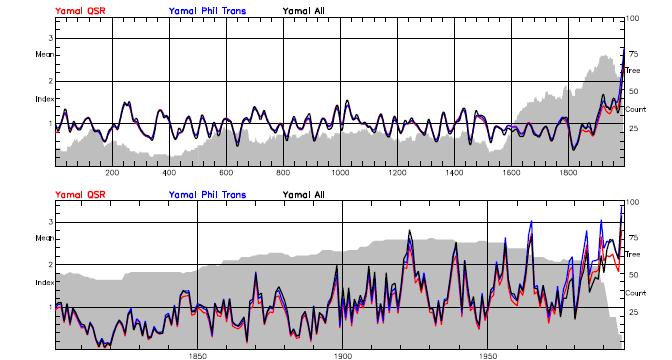
    In its response to the Muir Russell commission, the CRU discusses the Yamal imbroglio:

    Our work later became the subject of widespread misrepresentation in the media, amounting to hysterical and defamatory reporting of a posting on the “Climate Audit” website, managed by Steve McIntyre. McIntyre produced an alternative chronology omitting many of the modern sites we had used and replacing them with data from another single location. This alternative chronology differed markedly from our chronology during the late 20th century. McIntyre implied that this is evidence that Briffa had improperly selected certain tree-ring data, specifically in order to manufacture a false impression of recent enhanced tree-growth in the Yamal region.

    This assertion is entirely false. On the contrary, McIntyre’s omission of the data we had validly used and its substitution with data showing an atypical pattern of tree-growth variations in the region, itself constitutes a biased analysis. A detailed refutation of McIntyre’s implied accusations (Briffa and Melvin 2009) was posted on the CRU website (http://www.cru.uea.ac.uk/cru/people/briffa/yamal2009/) on 27th October, 2009. A copy is included with this submission. This includes details of a recent re-analysis we made of the Yamal chronology, in response to the posted criticisms. In this re-analysis we incorporate additional living-tree data made available by Rashit Hantemirov at our request. The inclusion of the additional samples and the use of improved statistical processing techniques produced only small differences in the tree-growth pattern (see Figure 1.3 below). From this it is clear that our original work was sound and where the CRU Yamal chronology is incorporated in multi-proxy reconstructions, the choice of which version will not significantly affect the outcome of the final reconstruction.Figure 1.3 – Extracted from Briffa and Melvin (2009)
    Comparison of published and reworked Yamal chronologies. This Figure shows the two earlier versions of the Yamal RCS larch chronology in red (published in Briffa, 2000) and blue (Briffa et al., 2008) compared to the new version, based on all of the currently available data (Yamal_All) for the original (POR, YAD and JAH) sites and including the additional data from the KHAD site (in black). Tree sample counts for this ‘new’ chronology are shown by the grey shading. The upper panel shows the data smoothed with a 40-year low-pass cubic smoothing spline. The lower panel shows the yearly data from 1800 onwards. All series have been scaled so the yearly data have the same mean and standard deviation as the Yamal_All series over the period 1-1600.

    And, oh yes, they don’t much like Fred Pearce neither

    In an article in the Guardian, published on 3rd February, 2010, Fred Pearce provides a misleading account of an email relating to this affair. Professor Tom Wigley wrote to Phil Jones on the 5th October, 2009, expressing some disquiet that our Yamal analyses might be suspect, from which it is obvious that he had been misled by reading Mcintyre’s posts. Pearce’s article is written in such a way as to strongly imply that Wigley had read the CRU response to this issue (posted on 27th October, 2009) and was dissatisfied. In reality, Wigley’s email predates the response by 3 weeks and after he did read it he was fully satisfied, as he explicitly communicated in a later email to a colleague on 3rd February 2010 (http://www.cru.uea.ac.uk/mr/Wigley_email.pdf).

    Which James Randerson might be interested in reading

    Date: Wed, 03 Feb 2010 15:46:23 -0700
    From: Tom Wigley

    I can see why you are concerned about Fred’s latest piece in The Guardian. It does look as though he has deliberately chosen dates to make it appear that I was dissatisfied with Keith’s response. Either that or it was a genuine mistake — or he is simply ignorant and has not seen the full response. Whatever, he really should write an apologetic P.S. to his piece.

    I was completely satisfied with Keith’s response. Not only did it answer all of my concerns and questions, but it also shows that the real villain here is McIntyre (although Keith is careful not to draw that conclusion).

    I am enclosing a chronology, and my own summary of the issue. Pearce is a good science writer, but he has really dropped the ball in his series of Guardian articles over the last few days. Sad.

    Best wishes,
    Tom.

    Oh nos! Steve is such an innocent little lamby.

    – Eli Rabett

  • How deep CO2 reductions can help the economy – An excerpt from the terrific new book, “Greening Our Built World: Costs, Benefits, and Strategies”

    http://islandpress.org/assets/products/lg/1971_katscoverfinal300dpi170x2.jpgPerhaps because we spend the vast majority of our lives in buildings or traveling between them, we often overlook the scale of building energy use and the associated impact on climate change. For example, in a 2007 national survey of 1,000 homeowners, almost 75% said that they believed their homes had no adverse environmental impact. The reality is quite different.

    According to the Energy Information Agency, residential and commercial buildings together consume 41% of the energy, including 74% of the electricity, used in the United States. And of course, it also takes energy to make the materials necessary to construct and operate buildings (e.g., bricks, concrete, mechanical systems); to transport the materials; and to actually construct buildings. Despite widespread misperception, at least 45% of all energy used in the United States and Europe is consumed directly in buildings. The level of energy use and the resulting CO2 emissions associated with buildings are almost as high as that from transportation and industry combined. Thus, the built environment provides a powerful and necessary lever for fundamentally changing our patterns of resource and energy use and responding to the grave threat of climate change.

    That’s an excerpt from a fact- and chart-filled new book, Greening Our Built World: costs, benefits and strategies (Island Press) by my long-time friend and former DOE colleague Gregory Kats.  Greg is director of climate change at Good Energies, a multi-billion dollar global clean energy investor, where he leads the firm’s investments in energy efficiency and green buildings. Greg is a founder of the American Council on Renewable Energy (ACORE). He is founding chair of the Energy and Atmosphere Technical Advisory Group for LEED, and was the principal advisor in developing Green Communities, the national green affordable housing design standard. Previously, Greg served as the director of financing for energy efficiency and renewable energy at the U.S. Department of Energy.

    Achieving the deep reductions in CO2 emissions that scientists tell us we must achieve to avoid the most severe consequences of climate change will require deep and relatively rapid reduction in energy use in buildings. This can only happen with a huge increase in building energy efficiency and a rapid increase in the use of renewable energy. Greening buildings provides a very cost effective way to achieve both objectives.

    Green design is less expensive and more cost-effective than is generally realized. A shift to green design would increase investment in measures such as insulation and waste diversion, while cutting energy use and creating substantial additional employment. If green design were scaled up nationally, the employment, financial, and environmental benefits would be huge. A recent major study, published in Greening Our built World provides a detailed analysis of the financial and CO2 impact of a feasibly designed national transition to green design. Sponsored by the country’s largest real estate originations and groups such as the American institute of architects, the study provides a basis for calculating the potential for a transition to a green low carbon economy.

    Such a transition would require a monumental shift in policy and an enormous financial, political, and technical challenge. The good news is that green buildings have the potential to cost-effectively drive deep reductions in the use of fossil fuels and in CO2 emissions. Such a strategy would also create large economic and social benefits.

    The study built on a detailed analysis of cost effectiveness of green design to compare a business as usual scenario to a green design scenario. Developed with 100 architects over a 20 month period the study details the financial impact of greening 170 green buildings, including energy and water savings, health and productivity increases, and societal benefits such as lower energy prices from reductions in demand and CO2 emissions. The study then used this data to compare the net present value of a green design scenario compared with a business as usual scenario.  The findings demonstrate that the benefits of green building and green communities greatly outweigh the additional costs associated with high-performance design, materials, and technology.

    Currently 12 to 15%% of all non residential construction is green. Based on growth in adoption and detailed cost benefits  analysis in a green scenario green could becomes standard practice for 95% of the new construction market by 2020, and for 75% of retrofits by 2030-reflecting the likelihood that some types of buildings will remain unlikely candidates for greening. The lag in greening retrofits reflects the fact that current green penetration of the retrofit market is far lower than the penetration of the new construction market. Buildings typically last 50 years or more. By contrast, an automobile fleet is replaced every 12 to 15 years. Not surprisingly, deep reductions in energy use in the building sector cannot be achieved quickly—and cannot be achieved by 2050 without a relatively rapid rate of comprehensive retrofits of existing buildings. Accordingly, the Green scenario assumes that comprehensive retrofits, whether as energy-efficiency retrofits or as part of greening, occur more frequently than in the BAU scenario.

    The financial benefits of a shift to green design probably offer the single largest opportunity to both strengthen the economy and address the critical challenge of global warming.

    Net Present Value of Benefits: Business and Usual Scenario versus Green Scenario

    Net Present Value of Benefits

    A sustained national commitment to green design would create tremendous financial, social, and environmental benefits. The costs of building green are far outweighed by the benefits, which include reduced energy and water costs, enhanced health and productivity, and broad societal benefits. Applying the cost-benefit findings from the study data set to our two scenarios shows that when compared with the BAU scenario, the Green scenario creates roughly one trillion dollars in net financial benefits. This reflects the fact that green buildings generate financial benefits that—as this book documents—are five to ten times as large as their green cost premium. Additional benefits that were not quantifiable include lowered dependence on energy imports, increased employment, and increased economic competitiveness.

    Related Post:

  • The complete guide to modern day climate change – All the data you need to show that the world is warming

    According to the IPCC 4th Assessment Report (2007):

    • Warming of the climate system is unequivocal, as is now evident from observations of increases in global average air and ocean temperatures, widespread melting of snow and ice, and rising global average sea level.
    • At continental, regional, and ocean basin scales, numerous long-term changes in climate have been observed. These include changes in Arctic temperatures and ice, widespread changes in precipitation amounts, ocean salinity, wind patterns and aspects of extreme weather including droughts, heavy precipitation, heat waves and the intensity of tropical cyclones.
    • Paleoclimate information supports the interpretation that the warmth of the last half century is unusual in at least the previous 1300 years. The last time the polar regions were significantly warmer than present for an extended period (about 125,000 years ago), reductions in polar ice volume led to 4 to 6 metres of sea level rise.
    • Most of the observed increase in globally averaged temperatures since the mid-20th century is very likely due to the observed increase in anthropogenic greenhouse gas concentrations. This is an advance since the [Third Assessment Report’s 2001] conclusion that “most of the observed warming over the last 50 years is likely to have been due to the increase in greenhouse gas concentrations”. Discernible human influences now extend to other aspects of climate, including ocean warming, continental-average temperatures, temperature extremes and wind patterns.

    Let us take a look at some of the evidence:

    This post is by guest Blogger Scott A. Mandia, Professor of Physical Sciences at Suffolk County Community College, Long Island, NY.  Mandia holds an M.S. Meteorology from Penn State University and a B.S. Meteorology from University of Lowell (now called UMass – Lowell). Mandia has been teaching introductory meteorology and paleoclimatology courses for 23 years.

    Temperature Trends

    20 of the warmest years on record have occurred in the past 25 years. The warmest year globally was 2005 with the years 2009, 2007, 2006, 2003, 2002, and 1998 all tied for 2nd within statistical certainty. (Hansen et al., 2010) The warmest decade has been the 2000s, and each of the past three decades has been warmer than the decade before and each set records at their end. The odds of this being a natural occurrence are estimated to be one in a billion! (Schmidt and Wolfe, 2009)

    According to NOAA climate monitoring chief Deke Arndt (Romm, 2009):

    The last 10 years are the warmest 10-year period of the modern record. Even if you analyze the trend during that 10 years, the trend is actually positive, which means warming.

    Figure 7.1 (IPCC, 2007) shows the global mean temperature anomalies (compared to 1961-1990) from the years 1850 to 2005. Figure 7.1a (NCDC, 2008) shows the global mean temperature anomalies with error bars from the years 1880 to 2007.

    Global Mean Temperatures
    Figure 7.1: Global mean temperature anomalies (compared to 1961-1990) from the years 1850 to 2005

    Global Mean Temperatures NCDC
    Figure 7.1a: Global mean temperature anomalies from the years 1880 to 2008

    Figure 7.2 (Tamino, 2009) clearly shows that surface temperatures north of latitude 60o are warming at an accelerated rate in the past few decades. Tamino retrieved 113 station records at latitude 60oN or higher with at least 30 years of data.

    Arctic Surface Temperatures
    Figure 7.2: Arctic surface temperatures since 1948.

    Tamino (2009) explains here and here. The analyses show:

    1. The Arctic has experienced a sudden, recent warming.
    2. In the last decade extreme northern temperature has risen to unprecedented heights.
    3. Over the last 3 decades, every individual station north of 70o indicates warming, 13 of 17 are significant at 95% confidence, all estimated trend rates are faster than the global average, some are more than five times as fast.
    4. Oft-repeated claims that “it was warmer in the 1930s” or “it was warmer in the 1940s” are wrong.
    5. The idea that present arctic temperatures are about equal to their 1958 values is wrong.

    Kauffman et al. (2009) also shows that the Arctic was experiencing long-term cooling in the past 2000 years according to Milankovitch cycles until very recently. Figure 7.3 (ibid) reveals this trend shift:

    A Hockey Stick in Melting Ice

    figure
    Figure 7.3: Recent warming reverses long-term arctic cooling

    Kaufmann et al. summarizes their study:

      The temperature history of the first millennium C.E. is sparsely documented, especially in the Arctic. We present a synthesis of decadally resolved proxy temperature records from poleward of 60 oN covering the past 2000 years, which indicates that a pervasive cooling in progress 2000 years ago continued through the Middle Ages and into the Little Ice Age. A 2000-year transient climate simulation with the Community Climate System Model shows the same temperature sensitivity to changes in insolation as does our proxy reconstruction, supporting the inference that this long-term trend was caused by the steady orbitally driven reduction in summer insolation. The cooling trend was reversed during the 20th century, with four of the five warmest decades of our 2000-year-long reconstruction occurring between 1950 and 2000.

    Arctic Ice & Glacial Trends:

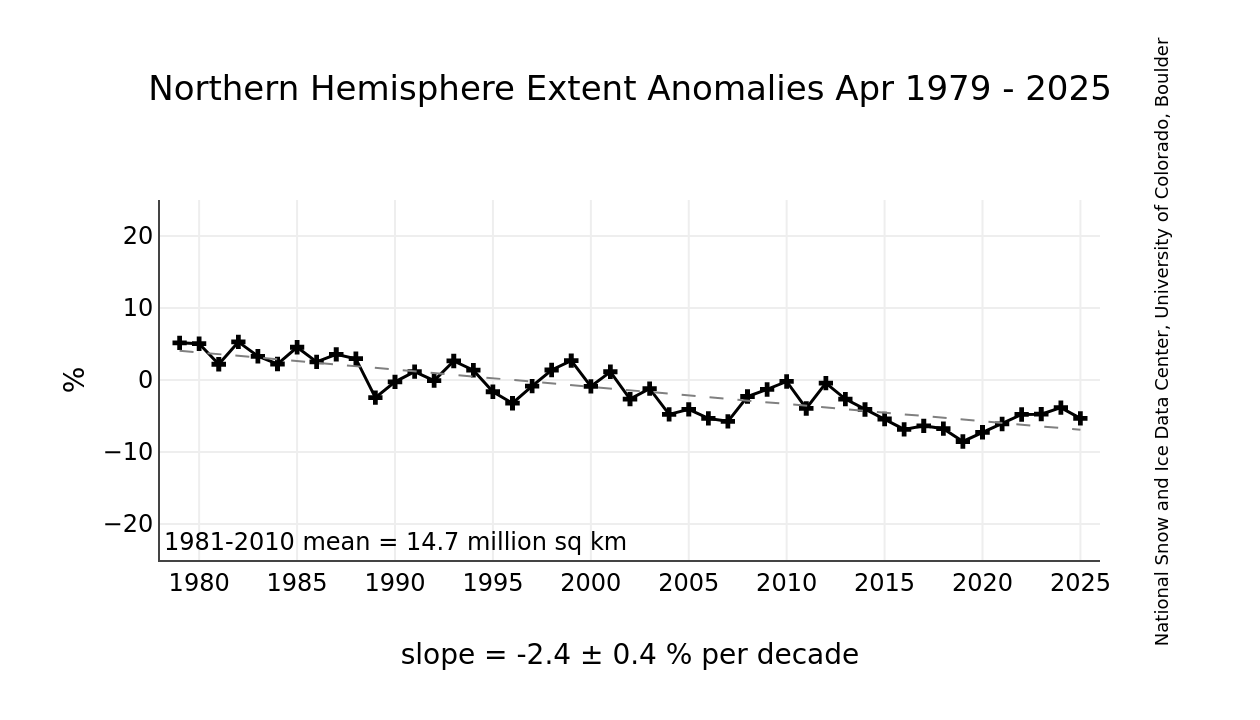
    Further signs of this warming trend can be seen in the Northern Hemisphere Sea Ice Extent from the National Snow and Ice Data Center. Figure 7.4 shows sea ice extent since 1953. For January 1953 through December 1979, data have been obtained from the UK Hadley Centre and are based on operational ice charts and other sources. For January 1979 through July 2009, data are derived from satellite. Figure 7.4a shows the most current sea ice extent from satellite measurements. Sea ice extent has been dramatically reduced since 1953.

    Sea Ice Extent Since 1953
    Figure 7.4: Northern Hemisphere sea ice extent since 1953

    Sea Ice Extent
    Figure 7.4a: Current Northern Hemisphere sea ice extent from satellite measurements

    Sea ice extent is just part of the picture. Sea ice thickness has also been measured by submarine and ICESat satellite measurement.

    Figure 7.5 (Rothrock, et al., 1999) shows sea ice thickness has substantially declined. Using data from submarine cruises, Rothrock and collaborators determined that the mean ice draft at the end of the melt season in the Arctic has decreased by about 1.3 meters between the 1950s and the 1990s.

    Sea Ice Draft
    Figure 7.5: Mean sea ice draft: Decrease in Arctic sea ice draft for 1958 to 1997.

    Since 2004 and there has been a dramatic decrease in thickness according to NASA’s press release, NASA Satellite Reveals Dramatic Arctic Ice Thinning dated July, 2009. Some excerpts:

      Using ICESat measurements, scientists found that overall Arctic sea ice thinned about 0.17 meters (7 inches) a year, for a total of 0.68 meters (2.2 feet) over four winters. The total area covered by the thicker, older “multi-year” ice that has survived one or more summers shrank by 42 percent. In recent years, the amount of ice replaced in the winter has not been sufficient to offset summer ice losses. The result is more open water in summer, which then absorbs more heat, warming the ocean and further melting the ice. Between 2004 and 2008, multi-year ice cover shrank 1.54 million square kilometers (595,000 square miles) — nearly the size of Alaska’s land area. During the study period, the relative contributions of the two ice types to the total volume of the Arctic’s ice cover were reversed. In 2003, 62 percent of the Arctic’s total ice volume was stored in multi-year ice, with 38 percent stored in first-year seasonal ice. By 2008, 68 percent of the total ice volume was first-year ice, with 32 percent multi-year ice.

    Figure 7.5a (NASA, 2009) shows that overall ice thickness and multi-year ice (MY) thickness are decreasing.

    Sea Ice Thickness
    Figure 7.5a: Northern Hemisphere sea ice thickness

    Sea Ice Thickness Composite
    Figure 7.5b: Northern Hemisphere sea ice thickness submarine & ICESAT combined

    Figure 7.5b (Kwock & Rothrock, 2009) shows the mean thicknesses of six Arctic regions for the three periods (1958– 1976, 1993–1997, 2003–2007). Thicknesses have been seasonally adjusted to September 15. According to the authors:

      “The overall mean winter thickness of 3.64 m in 1980 can be compared to a 1.89 m mean during the last winter of the ICESat record—an astonishing decrease of 1.75 m in thickness. Between 1975 and 2000, the steepest rate of decrease is 0.08 m/yr in 1990 compared to a slightly higher winter/summer rate of 0.10/0.20 m/yr in the five-year ICESat record (2003–2008). Prior to 1997, ice extent in the DRA was >90% during the summer minimum. This can be contrasted to the gradual decrease in the early 2000s followed by an abrupt drop to <55% during the record setting minimum in 2007. This combined analysis shows a long-term trend of sea ice thinning over submarine and ICESat records that span five decades.
    2009 Sea Ice Update Peter Sinclair’s Climate Crock of the Week: 2009 Sea Ice Update
    Watch this video to learn about the 2009 Arctic sea ice measurements.
    Ice Caps Peter Sinclair’s Climate Crock of the Week: Ice Area vs. Volume
    Watch this video to learn about the difference between ice area and ice volume and why volume is more critical.

    Velicogna (2009) used measurements from the GRACE (Gravity Recovery and Climate Experiment) satellite gravity mission to determine the ice mass-loss for the Greenland and Antarctic Ice Sheets during the period between April 2002 and February 2009. During this time period the mass loss of the ice sheets were accelerating with time implying that the ice sheets contribution to sea level becomes larger with time. In Greenland (Fig. 7.6), the mass loss increased from 137 Gt/yr in 2002–2003 to 286 Gt/yr in 2007–2009. In Antarctica (Fig. 7.7) the mass loss increased from 104 Gt/yr in 2002–2006 to 246 Gt/yr in 2006–2009.

    Greenland Ice Mass Loss
    Figure 7.6: Greenland Ice Mass Loss

    Antarctic Ice Mass Loss
    Figure 7.7: Antarctic Ice Mass Loss

    John Cook at Skeptical Science has several very good summaries of this research. See: An overview of Antarctic ice trends, An overview of Greenland ice trends, and Why is Greenland’s ice loss accelerating?.

    Glaciers also are used as a signature for climate change. Summer melting, called ablation, controls the mass and extent of glaciers. According to the World Glacier Monitoring Service (2009), preliminary mass balance values for the observation periods 2005/06 and 2006/07 have been reported from more than 100 and 80 glaciers worldwide, respectively. The mass balance data are calculated based on all reported values as well as on the data from the 30 reference glaciers in nine mountain ranges in North America and Europe with continuous observation series back to 1980.

    The average mass balance of the glaciers with available long-term observation series around the world continues to decrease, with tentative figures indicating a further thickness reduction of 1.3 and 0.7 metres water equivalent (m w.e.) during the hydrological years 2006 and 2007, respectively. The new data continues the global trend in accelerated ice loss over the past few decades and brings the cumulative average thickness loss of the reference glaciers since 1980 at almost 11.3 m w.e. (see Figures 7.8 and 7.9).

    Glacial Mass Loss Reference Glaciers
    Figure 7.8: Mean annual specific mass balance of reference glaciers

    Glacial Mass Loss Reported Glaciers
    Figure 7.9: Mean cumulative specific mass balance of all reported glaciers (black line) and the reference glaciers (red line)

    Glacial extent is also being monitored. Figure 7.10 (ibid) shows worldwide glacial extent measurements with red being a decrease and blue being an increase in the length of the glacier.

    Glacial Extent - Click for Larger Image
    Figure 7.10: Glacial extent – retreating (red) and advancing (blue)

    In 2005 there were 442 glaciers examined, 26 advancing, 18 stationary and 398 retreating. 90% of worldwide glaciers are retreating. In 2005, for the first time ever, no observed Swiss glaciers advanced. Of the 26 advancing glaciers, 15 were in New Zealand. Overall there has been a substantial volume loss of 11% of New Zealand glaciers from 1975-2005, but the number of advancing glacier is still significant. (ibid)

    Ocean Heat Content:

    Much of the heat that is delivered by the sun is stored in the Earth’s oceans while only a fraction of this heat is stored in the atmosphere. Therefore, a change in the heat stored in the ocean is a better indicator of climate change than changes in atmospheric heat. Figures 7.11 and 7.12 (Richardson et al., 2009) and 7.13 (NODC, 2009) clearly show that the oceans have warmed significantly in recent years and the trend is 50% greater than that reported by the IPCC in 2007.

    Energy content change of oceans
    Figure 7.11: Change in energy content in different components of the earth system for two periods: 1961-2003 (blue bars) and 1993-2003 (pink bars).

    Ocean Heat Content Trend
    Figure 7.12: Change in ocean heat content since 1951.

    Ocean Heat Content Trend
    Figure 7.13: Change in ocean heat content since 1955.

    There have been a few published articles by Loehle (2009), Pielke (2008), and Willis (2008) that suggest ocean heat content trend since 2003 has either been flat or slightly negative. Of course, a few years does not a trend make but these results appear to be in conflict with the current upward trend. von Shuckmann, Gaillard, and Le Traon (2009) address this apparent conflict in their article Global hydrographic variability patterns during 2003–2008. Their data extends to 2000 m of ocean depth in contrast to Loehle (2009), Pielke (2008), and Willis (2008) data that only extends to 700 m. von Shuckmann, Gaillard, and Le Traon (2009) show that the heat content of the upper 500 m of ocean are subject to strong seasonal and interannual variations primarily due to salinity changes. However, when considering the heat content of the upper 2000 m of ocean, global mean heat content and height changes are clearly associated with a positive trend during the 6 years of measurements. Figure 7.14 below shows this trend.

    Ocean Heat Content Trend Upper 2000 m
    Figure 7.14: Change in global heat content for the uppermost 2000 m of ocean between 2003 and 2008

    Murphy et al. (2009) examined the Earth’s energy balance since 1950 including ocean heat content, radiative forcing by long-lived trace gases, and radiative forcing from volcanic eruptions. They considered the emission of energy by a warming Earth by using correlations between surface temperature and satellite data and show that the heat gained since 1950 is already quite significant. Their findings are illustrated below. (Cook, 2009)

    Total Heat Content since 1950
    Figure 7.15: Total Earth Heat Content from 1950 (ibid)

    The oceans are taking in almost all of the excess heat since the 1970s which underscores the point that ocean heat content is a better indicator of global warming than atmospheric temperatures. Much of this ocean heat will be vented to the atmosphere in the future thus accelerating global warming.

    A superb discussion on this topic can be found at Skeptical Science’s How we know global warming is still happening.

    Precipitation Trends:

    Figure 7.16 (IPCC, 2007) shows the Palmer Drought Severity Index (PDSI). The PDSI is a prominent index of drought. Red and orange areas are drier (-PDSI) than average and blue and green areas are wetter (+PDSI) than average. The smooth black curve shows decadal variations. The PDSI curve reveals widespread increasing African drought, especially in the Sahel. Note also the wetter areas, especially in eastern North and South America and northern Eurasia.

    Palmer Drought Severity Index
    Figure 7.16: Palmer Drought Severity Index (PDSI)

    Zhang et al. (2007), IPCC (2007), and Held and Soden (2006) conclude that global warming due to human activities is increasing the severity of drought in areas that already have drought and causing more rainfall in areas that are already wet.

    Zhang et al. (2007) considered three groups of global climate model simulations and compared those simulations to the observed precipitation between 70o north and 40o south as shown in Figure 7.17 below.

    • ANT denoted simulations included estimates of historical ANThropogenic (human) forcing only which included greenhouse gases and sulfate aerosols.
    • NAT4 denoted simulations included just NATural external forcings only.
    • ALL denoted simulations include BOTH of the above – natural and human forcing.

    Observed Precipitation vs. Simulations
    Figure 7.17: Observed precipitation vs. various simulations

    This clearly shows that the ALL simulations (a and d) do a much better job of matching observed precipitation trends than either ANT (b and e) or NAT (c and f) alone. In fact, the correlations: ALL = 0.83, ANT = 0.69 and NAT4 = 0.02. It is for this reason that Zhang et al. (2007) conclude that changes in precipitation trends cannot be explained by natural forcing only and it certainly parallels what the IPCC WGI and WGII reports suggest.

    Precipitation Trends Accuracy
    Figure 7.18: Changes in observed vs. simulated precipitation anomalies (ibid)

    Figure 7.18 shows that the models do not predict the mid-latitude trends at all. Regional precipitation pattern predictions are NOT a strong suit of the models which modelers have stated. What this image does show however, is that areas of green and yellow show where the model trends match those of the observed trends and the models do a decent job of forecasting the correct trends in most regions.

    U.S. Climate Extremes Index (CEI):

    The U.S. CEI is the arithmetic average of the following five or six# indicators of the percentage of the conterminous U.S. area:

    1. The sum of (a) percentage of the United States with maximum temperatures much below normal and (b) percentage of the United States with maximum temperatures much above normal.
    2. The sum of (a) percentage of the United States with minimum temperatures much below normal and (b) percentage of the United States with minimum temperatures much above normal.
    3. The sum of (a) percentage of the United States in severe drought (equivalent to the lowest tenth percentile) based on the PDSI and (b) percentage of the United States with severe moisture surplus (equivalent to the highest tenth percentile) based on the PDSI.
    4. Twice the value of the percentage of the United States with a much greater than normal proportion of precipitation derived from extreme (equivalent to the highest tenth percentile) 1-day precipitation events.
    5. The sum of (a) percentage of the United States with a much greater than normal number of days with precipitation and (b) percentage of the United States with a much greater than normal number of days without precipitation.
    6. * The sum of squares of U.S. landfalling tropical storm and hurricane wind velocities scaled to the mean of the first five indicators.
      # The sixth indicator is experimental and is included in the experimental version of the CEI.
      * The sixth indicator is only utilized when the period of interest includes months with significant tropical activity. For practical purposes, the CEI does not include the sixth indicator for the cold season (Oct-Mar), winter (Dec-Feb) or spring (Mar-May). It also cannot be calculated independent of the first five indicators.
      (Gleason, 2009)

    Figure 7.19 (ibid) shows that in the United States, extremes in climate are on the increase since 1970.

    Unites States Climate Extremes Index
    Figure 7.19: United States Climate Extremes Index

    Are These Trends Unusual?:

    They are unprecedented in the modern record!

    • The concentration of CO2 has reached a record high relative to the past 15 million years and has done so at an exceptionally fast rate.
    • Most of the warming in the past 50 years is attributable to human activities.
    • CO2 concentrations are known accurately for the past 650,000 years. During that time, they varied between 180 ppm and 300 ppm. As of March 2009 CO2 is 385 ppm which took about 100 years to increase. For comparison, it took over 5,000 years for an 80 ppm rise after the last ice age.
    • Higher values than today have only occurred over many millions of years.
    • The last time CO2 levels were this high, sea level was 25 to 40 meters higher than present day.
    • Although large climate changes have occurred in the past, there is no evidence that they took place at a faster rate than the present warming.
    • If projections of a 5 oC warming in this century are realized, Earth will have experienced the same amount of global warming as it did at the end of the last glacial maximum.
    • There is no evidence that this rate is matched to a comparable global temperature increase over the last 50 million years!

    Sea-Level Rise:

    Sea-level rise due to global warming is a serious threat, especially to coastal communities in developing countries. Sea level gradually rose in the 20th century and is currently rising at an increased rate, after a period of little change between AD 0 and AD 1900. Sea level is predicted to rise at an even greater rate in this century, with 20th century estimates of 1.7 mm per year (IPCC, 2007). When climate warms, ice on land melts and flows back into the oceans raising sea levels. Also, when the oceans warm, the water expands (thermal expansion) which raises sea levels. Figure 7.20 (IPCC, 2007) shows the projected sea-level rise through AD 2100.

    Sea Level Rise
    Figure 7.20: Projected sea-level rise through AD 2100

    Figure 7.21 (Richardson et al., 2009) shows that IPCC 1990 projected sea level increases were too conservative. The latest observations show that sea levels have risen faster than previous projections.

    Sea Level Rise Newest Projection
    Figure 7.21: Observed sea-level rise between 1970 and 2008 compared to IPCC projections

    Figure 7.21a (Colorado Center for Astrodynamics Research) shows the current sea level change data using seasonally adjusted values from TOPEX and Jason.

    Sea  Level Rise
    Figure 7.21a: Current measured sea level change

    Mazria & Kirshner (2005) in Nation Under Siege: Sea Level Rise at Our Doorstep, a coastal impact study, show that beginning with just one meter of sea level rise, US cities would be physically under siege, with calamitous and destabilizing consequences. One can view the impact of sea level rise of various US cities at their interactive Website.

    Lemonick (2010) writes in the article The Secret of Sea Level Rise: It Will Vary Greatly by Region:

      As the world warms, sea levels could easily rise three to six feet this century. But increases will vary widely by region, with prevailing winds, powerful ocean currents, and even the gravitational pull of the polar ice sheets determining whether some coastal areas will be inundated while others stay dry.

    Climate Change and Hurricanes:

    A recent paper published by some of the top hurricane researchers in the field (Knutson, et al. 2010) concludes:

    …future projections based on theory and high-resolution dynamical models consistently indicate that greenhouse warming will cause the globally averaged intensity of tropical cyclones to shift towards stronger storms, with intensity increases of 2–11% by 2100. Existing modelling studies also consistently project decreases in the globally averaged frequency of tropical cyclones, by 6–34%. Balanced against this, higher resolution modelling studies typically project substantial increases in the frequency of the most intense cyclones, and increases of the order of 20% in the precipitation rate within 100 km of the storm centre.

    According to a review of the most recent literature, Vechi, Swanson, and Soden (2008) conclude that predicting the future of hurricane activity is at a crossroads. Vechi et al. compared the observed relation of the power dissipation index (PDI) vs. sea-surface temperatures (SST) in the main development region of Atlantic hurricanes. (PDI is the cube of the instantaneous tropical cyclone wind speed integrated over the life of all storms in a given season; more intense and frequent basinwide hurricane activity lead to higher PDI values.) There are two very different futures depending on whether absolute SST or relative SST controls PDI.

    Figure 7.22 (ibid) shows PDI anomalies based on absolute SST.

    PDI anomolies based on absolute SST
    Figure 7.22: PDI anomalies based on absolute SST

    By 2100, the lower end of the model projections shows a PDI comparable to that of 2005, when four major hurricanes (sustained winds of over 100 knots) struck the continental United States, causing more than $100 billion in damage. The upper end of the projections exceeds 2005 levels by more than a factor of two. Combined with rising sea levels, coastal communities face a bleak future if absolute SST determines hurricane activity and strength.

    Figure 7.23 (ibid) shows PDI anomalies based on “relative SST” which is the SST in the tropical Atlantic main development region relative to the tropical mean SST.

    PDI anomolies based on relative SST
    Figure 7.23: PDI anomalies based on relative SST

    A future where relative SST controls Atlantic hurricane activity is a future similar to the recent past, with periods of higher and lower hurricane activity relative to present-day conditions due to natural climate variability, but with little long-term trend. Even in this scenario, rising sea levels will still allow hurricanes to do more damage in the future than in present day.

    Because the correlation of PDI vs. absolute SST and PDI vs. relative SST are equivalent, Vechi et al. conclude that more research is needed in this area.

    IGBP Climate-Change Index:

    IGBP Climate Change Index
    Figure 7.24: IGBP Climate-Change Index (Click for larger image)

    The IGBP Climate-Change Index brings together key indicators of global change: atmospheric carbon dioxide, temperature, sea level and sea ice. It will be released annually. The index gives an annual snapshot of how the planet’s complex systems – the ice, the oceans, the land surface and the atmosphere – are responding to the changing climate. The index rises steadily from 1980 – the earliest date the index has been calculated. The change is unequivocal, it is global, and it is in one direction – up!

    Each parameter is normalized between -100 and +100. Zero is no annual change. One hundred is the maximum-recorded annual change since 1980. The normalised parameters are averaged. This gives the index for the year. The value for each year is added to that of the previous year to show the cumulative effect of annual change. (IGBP Climate-Change Index, 2010)

    With all of this evidence for global warming, it is quite difficult to understand why some people still claim that there is no global warming, or more absurdly, that the climate is currently cooling.

    For complete source information please see Works Cited.

    Mandia offers more climate change information at the links below:
    Global Warming: Man or Myth?
    Global Warming Blog
    “Global Warming Fact of the Day” Facebook Group

  • America’s hidden power bill – Examining federal energy tax expenditures

    Center for American Progress’s Richard W. Caperton and Sima J. Gandhi have put together an excellent report on the remarkable waste of taxpayer’s dollars on perverse subsidies for the profitable fossil fuel industry. I am reposting the executive summary:

    The most important day of the year for the many energy companies that receive federal financial support isn’t the day the president releases his proposed budget, or the day appropriations bills get passed, or even the day when government checks get sent out. It’s tax day. Why? Because each tax day energy companies—electric utilities, oil refiners, renewable energy developers, coal miners, ethanol producers, and others—record billions of dollars worth of special tax credits and deductions.

    Tax expenditures—government spending programs that deliver subsidies through the tax code via special tax credits, deductions, exclusions, exemptions, and preferential rates—are the dominant type of federal support for the U.S. energy industry. Altogether, these spending programs amount to 60 percent of the government’s total support to the industry. These tax expenditures are functionally equivalent to direct spending, but they are often subject to less scrutiny.

    Energy-related tax expenditures serve a broad range of purposes, from promoting renewable electricity generation to encouraging domestic production of oil. But the question is, are these energy programs working? And is implementing programs through the tax code the best way to achieve government goals?

    The Center for American Progress demonstrated in “Audit the Tax Code: Doing What Works for Tax Expenditures” (released in conjunction with this paper) that tax expenditures suffer from a lack of transparency, evaluation, measurement, and oversight. Energyrelated tax expenditures are not immune to these problems, and in fact they suffer from the same shortcomings as other tax expenditure programs.

    The basic problem with tax expenditures is that they are often not thought of as a form of spending, which makes for a dangerous double standard. When considering spending policymakers ask themselves, “Is offering hard-earned taxpayer dollars as a subsidy to a private, profit-making company a good idea?” But if the spending is cast as a tax expenditure the assessment is different. Even though tax expenditures come at a cost to taxpayers— as with any other type of spending—they are viewed through a different, less critical lens. Viewing tax expenditures through the same lens as other government expenditures provides a clearer image of both how they support public policy and use public resources.

    Are these energy programs working? And is implementing programs through the tax code the best way to achieve government goals?

    This paper will adopt that lens to look at two energy-related tax expenditures: the percentage depletion allowance in the oil industry and the production tax credit, or PTC, in the wind industry. We also consider a program in which a tax expenditure was temporarily converted into direct spending: the cash grant in lieu of the investment tax credit, or ITC, for wind generation.

    We chose these three areas both for their political timeliness—the president’s budget proposes the elimination of some fossil fuel subsidies, and ITC provisions will expire unless renewed— and their size (these are all fairly large expenditures). Through these three examples we are able to explore the major issues in tax expenditure design and evaluation.

    Through this analysis, we find these tax expenditures lack accountability, transparency, and measurability, yet there is some indication that the wind-related expenditures are effective. We find little justification for the percentage-depletion allowance, but we do find that when tax expenditures are redesigned and offered as direct spending—as with the cash grant in lieu of the ITC—the program can be more effectively monitored and managed.

    Our analysis in the pages that follow illustrate that spending programs implemented through the tax code play an important role in supporting energy policies. Accordingly, these programs must be examined with the same level of scrutiny as direct spending. The following recommendations can help the government use its limited financial resources to most effectively promote desirable energy policies:

    • Tax expenditures need to be held to the same standards as other government spending. This means Congress should clearly state the goals of expenditures, should contain sunset provisions so that that they expire and are re-evaluated, and should require periodic reviews of their effectiveness. Any safeguard that is designed to prevent wasteful spending should also be applied to tax expenditures.
    • Tax expenditures are a form of government spending and should be considered as such. This includes not just considering tax expenditures and direct spending at the same time but thinking about them in the right way. Every time a legislator thinks about a tax expenditure, they should ask themselves, “Is it a good idea for the government to pay someone for this reason?” This will encourage legislators to explore direct spending alternatives when appropriate, which are often better policy tools.
    • Congress should provide a rationale for each tax expenditure. When Congress decides to provide financial support to an industry through either a tax expenditure or direct spending, they should state why the chosen method is better than the other.
    • Congress should hold agencies responsible for budgeting tax expenditures. Agency budget requests that are sent to Congress should include the tax expenditure spending programs that support their policy areas. Just as agencies are required to explain and report on their direct spending request, they should perform the same exercise on each tax expenditure within their purview. This exercise would hold agencies responsible for explaining how all forms of government spending it uses support its policy areas, and it would empower Congress with the ability to cohesively examine how spending streams work together.
    • Tax expenditures should be measured and evaluated. The government collects large amounts of data on many industries, but sometimes this data isn’t sufficient to evaluate a tax expenditure. If an evaluator finds that they don’t have appropriate data for the evaluation, there should be a clear process by which they can communicate that need to Congress. Congress should require beneficiaries of tax expenditures to report all data that is necessary for evaluation.
    • Congress should adopt standard practices for reviewing tax expenditures. A good start would be to ensure that each expenditure is covered by a requirement that the Joint Committee on Taxation, the Congressional Budget Office, or the relevant agency report on the expenditure’s history, size, and effectiveness.
    • The Department of Energy should be the agency instructed to assess all energy-related tax expenditures. In particular, the Energy Information Administration is probably the best office within the DOE to conduct this review. Additionally, EIA should periodically issue a report on federal financial supports for the energy industry.
    • The JCT and the Office of Management and Budget should agree on a standardized measurement system for tax expenditures. There may be value to both of their current methodologies, but congressional review would be easier if they used the same methodology. Congress should work with the JCT and the OMB to determine the appropriate system.

    Download the full report (pdf)

    Download the executive summary (pdf)

    Download to mobile devices and e-readers from Scribd

    Event: Government Spending Undercover

    This is part of Doing What Works, a project to help streamline and upgrade our government.

    See also:

  • Newsweek Gets Coal Terribly Wrong

    Daniel Stone published a dreadful piece on coal and energy over at Newsweek’s The Gaggle called “West Virginia Mine Disaster Unlikely to Affect National Energy Debate.”  Guest blogger JW Randolph of Appalachian Voices, debunks it fully in this WR repost.

    David Roberts at Grist responded to Energy Committee Staffer Bill Wicker for a quote he had in the article, and it’s well worth the read. But the article was so full of misinformation and false pretexts that I wanted to spend some pixels correcting a few things, beginning with this paragraph:

    Coal is the one fuel that powers most of what we do. It accounts for 49 percent of American power consumption, and as demand for power increases while the cost of alternatives (wind, solar, biofuels) remains high, coal is poised to play a bigger, not smaller, role in our energy landscape. To put it more crassly, the cost of coal is just too cheap. A kilowatt hour of coal power costs about $0.04, less than a third of renewables.

    Facts:

    A) For 2009, coal provided just 44.6% of electricity, not the 49% Stone suggests (likely from the 2008 data.) If you are looking at “energy” then it is 22-23%, much less.


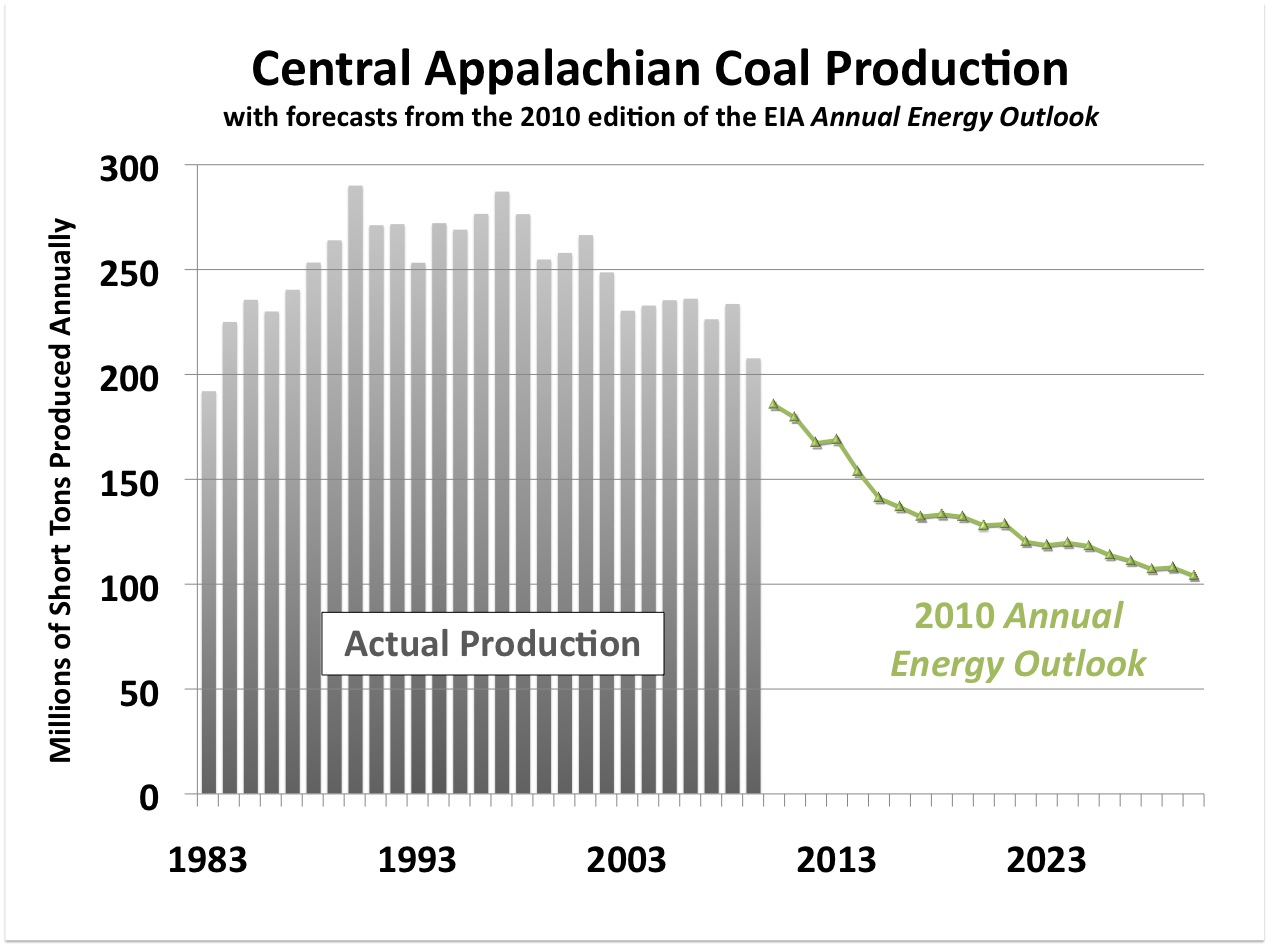
    B) Saying that coal is poised to play a “bigger” role is ridiculous. Coal is declining, particularly production in Central Appalachia. It has been declining for the past two decades and is projected to continue downward. But not only that. It is getting deeper, thinner, and of less quality. The heat content is in decline as well, meaning that it takes more tons of coal to produce the same amount of electricity.

    C) Delivered costs of coal are wildly different in different locations and in different coal plants. Central Appalachian coal (like that in West Virginia) is the most expensive coal on the domestic market.

    D) Stone uses ballpark figures for the cost of a coal plant that is already built, but renewables that are not yet built. If you are looking at building a new coal plant versus investing in renewables, the two are cost competitive, even without a price on coal pollution (EIA). In fact, except for solar, nothing even doubles the cost of coal, and that’s without CCS.

    E) The deeper we go for thinner seams of less quality coal, the more expensive central Appalachian coal gets and the more competitive natural gas, wind, geothermal, or biomass may look. The same is true for safety regulations. Coal companies fight them tooth and nail because safety isn’t free. This has an impact on energy policy. You can’t look at mining safety in a vacuum.

    Secondly, I am concerned that many in the news media continually fail to appreciate the sacrifice of coal miners, whose deaths occur with alarming frequency both at home and overseas. Mr. Stone continues:

    The reason safety isn’t included [in the cost of energy] is because accidents—from mine cave-ins to oil-rig deaths—don’t happen often enough for safety to become a formidable factor in the national discussion on our energy future. What’s more, the playing field isn’t all that tilted. Despite a bad week for coal miners, wind has also been fatal—14 men were killed working with wind energy in the mid ’90s, and more since, according to wind-industry analyst Paul Gipe. Not to mention the risks posed by nuclear. While most sectors have undergone regulation over the past few years to root out dangerous components, the reality is that all energy sectors are still risky in many ways.

    Facts:

    A) Mining accidents happen all the time in the US. Over 300 people have died mining coal in the United States just in the last decade, nearly always exceeding 20 per year. It’s just that there isn’t always media saturation. Over 51,000 people have died mining coal in China in the same time period. That’s more than 3600 times the numbers that have been “killed by wind” in just one country and in half the time span.

    B) Speaking of which, Mr. Stone uses MONSTROUS false equivalency regarding the different energy sectors. He says 14 people were killed working with wind energy in the mid-90s? What does that even mean? First of all, Gipe’s numbers are worldwide. That doesn’t even compare to the number of deaths from mining and processing coal in the United States alone. 18 people died in accidents mining coal in the US just last year, and that was a “great” year. Add in the 10,000 US coal miners who die each decade from black lung disease, and Mr. Stone’s comparison becomes even more toxic.

    C) You can’t look at energy in a vacuum. Policy makers certainly don’t. Look at the externalized cost of what is happening to coal communities, particularly in Appalachia. Not only has coal had a negative impact on endemic Appalachian poverty, but the health costs are estimated to be more than $42 billion every year due to health impacts and life lost. There is no cost comparison. There is no risk comparison.

    – Daniel Stone

    Related Posts:

  • Energy industry fights chemical disclosure – Natural gas companies want to prevent oversight of fracking

    The oil and natural gas lobby is working hard to prevent the Environmental Protection Agency from establishing safeguards to protect the public from chemicals used to produce shale gas through “hydraulic fracturing,” also called “fracking” or “fracing.”  CAP’s Sarah Collins and Tom Kenworthy have the story in this repost.

    Oil and gas companies use fracking in combination with horizontal well drilling; the process involves injecting a mixture of water, sand, and chemicals at high pressure into rock formations thousands of feet below the surface to fracture the rock and allow oil and gas previously trapped inside the rock to escape. Recent advances in drilling techniques combined with fracking have dramatically expanded the supply of technically recoverable shale gas. But studies show that the chemicals may pollute nearby sources of water.

    BP, ConocoPhillips, and Shell Oil Co.’s latest lobbying efforts propose adding “Sense of the Senate Language” to upcoming energy and climate legislation from Sens. John Kerry (D-MA), Lindsey Graham (R-SC), and Joe Lieberman (I-CT) that would exempt fracking from federal oversight. Lee Fuller, executive director of Energy in Depth, a consortium of U.S. oil and natural gas producers, wrote in a recent letter to the senators, “we hope that you can find space in your draft legislation to make your commitment to natural gas explicitly clear…to remind your colleagues once again of the critical role that technologies such as hydraulic fracturing can and must play in meeting the goals for our future.”

    The proposal would be on top of a similar fracking loophole already on the books. The practice is currently protected from oversight under the Safe Drinking Water Act due to an exemption in the Energy Policy Act of 2005. The loophole was added into the bill after a 2004 EPA study found the process posed “little or no threat” to drinking water. Natural gas companies have often cited this study as evidence that the practice is “safe,” but the study was cursory and called “scientifically unsound” by Weston Wilson, an EPA scientist with more than three decades of experience with the agency. The Oil and Gas Accountability Project also reported that, “EPA removed information from earlier drafts that suggested unregulated fracturing poses a threat to human health, and that the Agency did not include information that suggests fracturing fluids may pose a threat to drinking water long after drilling operations are completed.”

    An aide for Sen. Kerry has indicated that the three senators have not included the oil companies’ proposal in their draft bill. Sen. Graham also said that there is not yet language to continue to protect fracking included in the bill, but said, “we need to use the fracturing process to get gas. But it needs to be transparent, and we understand the environmental impact of it.”

    Hiding the truth on fracking chemicals

    The Safe Drinking Water Act loophole isn’t the only exemption natural gas producers enjoy. They are also free from reporting the specific toxic chemicals used for fracking, even though many other industries must report their toxic emissions under the 1986 Emergency Planning and Community Right-to-Know Act.

    The Right-to-Know Network, a project of OMB Watch, notes: “Studies have identified a long list of toxics that may be included in these fracking fluids, and numerous cases of drinking water contamination have been documented.” A study by Environmental Working Group “found that at least 65 chemicals used by the natural gas industry in Colorado—many of them used in hydraulic fracturing—were listed or regulated as hazardous substances under six federal statues including the Clean Air Act, Clean Water Act, and Superfund.” And the OGAP report found that, “The EPA states that many chemicals in hydraulic fracturing fluids are linked to human health effects. These effects include cancer; liver, kidney, brain, respiratory and skin disorders; birth defects; and other health problems.”

    The natural gas industry’s most common defense to these claims it that fracking fluid mostly consists of water and less than 1 percent is chemicals. Yet OGAP reports that, “The draft EPA study included calculations showing that even when diluted with water at least nine hydraulic fracturing chemicals may be injected into [underground sources of drinking water] at concentrations that pose a threat to human health.” Of course, this fact never made it into the final EPA report that led to the fracking exemption.

    Homeowners and communities adjacent to natural gas production facilities that employ fracking have the right to know about the toxic chemicals used at these sites. And without information from the natural gas industry on what chemicals it uses, it will be impossible to conclusively state that the practice poses no danger.

    The issue of public disclosure is not an idle debate without public health consequences. Congress need look no further than a 2008 Colorado case, where an emergency room nurse was sickened and nearly died after she treated an oil and gas worker whose clothes were soaked with fracking fluids. The nurse, Cathy Behr, said the physician who treated her was unable to get information on the chemicals she was exposed to and had to guess. “It was the right guess, because slowly I started getting better,” Behr told the Durango Herald.

    Some companies work to change, others fight it

    Some natural gas companies, notably Chesapeake Energy Corp., Range Resources Corp., and Schlumberger Ltd, have expressed a willingness to disclose the chemicals used in fracking. Announcements by CEOs of Chesapeake Energy and Range Resources on the need to make this information public followed twin events that bore ill tidings for the industry: spills at drilling sites in Pennsylvania and proposals for new regulations in New York.

    About 30 gas operators are already sharing data with the state Department of Environmental Protection in Pennsylvania. Although ProPublica notes that they “don’t list all the ingredients or explain how they might be combined, information that environmental scientists say is critical to measuring the risk associated with fracturing fluids.”

    Other firms, such as Devon Energy Corp., Southwestern Energy Corps., and Newfield Exploration Co., are “exploring ways to recycle waste water, use nontoxic chemicals for drilling and eliminate the need for some chemicals altogether.”

    Yet much of the natural gas industry continues to fight reasonable measures to protect the public health and environment. The industry claims that state regulation of hydraulic fracturing is sufficient but at the same time they fight more effective state oversight. Colorado recently added new oil and gas drilling rules that require companies to disclose fracking chemicals to the state, for example, and the industry is suing to overturn the new rules.

    Conclusion

    Natural gas producers should be required to make public and accessible information on the chemical components of fracking fluids rather than perpetuating the existing exemptions from the Right-to-Know program.

    Many gas producers are concerned that this would reveal their trade secrets, but the TRI program has a process to protect such proprietary information without forcing them to reveal trade secrets. And the EPA has acknowledged the need to deal with trade secrets in TRI submissions. And even if the EPA approves an industry’s claim of trade secrecy, there is still a provision to protect public health by allowing states to identify the health effects associated with the chemicals and make that information public.

    Natural gas emits half of the carbon dioxide pollution compared to coal and can serve as a bridge fuel to a lower-carbon future. Processes that make shale gas production possible, such as fracking, can help speed this transition. But we need to pursue this cleaner energy future in a sustainable manner that does not come at the expense of public health.

    Sarah Collins is an intern on CAP’s Energy Opportunity Team and Tom Kenworthy is a CAP senior fellow.

  • Applied Materials comes to Xi’An – Clean energy R&D finds a home in China

    CAP has sent a cohort of their experts into the field to China to study the rapidly expanding Chinese efforts to support clean energy R&D, innovation, manufacturing, and deployment. At one of their first stops on the tour, Julian Wong and Sarah Miller document how and why Serious Materials, a titan of Silicon Valley Innovation, has chosen to locate its new solar energy R&D facility in Xi’An province, instead of California.


    (YouTube version)

    Applied Materials, a prominent Silicon Valley technology firm that has been the leading maker of equipment to the semiconductor chip industry since the early 1990s, captured industry headlines when it announced the opening of the world’s largest nongovernmental solar research and development center in China and relocated its chief technology officer, Mark Pinto, from California to Beijing. And then The New York Times published a prominent profile of the new R&D center just last month.

    So we hopped a two-hour flight from Beijing on Friday to visit Applied Materials’ new facility, which consists of a center for research and development, engineering, product demonstration, testing, and training for thin film and crystalline solar module manufacturing equipment and processes. It’s located not in Beijing or Shanghai, but in Xi’An, home to the famous Terra Cotta Warriors and about 8 million people—a midsize city by Chinese standards.

    Shaanxi Province is one of China’s biggest coal mining areas, but Xi’An, the provincial capital, is becoming a cradle of clean energy technology development. It boasts 47 universities, more than any other Chinese city except Beijing and Shanghai, and this provides a strong source of human capital for its new High-Tech Zone.

    We sat down with General Manager of Applied Materials’ Solar Technology Center Dr. Ruiping Wang during our visit to talk about other elements that make Xi’An, and China in general, attractive as the site of its solar research and development efforts.

    Excerpts of the interview are in the video above.

    Julian L. Wong is  a Senior Policy Analyst for the energy policy team and Sarah Miller is the Policy Advisor to President and CEO John Podesta.

    Related Post:

  • Gov. Daniels: Climate science is “dubious”; even “extreme measures” won’t address global warming

    Conservatives keep compiling a collection of videos that future generations will ponder with combination of anger and bewilderment.  Here’s the lastest, courtesy of Think Progress.

    Last year, Gov. Mitch Daniels (R-IN) attacked the House’s climate change bill saying that “it looks like imperialism” because of the cap-and-trade provisions in the bill. However, Daniels refrained from addressing climate change science, saying that it is “being addressed by others.”

    But yesterday on C-Span, Daniels weighed in on the science and it appears that he comes down on the side of the global warming deniers:

    DANIELS: In terms of climate change, I think that everyone would be well advised to take a substantial time out. There’s been nothing but dubious news about the science of all this now for about a year, including apparent scientific wrongdoing. Meanwhile, we’re left with a situation where even if the zealots had their way, and the most extreme measures were taken, by their own computer models, we don’t move the world thermometer at all.

    In referring to “apparent scientific wrongdoing,” Daniels is presumably referring the the so-called “Climate-Gate” non-scandal in which scientists at the University of East Angila’s Climatic Research Unit in the UK were accused by conspiracy theorists of tampering with data in order to exaggerate the threat of global warming.

    However, just last week, the House of Commons’ Science and Technology Committee cleared the scientists of any “wrongdoing,” concluding that “the scientific reputation of [the scientists] and CRU remains intact.” The committee said that there is no evidence that data presented by the CRU challenges the scientific consensus that “global warming is happening and that it is induced by human activity.”

    Moreover, it’s unclear whose “computer models” Daniels is referring to when he claims “extreme measures” won’t reduce global warming. The Met Office Hadley Centre, the UK’s “foremost climate change research centre,” found that taking “rapid” action to reduce greenhouse gases in 2010 could prevent average world temperatures from increasing by up to 4.3 degrees Celsius.

    The International Panel on Climate Change has concluded that global warming and climate change are real and that it is man made. In fact, a panel of eminent U.S. and European scientists recently “confirmed the widespread scientific consensus that the Earth’s climate is warming due to human activities.”

  • Environmentally friendly hospitals

    The recently passed health care bill will cover an additional 32 million Americans and begin to dramatically change the way health care is delivered. These are welcome steps that will ultimately save resources, but there are other environmental concerns when it comes to health care—especially care delivered in hospitals. Hospitals should focus on three key areas to address these concerns — waste, cleaning chemicals, and green building — as discussed in this CAP repost.

    Waste

    The health care industry’s ecological impacts are massive. U.S. hospitals generate approximately 6,600 tons of waste daily—no small number—and 85 percent of this is nonhazardous solid waste such as paper, cardboard, food, glass, and plastics that can be recovered or recycled. This recyclable waste could easily be sorted from the hazardous, infectious, and radioactive waste, lowering disposal costs.

    Hazardous waste disposal is also a major problem. Dangerous waste from hospitals must undergo at least one of four treatment processes before it arrives at the disposal site: autoclaving, thermal disinfection, microwave sanitation, or incineration. Incineration releases dioxin, mercury, lead, and other carcinogens into the environment, threatening human health.

    Luckily, activists and pollution regulations have reduced the number of active medical incinerators in the United States to roughly 100 from more than 5,000 in the mid-1990s. An extended grassroots campaign in Hamtramck, Michigan shut down that state’s last operating incinerator in 2005, which violated state air pollution laws. The campaign was supported by citizens and elected officials and guarantees that residents will no longer be made ill by their own hospital. Continued community pressure could bring that number down to zero and promote the use of alternative, nontoxic disposal treatments.

    Chemicals

    Many potentially toxic chemicals are used in large amounts not just for patient care, but to clean the hospital itself. These traditional cleaning products, floor strippers, and disinfectants often contain bioaccumulative toxins or PBTs that can contribute to environmental pollution during manufacturing and lead to poor indoor air quality when they’re used. These cleaners also contain chemicals that can cause cancer; immunological, neurological, and reproductive disorders; respiratory problems; skin irritation; and a host of other ailments.

    Less toxic, environmentally friendly, and fragrance-free products can be used to ensure patients, health care workers, and the surrounding communities are safe. Many institutions have already gotten on board. For example, Kaiser Permanente, which is the largest nonprofit health system in the United States, instructs hospitals in their purchasing choices to avoid chemicals that can cause cancer and genetic mutation.

    Green building

    Waste and costs could also be reduced through efficiency. The Environmental Protection Agency, or EPA, estimates that 30 percent of the health sector’s energy use could be reduced by switching toward renewable and more efficient energy sources at no cost to quality of care. The EPA’s ENERGY STAR program has free energy audits for health care facilities as well as energy evaluation tools and information on how to purchase more energy efficient products. And it provides information on making your facility more efficient through simple steps like switching off machines when not in use, calibrating thermostats, and periodically checking the hot water system for leaks.

    All these changes can pay off. For-profit hospitals, for example, can boost earnings per share by a penny by reducing energy costs by 5 percent.

    Hospitals can also make structural changes to their buildings to save money. Boston’s Brigham and Women’s Hospital’s Shapiro Cardiovascular Center uses only nontoxic cleaners and has banned latex gloves to prevent allergies among workers, and 75 percent of the building’s interior is exposed to natural light. Natural light not only reduces energy costs, but scientific studies conducted in the health care sector support the conclusion that natural daylight shortens patient recovery times, improves their mood, and generally promotes well-being.

    The health care bill took a big step toward making sure every American can get the care they need. The health care industry can continue to make great strides and take steps to make sure that care is delivered in a way that causes the least harm to people and the planet.

    – Lauren Wyner


  • From promoting acid rain to climate denial — over 20 years of David Koch’s polluter front groups

    This week we learned that Koch Industries outspends Exxon Mobil on climate and clean energy disinformation.  And we saw that a Smithsonian exhibit funded by David Koch whitewashes the danger of human-caused climate change.

    Yet this is but the latest effort in a nearly quarter-century effort to misinform the public by the billionaire polluter, as Lee Fang reveals in this Wonk Room repost.

    The corporate-backed front group Americans for Prosperity (AFP) is again leading the charge for industry against environmental protections. Earlier this month, AFP kicked off its “Regulation Reality Tour” — a roadshow through the states of pivotal senators pressuring the Environmental Protection Agency not to regulate carbon emissions, as outlined by the Clean Air Act .

    The campaign is part carnival, part sophisticated K Street lobbying. Attendees are welcomed by an inflatable moonbounce for children, free food and drinks, and AFP staff dressed as “carbon cops” distributing freebies to the crowd. The rallies serve as a platform for AFP to scare voters with stories of bureaucrats regulating churches and “radio controlled thermostats.” Moreover, operatives from AFP collect names and train attendees on how to lobby Congress to defeat clean energy reform.

    The founder and chairman of Americans for Prosperity is oil baron David Koch, who is one of the richest men in the world because of his oil, chemicals, and manufacturing conglomerate Koch Industries. Koch Industries is a major polluter with an atrocious record of sloppy operations. According to the EPA, Koch Industries is responsible for over 300 oil spills in the US and has leaked three million gallons of crude oil into fisheries and drinking waters. They were fined a record $35 million dollars and an additional $8 million in Minnesota for discharging into streams. But AFP’s recent crusade against the EPA is just the latest in Koch’s twenty-year campaign to have unrestricted power to pollute. Below is a timeline with snapshots of Koch’s long running campaign to distort science, orchestrate fake grassroots campaigns, and defeat environmental protections. Click MORE for the timeline:

    1977:

    – David’s brother Charles Koch founds the libertarian think tank, the Cato Institute.

    1984:

    – David Koch, along with political operative Richard Fink, founds Citizens for a Sound Economy to create grassroots support to for deregulation, corporate tax cuts, and other right-wing, corporate causes. Fink, who also serves as an executive at Koch Industries, goes on to direct Koch charitable foundations and the Koch-funded academic center (known first as the Center for Market Processes, later renamed as the Mercatus Center) at George Mason University. Mercatus provides thousands of scholarships to students around the country to study Koch’s free market beliefs, and trains hundreds of academics in those same ultralibertarian theories.

    1990:

    – A market-based cap and trade program to regulate sulfur dioxide is proposed as an amendment to the Clean Air Act to eradicate acid rain.

    – Koch’s Citizens for a Sound Economy creates a spinoff front group called “Concerned Citizens for the Environment” to battle proposed regulations to deal with acid rain. The Pittsburgh Post-Gazette reported that the group “has no citizen membership of its own,” but produced studies arguing that acid rain was a myth and that deregulation would benefit the environment.

    1993:

    – President Clinton calls for a BTU tax on fossil fuel-based energy.

    – Koch’s Citizens for a Sound Economy, along with another Koch-funded group, American Energy Alliance, works closely with the U.S. Chamber of Commerce and the oil lobby to coordinate a campaign to kill the BTU tax. Citizens for a Sound economy commissions polls, takes full page newspaper advertisements, television advertisements, and sends operatives into Oklahoma and Louisiana to organize rallies against the tax.

    – After months of ads, Koch’s Citizens for a Sound Economy organizes rowdy anti-tax protests to ensure the BTU tax is killed. NPR noted that one CSE-sponsored rally outside of the House of Representatives was “designed to strike fear into the hearts of wavering Democrats.” Angry protesters surrounded a man on a hunger strike in favor of the energy tax and shouted him down. Among the gimmicks of rallies were timed releases of balloons to represent dollars families would supposedly pay under the tax. After Sen. David Boren (D-OK) and Sen. John Breaux (D-LA) collapsed to the pressure, the tax died.

    1994:

    – A Koch pipeline spill at Corpus Christi, Texas, led to a $10.5 million class-action settlement for people in the fishing industry. Almost 100,000 gallons were spilled, causing a twelve-mile oil slick in Nueces Bay and Corpus Christi Bay.

    – Court documents reveal that Phillip Morris and the tobacco industry rents Citizens for a Sound Economy for a campaign against proposed tobacco regulations. A memo outlines that the tobacco industry’s $2 million in contributions to CSE paid for a campaign to “educate and mobilize consumers, through town hall meetings, radio and print ads, direct mail, patch-through calls to the Capitol switchboard, editorial board visits, polling data, meetings with Members and staff and the release of studies and other educational pieces.”

    1996:

    – Koch’s Cato Institute develops a legal theory for environmental deregulation championed by lobbyists, GOP lawmakers to neuter the EPA. Jerry Taylor, Cato’s director of natural resources studies, argues that by granting the EPA authority to set specific rules about environmental standards, Congress was violating Article I of the Constitution, which vests “all legislative powers” in the Congress itself.

    – Through a shell corporation called Triad Management and a nonprofit called Economic Education Trust, Koch secretly funnels $1.7 million dollars in attack ads to help Republicans on the eve of the 1996 elections in states where Koch owns refineries, pipelines, and offices.

    1997:

    – The EPA proposes strengthening rules governing air pollution, regulating particles from coal plants and industrial plants which cause tens of thousands of premature deaths a year.

    – Koch’s Citizens for a Sound Economy springs into action, filing dozens of reports opposing the proposed EPA regulations on particle pollution and running ads across the country. One ad features a ”pediatrician” who says increased rates of asthma are not caused by the toxic particles, but rather by “dust mites, stuff like that.” A second voice in the spot adds: ”Sounds like the bureaucrats in Washington are scheming to keep their jobs.” Another ad from CSE claims the EPA regulations would ban fireworks and backyard grills. ”Imagine that,” the ad states, ”a new government regulation that takes away our freedom to, huh, celebrate our freedom.”

    – Citizens for a Sound Economy’s anti-EPA hysteria reaches a boiling point, with the Michigan House passing a resolution asking the EPA not to regulate barbecues. The new CSE president, C. Boydon Gray, who also served as a lobbyist for a firm representing several polluters, makes the rounds on television fighting the regulations.

    – Koch bankrolls the Cooler Heads Coalition, organized by Citizens for a Sound Economy and other Koch-funded groups, like the Competitive Enterprise Institute, to produce studies and ads aimed at scuttling the Kyoto climate accords.

    1999:

    – Koch admits to environmental violations at its oil refinery in Rosemount, Minnesota, and was forced to pay up $8 million in penalties for discharging oil in streams. At the time, the fine was the largest federal environmental fine in Minnesota history.

    2000:

    – The Texas Natural Resource Conservation Commission slaps a $171,570 fine on Koch for environmental violations at crude oil storage facilities. The company allegedly violated air quality restrictions at facilities in 32 Texas counties.

    2001

    – Koch pours $800,000 to Bush and Republicans for the 2000 election, funnels up to $20 million into various conservative think tanks and organizations.

    – In the months preceding the presidential elections, the Koch faced a 97-count federal indictment charging it with concealing illegal releases of 91 metric tons of benzene, known to cause leukemia, from its refinery in Corpus Christi, Texas. After Bush took office in 2001, 88 counts were dropped. Two days before the trial, then-Attorney General Ashcroft agreed to a plea bargain. Koch pled guilty to falsifying documents, all major charges were dropped and the company settled the lawsuit for $20 million, a small part of the possible $350 million in fines. This was the fifth largest ever settlement for criminal environmental prosecutions.

    – In North Carolina, Koch’s Citizens for a Sound Economy fights to stymie efforts to get 12,850 acres of forest in Avery County designated as wilderness. In organizing anti-tax and anti-regulation rallies, CSE experiments with the idea of reenacting a “Boston Tea Party.” Paul O’Connor, a columnist for the North Carolina Dispatch, pans the CSE-organized tea party rallies as a “flop.”

    – The Bush administration appoints Koch Industries lobbyists and political operatives to key environmental positions throughout the federal government. For instance, Koch Industries lobbyist Elizabeth Stolpe is appointed associate director at the White House Council on Environmental Quality.

    2002:

    – Bush appoints Jeffrey Holmstead to head the EPA’s clean air program. Holmstead had previously served as a scholar at Koch’s Citizens for a Sound Economy, writing papers to roll back EPA protections.

    2003:

    – Koch’s Citizens for a Sound Economy testifies to the right-wing Texas Board of Education, urging the panel to reject a book called “Environmental Science: Creating a Sustainable Future.” CSE’s Texas director claimed the book “blames Christianity, Democracy and Industrialization … as causing the so-called [environmental] ‘crisis’” and that this is “highly offensive to patriotic Americans and Christians.” The panel ultimately rejects the book.

    – House Republican Majority Leader Rep. Dick Armey (R-TX) resigns from Congress, becomes Chairman of Koch’s Citizens for a Sound Economy. Armey, who simultaneously served as a lobbyist for megafirm DLA Piper, uses CSE to promote the interests of his corporate clients, which include several polluters.

    2004:

    – Koch’s Citizens for a Sound Economy launches a massive nationwide effort to help reelect President Bush, congressional Republicans. Koch operatives, hoping to splinter the left-wing vote, help to qualify Ralph Nader on the Oregon ballot.

    – Koch’s Citizens for a Sound Economy splinters, with staff and resources joining with another right-wing from group, Empower America, to form FreedomWorks with Dick Armey as the chairman. Many staffers from CSE form a new organization called Americans for Prosperity, with David Koch as the chairman. Koch hires Tim Phillips — a longtime Astroturf lobbyist who had previously orchestrated grassroots campaigns with Ralph Reed, Enron, and outsourcing interests — to head his group.

    – The Wall Street Journal publishes a blockbuster story on Koch’s think tank at George Mason University, the Mercatus Center. The story details how the think tank wields more power than any single K Street lobbying firm in terms of influencing environmental regulations in the Bush administration. Among 23 regulations axed by the Bush administration, 14 were prescribed by Mercatus. Mercatus fellows, like “anti-regulatory zealot” Susan Dudley, move in a revolving door in and out of Koch’s Mercatus Center. In addition, the Center publishes papers challenging the science of climate change.

    2005:

    – Koch Industries finalizes its purchase of Georgia Pacific, one of the world’s leading timber firms. Koch’s Americans for Prosperity increases its advocacy against public lands and designated public forests in Illinois, New Jersey, much of the West.

    2006:

    – Koch groups organize to viciously smear Al Gore and his movie An Inconvenient Truth. Koch-funded Competitive Enterprise Institute produces ads mocking the movie. Koch funded political operatives follow Gore, smearing him as a “hypocrite” for traveling in a car, airplane.

    – After the Mercatus Center attacks EPA regulation of tailpipe greenhouse gases by challenging the science of climate change, Bush appoints Mercatus director Susan Dudley to head the OMB Office of Information and Regulatory Affairs, which has the power to change all proposed federal rules.

    2007:

    – Koch launches his annual conservative “Defending the Dream Summit.” Republican nominees for President, like Rudy Giuliani and John McCain, appear at the first summit to showcase their right-wing credentials, meet with David Koch.

    2008:

    – The 1990 cap and trade Clean Air Act amendments to regulate sulfur dioxide, to deal with acid rain, is deemed a stunning success. Despite Koch’s fear-mongering that it would destroy the economy and kill jobs with an expensive new mandate, the program not only rapidly reduced sulfur dioxide, but did so billions of dollars under projected costs.

    – Koch’s Americans for Prosperity launches its “Hot Air Tour,” a touring campaign to sow doubt about the science of climate change. The campaign, which still goes on today, gives away free items like food and t-shirts, and features an actual hot air balloon with a sign attacking “global warming alarmism.”

    – Koch launches RightOnline, an effort to train right-wing operatives in using technology, to mimic the success of the left, particularly in blogging.

    2009:

    –Over 100 operatives from Koch’s Americans for Prosperity and FreedomWorks organize quietly shortly before President Obama’s inauguration to try again to spark “tea party” protests. With the help of Fox News, right-wing media and the Republican Party, the tea party “movement” catches on, with dozens of rallies against President Obama all over the country throughout the year. Americans for Prosperity hands out talking points and signs for the tea parties to protest the EPA, clean energy legislation, and mocking the science of climate change.

    – Americans for Prosperity tries to crash the Copenhagen climate accords in December 2009. Guest speaker Christopher Monckton calls youth climate activists “Hitler Youth.” He told a Jewish youth climate activist whose grandparents escaped the Nazis that he was “Hitler Youth,” and that “you people don’t care” that “millions are dying in third world countries.” Americans for Prosperity again featured Christopher Monckton at a regional summit in March 2010.

    – Koch funds millions in ads attacking clean energy and climate science throughout the year. Attempting to stir up populist class anger, one Koch ad portrays a wealthy “eco-hypocrite” who “own three homes and five cars, but always talk with my rich friends about saving the planet.”

    2010:

    – A report finds that Koch is the largest funder of climate science denying organizations in the world, outpacing even ExxonMobil. Nearly $25 million in Koch money has flowed to various anti-climate science think tanks, including the Heritage Foundation, the Manhattan Institute, the Foundation for Research on Economics and the Environment, the Pacific Research Institute, and the Tax Foundation, among others.

  • Xcel-erating natural gas in Colorado – State’s largest utility switches off coal

    Colorado’s largest utility, Xcel Energy, has come to an agreement with the state government where it would retire coal plants powering about 900 megawatts by 2017 and replace them with natural gas-fired power. This move will mean a 30 percent reduction in Xcel’s Colorado coal fleet and a cut of as much as 5 million tons a year in carbon pollution. And this is all without federal legislation requiring cuts in emissions.   CAP’s Tom Kenworthy has the story in this repost.

    Advances like Colorado’s are being made possible by technological advances in developing shale gas fields, which mean that the domestic supplies of the natural gas that can power electric plants with half the CO2 emissions of coal are 39 percent larger than previously thought. Gas-powered electricity can make it far easier to meet global warming pollution reduction limits established in the American Clean Energy and Security Act passed by the House last year. And a shrinking limit on carbon pollution that establishes a price on these emissions should propel the electric power industry to retire aging coal plants and utilize spare capacity in building natural gas plants. Gas electricity will mesh well with rising levels of clean electricity from wind and solar power since gas plants are easier to power up when the wind doesn’t blow or the sun doesn’t shine.

    Gov. Bill Ritter unveiled Colorado’s innovative agreement with Xcel Energy in a March 5 announcement of the Colorado Clean Air – Clean Jobs Act. And the state is now moving swiftly to enact the bill, backed by an unusual coalition of lawmakers from both parties, the gas industry, environmentalists, and Xcel, Colorado’s largest utility. The State House passed the measure 53-12 on March 22, and the State Senate will take it up early next week.

    Some of the urgency comea from anticipated new clean air directives from the Environmental Protection Agency that will require Colorado to ease pollution on the state’s populous Front Range region that includes Denver. The plan to retire some of Xcel Energy’s coal-fired plants, said Ritter, “will keep Colorado at the forefront of America’s energy revolution. It will protect consumers, clean our air and protect public health, and create new jobs by increasing demand for Colorado-produced natural gas.”

    Yet the bill could face a challenging environment in the State Senate despite the broad coalition supporting the coal-to-gas bill. Organized labor is worried about a potential loss of coal-mining jobs in western Colorado, though most of the state’s coal production is exported. And some conservation groups from the same region are wary about ramping up natural gas development after a big run-up in drilling during the last decade brought a range of problems ranging from reduced air and water quality to increased costs for providing county services.

    When the EPA relaxed oversight of the industry during the Bush administration, drilling permits soared in Colorado, more than quintupling from 1,529 in 2000 to 8,027 in 2008. Colorado responded to that surge in oil and gas development in 2008 by enacting a comprehensive overhaul of its rules governing oil and gas drilling with a much greater emphasis on protecting public health and safety and the state’s water and wildlife. Jim Martin, executive director of Colorado’s Department of Natural Resources, says the new rules are already doing a better job of better protecting the values that state residents cherish. And he expects the Clean Air-Clean Jobs Act will only marginally increase drilling activity in western Colorado, which is well below its peak in large part because of the prolonged national economic downturn.

    As Colorado increases its clean energy investments, its largest utility “got religion,” too. Xcel Energy opposed a state ballot initiative just six years ago to impose Colorado’s first Renewable Electricity Standard—a modest 10 percent by 2015. Yet Xcel has since then determined that clean energy is the future of Colorado and supports many efforts to invest in the clean energy technologies of the future. It supported legislation that ratcheted up the RES to 20 percent and did not oppose the most recent increase to 30 percent, which Ritter signed into law just last week. Xcel is the state’s largest utility with 1.1 million residential customers and is backing Ritter’s Clean Air-Clean Jobs Act, which will require Xcel to submit by Aug. 15 a plan for cutting nitrogen oxide emissions at its coal plants by up to 80 percent to meet current and upcoming federal requirements under the Clean Air Act.

    And Colorado isn’t the only western state pursuing a clean energy future. The week, the developers of a planned 750-megawatt coal plant in Nevada announced they will shift to a 700-megawatt gas-fired plant combined with a 50- to 100-megawatt solar PV plant. Company officials said environmental concerns were the main driver behind the change. And Senate Majority Leader Harry Reid (D-NV) said that, “Clean natural gas projects like this will help us use this clean energy source to strengthen our economy while protecting Nevada’s great outdoors.”

  • Pollution limits essential for clean energy investments – “Energy only” bills short-change new technologies

    Studies show that “energy-only” legislation that fails to put a price on carbon pollution is less effective and more costly than comprehensive reform.  CAP’s Daniel J. Weiss and Kate Gordon explain why in this repost, which examines key provisions needed in a bill.

    A critical element of President Obama’s domestic agenda is transforming the United States to a low-carbon-pollution economy, which would spur recovery, create jobs, and generate long-term prosperity. The president also made clear in his State of the Union address this year that we need to ramp up our exports, especially of clean energy technologies, if we are going to stay competitive in the global economy. Comprehensive, bipartisan clean energy legislation that establishes a price on carbon pollution could provide the resources for a strong clean energy investment agenda. Yet an “energy-only” bill that excludes pollution limits and leaves carbon unpriced would make it difficult to raise the investment dollars we need to boost American competitiveness in the global clean energy market.

    Achieving the president’s goals requires comprehensive clean energy and global warming pollution reduction legislation. Nearly every other country that has pulled ahead in the race to innovate, develop, manufacture, deploy, and export clean energy and efficiency systems has done so through a set of comprehensive policy and investment measures. For example, Germany has invested heavily in the creation of a domestic clean energy industry, in part due to the European Union’s overall “20-20-20” goal: 20 percent reductions in greenhouse gas emissions from 1990 levels, 20 percent use of renewable power, and 20 percent reduction in energy use. Germany has responded by spurring market demand; helping to finance clean energy innovation, production, and deployment; and investing in the infrastructure necessary to move renewable electricity to market. As a result, it is the “global leader in installed solar energy capacity … Germany was the number one renewable energy system exporter in the world from 2003 to 2008.”

    China, meanwhile, races ahead of the United States. A Pew Charitable Trusts analysis found that China leads the world’s major economies in clean energy investments. According to their research, in 2009 “China invested $34.6 billion in the clean energy economy—nearly double the United States’ total of $18.6 billion.” China is now the world leader in solar PV cell production—a technology that was invented in the United States. It is time for us to catch up.

    An effective clean energy investment strategy has two necessary and interrelated parts. This first is a shrinking limit and a rising price on carbon pollution to drive the private sector to invest in and deploy low-carbon technologies. The second is a set of targeted investments in clean energy technology sectors. These investments would help the United States overcome short-term barriers such as lack of up-front financing that have stalled the wind, solar, geothermal, and energy efficiency sectors from getting to commercial scale. They would also move forward the energy innovations of the future through research, development, and commercialization.

    A global warming program that establishes a shrinking limit on carbon pollution and leads to a rising price on carbon would help drive massive private investment toward these clean energy technologies. Venture capitalist John Doerr and General Electric President Jeff Immelt noted that the United States must “send a long term signal that low-carbon energy is valuable. We must put a price on carbon and a cap on carbon emissions. No long-term signal means no serious innovation at scale, which means fewer American success stories.”

    Forty-five members of the House Sustainable Energy and Environment Coalition recently urged Speaker Nancy Pelosi (D-CA) and Majority Leader Steny Hoyer (D-MD) to ensure that “comprehensive energy legislation includes reductions in greenhouse gas emissions necessary to spur private investment in American clean energy technologies.” They also noted that “billions of dollars of private capital sit on the sidelines in the United States as investors and banks wait for the price signal that a limit on greenhouse gas emission [sic] will provide.”

    And the head of New England’s power grid sounded a sobering note last week when he argued that renewable energy projects in the region are popular but on hold, mostly due to market uncertainty. “The single greatest issue facing the operation, expansion, and regulation of the power system is the uncertainty about national energy policy,” he said.

    In short, these leaders are all saying that there is little short-term economic incentive to abandon the status quo absent a pollution price—even if that course leads to a long-run economic disaster.

    Setting a price on carbon is not only critical for America’s long-term competitiveness; it is necessary to pay for the energy programs that will help companies, consumers, and workers make a smooth and swift transition to a low-carbon economy. The House and Senate have already proposed some very effective policies and programs to help with this transition, all of which carry significant costs.

    House and Senate low-carbon economy proposals

    Program Bill # Estimated cost
    Clean Energy Deployment Administration S. 1462 $10 billion
    HOME STAR Program S. 3177 $6 billion
    Building STAR Program S. 3079 $6 billion
    Investments for Manufacturing
    Progress and Clean Technology Act
    S. 1617 $30 billion
    State and local energy efficiency programs (2012-20) H.R. 2454 $65 billion
    Cash for Coal Clunkers n/a n/a
    NAT GAS Act S. 1408 unspecified
    Siting of Interstate Transmission Lines S. 1462 unspecified
    Total $114 billion

    Taken together, these programs could cost at least $114 billion. This excludes the costs for the NAT GAS Act and the siting of new interstate transmission lines, which could add billions more to this price tag. Yet these investments are essential to provide the start up capital for some new technologies and speed commercial deployment of others.

    Most global warming bills would use a small amount of revenue from the sale of global warming pollution permits to fund these and similar clean energy investment programs. The House of Representatives took major strides to spur investment in June 2009 by passing the American Clean Energy and Security Act, H.R. 2454. This bill establishes a price on carbon pollution—a critical market driver that makes low-carbon technologies cost competitive with traditional fossil fuels. ACES combines this pollution price with a $24 billion investment in specific incentives for research, development, and production of these technologies. These programs would create demand for low-carbon technologies with essential investment dollars that would enable the alternative and efficient energy industries to scale up and make their products as affordable and available as possible.

    The Clean Energy Jobs and American Power Act, S. 1733, which passed the Senate Environment Committee on November 5, 2009, would also invest at least $6.5 billion in clean energy programs.

    Both these bills generate enough revenue to provide seed capital for clean energy investments, protect ratepayers from price increases, and even reduce the federal budget deficit. The Congressional Budget Office projects that ACES would reduce the deficit by $24 billion from 2010-19, while S. 1733 would reduce it by $21 billion from 2010-19.

    The Carbon Limits and Energy for America’s Renewal Act, S. 2877, which is pending in the Senate but with no action scheduled, would also invest in clean energy technologies. It would return to taxpayers three quarters of the revenue generated by its “cap and dividend” program, while using the other quarter for a Clean Energy Reinvestment Trust Fund for investments including “clean energy R&D … and need-based, regionally-specific assistance for communities and workers transitioning to a clean energy economy.”

    Sens. John Kerry (D-MA), Lindsey Graham (R-SC), and Joe Lieberman (I-CT) are drafting a comprehensive bipartisan energy bill, expected by mid-April. According to Sen. Graham, this legislation could invest as much as 40 percent of the funds generated from its limits on carbon pollution from utilities and industrial sources back into clean energy.

    Yet some senators are opposed to such legislation despite the pressing need to move forward with a clean energy investment agenda. These senators instead advocate passage of an energy-only bill that would not adequately spur investment in clean energy technologies—even though there is little hope of catching up to our global competitors in the clean energy race without a strong investment strategy.

    The fundamental flaw in an energy-only bill is that it would not include a price signal to favor investments in low-carbon energy or any revenue-raising elements to provide seed capital to invest in the transition to a clean energy economy.

    For instance, the American Clean Energy Leadership Act, S. 1462, which passed the Senate Energy Committee on July 16, 2009, would not limit or put a price on carbon pollution. Potential investors in clean energy technology would continue to lack certainty about the future market for clean energy, and investments in underpriced dirty fossil fuels would remain relatively attractive.

    ACELA does include several important clean energy investment programs, including the Clean Energy Deployment Administration, or “Green Bank,” and assistance for manufacturing to become more energy efficient and competitive. It would also provide financial assistance to the nuclear energy industry and has a renewable electricity standard that could increase investments in wind and solar if it were enhanced. Yet CBO estimates that ACELA “would increase budget deficits by about $13.5 billion over the 2010-2019 period.” Put simply, the clean energy programs included in this bill are not paid for.

    Any energy bill that does not include revenue raisers to pay for investment programs will only add to the budget deficit. One potential revenue raiser is the elimination of tax breaks for big oil companies, which could generate $36.5 billion over 10 years. Comprehensive energy bills also create revenue from their limits on carbon pollution. Yet energy-only bills do not include such a provision or establish a price on carbon pollution, and would therefore have to increase the deficit to pay for its investments.

    Basing investment programs on the assumption that Congress will continue to borrow to pay for them is a high-risk proposition that could create uncertainty about these programs. And companies may shy away from such investment programs if funding is uncertain or unstable.

    The United States must promptly take steps to boost its investments in clean energy technologies to keep up with our economic competitors. A price on carbon pollution is an essential ingredient in this strategy to level the economic playing field between dirty, old fossil fuel energy and new, cleaner efficiency and renewables. A carbon pollution price is also essential to provide the funds for an investment agenda. An energy-only bill lacks these two elements.

    Sen. Graham worries that: “Every day that we delay trying to find a price for carbon is a day that China uses to dominate the green economy.” He warned that an energy-only bill is a “‘kick the can down the road’ approach … It’s putting off to another Congress what really needs to be done comprehensively. I don’t think you’ll ever have energy independence … until you start dealing with carbon pollution and pricing carbon.”

    An energy-only bill might address some important energy needs, but is unlikely to provide the investments essential to transforming of our economy or help us catch up in the clean energy technology race for the future.

    Provisions necessary in a comprehensive clean energy bill

    We believe that a truly bipartisan, comprehensive clean energy bill should include these important energy provisions, along with a mechanism to raise the revenue to pay for them.

    Clean Energy Deployment Administration: $10 billion

    The creation of a federal Clean Energy Deployment Administration would provide the initial public investment to help drive the market commercialization of clean energy technologies. CEDA would provide loan guarantees, so the federal government would only need to fund the cost of any potential default, rather than funding the entire cost of a direct loan or grant. This subsidy would leverage private investments, and a $10 billion appropriation—the amount included in the Senate bill—would actually produce about $100 billion in investments.

    The House-passed American Clean Energy and Security Act, H.R. 2454, includes CEDA. The Senate Energy Committee passed American Clean Energy Leadership Act, S. 1462, includes a slightly different version of it.

    HOME STAR program: $6 billion over 1-2 years

    The HOME STAR program would create incentives for American homeowners to quickly cut their monthly energy bills by 20 percent or more by improving the energy efficiency of their homes. It would establish a $6 billion rebate program over the next one to two years to encourage immediate investment in cost-effective energy efficient products and services as well as whole-home energy efficiency retrofits. The program would be facilitated and coordinated through existing state programs using federal standards and incentives as a common platform to keep program costs as low as possible. It could create thousands of construction jobs.

    The House Subcommittee on Energy and the Environment passed a bipartisan HOME STAR bill on March 24. Sens. Jeff Bingaman (D-NM), Mark Warner (D-VA), and Lindsey Graham (R-SC) introduced a similar proposal, S. 3177.

    Building STAR Program: $6 billion over one to two years

    Building STAR would provide rebates and tax incentives to quickly put hundreds of thousands of people to work conducting energy efficient retrofits of commercial and multi-family residential buildings. It would rebate approximately 30 percent of the cost of installing energy efficient products and/or providing energy efficiency. The program would leverage $2 to $3 dollars of private investment for every $1 of federal investment. Every $1 billion investment would create 25,000 jobs—many in the hard hit construction industry. And it could reduce industry energy costs by $3.3 billion annually. Sen. Jeff Merkley (D-OR) introduced the Building Star Energy Efficiency Act, S. 3079 on March 4, 2010.

    Investments for Manufacturing Progress and Clean Technology Act: $30 billion

    The Investments for Manufacturing Progress and Clean Technology Act, S. 1617, would authorize $30 billion for state-revolving loan programs to assist small- and medium-sized firms in retooling, expanding, or establishing domestic clean energy manufacturing operations, and to improve energy efficiency in industrial operations. IMPACT also provides funding to the Manufacturing Extension Partnership program to provide technical assistance to these firms in entering the clean energy supply chain.

    The House-passed American Clean Energy and Security Act, H.R. 2454, includes a version of IMPACT; IMPACT is also included as a pilot program in S. 1462, but there is no funding authorization level for the program in that bill.

    State and local energy efficiency programs: $65 billion over 8 to 10 years

    ACES would provide significant resources to state and local energy efficiency programs by providing them with “pollution permits,” or allowances, that they could sell on the carbon market. A CAP analysis projects that this would generate a total of $65 billion between 2012-2020. These revenues could fund investments such as insulating and weather stripping homes, constructing “green” rooftops, replacing leaky windows, installing efficient heating and cooling systems, and replacing inefficient appliances with those that have high Energy Star ratings. This would save consumers $63 billion on their electric bills and create up to 137,000 jobs in 2015.

    Cash for Coal Clunkers: No authorization level

    This program would create incentives to retire or reduce utilization of dirty, aging coal plants, and increase the use of cleaner power from natural gas or other cleaner sources. Such a program has not yet been introduced.

    NAT GAS ACT: No authorization level

    The New Alternative Transportation to Give Americans Solutions, S. 1408, and H.R. 1835, would create tax incentives to power heavy trucks and fleet vehicles with natural gas instead of diesel or gasoline. This bill would save the United States millions of barrels of oil over time.

    Siting of interstate electric transmission facilities: No authorization level

    The United States must enhance its transmission system to increase its efficiency and reliability. And the expansion of the grid is essential to transmit electricity from wind and solar power generated in the more rural or remote places to urban areas where electricity demand is highest. S. 1462 would strengthen “the Federal Energy Regulatory Commission’s role in siting interstate electric transmission facilities.” This includes the Federal Energy Regulatory Commission’s coordination of regional planning and back stop authority for federal action if states fail to plan and construct essential transmission lines, and it would “ensure just and reasonable allocation of the cost of high-priority national transmission projects.”

    Daniel J. Weiss is a Senior Fellow and Director of Climate Strategy, and Kate Gordon is VP for Climate Policy at the Center for American Progress.  The photo source is AP/Charlie Riedel.

    Related Post:

  • How scientists think — and fight

    Today’s guest blogger is the best science writer in the country named Easterbrook.  Steve is a professor of computer science at the University of Toronto.  He wrote a much admired comment on RealClimate, which offers a rare look into the scientific mindset.

    In the interest of bridging the two cultures, I asked if I could reprint it, and Steve expanded it to add context and links.  It has been posted on his blog with the title, “Academics always fight over the peer-review process.”

    Note: This started as a comment on a thread at RealClimate about the Guardian’s investigation of the CRU emails fiasco. The Guardian has, until recently, had an outstandingly good record on it’s climate change reporting. It commissioned Fred Pearce to do a detailed investigation into the emails, and he published his results in a 12-part series. While some parts of it are excellent, other parts demonstrate a complete misunderstanding of how science works, especially the sections dealing with the peer-review process. These were just hopelessly wrong, as demonstrated by Ben Santer’s rebuttal of the specific allegations. In parallel, George Monbiot, who I normally respect as one of the few journalists who really understands the science, has been arguing for Phil Jones to resign as head of the CRU at East Anglia, on the basis that his handling of the FOI requests was unprofessional. Monbiot has repeated this more recently, as can be seen in this BBC clip, where he is hopelessly ineffective in combating Delingpole’s nonsense, because he’s unwilling to defend the CRU scientists adequately.

    The problem with both Pearce’s investigation, and Monbiot’s criticisms of Prof Jones is that neither has any idea of what academic research looks like from the inside, nor how scientists normally talk to one another. The following is my attempt to explain this context, and in particular why scientists talking freely among themselves might seem to rude or worse. Enough people liked my comment at RC that I decided to edit it a little and post it here (the original has already been reposted at ClimateSight and Prof Mandia’s blog). I should add one disclaimer: I don’t mean to suggest here that scientists are not nice people – the climate scientists I’ve gotten to know over the past few years are some of the nicest people you could ever ask to meet. It’s just that scientists are extremely passionate about the integrity of their work, and don’t take kindly to people pissing them around. Okay, now read on…

    Once we’ve gotten past the quote-mining and distortion, the worst that can be said about the CRU emails is that the scientists sometimes come across as rude or dismissive, and say things in the emails that really aren’t very nice. However, the personal email messages between senior academics in any field are frequently not very nice. We tend to be very blunt about what appears to us as ignorance, and intolerant of anything that wastes our time, or distracts us from our work. And when we think (rightly or wrongly) that the peer review process has let another crap paper through, we certainly don’t hold back in expressing our opinions to one another. Which is of course completely different to how we behave when we meet one another. Most scientists distinguish clearly between the intellectual cut and thrust (in which we’re sometimes very rude about one another’s ideas) and our social interactions (in which we all get together over a beer and bitch about the downsides of academic life). Occasionally, there’s someone who is unable to separate the two, and takes the intellectual jabs personally, but such people are rare enough in most scientific fields that the rest of us know exactly who they are, and try to avoid them at conferences.

    Part of this is due to the nature of academic research. Most career academics have large egos and very thick skins. I think the tenure process and the peer review process filter out those who don’t. We’re all jostling to get our work published and recognised, often by pointing out how flawed everyone else’s work is. But we also care deeply about intellectual rigor, and preserving the integrity of the published body of knowledge. And we also know that many key career milestones are dependent on being respected (and preferably liked) by others in the field, such as the more senior people who might get asked to write recommendation letters for tenure and promotion and honors, or the scientists with competing theories who will get asked to peer review our papers.

    Which means in public (e.g. in conference talks and published papers) our criticisms of others are usually carefully coded to appear polite and respectful. For example, a published paper might talk about making “an improvement on the methodology of Bloggs et al”. Meanwhile, in private, when talking to our colleagues, we’re more likely to say that Bloggs’ work is complete rubbish, and should never have been published in the first place, and anyway everyone knows Bloggs didn’t do any of the work himself, and the only decent bits are due to his poor, underpaid postdoc, who never gets any credit for her efforts. (Yes, academics like to gossip about one another just as regular people do). This kind of blunt rudeness is common in private emails, especially when we’re discussing other scientists behind their backs with likeminded colleagues. Don’t be fooled by the more measured politeness in public: when we think an idea is wrong, we’ll tear it to shreds.

    Now, in climate science, all our conventions are being broken. Private email exchanges are being made public. People who have no scientific training and/or no prior exposure to the scientific culture are attempting to engage in a discourse with scientists, and neither side understands the other. People misquoting scientists, and trying to trip them up with loaded questions. And, occasionally, resorting to death threatst. Outside of the scientific community, most people just don’t understand how science works, and so don’t know how to make sense of what’s going on.

    And scientists don’t really know how to engage with these strange outsiders. Scientists normally only interact with other scientists. We live rather sheltered lives; they don’t call it the ivory tower for nothing. When scientists are attacked for political reasons, we mistake it for an intellectual discussion over brandy in the senior common room. Scientists have no training for political battles, and so our responses often look rude or dismissive to outsiders. Which in turn gets interpreted as unprofessional behaviour by those who don’t understand how scientists talk. And unlike commercial organisations and politicians, universities don’t engage professional PR firms to make us look good, and we academics would be horrified if they did: horrified at the expense, and horrified by the idea that our research might need to be communicated on anything other than its scientific merits.

    Journalists like Monbiot, despite all his brilliant work in keeping up with the science and trying to explain it to the masses, just haven’t ever experienced academic culture from the inside. Hence his call, which he keeps repeating, for Phil Jones to resign, on the basis that Phil reacted unprofessionally to FOI requests. But if you keep provoking a scientist with nonsense, you’ll get a hostile response. Any fool knows you don’t get data from a scientist by using FOI requests, you do it by stroking their ego a little, or by engaging them with a compelling research idea that you need the data to pursue. And in the rare cases where this doesn’t work, you do some extra work yourself to reconstruct the data you need using other sources, or you test your hypothesis using a different approach (because it’s the research result we care about, not any particular dataset). So to a scientist, anyone stupid enough to try to get scientific data through repeated FOI requests quite clearly deserves our utter contempt. Jones was merely expressing (in private) a sentiment that most scientists would share – and extreme frustration with people who clearly don’t get it.

    The same misunderstandings occur when outsiders look at how we talk about the peer-review process. Outsiders tend to think that all published papers are somehow equal in merit, and that peer-review is a magical process that only lets the truth through (hint: we refer to it more often as a crap-shoot). Scientists know that some papers are accepted because they are brilliant, are others are accepted because its hard to tell whether they are any good, and publication might provoke other scientists to do the necessary followup work. We know some published papers are worth reading, and some should be ignored. So, we’re natural skeptics – we tend to think that most new published results are likely to be wrong, and we tend to accept them only once they’ve been repeatedly tested and refined.

    We’re used to having our own papers rejected from time to time, and we learn how to deal with it – quite clearly the reviewers were stupid, and we’ll show them by getting it published elsewhere (remember, big ego, thick skin). We’re also used to seeing the occasional crap paper get accepted (even into our most prized journals), and again we understand that the reviewers were stupid, and the journal editors incompetent, and we waste no time in expressing that. And if there’s a particularly egregious example, everyone in the community will know about it, everyone will agree it’s bad, and some of us will start complaining loudly about the idiot editor who let it through. Yet at the same time, we’re all reviewers, and some of us are editors, so it’s understood that the people we’re calling stupid and incompetent are our colleagues. And a big part of calling them stupid or incompetent is to get them to be more rigorous next time round, and it works because no honest scientist wants to be seen as lacking rigor. What looks to the outsider like a bunch of scientists trying to subvert some gold standard of scientific truth is really just scientists trying to goad one another into doing a better job in what we all know is a messy, noisy process.

    The bottom line is that scientists will always tend to be rude to ignorant and lazy people, because we expect to see in one another a driving desire to master complex ideas and to work damn hard at it. Unfortunately the outside world (and many journalists) interpret that rudeness as unprofessional conduct. And because they don’t see it every day (like we do!) they’re horrified.

    Some people have suggested that scientists need to wise up, and learn how to present themselves better on the public stage. Indeed, the Guardian published an editorial calling for the emergence of new leaders from the scientific community who can explain the science. This is naive and irresponsible. It completely ignores the nature of the current wave of attacks on scientists, and what motivates them. No scientist can be an effective communicator in a world where those with vested interests will do everything they can to destroy his or her reputation. The scientific community doesn’t have the resources to defend itself in this situation, and quite frankly it shouldn’t have to. What we really need is for newspaper editors, politicians, and business leaders to start acting responsibly, make the effort to understand what the science is saying, make the effort to understand what really driving these swiftboat-style attacks on scientists, and then shift the discourse from endless dissection of scientists’ emails onto useful, substantive discussions of the policy choices we’re faced with.

    – Steve Easterbrook

    Related Post:

  • Rail transport picks up speed

    Last year, Obama laid out a sweeping vision for high-speed rail  jump started by $8 billion in the stimulus bill (see “Make no little plans”).  These rail corridors will decrease our dependence on foreign oil and  reduce greenhouse gas emissions, as explained in this CAP repost.

    The United States uses 25 percent of the entire world’s oil supply despite having only 5 percent of the world’s population, and sprawling communities force people to drive even short distances. We need alternate modes of transportation to kick this oil dependence, and one alternative is high-speed rail, which offers tantalizing environmental and economic benefits. President Barack Obama, Vice President Joseph Biden, and Transportation Secretary Ray LaHood announced a strategic plan for high-speed rail last year that includes $8 billion in the American Recovery and Reinvestment Act and $1 billion a year for five years in the federal budget. Their goal is to jumpstart a potential world-class rail system in the United States.

    These economic incentives for a mass U.S. network of high-speed rail trains, or HSR, along existing transportation corridors could create much-needed jobs, decrease our dependence on foreign oil and fossil fuels, and significantly reduce greenhouse gas emissions.

    The national implementation of HSR would create jobs in the planning, design, and construction of track and station infrastructure as well as the management, design, and manufacturing of high-speed trains. A study by the California High-Speed Rail Authority found that building their proposed HSR system—which would run from Los Angeles to San Francisco and voters OK’d in 2008—will create 150,000 construction jobs and 450,000 permanent jobs.

    Critics worry that HSR will encourage sprawl and have a significant impact on parks and wildlife refuges. Yet there have been no links established between existing HSR stations in France and Spain, for example, and an epidemic of suburban growth. In fact, sprawl could be a thing of the past if we take preventative measures to encourage urban density, enact antisprawl regulations, and make it convenient to travel to outlying HSR stations with plenty of garage parking.

    HSR systems would take advantage of existing transportation corridors to minimize intrusion onto protected nature reserves, decrease air pollution generated by internal combustion engines in cars, and reduce greenhouse gas emissions. The California HSR, for example, will remove 12 billion pounds of carbon dioxide per year by 2030 because it uses electricity generated from wind, solar, and other renewable resources. In addition, California’s HSR will save 12.7 million barrels of oil by 2030.

    Further, the Center for Clean Air Policy and the Center for Neighborhood Technology concluded in 2006 that a national HSR system could reduce the number of annual car trips by 29 million and annual plane flights by 500,000, saving 6 billion pounds of carbon dioxide emissions equal to removing 1 million cars from the road each year.

    If the United States is going to have a world-class rail system, however, it needs to focus on the “speed” part of HSR. President Obama said on January 27, 2010, “there’s no reason why Europe or China should have the fastest trains.” Yet plans for a network in the United States indicate that U.S. HSR trains will be slower than their European or Asian counterparts. European HSR trains operate in excess of speeds of 180 mph, but the U.S. HSR train speeds vary from express routes that serve major population centers traveling at least at 150 mph to regional routes at 110-150 mph to developing corridors topping out at 90-110 mph on tracks shared with regular rails.

    In October 2009, Amtrak laid out a $10 billion plan that only reduces the 457-mile travel time between Washington and Boston from six and a half hours to five and a half hours, while China’s 601 mile line between Wuhan and Guangzhou takes only three hours.

    Central Japan Railway, France’s SNCF, and China South Locomotive & Rolling Stock are all competing for President Obama’s $8 billion grant for HSR corridors across the United States. The potential of foreign development forced Amtrak to internally reorganize and make HSR development and implementation their top priority. The publicly owned company announced that it will perform feasibility studies about boosting the Northeast Corridor service to 220 mph. Though Amtrak is notorious for slow trains and hemorrhaging money, grant funding—rather than bonds—for future HSR lines will not require the company to cover backpayment on construction loans, paving the way for profit.

    Some may lament that HSR lines in the United States are not the best use of tax dollars during an economic crisis. But a combination of reduced carbon emissions, congestion, and traffic-related deaths will provide an extra $21.63 million worth of benefits a year from HSR as well as the necessary commuting infrastructure for all Americans to lead sustainable lives.

  • Pile on the Copenhagen Accord! 110 countries now committed to contributing to 2°C target

    Guest blogger Andrew Light is a Senior Fellow at the Center for American Progress specializing in international climate, energy, and science policy. He is also director of the Center for Global Ethics at George Mason University, and author or editor of 17 books.

    The agreement that emerged from Copenhagen continues to attract parties, while many still insist that the UN climate summit ended in abject failure.  According to a recent Reuters article there are now 110 countries on board, including the world’s major emitters, representing over 80 percent of the world’s greenhouse gas emissions. While the collective commitments of these countries so far will not yet achieve the stated goal of the accord of holding temperature rise over pre-industrial levels at 2 degrees Celsius they could hold us to a 3 degree increase rather than the 4.8 degree pathway we would be on under a business as usual scenario by 2010.

    These results are consistent with CAP’s previously published analysis following the first soft deadline for submissions to the accord on January 31.  Using modeling from Project Catalyst we pointed out that the ambition for reductions in carbon pollution by the largest emitters had increased from the weeks leading up to the Copenhagen meeting to their January submissions to the accord.  Developed countries had increased their reductions from 3.6 to 4.9 gigatons annually by 2020 and developing countries had increased their ambition from 8.7 to 8.9 gigatons.  More recent numbers from Project Catalysthave these commitments to the accord now at 5.0 and 9.2 gigatons respectively for developed and developing countries.

    These projections assume that these countries will succeed in meeting the goals they set for themselves and also that any promises that they make which are contingent on other countries making comparable efforts go forward.  Nonetheless if all commitments are made then the parties signing on to the accord will only be five gigatons shy of the reductions needed to stabilize reductions at an increase of 2 degrees C over pre-industrial levels.

    The question now of course is how to achieve the remaining five gigatons of reductions.  This would be more likely, for example, if the US were to pass something like the American Clean Energy and Security Act which would achieve overall reductions in emissions greater than the US pledge under the accord of cuts of 17 percent below 2005 levels by 2020.  The direct set aside in ACES for international forestry programs alone could achieve 750 megatons of reductions annually by 2020.  But if a program like this is eliminated in a Senate bill, even if successful, then these additional reductions would not be possible.

    UN Secretary General Ban Ki-moon has pledged to move to turning the Copenhagen Accord from a political agreement to a legally binding agreement by the next UN climate summit in Cancun, Mexico this December.  US Climate Envoy Todd Stern has agreed that this should be the goal and most participants in the process believe that even if the accord cannot be made legally binding by the Cancun meeting a clear pathway to possibly making it legally binding by the time of the 2011 meeting in South Africa should be on the table by Cancun.

    Regardless of the time table though, one good outcome of the accord still being a work in progress is that these recent calculations of what can be achieved by current pledges under the accord are not final.  They can still be improved.  If the Copenhagen Accord had been finalized last December then the current commitments would have locked us into a pathway for global reductions insufficient to achieve climate safety.  As we move this year toward the goal of making the accord legally binding the global community will also be moving to adding specific emission reduction targets to the accord – something that was achieved for the Kyoto Protocol but which is not yet part of the Copenhagen Accord.  As those targets are added in they will have to conform to the two degree C temperature target that is part of the accord which should aim at closing the five gigaton gap between current pledges by countries signing onto the accord and where we need to wind up.

    A list of the 60 countries that have made reductions pledges, and the 50 more that have signed on in support of the accord without specifying pledges is reprinted from Reuters below.

    INDUSTRIALISED NATIONS — EMISSIONS CUTS BY 2020 (FROM 1990 LEVELS UNLESS STATED)

    * UNITED STATES – 17 percent from 2005 levels, or 4 percent from 1990 levels.

    * EUROPEAN UNION (27 nations) – 20 percent, or 30 percent if others act.

    * RUSSIA – 15 to 25 percent.

    * JAPAN – 25 percent as part of a “fair and effective international framework”.

    * CANADA – 17 percent from 2005 levels, matching U.S. goal.

    * AUSTRALIA – 5 percent below 2000 levels, 25 percent if an ambitious global deal. The range is 3-23 percent below 1990.

    * BELARUS – 5 to 10 percent, on condition of access to carbon trading and new technologies.

    * CROATIA – 5 percent.

    * KAZAKHSTAN – 15 percent.

    * NEW ZEALAND – 10 to 20 percent “if there is a comprehensive global agreement”.

    * SWITZERLAND – 20 percent, or 30 percent if other developed nations make comparable cuts and poor nations act.

    * NORWAY – 30 percent, or 40 if there is an ambitious deal.

    * ICELAND – 30 percent in a joint effort with the EU.

    * LIECHTENSTEIN – 20 percent, or 30 percent if others act.

    * MONACO – 30 percent; aims to be carbon neutral by 2050.

    DEVELOPING NATIONS’ ACTIONS FOR 2020

    * CHINA – Aims to cut the amount of carbon produced per unit of economic output by 40 to 45 percent from 2005 levels. This “carbon intensity” goal would let emissions keep rising, but more slowly than economic growth.

    * INDIA – Aims to reduce the emissions intensity of gross domestic product by 20 to 25 percent from 2005 levels.

    * BRAZIL – Aims to cut emissions by between 36.1 and 38.9 percent below “business as usual” levels with measures such as reducing deforestation, energy efficiency and more hydropower.

    * SOUTH AFRICA – With the right international aid, South Africa says its emissions could peak between 2020-25, plateau for a decade and then decline in absolute terms from about 2035.

    * INDONESIA – Aims to reduce emissions by 26 percent by 2020 with measures including sustainable peat management, reduced deforestation, and energy efficiency.

    * MEXICO – Aims to cut greenhouse gases by up to 30 percent below “business as usual”. A climate change programme from 2009-12 will also avert 51 million tonnes of carbon emissions.

    * SOUTH KOREA – Aims to cut greenhouse gas emissions by 30 percent below “business as usual” projections.

    OTHERS’ PLEDGES

    * ARMENIA – Increase renewable energy output, modernise power plants, restore forests.

    * BENIN – Develop public transport in Cotonou, better forest management, methane recovery from waste in big cities.

    * BHUTAN – Absorbs more carbon in vegetation than it emits from burning fossil fuels; plans to stay that way.

    * BOTSWANA – Shift to gas from coal. Nuclear power, renewables, biomass and carbon capture among options.

    * CONGO – Improve agriculture, limit vehicles in major cities, better forestry management.

    * COSTA RICA – A long-term effort to become “carbon neutral” under which any industrial emissions will be offset elsewhere, for instance by planting forests.

    * ETHIOPIA – More hydropower dams, wind farms, geothermal energy, biofuels and reforestation.

    * ERITREA – Improve energy conservation, efficiency, reduce deforestation, enhance soil carbon stocks.

    * GABON – Increase forestry, bolster clean energy

    * GEORGIA – Try to build a low-carbon economy while ensuring continued growth.

    * GHANA – Switch from oil to natural gas in electricity generation, build more hydropower dams, raise the share of renewable energy to 10-20 percent of electricity by 2020.

    * ISRAEL – Strive for a 20 percent cut in emissions below “business as usual” projections. Goals include getting 10 percent of electricity generation from renewable sources.

    * IVORY COAST – Shift to renewable energies, better forest management and farming, improved pollution monitoring.

    * JORDAN – Shift to renewable energies, upgrade railways, roads and ports. Goals include modernising military equipment.

    * MACEDONIA – Improve energy efficiency, boost renewable energies, harmonise with EU energy laws.

    * MADAGASCAR – Shift to hydropower for major cities, push for “large scale” reforestation across the island, improve agriculture, waste management and transport.

    * MALDIVES – Achieve “carbon neutrality” by 2020.

    * MARSHALL ISLANDS – Cut carbon dioxide emissions by 40 percent below 2009 levels.

    * MAURITANIA – Raise forest cover to 9 percent by 2050 from 3.2 percent in 2009, boost clean energy.

    * MOLDOVA – Cut emissions by “no less than 25 percent” from 1990 levels.

    * MONGOLIA – Examining large-scale solar power in the Gobi desert, wind and hydropower. Improve use of coal.

    * MOROCCO – Develop renewable energies such as wind, solar power, hydropower. Improve industrial efficiency.

    * PAPUA NEW GUINEA – At least halve emissions per unit of economic output by 2030; become carbon neutral by 2050.

    * SIERRA LEONE – Set up a National Secretariat for Climate Change, create 12 protected areas by 2015, protect forests.

    * SINGAPORE – Reduce greenhouse gas emissions by 16 percent below “business as usual” levels if the world agrees a strong, legally binding deal.

    * SIERRA LEONE – Increase conservation efforts, ensure forest cover of at least 3.4 million hectares by 2015. Develop clean energy including biofuels from sugarcane or rice husks.

    TOGO – Raise forested area to 30 percent of the country by 2050 from 7 percent in 2005; improve energy efficiency.

    Other nations asking to be associated, without outlining 2020 targets as of yet include: Albania, Algeria, the Bahamas, Bangladesh, Bosnia, Cambodia, Central African Republic, Chile, Colombia, Democratic Republic of Congo, Djibouti, Fiji, Guatemala, Guyana, Kiribati, Laos, Lesotho, Malawi, Mali, Montenegro, Namibia, Nepal, Palau, Panama, Peru, Rwanda, Samoa, San Marino, Senegal, Serbia, Tanzania, Tonga, Trinidad and Tobago, Tunisia, United Arab Emirates, Uruguay, Zambia.

    Ecuador, Kuwait and Nauru reject association. The Philippines will support the Accord if developed nations make deep and early cuts. (Compiled by Alister Doyle in Oslo; Editing by Janet Lawrence)

    Related Post:

  • Exclusive: Science reporter Eli Kintisch, excerpts his book, “Hack the Planet,” on carbon-eating cement

    Science magazine reporter Eli Kintisch, sent me a blog post based on the research he did on Calera company for his new book, “Hack the Planet.

    So startup Calera, who seeks to turn CO2 exhaust into limestone for “carbon negative” cement, has struck a $15 million deal with coal giant Peabody. And Monday you reported on various issues facing the technology.

    I thought I’d offer more:  Harvard geochemist Dan Schrag says its CEO is “pulling numbers out of his a##.” And other independent experts have their doubts as to various aspects.

    I cover Calera closely in Hack the Planet, my new book on geoengineering. For a chapter on carbon called “The One-Ton-Sucking Challenge,” I spent a day at Calera’s offices in Los Gatos, California and met its business-saavy and brash CEO, Stanford geologist Brent Constanz.

    Not only did Constanz disparage mainstream climate scientists (“A philosophy major in college,” he scoffed at one point, obliquely but clearly referring to rival Ken Caldeira). But he relentlessly attacked the idea of storing carbon underground, what he dismissed as “Russian roulette.” Better, he said, to turn the world’s carbon emissions into bricks and cement and buildings. “This isn’t just a niche solution,” he said. “We will be the primary solution.” Calera says it can sequester a ton of CO2 for a mind-bogglingly low $17 per ton.

    That (incredible) price is not for making limestone, the firm says. Rather, using less energy, the company could make a solution of bicarbonate ion and inject that into the ground to sequester the carbon.

    But regardless of what it makes with CO2, the main chemical challenge for Calera is its need for caustic chemicals known as alkaline solutions, I write in Hack the Planet:

    Wrenching the ultrastable carbon dioxide molecule into carbonate takes ultra-strong sour solutions. One of the main reasons why Constantz set up shop at Moss Landing [California] is that a few hundred feet from Calera’s pilot facilities are giant white meadows of alkaline powder, industrial waste known to the locals as Moss Mag.

    The problem is, as you wrote on ClimateProgress Monday [see “Does carbon-eating cement (still) deserve the hype?“] — not exactly everyone has that kind of (nasty) raw material handy. Caldeira’s right that fly ash represents a tiny portion of the required alkalinity.

    Another problem with fly ash, hydrologist Rob Jackson from Duke tells me: it’s often full of nasty chemicals, so if the bicarbonate slurry were to reach groundwater it could contaminate them. For example, mercury can be found at a level of 1 part per million in it, he says. That’s well above the EPA standard.

    Anyway, coal companies (like Peabody, presumably) may well have plenty of alkaline material to use. But elsewhere Calera wants to run electrochemistry facilities next to power plants to make alkalinity, sapping the plants’ energy. Constanz says that electricity can be obtained at night on the cheap. But as you pointed out in your Calera item yesterday, doing electrochemistry means creating huge amounts of hydrochloric acid waste.

    A problem that hasn’t gotten much attention yet is that storing the bicarbonate solution – a  giant (and therefore expensive) hassle perhaps even a bigger one than storing CO2, I write in my book:

    …Harvard geochemist Dan Schrag estimates that injecting a ton of pure CO2 carbon dioxide into the ground delivers more than 25 times more of the gas than injecting a ton of bicarbonate, which is only roughly 4% CO2. (Calera says that pumping bicarbonate solution as a partial solid can make up the difference—but geologists worry that injecting solids into the ground will seal up pores in the subsurface rock layers.)

    “That’s a real concern,” USGS hydrologist Dave Parkhurst told me yesterday. “If they’re not careful they’ll plug up their wells.”

    And there’s the real possibility, say geologists, that the bicarbonate will react with briny water underground, and out will bubble the carbon dioxide. “If something sounds too good to be true, it probably is,” says Howard Herzog. As for the seventeen-dollar sucking-1-ton cost? “My initial reaction is he’s pulling numbers out of his ass,” says Schrag, who has met with Constanz and actually licensed a patent to him.

    The scientists I’ve talked to think Constanz may well make some money with the technique. But they’re skeptical that CO2 into limestone is going to be “the solution” to the carbon challenge, or replace injecting CO2 into the ground as a way to deal with emissions from coal.

    – Eli Kintisch

    Related Post (which goes through some of the chemistry):

  • How to Avoid being Ripped Off as a Tourist

    [Nick Barber is a site editor for Voucher Codes, the UK’s leading money saving website.]

    Being a tourist in Europe is one of the toughest challenges anyone committed to the frugal life will endure. Even for locals, it’s dispiritingly easy to fritter away cash in tourist hotspots that seem to go out of their way to empty to your pockets at every opportunity.

    As always, planning is the key, otherwise you risk losing control of your spending. With a little inside knowledge and an internet connection, you could save up to 50% at top restaurants, get cheap theatre tickets, save on takeout pizza and ride the subway for half price.

    Before eating out, take the time to search for restaurant vouchers. Faced with a recession, European restaurants and attractions are resorting in droves to money-off vouchers to attract new customers. Savvy Europeans search online for restaurant vouchers (also known as printable vouchers), these coupons are downloaded from voucher codes websites printed out at home then handed over in the restaurant. Download a coupon for the eatery that most whets your appetite, print it out then hand it over when you get there. These can be found at Restaurant Vouchers for the UK. [Editor’s note: Nick also mentions PlanReduc for France, and Gutschein Codes for Germany, but I couldn’t easily find English versions of the site, making them fairly useless to most readers of this site.]

    Typical offers include two main meals for the price of one; half price food bills and kids eat free. The potential savings are huge, particularly for families.

    A family of four dining at Pizza Express, a stylish and family-friendly pizza restaurant chain, could easily spend $125. With a two-for-one printable voucher, this could be slashed by almost $35. An even better deal can be had at La Tasca, a popular Spanish restaurant chain. La Tasca’s 50% off food voucher would save the same family almost $50 on a typical bill of $125 that included drinks.

    Even if you don’t have an internet connection in your hotel, you can always nip into one of Europe’s many internet cafes and print out your coupon. The cost of doing so will only be a fraction of what you save.

    Another great way to avoid being stung at the end of a meal is to log on to the Time Out restaurant guides which are available for most major cities. As online bibles for food-loving Europeans, these sites have all the latest independent reviews and even lists all restaurants where you can dine for under $15 a head.

    Transport can also drain the cash from the holiday fund. A mistake that can often be made by families is to leave the bikes at home. While not right for all holidays many sunny and picturesque destinations can provide the perfect setting for a group bike ride. This can form a fun part of the holiday while avoiding the overpriced trains operating on tourist routes.

    In terms of accommodation it’s always best to book in advance with cheap hotel chains. While in Britain Travelodge, Holiday Inn and several others are leading the way in low cost accommodation. In France similar chains can offer three person rooms for under $30 a night, while still being close to major attractions.

    A tip that cannot be stressed enough is to check with your provider before using your credit card abroad. Most companies will charge a huge commission of around 2.75% every time you use your card – a sting that can be easily avoided with some forward planning.

    U.S. tourists made 2.96 million visits to the UK last year, according to the International Passenger Survey. While more French and Germans came to Britain in that time, no-one spent more than Americans, who handed over $3.66 billion in total. With London being consistently voted the most expensive European city it is worth being extra savvy when visiting the Big Smoke.

    Taking in a show in London’s West End is likely to be high on your to-do list but it is very expensive. Avoiding paying full price usually means running the gauntlet of ticket touts or wasting an afternoon queuing up for hours for a cut-price ticket. But there is an alternative. Check out lastminute.com for some amazing deals. Originally a highly successful online travel agent, lastminute.com has branched out to offer cheap deals on just about every form of entertainment. It’s a double whammy: save money on tickets and have more time to enjoy yourself.

    One final tip for visitors to London: get an Oyster travel card at the tube station at the airport. Costing less than $5, this pay-as-you-go travel card will save you 50% on all underground and bus travel.

    Given that a single tube ticket for just central London stations costs more than $6, it’s daft not to get an Oyster card. Just top it up with cash or credit card at tube stations or newsagents then swipe it as you pass the tube turnstiles or hop on a bus, happy in the knowledge you’re not being robbed blind like all the other tourists.

    Related posts:

    1. Our Best and Worst Wedding Registry Experiences (Hint: Avoid Sears) This past year Energi Gal and I finally tied the…
    2. Saving Money When Dining Out I hope that I’ve been clear about how cheap I…
    3. Restaurant Week for Fun and Profit A friend mentioned to me that our vacation to Boston…
    4. Every Restaurant Wants to Save Me Money I couldn’t help but notice restaurants have a new plan…
    5. Save Money at Restaurants Follow these tips to save some big money at restaurants…


  • Who Else Wants To Join Dream Routine?

    [Editor’s Note: Today’s guest post is from Andrew Kuo, the founder of Dream Routine. He’s put together a financial program that aims to motivate you to get into good financial condition. In that sense, it’s not too far from this week’s earlier post, Get Paid for Getting in Shape. I haven’t had a chance to review Dream Routine yet, but I am intrigued by the concept when he was explaining it to me.]

    Many of you will find that this applies to you. Listen carefully because it may change your life. Dream Routine is not a quick fix, but rather it drills down to the core of your money problems to solve them the right way. I’m talking about completely getting rid of your debt and applying fundamental money principles by clearing away all the crap and finding and solving what’s really stopping you from managing your money correctly.

    Instead of trying to convince you, in the next 7 days, I will show you several concepts from Dream Routine that will completely change the way you approach your money problems. On the 7th day, you will get a rare chance to join Dream Routine for free. So why don’t we get started immediately? Watch the video below to learn how to motivate yourself the right way to take maximum action and get optimum results.

    Managing money is a complex candle problem. Every single one of us has our own unique problems to money management. There is not one universal answer to all our problems, and hence we all are trying to solve our very own complex candle problem. What we have learned from the video is that we must motivate ourselves through autonomy, mastery, and purpose in order to get the best results. Don’t manage your money so you can buy that fancy car, or so you can go on that cruise. You may be harming yourself by doing so. Instead, do it for yourself; make it a challenge so that one day you can live your dreams in harmony!

    Visit Dream Routine for more great concepts and principles.

    Related posts:

    1. The Power of The Dream “I’m the assistant to the traveling secretary. I’m going…
    2. Personal Finance Review – “Living the Dream” Edition I was talking with a friend the other day and…
    3. The Price of Injustice? I’m not usually one to write with such emotion as…
    4. Time Alone is Time Well Spent [The following is a guest post from Matt Wolfe. He…
    5. Comments on the State of the Economy Since I’ve moved to the west coast, watching CNBC has…