Author: Guest

  • The American Power Act cuts pollution and helps American families

    Question: Why do we need comprehensive clean energy legislation? What types of measures are included in the draft American Power Act? How will these provisions help American families?

    CAP’s Daniel J. Weiss, Senior Fellow and Director of Climate Strategy, explains in this edition of Ask the Expert.

    Related Posts:

  • Jerome Ringo: BP disaster demands national shift – “It will be even more tragic if we … refuse to adopt new energy policies that will increase public health and safety while creating a new generation of clean energy jobs.”

    Guest blogger Jerome Ringo has worked as chairman of the National Wildlife Federation and President of the Apollo Alliance. Prior to that he spent 22 years in the petrochemical industry.  This is a repost.

    As someone who worked for more than 20 years in Louisiana’s oil fields and petrochemical industry, I am sad to say I was not surprised by the catastrophic oil spill in the Gulf of Mexico.

    During my youth, I saw bayous contaminated by toxic chemicals that destroyed the fish and other wildlife that should have been living there.

    As an adult, I saw the health of my fellow workers and community members jeopardized by polluted air and water.

    Now, as more than 200,000 gallons of crude oil pour into the Gulf of Mexico each day, I see the jobs that will be lost, the families and communities that will suffer and the impending devastation of our $2 billion seafood industry.

    Think about the fishermen, the truck drivers, the restaurant owners and so many others who depend on this industry. Think also about the fish, birds, sea turtles and other marine life whose ecosystem has just been turned on its head.

    There is a better way: clean energy.

    While many countries have already embraced clean energy and adopted national policies to increase energy efficiency and the use of renewables, the United States continues to suffer from a reactive, outdated energy strategy. It’s been nearly a year since the U.S. House of Representatives passed its energy and climate bill (the American Clean Energy and Security Act), but the Senate has yet to begin serious debate on its own legislation.

    Our policymakers are fiddling while Rome burns – or rather, while oil rigs burn and pollute our oceans and coasts.

    Not only is America’s refusal to embrace clean energy endangering human health and wildlife, it is also costing us jobs, which are precious commodities in this time of economic hardship. Several energy companies, including GE and BP Solar, recently announced plans to invest millions of dollars to develop and expand clean energy facilities – not in the United States, where such investments and the jobs they bring are desperately needed – but in Europe and China. We need incentives for green energy jobs here at home.

    Now is the time for the Senate to act. With photos of the oil spill on the front pages of newspapers across the country, Americans are starting to grasp the dangers of our country’s dependence on oil and other dirty sources of energy, and this awareness is being transformed into support for a new energy direction for our country.

    What is happening in the Gulf of Mexico is a tragedy, plain and simple. But it will be even more tragic if we fail to learn from the oil spill and if we refuse to adopt new energy policies that will increase public health and safety while creating a new generation of clean energy jobs.

    Let’s not wait for the death of another oil worker or the image of one more oil-drenched bird or the announcement of one more business shutting its doors before we commit to making the United States a clean energy leader.

    Jerome Ringo, former president and current board member of the Apollo Alliance, is senior executive for global strategies for Green Port, a private company that focuses on establishing sustainable green ports around the world. He wrote this for Progressive Media Project.

  • Drive down car emissions with a jolt of sunshine

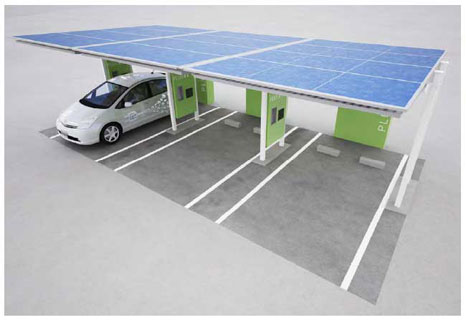
    Do solar charging stations for electric cars and plug-in hybrid electric vehicles make sense?

    The idea was discussed at a recent Congressional briefing “Reducing Oil Dependence through Energy and Climate Policy,” presented by the Environmental and Energy Study Institute (EESI).  Guest blogger and former CAP staffer  Alexandra Kougentakis has the story.

    Solar energy and hybrid electric vehicles would be effective in achieving emission reductions both from transportation AND electricity generation. Solar-powered charging stations for cars that run on electricity are already popping up around the country. With hybrid vehicles becoming ever more popular, and even all-electric cars entering the market, transportation-related oil usage will be reduced. To avoid replacing gasoline carbon dioxide emissions with conventional electricity carbon dioxide emissions, an electric or hybrid car battery could utilize solar electricity .The conventional wisdom likely to raise objections against solar electricity charging stations is that solar energy is just too expensive. Yet photovoltaic (PV) technology prices have been falling since 2008 at extraordinary rates, with module prices dropping by 37.8%, wafer prices by 50% and polysilicon prices by 80%.

    The capital investment for a carport structure topped with PV panels together with the actual charging unit may still exceed that of a conventional filling station. The high initial cost can be completely eliminated for the station owner, however, through an arrangement known as a solar power purchase agreement (SPPA).  Under an SPPA, the PV system is financed and owned by a solar project developer, and a property owner serves as a “host” for the array, purchasing all of the power that is produced at rates that are usually below local utility rates. Tax credits, grants and sales of solar renewable energy credits (SRECs) make it possible for the project developer to finance and profit from such a contract. This way, not only can solar electricity be used to charge hybrid and electric cars, but the electricity can be sold at rates competitive with that of oil, whose price will only keep getting higher. Notably, the 14-mW solar array at the Nellis US Air Force Base in Nevada employs an SPPA.

    A carbon price for the transportation sector is a priority that Congress should include in any comprehensive climate change legislation, and by helping to stimulate renewable energy growth will result in substantial emission reductions. Further, a plan to more comprehensively integrate solar energy into the developing national infrastructure for electric vehicles would generate and support thousands of green jobs, both in the solar sector and in electric vehicle technology development. The economic growth that would result from the expansion of electric cars and the solar industry, and the gains that would come from saving billions of dollars every year on foreign oil, serve as strong arguments for a twin approach of solar powered charging stations for electric cars and a carbon fee for transportation.

    Guest blogger Alexandra Kougentakis is a former CAP staffer and now regulatory analyst at Distributed Sun LLC, a Washington DC-based solar project developer.

    Related Posts:

  • Held up without a gun – Big oil rakes in the cash

    I was out driving/just a taking it slow
    Looked at my tank/ it was reading low
    Pulled in a Exxon station/out on Highway One
    Held up without a gun
    Held up without a gun

    Bruce Springsteen

    Springsteen’s song could not be more true today. Big Oil is once again riding high oil prices to large profits (see below) while American consumers get stuck with a $2.7 billion gasoline bill in the first quarter of 2010 due to higher oil prices. But the problems with oil go beyond these companies’ profits. Rising oil prices also add more filthy lucre to the coffers of hostile regimes, including Iran. CAP’s Daniel J. Weiss and Susan Lyon have the story in this repost.

    Meanwhile, the Gulf of Mexico is suffering a huge oil spill while taxpayers spend billions of dollars paying for tax loopholes for Big Oil. And Big Oil spends record amounts of money to pressure Congress to cement these loopholes in place and defeat clean energy legislation. Adding injury to insult, big oil opposes energy and global warming legislation that would reduce our reliance on oil.

    Enough is enough. We need Congress to stand up to Big Oil and pass legislation that addresses the problems with oil profits and oil use. Sens. John Kerry (D-MA), Lindsey Graham (R-SC), and Joe Lieberman (I-CT) are working on legislation that would reduce oil dependence and put a declining limit and rising price on carbon. These measures would reduce our dependence on oil, increase national security, create jobs, and cut pollution.

    Mo’ prices, mo’ problems

    U.S. crude oil prices rose from $31.76 per barrel in January 2009 to $85.17 by April 29, 2010 after a price slump at the end of 2008. This is an increase of nearly 160 percent over a 15-month period. The Energy Information Administration recently predicted that oil prices will rise to above an average of $81 per barrel by this summer while average gasoline prices will likely exceed $3.00 per gallon this spring. Drivers will pay 17 percent more for gas compared to summer 2009—$174 million per day, or an average of $602 per household annually. Energy price volatility like this hurts consumer and business investments, causing families to delay buying a car and spend less on buying or upgrading their homes. Businesses also cut investments, while profits surge in the oil and gas industry.

    While higher prices brought higher profits to Big Oil, they also brought higher gasoline prices that cost American consumers millions during the first quarter. A CAP analysis determined that higher oil and gasoline prices forced Americans to spend $2.7 billion more on gasoline during the first quarter compared to what they would have spent had prices remained steady after the first week.

    Big Five: We’re in the money

    big oil profits, Q1 2009 vs. Q1 2010

    Much of the U.S. economy is slowly recovering from a deep recession, but oil companies continue to prosper. The big five oil companies—BP, Chevron, ConocoPhillips, ExxonMobil, and Shell—announced huge first quarter profits—four of the five companies announced profits larger than analysts predicted. As the chart below shows, big oil saw profits in the first quarter of 2010 that far eclipse analysts’ projections and are significantly higher than 2009 profits as well.

    Big five oil company profits for the first quarter of 2010 vs. first quarter 2009

    Oil company Q1 2010 projected profits by Financial Times (in billions) Q1 2010, actual profits (net income) Q1 2009, actual profits Q1 2010 profits compared to Q1 2009
    BP $4.8 $5.6 $2.4 +133%
    Chevron $3.7 $4.6 $1.8 +156%
    ConocoPhillips $2.0 $2.1 $0.8 +163%
    ExxonMobil $6.8 $6.3 $4.6 +38%
    Shell $4.0 $4.9 $3.3 +49%
    Total $21.3 $23.5 $12.9 82%

    BP’s 2010 first quarter profits were $5.6 billion, a 135 percent increase over the first quarter of 2009. This profit was 50 percent higher than predicted by The Financial Times. Shell announced that its profits had risen by 49 percent since the first quarter of 2009. Chevron’s profit was $4.6 billion, a 156 percent increase, while ConocoPhillips had $2.1 billion in profits. The world’s largest private oil company, ExxonMobil, had a first quarter profit of $6.8 billion, which was 38 percent more than 2009.

    Iran: Thanks for high oil prices

    Higher oil prices also benefit nations that are hostile to U.S. interests—even if we don’t purchase any oil from them—such as Iran. Every $1 increase in the price of oil provides an additional $1.5 billion to Iran annually.

    Conversely, adoption of a shrinking limit on carbon pollution that reduces it by 80 percent by 2050 would reduce the use of oil and lower its price, costing Iran approximately $1.8 trillion in lost oil revenues over the next 40 years—over $100 million a day. These petrodollars fund and prop up unfriendly regimes, enabling them to support terrorists in other nations.

    Sea of fire

    Oil companies deserve to earn a profit since oil exploration and development can be financially and technically risky business. At the same time, though, they must produce this oil in a safe and environmentally sustainable manner. Yet despite rhetoric to the contrary about advances in environmental safeguards, the spill off the Louisiana coast shows that offshore oil development still poses a threat to its workers and risk to the ocean and coastal environment.

    BP owns the oil rig that exploded and sunk in the Gulf of Mexico last week, causing what CNN reports officials say “could become one of worst spills in U.S. history.” Tragically, there are 11 missing rig employees who are presumed dead. The well continues to leak 210,000 gallons of oil per day into the Gulf of Mexico—five times the original estimate. This growing oil slick already covers an area larger than West Virginia and and oozed onto the Louisiana shore early this morning. A major portion of the oil slick looms only five miles offshore. This major oil spill could be the worst environmental disaster since the Exxon Valdez spill in 1989, and it is a tragic reminder that we must dramatically reduce our oil use.

    The Exxon Valdez spill cost Alaska’s fishermen an estimated $800 million in damages to their livelihood. This oil spill could bring an economic Armageddon to the gulf coast seafood industry. Bloomberg reports:

    Louisiana is the largest seafood producer in the lower 48 states, with annual retail sales of about $1.8 billion, according to state data. Recreational fishing generates about $1 billion in retail sales a year, according to the state.

    BP should be required to place its first quarter profit of $5.6 billion in an escrow account to provide compensation to the fishermen whose livelihoods are threatened. These funds should also be used for cleaning up the soon to be blighted shores.

    Oil tax loopholes: More money for the misbegotten

    Despite high prices and profits, big oil companies still want taxpayer-funded loopholes even though some conservative oil men believe they are unnecessary. In 2005 former oil man and President George W. Bush noted that with higher oil prices big oil does not need tax breaks to explore and develop oil fields.

    I will tell you with $55 oil we don’t need incentives to the oil and gas companies to explore. There are plenty of incentives. What we need is to put a strategy in place that will help this country over time become less dependent.

    Yet even with today’s prices more than 50 percent higher than $55 per barrel, Big Oil companies want to maintain tax loopholes that siphon additional billions of dollars from U.S. taxpayers. Taxpayer money pays for the tax breaks claimed by Big Oil, but the industry claims that closing these loopholes is really a new energy tax on them. American Petroleum Institute President Jack Gerard stated:

    With America still recovering from recession and one in ten Americans out of work, now is not the time to impose new taxes on the nation’s oil and natural gas industry. New taxes would mean fewer American jobs and less revenue at a time when we desperately need both. A robust U.S. oil and gas industry is essential to the recovery of the nation’s economy.

    Contrary to this assertion, cutting the subsidies to Big Oil would help our economy while shrinking the federal budget deficit. In fact, a state-by-state analysis indicates that taxpayers would actually save money if the subsidies and tax breaks were lifted. A recent CAP analysis found that the effective federal income tax rate in the United States for major oil companies is lower than the effective tax rates they face abroad—sometimes close to 50 percent lower. The report also determined that subsidies to the oil industry will cost the U.S. government about $3 billion in lost revenues next year and nearly $20 billion over the next five years.

    These estimates are only the initial assessment—they still vastly underestimate the help that the oil industry receives from the government via extensive hidden tax code benefits as well.

    Big Oil squeezes the Capitol

    Given the generous subsidies Big Oil receives, it should come as no surprise that this industry is fighting hard to keep their loopholes and block reform. There was record oil and gas industry lobbying in 2009. These companies spent at least $154 million on squeezing Congress that year—more than 16 percent higher than 2008. Big Oil’s lobbying and political arm—the American Petroleum Institute—alone spent at least $7.3 million on lobbying in 2009 and another $1.3 million more in 2010 to kill legislation. API has also spent millions of dollars running expensive print, TV, and radio ads to do the same. The American Petroleum Institute alone “doled out $75.2 million for public relations and advertising” in 2008.

    Congress must act

    In short, Big Oil’s profits climb higher and higher as American consumers feel more and more pain at the pump. This needs to stop.

    Sens. John Kerry (D-MA), Lindsey Graham (R-SC), and Joe Lieberman (I-CT) are developing bipartisan comprehensive energy legislation that would reduce oil dependence and put a declining limit and rising price on carbon. These provisions would increase American energy independence (and our national security), create jobs, produce “Made in the USA” clean energy technologies, and cut pollution. The bill should also establish much stricter safeguards for existing offshore oil production.

    Additionally, Congress should cut subsidies to big oil and level the playing field for safe, clean energy sources. Further, we need to curb the economic, social, and environmental damage that our consumption of dirty fuel causes. To achieve these many goals, Congress must act swiftly to pass bipartisan comprehensive energy and climate reform.

    Methodology

    We used the weekly price and quantity data supplied by the EIA’s U.S. prices and consumption database to calculate how much more Americans spent on gas in the first quarter of 2010 relative to what they would have spent had prices remained steady after the first week of January 2010. Using their data from the “Finished Motor gasoline product supplied” and “Conventional retail gas prices” sections, we multiplied the average weekly product supplied value times that week’s recorded price, doing this separately for each week of the first quarter. From here, the initial week’s value was subtracted from each other week’s to obtain how much more was spent each week relative to the first. Aggregating this column resulted in the final figure.

    Daniel J. Weiss is a Senior Fellow and Susan Lyon is a Special Assistant for Energy Policy at American Progress.

    See also:

  • Taking biofuels to the next level

    President Barack Obama toured and met workers at a POET refining ethanol plant in Macon, Missouri Wednesday as part of his trip to Missouri, Iowa, and Illinois. POET is the largest ethanol producer in the United States, and has recently announced plans to produce 3.5 billion gallons of advanced cellulosic biofuels by 2022.  CAP’s Jake Caldwell has the story in this repost.

    There is no question that the United States must reduce its dependence on oil. One-fifth of the oil consumed in the United States is imported from nations that are “dangerous or unstable” for travelers, according to the State Department. And since surface transportation is responsible for 65 percent of oil use in the United States, this task will require us to meet the challenge of oil use in the transportation sector head-on.

    We will need to employ a variety of important measures to reduce oil use, including significantly more efficient fuel economy standards, investments in public transportation and high-speed rail, and smart growth development efforts. The production and use of alternative fuels, including natural gas and advanced biofuels, are also key components of a strategy to diversify our sources of energy for transportation. And each of these steps, taken together, can increase energy independence by reducing oil use by millions of barrels.

    President Obama and his administration, including Secretaries Thomas Vilsack and Steven Chu and Environmental Protection Agency Administrator Lisa P. Jackson, have demonstrated great leadership in promoting the production of advanced biofuels in a more innovative and efficient manner, while ensuring that we maintain the existing infrastructure for the current generation of biofuels.

    Yet there is still much more work to be done.

    The current generation of biofuels producers, the advanced biofuels industry, Congress, and the Obama administration should work together to promote this important energy sector with the following policy goals and recommendations:

    Support sustainable biofuels. Bring advanced, cellulosic biofuels—made from agricultural waste, wood chips, or dedicated energy crops such as switchgrass produced in rural America—to commercial scale on as rapid a timetable as possible. Ensure a stable long-term market for advanced biofuels by making investments in the infrastructure needs of the current generation of biofuels.

    Push for comprehensive, bipartisan clean energy and climate legislation in Congress that establishes a price on carbon pollution. The biofuels industry must raise its visibility and high-level support for federal clean energy and climate legislation. An economywide price on carbon will help reduce greenhouse gas emissions and reinforce a predictable price signal that will drive innovation and investment to produce cleaner fuels, create jobs, and deliver more renewable energy from rural communities.

    Increase support for the current national Renewable Fuel Standard. The RFS II will require better funding and interagency strategic implementation of the program, particularly regarding its emphasis on rewarding biofuels’ performance characteristics. Congress should also ensure that legislative definitions of “renewable biomass” adhere to certifiable environmental and land use safeguards on ecologically valuable and vulnerable public and private lands and provide a means to measure lifecycle greenhouse gas reductions.

    Support loan guarantees for the construction and deployment of advanced biofuel refineries. The U.S. Department of Agriculture’s Biomass Crop Assistance Program has in the recent past been the sole federal source of loan guarantees to develop, construct, and retrofit commercial-scale advanced biorefineries attempting to produce cellulosic biofuels at commercial levels, and it should receive an additional $300 million toward this goal. This core funding will allow the program to issue loan guarantees for biorefinery projects established primarily in rural communities.

    Provide incentives to farmers to begin growing advanced biofuel crops. The USDA’s Biomass Crop Assistance Program provides funding to producers and farmers of renewable energy crops of up to 75 percent of the cost of establishing the energy crop and annual payments for up to 15 years for crop production, and should receive additional support.

    Encourage farmer-owned and farmer-operated biorefinery and biofuel plant cooperatives and biomass enterprise zones. Direct producer payments and other targeted incentives can help farmers engaged in the establishment of farmer and locally owned biorefineries and biofuel facilities, but should be temporary and phased out over a 10-year period, and should have majority local ownership. Farmers will also need technical and financial assistance to encourage them to pool resources and enter into larger biomass enterprise zones that would maximize economies of scale and regional geographic proximity. Biomass enterprise zones could facilitate the co-location of biomass growing, production, and processing. And marketing alliances could encourage collaboration on facility construction, storage, and transportation infrastructure to enable biobased products to enter the retail market efficiently.

    Dedicate $300 million for five USDA regional feedstock research centers. These research centers will ensure appropriate biofuel feedstocks and supply chains are available in different regions of the country, and support other Department of Energy bioenergy and biomass programs. Biomass growers are primarily located in rural areas, and the costs of collecting and transporting biomass means that many production facilities are also in these communities, providing jobs and raising regional revenues.

    Import tariff phase down. The United States should gradually begin the phase down of the current 54 cent-per-gallon tariff on imported biofuels as Congress and RFS II provide a mandate for the biofuels industry to reach 36 billion gallons by 2022. All countries must take reciprocal action to remove trade restrictions on sustainable biofuels.

    Spur consumer demand and retail infrastructure. The United States must create requirements and strong incentives to make biofuel blends reliably available at filling stations by promoting the installation of new blender fuel pumps and distribution infrastructure that allow drivers to choose between traditional 100 percent gasoline blends and 85 percent biofuel blends. It should increase renewable fuel infrastructure grants to $100 million in each fiscal year.

    Mobilize government purchasing power. The federal government spends more than $230 billion annually on products and services and is a major consumer of transportation fuels. The United States should fully implement the existing Farm Bill biobased purchasing program to use the government’s purchasing power to increase market demand for biobased fuels and products.

    Biofuels and other types of biobased energy are not the only solution to all of the world’s energy and transportation challenges. We also need an array of energy sources from sun, wind, geothermal, and other renewable technologies. Most importantly, we need comprehensive, clean energy and climate legislation that puts a price on carbon pollution, and will allow sustained private and public investment in renewable energy and cleaner fuels.

    But with the right safeguards, biofuels can play a direct role in diversifying our energy sources and contribute to cutting our oil dependence, enhancing our national security, and spurring economic growth and development, particularly in rural communities.

    Jake Caldwell is the Director of Policy for Agriculture, Trade and Energy at American Progress.

    Related Post:

  • Podesta: Energy First for Congress, Then Immigration

    The great debate over the scheduling of comprehensive immigration reform versus clean energy and climate legislation has engulfed Washington. Lost in that frenzy is the need for Congress to do both.  John D. Podesta, CAPAF President and CEO explains why in this repost.

    The Senate now has a clear schedule for consideration: the energy and climate bill followed by immigration reform. The consternation and anxiety—and even the threats—surrounding the schedule must now come to an end so we can solve these critical problems.

    It is obvious that energy and climate legislation is further along in the legislative process than immigration reform. The Environmental Protection Agency is doing its assessment of the bill and it should be ready for Senate consideration within weeks. This gives leadership, sponsors, and supporters time to secure 60 votes.

    Comprehensive immigration reform is no less worthy of consideration but needs more time to develop legislatively. The passage of draconian legislation in Arizona amplifies the demand for a prompt federal solution. Constructing immigration reform that can garner bipartisan support can’t be done in a matter of days but it’s critical that the process be accelerated and we move to it this year.

    Given this path forward it is time for senators and interest groups alike to put an end to the histrionics and get to work.

    – John Podesta


  • Climate change indicators in the United States – Summary of scientific findings

    Rate of Temperature Change in the United States, 1901–2008. This figure shows how average air temperatures have changed in different parts of the United States since the early 20th century (since 1901 for the lower 48 states, 1905 for Hawaii, and 1918 for Alaska). Source: U.S. EPA, Climate Change Indicators in the United States [PDF], April 2010.

    Nick Sundt over at the WWF climate blog has put together a nice summary of the findings of the EPA’s new US Climate Change Indicators Report (with links to the key PDFs), which I repost below:

    The evidence of climate change is growing all around us.  In this posting, we provide a summary of the key findings of the new report from the  U.S. Environmental Protection Agency, Climate Change Indicators in the U.S.

    For more information on the report, see our posting, U.S. Environmental Protection Agency Issues Compendium of “Climate Change Indicators” for the U.S. (27 May 2010).  A PDF version of the Summary of Key Findings is available online. With the exception of bracketed text, the following is excerpted directly from the report.

    Greenhouse Gases
    [Details on these indicators are available here: Greenhouse Gases (PDF) (12 pp, 4.7MB)]

    U.S. Greenhouse Gas Emissions. In the United States, greenhouse gas emissions caused by human activities increased by 14 percent from 1990 to 2008. Carbon dioxide accounts for most of the nation’s emissions and most of this increase. Electricity generation is the largest source of greenhouse gas emissions in the United States, followed by transportation. Emissions per person have remained about the same since 1990.

    Global Greenhouse Gas Emissions. Worldwide, emissions of greenhouse gases from human activities increased by 26 percent from 1990 to 2005. Emissions of carbon dioxide, which account for nearly three-fourths of the total, increased by 31 percent over this period. Like in the United States, the majority of the world’s emissions are associated with energy use.

    Atmospheric Concentrations of Greenhouse Gases. Concentrations of carbon dioxide and other greenhouse gases in the atmosphere have risen substantially since the beginning of the industrial era. Almost all of this increase is attributable to human activities. Historical measurements show that the current levels of many greenhouse gases are higher than any seen in thousands of years, even after accounting for natural fluctuations.

    Climate Forcing. Climate or “radiative” forcing is a way to measure how substances such as greenhouse gases affect the amount of energy that is absorbed by the atmosphere. An increase in radiative forcing leads to warming while a decrease in forcing produces cooling. From 1990 to 2008, the radiative forcing of all the greenhouse gases in the Earth’s atmosphere increased by about 26 percent. The rise in carbon dioxide concentrations accounts for approximately 80 percent of this increase.
    Weather and Climate
    [Details on these indicators are available here: Weather and Climate (PDF) (14 pp, 3.3MB)]

    U.S. and Global Temperature. Average temperatures have risen across the lower 48 states since 1901, with an increased rate of warming over the past 30 years. Seven of the top 10 warmest years on record for the lower 48 states have occurred since 1990, and the last 10 five-year periods have been the warmest five-year periods on record. Average global temperatures show a similar trend, and 2000–2009 was the warmest decade on record worldwide. Within the United States, parts of the North, the West, and Alaska have seen temperatures increase the most.

    Heat Waves. The frequency of heat waves in the United States decreased in the 1960s and 1970s, but has risen steadily since then. The percentage of the United States experiencing heat waves has also increased. The most severe heat waves in U.S. history remain those that occurred during the “Dust Bowl” in the 1930s, although average temperatures have increased since then.

    Drought. Over the period from 2001 through 2009, roughly 30 to 60 percent of the U.S. land area experienced drought conditions at any given time. However, the data for this indicator have not been collected for long enough to determine whether droughts are increasing or decreasing over time.

    U.S. and Global Precipitation. Average precipitation has increased in the United States and worldwide. Since 1901, precipitation has increased at an average rate of more than 6 percent per century in the lower 48 states and nearly 2 percent per century worldwide. However, shifting weather patterns have caused certain areas, such as Hawaii and parts of the Southwest, to experience less precipitation than they used to.

    Heavy Precipitation. In recent years, a higher percentage of precipitation in the United States has come in the form of intense single-day events. Eight of the top 10 years for extreme one-day precipitation events have occurred since 1990. The occurrence of abnormally high annual precipitation totals has also increased.

    Tropical Cyclone Intensity. The intensity of tropical storms in the Atlantic Ocean, Caribbean, and Gulf of Mexico did not exhibit a strong long-term trend for much of the 20th century, but has risen noticeably over the past 20 years. Six of the 10 most active hurricane seasons have occurred since the mid-1990s. This increase is closely related to variations in sea surface temperature in the tropical Atlantic.
    Oceans
    [Details on these indicators are available here: Oceans (PDF) (10 pp, 3.1MB)]

    Ocean Heat. Several studies have shown that the amount of heat stored in the ocean has increased substantially since the 1950s. Ocean heat content not only determines sea surface temperature, but it also affects sea level and currents. Sea Surface Temperature. The surface temperature of the world’s oceans increased over the 20th century. Even with some year-to-year variation, the overall increase is statistically significant, and sea surface temperatures have been higher during the past three decades than at any other time since large-scale measurement began in the late 1800s.

    Sea Surface Temperature. The surface temperature of the world’s oceans increased over the 20th century. Even with some year-to-year variation, the overall increase is statistically significant, and sea surface temperatures have been higher during the past three decades than at any other time since large-scale measurement began in the late 1800s.

    Sea Level. When averaged over all the world’s oceans, sea level has increased at a rate of roughly six-tenths of an inch per decade since 1870. The rate of increase has accelerated in recent years to more than an inch per decade. Changes in sea level relative to the height of the land vary widely because the land itself moves. Along the U.S. coastline, sea level has risen the most relative to the land along the Mid-Atlantic coast and parts of the Gulf Coast. Sea level has decreased relative to the land in parts of Alaska and the Northwest.

    Ocean Acidity. The ocean has become more acidic over the past 20 years, and studies suggest that the ocean is substantially more acidic now than it was a few centuries ago. Rising acidity is associated with increased levels of carbon dioxide dissolved in the water. Changes in acidity can affect sensitive organisms such as corals.
    Snow and Ice
    [Details on these indicators are available here: Snow and Ice (PDF) (12 pp, 3.6MB) ]

    Arctic Sea Ice. Part of the Arctic Ocean stays frozen year-round. The area covered by ice is typically smallest in September, after the summer melting season. September 2007 had the least ice of any year on record, followed by 2008 and 2009. The extent of Arctic sea ice in 2009 was 24 percent below the 1979 to 2000 historical average.

    Glaciers. Glaciers in the United States and around the world have generally shrunk since the 1960s, and the rate at which glaciers are melting appears to have accelerated over the last decade. Overall, glaciers worldwide have lost more than 2,000 cubic miles of water since 1960, which has contributed to the observed rise in sea level.

    Lake Ice. Lakes in the northern United States generally appear to be freezing later and thawing earlier than they did in the 1800s and early 1900s. The length of time that lakes stay frozen has decreased at an average rate of one to two days per decade.

    Snow Cover. The portion of North America covered by snow has generally decreased since 1972, although there has been much year-to-year variability. Snow covered an average of 3.18 million square miles of North America during the years 2000 to 2008, compared with 3.43 million square miles during the 1970s.

    Snowpack. Between 1950 and 2000, the depth of snow on the ground in early spring decreased at most measurement sites in the western United States and Canada. Spring snowpack declined by more than 75 percent in some areas, but increased in a few others.
    Society and Ecosystems
    [Details on these indicators are available here: Society and Ecosystems (PDF) (12 pp, 3.4MB)]

    Heat-Related Deaths. Over the past three decades, more than 6,000 deaths across the United States were caused by heat-related illness such as heat stroke. However, considerable year-to-year variability makes it difficult to determine long-term trends.

    Length of Growing Season. The average length of the growing season in the lower 48 states has increased by about two weeks since the beginning of the 20th century. A particularly large and steady increase has occurred over the last 30 years. The observed changes reflect earlier spring warming as well as later arrival of fall frosts. The length of the growing season has increased more rapidly in the West than in the East.

    Plant Hardiness Zones. Winter low temperatures are a major factor in determining which plants can survive in a particular area. Plant hardiness zones have shifted noticeably northward since 1990, reflecting higher winter temperatures in most parts of the country. Large portions of several states have warmed by at least one hardiness zone.

    Leaf and Bloom Dates. Leaf growth and flower blooms are examples of natural events whose timing can be influenced by climate change. Observations of lilacs and honeysuckles in the lower 48 states suggest that leaf growth is now occurring a few days earlier than it did in the early 1900s. Lilacs and honeysuckles are also blooming slightly earlier than in the past, but it is difficult to determine whether this change is statistically meaningful.

    Bird Wintering Ranges. Some birds shift their range or alter their migration habits to adapt to changes in temperature or other environmental conditions. Long-term studies have found that bird species in North America have shifted their wintering grounds northward by an average of 35 miles since 1966, with a few species shifting by several hundred miles. On average, bird species have also moved their wintering grounds farther from the coast, consistent with rising inland temperatures.

    – Nick Sundt

    Related Post:

  • China seals oil deals – Map of China’s major overseas oil deals

    China’s oil demand is projected to grow by 80 percent between 2010 and 2030 due to its rapidly developing economy and in particular its growing middle class and exploding auto market.

    CAP has a new map out showing where China is securing oil rights around the world.

    China’s largest national, government-owned oil companies—CNPC, CNOOC, and Sinopec—have taken aggressive action over the last several years to secure oil abroad in an effort to cope with this growth and a looming global oil crunch. China’s recent overseas oil deals have the potential to deliver more than 7.8 billion barrels of oil to the country over the next several years.

    This figure shows some of China’s largest, most recent oil deals, with a focus on 2009 and 2010 contracts. Highlighted among those are countries currently on the U.S. Department of State’s travel warning list for “dangerous or unstable” nations.

    China's major overseas oil deals

    For more information, see:

    Citations

    1. Bo Kong, “Appendix 3.1: Foreign Upstream Investment by Chinese Oil Companies, 1992-2007.” In China’s International Petroleum Policy (Santa Barbara, CA: ABC CLIO, 2010).

    2. Monica Hatcher, “Oil sands sale brings more than expected,” Houston Chronicle, April 12, 2010, available at http://www.chron.com/ disp/ story.mpl/ business/ 6956022.html.

    3. Suzanne Goldberg, “Canada looks to China to exploit oil sands rejected by US,” The Guardian, February 14, 2010, available at http://www.guardian.co.uk/ business/ 2010/ feb/ 14/ canada-china-investment-oil-sands.

    4. Dan Molinski and John Lyons, “China’s $20 Billion Bolsters Chávez,” The Wall Street Journal, April 18, 2010, available at http://online.wsj.com/ article/ SB10001424052748703594404575191671972897694.html.

    5. Will Grant, “China in huge Venezuela oil deal,” BBC News, September 17, 2009, available at http://news.bbc.co.uk/2/hi/8260200.stm.

    6. ABC News, “Venezuela, China sign $US16b oil deal,” September 17, 2009, available at http://www.abc.net.au/news/stories/2009/09/17/2688335.htm (last accessed April 2010).

    7. John Lyons, “Brazil Turns to China to Help Finance Oil Projects,” The Wall Street Journal, May 18, 2009, available at http://online.wsj.com/ article/ SB124259318084927919.html.

    8. Jad Mouawad, “Deal for South American Oil Fields Extends China’s Global Quest for Energy,” The New York Times, March 14, 2010, available at http://www.nytimes.com/ 2010/ 03/ 15/ business/ global/ 15oil.html.

    9. CNOOC Limited, “CNOOC Acquires 45 % Stake in OML 130 Offshore Nigeria,” Rigzone, January 9, 2006, available at http://www.rigzone.com/news/article.asp?a_id=28369.

    10. Yvonne Lee, “Sinopec to Acquire Angolan Oil Assets,” The Wall Street Journal, March 29, 2010, available at http://online.wsj.com/ article/ SB10001424052702303429804575149714050757630.html?mod=googlenews_ws.

    11. Sameera Anand, “China’s CNOOC and Sinopec Pay $1.3 Billion for Angola Oil,” Bloomberg Businessweek, July 20, 2009, available at http://www.businessweek.com/ globalbiz/ content/ jul2009/ gb20090720_097528.htm.

    12. V. Phani Kumar, “Cnooc, Sinopec shares up on Angola stake buy,” Market Watch, July 29, 2009, available at http://www.marketwatch.com/story/cnooc-sinopec-shares-up-on-angola-field-stake-buy (last accessed April 2010).

    13. PBS NewsHour, “China-Sudan Trade Relations Complicate Darfur Crisis,” April 25, 2006, available at http://www.pbs.org/ newshour/ updates/ china-darfur_04-25-06.html.

    14. Guy Chazan and Shai Oster, “Sinopec Pact For Addax Boosts China’s Buying Binge,” The Wall Street Journal, June 25, 2009, available at http://online.wsj.com/ article/ SB124584068908746803.html.

    15. BBC News, “Iraq in third overseas oil deal,” November 5, 2009, available at http://news.bbc.co.uk/2/hi/8344067.stm.

    16. BP, “BP and CNPC to Develop Iraq’s Super-Giant Rumaila Field,” Press release, November 3, 2009, available at http://www.bp.com/genericarticle.do?categoryId=2012968&contentId=7057650 (last accessed April 2010).

    17. SOCO International, “Sinochem to Buy SOCO Yemen for $465M,” Rigzone, February 4, 2008, available at http://www.rigzone.com/NEWS/article.asp?a_id=56202.

    18. The World Tribune, “Iraq awards China major oil deal near Iran border,” March 11, 2010, available at http://www.worldtribune.com/ worldtribune/ WTARC/ 2010/ me_oil0191_03_10.asp.

    19. RIA Novosti, “Iran, China sign $1.76 bln contract to develop Iranian oil field,” January 15, 2009, available at http://en.rian.ru/ world/ 20090115/ 119506131.html.

    20. David Barboza, “China Starts Investing Globally,” The New York Times, February 20, 2009, available at http://www.nytimes.com/ 2009/ 02/ 21/ business/ worldbusiness/ 21yuan.html?_r=1.

  • One myth about the Washington Post: It still practices serious journalism – No myth: Wind power HAS reduced Denmark’s CO2 emissions a lot

    The Washington Post has adopted many strategies to stave off its collapsing circulation.  It has, for instance, gone tabloid, repeatedly publishing falsehood-filled op-eds by Sarah Palin, including one on climate science!

    It also strains to print an unconventional “contrarian” analysis ever week in its “5 Myths” series, which is supposedly “a challenge to everything you think you know.”  Of course, lots of what you know is true, and that means the Post has to print lots of stuff that isn’t.

    In its 5 Myths about China’s economic power piece two weeks ago, “Myth” 4 was “China’s hunger for resources is sucking the world dry and making major contributions to global warming.”  You may notice something about that myth — it isn’t one.  China is making major contributions to global warming.  One would have to categorize that as a fact.  China  is now actually the world’s biggest emitter, which must qualify as a “major” contribution even to the Post.

    And the ‘debunking’ asserts, “unlike the United States, China has recognized that it cannot let its fossil-fuel appetite grow forever and is working hard to improve efficiency.”  China, like the United States under Obama Administration, is working to improve efficiency, but right now China looks like it plans to keep building one or two coal plants a week for the foreseeable future — whereas U.S. fossil fuel consumption may well have peaked a few years ago and in any case will see little net growth from 2005 through 2020 and probably well beyond that.  Indeed, but for a handful of Senators, we’d be on a path to an 80% reduction by 2050.

    This Sunday, the Post published its most nonsensical piece in the series, “5 Myths about green energy.“  They farmed out the task to the right wing Manhattan Institute, which, surprise, surprise, has received $800,000 from the big-time polluters at Koch Industries in recent years, on top of money from ExxonMobil.  It’s no surprise Big Oil and polluters fund right-wing disinformation.   And I suppose it’s no longer a surprise that the Post reprint their misinformation as fact.

    I don’t have the time to debunk the entire piece.  Fortunately, Matt Wasson  Director of Programs for Appalachian Voices, dismantled the first one thoroughly at HuffPost, which I excerpt below:

    Readers of the Washington Post were served up some jaw-dropping whoppers yesterday about why renewable energy — and wind in particular — supposedly doesn’t reduce CO2 emissions, increase our national security, or create jobs in the US. The author of the op-ed is climate change denier and long time fossil fuel cheerleader Robert Bryce….

    While challenging everything you think you know is generally a good idea, it’s not a good idea to replace what you know with what Bryce thinks he knows because, as it turns out, he doesn’t know much about renewable energy. Relying on bad science like the Nature Conservancy’s “Energy Sprawl” study and thoroughly discredited white papers like “The Case of Denmark” from Bjorn Lomborg’s Institute for Energy Studies, Bryce deftly turns logic and common sense on its head to convince his readers that burning more fossil fuels is really the best path to a green energy future.

    … I’ll just focus on Bryce’s “Myth 1: Solar and wind power are the greenest of them all.”

    Bryce begins his argument with what has become the new favorite talking point of renewable energy detractors and climate change deniers: “solar and wind technologies require huge amounts of land to deliver relatively small amounts of energy, disrupting natural habitats.”

    As I have written extensively about in a previous post, the authors of the “Energy Sprawl” committed the cardinal sin of ecological modeling by comparing apples to oranges (more like watermelons to grapes). In the study, wind power was presumed to impact an area as much as 300-400 times greater than the actual footprint of the turbines on the land while the impacts of coal power, for instance, were assumed to go no farther than the footprint of mine permits, leaving aside any consideration of habitat fragmentation and wildlife disturbance that increased wind’s alleged sprawl factor by 300 to 400 times. Nor did the “Energy Sprawl” study include the acreage consumed by actual coal-fired power plants, the infrastructure for processing coal and disposing of processing wastes, the rail and barge infrastructure for transporting coal to power plants, or the fills and impoundments used for disposing of coal combustion waste.

    While it should strain the credulity of even the most entrenched climate change denier that a single wind turbine would impact more than 100 football fields worth of land, at least TNC’s paper makes clear that only 2-5% of the area is cleared for access roads and a buffer around each turbine. Bryce makes it sound like they’re referring to the actual footprint of the turbine, which is about 1/3rd of an acre for a 2MW turbine (or about 1/300th of the land impact estimate cited by Bryce). If a fair comparison were made, wind would produce 10 to 20 times as many watts per square meter as Bryce’s hypothetical natural gas well.

    But where Bryce really goes off the deep end is when he states:

    “Nor does wind energy substantially reduce CO2 emissions. Since the wind doesn’t always blow, utilities must use gas or coal-fired generators to offset wind’s unreliability. The result is minimal — or no — carbon dioxide reduction.”

    First off, while supporters of increased reliance on fossil fuels love to conflate the issues of intermittency (which is manageable) with unreliability (which is not), countries such as Spain and Denmark have managed to integrate large amounts of wind power into their grids without power outages or other problems that an “unreliable” power source might create.

    That said, it’s true that there is not necessarily a one-to-one relationship when it comes to displacement of coal or natural gas by wind. Because of its intermittency, wind requires a certain level of “firming” with conventional or other renewable technologies like biomass and hydro to ensure there is sufficient electricity supply when wind resources are low. That’s an issue that could be intelligently discussed and built into energy plans were it not for people like Bryce that use it as an opportunity to confuse the public and mislead them into believing intermittency makes wind an unreliable source of power.

    More apalling, however, is Bryce’s extraordinary claim that wind power results in little or no CO2 reduction. As evidence, he cites the 2007 annual environmental report from Energinet.dk, the largest operator of Denmark’s electricity grids. The online version on the Washington Post website even includes a link to that report, which should prove quite useful for Bryce, as he doesn’t appear to have read it. According to the report:

    “… some of Denmark’s thermal generation will be displaced by the commissioning of new wind turbine capacity. Extra wind capacity will also contribute to displacing thermal generation outside Denmark.”

    The purported evidence from the report that Bryce uses to support is based on his tortured and selective presentation of CO2 emissions data. According to Bryce, the Energinet.dk report shows that:

    “…carbon dioxide emissions from electricity generation in 2007 were at about the same level as they were back in 1990, before the country began its frenzied construction of turbines.”

    Contrast that with what the report actually stated:

    “CO2 emissions vary considerably from year to year, depending on electricity trading. Adjusting for imports and exports resulted in an overall emissions reduction of 23% in the 1990-2007 period. The primary reason is a conversion of Danish electricity and heat generation to less CO2 intensive fuels such as natural gas, coupled with increased use of renewable energy sources”

    So what’s the disconnect between Bryce’s analysis and reality? As with many small European countries, Denmark’s electric grid is integrated into larger grids of neighboring countries – in Denmark’s case those are the grids in Germany, Norway and Sweden. In general, Denmark exports a lot of electricity to the German grid while importing power from Sweden and Norway, which have large (and cheap) surpluses of hydropower, particularly in wet years. What Bryce has done is compare 1990, a year when Denmark imported a huge proportion of its electricity from other Scandanavian countries, with 2007, a year it was a net exporter of electricity. The graph below from the Energinet.dk report tells the story – the red bars are the in-country emissions, while the grey line shows emissions adjusted for imports and exports of electricity:

    Denmark_CO2_Emissions_1990_2008

    Bryce clearly draws his analysis from a 2009 white paper entitled “The Case of Denmark” produced by the Institute for Energy Studies. That institute is run by notorious climate change denier Bjorn Lomborg and the analysis has been thoroughly debunked by numerous analysts. Essentially, the analysis in The Case of Denmark is based on the bizarre assumption that wind-generated electricity exported to Germany simply disappears from the grid, rather than viewing Denmarks’s energy production in the context of a multi-nation integrated grid.

    But the point where Bryce’s analysis goes from misleading (or ignorant) to downright dishonest is when he attributes Denmark’s success in controlling CO2 emissions to a low population growth rate, while touting the United States’ success in decreasing per capita emissions by 2.5% between 1980 and 2006. Keeping with the 1990-2008 time frame from the most recent Energinet.dk report, the US has done somewhat better than that, decreasing per-capita CO2 emissions by about 4.5%. But over that same time period, the Danes have decreased their per capita CO2 emissions by 21%.

    A final piece of distorted analysis provided by Bryce is when he states:

    “… Through 2017, the Danes foresee no decrease in carbon dioxide emissions from electricity generation.”

    On the surface, that is true, the Danes project no decrease in carbon dioxide emissions from electricity generation over the next decade, but that is because they plan to replace inefficient old oil heaters with heat pumps and transition to far more efficient electric vehicles. The net effect will be an enormous decrease in overall CO2 emissions over that time period. The remarkable thing is that the projected 1.2% annual increases in electricity demand resulting mostly from transitioning to more efficient electric vehicles (10% by 2020) and heat pumps will be met entirely with renewable energy sources, primarily wind. In fact, increasing wind generation up to 20% of their electricity generation has been such a success that the Danes plan to expand their wind generation up to 36% of their electricity mix by 2020.

    On a final note, Bryce ignored the many other environmental benefits Denmark has enjoyed from its rapid transition to renewable energy sources. For instance, sulfur dioxide emissions, which decreased in the US by about 50% between 1990 and 2008, were reduced by 94% in Denmark over the same period. Here’s a graph of sulfur dioxide emissions from the Energinet.dk report:

    Denmark_SO2_Emissions_1990_2008

    It’s particularly notable that sulfur dioxide emissions are the primary cause of acid rain which, back in the early 90s, was found to be responsible for massive reproductive failure in some species of birds nesting in Northern European forests. The benefits of these reductions for bird populations absolutely dwarfs the impacts of the small number of birds killed by wind turbines.

    All of the analysis in this post is based on just one of five “myths” about renewable energy that Bryce addresses in his op-ed. His treatment of the other four is equally misleading, but hopefully this post will provide an indication of the depths to which Bryce is willing to sink to make his case for a greater reliance on fossil fuels.

    The analysis of these “myths” is presumably drawn from Bryce’s new book, Power Hungry: The Myths of ‘Green’ Energy and the Real Fuels of the Future….  If his piece in the Washington Post is indeed indicative of what’s in his book, it should provide excellent fodder for a variety of debunkers seeking an honest debate about the various paths the US could take in moving to a 21st century energy policy.

  • Climate and clean energy bill delivers real money for farmers – Inaction threatens farm income

    It remains conventional wisdom ignorance that a climate and clean energy jobs bill would not be good for farmers.  In fact, the future prosperity of U.S agriculture is tied to clean energy and the effects of climate change. Farmers are particularly vulnerable to the increased water shortages, widespread drought and floods, and lower crop yields that would result from global warming. And they are on the front lines every day, living and working the land, highly aware of these devastating consequences to farm productivity (see “A Stormy Forecast for U.S. Agriculture“).

    Clean energy legislation, on the other hand, creates 3 new paychecks for farmers: a pay check for leasing a small portion of land for sustainable energy development like putting in a wind turbine that can earn them $3,000 to $15,000 per year, a paycheck for sequestering carbon in their soils by engaging in more sustainable and productive farming practices, and a paycheck for producing 2nd generation biofuel crops. CAP Director of Agriculture and Trade Policy Jake Caldwell has the story in this repost.

    Curbing global warming pollution now through comprehensive, bipartisan clean energy and climate legislation in Congress that establishes a price on carbon pollution will bring real financial benefits to farmers, while reducing America’s dependence on oil and enhancing our overall competitiveness in agriculture and the wider economy.

    Comprehensive clean energy and climate energy legislation will triple potential revenue streams for farmers and rural communities. Farmers can earn real money in at least three different ways in the new low-carbon economy. Farmers can receive new income for leasing wind turbines or providing land for other clean energy production, growing switchgrass or other feedstocks for advanced biofuels, and sequestering carbon under their crops and forestland.

    Here are the facts:

    • The Department of Energy estimates that if 5 percent of the nation’s energy comes from wind power by 2020, rural America could see $60 billion in capital investment. Farmers and rural landowners would derive $1.2 billion in new income and see 80,000 new jobs created over the next two decades.
    • A University of Tennessee and 25×25 study predicts that a well-designed carbon offsets trading system that pays farmers to conserve carbon through good soil and forest management practices will grow farm revenue by $13 billion a year.
    • Other producers will be able to receive matching payments through programs such as the Biomass Crop Assistance Program that promote growing energy crops and biomass to feed the nation’s need for advanced biofuels and lessen our dependence on oil.

    U.S. agriculture is a critical bridge between global warming challenges and solutions. Our agricultural and forest lands sequester 246 million metric tons of carbon annually, absorbing 13 percent of U.S. greenhouse gas emissions. And the Congressional Budget Office has suggested that this number could rise to 50 percent of U.S. greenhouse gas emissions with the appropriate incentives.

    But agriculture is also carbon intensive. Our farms produce more than 413 million metric tons of carbon dioxide equivalent emissions per year and generate two-thirds of all nitrous oxide emissions and significant methane emissions. Nitrous oxide and methane are both more potent greenhouse gases than carbon dioxide. The agricultural sector is responsible for 6 percent of total U.S. greenhouse gas emissions overall.

    Farmers’ central role in carbon production and sequestration makes them critically important players in the clean energy and climate change legislative efforts. Comprehensive clean energy and climate legislation must clearly define a role for U.S. agriculture that reduces carbon emissions, invests in rural-based clean energy to enhance our national security and lessen our dependence on oil, and provides new sources of revenue to boost incomes and jobs in rural America.

    We simply will not reduce global warming pollution successfully without American farmers’ full participation.

    The following policy provisions are key components of comprehensive reform that can help ensure that energy and climate legislation provides real benefits to America’s farmers:

    Increase rural clean energy production

    Comprehensive clean energy and climate change legislation must promote energy cost savings and rural-based clean energy in wind, solar, geothermal, bioenergy, and other renewables immediately by setting a price on carbon, reducing emissions, and establishing consistent and high-level national renewable and energy efficiency standards. Other recommendations include:

    • Extend the federal American Recovery and Reinvestment Act grant financing program for wind, solar, geothermal, and bioenergy projects that benefit rural communities. This Section 1603 provision has been a particularly powerful incentive to encourage community-based renewable energy projects, including wind, in rural areas. But Congress should improve the transparency and data-gathering components of Section 1603 to expand its capacity to track the grants’ supply-chain aspects so as to ensure the program continues to create good, well-paying jobs for U.S. companies and workers.
    • Provide direct grants for clean energy projects. Congress should dedicate $300 million toward increasing farm-based clean energy, including the Rural Energy for America Program, by providing grants and loan guarantees directly to farmers, ranchers, and rural small businesses seeking to design and construct their own clean energy projects. Projects and technologies might include bioenergy facilities, manure digesters, energy efficiency projects, and wind and solar power.
    • Increase funding for Clean Renewable Energy Bonds to finance wind, bioenergy, and geothermal projects. Revenue raised from Clean Renewable Energy Bonds should be shared between state and local governments, public power producers, nonprofit utilities, and electric cooperatives.
    • Reinvest direct payment commodity subsidies in renewable energy and energy efficiency. The federal government automatically pays $5.2 billion in commodity-based ìdirect paymentî subsidies each year to people who may or may not even farm. The Government Accountability Office has found that USDA paid 69,120 individuals who had been dead at least three years between 1999 and 2005. We should reinvest the $5.2 billion per year in outdated direct payment commodity subsidies into initiatives to promote low-carbon, agriculture-based energy in USDA programs. This funding can provide incentives to encourage energy efficiency on farms and renewable energy such as wind turbines, solar, biomass, and geothermal power.

    Establish time-limited agricultural offsets to carbon-intensive industries

    Investments in agriculture and forestry can help curb greenhouse gas emissions. The agriculture and forestry sectors are good candidates to provide offsets to reduce the greenhouse gas reduction costs for major emitters in the initial stages of a carbon pollution reduction program. Comprehensive clean energy and climate change legislation should:

    • Establish a carbon offsets market. The offsets market would be part of a carbon pollution reduction program and would allow farmers to create and sell carbon offsets to polluting entities. This would reduce the cost of emissions reductions for polluters, and farmers would be paid for what they do so well—their longstanding carbon sequestration and land stewardship efforts.
    • Designate USDA as the lead agency for agriculture and forestry offset projects. Establish a list of eligible projects with precise definitions that rewards early adopters, including producers that practice reduced tillage agriculture today.
    • Ensure that carbon offsets are measurable, additional, verifiable, and permanent. Efforts that fall short of full compliance threaten to undermine the integrity and achievement of pollution reductions.
    • Provide incentives to encourage global emissions reductions. The federal government should utilize carbon offsets or other means to effectively encourage emissions reductions on a global scale from permanent avoided deforestation through such initiatives as the United Nations Collaborative Programme on Reducing Emissions from Deforestation and Forest Degradation in Developing Countries.

    Encourage farmers to reduce emissions and sequester carbon

    Farmers should be rewarded for other activities in the agricultural sector that reduce greenhouse gas emissions or sequester carbon, but may not qualify as an eligible carbon offset project. Legislation should set aside a number of allowances to fund an incentive program for activities that:

    • Promote U.S. agricultural lands as a carbon sink. Incentives can encourage farmers to undertake projects in agriculture or forestry that reduce greenhouse gases, or sequester carbon, and prevent the conversion of land that would otherwise release emissions.
    • Enhance soil quality. Reducing disturbance of the soil, producing more biomass, and ensuring that biomass is absorbed by the soil will all help increase the amount of carbon in the soil. The result: fewer harmful greenhouse gas emissions in the air.
    • Encourage restoration of federal forest and grazing lands. These restored lands can be used to sequester additional carbon.
    • Promote activities with carbon benefits and improved carbon management. The federal government can utilize conservation easements, carbon sequestration contracts, and similar tools to encourage better carbon benefits on public and private lands, and should monitor and verify all activities in an open and transparent manner.

    Promote energy efficiency in rural communities

    Energy efficiency retrofitting is the most cost-effective way to reduce household energy costs while providing manufacturing and construction jobs in local rural communities.

    • Implement a Rural Energy Savings Program to allow rural homeowners to obtain low-interest loans to help pay for many of the upfront costs of weatherization and energy efficiency home improvements. Farmers can pay back the low-interest loan through utility bills or attached to property taxes, so payback continues even if the homeowner moves away from the property. The USDA estimates such a program could cost $995 million to issue $4.9 billion in low-interest loans. More than 1 million rural homes would become energy efficient, and 34,000 auditing and weatherization jobs, mostly in rural communities, would be created by 2020.
    • Help manufacturers in rural areas build clean energy products. Provide low-cost loans or tax credits, such as the incentives in the proposed IMPACT Act and the Clean Energy Manufacturing Tax Credit program, to help manufacturers located in rural areas to retool to produce clean energy technologies and improve industrial efficiency.
    • Increase support and availability of USDA’s Home Repair Loan and Grant Program for rural areas. Low-income families who own homes in need of repair under the current program are eligible to receive loans and grants to undertake home renovations, including replacing heating and water systems. The program’s priorities should be expanded to include energy efficiency improvements and modernization of homes.

    Invest in clean energy research, development, and deployment

    Any comprehensive clean energy legislation should support the establishment of a Clean Energy Deployment Administration, or Green Bank, to rapidly and affordably develop and deploy emerging and existing clean energy and energy efficiency technologies in all regions of the country. It should also:

    • Establish an overarching clean rural energy venture capital fund. The fund of $2 to $3 billion would act as a catalyst for further private and public sector capital to promote research, development, and deployment of clean energy technologies in targeted regional areas. It would jumpstart capital to be injected into regional areas with a strong mix of private and public research institutions, natural resources, businesses, nonprofits, and a workforce conducive to clean energy development.
    • Expand funding of the farm bill’s existing Title IX overall clean energy initiatives. This should include clean energy research and development programs such as the Rural Energy for America Program. And it should increase support for renewable energy and energy efficiency program research, development, and deployment activities in wind, solar, biomass, and geothermal technologies beyond current $600 to $800 million levels.
    • Provide additional research and development funding for carbon sequestration in agriculture and forestry. Research should examine the significant potential of biochar to sequester carbon. Other areas of research should include efforts to reduce methane and nitrous oxide emissions, as well as carbon dioxide and improvements in measuring greenhouse gas reductions.

    Support sustainable bioenergy and biofuels

    Comprehensive clean energy legislation must bring advanced biofuels—made from agricultural waste, wood chips, or dedicated energy crops such as switchgrass—to commercial scale as rapidly as possible. Biomass growers are primarily located in rural areas, and the high costs of collecting and transporting biomass means that many production facilities are also in these communities. We must ensure a stable long-term market for advanced biofuels by making targeted short-term investments in the current generation of biofuels’ fuel infrastructure needs.

    • Support loan guarantees for the construction and deployment of advanced biofuel refineries. USDA’s Biorefinery Assistance program has in the recent past been the sole federal source of loan guarantees to develop, construct, and retrofit commercial-scale advanced biorefineries attempting to produce cellulosic biofuels at commercial levels, and it should receive an additional $300 million. This core funding will allow the program to issue loan guarantees for biorefinery projects established primarily in rural communities.
    • Provide incentives to farmers to begin growing advanced biofuel crops. USDA’s Biomass Crop Assistance Program provides funding to producers and farmers of renewable energy crops of up to 75 percent of the cost of establishing the energy crop and annual payments for up to 15 years for crop production, and should receive additional support.
    • Increase support for the current national Renewable Fuel Standard. This will require better funding and interagency strategic implementation of the program, particularly regarding its emphasis on rewarding biofuels’ performance characteristics. Congress should also ensure that legislative definitions of “renewable biomass” adhere to certifiable environmental and land use safeguards on ecologically valuable and vulnerable public and private lands, and provide a means to measure lifecycle greenhouse gas reductions.
    • Encourage farmer-owned and -operated biorefinery and biofuel plant cooperatives and biomass enterprise zones. Direct producer payments and other targeted incentives can help farmers engaged in the establishment of farmer and locally owned biorefineries and biofuel facilities, but should be temporary and phased out over a 10-year period, and should have majority local ownership. Farmers will also need technical and financial assistance to encourage them to pool resources and enter into larger biomass enterprise zones that would maximize economies of scale and regional geographic proximity. Biomass enterprise zones could facilitate the co-location of biomass growing, production, and processing. And marketing alliances could encourage collaboration on facility construction, storage, and transportation infrastructure to enable biobased products to enter the retail market efficiently.
    • Spur consumer demand and retail infrastructure. The United States must create requirements and strong incentives to make biofuel blends reliably available at filling stations by promoting the installation of new blender fuel pumps and distribution infrastructure that allow drivers to choose between traditional 100 percent gasoline blends and 85 percent biofuel blends. It should increase renewable fuel infrastructure grants to $100 million in each fiscal year.

    Spur rural innovation in clean energy

    Innovation clusters—designated regional centers where local businesses, universities, public sector institutions, and others interact in a coordinated manner to push forward research, development, and deployment of innovative technologies—should be encouraged in rural areas. Local leadership and communities can set innovation priorities appropriate to their regions and strengthen U.S. competitiveness in the global marketplace. Innovation clusters, if properly implemented, can drive the commercialization of new technologies and products, create jobs, generate revenue, and attract skilled workers to rural areas.

    • Invest $150 million in clean energy innovation hubs. The hubs will tackle high-priority technological challenges in the clean energy sector by linking highly integrated solution-oriented teams in designated regions to move technology from the laboratory to pilot phase to commercialization. Support for clean energy hubs will solve energy challenges, create jobs, and promote economic growth in regional rural and urban areas.
    • Invest $100 million in regional economies and applied innovation to support the creation of regional innovation clusters in rural areas. The clusters should build on the momentum generated by the clean energy innovation hubs and seek to address national economic and strategic priorities, including clean energy and energy efficiency. They should also rely on local (and often rural) leadership to design and implement the initiatives. A key component of establishing regional innovation clusters is to allow local decision makers to deploy their knowledge of local and regional advantages and strengths of particular geographic areas. Local leadership in rural communities should work to bind together local businesses, nonprofits, universities, and research and development institutions. These can combine with natural resources advantages to pursue applied innovation in a manner that will move clean energy technology from research to commercialization.

    Promote U.S. agricultural exports

    Clean energy legislation should strengthen agriculture’s role in meeting the National Export Initiative’s goal to double U.S. exports by 2015. The federal government should also:

    • Support and conclude trade negotiations. The United States should work on a variety of international trade fora and agreements that provide market access for U.S. agricultural products, including: the WTO Doha round of negotiations; bilateral free trade agreements with Korea, Panama, and Colombia; and the newly launched Trans-Pacific Partnership.

    Conclusion

    Comprehensive clean energy and climate legislation will deliver real, tangible benefits to America’s hardworking farmers. New income opportunities will emerge in clean energy generation, including wind power produced directly on the farm and a variety of carbon conservation efforts. Farmers growing energy crops for advanced biofuels will earn matching payments while lessening our dependence on oil and enhancing our national security. Clean energy and action on climate change represents real money in farmers’ pocketbooks, and a healthier climate for all Americans.

    Related Post:

  • Re-discredited climate denialists in denial – “The fact remains that the overwhelming body of evidence suggests that the alarmists’ fears are grounded in empirical reality.”

    “Climate Science In Denial,” reads a Wall Street Journal op-ed headline. “Global warming alarmists have been discredited, but you wouldn’t know it from the rhetoric this Earth Day.”

    Actually, the subhead should be revised: “Global warming denialists have been re-discredited, but you wouldn’t know it from the rhetoric in today’s Wall Street Journal.” Far be it from me, a non-scientist, to dispute the scientific expertise of an MIT professor of meteorology, Richard Lindzen, but then again, Lindzen’s selective recitation of the litany of arguments against global warming practically begs a rebuttal.

    The Atlantic hasn’t exactly been at the cutting edge of climate science (see “People Who Just Don’t Get Global Warming: Gregg Easterbrook and the Editors of the Atlantic).  So it was doubly nice to see this piece, “Climate Denialists in Denialst,” by Marc Ambinder, their politics editor (and chief political consultant to CBS News).

    Ambinder doesn’t know that Lindzen is one of the most debunked  climate scientists in the world (see Lindzen debunked again: New scientific study finds his paper downplaying dangers of human-caused warming is “seriously in error”:  Trenberth: The flaws in Lindzen-Choi paper “have all the appearance of the authors having contrived to get the answer they got”).

    But Ambinder still does a great job on Lindzen in this piece:

    First, he mentions “Climate Gate” — those e-mails from the Climate Research Unit from the University of East Anglia. He suggests that the e-mails show “unambiguous evidence of the unethical suppression of information and opposing viewpoints, and even data manipulation.”

    The e-mails were actually quite ambiguous and contained evidence of churlishness and defensiveness from scientists whose data had long been under attack from climate denialists.

    For some reason Lindzen presumes that “one might have thought the revelations would discredit the allegedly settled science underlying the currently proposed global warming policy,” without specifying what those “revelations” were.

    Two investigations, one conducted by the British government and one conducted by the university, as well as methodological reviews by the journals where some of the research mentioned in the e-mails, concluded that no data was manipulated and no legitimate (i.e., scientifically grounded) opposing views were supressed. So, of course, Lindzen finds the investigations “thoroughly lacking in depth” and “whitewashes.” You can read the government report here and make up your own mind.

    To go into detail on but one point: on the allegation that CRU scientists artifically adjusted (or corrected for) data from tree ring analysis that supposedly showed no warming after 1960, the review found that the corrective mechanisms were NOT, in fact, applied to the data published by CRU and were, instead, an appropriate possible way of dealing with methodological discrepancies that result from measuring tree ring data.

    A while later, Lindzen makes this curious claim about the International Panel on Climate Change’s conclusions: “For example, [their] observations are consistent with models only if emissions include arbitrary amounts of reflecting aerosols particles (arising, for example, from industrial sulfates) which are used to cancel much of the warming predicted by the models. The observations themselves, without such adjustments, are consistent with there being sufficiently little warming as to not constitute a problem worth worrying very much about.”

    First, the addition of aerosols to the models aren’t arbitrary. As Tim Flannery explains for a lay audience in “The Weather Makers,” from 1940 to 1970, aerosol particles in the atmosphere helped to counterbalance the effect of global warming. Once technology advanced to scrub aerosols from emitters, the cooling trend slowed. Numerous natural and man-made experiments have confirmed, and testable hypotheses have been successfully validated, to figure out exactly how aerosol emissions change temperature predictions.

    (Prediction: in the absence of jet contrails, daytime temperatures in developed areas will be higher because there will be less “stuff” in the atmosphere to reflect sunlight, thus cooling the earth. Result: check the daytime temperature figures for the days following 9/11 when airplanes were grounded.)

    Flannery notes that the two forces would seem to balance out — but they don’t, since we’re producing fewer aerosols and more CO2. That would seem to suggest that we should do more to reduce CO2 emissions, not less, if we’re worried about future warming….

    The discussion of aerosols and CO2 brings us to a larger question: temperature models vary considerably. Interesting how denialists often suggest that scientists rig these models to show warming and THEN use the same models to show how wide the variation in expected temperatures could be. If anything, what evidence there is of actual warming suggests that the less conservative modeling is more accurate.

    Then Lindzen writes about how some French academics have published books criticizing global warming advocates for being too alarmist in their predictions. Then he ends the op-ed by suggesting that the matter is settled. One can agree that global warming advocates can be alarmist, that they can hype the negative effects of the less conservative models, and that they can often present their conclusions with more certainty than is warranted.

    But the fact remains that the overwhelming body of evidence suggests that the alarmists’ fears are grounded in empirical reality.

    Precisely (see “Intro. to global warming impacts: Hell and High Water“)

    For a debunking of Lindzen’s one remaining big idea — that clouds are negative feedback — see Science: “Clouds Appear to Be Big, Bad Player in Global Warming,”an amplifying feedback (sorry Lindzen and fellow deniers).  And for more Lindzen debunking — see RealClimate here.

    Related Posts:

  • Bill McKibben on ‘Eaarth’ Day

    We have created a new planet. Not entirely new. It looks more or less like the one we were born into; the same physical laws operate it. But the changes that have already happened are large enough that if you were visiting our planet in a spaceship, this place would look really different from the outside than it did just decades ago — call it “Eaarth.”

    Bill McKibben co-founded 350.org. This Wonk Room repost excerpts his new book,EAARTH: Making A Life in a Tough New World.” .

    I wrote the preface to my new book EAARTH on a gorgeous spring afternoon in 2009, perched on the bank of a brook high along the spine of the Green Mountains, a mile or so from my home in the Vermont mountain town of Ripton. The creek burbles along, the picture of a placid mountain stream, but a few feet away there’s a scene of real violence a deep gash through the woods where a flood in the summer of 2008 ripped away many cubic feet of tree and rock and soil and drove it downstream through the center of the village. Before the afternoon was out, the only paved road into town had been demolished by the rushing water, a string of bridges lay in ruins, and the governor was trying to reach the area by helicopter.

    Twenty-one years ago, in 1989, I wrote the first book for a general audience about global warming, which in those days we called the “greenhouse effect.” That book, The End of Nature, was mainly a philosophical argument. It was too early to see the practical effects of climate change but not too early to feel them; in the most widely excerpted passage of the book, I described walking down a different river, near my then-home sixty miles away, in New York’s Adirondack Mountains. Merely knowing that we’d begun to alter the climate meant that the water flowing in that creek had a different, lesser meaning. “Instead of a world where rain had an independent and mysterious existence, the rain had become a subset of human activity,” I wrote. “The rain bore a brand; it was a steer, not a deer.”

    Now, that sadness has turned into a sharper-edged fear. Walking along this river today, you don’t need to imagine a damned thing — the evidence of destruction is all too obvious. Much more quickly than we would have guessed in the late 1980s, global warming has dramatically altered, among many other things, hydrological cycles. One of the key facts of the twenty-first century turns out to be that warm air holds more water vapor than cold: in arid areas this means increased evaporation and hence drought. And once that water is in the atmosphere, it will come down, which in moist areas like Vermont means increased deluge and flood.

    In our Vermont town, in the summer of 2008, we had what may have been the two largest rainstorms in our history about six weeks apart. The second and worse storm, on the morning of August 6, dropped at least six inches of rain in three hours up on the steep slopes of the mountains. Those forests are mostly intact, with only light logging to disturb them but that was far too much water for the woods to absorb. One of my neighbors, Amy Sheldon, is a river researcher, and she was walking through the mountains with me one recent day, imagining the floods on that August morning. “You would have seen streams changing violently like that,” she said, snapping her fingers. “A matter of minutes.” A year later the signs persisted: streambeds gouged down to bedrock, culverts obliterated, groves of trees laid to jackstraws. . . .

    Global warming is no longer a philosophical threat, no longer a future threat, no longer a threat at all. It’s our reality. We’ve changed the planet, changed it in large and fundamental ways. And these changes are far, far more evident in the toughest parts of the globe, where climate change is already wrecking thousands of lives daily. In July 2009, Oxfam released an epic report, “Suffering the Science,” which concluded that even if we now adapted “the smartest possible curbs” on carbon emissions, “the prospects are very bleak for hundreds of millions of people, most of them among the world’s poorest.”

    And so EAARTH is, by necessity, less philosophical than its predecessor. We need now to understand the world we’ve created, and consider urgently how to live in it. We can’t simply keep stacking boulders against the change that’s coming on every front; we’ll need to figure out what parts of our lives and our ideologies we must abandon so that we can protect the core of our societies and civilizations. There’s nothing airy or speculative about this conversation; it’s got to be uncomfortable, staccato, direct.

    Which doesn’t mean that the change we must make or the world on the other side will be without its comforts or beauties. Reality always comes with beauty, sometimes more than fantasy. But hope has to be real. It can’t be a hope that the scientists will turn out to be wrong, or that President Barack Obama can somehow fix everything. Obama can help but precisely to the degree he’s willing to embrace reality, to understand that we live on the world we live on, not the one we might wish for. Maturity is not the opposite of hope; it’s what makes hope possible.

    From the Book EAARTH: Making a Life on a Tough New Planet by Bill McKibben. Copyright (c) 2010 by Bill McKibben. Reprinted by arrangement with Henry Holt and Company, LLC. All rights reserved.

  • Earth Day 1970: That was then, this is now – A photo montage and notes of hope and despair

    Anneat11yrsold-fIt was spring, 1970.  Apollo 13 had just barely made it back safely.  We were about to invade Cambodia. The Beatles had just disbanded. Men wore ties so wide you could use them for napkins, mini-skirt lengths were finally coming down. I was 11, a 6th grader, tall, lanky, nerdy, awkward, and really worried about our planet — already.  Fresh memories of the tumultuous sixties lingered in the air, as did the pollution.  It hung over DC like stale cigarette smoke.

    Our assignment was to clip relevant news articles, and be ready to talk about the significance of the first Earth Day in class.  I recently unearthed my class project in storage and decided to show-and-tell, 40 years later.

    Guest blogger Anne Polansky has a blast-from-the-past repost — her version of “The Wonder Years.”

    Anne is a long-time friend and colleague who applies her training in the Earth sciences and public policy to effect positive change in government and the marketplace, with a strong focus on global climate disruption and sustainable energy policy and practices.  The photo is a school pic of Anne at ~11 yrs old.

    Gone are Gaylord Nelson and Ed Muskie, but founding organizer Denis Hayes, bless his soul, is still with us!  After an entire career devoted to environmental protection, it’s hard not to assess progress, admit defeat.  We did manage to get some strong laws on the books (e.g. Clean Air Act, Clean Water Act), raise awareness, but it hasn’t been enough.  Mother Earth is still choking, dying, it seems.  Meanwhile, enviros still hold rallies, polluters still pollute, blatant green-washing still abounds, and we continue to log in more devastation, destruction, degradation.  Where is the hope?

    Welcome to my personal scrap book, a photo montage of my 6th grade Earth Day One homework assignment.  A pretty cover page was always the key for a good grade – looks like I threw in some extra credit too.  Strangely, I recall the feelings I had back then, as a pre-teen, clipping these articles, absorbing all the Earth Day hype, feeling hopeful and excited but also concerned.


    Earth Day  1970 - 1f Earth Day 1970 - 3f

    ~ ~ ~ ~ ~ ~

    This clip is about students engaging in grassroots Earth Day stuff.

    Earth Day  1970 - 5f

    If you can’t make out the tag line for the cartoon, it says “the effluent society” and it shows a snarly traffic jam near the US Capitol (leaning as if about to topple), smoke stacks, and a jet with a nasty black contrail, totally exaggerated and unrealistic but it gets the message across.

    The opening paragraph would incite the anti-Earth-anti-liberal-anti-science-anti-IPCC crowd, providing rich material for another big attack-dog-style media go-round.  Recall the recent spate of attacks on presidential science adviser John Holdren for even mentioning the need to start thinking about limiting population growth in a 1970s book co-authored with Paul Ehrlich?

    Montgomery College Students will be asked on April 22 to pledge that if they marry they will produce only two children and if they remain single, they will limit their offspring to one.  Promoting the pledge is a student organization at the suburban Maryland college that has become concerned about dangers to the earth’s environment, including overpopulation.

    Another quote from this article is a real jaw-dropper:

    What has been accomplished so far by the movement, whose support comes largely from the white, middle class, is to generate concern.  But there seems to be no clear focus for action on a mass basis.

    Wow. Racial and socioeconomic profiling, plus a wildly inaccurate prediction, wrapped neatly in one paragraph!  Wash Post staff writer Herbert H. Denton really ought to write a retraction of that one!   (by the way, I looked him up to see if this is actually possible, but, RIP, he passed away in 1989.  His obituary says he was “one of the first blacks to reach a position of authority in the newsroom of the Post,” he died at the early age of 45 from AIDS. This discovery is a story all by itself…)

    Let’s move on to the next one.

    ~ ~ ~ ~ ~ ~

    Washington Post icon Colman McCarthy posts “Hard Facts About Dirty Facts” on the editorial page.  The cartoon is of a business man wearing a gas mask, the arrow on the sign says “Oxygen 5 miles.”
    Earth  Day 1970 - 14f

    Here are a few juicy excerpts:

    The lede:

    AFTER TONS of adjectives and the leg-work of a thousand advance men, today sees the arrival of Earth Day — so named because a few earth people are beginning to worry.  The basic dread is simple:  the dirt and waste is everywhere, we are running low on — if not out of — clean land, air and water, and nobody gets a transfer when the planet stalls in mid-air.  [Blogger’s comment:  Does anyone else recall farmer-types legitimately objecting to the word “dirt” to describe pollution, since it’s synonymous with “soil”?]

    Third paragraph:

    Trying to end the evil of pollution may meet many of the frustrations found earlier in the civil rights and antiwar movements: first, like racism and war, pollution has been going on unquestioned so long that suddenly putting on the brakes is more an act of alarm than actual stopping — the way a speeding car needs over 400 feet of braking before forward motion is killed. Second, ending pollution means that somebody will get hurt:  profits must be cut, comforts reduced, sacrifices endured.  As in all human struggles, the powerful and monied will fight the hardest to be hurt the least.

    Blogger’s comment:  So, McCarthy just puts it out there, plain and simple. In 1970 he nails the two most inconvenient truths of the environmental movement:  power and money.  And he essentially tipped off the US Chamber of Commerce who had their marching orders for the next several decades (and is still running strong).  Colman McCarthy knows of these things:  he has spent his entire life fighting the rich and powerful in a life-long struggle against violence and war, and has built a rich peace activist legacy.

    His concluding remarks:

    The question raised by an earth suddenly turned cesspool, after millions of years of grace and purity, is forcing a definitions of man:  is he a co-creator or a violent destroyer?  The hope of Earth Day is that we are the former, that survival, even self-improvement, is still possible.  But even here the evidence is mixed.  The very signs, posters, buttons and pictures used to dramatize April 22 will become tomorrow just more piles of junk and garbage to be hauled off to the burning ground — as much a pollutant to the air and earth as any Detroit smokewagon guaranteed to be damned more than once today.

    Blogger’s comment: He has a point.  It’s the same thinking that causes some to accuse IPCC scientists of polluting the air in the dozens of commercial flights they take while doing their research and attending meetings and others to accuse Al Gore of living in a gluttonous mansion just outside Nashville.  At the big rally this Sunday the 25th, how many will travel via SUV to get there?  How much litter will be left behind?  In the scheme of things these offenses amount to tiny misdemeanors, but, walking our talk is part of the deal.   How many of us do it?

    OK, onward.

    ~ ~ ~ ~ ~ ~

    Here, Washington Post staff writer Spencer Rich reports on a US Senate hearing held on April 21, 1970, to address solutions for cleaning up our nation’s surface waters.
    Earth  Day 1970 - 11f

    The hearing was a key part of the national dialogue that would culminate in passage of a seminal environmental law then known as the Federal Water Pollution Control Amendments of 1972, later to be known simply as the Clean Water Act.  Just the summer before, the Cuyahoga River in Ohio had caught on fire, again.  It was notable not because it was the first time oil slicks had burned on flowing river water, but because the public paid attention this time, and a growing number of us decided we wanted our lakes and rivers and streams to flow clear and clean again, as they once did.

    The discussions in the hearing are eerily similar to the intense battle we’re now witnessing between those who would cap CO2 emissions (but allow for trading of emissions rights) and those who would simply slap a rising price on carbon to discourage escalating greenhouse gas emissions.

    On this spring day in 1970 Democratic Senator William Proxmire from Wisconsin is testifying before the Senate Subcommittee on Air and Water, chaired by Sen. Edmund Muskie of Maine.  Alongside Proxmire as a hearing witness was Maryland Governor Marvin Mandel. Proxmire is championing a bill that would charge a fee for water effluent discharges and thus raise revenue for waste water treatment facilities and regional water plans.  Chairman Muskie is skeptical of the idea, not because he’s against regulating water pollution emitters, rather, he’s concerned that such a scheme would result in industry viewing the law as a “license to pollute” especially if the fees were set too low.  Sound familiar guys?  Muskie went on record as preferring “water cleanliness standards” for effluents (essentially, a cap on pollution), with a back-up alternative to send polluted water straight to the treatment plant and to pay for the service.  How amazing is that?  The very same dynamic is in play at this moment, as the US Senate works through its schizophrenic stance on climate and energy policy leading up to major legislation addressing climate change.  So back in 1970 we were seeing an earlier and wetter version of Cap-and-Trade vs. Price on Carbon.

    ~ ~ ~ ~ ~ ~

    Moving on…

    Hey, is this a great photo, or what?

    Earth Day  1970 - 7f

    Taken in a US Senate hearing room on April 21, 1970, the photo shows (left to right), Senator Edmund Muskie (D-ME) and Senator William Proxmire (D-WI) talking with Maryland Governor Marvin Mandel, during the hearing mentioned above about how best to regulate water pollution. (Marylanders especially will recall that Mandel was found guilty in 1977 of mail fraud and racketeering and served jail time; President Reagan commuted his sentence.)  Muskie and Proxmire each earned notable legacies as pioneers of pollution regulation and the environmental movement.

    Sen. Gaylord Nelson, not shown here but chairing the hearing that day, was a primary force behind envisioning and implementing the very first Earth Day.  Years later he was asked about the its enormous success as a grassroots movement:

    We had neither the time nor resources to organize 20 million demonstrators and the thousands of schools and local communities that participated. That was the remarkable thing about Earth Day. It organized itself.

    ~ ~ ~ ~ ~ ~

    On April 22, 1970, Earth Day was breaking out all over the place.

    Earth Day 1970 - 8f

    In high schools, colleges, churches, community centers all over the DC area – and in towns and cities nationwide — speakers were invited to talk about the nascent environmental movement and the many environmental challenges ahead.  Locally, Senators Bill Proxmire (D-WI), Bob Packwood (R-OR) and Birch Bayh (D-IN) — notably, father of Indiana’s current Senator Evan Bayh — made appearances, along with Reps. Gilbert Gude (R-MD) and Brock Adams (D-WA).  And on the national mall near the Washington Monument, there was song and dance:  among others, legendary folk singer Pete Seeger performed. I’m sure my parents didn’t know who he was, and if they did, they deemed me too young to go.  If I could live my life all over again, I’d make sure my folks took me to see Seeger.

    Here’s Pete on Earth Day, in an archived photo from the Smithsonian archives:

    PeteSeeger1970

    ~ ~ ~ ~ ~ ~

    Somehow the montage wouldn’t be complete without the voice of industry, the ones being asked to clean up their acts while maintaining our quality of life, our GDP, our right to a certain lifestyle….

    Earth Day 1970 -  13f

    This is Alcoa, taking out a full page ad on Earth Day 1970, to brag that it has already taken serious action to cut pollution.

    This is what the ad says, verbatim:

    Our Environmental Controls Division has developed a new air pollution control system for aluminum smelting plants.  It’s the most advanced system of its kind.  It removes nearly 100% of the pollutants collected.  And it has the added advantage that it doesn’t trade air pollution for water pollution, as all the older systems have had to do.

    Alcoa’s process removes fumes and particles from the gases gathered during production of the primary aluminum so that virtually none escape into the atmosphere.

    If you make aluminum, we’ll be very happy to license the system to you.  To help you lower your costs and brighten your skies.

    This is an example of early greenwashing.  In 1967 the Air Quality Act was passed and Alcoa knew that passage of major amendments in the form of the 1970 Clean Air Act was all but a done deal; the law passed a few short months after Earth Day.  So the company decided to create a new business opportunity.  Of course, Alcoa is a lot more sophisticated today about communicating their pro-environment (read: greenwashing) operations, with an online sustainability report.

    But the facts tell a different story.  For example, in 2008 Alcoa was listed as one of the ten most polluting companies in the United States, as one of the “Toxic Ten.”  Its aluminum smelters release over 6 million pounds of air pollution each year, and its power plants (though few) are among the dirtiest in the nation, on a pollution-per-megawatt-produced basis. In 2003, George Bush’s Department of Justice ordered Alcoa to shut down three out of four Texas power plants, noted by the US EPA to be the dirtiest in the nation.

    We really need a truth-in-labeling law when it comes to communicating environmental performance of both private and publicly owned corporations and businesses.   I hear the SEC is pursuing this, good for them!

    ~ ~ ~ ~ ~ ~

    So… is there more hope then despair?  Power and money and a few bad actors (can anyone say “Tea Party”?) are attempting to throw us back to the good old days before Earth Day, before all these pesky environmental regulations, before true accountability to and responsibility for stewardship of Earth’s natural systems, the ones that sustain life for conservatives and progressives alike.

    Fourty years and a few wrinkles and battle scars later, we’re all trying to keep hope alive.  I’ll be on the national mall on Sunday with thousands of other folks.  But I plan to ride my electric motorbike and haul out my own trash.

    – Anne Polanksy

  • The new environmentalists wear hard hats – Interview with Van Jones on ‘Earth Day 2.0’

    “It’s going to be a different kind of environmentalism. Sleeves rolled up, hard hat, lunch bucket, that’s going to become the image of the environmentalist rather than just our beloved tree huggers.”

    A lot has changed in the past 40 years, and so we asked CAP Senior Fellow Van Jones what he thinks about Earth Day this year and what the modern day environmentalist looks like.  His short answer is above.  Here’s more:

    Listen to the podcast with Van Jones (mp3)

    Now that we’ve become a little more environmentally savvy, Earth Day means some people are going out and buying Priuses and taking eco-friendly vacations. But let’s put this Earth Day in the context of the Great Recession. There are families struggling across the country. What does Earth Day mean for them?

    Well, first of all, Earth Day is changing. Earth Day at 40 is very different than Earth Day at 20. I remember Earth Day at 20. I was in college and it was really all about the birds and the bees and that kind of stuff. Now, it’s much more about economic opportunity. The next 40 years of environmental policy will be primarily economic policy as we begin to repower America with cleaner energy.

    Solar panels don’t put themselves up. Somebody’s actually got to get a job to put those solar panels up. Wind turbines don’t manufacture themselves. Homes don’t retrofit and weatherize themselves. So everything that is good for the environment is a job. I think we need to be a lot clearer about that, a lot louder and prouder about the fact that what we need to do to repair the “earth” and beat the global recession is the same thing we need repair the environment and beat global warming. It’s actually literally the same type of activity.

    So what are some of the smart policies that are out there right now either in play or being proposed that could actually go a long way to what you’re talking about?

    I’m most excited about the proposal for HOME STAR, which is so-called Cash for Caulkers, which is about making people’s homes better. Right now people are paying 20, 30, 40 percent too much on their energy bills because we don’t have the right insulation, we don’t have the right windows, we don’t have the new boilers and furnace, but nobody’s got any money to go get all that stuff. And so HOME STAR would actually give some tax credits and some support for ordinary Americans to go and say, “I’m going to invest in my home. I’m going to save on energy.” But that’s also going to stimulate the economy and give somebody a job to come in here and install all that stuff.

    What’s so important about energy efficiency—everybody talks about solar panels and that’s the kind of sexy stuff—but these hardworking energy efficiency dollars are the most fiscally conservative and possibly high-impact dollars we can spend in the short-term. So these are the kinds of proposals, I think, that it’s kind of like Earth Day 2.0 moment that we’re in where it’s going to be a different of environmentalism. Sleeves rolled up, hard hat, lunch bucket, that’s going to become the image of the environmentalist rather than just our beloved tree huggers.

    You said there are a lot of important debates coming up very soon. How important is it to hear the voices of diverse constituencies and everyday people in these debates around energy policy and legislation?

    Well, I think that coming up next week we’re going to see a renewal of this debate because Sen. Kerry and Sen. Graham and Sen. [Joe] Lieberman will be coming forward—allegedly—next week with a new proposal that will begin to get us off overseas oil and will begin to put people to work in giving us energy independence and cutting carbon. Ordinary folks need to be able to step up in that because there’s going to be a lot of people that want this bill to only help the energy companies and not to help ordinary people. And there’s going to be the opportunity for regular people to get real actual benefits—to get refunds. People are like, “oh, I’m scared of this energy bill because it’s going to make my energy bill go up,” but there’s a way you can actually get a refund on your energy bill and actually wind up with more money in your pocket if you make your home more energy efficient.

    So we’re going to see a tug of war now between the interests that want to keep things in the old way and people that want to do things in a new way. You say, “why is it important for ordinary voices to be heard?” Well, because frankly, if we had a clean energy economy, we would have more work, more wealth, and better health for regular people. That’s what’s not getting through. There are way more jobs putting up solar panels, building smart batteries, making wind turbines, putting them up, than we will ever have again in America in the coal lines. Period.

    If you want a jobs agenda, we need to be moving toward a technology-based job agenda rather than continuing to pull down on our natural resources that we are now beginning to see dwindle here in America. You’ll have more wealth. There are way more entrepreneurial opportunities for new businesses and new products and new services in the clean energy space. Not many people are going to go out and start an oil company tomorrow. But people can go start a solar company tomorrow.

    So just straight-up common sense. There’s more wealth to be had for ordinary people in a new economy. And also from a health point of view, the green agenda is about cleaner air, cleaner water, healthier food. And so the stuff that ordinary people are dealing with—the questions around work, wealth, and health—we have much better answers, those of us who are champions for the green economy, than the people who are the champions of the dirty energy economy.

    Listen to the podcast with Van Jones (mp3)

    Van Jones is a Senior Fellow at the Center for American Progress focusing on “green-collar jobs” and how cities are implementing job-creating climate solutions.

  • Taxpayer protection and the nuclear loan guarantee program

    The huge cost of nuclear power means that taxpayers will have to provide nuclear loan guarantees to finance new projects if the president and Congress are serious about building new reactors. The terms of these guarantees must include adequate protections for taxpayers.

    That’s from the testimony of CAP Action’s Richard Caperton before the House Committee on Oversight and Government Reform.  Below is a summary, and the full testimony is here.

    Nuclear power currently generates about one-fifth of American electricity. At the Center for American Progress Action Fund, we strongly believe that nuclear power will continue as a low-carbon baseload power source that will play an important role in America’s clean energy future. It’s vitally important that we explore all potential energy sources and encourage the development of sources that reduce our carbon emissions. At the same time, we must keep in mind that every dollar that supports one fuel source is a dollar that can’t be used somewhere else. In an era of tight budgets and limited government resources, it’s important that every dollar be spent in a way that cost-effectively transitions America toward a clean energy economy.

    Perhaps nowhere is this challenge of balancing carbon reductions with low spending more apparent than with nuclear power. Building a nuclear reactor today will involve dealing with tremendous financial uncertainty. Cost projections for nuclear plants keep rising because of variability in material costs, complex new technology, limited suppliers for key parts, and inevitable delays in construction projects. The projected cost for two new reactors in Canada shot from $7 billion to $26 billion in just two years. A new reactor built by Areva in Finland has run into widely publicized challenges, with construction costs going up at least 50 percent since construction began three years ago. And costs for two new reactors at the South Texas Project in the United States have ballooned from $5.4 billion to an estimated $18.2 billion since 2007. Neither of these reactors has been built, so there’s no way to predict what the final cost will be. But cost overruns are virtually certain in nuclear construction, which greatly increases the risk that the nuclear companies will default on their loans. Private lenders are well aware of the risks involved in building new reactors, which is why they’re unwilling to finance the projects without significant government support.

    The huge cost of nuclear power means that taxpayers will have to provide nuclear loan guarantees to finance new projects if the president and Congress are serious about building new reactors. The terms of these guarantees must include adequate protections for taxpayers.

    Related Post:

  • New polls show Latinos and African Americans support bipartisan climate and clean energy jobs bill – And are more likely to vote for Senate candidate who supports action

    Poll after poll shows that the general public STILL favors the transition to clean energy.  Two new polls show that the majority of African Americans and Latinos believe that switching to clean energy will create jobs and keep the economy strong while also combating climate change.  CAP Energy Opportunity intern Sarah Collins has the story.

    Not only do majorities of the polled groups feel that global warming is a serious problem that needs addressing, but majorities of both Latino and African American participants also say they will vote on climate in 2010.  African Americans were polled in Arkansas, Indiana, Missouri, and South Carolina, while Latinos were polled in Colorado, Florida, and Nevada – all key states in the upcoming 2010 midterm elections.

    On April 15th, the National Latino Coalition on Climate Change (NLCCC) and the Commission to Engage African Americans on Climate Change (CEAACC), a project of the Joint Center for Political and Economic Studies, held a joint briefing at the U.S. Capitol Visitor Center to release new findings in the report “Results of Multi-state Opinion Polls of African American and Latino Communities.”

    Of the total 900 Latinos polled, findings include:

    • Overwhelming majorities of Latino voters in Florida (80%), Nevada (67%) and Colorado (58%) say they are more likely to vote for a U.S. Senate candidate that supports proposals for fighting global warming. Virtually no one is less likely.
    • About three out of four Latino voters in Florida (76%) and Nevada (74%), and about two out of three voters in Colorado (64%), consider global warming very or somewhat serious. Three out of four Latino voters in each state say Congress should take action now.
    • By about three to one, Latino voters in these states say switching to a clean energy economy will mean more U.S. jobs (66% in Florida, 72% in Nevada, 64% in Colorado). Over 8 out of 10 voters in each state reject the idea that fighting global warming will hurt the American economy.

    Of the total 2000 African Americans polled, findings include:

    • In every state, three out of four respondents said climate change was either very or somewhat important in choosing a U.S. Senator – and in Arkansas and South Carolina, a majority said it was very important.
    • About 9 out of 10 African Americans in all four states support government investment in green jobs, and even more support green vocational educational programs to help prepare students for green jobs.
    • 60% said they wanted the climate change bill to pass in the Senate before midterm elections

    Communities of color are considered particularly vulnerable to climate change because they have fewer available institutional resources to adapt.  The U.S. Environmental Protection Agency’s proposed endangerment finding, from April 2009, explains:

    Within settlements experiencing climate change stressors, certain parts of the population may be especially vulnerable based on their circumstances.  These include the poor, the elderly, the very young, those already in poor health, the disabled, those living alone, those with limited rights and power (such as recent immigrants with limited English skills), and/or indigenous populations dependent on one or a few resources.

    In response to these inequities, the Commission recommends that, in order to ensure that the needs of colored communities are address in climate legislation, we must “addressing the impacts of climate change on the most impacted and disadvantaged communities, promote green jobs and economic opportunity, and ensure the protection of low-income communities.”  Further recommendations, as outlined by the NLCCC, involve providing consumer relief to vulnerable families to offset the loss of purchasing power, expanding employment and training to prepare for the clean energy economy, and reducing transportation-related greenhouse gas emissions by increasing transportation options.

    These polls underscore other recent survey research findings: that, even faced with conservative and mainstream media attacks on climate science, Americans still support comprehensive clean energy and climate legislation.  As Frank M. Stewart, President and COO of American Association of Blacks in Energy and Member of the Commission, noted in his opening remarks at the briefing, “climate change is both immediate and important.”

    For these reasons and many more, Congress must act in 2010 to create jobs, cut carbon pollution, and speed the transition to a clean energy economy.

    JR:  I’d add that pretty much every major poll in the past six months makes clear that the public supports climate and energy legislation because it achieves multiple benefits, including reducing greenhouse gas emissions:

  • Corporate front group funded by coal industry scorns widow of mine disaster: “Everyone wants free money” – Later apologizes for distasteful and baseless comment, locks Twitter account

    This is a Think Progress repost by Lee Fang.

    Yesterday, the AP reported that Marlene Griffith, a widow of William Griffith, one of the 29 men killed in last week’s explosion at a coal mine in West Virginia, is suing Massey Energy, the owner of the mine. Griffith filed a wrongful death lawsuit in Raleigh County Circuit Court, arguing that Massey’s handling of work conditions at the mine plus its history of safety violations amounted to aggravated conduct that rises above the level of ordinary negligence. Marlene and here husband were to celebrate their 33rd wedding anniversary weeks after the deadly blast on April 5.

    Indeed, as the Wonk Room’s Brad Johnson has reported, the mine where William Griffith worked had been cited for over 3,000 safety violations. Massey Energy CEO Don Blankenship, who has mocked safety regulators as being “as silly as global warming,” had gummed up the safety regulations process by filing endless appeals instead of paying fines and fixing safety problems.

    Responding to the lawsuit, Nathan Coffey, the Public Affairs Coordinator of the American Legislative Exchange Council (ALEC), took to Twitter yesterday to mock Marlene Griffith. Coffey posted a link to the AP story about Marlene Griffith, sarcastically commenting that “Everyone wants free money!” View a screen shot of the comment below:

    Nathan Coffey

    ALEC, founded in 1973 by conservative activist Paul Weyrich, is a DC-based front group which helps state lawmakers craft corporate-friendly legislation. State-based schemes aimed at deregulation are often conceived and coordinated out of ALEC. It is funded by some of the biggest corporations in America, including Koch Industries, Wal-Mart, and AT&T, as well as by the coal industry. Peabody Coal’s Kelly Mader, a Vice President for State Government Affairs at the company, sits on the board of directors of ALEC.

    Update Nathan Coffey has apologized for and retracted his “distasteful,” “insensitive” and “baseless” comment, saying he did not read the story before mocking the widow.

    JR:  The links to Coffey’s tweets are all dead.  Apparently he has “locked” his twitter account, so at least something good came out of this.

  • Duke’s Jim Rogers leaves Chamber of Commerce Board

    Duke Energy CEO Jim Rogers, a critic of the US Chamber of Commerce’s reactionary stance on climate policy, has left the lobbying giant’s board. Brad Johnson has the story in this repost. A Wonk Room review of the Chamber’s website found that six companies have left the board and thirteen joined since last year. Siemens USA’s George Nolen, another critic of the Chamber’s climate opposition, has also left the board. Duke and Siemens are members of the U.S. Climate Action Partnership, which helped develop the Waxman-Markey climate legislation that the Chamber opposed. In October 2009, Rogers had indicated he still believed his board membership was worthwhile:

    “I feel like the chamber is open to evolving their thinking,” Duke CEO Rogers said in an interview. He said he thought he could push the chamber “to the center” on the issue by staying on the board.

    He has evidently decided otherwise.

    Although both Duke and Siemens publicly criticized the Chamber’s stance on climate policy, neither publicly announced they were leaving the board. Last year the utilities PG&E, Exelon, PNM Resources, and PSEG ended their membership with the Chamber, unable to reconcile their support for climate action with the Chamber’s denial of the science and hard-line opposition to President Obama’s clean energy policies. The Wonk Room has not ascertained whether Duke and Siemens have left the Chamber entirely, although it appears Siemens is still an active member.

    Last year, USCAP had eight members on the U.S. Chamber board. This number is down to four (Alcoa, Dow, Deere, and IBM), with Siemens and Duke Energy leaving the U.S. Chamber of Commerce board and ConocoPhillips and Caterpillar leaving USCAP.

    Purported climate action advocates Pepsi and IBM, who were on the board in the beginning of 2009, have returned to the board in 2010. With the enactment of health care reform, the health care industry has stepped up its involvement with the nation’s largest lobbying group, as health insurance giant WellPoint, pharmaceutical maker Sanofi-aventis, and private hospital group Clarian Health have joined the board.

    The US Chamber of Commerce has also become more sinful, with the addition of US Smokeless Tobacco’s CEO Peter Paoli and Michael Leven, the president of Las Vegas Sands, the casino owned by right-wing billionaire Shel Adelson.

    Here are the changes from last year to now:

    Off the board
    Name Company Sector
    Orrin Ingram Ingram Industries books, barges, IT
    George Nolen Siemens electronics and engineering
    Mark French Leading Authorities public speaking, former Chamber exec
    David Moxam Authentix brand protection and authentication
    Jim Rogers Duke Energy electric utility
    David Steinberg CAIVIS internet marketing investment
    On the board
    Name Company Sector
    David Adkisson KY Chamber of Commerce business association
    Daniel Bryant Pepsi beverages
    John Cannon WellPoint health insurance
    Daniel F Evans Jr Clarian Health private hospitals
    Gregory Irace Sanofi-aventis pharmaceuticals
    James B Lee Jr JPMorgan Chase finance
    Michael A Leven Las Vegas Sands gambling
    Wes W Lucas SIRVA moving
    Tamara L Lundgren Schnitzer Steel recycling
    Peter Paoli US Smokeless Tobacco tobacco
    Thomas Joseph Tauke Verizon communication
    Mark E Watson III Argo Group insurance
    Robert C Weber IBM computers

    This analysis was assisted by the Public Accountability Initiative’s LittleSis.org project.

    Related Posts:

  • TV weathercasters know which way the wind blows – Weather reporters can teach climate science

    A little more than half, or 54 percent, of U.S. weathercasters accept that climate change is happening. And in many local television newsrooms, weathercasters have become the de facto science reporters at their station. Edward Maibach, who headed a recent study surveying professionals in the field, sees this as an opportunity for enhancing their role as informal science educators.  Science Progress’s Andrew Plemmons Pratt has the story in this repost.

    Previous public surveys demonstrate that weathercasters are the second-most trusted source of information on climate change. For Maibach, director of the Center for Climate Change Communication at George Mason University, that finding was unexpected. The first is climate scientists themselves, and running a distant third are “friends and family.” “That clued us into the fact that our nation’s weathercasters are a potentially important source of informal education about climate change,” he said in an interview with Science Progress. He spoke about his new research with Andrew Light, a Senior Fellow at the Center for American Progress focusing on international energy policy, and the director of the Center for Global Ethics at George Mason. (The podcast audio is accessible above.)

    The latest study from the Center for Climate Change Communication is the largest and most representative survey of TV weathercasters to date, and its findings on how this group of professionals thinks about climate change science and news generated significant media attention, including a front-page story at The New York Times. Coverage like that is hard to earn, and Maibach is grateful for it, though he disagrees with the conclusions. Much of the media attention has been on the 25 percent of respondents who said that global warming isn’t happening at all. But as Maibach points out, the idea that this group is “a hotbed of climate change skepticism turned out to not be the case.”

    “We see this as a ‘glass already half full’ finding,” he said, referring to the majority of weathercasters who accept global warming. “To the extend to which they were not currently acting as climate change educators, we wanted to identify the path to cultivate them as an important source of education for the public.”

    Maibach says the data points to that opportunity, as two out of three survey respondents said they were interested in educating their viewers about the relationship between local weather and the changing global climate.

    Weathercasters as informal science educators
    The latest survey confirms other findings on the small fraction of dedicated science reporting at local outlets. The study reached almost 1,400 weathercasters who belong to the two major professional associations, the American Meteorological Society and the National Weather Association. Almost all, or 94 percent of the 571 respondents, said they are the only full-time staffer covering science or environmental issues at their station. Some 79 percent embraced this role, a fact the American Meteorological Society already recognizes. The organization, Maibach says, sees an opportunity to embrace weathercasters as “station scientists” and is pursuing educational programs to support them.

    Moreover, weathercasters share their professional expertise not just on air, but at local school and adult education events. Almost 70 percent of the respondents do between one and three speaking events each month, building loyalty that helps draw viewers to their broadcasts. According to the survey, a small proportion of these weathercasters are incorporating climate change information into their broadcasts, but a large proportion of them are finding ways to address the issue in their community presentations.

    For Maibach, the “Ah-ha!” moment of the study came from looking at the responses from those participants who said they were interested in communicating more information on climate change. Ninety percent of that group indicated that a variety of relatively simple resources would help them do their jobs more effectively. They needed access to peer-reviewed journal articles, which are typically locked behind paywalls. They need to be able to interview media-savvy climate scientists. Most valuable, they said, are high-quality graphics and animations explaining key concepts of climate science. His group is now working with climate science communication experts to produce these resources.

    Andrew Light pointed out that federal government already plays an important role supplying these types of resources, as NASA and the National Oceanic and Atmospheric Administration produce a wealth of climate science information. As well, he suggested that a move within NOAA to create a National Climate Service will further ramp up the amount of accessible information. Administrator Jane Lubchenco is particularly interested in filling this information gap, he said.

    Meteorological myths

    While about four out of five weathercasters are men, there is a diversity of professional and educational backgrounds within the community. Previous research shows that about half of the practicing weathercasters in the United States are meteorologists, certified by the AMS or the NWA. Some hold scientific degrees, some have journalism backgrounds, and some simply come to the role through experience in broadcasting.

    But the survey results also dispel the notion that there is a rift between weathercasters and professional climate scientists, who tend to be academic researchers. “Approximately three out of four of our respondents look at climate scientists as a trustworthy source of information about climate change,” said Maibach. “That’s good news.”

    The myth of this “culture gap” between meteorologists and climatologists, he said, rests on an assumption that forecasters, who struggle to model weather a few days into the future, consider it hubris to claim that they should trust climate models that are decades in scope. But the trust meteorologists say they have in climate scientists doesn’t support this idea, said Maibach.

    Light suggested that the immediate media response to the survey may have rested upon this explanation, which he called “seat-of-the-pants sociology—of the working class meteorologists who ‘don’t get no respect.’” In that context, the survey fit into a particular storyline about the the continuing fallout of the overhyped “Climategate” incident, in which computer hackers stole emails from climate researchers at the University of East Anglia in the United Kingdom. The content of the years of private correspondence revealed scientists besieged by freedom of information requests from climate skeptics, and global warming deniers said the information undermined climate science itself. A recent inquiry of the British House of Commons found no basis for either that claim, nor others leveled against the Climate Research Unit at the University, its director, Phil Jones, and the research on historical climate data the group manages.

    “None of that has changed any of the overwhelming consensus on the causes of anthropogenic global warming and what are the necessary solutions,” said Light.

    In the present media climate, the release of the survey data did create the opportunity for “talking head debates” on cable news, said Light, pitting high-profile weathercasters who deny climate change against scientists who accept the facts.

    Setting up the discussion as a debate reinforces the notion that there is disagreement within the scientific community, said Maibach. “And that’s a totally erroneous notion.” Approximately 97 percent of climate scientists who are active researchers say that climate change is real and human-caused. “So this notion that there is still disagreement out there in the scientific community about climate change is fundamentally wrong.”

    Climate change as a public health hazard
    Maibach’s goal for future projects supported by this research is to enable “local weathercasters to make the connection between the conditions we are living with here, in our community, and the changing global climate.” People have a sense that climate change is “happening somewhere else,” he said, “We understand there is a problem, but it isn’t our problem.”

    “The way in which the climate change story has been framed historically is as an environmental problem,” he explains, and it is unquestionably an immense environmental problem. But it is also a public health problem, and before turning to climate change research in 2007, Maibach’s career focused on public health communications. “As a result of 25 or more years in the field, I’m absolutely convinced that for the American people, health is right up along with baseball, mom, and apple pie,” he said—it is something of immense social value. He aims to engage citizens “at a fundamentally deeper, more values-based level” by magnifying research on the public health impacts of climate change.

    The Obama administration focuses its discussion of climate change on jobs in clean energy industries and energy security, Light points out. Because it takes time to train scientists to communicate on the expanding set of issues, including the public health threats, it could be effective to provide that information to weathercasters in the near term.

    Maibach reports that he is already working with small group of 18 weathercasters who are actively using their platform to talk about climate change as informal science education.

    He is also collaborating with the weather team at WLTX, the CBS affiliate in Columbia, South Carolina, headed by Jim Gandy, to become “climate change educators in their community.” Climate Central, a nonprofit that provides scientific information on the issue, will develop graphics, and for the next year, the station will try to help its viewers better understand climate change science and the impacts the global phenomenon has on the local area. If the effort is effective, then Maibach’s group will have a strong case for scaling it.

    Andrew Plemmons Pratt is the managing editor for Science Progress. Click here for the podcast with Andrew related to this post.

    Related Posts:

  • Growth year for solar energy creates 17,000 new jobs despite harsh recession – Sign the Solar Bill of Rights

    Guest blogger Rhone Resch is President and CEO of the Solar Energy Industries Association.

    Solar jobsAs Americans, we make decisions by finding a balance between personal values and pragmatism — is it the right thing to do and is an effective solution or improvement? This balance persuades us to order a salad instead of fries or to buy a hybrid car instead of a Hummer. Or, in my family’s case, installing a solar photovoltaic system on my roof instead of relying on electricity from the nearest coal plant.

    For us, national energy policy works the same way.  Environmental conservation and the free market shape our decisions for better or for worse. This week’s release of the 2009 US Solar Industry Year in Review report shows, thankfully, that Americans are beginning to make the right choice. Statistics show that despite a harsh recession, the solar industry added new solar electric installations totaling 441 megawatts, pulled in $1.4 billion in new venture capital investments, created 17,000 new jobs and grew by 36 percent in annual revenue.

    While coal and oil companies laid off workers or stayed static, the photovoltaic solar sector grew by 37% percent, three new concentrated solar plants came online and public awareness and support grew. Despite an unprecedented lobbying effort by the coal and oil industries, solar saw increased support from the White House, Congress and state governments. We saw unprecedented renewable energy provisions in the American Reinvestment and Recovery Act, watched the establishment of a new Treasury Grant Program and the lifting of the $2,000 cap on the residential investment tax credit for solar thermal installations. The growth in the solar industry is proving that these policy investments are paying off.

    Solar now boasts a total supply chain that supports 46,000 jobs in the United States, a number that is likely to surpass 60,000 by the end of 2010. With Earth Day fast approaching, diversifying our energy portfolio with clean sources that will combat global warming while making us more energy secure is becoming a pivotal political issue as well. Solar creates jobs across a wide array of occupations without polluting our air or water like fossil fuels, and doesn’t enrich questionable foreign entities.

    PV Cost

    For these reasons, solar fits into our culture of economic freedom and national independence. Recognizing this, I and 2,000 other Americans have signed the Solar Bill of Rights, a grassroots movement for leveling the playing field for solar – an energy source that 92 percent of Americans say they want more of, now. SBOR signers believe America can do better in supporting innovations that spur domestic growth and entrepreneurship without sacrificing security, health and economic comfort.

    With spring being the time for renewed energy, we should all redouble our efforts to bring solar further into the mainstream energy market. Let’s fight for policies that will open up markets, form stronger industry coalitions, spread public and political awareness and create jobs.

    Environmental conservation and energy development are two of my strongest personal values. That’s why I chose solar for my home and for my profession. It works, and creates work when people need it.

    – Rhone Resch

    JR:  You can sign the Solar Bill of Rights here:

    1. Americans have the right to put solar on their homes and businesses…more

    2. Americans have the right to connect their solar energy system to the grid with uniform national standards…more

    3. Americans have the right to net meter and be compensated at the very least with full retail electricity rates…more

    4. The solar industry has the right to a fair competitive environment…more

    5. The solar industry has the right to produce clean energy on public lands…more

    6. The solar industry has the right to sell its power across a new, 21st century transmission grid…more

    7. Americans have the right to buy solar electricity from their utility…more

    8. Americans have the right to – and should expect – the highest ethical treatment from the solar industry…more