Author: Harvard Gazette Online

  • Three HLS students recognized for outstanding writing

    Cassandra Barnum ’10 was awarded the Irving Oberman Memorial Prize in Environmental Law; Jonathan Bressler ’10 was awarded the Irving Oberman Memorial Prize in two categories, in Constitutional Law: Separation of Powers and Federalism and in Legal History; and Ryan Park ’10 was a winner of the Yong K. Kim ’95 Memorial Prize.

    These students are among those recognized for their 2008-09 writing last spring, as part of Harvard Law School’s student writing prize competition.

    To read more, visit the Harvard Law School Web site.

  • Harvard American Indian Project honored with leadership award

    The Harvard Project on American Indian Economic Development, housed within the Malcolm Wiener Center for Social Policy at the Harvard Kennedy School (HKS), and its sister organization, the Native Nations Institute (NNI) at the University of Arizona were presented with the Public Sector Leadership Award by the National Congress of American Indians (NCAI) on March 1 in Washington, D.C.

    NCAI, which is the national association of American Indian nation governments, recognized the programs for their “groundbreaking research and technical assistance in partnership with and for the benefit of Native nations.”

    Co-founded in 1987 by Joe Kalt, the Ford Foundation Professor of International Political Economy at HKS, the Harvard Project is recognized for its pathbreaking research aimed at understanding and fostering the conditions under which sustained, self-determined social and economic development is achieved among American Indian nations.

    The project was instrumental in the launching of NNI in 2001. Together, the two organizations provide research, advisory services, executive education, and policy analysis. The Harvard Project also administers an internationally acclaimed tribal governance awards program, Honoring Nations, which shines a bright light on achievement in local governance and fosters replication of successful programs and policies. At the heart of the work of the Harvard Project is the recognition that governance plays a critical role in providing the necessary scaffolding to sustain prosperous societies.

  • Six from Harvard named Paul and Daisy Soros fellows

    In 1997, Paul and Daisy Soros created a charitable trust to support the graduate study of new Americans, immigrants, and children of immigrants. This year, 31 new fellows have been awarded fellowships, and to date, a total of 384 graduate fellowships have been awarded.

    Out of 890 applications nationwide, six individuals from Harvard have been awarded 2010 Paul & Daisy Soros Fellowships.

    Aarti Shahani was born in Casablanca, Morocco, to parents of Pakistani heritage. She attended the University of Chicago and was an honors graduate in anthropology in 2002. Shahani is currently a first-year public policy student at the Harvard Kennedy School.

    Laurel Yong-Hwa Lee was born in South Korea. She attended the Massachusetts Institute of Technology (MIT), graduating with a double major in brain and cognitive science as well as biology. At MIT, Lee won a Rhodes Scholarship and earned a doctorate degree in clinical medicine at Oxford University. She is currently in her second year of studying medicine at the Harvard-MIT Division of Health Sciences and Technology.

    Hari Prabhakar was born in Dallas, Texas, to parents from south India. While pursuing an undergraduate degree at Johns Hopkins University, he was awarded a British Marshall Scholarship, which he used to earn advanced degrees in tropical medicine and international health management. Prabhakar is a first-year student at Harvard Medical School.

    Deep Shah was born in Atlanta, eight years after his parents emigrated to this country from India. He attended the University of Georgia, and there Shah was named a Rhodes Scholar. At Oxford University, he earned a master’s degree in comparative social policy. He is currently a first-year student at Harvard Medical School.

    Vanara Taing was born in Thailand in a refugee camp for Cambodians who had escaped during the Vietnamese invasion. Soon thereafter, Taing’s family resettled in the state of Washington. She recieved her undergraduate degree from Scripps College and her master’s degree from the Harvard Graduate School of Education. Taing recently produced a film, “Beyond the Music,” which was shown at New York’s Museum of Modern Art and Anthology Film Archive. She has applications pending at several master of fine arts programs in film production and editing.

    Tony Pan grew up in Kaoshiung, Taiwan, and received his undergraduate degree in physics from Stanford University, winning awards for scholastic achievement and outstanding performance in physics. He is currently a Ph.D. candidate in theoretical astrophysics at Harvard.

  • Shinagel wins Frandson Award for ‘The Gates Unbarred’

    Michael Shinagel, dean of the Harvard University Extension School, has won the 2009 Frandson Award for Literature, given annually by the University Continuing Education Association (UCEA), for his book “The Gates Unbarred: A History of University Extension at Harvard, 1910-2009.”

    The Frandson Award for Literature recognizes the author and publisher of an outstanding work of continuing higher education literature, and is given in memory of Phillip E. Frandson, who served as dean of extension at the University of California, Los Angeles, and as National University Extension Association president (1977-78).

    Shinagel will be honored on April 10 at an awards presentation in San Francisco at UCEA’s annual conference.

    To read an excerpt of “The Gates Unbarred,” visit the Harvard University School Web site.

  • Crimson fall hard

    A loss is always harder when you know that the effort is there, but the results aren’t.

    Last year the Harvard women’s hockey team missed the postseason for just the second time in the nine-year history of the NCAA tournament. On Friday (March 12) the Crimson made their return, but it lasted just 60 minutes. With their season dangling in the balance, Harvard fought hard every minute.

    Giving up six goals through two periods, however, the fourth-seeded Crimson watched their season come to a disappointing end at the hands of the fifth-seeded Cornell Big Red, 6-2.

    “Obviously, we’re disappointed with the end result of tonight’s game, but certainly not disappointed with the effort of our players,” said Harvard head coach Katey Stone. “We got ourselves in a little bit of a hole and tried to dig ourselves out, and I think it was one of the hardest-fought, from start to finish, games that we played all season.”

    From the start, Cornell was on a mission. The Big Red jumped out to a 2-0 lead in the first seven minutes. By the middle of the second period, Harvard found themselves down 5-0, and the reality began to set in that this was the end of the road. Even so, the Crimson didn’t ease up.

    “Unfortunately, like coach said, we kind of dug ourselves into a hole, and I think our attitude throughout the game was to keep playing,” said Crimson co-captain Kathryn Farni ’10.

    Harvard’s first goal came in the 14th minute of the second period from senior forward Randi Griffin, assisted by Farni and Kate Buesser ’11. Unfortunately, the goal was quickly countered by Cornell two minutes later, putting the Big Red up 6-1.

    Leanna Coskren ’11 tacked on Harvard’s second and final goal in the third period, but that was too little, too late. It was just the Big Red’s big day. After their first-ever NCAA tournament appearance, Cornell now finds themselves in the Frozen Four, and one win away from the National Championship game.

    “They [Cornell] spent a lot of time recruiting, and they’re getting better. They have big strong kids, and they make plays, and we’ve had three very spirited matchups with them,” said Stone. “It was Dartmouth and Harvard for many, many years, and now it seems as though it may be Cornell and Harvard for a little while. They’ve done a good job of building their program, and they’re going to have a lot of success.…”

    Given the challenges the Crimson encountered this season, including losing senior goaltender Christina Kessler ’10, the NCAA all-time save percentage leader, to a season-ending knee injury, the season ends with more sweet memories than sour ones. This includes Harvard’s Beanpot Championship, Stone becoming the all-time wins leader in women’s college hockey, and the Crimson receiving their eight NCAA berth.

    Looking back, Farni noted that “… definitely there were points in the season where we struggled with the adversity we had, but we tried our best to regroup and make sure that we were focused on what happened on the ice and what was under our control.”

    And because of this, Harvard finished the regular season with a 20-8-6 record, ranked No. 4 in the country, which is something to be proud of.

    “Today’s game is somewhat similar to the entire season. We could have faded away, a lot of different things happened, but it’s a testament to the leadership of the seniors and all the kids stepping up and following them to get the job done,” said Stone. “Yes, we had a young team, but we didn’t play young. … And we were banged up at times, but we didn’t play banged up. And we were in holes before, but we didn’t play like we were in a hole. So again, tonight, the way our kids responded, regardless of what the score was, is exactly what we try to build this program on.”

    Harvard graduates six seniors, but will return five of their six starters.

  • Housing Day

    A sea of undergraduates flows outside Memorial Hall, shouting, dancing, pulsating, as students bob and weave to find and greet new housemates. Banners dip and soar like tethered kites. Colors abound, on signs, on painted faces, on makeshift tents and domes labeled “Adams,” “Winthrop,” and “Kirkland.” Music throbs, and the energy is frenzied, like at an outdoor disco. But it’s actually Housing Day at Harvard.

    This is the time when freshmen receive their assignments to one of the 12 upper-class Houses where they will live for the next three years. It is one of Harvard’s most hallowed rituals, an annual event generating more anticipation than the Harvard-Yale football game. “If you’re not happy with your House assignment today,” said one upperclassman, “just wait a month, and you will be.”

    “Just look around, it’s magical,” said another. He might have been referring to the costumed lion, two moose, and polar bears running about. It could almost be the Magic Kingdom, right here at Harvard.

    The last bastion of innocence

    The last bastion of innocence

    Eliot House’s resident tutor Brett Huggett holds one-and-a-half year old daughter Lucy for dear life.

    Jungle love

    Jungle love

    Leighdra the Lion (Johanna Rodda ’10) gets a beastly smooch off of Mike Pankratz ’11 of Mather House.

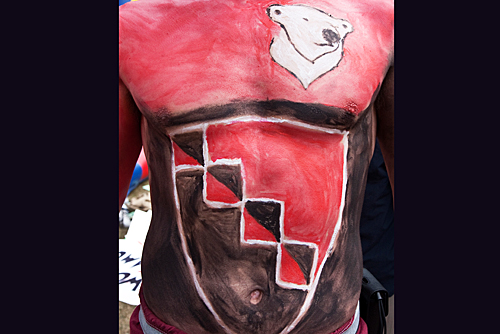
    Blood, sweat, and body paint

    Blood, sweat, and body paint

    Graham Frankel ’12, of Pforzheimer House, forgoes dignity and braves chilly temps in the name of Housing Day.

    Scoring one for Winthrop

    Scoring one for Winthrop

    Famous residents of Winthrop House include John, Joseph, and Edward Kennedy. Here, Daniel Lage ’11 culls from history to heighten the allure of Winthrop House.

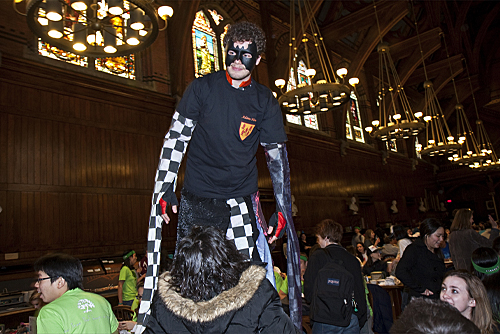
    A tall order

    A tall order

    Max Binder ’10, from Adams House, is on stilts, towering above freshmen inside Annenberg Hall.

    Cheeky wabbit

    Cheeky wabbit

    Lavinia Mitroi ’12 dons ears and Leverett House cheek tattoos.

    Too much information

    Too much information

    Harvard’s most historic House gets freaky with the likes of Kate Leist ’11 (left) and Kellie O’Toole ’11, who make a bold argument.

    Eliot forever

    Eliot forever

    Shouts and signs? This ain’t no political rally. It’s Alfredo Montelongo ’11, and he loves Eliot House.

    Resident bear

    Resident bear

    Body paint just won’t do for Graham Frankel ’12, as he do-si-does for Pforzheimer House with polar bear mascot Cara Sprague ’11.

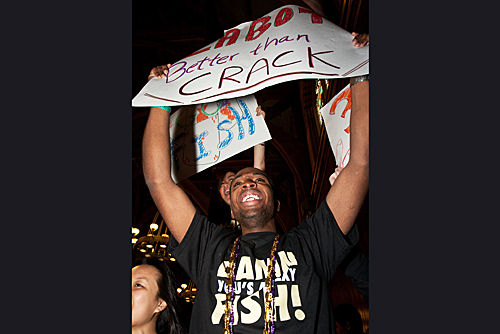
    Better than what?

    Better than what?

    Housing Day is kind of like the Mardi Gras of Harvard. Here, Ebele Anidi ’12 shows his passion for Cabot House, and some New Orleans-style bling.

    Mean green

    Mean green

    Danielle Gram ’11 (left) and Amy Rosenthal ’11 are lucky charms for Currier House.

    House party

    House party

    Life is a breeze at Eliot House, or so this T-shirt suggests.

    Photo slideshow: Housing Day 2010

    Jon Chase/Harvard Staff Photographer

  • HKS seeks grant proposals on Kuwait

    The Harvard Kennedy School (HKS) is now accepting applications for the spring 2010 funding cycle for the Kuwait Program Research Fund. With the support of the Kuwait Foundation for the Advancement of Sciences, an HKS faculty committee will consider applications for one-year grants (up to $30,000) and larger grants for more extensive proposals to support advanced research by Harvard faculty members on issues of critical importance to Kuwait and the Gulf. Grants can be applied toward research assistance, travel, summer salary, and course buyout.

    Priority will be given to the following subjects, although applications will be considered in other areas as well:

    • Technology transfer
    • Water resources and management
    • Oil and petrochemicals
    • Small country security
    • Governance and transparency issues
    • Government subsidies policy
    • Vocational training models
    • Human resources development
    • Applied research, education, and training related to the environment and pollution
    • Public health policy including disease treatment (diabetes) and prevention
    • Financial growth and foreign investment

    In addition, the Kennedy School is seeking more-extensive and ambitious proposals on renewable energy, climate change and its impact on the Gulf, education reform, and financial risk assessment and risk management, and is prepared to provide greater funding over a longer period of time for research in these areas.

    Proposals will be evaluated based on the direct involvement of Harvard faculty, the relevance and transferability of the research to Kuwait and the region, and the quality of the work plan, which should include an outreach component. Collaborative research with Kuwaiti academics and educational institutions is strongly encouraged.

    For inquiries, call 617.495.5963. To apply, submit a research proposal (no more than five pages), budget, other sources of funding, and the curriculum vitae for senior researchers to Director, Middle East Initiative, Harvard Kennedy School, 79 JFK St., Cambridge, MA 02138. The deadline for the receipt of grant applications is April 16, and decisions will be announced by May 14.

  • Around the Schools: Harvard Graduate School of Education

    Harvard University students have launched the first collegiate Sarah Jane Brain Club, to explore issues surrounding pediatric traumatic brain injury, at the Harvard Graduate School of Education.

    “We at Harvard are privileged to launch the first Sarah Jane Brain Club at a university, which will help spread the message and improve the treatment of people with brain damage,” said Professor Kurt Fischer, director of the Mind, Brain, and Education Program at HGSE.

    The club is bringing together students and faculty across Harvard to focus on advancing knowledge of the brain, and supporting the millions of families around the country dealing with brain injuries.

    Launched by Patrick Donahue, a father of a child suffering from Pediatric Traumatic Brain Injury, the Sarah Jane Brain Project focuses on creating a model system for research, rehabilitation, and development of children suffering from brain injuries. Brain injury is the leading cause of death and disability in people from birth to age 25 in the United States. The new Harvard club is open to all students throughout the university.

    — Jill Anderson

    If you have an item for Around the Schools, please e-mail your write-up (150-200 words) to [email protected]

  • Guardian of the House

    You can’t get past the door at Quincy House without getting to know Paul Barksdale. That’s not because the Harvard security guard will stop you, but because the residents likely will, singing his praises.

    Barksdale is a fixture of the House and a welcoming friend to the 500-plus students who call the residence hall home during their sophomore, junior, and senior years at the University. It’s a home made warmer by the light of the man who knows everybody’s name.

    From 4 p.m. to midnight, Barksdale mans the guard desk at the side of the building on Plympton Street, handing out care packages or parcels too big to fit in a small mailbox. He assists students with forgotten keys, lends them the House vacuum cleaner, or helps them locate a lost item. But, perhaps above all, he is a friend.

    Students can’t get through the door without Barksdale getting to know them. Since he started in 2003, he has made a point of memorizing the name, face, and concentration of every incoming sophomore.

    “He knew my name right off the bat,” recalled senior Janet He. “He is so friendly and outgoing. If I am having a bad day, he will still come and ask me how I am doing. … He brings so much happiness to my life at Quincy House.”

    Barksdale occasionally plays matchmaker if he senses there might be an unexpressed interest between two shy undergraduates, and regularly attends the House’s formals, dances, and variety shows.

    Prior to coming to Harvard, Barksdale worked with local homeless shelters, and HIV/AIDS and substance abuse programs, helping to counsel and support those trying to get back on their feet, or cope with a difficult disease. The skills he developed through those experiences, he said, translate to his interactions with students, who so often just need the supportive ear of a friend.

    “Whether someone is marginalized or a wonderful achiever, there is a sense of presence that you want to give a person, that sense of dignity and respect that everyone needs.

    “So often you are powerless to change people’s lives, … but by just being this presence to someone, you can affirm them. I can’t change if an exam didn’t go well, but I can listen.”

    In his spare time, Barksdale is an avid walker and loves to read. His current reading list tends toward the spiritual and includes the religious scholars Thomas Aquinas and John Henry Newman.

    His passion for books is something he shares with his students. On a recent afternoon, he and junior Matt Cavedon compared notes on the memoir of former Quincy House resident and New York Times columnist Ross Douthat. “If I can find my copy at home, I will bring it in for you,” Barksdale told Cavedon with a smile.

    “It must feel good to have that thesis done,” Barksdale quipped to another passing student, senior Ari Hoffman, who recently finished his English literature thesis. A die-hard Yankees fan, Hoffman said some of his happiest memories at Quincy House involve watching baseball games with Barksdale, an ardent Red Sox Fan.

    “Paul has been a real highlight of my time at Quincy House and my college undergraduate career,” said Hoffman, who added that when his Yankees won the World Series Barksdale offered kind congratulations. “It was above and beyond the call of duty.”

    When trying to describe what the job means to him, Barksdale gets emotional.

    He recounted a 2004 conversation with graduating senior David Lippin. Noticing Lippin outside the House early one morning during senior week with a contemplative look on his face, Barksdale stopped to say hello.

    “He said, ‘Paul, I can’t tell you what an honor it has been to be here, to be part of this.’

    “Those were his words, but if you saw his countenance, his face when he was saying this, it tells you about the magic of Harvard,” recalled Barksdale. “Harvard cannot be ensconced in a brand name. Harvard is much bigger than that. It’s this dynamic, living, creative organism that every student and professor is part of. It’s magical, and I think the most important thing is to be grateful to be part of it in any way. That’s what I feel. I feel like it’s an honor to work here, in whatever small role I play.”

  • East Asian Legal Studies announces Yong Kim Memorial Prize for 2010

    The East Asian Legal Studies (EALS) program at Harvard Law School (HLS) is accepting submissions of papers for the Yong K. Kim ’95 Memorial Prize, awarded to the author of the best paper concerning the law or legal history of the nations and peoples of East Asia or concerning issues of law as it pertains to U.S.-East Asia relations.

    The author must also embody Yong Kim’s interest in and enthusiasm for fostering U.S.-East Asian understanding, be planning a career that will further advance this, and have made contributions to EALS while a student. The paper can be written in conjunction with a course, seminar, or independent study project at the HLS. The prize includes a cash award and will be announced at Commencement.

    Submissions (two bound or stapled copies) must be received at the EALS office, Pound Hall, Room 426, Harvard Law School, by 5 p.m. on April 23. The papers must include the student’s name, School, class level, e-mail address, and phone number.

    For questions, contact [email protected].

  • Around the Schools: Faculty of Arts and Sciences

    What do John Keats’ Shakespeare volumes, William Wordsworth’s library catalog, and Victor Hugo’s commonplace book have in common with primers and spellers and other historical materials about learning to read?

    Each item is among the 1,200 books and manuscripts — more than 250,000 Web-accessible pages — that are now online at a site called in Reading: Harvard Views of Readers, Readership, and Reading History. Developed by Harvard’s Open Collections Program with support from the Arcadia Fund, the effort is an online exploration of the intellectual, cultural, and political history of reading as reflected in the historical holdings of Harvard’s libraries.

    “Although reading happens everywhere,” said Robert Darnton, Carl H. Pforzheimer University Professor and director of the University Library, “we don’t know what it is when it takes place under our nose. How do we make sense of typographical marks embedded on a page? How did other people in other times and places decipher signs in other languages? The process of reading lies at the heart of our most intensely human activity, the making of meaning, and therefore deserves study as a crucial element in all civilizations, even those without modern means of communication, where natives learn to read footprints in the sand and clouds in the sky as meaningful portents.”

    You can visit the collection at the Open Collections Program Web site, or read more about the project at Harvard University Library news.

    If you have an item for Around the Schools, please e-mail your write-up (150-200 words) to [email protected].

  • Around the Schools: Harvard Divinity School

    For a week in late January, five Harvard Divinity School students witnessed firsthand the impact of human rights abuses suffered by many Hondurans after a 2009 coup in which Honduran President Manuel Zelaya was ousted by the country’s military.

    Karen Bray, Tiffany Curtis, Garrett Fitzgerald, Julie Rogers, and Marianne Tierney traveled to Honduras with human rights experts and met local leaders to examine and discuss the fragile situation surrounding the ongoing Honduran constitutional crisis.

    Monica Maher, former HDS lecturer and current research fellow of the Harvard University Committee on Human Rights Studies, organized the trip and led a discussion of the group’s findings at an informal presentation in February, held at Harvard’s David Rockefeller Center for Latin American Studies (DRCLAS).

    Tierney said, “Each one of us who went was significantly impacted by this trip. When we came back to school and people asked, ‘How was your trip?’ it was really difficult to put into words. I started saying things like, ‘It was incredible, rejuvenating, inspiring, heartbreaking, intellectually stimulating, exhausting, depressing, amazing.’ Ultimately, it was an extremely powerful experience.”

    If you have an item for Around the Schools, please e-mail your write-up (150-200 words) to [email protected].

  • Running his buns off

    Harvard students are a pretty passionate bunch. The campus is home to a staggering variety of orchestras and dance troupes, political clubs and debate societies, newspapers, and satirical rags. For instance, we just celebrated Housing Day, in which students passionately defend and promote a residence hall into which they were randomly assigned.

    Like other Harvard students, I have my passion. Burgers. I love them. Beef. Turkey. Veggie. Extra pickles. Caramelized onions. Double tomatoes. Hold the mustard. Nothing picks up my day like a well-made burger.

    But the passions that we have for everything from chamber music to Big Macs are not just endearing quirks. They create incredible energy that can be channeled toward other ends. And when you look at certain intractable problems that face American society, these energies seem like a vast potential oil field with no wells, possibly lucrative source of ideas and inspiration that can be leveraged into resources.

    This spring, I’ve teamed up with Citizen Schools and the Harvard Square restaurant b.good burgers to channel my passion for burgers to help kids. Citizen Schools is a nonprofit organization that partners with middle schools to expand the learning day for low-income children across the country. It engages volunteers to share their energy and expertise with middle schoolers who are thirsty for fun, engaging learning projects. Every Thursday, I work with 12 sixth-graders at the Edwards Middle School in Charlestown who are designing an addition to b. good’s menu.

    Teaching a class like this makes you see the power of channeling the energy and passion of citizens to help kids. And that’s why I’ve started a movement to inspire others to do the same. That’s why I’ve become Burgerman.

    You see, in addition to burgers, I also love running. Having experienced the power of channeling my love for burgers to help kids, I wanted to tap into my passion for running as well. And wouldn’t it be doubly powerful, I thought, if I tapped into both of these passions at the same time?

    On April 19, Burgerman will run the Boston Marathon in a burger suit to raise $100,000 for Citizen Schools.

    The campaign seems improbable? How can a 22-year-old from Baltimore come up with $100,000?

    The answer comes in the words of Robert F. Kennedy: “Each time a man stands up for an ideal, or acts to improve the lot of others, or strikes out against injustice, he sends forth a tiny ripple of hope, and crossing each other from a million different centers of energy and daring, those ripples build a current which can sweep down the mightiest walls.”

    These ripples are already starting to spread. Christi Morrissey, a senior from Hawaii, has signed up to run the marathon in a fry suit and raise $10,000 by mobilizing Delta Gamma sorority chapters around the country. The Harvard Outing Club has engaged national chains REI and L.L. Bean to donate a bike and a boat to be raffled off among outing clubs throughout New England.

    Sehe Han, a high school senior in Duluth, Ga., heard about our movement on Facebook from a post by her high school friend. She will tap into her passion for music and hold a concert in April to raise funds.

    What are you passionate about? I am challenging you to channel that passion and energy to help inspire middle school students and your fellow citizens.

    If you’d like to learn more, send me an e-mail at [email protected], or visit the Burgerman site.

    When people get together, they can access the greatest untapped resource to aid education in America: the energy of American citizens.

    If you’re an undergraduate or graduate student and have an essay to share about life at Harvard, please e-mail your ideas to Jim Concannon, the Gazette’s news editor, at [email protected].

  • David Armitage named Royal Society of Edinburgh corresponding fellow

    David Armitage, the Lloyd C. Blankfein Professor of History at Harvard, has been elected a corresponding fellow of the Royal Society of Edinburgh, Scotland’s national academy of science and letters.

    Established in 1783 under a charter granted by King George III for the “advancement of learning and useful knowledge in Scotland,” one of the organization’s founding members was Adam Smith. Membership has since included Walter Scott (past president), William Wordsworth, James Hutton, Charles Darwin, John Logie Baird, James Clark Maxwell, Niels Bohr, and Francis Crick.

    The society currently has nearly 1,500 living fellows; among its other current fellows from Harvard are Bernard Bailyn, Michael E. Porter, Amartya Sen, and E.O. Wilson.

  • Playing on our instincts

    Researchers have long known that lab animals’ behavior can be manipulated by artificially stimulating their natural instincts. Over-stimulating animals can provoke such extreme responses that they end up preferring artificial objects to the natural ones for which the instincts were designed.

    Humans living in modern society are something like those lab animals, a Harvard psychology professor says. Like them, our innate instincts are overstimulated by unnatural products, as well as by advertising and images. And, like them, we respond almost unconsciously: reaching for more food, Web-surfing for porn, dumping time and money on “cute” toys, sitting for hours in front of televisions, and sending troops to fight a dehumanized “them.”

    The difference between lab animals and us, however, is that overstimulation for animals isn’t present in nature. It can really only be found in the laboratory. If an animal escapes to its natural environment, it will return to natural stimuli and responses. For people, however, because we live in an artificial world of our own making, escaping those stimuli is not so easy.

    But Deirdre Barrett, assistant clinical professor of psychology in Harvard Medical School’s Psychiatry Department, says that doesn’t mean there’s no hope for us.

    Barrett, author of the new book “Supernormal Stimuli: How Primal Urges Overran Their Evolutionary Purpose,” says the first step is to understand what’s happening to us. Instincts and urges honed for hundreds of thousands of years to keep us alive in a world of scarcity are being subverted in the modern era of plenty. People are bombarded by food that they crave, tempted by seductive images, and urged to buy products designed to appeal to specific wants, regardless of need.

    In her book, Barrett examines the history of research into supernormal stimuli, describing early behavioral experiments on birds and fish. In one, birds whose eggs were lightly speckled fell off as they tried to incubate ridiculously large, boldly polka-dotted fakes. In another, red-bellied male fish fought off artificial red-painted lures even when they didn’t look much like fish.

    These outsized prods to normal instincts are called “supernormal stimuli,” and Barrett believes they’re present in our world today, sometimes quite intentionally, prodding us to buy and consume and do. It’s an easy sell, in many cases, because the stimuli give us a push to do things we’re already inclined toward.

    Pornography, she said, subverts instincts intended for mating with people. Stuffed animals, dolls, and cartoon characters manipulate people’s preprogrammed affinity for childlike “cuteness.” She also looks at obesity, war, business, television, and even intellectual pursuits.

    Though supernormal stimuli are not universally related to problems, Barrett said many of the episodes in her book do fall into that category. Understanding ourselves and the reasons we feel as we do, Barrett said, is the first step in overriding our instincts, in our being able to resist the siren song of the Big Mac.

    She also recommended new government regulation to help limit supernormal stimuli, particularly in areas where public health may be at risk, and to “put normal back into our lives.” It might be easier to eat healthier foods, she said, if we lived in a food environment where we weren’t blasted by ads for “supernormal foods.”

  • Two from Harvard honored for research in biological sciences

    Erez Lieberman-Aiden, a Ph.D. candidate in the Department of Applied Mathematics in the Harvard-MIT Division of Health Sciences and Technology, and Mamta Tahiliani, a research fellow in pathology at Harvard Medical School who received her Ph.D. in immunology from Harvard in 2009, are two of 13 graduate students from institutes throughout North America who have been chosen to receive the 2010 Harold M. Weintraub Graduate Student Award, sponsored by the Basic Sciences Division of the Fred Hutchinson Cancer Research Center.

    The awards, given in recognition of outstanding achievement during graduate studies in the biological sciences, are presented on the basis of the quality, originality, and significance of students’ work.

    Lieberman-Aiden and Tahiliani will participate in a scientific symposium along with the other winners on May 7 at the Hutchinson Center in Seattle. The symposium will include scientific presentations by all awardees as well as poster presentations by Hutchinson Center graduate students.

    The award, established in 2000, honors the late Harold M. Weintraub, a founding member of the center’s Basic Sciences Division, who in 1995 died from brain cancer at age 49.

  • Dana-Farber calls for artists

    The Dana-Farber Cancer Institute is looking for artists to help create its 2010 collection of holiday cards and candle wraps.

    In the past, designs have featured scenes from New England, including New England Patriots and Boston Red Sox-themed artwork. All proceeds from the collection sales will go toward the support of adult and pediatric cancer care, benefiting Dana-Farber through the Jimmy Fund.

    Designs should be e-mailed in JPEG format to [email protected] and include the artist’s name, e-mail address, and phone number. For questions, call Suzanne Crane at 617.632.5344. The deadline for submissions is April 16. Artists will be notified by early May if their designs are selected.

  • Memorial service scheduled for James Stemble Duesenberry April 8

    A service in memory of James Stemble Duesenberry, the William Joseph Maier Professor of Money and Banking Emeritus, will take place at the Memorial Church on April 8 at 2 p.m. A reception will follow at Loeb House at 17 Quincy St. All are welcome to attend.

    Duesenberry, who died Oct. 5, 2009, was an authority on monetary policy and served as a member of the President’s Council of Economic Advisers under Lyndon B. Johnson from 1966 to 1968. He was also the chair of the Department of Economics at Harvard from 1972 to 1977.

  • Former director of computer services, Lewis Law dies, at 77

    Lewis (Lew) Law, 77, former director of computer services for the Faculty of Arts and Sciences (FAS), died in Belmont on Feb. 14 after suffering from Alzheimer’s disease for many years.

    Law was born and educated in England, graduating with a B.Sc. in physics from the University of Birmingham in 1953. After working with the British Civil Service in Malvern for five years, he and his wife, Margaret, whom he had married in 1957, decided to explore the other side of the Atlantic. Initially, they spent two years in Hamilton, Ontario, where Law worked on radar systems for Canadian Westinghouse. In January 1961, the two moved to Cambridge, Mass., intending to stay two more years. Those two years quickly turned into 49.

    Upon moving to Cambridge, Law joined the staff of the Cambridge Electron Accelerator, a joint Harvard-Massachusetts Institute of Technology project. In 1963, he was made head of the electronics group, working on projects to keep the accelerator competitive with new technology.

    In 1972, Law received a master’s degree in electrical engineering from Northeastern University, and a year later he became director of technical services in the newly built Harvard University Science Center, turning it into a working building for lectures, laboratories, and classrooms.

    During the early 1970s, Law became increasingly involved with computer hardware. Along with assistant professor of computer science Chuck Prenner, he introduced the then very new UNIX operating system to Harvard, making the University one of the first places to use the system outside of Bell Laboratories, where it had been developed as an in-house system. He was also one of the five founding members of USENIX, the UNIX users group, which is now a nationwide organization. He was a valued member of the USENIX board until 1986.

    In 1975, Law was instrumental in initiating the first undergraduate time-sharing system at Harvard. This system, which allows more than one user to use a computer system from multiple terminals, it was based on a PDP-11/45 machine, with 10 teletype machines used as terminals. This system was the forerunner of today’s extensive operation in FAS. When the drive to network computers began, he was involved in the creation of FASNET, a network that included the Science Center, most of the Harvard science departments, and the Harvard Law School. This network enabled students to work with their instructors online and heralded the introduction of e-mail to FAS.

    By 1977, Law was made associate director of the Science Center and in 1984 the title changed to director of computer operations for FAS. In 1988, the position was upgraded to director of computer services. Law retired in 1992.

    Outside of Harvard, Law’s avocations were sailing, both dinghy racing and large boat cruising, skiing, and skating.

    He is survived by his wife of 52 years, Margaret, two sisters and a brother, in England.

  • Buddhism on the dinner plate

    You’ve heard the old saying: Anything’s possible if you set your mind to it.

    Mindfulness, the Buddhist principle of being fully aware of the present, is at the heart of Lilian Cheung’s collaborative book “Savor: Mindful Eating, Mindful Life,” written with Thich Nhat Hanh, a renowned Buddhist monk and author of “Peace Is Every Step: The Path of Mindfulness in Everyday Life.”

    According to “Savor,” the practice of mindfulness is an essential tool in ending weight loss struggles for good.

    “A lot of us know that we should be eating healthily and exercising to maintain our well-being, but somehow we cannot sustain our effort,” said Cheung, a nutritionist at the Harvard School of Public Health. “To control our weight, we also need to first understand who we are, how and why we arrive at this circumstance, and how we relate to food. Buddhist teachings on mindfulness help us better understand our true nature: our body, our feelings, our mind, and all that is around us.”

    Cheung met Nhat Hanh — whom The New York Times considered “second only to the Dalai Lama” among the most influential Buddhist leaders in the West — in 1997 at one of his retreats. “As he was explaining the Buddhist perspective on nutriments to the attendees … I realized that I had the missing pieces to complement what I had learned from nutrition science about the difficulties people face in changing their food consumption and lifestyle habits,” she recalled.

    Then and there, Cheung scribbled down in her notebook the idea for a book that has now come to fruition. She showed Nhat Hanh an outline of the book in 2005, when she asked him to co-author it. “To my amazement, he said, ‘Why not?’ ”

    Cheung and Nhat Hanh encourage mindfulness practice — being present in everything that we do — as a way to cultivate awareness of our eating and activity habits, and ultimately uproot undesirable habits to improve our health. It may sound difficult, but they show in fact how easy it is to incorporate mindfulness practice in our daily routines. We can breathe, walk, listen, cook, and eat mindfully.

    “When you sit down to eat a truly mindful meal, you will see far beyond the rim of the plate,” said Cheung. “Look closely at your salad, and you will see the farmer who planted the seeds, the rain and sunshine, the rich earth that nourished them as they grew. Mindful eating can help us approach the core Buddhist concept of ‘interbeing,’ the recognition that everything and everyone is interrelated. With this as our foundation, we realize that it is important to eat not only for our own health, but in a way that promotes the health of others around us, as well as the health of the planet.

    “Our appointment with life is in the here and now, where we have the opportunity to transform our being. We need to learn to stop and look at what is in front of us,” said Cheung. “It is in engaging the present moment that we can change, while finding peace and happiness.”