Author: Heritage

  • Patrick Henry?s Fight for Liberty

    On 03.23.10 02:30 PM posted by Matt Spalding

    In light of this week’s events, many Americans are frustrated and disheartened. But we should take heart. Today marks the 235th anniversary of Patrick Henry’s famous speech, when he proclaimed “Give me liberty, or give me death.” This sentiment represents a legacy much older and nobler than tyrannical healthcare legislation and should inspire our efforts to restore liberty.

    Some may know the story; I tell it in the first pages of my book, <ahref="http://www.westillholdthesetruths.org">We Still Hold These Truths.* It was 1775. Patrick Henry, a young backcountry lawyer, rose before a gathering of Virginia state legislators. He encouraged his countrymen to prepare for war against Great Britain – little did they know, the fighting would begin in a month’s time.

    Henry crafted one of the most convincing and impassioned speeches of the revolution. “We have done everything that could be done to avert the storm which is now coming on,” he argued in building to the close of his close of his address. “The next gale that sweeps from the north will bring to our ears the clash of resounding arms! Our brethren are already in the field! Why stand here idle? What is it that gentlemen wish? What would they have?”

    “Is life so dear, or peace so sweet,” he cried, “as to be purchased at the price of chains and slavery?” Henry raised his hands, crossed at the wrists, as though he were bound. “Forbid it, Almighty God!”

    “I know not what course others may take,” he calmly professed then he paused. Slowly, deliberately, and in a firm voice, Henry concluded to the hushed audience, “But as for me, give me liberty, or give me death!”

    Americans should remember his courage and strive to revive our commitment to liberty and self-government.

    http://blog.heritage.org/2010/03/23/…t-for-liberty/

  • The Most Clear-Cut Choice Imaginable: Save the D.C. Opportunity Scholarship Program

    On 03.23.10 03:00 PM posted by Lindsey Burke

    </p>The Washington Post today <ahref="http://www.washingtonpost.com/wp-dyn/content/article/2010/03/22/AR2010032203468.html">calls on D.C. Mayor Adrian Fenty to take a stand on the embattled D.C. Opportunity Scholarship Program.

    PARENTS LOVE IT. Students benefit from it. But neither the White House nor most Democrats in Congress had the backbone to support a unique program that provides vouchers to low-income D.C. families in search of better educational opportunities. Now the question is whether D.C. Mayor Adrian M. Fenty (D) — who has made education his priority — has the guts his party leaders lack and will seek to save this worthy program…

    The animus toward this tiny, clearly successful program is not grounded in logic. ‘The real goal of education,’ Ms. [Dianne] Feinstein said, sensibly enough, ‘ought to be to provide a number of different choices for youngsters so you can see where they learn best and then enable them to be in that situation.’ That’s supposed to be the philosophy of Mr. Obama’s Education Department, too, which purports to want to reward programs that work…‘What is everybody scared of?’ Ms. Feinstein asked. Sadly, the answer is no secret: Teachers unions have an outsized influence on the Democratic Party. The unions fear that if objective analysis rather than political muscle is allowed to shape education policy, traditional public schools that are more frequently union shops would lose out. Only the children would be better off…

    No doubt Mr. Fenty is being counseled on the political dangers of going where President Obama and Sen. Richard J. Durbin (D-Ill.), among others, fear to tread. Such arguments have never stood in his way when it comes to promoting school change. We hope he gives serious thought to stepping up one more time.<spanid="more-29594"></span>

    The Post editorial builds on <ahref="http://www.washingtonpost.com/wp-dyn/content/article/2010/03/19/AR2010031903679.html">a piece by George Will on Sunday, also in support of the Opportunity Scholarship Program. Will writes:

    Duncan seems to fancy himself an Earl Warren, expanding civil rights. Actually, he resembles Mrs. Jellyby.

    While his lawyers seek evidence of displeasing enrollments in AP courses, he is complicit in strangling the scholarship program that enables 1,300 District of Columbia low-income minority students to escape from the District’s execrable schools. Like Mrs. Jellyby in Dickens’ “Bleak House,” who was indifferent to her chaotic family while fretting about conditions in distant Borrioboola-Gha, Duncan practices what Dickens called “telescopic philanthropy.” Sensitive about supposed injustices in distant AP classes, Duncan is worse than merely indifferent to children within sight of his office at the foot of Capitol Hill.

    http://blog.heritage.org/2010/03/23/…rship-program/

  • Morning Bell: Congress vs. The American People

    On 03.23.10 05:30 AM posted by Conn Carroll

    Another day, two new polls showing the American people are strongly against the health care plan President Barack Obama will sign into law today. According to CNN, 59% of Americans oppose President Obama’s plan. And according to CBS News, 48% of Americans oppose the plan (with 33% in strong opposition) compared to only 37% who support it (with only 13% in strong support). Digging deeper into the CBS poll, we find that 76% of Americans disapprove of how Congress is handling its job on health care, 46% think Congress has spent too much time on health care, and 49% believe the rules and procedures used in Congress to get the current health care bill passed have been mostly unfair.

    But the leftist majorities in Congress just do not care what the American people think. Today, the Senate will press forward with work on the proposed “fix-it” bill through the reconciliation process. You may have thought it was impossible to make the policy and process of Obamacare even worse, but that is exactly what this reconciliation bill does:

    Abuse of Process: According to the Congressional Research Service, 19 reconciliation measures have been enacted into law since the procedure’s first use in the Carter administration. The record shows that reconciliation has been used for virtually all imaginable scenarios — save one: There is no precedent for using it to enact a once-in-a-generation rewrite of the relationship between Americans and their government that appeals exclusively to one side of the aisle. But that is exactly what Majority Leader Harry Reid (D-NV) is attempting to do. According to the latest NBC News/Wall Street Journal poll, a plurality of the American people strongly oppose this procedural tactic for this highly unpopular policy.

    Even Higher Deficits: According to the Congressional Budget Office, new entitlement spending in the reconciliation bill would cost $216 billion in 2019 alone and will increase by 8% every year after that. Now, the Democrats will tell you that the CBO has also said their plan raises enough taxes and cuts enough Medicare to pay for this gigantic new entitlement. But the CBO is obligated by law to believe whatever Congress tells them. The American people are not. According to the latest NBC/WSJ poll, 76% of the American people do not trust Congress. That is why, according to the latest CNN poll, 70% of the American people believe Obamacare will cause the federal budget deficit to go up.

    Even Higher Taxes on Business: As bad as the employer mandates in the Senate health bill were, the taxes on businesses in the reconciliation bill are even worse. Companies that hire certain low-income Americans will have to pay $3,000 per employee, per year, even if the company offers insurance. And companies that employ 50 or more workers will face higher tax penalties to the tune of $2,000 per full-time employee.

    New Taxes on Investments: Investment is what creates job growth. One would think at a time of 9.7% unemployment, the government would not want to increase taxes on investment. Not this leftist government. The reconciliation bill slaps a 3.8% tax on investment income.

    Cornhusker Kickbacks for All: You may have heard that the reconciliation bill “got rid of” the Cornhusker Kickback. That is not quite true. What it really did is extend the additional Medicaid funding Nebraska got to every state. But to keep the new entitlement spending deficit neutral, the new Medicaid funding creates a fiscal time bomb for states by vastly cutting Medicaid reimbursements in 2015. This reconciliation will only further strain already bankrupt state governments.

    A Government Takeover Preview: Sen. Ben Nelson (D-NE) has already announced he will vote against the reconciliation bill because of the government takeover of the student loan industry that Democrats tacked onto the health care bill in order to help pay for the new entitlement. The student loan debacle is unfortunately just a preview of the direction the left wants to see health care go. The government first justified subsidizing student loans in the Clinton administration by saying it would make college more affordable. The opposite happened. College costs have only skyrocketed, just like health care costs will only sky rocket under this bill. So now this reconciliation bill is completely nationalizing the student loan industry. Unless the direction of health care policy changes, our health care sector will not be far behind.

    Quick Hits:

    http://blog.heritage.org/2010/03/23/…erican-people/

  • Reagan Missile Defense Speech Matters More than Ever

    On 03.23.10 06:00 AM posted by James Carafano

    Twenty seven years ago President Ronald Reagan delivered one of the most important speeches in modern history. For almost five decades, Americans had lived under the threat of nuclear war. The arms race had become a stand-off between the superpowers called mutually-assured-destruction, where any nuclear exchange would likely evolve into a full-scale atomic war annihilating the East and the West. President Reagan believed that this was an immoral way to maintain an uneasy peace if there was a more responsible and proportional alternative. On March 23, 1983 he announced that there was. The president concluded that not only were missile defenses feasible, but that they would lessen the threat of nuclear war.

    History proved Reagan right on both counts.

    The mere suggestion of deploying what President Reagan called the Strategic Defense Initiative (SDI) brought the Soviet to the negotiating table and resulted in the largest reduction of nuclear arms in history. And though, his proposal was denounced by detractors as science-fiction “Star Wars,” in the last decade, the United States has demonstrated that it can build missile defenses capable of destroying enemy weapons in flight before they can result in harm to anyone.

    Yet, despite being on the right side of history, Reagan’s vision has not fully been realized—and it is needed more than ever. Countries like Iran and North Korea are actively seeking to build nuclear-tipped intercontinental ballistic missile forces. And, they are not the only dangers. Their arsenals and aggressive atomic diplomacy may prompt other powers to develop nuclear programs, resulting in a new global arms race. Additionally, both Iran and North Korea are known proliferators of weapons material and technology. For all these reasons, missile defense is more important than ever.

    The Heritage Foundation, which sponsored the 1982 High Frontier study (which first made the case that missile defenses were essential and achievable), has long worked to help realize President Reagan’s vision of eliminating the threat of nuclear missile attack forever, by rendering this threat obsolete. Today, the foundation remains on the fore front of public policy research on the vital issue, including producing the groundbreaking documentary 33 Minutes. The film makes the case that the Congress and American people should demand that our government “finish the job,” build robust, comprehensive missile defenses now—not just to defeat existing threats but to preempt America’s enemies from ever believing that could hold the lives of Americans hostage with the menace of nuclear attack.

    On this day, it is worth stopping to recall Reagan’s monumental vision and to ask—why isn’t Washington doing everything possible to make it a reality?

    http://blog.heritage.org/2010/03/23/…ore-than-ever/

  • Senate Financial Regulation Bill: How Fast Can You Read 1,336 Pages?

    On 03.22.10 07:48 AM posted by David John

    At 1,336 pages, the Dodd financial services regulation bill proposal, which the Senate Banking Committee will begin to consider today, includes language that could create a permanent bank bailout. It is also filled with other significant issues, any one of which could cause serious damage to the economy or consumers by allowing bureaucrats to micromanage financial services firms and require than to meet political priorities. Unfortunately, Sen. Dodd says that he wants the Senate Banking Committee to rush through the bill this week and then to send it to the Senate floor for equally swift passage. This is completely the wrong approach to this issue.

    As with any long and complex financial regulatory bill, Dodd’s bill should be closely and thoroughly reviewed before it is voted upon in committee or on the Senate floor. Regardless of whether the bill is approved, anything less than careful examination is almost certain to have unintended consequences due to innocent drafting errors, poorly described policy decisions, or just plain bad policy. Rather than acting in haste and repenting at leisure, the Senate should carefully examine each and every section of the Dodd bill before taking any votes. Rhetoric can be a powerful motivator in politics, but quick action on all but the simplest areas almost always results in bad decisions that can have lasting effects.

    http://blog.heritage.org/2010/03/22/…ad-1336-pages/

  • Video of the Week: Sharpton Says American People Voted for Socialism When They Electe

    On 03.22.10 08:00 AM posted by Brandon Stewart

    </p>After the health care vote last night, Reverend Al Sharpton told Fox News:* “I think that this began the transforming of the country where the President had promised. This is what he ran on.” When the interviewer interjected that many view the vote as a step towards socialism, Sharpton didn’t skip a beat, responding:

    the American public overwhelmingly voted for socialism when they elected President Obama.<spanid="more-29423"></span>

  • Outside the Beltway: State AGs Start the Road to Repealing Obamacare

    On 03.22.10 08:30 AM posted by Mike Brownfield

    <ahref="http://blog.heritage.org/wp-content/uploads/constitution0312101.jpg"></p>As liberal groups begin <ahref="http://www.politico.com/news/stories/0310/34785.html">plotting to spend millions of dollars to “sell” Obamacare to Americans in swing House districts, at least 12 state attorneys general are mounting an effort to stop Obamacare in its tracks on constitutional grounds.

    At issue is the provision in Obamacare that forces Americans to buy health insurance or face an annual $750 fine. <ahref="http://www2.timesdispatch.com/rtd/news/state_regional/state_regional_govtpolitics/article/HEAL221S1_20100322-000603/332103/">Richmond Times-Dispatch reports that Virginia Attorney General Ken Cuccinelli plans to sue the federal government on grounds that the mandate violates the Commerce Clause of the U.S. Constitution:

    “At no time in our history has the government mandated its citizens buy a good or service,” Cuccinelli said.

    <spanid="more-29441"></span>Separately, attorneys general in 11 other states – Florida, South Carolina, Nebraska, Texas, Utah, Pennsylvania, Washington, North Dakota, South Dakota, Alabama and Michigan – plan to join together in filing a lawsuit as soon as President Barack Obama signs the legislation into law, according to a <ahref="http://www.bizjournals.com/jacksonville/stories/2010/03/22/daily2.html">Jacksonville Business Journal and <ahref="http://www.miamiherald.com/2010/03/22/1541623/republican-ag-cox-joins-challenge.html">Associated Press reports.

    In a press conference this morning, <ahref="http://www.bizjournals.com/jacksonville/stories/2010/03/22/daily2.html">Florida Attorney General Bill McCollum said, “To fine or tax someone just for living … that’s unconstitutional. There is no provision in the Constitution giving Congress the power to do that.”

    South Carolina Attorney General <ahref="http://www.csmonitor.com/USA/Justice/2010/0322/Attorneys-general-in-12-states-poised-to-challenge-healthcare-bill">Henry McMaster said Sunday: “The health care legislation Congress passed tonight is an assault against the Constitution … A legal challenge by the states appears to be the only hope of protecting the American people from this unprecedented attack on our system of government.”

    The Heritage Foundation’s legal scholars <ahref="http://www.heritage.org/Research/Reports/2009/12/Why-the-Personal-Mandate-to-Buy-Health-Insurance-Is-Unprecedented-and-Unconstitutional">have documented why an individual mandate violates the U.S. Constitution, noting, “Nowhere in the Constitution is Congress given the power to mandate that an individual enter into a contract with a private party or purchase a good or service.”

    That fact, however, did not stop Congress from acting outside its authority. Now, it seems, states are taking up arms to defend the tenets of our Constitution that Congress has been so quick to ignore.

    http://blog.heritage.org/2010/03/22/…oad-to-repeal/

  • Intolerable Acts and Tea Parties

    On 03.22.10 09:00 AM posted by Matt Spalding

    <ahref="http://blog.heritage.org/wp-content/uploads/Tea-Party.jpg"></p>In 1774, in response to the first Tea Party, the British Parliament issued a series of acts designed to control the colonists, stop their protests and restrict their liberty. The American colonists called them “The Intolerable Acts.”
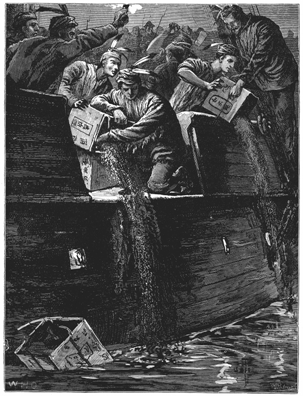
    What we have all just witnessed in <ahref="http://www.nytimes.com/2010/03/22/health/policy/22assess.html?partner=rssnyt&emc=rss">the debate over health care reform, in substance and in process violates our first principles, takes away our independence and undermines the very rule of law. If left standing, this law places us evermore firmly on the course of becoming a heavily centralized European-style nation, stifled by government run health care and ruled more by bureaucrats than elected legislatures. This is not “progress” but the revival of a failed, undemocratic, and illiberal form of statism.

    These acts are intolerable.

    In 1763, with the British victory over France in the Seven Years’ War (which began in North America as the French and Indian War), Great Britain controlled—in addition to the thirteen American colonies— New France (Canada), Spanish Florida, and all the lands east of the Mississippi River. It also had massive debts, incurred in large part in the defense of that empire, and so the English Parliament looked for the first time to the American colonies as a source of revenue.<spanid="more-29446"></span>

    The American Revenue Act (sometimes called the Sugar Act) expanded various import and export duties and created additional courts and collection mechanisms to strictly enforce trade laws. Then parliament went a step further and passed the first direct tax levied on America, requiring all newspapers, almanacs, pamphlets, and official documents—even decks of playing cards!—to have stamps (hence it was called the Stamp Act, which was passed 245 years ago today, March 22nd) to show payment of taxes.

    The colonists—who by this point were very used to their independence and Britain’s benign oversight of their affairs—were none too pleased with the new imperial policies. Colonial merchants instinctively began a movement to boycott British goods, and a new group called the Sons of Liberty was formed to foment and organize opposition. Several legislatures called for united action, and nine colonies sent delegates to a Stamp Act Congress in New York in October 1765.

    The American Revolution began as a tax revolt. But it is important to understand from the start that the debate was never really over the amount of taxation (the taxes were actually quite low) but the process by which the British government imposed and enforced these taxes. As loyal colonists, the Americans had long recognized parliament’s authority to legislate for the empire generally, as with colonial trade, but they had always maintained that the power to tax was a legislative power reserved to their own assemblies rather than a distant legislature in London. You’ll remember their slogan: no taxation without representation.

    In making this argument, the colonials were objecting to being deprived of an important historic right: The English Bill of Rights of 1689 had forbidden the imposition of taxes without legislative consent, and since the colonists had no representation in parliament they complained that the taxes violated their traditional rights.

    The British ended up repealing the tax, but in the Declaratory Act of 1766 they flatly rejected the Americans’ general argument by asserting that parliament was absolutely sovereign and retained full power to make laws for the colonies “in all cases whatsoever.” To the British, “no taxation without representation” was indeed a well-established right, but it was understood to mean no taxation without the approval of the British Parliament. And, they argued, it never literally meant—not for the Americans and not even for the overwhelming majority of British citizens—representation in that body. The colonists, like all British subjects, enjoyed “virtual representation” of their interests by the aristocrats that voted in and controlled parliament.

    To the Americans, this was as absurd as it was unacceptable. Their commonsense notion of consent required actual representation—elected representatives of the governed making laws. So the declaration of the Stamp Act Congress—the first statement of the united colonies—argues that because the colonists were “entitled to all the inherent rights and privileges of his natural born subjects within the kingdom of Great Britain,” no taxes could be imposed without colonial consent. And since as a practical matter they couldn’t participate in a parliament thousands of miles away, the Americans concluded that this authority could only be vested in their local legislatures.

    In 1767, the British government passed a new series of revenue measures (called the Townshend Acts) which placed import duties (external taxes) on a number of essential goods including paper, glass, lead, and tea—and once again affirmed the power of British courts to issue undefined and open-ended search warrants (called “writs of assistance”) to enforce the law. Asserting that the sole right of taxation was with the colonial legislature, Virginia proposed a formal agreement among the colonies banning the importation of British goods—a practice that quickly spread to the other local legislatures and cut the colonial import of British goods in half. So parliament eventually repealed those duties, too, except—in order to maintain the principle that it could impose any taxes it wished—for the tax on tea.

    It was at Boston in the spring of 1770 that, tensions running high, British soldiers fired on a large crowd of protesters, wounding eleven colonials and killing five. The Boston Massacre, as it was quickly called, marked the final downturn in the relationship between Britain and the American colonies. By late 1772, Samuel Adams and others were creating new Committees of Correspondence that would link together patriot groups in all thirteen colonies and eventually provide the framework for a new government. They would soon form Committees of Safety as well to oversee the local militias and the volunteers who had begun calling themselves Minutemen.

    In December 1773, a group of colonists disguised as Indians boarded ships of several British merchants and in protest of British colonial policies dumped overboard an estimated £10,000 worth of tea in Boston Harbor. “The die is cast,” reported John Adams. “The people have passed the river and cut away the bridge. Last night three cargoes of tea were emptied into the harbor. This is the grandest event which has ever yet happened since the controversy with Britain opened.”

    The British government responded harshly by punishing Massachusetts— closing Boston Harbor, virtually dissolving the Massachusetts Charter, taking control of colonial courts and restricting town meetings, and allowing British troops to be quartered in any home or private building. Richard Henry Lee wrote that these laws were “a most wicked system for destroying the liberty of America.” The American colonists, outraged by these violations of their first principles, their basic rights and the rule of law itself, called them what they were: Intolerable Acts.

    In response to these acts, the various Committees of Correspondence banded together and planned a congress of all the colonies to meet in Philadelphia in September 1774. This united resistance gave rise to the Declaration of Independence and, later, to the United States Constitution.

    Is it possible that Americans are waking up to the modern state’s long train of abuses and usurpations?

    There is something about a nation grounded on principles. Most of the time, American politics is about local issues and those policy questions that top the national agenda. But once in a while, politics is about voters stepping back and taking the longer view based on the fundamental principles of the regime.

    The opportunity and the challenge for those that seek to conserve America’s liberating principles is to turn the healthy public sentiment of the moment, which stands against the Left’s agenda of the unlimited state, into a settled and enduring political opinion about the nature and purpose of American constitutional government.
    Only with this sure foundation can we go forward as a nation, addressing the great policy questions before us and continuing to secure the blessings of liberty.

    http://blog.heritage.org/2010/03/22/…d-tea-parties/

  • Senate Health Care Timeline

    On 03.22.10 09:30 AM posted by Conn Carroll

    Obamacare is still just one signature away from becoming law, but the <ahref="http://blog.heritage.org/2010/03/22/morning-bell-repeal/">battle over its repeal has <ahref="http://blog.heritage.org/2010/03/22/outside-the-beltway-state-ags-start-the-road-to-repeal/">already begun.* Key to this debate will be which elements of Obamacare phase in when. Back in December after Obamacare first passed the Senate, Heritage Foundation scholar Robert Book* produced the following <ahref="../wp-content/uploads/2009/12/timeline_chart.pdf">chart (pdf) detailing how the policy is scheduled to be implemented between 2010 and 2017. Highlights from each year include:

    2010: Physician Medicare payments decrease 21% effective March 1, 2010

    2011: “Annual Fee” tax on health insurance, allocated according to share of total premiums. Begins at $2 billion in 2011, then increases to $4 billion in 2012, $7 billion in 2013, $9 billion in the years 2014, 2015, and 2016, and eventually $10 billion for 2017 and every year thereafter. Two insurers in Nebraska and one in Michigan are exempt from this tax.

    2012: Medicare payment penalties for hospitals with the highest readmission rates for selected conditions.

    2013: Medicare tax increased from 2.9% to 3.8% for incomes over $250,000 (joint filers) or $200,000 (all others). (This is stated as an increase of 0.9 percentage points, to only the employee’s share of the FICA tax.)<spanid="more-29459"></span>

    2014: Individual mandate begins: Tax penalties for not having insurance begin at $95 or 0.5% of income, whichever is higher, rising to $495 or 1% of income in 2015 and $750 or 2% of income thereafter (indexed for inflation after 2016). These penalties are per adult, half that amount per child, to a maximum of three times the per-adult amount per family. The penalty is capped at the national average premium for the “bronze” plan.

    2015: Establishment of Independent Medicare Advisory Board (IMAB) to recommend cuts in Medicare benefits; these cuts will go into effect automatically unless Congress passes, and the President signs, an override bill.

    2016: Individual mandate penalty rises to $750 per adult ($375 per child), maximum $2,250 per family, or 2% of family income, whichever is higher (capped at the national average premium for the “bronze” plan). After 2016, the penalty will be increased each year to adjust for inflation.

    2017: Itemized deduction for out-of-pocket medical expenses is limited to expenses over 10% of AGI for those over age 65.

    http://blog.heritage.org/2010/03/22/…re-timeline-2/

  • New CNN Poll: 59% Oppose Obamacare

    On 03.22.10 09:39 AM posted by Rob Bluey

    <ahref="http://blog.heritage.org/wp-content/uploads/2009/09/9-12protest4.jpg"></p>A new <ahref="http://i2.cdn.turner.com/cnn/2010/images/03/22/rel5a.pdf">CNN Opinion Research poll, conducted over the weekend as the House debated Obamacare, finds that 59 percent of Americans now stand opposed to the health care legislation in Congress. Just 39 percent of the poll’s 1,030 respondents said they favored the bill.

    These numbers shouldn’t come as a surprise — even to the White House. In fact, <ahref="http://www.washingtonpost.com/wp-dyn/content/article/2010/03/21/AR2010032103130_2.html?sid=ST2010032100955">The Washington Post reported this morning that “President Obama is set to begin an immediate public relations blitz aimed at turning around Americans’ opinion of the health-care bill.” The White House plan will be both a short-term strategy to shore up political supporters of the legislation and a long-term effort to bolster Obama’s legacy.<spanid="more-29466"></span>

    Reshaping the legislation’s image will take place in three phases, White House aides said: the immediate aftermath; the seven months until the November midterm elections; and the several years that follow, during which many provisions in the measure will gradually take effect.

    Of course, given the findings of the CNN poll, the White House has it’s work cut out. In addition to the nearly 6 in 10 Americans who oppose the legislation, the poll also found very little good news about the bill’s details.

    • 62 percent say the amount they pay for medical care will increase.
    •*47 percent think they’ll be worse off when it becomes law.
    •*70 percent believe the federal budget deficit will go up — contrary to repeated claims from Democrats.
    •*56 percent view Obamacare as creating too much government involvement in health care.

    As troubling as these numbers are for the White House, Obama’s advisers are confident their savvy public-relations campaign will*quell*public anger. “The Republicans have way overshot the runway in their criticism of health reform,” White House communications director Dan Pfeiffer told the Post.

    http://blog.heritage.org/2010/03/22/…ose-obamacare/

  • Chavez’s Nationalizations May Spell His Doom

    On 03.22.10 10:12 AM posted by Michael Powell

    <ahref="http://blog.heritage.org/wp-content/uploads/Hugo_Chavez090219.jpg"></p>Venezuelan President Hugo Chavez rose to power by tapping into populist and nationalist sentiment. Blaming the problems facing his country on western superpowers, Chavez portrayed himself as a man of the people who would bring the wealth of Venezuela to the people.

    The pie-in-the-sky rhetoric does not jive with cold, grounded reality, however. As Hugo Chavez has nationalized foreign owned grocery stores in a protectionist wave encapsulated best by the state slogan “Food Sovereignty! All power to the people!,” supplies of food have only become lower. During Chavez’s ten year reign, the production of fruit in Venezuela has declined by 25% and the production of beef by a whopping 38%.

    Food supplies are not the only goods being rationed in Venezuela. <ahref="http://www.businessinsider.com/chavez-blames-sabouters-2010-2">Rolling blackouts led to the <ahref="http://www.irishexaminer.com/breakingnews/world/chavez-sacks-energy-minister-after-rolling-blackouts-441849.html">forced resignation of Chavez’s energy minister and flirtation with Cuban-styled communism to steady the ship. Energy problems, bad economics, and erratic investment policies further threatened an already fragile Venezuelan economy, which experienced a 5.8% decline late last year. <ahref="http://english.eluniversal.com/2010/03/16/en_eco_esp_venezuela-slides-bac_16A3593531.shtml">By contrast, the more free market economy of Brazil expanded by 4.3% in the same period.

    <spanid="more-29472"></span>Although populism brought Chavez into power, it could subsequently be what sweeps him out. Polls show Chavez’s policies to be increasingly unpopular among Venezuelans. According to the researcher DATOS, <ahref="http://www.businessweek.com/magazine/content/10_12/b4171046603604_page_3.htm">58% disapprove of Chavez’s takeover of grocery chains. As Chavez has continued to <ahref="http://www.youtube.com/watch?v=HfbRGwwrr8Y">embrace the Cuban regime, 86% have said they believe the Castro model is inappropriate for Venezuela.

    As alluring as Chavez’s populism was at the time of his rise to power, only the ideologically pure will support him when he fails to deliver the daily necessities of life to ordinary Venezuelans.

    Michael Orion Powell is currently a member of the Young Leaders Program at the Heritage Foundation. For more information on interning at Heritage, please visit: <atitle="http://www.heritage.org/About/Internships-Young-Leaders/The-Heritage-Foundation-Internship-Program" href="http://www.heritage.org/About/Internships-Young-Leaders/The-Heritage-Foundation-Internship-Program">http://www.heritage.org/About/Intern…rnship-Program

    http://blog.heritage.org/2010/03/22/…pell-his-doom/

  • Is America’s AAA Rating in Trouble?

    On 03.22.10 11:00 AM posted by Aleksey Gladyshev

    <ahref="http://blog.heritage.org/wp-content/uploads/2009/08/tripple-debt.jpg">

    <ahref="http://blog.heritage.org/wp-content/uploads/2009/08/tripple-debt.jpg"></p>America’s current predicament is that it borrows money from countries or individuals to finance many of its expensive obligations, including financing the $862 billion stimulus bill as well as the wars in Iraq and Afghanistan. But what would happen if America had to pay higher interest rates on all future borrowing? This is the question that some people in the federal government have to ponder, as influential rating agencies such as <ahref="http://online.wsj.com/article/SB10001424052748703701004575113151234368416.html?K EYWORDS=US+credit+rating">Standard & Poor’s and <ahref="http://www.washingtonpost.com/wp-dyn/content/article/2010/03/15/AR2010031503465.html">Moody’s have both recently voiced their view that America’s AAA rating is not guaranteed or in fact even assured. The massive and growing debt obligation makes some professionals <ahref="http://www.bloomberg.com/apps/news?pid=20601087&sid=aYUeBnitz7nU">question whether this country’s rating may soon be lowered.

    A downgrade in America’s credit risk would mean paying higher interest on additional borrowing, thus making borrowing much more expensive. Just as importantly, it would signify a change in perception of quality about the American economy and by extension of the world economy.

    Moody’s softened the impact of their statement by being clear that a downgrade is not likely but just a possibility, and <ahref="http://thehill.com/blogs/on-the-money/banking-financial-institutions/87087-geither-losing-aaa-rating-is-not-going-to-happen">similarly Treasury Secretary Timothy Geithner has said that he is confident that that will not happen. The purpose of talking about this unpleasant possibility is to remind policymakers in Washington that it is important to address America’s fiscal deficit and debt. However, the fact that this possibility is being talked about and discussed should be seen as a warning, if not an ebbing sign for concern.<spanid="more-29425"></span>

    Although the federal government has trillion dollars of debts to pay off and for the last couple of years America has had a budget deficit, it is difficult for Americans to imagine U.S. debt as being anything but totally risk free. Yet this just might be the reality America may one day face if politicians in Washington continue to spend with reckless abandon, seemingly funding everything in sight, and with little regard for how much money they actually have to work with.

    Aleksey Gladyshev currently is a member of the Young Leaders Program at the Heritage Foundation. For more information on interning at Heritage, please visit: <ahref="http://www.heritage.org/About/Internships-Young-Leaders/The-Heritage-Foundation-Internship-Program ">http://www.heritage.org/About/Intern…rnship-Program

    http://blog.heritage.org/2010/03/22/…ng-in-trouble/

  • Bipartisan Group of Senators Support the D.C. Opportunity Scholarship Program

    On 03.22.10 12:33 PM posted by Sarah Torre

    Amid the partisan bickering and procedural conundrums of the health care bill last week, a small group of senators from both sides of the aisle found common ground in advocating for school choice in the District of Columbia.

    An amendment to reauthorize the D.C. Opportunity Scholarship Program for the next five years was brought to the floor Tuesday evening by Senator Joseph Lieberman (I-CT) and a bipartisan coalition of cosponsors including Sens. Dianne Feinstein (D-CA), Susan Collins (R-ME), Robert Byrd (D-WV), and George Voinovich (R-OH). Although the Senate voted 42-55 to strike down the amendment, Senators Lieberman, Feinstein, and Voinovich passionately defended the D.C. Opportunity Scholarship Program.

    Senator Lieberman particularly noted the scholarship’s importance to the many students and families currently enrolled in the program and illustrated the necessity of continuing to provide disadvantaged children the opportunity to escape failing public schools.

    <spanid="more-29482"></span>

    Senator Feinstein also expressed support for the D.C. Opportunity Scholarship by highlighting the experiences of a few students who are benefiting from the program in their academic and personal lives. Many of the low-income students enrolled in the program through high school now attend colleges throughout the country.

    Senator Voinovich outlined the political and financial struggles the D.C. Opportunity Scholarship has faced, specifically within the FY 2011 budget, and noted the paucity of reasonable objections to reauthorizing the program.

    The amendment would have allowed currently enrolled students to remain at their choice of private or parochial schools and afforded thousands of other eligible children the same opportunity of school choice. If programs like the Opportunity Scholarships are to continue providing low-income children a chance at a safe and effective school, Americans need to stand up for educational choice for families in the District and around the country.

    Sarah Torre currently is a member of the Young Leaders Program at the Heritage Foundation. For more information on interning at Heritage, please visit: <ahref="http://www.heritage.org/about/departments/ylp.cfm">http://www.heritage.org/about/departments/ylp.cfm

    http://blog.heritage.org/2010/03/22/…rship-program/

  • Morning Bell: Repeal

    On 03.22.10 04:33 AM posted by Ed Feulner

    Fellow Americans,

    Late last night, in a narrow and partisan vote, the U.S. House of Representatives passed the most significant piece of social legislation in over seven decades. It did so in the face of overwhelming and principled opposition from the American people. Large majorities of Americans oppose this legislation because it offends the historic American dedication to the principle of self-government. They understand that this new law will accelerate Washington’s intrusion into our most personal and private decisions.

    This is why opposition to this bill will only grow. Supporters of this bill argue that popular hostility will recede upon its passage. But, rather than cementing our descent into a European-style welfare state, last night’s passage of Obamacare is best seen as a historic turning point, a true catalyst for real change.

    I write to reassure our supporters, the conservative movement, and the American people at large that The Heritage Foundation will do all within its power to keep this issue alive in the public square and make the intellectual case for the repeal of this act. We will bring all our resources to bear on behalf of those who believe America is and will always remain the Land of the Free.

    This, rest assured, can be done. The American people are never permanently thwarted. President Obama’s health care legislation can and will be repealed.<spanid="more-29393"></span>

    Those who supported this bill are our fellow Americans, and we do not question their good will or patriotism. In public policy, however, good intentions alone do not suffice. And let there be no mistake, our philosophical differences with supporters of this bill are profound. The reason government-run health care has been the holy grail of the left for decades is that liberals realize as much as we do that it is a giant step toward the creation of a European-style welfare state. This is an evolution Americans have always resisted because it is alien to our national character.

    If there is one good thing about the past year—one in which we have witnessed unprecedented horse-trading, press stunts, midnight votes and political manipulation in both houses of the U.S. Congress—it is that the American people have come away educated as never before about the differences between these two visions for America. Americans are strongly opposed to this bill not because they have been hoodwinked but because they understand this bill both in its particulars and at an instinctive, gut level.

    They understand this health care bill forces individuals and employers to buy insurance policies designed by government bureaucrats. This intrusion is intended to follow us from cradle to grave.

    Instead of empowering families and individuals to make their own choices, Obamacare empowers the bureaucracy to make those decisions for them. It is this unelected bureaucracy, unanswerable to the electorate, that will determine the content of health benefits packages, including medical treatment and procedures, and how much will be paid for those services. Yesterday’s legislation brings us one step closer to fully government-run medicine, with expanded government power over the financing and delivery of medical services that is sure to ration care in the name of cost control.

    You will hear the left say this new entitlement will be popular with the American people. Do not believe them for a second. Yes, 32 million people will gain the theoretical right to health insurance. But over half of that coverage comes from placing at least 16 million more Americans into Medicaid, an unpopular and overextended welfare program that already rations care.

    Americans will not stand for it. The American love for liberty prevailed in our founding, and will prevail once again.

    In December of 1773, to protest unjust taxation, a group of American colonists dumped tea in Boston Harbor. The punishment for that first Tea Party was a series of intrusive laws passed by Parliament that were so oppressive that they could only be described as the “Intolerable Acts.”

    Obamacare is today’s Intolerable Act. And just as the colonists banded together to enact change after those acts were passed, so should America respond to Obamacare. This law must be repealed.

    Much of the fight against this bill will be led by the individual states, a process we encourage. All told, 33 states have already taken steps to challenge various aspects of Obamacare, including its unprecedented mandate that every American purchase health insurance or face a steep penalty for noncompliance. Four additional States will have this question on the ballot in November.

    On Capitol Hill, the initial battle over Obamacare will occur when Congress considers whether to fund the tens of thousands of new federal bureaucrats necessary to implement the new law. In the tradition of the Hyde amendment, which prevented federal funding for abortions through annual limitations appended to appropriations bills, conservatives should look to the appropriations process as our first line of defense. Straightforward funding limitations would prevent any Administration official or any bureaucrat from implementing the law.

    Our health care system requires reform, and we have long advocated measures to improve our system. We can and should strengthen the ability of American families to choose the coverage they want, rather than giving that power to Congress and its agency bureaucrats. We can also spur competition and choice to bring efficiency and lower costs to the health system, in place of the bill’s deadening regulation and damaging price controls. And, above all, we should foster state innovation rather than Washington-based central planning.

    But such reforms can only be considered once this tragedy of arrogance has been fully and completely repealed.

    Fortunately, there are no permanent victories or defeats in Washington. For millions of Americans and for Heritage, Round One of this fight is over. Today, the Heritage Foundation is answering the bell for Round Two. <ahref="http://www.myheritage.org/donate/2010-03-support-heritage-healthcare.html?utm_source=MorningBell&utm_medium= email&utm_campaign=2010_03_Health"> Join our fight; <ahref="http://www.myheritage.org/donate/2010-03-support-heritage-healthcare.html?utm_source=MorningBell&utm_medium= email&utm_campaign=2010_03_Health">become a part of our mission. Help us educate our lawmakers, as well as those who aspire to become tomorrow’s lawmakers. Together we can make the persuasive case for repeal of this Intolerable Act and thereby return us to our American destiny.

    Onward!

    Sincerely,
    Edwin J. Feulner, Ph.D., President, The Heritage Foundation

    Quick Hits:

    • The New York Times <ahref="http://www.nytimes.com/2010/03/22/health/policy/22campaign.html?ref=todayspaper">reports that Obamacare faces “long-term political and legal fights” as the “battle over health care” moves from “Congress back to the country.”
    • The U.S. Conference of Catholic Bishops condemned the <ahref="http://www.washingtonpost.com/wp-dyn/content/article/2010/03/21/AR2010032101712.html">Rep. Bart Stupak (D-MI) taxpayer funded abortion deal, noting that an executive order cannot override legislation.
    • Yesterday was <ahref=" http://www.washingtonpost.com/wp-dyn/content/article/2010/03/21/AR2010032102269.html">a good day for socialists in France as the Socialist party and their allies won 54% of the vote in regional elections.
    • According to <ahref="http://www.rasmussenreports.com/public_content/politics/general_state_surveys/california/52_in_california_say_public_employee_unions_signif icantly_strain_budget">Rasmussen Reports, 52% of California likely voters believe public employee unions place a significant strain on the state’s budget and 53% oppose unions for public employees all together.
    • According to <ahref="http://www.gallup.com/poll/126827/Support-Nuclear-Power-Climbs-New-High.aspx">Gallup, at 62% Americans’ support for the use of nuclear power is at an all time high.

    http://blog.heritage.org/2010/03/22/…g-bell-repeal/

  • In the Green Room: Economist Arthur Laffer Discusses America?s Financial Future

    On 03.22.10 06:00 AM posted by Brandon Stewart

    </p>Yesterday, former Reagan administration economic adviser Arthur Laffer stopped by the Heritage Foundation for a lecture titled, “<ahref="http://www.heritage.org/Events/2010/03/Return-to-Prosperity">Return to Prosperity: How America Can Regain Its Economic Superpower Status”. Laffer popularized what has become to be known as the “Laffer Curve” which helped demonstrate that increased taxation can be counterproductive in the long-term as it leaves citizens with less resources and depresses economic growth.<spanid="more-29307"></span>

    After his speech, Laffer sat down for an “<ahref="http://www.foundry.org/tag/in-the-green-room">In the Green Room” segment where he discussed the roots of the financial crisis, how President Bush and Obama have mishandled the problem, and what to expect in 2010 and 2011.

    http://blog.heritage.org/2010/03/22/…ancial-future/

  • Tehran?s Terrible Future, and Maybe America?s Too

    On 03.22.10 07:00 AM posted by James Carafano

    </p>It was a sobering read. In 1950, Samuel Glasstone’s “The Effects of Atomic Weapons” provided the first unclassified explanation of the physical destruction caused by nuclear weapons. The book’s descriptions were detailed, clinically precise … and terrifying.

    For decades, it remained the authoritative source on the topic. Only one problem: It wasn’t always right. Take this conclusion: “The shock wave produced by an air-burst atomic bomb is the most important agent in producing destruction. …”

    For years, military planners used that insight to estimate the scope of destruction wrought by a mushroom cloud. They were way off.<spanid="more-29417"></span>

    In “Whole World on Fire” (2003), Lynn Eden argues that focusing on shock waves led planners to significantly underestimate the destructive power of atomic warfare because they didn’t take into account the damage done by mass fire.

    Analysts had concluded it was difficult to predict the effects of fire and, because it was only a secondary agent of destruction, they simply omitted fire from their calculations.

    Big mistake, Eden says. Recent research suggests that nuclear weapons are much more destructive than previously thought because of the effect of mass fire. At the moment of detonation, the heart of an atomic fireball is four to five times hotter than the sun. It generates a firestorm of hurricane-force winds. Air temperature soars above the boiling point.

    Both Washington and Tehran have much to learn from this. The people of Iran should realize the terrible price they may pay due to their president’s relentless pursuit of nuclear weapons. For Mahmoud Ahmadinejad, nukes are more than a status symbol. He views them as a useful tool. He publicly yearns to bring about the “death of Israel” and live in “a world without America.”

    Nukes are the way to reach these goals. Give this delusional dreamer a nuclear weapon and a missile to deliver it, and he’ll be only too eager to threaten his enemies with nuclear holocaust.

    That, of course, would only invite atomic retaliation … the type that would obliterate Iran. Ahmadinejad is an existential threat to his own people. And that’s reason enough for Iranians to take back their country.

    The lesson for Washington is that the United States, a long-established nuclear power, must act like a responsible one. President Obama has started a mad dash down the “road to zero” — with the announced goal of eliminating our nuclear arsenal. It’s a path more likely to end in a nuclear firestorm than in peace.

    Why? The danger starts with the administration’s refusal to fully modernize our nuclear weapons. Our aging inventory is increasingly less usable and reliable. The continuing erosion of a credible deterrent force will only invite aggression.

    Moreover, slashing U.S. arsenals may well spur a news arms race. It may encourage emerging atomic enemies such as Iran and North Korea to “pick up the pace” to become our nuclear equals. That in turn could spark other nations wary of these rogue regimes to fast-track their own nuclear programs. Instead of easing tensions, our nuclear drawdown could ratchet up worldwide instability.

    The administration has compounded its nuclear error by hobbling our missile defense program. War gaming exercises consistently show missile defenses not only deter attacks, they deter others from even building up their arsenals. Why build missiles when they’ll just be shot down?

    A world on fire is horrific vision of the future. The Iranian administration views it as glorious, while our administration steadfastly averts its gaze. It should worry peace-loving Iranians and Americans alike.

    <ahref="http://www.washingtonexaminer.com/opinion/columns/Tehran_s-terrible-future_-and-maybe-America_s-too-88770017.html">Cross-posted at <ahref="http://www.washingtonexaminer.com/">The Examiner.

    http://blog.heritage.org/2010/03/22/…-americas-too/

  • It Will Not Stand

    On 03.21.10 06:45 PM posted by Bob Moffit

    Members of the House of Representatives tonight approved President Obama’s health care agenda, the biggest expansion of government power since the Great Society. The Obama health care legislation is universal in scope and will profoundly impact the personal lives of more than 300 million Americans. It will restrict our personal freedom while undercutting the independence and authority of the several states.

    This unprecedented congressional action will give Washington control over the content of health benefits packages; the kind of health insurance available to Americans and the organization and regulation of health insurance markets. This has been accompanied by one of the most shocking Congressional exhibition of arrogance and special interest deal-making in memory.

    In 1774, in response to the first Tea Party, the British Parliament issued a series of acts designed to control the colonists, stop their protests and restrict their liberty. The Americans called these “The Intolerable Acts.”

    Obamacare is today’s Intolerable Act. In poll after poll, in town hall meetings, in popular protests and in special elections, ordinary Americans have declared their firm opposition to this scheme, only to be derisively dismissed.

    This imposition of legislation is intolerable for two reasons:

    • Process: The outrageous way in which this massive restructuring of one six of the economy has been pushed through.
    • Substance: Huge obligation shifted to future generations, a huge lurch toward European-style welfare states.

    The Heritage Foundation will have a full answer to Congress’ action tomorrow and in the days and weeks and months to come. We will do all within our power to recommend, and make the intellectual case for, the repeal of these acts. We will help marshal the full resources of the conservative movement for this cause. You can <ahref="http://www.myheritage.org/donate/2010-03-support-heritage-healthcare.html?utm_source=Foundry&utm_medium=text link&utm_campaign=2010_03_Health">join the fight to keep America the Land of the Free today

    Fortunately, there are no permanent victories or defeats in Washington.* For millions of Americans and for Heritage, Round One of this fight is over. Tomorrow morning, we are answering the bell.

    http://blog.heritage.org/2010/03/21/it-will-not-stand/

  • Reconciliation Bill Tosses New York a Fiscal Hand Grenade

    On 03.20.10 08:33 AM posted by Edmund Haislmaier

    The pending health care legislation would cover the uninsured mainly by dumping most of them into the federal/state Medicaid program. Not surprisingly, many states have objected to the additional costs that such a Medicaid expansion would impose on their taxpayers. Indeed, that was the motivation behind the infamous “Cornhusker Kickback” in the Senate bill, under which the Federal government would pick up all of Nebraska’s Medicaid expansion costs in perpetuity.

    In response to complaints from governors and state lawmakers, coupled with public outrage over the “Cornhusker Kickback,” section 1201 of Speaker Pelosi’s reconciliation bill amends the Senate bill to have the federal government cover all of the extra Medicaid benefit costs for all states in the first three years (2014-2016) with the federal share then declining so that from 2020 onward the Federal government would pay 90 percent of the costs with state taxpayers covering the remaining 10 percent.<spanid="more-29374"></span>

    New York Governor David Paterson, for one, has pronounced himself <ahref="http://www.state.ny.us/governor/press/031810HealthCareStmt.html">pleased with Speaker Pelosi’s solution and Democrats in New York’s congressional delegation are patting themselves on the back for securing this promised “improvement” to the Senate bill.

    However, New York’s taxpayers and state legislators — as well as those in a some other states, most notably California — might be interested to learn that the Speaker’s bill also tosses them a Medicaid fiscal hand grenade with a five-year fuse attached.

    Specifically, section 1202 of the reconciliation bill requires state Medicaid programs to pay primary care doctors rates for Medicaid patients that are equal to Medicare rates for two years in 2013 and 2014. This mandated physician pay hike would apply to services provided to all Medicaid patients, not just the “expansion population.” The federal government would also pick up 100 percent of the extra costs for this provision as well.

    So what is the problem? Well, for a lot of states section 1202 will not be a problem, but for some — especially New York — it triggers a countdown to a state budget fight in five years.

    To understand how and why that is so, one first needs to recognize a dirty little secret about Medicaid. Namely, the states that have expanded Medicaid eligibility to more of their populations have limited the cost of those expansions by slashing Medicaid physician payment rates. Of course, physicians in those states risk going broke if they see too many patients whose Medicaid reimbursement is less than the doctor’s costs, so most of them refuse to participate in Medicaid. The result is that those states have both the largest Medicaid rolls (as a percentage of the state’s total population) and the worst access to care and quality of care for Medicaid patients.

    Put another way, some states like New York have already implemented in their Medicaid programs the classic leftist health care con job of offering more people government health insurance coverage that not only doesn’t increase, but actually decreases, their access to medical care.

    The most recent available data from 2006 show that over one-quarter of New York’s population (27 percent), or more than 5.1 million individuals, are covered by Medicaid, but New York’s Medicaid program pays primary care doctors only 36 percent of the rates that they get for providing the same services to Medicare patients.

    So, when section 1202 takes effect in 2013, primary care physicians in New York will suddenly get paid nearly three times as much as they previously did for treating Medicaid patients. That will certainly be good for doctors. It will also be good news for Medicaid patients, as it will make it more likely for them to actually get medical care.

    But then what happens twenty-four months later on January 1, 2015 when the federal funding to cover the extra cost of that pay hike, goes away? Will New York physicians simply accept a return to the status quo ante with an effective 64 percent cut in their Medicaid rates, and will Medicaid enrollees simply accept the reduced access to care that such a physician payment cut will entail? Not likely.

    New York’s normal federal match rate for Medicaid spending is 50 percent. So if New York lawmakers are to keep in place after 2014 the physician payment increase imposed by section 1202, they are going to have to get their own — already overtaxed — state taxpayers to cough up half the extra cost.

    Of course, New York could try to get the Federal government to keep bailing it out, but how likely is it that U.S. Senators from states that got little or nothing in extra payments under section 1202 will vote to approve the “Empire State Bailout” of 2014?

    Six states already pay their primary care physicians Medicaid rates that are equal to — or in the case of Alaska, Wyoming, Idaho and North Dakota — greater than Medicare rates. Another nine states pay Medicaid rates that are between 90 and 98 percent of Medicare rates, and a further 10 states pay Medicaid rates that are between 80 and 89 percent of Medicare rates. So, collectively exactly half of the states — including some of the poorest ones such as Mississippi, Louisiana and New Mexico — will get little or no benefit from section 1202. Why would their Senators be willing to keep bailing out New York at the expense of their own constituents?

    The same holds true for some other states that will also be tripped up by section 1202, most notably, California. According to the same data, 29 percent of California’s population (over 10.5 million individuals) are in Medicaid, California’s Medicaid program pays its primary care doctors 47 percent of Medicare rates, and the state has a normal federal match rate for Medicaid spending of 50 percent. So, California primary care physicians will see their Medicaid payment rates more than double for two years, but then what happens?

    Other states that will face the same problem, though to varying and generally somewhat lesser degrees than New York and California, are New Jersey, Rhode Island, Florida, Minnesota, Michigan, and Illinois. All of those states pay their primary care physicians Medicaid rates that are less than 60 percent of Medicare rates and all have federal Medicaid matching rates of between 50 and 58 percent.

    If Speaker Pelosi gets her way reporters covering those states’ governments, particularly ones in Albany and Sacramento, should pencil in on their 2014 calendars a note to “cover state doc-fix battle.”

    http://blog.heritage.org/2010/03/20/…-hand-grenade/

  • A Better Way to Mend Immigration

    On 03.19.10 09:25 AM posted by Jena McNeill

    <ahref="http://blog.heritage.org/wp-content/uploads/graham-schumer-100319.jpg"></p>Senators Chuck Schumer (D-NY) and Lindsey Graham (R-SC) <ahref="http://www.washingtonpost.com/wp-dyn/content/article/2010/03/17/AR2010031703115.html">published an op-ed featured in today’s Washington Post which outlines their plan for comprehensive immigration reform.* The two Senators emphasized that their approach is “the right way to mend immigration.” This strategy comes as a result of President Obama’s campaign promise to pursue comprehensive immigration reform within his first year in office—a deadline that has since passed, leading to significant pressure to take up legislation.<spanid="more-29308"></span>

    The basic idea of ‘doing something’ to fix immigration is an idea that all Americans can rally around. We can all agree, and Senators Schumer and Graham rightly assert, that “our immigration system is badly broken.”* Their plan, however, which centers on an amnesty for the 10.9 million illegal immigrants inside the U.S., would punt the immigration problem to the next generation of Americans by encouraging even more illegal migration into the United States.* Specifically, the plan is described in four pillars:

    • “requiring biometric Social Security cards to ensure that illegal workers cannot get jobs”
    • “fulfilling and strengthening our commitments on border security and interior enforcement”
    • “creating a process for admitting temporary workers”
    • “implementing a touch but fair path to legalization for those already here.”

    The first pillar will undoubtedly be controversial for millions of Americans concerned with the idea of a national identification card. Heritage has long stood up against efforts to create such a card, and any legislative mandate that would take that step should be subjected to considerable scrutiny.

    However, the success of pillar one still rests on the ability of the United States to be successful at pillar two—strengthening the security of the border and maintaining a robust interior enforcement system.* Without enforcement—immigration laws are relatively meaningless.* And given the Obama Administration’s recent rollbacks in immigration enforcement efforts—including decreased to non-existent workplace checks, discouragement of state and local enforcement programs, and an all-out abandonment of Social Security No Match—the Administration has failed to show much dedication to the enforcement of the law.* E-Verify, the Administration’s golden egg of enforcement is good, but it isn’t perfect and still fails to stop those individuals engaged in identity theft.* The Senators are right when they assert that there has been significant border progress over the past few years, however, without an interior enforcement system, half of the job is left unfinished.

    Without such an enforcement and security system in place, it is difficult to see how the fourth pillar—legalizing the illegal immigrants here in the United States, would do anything but contribute further to the America’s immigration problem.* In fact in 1986 we did an amnesty for those here in the United States—but failed to finish the border and enforcement piece, sparking a wave of illegal immigration that brought us to where we are today.* Immigration experts can argue the semantics of whether a legalization is the same as an amnesty—but with a lack of enforcement and the hope of a job inside the United States, such an action will encourage more people come to illegally.

    Fundamentally, it is unfair to straddle the next generation of both American citizens and new immigrants with a problem that can be tackled now in an incremental fashion.

    The plans third pillar actually hints of this better way forward, one that would not involve amnesty or the need for anything that resembles a national id card.* This approach recognizes the need to make America’s immigration system better able to meet the needs of the economy while allowing new immigrants to come to the U.S. for a new life and new opportunities.* By taking a phased approach which starts with robust border and immigration enforcement and is followed by a significant overhaul in legal immigration processes –including better visa management, a pilot temporary worker program, and better citizenship programs—the U.S. can begin to tackle the immigration problem.* At the same time, the U.S. should look for ways to help the economic development and public safety in Mexico and Latin America.* These measures would greatly decrease the incentive for south-north migration and for individuals to overstay their visas.

    Solving illegal immigration is more often than not phrased as a choice between amnesty and mass deportation.* Schumer and Graham rely on those talking points. Undoubtedly, this is a great line for an op-ed, but not representative of reality. Most Americans want a solution that does neither.* They want an immigration system that enforces the law, helps the economy, betters America’s image, and brings new immigrants into the United States, much like their ancestors did not so long ago.* This should be the goal of real immigration reform.

    http://blog.heritage.org/2010/03/19/…d-immigration/

  • Blowing Smoke on Wind Energy

    On 03.19.10 09:32 AM posted by Nick Loris

    <ahref="http://blog.heritage.org/wp-content/uploads/smoke-10-03-19.jpg"></p>President Obama has been quite adamant about his push to transition to a clean energy economy, most notably by subsidizing wind and solar energy sources. He argues we need the government to invest in renewable energy to strengthen our economy and reduce the earth’s fever before it’s too late. Despite the Congress’s attempt to address the nation’s economic concerns and the government’s climate concerns, Washington’s policy prescriptions may not be all they’re cracked up to be. Consider <ahref="http://www.outlookseries.com/N6/Science/2878_Ron_Prinn_MIT_Wind_Turbines_Temperatures_Rise _Ron_Prinn.htm">a new study from MIT on wind power says that large wind farms could increase temperatures:

    Using a climate model developed by the U.S. National Center for Atmospheric Research, the researchers simulated the aerodynamic effects of large-scale wind farms — located both on land and on the ocean — to analyze how the atmosphere, ocean and land would respond over a 60-year span.

    For the land analysis, they simulated the effects of wind farms by using data about how objects similar to turbines, such as undulating hills and clumps of trees, affect surface “roughness,” or friction that can disturb wind flow. After adding this data to the model, the researchers observed that the surface air temperature over the wind farm regions increased by about one degree Celsius, which averages out to an increase of .15 degrees Celsius over the entire global surface.”

    <spanid="more-29320"></span>

    Add in the <ahref="http://www.youtube.com/watch?v=FpucONE7WWk">fossil fuels used to make turbines as well provide back up power and wind may not be environmental solution advocates purport it to be. If wind turbines made sense economically, these points wouldn’t matter as much, but wind energy cannot survive without tax credits and subsidies. In a speech last year to sell the stimulus package, President Obama <ahref="http://www.boston.com/news/politics/politicalintelligence/2009/01/obama_takes_to.html">said, “Take the example of wind power alone: I’m told that if we don’t act now, because of the economic downturn, half of the wind projects planned for 2009 could wind up being abandoned.”

    Many businesses and companies held off on projects or contracted in this recessionary environment, but they weren’t artificially propped up. They were allowed to fail and their resources were put to more productive use.

    Even so, the stimulus package <ahref="http://www.latimes.com/business/la-fi-green-jobs2-2010feb02,0,6156904.story">failed to create as many clean energy jobs as many supporting the stimulus thought it would. <ahref="http://www.latimes.com/business/la-fi-green-jobs2-2010feb02,0,6156904.story">Moreover, “Clean-energy leaders and many outside analysts added that green companies won’t begin hiring in large numbers until the federal government mandates renewable power consumption nationwide and dramatically upgrades the nation’s electric grid.”

    In other words, if the government subsidizes us, sure we’ll build you some windmills. But don’t expect any until then. This is an unwelcoming sign for every single American who will be stuck financing these projects with higher taxes and higher electricity bills.

    If wind can compete absent subsidies, mandates or tax credits, then Americans will benefit from a more robust, competitive energy market. To suggest that windmills will be the answer to our economic and alleged climate problems is nothing but blowing smoke to the American people.

    http://blog.heritage.org/2010/03/19/…n-wind-energy/