Author: Heritage

  • Slaughter Rule Not Defended by President

    On 03.18.10 10:07 AM posted by Brian Darling

    Yesterday FOX News Special Report interviewed President Barack Obama about the process for passing the President’s controversial and unpopular health care proposal.* Fox’s Bret Baier asked some pointed questions to see if the President supported or would even talk about the controversial “Slaughter Rule” being considered by the House to pass Obamacare. The President would not directly answer repeated questions about a potentially unconstitutional Deem and Pass rule, but he seemed to tacitly support the idea.

    There is no precedent for legislation of this scale to be jammed through Congress by using a deeming resolution in concert with a reconciliation measure. Liberal leaders in the House argue that because Republicans used this potentially unconstitutional procedure in the past, they should be allowed to do so now on a much larger scale. Article 1, Section 7 of the Constitution states, “Every Bill which shall have passed the House of Representatives and the Senate, shall, before it becomes a Law, be presented to the President of the United States.” This procedure, on it’s face, seems to violate the letter of the constitution.

    The President was asked by Bret Baier about the Slaughter Rule:

    FOX News Reporter Bret Baier: So you support the Deem and Pass Rule?

    President Barack Obama: What I am saying is whatever they end up voting on, and I hope it is going to be sometime this week, it is going to be a vote for or against my health care proposal. And that’s what matters. And that’s what people are going to judge this on.

    The President seemed to abide by Congressman Chris Van Hollen’s (D-MD) advice to avoid talking about the process. Obama would not directly answer this question, but seemed to tacitly endorse the potentially unconstitutional strategy with his statement that he hoped for a vote “sometime this week.” The President does not seem troubled by the constitutional concerns of the Slaughter Rule strategy. The Wall Street Journal Op Ed agrees with the argument that this controversial procedure is unprecedented because never before has Congress passed a comprehensive reform bill using this tactic. Baier pressed the President:

    Baier: Monday in Ohio, you called for courage in this health care debate. At the same time, Pelosi was saying this to reporters about the Deem and Pass rule, “I like it, this scenario, because people don’t have to vote on the Senate bill.” Is that the type of courage you are talking about?

    Obama: Well, here is what’s taking place. We both know what is going on. You have got a Senate bill that was passed that had provisions that needed to be changed. Right. People were concerned about the fix that only fixed Nebraska and didn’t fix the rest of the States. Now a lot of the members of the House legitimately say, we want to vote on a package as the President has proposed that has those fixes embedded in them. Now that may mean that they have to sequence the votes, but the ultimate vote they are taking is whether they believe in the proposal that I have put forward.

    Baier seemed to be trying to get the President to condemn Members of Congress for dodging a direct vote and showing no courage in structuring a vote that would allow members to claim that they never voted directly for the Senate passed version of Obamacare while that same legislation would be deemed passed by the House and sent to the President for his signature. Pelosi’s intent is to avoid a direct vote on the Senate bill seems to be a violation of the spirit if not the clear language of the Constitution. The President has taken an oath to uphold the Constitution, as have members of Congress, they need to put more thought into upholding that oath during this contentious and divisive process.

    http://blog.heritage.org/2010/03/18/…-by-president/

  • Lower Taxes Vs. Growing Entitlements ? That is the Question

    On 03.18.10 10:30 AM posted by Aleksey Gladyshev

    The United States has set itself on a path of unsustainable debt levels with little political prospect to implement the policy mix that will turn this tide. What America needs is a government committed to generating real and sustainable economic growth and a real lowering of the fiscal deficits through strong commitments to (1) permanently lower tax rates on households and businesses and (2) stricter responsibility and control on government spending.

    Recent research by two Harvard economists highlights the link between regaining a balanced budget by the federal government, lower tax rates, and the economy. This research supports the model of economic growth where a reduction in the tax rates faced by households and businesses stimulates an economy much more than a model relying on more government spending.

    Printing more money to pay off our debt (by creating inflation so the fixed debt is worth less in real terms) is out of the question because of the possibility of losing control of the high inflation. Hence, our only remaining option is to pay off the debt the old fashioned way, by creating budget surpluses and paying a bit of our debt every year.

    Moreover, the research recommends that a strong commitment to cost-cutting measures will also contribute substantially to lower and sustainable deficit- and debt-to-GDP levels. A critical step we could take to decrease spending is to cut costs of largely inefficient government-sponsored programs, allowing lawmakers to cut back tax rates across the board accordingly.

    And yet this is easier said than done. Government-sponsored entitlement programs have no end in sight, making it hard to significantly cut spending and by extension to refrain from raising taxes to fund these entitlement programs. The stimulus bill and the current health care bill will make it even more difficult to achieve fiscal solvency. These authors conclude:

    Health care reforms seem to imply large increases in spending, the retirement of the baby boomers is not too far, and in the pressing time of the crisis the issue of Social Security has been in the background, but it has not disappeared. A relatively high unemployment for a couple of more years will require spending on subsidies. The budget outlook looks rather grim on the spending side. The Congressional Budget Office predicts deficit of 7 per cent of GDP up to 2020. This is not a rosy scenario.”

    Aleksey Gladyshev*currently is a member of the Young Leaders Program at the Heritage Foundation. For more information on interning at Heritage, please visit: http://www.heritage.org/About/Intern…rnship-Program

    http://blog.heritage.org/2010/03/18/…-the-question/

  • ?America is Back in Asia!??. Uh, about that?

    On 03.18.10 10:52 AM posted by Walter Lohman

    After hearing ad nausea from the Administration that America is back in Asia after a presumed absence under eight years of the Bush Administration, now comes the caveat.* President Obama will cancel his upcoming trip to Guam, Indonesia and Australia – in the interest of salvaging his near singular preoccupation – health care reform.* That didn’t take long.* (Now, the trip is officially “postponed”.* But this*being the third time it has happened, the hosts certainly shouldn’t count on rescheduling.* If it were a dinner invitation, such a guest would certainly be struck from future lists.)

    The visit was a big deal for Guam.* Guam is part of America, a place that most vividly demonstrates America’s “resident status” in the Pacific.* It bulges with American military; it is also at the center of a*dispute between the US and Japan over the transfer of American forces on Okinawa.* But Guam is*used to being overlooked.

    The Australians will also deal with it.* The*US-Australian*alliance is a mature one.* They can always be counted on to serve at the side of freedom.**Do the Americans take their friendship for granted?* Absolutely.* But sometimes that’s what friends are for.* Sometimes.* The big downside to the Australia miss involves America’s highest priority – Afghanistan.**The*visit was an opportunity*for Obama to secure Australian command*in place of the departing*Dutch in Oruzgan Province, and potentially an augmentation of their troop numbers there.**It was also an opportunity for Obama and Prime Minister Rudd to establish a personal rapport that could be important to American interests in Asia – but also globally.

    The Australians could be*forgiven some*coolness to American needs in Afghanistan in response to the President’s cancellation.* I mean, if*the President of the United States can’t pull himself away from Washington long enough to personally request they stretch themselves in Afghanistan, I don’t know how he can ask*Prime Minister Rudd to stick*his own neck out*politically.* But, you know, the Australians will probably do the right thing anyway.* That’s just the way they are.

    That leaves us with Indonesia.* The benefits of the Indonesia visit are not*as immediately tangible as they are in Australia.* The President’s trip was an opportunity to begin a “comprehensive partnership” with Indonesia, a challenging, long-term*undertaking to be sure, but one well worth the investment.* Indonesia’s geographic position alone, between the Indian and Pacific*oceans and astride straits through which more than half of world trade and energy supplies to Northeast Asia (China, Japan, Korea) flows make it critical to American interests.* So does its initiative in successfully fighting back terrorists.* Indonesia is the fourth largest country in the world.* It is the giant of Southeast Asia, representing the*predominance of power in the 10-nation*Association of Southeast Asian Nations (ASEAN).* It’s a full fledged, if still developing, democracy, the freest in Southeast Asia.* So much more than a “Muslim country,” Indonesia is, indeed, a country made up*mostly of Muslims, an example to other Muslim communities of*the coexistence of Islam and political liberty.

    Indonesia is not Australia.* Our relationship with newly democratic Indonesia is*barely out of the blocks.* As noted above, this is the third time President Obama has “postponed” on Indonesia.**Originally, he was to have visited during his*November 2009 swing through Asia.* The mistake there was nurturing*Indonesian*expectations. It was always the case that if the President could only visit three countries, they would naturally be Japan, South Korea, and China.* The President and his staff should have known that. *(His stop*in Singapore was*the pretext for the*trip – the annual meeting of APEC.**Obama nicely leveraged that stop to broader American geopolitical symbolism by meeting with the 10 ASEAN heads of*state/government in the first ever ASEAN Summit.)

    The new era of American engagement in Southeast Asia now seems so far away.**Already burdened by a lack of a trade policy – the substantive heart of Southeast Asia – now leaders there cannot even count on the physical presence of the American President.

    If you think for a moment that the Indonesians will understand, think again.* The President cancelling on them – and on President Yudhoyono (SBY) in particular – is a major insult.* Not everyone in Indonesia was happy about President Obama coming – particularly the very small but determined band of Indonesian Islamists still bent on overturning Indonesia’s democratic constitution.** They will now claim victory and snicker at SBY’s naiveté.* Similar story elsewhere in the region.* The envy among the other countries in Southeast Asia, particularly among America’s formal treaty allies in the Philippines and Thailand, was palpable.* SBY’s face will be a*little redder next he sees*his friends there.* But hey, Chinese Premier Wen Jiabao will be visiting Indonesia next month.* Maybe in the interest of “strategic reassurance”, Wen can represent U.S. interests…

    So the “America’s back” charade has been punctured.* It’s an excellent time to puncture another: President Obama as “America’s first Asia Pacific President.”* Let’s be clear.* The President’s (self-declared) claim to this title rests on his residence in Jakarta*between the ages of 6 and 10.* That, and*his years growing up in Hawaii*(actually still part of the United States).* President Obama has thus far demonstrated a remarkably tin ear for American leadership in Asia – befitting his limited, albeit much hyped, connection to the region.* American Presidents do not bow to the Emperor of Japan. They don’t kowtow to or plead with Chinese Communists.**And when they make promises to new friends like we’re seeking in Indonesia, they keep them.**All the references to Obama’s boyhood in Indonesia, his love of Indonesian meatball soup, and the rumors of his fluency in Indonesian language mean nothing if he can’t keep his word.* How do they*trust him on the big things if*they can’t trust him on the small things?* That question*is more than protocol; it is a matter of American strategic interest.

    http://blog.heritage.org/2010/03/18/…uh-about-that/

  • Wyden-Gregg Bipartisan Tax Reform Would Enhance Economic Freedom

    On 03.18.10 11:30 AM posted by Anthony B. Kim

    In a time when the usage of the word “bipartisan” spawns cynicism among taxpayers across the 50 states, a recent bipartisan Senate bill stands out as an exception. “The Bipartisan Tax Fairness and Simplification Act of 2010,” introduced by Senators Ron Wyden (D-OR) and Judd Gregg (R-NH), is a serious bipartisan effort to overhaul our current tax code that most economists and business people agree constitutes one of the most damaging drags on U.S. competitiveness and economic recovery.

    To succeed, Wyden and Gregg will need to swim against a tide of populist anti-corporate dogma and convince their colleagues to make the necessary adjustments to keep our economy competitive and flexible. Considering the fact that our nation has stood almost alone in having resisted tax reforms, and currently has the second highest corporate tax rate among advanced nations, tax reform is an urgent priority for promoting fairness and efficiency in our economy, restoring our economic freedom, and increasing prosperity.

    America’s complex and investment-squashing tax code is a major factor in reducing our score in the Heritage Foundation’s Index of Economic Freedom. As the 2010 Index reveals, since July 2008 more than 30 countries have introduced reforms in direct taxes or have implemented tax cuts as previously planned, despite the challenging economic and political environment caused by the global economic slowdown. The United States is not one of these countries. Not surprisingly, in light of such inaction (and other policy mistakes over the last year, our economy fell out of the top tier of “free” economies in the 2010 Index.

    The Wyden-Gregg Bipartisan tax reform bill contains many solid proposals that would effectively overturn years of policy inaction and poor policy choices by the U.S. Congress and restore our economy on the path of economic freedom. One of the key features of the bipartisan tax reform bill is the introduction of a flat corporate tax rate of 24 percent, a significantly reduced rate from current 35 percent. If enacted, the new corporate tax rate would improve our Index fiscal freedom score by at least 6.5 points, and perhaps even more in light of the regulatory simplification and overall reduction of the tax burden that would ensue.

    What does this score increase practically mean to our economy? The improvement in fiscal freedom triggered by a noticeably lower corporate tax rate could generate more than 300,000 additional manufacturing jobs and a rise of total employment by over 2 million by the end of this decade, as indicated in a recent Milken Institute study. Most importantly, if combined with other reform measures such as meaningful spending cuts, tax reform would enhance our overall economic freedom to a far greater degree, paving a genuine path towards restoring our economy as a “free” economy and creating more dynamic job creation.

    While many economies around the world continue on the path of increasing competitiveness and flexibility, the U.S. has recently been moving in the opposite direction, simultaneously eroding our economic freedom with uncompetitive tax rates and ever increasing government spending, hampering dynamic private investment and retarding economic recovery. More than ever, it is the time to reverse the slide in our economic freedom. A good stepping stone to that would be to make bipartisan tax reform a reality.

    http://blog.heritage.org/2010/03/18/…nomic-freedom/

  • Economy over Environment? Why Not Have Both?

    On 03.18.10 11:35 AM posted by Nick Loris

    It’s a common misconception that a tradeoff exists between economic growth and environmental cleanliness. For decades Gallup has been conducting a poll asking about this very tradeoff. According to its latest one, “53 percent said economic growth should be the nation’s top priority, even if the environment has to suffer. Just 38 percent put their priority on environmental protection, even if it limited growth. The share of Americans favoring the environment over growth is the lowest since 1984.”

    In 1990, the results were 71 percent preferred protection of the environment even at the chance of curbing economic growth compared to only 19 percent suggesting economic growth should be the priority. Clearly this is indicative of the current state of our economy but the trend in the Gallup chart shows more people favoring the economy. This year’s results should send a strong signal to Congress that now (but not ever) is not the time to implement policies that would raise the price of energy and stunt economic growth, especially when these policies produce negligible or detrimental environmental effects. Legislation that aims to cut CO2 reduces resources available to grow our economy and become more energy and environmentally efficient. John Tierney from the New York Times says,

    In dozens of studies, researchers identified Kuznets curves for a variety of environmental problems. There are exceptions to the trend, especially in countries with inept governments and poor systems of property rights, but in general, richer is eventually greener. As incomes go up, people often focus first on cleaning up their drinking water, and then later on air pollutants like sulfur dioxide. As their wealth grows, people consume more energy, but they move to more efficient and cleaner sources.”

    The market yields economic and environmental outcomes people desire by allocating scarce resources and inviting competition. Fred Smith of the Competitive Enterprise Institute provides an example:

    Consider, for example, the fears expressed in the early post-war era that copper would soon be in short supply. Copper was the lifeblood of the world’s communication system, essential to link together humanity throughout the world. Extrapolations suggested problems and copper prices escalated accordingly. The result? New sources of copper in Africa, South America, and even the U.S. and Canada were found. That concern, however, also prompted others to review new technologies, an effort that produced today’s rapidly expanding fiber optics links.

    Such changes would be viewed as miraculous if not now commonplace in the industrialized, and predominantly capitalistic, nations of the world. Data assembled by Lynn Scarlett of the Reason Foundation noted that a system requiring, say, 1,000 tons of copper can be replaced by as little as 25 kilograms of silicon, the basic component of sand. Moreover, the fiber optics system has the ability to carry over 1,000 times the information of the older copper wire. Such rapid increases in communication technology are also providing for the displacement of oil as electronic communication reduces the need to travel and commute. The rising fad of telecommuting was not dreamed up by some utopian environmental planner, but was rather a natural outgrowth of market processes.”

    And the importance of well established property rights cannot be stressed enough. When property rights cease to exist, people do not have the proper incentives to devote their own resources to protect and improve their land. It also allows for a conservation market to thrive. Pacific Forest Trust, for instance, makes payments to a tree farm “in return for an agreement to never subdivide its land and always maintain a sustainable forest.” Nature Conservancy and Ducks Unlimited purchase land to create and protect habitats and establish wildlife preserves, and billionaire Ted Turner is attempting to restore bison wildlife by buying property in Montana.

    In today’s economy, it’s no surprise Americans are prioritizing the economy ahead of the environment, but these two issues are not mutually exclusive. We can have our cake and eat it too.

    http://blog.heritage.org/2010/03/18/…not-have-both/

  • Morning Bell: What the Senate Bill Would Do To America

    On 03.18.10 05:19 AM posted by Conn Carroll

    Another day, another no-show for the Obamacare reconciliation bill. House Democrats were quick to shift blame to the Congressional Budget Office (CBO) with Rep. Robert Andrews telling <ahref="http://thehill.com/homenews/house/87517-no-cbo-score-wednesday-saturday-healthcare-vote-unlikely">The Hill that the delay “has been much more technical than substantive. … It’s not like what tax has to go or what spending has to go.” Which is an interesting claim, since <ahref="http://www.politico.com/blogs/bensmith/0310/Excise_tax_questions_reemerging.html?showall">Poli tico reported that AFL-CIO President Richard Trumka was summoned to the White House yesterday afternoon “to discuss a higher-than-expected excise tax on some health care plans.” In fact, Politico added: “A labor source said Trumka’s meeting would focus on the entire bill, not just the excise tax question.” Sounds like more than just technical details are still in flux.

    But in reality, none of these discussions really matter. The reconciliation bill being drafted is nothing more than thin political cover for House Democrats who believe the Senate bill is terrible public policy but want to please their leadership and the President by voting for it anyway. As we detailed yesterday, <ahref="http://blog.heritage.org/2010/03/17/morning-bell-there-is-no-bill-but-the-senate-bill/">there is no bill but the Senate bill. Once the House passes the Senate bill, the President will sign it. Game over. It has been almost three months since the Senate passed their bill in the dead of night on Christmas Eve. A <ahref="http://www.heritage.org/Research/Reports/2010/03/What-House-Passage-of-the-Senate-Health-Bill-Means-for-America">review of just how terrible it really is, is in order:

    New Middle-Class Taxes: Throughout his campaign, President Barack Obama promised he would not raise taxes on American households making less than $250,000. The Senate bill shatters that promise. For starters, just look at the reason Trumka went to the White House yesterday: the excise tax on high-cost health insurance plans. <ahref="http://www.heritage.org/Research/Reports/2009/12/The-Senate-Health-Bill-Cost-of-the-Insurance-Premium-Tax-to-Individuals-and-Families">This tax would overwhelmingly hit middle-class taxpayers. Taxes on <ahref="http://www.heritage.org/Research/Reports/2009/11/Taxes-Proposed-to-Pay-for-Health-Care-Reform">prescription drugs, wheel chairs and other medical devices would also be passed on to all consumers, hitting the lower- and middle- classes the hardest.<spanid="more-29118"></span>

    Increased Health Care Costs: The Senate bill manifestly does nothing to bend the health care cost curve downward. According to the latest <ahref="http://www.cbo.gov/ftpdocs/113xx/doc11307/Reid_Letter_HR3590.pdf#page=6">CBO report, the Senate bill would actually increase health care spending by $210 billion over the next 10 years. This follows a previous report from the President’s own Center for Medicare and Medicaid Services (CMS) showing the Senate bill would result in <ahref="http://enzi.senate.gov/public/index.cfm?FuseAction=Files.View&FileStore_id=85899 a92-a646-4bca-87b6-81ae629e7533#page=4">$234 billion in additional health care spending over 10 years.

    Increased Health Insurance Premiums: The President initially promised that Americans would see a $2,500 annual reduction in their family health care costs. But under the Senate bill, premiums would go up for millions of Americans. In fact, according to the CBO, estimated <ahref="http://www.cbo.gov/ftpdocs/107xx/doc10781/11-30-Premiums.pdf#page=23">premiums in the individual market would be 10–13 percent higher by 2016 than they would be under current law.

    Increased Deficits: Despite claiming to be comprehensive health care reform, the Senate bill does not address the fact that Medicare’s current price-fixing doctor reimbursement scheme is set to reduce doctor payments by 21% this year. <ahref="http://blog.heritage.org/2009/11/18/morning-bell-doc-fix-digs-debt-deeper/">That simply is not going to happen. Congress will pass that fix separately. If that cost were included, <ahref="http://www.heritage.org/Research/Reports/2010/01/The-Real-Budgetary-Impact-of-the-House-and-Senate-Health-Bills">Obamacare is already $200 billion in the red. Now throw in the fact that the Senate bill is paid for with another $463 billion in Medicare cuts to health care providers. CMS says if these cuts occur, <ahref="http://enzi.senate.gov/public/index.cfm?FuseAction=Files.View&FileStore_id=85899 a92-a646-4bca-87b6-81ae629e7533#page=9">one-fifth of all health care providers will face bankruptcy. That simply is not going to happen. Just like the doctor reimbursement cuts have never happened, the Obamacare Medicare cuts will never happen. So in reality, Obamacare will add almost $700 billion to our national deficit in the next ten years alone.

    Increases Unemployment and Puts Millions of Americans on Welfare: According to <ahref="http://www.heritage.org/Research/Reports/2010/03/Mandates-and-Taxes-Reburden-Health-Insurance-Markets">The Heritage Foundation’s Center for Data Analysis (CDA), a dynamic analysis of the tax hikes and deficits created by the Senate bill shows that an average 690,000 jobs per year would be lost if it became law. In addition, over half of all Americans who would gain health insurance through the bill (<ahref="http://enzi.senate.gov/public/index.cfm?FuseAction=Files.View&FileStore_id=85899 a92-a646-4bca-87b6-81ae629e7533#page=3">18 million out of 33 million) would do so by being placed on Medicaid, which is a welfare program.

    Higher taxes, higher health care costs, higher health insurance premiums, higher deficits, more unemployment and more Americans on welfare. That is America’s future should the Senate Obamacare bill become law.

    Quick Hits:

    • According to the Treasury Department, <ahref="http://www.cbsnews.com/8301-503544_162-20000576-503544.html">the National Debt has increased over $2 trillion over the 421 days since President Obama took office.
    • If the House does pass the Senate bill, dozens of conservative lawmakers and candidates have signed a pledge to back an effort to <ahref="http://www.washingtonpost.com/wp-dyn/content/article/2010/03/17/AR2010031704028_pf.html">repeal the measure.
    • Yesterday Mark Levin posted <ahref="http://www.landmarklegal.org/uploads/Landmark%20Complaint%20(00013086-2).pdf">the complaint his <ahref="http://landmarklegal.org/DesktopDefault.aspx">Landmark Legal Foundation will file in federal court if the House uses the Slaughter Rule to pass the Senate bill.
    • Over half of the Americans who gain health insurance through the Senate bill will not be able to get their drugs from Washington state Walgreens, since they announced yesterday that as of April 16th they <ahref=" http://seattletimes.nwsource.com/html/localnews/2011367936_walgreens18m.html">will not accept any new Medicaid patients.
    • According to <ahref="http://www.gallup.com/poll/126788/Americans-Firm-Prioritizing-Economy-Environment.aspx">Gallup, Americans firmly prioritize the economy over the environment and fewer than half of Democrats now believe environmental protection is the more important goal.

    http://blog.heritage.org/2010/03/18/…do-to-america/

  • The Senate Health Bill: Ordinary Americans Have Been Warned

    On 03.17.10 02:00 PM posted by Richard Sherwood

    As the House of Representatives prepares for a final round of debate on the health care legislation, ordinary Americans must grasp the huge impact on the future of the country. House Speaker Nancy Pelosi is pulling out all the stops to get the 216 votes needed to pass the Senate health bill, H.R. 3590 (PDF). The Speaker is also promising to fix the Senate bill’s many objectionable components later through the budget reconciliation process, parliamentary rules normally used to reconcile tax and spending provisions with the annual congressional budget resolution.

    Meanwhile, the House leadership is also reportedly pursuing the controversial “Slaughter Rule,” in which the entire Senate bill be “deemed” to have passed the House without an “up or down” vote on the Senate language.

    Regardless of whatever procedural shenanigans the House leadership tries to play, the end result would be enactment of the Senate health bill as the law of the land. That’s the end game.*Period.

    In a recent analysis, Heritage’s Kathryn Nix and Bob Moffit examine the consequences*of policies embodied in the Senate bill. It would have enormous consequences for jobs, the economy, and the health care of every American. For example, it:

    • Bends the Cost Curve Up: The Senate bill is projected to further increase the cost of health care. According to the latest report (PDF) by the Congressional Budget Office (CBO), the bill would increase health care spending by $210 billion over the next ten years.Provisions in the bill such as federal regulations on insurers and taxes on medical devices and prescription drugs distort health care markets by creating the wrong economic incentives.
    • Increases the Federal Deficit: The Senate leadership used accounting tricks and budgetary gimmicks to claim that the Senate Bill is “deficit neutral.” However, when government outlays and revenue collection are considered together in a 10-year period, Medicare cuts are not double-counted, and the “doc fix” is included, the bill will substantially increase the deficit, with an overall cost of approximately $2.3 trillion.
    • Expands Medicaid: The bill calls for an expansion of Medicaid, an already-inefficient entitlement program. Heritage analysis has shown that Medicaid expansion is costly, and yet failures to meet the health care needs of its beneficiaries.
    • Imposes additional costs on insurance. New federal regulations will include a minimum medical loss ratio, an excise tax on high-cost insurance plans, and federally defined benefits. These provisions would increase premiums
    • Invites Insurance Market Instability : The combination of an individual mandate and the requirement of insurance companies to guarantee coverage regardless of preexisting conditions invites instability in health insurance markets. Younger and healthier Americans are likely to pay the cheaper mandate penalty rather than purchase a more costly health plan. The end result would be a “death spiral” with only sick people comprising the risk pool—causing a substantial increase in premiums
    • Creates Incentives for Employers to Drop Group Insurance Plans: The structure of the employer mandate creates incentives for firms that hire a large percentage of low-income workers to drop health insurance all together.
    • Discriminates Against Low Income Workers: Employers would be required to pay a $3000 fine for each low-income employee that opts out of the employer coverage and into the state government exchanges. This creates incentives for employers to discriminate against workers from low income families when hiring
    • Creates New Inequities Among Employees: Because eligibility for subsidies in state government exchanges is determined by family income, employees making the same wage can receive vastly different enumerations based on family size and the spouse’s income. The lower the income of the entire family, the greater the amount of federal assistance an employee will receive relative to another with higher family size and/or income.
    • Creates an Uneven Playing Field for Private Insurance: The legislation requires the Office of Personnel Management (OPM) to sponsor two health plans that would compete nationwide against private health plans in the state insurance exchanges. This could create a de facto public option, with separate rules on benefits, profits, and medical loss ratios Ultimately, this separate treatment under the rules could work against private plans that compete with government-sponsored plans. Worse, there is always a danger of dunning taxpayers to bailout the OPM-administered plans.
    • Taxes the Middle Class: Contrary to President Obama’s campaign promises to add no new taxes to the middle class, the bill calls for several taxes that would hit the middle class, including but not limited to an excise tax on high cost insurance plans taxes on medical devices and prescription drugsand a tax on investment income included in the President’s proposal, which would presumably be included by reconciliation.
    • Penalizes Marriage: The structure of health insurance subsidies are inequitable, offering more financial assistance to non-married couples than married couples with comparable incomes.

    The Senate health bill fails to address many of the underlying deficiencies in health care, while it concentrates power in the hands of government officials. Contrary to what the president keeps insisting, it is indeed a federal takeover of health care.

    Rick Sherwood currently is a member of the Young Leaders Program at the Heritage Foundation. For more information on interning at Heritage, please visit: http://www.heritage.org/About/Intern…rnship-Program

    http://blog.heritage.org/2010/03/17/…e-been-warned/

  • Glenn Beck and the Buzz About Social Justice

    On 03.17.10 04:18 PM posted by Ryan Messmore

    Fox News commentator Glenn Beck recently raised concerns about churches promoting social justice.* He noted that the term “social justice” has been linked with Marxist economics and government redistribution of wealth, and he called it “a perversion of the gospel.”

    Various Christian commentators have responded that social justice is a central theme in many Protestant and Catholic churches. A concern for the poor and justice in society, they argue, aligns with the teachings of Jesus and the Old Testament prophets.

    All of this buzz reveals the great amount of passion and confusion surrounding the notion of social justice in our culture today.

    Many have used the idea to advocate redistribution of wealth. Others, especially young adults, use “social justice” more generally, simply to signal their interest in issues like poverty, sex trafficking and social breakdown.* They rightly note a concern for the poor and others in need throughout the pages of the Bible.

    The question isn’t whether it’s important to care for those in need, but how to act on that concern in ways that do the most good.

    Numerous Christian scholars and leaders address questions of social justice by emphasizing the importance of civil society. *Catholic scholar Michael Novak, for example, has argued that social justice has to do with the “elementary habits of civil society.” And Marvin Olasky, Editor-in-Chief of WORLD Magazine, has highlighted the importance of building interpersonal relationships from the bottom up.

    This question is taken up in a new resource from The Heritage Foundation called Seek Social Justice: Transforming Lives in Need.* This six-lesson DVD and small group study guide provides a framework for understanding poverty and social breakdown and what to do about them.

    Seek Social Justice emphasizes the role of social institutions such as families, charitable groups, and businesses in promoting the common good.* It also provides helpful clarity about the important role churches specifically can play in caring for those in need. And it addresses the proper but limited role of government in a just society.

    This innovative curriculum can be viewed in its entirety, or ordered for the cost of shipping and handling, at www.seeksocialjustice.com.

    Stephen Roberts, a visiting religion fellow in the DeVos Center on Religion and Civil Society, contributed to this piece.

    http://blog.heritage.org/2010/03/17/…ocial-justice/

  • Obamacare Increases Unemployment, Insurance Premiums, Deficit, and Debt

    On 03.17.10 06:27 AM posted by Kathryn Nix

    President Barack Obama and congressional leaders claim that the Senate health bill, which will likely face a vote in the House by the end of the week, will decrease the deficit and bend the cost curve related to health care spending.* <ahref="http://www.heritage.org/Research/Reports/2010/03/Mandates-and-Taxes-Reburden-Health-Insurance-Markets">However, recent analysis by The Heritage Foundation’s Center for Data Analysis (CDA) shows that this is far from true.* Instead, the bill’s mandates and numerous new taxes will have tumultuous effects.* Passing Obamacare will come at the expense of the American people as it would grow the federal debt, increase premiums, and stifle economic growth.

    The Senate bill would have disastrous effects on the economy and federal spending.* <ahref="http://www.heritage.org/Research/Reports/2010/03/Mandates-and-Taxes-Reburden-Health-Insurance-Markets">CDA shows that the bill:

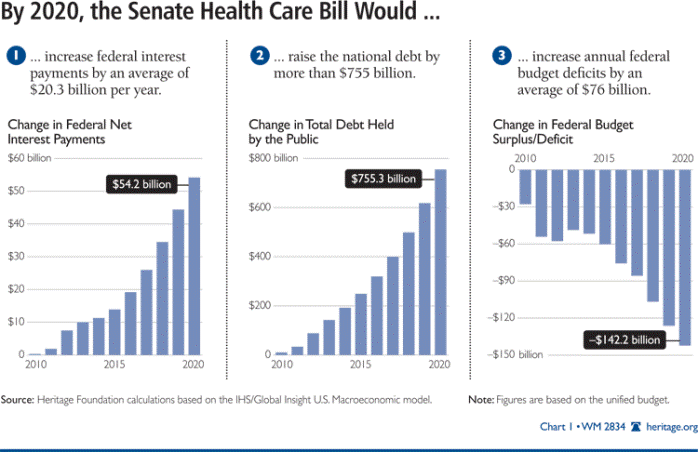
    • Increases the federal deficit and national debt. The Congressional Budget Office shows deficit neutrality for the Senate bill—however, this is based on static analysis which ignores the effects new taxes and an individual and employer mandate would have on economic growth.* These provisions would decrease investment in the economy, resulting in lower wages and salaries.* This means less taxable income, lowering federal revenues and growing the debt. Increased borrowing puts upward pressure on interest rates causing some private sector productive investment opportunities to be foregone.* This also increases the interest owed on the national debt, such that the government would pay, on average, $20 billion more in interest between 2010 and 2020.* By the end of the decade, CDA estimates the publicly held debt would be $755 billion dollars more than under current law.<spanid="more-29018"></span>

    <ahref="http://blog.heritage.org/wp-content/uploads/SenateBill.gif">

    • Increases insurance premiums. Mandates in the Senate bill would require health plans to offer more generous coverage, increasing the cost of insurance.* Increased spending on premiums, accompanied by increased medical spending, would create upward pressure on prices.* This would further increase government spending, since offering the current levels of care covered by Medicaid and the proposed subsidies would cost significantly more.* Another choice would be to ration provider payments even more severely.
    • Increases unemployment. The bill also places new taxes on “the rich”—or, in more realistic terms, small businesses and those who create jobs.* CDA’s dynamic analysis of the bill shows that an average 690,000 jobs per year would be lost due to the effects described above.

    Americans have recently voiced that Congress’ top legislative priority should be restoring jobs and the economy.* Instead, congressional leaders have focused their agenda on passing the Senate health care bill, which would have the opposite effect of killing jobs growth, suppressing economic growth, and adding to the nation’s already unsustainable levels of federal spending.

    http://blog.heritage.org/2010/03/17/…icit-and-debt/

  • Fed Forced Felon Voting: Another Leftist Assault on the Constitution

    On 03.17.10 07:00 AM posted by Hans Von Spakovsky

    <ahref="http://blog.heritage.org/wp-content/uploads/test.jpg"></p>There seems to be an almost constant effort by some members of Congress to act unconstitutionally and to push through legislation that is beyond the enumerated powers given to Congress in Article I of the Constitution.

    On Tuesday, I <ahref="http://judiciary.house.gov/hearings/pdf/Spakovsky100316.pdf">testified before the House Judiciary Committee’s Subcommittee on the Constitution, Civil Rights and Civil Liberties about H.R. 3335, the Democracy Restoration Act. This bill, sponsored by Rep. John Conyers (D-MI), would force states to immediately restore the voting rights of convicted felons in federal elections the moment they are out of prison – even if they are on parole or probation or have not completed any of the other requirements of their sentence such as paying restitution to the victims of their crimes or the fines and civil penalties imposed on them.<spanid="more-29033"></span>

    But the Fourteenth Amendment specifically gives states the ability to abridge the right to vote “for participation in rebellion, or other crime.” The Constitution also provides in Article I, Sec. 2 and in the Seventeenth Amendment that voters for members of Congress “shall have the Qualifications requisite for Electors of the most numerous Branch of the State Legislature.” So Congress is trying to overturn constitutional authority explicitly conferred on the states twice through legislation. This is just as unconstitutional as the attempt to give the District of Columbia a voting member of Congress or to force individual Americans to buy a health insurance policy.

    Many states automatically restore the right to vote once a felon has completed his prison term. Others such as Virginia require an individual application that gives the state the ability to determine whether a felon has paid his debt to society and shown that he can be trusted to exercise the rights of full citizenship. Under this law, a terrorist like Sulayman al-Faris (i.e., John Walker Lindh) would be able to vote as soon as he is released from federal prison – so he will be able to participate in choosing the representatives of the government he wanted to help destroy.

    What is particularly revealing about this bill is that it does not say anything about the other civil rights that a felon loses such as the right to own a gun or serve on a jury or in some states, to work as a public employee. Apparently, the sponsors trust felons enough to vote but not enough to own a gun or work as a teacher or a police officer. That is an interesting comment given that the “Findings” in the bill claim that such state felon laws “serve no compelling State interest.” I guess this legislation would serve one compelling interest for the sponsors – it might get them votes they need to win in close elections.

    http://blog.heritage.org/2010/03/17/…-constitution/

  • Common Sense Solutions From States’ Education Reform Agendas

    On 03.17.10 07:30 AM posted by Nick Taddeo

    <ahref="http://blog.heritage.org/wp-content/uploads/floridaschool.jpg"></p>Although significant attention is being paid to the Obama Administration’s “Race to the Top” first round winners, one state is implementing rigorous education reforms without the <ahref="http://blogs.edweek.org/edweek/campaign-k-12/2010/03/race_to_the_top_when_states_as.html">help of the federal government.

    In Florida, the State Senate has proposed legislation in two committees to strengthen merit pay for teachers and end tenure. The <ahref="http://jacksonville.com/news/florida/2010-03-03/story/senate_leaders_want_to_end_teachers_tenure">Florid a Times Union reports:

    The measure, sponsored by Sen. John Thrasher, R-St. Augustine, would require the state to oversee the implementation of pay for performance models by local school districts, with those who don’t comply losing state funding that would then have to be replaced with a property tax increase.

    <spanid="more-29021"></span>In the process, protections for teachers widely known as tenure would be replaced by a continuing series of annual contracts…Student achievement would account for 50 percent of a teacher’s salary under the bill.

    Utah has also taken a serious step in the direction of responsible education reform. The Utah State Senate passed a bill recently to <ahref="http://www.deseretnews.com/article/700008872/Utah-Legislature-Senate-bill-requires-schoolchildren-to-be-good-readers.html">ban the social promotion of first, second, and third graders who are not yet reading on grade level. The majority noted that reading skills are the fundamental building blocks of future learning.

    The Arizona Senate recently passed a bill that would update how schools are graded. <ahref="http://www.azleg.gov/FormatDocument.asp?inDoc=/legtext/49leg/2r/summary/s.1286ed_aspassed.doc.htm">The bill would change a previously vague system of grading to a clear A-F format. This would easily show teachers, administrators, students and parents how their school is performing compared to other schools in the state. Arizona is following a path Florida blazed as part of its original set of sweeping reforms. The Sunshine State revamped its I-IV grading system to an A-F scale for schools, giving parents a clear indication of how their child’s school was performing. The results? Parents and administrators that sit on the edges of their seats waiting to hear if their school has made a passing grade. <ahref="http://www.tampabay.com/news/education/testing/article1011540.ece">The St. Petersburg Times writes:

    Katie Lail’s phone kept ringing Thursday with calls from excited teachers who couldn’t stop screaming. Their school – Mary Giella Elementary – had overcome the odds of serving a high-poverty area to earn an A in the Florida grading system and also make ‘adequate yearly progress’ under federal accountability guidelines.

    These actions are great steps towards meaningful education reform. The states enacting these sensible reforms are showing their commitment to the students and parents they serve. Congress should look across the many states serving as laboratories of reform to find out “what works” in education, instead of continuing to support the status quo.

    http://blog.heritage.org/2010/03/17/…eform-agendas/

  • Mexican Cartels Throw Down A New Gauntlet

    On 03.17.10 08:10 AM posted by Ray Walser

    <ahref="http://blog.heritage.org/wp-content/uploads/drugviolence100317.jpg"></p>The senseless <ahref="http://www.nytimes.com/2010/03/16/world/americas/16juarez.html">daylight murders of Lesley A. Enriquez, an American employee in the U.S. Consulate General in Ciudad Juarez, her U.S. citizen husband, Arthur Redelfs, and a Mexican employee of the Consulate General, Jorge Salcido sends a sobering signal to Washington that Mexico’s drug violence is evolving in even more dangerous directions, especially if it is proven that the U.S. government employees were deliberately targeted by drug gunmen.

    Clearly the perpetrators of these and other crimes believe murder, terror, and fear will allow them to prevail against the Government of Mexico.* Likewise, they hope frustration over Mexican President Calderon’s inability to deliver public security will cause a backlash of panic and defeatism in Mexico and <ahref="http://blog.foreignpolicy.com/posts/2010/03/14/Obamas_drug_war">a loss of U.S. confidence in his Administration.* The killings have sparked fresh concerns in Texas about the security of the U.S.-Mexican border and calls by <ahref="http://www.dallasnews.com/sharedcontent/dws/dn/latestnews/stories/031610dntexborderviolence.1b40a1de7.html">Texas Governor Rick Perry for additional federal help.<spanid="more-29053"></span>

    Ciudad Juarez, just across from El Paso, is now a major epicenter for Mexico’s drug war. The Juarez or Carrillo Fuentes cartel, enforcement gangs such as La Linea and Aztecas, and rival interlopers were largely responsible for over 2,600 deaths in 2009 alone, making the city of 1.3 million arguably the world’s most dangerous city.* Investigators are still unsure whether the consulate killings were the result of a targeted effort or a case of “<ahref="http://www.washingtonpost.com/wp-dyn/content/article/2010/03/15/AR2010031503130.html">mistaken identity.”

    The Obama Administration has begun to move family dependents of employees from its border consulates, increased security, and issued <ahref="http://travel.state.gov/travel/cis_pa_tw/tw/tw_mexico.html">a new travel warning that should be heeded.* *Nonetheless, the Obama Administration has vowed to work closely with the Mexicans to find and punish the perpetrators of these crimes.

    Following the cold-blooded murder of Americans in Mexico, the Obama Administration needs to strengthen cross-border law enforcement efforts and direct the Departments of Homeland Security and Justice to utilize all available legal and law enforcement tools <ahref="http://www.washingtonexaminer.com/opinion/columns/Back-to-the-border-battle-87619212.html">to fight back against the Ciudad Juarez killers. *The Administration must also review ways to employ <ahref="http://www.heritage.org/Research/Reports/2008/07/Mexico-Drug-Cartels-and-the-Merida-Initiative-A-Fight-We-Cannot-Afford-to-Lose">Merida Initiative funds and future anti-drug assistance to Mexican to target mounting drug violence along the border.

    http://blog.heritage.org/2010/03/17/…-new-gauntlet/

  • Slaughter Solution: Still the Senate Bill

    On 03.17.10 08:55 AM posted by Tom Feeney

    <ahref="http://blog.heritage.org/wp-content/uploads/healthcarebill1001272.jpg"></p>The House Rules Committee will meet this afternoon to discuss what has been dubbed the “Slaughter Solution” to passage of the Senate health care bill. The precedent <ahref="http://blog.heritage.org/wp-content/uploads/Slaughter.pdf">cited by Rules Chairman Louise Slaughter to justify the proposed maneuver (to “deem” passage of the Senate Health Care bill when in fact the bill has never been actually “passed”) simply does not support the planned manipulation of the House rules and may well violate the US Constitution.

    As early as 1933 House rules were <ahref="http://rules-republicans.house.gov/ShortTopics/Read.aspx?id=345">interpreted to permit House acceptance of Senate Amendments in a bill simultaneously with House passage of a Resolution on a separate matter. But that precedent clearly included House concurrence in (or “passage” of) the Senate Amendments. The new maneuver planned for this week’s health care bill is not designed to be an up or down vote on Senate Amendments to a bill or a bill itself. Instead the proposed Rule will “deem”, or pretend, that a Senate bill that will never have been in fact “passed”, was instead “deemed” to have been passed.<spanid="more-29051"></span>

    The United State’s Constitution says:

    Every Bill which shall have passed the House of Representatives and the Senate, shall, before it become a Law, be presented to the President of the United States.

    House precedents do allow more that one matter to be “passed” by the same vote. But a member’s vote in favor of the bill and the other matter is a simultaneous vote* on both the merits and passage of both propositions.

    Either the US House has had an actual vote to “pass” a bill, or it has not meet Constitutional requirements for a bill to become law. The House can not “deem” that a majority voted for a bill and simultaneously maintain that there was never actually a vote on the bill.

    The House is ultimately the arbiter of its own internal Rules, but it cannot avoid Constitutional prerequisites for a bill to become law. Parliamentary slight of hand does not trump the US Constitution.

    The Honorable Thomas C. Feeney is Senior Visiting Fellow at The Heritage Foundation.

    http://blog.heritage.org/2010/03/17/…e-senate-bill/

  • Medicaid Expansion Neglects Program’s Current Failures

    On 03.17.10 10:00 AM posted by Kathryn Nix

    </p>This week, the House is preparing to vote on the Senate-passed health care bill, which depends on a massive expansion of Medicaid to reduce the number of uninsured.

    However, as has become apparent in the months of debate surrounding Democrats’ health care proposals, all that glitters is not gold—especially in the case of expanding Medicaid, a low-quality, poorly-functioning federal-state program which fails to meet the needs of its beneficiaries.* Increasing the number of citizens dependent on this program fails to address its numerous shortcomings, and instead applies them to millions more.

    <ahref="http://www.nytimes.com/2010/03/16/health/policy/16medicaid.html?ref=todayspaper&pagewanted=print"> A recent article in the New York Times portrays the plights of current Medicaid beneficiaries which are slowly becoming the norm.* Since Medicaid reimburses doctors significantly below the cost of providing care, more and more doctors are being forced to turn patients away.* <ahref="http://www.nytimes.com/2010/03/16/health/policy/16medicaid.html?ref=todayspaper&pagewanted=print"> According to Dr. Saed J. Sahouri, “…we’re really losing money on seeing those patients, not even breaking even. We were starting to lose more and more money, month after month.”<spanid="more-29075"></span>

    As it becomes harder for Medicaid beneficiaries to find providers, more and more rely on emergency room care—in fact, <ahref="http://www.heritage.org/Research/Reports/2007/12/The-Crisis-in-Americas-Emergency-Rooms-and-What-Can-Be-Done">Medicaid enrollees are more likely than even the uninsured to end up in emergency rooms in lieu of primary care.

    As former Heritage analyst Dennis Smith <ahref="http://www.heritage.org/Research/Reports/2010/01/Medicaid-Expansion-Ignores-States-Fiscal-Crises">points out, Medicaid spending is demanding a larger portion of state budgets, squeezing out other state priorities from education to transportation. This is a trend which is expected to continue in the years ahead.

    If the federal government is serious about health care reform, expanding Medicaid is the worst way to go.* Making more Americans dependent on this program may decrease the number of uninsured, but will do nothing to improve the access and quality issues plaguing the program. **Moreover, federal funding to cover the expansion only offers states temporary relief and simply shifts these costs to federal taxpayers. Eventually states (and state taxpayers) will be left to pick up the cost, only intensifying the problems in the future.

    Washington can do better by reforming Medicaid so that it works for those who currently use it.* <ahref="http://www.heritage.org/Research/Reports/2005/06/A-Road-Map-for-Medicaid-Reform">Heritage analyst Nina Owcharenko outlines what states legislators and Congress can do to improve the quality of Medicaid:

    States … should mainstream some Medicaid enrollees into private coverage and adopt consumer-directed models to promote personal responsibility and enable individuals to take control of their health care decisions… federal policymakers should look for ways to make this process easier and remove obstacles to change.

    …Congress should enact key health care initiatives, such as health care tax credits, and private long-term care incentives that complement Medicaid reform and relieve the increasing pressures on state Medicaid budgets.

    Millions of Americans currently struggle to receive adequate care due to Medicaid’s inadequacies.* Adding more families to these poor performing programs will make these problems worse.

    http://blog.heritage.org/2010/03/17/…rent-failures/

  • Senate Votes Against School Choice

    On 03.17.10 11:29 AM posted by Lindsey Burke

    </p>Last night, the Senate considered an amendment by Sen. Joe Lieberman (I-CT) to reauthorize the D.C. Opportunity Scholarship Program. The amendment failed 42 – 55. The bi-partisan amendment, which was cosponsored by Sens. Susan Collins (R-ME), Dianne Feinstein (D-CA), Robert Byrd (D-WV), and George Voinovich (R-OH), would have allowed new students to enroll in the scholarship program and would have ensured current students are able to remain in the existing private schools. <ahref="http://www.washingtonpost.com/wp-dyn/content/article/2010/03/16/AR2010031604034.html">The Washington Post writes today:

    Sen. Joseph I. Lieberman (I-Conn.) introduced an amendment to a reauthorization bill for the Federal Aviation Administration that would have extended the voucher program for five years and funded it at $20 million a year, opening it to new students. The Senate killed Lieberman’s attempt to amend a different bill earlier this month.<spanid="more-29082"></span>

    ‘Many teachers in our nation’s capital . . . are just not providing an adequate education to their students,’ Lieberman said. ‘We’re giving these children the ability to save their own lives.’

    More than 1,700 students participated in the 2008-09 school year. That number dropped to 1,319 this year because applications were closed to new students in the spring, and some students have graduated or left the program…

    ‘Already, D.C. parents have a choice,’ said Sen. Tom Harkin (D-Iowa), chairman of the Health, Education, Labor and Pensions Committee, who spoke on the Senate floor against the program. ‘We have over 60 charters in the District of Columbia, and they’re growing all the time.’

    While charters are in fact serving many children, the scholarships are specifically meeting the needs of those students enrolled in the program – and <ahref="http://ies.ed.gov/ncee/pubs/20094050/pdf/20094050.pdf">have been successful in raising academic achievement.

    In the video above, watch Sen. Lieberman explain how a federally-mandated evaluation of the D.C. Opportunity Scholarship Program found children to be improving academically.

    http://blog.heritage.org/2010/03/17/…school-choice/

  • Health Coverage for All Americans? Not Under the Senate Health Bill

    On 03.17.10 12:30 PM posted by Richard Sherwood

    <ahref="http://blog.heritage.org/wp-content/uploads/2009/08/doctor_and_patient090622.gif"></p>As Congressional leaders continue to search for ways to pass the Senate health bill in the House later this week, Americans continue to be subjected to dubious rhetoric surrounding the bill’s provisions.* The Senate bill’s supporters claim that their legislation must be made law, no matter the cost, in order to achieve universal coverage in the United States.* However, even if the Senate bill does pass, this will not be the case.* Despite the fact that the proposed legislation is exorbitantly expensive, it would still fail to achieve universal health coverage.

    <spanstyle="font-weight: normal;">According to the Congressional Budget Office (CBO), by 2019, <ahref="http://www.cbo.gov/ftpdocs/107xx/doc10731/Reid_letter_11_18_09.pdf">the legislation would cost (PDF) $196 billion annually and still leave 24 million Americans uninsured.</span>

    <spanstyle="font-weight: normal;">The fact that 24 million people remain would uninsured with enactment of the Senate health bill is remarkable. Under current law, there would be <ahref="http://cnsnews.com/news/article/57454">55 million uninsured Americans in 2019.* That means that over 43 percent of the projected uninsured would be unaffected by the legislation, continuing to go without coverage ten years from now.* Yet <ahref="http://www.heritage.org/Research/Reports/2010/01/The-Real-Budgetary-Impact-of-the-House-and-Senate-Health-Bills">according to research by Heritage expert James Capretta, the bill would cost well over $1 trillion over the next ten years.* Capretta shows that the true ten year cost of the plan is more likely to be close to $1.2 trillion, but even this estimate significantly underestimates the true long term cost of the plan.* Capretta further points out that this estimate includes ten years of new revenues, but only 6 or 7 years of new spending, skewing the Congressional Budget Office’s ten-year cost analysis to make the bill appear less expensive than it really is.* He says* that a *true ten year estimate would put the price tag closer to $2.3 trillion.<spanid="more-29088"></span></span>

    <spanstyle="font-weight: normal;">Congressional leaders claim that the cost is justified because the bill extends health care coverage to 31 million uninsured Americans.* It depends on what one means by “coverage”. Much of the *increased coverage <ahref="http://cnsnews.com/news/article/57454">would come in the form of Medicaid expansion, as well as exchange subsidies. But Medicaid is characterized by *low-quality care and it often fails to meet the health needs of its beneficiaries.** According to <ahref="http://www.heritage.org/Research/Reports/2010/03/Obamas-Proposed-Medicaid-Expansion-Lessons-from-TennCare">recent analysis by Heritage Health Policy Fellow Brian Blase, Medicaid expansion in Tennessee actually decreased the quality of care relative to surrounding states that did not expand their own Medicaid programs.* In the four years after expanding Medicaid, Tennessee’s improvements in general mortality were more than 50 percent lower than its neighbors. In many states, Medicaid beneficiaries end up in the hospital emergency rooms because they can’t find a doctor who’ll take artificially low Medicaid payment rates. *Clearly, Medicaid is not a vehicle for improving the quality of care for millions of Americans. And coverage without efficient access to medical services is probably not what ordinary Americans have in mind when it comes to health care reform.</span>

    <spanstyle="font-weight: normal;">If the highly unpopular health care legislation is going to cost taxpayers over $196 billion annually ten years from now, while leaving an estimated *24 million Americans without coverage, perhaps that is yet another reason why Congress ought to pause, come to its senses, and press the re-set button. Americans expect and deserve better.</span>

    <spanstyle="font-weight: normal;">Rick Sherwood currently is a member of the Young Leaders Program at the Heritage Foundation. For more information on interning at Heritage, please visit:<ahref="http://www.heritage.org/about/departments/ylp.cfm">http://www.heritage.org/about/departments/ylp.cfm</span>

    http://blog.heritage.org/2010/03/17/…e-health-bill/

  • Forget Doctors? Support for the Health Care Bill

    On 03.17.10 01:00 PM posted by Vivek Rajasekhar

    <ahref="http://blog.heritage.org/wp-content/uploads/2009/10/obamadoctors.gif"><imgsrc="http://blog.heritage.org/wp-content/uploads/2009/10/obamadoctors.gif" alt="" title="obamadoctors" width="300" height="303" class="alignnone size-full wp-image-16358" /></p>Earlier this month, President Obama held a press conference at the White House with white coated physicians in his push for a government overhaul of the nation’s health care system. Though the presence of physicians in support of the Democrats’ plans for health care “reform” created the illusion that the medical profession is in strong support of the legislation, it remained just that—an illusion. Recent reports show that the health care legislation does not have the broad support among physicians.

    A poll by The Medicus Firm appearing in the current issue of the prestigious <ahref="http://www.nejmjobs.org/rpt/physician-survey-health-reform-impact.aspx">New England Journal of Medicine shows that, on virtually every count, physicians understand and don’t like the congressional legislation. 62.7 percent of physicians feel that health reform is needed but should be implemented in a more targeted, gradual way; just the opposite of the sweeping overhaul embodied in the massive congressional legislation. Indeed, 46.3 percent of primary care physicians feel that “the passing of health reform will either force them out of medicine or make them want to leave medicine.”<spanid="more-29093"></span>

    On March 10th, 15 state and national medical specialty organizations representing 85,000 physicians across the nation <ahref="http://www.intrepidresources.com/html/djp_update/coalition_djp.pdf">wrote a letter to House Speaker Nancy Pelosi and Minority Leader John Boehner voicing their opposition to the Senate bill (H.R. 3590), which the House is expected to vote on later this week. Liberals in and out of Congress, meanwhile, have been insisting that their legislative handiwork has enjoyed the support of the <ahref="http://cmhmd.blogspot.com/2010/02/organized-medicine-on-hcr-updated-again.html">ten largest doctor organizations in the country.

    Physician opposition is understandable. Heritage economist Robert Book describes how, against the better interests of physicians and their patients, <ahref="http://www.heritage.org/Research/Reports/2009/11/Government-Run-Health-Care-Even-Without-the-Public-Option">Americans may end up with government-run health care even without the public option

    Both the Senate and House bills give unprecedented levels of control to federal bureaucrats to pre-empt patient choice and block competitive innovation. The House bill would create a new federal office — a “Health Choices Commissioner” — to make health choices for the entire nation, specifying precisely what services health plans must cover, may cover, and (perhaps) must not cover. The Senate bill would direct the Secretary of Health and Human Services (HHS) to define precisely the services that health plans must cover.

    Doctors are clearly opposed to congressional health legislation. <ahref="http://www.heritage.org/Research/Reports/2008/04/Health-Care-Reform-Design-Principles-for-a-Patient-Centered-Consumer-Based-Market">There is a better way. If Congress were to pursue patient-centered health care reform, doctors could rest assured that their patients, their practices, and their profession remained in good hands—their own.

    http://blog.heritage.org/2010/03/17/…lth-care-bill/

  • Morning Bell: There Is No Bill But the Senate Bill

    On 03.17.10 05:23 AM posted by Conn Carroll

    Another day, another poll showing President Barack Obama’s health care plan is wildly unpopular with the American people. Yesterday NBC News/The Wall Street Journal released <ahref="http://online.wsj.com/public/resources/documents/wsjnbcpoll03162010.pdf">their latest poll showing that <ahref="http://online.wsj.com/public/resources/documents/wsjnbcpoll03162010.pdf#page=23">the percentage of Americans who believe President Obama’s health care plan is a bad idea (48%) is at the highest level since they started asking the question last year. Only 36% of Americans are willing to call the plan a “good idea” which is up a whole four points from the time when House Rules Committee Chair Louise Slaughter (D-NY) <ahref="http://www.cnn.com/2009/OPINION/12/23/slaughter.oppose.senate.bill/index.html">wrote this about the Senate health plan:

    [U]nder the Senate plan, millions of Americans will be forced into private insurance company plans, which will be subsidized by taxpayers. That alternative will do almost nothing to reform health care but will be a windfall for insurance companies. … Supporters of the weak Senate bill say “just pass it — any bill is better than no bill.”

    I strongly disagree — a conference report is unlikely to sufficiently bridge the gap between these two very different bills. It’s time that we draw the line on this weak bill and ask the Senate to go back to the drawing board. The American people deserve at least that.

    The Senate health bill is so unpopular, even among House Democrats, that the leftist House leadership is desperately trying to trick the American people into believing that the House can pass the Senate bill without voting on it. Hence the Slaughter Rule which would deem the Senate bill passed at the same time the House would approve a new reconciliation bill. Speaker Nancy Pelosi (D-CA) was crystal clear on her motives this week <ahref=" http://www.washingtonpost.com/wp-dyn/content/article/2010/03/15/AR2010031503742.html">telling a group of leftist bloggers: “It’s more insider and process-oriented than most people want to know. But I like it because people don’t have to vote on the Senate bill.”<spanid="more-28998"></span>

    There is one increasingly glaring problem with Pelosi’s pass-the-bill-without-voting plan: it is proving impossible to draft that reconciliation bill. The Democrats first promised to unveil their new bill last Wednesday. Then Thursday. Then Friday. Then Monday. Then last night. As of this morning, still nothing. Democrats say they are waiting for a score from the Congressional Budget Office before they release their bill, but there is nothing stopping them from releasing whatever text they have now and then publicizing the CBO score when it comes back. But they are not choosing that open and transparent path.

    As we <ahref="http://blog.heritage.org/2010/03/09/morning-bell-dead-legislation-walking/">reported last week, getting a CBO score consistent with reconciliation is going to be very difficult. According to House rules, a reconciliation measure must reduce the deficit by at least $2 billion over five years compared to existing law. In this case, however, “existing law” would be the yet-to-be-passed Senate bill. And all of the changes* Democrats want to make to the Senate bill* (scaling back the tax on high-end health insurance policies;* closing the Medicare D loophole; boosting insurance subsidies;* increasing Medicaid payments; and expanding the Cornhusker Kickback to all) either increase spending or decrease revenue. Which means the Democrats have to identify new revenues to make the CBO score work. And as <ahref="http://www.cqpolitics.com/wmspage.cfm?docID=cqmidday-000003558164">Congressional Quarterly reported yesterday, Democrats have not yet identified the right pay-fors to game the CBO right. That is why House Leadership has not unveiled their new bill yet: they can’t figure out how to pay for it.

    Not that it really matters if they ever do. The reconciliation bill is never going to become law. The Senate will never pass it. They have no reason to. The Senate likes the existing Senate bill. That’s why it’s called “the Senate bill” … they are the ones who passed it. The White House also likes the Senate bill. As soon as the House passes it, President Obama will sign it and then leave for Asia. That’s it. Obamacare will be, as White House Press Secretary Robert Gibbs <ahref="http://thehill.com/homenews/administration/86623-gibbs-by-next-sunday-healthcare-will-be-law-of-the-land">promised last Sunday, “the law of the land.” After the Senate bill is law, what could possibly motivate the White House, let alone the Senate, to ever pick up the yet-to-be-written House reconciliation bill?

    This is why the White House political machine is pulling out all the stops to get the House to pass the toxic Senate bill. Democratic National Committee Vice Chair Donna Brazile is actively encouraging <ahref="http://www.politico.com/news/stories/0310/34540.html">primary challenges to Democrats who vote against the Senate bill. One House Democrat aide tells <ahref="http://www.politico.com/news/stories/0310/34540.html">Politico: “We’re having donors, even donors outside of our district, that are being called and asked to urge support.” For her part Speaker Pelosi is relishing the bare knuckle fight <ahref="http://www.politico.com/news/stories/0310/34540_Page2.html">telling reporters yesterday: “I never stop whipping. There’s no beginning, there’s no middle, and there’s no end.” Let’s just hope her members remember which bill she’s really whipping them on.

    Quick Hits:

    • Testifying before the House Appropriations Committee, <ahref="http://abcnews.go.com/Politics/attorney-general-eric-holder-holder-911-trial-decision/story?id=10119679">Attorney General Eric Holder refused to answer whether or not the Obama administration would read Osama bin Laden his Miranda rights, insisting that bin Laden would never be taken alive.
    • Cash strapped states like Illinois and California are coming hat in hand to Washington for <ahref="http://online.wsj.com/article/SB10001424052748703447104575118210410953620.html?m od=WSJ_newsreel_us">hundreds of billions of federal taxpayer dollars in bailouts.
    • Homeland Security Secretary Janet Napolitano announced yesterday the Obama administration <ahref="http://www.politico.com/news/stories/0310/34528.html">will delay the virtual U.S.-Mexico border fence.
    • The Chinese government is setting the foundation for Internet giant Google to <ahref=" http://www.washingtonpost.com/wp-dyn/content/article/2010/03/16/AR2010031600115.html">pull out of the country.
    • Former-Democrat and current Massachusetts State Treasurer Timothy Cahill tells <ahref=" http://www.boston.com/news/local/breaking_news/2010/03/cahill_bashes_s.html">The Boston Globe: “If President Obama and the Democrats repeat the mistake of the health insurance reform here in Massachusetts on a national level, they will threaten to wipe out the American economy within four years.”

    http://blog.heritage.org/2010/03/17/…e-senate-bill/

  • The Obama Apology Tour Continues: No U.S. Flag in Haiti

    On 03.16.10 11:30 AM posted by Conn Carroll

    <ahref="http://blog.heritage.org/wp-content/uploads/USAUSA.jpg"></p>France’s tricolor, Britain’s Union Jack and even Croatia’s coat of arms have been lifted above those nation’s installations in Haiti. But in the United States camp, <ahref="http://www.usatoday.com/news/world/2010-03-14-haiti-flag-flap_N.htm/">“whose contributions dwarf the rest of the world’s,” no flag is allowed to fly. Why? The Obama administration has forbidden it. <ahref="http://www.usatoday.com/news/world/2010-03-14-haiti-flag-flap_N.htm">USA Today reports:

    The lack of the Stars and Stripes does not sit well with some veterans and servicemembers who say the U.S. government should be proud to fly the flag in Haiti, given the amount of money and manpower the U.S. is donating to help the country recover from the Jan. 12 quake.

    The Obama administration says flying the flag could give Haiti the wrong idea.

    “We are not here as an occupation force, but as an international partner committed to supporting the government of Haiti on the road to recovery,” the U.S. government’s Haiti Joint Information Center said in response to a query about the flag.

    <spanid="more-28969"></span>It used to be that Americans serving abroad were proud to serve oversees under our nation’s flag. Not the Obama administration.

    And this is not the first time President Obama has sought to distance himself from our nation’s past. Let us not forget <ahref="http://blog.heritage.org/2009/06/03/morning-bell-president-obamas-top-ten-apologies/">last year’s world wide apology tour, including:

    10. <ahref="http://www.whitehouse.gov/the_press_office/Remarks-by-the-President-On-National-Security-5-21-09/">Apology for Guantanamo in Washington: “There is also no question that Guantanamo set back the moral authority that is America’s strongest currency in the world. … Rather than keeping us safer, the prison at Guantanamo has weakened American national security. It is a rallying cry for our enemies.”

    9. <ahref="http://www.whitehouse.gov/the_press_office/Remarks-by-the-President-to-CIA-employees-at-CIA-Headquarters/">Apology for the Mistakes of the CIA: “So don’t be discouraged by what’s happened in the last few weeks. Don’t be discouraged that we have to acknowledge potentially we’ve made some mistakes.”

    8. <ahref="http://www.whitehouse.gov/the_press_office/Op-ed-by-President-Barack-Obama-Choosing-a-Better-Future-in-the-Americas/">Apology for U.S. Policy toward the Americas: “Too often, the United States has not pursued and sustained engagement with our neighbors. We have been too easily distracted by other priorities, and have failed to see that our own progress is tied directly to progress throughout the Americas.”

    7. <ahref="http://www.whitehouse.gov/the_press_office/Remarks-By-President-Obama-To-The-Turkish-Parliament/">Apology before the Turkish Parliament: “The United States is still working through some of our own darker periods in our history. … Our country still struggles with the legacies of slavery and segregation, the past treatment of Native Americans.”

    6. <ahref="http://www.whitehouse.gov/the_press_office/Remarks-by-President-Obama-at-Strasbourg-Town-Hall/">Apology for Guantanamo in France: “I don’t believe that there is a contradiction between our security and our values. And when you start sacrificing your values, when you lose yourself, then over the long term that will make you less secure.”

    5. <ahref="http://www.whitehouse.gov/the_press_office/Remarks-by-the-President-On-National-Security-5-21-09/">Apology for the War on Terror: “Unfortunately, faced with an uncertain threat, our government made a series of hasty decisions. … In other words, we went off course.”

    4. <ahref="http://www.whitehouse.gov/the_press_office/News-Conference-by-President-Obama-4-02-09/">Apology at the G-20 Summit of World Leaders: “I would like to think that with my election and the early decisions that we’ve made, that you’re starting to see some restoration of America’s standing in the world.”

    3. <ahref="http://www.whitehouse.gov/the_press_office/Remarks-by-the-President-at-the-Summit-of-the-Americas-Opening-Ceremony/">Apology to the Summit of the Americas: “While the United States has done much to promote peace and prosperity in the hemisphere, we have at times been disengaged, and at times we sought to dictate our terms. … So I’m here to launch a new chapter of engagement that will be sustained throughout my administration. The United States will be willing to acknowledge past errors where those errors have been made.”

    2. <ahref="http://www.alarabiya.net/articles/2009/01/27/65096.html">Apology to the Muslim World: “We sometimes make mistakes. We have not been perfect.”

    1. <ahref="http://www.whitehouse.gov/the_press_office/Remarks-by-President-Obama-at-Strasbourg-Town-Hall/">Apology to France and Europe: “Instead of celebrating your dynamic union and seeking to partner with you to meet common challenges, there have been times where America has shown arrogance and been dismissive, even derisive.”

    Now we are apologizing for saving lives in Haiti!

    http://blog.heritage.org/2010/03/16/…flag-in-haiti/

  • This Just In! The Pledge of Allegiance is Constitutional

    On 03.16.10 12:30 PM posted by Deborah O’Malley

    <ahref="http://blog.heritage.org/wp-content/uploads/americanflag100316.jpg"></p>Last week, the Ninth Circuit Court of Appeals upheld the constitutionality of the Pledge of Allegiance. Judge Carlos Bea, the author of the majority opinion, finely exhibited what it means to be a constitutionalist judge. His opinion considered the words “under God” not in isolation, but within their proper context and according to an honest analysis of the relevant history.

    In contrast, Judge Reinhardt’s dissenting opinion displays judicial activism at its best. Reinhardt used his opinion as a vessel through which to advance his own political views: attacking politicians and praising others: none of which had anything to do with the constitutional issue at hand.

    Here are some of the highlights from Reinhardt’s hubristic dissent:

    • Attacking Sarah Palin<spanid="more-28985"></span>
      Reinhardt mentions that some people who are not familiar with American political history** may think that the current language of the Pledge dates back to the Founding Fathers.* In a footnote 4, he states, “See, for example, the words of former Governor Sarah Palin of Alaska: ‘If [the Pledge] was good enough for the founding fathers, its [sic] good enough for me . . . ‘”

    While quoting misstatements by politicians is great fun for late night talk show hosts, it is difficult to see what if any purpose it has in a judicial opinion. Would quoting President Obama’s campaign gaffe in which he claimed to have visited 57 states be a proper judicial citation for the fact that some people don’t know how many U.S. States there are? No, and the citation to Palin does little to make Reinhardt’s point, unless that point is to mock Palin at the expense of judicial decorum.

    • Accusing the majority of embracing the Tea Party movement:
      In footnote 6, Reinhardt summarizes the majority’s argument that “under God” conveys the secular purpose of “limited government” because it refers to “the Founding Fathers’ belief that the people of this nation are endowed by their Creator with certain inalienable rights.” Reinhardt continues, “The majority’s explanation of the phrase bears a suspicious resemblance to the platform of the Tea Party movement, which proclaims itself to be a ‘group of like-minded people who desire our God given Individual Freedoms which were written out by the Founding Fathers. We believe in Limited Government[!]’… But even the Tea Party has not suggested previously that the phrase ‘under God’ was intended to refer presciently to its platform.”

    But it goes without saying that the majority’s language bears a suspicious resemblance to, uh, the language of the Founders, and that modern American political activists movements–from both the Left and the Right–tend to draw on the language of the Founders themselves. Perhaps he missed this connection because his opinion bears such a suspicious resemblance to the diatribes of liberal activist organizations that themselves seek to strip any reference to our religious heritage from the public square based not on the actual requirements of the Constitution, but based upon their respective policy preferences.

    And, finally, after using his opinion to make his political views ever so clear, Reinhardt makes clear his judicial philosophy as well:

    • Embracing “Judicial Empathy”
      In footnote 109, Reinhardt states, “Empathy, a much misunderstood term, even in the world of the judiciary, means ‘the intellectual identification with or vicarious experiencing of the feelings, thoughts, or attitudes of another.’… It is a quality that is most desirable in, even if frequently absent from, today’s federal judges at all levels of the judicial system.”

    Reinhardt’s musings on political movements, politicians, and the current president’s political decisions have absolutely nothing to do with the original meaning of the First Amendment. Though these statements were not the core of Reinhardt’s arguments, they had no place in the opinion whatsoever. In fact, whatever credibility his core arguments may actually have is undermined by his bizarre comments and obvious biases.

    This is just another disturbing example of what happens when judges eschew the genuine exercise of interpretation in favor of political grandstanding. Reinhardt accused the majority of echoing modern political movements in their opinion, but the only politically-loaded opinion in this case is his own.

    http://blog.heritage.org/2010/03/16/28985/