Author: Heritage

  • Greece Gets Visa Waiver Privileges, But Other Nations Left in the Cold

    On 03.15.10 09:00 AM posted by Jena McNeill

    <ahref="http://blog.heritage.org/wp-content/uploads/DHS3.png"></p>Last week Greece was <ahref="http://whitehouse.blogs.foxnews.com/2010/03/09/opa-greece-joins-the-visa-waiver-program/">admitted as the 36th member nation of the <ahref="http://www.heritage.org/Research/Reports/2009/06/Visa-Waiver-Program-A-Plan-to-Build-on-Success">Visa Waiver Program, (VWP). While this is certainly a welcome move for a program that hasn’t added a new member since 2008, it also highlights a real lack of willpower and effort by the White House to keep adding new member countries. In fact, DHS can barely add any new members right now because of the biometric exit mandate Congress linked to its waiver authority. The biometric mandate—which hasn’t gotten much of anywhere is a real stumbling block for the program—yet, the White House hasn’t even tried to pressure Congress to decouple them.

    For a President who once emphasized, how we need “a new era of American diplomacy” he has done little to support VWP—which betters relations between the U.S. and its member nations. As explained by Heritage Analysts, the VWP offers many benefits to the U.S. and its allies. When travelers come to the United States, they spend billions of dollars in American restaurants, stores, and hotels, and also have the opportunity to bring positive experiences of the U.S. back to their home countries to be shared with others. While diplomatically, membership in the program serves as a real sign of trust to our allies—something they have expressed repeatedly throughout the program’s existence.<spanid="more-28843"></span>

    Prior to Greece’s admission, the Department of Homeland Security had identified several “road map” nations, that is, nations that were on the right path to becoming member nations. Yet as the White House has done little to foster their admittance and countries such as Poland, Romania, and Taiwan have clearly become frustrated.

    The President needs to go out and make the case to Congress for VWP. He needs to talk about the 2007 security modifications that made this program a valuable counterterrorism tool. And he needs to explain how DHS should be granted permanent waiver authority to allow nations to join the VWP more readily. Likewise, the Visa Waiver Program must be decoupled from the mandate for biometric air-exit, which seriously limits the ability of the program to grow further. At the same time, ESTA, the Electronic System for Travel Authorization, must remain user-friendly to allow member citizens to easily apply for entry, and older member nations must be held to the same security standards as new nations.

    Bringing Greece into the program is progress for VWP, but other American allies are waiting…

    http://blog.heritage.org/2010/03/15/…t-in-the-cold/

  • House and Senate Cloakroom: March 15– 21, 2010

    On 03.14.10 06:25 AM posted by Dan Holler

    House Cloakroom: March 15 – 21, 2010

    Analysis:

    It’s crunch time on health care. The Budget Committee will meet Monday to start marking up a shell of a Reconciliation Bill. The Rules Committee will then meet as early as Wednesday to* hollow out whatever the Budget Committee passed and then insert a new bill from Speaker Nancy Pelosi’s (D-CA) office. The Majority is still planning to use the “Slaughter Rule” that would allow the House to pass the Senate health care bill without voting on it. Final votes are expected to stretch into the weekend.

    Senate Cloakroom: March 15 – 21, 2010

    Analysis:

    A new dynamic has been thrown into the health care mix: the impact of reconciliation on the remaining components of President Obama’s legislative agenda.* Senator Lindsey Graham (R-SC) raised the stakes last week when he suggests the controversial procedure could undermine his efforts to strike a bipartisan deal on comprehensive immigration reform.* Graham is also the only Senate Republican thought to be negotiating an agreement on global warming legislation.* Will President Obama and Senate Majority Leader Harry Reid (D-NV) move forward on health care reconciliation at the expense of these other priorities?* Those conservations are no doubt taking place behind closed doors and could determine the outcome of Obamacare itself.

    Major Floor Action:

    The Senate will continue work on H.R. 1586, the FAA reauthorization bill.* Potential amendments include earmark reform, discretionary spending limits and the continuation of the DC school choice program.

    Major Committee Action:

    http://blog.heritage.org/2010/03/14/…80%93-21-2010/

  • Saving Freedom in Urban Centers

    On 03.13.10 08:30 AM posted by Diane Mannina

    Rather than being inevitable cesspools of crime and sin,” says Howard Husock of the <ahref="http://www.citiesonahill.org/policing/">Manhattan Institute, “cities are, rather, the key foundations of prosperity and economic dynamism, the places where social and economic freedom [take] root and bear fruit.”

    Husock joined a panel at the recent Conservative Political Action Conference (CPAC) in DC—“Saving Freedom in Urban Centers”—where panelists discussed conservative solutions to inner city challenges such as poverty, crime and education.

    The solutions focused on the need to restore human dignity and empower individuals by encouraging personal responsibility through relationships. Star Parker from the Coalition on Urban Renewal and Education (<ahref="http://www.urbancure.org/dev/catdetails.asp?MajorCatID=33">CURE) pointed out that “faith and market principles are key to curing poverty” and that we should “develop social policies that encourage individual merit and personal responsibility.” Niger Innis of the Congress of Racial Equality (<ahref="http://www.core-online.org/Features/what-is-core.htm">CORE) emphasized the need for self-government and equal opportunity, rather than prescribing equal outcomes.<spanid="more-28618"></span>

    Howard Husock of the <ahref="http://www.citiesonahill.org/policing/">Manhattan Institute provided examples of how conservative policies have allowed areas formerly tarnished with crime and poverty to prosper, including the 1996 welfare reform, 1990s Compstat policing in New York City, and public housing reform in Atlanta.

    Challenging circumstances should not be used as justification for the government continuing to create and enforce federal programs that don’t work.* Instead, government policy should create an environment that empowers individuals, communities, churches, charities and businesses through sound economic policy and work incentives that help welfare recipients move to independence. Poverty should be addressed from the ground up by restoring relationships, restoring communities, and restoring civil society.

    To learn more about such strategies and to read Howard Husock’s remarks, Conservatives and Cities, visit <ahref="http://www.restoringsocialjustice.com/">http://www.restoringsocialjustice.com. Also, to learn more on how free market economic principles capture the ideas of human flourishing, prosperity, and freedom, check out our booklet <ahref="http://www.culture4freedom.com/freedom-economics-primer/">Freedom Economics and Human Dignity: Economics for the Good of People.

    Diane Mannina* is currently a member of the Young Leaders Program at the Heritage Foundation. For more information on interning at Heritage, please visit: <ahref="http://www.heritage.org/about/departments/ylp.cfm">http://www.heritage.org/about/departments/ylp.cfm

    http://blog.heritage.org/2010/03/13/…urban-centers/

  • White House Delays Asia Trip: Another Sign Obamacare on Code Blue

    On 03.12.10 10:00 AM posted by Conn Carroll

    </p>In the face of <ahref="http://www.gallup.com/poll/126521/Favor-Oppose-Obama-Healthcare-Plan.aspx">declining polling numbers, <ahref="http://news.firedoglake.com/2010/03/11/new-health-care-whip-count-189-yes-202-no/">daily Democratic defections, and <ahref="http://cdn.rollcall.com/media/44110-1.html">unfavorable rulings from the Senate Parliamentarian, the White House has devolved into all out panic mode. <ahref="http://www.politico.com/news/stories/0310/34321.html">Politico reports:

    President Barack Obama is delaying his trip to Indonesia and Australia by three days in hopes of finalizing a health care deal — and will scrap plans to bring along First Lady Michelle Obama and his two daughters, according to senior administration officials.

    By postponing his trip, Obama effectively gives the House some breathing room, preserving the hope that members will be able to depart the Capitol for their Easter break two weeks from today with a deal in their pockets.<spanid="more-28695"></span>

    Two things to remember about this latest development:

    1) This just proves, again, how desperate the White House is for the House of Representatives to pass the Senate health care bill before the Easter recess. The Obama administration knows the American people hate Obamacare and that after a week listening to their constituents back home, there is no way the House will take up the Senate bill again.

    2) President Obama has made many other attempts at influencing outcomes with his presence. He went to Copenhagen in November to lobby for the 2016 Olympics to come to Chicago, returning there again a month later to obtain a global climate treaty. The President also campaigned for Creigh Deeds to be governor of Virginia, Jon Corzine in New Jersey and for Martha Coakley’s campaign to become junior senator from Massachusetts. We fail to see why he believes his presence at the health care negotiations might have a different impact.

    http://blog.heritage.org/2010/03/12/…-on-code-blue/

  • College is about to Cost You Even More

    On 03.12.10 11:00 AM posted by Lindsey Burke

    <ahref="http://blog.heritage.org/wp-content/uploads/2009/02/harvard090205.jpg"><imgsrc="http://blog.heritage.org/wp-content/uploads/2009/02/harvard090205.jpg" alt="" title="Harvard College" width="400" height="320" class="alignnone size-full wp-image-2487" /></p>The New York Times and Washington Post are reporting that an agreement has been reached to include a federal takeover of student loans as part of the forthcoming reconciliation package. The New York Times <ahref="http://www.nytimes.com/2010/03/12/us/politics/12loans.html?src=me ">reports:

    Democratic Congressional leaders struck a tentative agreement on Thursday that breathes new life into President Obama’s proposed overhaul of federal student loan programs. The deal would bundle the bill into an expedited budget package along with the Democratic health care legislation, which would allow for both measures to be passed by the Senate on a simple majority vote.The bill would end government payments to private, commercial student lenders, leaving the government to lend directly to students. It would also redirect billions of dollars to expand the Pell grant program for low-income students, and to pay for other education initiatives.

    <spanid="more-28731"></span>

    The Washington Post <ahref="http://www.washingtonpost.com/wp-dyn/content/article/2010/03/11/AR2010031103144.html?hpid=topnews ">notes:

    Both proposals, stuck in Congress for nearly a year, are gaining new momentum as Democrats contemplate facing voters in November without having delivered on any of Obama’s major policy objectives.
    Key Senate Democrats initially balked at combining the health-reform bill with a measure that overhauls the nation’s student-loan program, but on Thursday they had warmed to the idea.

    But, as <ahref="http://www.heritage.org/Research/Education/wm2615.cfm ">Heritage wrote last year, this federal takeover, originating with the House SAFRA bill, would be a bad deal for students and taxpayers:

    <blockquote>[The proposal] would end the FFEL program in 2010, shifting all student aid lending into the federal government’s Direct Loan program and the Federal Direct Perkins Loan program. This proposed change is premised on the belief that ending subsidies to private-sector lenders will reduce government costs and that the federal government will administer student loans more efficiently than private lenders do.

    In July, CBO Director Douglas W. Elmendorf acknowledged that the original CBO projection did not adjust for the cost of market risk of increasing defaults that the federal government will assume with the shift to direct lending. In addition, there is a danger that taxpayers’ costs could balloon if the federal government proves less efficient in administering and collecting loans than current private-sector lenders, which have an incentive to administer and collect loans efficiently in order to maximize profits.

    There are also concerns that the elimination of FFEL and shift toward direct loans would lead to worse service for borrowers. Right now, college students have the opportunity to originate loans with the federal government through the Direct Loan program; however, most borrowers choose to take loans from the private-sector providers. If the federal government is given responsibility for making and administering all loans, there the quality of service in loan administration could be poor, presenting challenges for borrowers and colleges.

    http://blog.heritage.org/2010/03/12/…you-even-more/

  • A History of Insisting: Abortion and the House of Representatives

    On 03.12.10 11:30 AM posted by Chuck Donovan

    <ahref="http://blog.heritage.org/wp-content/uploads/2009/10/stupak.gif"></p>Democratic leaders in the House of Representatives appear to have abandoned their efforts to persuade a small band of pro-life members of their party to vote for a Senate bill that contains numerous <ahref="http://www.forbes.com/2009/11/16/abortion-public-option-court-opinions-columnists-richard-a-epstein.html">provisions that subsidize elective abortion. Instead, the Democratic leaders are <ahref="http://www.rhrealitycheck.org/blog/2010/03/12/doorstep-reconciliation">daring those pro-life members not to vote for the permissive Senate bill and take what they believe will be heat for defeating health reform. In something of a reverse grief cycle, Speaker of the House Pelosi has moved from bargaining to <ahref="http://changingminds.org/disciplines/change_management/kubler_ross/kubler_ross.htm">anger. It remains to be seen whether the death of the health care reform she favors lies along that axis or whether a resurrection is at hand.

    The stakes could not be clearer for the “Stupak 12,” a group of House members largely from the industrial heartland who either have served in Congress for decades or who occupy seats that, though they may “swing” between the two major parties, don’t swing on the abortion funding issue.<spanid="more-28738"></span>

    District 1 of Ohio is a case in point. The seat is now held by first-term Democratic Rep. Steve Driehaus, who voted for both the comprehensive Stupak-Pitts pro-life amendment and for the House health care bill. Driehaus is facing a reelection challenge from the candidate he defeated in 2008, Steve Chabot. Chabot also strongly opposes abortion but is a declared foe of the massive health care reform legislation. Cincinnati is one of the most conservative areas in the state and it was long represented by former Cincinnati Mayors <ahref="http://en.wikipedia.org/wiki/Tom_Luken">Tom Luken and his son Charlie Luken, Democrats who, like Chabot and Driehaus, consistently voted for abortion funding limits like the <ahref="http://www.nchla.org/datasource/ifactsheets/4FSHydeAm22a.08.pdf">Hyde amendment.

    <ahref="http://www.sba-list.org/atf/cf/%7B482eea2d-175c-4e1d-a859-84d48dfd5852%7D/SBAL-Congressional-Districts-Study-Comprehensive-Analysis-3.5.10.PDF">Strong opposition to federal payments for abortion permeates Ohio 1 and other districts now held by the Stupak 12. These members of Congress are likely aware that throughout the entire history of the abortion funding debates in Congress, it has been axiomatic that the House of Representatives has favored tighter limits than the generally more permissive Senate. Repeatedly since 1976, when the Hyde amendment was first adopted, the House of Representatives has initiated restrictions on abortion funding on the appropriations bills that, constitutionally, must originate in that chamber. In those years when attempts have been made to liberalize the funding law, it was invariably the Senate that pushed for expansion against strong House resistance.

    It’s the height of irony therefore that President Obama and the Congressional Democratic leadership have been asking the Stupak dozen to accept that the Senate will rescue them politically by adopting abortion funding limits that will be omitted when the Senate bill is approved on the House floor. It is doubly ironic because, once Stupak and company have presumably abandoned their bedrock principles, the Senate bill would go directly to the President for his signature. Senators who favor both abortion funding and Obamacare will have achieved their goal and will have no incentive whatsoever to adopt a reconciliation bill that contradicts their own policy goals.

    Considerations like this have kept the House of Representatives voting time and again over the last 35 years to insist on its position on abortion funding and compel the Senate to give ground in search of a compromise. Speaker Pelosi now seems to have recognized this fact and chosen to move on without as many as a dozen Democratic members she and President Obama desperately need.

    http://blog.heritage.org/2010/03/12/…presentatives/

  • The Democrats? Tangled Web

    On 03.12.10 12:00 PM posted by James Capretta

    <ahref="http://blog.heritage.org/wp-content/uploads/spiderweb100312.jpg"><imgsrc="http://blog.heritage.org/wp-content/uploads/spiderweb100312.jpg" alt="" title="spiderweb100312" width="300" height="350" class="alignnone size-full wp-image-28742" /></p>In 2009, Democrats chose to proceed with a health-care bill under the regular order – that is, they sought to pass the legislation under normal House and Senate rules. They did not put together a budget reconciliation bill with health care in it, something that could have passed the Senate with a simple majority vote. They conceded that such an approach would likely produce a flawed product, as many non-budgetary provisions in a health-care plan would not survive the reconciliation process. And so they decided to try and pass a bill without resorting to reconciliation, even though they knew they would need sixty votes in the Senate to succeed. It worked. They passed a bill in the House in November, and a somewhat different version in the Senate in December.

    Then came Scott Brown. His stunning election to the Senate on January 19 upended the Democrats’ end-game. They were going to work out the differences between the House and Senate-passed bills in January and proceed to pass an agreed-upon version in both chambers as expeditiously as possible. But that plan was contingent on getting sixty votes again in the Senate. With Brown’s election, Senate Republicans increased their numbers from forty to forty-one, thus forcing Democrats to find at least one Republican Senator to support their final bill.<spanid="more-28735"></span>

    For the past two months, the White House and Democrats in Congress have been weaving ever-more complicated legislative webs all with the express intent of avoiding at all costs any need to negotiate with the now slightly enlarged Senate minority. In effect, what Democratic leaders want to do is – at the very end of the legislative process – switch from regular order to a reconciliation process in order to avoid having to deal seriously with any elected Republicans.

    But it’s become increasingly clear that the Democratic scheming and maneuvering necessary to pull off such a high-wire act has created a web of entanglements that could very well doom passage of the entire effort.

    In particular, there now appear to be two huge hurdles standing directly in the way of a plan to jam a bill through in the coming days.

    First, there is the matter of the liberal abortion provisions in the Senate bill. As the Catholic Bishops conference has <ahref="http://www.usccb.org/comm/archives/2009/09-264.shtml">noted the Senate-passed bill includes several provisions that would allow taxpayer funding of elective abortions. Consequently, the Bishops opposed passage of that bill when it was considered in the Senate, and now oppose its passage by the House. The problem for House Democrats is that every version of the end-game they are now considering is predicated on having the House take up the Senate bill and pass it unchanged for presidential signature.

    That is entirely unacceptable to the Catholic Bishops. They oppose House passage of the Senate’s pro-abortion health bill. <ahref="http://catholickey.blogspot.com/2010/03/usccb-clarifies-politico-comments-still.html">Period. And their opposition hasn’t come with procedural loopholes that would let members off the hook if they promised to pass a fix separately. That would be fool’s bargain, and the Bishops know it. So pro-life House Democrats, led by Congressman Bart Stupak, really have no choice here. They can’t support the Senate bill unless they want to be known for supporting the most pro-abortion bill ever considered in Congress. Their only real option is to force House leaders to amend the Senate bill before passing it to include strong restrictions on funding of abortion. Yes, that would mean the bill would have to go back through the Senate again before going to the president, but so be it. That’s not the Bishops’ problem. It would mean the president and the Democrats would have to really negotiate to get some Republican support, which is of course the norm for sweeping and important legislation.

    This post originally appeared at <ahref="http://healthcare.nationalreview.com/post/?q=ODhhZTVhYWEyYWNiODk0ZTE0MmM0ZWI2NTFiZjM2MTE=">N ational Review Online.

    http://blog.heritage.org/2010/03/12/…s-tangled-web/

  • In the Green Room: Professor Todd Zywicki on Proposed Financial Reforms

    On 03.12.10 12:20 PM posted by Brandon Stewart

    </p>Yesterday, Professor Todd Zywicki from the George Mason School of Law joined Heritage’s David John and American Enterprise Institute’s Alex J. Pollock for a panel titled, “<ahref="http://www.heritage.org/Press/Events/ev031110a.cfm">Protecting Consumers in the Financial Marketplace: Thinking Outside the Boxes“. The discussion centered around the proposed financial regulations and a possible Consumer Financial Protection Agency (CFPA).

    After the panel, Professor Zywicki, a Senior Scholar of the Mercatus Center and contributor to the popular legal blog <ahref="http://volokh.com/">The Volokh Conspiracy,**sat down with us for an “<ahref="http://www.foundry.org/tag/in-the-green-room">In the Green Room” segment. We talked about the problems we face if Congress enacts the CFPA, the real causes behind our current financial crisis, and what principles should*undergird*real financial regulatory reform.

    http://blog.heritage.org/2010/03/12/…ncial-reforms/

  • Secluding Schools and Restraining States: Congress Prepares to Regulate Private Schoo

    On 03.12.10 01:00 PM posted by Sarah Torre

    <ahref="http://blog.heritage.org/wp-content/uploads/milwaukee-children-voucher100205.jpg"></p>The Keeping Children Safe Act might sound laudable in name, but it represents the most recent intrusion of the federal government on local public and private schools. <ahref="http://www.govtrack.us/congress/bill.xpd?bill=h111-4247">H.R. 4247, which passed the House last week by a vote of 262 to 153, prescribes federal regulations on seclusion and restraint disciplinary procedures used by teachers to control violent students. While the intentions may have been to protect children, the compliance requirements make the legislation another unnecessary and unfunded federal burden on states and local schools.

    <ahref="http://edlabor.house.gov/blog/2009/12/preventing-harmful-restraint-a.shtml ">The bill contains an unprecedented mandate for increased teacher training, requiring schools – both public and private – to employ at least one teacher trained in federally-defined appropriate disciplinary action.<spanid="more-28748"></span> The legislation also requires affected schools to report yearly disaggregated data on every instance of physical restraint or seclusion, as defined in the bill, and any parental follow up that occurs after such instances.

    In a rare expansion of federal regulation of private schools, the bill will apply to all Title 1 schools or any academic institution that receives federal funding under the Elementary and Secondary Education Act. According to the <ahref="http://www.capenet.org/pdf/CAPEHouse4247.pdf ">Council for American Private Education (CAPE), the bill would apply to 80 percent of private, Catholic schools and many more private and religious institutions across the country. <ahref="http://www.capenet.org/new.html ">CAPE notes the danger inherent in allowing the federal government’s hand to slip into the administration of private institutions:

    The bill represents an unprecedented degree of federal control of private schools that threatens their autonomy and puts them between a rock and a hard place: accept the federal intrusion in policies and practices or give up participation in federal programs that benefit students and their teachers. By using even limited involvement in federal programs as the pathway for regulating schools, the bill establishes a dangerous precedent for federal control of private education in the future.

    A recent <ahref="http://www2.ed.gov/policy/seclusion/summary-by-state.pdf ">report by the U.S. Department of Education found that 31 states have some policy on restraint and/or seclusion and 15 of the remaining states are currently working towards legislation regulating the use of seclusion techniques, especially with special needs children. Since the House bill requires regulation of disciplinary actions within two years, some fear the federal government’s intrusion in the matter will hinder current advancements in protecting children. As <ahref="http://republicans.edlabor.house.gov/PRArticle.aspx?NewsID=1461 ">Rep. John Kline stated in his remarks opposing the House bill:

    It would do a disservice to the safety of our children and their teachers for Congress to hastily take action that either undercuts existing efforts at the local level or delays implementation of state-based reforms. While ignoring the warnings reported by the GAO is not an option, taking action before we have all the facts is equally problematic. There are dangers to federal overreach, including this bill’s abandonment of longstanding precedent that prevents federal education mandates from being imposed on private schools.

    While student safety should always be considered, policymakers must avoid unnecessary and overbearing federal intrusion into the daily administration and policies of local schools. Empowering those closest to the student is critical for maintaining school discipline and making decisions most appropriate to individual student needs.

    Sarah Torre currently is a member of the Young Leaders Program at the Heritage Foundation. For more information on interning at Heritage, please visit: http://www.heritage.org/about/departments/ylp.cfm

    http://blog.heritage.org/2010/03/12/…ivate-schools/

  • Guest Blogger: Rep. Paul Broun, M.D. (R-GA) on Federal Power

    On 03.12.10 01:30 PM posted by Rep. Paul Broun

    <ahref="http://blog.heritage.org/wp-content/uploads/Paul_Broun100312.jpg"></p>Since the New Deal, the American people have witnessed the federal government steadily overstep its authority established by the U.S. Constitution. But that just laid the groundwork for the damage that has occurred over the past two years. The snowball started with bailouts for the two housing giants, Fannie and Freddie, followed by the banking and auto bailouts, and then lawmakers drafted an overhaul of our financial industry to establish permanent bailouts. Now Washington is trying to takeover our entire health care system, our energy-supply, and even the job market.

    All of these egregious grabs for the American people’s liberties are just symptoms of a deadly disease.* When Washington creates a new federal program, the debate often revolves around the merits of the program.* A few politicians may even bother to debate whether or not we can afford to fund an additional program.* However, no one is asking the most important question: do we have the constitutional authority?<spanid="more-28727"></span>

    I am a strict, original intent constitutionalist. Before I cast a vote on the floor of the House of Representatives, I apply my four-way test: is it right/moral? Is it constitutional? Is it needed? Is it affordable? If the legislation fails the first two questions, I stop there.

    Too often, Members of Congress, skip to the third question or even all the way to the fourth question.* This is but one reason that our government continues to grow. *And this never ending expansion leads to more need for revenue – which is squeezed from taxpayers’ pockets.* Enough is enough.

    Washington has already demonstrated a complete lack of self-control. In order to restore our nation to the limited government established by our Founding Fathers, the American people will have to demand it—and it requires going back to the beginning.

    Understanding that the Constitution is a stable document is the crux to restoring our nation.* If the Constitution is viewed to*be ever-changing, it opens the door to wide interpretation by judges and legislators.* We cannot rule by whatever way the political wind blows.* We need something to guide our steps, and the Constitution is our compass. We shouldn’t interpret the Constitution.* We should apply the Constitution.

    Our elected officials swear and affirm to protect the Constitution.* Every time we elect leaders who are willing to grow government and infringe on our rights, our liberties are assaulted.

    I recently signed the Mt Vernon Statement, which acknowledges that the ideals upon which this nation was founded are under attack.* I remain committed to ensuring that the government performs its duties without violating the boundaries outlined in the Constitution.

    Not only will I continue to oppose any legislation that disregards the principles outlined in the Constitution, I will continue my efforts to educate the American people on these issues. However, I cannot do it alone.

    I urge Americans to arm themselves with knowledge by re-visiting and re-reading the Constitution and share the information with your friends and neighbors. When you read Article 1 Section 8, you may be surprised to see how few areas the federal government has authority over and how much the authors left to the states. Change in Washington will only come when lit by small grassfires across the country, and you can light that fire of freedom and liberty.

    The views expressed by guest bloggers on the Foundry do not necessarily reflect the views of the Heritage Foundation.

    http://blog.heritage.org/2010/03/12/…federal-power/

  • The Debate on Nuclear Loan Guarantees

    On 03.12.10 01:32 PM posted by Jack Spencer

    The debate over nuclear power in recent months has revolved around taxpayer backed loan guarantees for new nuclear projects. Not only has the President announced $8.3 billion in federal loan guarantees for a two-reactor project in Burke County, Georgia, his budget proposal includes tripling the nuclear loan guarantee program from $18.5 billion to over $54 billion.

    Unfortunately, some groups have used this debate to disguise their anti-nuclear agenda in anti-loan guarantee rhetoric. The basic construct of their argument is that nuclear energy is so risky and so expensive that using government backed financing subjects the taxpayer to unreasonable risk. The problem is that they often not only misrepresent facts about loan guarantees and what risks they pose, but also about nuclear energy broadly to make their case. Misrepresenting the facts not only undermines the legitimacy of their argument but takes away from a very important debate over whether or not loan guarantees are an appropriate tool for financing new nuclear (or any other energy source) projects.

    While The Heritage Foundation is opposed to expanding the nuclear loan guarantee program, we believe that it is critical that the debate be informed by facts. The <ahref="http://neinuclearnotes.blogspot.com/2010/03/center-for-american-progress-distorts.html">Nuclear Energy Institute’s 13-page report in response to some of the misleading rhetoric helps do exactly that. By answering in detail many of the unfounded criticisms used to advance the anti-nuclear agenda, NEI sets the stage nicely for where the debate should be: on the efficacy of loan guarantees.
    <spanid="more-28766"></span>
    The Heritage Foundation Position on Loan Guarantees

    The Heritage Foundation has not opposed limited loan guarantees (those already authorized under the Energy Policy Act of 2005). If limited, the subsidy can provide a mechanism to establish predictability after years of erratic regulatory hurdles and government-imposed risk. Expanding government intervention into capital markets beyond current authorizations <ahref="http://www.heritage.org/Research/EnergyandEnvironment/wm2789.cfm">would simply distort long-term market integrity. At a minimum, they create taxpayer liabilities, give recipients preferential treatment, and distort capital markets. Further, depending on how they are structured, t<ahref="http://www.heritage.org/Research/EnergyandEnvironment/wm2277.cfm">hey can remove incentives to decrease costs, stifle innovation, suppress private-sector financing solutions, perpetuate regulatory inefficiency, and encourage government dependence.

    If the loan guarantee program is to be expanded, <ahref="http://www.heritage.org/Research/EnergyandEnvironment/wm2789.cfm">it should be conditioned on: ending further loan guarantees, ensuring that recipients pay the full cost of the subsidy, making recipients privately refinance within five years of project completion, limiting guarantees to no more than two plants of any reactor design and limiting two thirds of the loan money to supporting a single technology.

    The loan guarantee debate should not be a rehash of old arguments over nuclear power. That i<ahref="http://neinuclearnotes.blogspot.com/2008/01/barack-obama-on-nuclear-energy.html">s largely over. The real debate should be whether or not the loan guarantee program ought to be expanded. We strongly believe the answer to that is no. However, we also believe that it is a debate worth having and one that should be based on facts.

    http://blog.heritage.org/2010/03/12/…an-guarantees/

  • U.S. Record to be Examined by the U.N.’s Underwhelming Human Rights Body

    On 03.12.10 02:00 PM posted by Brett Schaefer

    </p>A <ahref="https://email.heritage.org/exchweb/bin/redir.asp?URL=http://cnsnews.com/news/article/62698" target="_blank">story by CNSNews today discussed how the U.S. State Department has been quietly holding meetings and soliciting comments on America’s human rights record for inclusion in a report it must submit this fall to the U.N. Human Rights Council (HRC). Designed to be an improvement over the discredited U.N. Commission on Human Rights, the HRC has proven <ahref="https://email.heritage.org/exchweb/bin/redir.asp?URL=http://www.heritage.org/Research/InternationalOrganizations/bg2339.cfm" target="_blank">gravely disappointing. In its first four years, the HRC has been weak and ineffectual in promoting fundamental human rights, in large part because influential countries opposed to strong HRC scrutiny of human rights (e.g., China and Cuba) and groups such as the Organization of the Islamic Conference have been able to negatively influence council deliberations, resolutions, and decisions.<spanid="more-28763"></span>

    Although frustrated with the neutered HRC, human rights advocates had held out hope that the saving grace of the Council would be the Universal Periodic Review (UPR). Under the UPR, each of the U.N.’s 192 member states, including the sitting members of the HRC, must submit to a review of its human rights record. This was designed to prevent the HRC from emulating the old Commission’s practice selective of scrutiny. The U.S. report discussed in the CNSNEws story is the beginning of the process that every U.N. member state goes through once every four years under the Universal Periodic Review.

    Unfortunately, the UPR process – as with the broader human rights agenda in the U.N. system – has been hijacked. As I detailed in a <ahref="https://email.heritage.org/exchweb/bin/redir.asp?URL=http://www.heritage.org/Research/InternationalOrganizations/bg2255.cfm" target="_blank">2009 report, the UPR procedures virtually ensure that if a country wants to bury criticism, it can. Contributions to the process by nongovernmental organizations (NGOs) are strictly curtailed. The Office of the High Commissioner for Human Rights (OHCHR) distills and summarizes NGO reports. Many NGOs have complained that the document prepared by the OHCHR ignored or did not include key issues. In addition, a number of countries have used points of order and other procedures to intimidate NGOs from making statements or to strike their comments from the record if the NGOs did not strictly reference comments in the report.

    This has resulted in farcical reviews of China, Cuba, and North Korea. China laughably <ahref="https://email.heritage.org/exchweb/bin/redir.asp?URL=http://lib.ohchr.org/HRBodies/UPR/Documents/Session4/CN/A_HRC_WG6_4_CHN_1_E.pdf" target="_blank">claimed in its UPR report that it “adheres to the principle that all ethnic groups are equal and implements a system of regional ethnic autonomy in areas with high concentrations of eth*nic minorities,” that elections are “democratic” and “competitive,” that “citizens enjoy freedom of speech and of the press,” and that China respects the right to religious freedom. <ahref="https://email.heritage.org/exchweb/bin/redir.asp?URL=http://lib.ohchr.org/HRBodies/UPR/Documents/Session4/CU/A_HRC_WG6_4_CUB_1_E.pdf" target="_blank">Cuba’s UPR report to the council claimed that “Cuba’s democratic sys*tem is based on the principle of ‘government of the people, by the people and for the people’” and that the right to “freedom of opinion, expression and the press” is guaranteed and protected, as are the rights of assembly and peaceful demonstration. <ahref="https://email.heritage.org/exchweb/bin/redir.asp?URL=http://lib.ohchr.org/HRBodies/UPR/Documents/Session6/KP/A_HRC_WG6_6_PRK_1_E.pdf" target="_blank">North Korea asserted that it “comprehensively provides” for fundamental rights and freedoms, including “the right to elect and to be elected, the freedoms of speech, the press, assembly, demonstration and association, the rights to complaints and petitions, work and relaxation, free medical care, education and social security, freedoms to engage in scientific, literary and artistic pursuits, and freedoms of residence and travel.”

    These fantastic reports were accepted at face value and acclaim by the majority of member states in the Council.

    Don’t expect a similar scene when the U.S. record is reviewed, however. First of all, the U.S. will go to great pains to highlight its human rights problems, flaws and concerns. This would have occurred regardless of who was in the White House – the U.S. has a long record of forthrightly admitting its foibles and shortfalls – but is likely to be further emphasized under the current administration. After all, President Obama’s most well-known foreign policy tactic is to <ahref="https://email.heritage.org/exchweb/bin/redir.asp?URL=http://www.heritage.org/research/europe/wm2466.cfm" target="_blank">apologize reflexively to foreign audiences.

    Countries like China and Cuba, deeply resentful of U.S. tendencies to <ahref="https://email.heritage.org/exchweb/bin/redir.asp?URL=http://www.state.gov/g/drl/rls/hrrpt" target="_blank">criticize their human rights records, will seize with great glee the opportunity to hoist the U.S. up on its self-confessed petard of human rights problems. Human rights NGOs will eagerly join them to make sure that their complaints and concerns, submitted during the consultative process organized by the State Department in drafting its report and during the UPR process in Geneva, are amply highlighted. Don’t expect the U.S. to play the game of stuffing the Council’s queue with allies to lessen the time for critical comments.

    The U.S. UPR will inevitably be a painful and embarrassing process made more so by an Administration reluctant to robustly defend America’s human rights practices – especially those it strongly criticized during the presidential campaign.

    In the end, however, the predictable spectacle will reveal more about the dysfunction of the Human Rights Council than it will about the U.S. record on human rights. Perhaps the experience will lead the Obama Administration to reconsider its embrace of this failed institution.

    ?

    http://blog.heritage.org/2010/03/12/…n-rights-body/

  • Obama?s Weak Missile Defense Nominee

    On 03.12.10 02:35 PM posted by Conn Carroll

    <ahref="http://blog.heritage.org/wp-content/uploads/PhilipCoyle100312.jpg"></p>When President Barack Obama first nominated long time missile defense critic Philip Coyle to be associate director for national security and international affairs at the White House Office of Science and Technology Policy back in October, we <ahref="http://blog.heritage.org/2009/10/29/nomination-shows-obama-will-weaken-missile-defense/">immediately noted that this nomination signaled a major shift in our ballistic missile defense policy.
    <ahref="http://thecable.foreignpolicy.com/posts/2010/03/11/conservatives_seeking_to_deep_six_nomination_of_mi ssile_defense_critic">Now others are also taking note. At <ahref="http://www.weeklystandard.com/blogs/obama-nominates-missile-defense-critic-key-dod-spot">The Weekly Standard, John Noonan writes: “If theology has crept into the missile defense debate, Coyle is the high priest of nay saying. There’s an inherent danger in placing ideologues, particularly those in favor of treaties which negotiate away U.S. security, in high level defense posts. … Coyle’s long, steadfast opposition to badly needed defensive systems, and his refusal to bend even when geo-political events dictate, make him a highly dubious candidate for such a critical White House position.”<spanid="more-28776"></span>

    At <ahref="http://corner.nationalreview.com/post/?q=NmU3MThlZWU5YjI1OGY4MGUzNjVhODIxY2UwNTQ3ZmQ=">N ational Review Online, Foreign Policy Initiative executive director Jamie Fly adds: “Coyle made a name for himself by questioning whether missile defense is technically possible, contradicting a proven track record of repeated successes by the Pentagon’s Missile Defense Agency. … Given Iran’s recent tests of missiles with increasing ranges and its successful launch of a satellite into orbit, Mr. Coyle’s questioning of the intentions of rogues such as Iran is incredibly naive.”

    President Obama has made his approach towards national security and missile defense very clear: he wants to weaken our defense against long-range ballistic missiles and concentrate on defenses against short- to medium-range missiles. Coyle is exactly the type of personal a President would need to appoint to implement this shift away from comprehensive missile defense.

    http://blog.heritage.org/2010/03/12/…fense-nominee/

  • Government Dependency Grows As ?Non-paying? Taxpayers Hits Record Level

    On 03.11.10 03:45 PM posted by Curtis Dubay

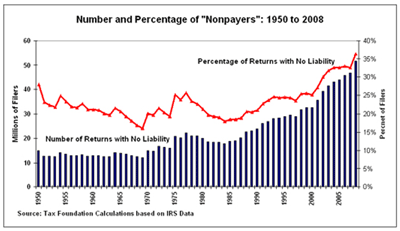
    <ahref="http://blog.heritage.org/wp-content/uploads/Nonpayer-Chart.gif"></p>The Tax Foundation recently released <ahref="http://www.taxfoundation.org/publications/show/25962.html">its annual report on the number of tax returns filed that have no tax liability, and the study shows a record number of “nonpayers” in 2008. Taxpayers become “non-payers” when credits and deductions wipe out any income tax they owe.

    According to the Tax Foundation report, of the more than 142 million returns filed in 2008, almost 52 million have no tax liability. That means more than 36 percent of tax filers paid no income taxes in 2008 – a new record high. This was a steep increase over 2007 when fewer than 33 percent of filers paid no taxes. As the table below shows, the growth of non-payers is a long-term trend that has been accelerating in recent years. For instance, 21 percent of taxpayers were non-payers in 1990.

    <spanid="more-28656"></span>The amount of income that a family can earn and still be non-payers is also alarming. In 2010, a family of four can earn up to $51,000 and still pay no income taxes.

    Not only do a record number of taxpayer’s pay no taxes, but many of them actually receive cash payments through the tax code because of refundable credits like the Earned Income Tax Credit (EITC) and the Child Tax Credit. According to the Tax Foundation, cash payments from these two credits alone totaled over $70 billion.

    President Obama’s policies will add to the numbers of non-payers and the amount of income redistributed because he wants to expand and add even more refundable credits.

    Like the Tax Foundation’s report, the <ahref="http://www.heritage.org/Research/SocialSecurity/cda1001.cfm">Heritage Foundation’s Index of Dependence on Government shows a growing dependence on government and a substantial increase in recent years. According to the report, the average recipient of government aid received over $26,000 in assistance in 2008 – a record high.

    The growing dependency on government and shrinking number of taxpayers is troubling and will lead to an even faster rise in unsustainable government spending unless the trend is reversed. Congress should start by ceasing the expansion of refundable tax credits. It should then <ahref="http://www.heritage.org/Research/Budget/wp0408.cfm">reform entitlement programs like Social Security and Medicare before baby-boomers start collecting benefits from them and dependency on government explodes even further. If Congress starts soon perhaps it won’t be too late to stop the impending fiscal implosion.

    http://blog.heritage.org/2010/03/11/…-record-level/

  • Morning Bell: Obamacare at Any Cost

    On 03.12.10 06:42 AM posted by Conn Carroll

    Yesterday the White House <ahref="http://voices.washingtonpost.com/thefix/white-house/white-house-memo-argues-health.html">circulated a memo by pollster Joel Benenson. It was designed to create momentum for Obamacare by convincing wayward House Democrats that support for the President’s plan has been building since the State of the Union. As with everything else that comes out of the White House on health care these days, the memo is nothing but pure fantasy.

    This Tuesday, Gallup released its latest poll showing that by a <ahref="http://www.gallup.com/poll/126521/Favor-Oppose-Obama-Healthcare-Plan.aspx">48%-45% margin Americans would tell their representative in Congress to vote against President Obama’s health plan. Compare that to the last time Gallup asked the question in January, Americans supported the President’s plan <ahref="http://www.gallup.com/poll/125030/Healthcare-Bill-Support-Ticks-Up-Public-Divided.aspx">49%-46%. That’s a net six point loss in support for the President’s plan since the State of the Union. That is momentum. Against Obamacare.

    And Gallup isn’t alone. The <ahref="http://news.yahoo.com/s/ap/20100309/ap_on_bi_ge/us_ap_poll_health_care">Associated Press released a poll this week showing that 68% of Americans believe the President and Congressional Democrats shouldn’t pass their health care plan without Republican support.* “Nothing has been more disconcerting than to watch Democratic politicians and their media supporters deceive themselves into believing that the public favors the Democrats’ current health-care plan,” Democratic pollsters Pat Caddell and Doug Schoen add in today’s <ahref="http://www.washingtonpost.com/wp-dyn/content/article/2010/03/11/AR2010031102904.html">Washington Post, “A solid majority of Americans opposes the massive health-reform plan.”<spanid="more-28664"></span>

    Yesterday was particularly tough for the President’s plan. First, <ahref="http://tpmdc.talkingpointsmemo.com/2010/03/little-progress-as-dems-hash-out-health-care-plan.php">the White House underwhelmed the Democratic Caucus in a presentation of the new (still unwritten) reconciliation bill. Then, the Senate Parliamentarian <ahref="http://cdn.rollcall.com/media/44110-1.html">killed the Democrats favored procedural path for passage by signaling he would rule that President Obama must sign the original Senate bill into law before the Senate could act on the President’s new reconciliation package. Finally, the Associated Press reported that House leaders have abandoned all hope of finding language to satisfy Rep. Bart Stupak’s (D-MI) concerns that the Senate bill funds abortion. By the end of the day, the leftist firedoglake site had dropped <ahref="http://news.firedoglake.com/2010/03/11/new-health-care-whip-count-189-yes-202-no/">its count of committed House Democrats for passage to 189 (Speaker Pelosi needs 216 for passage).

    With the loss of Stupak and his 7-12 member caucus opposed to taxpayer-funded-abortions, Speaker Pelosi will have to find the remaining dozen plus votes from the ranks of cost conscious Blue Dog Democrats. For example, Rep. Suzanne Kosmas (D-FL) who voted against the House bill in the fall <ahref="http://prescriptions.blogs.nytimes.com/2010/03/04/for-many-house-democrats-cost-is-the-concern/?pagemode=print">explained at the time: “According to the Congressional Budget Office, the House health care bill will actually increase federal health care spending over the long term, while proposals being considered by the Senate would have a net decrease.” But according to a new CBO score of the Senate bill passed on Christmas Eve (the one with the Cornhusker Kickback), it <ahref="http://www.cato-at-liberty.org/2010/03/11/the-senate-bill-would-increase-health-spending/">actually increases health care spending. And the reconciliation bill only make things worse, since, <ahref="http://blog.heritage.org/2010/03/09/morning-bell-dead-legislation-walking/">among other increased spending measures, President Obama “fixed” the Cornhusker Kickback not by eliminating the new spending, but by extending it to all 50 states.

    With <ahref="http://thehill.com/homenews/house/86193-house-dem-no-votes-on-healthcare-reform-pile-up">no votes piling up, and* <ahref="http://hotlineoncall.nationaljournal.com/archives/2010/03/updating_the_he_2.php">“yes” votes materializing, the Democratic plans to shove Obamacare down the throats of the American people are becoming more and more desperate. This Monday, the House Budget Committee will <ahref="http://corner.nationalreview.com/post/?q=MWIwMmYzMjMzYTJhZjZjYTRkY2MzZDgxYzRiYTc5MDE=">b egin markup on the new reconciliation bill even though actual legislative text does not exist for it yet. The Democrats plan to pass a shell of a bill through the appropriate committees so that the Rules Committee can then substitute the bill that is being drafted completely behind closed doors by the White House and Senate and Democrat leaders.

    Politico reports that despite the Parliamentarian’s initial verbal ruling, they will press on with their Slaughter Rule plan to pass the Senate bill without voting on it. NRO’s Yuval Levin <ahref="http://corner.nationalreview.com/post/?q=NzdjZDRiNWIxMzI3NDlhNWVjZDcyZDFkOWQ1NzBkZGM=">q uips: “Democratic leaders should be asking themselves just how they have gotten to the point that their strategy is to amend a law that doesn’t exist yet by passing a bill without voting on it.”

    But President Obama’s progressive base is way past rational thought when it comes to health care. They want it passed at any cost. And as George Will <ahref="http://www.washingtonpost.com/wp-dyn/content/article/2010/03/10/AR2010031002638.html">pointed out yesterday, the very essence of progressivism sublimates the democratic process to the rule of experts in Washington. No one can say if this bill will finally pass, but if it does, it is abundantly clear that our republican form of government will be permanently damaged by it.

    Quick Hits:

    • House Republicans agreed Thursday to adopt <ahref="http://edition.cnn.com/2010/POLITICS/03/11/gop.earmarks/">a ban on congressional earmarks in spending bills for next year.
    • The Justice Department <ahref="http://www.nytimes.com/2010/03/12/us/politics/12holder.html?partner=rss&emc=rss">acknowledged yesterday that Attorney General Eric Holder failed to disclose to the Senate that he had signed several briefs arguing the President has no power to detain American citizens as enemy combatants.
    • Countrywide Financial special loan recipient Sen. Chris Dodd (D-CT) will <ahref="http://abcnews.go.com/Politics/dodd-set-unveil-wall-street-reform-package-bipartisan/story?id=10073604">unveil his financial reform bill on Monday without any bipartisan support.
    • The Obama administration has <ahref="http://www.nytimes.com/2010/03/12/us/12border.html">fallen far behind in making anti-corruption checks on new hires and current employees on the Mexican border.
    • President Barack Obama <ahref="http://www.bloomberg.com/apps/news?pid=20601103&sid=aNSmCLwBWFX0">promised yesterday to revive legislation that would grant amnesty to millions of illegal immigrants currently in the United States.

    http://blog.heritage.org/2010/03/12/…e-at-any-cost/

  • Hollywood: Chavez?s Last Bastion of Support

    On 03.12.10 07:00 AM posted by Michael Powell

    <ahref="http://blog.heritage.org/wp-content/uploads/Chavez-Penn-100311.jpg"></p>In the wake of a devastating report on his presidency by the Organization of American States’ (OAS) Inter-American Commission, Venezuelan President Hugo Chavez’s loudest defense <ahref="http://www.foxnews.com/entertainment/2010/03/08/sean-penn-wants-reporters-jailed-calling-chavez-dictator/">has come from actor Sean Penn, known most recently for his roles in <ahref="http://www.imdb.com/title/tt1013753/">Milk and <ahref="http://www.imdb.com/title/tt0327056/">Mystic River.

    <ahref="http://cidh.org/pdf%20files/VENEZUELA%202009%20ENG.pdf">In the OAS report, Chavez is accused of not only centralizing his own power but eliminating his country’s private sector, repression of opposition media outlets and criminalization of human rights groups. Appearing on the HBO show “Real Time with Bill Maher,” Penn denied Chavez’s tyranny, saying, “Every day, this elected leader is called a dictator here, and we just accept it, and accept it,” before adding that he believed those who call Chavez a dictator should be imprisoned, “truly, there should be a bar by which one goes to prison for these kinds of lies.”

    <spanid="more-28647"></span>Penn’s role as Chavez propagandist is lockstep with Hugo Chavez’s dismissal of the OAS report. In his response, Chavez showed himself to be little more than a strongman, whose power is based on bullying and intimidation, ridiculing the OAS report in a manner that would be hilarious if it weren’t so sickening. In a fit of rage unbecoming anyone who would deem themselves a “leader,” Chavez said that Santiago Canton, the head of OAS, was “<ahref="http://www.guardian.co.uk/world/2010/feb/25/oas-report-chavez-human-rights">executive excrement, pure excrement” and that the OAS was a “mafia.”

    However passionate he may be for the Venezuelan dictator, Penn is a lone voice in an increasing loud chorus of condemnation aimed at Chavez. <ahref="http://www.washingtonpost.com/wp-dyn/content/article/2010/02/28/AR2010022803492.html">In a harsh editorial in the Washington Post last month, the newspaper deemed the OAS report as “a powerful and sometimes chilling account” and a late response “to the steady deterioration of Latin American democracy during the past few years.” With so many voices, it’s time to ask who we should trust: the sobering report of the OAS or a celebrity who is clearly out of his league when it comes to politics?

    Michael Orion Powell is currently a member of the Young Leaders Program at the Heritage Foundation. For more information on interning at Heritage, please visit: <ahref="http://www.heritage.org/about/departments/ylp.cfm">http://www.heritage.org/about/departments/ylp.cfm

    http://blog.heritage.org/2010/03/12/…on-of-support/

  • The Real Debt Washington Doesn’t Want You to Know About

    On 03.12.10 07:02 AM posted by Alison Fraser

    Remember how public anger over the federal debt reaching new sky-high levels last year drove lawmakers into a flurry of discussions about budget controls? Responding to public and international pressure to do something about permanently spiraling deficits, President Obama established a <ahref="http://blog.heritage.org/2010/01/20/please-no-white-house-lame-duck-commission/">flawed commission to tackle the spending problem. Congress, doing its part, voted for a massive $1.9 trillion increase in the debt limit to $14.3 trillion. That increase was so large it would allow them to spend freely during this election year without upping the limit on the federal credit card again. What’s more, they could use the Obama’s commission as a figleaf of cover towards fiscal responsibility. Bad enough, right? But the real story behind the nation’s debt is far worse.

    The debt limit is comprised of two types of debt: debt held by the public and debt held by other governmental entities like the Social Security Trust fund. This measures money lent to the federal government by others as well as money lent from one part of the government to another. But there is much more the taxpayers are on the hook for and it can be found in the Annual Financial Report of the United States Government. The recently released report for 2009 shows that total liabilities are $14.5 trillion, more or less equal to the debt, but up $2.3 trillion from 2008, driven by spending on TARP and declining revenues and tax cuts for low income Americans. However, the long-term excess costs from burgeoning entitlement costs like Social Security and Medicare are $45.8 trillion, up $2.9 trillion – a far larger increase. Along with other commitments and contingencies, the total obligations of the U.S. Government total $63.3 trillion, or $63,300,000,000,000. <spanid="more-28685"></span>

    If that makes your eyes glaze over, this represents a debt burden of $200,000 for every man woman and child in America. It is a $16,000 jump over last year. This is the real debt that Washington doesn’t want you to know about. This is the real debt that Congress must immediately get serious about. So when Congress passes new spending bills or a massive new entitlement benefit like the health care bill now being debated, they should tell the taxpayers – present and future- how it will affect this real debt – $63.3 trillion, $200,000 for every American.

    http://blog.heritage.org/2010/03/12/…to-know-about/

  • Obama Admin on Welfare: ?Who?s to Say What is Enough??

    On 03.12.10 07:30 AM posted by Kiki Bradley

    </p>Yesterday, the U.S. House of Representatives Ways and Means Subcommittee on Income Security and Family Support held a hearing on the Temporary Assistance for Needy Families (TANF) program and its role in providing assistance to struggling families.

    The Obama Administration’s witness, Assistant Secretary for the Administration for Children and Families, Carmen Nazario, included in <ahref="http://waysandmeans.house.gov/media/pdf/111/Carmen_Nazario_Testimony.pdf">her testimony a request to extend for a year the TANF Emergency Fund at a cost of $2.5 billion. This would extend a $5 billion program created in the Stimulus package last year that severely undermines the success of welfare reform. It essentially pays states for every new TANF case added to the caseload <ahref="http://www.heritage.org/Research/Family/wm2819.cfm">creating a perverse incentive to grow the size of the welfare state. <spanid="more-28688"></span>

    Robert Rector, Senior Research Fellow at The Heritage Foundation, testified at the same hearing that federal and state welfare spending under the Obama Administration is already on a trajectory to spend $953 billion in 2011 on means-tested programs for the poor. This prompted the Ranking Republican on the Committee, Congressman John Linder, to ask Ms. Nazario, “Is it your testimony that $953 billion is not enough?” See her response in the video above.

    Rector’s <ahref="http://waysandmeans.house.gov/media/pdf/111/Robert_Rector_Testimony.pdf">testimony went on further to say:

    President Obama’s increase in federal means-tested welfare spending during his first two years in office is two and a half times greater than any previous increase in federal welfare spending in U.S. history, after adjusting for inflation.

    According to the long-term spending plans set forth in Obama’s FY 2010 budget, combined federal and state spending will not drop significantly after the recession ends. In fact, by 2014, welfare spending is likely to equal $1 trillion per year…..$10.3 trillion over the next 10 years. This spending will equal over $100,000 for each taxpaying household in the U.S.

    It’s clear from the President’s 2011 budget as well as those testifying on behalf of the Administration that continuing to increase welfare spending at historic levels is a priority despite the record level deficit. In these tough economic times, President Obama is intent on keeping his promise to “spread the wealth” while at the same time bankrupting America.

    http://blog.heritage.org/2010/03/12/…hat-is-enough/

  • To Answer or Not to Answer the Census – That Is the Question

    On 03.12.10 08:09 AM posted by Conn Carroll

    I have been deluged lately with requests asking me whether one has to answer all of the questions on the 2010 Census, particularly those about race and ethnic background. Like <ahref="http://corner.nationalreview.com/post/?q=NDAzNTgyZTM4NGRiMzUxNDk2MzljMDBlMDdlYTQxMzU=">M ark Krikorian, I don’t like those questions and don’t think the U.S. government should be collecting that information — its only use is to continue to separate us on racial grounds, for reapportionment purposes and for certain government programs.

    Mark has said that he is going to answer “American” on the race question. I have always been tempted to answer “Native American,” since I was born and raised here. However, people need to understand that they may incur a legal liability if they use such answers or don’t answer questions at all.<spanid="more-28706"></span>

    In Article I, Section 2, the Constitution says that an “Enumeration” must be conducted every ten years “in such Manner as [Congress] shall by Law direct.” Congress has directed through a federal law that anyone who “refuses or willfully neglects…to answer, to the best of his knowledge, any of the questions” on the Census form can be fined $100 (13 U.S.C. § 221). If you deliberately give a false answer, you can be fined up to $500.

    Although there are not a lot of reported prosecutions, this statutory requirement has been upheld by the courts as constitutional. There is even a 1970 court decision from Delaware holding that there is a separate violation for each question you don’t answer. So, on this year’s ten-question Census form, you could be fined as much $1,000 — $5,000 if you refuse to answer or deliberately give false answers. If there was a mass refusal by millions of Americans to answer parts of the form — like the race question — the U.S. Justice Department would not have the resources to prosecute everyone who violated the law. But you could be prosecuted and fined, and there is a court decision from New York (which the Supreme Court refused to review) holding that a conviction for violating this law is valid even if there were other persons who also refused to fill out the form but were not prosecuted. (One curious exception to that: The liberal Ninth Circuit reversed a conviction when it was shown that the defendant might have been targeted due to his publicly held “dissident” view that the Census is an unconstitutional invasion of privacy.)

    Everyone should realize that if you don’t complete a Census form, you are violating federal law. The chances of actual prosecution may be remote, but it could happen. The only real answer to this problem is for Congress to prohibit the Census Bureau from collecting such information and to make all government programs (and the reapportionment process) explicitly race-neutral.

    <ahref="http://corner.nationalreview.com/post/?q=MjU1YTE0ZjQ5YTYwMWVkMzlmMTc5MTIxY2I2ODQyY2I">Cr oss-posted at <ahref="http://corner.nationalreview.com/">The Corner.

    http://blog.heritage.org/2010/03/12/…-the-question/

  • Federal Preschool Programs Waste Taxpayers’ Money, Limit School Choice

    On 03.11.10 10:00 AM posted by Sarah Torre

    <ahref="http://blog.heritage.org/wp-content/uploads/alphabet-100311.jpg"></p>The alphabet is expensive. The Obama administration’s FY 2011 budget includes $9.3 billion in new spending on an Early Learning Challenge Fund, a new federal preschool program contained within the Student Aid and Fiscal Responsibility Act (SAFRA). The SAFRA, a higher education bill, has passed the House and is awaiting action in the Senate. <ahref="http://www.heritage.org/Research/Education/bg2378.cfm ">

    <ahref="http://www.heritage.org/Research/Education/bg2378.cfm ">Heritage education policy expert Lindsey Burke outlines current federal spending on preschool programs and illustrates that further federal involvement in early childhood education is unnecessary. Burke points out:

    The ultimate goal of the myriad early education bills is to guarantee access to publicly subsidized preschool for all families.…But statistics show that most American children already have access to preschool: More than 80 percent of four-year-old children are enrolled in a preschool program; enrollment of three-year-olds and four-year-olds has increased fivefold since 1964. Moreover, the federal government already provides preschool subsidies to low-income children…turning another benefit for universal preschool into a new subsidy for middle-class and upper-income children.

    <spanid="more-28581"></span>The administration’s plans to increase federal involvement and spending in early education come on the heels of a recently-released study by the Department of Health and Human Services on Head Start, the federal government’s largest preschool program. <ahref="http://www.heritage.org/Research/Education/bg2363.cfm ">HHS found that Head Start offers no long term benefits for participating students, yet the federal government continues to pour funds into these ineffective and inefficient programs. In addition to wasting taxpayer money on programs that fail to increase student achievement, the federal government insists on fixing a problem that doesn’t exist. As Burke illustrates:

    American children are currently well served by the existing network of early education and care providers. More than three-quarters of children are already enrolled in some form of preschool program. Private providers, who make up a substantial portion of the preschool market, are in danger of being crowded out by a large “free” government program and burdensome regulation and certification requirements.

    Rather than uphold the status quo of funding ineffectual federal preschool programs, Congress should reform existing preschool programs such as Head Start. As Burke reasons:

    Policymakers should resist calls for universal preschool because it would lead to the creation of a large-scale taxpayer-funded program of questionable value, which would ultimately limit choice for families….Expanding access to preschool would likely create unnecessary subsidies for middle-class and upper-class families, while generating a disincentive for parental care-giving.”

    Teaching the alphabet to every four year old in America shouldn’t leave those same children with a greater national debt burden. After all, our <ahref="http://www.heritage.org/research/economy/economy-hits-home-002.cfm">entitlement crisis already promises to do that.

    Sarah Torre is currently a member of the Young Leaders Program at the Heritage Foundation. For more information on interning at Heritage, please visit: <ahref="http://www.heritage.org/about/departments/ylp.cfm">http://www.heritage.org/about/departments/ylp.cfm

    http://blog.heritage.org/2010/03/11/…school-choice/