Author: Heritage

  • Is Increasing Education Spending Really Good News?

    On 01.29.10 02:58 PM posted by Dan Lips

    We received an email today from Education Secretary Arne Duncan. “By now, I expect you’ve heard the good news,” the Secretary wrote. “…at a time when most government spending is frozen, the President proposed a significant increase in discretionary spending for education in his fiscal year 2011 budget.”

    We were tempted to respond: What makes you think we’d think this is good news?

    Secretary Duncan’s email offered a sneak-peak of the highlights of the Obama administration’s 2011 budget for education: “a massive increase in student aid” ($156 billion for 2011), a $4 billion increase for K-12 education programs, and new funding ($9.3 billion over 10 years) for a new federal preschool program.

    But is this really good news for American students and taxpayers? Past experiences suggest the answer is negative:

    • In higher education, decades of increasing spending on federal student aid has failed to solve the college affordability problem, and evidence suggests that rising subsidies have spurred skyrocketing tuition costs.
    • In K-12 education, the ever-expanding federal role has done little to fix the crises in our nation’s classrooms. Since the 1970s, federal per-student spending has tripled, while long-term test scores are relatively flat and the performance in many school districts remains abysmal.
    • A new national evaluation of the federal Head Start program found that the largest federal preschool program, which has received $167 billion since 1965, is a complete failure—providing zero lasting benefits for students by the end of first grade. Little is known about the effectiveness of the other 68 federal preschool and child care programs.

    It’s easy to see why Secretary Duncan would see this budget proposal as good news. But we’d hope he’d understand why American taxpayers and students might think otherwise.

    http://blog.heritage.org/2010/01/29/…lly-good-news/

  • Growing Momentum for Iran Sanctions in Congress, But Not So Much at the U.N.

    On 01.29.10 03:00 PM posted by James Phillips

    The Senate yesterday passed a bill that would impose new sanctions on Iran and on companies that assist Iran’s oil industry. The legislation, S.2799, targets companies that supply Iran with gasoline and other refined products or help it to expand its refinery capacity. Although Iran possesses the world’s third largest oil reserves, it must import approximately 40 percent of its gasoline supplies because of a lack of refinery capacity. The House voted to pass similar legislation last month by a vote of 412-12.

    The Senate vote came the day after seven senators wrote a letter urging President Obama to take stronger action to escalate pressure on Iran over its suspect nuclear efforts. The letter, which urged the administration “to do everything that is necessary to stop Iran’s acquisition of a nuclear weapons capability in the critical months ahead,” was signed by Republican Senators Jon Kyl, John McCain, Johnny Isakson, and David Vitter, independent Joe Lieberman, and Democratic Senators Evan Bayh, Robert Casey, Charles Schumer, and Benjamin Cardin.

    Meanwhile, the Obama Administration’s efforts to ratchet up pressure on Iran in the United Nations Security Council faces resistance from the usual suspects: China and Russia. The Wall Street Journal reported that the administration will push for enhanced financial sanctions on Iran and measures aimed specifically at Iran’s Islamic Revolutionary Guard Corps and its huge constellation of enterprises and front companies.

    China, which has a growing trade relationship with Iran, has been dragging its feet on another round of sanctions. It forced a cancellation of a meeting of the five permanent members of the Security Council on Iran in December and only sent a low-level delegation to a meeting on that issue two weeks ago. Russia also has sought to dilute and delay any sanctions at the Security Council. Yesterday Moscow signaled that this resistance is likely to continue: a top arms trade official issued a statement that reassured Iran that it is a valued market for Russian arms exports and noted that no international agreements bar Russia from selling weapons to Tehran.

    This is one more sign that if and when the United Nations Security Council takes action, it is likely to be a day late and a dollar short.

    For more on Iran, see: Iran Briefing Room

    http://blog.heritage.org/2010/01/29/…ch-at-the-u-n/

  • Fine, Now Sell Taiwan the F-16s

    On 01.29.10 03:30 PM posted by Walter Lohman

    The Department of Defense today notified Congress on the sale of $6.4 billion in arms to Taiwan, including patriot missiles, black hawk helicopters and assistance for its military communications network.

    This almost clears the books on sales committed to by President George W. Bush since 2001. President Bush himself closed the deal on half of it in the Fall of 2008 just before leaving office. President Barack Obama is to be commended for making the second part of the sale happen in the face of vociferous, and in some ways unprecedented Chinese objections. The President should now turn expeditiously to addressing needs that have been piling up over the ensuing 9 years – starting with the sale of the 66 advanced F-16C/Ds Taiwan has requested. Taiwan has been stymied on that request now by two Administrations – going back to 2006. These planes are the real meat of Taiwan’s pending requests – and even they, unfortunately, will not completely fill the need.

    The Taiwan-China watching community in the United States, largely resigned to the imbalance in forces across the Taiwan Straits in favor of China, often makes the point that they sales are important “symbolically.” Indeed, they are – and in much the way the commentators intend. They demonstrate U.S. commitment to sell defensive weapons to Taiwan as required by American Law. To the extent that the new sale demonstrates this, it is a very good thing.

    But the limited nature of the sale symbolizes something else entirely, something more powerful – an unwillingness to sell anything that truly counters China’s rapidly modernizing armed forces and the threat they pose to its neighbors. What good is reserving the prerogative to sell weapons to Taiwan if we never get around to selling them what they need most? This is about Taiwan’s defense. It is also about U.S. credibility as a security partner and the maintenance of peace and security in the Asia Pacific: Two things that are closely related.

    http://blog.heritage.org/2010/01/29/…wan-the-f-16s/

  • Escape From New York: Obama Retreats On KSM Trial

    On 01.29.10 06:11 AM posted by Cully Stimson

    Today, the Obama White House asked Attorney General Eric Holder’s Justice Department to look for an alternative site to hold the federal trial of 9/11 mastermind Khalid Sheikh Mohammed and his co-conspirators. In the last week, the political support for the controversial decision to hold the trial in New York City evaporated. Now, the Obama administration is scrambling to find an alternative location for the federal trial. Instead of looking for a new ZIP-code for a costly federal trial, the administration should send those detainees back to a military commission where they belong.

    Earlier this week, Sens. Blanche Lincoln (D-AR), Joe Liberman (I-CT), Jim Webb (D-VA), John McCain (R-AZ), Lindsay Graham (R-SC) and Susan Collins (R-ME) sent a letter to the President asking him to strongly reconsider his decision to try KSM in a federal court. The attacks of 9/11 were acts of war, they argued, and thus those responsible should be tried as “war criminals.” In other words, send them back to military commissions.

    The NYC Police Commissioner opined that he did not support holding the trials in the city. It’s no wonder, given that the estimated cost for providing police and other security for the trials keeps creeping upwards. Most recently, it was estimated that it would cost at least $200 million a year for security alone. Keep in mind that the trial could last years. Some put the total cost estimate at over $1 billion.

    NYC Mayor Michael Bloomberg, who apparently was not consulted about the decision to hold the trials in his city, first supported the idea. Then, after the gravity of the situation sank it, he withdrew his support.

    Since the decision to hold the trial in NYC was announced by Eric Holder, residents there grew more and more skeptical of the decision. Many were outright hostile to the idea.

    Yesterday, Sen. Diane Feinstein (D-CA), who chairs the Senate Select Committee on Intelligence, publicly withdrew her support for the location of the federal trial in Manhattan. That was the tipping point.

    And finally, liberal New York Senator Charles Schumer, who staunchly defended the decision to try KSM in federal court in NYC, called the White House and asked them to strongly consider finding an alternate location for the trials.

    So much for standing up for principle and having the courage of one’s convictions.

    No doubt the administration is working behind the scenes to find an alternative site for the federal trials, but what mayor or citizenry of a major city will now step up and beg for the trial, especially given Mayor Bloomberg’s public statements about the danger and costs that come with it?

    Perhaps the administration will seek out a “Thompson” option (Thompson is the name of the underused state facility in Illinois where Obama wants to bring Gitmo detainees.) After being rebuffed by large city mayors, will they seek out a small or mid-size city for the federal trial, with the illusory promise of “jobs?” Perhaps.

    It is time for the administration to acknowledge the folly of deciding to try KSM and others in federal court and refer them back to a military commission where they belong. Then, the administration should give commissions the full resources that they have lacked, including world class prosecutors and defense counsel.

    The tide is turning against the administration’s approach to terrorism. Perhaps that is why the President did not mention KSM during his State of the Union address. Americans don’t think terrorists deserve constitutional rights. Americans also know that military commissions are fair.

    The administration has an opportunity to do the right thing. If they don’t, Congress may force their hand.

    http://blog.heritage.org/2010/01/29/…-on-ksm-trial/

  • Morning Bell: It Is Time To Prioritize Security Over Terrorist Rights

    On 01.29.10 06:46 AM posted by Conn Carroll

    Yesterday,*the White House ordered the Department of Justice to begin considering places other than New York City to host the civilian criminal trial of 9/11 mastermind Khalid Sheikh Mohammed and four other terrorists. The New York Times describes a decision to move the trials out of New York as “a retreat by the administration” and reported that the Obama administration “was scrambling” to find a new way forward.

    This latest bit of self-inflicted national security chaos comes after Obama ally New York Mayor Michael Bloomberg announced yesterday that he did not want KSM’s trial in Manhattan. And Bloomberg was not the only Obama sympathizer to plead with the President to rethink his detainee policies. Six Senators, including Sens. Joseph Lieberman (I-CT), Blanche Lincoln (D-AR), Jim Webb (D-VA), John McCain (R-AZ), Susan Collins (R-ME) and Lindsey Graham (R-SC) all signed a letter saying of KSM and his conspirators:

    You will be providing them one of the most visible platforms in the world to exalt their past acts and to rally others in support of further terrorism.

    And the KSM trial debacle is not the only sign the Obama administration is putting their personal politics over protecting American citizens. Last week, the nation’s top intelligence official, Director of National Intelligence Dennis Blair, told a Senate committee that the Obama administration was wrong to question Flight 253 would-be-bomber Umar Farouk Abdulmutallab with civilian law officers instead of using specially trained interrogators from the recently-created High-Value Detainee Interrogation Group.

    These concerns were then echoed by 9/11 Commission heads former-Gov. Thomas Kean (R-NJ) and former-Rep. Lee Hamilton (D-IN), who said U.S. intelligence agencies should have been consulted before Abdulmutallab was granted constitutional protections under U.S. law, known as Miranda rights, and initially stopped talking to investigators.

    It is high time for the Obama administration to stop allowing their leftist base to undermine our national security. As Heritage fellow Cully Stimson explains, returning KSM to a military court would be a great place to start:

    It is time for the administration to acknowledge the folly of deciding to try KSM and others in federal court and refer them back to a military commission, where they belong. Then, the administration should give commissions the full resources that they have lacked, including world-class prosecutors and defense counsel.

    The tide is turning against the administration’s approach to terrorism. Perhaps that is why the President did not mention KSM during his State of the Union address. Americans don’t think terrorist deserve constitutional rights. Americans also know that military commissions are fair.

    Quick Hits:

    • A day after President Obama’s State of the Union address, The Washington Post reports that Democrats are “confused” about how to move forward on their legislative agenda.
    • Sen. Mary Landrieu (D-LA) called parts of Obama’s speech “a little strange, a little odd,” and said health care reform “is on life support.”
    • A day after President Obama ripped lobbyists in his State of the Union address, his administration invited K Street insiders to join private briefings on a range of topics.
    • The Senate voted to raise the legal limit on government borrowing by $1.9 trillion, making the $14.3 trillion current limit a historic high.
    • Small businesses do not believe that President Obama’s package of loans and tax incentives will do anything to spur hiring.

    http://blog.heritage.org/2010/01/29/…rorist-rights/

  • Obama?s Bank Tax: Missing the Target

    On 01.29.10 06:51 AM posted by James Gattuso

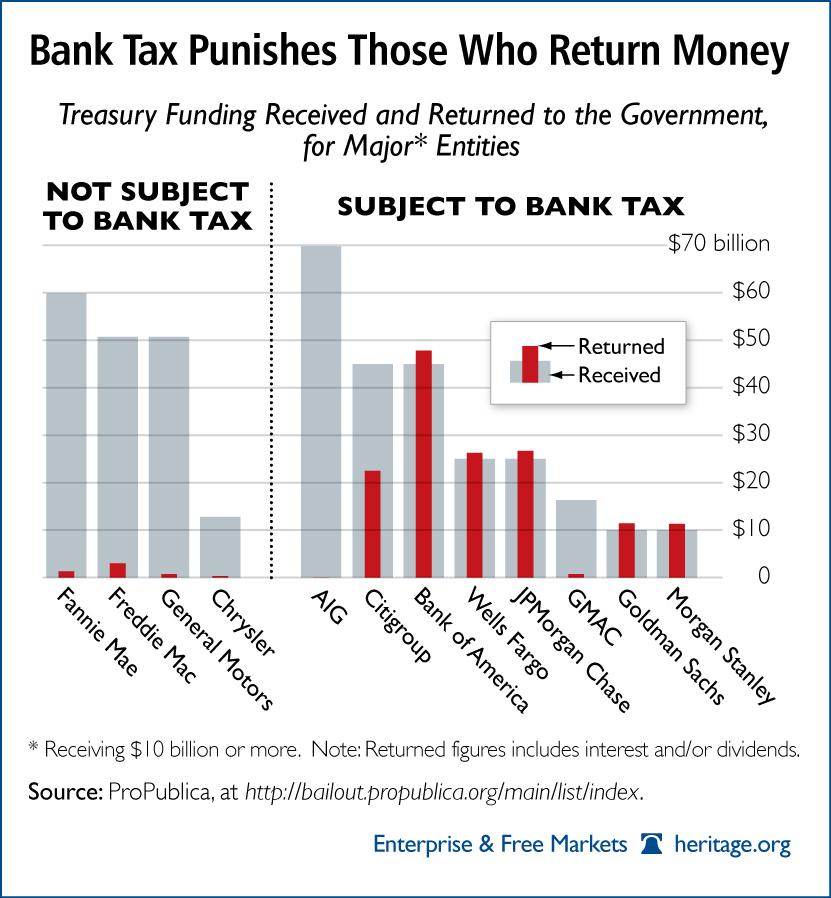
    In his State of the Union address Wednesday night, President Obama repeated his call for a tax on banks, calling it “a modest fee to pay back the taxpayers who rescued them in their time of need.” That sounds good, everyone agrees the taxpayer’s money should be paid back. But there’s a bit of misdirection going on here.

    As shown in the chart above, most big banks have already paid back the government money they received, with interest. On the other hand, most of the big companies that still owe billions to taxpayers, including Fannie Mae and Freddie Mac, and auto firms GM and Chrysler would not be subject to the tax. Only two big firms, AIG and GMAC, owe the government and would pay the tax. Even in these cases, the “modest fee” won’t add anything to the government’s coffers — any taxes they pay would simply reduce the amount the amounts they pay back.

    The plan will do nothing to help taxpayers or get bailout money returned to the Treasury. It makes for good rhetoric — what politician doesn’t want to sound anti-bank nowadays? — but is no substitute for real policy.

    http://blog.heritage.org/2010/01/29/…ng-the-target/

  • Democrats? Health Care Plans Come at High Cost to the Young

    On 01.29.10 07:49 AM posted by Kathryn Nix

    Extending health care to the uninsured and those who can’t get coverage for pre-existing conditions is the epicenter of Democrats’ health care bills, but achieving that goal requires adding younger, healthier Americans to insurance pools to hold down costs. And achieving coverage for sicker populations comes at a significant price to young Americans, according to a recent report by Rea Hederman and Paul Winfree of Heritage’s Center for Data Analysis.

    Two provisions in the bills ensure that those with pre-existing conditions will be able to get coverage at an affordable cost. *”Guaranteed issue” requires that insurance companies provide coverage to anyone, regardless of their medical history, and age rating would entail insurance companies charging older or sick customers no more than twice as much (three times as much in Senate bill) as they charge younger enrollees. This guarantees that premiums for the young will increase to subsidize the cost of covering the older and more sickly population.

    Increased premiums would inevitably discourage more youth, not less, from purchasing insurance. In order to counter this effect, the bills include provisions to ensure that younger Americans still join the risk pool: an individual mandate to purchase insurance and subsidies to purchase insurance for low and middle-income singles and families.

    But, according to Hederman and Winfree, “Unfortunately, trying to fix one flawed policy (the rating restrictions and guaranteed issue requirements) by adding another flawed policy (the mandate and costly subsidies) only makes the policy outcome even worse

    CDA’s findings echo predictions from the Congressional Budget Office that premiums in the non-group market will increase as a result of the bills. CDA shows these premiums increasing 10 to 13 percent. Rather than encouraging younger Americans to purchase insurance, this will achieve the opposite, thereby increasing premiums for the older and sicker population who must purchase insurance as younger Americans leave the market.

    The individual mandate is intended to force youth into the market, but further CDA analysis shows that this will not occur. Instead, most youth will opt out, largely because of the higher premiums that would result from the guaranteed issue and age rating provisions, but also because the penalty for not purchasing insurance would be significantly lower than premiums.

    For those to whom the individual mandate will apply and who are eligible for the health exchange, CDA predicts only 12 percent of single uninsured individuals under 35 will purchase insurance. Only 20 percent of families in the same category would bcome insured, and of the uninsured that don’t qualify for subsidies in the exchange, only 5 percent are expected to buy insurance. Altogether, CDA finds that greater than 93 percent of insured households would sooner pay the penalty and than purchase insurance at higher premiums.

    As Hederman and Winfree explain, “this quickly becomes a downward cycle as insurance costs increase, which will drive out more and more of those who are less costly to insure. Insurers will have no choice but to raise premiums, as they face paying out far more in benefits to cover a sicker pool…” *Clearly, the consequences of Obamacare are disadvantageous for everyone.

    http://blog.heritage.org/2010/01/29/…-to-the-young/

  • Repealing the Death Tax: A Good Deal for Everyone

    On 01.28.10 11:30 AM posted by Kathryn Nix

    While jobs and the economy are at the forefront of all Americans’ minds, Congress has the ability to create jobs, raise federal revenues, and boost the economy at the end of their fingertips —without any expense to the taxpayer. This could all be achieved simply by permanently repealing the death tax.

    At a lecture at the Family Research Council, Dick Patten, the President of the American Family Business Institute, presented a compelling case for repealing the death tax. The death tax is a costly burden for small family-owned businesses. According to President Obama, small business “created roughly 70% of all new jobs in the past decade.” And yet the death tax punishes growth of these job producers by making it difficult for them to succeed after the death of their owner. A study by Prince and Associates showed that “the need to raise funds to pay estate taxes” was cited by 98% of respondents as the reason for failure of such firms.

    The death tax has been on a path towards elimination since 2001, thanks to the 2001 and 2003 tax cuts. Those cuts abolished the tax for 2010, but only for one year. The tax comes roaring back to life in 2011 at its rate and exemption levels prior to the cuts. Now Congress must decide whether to repeal the currently dormant tax permanently, or to allow it to resume in 2011 at its pre-tax cut levels: 55 percent on estates worth over $1 million. Hanging in the equation are jobs and economic growth.

    The decision should be an easy one given the facts. Patten outlined studies done by former director of the Congressional Budget Office Douglas Holtz-Eakin, Ph.D and Stephen Entin, President of the Institute for Research on the Economics of Taxation show that while reinstating the death tax would cost 500,000 jobs, repealing it altogether would actually create 1.5 million jobs—almost half of President Obama’s not yet reached goal of 3.5 million jobs under the $800 billion stimulus bill.

    What is more, unlike the President’s failed stimulus plan, repealing the death tax would have no net cost. Rather, federal revenues would rise were the death tax to permanently expire. Entin shows that fully repealing the death tax would decrease revenues for the federal government by $19.2 billion a year, relative to 2009 rates. However, revenues from other tax collections would increase as a result, to a total of $42.4 billion. Together, this means that repealing the death tax would create a net federal yearly revenue gain of $23.3 billion, more than doubling the revenue created by the death tax. Congress could then cut income tax rates for all taxpayers to make sure there is not a net tax increase.

    Many wrongly see the tax as a mode of redistribution from the wealthy to the not-so-wealthy. But in reality, the death tax punishes middle and low-income Americans by discouraging new hiring and stifling new growth.

    The United States has the third highest death tax in the world. All other western countries tax estates well below what we do. Furthermore, in Heritage’s recent publication of the Index for Economic Freedom, all of the countries that ranked more economically free than the United States did not have a death tax at all. The choice is clear: repeal the death tax and protect American prosperity by ensuring jobs and economic growth at zero cost to the taxpayer, or allow the tax to continue to lead us down the road towards economic decay.

    http://blog.heritage.org/2010/01/28/…-for-everyone/

  • The President Looks Inward

    On 01.28.10 12:28 PM posted by Theodore Bromund

    In publicizing the President’s State of the Union address, Senior Adviser Valerie Jarrett announced that one of the achievements of which the administration was most proud in its first year in office was its action to repair “badly frayed global alliances” and “to restore America’s leadership in the world.” That leadership was not much in evidence in the President’s speech, which is only fitting, because it has been lacking in reality as well.

    The President name-checked the obvious foreign crises. Haiti, predictably, took pride of place, and here, at least, the administration does have something to be proud of. Its response is no more than previous administrations would have done, and it comes after the U.S. defaulted on leadership by turning the management of Haiti over to the UN in the mid-1990s, but it was prompt and substantial.

    Some on the left, predictably, have criticized the President for his action, but in an otherwise gloomy year for American leadership, it was a response worthy of the applause it received.

    The rest of the world passed by in very quick review. What was striking about the President’s claims of unity and determination on Iran and Afghanistan is how completely they are contradicted by the facts, and even by his own words. The Administration’s policy on Iran is in tatters: the open hand to Iran he extended has been repeatedly smacked away, and, spite of the President’s optimistic assertions to the contrary, the reset of relations with Russia has not inclined Moscow – never mind Beijing – to support sanctions. Nor did the President recognize that his dream of abolishing nuclear weapons does absolutely nothing to persuade the Iranians to follow suit. And while the President’s glowing words about America’s need to “stand on the side of freedom and human dignity” were well put and true, they would have rung even truer if the administration had taken even one single, solitary action to support the protesters in Iran in June, instead of throwing them to the wolves.

    On Afghanistan, the President’s early belief that he would succeed in bringing the Europeans into the fight simply by virtue of not being George W. Bush has been comprehensively crushed. Only yesterday French President Sarkozy announced, in advance of a much hyped London summit on Afghanistan, that France had no interest in sending any more troops to Afghanistan, in spite of his own statement that nuclear-armed Pakistan would fall if the Taliban win in Afghanistan. The President paid this no attention, and did not help his own cause by firmly reiterating his arbitrary July 2011 deadline to begin to put Afghan forces in the lead.

    The awkward fact is that, while the President has done a great deal of traveling, he does not have a single substantial foreign policy achievement to his credit, or any stronger partnerships abroad to celebrate. The administration has gone out of its way to ignore and insult Britain, whose forces are fighting side by side with America’s in Afghanistan, and relations with other friends old and new, from Japan to Poland to India, are at a low ebb. It is amazing but true that the U.S.’s relations with every single one of its democratic allies are worse now than they were when George W. Bush left office.

    For the past twelve months, conservatives have made one fundamental critique of the President’s foreign policy: it mistakes words for substance and personality for policy. Winning the Nobel Peace Prize is delightful, but receiving it for nothing except promises only validated the conservative critique. Recently, the President acknowledged that his critics had it right all along. In an interview with Politico about the Middle East, the President stated: “This is just really hard. . . . it was very hard for [the Israelis and Palestinians] to start engaging in a meaningful conversation. And I think that we overestimated our ability to persuade them to do so.”

    Yes, Mr. President, the Middle East is hard. But so is Russia. So is Afghanistan. So are Venezuela, China, Pakistan, and Iran. They’re all hard. The easy problems never get to the White House. And all of the hard problems have something in common: they are created by people, states, and institutions with ideas and interests of their own. They will not be taken in fantasies about engagement or deluded by Oval Office rhetoric into abandoning policies they have pursued for years.

    There is a place for rhetoric in the making of American foreign policy, which must be based on clear principles, clearly enunciated.

    But, as Sarkozy put it in September, it is “incredibly naive and grossly egotistical” for the President to believe that the fate of American leadership, and America’s alliances, rests solely on the charismatic appeal of his words and his personality around the world.

    The mistake the President has acknowledged about his Middle East policy is central to his foreign policy as a whole. The United States, and the world, needs a lot less of Obama the symbol, and a lot more of Obama the President. Unfortunately, last night’s speech did not give either the nation or the world what it needs.

    http://blog.heritage.org/2010/01/28/…-looks-inward/

  • What Next? PETA Proposes Robot Groundhog

    On 01.28.10 01:00 PM posted by Brandon Stewart

    Next week, Punxsutawney Phil will make his annual appearance to decide whether we will experience another six weeks of winter or whether spring has finally arrived. However, PETA has other plans — they have*demanded that Phil be replaced this year with a robot. You got that right — a robot. According to the Associated Press:

    People for the Ethical Treatment of Animals says it’s unfair to keep the animal in captivity and subject him to the huge crowds and bright lights that accompany tens of thousands of revelers each Feb. 2 in Punxsutawney, a tiny borough about 65 miles northeast of Pittsburgh. PETA is suggesting the use of an animatronic model.

    However, it doesn’t look like Phil is going anywhere soon. According to event organizers, the groundhog is “treated better than the average child in Pennsylvania” and even receives an annual checkup from the Pennsylvania Department of Agriculture.

    But while we will await Phil’s predictions, we don’t need him to predict the climate in Congress. We know that despite the shakeups of the last few weeks, far too many in Congress are still hostile to the sorts of market-driven solutions we need to get our country back on track and restore our place among the world’s freest*economies.

    http://blog.heritage.org/2010/01/28/…bot-groundhog/

  • No OSP Students in the First Lady’s SOTU Box

    On 01.28.10 01:32 PM posted by Lindsey Burke

    Last night, one of the coveted seats in the First Lady’s Box was occupied by Clay Armstrong, a recent graduate of Ballou High School, part of the D.C. public school system. The Washington Post reports:

    Armstrong does not shy away from describing his life at Ballou as difficult, stressful and disadvantaged. ‘It was tough, but I handled it pretty well,’ he says. ‘There were fights every day and people have gotten stabbed. People have gotten shot. There’s constantly people being knuckleheads and trying to be the class clown.’

    Fortunately, as Mr. Armstrong puts it, “I was big on self-motivation.” While Armstrong’s personal achievements were impressive enough to earn him a seat in the First Lady’s Box last night, unfortunately, he is the exception that proves the rule. Despite Chancellor Rhee’s efforts to reform the D.C. public schools, the system remains one of the most troubled in the country. Students in the Nation’s Capital rank nearly dead last in academic achievement and attend classes in the most dangerous schools in the country. Armstrong’s description of violence is reinforced through statistics on the incidents of violence in D.C.P.S. Heritage’s Dan Lips and David Muhlhausen write:

    During the 2007-2008 school year, 3,500 incidences of crime were reported to the MPD [Metropolitan Policy Department] from D.C. public schools. These incidents occurred during all days and times during the school year… The 912 violent incidents included one homicide. Simple assault, the most prevalent type of violent incident reported, accounted for 648 reports. In addition, there were 114 aggravated assaults.

    Last night, President Obama honored Clay Armstrong as a successful product of the D.C. Public Schools – which he is by his own determination – but imagine the success many more students could achieve if given the chance to attend a safe and effective public school – not a school such as Ballou, one of the most dangerous schools in the most dangerous districts in the country.

    1,715 children in the District of Columbia know exactly what that means. For them, and hundreds of others who have been recipients of scholarships through the D.C. Opportunity Scholarship Program (D.C. OSP), their chance at a bright educational future has been realized by the opportunity to attend a safe and effective private school of their choice. If Mr. Obama wants to illustrate the best the nation’s capital can offer when it comes to educational opportunity, he could point out the dramatically increased academic achievement and safety of scholarship students, the satisfaction of scholarship parents, and the demand in the District to continue the program. But we’re not holding our breath.

    Co-authored by Diane Mannina

    http://blog.heritage.org/2010/01/28/…%99s-sotu-box/

  • The President?s Anemic Speech on the State of National Defense

    On 01.28.10 02:00 PM posted by Kim Holmes

    On foreign policy and national defense, President Barack Obama’s State of the Union Address was anemic.

    It brushed over key issues like Iran and terrorism and skipped some important issues, like how best to handle detainees, entirely. There were, in fact, moments when the President’s rhetoric flew in the face of his actions, such as when he praised the very Iranian protestors whom had been ignored in the days after the Iranian election. Another example is that while he sounded supportive of free trade, what he said (e.g., his emphasis on export subsidies that will likely violate WTO rules and his non-reference to ratifying the free-trade agreements with Colombia and others) is actually quite protectionist in nature.

    The comments on Afghanistan were perfunctory at best, focusing on bringing U.S. troops home rather than prevailing. There were other times when the President tried to shift blame for things which he had been partly responsible himself, such as in lamenting the loss of national unity since 9/11 — a development in which he had played such a huge role during the campaign when attacking U.S. policy in Iraq.

    The President continued his ungracious habit of contrasting himself with the previous administration, such as when he claimed to have killed or captured more al-Qaeda “fighters” than in 2008, all the while taking credit for “ending the war” in Iraq without making the slightest attempt to credit President Bush’s policies for enabling that outcome.

    One of the more awkward moments was when President Obama tried to claim the legacy of Ronald Reagan in his campaign to rid the world of nuclear weapons. This is disingenuous at best coming from a President who cut back on Reagan’s dream of missile defense. President Reagan’s entire claim to “make nuclear weapons obsolete” was based on his Strategic Defense Initiative, or SDI — the idea of defending against missile attack. It was not based on the empty dream of eliminating all nuclear weapons by arms control treaties, as President Obama has envisioned.

    Finally, the speech had a couple of spurious claims that defy reality, such as when he pretended his policies have “strengthened our hand” in dealing with nations violating international proliferation agreements. If anything, North Korea and Iran have become more defiant on President Obama’s watch. *While there were a couple of attempts to reach out to his critics, they fell short on a commitment to action.

    http://blog.heritage.org/2010/01/28/…ional-defense/

  • Tweet of the Week: Daily Kos Founder Disses Spending Freeze

    On 01.28.10 02:00 PM posted by Brandon Stewart

    On Tuesday, President Obama announced his plan for a discretionary spending freeze, a plan he outlined in greater detail at the State of the Union. As we have outlined throughout the week, while a step in the right direction, this plan does little to provide the comprehensive reform of the federal budget that is so*desperately*needed.

    After the freeze was announced, Daily Kos founder Markos Moulitsas, sent the following tweet to his followers:

    @marcos: You don’t freeze spending, then spend. And if a program is “wasteful”, you eliminate it rather than freeze.

    It goes without saying that when even the Daily Kos fails to find merit in the President’s proposals, the Administration needs to step back and reevaluate its policies.

    You can follow The Heritage Foundation on Twitter @Heritage

    http://blog.heritage.org/2010/01/28/…ending-freeze/

  • Charging Obamacare to the Federal Credit Card

    On 01.28.10 02:29 PM posted by Kathryn Nix

    Despite the recent focus of Congress and the White House on fiscal responsibility in federal spending, passing Democrat’s health care agenda will add significantly to, not reduce, the federal deficit. Pushing Obamacare through Congress would fly directly in the face of any rhetoric spoken in favor of reducing the deficit.

    The necessity for Congress to raise the debt limit has spurred a nationwide conversation on the enormity of the federal debt and the recklessness of federal spending. Several proposals have been made within Congress to create commissions to suggest legislation to deal with the out-of-control budget. Even external organizations have begun to take on the task of solving America’s impending fiscal crisis. The latest development is the freeze on discretionary spending that President Obama proposed during his State of the Union Address.

    And yet none of this means anything if spending, especially on entitlements, is not controlled. Unfortunately, adopting the Senate’s health care bill which would increase entitlement spending and add tremendously to the deficit. Though the Congressional Budget Office (CBO) initially reported the Senate health care bill would reduce the deficit, a more recent report from CBO confirms that, in actuality, the bill would increase the deficit by more than $200 billion.

    The reason for this discrepancy is that the bill “double-counted” savings from Medicare by claiming that they would both fund other provisions in the bill and increase the solvency of the Medicare program. Senator Jeff Sessions (R-AL) inquired of CBO to clarify. CBO responded that if the savings from Medicare are applied back to the program, the Senate health care bill would add $226 billion to the federal deficit in the next ten years.

    This staggering number is in addition to the other budgetary gimmicks the bill’s authors employed to make it appear fiscally sound. For example, the removal of the “doc fix” legislation from the Senate bill. This legislation would permanently repeal the cuts to physician payment rates under Medicare that Congress already suspends every year. Pretending these cuts won’t occur is pure fantasy—in reality, they will also add over $200 billion to the federal deficit between now and 2019.

    Democrats also manipulated the spending and savings provisions of the bill in order to maximize revenue during the first ten year window while minimizing expenditures. New taxes and other revenue-raising provisions become effective immediately, while expenditures, like the subsidies for the lower and middle class to purchase health insurance, would not occur until years later. This creates a convenient spending cushion to hide the true costliness of the bill.

    Finally, though it may seem perverse, the growing unpopularity of health care reform is causing its price tag to grow as well. First there was the Nebraska deal, where Senate Majority leaders promised Senator Ben Nelson (D-NE) a sweet Medicaid deal if he would vote for the bill. Now all the other states want it, too. According to CBO, this would add $35 billion to the Senate bill.

    Then there was the excise tax on high-cost insurance plans, which had unions hopping mad because many union members would see their health benefits taxed under the plan. So the Senate Majority cut another deal, exempting unions from the tax until 2018. This means about $55 billion of lost revenue, which would either have to be made up elsewhere or—you guessed it—added to the deficit.

    Clearly, our elected officials don’t understand the meaning of “spending problem”. With the amount of United States’ debt held by the public set to reach 100% of the Gross Domestic Product by 2019, it’s time for Congress to look beyond the ten-year window of CBO’s cost estimates and acknowledge the threat that deficit spending on health care has on the fiscal future of America.

    http://blog.heritage.org/2010/01/28/…l-credit-card/

  • Obama’s Attempt to Revive Cap and Trade

    On 01.28.10 02:33 PM posted by Nick Loris

    President Obama gave his first State of the Union speech last night and while his delivery reminded many Americans of the man they saw on the campaign trail, his rhetoric was much of the same. Although the president did call for offshore drilling and an expansion of nuclear, his focus was clean energy jobs. He declared,

    But to create more of these clean energy jobs, we need more production, more efficiency, more incentives. That means building a new generation of safe, clean nuclear power plants in this country. It means making tough decisions about opening new offshore areas for oil and gas development. It means continued investment in advanced biofuels and clean coal technologies. And yes, it means passing a comprehensive energy and climate bill with incentives that will finally make clean energy the profitable kind of energy in America.

    I am grateful to the House for passing such a bill last year. This year, I am eager to help advance the bipartisan effort in the Senate. I know there have been questions about whether we can afford such changes in a tough economy; and I know that there are those who disagree with the overwhelming scientific evidence on climate change. But even if you doubt the evidence, providing incentives for energy efficiency and clean energy are the right thing to do for our future – because the nation that leads the clean energy economy will be the nation that leads the global economy. And America must be that nation.”

    A climate bill with incentives that will make clean energy profitable really means a carbon tax on cheaper, more reliable fuels with a cap and trade system. Of course, the President Obama can’t say that. Incentives in this case also means tax credits, subsidies, mandates and loan guarantees for preferred energy sources. To be clear, no energy source should receive such support, subsidizing inefficient energy sources costs Americans as energy consumers in terms of higher prices and as taxpayers.

    The president said there were those disagreeing with the overwhelming scientific evidence on climate change. While it was clear from the grumblings from some sections in the Capitol that certain Members of Congress disagree, so do scientists and climatologists. The government relies heavily on the 2007 United Nations’ Intergovernmental Panel on Climate Change (IPCC) report to establish consensus, but more than 700 scientists dispute the findings of that report. And a new study is showing that the amplification of global warming by carbon-cycle feedback is much less than previously though. Another study finds that “the airborne fraction of carbon dioxide has not increased either during the past 150 years or during the most recent five decades.”

    Now, it’s turning out that some of the claims in the IPCC report may not be accurate. The Himalayan glaciers won’t disappear by 2035 as it was said in the report; and that claim was based on speculation. Digging deeper, the IPCC climate models were based on data from the Climatic Research Unit (CRU) at East Anglia University. Hackers leaked e-mails and other documents CRU’s scientists and the emails detail how these climatologists refused to share data, plotted to keep dissenting scientists from getting published in leading journals and discarded original data. Some have resigned. Others are under investigation. It turns out that the actions of CRU scientists breached data laws under the Freedom of Information Act.**The president brought the swagger he had during his campaign trail*back to the podium last night, but his insistence on transparency was nowhere to be found.

    And President Obama says we must be the best in clean energy production. Why? What if it’s cheaper to import it? His confidence in American innovation and entrepreneurial spirit is laudable but his mercantilist approach (he also said he wants to double exports in 5 years) to job creation will be a road to inefficiency and less prosperity.

    http://blog.heritage.org/2010/01/28/…cap-and-trade/

  • The Truth About President Obama and Citizens United

    On 01.28.10 03:24 PM posted by Hans Von Spakovsky

    I have to admit that if I had been sitting in the House chamber during President Obama’s State of the Union address, I would have had to fight the urge to have a Joe Wilson moment when the President unjustly criticized the Supreme Court, six of whose members were there. Why? Because the two claims President Obama made about the Court’s decision last week in the Citizens United case are categorically and undeniably false.

    President Obama claimed that the Supreme Court had “reversed a century of law to open the floodgates – including foreign corporations – to spend without limit in our elections.” Justice Alito seemed to shake his head and mouth the words “not true.” And well he should. The fact is that the Court overturned a federal ban on independent political expenditures by corporations and unions, and in so doing, it rejected the proposition that the government can decide who gets to speak and can ban some from speaking at all.

    First of all, the 100-year claim is completely wrong. In 1907, Congress passed the Tillman Act that banned direct contributions by corporations to federal candidates – there was no ban on independent political expenditures in the law. “Contributions” are funds given directly to candidates for their election campaigns; independent expenditures are funds spent by third parties on things like political advertisements without any coordination with the candidate.

    The Tillman Act was sponsored by South Carolina Senator Ben “Pitchfork” Tillman, probably the most vicious racist to ever serve in Congress. Tillman was a Democratic segregationist who was chiefly responsible for the imposition of Jim Crow in South Carolina after the end of Reconstruction when he was governor. This federal law, that so-called “progressives” like the President are constantly praising, was intended by Tillman to hurt the Republican Party – the party of abolition and Abraham Lincoln – because many corporations contributed to the Republican Party, not the Democratic Party. These corporations did not like segregation in the South – it cost them money and made it more expensive to sell their goods and services.

    Congress did not ban independent political expenditures by corporations and labor unions until 1947. For three decades after the passage of that law, the Supreme Court went out of its way to avoid upholding its constitutionality, and the Court actually struck down a separate ban on independent expenditures as well as a state law prohibiting corporate expenditures on referenda. It was not until 1990 in the Austin case that the Court, in a 5-4 decision, upheld a state ban on independent political expenditures by a nonprofit corporation (a trade association) in a case completely at odds with prior precedent. The actual electioneering communications provision at issue in the Citizens United case was part of the McCain-Feingold amendments to federal campaign finance law in 2002.

    So the point is that the law the President claims has been in place for 100 years has been on the books since 1947, and the Supreme Court only issued a very odd decision twenty years ago upholding such a corporate ban in conflict with stare decisis (Quite tellingly, the government refused to defend the 1990 decision on the basis of its actual reasoning when it argued the Citizens United case). As Justice Kennedy said, “[n]o case before Austin had held that Congress could prohibit independent expenditures for political speech based on the speaker’s corporate identity.” While the Supreme Court in Citizens United found that the corporate ban on independent political expenditures is unconstitutional, it did not touch the ban on direct contributions to federal candidates. That is the ban that represents “a century of law” and it remains in force today contrary to the President’s assertion.

    The President’s second point about those evil foreign corporations is also totally wrong. 2 U.S.C. § 441e bans all foreign nationals from directly or indirectly contributing to a federal candidate or a political party. It also bans all foreign nationals from making any independent political expenditures – and this ban was not overturned by the Supreme Court. The term “foreign nationals” is defined to include individuals, foreign governments, foreign political parties, and corporations “organized under the laws or having its principal place of business in a foreign country.” It is simply not true that Citizens United freed foreign corporations to make independent expenditures in American elections.

    Congress itself put an exemption into the law. If you are not a U.S. citizen but are lawfully admitted for permanent residence in the U.S., this ban does not apply to you. The Federal Election Commission has interpreted this provision with regard to corporations to mean that only U.S. domestic subsidiaries of foreign corporations can establish political action committees, and only if those PAC’s donations and disbursements derive entirely from funds generated by the U.S. operations of the subsidiary and all decisions concerning the donations and disbursements are made by U.S. citizens or permanent residents. I was actually on the FEC as a commissioner when we considered an advisory opinion request from a Canadian company over its U.S. domestic subsidiary, and this was the rule followed by the FEC to implement federal law. Under current law, there are multiple layers of protection to prevent foreign influence on our elections.

    This makes perfect sense. Foreign corporations are prohibited from participating in American elections. But their domestic subsidiaries that are American companies, employ American workers, have American officers, and pay American taxes, are able to participate in the American election process to the same extent as other U.S. companies as long as all of the money and all of the decisions are American.

    The Citizens United decision did not even consider this ban on foreign nationals. So the President was completely out-of-line when he made the claim that foreign corporations would be able to spend without limit in our elections, a claim that seems to have become a talking point for critics of the Supreme Court’s decision.

    The President should know better than to make these false claims. After all, he taught a voting rights class at the University of Chicago that loosely covered campaign finance law, and his new White House counsel is Bob Bauer, probably the leading Democratic campaign finance lawyer in Washington. Bauer even wrote one of the only books that exists explaining the nuts and bolts of federal campaign finance law.

    The President owes Justice Alito and the other justices of the Supreme Court an apology for completely mischaracterizing their opinion, an opinion that helped restore the full protections of the First Amendment. It was a decision that upheld some of our most basic principles, principles about the freedom to engage in political speech that are incorporated into the Constitution, a document that the critics of this decision seem all to willing to ignore when its requirements don’t fit their political objectives.

    http://blog.heritage.org/2010/01/28/…tizens-united/

  • Morning Bell: A Speech Only Washington Could Love

    On 01.28.10 05:54 AM posted by Conn Carroll

    The more things change, the more things stay the same. A little over a year ago, President Barack Obama came to office expecting to pass a “big bang” of policy changes all in the first year: health care, cap-and-trade, and banking regulation. With the big-bang strategy officially a failure, President Obama’s State of the Union address last night desperately tried to keep all of these legislative efforts alive while also acknowledging that the country has firmly rejected his policy agenda.

    The result was an incoherent mess of promised tax cuts for small businesses coupled with the threat of tax hikes from his health care and energy proposals; more federal money to encourage banks to lend to businesses, coupled with new taxes on banks and individuals; the continued waste of his $862 billion stimulus plan and $2 trillion in new health care spending, coupled with a delayed and temporary spending freeze. As one of the longest State of the Unions in the past 45 years, we cannot cover everything here. But our crack team of Heritage experts did hit almost every issue last night, and you can read their full reactions*here. Highlights include:

    The New Hire Tax Credit
    The tax credit for new hires is another recycled idea from Washington. Last tried in the 1970s, the tax credit proved to be a windfall for big businesses that were planning to hire anyway. Small businesses, the engine of job growth, did not use the tax credit largely because they were unaware of it and did not understand how to take advantage of the credit. The jobs tax credit proposal will likely also delay hiring since businesses that understand the tax credit now face an incentive to postpone hiring decisions to take advantage of the tax credit. Extending the Bush tax cuts and undoing the heavy taxes in the health care legislation is a better step to job creation than this tax credit.

    The Bank Tax
    President Obama tonight called for a new tax on banks and other large financial institutions, “a modest fee,” he said, “to pay back the taxpayers who rescued them in their time of need.” That sounds great, but in truth, the new tax would do nothing of the kind. Mr. Obama knows that almost every major bank has paid-back their bailout funds, with interest. Taxpayers made substantial profits on those repayments. On the other hand, most of the companies that still owe billions to taxpayers, including Fannie Mae and Freddie Mac, and auto firms GM and Chrysler, would not be subject to the tax. In short, Mr. Obama would tax those that have paid back taxpayers and exempt those who have not.

    The Spending Freeze
    Obama’s spending freeze would apply to a narrow sliver of spending (somewhere around 1/8th of total spending) and at best, savings would be less than one percent of the total budget. Moreover, it explicitly exempts the very entitlement programs driving future deficits. At a time when the deficit is $1.4 trillion and we face a sea of even worse red ink as far as the eye can see, such a freeze is tantamount to bailing out – forgive the double entendre – the Titanic with a dixiecup. And it would start next year, conveniently after the elections. Freezing spending is the right idea, but this freeze falls short of real action.

    Energy Production
    His calls for new nuclear power, offshore oil and gas exploration, and other new energy technologies are certainly welcome. The problem is that his program of subsidies, special tax treatment, and government support will not work. While government programs can create jobs in specific sectors, the President ignores the evidence that these programs end up killing more jobs than they create. Spain has already gone down this road, and its experience should give the President caution. Between 2000 and 2008, the Spanish government spent $36 billion in taxpayers’ money on wind, solar and mini-hydro development. Each green job created cost on average $758,471.

    Foreign Policy
    Many around the world have expressed concern that a U.S. administration so focused on domestic priorities and troubles as the current one will be too inward-looking to be deeply engaged in the world. Judging by its placement in his list of priorities, foreign affairs did seem like an afterthought, briefly addressed. In Afghanistan, allied nations are hardly coming together to support the President’s surge — indeed French President Nicolas Sarkozy very publicly stated this week that he would not be contributing any more troops to the endeavor, this on the eve of the Afghanistan conference in London.

    And the fight on terrorism has not, as stated, been advanced by the Obama administration — quite the reverse as the nation has become more vulnerable. Nor has the administration distinguished itself by its support for human rights in Iran — in fact it missed a critical moment to get involved during last summer’s uprisings against the Iranian regime. As for the President’s aspiration to control nuclear materials around the world, a goal to be reached through an international conference — that horse left the barn a long time ago.

    In “Government’s End,” Jonathan Rauch writes: “Economic thinkers have recognized for generations that every person has two ways to become wealthier. One is to produce more, the other is to capture more of what others produce. … Washington looks increasingly like a public-works jobs program for lawyers and lobbyists, a profit center for professionals who are in business for themselves.” From complicated new tax credits that small business owners don’t have the time or expertise to take advantage of, to new energy, financial and trade regulations that only large corporations have the lawyers and lobbyists to take advantage of, every policy proposal in Obama’s speech last night is a boon for the lawyer/lobbyist economy in Washington and a hindrance to wealth-creating Americans everywhere. This was a speech only the entrenched interests in Washington could love.

    Quick Hits:

    http://blog.heritage.org/2010/01/28/…on-could-love/

  • Defending Freedom In A Second-Hand Car

    On 01.28.10 06:55 AM posted by Mackenzie Eaglen

    Yesterday, an Army General penned an op-ed about why the Army needs a new combat vehicle. Most Americans would be shocked to learn that many soldiers serving in the U.S. Army today are riding around in vehicles built in the 1980s based on technology from the 1970s.

    While the rest of us are used to a fast-paced, information-accessible real-time culture of i-Phones, Blue Ray, portable video games, tablets to read books, and GPS in our cars, Army soldiers are stuck in the era of Atari.

    “The State of the U.S. Military,” a chart book released yesterday by the Heritage Foundation, draws attention to an issue that should be of immediate concern to Washington even though the military warranted only a paragraph of time and attention in the President’s state of the union address last night.

    The old age and debilitated condition of many of the Army’s ground combat vehicles and helicopters is simply unacceptable when the nation is asking its soldiers and their families to wage two wars overseas…the longest war in the history of America’s all-volunteer force.

    For example, M113 personnel carrier vehicles and UH-1 Huey helicopters were introduced in the 1960s, and the Army’s Abrams tanks and Bradley fighting vehicles are largely based on technology from the 1980s. The advanced age of these Army platforms, which is compounded by wartime wear and tear, is exposing soldiers to unacceptable levels of risk in combat.

    U.S. Army Lt. Gen. Michael Vane explains why the Army needs a new ground combat vehicle now. The maintenance costs for old vehicles are becoming unsustainable and these vehicles have little potential for technological improvement. These older systems simply fail to meet the long-term demands of land warfare and new, next-generation vehicles and networks must be purchased. The same problems apply equally to aging helicopters.

    In short, the Army is running out of effective band-aids. America’s “soldiers need a vehicle that can meet the demands of modern war.” Currently, “no vehicle in today’s inventory offers the needed combination of capabilities: an MRAP’s soldier protection from improvised explosive device blasts, the Bradley’s tactical mobility, and the Stryker’s operational mobility” says the Army.

    Last night, the President stated that our men and women in uniform must have the resources they need in war. To truly make good on these commitments, the Obama Administration’s defense budget must prioritize overdue military modernization.

    http://blog.heritage.org/2010/01/28/…cond-hand-car/

  • U.S. Can?t Lead on Economic Freedom When It’s Retreating

    On 01.28.10 07:00 AM posted by Theodore Bromund

    The news is out: the U.S. is falling behind on economic freedom. In the 2010 edition of the Index of Economic Freedom, the United States, for the first time, dropped out of the ranks of the free, and into those of the ‘mostly free,’ ranking eighth in the world and behind Canada in North America.

    The U.S. retreat was broad-based: it fell backward in seven of the ten areas measured. And while much of the U.S.’s decline stemmed from its response, under both President George W. Bush and President Obama, to the financial crisis, some of the burden it carries is older, and even heavier. Its corporate tax rate, at 35 percent, is high compared to most of its major competitors. Its government spending, though lower than some, has risen steadily since 2000. And though it ranks relatively highly on freedom from corruption, it is only 18th out of the 179 nations surveyed, which is far from flattering to our sense that Americans are an honest people.

    The costs of economic unfreedom should be obvious. In the U.S., it means fewer jobs and lower growth. And what is true here is true abroad as well. As the Adam Smith Institute in Britain points out, the way to minimize poverty is to promote the creation of wealth. And as the economic and political walls came down across the world over the past decades, the people of the world enjoyed both the material and moral fruits of freedom. As the Institute puts it:

    over that 36 years . . . our living standards [in Britain] have around about doubled, even while they’ve taken a 5% or so hit in these last couple of years, and global poverty has fallen by 80%. That’s the largest drop in poverty in the entire history of our species

    To its credit, the United States has led this march of freedom. It led, of course, by resisting Communism, which sought to advance political tyranny in the name of ending economic freedom. But it led even before that. After the Second World War, the U.S. rejected protectionism and sought to promote freer trade and economic liberalization among its friends and allies in Europe and Asia. Its reasoning was clear: not only is economic growth a good thing in itself, it also – as the Great Depression and the rise of Hitler showed – helps to stabilize liberal democracy. And if the U.S. was going to speak the virtues of economic freedom to others, it had to practice those virtues at home.

    Economic freedom is not, just, in the self-interest of the United States. It is in our interest as the world’s leading democratic power. The American grand strategy since 1945 has been to advance economic freedom and political freedom, and to recognize that both freedoms are closely linked. The Obama administration’s retreat on economic freedom is not just bad at home: it signals a wider disinterest in the cause of promoting freedom abroad. In short, one of the bipartisan pillars of our foreign policy – it was conceived, after all, by the Rooseveltian liberals who were in charge in the mid-1940s – has disappeared, and no one has noticed. That is a retreat from prosperity, from true liberal values, and from international leadership all in one.

    http://blog.heritage.org/2010/01/28/…9s-retreating/

  • Pelosi Wrong On Defense Spending

    On 01.28.10 10:14 AM posted by James Carafano

    POLITCO reported yesterday House Speaker Nancy Pelosi wants to freeze defense spending too. “Everybody has to make a sacrifice,” the San Francisco Democrat said in an interview conducted as part of POLITICO’s “Inside Obama’s Washington” video series. “If you’re asking everybody else in the country who has an interaction with the federal government – and that means our states and cities and all the rest, too – to cut back, then I think we have to subject every federal dollar to the very harshest scrutiny.”

    If the speaker were really concerned about fiscal responsibility, a dubious assumption, that might make sense except for a few points.

    First, defense is not just another thing government funds. It is the first obligation of government cited in the Constitution. It is Washington’s job to “provide for the common defense.”

    Second, we are a nation at war. Thus, the secretary would arbitrarily freeze defense spending even if that means our men and women would be denied the resources they need to make the nation safe and come back alive.

    Third, the President is already cutting the core defense budget. That started with the FY2010 budget….and even if nothing is done Obama’s cuts to defense will grow in the out years. The Congressional Budget Office projects that the average Pentagon budget for the period covering fiscal years 2011 through 2028 will be $50 billion less in real dollars than its current estimate for this fiscal year. Obama is already cutting the defense budget, both in real dollar terms and as a percent of the economy. A freeze would mean a double cut for defense.

    Where did madam speaker learn her math?

    The Heritage Foundation has released a chart book examining the state of the U.S. military. If the speaker wants the real facts on defense spending she should look there.

    http://blog.heritage.org/2010/01/28/…ense-spending/