Claims by the wind industry that another year-long extension of the Production Tax Credit (PTC) would create American jobs are based on “self-serving industry interviews and unsupported wind capacity forecasts that have no credibility,” according to a study released today…
Author: IER
-
BREAKING NEWS: Is the EPA Coordinating With Hollywood?
WASHINGTON D.C. – The Institute for Energy Research released a statement today after conducting a document review of emails made public in response to a recent FOIA request by E&E News.
Buried in a tranche of official emails related …
-
IER Responds to DOE Nomination
WASHINGTON D.C. — President Obama has nominated Dr. Ernest Moniz to be the next Secretary of Energy. Moniz, a nuclear physicist, will succeed Dr. Steven Chu. IER President Thomas Pyle released the following statement in response to the nomination:
“The …
-
IER Responds to EPA Nomination
WASHINGTON D.C. — The White House has confirmed that President Obama will nominate Gina McCarthy to lead the Environmental Protection Agency (EPA). McCarthy currently acts as assistant administrator for EPA’s Office of Air and Radiation and will replace Administrator Lisa …
-
PYLE: Sequestration Crisis Presents Energy Opportunity
WASHINGTON D.C. — IER President Thomas Pyle published an opinion editorial in U.S. News and World Report today arguing that the real concern about the coming sequester is not about the size of the cuts to take effect, but rather about the way Washington bureaucrats will use it to advance a political agenda. By contrast, the administration could use the opportunity of mandatory budget cuts to adopt a new policy for energy development on federal lands. The result: as much as $80 billion in annual revenues to the federal treasury.

Obama can turn sequestration crisis into energy opportunity
By Thomas Pyle
Feb. 28, 2013Some Washington policymakers are quivering over the fact that the sequester is scheduled to take effect on Friday, though the most disconcerting thing about the coming spending cuts has little to do with the size of the cuts themselves. In truth, the coming sequester doesn’t cut spending. It only keeps spending increases down to $15 billion more than last year.
No, the real concern about the sequester has more to do with the way the administration will use it—and we all know how the White House hates to waste a crisis to advance its political agenda. Outgoing Interior Secretary Ken Salazar, for instance, is warning that the sequester will delay oil and natural gas permitting on federal lands and waters.
What Secretary Salazar doesn’t want you to know is that under his leadership the administration has already pursued a policy of slow-walking drilling permits, with results borne out in record high gas prices and lost job creation everywhere. In 2005, it took the federal government 154 days to process a permit to drill for oil or gas on federal lands. By 2012, it took 307 days on average for Interior to process a permit to drill—nearly twice as long. By comparison, it takes merely 10 days to receive a permit to drill in North Dakota and 27 days in Colorado.
The numbers speak for themselves. In North Dakota, economic prosperity has followed sensible regulatory policies. Unemployment is at 3.2 percent, the lowest in the nation, and the state is growing at a breakneck pace. Colorado ranks seventh in the nation in overall energy production, thanks in large part to the oil shale boom. Like other resource-rich states, North Dakota and Colorado understand their unique geography better than regulators in Washington. This allows the states to create a regulatory framework that protects its environment and also allows for robust energy development. In contrast, Americans dealing with Secretary Salazar’s Interior Department are met with roadblocks, red tape, and the run-around.
If sequestration is as bad as Obama administration officials predict, it makes sense to expedite, not further delay, oil and gas permitting on federal lands. Every dollar Interior spends administering the onshore oil and gas program on federal lands generates $66 in revenue to the federal government, according to the Western Energy Alliance. That’s a remarkable return on investment.
Expanding oil and natural gas exploration on federal lands makes good economic sense. A recent study by Dr. Joseph Mason of Louisiana State University estimates that opening up federal lands to oil and gas production would create 500,000 jobs a year and generate $30 billion a year in revenue for the next seven years and 2 million jobs a year and $80 billion a year in revenue over the next 30 years.
During his the State of the Union address last month, Obama vowed to “keep cutting red tape and speeding up new oil and gas permits.” He said this, of course, in full knowledge of the pending sequester. Perhaps Ken Salazar didn’t get the memo.
As sequestration draws near, the White House has an opportunity to dispense with the politics of fear and make good on its promise to produce more reliable, affordable energy. A good place to start would be expediting, not road-blocking, energy development on federal lands and waters.
###
The Keystone Pipeline: America’s Contradictory Behavior
Canada is our most trusted ally and neighbor to the north. And yet, when it comes to energy independence, we question whether we should build an oil pipeline from there that would carry additional oil imports into the United States …
Oil and Gas Production Decline on Federal Lands . . . Again
“I’m proud of the fact that under my administration, oil production is higher than it has been in a decade or more. President Obama, February 20, 2013
When President Obama claims responsibility for the increase in oil and natural gas production in the United States, it is important to know that he is referencing the energy miracle that is occurring on private and state lands, where his Administration has little or no say over what happens. In fact, the United States is the largest natural gas producer in the world, and last year, production of oil increased at the fastest annual rate since Abraham Lincoln was in the U.S. Senate. From those lands that the President oversees, however, oil and natural gas production fell again last year.
The Office of Natural Resources Revenue of the Department of Interior (ONRR) just released its sales volume data for fiscal year 2012 with the result that oil and natural gas production on federal lands dropped again in FY 2012.[i] Natural gas production on federal lands continues to fall and oil production on federal lands fell in both fiscal years 2011 and in 2012 ending two years of increase. Specifically:
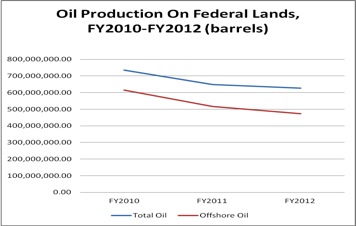
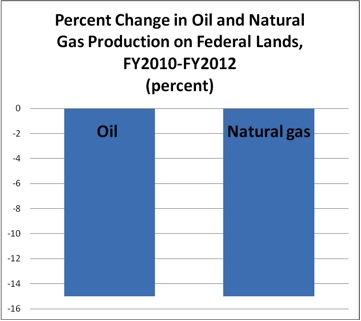
- Crude oil production on federal lands is 4 percent lower in fiscal year 2012 than in fiscal year 2011, (a smaller percentage than its reduction in fiscal year 2011 compared to fiscal year 2010 levels), with the total percentage reduction over the 2 years at 15 percent.
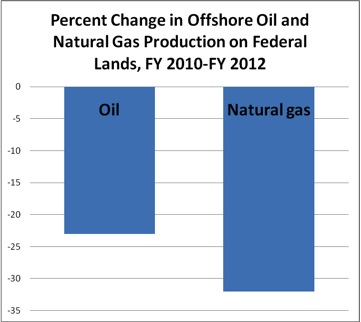
- Offshore oil production in federal waters is 8 percent lower in fiscal year 2012 compared to fiscal year 2011 with the total percentage reduction over the past 2 years at 23 percent.
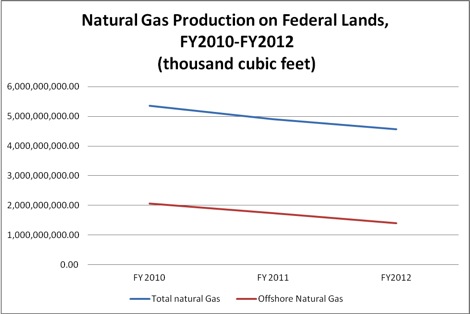
- Natural gas production on federal lands is the lowest in the 11 years that data is available and is 7 percent lower in fiscal year 2012 than in fiscal year 2011 with a total percentage reduction over the past 2 years of 15 percent.
- Offshore natural gas production in federal waters is 20 percent lower in fiscal year 2012 compared to fiscal year 2011 levels with a total percentage reduction over the past 2 years of 32 percent.
Oil and Natural Gas Production on Federal Lands
Crude oil production on federal lands decreased 15 percent over the past 2 years from 736 million barrels in fiscal year 2010 to 626 million barrels in fiscal year 2012. Production of crude oil on federal lands is dominated by offshore production, which fell by 23 percent in fiscal year 2012 from fiscal year 2010 levels, mostly notably due to government actions taken following the oil spill in the Gulf of Mexico in 2010. These actions include a moratorium on offshore drilling by the Obama Administration, followed by a permit moratorium, and withdrawal of President Bush’s 2010-2015 offshore lease plan, which would have opened additional areas to oil and gas production. These areas were made available when President Bush lifted the executive drilling moratorium and Speaker Pelosi and Majority Leader Harry Reid passed legislation lifting a 27 year old appropriations ban on such drilling in 2008. It was not until late in 2012 that the Obama administration released its draft 2012-2017 offshore lease plan that reduced the number of lease sale opportunities from prior plans and that removed areas that the Bush administration had made available to drilling (e.g. off the coasts of the Atlantic and Pacific oceans).
Source: Department of Interior, Office of Natural Resources Revenue, http://statistics.onrr.gov/
Natural gas production on federal lands decreased every year since fiscal year 2003, the earliest fiscal year data available. In fiscal year 2012, natural gas production on federal lands was 4,566 billion cubic feet, 15 percent less than in fiscal year 2010 when it totaled 5.35 billion cubic feet. Offshore natural gas production volumes have been on a consistent downward trend for the last 11 years, and are 32 percent less in fiscal year 2012 than in fiscal year 2010.
Source: Department of Interior, Office of Natural Resources Revenue, http://statistics.onrr.gov/
Source: Department of Interior, Office of Natural Resources Revenue, http://statistics.onrr.gov/
Source: Department of Interior, Office of Natural Resources Revenue, http://statistics.onrr.gov/
Conclusion
The big picture is clear that government policies undertaken by the Obama Administration have produced a significant decline in offshore oil production on federal lands over the past 2 years. If it were not for hydraulic fracturing and horizontal drilling on private and state lands where oil and gas drilling regulation performed by the states is much more efficient than that on federal lands, the United States would not be increasing its domestic oil and natural gas production. Americans can only wonder how much more oil we could have produced if federal policies did not get into the way and how much lower gasoline prices might be if positive actions were taken 4 years ago.
INTERIOR: Top Ten Questions for Obama Nominee Sally Jewell
President Obama recently nominated Sally Jewell to replace Ken Salazar as Secretary of the Interior. As the head of Recreational Equipment Inc. (REI), Jewell showed that she can grow a company, and now she is faced with an opportunity to grow the American economy through responsible stewardship of our nation’s vast energy resources. In the past, Jewell has argued for more regulations and against resource development on federal lands. Her record necessitates rigorous scrutiny by the United States Senate. IER offers the following ten questions as a sampling of the sorts of questions that Sally Jewell should answer before the American people before she is allowed a vote for confirmation.
10. Sally Jewell has served on the board of the National Parks Conservation Association (NPCA) since 2004. During her tenure on the board, the NPCA has been a litigious nuisance to the federal government, suing for hundreds of thousands of taxpayer dollars while spending more than $300,000 on lobbying in 2012 alone. Does Jewell believe that this so-called “sue and settle” practice, which gives taxpayer money to groups like the NPCA in order to limitthe general public’s access to federal lands, is an appropriate way for the NPCA to influence public policy?
9. During Jewell’s tenure, the NPCA sued the Army Corps of Engineers regarding hydraulic fracturing (fracking). An NPCA press release about the 2011 lawsuit quoted an environmental advocate who said that hydraulic fracturing was a “risky industrial activity that has already caused documented environmental and human health impacts,” adding, “No one’s drinking water should be sacrificed in the rush to pursue exploitation of methane gas deposits that have existed for millions of years.”
In the last 60 years, hydraulic fracturing has been employed safely in more than 1.2 million wells without a single confirmed case of groundwater contamination, despite recent efforts by some federal regulators whose power and budgets would benefit from creating a straw man that would be used to justify stricter rules. Does Jewell believe that hydraulic fracturing threatens America’s vital water resources, warranting the restriction of this technology that has created thousands of jobs, billions of dollars in economic growth, and put America on the road to becoming the world’s top oil producer by 2020?
8. In its 2010 annual report, the NPCA noted that it filed lawsuits stopping the construction of eight new coal plants. The report boasted that the effort was aimed at stopping “airborne chemicals.” Given that every criteria pollutant in the Clean Air Act has seen dramatic reduction since the 1970’s, does Jewell still think economic growth in the form of new power plants should be discouraged? What role do North America’s vast coal resources — sufficient to provide enough electricity for the next 500 years – play in the administration’s “all of the above” energy strategy?
7. At a 2007 talk at the University of Montana, Jewell noted that she wanted to see legislation and regulation from government to “help companies make the right decisions” regarding the environment, which sounds like a threat. Under Jewell’s leadership, REI has a goal of becoming “climate neutral” by 2020. Does Jewell think that carbon neutrality within the next seven years is the “right” decision for all U.S. companies and, if so, how does she plan to lead the Department of Interior to “help” companies make that decision?
6. After working for three years at Mobil Oil, Jewell became a petroleum engineer for Rainer Bank in the early 1980s. Jewell stayed in the banking sector until leaving for REI in 2000. In 2009, Jewell said of climate change, “You can’t be a company that is relying on a clean environment and be part of the problem, polluting the environment.” If companies that produce carbon-based energy are part of the problem, does that mean Jewell was part of the problem for a significant portion of her career?
What efforts has REI made to curtail its sales of refined petroleum products – from mountain bikes to yoga mats, sleeping bags, hiking boots, and virtually every other item on its sales floor? What about its travel programs, which tout exotic faraway places such as the Annapurna Adventure Trek, and necessitate enormous fossil energy consumption just to travel there? If so, how does she reconcile her demand that others not profit from carbon-based energy when both her own professional career and her company’s profits have done just that?
5. When asked in 2009 if REI lobbies the government for environmental causes, Jewell said, “I would not use the term lobbying because we are not really lobbyists, but we do educate.” According to the Center for Responsive Politics, which collates public records data, REI spent $610,000 on lobbying between 2009 and 2012, with $250,000 spent on lobbying in 2012. Does Jewell care to reconsider her statement “we are not really lobbyists”?
In 2010, President Obama noted in his State of the Union address that America faces a “deficit of trust” that required “action on both ends of Pennsylvania Avenue to end the outsized influence of lobbyists.” Earlier, he had pledged that lobbyists wouldn’t “find a job” in his administration. How does Sally Jewell negotiate her administration of REI’s lobbying efforts with her appointment to a top cabinet office, given the president’s views?
4. Jewell has said that one of the five focus areas of REI’s leadership is “[g]lobal climate change.” Advocating a carbon tax, she said, “I know tax is a dirty word, but if we were paying a carbon tax that accounted for our impact on greenhouse gases, that would in fact change our consumption.”
Does Jewell think that a carbon tax in the United States would significantly affect climate change? After all, unilateral carbon dioxide emission reductions in the United States would only lead to negligible reduction in global temperatures (using assumptions based on IPCC’s Assessment Reports, if the U.S. as a whole stopped emitting all carbon dioxide emissions today, and the impact on projected global temperature rise would be a reduction, of approximately 0.08°C by the year 2050 and 0.17°C by the year 2100). Does Jewell think that the government should intervene to stop leisure and recreational activities that involve carbon emissions or consumption?
3. Jewell has argued strongly against resource development on federal lands, noting in one interview, “Many of the lands that are forests would have been developed with houses today if not for the Greenway Initiative [a local environmentalist effort] . . . . Every intersection could have had gas stations and fast food establishments.”
Setting aside that the local zoning effort referred to by Ms. Jewell has no correlation with national forests, which are supposed to be used for natural resources for the benefit of citizens but which cannot be sold for gas stations or fast food establishments, should the personal aesthetics of a corporate leader affect government decision making any more than those of any other citizen? Now that Ms. Jewell is being asked to administer those lands belonging to all other citizens, how does she intend to balance her own well-documented views with the energy and other resource needs of the American people? With economic growth weak and the poorest Americans struggling with wage stagnation, would it be such a bad thing to open more federal lands for resource development to balance conservation with an increase in small business growth?
2. At the federal level, oil and gas production on federal lands is declining even while it surges on private lands. Meanwhile, under Ken Salazar, the Department of the Interior denied 1.6 million acres of federal land for shale development, but approved using federal land for 35 renewable projects.
An IER study recently found that opening more federal lands for resource exploration could lead to a $14.4 trillion increase in economic activity over the next thirty seven years. Given the persistently high unemployment rate the U.S. currently faces, will Jewell support expanding resource exploration on federal lands? If not, why not?
1. REI has a stake in hindering multiple-uses of federal lands, or at least it appears to, in that the company appears to take the position that lands should be used only for those activities they profit from, including recreation and leisure. This many help explain REI’s $610,000 in lobbying. If confirmed to become the Secretary of the Interior, what assurances can Jewell give us that she will fairly weigh the competing “multiple uses” as is required by many of the laws governing federal lands and not favor the outdoor recreation industry? For example, does Jewell think there is too much energy development on federal lands? Is leasing less than 6 percent of onshore lands and less than 2 percent of offshore lands for energy production too much?
President Obama says that he is “proud of the fact” that oil and natural gas production is increasing. Since 96 percent of the increase, according to CRS is from non-federal lands, what will Jewell do to make the President even prouder by actually increasing energy production on federal lands?
###
FACT CHECK: Is the White House Responsible for Production Increases?
“I’m proud of the fact that under my administration, oil production is higher than it has been in a decade or more. We have seen a doubling of fuel efficiency standards on cars over the next several years, so that is saving people money at the pump,” Obama said.
President Obama still doesn’t seem to get it. Yes, oil production is higher than it has been in a decade or more. But, that is not because of actions taken under the Obama Administration. Rather, it is because of state policies and regulations that have encouraged exploration and development on private and state lands, according to the Congressional Research Service. In fact, 96 percent of the increase in oil production over the past 5 years has been on private and state lands, where President Obama and his administration have no input. On federal and Indian lands, where federal policies and regulations are in force, it takes an extremely long lead time to produce energy, and the Obama administration has repeatedly used delaying tactics and moratoria that have reduced production. In fact, between fiscal years 2010 and 2011, oil production on federal and Indian lands declined by 13 percent.
President Obama also claims that a doubling of fuel efficiency standards over the next several years (actually, a dozen years, by 2025) will save people money at the pump. Mr. Obama must be oblivious to the fact that average gasoline prices have increased by 55 percent between 2009 and 2012, are currently rising, and are at the highest levels recorded for this time of year. This price increase has occurred during his administration.
Does President Obama believe that doubling fuel economy standards by 2025 will make the American public feel better about rising gasoline prices when they won’t be able to afford the new, more efficient cars that are mandated? Does he believe that American parents will feel okay transporting their children in cars of much less weight, which is the only way to achieve such standards? People are keeping their existing cars longer, leading to historic numbers of older cars on the road. In 2011, for example, the average car on U.S. streets was 11 years old, up 12 percent from the previous 5 years.[i] With a bad economy and rapidly rising auto prices in part due to government mandates such as fuel economy, people cannot afford new vehicles, particularly the higher-priced vehicles that stricter economy standards force into the market.
Studies have shown that the Obama fuel economy mandate will force about the 7 million drivers out of the market because the mandate increases the price of automobiles.[ii] Even though these people will not be able to afford a new more efficient car to take to the pump, the President will presumably state that they “saved money at the pump.”
Oil Production on Federal Lands
In February 2009, at the start of the Obama administration, Secretary of the Interior Ken Salazar began withdrawing tracts of public land that had already been approved for oil and gas leasing, even though most of the tracts had undergone a thorough, seven-year-long environmental review.[iii] Then, after the oil spill in the Gulf of Mexico, the Obama administration put a six-month moratorium on both shallow and deep offshore drilling, even though the oil spill accident occurred in deep water and drilling in shallow water had spilled only 15 barrels in the previous 15 years. Although the administration ostensibly lifted the moratorium in October of 2010, drilling permit approvals did not take place, resulting in a so-called “permitorium”. These delays led a Federal Court to hold the Administration in contempt for its actions of slow-walking permits.[iv] Further, the Obama administration did not put in place President Bush’s offshore lease plan for fiscal years 2010 to 2015 that would have opened new areas to drilling, and waited until late 2011, to put forth its own offshore lease plan for the 2012 to 2017 period that reverted basically to the original areas that had been opened to offshore drilling.
Data from the Bureau of Land Management in the Department of Interior shows just how bad the leasing statistics are under President Obama’s administration. According to a study by Nobel Royalties Inc., the number of acres leased on federal onshore lands in the lower 48 states in 2010 was at a 30 year low, with 38.9 million acres leased in 2010 compared to 126.6 million acres leased in 1984—a drop of 69 percent. That study also states that on federal lands, 91 percent of resources are either inaccessible or restricted due to government policies. If the federal government were to allow leasing to gradually trend up to normal levels, the government would receive $442 billion in royalties from federal onshore lands and $363 billion from federal offshore projects between 2013 and 2042, for a total of about $800 billion. Once drilling on federal lands is fully operational and production levels have peaked, however, annual royalty payments could reach $100 billion, putting federal royalty income at $1 trillion over 10 years.[v]
But limiting the leases available on federal lands is not the only destructive policy that the Obama administration has undertaken. The administration dramatically increased the time it takes to get a permit to drill to 307 days in 2012. That’s a 100 percent increase since 2005. By comparison, it takes the oil producing states less than a month to grant a permit to drill on private and state lands. North Dakota, for example, where the unemployment rate is around 3 percent and the state economy is growing at 7 percent annually, takes only 10 days to grant a permit. North Dakota now ranks second among the states in oil production, recently surpassing Alaska in output despite having one sixth the land mass and no offshore oil reserves.

Efficiency Standards for Automobiles
The Institute for Energy Research has already assessed the problems with President Obama’s corporate average fuel economy standards in a recent publication. Basically, there is a trade-off between fuel efficiency, horsepower, safety, and cost. The automobile manufacturers can only go so far in increasing fuel efficiency without reducing the weight of the vehicle, thereby affecting safety. Further, increased fuel economy comes with a cost, so there is a further trade-off between purchasing a new vehicle versus just spending more at the pump. With the economy contracting, it will be more difficult for a middle class family to afford buying the new, more fuel efficient car that President Obama is touting.
Conclusion
If Obama wants more federal revenue, he can get it without raising taxes by just relaxing the restrictions on drilling on federal lands both on and off shore. The new revenue from taxes and royalties would be large, jobs would be created, and the economy would grow rather than contract. The oil boom in North Dakota is an example of what the nation could achieve: 3 percent unemployment, 7 percent economic growth, if only he would embrace oil and gas drilling and innovation in this country. While his rhetoric tries to take credit for growing production, his actions show another story entirely.
[i] Auto Blog, Average U.S. vehicle age rises 12% in the last five years, January 20, 2012, http://green.autoblog.com/2012/01/20/average-u-s-vehicle-age-rises-12-in-the-last-five-years/
[ii] Proposed Fuel Economy Rules Cut 7 Million Car Buyers Out of New-Vehicle Market, April 12, 2012, http://www.nadafrontpage.com/NADA_Proposed_Fuel_Economy_Rules_Cut_Millions_of_Car_Buyers_Out_of_Market.xml
[iii] Forbes, Putting the Truth-o-Meter on President Obama’s State of the Union Energy, December 13, 2013, http://www.forbes.com/sites/merrillmatthews/2013/02/13/putting-the-truth-o-meter-on-obamas-state-of-the-union-energy-claims/
[iv] Bloomberg, U.S. in Contempt over Gulf Drill Ban, Judge Rules, February 3, 2011, http://www.bloomberg.com/news/2011-02-03/u-s-administration-in-contempt-over-gulf-drill-ban-judge-rules.html
[v] The Institute for Policy Innovation, Smart Energy Policy Would Make Obama Look Like an Economic Genius, December 21, 2012, http://www.ipi.org/ipi_issues/detail/smart-energy-policy-would-make-obama-look-like-an-economic-genius
Why Are Gasoline Prices High and Rising?
“Motorists are paying more for gasoline at this time of year than they’ve ever paid,” according to AAA spokesman Michael Green
As of February 18, 2012, gasoline prices in the United States are averaging $3.75, 13 percent higher than a month ago and are the highest on record for this time of the year. The purpose of this post is to explain why this increase is occurring.
Gasoline prices are composed of four main components:
- the price of oil determined on world markets;
- refining costs to transform oil into gasoline;
- taxes that are levied by federal, state, and local governments and
- distribution and marketing costs that include the costs of the retailer who provides the gasoline at the pump.
The largest component of the price of gasoline is the price of oil, which makes up almost 70 percent of the price at the pump. This is followed by taxes that represent 13 percent of the price, distribution and marketing costs at 11 percent, and refining costs at 8 percent. The cost distribution varies with seasonal changes as refineries retool to switch from winter grade to summer grade gasoline, perform regular maintenance on their facilities, and fix any break-down of equipment.
Currently, several refineries are down for maintenance or equipment failure that is a result of normal operations. With limited refinery capacity in the United States, the removal of some refineries from the production of gasoline results in higher prices. Along with these refinery outages and associated gasoline price increases are higher prices for oil on world markets due to increasing world demand, production quotas by OPEC countries, an embargo on Iranian crude as a result of sanctions by the United States and the European Union to make Iran abandon nuclear weapons development and the dollar’s continuing devaluation.[1] The result is the gasoline price increases we have seen over the past several weeks.
Lowering world oil demand or increasing world oil supplies would lower oil prices, but the United States can neither affect the oil demand of other countries nor can it increase the supply of oil from other oil producing countries. Besides reducing oil demand or increasing oil supply, U.S. gasoline prices can be lowered by lowering refining costs, decreasing gasoline taxes, or decreasing marketing and distribution costs, but as the figure above shows, these components of the cost of gasoline are small compared to the price of oil.
1) Supply and Demand for oil
a) World Oil Demand Growth: World crude oil and liquid fuels consumption grew to the highest level ever in 2012, with an estimated 89.2 million barrels per day (bpd) consumed in total.[2] The Energy Information Administration (EIA) projects that total world oil consumption will grow by 1.05 million bpd during 2013 and 1.4 million bpd in 2014 with countries outside the Organization for Economic Cooperation and Development (OECD) comprising most of the growth in consumption.[3] The largest increases in oil consumption will be non-OECD Asian countries, which are using increasing amounts of oil to pursue rapid economic growth. By comparison, U.S. liquid fuels consumption has declined since 2010.
China, in particular, has a large role in the increased global demand for oil. China likely consumed nearly half of the global 2 million barrel per day increase in world oil consumption since 2010.[4] According to the Energy Information Administration, China increased its petroleum consumption by almost 500,000 barrels per day in 2011, and preliminary estimates are that China added another 420,000 barrels to its daily consumption in 2012. China is the second-largest consumer of oil behind the United States and as of 2009, China became the second-largest net importer of oil. In 2011, Chinese crude oil imports were 5.52 million bpd[5]—up 8.2 percent from 2010 levels.
If world demand for oil rises faster than oil companies can produce the crude, oil prices will go up, which is what is occurring now.
b) Domestic Supply: According to the EIA, the U.S. produced 6.4 million bpd of crude oil in 2012,[6] up from 5.6 million bpd in 2011—the largest one year increase since the first oil well was drilled before the Civil War. The EIA expects production from the Federal Gulf of Mexico (GOM)—which produced 28 percent of U.S. oil in 2010—to produce only 19 percent of U.S. oil production in 2013.[7] There are two reasons for this. First, hydraulic fracturing on private and state lands is rapidly increasing total domestic oil production. According to the Congressional Research Service, 96 percent of the increase in domestic oil production since 2007 has come from non-government lands. Second, oil production in the Gulf of Mexico is predicted to fall by 10 percent from production levels in 2010 mainly due to government policies that restricted drilling in the Gulf.[8] Only 2 percent of offshore federal lands and 6 percent of onshore federal lands are leased to oil and gas drilling and permits for drilling in those areas where it is allowed have fallen dramatically. More domestic oil could be produced if the federal government permitted it and if their regulatory procedures were commensurate with state regulation that is more conducive to exploration and drilling.
c) OPEC Production Restraints: About 23 percent of our oil product supply in 2012 arrived from the twelve OPEC countries:[9] Algeria, Angola, Ecuador, Iran, Iraq, Kuwait, Libya, Nigeria, Qatar, Saudi Arabia, United Arab Emirates, and Venezuela. These twelve oil-exporting nations possess much of the world’s known conventional oil reserves, and as such, have excess production capacity. However, in order to maintain favorably high oil prices to fund their governments, these nations agree on production targets that curtail the supply of oil from member states. For instance, in December 2008, the 11 members bound by quota restrictions, all but Iraqagreed to a 4.2 million bpd production cut to keep oil prices high. In December 2012, OPEC agreed to cut production by 465,000 bpd to maintain high oil prices.[10]
In addition, oil prices are buoyed due to unrest in the Middle East and the boycott of Iranian oil[11] in an attempt to make Iran abandon development of nuclear weapons. Recently, Iran agreed on “some points” in talks with U.N. experts. If an agreement is reached and sanctions are removed, the $10-$15 per barrel risk premium could lower oil prices very quickly.[12]
The mere potential of an outbreak of a major war in the Middle East keeps oil prices artificially high, as oil traders factor in the chance of a major disruption in exports from the region. Along with growing demand from China, lower oil production from Saudi Arabia and potential and real supply disruptions in Venezuela, Nigeria, North Africa and the Middle East have put markets on edge.[13]
d) Expansionary U.S. Monetary Policy: Since 2009, commodity prices (like food and fuel) have risen with Federal Reserve interest rate cuts and the various rounds of “quantitative easing.” This increase is precipitated by investors choosing to secure their finances with non-income generating real assets, like oil and precious metals, in the face of inflation and the threat of a devalued dollar. In particular, oil prices surged along with other commodity prices when the Federal Reserve Board revved up its second burst of quantitative easing in 2010-2011 and stabilized when QE2 ended.
In recent months, the Federal Reserve Board has again signaled its commitment to near-zero interest rates first through 2013, and then through 2014. Oil and other commodity prices have begun another surge and hedge funds are again betting on commodity plays.
e) Oil Imports and North American Oil Supplies: Petroleum is a globally-traded commodity. On net, the United States imported 41 percent of the crude oil it consumed in 2012.[14] The United States exports some crude oil and petroleum products due to geography and location and ownership of refineries. For example, the United States purchases crude oil from Canada, its largest foreign supplier, and sells Canada a small amount of crude oil produced in Alaska. The United States also purchases crude oil from Mexico and sells Mexico gasoline in return. Also, Venezuela owns three CITGO refineries in the United States and ships some of the products refined in the United States back to Venezuela.
Canada, our neighbor and ally to the North, has the third largest reserves of oil in the world at 175 billion barrels. It currently sells us almost 3 million barrels per day and could easily sell us more if the transportation infrastructure were in place to move it to U.S. refineries. However, with the federal government stalling on the Keystone pipeline, more expensive forms of transportation are moving some of this oil to U.S. markets, such as rail. Because Canadian crude is currently land-locked, its price is low, about half that of Brent crude, making more expensive rail transportation economic.
U.S. crude oil that is land-locked in North Dakota and at Cushing, Oklahoma storage terminals also is lower priced than foreign overseas oil. Ships could be used to move this lower priced oil to East Coast markets where overseas oil is used if the 1920 Jones Act were repealed. The Jones Act requires that shipments from one U.S. port to another be carried on vessels built in the United States, owned by U.S. citizens, and operated by a U.S. crew. [15]
2) Federal and State Taxes
The second main cost of the price of gasoline is federal and state taxes. In December 2012, federal, state and local taxes accounted for 13 percent of the price of gasoline.[16] The federal tax on gasoline accounts for 18.4 cents per gallon, while the volume-weighted average state and local tax is 30.4 cents per gallon as of January 2013. This amounts to a 48.8 cent nationwide average tax on gasoline.[17]
3) Refining Costs
The third cost to factor into the price of gasoline is the refining process, where crude oil is “cracked” and formulated into its chemical components and made into gasoline. In December 2012, refinery costs comprised 8 percent of the retail price of gasoline.[18] This figure varies regionally because different parts of the country require different additives and processing steps in their gasoline formulations. The figure of 8 percent would also vary in other months, owing to seasonal changes in refinery operations. For example, in the spring when refineries need to retool to produce summer-blend gasoline and to meet summer gasoline demands, the cost of refinery operations is higher.
Currently, gasoline production is at a low because plants like Chevron’s El Segundo refinery near Los Angeles and LyondelBassell Industries NV’s Houston site in Texas are offline, undergoing routine maintenance[19], which points to the lack of excess refining capacity in this country. Since the 1990s, 66 U.S. refineries have been shuttered due mainly to increasing regulatory costs. Since 1990, refineries have spent $128 billion to comply with federal environmental regulation.
Refinery costs are set to increase even more as a result of a number of federal regulations including new ozone national ambient quality standards, greenhouse gas emissions regulations, Tier III gasoline mandate, EPA’s mandate to buy commercially unavailable cellulosic biofuel, among other regulations.
4) Distribution and Marketing Costs
The last component of the price of gasoline is the retail dealer’s costs and profits, which constituted a combined 11 percent of the cost of a gallon of gasoline in December 2012.[20] From the refinery, most gasoline is shipped first by pipeline to terminals near consuming areas and then loaded into trucks for delivery to individual stations. Ethanol must also be transported by truck or train since it cannot be transported by most pipelines prior to delivery.
Even though many gas stations are branded as Shell, Exxon, BP or another major oil company, the major oil companies actually own less than 5 percent of gas stations.[21] The vast majority of gas stations are actually independent businesses that purchase gasoline for resale to the public. In addition, some retail outlets are owned and operated by refiners.
The price at the pump reflects both the retailer’s purchase cost for the product and the other costs of operating the service station. It also reflects local market conditions and factors, such as the desirability of the location and the marketing strategy of the owner.
Conclusion
Gasoline prices are high and increasing because world oil demand growth is outpacing oil supply output, thereby increasing oil prices and gasoline prices. This is despite increasing U.S. production and decreasing U.S. consumption. Further exasperating world markets are the sanctions on Iran and unrest in other oil producing regions that have traders adding a risk premium to oil prices. Gasoline prices are further being boosted because of lack of refining capacity to compensate for outages due to equipment failure and routine maintenance, keeping supplies of gasoline low. Environmental regulations on refineries have shuttered plants over the last several decades and new regulations will be increasing the cost of refining crude which will be passed onto consumers of oil products in the future.
[1] Forbes, The Weak Dollar Is Getting Caught in a Currency War Pincer, February 19, 2013, http://www.forbes.com/sites/briandomitrovic/2013/02/19/the-weak-dollar-is-getting-caught-in-a-currency-war-pincer/
[2] Energy Information Administration, Short Term Energy Outlook: February 2013, http://www.eia.gov/forecasts/steo/tables/pdf/3atab.pdf .
[3] Energy Information Administration, Short Term Energy Outlook: February 2013, http://www.eia.gov/forecasts/steo/tables/?tableNumber=9# .
[4] Washington Post, The boom in U.S. oil drilling hasn’t lowered gas prices, February 11, 2013, http://www.washingtonpost.com/blogs/wonkblog/wp/2013/02/11/the-boom-in-u-s-oil-drilling-hasnt-lowered-gas-prices/
[5] Energy Information Administration, China: Country Analysis Brief, Oct. 16, 2012, http://www.eia.gov/countries/country-data.cfm?fips=CH&trk=c
[6] Energy Information Administration, Monthly Energy Review January 2013, Table 3.1 Petroleum Overview, http://www.eia.gov/totalenergy/data/monthly/pdf/sec3_3.pdf
[7] Energy Information Administration, Short-Term Energy Outlook—February 2013, Table 4a. U.S. Crude Oil and Liquid Fuels Supply, Consumption, and Inventories, http://www.eia.gov/forecasts/steo/tables/?tableNumber=9# .
[8] See Energy Information Administration, Short-Term Energy Outlook—February 2013, Table 4a. U.S. Crude Oil and Liquid Fuels Supply, Consumption, and Inventories, http://www.eia.gov/forecasts/steo/tables/?tableNumber=9# .
[9] Energy Information Administration, Monthly Energy Review: January 2013, Table 3.3c Petroleum Trade: Imports From OPEC Countries, http://www.eia.gov/totalenergy/data/monthly/pdf/sec3_10.pdf .
[10] PennEnergy, Saudi Arabia keeps oil production steady as OPEC maintains ceiling
[11] Zaida Espana and Dmitry Zhdannikov, Analysis: Oil price rise raises specter of global recession, Feb. 26, 2012, http://www.reuters.com/article/2012/02/26/us-oil-recession-idUSTRE81P0JA20120226?feedType=RSS&feedName=topNews&rpc=71
[12] Wall Street Journal, Crude-oil Futures Trade Higher in Asia, February 14, 2013, http://professional.wsj.com/article/BT-CO-20130214-705069.html?mg=reno64-wsj
[13] Reuters, As U.S. gasoline prices soar, hedge fund oil bets near record, February 12, 2013, http://www.reuters.com/article/2013/02/12/us-oil-speculators-gasoline-idUSBRE91B1L520130212
[14] On a gross basis 60 percent of U.S. oil demand is imported from foreign countries. There is a difference between the gross and net imports because the U.S. exports some oil and refined products.
[15] Wall Street Journal, Oil and the Ghost of 1920, September 13, 2012, http://professional.wsj.com/article/SB10000872396390444433504577649891243975440.html?mg=reno64-wsj and Americans for Tax Reform, Repeal the Jones Act, Reduce the Price of Gasoline, February 18, 2013, http://www.atr.org/repeal-jones-act-reduce-price-gasoline-a7477
[16] Energy Information Administration, Gasoline and Diesel Fuel Update, Feb. 11, 2013, http://www.eia.gov/petroleum/gasdiesel/
[17] American Petroleum Institute, Gasoline Taxes January 2013, http://www.api.org/oil-and-natural-gas-overview/industry-economics/~/media/Files/Statistics/gasoline-diesel-summary.ashx .
[18] Energy Information Administration, Gasoline and Diesel Fuel Update, February 11, 2013, http://www.eia.gov/petroleum/gasdiesel/
[19] Bloomberg, Retail Gasoline Sets Season Records as Plants Shut, Oil Rises, February 12, 2013, http://www.bloomberg.com/news/2013-02-12/retail-gasoline-sets-seasonal-record-as-plants-shut-oil-surges.html
[20] Energy Information Administration, Gasoline and Diesel Fuel Update, Feb. 11, 2013, http://www.eia.gov/petroleum/gasdiesel/
[21] Associated Press, Exxon to sell all of company’s gas stations, Jun. 13, 2008, http://www.nbcnews.com/id/25126563/ns/business-oil_and_energy/t/exxon-sell-all-companys-gas-stations/ .
Special Report: Opening Federal Lands
Senior VP of Policy Dan Kish speaks with Special Report about opening vast federal lands to energy development which could produce $14.4 trillion in GDP over the next 37 years.
EPA’s Coal Purge Claims Latest Victim
A planned 1200 megawatt, $3 billion coal-fired power plant in Corpus Christi, Texas is one of the latest casualties in the war on affordable, reliable energy. Chase Power, the company behind the Las Brisas power plant, announced last month that it is cancelling the project due to red tape and litigation spawned by the Environmental Protection Agency’s regulations on coal plants.
Discussing the demise of the project, which would have used the petroleum coke byproduct of refineries as an electricity generating source, Chase Power CEO Dave Freysinger held the EPA responsible. “The (Las Brisas Energy Center) is a victim of EPA’s concerted effort to stifle solid-fuel energy facilities in the U.S., including EPA’s carbon-permitting requirements and EPA’s New Source Performance Standards (NSPS) for new power plants,” he said. “These costly rules exceeded the bounds of EPA authority, incur tremendous costs, and produce no real benefits related to climate change.”
The plant—and the 3,900 jobs that would have come with it—fell victim to EPA’s concerted effort to end coal-fired power in the U.S. using rules like the ban on new coal-fired power plants and the Mercury and Air Toxics Rule (MATS, and also colloquially called Utility MACT).
But Las Brisas is just one more example of EPA’s efforts. Barclays, the investment bank, estimates that the MATS rule alone will cause 42 gigawatts of coal plant generating capacity to close.[1]
President Obama has said many times that we should follow the example of Europe when it comes to electricity generation. But that is a recipe for higher electricity rates. In Germany, residential electricity prices are nearly three times higher than the U.S., thanks to the country’s massive subsidies for renewables.
Cap-and-trade legislation failed in 2009 when Obama’s allies controlled both chambers of Congress, because the American people rejected it. MATS and the ban on new coal-fired power plants are the president’s attempt to impose by regulatory fiat what he could not accomplish democratically. These are costly rules which the American people never asked for and President Obama never ran on. They are a reflection of how “the most open and transparent” administration in history has failed to live up to its billing.
For the past few years electricity demand growth has been weak because of a sputtering economy. But there will hopefully come a time when we will need more energy. When that time comes, these coal-fired power plants will be gone and America will have substantially less affordable, reliable energy. The electricity we need to power our homes, schools, and offices will be more expensive, and our country will be worse off for it. That’s not progress, it’s perilous.
IER Policy Intern Alex Fitzsimmons contributed to this article.
[1] Barclays, Power & Uilities: CO2 Reductions Ahead, Jan. 28, 2013.
ICYMI: Government Hubris Leads to Unnecessary Regulations
WASHINGTON D.C. — On Saturday, IER Senior Vice President Daniel Kish published an op-ed in The Washington Times titled, Steven Chu and the Hubris of Big Government. In the article, Kish demonstrates how big government and heavy-handed regulations harm Americans:
Steven Chu and the Hubris of Big Government
By Daniel Kish — 2/16/2013
President Obama has been seeing off loyal retainers from his first term, and recently he bid adieu to Steven Chu, his in-house Nobel Laureate and secretary of energy. In doing so, the president praised Mr. Chu for “designing a cap to plug a hole in the middle of the Gulf of Mexico when nobody else could figure it out.” This was in reference to the 2010 BP oil spill known as “Deepwater Horizon.” The problem is, Mr. Chu did not design the containment cap; the hardworking engineers of BP and its private sector contractors did that, working night and day from the moment of the disaster. Any energy business that had expertise offered to help, and many did.
Mr. Chu is a brilliant man and has done the world a service by his work in optical physics, including his Nobel prize work involving light and atoms. Still, Mr. Obama giving him credit for the cap fits perfectly with the central conceit of liberalism in general, and the dangerous path down which Mr. Obama is leading the nation.
When the president shouted out, “You did not build that” during the latest campaign, he was echoing a central tenet of the liberal credo: Government — not free citizens or the businesses or works they create — is responsible for the progress that Americans have achieved over the last two centuries. Government can set and enforce rules that enable individuals and businesses to take risks, innovate, invest, succeed and fail. Yet government itself does not build or create wealth; even those things it does build only come from revenues it coercively takes from individuals and businesses to be spent on what politicians deem popular at the moment…
To read the full article, click here.
###
HEARING PREVIEW: IER’s Simmons to Testify on Gasoline Prices
IER Director of Regulatory and State Affairs Daniel Simmons will testify on Thursday, February 14, 2013 at 1:00PM before the House Oversight and Government Reform Subcommittee on Energy Policy, Healthcare, and Entitlements. The hearing is on “The Effects of Rising Energy Costs on American Families and Employers.” Simmons’s testimony will focus on the various components of gasoline prices and how regulations and supply issues affect these components. Highlights from the testimony include:
“World crude oil and liquid fuels consumption grew to the highest level ever in 2012, with an estimated 89.2 million barrels per day (bpd) consumed in total… China is the second-largest consumer of oil behind the United States and as of 2009, China became the second-largest net importer of oil.”
“According to the EIA, the U.S. produced 6.4 million bpd of crude oil in 2012, up from 5.6 million bpd in 2011—the largest one-year increase ever…96 percent of the increase in domestic production since 2007 has come from non-government lands. This increase could be much larger, but for government policies.”
“The second main cost of the price of gasoline is federal and state taxes. In December 2012, federal, state and local taxes accounted for 13 percent of the price of gasoline. The federal tax on gasoline accounts for 18.4 cents per gallon, while the volume-weighted average state and local tax is 30.4 cents per gallon as of January 2013. This amounts to a 48.8-cent nationwide average tax on gasoline.”
“The third cost to factor into the price of gasoline is the refining process… It is becoming harder and harder to refine oil in the United States. Over the past 30 years, refineries have dealt with a huge number of ever-stricter regulations. Between 1981 and April 2012, the federal government has promulgated 65 major regulations and 755 non-major regulations that affect the subset of manufacturers that includes refineries.”
“Since 1990, refineries have spent $128 billion to comply with federal environmental regulation. To put that in context, that works out to over $850 million per operating refinery in 2011.”
“The last component of the price of gasoline is the retail dealer’s costs and profits, which constituted a combined 11 percent of the cost of a gallon of gasoline in December 2012. From the refinery, most gasoline is shipped first by pipeline to terminals near consuming areas and then loaded into trucks for delivery to individual stations. Ethanol must also be transported by truck or train because it cannot be mixed with gasoline prior to delivery.”
“The federal estate contains vast energy resources, but the federal government allows energy production on a very small percentage of taxpayer-owned federal lands. The Interior Department has leased just 2 percent of federal offshore areas and less than 6 percent of federal onshore lands for oil and gas development.”
“It takes 307 days for the federal government to process a permit to drill, but only 27 days for Colorado and 10 days in North Dakota. It should come as no surprise why North Dakota’s oil production is rapidly increasing while energy production on federal lands is stagnating.”
“The federal government’s land use policies have reduced oil and natural gas production on federal lands because federal regulations make it much more difficult to work on federal lands… These technically recoverable resources total 1,194 billion barrels of oil and 2,150 trillion cubic feet of natural gas that is owned by the federal taxpayer… the value of the estimated oil resources is $119.4 trillion and the value of the estimated natural gas resources is $8.6 trillion for a grand total of $128 trillion.”
“IER commissioned a groundbreaking paper highlighting the larger economic effects, including economic growth, wages, jobs, and federal and state and local tax revenues, of opening Federal lands and waters to oil and gas leasing… The study finds that if the federal government opened up additional federal lands and waters to exploration and production, the increase to GDP would be $127 billion annually for the next seven years, and $450 billion annually in the long run. Most impressively, the opening of federal lands would have a cumulative increase in economic activity of up to $14.4 trillion over a period of 37 years.”
To read the full testimony, click here.
Tomorrow’s hearing can be seen live here.
Interior Prioritizes Renewable Energy Permits, Delays Oil and Gas
In a study released last week, Dr. Joseph Mason of LSU demonstrated the vast economic benefits of opening up federal lands to oil and gas development: 500,000 new jobs a year and more than $30 billion a year in federal, state, and local tax revenue over the next seven years alone. That’s just for starters. The study also shows that opening new federal lands to oil and gas production will create a cumulative $14.4 trillion in economic activity. But instead of seizing the opportunity to unlock the benefits of expanding oil and natural gas exploration, the Interior Department on Feb. 6 identified 23 renewable energy projects for priority permitting.
If all 14 wind, 6 solar, and 3 geothermal projects are approved and built, the Bureau of Land Management (BLM) estimates the completed projects would total 5,300 megawatts of electricity generating capacity. That’s enough energy to power 1.6 million homes when the wind is blowing hard enough, the sun is shining, and the geothermal plant is operating at full capacity.
While 5,300 megawatts of electricity is a lot, how does that compare to the energy produced from oil and gas production? In the table below, we calculate the total British thermal units (Btu) these projects would produce if their capacity factors equal EIA’s estimates in its Annual Energy Outlook.[i]
As the table below indicates, BLM’s priority projects would be capable of producing about 44 trillion Btu of energy annually. To put that in perspective, oil wells in North Dakota produced more than 127 trillion Btu in Nov. 2012 alone.[ii] That’s almost three times more energy in one month than BLM expects all of its priority wind, solar, and geothermal projects to produce in an entire year. Not only that, but in the last 14 months for which there is data, North Dakota’s energy production, increased by 46 trillion Btus a month.[iii] In other words, the increase in North Dakota’s monthly production over the last fourteen months was greater than what the Department of Interior’s pet projects will produce over the course on an entire year. Plus, unlike solar or wind, oil can be used when and where it is needed.
BLM’s Priority Renewable Energy Projects on Federal Land
| Project Name | Capacity (MW) | Capacity Factor | Capacity Factor2 | mWh per year | Btu |
|---|---|---|---|---|---|
| Hyder Valley Solar | 350 | 0.25 | 8760 | 766,500 | 2,615,298,000,000 |
| Quartzsite Solar Energy | 100 | 0.25 | 8760 | 219,000 | 747,228,000,000 |
| Stateline Solar | 300 | 0.25 | 8760 | 657,000 | 2,241,684,000,000 |
| McCoy Solar | 750 | 0.25 | 8760 | 1,642,500 | 5,604,210,000,000 |
| Desert Harvest Solar | 150 | 0.25 | 8760 | 328,500 | 1,120,842,000,000 |
| Ocotillo Sol | 14 | 0.25 | 8760 | 30,660 | 104,611,920,000 |
| Ft Mojave Solar | 310 | 0.25 | 8760 | 678,900 | 2,316,406,800,000 |
| Silverleaf Solar | 160 | 0.25 | 8760 | 350,400 | 1,195,564,800,000 |
| Blythe Mesa Solar | 485 | 0.25 | 8760 | 1,062,150 | 3,624,055,800,000 |
| Hidden Hills Solar | 500 | 0.25 | 8760 | 1,095,000 | 3,736,140,000,000 |
| Silver State South Solar | 350 | 0.25 | 8760 | 766,500 | 2,615,298,000,000 |
| Boulder City Solar | 300 | 0.25 | 8760 | 657,000 | 2,241,684,000,000 |
| Mountain View Solar | 20 | 0.25 | 8760 | 43,800 | 149,445,600,000 |
| Moapa Solar | 200 | 0.25 | 8760 | 438,000 | 1,494,456,000,000 |
| Mohave County Wind Farm | 500 | 0.33 | 8760 | 1,445,400 | 4,931,704,800,000 |
| Granite Mountain Wind | 84 | 0.33 | 8760 | 242,827 | 828,526,406,400 |
| Walker Ridge Wind | 70 | 0.33 | 8760 | 202,356 | 690,438,672,000 |
| Alta East Wind | 300 | 0.33 | 8760 | 867,240 | 2,959,022,880,000 |
| Tule Wind | 51 | 0.33 | 8760 | 147,431 | 503,033,889,600 |
| Searchlight Wind | 200 | 0.33 | 8760 | 578,160 | 1,972,681,920,000 |
| Casa Diablo | 33 | 0.91 | 8760 | 263,063 | 897,570,273,600 |
| Silver Peak | 5 | 0.91 | 8760 | 39,858 | 135,995,496,000 |
| New York Canyon | 62 | 0.91 | 8760 | 494,239 | 1,686,344,150,400 |
| Total | 5294 | 13,016,484 | 44,412,243,408,000 | ||
| Total average | 230 | 565,934 | 1,930,967,104,696 | ||
| Solar average | 285 | 623,994 | 2,129,066,065,714 | ||
| Wind average | 201 | 580,569 | 1,980,901,428,000 | ||
| Geothermal average | 33 | 265,720 | 906,636,640,000 | ||
| ND oil production (11/12) | 127,558,901,200,000 |
As another example, IER calculated the energy production potential of the Manteo Prospect, a potential natural gas project off the shore of North Carolina. IER estimated the natural gas project could generate 320 trillion Btu of energy per year—more than 7 times as much energy per year as the Department of Interior’s expedited renewable projects.
But prospects like Manteo continue to be stopped by the federal government. For example, the federal government controls vast swaths of land and water which could be used for more exploration, but the Interior Department has leased just 2 percent of federal offshore areas and less than 6 percent of federal onshore lands for oil and gas development. Since the 2010 drilling moratorium, the Obama administration has pursued a policy of slow-walking offshore drilling permits. Onshore leasing is treated in a similar fashion, with leases falling to approximately 50% of those issued by the Bush administration, which leased fewer lands than the Clinton Administration before it. While production of energy from such lands lags far behind those on private and state lands, delays, red tape and uncertainty has grown exponentially. For example, it takes 307 days for the federal government to process a permit to drill on its lands, but only 10 days for North Dakota and 27 days Colorado to process a similar permit. The government process makes no attempt to be user friendly for those willing to pay money to explore for energy, hire employees and make investments here in the U.S.
As Dr. Mason pointed out, opening federal lands to oil and gas development would result in enormous economic benefits, yet Interior obviously thinks renewable energy projects are more deserving of streamlined permitting. In the face of basic math, Interior continues to lease a pittance of federal land for oil and gas production, while prioritizing renewable energy projects with more limited potential.
IER Policy Intern Alex Fitzsimmons contributed to this article.
[i] Energy Information Administration, Levelized Cost of New Generation Resources in the Annual Energy Outlook 2012, June 25, 2012, http://www.eia.gov/forecasts/aeo/electricity_generation.cfm.
[ii] According to the Energy Information Administration, 1 barrel of crude oil converts to 5.8 million Btu based on U.S. production in 2011. http://www.eia.gov/kids/energy.cfm?page=about_energy_conversion_calculator-basics
[iii] For historical oil production statistics in North Dakota, see https://www.dmr.nd.gov/oilgas/stats/historicaloilprodstats.pdf
IER President Thomas Pyle Responds to State of the Union
WASHINGTON D.C. — IER President Thomas Pyle released the following statement in response to President Obama’s State of the Union address, given tonight before a joint session of the United States Congress:
“Tonight, the president affirmed the renaissance in American manufacturing and recognized the promise of American energy. Yet he seems to misunderstand the reason that manufacturing jobs are coming back to America and why domestic oil and natural gas production are on the rise. These bright spots in an otherwise dark economic time have happened despite the president’s policies, and not because of them.
The proof of his administration’s failure is that, despite federal lands and waters much larger than the combined private and state lands in the U.S., the CRS says 96% of this increase in oil production occured on non federal lands. Something is very, very wrong with the president’s energy programs.
“It is telling that President Obama seemed more concerned about climate change than job creation, clearly following a well-worn path for this administration where no crisis goes to waste in pursuit of the President’s progressive agenda. For this administration, a deadly hurricane means a chance for carbon taxes. A crop-killling heat wave means another opportunity to attack the coal industry. Virtually any nightly weather report can be exploited to justify the empowerment of Washington regulators and more hurdles for affordable energy. In fact, the only jobs the president seems to be worried about are at the Environmental Protection Agency.
“The President promised to ‘keep cutting red tape and speeding up new oil and gas permits.’ Yet his record is a more reliable indicator of his agenda than his rhetoric. Currently, it takes more than 300 days to get a permit to drill for oil or gas on federal lands, compared with 10 days in North Dakota where an energy boom has led to the lowest unemployment in the country. For all his talk of speeding up permits, it is telling that one permit remains on ice: the Keystone XL pipeline.
“In the very next breath, the president promised to spend more federal dollars on efficiency standards and green energy progams. He just doesn’t seem to get it. More spending from Washington will neither solve our fiscal crisis nor promote American energy independence.
“Essentially, the president’s plan amounts to greater dependence on Chinese financiers to reduce dependence on OPEC. Trading one form of foreign dependency for another is not a path forward.
“This past week, the Institute for Energy Research released a report detailing a path forward to economic growth, job creation, and much-needed tax revenues without a single dollar of government spending required. This study, entitled “Beyond the Congressional Budget Office,” estimates that the United States could experience more than $14 trillion dollars in GDP growth, nearly $80 billion in annual federal tax revenues, and nearly 2 million jobs every year if the administration would get out of the way and let the American people go to work producing energy on our federal lands and waters.
With commonsense solutions and a commitment to American energy security, we can move forward. What we do not need is more of the same false rhetoric, or more of the same failed policies.”
Prebuttal to the State of the Union Address
Tonight President Obama will give his fifth State of the Union address, and the first of his second term. Among the topics the President is widely reported to discuss tonight are climate change, renewable energy, and various administration programs to spur economic growth and job creation. The Institute for Energy Research provides the following reading list to address claims the President may make about these topics:
Beyond the Congressional Budget Office
By Dr. Joseph Mason
We have recently seen a boom in US oil and gas development on private and state lands and waters. The success of this development could be expanded greatly if the President were to open up federal lands for energy development. This report explains the benefits of pro energy growth policies in terms of tax revenue, job creation, GDP growth, and wage increases.
Recapping the Obama Administration Green Energy Stimulus Failures
By IER
Companies such as Solyndra and Abound Solar were touted as the future of energy in America. However, not even hundreds of millions of dollars in government loans could save them from their inevitable failures. The President and his administration have shown that they are incapable of picking winners, but the question remains if this will change their policies moving forward.
The Myth of Wind and Solar Energy: They Are Not Free
By IER
Proponents of wind and solar energy like to refer to them as “free” energy sources. Due to the intermittency of these sources, this is just not the case, as they need more reliable sources such as coal and natural gas to back them up. California, a state that has put much of its energy focus on wind and solar, is a great case study of how wind and solar energy actually increase electricity costs.
Economics of the Bakken Oil Boom: What the Rest of the Nation is Missing
By IER
North Dakota has been booming economically, thanks in large part to the Bakken shale formation. Energy development in this area has led to lower unemployment and overall economic growth. The success of the Bakken should be seen as a model for the rest of the nation and something that the President should strive to emulate in his second term.
Approving Keystone XL Pipeline Would Be a Big Win for Obama
By Daniel Kish, IER. US News and World Report
In light of Nebraska Governor Dave Heineman’s approval of the Keystone XL pipeline, the decision now rests squarely on the President’s shoulders. The President’s first term was marked by recession and energy regulation, but he has an opportunity to change this in his second term by approving Keystone XL.
Germany’s Green Energy Destabilizing Electric Grids
By IER
The President often points towards other countries as models the United States must follow. One of his favorite examples has been that of Germany and its push for more wind and solar power. This push has led to a destabilization of the German electric grid, thus turning Germany into a shining example of what not to do.
Obama’s CAFE: Efficiency over Safety
By IER
The President’s decision to raise the Corporate Average Fuel Economy (CAFE) standard to 54.5 miles per gallon by 2025 indicates his preference of efficiency over safety. The aim of this new standard is to combat carbon emissions, but this strategy could lead to lighter and less safe vehicles.
Carbon Tax Would Raise Unemployment, Not Swap Revenue
By David W. Kreutzer, Ph.D. and Nicolas Loris. Heritage Foundation
A carbon tax has been mentioned as a possible option to curb carbon emissions. This tax would have a damaging effect on the economy without the proposed environmental benefits. Going into his second term, the President will have to choose between policies that will damage our economy or ones that will help foster growth.
PTC Extension Passes; Layoffs and Cancellations Continue
By IER
An expansion of the wind Production Tax Credit (PTC) was passed as part of the “fiscal cliff” deal. Despite the expansion, which will cost taxpayers $12 billion, the wind industry continues to experience layoffs and cancellations due to a multitude of issues. Will the President and his administration continue to prop up the costly and ineffective wind industry in his second term?
Analysis of US and State-by-State Carbon Dioxide Emissions and Potential “Savings” in Future Global Temperature and Global Sea Level Rise (PDF)
By Paul C. Knappenberger
The President has made it clear that he wants to take actions to curb carbon emissions. If the U.S. as a whole stopped emitting all carbon dioxide emissions immediately, the ultimate impact would be a reduction of only 0.08°C by 2050. In fact, the increase in CO2 emissions from other countries around the world will make any reductions here irrelevant.
###
Obama’s CAFE: Efficiency over Safety
In automobile design, there is a trade-off between efficiency, horsepower and mass (safety) that manufacturers must deal with in coming up with their new car designs each year. The Obama Administration, however, has seized decision-making from auto manufacturers and their consumers when it chose to increase the Corporate Average Fuel Economy (CAFE) standard to 54.5 miles per gallon by 2025, about twice its current level. The problem with this huge increase in CAFE is that we can only go so far in achieving this increase without affecting driver and passenger safety due to weight reductions.
The Process to Increase Automobile Efficiency
Automobile manufacturers employ various engine technologies to obtain improved efficiency, including direct-injection combustion, variable valve timing, sophisticated air management including turbo-charging, and fine-tuning engines with sophisticated sensors and algorithms. All of these processes are used by the industry to meet current CAFE standards. Automobile manufacturers also evaluate transmission processes to help save fuel by allowing the engine to run at lower revolutions per minute (rpm). Some of today’s vehicles employ as many as 8 gears that automatically maintain engine rpm within a certain range; far from the original 2-gear automatic transmissions.
However, engine and transmission modifications cannot achieve a 54.5 mile per gallon average vehicle efficiency without reducing car weight significantly.[i] Obviously, it takes less energy to propel a lighter car at a particular speed than a heavier car. In the past, automobile manufacturers reduced weight by removing the spare tire, making thinner glass components such as windshields and employing plastic in vehicle design.
But weight reduction also can mean less safety. For instance, a Dodge Ram pick-up in a head-on collision with a Ford Focus would surely be the winner, i.e. the Dodge Ram owner would walk away with minor injuries while the Ford Focus driver may not survive the crash. Bigger and heavier is better when it comes to car accidents as many a soccer Mom knows since they choose SUVs to haul their children to and from school functions.
The Insurance Institute for Highway Safety (IIHS) ran a series of tests in which it pitted a smaller vehicle against the next size larger vehicle from the same manufacturer. Specifically, they ran a Honda Fit into a Honda Accord, a Toyota Yaris into a Toyota Camry, and a Mercedes C Class into a Smart Fortwo (owned by Mercedes). In 40 mph offset-collision tests, the small cars were basically obliterated by the larger models.
Of course, the industry has improved safety by installing air bags, using high-tech materials like carbon fiber, and employing seat belts. But these initiatives can only do so much. While traffic fatalities had reached the lowest level in more than six decades in 2011, in the first nine months of 2012, traffic deaths increased 7.1 percent compared to last year’s figures, which is the largest increase for that calendar period since the National Highway Traffic Safety Administration began keeping records in 1975.[ii] And, in fact, it reversed a downward trend that had continued for 6 years.[iii] The historical six-year decline in the fatality rate is believed to be due to improvements like safer vehicles and roads; more effective laws such as graduated driver licensing laws that govern teenage driving; better technology such as electronic stability control; and awareness efforts that, among other things, have led to increased use of seat belts.
Technological innovations such as electronic stability control, anti-lock brakes, and air bags may have reduced the number of fatalities. But, none the less, it is clear that smaller vehicles forced on the public by the federal government to increase efficiency cannot compete against larger vehicles in crashes. Mass is key to safety, all things being equal.
Horse Power, Vehicle Weight and the American Public
It is no surprise to automobile manufacturers that the American public has historically preferred greater horse power and more weight than increased efficiency in its vehicle purchases. To evaluate this, Christopher Knittel, a professor of applied economics at the M.I.T. Sloan School of Management, determined that if weight, horsepower and torque were held to their 1980 levels, and efficiency-boosting technologies were employed, fuel economy for both passenger cars and light trucks would have increased by almost 60 percent from 1980 to 2006. That means, instead of an average fuel economy of 23 miles per gallon across the fleet, fuel economy would have reached about 37 miles per gallon. The actual fuel economy gain during that period, however, was only 15 percent.[iv]
According to Mr. Knittel, the addition of robust safety equipment to vehicles caused some of the weight gain, but changing preferences among consumers was a greater contributor to the lower increase in fuel economy. For example, in 1980, 18 percent of new cars sold in the United States were light trucks, but by 2004, the percentage of those vehicles freely chosen by consumers was 60 percent. As a result, horse power doubled and weight increased by 30 percent over that time period.
Conclusion
The Obama Administration has determined that the average new car fuel efficiency must meet 54.5 miles per gallon by 2025, regardless of what that means to horse power, vehicle weight and mass, and passenger safety. While we do not have the data that indicates the number of fatalities that have occurred because of the push for lighter and more environmentally friendly cars, we do know that the public has chosen performance and weight (and likely safety) over fuel economy in the past. Plus, now we see that the number of automobile fatalities grew in 2012. The federal government, however, has decided that the preferences of the American public are no longer relevant and that a doubling of new car fuel economy must occur by 2025. The total cost of that decision for drivers and their passengers is unknown.
[i] National Review, Our Cars’ Weight Problem, January 8, 2013, http://www.nationalreview.com/articles/337110/our-cars-weight-problem-robert-e-norton?pg=1
[ii][ii] Auto Blog, U.S. traffic deaths climb 7.1% in first 9 months of 2012, December 21, 2012, http://www.autoblog.com/2012/12/21/us-traffic-deaths-climb-7-1-in-first-9-months-of-2012/
[iii][iii] New York Times, After Six Years of Decline, Traffic Deaths Begin to Inch Upward, October 4, 2012, http://wheels.blogs.nytimes.com/2012/10/04/after-six-years-of-decline-traffic-deaths-begin-to-inch-upward/
[iv] New York Times, How Weight and Horse Power Nullify Gains in Efficiency, January 4, 2012, http://wheels.blogs.nytimes.com/2012/01/04/m-i-t-professor-high-weight-and-horsepower-nullify-gains-in-efficiency/
BREAKING NEWS: Top Lawmakers Tout New IER Study
WASHINGTON D.C. — The Institute for Energy Research study, entitled “Beyond the Congressional Budget Office”, received more recognition today from influential Congressional leaders. The study, conducted by Dr. Joseph Mason, a professor at the Louisiana State University and the University of Pennsylvania’s Wharton School, is an assessment of the economic impact associated with policies to immediately open federal lands and waters.
U.S. Senator John Barrasso (WY)
Chairman, Senate Republican Policy Committee“For the past four years, this Administration has used almost every excuse in the book to block responsible energy production on federal public lands. As this report confirms, increasing energy production on federal public lands is a win-win for our economy and American taxpayers. It’s a much more effective way to generate revenue than raising taxes on Americans families and businesses. It’s time for the Administration to finally acknowledge that we can responsibly open access to our public lands, create jobs, and strengthen our nation’s energy security.”
Chairman, Senate Republican Policy Committee“For the past four years, this Administration has used almost every excuse in the book to block responsible energy production on federal public lands. As this report confirms, increasing energy production on federal public lands is a win-win for our economy and American taxpayers. It’s a much more effective way to generate revenue than raising taxes on Americans families and businesses. It’s time for the Administration to finally acknowledge that we can responsibly open access to our public lands, create jobs, and strengthen our nation’s energy security.”
U.S. Congressman Darrell Issa (CA)
Chairman, House Committee on Oversight and Government Reform
“I welcome the analysis done by the Institute for Energy Research as it explains the potential of American energy sources to grow our economy. The report, “Beyond the Congressional Budget Office: The Additional Economic Effects of Immediately Opening Federal Lands to Oil and Gas Leasing,” offers an effective analysis of how opening up federal lands for energy development will ensure that Americans receive the full benefit of these resources through increases in jobs, wages, and tax revenue.
“Instead of wasting the money of hardworking taxpayers on technologies that have yet to prove themselves, Congress must consider a different path for our economy. This new report adds to arguments for achieving economic goals through a smarter energy policy.”
U.S. Senator Mike Crapo (ID)
Ranking Member, Senate Subcommittee on Water and Wildlife
“One of Congress’ main priorities should be addressing our nation’s massive debt problem, and this study shows commonsense policies that could contribute significantly to deficit reduction.
“A successful national energy policy should be shaped like a financial portfolio made up of many different energy sources. This study demonstrates that expanding our domestic energy sources could immediately create millions of jobs and generate billions in revenue to reduce our federal debt, while also furthering our energy independence. Utilizing our diverse resources is central to energy affordability, economic recovery and national security. If the administration is truly committed to identifying and overturning burdensome, unnecessary regulations that stymie economic growth, this study shows a good place to begin.”
U.S. Congressman Doug Lamborn (CO)
Chairman, House Subcommittee on Energy and Mineral Resources
“I intend to continue to push an aggressive legislative agenda in this Congress to open up America’s vast energy resources on our federal lands. This report should be required reading at the Obama White House. According to the study, if the Obama administration were to simply open up federal lands currently closed to energy production, it would jump start the economy.
“This economy could use the boost. Millions of American families are barely making it each month as they struggle with high taxes, high gasoline prices, and high unemployment. We can do better, and boosting domestic energy is a great place to get started.”
U.S. Congressman Mike Pompeo (KS)
Member, House Committee on Energy and Commerce
“While the president insists we need to waste billions of taxpayer dollars propping up risky and unreliable energy sources, we already have vast resources available to us. Our GDP just shrank, yet, according to IER’s study we could easily replenish it by committing to expand exploration on federal lands. Unemployment ticked up, yet we have the opportunity to create hundreds of thousands of new jobs. The White House must stop neglecting the needs of Americans and allow our economy to grow.”
###
VITTER TO OBAMA: OPEN FEDERAL LANDS
Senator Cites IER Study, Urges President to “Redirect Anti-Fossil Fuel Agenda”
WASHINGTON D.C. — Citing a study released yesterday by the Institute for Energy Research, U.S. Senator David Vitter (R-La.) wrote President Obama today urging the administration to redirect its current “anti-fossil fuel agenda” and “make the right decision to promote the positive financial and economic impacts of domestic energy production on federal lands on our nation’s economy.”
The IER study, entitled “Beyond the Congressional Budget Office: The Additional Economic Effects of Immediately Opening Federal Lands to Oil and Gas Leasing” was conducted by Dr. Joseph Mason, professor at the Louisiana State University and the University of Pennsylvania’s Wharton School. According to Vitter, the study highlights “the true potential our economy has to experience if our federal government, specifically the Department of Interior, were genuine about our bountiful domestic fossil fuels.”
“We welcome Sen. Vitter’s letter to President Obama, and we will continue our aggressive efforts to inform policy makers about the tremendous benefits that pro-growth policies for federal lands and energy production could provide for the American people,” IER President Thomas Pyle said.
“Leading policy makers are increasingly aware that the management of our federal lands and the laws that govern them are failing the American people, resulting in lost economic opportunity, lower federal revenues, and fewer jobs. Senator Vitter is a bold advocate for responsible permitting and access decisions on federal lands and waters, and he knows all too well the effects that restrictive energy development can mean to states like Louisiana that depend on energy to support the economy.”
To read Sen. Vitter’s letter to President Obama, click here.
To read the “staggering numbers” that Senator Vitter cites from IER’s recent study, click here.
###