Author: Jamais Cascio

  • Synthetic Genome: TL;DR

    If you already understand what’s happening with the Venter Institute synthetic genome announcement, and just want to see my response, here’s the money quote from the end of the previous post:

    One suggestion that we know is possible, because a variation appeared in the Venter announcement: all synthetic genomes should be signed. According to Wired:

    “They rebuilt a natural sequence and they put in some poetry,” said University of California at San Francisco synthetic biologist Chris Voigt. “They recreated some quotes in the genome sequence as watermarks.”

    What Voigt refers to as a “watermark” should instead be thought of as a “DNA signature.” We should require that all synthetic genomes include something like this, unique sequences following a designated pattern, identifying the organization behind the genome, the lab responsible, the date, and any other useful bits of information. Multiple copies should appear throughout the synthetic genome, so it doesn’t get mutated away.

    That way, if something unexpected happens, we know whom to talk to.

  • Give My Creation… Life!

    The Venter Institute announcement that it had successfully crafted the first self-replicating synthetic organism caused quite a stir, even among people who are otherwise pretty jaded about emerging tech.

    It’s useful to understand exactly what is — and what isn’t — going on here.

    Where we are:

  • Synthetic genome copied from natural genome and transplanted into existing cell structure.

    This is a moderately big deal, but only that; it’s a stepping-stone to a real big deal down the road. What the Venter Institute has done is synthesize a genome that reproduces the genome of an existing organism, then insert that genome into the body of an existing cell, replacing its own DNA. That cell was then able to self-replicate, indicating that the synthetic DNA copy was sufficiently complete.

    “Synthetic” here doesn’t mean artificial, by the way. The DNA of the synthetic genome comprises the same base pairs and nucleotides as a natural genome, but was synthesized in the lab rather than replicated from an earlier cell. The best analogy I can think of is if, rather than copying the MP3 of your favorite song, you pulled together a really sophisticated music creation application and reproduced the song yourself, exact in every detail. It’s the same, but a synthetic version.

    If that sounds like a lot of work to get something that is essentially the same as the natural/original version, you’re right. But this step was never the real goal — it’s just preparation. The real goal is to create an entirely novel life form, comprising both entirely new DNA and an entirely new cell. That’s still to come.

    Where we aren’t:

  • Transgenic synthetic genome (natural genome copy with genetic code from other kinds of organisms).

    The synthetic genome created by the Venter Institute is a streamlined version of the original Mycoplasma mycoides bacteria, containing enough of the original code to replicate and function as M. mycoides. Adding transgenic features — that is, genetic material copied from non-M. mycoides species — should be fairly straightforward, as it’s essentially doing standard bioengineering.

    In principle, this should actually be somewhat safer than current transgenic biotech, as they’ll have much more precise control over the engineered genomes.

  • Novogenic synthetic genome (entirely constructed novel genome).

    The ultimate goal would be to create an entirely new bacterial species by creating genes that do new things, or by combining diverse known DNA sequences to create a functional, replicating bacteria that doesn’t mimic any existing species. This will be hard, but clearly not impossible.

    The bonus goal:

  • De novo creation of cell structure.

    The cell in which the synthetic DNA is housed already existed, but with different DNA (it was the cell of a related species of Mycoplasma). One likely future step will be to create an entirely synthetic cell by throwing together the right set of proteins in just the right way. Like the latest breakthrough, that will undoubtedly start out by simply reproducing an existing cell structure. Ultimately, they’ll want to create cellular bodies that have novel features, such as (conjecture here) additional mitochondria for added power.

    Where we go:

    So what does this all mean?

    The idea is to turn bacteria into microscopic machines, carrying out designated tasks in massively-parallel operations. Given the extreme range of things that bacteria can do in nature, the extent to which bacterial machines might be used is pretty staggering, particularly concerning environmental response. This would be a perfect platform for methanotrophic remediation of melting permafrost, for example; the Venter folks are already talking about building synthetic bacteria to do carbon capture. Biofuels are also high on the agenda.

    The big concern about synthetic biology is the potential for the creation of hazardous materials — aggressive, infectious bacteria, for example. We should also consider, at the same time, its biomedical potential. Are there ways of delivering drugs via synthetic bacteria?

    One advantage of the big splash this relatively modest development has made is that it opens up the possibility of laying out the parameters of what ethical, responsible management of this technology would look like before have to confront its fully-developed form.

    Should we require a “shut-off” gene in any novogenic organism, one that kills the cell if certain conditions are (or aren’t) met? A reproduction-limiting set of genes that only permits replication in the presence of a rare chemical? Public registration of all novogenic genomes?

    One suggestion that we know is possible, because a variation appeared in the Venter announcement: all synthetic genomes should be signed. According to Wired:

    “They rebuilt a natural sequence and they put in some poetry,” said University of California at San Francisco synthetic biologist Chris Voigt. “They recreated some quotes in the genome sequence as watermarks.”

    What Voigt refers to as a “watermark” should instead be thought of as a “DNA signature.” We should require that all synthetic genomes include something like this, unique sequences following a designated pattern, identifying the organization behind the genome, the lab responsible, the date, and any other useful bits of information. Multiple copies should appear throughout the synthetic genome, so it doesn’t get mutated away.

    That way, if something unexpected happens, we know whom to talk to.

  • OtF Core: Ethical Futurism (from 2006)

    (This is the original Ethical Futurism piece I wrote for Futurismic in 2006; I intend to update and build on it, but I wanted to make sure the original could be found in its entirety here.)

    What does it mean to be an “ethical futurist?”

    I don’t mean just the basics of being an ethical human being, or even the particular ethical guidelines one might see for any kind of professional — disclosure of conflicts of interest, for example, or honesty in transactions. I mean the ethical conventions that would be essentially unique to futurists. What kinds of rules should apply to those of us who make a living (or a life’s goal) out of thinking about what may come?

    Futurists — including scenario planners, trend-spotters, foresight specialists, paradigm engineers, and the myriad other labels we use — have something of an odd professional role. We are akin to reporters, but we’re reporters of events that have not yet happened — and may not happen. We are analysts, but analysts of possibilities, not histories. We’re science fiction storytellers, but the stories we tell are less for entertainment than for enlightenment. And, much to our surprise, we may be much more influential than we expect.

    It’s not that no futurists have considered ethical issues before. Foresight professionals regularly grapple with the question of what kinds of ethical guidelines should govern futurism, in mailing lists, organizational debates, and academic papers. But — to my surprise — neither of the two main professional organizations for futurists, the World Future Society and the Association of Professional Futurists, have any lists, documents or debates on the subject available to the public. This doesn’t mean that futurists are inclined to behave unethically or amorally, but simply that there seems to be no overarching set of principles for the field, at least none open to the broader community in which futurists act.

    As I gave this some thought, it struck me that futurists are not alone in thinking about tomorrow professionally. Most business consultant types also concern themselves with what may come, with the results of corporate decisions and organizational choices. But the difference between that sort of business consulting and foresight consulting comes down to the difference between outcomes and consequences. Outcomes are the (immediate or longer-term) results of actions; consequences are how those actions connect to the choices and actions of others, and to the larger context of society, the environment, and the future itself.

    As I see it, then, where business professionals are responsible to the client and their various stakeholders, foresight professionals are responsible to the future.

    Here’s what I think that means:

    It means that the first duty of an ethical futurist is to act in the interests of the stakeholders yet to come — those who would suffer harm in the future from choices made in the present. This harm could come (in my view) in the form of fewer options or possibilities for development, less ecological diversity and environmental stability, and greater risks to the health and well-being of people and other species on the planet. Futurists, as those people who have chosen to become navigators for society — responsible for watching the path ahead — have a particular responsibility for safeguard that path, and to ensure that the people making strategic choices about actions and policies have the opportunity to do so wisely.

    From this, I would argue for the following set of ethical guidelines:

    An ethical futurist has a responsibility not to let the desires of a client (or audience, or collaborator) for a particular outcome blind him or her to the consequences of that goal, and will always informs the client of both the risks and rewards.

    An ethical futurist has the responsibility to understand, as fully as possible, the range of issues and systems connected to the question under consideration, to avoid missing critical potential consequences.

    An ethical futurist has the responsibility to acknowledge and make her or his client (audience, collaborators) cognizant of the uncertainty of forecasts, and to explain why some outcomes and consequences are more or less likely than others.

    An ethical futurist has the responsibility to offer unbiased analysis, based on an honest appraisal of sources, with as much transparency of process as possible.

    An ethical futurist has the responsibility to recognize the difference between short-term results and long-term processes, and to always keep an eye on the more distant possibilities.

    Futurists perform a quirky, but necessary, task in modern society: we function as the long-range scanners for a species evolved to pay close attention to short-range horizons. Some neurophysiologists argue that this comes from the simple act of throwing an object to hit a moving target. Chimpanzees and bonobos, even with DNA 98% identical to our own, are simply unable to do so, while most humans can (at least with a bit of experience). It turns out that the same cognitive structures that let us understand where a moving target will be may also help us recognize the broader relationship between action and result — or, more simply, how “if” becomes “then.”

    I’m not sure how many futurists recognize the weight of responsibility that rests on their shoulders; this is an occupation in which attention-deficit disorder is something of a professional requirement. But when we do our jobs well, we can play a pretty damn important role in shaping the course of human history. It’s incumbent upon us, then, to do our jobs with a sense of purpose and ethics.

  • Soylent Twitter talk

    My talk from Social Business Edge is embedded below (Flash required).

    About a minute of set-up, but then I get going. No slides.

    Some nice phrases pop up here: “continuous partial attention means continuous partial empathy” is probably my favorite.

  • What I’ve Been Up To Recently…

    Talks

    My talk at UC Santa Cruz went well. Video may be available at some point.

    My talk at Social Business Edge went very well — I’ll have video as soon as it’s available.

    2010-04-19 21:35:15: @cascio just said like five excellent things in 2 sentences and i can’t keep up. #sbenyc #smartpeoplerule
    via randomdeanna (Deanna Zandt)

    IFTF Ten-Year Forecast meeting starts tomorrow evening.

    I speak at LIFT10 in less than two weeks, and have been asked to speak at Activate2010 in London on July 1.

    Fast Company

    Earth Day post at Fast Company: “Earth Day 2020” — a set of four scenarios of what we might be doing in 10 years…

    Scenario #2: “Signs of Desperation”
    Unlike scenario #1, in this world the signals of looming environmental chaos are unmistakeable, and the sense of desperation is palpable. Unfortunately, what results is even greater political and social friction, as the dynamic changes swiftly from denial to blame. There are more Congressional hearings on the role that energy and transportation companies played in suppressing debate about the climate than there are hearings to figure out what to do. Environmental scientists are regularly attacked by TV pundits for not doing enough to make people believe that a crisis was at hand. Advocates for a wide variety of quick-response schemes come out of the woodwork, trying to take advantage of a fearful society.

    Also, Futures Thinking: A Bibliography at Fast Company.

    Other Articles

    Bouncing Back: Building a Resilient Tomorrow,” for the Swiss Federal Institute of Technology, Zurich, International Relations and Security Network.

    At the core of the resilience concept is a simple argument: Failure happens, so we need to be ready. Yet strategies that depend upon complete, ongoing success – and that collapse under pressure – are distressingly common. We saw it in Iraq war planning that paid insufficient attention to the potential for post-war instability and in financial models that assumed that home prices only go up; we see it now in environmental arguments that assert that our only option is an immediate, complete cessation of carbon emissions. This way of thinking – call it the “aspirational” model – has us ask one big question: “What can we do to maximize our results?” When everything works as desired, this approach can be quite efficient and sometimes enormously successful.

    But what if things don’t go as planned?

    The Potential and Risks of Geoengineering,” for The Futurist (World Future Society) — part of the “20 Forecasts for the Next 25 Years” series.

    It’s hard to exaggerate the sheer complexity of the situation. If the great obstacle to our continued survival and prosperity as a species were “just” global warming, achieving success would be tricky but doable. The challenge we face is global warming plus resource collapse plus pandemic disease plus post-hegemonic disorder plus the myriad other issues.

    Nonetheless, there are reasons for optimism.

    (Some of the essay might sound familiar; I was encouraged to go ahead and re-use bits to streamline the process of writing it.)

    …whew…

  • Yes, I’m Alive

    This month has proven to be hellaciously swamped, but that’s no excuse for disappearing like that.

    I’m still on the hellaciously swamped clock until the end of April, however. One of the things on my checklist is a very short trip to NYC to speak at the Social Business Edge conference. My topic:

      Soylent Twitter: Why the Future is Made of People

    Now to figure out what that means…

    If you can’t make it to NYC, you can still follow the livestream of the Social Business Edge conference here. It’s a good set of speakers, and I’m really looking forward to hearing what everyone else has to say.

    I’ve also been asked to speak at the Activate Summit 2010, in London. It’s put on by The Guardian, and looks to be an effort to put together a UK-based TED-type event. It’s definitely a TED-class set of speakers on the roster this time around, so it should be quite fun.

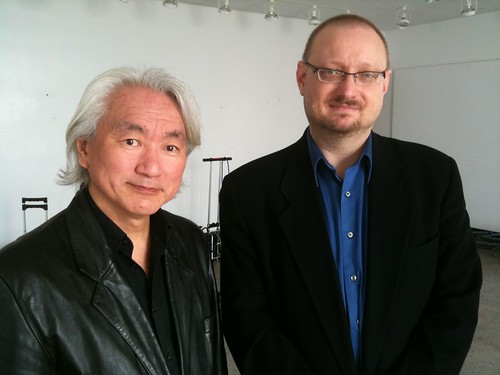
    It turns out that I was in NYC a bit over a week ago, filming an interview for “Sci-Fi Science: Physics of the Impossible,” a show on the Science Channel in the US, and ITV in the UK. My bits won’t run until the Summer. It seems to be broadly similar to the “That’s Impossible” show I popped up in last year, only this one is hosted by an honest-to-goodness scientist: Michio Kaku.

    With Michio Kaku

    While Dr. Kaku didn’t conduct the interview, he was there for it, and he and I had an informal lunch afterwards. Let me say, talking about the Fermi Paradox, the origins of the universe, and boiling spacetime(!) with one of the leading thinkers in string theory was pretty damn cool.

  • New Fast Company: World Water Day

    My latest Fast Company piece went up last night, in commemoration of World Water Day 2010. This was the perfect opportunity to talk a bit about my time at the LAUNCH inaugural event, which focused on — surprise — water. In the essay, I talk a bit about three of the ten innovative ideas we got a chance to explore at the LAUNCH meeting. Here’s one:

    Dutyion Root Hydration System, a mouthful of a name for something that’s actually pretty remarkable. The system takes a specialized form of hydrophilic plastic and converts it into heavy-duty tubes suitable for below-ground irrigation. If you run saltwater (or similarly brackish/unusable water) through the tubes, the plastic wicks the water out as vapor, permeating it into the soil, which can then support many kinds of food crops and trees. That is, this plastic would let you irrigate orchards and farmland with sea water.

    There are still plenty of questions, most critically about how long the plastic lasts and how to bring down production cost (it’s not cheap, at present), but the utility of something like would be enormous. Test uses in the Middle East have already shown quite a bit of promise; one use that could be of particular value would be to maintain trees to fight desertification.

    This was actually the first item we talked about at LAUNCH, and it really set the tone for the meeting. A technology in the early stages of development, with some good test results already available, and with incredible potential for transforming the landscape. The pilot projects really underscore just how powerful this kind of tech might be: rows of fruit trees growing in the sands of Abu Dhabi, watered only by seawater pumped from the Gulf through the dutyion tubes. As I say at the end of the Fast Company post:

      On this World Water Day, 2010, it’s hard not to feel a bit of hope for the future.
  • Getting it Right

    Screen shot 2010-03-13 at 12.35.20 PM.PNG

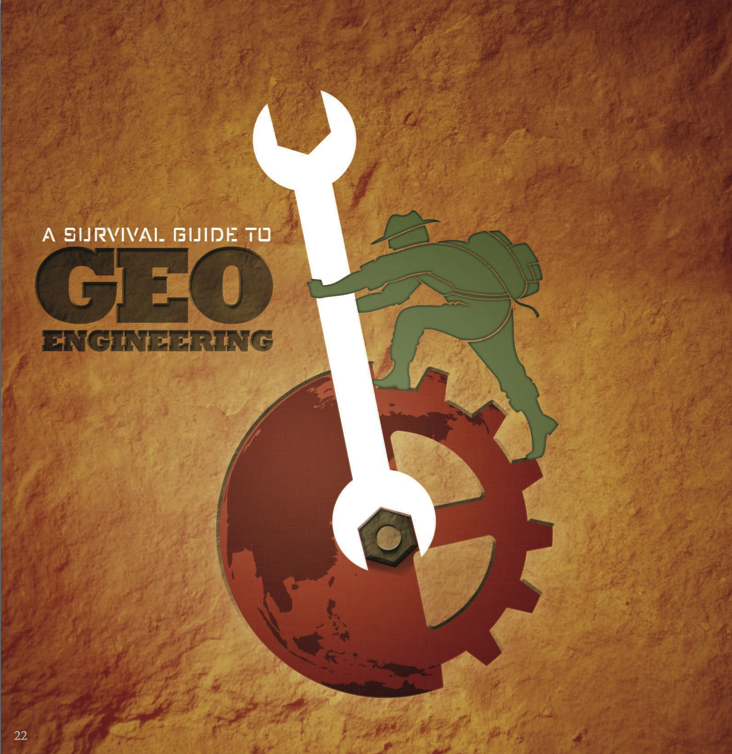
    A Survival Guide to Geoengineering, my essay for Momentum, the journal of the University of Minnesota’s Institute on the Environment, is now available online and via PDF. It’s an exploration of what would be necessary to reduce the risks associated with geoengineering, if (or, sadly, when) it gets deployed. This essay served as the basis of the talk I gave at the State of Green Business Forum last month.

    The first part of the essay is a recap of the main issues around geoengineering — the kinds of proposals out there, the uncertainties involved, and the political dilemmas. But the real focus is the list of five key steps that I believe to be mandatory to steer us away from the worst potential results of geoengineering:

    • Transparency
    • Ongoing international advisory group
    • A bottom-up “Ecoscientists without Borders”
    • Clear mechanisms for resolving disputes
    • Ban (with teeth) on non-state projects

    Interestingly, when I gave the talk in February going over these ideas, the last is the one that I got the most push-back on. I suspect that, once real mechanisms for monitoring and managing global climate systems are in place, non-state projects could be useful and warranted. For now, however, it seems clear that non-state groups acting independently are more likely to lead to inter-state disputes than any persistent moderation of temperatures or carbon.

  • Countdown

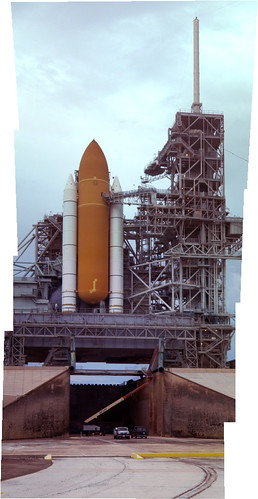
    Shuttle Launch Pad (big)I spent the last three days at the Kennedy Space Center, for the inaugural meeting of the LAUNCH organization. We talked water, and saw some pretty interesting — and occasionally remarkable — innovations and proposals. I’ll have more to say about them in a bit, but for now…

    I grew up a space geek (and dinosaur geek, etc.), so the visit to KSC was a welcome reminder of those feelings. We didn’t just get the basic tour; we actually got some behind-the-scenes stuff that was just amazing (and, because the shuttle program is ending soon, won’t be replicable for much longer). We got to go into the shuttle processing facility, where one of the shuttles (in this case, Endeavor) gets cleaned and fixed and otherwise readied for an upcoming launch. This meant walking around beneath the shuttle, right below the heat-resistant tiles (and occasionally spotting when one of them needed to be replaced).

    The photomontage at right was taken of the shuttle Discovery, set to launch in the next few weeks; I took the pictures while we were parked in the blast zone, where flames from the engines go in the initial moments of take-off. Anything in this zone would be instantly incinerated — and even the fencing a few hundred yards behind us was bent and blackened.

    (You can see all of the pictures I’ve made public at this link on Flickr.)

    Even the normal tour items were pretty amazing — the Saturn V rocket engines, the actual Apollo mission control consoles, and a piece of the Moon.

    That you can touch.

    And I did.

    As astounding as it all was, there was a subtle melancholy there, as well. The Constellation program to return to the Moon was canceled in the most recent NASA budget (with the money redirected to more robotic missions and long-range research, so I’m actually in full approval), and the engineers we spoke to all made a point of mentioning it unhappily.

    But beyond that was the recognition that the massive rockets and space-stations programs are the apotheosis of 20th century engineering. These are artifacts of yesterday’s version of tomorrow, the mechanistic urge on an unthinkable scale. And such remarkable, complex systems are ultimately tied to a worldview and process that celebrates the centralized and the controlled in an era that is increasingly neither.

    The future of human civilization, in the end, lies in space. But getting there, and staying there, will look nothing like the heady visions of Apollo.

  • Cool Project #3: Social Business Edge

    yUgeP.Screen shot 2010-03-09 at 07-41-15.pngOn Monday, April 19 (yeah, just two days after the UCSC thing), I’ll be speaking at Social Business Edge in New York City, a new (and hopefully recurring) event looking at the intersection of business innovation and social media.

    Certainly what is going on today is more than just social media marketing, limited to marketing and community outreach efforts. Some of the leading thinkers in this area believe that we are at the start of something much larger than a retake on marketing. We are seeing a rethinking of work, collaboration, and the role of management in a changing world, where the principles and tools of the web are transforming society, media, and business. The mainstays of business theory — like innovation, competitive advantage, marketing, production, and strategic planning — need to be reconsidered and rebalanced in the context of a changing world. The rise of the real-time, social web has become one of the critical factors in this new century, along with a radically changed global economic climate, an accelerating need for sustainable business practices, and a political context demanding increased openness in business.

    Assembled (and hosted) by my friend Stowe Boyd, Social Business Edge includes a pretty good variety of speakers. Stowe has decided to do this in something of a “talk show” format, so use of powerpoints will be limited, and the presentations will be more conversational than formal.

    The event isn’t free, but it is pretty reasonably priced for something like this. If you’re in the area, and are interested in the future of social media, I think you’ll find this quite valuable. Hope to see you there!

  • Cool Project #2: UC Santa Cruz “Intellectual Forum”

    As you might know (especially if you’ve read my bio), I went to college at the University of California at Santa Cruz, receiving a double-BA in History (with a focus on 20th century revolutionary movements) and Anthropology (with a focus on human evolution). UCSC was a terrific place to get an education, due to (at the time) its use of narrative evaluations rather than letter grades, the deep commitment on the part of the faculty to undergraduate education, and its general spirit of enlightened experimentation. Although UC Santa Cruz has changed over the 22 years since I left, I still have real affection for the place.

    So when UCSC contacted me about speaking at an upcoming event, I jumped at the opportunity to give something back.

    On Saturday, April 17, I’ll be one of the three featured speakers at what they’re calling the “Intellectual Forum,” part of the 2010 Reunion Weekend “Day by the Bay.”

    What does the future look like?

    Three UCSC alumni explore the next generation of communities, work and health care, offering fascinating insights into the way we’ll live our lives:

    Jamais Cascio (Cowell, anthropology and history ’88)
    Writer, leader, and visionary, Jamais will share scenarios of the future that cross the boundaries of technology, the environment, and society. Research Fellow, Institute For The Future. Named by Foreign Policy as one of the top 100 global thinkers and a “moral guide to the future.”

    Shannon Brownlee (College Eight, biology ’79)
    Nationally known writer and essayist whose book, Overtreated: Why Too Much Medicine is Making Us Sicker and Poorer was named the best economics book of 2007 by the New York Times.

    David Bank (Oakes, politics ’82)
    Vice President, Civic Ventures. A veteran journalist, Bank was a reporter for The Wall Street Journal for nine years, covering Silicon Valley and the software industry. His book, Breaking Windows: How Bill Gates Fumbled the Future of Microsoft (Free Press) was named one of the “Best Business Books of 2001” by the Harvard Business Review

    The event is free, although you’ll need to register. And don’t blame me for what they’re calling it.

  • Cool Project #1: LAUNCH

    Launch Logo.jpegI’m honored to have been asked to serve on the advisory council for LAUNCH, a group looking to support innovative ideas for sustainability. Sponsored by NASA, the US Department of State, US Aid for International Development, and Nike(!), LAUNCH is intended to give good ideas the assistance — financial and otherwise — necessary to move from concept to plan to implementation.

    LAUNCH will identify 10 innovative, often disruptive world-class ideas, technologies or programs that show great promise in making tangible and impactful progress for society in each of the key challenge areas. These innovators will be invited to be part of the LAUNCH Sustainability Forum which is a high-level impact event where they present their innovative ideas to LAUNCH and engage in a collaborative discussion.

    The event however, is just the starting point, post-event the Innovators will become part of the LAUNCH Accelerator, an on-going effort which utilizes the collective power of the networks, resources and expertise of the LAUNCH organization to create and execute an action plan accelerating them from where they are to where they need to be to successful have a positive impact on global sustainability.

    The first meeting will be about water-related innovations; you can see the list of ideas we’ll be talking through here.

    My fellow LAUNCH Council members are all brilliant and insightful, and I’m gobsmacked to be a part of this group.

  • Pushing Back Against the Methane Tipping Point

    (This is a long piece, but I’m putting it all on the front page because it’s a massive issue.)

    A piece in the latest issue of Science shows that there’s a considerable amount of methane (CH4) coming from the East Siberian Arctic Shelf, where it had been trapped under the permafrost. There’s as much coming out from one small section of the Arctic ocean as from all the rest of the oceans combined. This is officially Not Good.

    Here’s why: methane is a powerful greenhouse gas, significantly more powerful than carbon dioxide. There are billions of tons of methane trapped under the permafrost, and if that methane starts leaking quickly, it would have a strong feedback effect — warming the atmosphere and oceans, causing more methane to leak, and on and on. The melting of methane ice (aka “methane hydrates” and “methane clathrates”) is probably the most significant global warming tipping point event out there. If we see runaway methane from underneath the Siberian permafrost, we could see temperatures increasing far faster than even the most pessimistic CO2-driven scenarios — perhaps as much as 8-10° C, very much into the global catastrophe realm. To put it in context: rapid methane releases have been implicated in extinction events in Earth’s geologic past.

    (Here’s one piece of mitigating information: it’s unclear how long this methane leak has been happening, or the degree to which the measured methane levels exceeds previous amounts. If we’re lucky, this is actually a status quo situation, and we still have time before we reach a tipping point. But basing our strategy on “if we’re lucky” is not very wise.)

    Because of this tipping point/feedback process, a runaway methane melt won’t stop on its own. When I’ve written before about desperation as a driver for the rapid (and risky) implementation of geoengineering, this is precisely the scenario I had in mind. If this news holds up, and if it can be shown that the methane leak is actually increasing, then I believe that we are certain to engage in geoengineering, and probably will do so before we have enough good models and studies to suss out any unwanted consequences. We’d be faced with a choice between guaranteed catastrophe or terrible uncertainty.

    We’d probably try every geoengineering option available in the event of a methane runaway, but the one that most people would focus on would be the temperature management strategies: stratospheric sulfate injection, seawater cloud brightening, and (unlikely to happen but certain to get a lot of media attention) orbiting reflectors. But there’s one more method we should consider. Understanding its potential requires a bit of science talk.

    I noted earlier that methane is a “significantly more powerful” greenhouse gas than carbon dioxide. More specifically, it’s at least 21 times more powerful a greenhouse gas than CO2; some reports (such as the first piece I linked to above) cite it as 30x stronger, and I’ve been seen as much as 72x stronger. The difference comes from how the effect is measured over time — methane and carbon dioxide leave the atmosphere at very different speeds. Although CO2 takes upwards of a century to cycle out naturally, methane takes only about ten years. Why the difference? Chemical processes in the atmosphere break down CH4 (in combination with oxygen) into CO2+H2O — carbon dioxide and water. In addition, certain bacteria — known as methanotrophs — actually consume methane, with the same chemical results. These processes have their limits, however; an abundance of methane in the atmosphere can overwhelm the oxidation chemistry, making the methane stick around for longer than the typical 8-10 years, and the commonplace methanotrophic bacteria evolved in an environment where methane emerges gradually.

    These are pretty much the only two natural methane “sinks.” There are a few small-scale human processes that can make use of methane (for the production of methanol for fuel, for example) and function as artificial sinks, but such efforts would be hard-pressed to capture methane released across two million square kilometers. So here’s where we start to think big.

    Both of the natural processes are, in principle, amenable to human intervention. The oxidation of methane into CO2 and water is a well-understood phenomenon, and relies on the presence of OH (hydroxyl radical); upwards of 90% of lower atmosphere methane is oxidized through this process (PDF). But OH is something of a problem chemical, in that it’s also a key oxidation agent for many atmospheric pollutants, such as carbon monoxide and NOx. Although we could produce OH to enhance the natural chemical oxidation process, the side-effects of pumping enough OH into the atmosphere to oxidize all of that methane would be unpredictable, but almost certainly quite bad.

    So what about methanotrophic bacteria? Such bacteria have long been recognized in freshwater areas and soil, and have had limited use in bioremediation efforts. Methanotrophic Archaea — similar to bacteria, but a wholly different kingdom of organism — were recently identified in the oceans; research suggests that methanotrophic Archaea may be responsible for the oxidation of up to 80% of the methane in the oceans. Methanotrophic microbes can also be temperature extremophiles, as they were among the various species found after the Larsen B ice shelf collapsed.

    We recently began to learn much more about how methanotrophic bacteria function, as a team from the Institute for Genomic Research sequenced the genome of the methanotroph Methylococcus capsulatus. The scientists discovered that Methylococcus has the genomic capacity to adapt to a far wider set of environments than it is currently found in. They also looked at the possibility of enhancing the microbe’s ability to oxidize methane, although admittedly for purposes other than straight methane consumption.

    So here’s the proposal: we need to deploy methanotrophic microbes at the East Siberian Ice Shelf. Methanotrophic Archaea appears to be best-suited for this task, but we don’t know as much about them as we do about bacteria. If we need to modify the microbes (to consume methane more quickly, for example), we may need to work on Methylococcus bacteria, making them viable in extremely cold seawater. I suspect that working with the Archaea will probably be sufficient, but it’s important to think ahead about different pathways. Either way, we should consider just how we could make use of methanotrophs to avoid a methane-melt disaster. Given the size of the region, we’ll need lots of them, but that’s one advantage of biology over straight chemistry: the methanotrophs would be reproducing themselves.

    We need to be aware of possible unintended consequences, but at this point, it’s not clear how additional methanotrophs would pose a larger risk; moreover, a mass of methanotrophic organisms would undoubtedly be helpful for reducing overall atmospheric methane beyond the Siberian release. Nonetheless, there are some crucial questions we need to answer before we could consider deploying natural or GMO methanotrophs:

  • Is it physically possible? Could a sufficient number of methane-eating bacteria even be produced to counter a fast release of methane from the Siberian ice shelf?
  • Is it biologically possible? Would methanotrophic Archaea survive in the Siberian ocean? Could a species of methanotrophic bacteria be engineered to be able to do so (as well as consume large quantities of methane)?
  • What are the unrecognized risks? What are we missing in an initial risk analysis? Saying “we don’t know the risks” doesn’t, in and of itself, mean “we should not attempt this,” it means “we need to do more research.” Clearly, if the risks from enhancing the methane consumption and environmental adaptation capacities of a methanotroph could lead (through species-hopping genes or simple mutation) to even harder-to-manage problems than gigatons of atmospheric methane, this isn’t an option. Boosting OH levels in the region would be the fallback position, as we have more experience with managing CO and NOx pollutants.

    If the frozen methane in the Siberian ocean is melting faster, our options are extremely limited. We’d no longer be in a position to stop the melting, even by ceasing all greenhouse gas production today; the temperature increases we’re seeing now are the results of greenhouse gases put into the atmosphere decades ago. And when methane melts, it appears to do so quickly — there are signs that past methane clathrate events took less than a human lifetime.

    This is why I think that methane melt would inevitably mean geoengineering. But if this is the case, the pathway I suggest here may be the best option. The engineering options are enhancements of common natural processes, as opposed to something that emulates extreme conditions (such as sulfate injection). At least with current understanding, there would be few downsides to a greater-than-expected growth of the methanotroph population — it might even be helpful in mitigating atmospheric methane coming from other sources, such as cattle.

    A further advantage is that this is a process that could begin after we start to see significant methane output and could still have a measurably positive result. Using microbes for bio-“scrubbing” of methane from the atmosphere would work on methane that was a decade old as readily as methane fresh from the permafrost. We’d still see some effect from the methane that makes it to the atmosphere, but eventual removal would help to reduce that effect. This means that we still have time to get more certainty about the methane situation before we would need to use the methanotroph option; we don’t necessarily have to rush past our better judgment in response. With a process of this magnitude, it’s worth taking the time to get it right.

    If we are seeing the beginning of a runaway methane melt, we would be facing a problem of a scale with few precedents in human history. No society on the planet would be unaffected; if left unmitigated, it would continue to affect the lives of our children, and our children’s children, and generations beyond that. And remember, this is a fast process — simply pushing a bit harder to reduce carbon emissions will do nothing to stop it.

    Our choices are few, and the risk of not acting is (potentially) immense. We may well be on the brink of a new era in planetary management. Let’s hope we’re up to the challenge.

    (Some of this essay reproduces text from my initial methanotroph proposal on Worldchanging back in 2005. At that point, it was speculation — now, it’s something we need to seriously consider.)

  • New Fast Company: Augmented (Fashion) Reality

    My latest Fast Company piece is up: Augmented (Fashion) Reality takes a look at what happens when the world of fashion gets ahold of AR technology.

    It starts out with a scenario. Here’s a bit of it:

    I remember the first time I saw an AR outfit. I did a double-take, because I could have sworn that the woman had been wearing a fairly bland dress when I saw her at a distance, but suddenly she was wearing a sparkling gown that I could swear was made of diamonds. A few minutes later, I took off my arglasses to get something out of my eye, and *poof* her dress was back to the simple beige shift. That bland outfit was actually carrying a half-dozen or so specialized smart tags, providing abundant 3D data that my arglasses–and the AR systems of everyone else around her–translated into that diamond dress.

    I note late in the essay that fashion may end up being the “killer app” for wearable AR. The more I think about it, the more it rings true — AR can’t just be about finding the nearest Starbucks or getting a read on local environmental conditions. It has to be playful, too.

  • Participatory Panopticon On Its Way (Maybe)

    Picturephoning gives a heads-up on “Recognizr” (you know it’s cutting-edge when they leave out the “e”), an iPhone app that will supposedly recognize faces seen by the camera. Here’s the promo video:

    It’s a prototype from the Swedish group The Astonishing Tribe. Apparently, a photo taken in Recognizr (sigh) gets compared to pictures in various social networking platforms, including Flickr (see? no “e”!!!!), Facebook, and the like.

    Picturephoning links to a hysterical Daily Mail article, which plays up the STALKRS WILL STEAL UR VIRTUE angle, not really looking at the more interesting — and potentially more troubling — aspects. Popular Science is a little more sober, but ultimately not hugely more informative.

    Until I see something more than just the one video, I’m going to call this one Plausible, but not at all difficult to hoax. Anybody know better?

  • Time Enough

    I’ve been blogging for over six years. (Yes, blogging about blogging is a sin; I am aware of all Internet traditions.)

    My first post, at WorldChanging, was on October 2, 2003, linking to a BBC story about an “Earth Simulator” computer system in Japan. In fact, you can look at the handful of posts I put up that first month and see the early moments of a set of interests that have remained with me: nanotech, biotech, green tech, open source, social networking, ethics… These first posts were mostly just pointers with excerpts, and without much analysis, but these are the seeds from which larger things grow.

    Although my six-to-nine months of blogging had a pretty sporadic pace, by late 2004 I was on a much more frequent schedule, and in 2005 I don’t think I had much in the way of a day off of any kind — if I was healthy enough to pick up a laptop, I was blogging. After I left WC in April of 2006, and started Open the Future, I went back to a less-frequent blogging calendar. And in recent months, the emphasis has definitely been on the “less” rather than on the “frequent.”

    This isn’t an announcement that I’m stopping now, nor is it a promise to post more frequently. It’s more of an acknowledgement that Open the Future isn’t as lively as it might once have been, and is largely pointing to Things I’ve Done. I have this vague feeling that I should apologize for that, but OtF has always been a place for my brain to get some exercise. I do still need to play with ideas, and I’m glad I still have this platform. I’m not going to stop doing that, and — as I finally get this damn book proposal rewrite finished — I hope to use it much more actively while writing my next book.

    So there we are.

  • Futures Thinking: Mapping the Possibilities, and Writing Scenarios

    (tap tap… this thing on? There’s dust and cobwebs all over the place.)

    My most recent three Fast Company pieces are all of a set, part of the Futures Thinking series. Mapping the Possibilities (Part One, Part Two) give some practical advice for coming up with differing scenarios as part of a futures thinking project. Writing Scenarios offers up a set of real-world scenarios as examples of different styles.

    Part One offers some advice as to how to think about what you’re going to do:

    Foresight exercises that result in a single future story are rarely as useful as they appear, because we can’t predict the future. The goal of futures thinking isn’t to make predictions; the goal is to look for surprising implications. By crafting multiple futures (each focused on your core dilemma), you can look at your issues from differing perspectives, and try to dig out what happens when critical drivers collide in various ways.

    Whatever you come up with, you’ll be wrong. The future that does eventually emerge will almost certainly not look like the scenarios you construct. However, it’s possible to be wrong in useful ways–good scenarios will trigger minor epiphanies (what more traditional consultants usually call “aha!” moments), giving you clues about what to keep an eye out for that you otherwise would have missed.

    Part Two lays out the basics of world-building:

    World-building is, in many ways, the mirror-opposite of a good science fiction story. With the latter, the reader only needs to see enough of the world to make the choices and challenges facing the characters comprehensible. The world is a scaffolding upon which the writer tells a story. Clumsy science fiction authors may over-explain the new technologies or behaviors–where they came from, why they’re named as they are, etc.–but a good one will give you just enough to understand what’s going on, and sometimes a little less than that (trusting that the astute reader can figure it out from the context).

    Scenarios, conversely, are all about the context. Here, it’s the story that’s a scaffolding for the scenario–a canvas upon which to show the critical elements of the world you’ve built. A good scenario doesn’t make a good science fiction story–but it’s a setting within which a good science fiction story might be told.

    And Writing Scenarios looks at the different styles that can be employed to tell a scenario story:

    In Scenario-as-Story, the presentation is similar to that of a work of fiction. Named characters operate in a lightweight plot, but in doing so engage in behaviors that display key aspects of the scenario. […]

    The advantage of the Scenario-as-Story approach is that fiction is a familiar presentation language for readers, and they can more readily grasp the changes to one’s life that emerge from the scenario. A story model lets you describe some of the more nuanced aspects of a scenaric future. The disadvantage is that, generally speaking, scenarios are lousy fiction. Even the best-written scenario stories generally wouldn’t pass muster with a fiction editor.

    The examples I use are from the project I did with Adaptive Path (for Mozilla) in 2008, looking at the future of the Internet. The full set of scenarios can be downloaded here (PDF).

  • Homesteading the Uncanny Valley

    An audio recording of my talk at the “Biopolitics of Popular Culture” meeting in December is now available, so I’ve gone ahead and uploaded the presentation to slideshare.

    It’s a ~25 minute talk, and it should be relatively easy to follow along while listening to the audio.

    Audio: MP3

  • Hacking the Earth (Without Voiding the Warranty)

    The talk I gave at the State of Green Business Forum last week is now available on video.

    Runs about 22 minutes.

    (There are some inexplicably lengthy shots of the static presentation images, but other than that, it looks pretty decent.)

  • Translating Opacity

    Andrew Revkin asked what I thought about his arguments for greater development and use of automated language translation technologies. In his piece “The No(w)osphere,” Revkin writes:

    As the human population heads toward nine billion and simultaneously becomes ever more interlaced via mobility, commerce and communication links, the potential to shape the human journey — for better or worse — through the sharing of ideas and experiences has never been greater. […]

    But language remains a barrier to having a truly global conversation…]

    .

    Automated translation remains clumsy, at best, these days. (One perfect illustration is the website “Translation Party,” which translates an English phrase into Japanese, then translates it back to English, then back to Japanese, until it reaches “equilibrium” — a point where the English and the Japanese auto-translate back and forth precisely.) Linguistic accuracy is a much harder problem than technology pundits of a few decades ago had expected. Nonetheless, as Revkin points out, there are a number of projects out there that suggest that a future of relatively useful automated translation is probably fairly near.

    Here’s the twist: I suspect that a less-than-perfect system would be better than an idealized perfect translation. Why? Because an imperfect system would require us to speak more simply and in a more straightforward fashion, with fewer culture-specific idioms and convoluted sentences, as we do today with our current tools. Working with people for whom English is not their primary language, I know that I need to speak and write in a way that doesn’t lend itself to unintended ambiguity or confusion. If I knew that an automated system could be tripped up by overly-complex language, I’d be as careful and precise as possible.

    But in everyday conversation, we don’t tend to speak carefully and precisely. Correspondingly, an effectively perfect system would let us slip into the kinds of discussion and writing patterns that we use with other native speakers. I suspect that, counter-intuitively, this would lead to more confusion and friction, as meaning is culturally-rooted. A perfect translation of the denotation of a word or phrase may not carry the correct connotation; moreover, the translated word or phrase may have a very different connotation in a different culture.

    In other words, translation technology that offers results that make sense linguistically, and carry the proper surface meaning of the words and phrases used, could well be close at hand. But translation technology that offers results that have the same meaning in both languages, especially with complex or idiomatic phrasing, probably awaits the arrival of relatively strong machine intelligence. Simply put, it would require software that understood what you meant, not just what you said.

    We should be careful not to get these two outcomes confused. The more that we expect our translation tools to convert meaning, not just phrasing, the more likely we are to be unhappy with the results.