Author: Jamais Cascio

  • “Inflection Points” Presentation

    For those folks who are interested, here’s the Slideshare version of the presentation I gave last week at the Earthquake Engineering Research Institute annual meeting. I was asked to talk about foresight thinking, as the event theme was “The Big One of 2056: What Went Right?” a look at a fictional 7.8 quake in the SF region that was handled as well as they could imagine possible.

    My goal was to offer a bit of reassurance to the audience that there is some real utility to thinking about the future, and to spell out (in a cursory way) the kinds of big picture issues they should keep in mind while looking ahead forty-six years.

    By and large, it was a successful talk. The post-talk questions were engaged, with little push-back, and I’m told that the overall response from the audience was quite positive.

    The talk was video recorded, and I’m told will eventually be available to the public. I’ll link when that happens.

  • Living On (and Hacking the) Earth

    Last month, I was interviewed for the syndicated “Living on Earth” program (typically heard on NPR stations) on the subject of geoengineering. That interview was run this past weekend, and is now available — with transcript — at the Living on Earth website.

    (Direct link to the MP3.)

    YOUNG: What do you think is the likelihood that we might need a geo-engineering approach?

    CASCIO: I think it’s more likely than not, unfortunately because…

    YOUNG: Now wait a minute, you spent all this time telling me how it’s a disaster, now you’re saying we might have to use it?

    CASCIO: Well, yes. It’s because over the past few decades we simply have been ignoring the problem of global warming. We’re in a situation where we simply no longer have the best option available to us. The best option would have been to deal with this 20 years ago.

    And so, what we’re stuck with [is] a selection of less good options. Are we talking rapid decarbonization and what that’s going to the economy? Are we talking about making major changes to our energy infrastructure? Useful, but again, disruptive. These other alternatives are so seemingly unpalatable. It’s very likely that we’re going to be stuck in a situation where we will feel ourselves forced to take radical action.

    Emphasis in that last paragraph on the “seemingly,” btw.

  • New Fast Company: iWorry

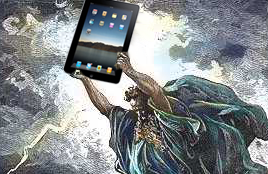
    MosesPadclip.png(Well, “new” in the sense of it’s the most recent; it actually went up earlier this week, I just didn’t get around to linking to it here. Ahem.)

    iWorry” is my foray into the iPad discussion, focusing less on the product and more on its support infrastructure:

    But the iPad isn’t a phone; it is a general purpose computer. It does email and Web and documents and presentations and games and all of the other kinds of things we do with our “regular” computers. Yet it will suffer under the same restrictions as the iPhone–prohibition of any application that Apple doesn’t like, for whatever reason. Sometimes that means the application uses undocumented features, but startlingly often it just means “duplication of features”–the application does something that Apple’s own software does, but does it differently. (This raises the uncomfortable question as to whether the Kindle app for the iPhone–which works quite nicely, actually–will run on the iPad.)

    These restrictions aren’t going to hurt Apple’s bottom line, and admittedly will probably make for a more comfortable user experience on the device itself. But the risk — and the source of my worry — is that the locked-down app model moves from these kind of appliance systems to the kinds of devices that have historically been open. If the next version of the MacOS insists that you use a “MacOS App Store” to get the software you want, I’ll be moving to another platform.

    I brought up a similar point in a conversation with Annalee Newitz, who wrote about her own concerns about the iPad for io9.com, Why the iPad is Crap Futurism. I think her summary of my point following the quote gets it exactly right.

    As futurist Jamais Cascio told io9:

    This is Apple’s big push of its top-down control over applications into the general-purpose computing world. The only applications that will work with the iPad are those approved by Apple, under very opaque conditions. On a phone, that’s borderline acceptable, but it’s not for something that is positioned to overlap with regular computers.

    The iPad has all the problems of television, with none of the benefits of computers.

    If I get one, it will be for the hands-on experience of seeing what kinds of uses I would have for a device that sits between a smart pocket device and a notebook computer. But I promise not to like it.

  • Doom & Gloom

    IEET’s Mike Treder interviewed me on Bloggingheads.TV this week, and the video is now available. It runs about 45 minutes.

    Egad, it’s depressing. Sorry about that.

    First time I’ve done one of these, and something that leapt out at me was that I can’t seem to sit still. So, question for the viewers — should I try to make a point of keeping still during something like this, or is being more “animated” a good thing?

  • New Fast Company: Vampire Loads, White Roofs, and the Quest for Efficiency

    Latest Fast Company is now up: Vampire Loads, White Roofs, and the Quest for Efficiency gives a shout-out to the newly-retired head of the California Energy Commission, Art Rosenfeld, and the benefits his policies have provided to California and, as other states adopt them and manufacturers adhere to them, the rest of the US.

    Rosenfeld was, until his retirement, the head of the California Energy Commission, a state organization that shapes the rules surrounding electricity production and use in California. During Rosenfeld’s 30-year tenure at the CEC, he made energy efficiency the overriding driver of regulatory policy, creating rules for everything from refrigerators (which now use only a quarter of the power that their less-fancy 1970s ancestors did) to “vampire loads” (the power still consumed by devices when turned off) to–most recently–the power consumed by flat screen televisions, which by some reports now account for nearly 10% of the power consumption in California.

    And in doing so, is directly responsible for this remarkable fact: despite an explosion of consumer electronics, mobile gadgets, and personal computers of all types, energy use per-capita in California is the same as it was 30 years ago.

    There are a couple of ways to look at this data point. You could say “See! With all of the effort we put into efficiency, people just find ways to keep using that power — things never get better!” Or you could say “See! Through increasing efficiency, we can keep improving our quality of life without increasing the impact we have on the world!”

    Which one is more persuasive depends on what kind of mood I’m in.

  • The Return of El Niño

    I’ve been awakened several times this week at 4am by 30+ mile-per-hour winds ripping through the bushes in the backyard, pushing the soaked metal table around on the stone patio. The rain is loud, but the wind somehow more disturbing, foreboding. And there’s at least another week more of this to come.

    California (and the western US as a whole) needs the rainfall, to be sure, but the intensity of the inundation in an El Niño cycle can itself be destructive — flooding, mudslides, trees and power lines blown down, and so forth. California natives (like me) often joke about local news turing half an inch of rainfall into an OMGSTORMWATCH’010!!! environoia event, but when we’re looking at getting close to a half-season’s worth of rain over the course of a couple of weeks, the hyperbole is almost warranted. And rainfall arriving in torrential bursts doesn’t soak in and store up as readily as slower, more spread out, showers.

    And so our weather becomes a metaphor: we need the rain; the rain arrives, but it does so in a way that doesn’t actually help much, and undermines other aspects of our lives. Sound like anything else going on these days?

    Maintaining optimism when the storm is approaching its peak is difficult, at best. It’s easy to fall victim to the 4am darkness. And, just maybe, it’s good to let ourselves have that moment of despair. It’s the despair, the fear, the sorrow that lets us truly appreciate the opportunities to act that will eventually come. The calm, clearing skies never look so good as they do after a terrifying storm; the tree limbs and broken fences littering the streets confirm the power of the wind and the rain, but in the breaking sunlight seem less like a nightmare made real, and more like a challenge to be cleared.

  • Speaker Circuit

    My 2010 calendar is filling up already!

  • February 4: The Earthquake Engineering Research Institute‘s 2010 Annual Meeting (PDF). Morning keynote. San Francisco.
  • Also February 4: State of Green Business Forum — “Hacking the Earth Without Voiding its Warranty.” San Francisco (just down the street from the previous conference, fortunately).
  • February 13: Information Technology Senior Management Forum 2010 Symposium on Green IT. San Jose.
  • Mid-March: NASA-sponsored project on sustainability, coinciding with shuttle launch. Cape Canaveral, Florida. (No public link yet.)
  • April 19: Social Business Edge, Show 1. New York City.
  • April 26-27: Institute for the Future Ten-Year Forecast. San Francisco.
  • May 5-7: Lift10. Geneva.

    …whew…

  • New Fast Company: Innovation as Resource

    I’m back to blogging at Fast Company, and my latest piece is now up: Innovation as Resource and China’s New Magnetism.

    The U.K.’s Independent reports that China has been gradually cutting the amount of rare-earth elements it exports, now down 40% from seven years ago. China now exports only 25% of the rare-earth elements it mines. […]

    So what are our options? We (as in, the non-China parts of the industrialized world) could try to pressure China to sell more, but that’s unlikely to work–and China tends not to respond well to even mild criticism. We could try to rapidly reopen the now-closed rare-earth element mines, but mining is, frankly, an environmental nightmare and incredibly dangerous–hardly a sustainable practice.

    Our best option is to innovate our way out of the problem.

    China, and to a lesser (but increasing) extent India, can be seen as “leapfrog superpowers” — undergoing a rapid shift in global status, a shift which remains incomplete. China has more influence and importance on the global stage than it is willing to admit (preferring to call itself a developing nation), but not nearly the power that some fear.

    The question is, does the immense potential power of China (and India) make a leapfrog transition easier or harder?

  • Sprechen sie Deutsch?

    When in Vienna a couple of months ago, I was interviewed for their newspaper Die Presse; that interview was finally published (although sadly/fortunately absent any of the pictures they took of me).

    Futurologe: Die Zukunft passt wie angegossen

    I suspect that the Austrian dialect of German is rather idiomatic, as the Google Translate version of the piece is especially nonsensical (in ways that you can’t blame me for!). Anyone out there want to give a rough translation a shot?

    (Update: We now have one translation from Torsten Meier in the comments, and other from Carmen Tschofen in the extended entry. Between the two of them, you should have a pretty good sense of the interview. Thanks, folks!)

    Futurologist: The Future is a tailored fit

    The US- futurologist Jamais Cascio detects trends like others as a good business. He spoke with the Press on Sunday about the joy of hacking and designing at the push of a button.

    You are someone who believes that the world can be changed positively, without rejecting considerations of the darker side. Do you think people can learn from history?

    I fight against the idea that we’re all lost and that we’ll be paralyzed by shock and say ,“Oh, God, there’s nothing anyone can do.” Because: In most cases, one can do something. It is really easy to get caught up in the idea that people are simply dumb and aren’t able to learn. But look at history and how society has changed. Particularly in the West, in the USA, Europe, or countries like Japan: Life has become so much more free, so much richer—not only from a material perspective, but also from a social perspective. We have more options that ever before in history, we have access to more information than ever before. This small device in my pocket has more power than all the computers there were used to send a man to the moon combined. It may not always look like it, and we don’t always learn the right lesson, but we learn above all from our constant mistakes.

    Failure was [perhaps] forbidden before?

    In depends on the region: Where I come from, in Silicon Valley, San Francisco, where most of the computer executives work, you aren’t viewed as a good company leader as long as you haven’t completely fallen on your face once. Ok, you tried it, you made a great big mistake, everything’s falling apart, and you learn a lot from it, and you don’t make the same mistake again, but instead will create something better. And this approach has been around for a while, particularly in regions with a high degree of innovation and where there’s lots of room from experimentation.

    In the USA, creativity is required even in failure. Will the negotiation with “ideas” and “creativity” determine the economy of the future in the post-industrial society?

    Yes, and for a whole lot of reasons: one reason is the rapid development of technology and how this technology changes our economy. Creative ideas are the catalyst for this transition [change], in that our whole system is based on innovation. In addition, in the meantime there are already many production mechanisms and processes that increasingly allow the small business, individual businessperson, or small collective to produce their own products that once required large industrial production.

    Can you give a specific example?

    For example, there are now 3-D printers. You might not have them here now, but these things have been on the market for almost ten years. At first they were primitive machines that only produced strange forms, only good enough to create models. Today, due to new plastics [polymers] that these printers use as ink, it’s possible to create products that are really usable. And they keep getting cheaper. It’s possible that within the next ten years families will have a printer like this at home and will be in the position to create their own special items at the push of a button. And where does one get the design for such things? There will be a lot of new occupations and educational opportunities coming out of this “idea.” One can put the designs online or sell them on iTunes or similar platforms.

    Isn’t it true that through technology we’re losing [forgetting] our natural abilities: for example, memorizing [remembering] telephone numbers, finding our way through a city by car, or writing by hand?

    I think it was Socrates that complained bitterly that his students learned to read, thus losing that ability for oral recitation of stories. And in a way he was right: the students didn’t learn one thing, but what they got instead was huge. And the same is happening with modern transitions [changes]: We give up something, but in exchange the technology gives us the opportunity to do more, to experience more, to learn more and to connect us better than ever before in history.

    Would you say that technology inspires our creativity? Anyone can film and edit a movie, everyone can create animations or produce music.

    There have always been very many people out there who had talent and ideas, but simply didn’t have the money and the chance to express these ideas. In that this ability to express [yourself] creatively, at this level [amount], with these options, becomes democratized, the pile of complete shit that’s being produced grew. Every day millions of videos are uploaded to YouTube, and 99 percent are crap. But that also means that we have a growing number of products that are quite good. And again here a completely new industry is created, focusing on information filtering and methods that help users to find what they’re really looking for. That can be new software, but it can also be people, who can sort and rate the Net [information] on what’s good and what can be ignored.

    This trend can be linked to personalization: Do we feel so lost in the mass society that we want to make [put] our mark on every item [product]?

    Three hundred years ago nearly everything was “personalized” because almost everything was made by hand—it even had a personal signature. Through most of the history of civilization products were totally personalized, meaning this type of production was slow and difficult. And then came the industrial revolution, and suddenly one could mass produce things. That was in some sense a wrong path in history, made possible by technology but one that wasn’t very humane. However, the profits were so large that it was impossible to give up this new type of production—and yet today technological development is going exactly in the direction of individualized work. And now it’s possible to offer the masses both individualized production processes as well as personalized products. It is a so-called democratization of personalization. In addition there is a whole new generation of people who have the desire and the ability, not just to passively consume things, but rather to work actively with products – to tinker, to hack the products and manipulate them. In the USA this is called the Maker Movement, with the motto: If I can’t take it apart, I don’t want it. For example, they don’t particularly like the iPhone, because it [isn’t open]. They want access to the source code or to be able to add new hardware features.

    So the new generation doesn’t only want to be presented with finished products?

    That is a very important and significant idea that will change a lot in the economy, because it means nothing less that a new conceptualization of the relationship between producer and consumer. It’s about a fundamentally different positioning: One doesn’t just want to be the consumer anymore, but rather an active co-producer. And when coupled with the opportunities, with the current changes in the economy, we will – I’d say in about 20 to 25 years—live in a world, in which pretty much every object we will use, from various products to computers, cars, advertisements, will be “personalized.” That doesn’t necessarily mean that your name will be on it, but it could be a chair that is able to fit itself exactly to your rear end.

    If everything is being made at home, who pays for what and why?

    This transition will be fundamental for the economy; industrial capitalism as we know it won’t exist much longer. And just because profit and efficiency were the only factors up until now on which everything was based, it doesn’t mean that it will stay that way. One possible accomplishment of this new creative world of the future could be, that uncontrolled growth will no longer be the requirement [assumption] for the system. When we can produce things at home, the pressure to earn money also drops.

    Next week: Mass customization: how personalized design works
  • The Old Year

    Sunset at 34,000 Feet

    (Updated – I knew that I had forgotten a couple of talks…)

    I’ve spent the last week or so just… sleeping. Relaxing. Not thinking. Trying to get myself rested and ready for what looks to be another heavy year.

    2009 ended on quite a high note, with my selection by Foreign Policy magazine as one of their “Top 100 Global Thinkers for 2009,” and my being honored by the Institute for the Future as their second “Research Fellow,” something that was previously bestowed upon Howard Rheingold — so that’s terrific company to be in.

    My work at IFTF continued unabated, focusing primarily upon sustainability futures and their annual “Ten Year Forecast” program, but being pulled in on everything from food futures to global health to the future of construction equipment.

    Here’s what the rest of 2009 looked like for me:

    Travel

    Pasadena, London, Manchester, Amsterdam, Sydney, Atlanta, Toronto, New York, Chicago, Vienna, Chicago, Irvine, Chicago.

    Media

    February: Published Hacking the Earth
    March: Column for Fast Company.com starts
    April: Article in Foreign Policy
    June: Wall Street Journal article
    June: Big Atlantic Monthly article
    July: Appeared on two episodes of History Channel’s That’s Impossible
    October: Second Atlantic Monthly article

    Public Talks

    February: Future: To Go at the Art Center College Sustainable Mobility Summit.
    March: Cascio’s Laws of Robotics at the Menlo Park AI Meetup.
    June: Hacking the Earth at Futuresonic.
    June: Mobile Intelligence at Mobile Monday Amsterdam.
    June: ReMaking Tomorrow at AMPlify09.
    October: If I Can’t Dance, I Don’t Want to be Part of Your Singularity at New York Future Salon.
    November: The Next Ten Years at Futurespace Vienna.
    December: Biopolitics of Popular Culture closing talk.

    Interviews

    March: NPR/Day to Day
    April: CBC/Spark
    April: New Hampshire Public Radio
    May: Freedom Lab Amsterdam (last on page)
    May: AMP Sydney
    July: Tactical Transparency
    July: Wisconsin Public Radio/Kathleen Dunn
    August: Slate (video)
    September: CBC/Q
    October: /Message (video)
    November: Public Radio International/On the Media

    Here’s hoping that your 2010 is less exhausting than mine will be!

  • Cold War Over Warming Already Underway?

    Seems like it.

    Mark Lynas, who worked with the Maldives group at COP15, was literally in the room when the final negotiations took place, and wrote about it for The Guardian. The key section:

    To those who would blame Obama and rich countries in general, know this: it was China’s representative who insisted that industrialised country targets, previously agreed as an 80% cut by 2050, be taken out of the deal. “Why can’t we even mention our own targets?” demanded a furious Angela Merkel. Australia’s prime minister, Kevin Rudd, was annoyed enough to bang his microphone. Brazil’s representative too pointed out the illogicality of China’s position. Why should rich countries not announce even this unilateral cut? The Chinese delegate said no, and I watched, aghast, as Merkel threw up her hands in despair and conceded the point. Now we know why – because China bet, correctly, that Obama would get the blame for the Copenhagen accord’s lack of ambition.

    China, backed at times by India, then proceeded to take out all the numbers that mattered. A 2020 peaking year in global emissions, essential to restrain temperatures to 2C, was removed and replaced by woolly language suggesting that emissions should peak “as soon as possible”. The long-term target, of global 50% cuts by 2050, was also excised. No one else, perhaps with the exceptions of India and Saudi Arabia, wanted this to happen. I am certain that had the Chinese not been in the room, we would have left Copenhagen with a deal that had environmentalists popping champagne corks popping in every corner of the world.

    […] With the deal gutted, the heads of state session concluded with a final battle as the Chinese delegate insisted on removing the 1.5C target so beloved of the small island states and low-lying nations who have most to lose from rising seas. President Nasheed of the Maldives, supported by Brown, fought valiantly to save this crucial number. “How can you ask my country to go extinct?” demanded Nasheed. The Chinese delegate feigned great offence – and the number stayed, but surrounded by language which makes it all but meaningless. The deed was done.

    I figured something like this would happen. I just didn’t expect the signs to show up so quickly.

  • None More Black

    nonemoreblack.pngAn aerosol known as “black carbon,” a primary component in soot, looks to be a key driver of anthropogenic global warming in tropical locations around the world — most notably, in the Himalayan region.

    …new research, by NASA’s William Lau and collaborators, reinforces with detailed numerical analysis what earlier studies suggest: that soot and dust contribute as much (or more) to atmospheric warming in the Himalayas as greenhouse gases. This warming fuels the melting of glaciers and could threaten fresh water resources in a region that is home to more than a billion people.

    […] Nicknamed the “Third Pole”, the region in fact holds the third largest amount of stored water on the planet beyond the North and South Poles. But since the early 1960s, the acreage covered by Himalayan glaciers has declined by over 20 percent. Some Himalayan glaciers are melting so rapidly, some scientists postulate, that they may vanish by mid-century if trends persist. Climatologists have generally blamed the build-up of greenhouse gases for the retreat, but Lau’s work suggests that may not be the complete story.

    He has produced new evidence suggesting that an “elevated heat pump” process is fueling the loss of ice, driven by airborne dust and soot particles absorbing the sun’s heat and warming the local atmosphere and land surface.

    Globally, black carbon looks to be the second most-important warming agent after CO2.

    Here’s the twist: much of the production of black carbon comes from the combustion of biofuels and diesel, the two leading “greener” fuel technologies.

    Aerosols last for months in the atmosphere, as opposed to the decades that greenhouse gases can last. This is good, as it means that policies that reduce the production of black carbon can start showing positive results in a matter of weeks.

  • Lift ‘010

    Just as a heads-up to anyone planning on being in Geneva (or in a nearby European location) in early May: I’ll be speaking at the 2010 Lift conference. The theme is “What can the Future do for you?”

    Generations and technologies

    How to go beyond the usual clichés on generations, with Seniors unable to benefit from technology and Millenials ruining their future careers on social networks?

    The redefinition of Privacy

    What is privacy in the 21st Century? Is personal security threatened by the massive collection of personal data?

    Communities

    Since 2006 Web 2.0 has celebrated the so-called “amateur revolution”. What did we learn in the past 5 years? Are we reaching the limits of Web 2.0?

    Politics

    Beyond the much talked-about political campaigns on Facebook, how to turn users into engaged citizens in public action?

    The old new media

    Newspapers are struggling, TV is not sure of what the future holds. What is at stake nowadays when informing, reaching and involving people?

    It’s shaping up to be a good group of speakers, and I’m definitely looking forward to it. Do let me know if you’re going to attend!

  • A Cold War Over Warming

    sunset.png

    What happens if global efforts to set and abide by strong carbon emissions cuts fail?

    The standard answer to a question like this is that “we all suffer.” While that’s probably true, it misses the point — we may all suffer, but we don’t all suffer equally. Some nations will be hit harder by storms or droughts than others; some nations will have the resources and technologies to adapt better than others. And therein lies the potential for what may end up as a nasty tool of international competition.

    There is, I believe, a non-zero chance that an extended period of climate instability could induce a state that believes itself to be better able to adapt to global warming to slow its efforts to decarbonize in order to gain a lead over its more vulnerable rivals.

    Hear me out.

    We know that while carbon emissions may come from particular locations, the effects of carbon in the atmosphere are global. If only China, or only the US (or Europe, or Japan) cut carbon emissions to zero, the net result would be at best a delay of the onset of significant climate effects. This is one reason why climate negotiations are such a mess — we don’t just have to change our own systems, we have to make sure that (essentially) everybody else is changing their systems, too. No one nation can cut carbon emissions enough to stop global warming by itself. As a result, we could have a situation where we still get bad climate impacts — that is, climate agreements have effectively failed — even if some or most of the treaty signatories have met their commitments.

    In such a scenario, there’s no doubt we’d see widespread calls to decarbonize as swiftly as possible — but “as swiftly as possible” may itself be problematic, if the effects of climate disaster hit the world’s economy hard (as it likely would).

    This is the kind of scenario that would push some people to call for geoengineering, and while I do think that would end up being considered, it’s not the focus of this essay.

    It’s very likely that one of the political impacts of climate problems would be to increase tensions between nations. This would come about due to people assigning blame (rightly or wrongly), competition over resources such as arable land, and just the defensiveness and hostility that seems to inevitably happen when a powerful state comes under significant pressure. Even countries that have had historically close relations (such as the US and western Europe, or the US and post-WWII Japan) could see wedges driven between them; countries that have had a more complicated history could see a level of hostility unmatched in recent years.

    Just imagine, for a moment, how China would act if it had cause to believe that American or Russian intransigence over carbon reduction was a leading trigger of global warming-induced problems such as droughts and massive dust storms? Or how America would act if they felt they had cause to blame the Chinese or Russians? It’s unlikely that this would be enough to bring about a shooting war; at the very least, nuclear deterrence would still apply. But it would definitely lead to angry rivals trying to undermine each other.

    In this scenario, the leadership of a powerful state might come to believe that:

  • The effects of decarbonization would be slow and diffuse, but
  • Said powerful state was well-suited to engage in adaptation projects, while
  • The rival(s) of said powerful state were more vulnerable to the impacts of anthropogenic global warming, so that
  • The rival(s) would be weakened relative to said powerful state if the effects of global warming persisted and said powerful state adapted.

    In short, a powerful state believing itself better-able to adapt to or withstand the effects of global warming might see a persistent advantage to its rivals being hurt by global warming, and slow its decarbonization accordingly.

    If all of that sounds ludicrous to you, you’ve probably forgotten about (or never lived through) the Cold War between the US and the Soviet Union. This kind of thinking wouldn’t be new. The US feared that a Soviet nuclear first strike would sufficiently degrade the potential US response that, in combination with widespread bomb shelters and other civil defense mechanisms, the Soviets could “ride out” retaliation (making the Soviets more willing to launch a first strike). This fear led the US to embrace a “launch on warning” posture, meaning that the US declared that it would launch an attack on the USSR upon receiving alerts that a Soviet attack was starting.

    It doesn’t matter whether or not the fears were justified — simply recognizing the possibility resulted in altered behavior.

    How, then, would the recognition of the possibility of the strategic use of differential climate adaptation change international behavior? What could we as citizens do to prevent this kind of action?

    More troublingly, how could we tell if something like that was happening already?

    The irony in all of this? Geoengineering may start to look like the less politically-fraught alternative.

  • Be Biopolitical At Home

    IEET has announced that Friday’s Biopolitics of Popular Culture Seminar (referenced here and here) will be live-streamed for those folks unable to attend in person.

    Those unable to attend the event in person will be able to follow along in real-time.

    In order to make all of the valuable information being presented at this week’s “Biopolitics of Popular Culture” seminar available to as many people as possible, the IEET has arranged to have the entire event live-streamed online.

    It will be shown at this page on the IEET site, and can also be viewed on TechZulu.

    Times are from 8:30am to 5:30pm PST (11:30am to 8:30pm EST) on Friday, December 4, 2009.

    Nifty.

  • New Fast Company: Futures Thinking: Scanning the World

    …And just now my latest Fast Company piece popped up on the site. “Futures Thinking: Scanning the World” is the third in the occasional series on thinking like a futurist.

    In my opinion, it may actually be the hardest step of all, because you have to navigate two seemingly contradictory demands:

    • You need to expand the horizons of your exploration, because the factors shaping how the future of the dilemma in question will manifest go far beyond the narrow confines of that issue.
    • You need to focus your attention on the elements critical to the dilemma, and not get lost in the overwhelming amount of information out there.

    You should recognize up front that the first few times you do this, you’ll miss quite a few of the key drivers; even experienced futurists end up missing some important aspects of a dilemma. It’s the nature of the endeavor: We can’t predict the future, but we can try to spot important signifiers of changes that will affect the future. We won’t spot them all, but the more we catch, the more useful our forecasts.

    It boils down to this: keep reading, keep asking questions, keeping looking for outliers… and if you think you have enough, you don’t.

  • Foreign Policy 100 Top Global Thinkers

    About two months ago, I was notified by the editors at Foreign Policy magazine that they had selected me as one of their “top global thinkers,” to be announced on November 30. I was asked to not say anything about it until then, and, frankly, I wouldn’t have had much to say. A search of the FP archives showed no previous iteration of this list, so I had no idea if it was just a list of people who had interesting articles in an issue over the last year or some such.

    So when the new issue of Foreign Policy went live on the web on Sunday Nov 29, I was stunned to discover that it was a list of the 100 “most influential” thought leaders shaping 2009… and that I was #72. Even more surreal was what they said:

    72. Jamais Cascio

    for being our moral guide to the future.

    FUTURIST | INSTITUTE FOR ETHICS AND EMERGING TECHNOLOGIES | SAN FRANCISCO

    Climate change is coming, and geoengineering — the prospect of artificially manipulating the world’s climate — may seem like an easy save. But in fact it’s threatening and ethically complex, putting a literally earth-shaking power in the hands of a few, says Cascio in his new book, Hacking the Earth, the most subtle analysis so far on the subject. This year, Cascio, guru of all things on the horizon and founder of the website Open the Future, agitated to strengthen the global financial system through decentralization; argued passionately that resilience, not sustainability, must be the new goal of environmentalists; and has become a leading thinker on robot ethics.

    “Our moral guide to the future.” No pressure.

    It’s a very odd list, mixing the usual institutional suspects (e.g., Bernanke, Obama, the Clintons, Cheney(!), Petraeus, Friedman) with a much more interesting (to me) group of more obscure scientists, writers, activists and thinkers. It’s a list of “most influential,” not “best,” so there’s a healthy mix of “yay!” and “no way!”

    As part of the process, FP asked the listed folks to answer a set of questions about the world; about half did so (you can do it, too). The more personal items show up with the entries (and you can read mine there), but the more global issues got added up as survey results. But in the spirit of full disclosure, my answers to those questions can be found the extended entry.

    But thank you to the editors at Foreign Policy for putting me on your list. I’ll try to live up to those expectations.

    In your opinion, is the worst over for the global economy?

    b) No

    If no, how long will it take for the global recession to end?
    a) Less than a year b) 1-2 years c) 2-5 years

    Global recession: (a) Less than a year (technically)
    Structural weakness, leading to further problems: (c) 2-5 years (or more)

    2) What is the most significant underreported story from 2009?

    Somali pirates consider themselves a “coast guard,” to defend against illegal fishing by non-African states and illegal dumping of toxic wastes in Somali coastal waters. It’s not just a “piracy” story – or, rather, there are two piracy stories there, but only one is being reported.

    3) What will be 2010’s “unknown unknown” – in other words, a global game-changer such as the September 11, 2001 terrorist attacks or Iran acquiring nuclear weapons?

    It’s rarely possible to predict these, but a few plausible candidates:

  • major (and unusual) weather event in densely-populated area crystallizes public demand for action on global warming;
  • another pandemic flu, this one hitting even harder than H1N1
  • violent unrest in China

    4) Who are the three most influential global leaders outside the United States?

    1. Hu Jintao
    2. Kofi Annan
    3. Whoever is running Pakistan ISI’s Taliban desk.

    5) On a scale of 1 to 10 (with 10 signifying the highest rating), how would you rate U.S. President Barack Obama as a leader after one year in office?

    7

    How would you describe Obama’s contribution to the global marketplace of ideas?

    I believe that Obama has been more effective internationally than domestically; he has returned subtlety and strategic thinking to the world of US-led diplomacy. On international issues, he clearly seems to be thinking several moves ahead of most observers (still accustomed to the more blustery Bush admin practices).

    6) The future of the world will be better if we listen to what one person’s ideas?

    Dr. James Hansen, NASA

    7) Did anything happen in 2009 that caused you to fundamentally change how you think about the world? If yes, what was it?

    Not in 2009, no.

    8) What is the most dangerous country in the world? (Pakistan, Somalia, other)

    Neither Pakistan nor Somalia can actually threaten the survival of the Earth’s civilization. However, the United States and China each produce enough anthropogenic greenhouse gases individually to tip the planet into a climate catastrophe. India is heading up there, too.

    9) Which country will emerge as the world’s next powerhouse:

    b) India (Arguably, China is already a global powerhouse.)

    10) What is the world’s most serious military conflict right now:

    a) Afghanistan/Pakistan

  • On the (Augmented) Media

    Sixth Sense,” my interview with NPR’s On the Media, talking about augmented reality, went live this weekend. Here’s the audio:

    (MP3 download also available.)

  • New Fast Company: The Meowtrix

    I CAN HAS SINGULARITY?

    My new Fast Company essay is now up, looking at the news that IBM researchers have produced a cortical computing system with the connection complexity of a cat’s brain. (My original title is shown here on the illustration; the replacement title is a bit inaccurate and I’ve suggested a replacement, so let’s just move along.) It’s a follow-up to the research from a couple of years ago on a mouse-scale brain simulation; we’re still on-target for a human-level brain connection simulation by 2020.

    All of the stories about this, including my own, have emphasized the cat brain aspect, but in reality the truly nifty development is the improved ability to map brain structures using advanced MRI and supercomputer modeling.

    Ultimately, this is a very interesting development, both for the obvious reasons (an artificial cat brain!) and because of its associated “Blue Matter” project, which uses supercomputers and magnetic resonance to non-invasively map out brain structures and connections. The cortical sim is intended, in large part, to serve as a test-bed for the maps gleaned by the Blue Matter analysis. The combination could mean taking a reading of a brain and running the shadow mind in a box.

    Science fiction writers will have a field day with this, especially if they develop a way to “write” neural connections, and not just read them. Brain back-ups? Shadow minds in a box, used to extract secret knowledge? Hypercats, with brains operating at a thousand times normal speed? The mind reels.

    The phrase “shadow minds” should be familiar to anyone who read the Transhuman Space game books — this is almost exactly what the game talked about, and on an even more aggressive schedule!