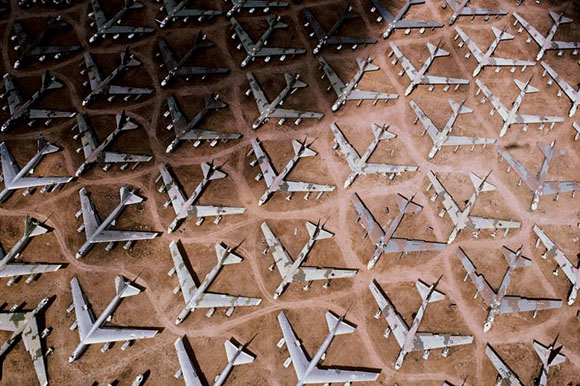
Photo credit: John McDowell. (Worth checking out his entire portfolio, by the way).
Peter Baker, in the New York Times, has a long piece on the bomber counting rules in the New START (or Prague Treaty).
The bottom line — as both Pavel Podvig and Hans Kristensen argue — is that the bomber rules are an accounting gimmick and, by extension, that the treaty would not meaningfully cut US strategic nuclear forces.
Despite my respect for both Pavel and Hans, I think their criticism is a little unfair. Although attacking the treaty from the left may help ratification — cue a senior official saying “This was a negotiation with the Russians, not the Arms Control Association.” The cuts in the Prague Treaty are real, if modest. (And let’s be clear: modest cuts were always the goal.)
Recall that the treaty imposes three limits, including two on delivery vehicles:
• 1,550 warheads. Warheads on deployed ICBMs and deployed SLBMs count toward this limit and each deployed heavy bomber equipped for nuclear armaments counts as one warhead toward this limit.
• A combined limit of 800 deployed and non-deployed ICBM launchers, SLBM launchers, and heavy bombers equipped for nuclear armaments.
• A separate limit of 700 deployed ICBMs, deployed SLBMs, and deployed heavy bombers equipped for nuclear armaments.
Complaining about one of the limits in isolation is a mistake. A primary purpose of US-Russian arms control treaties, I would argue, is to drive the two parties to more stable force structures. To do so requires integrated limits on both warheads and strategic nuclear delivery vehicles (SNDV, i.e. the missiles and bombers that would deliver those warheads). Similarly, an assessment of the treaty needs to understand how the provisions work together.
Yes, the bomber rules are silly. Bomber rules always are. But as a whole, the limits are serious and meaningful.
First of all, chillax about the bombers
The argument about the bomber counting rules is a proxy for the larger argument about the treaty, focusing on the total number of warheads as the measure of merit.
I happen to agree that the White House is wrong to compare the warhead reductions under this treaty to those in either START or the Moscow Treaty, since none of the three use the same counting rules. What you have are apples, oranges and maybe a ham sandwich.
The only thing the three treaties have in common with each other is that none of them counted actual bomber loadings.
START had completely artificial counting rules for bombers known as discount rules. You will thank me for not summarizing them, but for more than you ever wanted to know, see Kartchner, pp.195-215. To understand how artificial the START rules were, Colin Powell explained to Congress that the United States was moving to “6,500 accountable warheads which will result in 9,500 actual warheads.” That’s a 3,000 warhead slush fund, thank you very much.
The Moscow Treaty, by comparison, had no formal counting rules. As a result, the US counted warheads “stored in weapons storage areas of heavy bomber bases” while Russia, as Amyfw noted, did not. That’s hardly an improvement.
The Prague Treaty is not so different in this sense. Overall, the Prague Treaty actually moves the United States and Russia much closer to an actual accounting of warheads, rather than the attribution rules under START — at least for ICBMs and SLBMs. That, however, is the subject of a later post, on verification.
Bombers remain difficult to count, since their warheads are in storage and the aircraft are usually training for, or deploying on, conventional missions. Bomber rules are always weird. Kingston Reif makes all the right arguments about why we shouldn’t be too worked up about that fact.
Fundamentally, I think of bomber loadings as a secondary concern. The main goal is to get stabilizing limits on ICBMs and SLBMs, then use the bomber force to make the math work. It’s not pretty, but if you watched health care reform unfold, you don’t care about the niceties.
Second, focus on the SNDV
The best argument Kingston makes about bombers is probably the best defense of the treaty as a whole: The treaty constrains the number of bombers, if not their warhead loadings.
While the number is warheads is important, the real key to the Prague Treaty is the numerical limit on deployed delivery vehicles — 700. Seven hundred is the number of Minuteman III missiles, Trident missiles and B1, B2 and B52 bombers.
The United States wanted a much lower warhead number than did the Russians, who were only willing to budge on warhead numbers of the US came down on delivery vehicles. So, the two numbers are tightly integrated.
Delivery Vehicles
Comparing the 1991 START and 2010 Prague Treaties
| System |
1991 START |
Prague Treaty (2010) |
Notional 2017 Force Structures |
| MOU |
Total |
Deployed |
A |
B |
C |
| Minuteman III |
550 |
450 |
450 |
350 |
400 |
450 |
| Trident |
432 |
336 |
288 |
288 |
240 |
192 |
| B1 |
47 |
0 |
0 |
0 |
0 |
0 |
| B2 |
19 |
19 |
16 |
16 |
16 |
16 |
| B52 |
141 |
76 |
44 |
44 |
44 |
44 |
| TOTAL |
1189 |
881 |
798 |
698 |
700 |
702 |
START data is from the MOU. All other are author estimates.
The bulk of the reduction in delivery vehicles will come from changes in counting rules. As the table above illustrates, using the 1991 START counting rules, the United States has today about 1189 delivery systems. Many of these are so-called “phantom” delivery systems, including:
• 100 unexploded silos (100 delivery vehicles). The 1991 START treaty provided for two procedures to eliminate missile silos: explosive destruction of the top 6-8 meters of “headwork” or excavation. Explosive destruction is significantly cheaper than excavation, but local opposition to explosive demolition in the United States left 100 unusable silos.
• 4 converted ballistic missile submarines (96 delivery vehicles). The United States converted four ballistic missile submarines to guided missile submarines (SSGNs).
• 47 converted B1 bombers (47 delivery vehicles). Similarly, the United States converted its B1 bombers to conventional roles.
• 65 B52 bombers sitting in The Boneyard (65 delivery vehicles). The 1991 START treaty rather famously contained extensive procedures for the verifiable elimination of heavy bombers.
The Prague Treaty appears to remove these “phantom” systems in a number of ways. Perhaps most importantly, Russia accepted the principle of conversion of strategic systems to conventional roles.
As a result, with the signing of the Prague Treaty, the total number of strategic nuclear delivery vehicles will, with the stroke of a pen, drop to 881. (Well, maybe not quite with the stroke of a pen — in some cases, the treaty may simply provide for simpler elimination procedures, such as in the case of those empty silos.) As far as I can tell, of the 881 delivery vehicles, about 798 would be considered “deployed” – excluding two submarines in overhaul at any time (48 tubes) and 35 B2 and B52 aircraft that are not “combat coded.” (See Marc Schanz’s magisterial post, BUFF Blogging for Arms Control, for an arms-control oriented explanation of the bomber force.)
Even with the new counting rules, by my estimate, the United States would still need to convert or eliminate about 100 delivery systems to reach 700. If I am right about these counting rules, the number of non-deployed warheads (limited to 800) is largely a function of the deployed force, representing heavy bombers that are not combat-coded (for example, training assets) and ballistic missile submarines in overhaul.
Despite worries in some quarters, I don’t expect these cuts to come from the hide of the bomber force. Because ICBMs and SLBMs sum to more than 700 delivery vehicles, the United States will have to either eliminate additional squadrons of Minuteman III missiles or convert additional ballistic missile submarines. The bomber force is, in David Mosher’s turn of phrase, small potatoes.
It is my understanding that the White House has not yet decided how to achieve any reductions under the Prague Treaty, other than stating that the Holy Triad shall not be desecrated. But Options A-C (in the table above) show three notional force structures that are either compliant or very close with the limit of 700 deployed strategic nuclear delivery vehicles:
• Option A eliminates two squadrons of Minuteman III missiles (100 delivery vehicles)
• Option B eliminates one squadron of Minuteman III missiles and converts two additional ballistic missile submarines (98 delivery vehicles)
• Option C converts four additional ballistic missile submarines (96 delivery vehicles)
I don’t know which is best — Option C inflicts the least political pain; Option A preserves the biggest “hedge.” Option B is middling, which is a kind of virtue.
But all three are real reductions.
***
You can see, looking at the current and notional forces, why the warhead loadings make little sense when isolated from the number of delivery vehicles. The United States could have downloaded the current force structure to meet the 1550 warhead limit. The expected reduction in delivery vehicles – and the change in counting rules – will bring the number of US warheads to between 1500-1700 warheads without any additional downloading. The United States appears headed toward 1550 warheads or below, with or without a new treaty. That momentum largely explains the US desire to see a significantly lower warhead limit, in some cases reported to be as low as 1,300 warheads.
I accept that the White House fact sheet oversells the reductions in the treaty, which are in fact modest. But a modest reduction is not the same as no reduction. And, when coupled with achievements in verification — which are very good — modest reductions are no mean feat.