Author: jeffrey

  • China’s Centralized Warhead Storage [11]

    Mark Stokes has a really cool paper out on China’s system for handling warheads (China’s Nuclear Warhead Storage and Handling System):

    The Chinese Communist Party’s Central Military Commission (CMC) maintains strict control over China’s operational nuclear warheads through a centralized storage and handling system managed by the People’s Liberation Army (PLA) Second Artillery. Nuclear warheads are granted special consideration due to their political significance and potential consequences of an accident, incident, or unauthorized use. As a result, warheads are managed in peacetime
    through a system that is separate and distinct from Second Artillery missile bases and subordinate launch brigades. Second Artillery nuclear warheads also appear to be managed separately from China’s civilian fissile material protection, control and accounting (MPC&A) system. In addition, the Second Artillery appears to control and manage nuclear warheads that could be delivered by other services, such as the PLA Air Force and Navy.

    The narrative is not surprising, but the detail is jaw-dropping.

    He’s gotten well-deserved raves in Defense News (Wendell Minnick, “China’s Central Nuke Storage ID’d,” March 8, 2010) and the Washington Times.

  • More on US-Japan “Secret Agreements” [5]

    As I noted yesterday, the Japanese government released two reports
    (an official report and an experts report) on the so-called “secret agreements” regarding the storage and transit of US nuclear weapons in Japan, as well as a massive amount of declassified supporting documentation.

    Unfortunately (for me at least), this treasure trove is entirely in Japanese.

    Below is the text of an article in the Yomiuri Shimbun, identified by reader Julia, which is the best description of the contents that I have found so far:

    A Foreign Ministry panel of experts concluded in its report released Tuesday that there were three secret deals between Japan and the United States out of four alleged deals it has been investigating, including one on the introduction of nuclear weapons into Japan concluded when the bilateral security treaty was revised in 1960.

    [snip]

    The six-member panel of experts classified secret agreements into two types: narrowly and broadly defined pacts. Narrow deals carried official agreements, but the government accepted obligations or cost burdens without informing the general public of the agreements. Broad secret deals were those without clearly documented arrangements that represented “tacit agreements.”

    Although the panel could not confirm there was a clear secret agreement made at the time of the revision of the Japan-U.S. Security Treaty in 1960 between Japan and the Untied States over bringing nuclear weapons to Japan by U.S. forces, it recognized a “tacit agreement” to effectively tolerate port calls by U.S. vessels carrying nuclear weapons, categorizing it as a broadly defined secret agreement.

    Concerning combat operations of U.S. forces in the event of a contingency on the Korean Peninsula, there was a “narrowly defined secret pact” compiled at the time of the 1960 treaty revision as the panel confirmed the existence of documents to prove that Japan promised the United States use of U.S. bases in Japan without prior consultations if the occasion arose.

    On an agreement to cover cost burdens for the 1972 reversion of Okinawa to Japan from U.S. control, documents found in the United States, signed by the Foreign Ministry’s then American Bureau chief, did not bind the two nations and therefore cannot be called a narrowly defined secret deal, the panel concluded.

    However, the panel recognized that the Japanese government shouldered costs for restoring land plots that the U.S. forces had used to their original condition—costs which should have been paid by the U.S. government—thus constituting a broadly defined secret pact.

    However, the panel did not recognize the minute of an accord in 1969, believed to have been exchanged between then Prime Minister Eisaku Sato and then U.S. President Richard Nixon during negotiations on the reversion of Okinawa to Japan, made public by a relative of Sato in December, as a secret agreement to allow nuclear weapons into Okinawa Prefecture in times of emergency, although the panel authorized the minutes as “genuine.”

    The minutes did not have binding power after the Sato administration, according to the panel, which also cited other reasons.

    As I read this, Japan allegedly agreed to four secret deals: two following the 1960 Security Treaty relating to (1) port calls and (2) the introduction of nuclear weapons in the event of renewed fighting in Korea and two following the 1972 reversion to Okinawa relating to (3) compensation to local landowners — it seems Tokyo agreed to pay the compensation to avoid revealing that nuclear weapons had been present in Okinawa — and (4) the Sato-Nixon accord on reintroduction of nuclear weapons that caused all the uproar in December.

    Interestingly, the panel concluded that the Sato-Nixon understanding was the only allegation that did not constitute a secret understanding. The document is genuine, but apparently not binding. This Asahi editorial captures my thinking perfectly: “We do not understand how the panel reached this conclusion.” No kidding.

    Of course, the answer may lie in the reams of Japanese documents that might as well be written in Klingon as far as I am concerned. Fortunately, we have some great Japanese speaking readers who’ve helped out on past issues like the Okada letter and an article in Sankei, including blogger Michael Cucek.

    I really hope this interests you all as much as it does me.

  • PPNT Deadline Coming Up

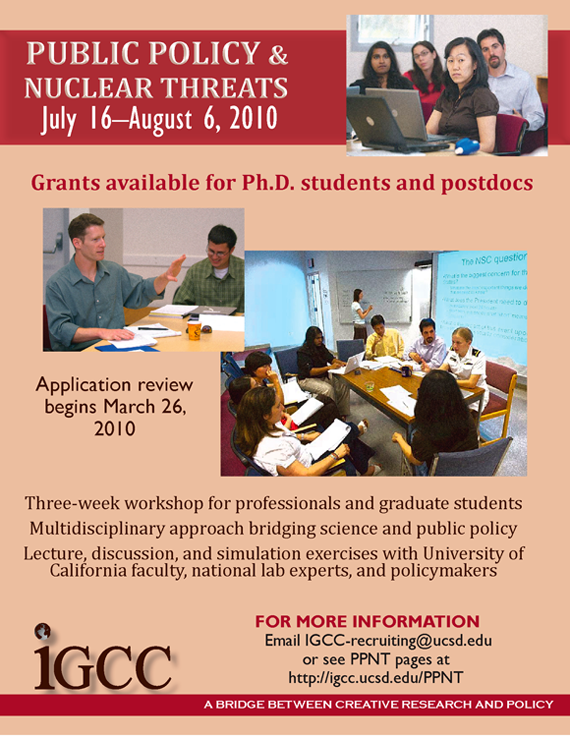
    As you can see from the poster, the University of California-San Diego is hosting its annual Public Policy and Nuclear Threats course from July 16–August 6, 2010:

    A rapidly evolving nuclear landscape poses major challenges and opportunities for the United States. The most critical of these issues include the growing threat of nuclear proliferation and terrorism, the renaissance of civilian nuclear power, and the pressing need to renew the country’s aging intellectual infrastructure of specialists equipped to address America’s nuclear weapons policies.

    The Public Policy and Nuclear Threats course is designed to cover important issues in U.S. nuclear strategy and policy, supported by an understanding of the scientific foundations of this policy. This course aims to give participants the knowledge and analytic tools to contribute to the debate on future U.S. nuclear policy.

    The course features lectures, discussions, debates and mini-workshops on a wide range of issues. Participants will attend talks by distinguished researchers, academics, policy officials, and operational specialists from the University of California system and other leading universities, the Los Alamos and Lawrence Livermore National Laboratories, the International Atomic Energy Agency, and federal government agencies dealing with nuclear policy, threat, detection, and safeguard issues.

    [snip]

    For more information about any aspect of the program, please email igcc-recruiting [at] ucsd.edu.

    The deadline is March 26.

    I’ve participated the last two years; it’s been fun.

    The big draw, though, is Linton Brooks, who is set to appear as a scholar-in-residence again. You can learn more about nuclear weapons by hanging out with Linton for two weeks than just about any other way I can imagine.

    The fact that you can do so in sunny La Jolla is just gratuitous.

  • Japan Releases NCND Documents [2]

    The United States has long had a policy to “neither confirm nor deny” the presence of nuclear weapons on US ships in foreign ports (NCND). There has always been an interesting question about the degree to which foreign governments understood, until early 1992, many US warships calling on their ports were loaded with nuclear weapons.

    To date, our case studies on the theory and practice of the “neither confirm nor deny” policy have been concerned Iceland, Norway and Denmark. (Some of Hans Kristensen’s very best work has been on the question of NCND with respect to his native Denmark. Here is a short article by Hans on what that work means for Japan.)

    As a result of Japan’s ongoing debate about its nuclear history, Japan’s Foreign Ministry has released an official report on “secret nuclear agreements”, backed up with a treasure trove of documents — which unfortunately (for me at least) is almost entirely in Japanese.

    Here is my initial attempt at an English guide to what the Japanese have released. There is a general introductory page, with several links including one to the main page on the March 9 announcement. The principal documents appear to be:

    Ministry of Foreign Affairs internal report

    Report by the Expert Committee

    Historical Documents, including

    List of documents

    Documents related to the 1960 Security Treaty

    Documents related to the 1960 Security Treaty

    Documents related to the 1972 Okinawa Reversion

    Documents related to the 1972 Okinawa Reversion

    Other relevant documents

    List list other relevant documents

    ✓ Other Documents related to the 1960 Security Treaty (Volumes 1, 2, 3, and 4)

    ✓ Other documents related to the 1960 Security Treaty (Korea) (Volumes 1, 2, 3, 4 and 5)

    ✓ Other documents related to the 1972 Okinawa Reversion (Volumes 1 and 2)

    Other documents related to the 1972 Okinawa Reversion

    I can’t speak a word of Japanese, so I welcome efforts by Japanese speakers to begin making sense of what is a treasure trove of documents.

  • North Korea-Venezuela Friendly [4]

    Footballer Grenddy Perozo (L), of the Venezuelan national squad, marks An Chol Myok of North Korea during a friendly match held in San Felipe-Yaracuy, some 300 km from Caracas, on March 4, 2010. The Match ended 1-1. AFP PHOTO/Juan Barreto

    Because nothing involving North Korea is ever easy.

    North Korea, which qualified for the World Cup in South Africa, met Venezuela in a friendly, but didn’t manage to bring along uniforms and just generally acted like North Koreans:

    As part of preparations for its first World Cup appearance in 44 years, North Korea was in Venezuela on Thursday for a friendly. The match ended in a 1-1 tie. But with the North Koreans, it’s never that cut and dried. According to reports in Venezuela, the Koreans lost their uniforms at some point and had to borrow replacement kits from the Venezuelans. Because of the intense heat, the Koreans refused to start on time, a delay that resulted in the match being stopped 10 minutes early because the field in San Felipe didn’t have lights. The teams will play again Saturday in Puerto la Cruz. (A game against Chile was canceled because of the earthquake.) Why do I have a feeling we’re going to hear many more wacky tales from North Korean camp over the next few months?

    As you can see from the image, the DPRK team had to play with tape over the Venezuelan crest on the borrowed kit.

    Apparently the jerseys arrived for the second game, which Venezuela won 2-1.

  • India To Conduct Hit-to-Kill Test [7]

    Update | 8 March 2010 Well, damn. That story is dated March 4, 2009. My parents used to get the year wrong when I was a kid. I’d roll my eyes and they warned me that it would happen to me someday. Wow.

    India is planning a test of its hit-to-kill theater missile defense system:

    The launch will feature two missiles. The “enemy” missile will be a modified version of Dhanush, a surface-to-surface missile. It will take off from a naval ship in the Bay of Bengal and simulate the terminal phase of the flight of a ballistic missile with a range of 1,500 km, similar to Pakistan’s Ghauri. As it zeroes in on the Wheeler Island, off Damra village on the Orissa coast, a Prithvi Air Defence (PAD) missile will lift off from the Wheeler Island, intercept the incoming “enemy” missile at an altitude of 70-80 km in the last one second and a half of its flight and pulverise it.

    Loyal readers will know that the rapid proliferation of hit-to-kill technologies, and the total neglect of this development, is one of my hobby horses:

    First, once uncommon hit-to-kill technologies are now at the early stages of spreading around the world. Second, the broad focus on space weapons and ASAT technologies, many of which are quite unrealistic and exotic, distracts from the technological challenge posed by the proliferation of hit-to-kill systems. Third, partial arms control measures, such as a ban on kinetic ASAT testing, may mitigate the most threatening aspects of hit-to-kill technology while avoiding some of the difficulties associated with more comprehensive agreements.

  • Plague and Cholera [7]

    Julian Borger has a post up on the Nuclear Posture Review, in which I liken choosing among the two options on declaratory policy to the choice between plague and cholera.

    Chris Jones over at PONI literally doesn’t understand the argument, which leads me to think that if a smart guy like Chris can be so confused, then I should explain more.

    My preferred option for declaratory policy is to state the purpose for possessing nuclear weapons, rather than speculating on when a future President might use them:

    The United States maintains nuclear weapons to deter and, if necessary, respond to nuclear attacks against ourselves, our forces, or our friends and allies.

    My reason for phrasing it this way, as Josh Pollack captured, is to avoid the “what-if questions meant to exhume sinister contradictions” in our nuclear policies. That’s much better than I said it.

    The authors of the NPR appear to have internalized this message — to talk about the purpose, rather than speculate on use — but the two options for the final document, as described by Borger and Josh Rogin, are very unsatisfying to me.

    The first choice is to state that the the primary purpose is deterrence. This, in my opinion, merely draws attention to any secondary purposes, which is precisely the conversation to be avoided. It’s better not to have a declaratory policy that raises an obvious question unless you know the answer to that question in advance. And it seems to me that no good can come of answering what “secondary” purposes might exist. The fact is that decisions about the size, composition and posture of our nuclear forces are all made in the service of deterrence. Anything else is a lesser included case that is not a fit subject for discussion in polite company.

    The second choice is to say that our goal is for some future President to someday be able state that the “sole purpose” is deterrence. (For the record, I am not wedded to the adjective “sole.”) To articulate the preferred outcome as a goal, rather than a description of current policy, is is almost, though not quite, as bad.

    This is a simple question: Why do we have these awful things? Setting sole purpose as a “goal” leaves this question unanswered. We know what the purpose is not (solely deterrence), but not what is. We are left to guess at which purposes might prevent the Obama Administration from answering this simple question forthrightly. Rather than lamely admitting that the posture (and the posture review) is in some sense a disappointment, one might as well defend the role of extending nuclear deterrence to conventional attacks against allies.

    A second downside of admitting that the reality of a nuclear policy falls short of our ideal is the degree to which it implicitly undermines the goal set in Prague. The President committed the United States to seek the “peace and security of a world without nuclear weapons.” The logical corollary of that statement, is that all other threats — including those to our allies — could be met with what Bundy, Crowe and Drell called “prudent conventional readiness.” The argument, especially in Paris, has been that it is easy for the United States to seek a world without nuclear weapons given our vast conventional military power. If the United States today doesn’t have enough conventional capabilities to relegate nuclear weapons to the task of deterring nuclear attacks, no country ever will.

    Still, it must be admitted that “sole purpose” is an admirable goal for US nuclear weapons policy, even if admitting that the reality of US nuclear policy falls short of it makes the Prague Speech look a little naive.

    Yet, I do not understand why we can’t simply state that the purpose of the weapons narrowly, while declining to speculate on their use. After all, as a practical matter, the United States maintains nuclear weapons today for purpose of deterring, and if necessary responding to, nuclear attacks against the United States and our allies. Any other scenario is, at best, a lesser-included case.

    The President should just say so.

    All this is terribly disappointing, but fortunately it is not the sort of disappointment that can’t be overcome with a stiff Manhattan at the University Club with an old friend. I guess in that way it really isn’t like plague or cholera. Until tomorrow …

  • IPFM & Khushab 2 Come Online

    Two announcements of note.

    First, the International Panel on Fissile Materials has a cool new blog. (No one tells me anything!)

    Second, writing on said blog, Zia Mian notes that construction on Pakistan’s Khushab 2 reactor is now probably complete:

    On 20 February, Pakistan’s Prime Minister visited the Khushab nuclear complex, along with senior military officers and top officials from the country’s nuclear weapons program. The Prime Minister is reported to have congratulated Khushab engineers for completing important projects, announced one month bonus pay, and approved new projects. He was accompanied by the Chairman of the Joint Chiefs of Staff, the Director General of the Strategic Plans Division, and the Chairman of Pakistan Atomic Energy Commission.

    The Prime Minister’s visit may mark the completion of work on Pakistan’s second plutonium production reactor. Khushab is the home of the country’s first plutonium production reactor (Khushab-I), which started work in 1998, and is the site where two new reactors are under construction. The construction of Khushab II appears from satellite imagery to have started in 2001-2002, while work on Khushab III seems to have started in 2005 or 2006.

  • New Missile Defense Agency Logo [13]

    The Missile Defense Agency released a new logo yesterday. I was contemplating some witty commentary regarding alternate logos, maybe two streaks of light just seeming to miss one another, or maybe just moaning that it would be best if they gave the dough to Raytheon for the SM-3 instead of some design firm.

    I was even planning on tracking down that Bloom Country strip in which the Defense Department sends Opus $900 million, mistaking him for “Mr. Spock, chief science officer for ‘Star Trek’ defense research.” Opus designs “Net Wars”, a strategic defense concept in which the earth is covered with a “space net” comprising $500 billion in small bills, and testifies before Congress.

    (The strip helped Berke Breathed win the Pulitzer Prize. If someone could scan the strips from Billy and the Boingers Bootleg, I’d love a copy.)

    But no commentary on the new MDA logo could best this little wonder from Frank Gaffney (with help from another nut-job), who has taken the whole “Obama as secret Muslim” thing where no wing-nut has gone before:

    Team Obama’s anti-anti-missile initiatives … seem to fit an increasingly obvious and worrying pattern of official U.S. submission to Islam and the theo-political-legal program the latter’s authorities call Shariah.

    What could be code-breaking evidence of the latter explanation is to be found in the newly-disclosed redesign of the Missile Defense Agency logo (above). As Christopher Logan helpfully shows, the new MDA shield appears ominously to reflect a morphing of the Islamic crescent and star with the Obama campaign logo.

    [snip]

    Even as the administration has lately made a show of rushing less capable sea- and land-based short-range (theater) missile defenses into the Persian Gulf in the face of rising panic there about Iran’s actual/incipient ballistic missile and nuclear capabilities, Team Obama is behaving in a way that — as the new MDA logo suggests — is all about accommodating that “Islamic Republic” and its ever-more aggressive stance.

    Watch this space as we identify and consider various, ominous and far more clear-cut acts of submission to Shariah by President Obama and his team.

    Seriously, Frank Gaffney believes that Barack Obama has a secret plan to subject the United States to Shariah, which he has decoded based on the logo for the Missile Defense Agency.

    This is not, as far as I can tell, Juvenalian satire. Indeed, an aspiring satirist could hardly go as far as Gaffney without inviting the criticism that his caricature was too crude.

    Wow.

    Update | 12:54 I just noticed that Media Matters, Al Kamen in his In the Loop column in the Post and Max Bergmann at Think Progress all beat me to it.

  • Rozen on the Nuclear Posture Review [20]

    Laura Rozen in the Politico has written an interesting article on the Nuclear Posture Review. In it, an anonymous US official described the Nuclear Posture Review as “seminal.”

    I would have picked a different bodily discharge.

    But, this is the new Arms Control Wonk.com. So you won’t see any references to excrement or suggestions that a seminal document is precisely what one would expect from a circle jerk like the NPR.

    Really, we’re above all that.

    Rozen depicts a very conventional document that will fall far short of the President’s rhetoric in Prague:

    Disarmament hands say the review draft originally headed by the Defense Department’s Brad Roberts was too status quo on the policy issues from the administration’s perspective, and is being reworked at the senior inter-agency level by Principal Deputy Undersecretary of Defense for Policy Jim Miller, officials from the office of State’s Under Secretary of State for Arms Control Ellen Tauscher, and White House and OVP nonproliferation advisors before heading to the president’s desk.

    [snip]

    Non-proliferation hands in and out of the administration question why the Obama team would have expected any differently since it put career civil servants with more traditional views on arms control, including the DoD’s Roberts, and NSC Senior Directors Barry Pavel and George Look, in key roles on the NPR.

    “If you want a transformational document, you don’t ask two men who have spent a combined forty years in the bureaucracy to do this job,” another non-proliferation hand who asked for anonymity said.

    I think the “anonymous nonproliferation hand” is mistaken to lay the blame on specific individuals like Roberts, Pavel or Look. This is about the structure of the process, not the people.

    I fully expect the Nuclear Posture Review to be disappointing — the structure of such a review is designed to produce a status quo document. I have previously recommended Janne Nolan’s “An Elusive Consensus.” Heck I even invited her to give a talk on the prospects for the NPR at the New America Foundation. (She was great, by the way.)

    It has long been clear, as both Joe Cirincione and I wrote this fall, that the Nuclear Posture Review was shaping up as a very status quo document. For participants to suddenly be shocked leads me to ask “What rock have you been living under for the past year?”

    (In other news: Michael Jackson is dead, the New Orleans Saints are Superbowl champions and the junior senator from Massachusetts is a Republican. It’s been an odd year.)

    The danger from a Nuclear Posture Review has always been, and continues to be, that the President will not get real options. Guess who is to blame for that? You may recall this sign on Harry Truman’s desk.

    One of the under-reported stories in Washington is the dominance of Robert Gates on national security issues (with Elizabeth Rubin’s profile in Time magazine is a notable exception.) Gates openly discussed the likely conclusions of the NPR back in September, with nary a public peep from the President. The NPR, of course, is supposed to provide options to the President, not conclusions.

    Gates has been boxing in Obama for about a year now. Which is what powerful cabinet secretaries do. Hate the game, not the player.

    In form, the NPR will contain nominal options for the President to chose among. Yet the question continues to be whether those options will reflect real differences in policy, or just three articulations of the same Cold War dogma on the role of nuclear weapons. A draft of the NPR is going around and, from everything I hear, there is no reason for me to change this passage I wrote in August:

    If the Nuclear Posture Review is truly going, as the President has promised, “to put an end to Cold War thinking” on nuclear weapons, throw out the f’ing reports. The Strategic Posture Commission is not the Bible. No need to turn Pentagon offices into monasteries where scholars perform exegesis on the sacred text. Most the Commissioners don’t remember what they had for breakfast, let along the arcane compromises they agreed to a couple of months ago. (If you’ve actually run such a project you know how ephemeral such agreements can be.)

    Instead, give the President three or four real options. Not three flavors of vanilla. Not a couple of flavors like “dirt” and “cat urine” intended to make a scoop of vanilla comparatively appetizing.

    That, by the way, is the core of what Joe [Cirincione] had to say in the meeting I described: There is every reason to doubt, at this stage, that the Nuclear Posture Review will give the President real options. A set of real options would reflect, rather than obscure, the very different views about how much the details matter [to the stability of deterrence].

  • GOV/INF/2010/5 [12]

    Somewhat belatedly, I have come into possession o f GOV/INF/2010/5, which contains Iran’s answer to the proposal to swap its stockpile of low enriched uranium for fuel assemblies for the Tehran Research Reactor.

    Here is the key graf:

    …the Islamic Republic of Iran is still seeking to purchase the required fuel in cash. However, if the Agency is not able to fulfill its duty under Article 3, then Iran is ready to exchange the TRR required fuel assemblies with the LEU material produced at Natanz, simultaneously in one package or several packages in the territory of the Islamic Republic of Iran.

    Thanks to those of you who sent it along.

  • Tinner Tidbit [6]

    Many of us have long suspected that the Tinner Family — Father Freidrich and brothers Marco and Urs — Swiss businessman who participated in the AQ Khan network — were also US intelligence assets (See Urs Tinner and Tinner Talks).

    World Radio Switzerland reports that a Swiss court ruling “confirms” that the Tinners were assets — though how this was confirmed is not made clear:

    For the first time, it’s been officially confirmed that the Swiss brothers Urs and Marco Tinner did work for the American Central Intelligence Agency, the CIA.

    The brothers and their father have been suspected of smuggling nuclear secrets for a group that supplied weapons components to Libya. The documents related to their case have been the subject of dispute – the Americans and some members of the Swiss government have wanted the documents destroyed.

    The Tinners and the CIA denied that they were working together but information revealed in a ruling today from the Federal Court confirms that there was a secret collaboration between them.

    The case against the Tinners continues.

    Update | 8:33 23 February 2009 In the comments, reader Nik posts the relevant passage of the document, in which the court notes that “die Tinners auch für die USA gearbeitet hätten.”

  • Gov/2010/10 and Gov/2010/11 [12]

    Here is the full text of the IAEA Board of Governor’s reports:

    ℘ Implementation of the NPT Safeguards Agreement and relevant provisions of Security Council resolutions 1737 (2006), 1747 (2007), 1803 (2008) and 1835 (2008) in the Islamic Republic of Iran, Gov/2010/10

    ℘ Implementation of the NPT Safeguards Agreement in the Syrian Arab Republic, Gov/2010/11

    Also, don’t forget, the IAEA released a document on Iran’s re-enrichment of LEU last week: GOV/INF/2010/2.

    I feel agile today. And grateful, as always, to that little bird in Vienna.

  • Report on French Nuclear Testing [9]

    Sacrebleu!

    I’ve never seen a classified French document before, but this one is a doozy.

    Bruno Barrillot —who I have just discovered has written a lot about French nuclear testing, how did I miss this? — somehow obtained, and published, a confidential history of France’s nuclear program, entitled Report on French Nuclear Testing (1960-1996). It appears this is Volume 1: Organizational Genesis and Experiments in Sahara. Presumably there is a second volume for the period after testing moved to the South Pacific in 1968.

    Barrillot released the document as part of the push for his book, Victimes des essais nucléaires: histoire
    d’un combat
    , on France’s atomic veterans. Nicolas Jacquard in Le Parisien writes:

    Intitulé : « la Genèse de l’organisation et les expérimentations au Sahara », ce texte rédigé par un ou des militaires anonymes daterait de 1998, juste après l’abandon définitif des essais par Jacques Chirac. Il y évoque avec emphase « une grande aventure scientifique », tout en jugeant « inopportun d’en extraire une synthèse grand public. » A sa lecture, on comprend aisément pourquoi, chaque ligne du rapport expliquant comment scientifiques et militaires veulent, à l’époque, obtenir « la bombe », quel que soit le prix à payer, y compris humain. Gerboise verte, le quatrième et dernier tir dans l’atmosphère, fait ainsi jouer les appelés du contingent à une véritable guerre nucléaire grandeur nature. Souvent, les vétérans se plaignaient d’avoir été des cobayes. C’est désormais une certitude.

    Quant aux « faibles doses » reçues qu’évoque le ministre de la Défense, elles sont à l’origine de maladies irréversibles. « Que dans le contexte de l’époque, on fasse des manoeuvres, on peut en discuter, résume Patrice Bouveret. Mais que tout cela soit fait sans aucune prise en compte sociale ou médicale des hommes, c’est quasi criminel. »

    The important phrases here are “cobayes” (guinea pigs) and “quasi criminel” (almost criminal).

    But the document is also fascinating from an historical perspective, providing information about the early French nuclear program.

    Check it out.

  • Egyptian Ballistic Missile Center [9]

    During my panel at the Wilson Center, David Albright told a story about how the Israelis talked to Gernot Zippe — inventor of the Zippe-centrifuge — about the contacts that some German scientists and firms had in Egypt.

    I wanted to shout “Hey, that’s the opening to The Odessa File!”

    So, with my admission of really enjoying Frederick Forsyth’s novels, I readily admit that the phrase “Egypt’s ballistic missile test and launch facility” gets my attention.

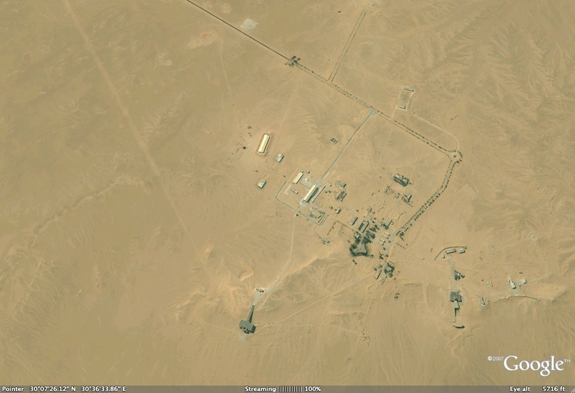
    Joseph Bermudez has an interesting examination of just that facility, near Jabal Hamzah, in the most recent Jane’s Intelligence Review, (Pyramid scheme: Egypt’s ballistic missile test and launch facility, February 4, 2010.) It is subscription-only, but you can look at the images in Google Earth. Here is the key graf:

    Since 2000, satellite imagery has revealed significant and continuing infrastructure expansion at the Jabal Hamzah facility.

    The missile facility is located in the governorate of Al Jizah (Giza). While the national designator is presently uncertain, in the late 1960s the US Central Intelligence Agency designated it the Jabal Hamzi Surface-to-Surface Missile Complex because it is on the road from Cairo to Alexandria just 12 km south-southwest of the abandoned Jabal Hamzi Airfield, which is no longer visible.

    The original installation is located at 30° 07’ 38.71” N, 30° 36’ 25.08” E, and consists of a small cluster of facilities built on the edge of a low sandstone escarpment. Between 1967 and 2000 the original installation had only minor infrastructure development. However, since 2000, not only has there been significant expansion at this site but there has also been a major related construction project at a site approximately 3 km to the south. The two sites, which are here referred to as the north and south sites, are connected by an asphalt road that was paved between 2008 and 2009.

    Click on the image to open Google Earth to 30°07’38.71“N, 30°36’25.08“E and have at it.

  • Gibbs Might Want Iran Statement Back [5]

    White House Press Secretary Robert Gibbs, in the midst of a perfectly acceptable statement of Administration policy, cast doubt on Iran’s ability to enrich uranium:

    MR. GIBBS: Well, look, I think Iran has made a series of statements that are far more political than they are — they’re based on politics, not on physics. Okay? The Iranian nuclear program has undertaken — has undergone a series of problems throughout the year. Quite frankly, what Ahmadinejad says — he says many things and many of them turn out to be untrue. We do not believe they have the capability to enrich to the degree to which they now say they are enriching. [Emphasis mine.]

    Although I think most of this is true, Gibbs is going to want that last sentence back.

    As should be clear from the IAEA document (GOV/INF/2010/2) I posted a few days ago, Iran seems quite deliberately moving to re-feed some of its current stock of LEU into a single cascade configured to produce 19.75 percent enriched uranium.

  • Iran as a Nuclear State [11]

    I see that some media outlets are latching on to Mahmoud Ahmadinejad’s claim that Iran is a “nuclear state” as though this is a profound bit of reading the tea leaves.

    A quick perusal of lexis-nexis suggests this is something like the eighth time in four years that Ahmadinejad (or an aide) has declared Iran to be a nuclear state, nuclear power or member of the nuclear club. I am sure you can find more, if you don’t have anything better better to do.

    Here is my tentative list:

    Iran is a nuclear power. (Ahmadinejad aide, September 2009)

    As a result of the resistance of Iranian people, the country has reached a major goal which is to become a nuclear state. (April 2008)

    Iran is among the world’s nine nuclear states. (July 2007)

    Iran is already a nuclear state and possesses the necessary technology for producing its own nuclear fuel. (June 2007)

    The Iranian people have reached the stage of nuclear industrial production and Iran has thus joined the club of great nuclear states. (April 2007)

    Becoming a nuclear state is a high aspiration and a holy goal for Iran. (January 2007)

    The Islamic Republic of Iran is now a nuclear power. (December 2006)

  • Iran Produces HEU [22]

    Iranian President Mohamed Ahmadinjed, aka A-Bomb, has announced that Iran has produced the first “consignment” of 20 percent highly enriched uranium (HEU). I don’t know what a consignment is, but I would think in this case, it is less than a kilogram.

    Arms Control Wonk.com has obtained GOV/INF/2010/2 — the 10 February IAEA document on Iran’s preparations to create highly enriched uranium.

    Amano notes that IAEA inspectors were informed on 10 February (talk about quick turnaround!) that Iran was feeding UF6 into one cascade for passivation purposes. For those of you who don’t remember, reader Russel provided a fine description of passivation:

    One of the preparatory processes that is required before using a centrifuge component for the first time is “passivation” – which basically involves bathing any UF6 exposed bits in UF6 so that anything with a remaining potential to react will react in a controllable environment rather than in the vacuum system.

    The Iranians told the IAEA the would be begin to produce HEU “within a few days.” Hence A-Bomb’s announcement.

    For more, David Albright and Jacqueline Shire have published an analysis of Iran’s potential HEU production and its implications.

    Update | 12:38 pm George Jahn has a story on the document. Of course, we have the full text!

  • Iran to Enrich 20 Percent LEU [35]

    Iran’s announcements that it is going to produce 20 percent Highly Enriched Uranium is bad news — not least because the Iranians said they would do so without respect to the presumably doomed TRR fuel swap. (Though this thing has risen from the dead so many times, maybe I should start calling it the Zombie Fuel Swap.)

    I made some comments to Le Figaro, but they are in French. (Well, they’ve been translated. I can barely say Châteauneuf-du-Pape.)

    Glenn Kessler has a news analysis on the implications of the deal, in which David Albright explains why Iran could go from 20 percent HEU to a bomb in relatively short order:

    Meanwhile, enriching uranium under the guise of medical needs will get Tehran much closer to possessing weapons-grade material. Iran insists it has no interest in nuclear weapons. But Albright said 70 percent of the work toward reaching weapons-grade uranium took place when Iran enriched uranium gas to 3.5 percent. Enriching it further to the 19.75 percent needed for the reactor is an additional “15 to 20 percent of the way there.”

    Once the uranium is enriched above 20 percent, it is considered highly enriched uranium. The uranium would need to be enriched further, to 60 percent and then to 90 percent, before it could be used for a weapon. “The last two steps are not that big a deal,” Albright said. They could be accomplished, he said, at a relatively small facility within months.

    It must seem odd for casual readers to see 20 percent and 90 percent U235 lumped together as highly enriched uranium or to be be told that Iran will find it much easier to go from 20 to 90, than from 5 to 20. That’s not how everyday math works, where 5 and 20 are closer to “ten” and 90 rounds to “one hundred.”

    For many readers (especially of this blog) the answer is obvious. But for those to whom it is not obvious, Francesco Calogero found a nice way to illustrate the same point to students at a previous ISODARCO meeting. The essential concept is understand enrichment as a process of removing undesirable isotopes (or more specifically, isolating the desirable ones).

    So, imagine 1000 atoms of uranium. Seven of them will be the fissile isotope Uranium 235. The rest are useless Uranium 238. (If you are the sort of person who just said, “Hey! What about Uranium 234?” or other nitpicks this post is not aimed at you.)

    To make typical reactor fuel, Iran or any other country would removes 860 of the non-U235 isotopes, leaving a U235:U238 ratio of 7:140 (~5 percent).

    To make fuel for the TRR, Iran removes another 105 non-U235 atoms from the 140, leaving a ratio of 7:35 (20 percent).

    To make a bomb, Iran needs only to remove 27 of the remaining 35 atoms, leading a ratio of 7:8 (~90 percent).

    This is simplified illustration, of course, since some of the U235 ends up in the depleted stream as “tails” — but you get the idea.

    You can see why separative work is measured as mass — the interesting question is the amount of material separated — and why the lower levels of enrichment actually require more work.

    As a result, as Kessler notes, Iran’s announcement “marks a new and potentially dangerous turn” in the situation. If Iran enriches a significant amount of U235 to 20 percent — and that’s a stated goal right now, not yet an actual achievement — then Iran would be able to “top off” the enrichment a small, clandestine facility like the one revealed near Qom. I did a few calculations, but I don’t need to wade into the middle the FASISIS steel cage death match that Josh has so ably chronicled. I will just encourage people to do their own back-of-the-envelop calculations. I think the answer is pretty obvious.

  • Seibersdorf! [1]

    Josh Pollack happened upon this amazing video of Safeguards Analytical Laboratory at Seibersdorf. Some briefs shots of what looks like Tuwaitha, Yongbyon (inside) and Pelindaba. Which got me thinking that the IAEA must have a spectacular video library.

    It turns out the IAEA has a channel on YouTube, including a video on an inspection of imported fuel assemblies at the Kundankulam reactor in India.