Author: jeremiah_owyang

  • Slides: Four Social Media Trends for Business in 2010

    Companies Must Approach Social Programs In A Coordinated Effort
    Many companies are enthralled by the opportunity to use social technologies to connect with customers, yet many lack a plan or coordinated effort. Additionally, things are going to get more difficult as they don’t realize that as consumers and employees rapidly adopt these tools the level of complexity increases across the organization. While it’s easy to get caught up on the specific new technologies that are constantly emerging, companies should focused on business trends and themes in 2010. In particular, companies must develop a business strategy based on customer understanding, put the baseline resources in place to get your company ready, deliver a holistic experience to customers –and build advocacy programs and anticipate customer need.

    Open Research: You can download the slides from slideshare, and use with attribution for non-commercial reasons.

    To Be Successful, Companies Should Focus On Four Key Trends
    While there are many themes in 2010 for companies, II focused in on the four key themes companies must focus on:

    1) Don’t fondle the hammer. Understand customers, focus on objectives, not develop strategies based on ever-changing tools. Companies really need to understand their customers first, see our recorded webinar to learn more.
    2) Live the 80% rule. This is a movement: get your company ready. 80% of success is getting the right organizational model, roles, processes, stakeholders, and teams assembled –only 20% should be focused on technology.
    3) Customers don’t care what department you’re in. Customers just want their problem fixed, they don’t care what department you’re in. Yet, now, nearly every department can have a direct relationship with your customers using social tools. As a result, provide customers with a holistic experience Start to investigate how brand monitoring, community tools and CRM systems are merging.
    4) Real time is *not* fast enough. Companies cannot scale when it comes to social media, for most companies, you cannot hire enough people to monitor and respond to the conversation, As a result, lean on advocates, by building unpaid armies, and anticipate customer needs through advanced listening techniques.

    This event was hosted last night at the Silicon Valley American Marketing Association nice redesign, and hosted by Adobe (disclosure: an Altimeter client). I was later joined by Jeannette Gibson, social media executive of global marketing at Cisco, Ed Terpening, VP of Social Media at Wells Fargo, Maria Povermo, leading Social Media in Marketing at Adobe, and Rob Fuggetta of Zuberance to have a lively panel on how they are using these technologies. The event was recorded, I’ll add a link as soon as it becomes available.

    Translations
    Text translations now in Japanese


  • Socialgraphics Help You To Understand Your Customers: Slides and Webinar Recording

    Companies should have a ‘Customer Strategy’ not a ‘Twitter or Facebook Strategy’. To start, first understand your customers social behaviors, below are the slides and recorded webinar featured yesterday by Charlene Li and myself.

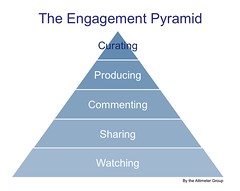
    We know that customers are adopting new technologies to communicate with each other –and companies must change their own behaviors to reach them. Yet, to often, we hear of companies ‘fondling the hammer‘ where they have knee-jerk reactions to which ever technology emerges. The problem with this strategy is that new technologies are emerging in rapid iterations due to low-cost of innovation. As a result, focus on their behaviors, which we cover in detail in the Engagement Pyramid.

    While using surveys is an effective way of getting a strong baseline set of knowledge, you must be constantly monitoring and updating the changes your ever-changing customers are having, and encourage you to partner with brand monitoring companies like Visible Technologies, Techrigy by Alterian, Radian 6, TNS Cymfony, Nielsen Buzzmetrics, Crimson Hexagon, and even simple easy to use tools like Twitter search and Google Alerts.

    We focus on disruptive technologies, and know we don’t have all the answers, so we want to work with the community. Like the Opensource movement and creative commons, we’re embracing ‘Open Research‘ which means we want to share what we learn so others can build on top of it. We like Creative Commons, and hope you use this content for educational purposes and to share with others with attribution. Stay tuned, as we plan to share more about the socialgraphics methodology and other frameworks.

    Above: Access the slides on slideshare (you can download them in PPT format)


    Above: Listen and watch the recoded webinar, there were over 600 attendees in real time, making it interesting to watch the discussion in the chat and in Twitter.

    Here’s the link that I mentioned comparing Toyota’s shotgun approach and Ford’s laser-like approach. Next, join the conversation in Twitter and beyond, see the many tweets tagged #socialgraphics. Last but not least, thanks to Christine Tran, for her research expertise and rolling out our new powerpoint design.

    Now in Russian, thanks.


  • Microsoft Makes Work Fun: Office Launches “Ribbon Hero”, A Social Game

    Forget Farmville or Mafia Wars, Microsoft wants you to play Excel –pivot tables FTW.

    Most software training and help resources are painful experiences written by technical publication editors.  We know that most tutorial and help sections within applications are horrible to work with (I’ve shaken my head in frustration quite a few times using Microsoft’s own tutorial tools), and not every office worker can afford to attend a powerpoint training class.

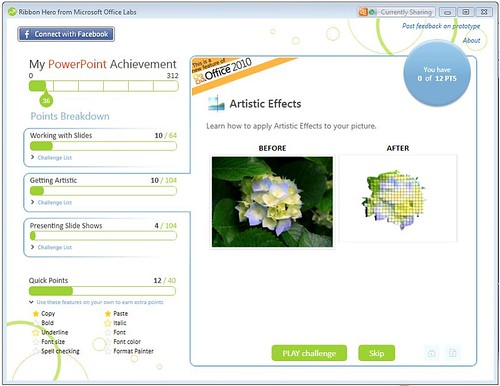
    Microsoft's "Ribbon Hero" is a social game that encourages people to learn the product
    Click above image to see my notes: Powerpoint users are given challenges, like this artistic effect, to win points which are used to brag on Facebook.

    Learning game encourages social sharing
    First, click on the image to see my additional notes.   I rarely get excited at briefings, however big-enterprise Microsoft is doing something interesting. In an effort to make learning fun and increase usage of Microsoft office products, they’ve launched a pilot program called “Ribbon Hero” (read blog, or watch video).  Much like a game you’d find on Facebook, Ribbon Hero lets users of Word, Excel, Powerpoint, and other office applications score points by unlocking challenges –then touting it to their friends.

    Microsoft staff creates ‘challenges’ in the software, and encourages users to play to learn.  As users unlock challenges (see screenshot above) they can earn up to a max of 300 points per product,  and can choose to share their scoring with their Facebook friends on the Fan page.  Don’t think there’s any social captial here? well if people can brag about their fictitious mafia wars scores, we should expect them to tout their real-world workplace proficiencies.

    Innovation exposes challenges
    There are three four major hurdles as I see it: 1) I’m not confident that this launch will reach a wide audience in the workplace, it may skew towards Gen X and Y. 2) Secondly, they’ll need to overcome the barriers of those who score low being bashful about their scores, and not wanting to share with others. 3) It’ll take some studies to show that professionals that complete the challenges (300/300 points) are better workers, then get HR to promote, 4) Lastly, like all games, they can be cheated, like gaming hint websites, expect there to be a ‘tip blog’ for Ribbon Hero.

    Microsoft most tap into new opportunities:
    Although we’ve not tried Ribbon Hero, this is an innovative way to encourage users to learn about a typically single person product -and then share with their friends.  Microsoft sharing data with Facebook (who they’ve invested in) doesn’t seem like their typical big box culture, kudos for them for doing something out of their normal engineering culture. Yet despite these upsides, Microsoft must:

    • Harness reputation points to grow the program. has just scratched the surface in using this reputation data like they have with the Microsoft MVP advocacy program to create a non-paid growing army of Microsoft Office experts.
    • Add features to enable game to scale. 1) Q&A features that allows members to pose questions to each other and answering them, gaining more points, 2) Challenges to be created by the members themselves, growing the game at a scalable pace for high achievers. Never letting the game end.
    • Develop a global leaderboard of top users. Allow them to build profiles as true ‘Office Heros’ and how they succeed at their job on a separate website, and encourage them to share their achievements on their blogs, resume and LinkedIn pages.
    • Measure based on new benchmarks. 1) Top line adoption curves skew up 2) Reliance on existing support features goes down 3) Ten solid case studies of people getting new jobs or promotions in part because of their proficiency at the game.

    I’m sure we’ll hear more about this from Microsoft –and maybe other traditional enterprise software companies like IBM, Oracle, and social fearful, Apple, will follow suit.  I gotta hand it to Microsoft on this one, they’re finally making work fun. Lastly, ya know I gotta ask, but will Clippy make a cameo in the game?

    Disclosure: Microsoft is an Altimeter client. We want you to trust us more by being upfront about our relationships, read our disclosure policy.


  • A Collection of Social Network Stats for 2010

    For the third year running (see 2008, 2009) I’m going to aggregate stats in the social networking space on a single blog post, and update it through the year.  Data fiends should bookmark this post for future reference.

    Stats are important –but on their own, they don’t tell us much
    Stats on social networks are important, but don’t rely on them alone. Data is like fire, it can be used for good and bad, proper insight and analysis is always required. Beyond that, you’ll often see conflicting stats across the industry as everyone has different methodologies, as a result, this listing will help you to see the greater trends –not numbers without context.

    How to interpret stats
    Numbers don’t tell us much without insight and interpretation, in fact, you’re going to see conflicting numbers of usage from many of the agencies and social networks themselves. The key is to look at trend movements, don’t focus on the specific numbers but the changes to them over time. Put more weight on active unique users in the last 30 days vs overall registered, in fact, the actual active conversion rate will often range from 10-40% of actual users sticking around and using the social network, so don’t be fooled by puffed numbers. No single metric is a good indicator, you have to evaluate the usage from multiple dimensions, so you also have to factor in what are users doing, time on site, interaction, and of course, did they end up buying, recommending products, or improving their lives.


    A Collection of Social Network Stats for 2010
    I’ll be updating this post throughout the year, bookmark it, and share it with others.

    Comparison: All Social Networks

    • “The data doesn’t deny that Facebook has come to dominate social networking in the US, and overtook MySpace in 2009. But MySpace’s 57 million US unique users are nothing to sneeze at – it’s still a top web property with users who are highly engaged. The second tier networks, such as Tagged, Hi5, MyYearbook and Bebo, still receive an impressive 3-6 million uniques per month, and users spend a fair amount of time on those sites. BlackPlanet users spent 3.6 minutes longer interacting with the site than the average Facebook visitor. MyYearbook and Tagged users were on these sites more than 3 minutes longer than the average MySpace visitor. There is definitely addictive behavior occuring on these other sites.” LeeAnn Prescott (Someone I personally trust), Feb 2009

    By Region and Geography

    • Japan: This slideshare has data on Japan’s mobile behaviors, and demonstrates how most social networks are accessed through mobile devices, and discusses Twitter, Facebook, and other social network adoption. Japan’s Cellphone Edge, 2010.

    Facebook

    • Facebook keeps it’s stats page updated, and boasts over 350mm users. Facebook, ongoing
    • Facebook has announced 400mm users, Feb 5, 2010.
    • Infographic on Auguts 2009 Facebook stats, including usage, size, adoption rates by Mashable, on Feb 12.
    • Facebook demonstrates growth in total number of visitors (now over Yahoo, for second place) and a high degree of attention (time on site) “Facebook has surged past Yahoo as the number two most popular site in the U.S., drawing nearly 134 Million Unique Visitors in January, 2010. It’s been two full years since we’ve seen a shakeup at the top – In February, 2008, Google overtook Yahoo as number one, and never looked back.” Compete, Feb 18, 2010
    • Usage of casual gaming (Farmville, mafia wars) is suggested to be by moms.  A PopCap survey reports that “The PopCap study showed that 55 percent of all social gamers in the U.S. are women, as are almost 60 percent of those in the UK. The average age in the U.S. is 48, which is substantially older than the 38-year-old average in the UK, and 46 percent of American social gamers are 50 or older, compared with just 23 percent in the UK. Only 6 percent of all social gamers are age 21 or younger.”  Via GigaOm, Feb 18

    LinkedIn

    • Now has 60mm users, “Over the past year, network has seen a significant amount of growth, especially internationally. As of last December, the network had 55 million members, so its grown by 5 million in less than two months. In October, LinkedIn’s network’s CEO, Jeff Weiner, said in the post that half of LinkedIn’s membership is international. ” reports Techcrunch, Feb 11

    Twitter

    • Hubspot luanches a report of Twitter.com registrations and shows a decrease in rate of adoption. There’s also useful data within the report about followers and their behaviors based on a sample methodology. Hubspot, Jan 19, 2010.
    • Sysmos launched a report about global usage of Twitter, with most adoption in US. Interesting that the key nugget is “… the number of U.S. unique users was 50.8%, a sharp drop from 62.1% in June. This suggests the use of Twitter outside the U.S. has experienced significant growth over the past six months.”, Jan 14th, Sysmos. Thanks Jean in the comments for the submission.
    • Data indicates that many Twitter users are not active. read “The number of Twitter users has climbed to a lofty 75 million, but the growth rate of new users is slowing and a lot of current Twitterers are inactive” ComputerWorld, Jan 28
    • Twitter themselves finally publish numbers indicating there are 50mm tweets created each day.  ”Folks were tweeting 5,000 times a day in 2007. By 2008, that number was 300,000, and by 2009 it had grown to 2.5 million per day. Tweets grew 1,400% last year to 35 million per day. Today, we are seeing 50 million tweets per day—that’s an average of 600 tweets per second. (Yes, we have TPS reports.)” Twitter, Feb 22

    YouTube

    • Find out who is creating the top YouTube videos and who is embedding them. “The study also looked at the demographics of bloggers who embed these videos. In general, 20-to-35-year-old bloggers embed most of the videos (57%), followed by teenagers (20%) and bloggers over 35 (20%).” Including stats on average number of comments, duration and other tidbits, Read Write Web, Feb 15.

    Mobile, Desktop and Social Networks

    • There’s a sea change in more people using social networks from mobile devices rather than desktop clients “more people are using the mobile web to socialize (91%) compared to the 79% of desktop users who do the same. It appears that the mobile phone is actually a better platform for social networking than the PC.”  Ruder Fin via Read Write Web, Feb 2010

    I’ll continue to update this page over time, please leave a comment if you have 2010 submissions, I’ll credit you.


  • People on the Move in the Social Media Industry: Jan 16, 2010

    potm-banner-2

    From an industry perspective there were significantly more hires this month, than last. This is due to two pieces: 1) It’s traditional for new roles to be filled during the new year, 2) An uptick in the overall financial space and a continued focus on the social and open web.

    In an effort to recognize the changes in the social media space, I’ve started this post series (see archives) to both track and congratulate folks who get promoted, move, or accept new exciting positions. Please help me congratulate the following folks:

    • Chris Messina who’s been a leader in the open web and standards joins Google, where he’ll be focused on leading the open web initiatives. I’m certainly going to be following his work regardless of where he goes.
    • Joseph Smarr, via product team at Comcast’s Plaxo also joins Google, both of these gentleman have a focus on web standards and the ‘Openstack’ so it’ll be interesting to see how this unfold. I’ve been friends with Joseph for a few years now, and it’s great to see him continue to grow.
    • BL Ochman, a force of great positive energy who I’ve known for over 5 years, has joined Proof Digital Media – the new digital marketing arm of Burson-Marsteller. She’ll report to Proof CEO Jay Leveton, and have been given the opportunity to help guide the agency into the forefront of new media agency.
    • Johannes Neuer joins the The New York Public Library as the eCommunications Manager where he’ll expand and promote eCommunications and social media initiatives at The New York Public Library (both internally and externally).
    • Kati Driscoll lands at AAA Mid-Atlantic as a Social Media Community Specialist Working within existing and emerging AAA Mid-Atlantic communities to engage members, providing information and conversation to help them receive the full benefit of their membership and our community.
    • Karthik S joins Edelman as Head of Digital Strategy (India) Create and frame Edelman’s social media PR offerings in India, help clients integrate social media and digital communications within existing PR programs.
    • Greg Meyer joins Gist Customer Experience Manager where he’ll be providing VIP Support, Building a Customer “Power Tips” channel, and generally doing whatever necessary to make users successful.
    • Jennifer Polk has been promoted at Sears Holdings as the Director, BU Social Strategy Developing and leading community and social networking initiatives for SHC BUs, including building strategies and programs to help the BUs achieve greater customer engagement. She’ll be ensuring social programs align with BU business objectives and promoting partnership between Social Media, Online, Marketing and the BUs.
    • Robert Lommers has been promoted at Rabobank as the online media specialist focused on social media, online media, mobile, webcare, and social networking.
    • Joel Burslem is now with 1000watt Consulting as Associate of Social media marketing and strategy for the real estate industry.
    • Shara Karasic has been hired at Appolicious as the Director of Social Strategy developing community engagement and managing social strategy.
    • Judith A. Mod is at Social Gastronomy as a Principal where she’ll be focused on enabling organizations to leverage social media for marketing, customer relationships, operations, employee engagement, and partner management.
    • Matthew Rosenhaft also joins Social Gastronomy as a Principal where he’ll enable organizations to leverage social media for marketing, customer relationships, operations, employee engagement, and partner management.
    • April M. Williams is now with Cyberlife Tutors as the President of Coaching: focused on career and social media
    • Eileen O’Brien joins Siren Interactive as the Director, Search & Innovation at a social media lead for agency’ clients.
    • Paul Miser has been promoted at VML Senior Social Marketing Strategist where he’ll be creating dynamic Social and Mobile strategies for VML clients as they tie in with their digital and interactive strategies.
    • Kurt Abrahamson joins SocialMedia.com as the CEO, Leading the SocialMedia.com team to deliver our new social advertising platform for publishers.
    • Heather Strout joins the Farland Group as a Director of Community Services, there Heather will be helping companies discover ways to establish and sustain customer communities. She comes from a great family, her brother Aaron is a friend and constituent.
    • Ari Lightman has a teaching appointment at Carnegie Mellon University as an Adjunct Professor teaching a case study class on measurement and analysis of social media initiatives.

    How to connect with others (or get a job):
    Several people have been hired because of this blog post series, here’s how you can too:

    Submit an announcement
    If you know folks that are moving up in the social media industry, fill out this form.

    Seeking Social Media Professionals?
    If you’re seeking to connect with community advocates and community managers there are few resources

    This list, which started with just 8 names continues to grow as folks submit to it. List of Social Computing Strategists and Community Managers for Enterprise Corporations 2008 –Social Media Professionals.

    Job Resources in the Social Media and Web Industry

  • Web Strategy Jobs powered by Job o Matic (Post a job there and be seen by these blog readers, these affiliate fees pay for my hosting)
  • Read Write Web keeps announcements flowing at Jobwire, although is broader than just social media jobs
  • Facebook group for community manager group in Facebook
  • Jake McKee’s community portal for jobs
  • Chris Heuer’s Social Media Jobs
  • SimplyHired aggregates job listings, as does Indeed
  • ForumOne Jobs for Social Media and Community
  • Teresa has a few jobs, some around community
  • New Media hire has an extensive job database
  • Social Media Headhunter
  • Social media jobs
  • Jobs in social media
  • Altimeter Group’s list of social media consultants and agencies
  • Hiring? Leave a comment
    If you’re seeking candidates in the social media industry, many of them are within arms reach, feel free to leave a link to a job description (but not the whole job description, please)


  • Ongoing List of Social Marketing Efforts from Vacation Destinations, Convention, and Tourism Bureaus

    Oahu Sunrise: North Shore
    Above: A photo I took on a recent trip to North Shore Oahu, inline with my plans to fulfill operation bluewater.

    Recent data around interactive marketing spend indicates that the hospitality industry was ripe for spending on social marketing above all other industries.  Why?  This form of consumer marketing could be dependent on the human emotion and story telling between individuals, or through compelling word of mouth marketing campaigns.

    As a result, Christine Tran, Altimeter Researcher and myself are kicking off this list, and encourage you to add  examples by leaving a comment.  The scope for this is list is a tourist destination –not a hotel, airline, or specific restaurant.

    If you’ve got examples, please leave a comment below, with a description and URL, we’ll add.


  • Webinar: Socialgraphics Provides a Customer-Centric Approach to Social Strategy.

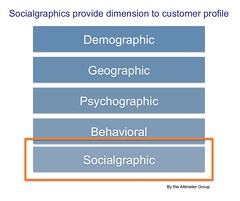
    Good For BusinessLeft: In the past, marketers have relied on tried and true demographics to understand customers. Now, as consumers adopt social technologies, marketers must measure socialgraphics, which indicates how they interact with each other.

    Update: Get the slides and watch the webinar: Thanks for attending, with over 800 registered, we’ve now made the Slides and Recorded Webinar available.

    Beware of plans or proposals that start with “Twitter Strategy” or “Facebook Strategy” Instead, they should have a “Customer Strategy” that focuses in on how customers behave –not on the ever-changing toolset. As a result, companies should first understand how their customers use social technologies before they choose the tools. Socialgraphics is how to measure how customers use social technologies, where they are online, and how it influence them in the context of the customer lifecylce.

    This upcoming free webinar, suited for corporations who want to develop plans in social with confidence, will answer how to apply socialgraphics. Like demographics or psychographics, companies must now understand socialgraphics, which answers five key questions:

    Socialgraphics answers five key questions:

    1. Where are your customers online? First, find out where your customers are online, knowing which websites they are particiating at, this will reduce guessing.How to make this data actionable: Don’t aimlessly approach social networks without knowing if they are there, if they are in Hyves, Mixii, or Facebook, go there. Fish where the fish are.
    2. What are your customers’ social behaviors online? How do they use social technologies? Do they share? Comment? Create their own content?How to make this data actionable: Which social features should you deploy. Example: if they frequently like to comment on websites, allow them to leave their comments.
    3. What social information or people do your customers rely on? How to make this data actionable: If they rely on their friends, facilitate a marketing program that encourages customers to share with friends, this data helps with determining resource allocation on advocacy programs.
    4. What is your customers’ social influence? Who trusts them?How to make this data actionable: If your customers are trusted by others, highlight your customers in front of their community. For example, teens may share information with each other, spreading their influence to others.  Example: Walmart’s 11 Moms blogger program is a platform for customer voices.
    5. How do customers use social in context of your products? How do customers use social technologies to learn, make decisions, and support your products and services? How to make this data actionable: Be confident in your resource allocation by understanding when customers rely on social tools or their peers in pre-sales, awareness, decision making, implementation, or support of a product.

    When properly deployed, Socialgraphics, helps companies, their agency partners, and business units be more effective in their planning and deployment –reducing risk from deploying without having knowledge.

    In the spirit of open research, we will make this webinar, the slides, and the overall methodology available for the public to use, under creative commons license. We hope you’ll join us.  Stay tuned as we have other webinars coming soon.


    Socialgraphics: The Engagement Pyramid Offers An Understanding of Customer Behaviors

    Above: The Engagement Pyramid makes it easy to understand the specific behaviors of socialgraphics, making it simple to decide which technologies to deploy. Having customer understanding makes go-to-market strategy more effective.


  • First Take: Powered, A Social Marketing Suite, Acquires Crayon and Social Media Agencies

    News hit this Monday that Powered has acquired three social media agencies: crayon, Drillteam and StepChange. I just had a skype video conversation with Aaron Strout and Joseph Jaffe to learn more, here’s my take.  You can read crayon founder Joseph’s take and Aaron Strout the CMO of Powered and a quick mention in NYT.

    A Solution Set of Services Bolsters a Marketing Platform
    I’ve heard of crayon, and have many conversations and even podcasts with founder Joseph Jaffe, I’ve also spent time with the Powered executive team last year.  Stepchange is a 13 person team out of Portland focused on Facebook Apps and mobile, and Drillteam, from NY, has been around for 10 years and focuses on experitntial and advocacy marketing, such as connecting events to online like street teams, guerrilla, and ambassador programs. Powered isn’t just a community platform, I learned they have other marketing features that really intent to provide a suite of offerings.

    Natural Evolution Of A Growing Market:

    • Consolidation happens in downturned markets. As the recession starts to show signs of it lifting, now’s a great time for companies to come together and create a greater value.  We saw this type of acquisition behavior from agencies during the first boom, and we should expect similar patterns here.
    • Acquisition provides key services software platforms can’t fill. It makes sense for Powered platform to partner up with a service(s) teams that have already been successful for some time, this improves the time to market to deployment.  In addition to coming with a book of business, they can quickly deploy the Powered platform, expanding the software footprint.  Joseph Jaffe has strong thought leadership, an existing marketing brand, and reach needed to the group.
    • Yet, brings risk for Powered and new partners. First of all, there are some big names coming together,  the real stress will be can these cultures, and their strong willed leaders, be able to jive together.  Secondly, it’ll be interseting to see if Crayon and services teams forces stragies on their clients that involve the Powered platform.  I asked if there are any layoffs coming from consolidation, they haven’t made any plans, but when you have 4 companies coming together expect redundancy.

    Impacts To Customers, Partners and Competitors:

    • Social Agencies should rekindle and bolster relationships. This impacts other social agencies like Stage Two Consulting, Social Media Group, AdHoc, Ant’s Eye View, ForumOne, Community Roundtable, Shift Communications, Dachis, FutureWorks, New Marketing Labs, who may be at medium and small tier, they should quickly partner up with other firms to increase their value.
    • Customers of crayon, Drillteam, and Stepchange should request agnostic recommendations. Any client of these three agencies should make sure that the strategy they are being offered includes other vendors and platforms –not just the Powered platform and Facebook platform.  Remember, first find out where your customers are online before choosing the tools to use.
    • This is competition for larger agencies –yet savvy agencies will partner. This is a threat to large agencies like Organic, Razorfish, Ogilvy, and Edelman.  Yet the smart agencies won’t get defensive, they should partner with this team, and figure out what offerings they can offer that they don’t have in their portfolio.

    Congrats to the Powered, crayon, Drilldteam and Stepchange team for this merger, I’m excited to see the industry emerge from small disparate startups to a larger entity going forward.


  • Matrix: Breakdown of Advocacy Marketing

    The recession has been great for social marketing, in fact, I feel it’s spurred the industry on. With overall reduced marketing budgets, companies must innovate, and find new channels that are more efficient than the ‘carpet-bombing’ techniques of traditional marketing.

    There are a handful of goals that companies can have with social technologies, from learning, dialog, support, and innovation (see Charlene’s deck, starting at slide 8 to learn more), I want to drill down in the following matrix to focus on the goal of spreading, and word of mouth, and viral. I call this “Advocacy”.

    Marketers, who strive to find efficient ways of reaching customers at lower cost, seek ‘force-multipliers‘ or a method where using a small degree of energy (or the energy of another force) to your advantage. Do remember, there is a downside to any action, and with ‘advocacy’ there’s reduced control over message and therefore more risk. With that said, many marketers know the benefits of content spreading are worth the risks.

    Matrix: Breakdown of Advocacy Marketing

    Sophistication and Description Investments and Returns Strengths: Weaknesses: Great For:
    Sharing Tools Baseline effort. Tools like Sharethis, AddThis, Gigya, and some features in Pluck, and Kickapps. High. Low investment as it can easily be deployed on CMS templates. Continual returns of content spreading with no additional overhead or cost. Easy to deploy, yet transactional Do not build deep relationship with customers Getting started, a baseline activity.
    Viral Marketing A basic technique. Word of mouth campaigns on Facebook apps, YouTube (see popular), or Twitter (see moonfruit example) Low. Being able to hit the right elements of the content people want, timing, and other factors are difficult. Chances are, most campaigns that intend to be viral never are Easy for media and interactive agencies to create and deploy. Dime a dozen. Short term and cheap. Not conducive to building long term relationships. Traditional agencies and transactional marketers that are trying to learn social
    Social Network Connections An intermediate technique. Facebook, Twitter Connect. Easy to comment systems on blogs, to sophisicated Huffington Post social recommendations, see Buddy Media. Moderate to High. Allowing customers to login to your site with existing connections increase value of social sharing and chance to serve up contextual data. However there are considerable costs in creating contextual content and systems that are not yet mature. Encourages people to quickly login, share, and find others who have interests Challenges in collecting email leads as customers now ‘login’ using social connections. Static websites who need to inject social interactions.
    Advocacy Programs An advanced technique, see this checklist. Longer term programs with customer advocates like Microsoft MVP or Walmart’s 11 Mom’s High return but high cost. Companies can benefit from an unpaid army that will market, defend, and support customers, but this requires significant resources to launch, grow, and maintain. Builds long term deep relationships with a customer group that will defend brand. Requires full resources for program, takes time to build Companies that can’t scale their marketing in a high touch customer experience.

    Companies Should Embrace Advocacy Programs
    Organizations are already deploying these word of mouth tools, but often without a plan or strategy, get started now by:

    • Deploy simple sharing features now. These cheap and easy to insert embeds should be on every content type where companies want the content to spread. From press releases, to blog posts, companies need to make it easy for their market to share with others.
    • Reduce risks by providing proper support and resources. Organizations should first understand the costs, downsides and risks for each type of marketing program, with greater returns (Advocacy program) comes greater commitment of resources, and greater risk, so to reduce those risks, put the right resources behind it.
    • Develop new measurement techniques. Measuring the spread of information is more difficult, as often companies won’t have web analytics installed on third party websites. Instead use a variety of mention and url tracking with brand monitoring software to track how far information spreads over time.


  • Placing Bets On Social Strategy, SCRM, and Mobile in 2010

    Screen shot 2010-01-05 at 12.43.57 PM

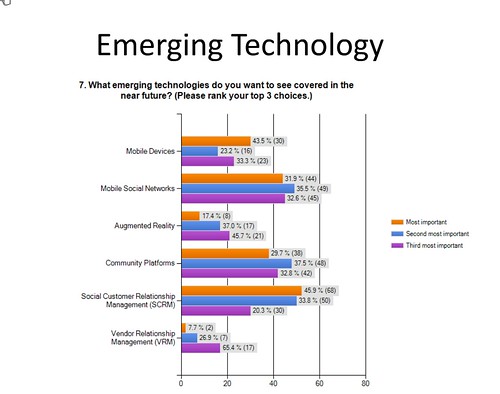
    Above Image: Readers of this blog asked for coverage in Social CRM, Mobile Social Networks, and Community Platforms. This is in alignment with my goals for 2010.

    First of all, thanks to those who responded to the 2009 Web Strategy survey, the results were telling. One of the questions that I asked was about areas of focus, I’m pleased to hear that the direction readers want me to focus is in alignment with where I’m headed. It’s important to have goals, (even my personal goals to live in Hawaii 30 days a yearlike Operation Bluewater) and I’m happy to share my focus for the coming year.

    Here’s my baseline topics that I’ve been blogging about, and helping clients through advisory and research, I’ve been doing this since I ran the social program at Hitachi, back in 2006, over four years ago.

    Organizational Social Readiness: 80% of a companies success is getting their organization ready through the right roles, processes, policies, measurement, only 20% should be on tools. I’ll continue to talk about organizational readiness.

    Social Strategy: This also ties into social marketing strategy, which should be focused first on socialgraphics (how your customers use these tools) and business goals –not reacting to the latest technology.

    Vendor and Technology Review: I’ll continue to cover the social networking space, like Facebook, MySpace, Twitter, as well as enterprise systems like Community Platforms like Jive, Lithium, Telligent, Awareness, Mzinga, Pluck, Eos, Salesforce Chatter.

    I make it a point in my career to always be uncomfortable: trying new things, looking at the upcoming changes and taking risks, I hope that by continuing to blog what I learn, we can grow together. The areas of increased focus for this year are:

    Social CRM: An organization’s response to the fleeting customer in the social space, and how companies must provide a holistic experience to customers by creating processes, integrating new channels, and responding to customers in near-real time. Why this space? Most companies don’t know they need it, but as customers increase their social behavior, tacking, managing, and responding will become increasingly difficult. I’ve already blogged some of my findings, read all the posts tagged ’social crm’.

    Location based and Mobile Marketing: I place to distinct separations between these topics, although they are intrinsically tied. I’m placing bets on the increased marketing context that’s available by triangulating information through mobile and location devices. Similarly, I’ll continue to look at applications that extend to mobile devices –a natural extension to the social web. I’ve never put a lot of effort into the immature mobile space, but the adoption of these mini-computers are taking off, the space is slowly moving out of diapers and into adolescence. Read all my posts tagged ‘mobile’.

    Now back to you: What topics and focuses will you have during this coming year? What areas of education are you planning to bolster up on? What will you practice and deliver? Wishing you a very successful 2010!


  • Matrix: Social Technology Adoption Curve Benefits –and Downsides

    Know The Upsides –And Downsides Of Your Adoption Behavior
    Individuals and companies should be deliberate in their adoption strategy, there are benefits and risks to each category. It’s been interesting watching different group adopt social technologies over the past few years, I can see who benefits from being first –and the pains to be a thought leader of both individuals and companies.  

    Screen shot 2010-01-03 at 7.30.36 AM

    Above, this is the standard Rogers Adoption Curve, it’s important to point out that my matrix below only is in context of social technologies, it will vary from technology to technology.  I found this take on the adoption stages of social technologies helpful in framing how I thought about the following matrix. I built this following matrix in the context of social technologies and adoption by both individuals and mixed in with organizations and industries.

    Matrix: Social Technology Adoption Curve Benefits –and Downsides

    Categories Description Benefits Downsides
    Innovators These brave souls take on new technologies, trial them, then will often evangelize them. I’d put those that adopted Twitter in 2006. or any entrepreneurs that creates new technologies fitting into these categories.  From a corporate perspective, Dell was forced into this arena, and has benefited. Glory for being first, a thought and practice leader.. Will have learned from their mistakes, and have far more experience than any others. Will always be able to tout they were first. Very costly in terms of time, effort to find new technologies that are often flawed. Additionally, since innovation becomes cheaper and more accessible, this becomes more difficult as more entrants to the market launch products. Lastly, while these folks may be first for some technologies, they are often wrong for the many other technologies that did not take off.
    Early Adopters This behavior is exhibited by those that try out new technologies in a careful way, often thought leaders. Some analyst firms like Forrester adopted early, and the Tech industry deployed social.  Agencies like Edelman, Razorfish have helped their clients. Learn from the failures of innovators, they reduce risk. Often they have the opportunity to explain how it works to others. Become the case studies that other groups follow Never first, and have to write the playbooks. They may adopt, but at higher costs than the majorities as the technology has not matured. Tech companies adopted social in 2005-2007 as an early industry, but a lack of measurement, and rapid tool change required great effort to stay current.
    Early Majority Although thoughtful in their deployment, they adopt faster than the mainstream. in 2009, we saw industries like consumer packaged goods, finance, and healthcare adopt social technologies. I think of when mainstream Oprah joining Twitter as a defining moment as she was ahead of most celebrities and media. Technology starts to mature, reducing risk and costs. Standards emerge, although this group gets to help define mainstream adoption. Some of the cool factor leaves, and brands start to move in on social technologies, scaring off some innovators.
    Late Majority This skeptical group only adopts when the mainstream does. Industries that only got on board with social when Obama, mainstream press, or celebrity adoption occurred fit here. Companies adopting in 2009 and beyond. Reduced risk from learning from who’s done it right and wrong, as well as benefits from standard proccesses, and consolidation of vendors. Not seen as thought leaders and don’t benefit from the residual buzz from being ‘cool’, instead come across as a ‘me too’./td>
    Laggards Still cautions in deployment, even after the technology has become mainstream. These folks will adopt social technologies in 2010 or later. Cookie cutter deployment from standardization and very little risk.  Deployment may actually be faster and with less effort than those above. In balance with lower risk, lower opportunity for reward. No thought leadership, and little additional reputation or buzz value from the intended investment.

    Matrix: Be Deliberate In Your Adoption Strategy
    Each category has specific benefits and risks, but rather than just behaving in a way that comes natural, I encourage you in your personal and work adoption to be deliberate in your actions.

    1. Examine your organizations adoption patterns. First, define how quickly your organization responds and adopts to technologies, and factor into your considerations.
    2. Be a Category Ahead Of Your Company. If you’re responsible for new technologies at your company, your personal adoption should be a level or two ahead of the organizations adoption, as you cannot effectively deploy for your company if you don’t personally understand the impacts of the new technologies.
    3. Track The Category Ahead Of You. Find an individual that’s above your adoption category (the early adopter watches the innovator) and be sure to watch their behaviors and learn from them. Adopters are often blazing their own trail, and may not ever follow anyone.

    My Strategy: Early Adopter –But Not Innovator
    One thing is clear, being first doesn’t mean you’re right, in fact, the Innovators have a difficult time dealing with early and late majority, paving roads of opportunity for analysis, agencies, and consultants. As a result, I make a distinct effort to be an early adopter of new social technologies, but not the innovator, as I find I’d rather be more often right, and expend less energy trying to be first.

    Leave a Comment. Share Your Adoption Strategy
    Let’s learn from each other, I’d like to know about your adoption behavior and that of your company. Were you deliberate in choosing your adoption strategy? How does it hurt or help your company?


  • Who Reads This Blog? Find out with 2009 Web Strategy Survey Results

    Above: See the details of the survey results, due to heavy data, it’s best when put into ‘full screen’ mode, the fourth icon on bottom.

    To me, this blog belongs as much to the community in which I serve as it does to me, as such, it’s important to find out who the readers are and what they want, to learn about previous efforts, see 2008’s results. The goals of this survey are simple 1) Find out who the readers are, 2) Find out if they are they influenced by this blog, and how, 3) How this blog can improve year-over year. With a sample size of nearly 200 respondents, some of the key findings from this survey were:

    1. Overall, Readers Were Satisfied: Overall, respondents were pleased with the blog, and 47% rated it a “10/10″ in recommending it to others when asked “would you recommend this blog to a friend or colleague”, and 54% read more than half the posts, and over one-third shares it monthly with others (slides 3, 4, 5)
    2. Many are Buyers at Corporate: 59% of respondents said they are buyers,  28% of respondents have budgets $100k-$1 million (although one-fifth do not hold budget), and over a quarter work at enterprise class companies with over half of respondents in the United States (slides 10, 14, 18, 19).
    3. Some are Influenced By Blog: Over one-third of respondents said this blog strongly informs their actions at work, but it was nearly split between influence in their buying process, with 40% agreeing, and 39% disagreeing.  (slide 6).  Read more from Edelman’s Analyst Relations specialist, Jonny Bentwood on his take of this data.
    4. Sophistication of Social and Mobile at Work Varies: 39% of respondents said their company was intermediate when it came to social strategy, and 43% said their novice when it comes to mobile strategy. (slide 20, 21)
    5. Identified Many Areas for This Blog to Improve: There was a large request for adding more case studies, and interviews with thought leaders in the space, and a variety of comments in the open-ended section that I’m all taking to heart. (slide 8, and qualitative answers)

    You can read the qualitative answers on a separate page, in case you want to understand why they read this blog, and what they want to see improved.

    A few notes on this survey.  I’m not sure this is truly representative of all readers, it’s likely those that are more engaged, and are willing to spend time filling out the survey.  While some research firms take data samples from smaller numbers, this is only 195 of respondents, although there are far more readers than that.

    If you want to influence the readers of this blog, it’s simple.  Be part of the ongoing conversation (not be pitchy) by leaving comments and demonstrating your knowledge and expertise.  Also, you can schedule a briefing with me, but I’ll have to admit up front, it’s been hard getting on my cal as we just launched this new company.  I’m figuring out ways to make briefings easier, such as blocking out Friday mornings, using web based forms to collect more information up front.

    Thanks to the folks who took the time to answer the 20 question survey, I read every response, and am constantly trying to improve this blog. Here’s to making this blog even better in 2010!


  • Tell Your Y2K Story –Ten Years Later

    We’re just a few days from Y2K+10, ten years after the big scare of the whole world collapsing from a lapse in computer programming foresight.

    I remember it closely, I spent a few hours in the later part of Dec 1999 backing up data at the small business my wife was working at. We were able to download nearly all of her company’s (a very small office) data onto just over a dozen zip drives, remember those? Funny that we could fit nearly all the digital files onto those drives –perhaps, if Y2K fears were to happen, it’s better than uploading to the cloud.

    I also remember an army of Y2K consultants, and their concerns over liabilities, appear marketing how they’d offer CIOs Y2K enterprise proofing for companies that were concerned about losing all their data. I even had one slightly off-keel friend stay home on NYE 2000 eve with a gun in hand, military rations beside his bed. I wasn’t phased, I enjoyed reveling in downtown San Francisco with friends.

    I want you to reminisce, do you remember what you did to protect your personal data, finances, work data, or what your company did in preparation for the Y2K apocalypse? Leave a comment, share with others, and take a look back 10 years ago. To trigger some memories, here’s a video to remind you of the fear, oh Leonard, really? Illogical.


  • Forbes: A Year In Review: 2009 Social Marketing Trends

    Here’s my latest column in Forbes, which I’ve also posted below.  I’m leaning on naming this CMO focused column “The Connected Customer”, which appears to be a theme, what would you name it?


    A Year In Review: 2009 Social Marketing Trends

    The connected customer leaves brands in the dust.

    As we close out the year, it’s important to look back at what happened in social marketing in order to plan for the future. There were four key trends in 2009 that CMOs should reflect on, starting at the macro level then shifting down to micro real-time updates. They are:

    The Recession Spurred Consumers to Adopt Social Technologies. Humans are social creatures and, as a result, they tend to band together in hard times. During financial crises, this same behavior is evident: People connect to one other, share, learn, and communicate. What’s more, with unemployment at record highs, those with internet access have more time–and need–to connect with others. It’s evident through Facebook’s 350 million global users. For brands, it’s interesting to note a study by Razorfish, which indicates that 52% of consumers have blogged about a brand’s product or experience. Don’t expect this to change as the recession lifts, as it is the preferred method of communication for young people.

    Some Brands Followed Suit With Social Marketing. Marketing budgets are pinched during tough times. Recent data from eMarketer indicates that companies are slashing print budgets by 37% and TV by 21% as a response to the recession. Yet marketers know that tough times also spur innovation, as they experiment with mediums such as social marketing. Social marketing promises lower costs and bigger returns. In fact, word-of-mouth campaigns encourage consumers to do the marketing on behalf of the brand themselves. Yet despite the opportunity, research conducted by the Altimeter Group (where I’m a partner) and Wetpaint found that while brands like Starbucks, Dell, eBay, and Google interact with their customers, most brands do not. Still, we’re seeing a noticeable increase in social marketing budgets, as brands find ways to innovative marketing.

    Social Networks Share Data, Spreading Social Influence. A key trend across the technology vendor space in 2009 is that social networks are connecting with other systems. Much like how Apple’s iPhone developer program enables third parties to build and create new applications, many social networks are doing the same. Take for example, LinkedIn, a business network that recently began allowing third party sites to connect with the LinkedIn platform to share data. Similarly, Facebook Connect allows users to log into third party sites using their Facebook ID. There have been over 80,000 connections since this time last year. So what does this data availability mean? It means that consumers’ social experience will spread from site to site, and that wherever they go online or off, they can access their friends’ opinions, experiences, and recommendations in real time.

    Consumers Move Faster By Sharing Real-Time Data. In August, 2009, blogger Heather Armstrong, who boasts over a million followers on Twitter was miffed about a shabby customer experience and tweeted about it. Although the company, Whirlpool, responded within hours, the damage had been done–Armstrong’s real-time feedback about her company experience spread quickly through her network and beyond. This spread of customer experiences in real time is a trend, in fact, status updates are a feature found not just in Twitter but in many social networks like Facebook and LinkedIn. Recently, Twitter signed a deal to allow Microsoft’s Bing and Google access its real-time data, displaying real-time tweets which appear along side traditional search results. So what is the impact of this increase in real-time data? It means that consumers can instantly give feedback about their product experiences and tell their friends. For brands, it means they have to move faster to keep up with consumers who are sharing.

    Takeaway: This year, consumers are more connected, and moving faster than brands. It’s essential for senior marketers to use the past to plan for the future, and these four trends indicate that people are connecting and sharing with each other–at an increased pace. Brands need to develop a strategy and a plan to respond–not simply react–to the latest technology. In our next piece, we will discuss the key trends to watch in 2010 to help with strategy planning.


    Thanks to Christine Tran on the Altimeter Research team for her assistance if finding data references.


  • (Video) 2010 Trends: More Speed and Integration, 27 min

    Long term friend and former colleague Robert Scoble (who’s now with Rackspace) came by to interview the Altimeter Group. Although Deborah Schultz and Charlene Li were off traveling the globe, Ray Wang (who covers enterprise strategy) and myself were able to sit down with Robert and discuss the trends we see happening in the industry. Big wave to Rocky who’s the show producer, and also a former colleague.


  • To The Future! A List of Intention Enabled Websites

    The web is quickly moving to real-time, people share the information about what they’re doing while their doing it. Yet the next step beyond real time, is future-looking data, which is called the Intention Web (get up to speed by reading this post). In an effort to map out this trend in 2010, let’s list out the vendors, companies, and beyond that will facilitate this type of forward looking data.

    There are countless opportunities for people to connect with others with the same goals, or for companies that want to serve them as new technologies like Social CRM evolve and develop. Scope: These Intention websites facilitate a person to publish their future goals in the context of their community, or sometimes even in public. For example, an unshared CAL isn’t a qualifier.

    To The Future! A List of Intention Enabled Websites

    • 43 Things: This “wish list”, they suggest that you make a list on 43 Things and see what changes happen in your life. They encourage you to connect with others with the same goals.
    • Coachsurfing:  Helps those traveling to other cities to find homes and couches to stay on, by organizing availability. (thanks jasminw)
    • Facebook Events: Facebook allows members to RSVP for future events, publish their own events, or see what friends are doing.
    • Localist: Allows those in DC and Baltimore to find events, publish their intent to attend, and organize with friends (thanks Mary)
    • Meetup: Encourages groups to organize events, plan events, and connect with others.
    • Plancast: Is a social network that allows members to publish their future plans. It allows people to see who is going to other future goals, and to publish to Facebook, and Twitter.
    • Tripit: This website allows travelers to plan out their travel itineraries. (thanks Sameer)
    • Upcoming: This Yahoo owned property allows people to find, publish, and share future events.

    Leave a comment if you know of other technologies that meet this critia


  • People on the Move in the Social Media Industry: Dec 16, 2009

    potm-banner-2

    Above, thanks to Mitch Canter, we’ve a new header graphic for the “On The Move” series, which needed an update since I started this digest a few years ago.

    In an effort to recognize the changes in the social media space, I’ve started this post series (see archives) to both track and congratulate folks who get promoted, move, or accept new exciting positions. Please help me congratulate the following folks:

    • My former colleague Alexis Karlin who was very involved with Forrester’s social media efforts now joins Neolane, and will be starting their social strategy from scratch and running their web site. She’s quite the professional, an incredibly fast learner, and I’m glad to have worked with her. Follow her on Twitter at @akarlin.
    • David Armano moves on from Dachis Group and joins Edelman Digital as a SVP. Regardless of where David works, his blog is a fantastic collection of thoughts, informative graphics, and insight, I’ll follow his insights anywhere, find him @armano It’s interesting to see how Edelman is placing bets in social strategy, with that in mind, also see that…
    • Michael Brito, formerly one of Intel’s Social Media Strategists also joins Edelman in Silicon Valley office as a Vice President. I’ve worked with Michael on projects in the past, and have been impressed, great hire. Find him on Twitter at @britopian
    • Paul Gilliham, who I’ve had excellent professional experiences with, joins Lithium Technologies Director, Customer Marketing where he’ll be Running Lithosphere (Lithium’s customer community), social strategy, customer consultancy, customer/analyst relations. Find him on @bladefrog
    • Samir Bhavnani has been hired at EXPO as a Vice President where he’ll be working with brands to engage with consumers, on video, for insights and marketing. Find him on Twitter at @samirb
    • Deidra Bodkin leaves Zenith Optimedia and joins IDG as VP, Group Media Director as VP, Client Services leading social media marketing programs for IDG’s IT and B2B Clients. Find her on Twitter at @deidrabodkin.

    How to connect with others (or get a job):
    Several people have been hired because of this blog post series, here’s how you can too:

    Submit an announcement
    If you know folks that are moving up in the social media industry, fill out this form.

    Seeking Social Media Professionals?
    If you’re seeking to connect with community advocates and community managers there are few resources

    This list, which started with just 8 names continues to grow as folks submit to it. List of Social Computing Strategists and Community Managers for Enterprise Corporations 2008 –Social Media Professionals.

    Job Resources in the Social Media and Web Industry

  • Web Strategy Jobs powered by Job o Matic (Post a job there and be seen by these blog readers, these affiliate fees pay for my hosting)
  • Read Write Web keeps announcements flowing at Jobwire, although is broader than just social media jobs
  • Facebook group for community manager group in Facebook
  • Jake McKee’s community portal for jobs
  • Chris Heuer’s Social Media Jobs
  • SimplyHired aggregates job listings, as does Indeed
  • ForumOne Jobs for Social Media and Community
  • Teresa has a few jobs, some around community
  • New Media hire has an extensive job database
  • Social Media Headhunter
  • Social media jobs
  • Jobs in social media
  • Altimeter Group’s list of social media consultants and agencies
  • Hiring? Leave a comment
    If you’re seeking candidates in the social media industry, many of them are within arms reach, feel free to leave a link to a job description (but not the whole job description, please)


  • Making Your Blog Mobile: Testing the Web Strategy iPhone App

    Experimenting With Mobile Apps
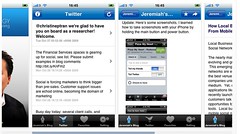
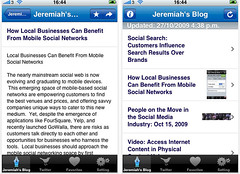
    It’s clear that content can become more contextual and personalized as it transects with location based devices.  A few weeks ago the folks at the company MotherApp, created a “Web Strategy iPhone App (download in iTunes)” to take on the go. This isn’t just a “m.” mobile website that shows essential content minus heavy graphics, this is a true iPhone app, with the native interface of Apple products, see screenshots below. I’m not the only one, they created the app for Tim Ferris (iTunes), Guy Kawasaki (iTunes) and Brian Solis (iTunes) and others.


    Screen shot 2009-12-14 at 6.36.57 AM
    Above: Screenshots of the Web Strategy iPhone App, featuring latest Tweets and Options

    Screenshots of the Web Strategy iPhone App
    Above: Screenshots of the Web Strategy iPhone App, featuring latest blog posts details and summary of posts


    Mobile Based Apps Offer Content On The Go
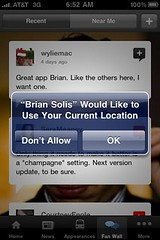
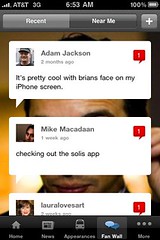
    The content can be accessed on an iPhone, even if there’s no internet connection, the content is downloaded. Secondly the content is in a clean Apple native user interface making it easier to read and navigate, rather than some clunky “m” looking site. Also, you can serve up a variety of content sources related to your brand. Also, the app has location based content, I’m looking at Brian’s app, and it can serve up Fan comments based on location (it asks you for your current location, first). In the future, it would be interesting if two fans of Brian Solis’s app would be signaled to each other they are in proximity, resulting in unique engagements. Brian’s app links directly to his amazon page, where his books (products) are available for sale.


    photo
    Brian Solis’s Apps Requests To Access Your Location

    photo
    Brian Solis’s Apps Filters Fan Wall Shout Outs By Proximity.

    photo
    Conversion: Brian Solis’s App Promotes His Books, With Links to his Amazon Store.


    What’s the downside? The URLs and comments are visible, only my voice. In the future, I’m sure these will be native into the app, so the community can talk back. The barriers to entry are still high, you’ll need to find an app developer to build this for your iPhone or other mobile device.

    Apps for Events and Corporate Conferences
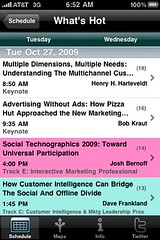
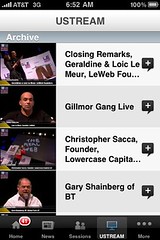
    It’s not just personal brands, I recently noticed the Forrester Consumer Forum iPhone app that listed out the schedule, top topics “What’s hot” based on attendee votes (I think) and the ability to create a schedule of tracks to attend. LeWeb has the most impressive event iPhone application, with links to previous videos, session list, news, maps, and speaker roster. Nearly the entire event website was ported to the device on the go.


    photo
    Forrester’s Consumer Forum App Highlights the “Hot” sessions. No doubt, of course, it’s Josh Bernoff.

    photo
    LeWeb IPhone App Streams Archived Videos


    Key Takeaways

    • Expect majority of top blogs to have mobile apps within the next few months, at first they will be custom created, then a platform will emerge allowing them to quickly ported to multiple platforms (blackberry, droid, etc).
    • This platform will emerge that will create this blog network, and new advertising opportunities will emerge who are able to cascade the information to the mobile devices. Players like Federated Media, Blogher, should move quickly.
    • Content will become location-based, as blog posts, tweets, and other content is based on a specific area (a foodie blog, reviewing restaurants in Mission district, SF) the content will auto-surface to the application when needed.
    • A standard will be set for all conferences and events to have a mobile based event that encourages members to find out about sessions, find other attendees, and even tweet from it.

    I’ll continue to experiment with the Web Strategy brand in a variety of mediums, to test, and report back to you what works and what doesn’t.


  • Meet the Arabic Blogosphere: Read The Comment Section


    The purpose of this post is two-fold: 1) To share my keynote presentation about blogging strategy, 2) Help connect the Arabic bloggers with my Western business readers and community.

    I’m in amazing Doha, in the nation of Qatar, who’s sponsored my travel to speak at the ictQATAR and my friends at ForumOne event about blogging.  Qatar wants to reach out and connect with the world, I’m excited to be one of those who can help bridge.

    Blogging conferences in the US were popular a few years ago –and have given way to Facebook conferences, and now Twitter or last week’s “Real Time” focus at LeWeb. The Middle East has been evolving quickly in the blogosphere, and this is a real focus for individuals, organizations, institutions, and governments to connect with others, and let their voice to be heard.m Embedded above, you’ll find my presentation, which has international examples of bloggers.  It has a section with data (sourced cited) and then I talk about where I see blogging headed into the next era. The purpose of this event is to educate local bloggers on how to most effectively use blogging tools to connect and reach to the outside world, so I’ll give a hand, and try to connect the community right here on this blog.

    Arabic Bloggers, Kindly Leave A Comment
    In the spirit of community, in this case, global community, at the end of my keynote, I’m suggesting that the attendees leave a comment on this post, to shout out to the world, leave a URL, and a few sentences on what they focus on.

    Web Strategy Community, Please Welcome Them
    My hope is that these Arabic bloggers will not only connect with each other, but also connect with my readers in the business world.  If you’re a regular reader of the Web Strategy blog –please welcome them, surf their blogs, and share about yourself if you’ve similar interests.  We recently installed Disqus so we have threaded conversations –making it easier to keep track of multiple discussions.   Be sure to return to this post in the future, in order to see how the conversation developers over time.

    To me, success for this project is to see at least two people connecting with each other in which they can develop a meaningful relationship for understanding, business, or friendship.   Blogs, a simple technology, that can bridge people around the world.

    Update: It’s a few hours after the conference, and I’ve had time to reflect, and connect with other bloggers that attended. I’m told this was the first time bloggers were able to get together in Qatar, and some met for the very first time face to face. It was an privilege to be part of this historical event, which was organized and sponsored by ictQatar, ForumOne, and the many bloggers who attended. Really an honor, I hope to return in the coming months, this is one of the highlights in my career, and a milestone for the social web. Also, do see their latest blog, which was launched at the event, both in Arabic and English. The Gulf Times featured the event on the front page (pic).


  • Slides: Real Time Web Is Not Fast Enough– Three Strategies For Business


    I’m about to present at LeWeb, Europe’s largest internet conference with this year’s focus on “Real Time”.  With information moving even quicker, there’s a new strategy needed for companies to adopt.  Since the accompanying slides are best used with narration, here’s the gist of my presentation:

    Real time data is exploding at a rapid pace with the influx of status features and mobile devices.  This brings new opportunities for people to get information when they need it and opportunities and the companies that want to provide contextual information.  Yet, despite the opportunities, most companies are unable to keep up with the “Slow time” web as it is.  In fact, those that can’t keep up risk missing opportunities, or worse –heading off detractors before they become mainstream.  To best leverage real time data, companies must adopt three strategies:  1) Start listening now, and quickly offer social personalization features, 2) Develop an unpaid army of advocates who can respond when you’re not there, and 3) Start to invest in systems –like social CRM– that can support their overall strategy.

    Looking forward to sharing more on this topic as it develops during 2010, I’ve written more about this topic and the intention web.

    Also, thanks to Carmen of Rexi Media, who is a great coach on presenting, her resources for presenters, such as the iPhone app are helpful for any speaker.  Update: Here’s a video of my presentation.