Author: jeremiah_owyang

  • List of Companies Providing Social CRM Offerings

    Social CRM: A Growing Segment
    Yesterday’s
    post on Social CRM vendors not walking-the-talk raised awareness of this nascent space.  However, not everyone was thrilled with the effort, as CTO John Moore gave us an A for effort but a C- for results, and Kim Kobza, the CEO of Neigborhood America (they were an early adopter) left a comment on John’s post suggesting we missed the mark (also, SAP ’s passionate team strongly represents).  Although we stand by our scoring, both John and Kim are right, our evaluation yesterday was only on a small subset of the industry, but a manageable starting ground, as we continue to unearth the variety of players.

    Tracking the Market with an ‘Industry Index’
    For a few years ago, I’ve created what I call my posts called the Industry Index (see all) lists to track companies in any particular vertical, it helps me, vendors, and buyers to track the space.  I expect this space to rapidly increase in size as social channels will be bolted onto CRM vendors, and many brand monitoring and community platforms are adding workflow, triage, and tracking capabilities. The purpose of this list is to quickly capture the vendors participating in this space, and to acknowledge those that were not on yesterday’s review, I expect there to be many more vendors who leave a comment, which we can quickly add to this list.

    We owe it to the market to try to include as many as possible, although it’s going to be very difficult as this space quickly grows. So first, let’s try to put some scope around this space with a definition.

    Social CRM Definition
    We prefer Paul Greenberg’s definition of Social CRM, which he summarizes as:

    “CRM is a philosophy & a business strategy, supported by a technology platform, business rules, workflow, processes & social characteristics, designed to engage the customer in a collaborative conversation in order to provide mutually beneficial value in a trusted & transparent business environment. It’s the company’s response to the customer’s ownership of the conversation.” (also read his 2009 review of this space on ZDnet)

    It’s a broad definition, but the key criteria he lists out are enough for me to go on.

    List of Companies Providing Social CRM Offerings: (32 vendors total)


    Traditional CRM Vendors offering Social Integration (10 vendors)

    • ACT!:  This barely fits the scope of social crm, but ACT! allows a single individual to manage multiple types of information, including social, however if this product was extended across an enterprise, it fits the quota.
    • BatchBlue: While not a ‘traditional’ CRM like many of the others listed below, has traditional sales automation features, but also connect with existing social graph data, think social aggregation of contact lists.  After watching the demo, it looks like you have to manually enter feeds of contacts, rather than auto-finding data from social graphs by scraping.
    • Buzzient: Offers a CRM platform that provides social media analytics that can be used for web marketing, customer tracking, or reporting.  They have partnerships with Salesforce, Oracle, and SugarCRM.
    • Microsoft Dynamics:  Offers Accelerators (here and here) that “Allows business professionals to monitor and analyze customers’ conversations on social networking sites, and as a result, provides real-time status updates about their products and services” (thanks Menno, who writes on the topic) They are also partnered with Neighborhood America
    • NetSuite:  Offers social CRM with a partnership with InsideView and has Twitter integration (submitted by Paul Greenberg)
    • Oracle Siebel Social CRM: Promises the ability to provide insights based on the buying behaviors of similar customers, as well as shared content to be used between sales teams.
    • RightNow CRM: Offers several features in their suite such as Support Communities, Innovation Communities, Cloud Monitoring, and Social Experience Design. Rightnow recently acquired Hivelive an enterprise community platform.
    • Salesforce: Offers acces to Social Networking like Facebook and Twitter. Salesforce, like SAP is importing the Twitter “firehose” feed, and has offered social features like Q&A, and social networking like Chatter, and has lightweight LinkedIn integration.
    • SAP CRM: Imports the Twitter firehose feed, and
    • Sugar CRM: Offers “SugarCRM Cloud Connectors connect via Web Services to leading third-party data service providers such as Hoover’s, JigSaw and LinkedIn”

    Community Platforms Offering Social CRM (5)

    • Jive Software: Community Engagement, offers data integration from Radian6, encouraging management of the discussion.
    • Leverage Software:  I recall that Leverage offers built in integration with Salesforce, but I was unable to find it on their site.
    • Lithium Technologies offers the Social CRM Suite offering features such as Community Applications, Reputation Engine, Actionable Analytics, CRM Connectivity, and Social Web Connectivity.
    • Neighborhood America: Has had a partnership with Microsoft Dynamics, read press release, (they were early on in March 2009) and commentary from Paul Greenberg on ZDNet.
    • Concourse:  Offers a variety of integration modules to a variety of apps, including a CRM module that’s prebuilt. (via pjk54)

    Brand Monitoring Offering Social CRM (3)

    Social Media/Twitter Clients (2)

    Social Customer Experience (4)

    • CrowdEngineering:  Helps to match experts to customer problems, by using a recommendation engine and skill resource set engine.
    • Fuze Digital Solutions: Provides a broad and modular multi-channel customer care solution using a community knowledge base as its foundation.
    • Helpstream: Offers tools that allow customers to submit questions to each other, with integration into SalesForce in addition to community driven knowledge centers.  see video.
    • Parature: Offers chat-like features for support reps to interact with customers, then measures sentiment.
    • Get Satisfaction:  Is an off-domain (all the support is done on their site –not yours) community that now offers premium features that offer ability to manage discussions.

    Sales 2.0/Social Graph Aggregation (6)

    • Flowtown:  Allows marketers to prioritize targets to contact by a variety of influence scores, and their social graph.  It then offers targeted email marketing based on those two criteria.
    • Gist: Offers a way to track the social behaviors of your customers and prioritize.
    • InsideView: Offers some unique offerings that mine a business social graph to provide alerts as a plugin to traditional CRM systems, Watch this lengthy demo.
    • Roving Group: Offers a product called ‘Roving Contacts’ that aggregates the social graphs and contact information from your address book.
    • SocioToo: Not the typical corporate enterprise company, this Dutch company offers a search page (and no real corporate site –by intent) that mines social graph data in public.
    • Xobni:  This cleverly named (opposite of inbox) Outlook plugin scrapes your social graph and most frequently emailed contacts improving email utility.  This barely falls within the scope of social crm, but if the data was able to export to other systems, it could start to apply.

    CRM Applications and Plugins (2)

    • Appirio: Offers the ability for companies to create applications on Facebook which then marry data back to Salesforce, called Cloud Connectors.
    • SocialCRMTools: Offers integration with Salesforce that imports, monitors, and manages Twitter, Facebook and LinkedIn. (via John Perez)

    Social Networks and Others

    • Twitter: Has made motions they plan to offer premium services to brands, that would offer verified accounts, then management-like features. The specifics are still unknown, as they sort out their business model. They have partnered with Google and Bing.
    • Google has announced real time search integration, and Bing has shown some early integrations.  While far fetched we should not completely rule them out as eventually building a dashboard for brands to manage their namesakes, advertising, and website analytics, or Google alerts.  Historically, they generate money off content created by publishers, so this actually falls in line with ‘organizing the world’s information”.

    Not on this list? Leave a comment, with justification why you fit in Paul’s definition with a link to your site explaining more, I’ll take a look and add to it, please be patient while I review.  Also, if you want to brief Ray and myself, please read and submit to this briefing form.

    Update: Business Partner Ray Wang and I have created a more detailed matrix of this space for our clients.


  • Finding: Social CRM Vendors Don’t Walk The Talk

    I first posted this on the Destination CRM blog, thanks to Josh Weinberger @kitson. Update: The below is a partial view of the industry, do see this larger index of Social CRM vendors.

    Surveying the Social CRM Industry
    Business partner Ray Wang (focused on enterprise strategy) and myself (customer strategy) of the Altimeter Group is undergoing a major project for a client in the nascent Social CRM arena.  We’re surveying the landscape to learn about a variety of vendors in the space, their capabilities and deployments. A small portion of our survey is to see who’s eating their own dog food, and truly demonstrating they understand the ’social’ aspect of social crm and living it.

    Companies Who Sell Social Products Should Demonstrate Credibility By Living It
    While critics may be quick to dismiss the mere inclusions of a blog or community to a product landing page, the message goes much deeper. Social CRM isn’t just about bolting on a new plugin to your system like a new air foil on your minivan but instead a new way of doing business. The promise of social crm says that companies are truly listening to their customers wherever they are, responding, anticipating, and making the commitment to improve products and services. Vendors that are assisting brands with this promise to the market need to demonstrate they fully understand the ramifications of social crm –not just a keyword checklist of the buzzword du jour.

    Criteria: How We Graded the Social CRM Vendors
    There are four major areas of grading, from very tactical ability to 1) Simple sharing of social content from the corporate product page 2) Surfacing a developer or business community, and a look inside of the discussions in each community, with bonus points for integration with product page. 3) Thought leadership with relevant blogs on the subject, and a gauge of their level of interaction and any twitter accounts they may have. 4) A subjective look at the overall page experience in the context of a company that’s offering a ’social experience’.

    Findings: Overall, Social CRM Vendors Aren’t Walking the Talk
    We’ve decided to make our findings public, at least for this part of our client deliverable to see how different vendors that are in the Social CRM space are walking the talk.

    Sharing Features on Product Page (out of 1 point) Community and Integration (out of 1 point) Thought Leadership: Blogs, Twitter (out of 1 point) Overall Social Experience (out of 1 point) Final Score (out of 4 points)
    Salesforce 0 0 0 .25 .25/4
    Microsoft Dynamic 0 0 0 .5 .5/4
    SAP CRM .5 0 0 0 .5/4
    Jive (Community Platform) 0 0 .5 .5 1.0/4
    Oracle/Siebel Social CRM 0 .5 .5 0 1.0/4
    RightNow CRM 1 0 .5 0 1.5/4
    Lithium (Community Platform)* .75 .75 .75 0 2.25/4

    To pass, companies need to receive greater than a .5 in each category for a total score of 2.0 plus making Lithium the only vendor to pass.

    For details, see the data, and our justifications on this Google Sheet.

    Highlights From Study
    The product pages are devoid of true social interaction, and none of them actually surface discussions about how the market is even talking about them. Marketing machine Salesforce demonstrated they aren’t engaging in a social experience on their own product pages and SAP and Microsoft’s typical enterprise looking design stayed consistent with ‘boring’ social experiences. Although Oracle’s bland web experience looks like it’s designed for the media-phobes, there is links to community and thought leadership blogs. Despite the overall meager findings, there were a few social hopefuls such as Lithium (Altimeter client*) who integrated social throughout the experience followed by RightNow Technologies who demonstrated thought leadership through executive blogs. Honorable mention to Jive engaging online video that captures the spirit of the Social CRM movement. We know that soon every webpage will be social, even if you don’t choose for it to be, so companies should enable features that allow websites to have conversations. Social CRM vendors that want to demonstrate to the market they are experts at this space should gear up to demonstrate they’ve the ability to do as they preach –as for now, it doesn’t show.

    *Altimeter Client. At the Altimeter Group we practice open leadership (also the topic of Charlene’s upcoming book) and disclose our relationships with clients, given their permission. We hope you will trust us more if we do.


  • When Real Time Is *Not* Fast Enough: The Intention Web

    Things started slow
    I remember when people would go to conferences, take notes, then share them a few hours or days later.  Then in 2005-2006 I noticed people started to live blog sessions, anxious readers would refresh as the page was updated in real time –sometimes with photos.  Fast forward to Dec 2006, Twitter emerges to the early adopters and people begin to share in real-time.   Plurk, Jaiku, and then Facebook status updates emerge, followed by the enterprise vendors like SocialText, it’s not just a product, status updates are now a feature.

    [The Intention Web: A Published, Anticipated Goal.]

    When Real Time Is Not Fast Enough: The Intention Web
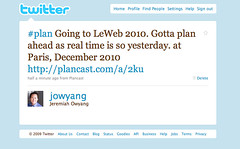
    I’ll be presenting at Europe’s largest tech conference, LeWeb next week.  My topic?  When Real-Time Isn’t Fast Enough: The Future Of the Web (I’ll publish slides, later).  In particular, with event planning features, like Facebook events, upcoming.org, we’re starting to see people make explicity public remarks on what they want to do, when, and with who.  Welcome plancast.com a startup by Mark Hendrickson formerly of Techcrunch who created this simple website that allows people to broadcast what they plan to do next using Twitter or Facebook.

    Web Strategy Matrix: Asynchronous, Real-Time, and Intention Web

    What It is, and Examples Opportunities Challenges
    Asynchronous Web Information exchanging between multiple sets of time. People publish, someone else reads later.  Examples: News sites, press releases, websites without social features. Information with longer term shelf life can be archived and consumed. Much of today’s information is related to real time events, people want to share their thoughts and experiences, this is quickly getting outdated as social features empower real time conversations appear, regardless.
    Real-Time Web Information published as it happens, often, content is consumed in real time, with the reader also broadcasting back, resulting in synchronous communication. Examples: Twitter, Jaiku, Facebook Status updates. Consumers can give instant feedback about their needs. Companies can respond to the immediate needs of customers. Excessive noise from everyone publishing their status. Companies unable to sort through noise, prioritize, and react. This problem to compound over time.
    Intention Web Information that provides explicit predictions of who will do what next, although it’s not happened yet.  Examples: Upcoming.org, Facebook events, Plancast. Update: Silicon Valley Insider writes about Tweetmeme, Topsy, Sency, OneRiot People can connect to each other, improving experience. Businesses can provide a more contextualized experience for customers or prospects using Social CRM Explicit intentions may not be true, the future is always uncertain. Companies can barely keep up with real time web –let alone predict the future.

    Intention Web Provides People and Companies Opportunities
    Some may call this the, anticipation web, intention web, or forward looking web, but regardless of the name, there are some unique opportunities:  1) People can now use their social relationships that have similar goals or events on their cal and improve their experience.  2) They can also identify who in their social circles are most likely going where, increasing their knowledge of top events.  3) This provides businesses with the ability to listen to provide highly contextualized offerings and experiences for those explicitly stating their intents. Once a listening strategy is developed, expect Social CRM to be in the foreground mining, organizing, and making this data actionable.

    Yet Barriers Will Challenge Consumers and Companies
    Yet the intent based web is also fraught with challenges for both people and companies.  1) Status updates are still getting traction.  Twitter has the media hype, but not yet the mainstream adoption, so you can’t expect the social behaviors of everyone to broadcast their future intents.  2) For those that do broadcast their intent, should be concerned about privacy and personal security.  3)  The future is always uncertain, a great degree of intention data will be inaccurate. 4) Most companies can’t even keep up with the asynchronous web, let alone the real-time web, and certainly not the intent based web.


    Screen shot 2009-12-04 at 5.42.12 AM
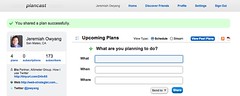
    Above: Plancast allows me to broadcast my goals which include, what, where, and when.

    Screen shot 2009-12-04 at 5.41.41 AM
    Above: My goals can now be published to Twitter, Facebook, or to my friends on Plancast.

    Screen shot 2009-12-04 at 7.10.05 AM
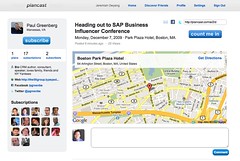
    Above: Community can subscribe to Paul Greenberg’s intentions, who’s set a goal to attend the upcoming SAP event.

    Bottom Line: Intention Web Will Provide Consumers With Contextualized Experiences
    Expect the real-time web to quickly evolve into the intention web. People will work together to share their information about what they plan to do, and improve how they work or organize. Expect Social CRM systems (Salesforce, SAP), Brand Monitoring vendors (Radian6, Visible Technologies), and Search Engines (Bing and Google) to quickly try to make predictive models on what could happen, and what are the chances. Businesses that have a physical location like retail, events, or packaged goods can use this data to anticipate consumer demand. They may offer contextualized marketing, or increase or decrease inventory or store hours to accommodate. Don’t be surprised in the future and you walk into a store with your preferred items, meal, or drink already nicely packaged for you.


  • Action Requested: Take the Web Strategy Survey

    Update: Edelman’s Jonny Bentwood comments on the survey results, which I provided to him.

    As the year winds down, I want to take a moment to breathe, recollect, and refocus on 2010.

    In an effort to continually improve, I’m launching a survey to find out more about you, what you find useful, and what can be improved for the web strategy blog.  Frequently, I’ve taken the community’s feedback to factor into blog designs, and have taken in feedback from a survey we conducted about this blog in May 2008 (read part 1, and 2, ).

    Although we’ll keep your name, email and other personal information private, I plan on sharing the high level findings (just as I did before), so we can collectively learn about the Web Strategy blog and the surrounding community.  I’ll also be sharing the anonymous data with some of the well known Analyst Relations bloggers, to get their take on it.  This survey is 20 questions, and should take hopefully less than 10 minutes to complete.  I really value your feedback, thanks.

    Action Requested: Please Take The Web Strategy Feedback Survey.  (Update: Thank you, this survey is now closed, with nearly 200 respondents, will publish data soon)


  • People on the Move in the Social Media Industry: Nov 24, 2009

    potm-banner-2

    In an effort to recognize the changes in the social media space, I’ve started this post series (see archives) to both track and congratulate folks who get promoted, move, or accept new exciting positions. Please help me congratulate the following folks:

    • Respected technology commentator and friend of mine, Louis Gray joins Paladin Advisors Group as the Managing Director of New Media. Louis is one of the leading voices in technology, and a fine human being, congrats.
    • Brian Ellefritz leaves Cisco and joins SAP as the Senior Director of Web 2.0 Marketing, I’ve worked with Brian on a handful of occasions and expect him to continue leading programs at technology corporations.
    • Stephanie Fuerniss is Capella’s new Managing Editor for Online Communities at Capella University.
    • Robert Stanke a new hire at Life Time Fitness Community Management & Social Media Strategist, in which he helps develop the growing community of Life Time Fitness members.
    • Kim Snedaker is now the Social Media Manager AAA Mid-Atlantic, a financial services company.
    • Angela Patterson joins Bridgestone Americas, Inc. as the Digital Media Coordinator, Corporate and Community Relations Dept. helping to rework the company’s social media strategy, and working across departments to implement it.

    How to connect with others (or get a job):
    Several people have been hired because of this blog post series, here’s how you can too:

    Submit an announcement
    If you know folks that are moving up in the social media industry, fill out this form.

    Seeking Social Media Professionals?
    If you’re seeking to connect with community advocates and community managers there are few resources

    This list, which started with just 8 names continues to grow as folks submit to it. List of Social Computing Strategists and Community Managers for Enterprise Corporations 2008 –Social Media Professionals.

    Job Resources in the Social Media and Web Industry

  • Web Strategy Jobs powered by Job o Matic (Post a job there and be seen by these blog readers, these affiliate fees pay for my hosting)
  • Read Write Web keeps announcements flowing at Jobwire, although is broader than just social media jobs
  • Facebook group for community manager group in Facebook
  • Jake McKee’s community portal for jobs
  • Chris Heuer’s Social Media Jobs
  • SimplyHired aggregates job listings, as does Indeed
  • ForumOne Jobs for Social Media and Community
  • Teresa has a few jobs, some around community
  • New Media hire has an extensive job database
  • Social Media Headhunter
  • Social media jobs
  • Jobs in social media
  • Altimeter Group’s list of social media consultants and agencies
  • Hiring? Leave a comment
    If you’re seeking candidates in the social media industry, many of them are within arms reach, feel free to leave a link to a job description (but not the whole job description, please)


  • Quicktake: Extend LinkedIn’s Community To Your Website

    I was briefed as an analyst by Adam Nash, LinkedIn’s Vice President, Search & Platform Products to learn about today’s announcement around opening their network as a platform.

    Announcement: Access LinkedIn Data From Other Locations Using The LinkedIn Platform
    Starting today, developers worldwide can integrate LinkedIn into their business applications and Web sites. They’ve announced that OAuth os now available at Developer.linkedin.com.  Like Facebook Connect, this means that any website or any web application can allow users to login from their LinkedIn account on a third party site, and even publish information back to their LinkedIn profile and network from that third party site.

    What It Means To Business:

    Connect the Affluent, Educated, and Active Community To Your Site
    The stats are obvious, they have a network of 52mm (a sixth of the size of Facebook’s 300mm+) engaged individuals that represent decision makers and those that aspire to be upwardly mobile in their career, view the stats page to learn more. In fact, over 51% earn more than $100k+ a year, and 23% earn more than $150K+ annually. Over 77% of community members have a college degree, making this an educated bunch, yet It’s not just about quality of community, their is an apparent degree of site activity, LinkedIn’s site rivals that of Forbes, and even the WSJ.com, according to Compete.

    Your Business Applications And Website Should Never Be “Alone”
    If your company is in B2B or trying to reach business professionals, chances are you have an application for them to use.  Now, as you launch them, you can quickly integrate with the LinkedIn platform, this way personal data is already populated.    This also goes for your corporate website, provide your users the ability to see which one of their LinkedIn contacts has been there, and encourage them to interact with your site and trigger messages back to their LinkedIn news page –fostering word of mouth.

    LinkedIn Data To Be Pervasive
    CIOs must wake up and realize the value of social networks, even last week, LinkedIn announced a partnership with Microsoft Oulook, extending it’s profile information to legacy email systems.  Data will get pre-populated, meaning your contacts can be viewable within the context of your existing emails, empowering you to know more about who you’re meeting even though you’ve never met.  We should expect in the future that existing Intranet networks will connect their LDAP to the LinkedIn profile.

    And yes, if you haven’t noticed yet, the speed on innovation on the social web is increasing at a rapid pace, things are happening faster than ever. To get a good sense of the evolution of LinkedIn, I’ve created this matrix which shows it’s evolution and some predictions of where things are to head.

    Web Strategy Matrix: Evolution of LinkedIn

    LinkedIn Evolution Example Status
    Destination Social Network LinkedIn is a destination social network, users to there, login and only communicate within the confines of the domain. Since it’s inception in 2003, this is how it’s been.
    Application Platform Allows third parties to build applications that sit on the LI domain and interact much like Facebook’s Platform In Oct 2008, A small hand-selected group of companies like Box were allowed to do this, it’s not currently rolled out to others.
    Portable Data Third party websites can allow users to login using LinkedIn identity, see which friends are also present, then spread information back to LinkedIn.com. This is today’s announcement, Nov 2009
    Personalized Experiences on Third Party Sites Third party websites can provide personalized content to first time users by recognizing their LinkedIn profile. Prediction: Mid 2010
    Social CRM LinkedIn partners with SalesForce, SAP, Oracle, Microsoft, to allow data in LinkedIn to quickly be exported to CRM systems. As customers have queries or support issues, the CRM systems will trigger notifications to brand managers. Prediction: Late 2010
    Augmented Reality Using mobile devices, users can quickly hold a device up a cell phone in front of a peer to see their LinkedIn data –without even having a conversation. Prediction: 2011


  • Social Technology Impacts Every Customer Touchpoint

    Forbes CMO Network, An Insightful Resource For Marketing Leaders
    I’m serving CMOs by teaming up with the Forbes as a regular contributor. My goal? To guide marketing leadership on how to leverage disruptive technologies and meet business goals.   At a more detailed level, this blog will continue to aim at providing nitty-gritty breakdowns, frameworks, and insights.  Use these two resources in tandem to both develop strategies, and then implement best practices across the organization.

    [Companies Must Develop A Holistic Strategy, As Social Technologies Impact Every Customer Touchpoint]


    Social Technologies are a Horizontal –Not A Vertical Approach
    It continues to amaze the market that such simple social technologies can impact the entire organization.  In fact, social technologies, at the core, allow people to connect to each other without a middle person in the way.  As a result, expect social technologies to impact every employee and customer touchpoint.   CMOs must prepare in their 2010 planning how to leverage social, not as a skunkworks but as a strategic shift in all communications.

    Three Resources to Use:

    1. Use the Forbes CMO article as a guide for your marketing leadership, pass along this article “CMOs: Consumers Are Connected. You Need To Be, Too”.
    2. Below, use the detailed matrix (and the links within them) for the strategists who need to plan out the actual programs.
    3. Leave a comment with other suggestions, and benefit from working with the very savvy Web Strategy community, who I learn from every single day (thank you).

    Web Strategy Matrix:  Social Technologies Impact Every Customer Touchpoint

    Medium Description and Examples Market Maturity Impacts To Brands
    Digital Advertising Facebook launched “Social Ads” that allow advertisements to appear based on your profile information and friends. Infantile As profiles become portable (like Facebook or Google connect) people can share their personal info for contextual experiences, expect advertising to improve CTRs as social data is added.  See how an interactive ad benefitted from my Facebook data.
    Search Marketing (Paid and SEO) For years, bloggers heavy linking and frequent content have scored high on SERP pages. Recently, Google and Microsoft partnered with Twitter, to offer “Social Search” which means users could received customized SERP based on their friends behaviors and preferences. Pre-Teen Social search will impact a prospects search results are impacted by their friends, this complicates the traditional search marketing strategy of simple keyword placement. Conversational marketing becomes a key factor in search strategy. Learn more about Social Search.
    Email Marketing Many email vendors like Responsys, ExactTarget, Constant Contact and Zeta Interactive provide simple ways to “share this” email with their friends on social networks. More advanced vendors are offering advanced monitoring, and innovative companies like Flowtown are using email addresses to identify a prospects social networks Infantile Email marketers can no longer be in broadcast mode, but must be prepared for emails to be shared with each other. Furthermore, they should seek how to influence content on the newsfeed in social networks like Facebook and LinkedIn.  Learn how email and social networks are interlaced.
    Web Campaigns/Microsites Traditional microsites now have social components from simple “Share this” features to viral videos and community dialog. On the extreme side, Skittles allowed the whole site to be taken over by consumers. Adult A marketing campaign today without social elements is asking to be ignored. To benefit from word of mouth, marketers know spurring a conversation will cause the campaign to spread.
    Corporate Site Corporate sites are integrating social features, From Community Platforms like Mzinga, Awareness, Pluck, Kickapps, Liveworld (client) they encourage customers to talk back. Young Adult Even if companies don’t want their website to be social, they can’t stop it. Google’s “SideWiki” product allows any webpage to be social using a browser plugin.
    Mobile, Location Based Location based social networks are quickly emerging among early adopters. Foursquare, Gowalla, and even Twitter are allowing people to share their location, time, and social context. Infantile Advertising and special offers becomes more targeted as brands can triangulate contextual information for consumers –but only if they desire to see it.
    Sales Efforts Ok, this isn’t a medium, nor the two listed below, but it impacts the scope of the CMO. Most marketers provide sales enablement resources, now these sales folks are armed with LinkedIn, Facebook, Twitter. In fact, many sales folks have had their digital rolodex in LinkedIn for years. Young Adult For savvy marketers, providing social marketing skill training to sales folks will provide them with best practices, and teach them to do more quicker. Those that do nothing run the risk of PR nightmares and even legal problems for the untrained department. Learn about social media policies.
    Support Efforts What happens in customer support now echos on the social web, from Dooce’s flare up with Maytag to Domino’s Employees snotting on Youtube.  Furthermore, customers self-support each other in forums, Facebook, and GetSatisfaction. Adult Marketers must provide a holistic experience to customers, as they don’t care what department you’re in.  Read more about Social Support.
    Product Development A handful of savvy companies like Dell, Starbucks, and Nokia are using social tools to improve the innovation process using tools from Salesforce ideas, Uservoice, or Getsatisfaction Infantile Customers want to innovate with brand, use these free resources to improve brand messaging, test new features, and to develop an army of advocates.  Learn how some companies have benefitted from co-innovation.
    Real World and Events Physical events are now impacted by social technologies, and even virtual events.  Attendees will connect to each other, comment about the event, and discuss if even after the event has concluded. Adult Event marketers must develop a strategy to encompass both pre, during, and post event to be successful.  Here’s a playbook to integrate social and events.

    Sharing This Content
    Occasionally, I get a few emails from people asking if they can use my blog posts in their presentations. Here’s my policy: You cannot package up this content and sell it without my permission. However, it is ok to use for educational purposes as long as you give me credit on the slide, mention it verbally, and link to my blog. Creative Commons defines this as: Creative Commons Attribution-Noncommercial-Share Alike 3.0 United States License. Love to hear your comments below, and how social impacts all digital channels.

    Thanks to Christine Tran, Altimeter Researcher for her editorial expertise on the Forbes piece.


  • Matrix: The Four Social Support Strategies

    At the Altimeter Group, I cover Customer Strategy, which encompasses not only marketing, but also support, expect our discussion to grow as social technologies impact the whole enterprise.

    The Social Support movement is afoot (see opportunities), and more companies will be connecting existing marketing and support systems with the social web. Many companies, like Comcast, Wells Fargo, Intel, BestBuy, JetBLue are responding to customers and in some cases, supporting them in near real time.

    The challenge is that these teams are unable to scale, even a support team of ten full time folks at Comcast will have a hard time responding to all customers in all social channels. As a result, expect companies to resort to scalable ways to respond to customers, such as:

    The Four Social Support Strategies

    1) Do Nothing: Use Legacy Support Channels
    Some companies will not respond to customers, it’s not in their culture, exposes them to risk, have specific legal or federal restrictions in place, or simply don’t get this space. In this case, these companies may only choose to support customers in their formal forms of support in 1800 numbers or on the official company websites

    2) Employee Based Support:  Employees Respond to Customers
    Many companies are assigning people in their support or product teams to respond to customers in the social web. The more conservative the company, the less people are officially able to support. Take for example financial services company Wells Fargo has a handful of “Social Concierges” that tweet on the @Ask_WellsFargo account, they set expectations around hours of service (insert banker’s hours joke here) and not to disclose account information. On the flip side, Best Buy encourages their thousands and thousands of “Blue Shirt” employees to respond using a Twitter CMS system that response from the official @Twelpforce account.

    3) Peer Based Support: Customer to Customer Other companies will approach this by encouraging their top customers to respond on their behalf. By creating online communities where customers can self-support each other using Q&A features like Salesforce “Answers”, or my Lithium’s unique Twitter alerting system that encourages advocates to respond to prospects.  (Lithium is an Altimeter Group client).  It’s not just on branded communities, many companies encourage support from third party sites such as Get Satisfaction, who centralizes support for all products.

    4) Automated Social Support: Computer Generated Tweets
    Social CRM systems are going to be intelligent, in fact, they’ll start to incorporate bot-like features you can find in web-based chat support, or the logic from interactive voice systems (IVR), and respond to customers. Support and product teams can already tweet from some CRM interfaces, so attaching an intelligence module will be the next step –it could even come from existing employee Twitter handles.

    Web Strategy Matrix:  The Four Social Support Strategies

    Benefit Downside
    Rely on Legacy Systems This keeps customers in the right process and funnel that the company is used to. Secondly, it doesn’t reinforce that customers should yell at their friends to get help from a company Missed opportunities: Angry customers could revolt starting a Groundswell, or leave an opportunity for competitors to swoop in and take dissatisfied customers.
    Employee to Customer Provides a personal touch to help and assist customers, builds relations and trust For large companies, this is not scalable, and will result in companies prioritizing responses to the most authoritative or most urgent. If rolled out to support in all social avenues, it can be costly.  Lastly, it teaches customers to yell at their friends to get support.
    Peer Based Support Companies can reduce costs by having customers self-support each other. Collectively, customers may often know more about the company’s products than the actual product team. Unfortunately, not all questions may get answered in a timely way, or answered correctly by staff who may have the inside details. Also, content in knowledge bases, wikis, forums, and Q&A features are often unstructured, messy, and hard to navigate.
    Automated Social Support Companies can quickly scale by responding to customers faster, and more accurately, using automated responses. Some customers may feel cheated if they find out they are talking to a bot, and it may be more difficult to build that personal relationship.


  • Breakdown: Lego’s “Digital Box”, an Augmented Reality Kiosk

    Augmented Reality provides brands with an engaging experience that merges both the digital and the real world. This 30 second video shows how a 3D animation on the product box enabled me to understand the assembled product.

    Lego’s “Digital Box” Provides Customers with an Interactive 3D Digital Experience
    This weekend, I went to the local Lego store here in Silicon Valley (Hillsdale) to see a practical version of Augmented Reality. I was previously briefed by Metaio, the technology vendor that empowers the software for the Augmented Reality kiosks called, Digital Box. This store, outfitted with a kiosk with a screen and webcam gives instructions on how to show the contents of any box assembled in real time.   Not all of the boxes were equipped (I tried the Star Wars line with no available) but was able to grab this lego kit of a bus, hold it in front of the kiosk.  You can see that the contents ‘assembled’ on the screen, and came to life as a pre-set animation, as I rotated the box, the virtual animation would move with it, giving the illusion that the bus was actually moving over the box.

    Breakdown: “Kiosk” Style Augmented Reality

    Description Accessing Augmented Reality experiences from a built in camera and screen at a physical location
    Market Maturity Embryonic, this market has physical and software barriers, as well as low consumer awareness and adoption.
    Vendors Metaio
    Requirements Kiosk, webcam, encoded experiences.
    Opportunities Increase customer engagement in store, increase intent to buy and reduce sales costs. An immediate opportunity is for retail, small business, tourism, and consumer packaged goods industries. Secondly, media, gaming, home and business design, and mobile industries should take note and investigate this space.
    Challenges Consumers have limited awareness to AR space, and are unaware of the kiosks. Interaction is clunky and requires practice, graphics are effective –but not refined
    Benefits Brands that deploy AR in 2010 will benefit from “cool” factor being an early adopter.
    Risks Expensive deployment to create animations, and put kiosks in all locations.
    Verdict Innovative, but a victim of ’shiny object’ syndrome as the business benefits aren’t directly indicated. Heavy overhead required to deploy hardware and software, as well as moderate learning curve for consumers. To truly become a mainstream channel, AR within stories should be accessed by mobile devices –not kiosks. Secondly, existing web content should be ‘linked’ to existing products that include additional videos, support, and consumer generated content. Brands that have complex consumer packaged goods should deploy in stores, or products that have an heavy education or support cost and can’t deploy in house sales or service folks.

    Augmented Reality Not Ready For Primetime –Yet Promises Real World Engagement
    The above matrix is just a breakdown of ‘Kiosk” style of Augmented reality, however let’s look at this space as a whole. This technology is in its infancy, the animations are still simple, don’t have a lot of interaction beyond rotation, and require moderate ability to line the product up directly with the web cam. Furthermore, there are barriers to entry as most people didn’t even know about this feature in the store till I showed them, and not every product was outfitted with the ability to display the interactions.

    Despite the fact that this is an emerging technology with years ’till maturity, there are three major business opportunities:

    1. Extending the web to the real world. Reusing existing digital marketing and support content (from the web) in the physical world will add mileage to marketing assets.  Consumers can access related existing content such as brochure facts, customer reviews, or web based demos that already exist wherever they are, without looking for a URL.  The camera lens will identify the product, then serve up the context information with a click of a button.
    2. Greasing marketing and sales process. Creating an engaging experience with customers near point of sale reducing sales costs through sales aids or increasing interest. Animations and virtual experiences can be connected with any device from anywhere, triggering demos, how-to videos, or even 3D media that would entice a prospect to spend more time, or purchase the product.   Essentially, this means a virtual sales person or guide could assist any consumer from anywhere at anytime.
    3. Ubiquitous information with mobile devices. Aside from kiosks in stores, we should eventually expect mobile devices to be equipped with the capability to instantly bring up internet information about any product in real-time.  Expect Google to develop a product that maps physical products with their online information, making them yet the middleman for internet advertising –again. Furthermore, it gets really interesting when a brand can ‘hijack’ another company’s brand by creating augmented reality experiences on the boxes of their competitors.


  • Personal Goals and #OperationBluewater

    Most people miss out on life because they don’t have a strategy around personal goals.

    Most Lack a Personal Goal Strategy
    Let me lay out some the observations I’ve noticed from some of the smartest folks I’ve watched achieve success in their lives.  Often they first tell me about the challenges, that most people don’t even have a personal goal strategy.  1) Most people don’t even have personal goals, seriously try it,  ask folks you work with: “What’s your personal goal?”   2) Most people think the end goal is a at 65 and do all their planning in anticipation of retiring a glorious life after doing 45 years in a desk job.  3) People confuse personal goals with personal first downs.  In football, A first-down is an incremental improvement (10 yards) but not the final goal.  Some examples of first-downs are  to finish a project, get a raise at work, lose 5 pounds, or to put money in their 401k account –all short term tasks but not addressing what they really would do if they were freed in life.  4) Most people keep their personal goals private and to themselves.  Afraid of rejection, or wanting to keep it private they write their idea down in the back of their minds, hoping it’ll someday get accomplished.

    Develop A Personal Goal Plan
    Now that I’ve outlined some of the challenges, let’s focus on the guidelines.

    1. Actually have a personal goal. This is the most difficult one, although this requires some soul-searching think about the following questions:  ”What would you do if you were able to retire right now?”   or  ”What would you do if you were able to stop working because you’d be independentatly wealthy”.
    2. Weave this goal into your life. Rather than waiting for 65 to achieve this goal, start weaving it into your life right now.  Make it your job, your career, your mission.  Do real research and write a blog about the topic, start to speak about it, people will see you as someone focused on it, which will fuel your path to the this goal.
    3. Work backwards. Setting the goal is easy, but then layout the steps you’ll need to achieve in order to get there, I try to lay out 10 steps, and I can obviously see the first few steps and the last few steps, yet it’s dizzying filling out the in-between steps.
    4. Tell everyone. Rather than keep your personal goals secret use your online and offline social networks to help people achieve your goals.  You’ll be surprised at people who have similar goals, or want to make that their goal and will join you.   Your network of friends will help you fill in the middle or ending steps that you might have been unable to see.

    My Personal Goal: Operation Bluewater, 30 days in Hawaii, Net Positive
    For what it’s worth, I’m going through this as I focus on #OperationBluewater: To spend 30 days in Hawaii net positive (I’m not paying to be there) a year, which I briefly outlined a few weeks ago.

    Retirement, why wait now?  weave it into my career now, and work from the beach.  I blogged before how I love the tropics, the beautiful beaches, warm humid air, pink skies, Japanese food, and kind souls .  It’s a mere 5 hours plane ride for me from SF, and half way to Asia, and while it feels like another place, the creature comforts I’m used to are all accessible.  Rather than waiting till I’m 65 to retire there, I’m going to slowly relocate, up to 30 days at a time and maybe increase the duration over time.   So far, my plan is on track, and I’m following the guidelines above.

    So how is it going? A few weeks ago I was at RetThink at Hawaii and was able to meet locals and those that loved being at the islands, I told anyone who would listen about my goals, and they were supportive.  Lately, it’s started to take on a life of it’s own, more people are talking about #OperationBluewater (see Twitter stream), and want it to be a personal goal of their own, and Christine Lu, Chris NobleEric Nakagawa are starting to talk about ways to make this happen.   Often people are coming up to me and saying “I support your goal of #OperationBluewater” which I translate as “I want to do it too, let’s do it together”, great let’s do it.  So there it is,  I’m putting my personal goals out there, let’s see if my goal can grow into a larger movement.

    I wish you success on your own #OperationBluewater, I hope these guidelines helped.  Please share with others about your goals, or methods in which you achieve them in your life.

    Photos from the last visit to Oahu two weeks ago
    Waikiki Afternoon
    East OahuShadePalms on Waikiki
    SalvationVintage Truck In Haleiwa, HIDiamond Head at SunriseQuietness


  • Is Your Company Trusted or Do You Have a Digital Comb Over?

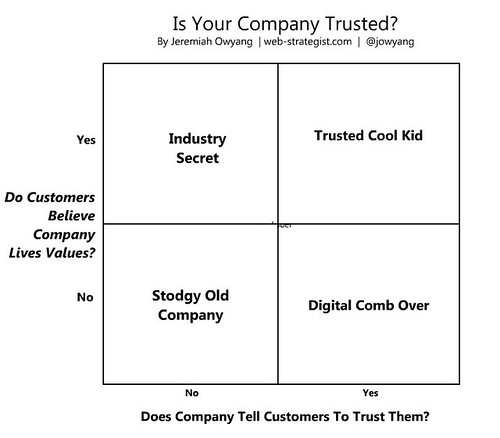
    Is Your Company Trusted?

    Many companies are entering the social/green/community space, with hopes of impressing customers, yet despite their best intentions, they could come across as inauthentic, and be damaging their own brand.  Companies should first take a self-assessment of their brand to see if they’re ready before they decide to enter the social space.

    Companies should first assess their culture and ask:

    • Is the company ready to talk about the good –and bad– with the market?
    • Is the internal culture ready to embrace customers on their own terms?
    • Is the culture ready to make changes based on the request of customers?

    Launching a corporate blog is easy, a Twitter account even easier, yet if companies culture doesn’t match the values they’re telling the market, they risk brand damage through reduced credibility. You’re not fooling anyone.


  • Evolution: The Eight Stages Of Listening

    As Social Customers Become More Empowered, Organizations Must Have A Listening Strategy
    As we approach 2010 planning companies need a strategy around listening. Sadly, most companies, and their agency partners don’t know why to listen or how. As a result, they must identify which stage of listening they are at, and then set a goal on which stage they see to aspire in 2010. I originally published this matrix for client workshops and a keynote presentation on developing listening and advocacy programs, and I’m going to continue to share more and blow-out each of my slides.

    Web Strategy Matrix: The Eight Stages Of Listening

    Stage Description Resources Needed Impacts
    1) No objective at all Organization has a listening program but has no goals, nor uses the information for anything resourceful Simple alerting tools, like Google Alerts and feedreaders will suffice. At the basic level, simple self-awareness.  Yet without any action from the data, this is useless.
    2) Tracking of brand mentions Like traditional “clip reports” of media relations, companies now track mentions in the social space.  Despite tracking there is no guidance on what to do next. Listening platform with report capability based on brand or product keywords.  Radian 6, Visible Technologies, Techrigy/Alterian, Buzzmetrics and Cymfony, Dow Jones are providers. Improved self-awareness to track volume of information, yet unable to track depth, and tonality of conversations.  As a result, not a full understanding of opportunities.
    3) Identifying market risks and opportunities This proactive process involves seeking out discussions online that may result in identifying flare-ups, or possible prospect opportunities. In addition to a listening platform staff must actively seek out discussions and signal to internal teams.  Alerting tools, and listening platforms are required. Organization can reduce risk of flare ups before they become mainstream, identify prospects and poach unhappy competitors customers.
    4) Improving campaign efficiency Rather than just measure a marketing effort after it’s occurred, using tools to gauge during in-flight behavior yields real-time marketing efficiency. Dedicated resource to manage reactions, activity, and sentiment to a marketing effort, and the resources to make course corrections nearly real-time.  Traditional web analytics tools like Omniture, Webtrends and Google Analytics are common. Campaigns can be more effective, as hot spots are bolstered, and dead spots are diminished.
    5) Measuring customer satisfaction In addition to customer satisfaction scores,organizations can measure real-time sentiment as customers interact. Sysomos and Backtype have focus areas into this space. Customer experience professionals will have to extend their scope to the social web, using a listening platform and sentiment analysis.  Insight platforms like Communispace and Passenger offer online focus groups solutions. Brands can now measure impacts of real time satisfaction or frustration during the actual phases of customer interaction.  Then identify areas of improvement during customer lifecycle
    6) Responding to customer inquiry This proactive response finds customers where they are (fish where fish are) in order to answer questions.  Example: Comcastcares account on Twitter asks customers if they need help –then may respond. An active customer advocacy team that’s empowered, training, and ready to make real-time responses nearly around the clock. Customers will fill a greater sense of satisfaction, yet this teaches customers to ‘yell in public’ to get a response.
    7) Better understand customers Evolving the classic market research function, brands can improve their customer profiles and personas by adding social information to them. Social CRM systems are quickly emerging that tie together a customer record and their online behavior, locations, and preferences. Salesforce, SAP, both have partnerships with Twitter to synch data The opportunity to not only serve customers in their natural mediums, but to offer them a richer experience regardless of their customer touchpoints.
    8. Being proactive and anticipating customers Minority Report: This most sophisticated form actually anticipates what customers will say or do before they’ve done it.  By looking at previous patterns of historical data, companies can put in place the right resources to guide prospects and customers. An advanced customer database, with a predictive application put in place, as well as a proactive team to reach out to customers before an incident has happened.  Haven’t seen any such application yet. Identifying prospects and engaging them before competitors can yield a larger marketing funnel, or reducing customer frustration as problems are fixed before they happen.


    Exercise: Self-Assess Culture, Roles, Process, Data, and Tools

    Use this matrix to initiate a discussion within your company on which stage you’re at, then put a plan in place to grow to the next level. Do note, depending on size and complexity of the organization, different groups may be in more than one phase. First, identify the characteristics your company currently has, then define which phase you’re in:

    1. Does the organization have the right culture setup that’s ready to listen?
    2. Is the organization prepared to react to customer opinions? how about in real time?
    3. Are the processes in place to triage information to the right teams? How about during a real-time crises on a Saturday morning?
    4. Are the right roles in place to listen? Are proactive marketing and support teams trained, empowered, and ready to respond?
    5. Is there a single repository of customer information or is it currently fragmented around the enterprise
    6. Lastly, what technology platforms are in place to facilitate this strategy? ? Hint: choose this last –not first.

    For Dialog: Which Stage Are Companies At?
    Curious to hear your professional opinions, what stage do most companies think they’re at?  In reality, what stage are they truly acting at?

    Translations
    Please translate into other languages, I’ll be happy to link back to you

    Thanks to the team at Foreplay, a digital agency, making the slides available in English.


  • Two Approaches: Shotgun vs Laser

    Companies approach social in one of two ways: The first way, companies experiment with little order or goals, the second way, companies have clear goals and intend to invest in a deeper relationship.

    1) Shotgun: Toyota’s Yaris Campaign Spreads Chances
    While experimentation is always important, companies must do so in the context of a goal, whether it’s to test and learn, or just to prove to management it can be done. Take for example Toyota’s latest campaign, which is much akin to interactive marketing or advertising (not social engagement), where they’ve funded eight agencies to spend $15,000 only on their social marketing campaigns. The goal is to see who can make it work and stick, then they’ll spend more money with the firm that achieves ‘viral’ growth. This shotgun approach has caught the criticism of Laurel Papworth, she’s right at vegas, this is called spreading your bets on the roulette table.

    2) Laser: Ford’s Fiesta Movement Amplifies a Smaller Target
    On the other hand, take for example the competitive car, the Ford Fiesta, which also plays the young hip efficient car for today’s youth. Ford’s approach was more focused, they put most of their eggs into reaching only 100 drivers that were social savvy influencers to get them to spread the word. This “Fiesta Movement” (NYT) was targeted at social influencers, empowered them although it’s unknown what the final impacts of the expensive loaner car program is.

    Web Strategy Matrix: Social Marketing Approaches, Shotgun vs Laser

    Shotgun Laser
    Description Hiring multiple agencies to conduct social campaigns Building a deeper relationship with a core group of influencers
    Similar to Interactive Advertising, “Fishing” Influencer Relations, ‘Friending”
    Benefits Efficient way to get started, identify hot spots to pursue. Deeper relationships with core influencers who may spread word of mouth, and become brand evangelists.
    Risks Brand burnout on community, risk of appearing disingenuous Spending more resources on a smaller few reduces chances of spread.
    Costs Inexpensive. In this case, it was 15k X 8 agenices, for a total of 120k. Costly. Relationship marketing estimated 50-100k in agency costs. Loaning 100 economy cars at 15k each around 1.5 million.
    Takeaway Ideal for the company that doesn’t understand social marketing and is willing to test on their own customers. Ideal for company that’s ready to invest time, people and money on relationships.


    Brands Should First Start With Understanding Customers

    So which way is better? First, let’s start with the most important factor, people. While padding the top line for revenues in a slumping economy continues to be important, it’s important to note that burning out your relationships with your community can cause long-term drain. Rather than test eight campaigns on a community causing ‘brand overload’, first do the research to find out the social behaviors (we call this SocialGraphics), identify who they trust online, and where they are located at online before doing anything. By first starting with data, you can reduce eight campaigns to two, or maybe one, and avoid burning out your brand –and community.

    So what does this means to Toyota and Ford?  Toyota’s social efforts come across as young, they’re not sure what they’re doing so they’re hoping to see which (interactive+advertising) agency will figure it out for them.  On the other hand, Ford comes across as slightly more mature as having true influencer relationships (Similar to PR Influence Relations) and spend the time to build these real-world relationships.

    Update: Thanks to Barbara for the “Fishing vs Friending” analogy.  Apparently the CEO of Ford read this post, welcome, an honor.


  • Insights for CMOs: I’m Writing A Column For Forbes

    Good For BusinessI’m very thankful that Forbes has extended me an offer to be a regular contributor discussing emerging technologies for the evolving customer strategy.

    CMOs are hungry for information. The information landscape is in flux, consumers are more empowered as they assert control using social technologies. Additionally, things are moving faster, as mobile devices and microblogging makes real-time responses from companies not fast enough.  As a result, they are thirsty for what’s next, and how they can get ahead of the curve –with minimal risk.

    This regular monthly (or more) column on the Forbes CMO network (@ForbesCMO) isn’t reporting, but instead will marry industry level insight and provide pragmatic advice. After I post industry insights at Forbes, I’ll also cross-post or point to it from the Web Strategy blog so you don’t miss out on anything.

    View my contributions on the Forbes Network

    Having met many of the CMO and marketing leaders at a recent Forbes event, they are certainly more sophisticated in their understanding (my first piece at Forbes) of new technologies and are ready to understand, trial, and adopt new methods. While we know that ’social marketing’ is the hot topic for senior marketers especially during a recession, I’ll be pushing the thinking as I explore location based social networks and mobile technologies –all in support of improving the customer relationship.  I’m thankful for the opportunity to advance the industry, and hope to be a guide to marketing leaders who want to benefit from new technologies.

    Now, to hear your opinions. As we continue to connect with marketing leaders and CMOs around the globe, I need your help what do you think they should know about emerging technologies. If you could speak to CMOs, what would you tell them? I’d love to hear your thoughts.