Author: Jim White

  • Actions Instead of Rhetoric in Nuclear Nonproliferation

    A Chilean official loads the fresh highly enriched uranium into the special transport container. (photo: NNSA News via Flickr)

    In a remarkable story in Sunday’s Washington Post, we learn that the US National Nuclear Security Administration had just packed up a bit less than 40 pounds of highly enriched uranium, which is enough to make a bomb, in Chile when the magnitude 8.8 earthquake struck that country on February 27. As expected, the shipping containers holding the material were not breached in the earthquake, and after a few minor adjustments to the shipping plan, the materials were safely shipped and arrived in the US in late March.

    The Post article informs us that this action was taken under the Nunn-Lugar program, which was funded by Congress in 1991 to provide billions in funding to secure nuclear weapons and weapons-grade material from the former Soviet Union and other countries. The website for the Nunn-Lugar program informs us that it has been responsible for the deactivation of almost 6000 nuclear warheads. The Post article tells of the most recent successes:

    In the early 1990s, the collapse of the Soviet Union gave rise to worries about hundreds of tons of weapons-grade uranium and plutonium left spread across 11 time zones, as well as questions about the security and storage of nuclear materials from weapons being withdrawn and disassembled.

    Today, the focus is on smaller but still dangerous quantities of nuclear material, often nestled in research reactors well beyond the former Soviet Union. In the past year, the United States has cleaned out highly enriched uranium from Romania, Taiwan, Libya, Turkey and Chile. Bieniawski said 18 countries have been swept free of highly enriched uranium.

    The upcoming summit in Washington is aimed at further progress:

    At a summit in Washington on Monday and Tuesday, President Obama will press leaders or other representatives of 46 countries to accelerate such efforts and fulfill his pledge to lock up all the vulnerable material within four years.

    It’s so refreshing to see actual progress in making the world a safer place. With the increased rhetoric aimed at sanctions on Iran, which is still far short of weapons-grade enrichment (they have boasted 20% enrichment, although it is likely more like 5-10%, and over 90% is required for weapons), this report of actual success in removing already existing weapons-grade material to safe storage is documentation of tangible progress.

    When this information is coupled with the signing of the new strategic arms limitation treaty with Russia (pdf) and the nuclear posture review, we see that the Obama administration seems to be moving in the right direction on the issue of arms reduction.

    Lest we get too happy about this situation, though, we should keep in mind that the general effort toward seeking out and removing weapons of mass destruction was dealt a huge blow when Vice President Cheney outed Valerie Plame’s CIA identity, since she led a covert group working in WMD anti-proliferation. Also, I note on the Nunn-Lugar website this discouraging bit:

    For a private citizen, the best way to support NUNN-LUGAR is to make sure that the money, authorized by the United States Congress for such an important task, is being spent efficiently. Unfortunately, Defense Enterprise Fund (“DEF”), a Program funded with NUNN-LUGAR money, fell victim to gross mismanagement, and the US government’s investigation of DEF has been, at best, half-hearted.

    The documents related to the continuing DEF investigation are found on this website. It is our belief that those who mismanage the funds that were supposed to be used to enhance the security of the world should be held accountable.

    Blatantly stealing a tactic from Marcy Wheeler at Emptywheel, I’d like to invite readers to consider this to be a working thread in which we can read the posted documents together and work toward further exposure of the mismanagement. Sadly, even though there may well be documentation of “gross mismanagement”, I don’t expect much cooperation from the Obama administration in looking back on these crimes, just as they won’t look back on torture or illegal wiretapping.

  • Official Joint Chiefs Policy for Long-Term Detention and Interrogation of Civilians

    An article posted Friday on the website for The Times of London points out that Col. Lawrence Wilkerson, former Chief of Staff to Secretary of State Colin Powell, has submitted a sworn statement confirming that President George W. Bush, Vice President Dick Cheney and Secretary of Defense Donald Rumsfeld all knew that innocent civilians were detained at Guantanamo:

    George W. Bush, Dick Cheney and Donald Rumsfeld covered up that hundreds of innocent men were sent to the Guantánamo Bay prison camp because they feared that releasing them would harm the push for war in Iraq and the broader War on Terror, according to a new document obtained by The Times.

    The accusations were made by Lawrence Wilkerson, a top aide to Colin Powell, the former Republican Secretary of State, in a signed declaration to support a lawsuit filed by a Guantánamo detainee. It is the first time that such allegations have been made by a senior member of the Bush Administration.

    Colonel Wilkerson, who was General Powell’s chief of staff when he ran the State Department, was most critical of Mr Cheney and Mr Rumsfeld. He claimed that the former Vice-President and Defence Secretary knew that the majority of the initial 742 detainees sent to Guantánamo in 2002 were innocent but believed that it was “politically impossible to release them”.

    While doing background research and reading that was inspired by this post and the ensuing comment thread at Emptywheel, I ran across a document that I believe outlines the Joint Chiefs policy that was cobbled together to justify the long term detention and interrogation of innocent civilians that was described in the Times article.

    The publication, which is a 298 page pdf file, can be found here. The document is titled “Joint and National Intelligence Support to Military Operations”. I have not read the entire document, but my attention was directed to Appendix G through my initial Google internet search on the term “mobile detainee review and screening teams”. Appendix G is titled “Joint Exploitation Centers” and has this graphic at the beginning:

    joint exploitation centers

    Moving down to section 4 of this appendix, titled “Joint Interrogation and Debriefing Center” we find the description of the responsibilities of the centers…

    b. Responsibilities. Service component interrogators collect tactical intelligence from EPWs and ECs based on joint force J-2 criteria. EPWs (i.e., senior level EPWs) and ECs are screened by the components; those of further intelligence potential are identified and processed for follow-on interrogation and debriefing by the JIDC to satisfy theater strategic and operational requirements. In addition to EPW and ECs, the JIDC may also interrogate civilian detainees, and debrief refugees as well as other nonprisoner sources for operational and strategic information. The JIDC may identify individuals as possessing intelligence of national strategic significance; these persons may be relocated to a strategic exploitation center for longer-term interrogation.

    Acronyms present here: EPW = enemy prisoner of war; EC = enemy combatant; J-2 = intelligence directorate of a joint staff; JIDC = joint interrogation and debriefing center.

    There is a lot packed into this small paragraph. We start with normal interrogation and debriefing of enemy prisoners of war and enemy combatants, but somehow these same joint interrogation and debriefing centers are supplied with civilian detainees and even refugees [don’t refugees have special, protected status under the Geneva Conventions?] to interview, and then, somehow, from among these various groups interviewed, the JIDC “may identify individuals” who are sent for longer term interrogation (i.e. to Guantanamo) if the JIDC decides that they posses “intelligence of national strategic significance”. There seems to be no restriction that the long-term detainees only come from the EPW or EC groups, so innocent civilians could end up in Guantanamo under this policy, just as Wilkerson has documented.

    The policy outlined in the document is official, as we see in the preface that “The guidance in this publication is authoritative”. The preface also notes that the document is a revision of 1996 and 1998 documents, so it appears that this policy document is another example of Bush-era “after the fact” justification/documentation providing official policy to authorize crimes already committed.

  • Another Move in the Afghan Prison Shell Games: Certificates!

    Shuffling the detainees from one shell to another with a desktop-produced certificate (photo: ISAF Media via Flickr)

    In my most recent post on the shell games being employed by the United States in its attempt to deflect responsibility away from General Stanley McChrystal for his practice of widespread detention and abuse of innocent civilians as a central feature of his COIN strategy, I obtained a clear statement from a spokesman from US Central Command that McChrystal does maintain command authority over Joint Task Force 435, the unit headed by Vice Admiral Robert Harward that is tasked with responsibility for Afghan prisons, despite press reports that created the impression he did not have such command authority. Today, while scanning the most recent photos uploaded to Flickr from the ISAFMedia stream, I found a very interesting photo (at right).

    Here, in full, is the caption that was provided for the photo:

    CAMP DARULAMAN, Afghanistan – Brig. Gen. Saffiullah, Afghan National Army Military Police Brigade commander, holds a certificate presented by Vice Adm. Robert Harward, Joint Task Force 435 commander. The certificate was presented during a ceremony here April 5 in front of an ANA Military Police brigade. The brigade will complete the extensive training program prior to their assumption of detention facility security operations at the Detention Facility in Parwan. The brigade already conducts detention and corrections operations at the Afghan National Detention Facility in Pol-e-Charkhi. The event was another step toward the transition of the detention facility from the United States to the Afghan government. (Photo by U.S. Air Force 1st Lt. Joost Verduyn)

    So it appears that the shell game has progressed to one prison already being handed over to Afghan control. With Saffiullah now in possession of his full color Military Police Training Certificate, he and his brigade are nearly ready to take over control of another prison. Somehow, I doubt that these changes will result in any improvements in the process for Afghan citizens who have been detained to obtain a hearing on whether they were properly arrested.

  • Afghanistan Civilian Death Story Just Latest Example of McChrystal’s Deception

    President Obama and Stanley McChrystal discussing Afghanistan strategy last May (Official White House photo by Pete Souza)

    By now, since the New York Times is grudgingly going along with Jerome Starkey’s blockbuster reporting on US Special Operations Forces murdering pregnant Afghan women and manipulating the evidence in an attempt to hide their crimes, it should be painfully obvious to even the most disinterested observer that US forces, and especially US Special Forces, engaged in deception on this case. What I want to point out in this post is that the deception employed here is not a rare, unexpected development, but is instead a designed feature of how our Joint Special Operations Command forces operate under the command of General Stanley McChrystal. Although McChrystal is no longer head of JSOC after assuming command of all forces in Afghanistan, I consider JSOC still to be under his control since his hand-picked aide, William McRaven, is now in command.

    Consider the deceptions we can lay unequivocally at McChrystal’s feet. In this article in The Nation, we find evidence that McChrystal played a large role in the coverup of the Pat Tillman death and that he played a personal role in the hiding of Camp NAMA (a secret prison site in Iraq) from the International Committee of the Red Cross.

    Another deception that is still being investigated relates to the “suicides” at Guantanamo in 2006. Scott Horton pointed out that the secret Camp No at Guantanamo could well have been under JSOC control. The head of JSOC at that time was Stanley McChrystal. Of special relevance is the report that the throats of the prisoners were missing when their bodies were sent to the families for burial. That seems awfully similar to the action of digging bullets out of bodies with knives. In both cases, bodies were cut up to remove incriminating evidence.

    Deception flows easily from JSOC because deception is one of its tasks. . . . Here is Senate testimony from 2003 from Lieutenant General Bryan D. Brown:

    Information operations and information warfare will likely play an increasing role in 21st Century warfare. What role do you envision for U.S. SOCOM in overall U.S. information operations?

    Special operations forces are very aware of the significant role Information Operations (IO) plays in today’s and in future conflicts. In fact, USSOCOM made IO one of the command’s core tasks in 1996. USSOCOM units have successfully employed IO core capabilities in both OEF and OIF, and IO continues to be embedded throughout SOF operations. However, USSOCOM continues to play a very significant role in PSYOP. As you know, USSOCOM owns the preponderance of the Department’s PSYOP forces and capabilities, including the EC-130 Commando Solo radio and TV broadcast aircraft. Due to the high demand for PSYOP forces, USSOCOM is in the process of growing its PSYOP force structure by adding two active duty regional companies and four reserve component tactical companies. This year the command also proposed an Advanced Technologies Concept Demonstration (ACTD) aimed at improving PSYOP planning tools and long range dissemination into denied hostile areas. In addition, USSOCOM is creating a 70 person Joint PSYOP Support Element, to provide dedicated joint PSYOP planning expertise to the Geographic Combatant Commanders, Strategic Command, and the Secretary of Defense.

    Under what circumstances would the Commander, U.S. SOCOM, conduct information operations as a supported combatant commander?

    USSOCOM became the lead for the war on terrorism IO planning after September 11th, 2001. In this new capacity, USSOCOM leads collaborative planning, coordination, and when directed, execution of IO. USSOCOM envisions IO supporting surgical, limited duration, counterterrorism missions, as well as, long range planning to develop coordinated, trans-regional strategies against terrorists and their supporters. Due to Strategic Command’s new Unified Command Plan responsibilities in regard to global IO, USSOCOM is working very closely with Strategic Command to insure mutual IO and PSYOP support and continuity.

    Remember the recent news about Michael Furlong going a bit overboard on hiring contractors for Information Operations? Here is an interesting snippet from the Washington Post coverage:

    Based in Lackland Air Force Base, Tex., the Joint Information Operations Warfare Center is the 435-person lead unit that “plans, integrates and synchronizes information operations in direct support of joint forces commanders . . . across the Defense Department,” according its mission statement. Those operations may include “psychological operations . . . and military deception,” according to a 2006 publication from the office of the Joint Chiefs of Staff. Because senior military officers have had little experience in those areas, they frequently have relied on private contractors.

    After a bit of digging, I found an excerpt from that 2006 Joint Chiefs publication on military deception. What I find interesting in the excerpt is this bit:

    The functions of MILDEC include:

    a. Causing ambiguity, confusion, or misunderstanding in adversary perceptions of friendly critical information, which may include: unit identities, locations, movements, dispositions, weaknesses, capabilities, strengths, supply status, and intentions.

    Was a deception operation put in place to cover the murders of the pregnant Afghan women? Could it have been justified on the basis that admitting the incorrect targeting of this innocent household would reveal a weakness in intelligence gathering for JSOC?

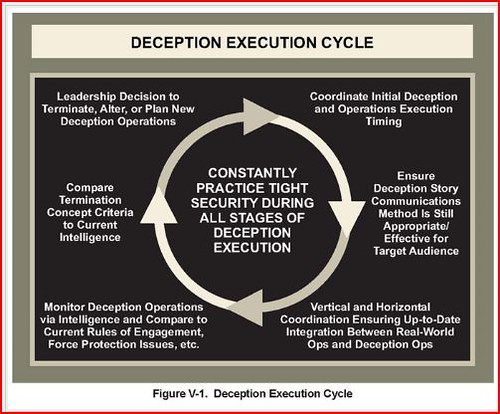
    The excerpt of the document even has this illustration of how deception operations are meant to operate:

    deception operation

    Glenn Greenwald documented today the creation and dissemination of the false story of the murders of the Afghan women. I find Glenn’s description to match pretty closely the deception process described in the illustration. Without Jerome Starkey piercing the veil of deception, the operation most likely would have worked.

  • Welcome to the Era of Pre-Justice

    Justitia (sculpture by Nicholas Mayer, photo via Wikimedia)

    The statue in the photograph at right is one of the more common images evoked for many people when considering the concept of justice. Here is one of the more succinct interpretations of the sculpture:

    The author of this sculpture, named “Scales of Justice”, is Nicolas Mayer, a French sculptor of the XIX century. It is a symbolic representation of Justice.

    * The scales symbolize the objective consideration towards the arguments given by the parties to a dispute.
    * The blindfold is the symbol to the impartiality at the moment to practice justice.
    * The sword indicates justice’s coercion capacity to impose the decision it takes.

    Ancient concepts of justice and its embodiment have varied:

    A common representation of Justice is a blind-folded woman holding a set of scales. The origin of the Goddess of Justice goes back to antiquity. She was referred to as Ma’at by the ancient Egyptians and was often depicted carrying a sword with an ostrich feather in her hair (but no scales) to symbolize truth and justice. The term magistrate is derived from Ma’at because she assisted Osiris in the judgment of the dead by weighing their hearts. [1]

    To the ancient Greeks she was known as Themis, originally the organizer of the “communal affairs of humans, particularly assemblies.” [2] Her ability to foresee the future enabled her to become one of the oracles at Delphi, which in turn led to her establishment as the goddess of divine justice. Classical representations of Themis did not show her blindfolded (because of her talent for prophecy, she had no need to be blinded) nor was she holding a sword (because she represented common consent, not coercion). [3]

    The Roman goddess of justice was called Justitia and was often portrayed as evenly balancing both scales and a sword and wearing a blindfold. She was sometimes portrayed holding the fasces (a bundle of rods around an ax symbolizing judicial authority) in one hand and a flame in the other (symbolizing truth). [4]

    Throughout the 19th and 20th centuries, the idealized image of American justice fit well with Mayer’s sculpture of Justitia. There was an effort at impartiality (although convictions in practice were strongly tilted against minorities and the poor) and reliance on evidence, while the power of the state was used to enforce the decisions.

    In the late 20th century, there was a drifting toward nominations to the bench taking political leanings into consideration. This process has intensified in the 21st century and has metastasized into other aspects of the justice system. The Department of Justice was politicized in many ways under George W. Bush, as poorly trained, fundamentalist Christian attorneys were seeded heavily into career positions. In addition, US Attorneys who would not sufficiently politicize their prosecutions were removed in favor of those who would. The Office of Legal Counsel was turned from the executive branch’s legal research resource into a rubber stamp authorization source for any abuse and a “get out of jail free” card for illegality. The Attorney General became the President’s personal attorney and David Margolis elevated his role as the final white-washer of any internal findings of wrong-doing.

    Sadly, these miscarriages of justice have not been reversed under Obama, and any attempts at doing so are met with fierce resistance. The Obama Justice Department has been told in no uncertain terms that it is to “look forward, not back” with regard to known acts of torture designed and authorized at the highest levels of the Bush administration along with other known illegal acts such as warrantless wiretapping. Concepts such as the proper venue for trying suspects and the indefinite detention of suspects without charges are now seen as properly decided through political deal-making debated openly in the press as an intentional bypassing of the judicial branch of government by a coalition of the executive and legislative branches.

    So now we are at the era of Pre-Justice. This is different from pre-crime as depicted in Minority Report, where people are arrested in advance of crimes they have been predicted to commit. With Pre-Justice, the crimes already have been committed, but the question of being judged can no longer be left to an impartial court guided by the rule of law and the evidence which is available. Instead, those at the upper levels of the executive and legislative branches of the government come together to decide whether a sentence will be imposed and what that sentence will be. For those who have committed crimes on behalf of these new supreme rulers (or those committed by the rulers themselves), no charges are to be filed and no punishment is to be allowed. For those who have been deemed guilty by the supreme rulers and detained solely on their word, punishment is to be doled out through the venue most likely to achieve conviction. For those who it turns out were improperly detained and who have committed no crime, they are to be detained indefinitely without charges, because the supreme rulers deem them too dangerous to release (okay, this bit does border on pre-crime).

    Justice in 21st century America no longer resembles the sculpture of Justitia above. Now, her blindfold has been removed and the thumbs of the exectuvie and legislative branches of government are on the pans of the balance. The balance is now held low and the sword is held high to threaten those who would question the wisdom of the supreme rulers.

    Oh, and what’s another word for Pre-Justice? That would be prejudice.

    Tags: , ,

  • Most Likely Source of Silicon in Anthrax Attack Spores Argues Against Production by Ivins

    The flask claimed as the source of anthrax

    In “Silicon Analysis of Anthrax Attack Spores: New Answers Leave More Questions Unanswered“, I referred to data recently published in Science, where it was found that the anthrax spores used in the attacks of 2001 contained an unexpectedly high concentration of silicon inside them, as a component of the internal spore coat. I also discussed data from a paper by researchers in Japan who demonstrated that they could produce spores with high silicon content using a closely related bacterium by culturing the bacteria in medium containing high concentrations of silicates.

    I am deeply indebted to commenter behindthefall (see this comment as just one in the series) in the comments section of the diary linked above for continuing to ask why someone would put a high concentration of silicates in the growth medium. Those persistent “why?” questions kept coming at me, and I finally extended my thinking from just the narrow question of silicates in the medium to think more broadly about any material containing the element silicon which could somehow wind up in the spores. That took me directly to materials called antifoam agents.

    Before getting to the silicon content of popular antifoam agents, a brief digression to explain foaming in microbial cultures is necessary. When microbial fermentation is carried out in large fermenters as opposed to small shake flasks, it is common practice to add agents generally classed as antifoams. Microbial growth rate in liquid medium is often limited by the rate of oxygen transfer into the medium. In shake flasks, the flask is filled below the half-way mark and oxygen is supplied simply by swirling the flask with it attached to a moving platform. Oxygen transfer occurs at the liquid-air interface and keeping the liquid circulating in this way allows oxygen to achieve a sufficient concentration in the liquid to support growth. In larger fermenters, on the other hand, the liquid is much “deeper” and so must be both stirred with a mechanical stirrer and aerated through the use of forced air generally introduced at the bottom of the tank, similar to the air pumps commonly used in aquariums.

    To appreciate the foam problem that forced aeration induces, consider two different glasses containing a carbonated soft drink. First, consider a highball glass (for you non-drinkers a higball glass ironically has a low profile, just taller than the height of an adult hand and with a similar diameter) filled less than halfway. Swirling this glass gently by hand isn’t going to cause much trouble for containing the liquid. That is the situation seen in shake flask cultures. Now consider a much taller glass tumbler with a narrow diameter and filled to about the three-quarters mark. Imagine that the soft drink is being stirred by a small propeller and you then insert a straw to the bottom of the glass and blow. That is the foamy mess encountered in large fermenters if steps are not taken to control foam.

    Antifoam agents work to reduce the surface tension on bubbles, collapsing them.

    Although there are multiple types of antifoam agents employed in microbial fermentation, silicone based antifoams are among the most popular. My favorite antifoam agent of all time is Dow Corning Antifoam M (pdf) because in addition to its use in fermentation, it also is used as an antiflatulent.

    Here are the typical properties of this material from the Dow website I linked above…

    Antifoam M properties

    From a biochemical perspective, it seems quite unlikely that the dimeticone itself (polydimethylsiloxane is a large, polymeric molecule with lots of silicon in it) would be able to be taken up by anthrax cells in culture. However, the presence of four to seven percent of the material as silica is quite intriguing, because very small particles of silica carried in the mixture of silicon polymer could be expected to be available for movement into the cells. (In the calculations that follow, I will assume a silica content of 5%.)

    That thought prompted a return to the paper from the Japanese researchers to look again at what they had to say about the chemical structure of the silicon they found in spores. It turns out that although they supplied silicon to the cultures in the form of silicates, the silicon inside the spores was most likely present as silica (the “HF” they refer to is hydrofluoric acid, which is a very strong acid that is different from the other “mineral acids” to which the high silicon spores are resistant):

    As far as we know, diatoms, plants, and animals accumulate silicate as silica (13). Silica can be dissolved in HF (16). Accordingly, if the Si layer of spores contains silica, it could be removed from the high-Si spores with HF treatment. Approximately 75% of Si that was accumulated in the spores was released as silicate after treatment with 50 mM HF (data not shown). We compared the acid resistance of HF-treated high Si- and low-Si spores (Fig. 7). After HF treatment, the viability of the high-Si spores was no longer higher than that of the low-Si spores. These results indicated that the Si layer mainly contains silica and supports acid resistance.

    It seems very likely to me that anthrax grown in the presence of antifoam agents that contain silica would be able to incorporate this silica directly into the spore coat, skipping the step of converting silicates to silica. It appears that typical working concentrations of antifoam agents could achieve silica concentrations in the range at which silicates were incorporated into medium in the experiments in Japan. The silicate concentration in their experiments was 100 micrograms of silicate per milliliter of culture medium. That corresponds to roughly 0.01% of the medium’s total weight in silicates.

    Antifoam agents can be effective at very low concentrations. For example, see here for a recommendation for use at 0.005 to 0.02% for the polymer, so for Antifoam M the silica would be only at 0.001% of the weight of the medium, 10-fold lower than the silicate concentration fed in the reported experiments. However, it is common to exceed those low recommended levels. For example, see this publication (pdf) from 1973, where a silicone antifoam was added to a final concentration of 0.5%. In this case, if the agent were Antifoam M, the silica concentration would be 0.025%, well above the 0.01% silicate fed in the experiments in Japan. Also, my own personal experience running a fermentation pilot plant involved many fermentation runs I can recall that added up to a full one percent or more of the total medium volume as polymeric antifoam before the process ended.

    If the silicon in the anthrax attack spores does indeed come from the material having been cultured in the presence of a silicone antifoam agent that also had silica present, then the FBI’s conclusion that Bruce Ivins acted alone in the attacks is called into serious doubt. In this diary, I calculated that Ivins would have to have grown 36 of his two liter shake flask cultures to produce the spores used in the attacks. I further quoted pages 26 and 27 of the FBI’s Amerithrax Investigative Summary (pdf):

    In 1997, USAMRIID commissioned another Army research facility, Dugway, to prepare large batches of Bacillus anthracis spores for an upcoming series of studies testing the anthrax vaccine, because USAMRIID lacked the capacity to do so. By the fall of 1997, Dr. Ivins received from Dugway seven shipments containing the concentrated product of 12 ten-liter, fermenter-grown lots of Bacillus anthracis – the “Dugway Spores.” By Dr. Ivins’s own account, these spores were not in perfect shape, so he had to “clean them up.” Indeed, he even discarded the seventh shipment because he deemed it to be inadequate. He noted in his lab notebooks the process that he used to clean them, and also sent e-mails to various people noting his frustration that he had to wash them. To the Dugway Spores, Dr. Ivins added concentrates of 22 two-liter batches of spores which he himself prepared with the help of a laboratory technician. He combined his spores with those from Dugway, and put them in two flasks, labeled “GLP [Good Laboratory Practices] Spores.” In addition, he created a Reference Material Receipt record on which he made the following notation: “Dugway Proving Ground + USAMRIID Bact’D – highly purified, 95% unclumped, single refractile spores.” Finally, in his laboratory notebook 4010, page 074, he described the end-product of these efforts as “RMR-1029: :99% refractile spores;

    The alternative explanation to Ivins growing 36 two liter cultures is one fermenter run of approximately 70 liters or more. Note that the FBI investigative summary informs us that Dugway was engaged for the 1997 work precisely because Ivins did not have access to large scale culture equipment. The fact that the RMR-1029 spores themselves did not have a high silicon content could be explained by the use an antifoam agent that did not have silica present for those particular fermenter runs at Dugway, since silica is not uniformly found in all antifoam agents. However, the presence of high silicon in the attack spores strongly suggests that they could have been grown in the presence of an antifoam agent that did contain silica. If Ivins had grown the spores in his shake flask equipment, he would have had no reason to include any sort of antifoam agent, much less one containing silica, because antifoam is just not used in shake flasks. It also seems unlikely that Ivins would have changed his culture process to produce the attack material. If he did not introduce silicon in his early shake flask cultures (and we know he didn’t from the silicon analysis of the RMR-1029 material), it seems unlikely he would have done so with shake flasks for the attack material.

    Note also from the Science report that the only other elevated (but not as high as the attack spores) silicon content spores analyzed came from Dugway, where we know that fermenters are available.

    In conclusion, the finding of high silicon in the spores used in the anthrax attacks suggests that these spores were grown in a large fermenter that used an antifoam agent containing silica. Since Bruce Ivins did not have access to a large fermenter, fermenter growth would suggest that he could not have acted alone in the attacks.

    This hypothesis could be tested easily in a series of experiments where B. anthracis or B. cereus is grown in media with a range of concentrations of antifoam agents with and without silica present in them. followed by analysis of the silica content of the spores. From an investigation standpoint, it would not be difficult to determine if Ivins or someone in his laboratory ever purchased an antifoam agent containing silica that could have inexplicably been used in shake flasks.

    Update: Due to the ongoing conversation in the comments below, it is useful to see the analysis of silicon locations in the high silicon spores in the Japanese study cited above. In the illustration below, CX stands for cortex, CT for coat, SX for particles containing silicon, EX for exosporium and UC for undercoat:
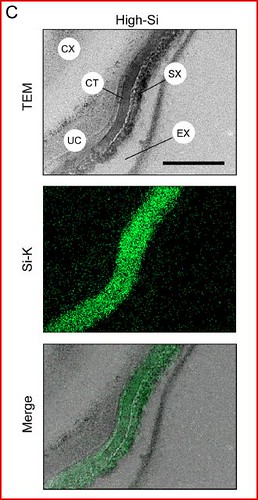
    Japanese high silicon spore

    To my eye, this silicon coating of the spore coat looks just as contiguous as that in the electron micrographs of the attack spores in the previous diary.

    Tags: , , , ,

  • Bunker Busters Shipped to Diego Garcia: Imminent Attack or Strategic Move?

    US Navy photo of bombs with Blu-117 warheads (source: Wikimedia)

    The internet is buzzing about this report on heraldscotland.com, where we find that large, “bunker buster” bombs are being shipped from Concord, California to a base on the island of Diego Garcia. The report claims the bombs are intended for immediate use in an attack on Iran. An alternate explanation would be that the bombs are meant to increase pressure on Iran to prevent enrichment of uranium to weapons grade.

    Here is how the article opens:

    Hundreds of powerful US “bunker-buster” bombs are being shipped from California to the British island of Diego Garcia in the Indian Ocean in preparation for a possible attack on Iran.

    The Sunday Herald can reveal that the US government signed a contract in January to transport 10 ammunition containers to the island. According to a cargo manifest from the US navy, this included 387 “Blu” bombs used for blasting hardened or underground structures.

    The article is receiving a lot of attention because of this quote it contains:

    “They are gearing up totally for the destruction of Iran,” said Dan Plesch, director of the Centre for International Studies and Diplomacy at the University of London, co-author of a recent study on US preparations for an attack on Iran. “US bombers are ready today to destroy 10,000 targets in Iran in a few hours,” he added.

    The key portions of the cargo are 195 Blu-110 bombs (at 1000 pounds each) and 192 of the even larger, 2000 pound Blu-117 bombs, as seen in the Navy photo above.

    Although I’ve seen unconfirmed rumors that the bombs arrived at Diego Garcia yesterday, note that the shipping contract was signed in January. Shipping our largest existing bunker busters in January fits with this article from the New York Times and this report from Reuters.

    First, the Times article (from January), which deals mostly with an explanation that Iran has engaged in hiding its nuclear facilities underground, but has this very interesting statement almost in passing…

    Now, with the passing of President Obama’s year-end deadline for diplomatic progress, that cloak of invisibility has emerged as something of a stealth weapon, complicating the West’s military and geopolitical calculus.

    Couple the passing of Obama’s diplomatic deadline with this Reuters report from December on our development of even larger bunker buster bombs:

    A “bunker buster” bomb with more than 10 times the explosive power of its predecessor will be put into service by the United States next December, six months later than previously scheduled, the U.S. Defense Department told Reuters on Friday.

    Here is how Reuters previously characterized the new bomb:

    The Pentagon is seeking to speed deployment of an ultra-large “bunker-buster” bomb on the most advanced U.S. bomber as soon as July 2010, the Air Force said on Sunday, amid concerns over perceived nuclear threats from North Korea and Iran.

    The non-nuclear, 30,000-pound Massive Ordnance Penetrator, or MOP, which is still being tested, is designed to destroy deeply buried bunkers beyond the reach of existing bombs.

    /snip/

    Carrying more than 5,300 pounds of explosives. it would deliver more than 10 times the explosive power of its predecessor, the 2,000-pound BLU-109, according to the Pentagon’s Defense Threat Reduction Agency, which has funded and managed the seed program.

    So, with Obama’s diplomacy deadline passing and the deployment date for the MOP delayed for almost a year past that deadline, it would make sense for him to put into place the current largest ordnance designed for underground targets.

    Getting back to the Times article, we see the difficulties brought about from the Iranian facilities being underground:

    “It complicates your targeting,” said Richard L. Russell, a former Central Intelligence Agency analyst now at the National Defense University. “We’re used to facilities being above ground. Underground, it becomes literally a black hole. You can’t be sure what’s taking place.”

    Even the Israelis concede that solid rock can render bombs useless. Late last month, the Israeli defense minister, Ehud Barak, told Parliament that the Qum plant was “located in bunkers that cannot be destroyed through a conventional attack.”

    Heavily mountainous Iran has a long history of tunneling toward civilian as well as military ends, and Mahmoud Ahmadinejad has played a recurring role — first as a transportation engineer and founder of the Iranian Tunneling Association and now as the nation’s president.

    There are hundreds, perhaps thousands, of big tunnels in Iran, according to American government and private experts, and the lines separating their uses can be fuzzy. Companies owned by the Islamic Revolutionary Guards Corps of Iran, for example, build civilian as well as military tunnels.

    For a full appreciation of the folly of this very expensive cat and mouse game, where Iran is building multiple facilities buried deeper and deeper underground, while the US develops larger and larger bombs designed to reach ever deeper targets, one needs to see just how far away from a nuclear weapon Iran’s technology is today (caution, FoxNews link):

    The internal International Atomic Energy Agency document was significant in being the first glimpse at Iran’s plan to enrich uranium to 20 percent that did not rely on statements from Iranian officials.

    Iran says it wants to enrich only up to that grade — substantially below the 90 percent plus level used in the fissile core of nuclear warheads — as a part of a plan to fuel its research reactor that provides medical isotopes to hundreds of thousands of Iranians undergoing cancer treatment.

    That report, of only a small amount of uranium being enriched to 20% (where Iran’s previous best was only 5%), was from February. It’s hard to see how that capability is anywhere near the large amounts of 90% enrichment needed for weapons. With Iran so far away from real nuclear weapon development and with the targets so hard to discern and destroy, it’s hard to imagine that Obama and the military really intend to attack now. This movement of bunker busters looks to me like just another move in the childish games Iran and the US are playing with one another.

    Tags: , , ,

  • Central Command: McChrystal Does Have Command Authority Over Detainee Operations Unit

    Gen. Stanley McCrystal (this photo no longer in ISAFMedia's Flickr stream!)

    In a post titled “More Shell Games: Command Structure for US Prisons and Special Operations in Afghanistan“, I cited this article from AFP, which included this statement:

    As the NATO commander, the only forces not under McChrystal’s control will be a special US task force that handles detainees, the small number of special operations forces and some support troops from other nations, the official said.

    I also linked to this press release describing the return of a group from the Joint Enabling Capabilities Command (JECC) which had been in Afghanistan helping to set up Joint Task Force 435. JTF-435 has authority over US prisons in Afghanistan. I misinterpreted the press release to wrongly conclude that JTF-435, like the JECC, falls under the Joint Forces Command (JFCOM), when I stated:

    As a part of JFCOM, then, JTF-435, and the prisoner operations under Harward, are well outside McChrystal’s official sphere of command within CENTCOM.

    I received a response from a Media Officer in Central Command, Lieutenant Commander William Speaks, who has provided very useful information regarding the various command responsibilities involved. In the initial email, Speaks explained that the group from JFCOM was involved only in setting up JTF-435, as is common for JECC when it is involved in “helping to stand up new task forces before the permanent jobs are filled”. He further explained that

    Once they help get things set up and the permanent billets are established and filled, they turnover and leave. More importantly, while they’re there, they report to whomever has operational control over the entity they are helping to set up, not JFCOM. I thought this was made clear in the release White linked to, which was about the JECC team returning home.

    I asked for further explanation regarding the media reports that I had seen where it appeared to be reported that McChrystal did not have authority over detainee operations, especially since even the first email from Speaks stated that ” I can assure you that CENTCOM and ISAF do have authority over JTF-435, and JFCOM does not.”

    Here is Speaks’ full response to that question from me:

    Jim:

    The AFP story is not inaccurate, but it is imcomplete in its explanation of Gen. McChrystal’s authorities. The story says that “as the NATO commander,” the detainee operations task force is not under his control. While that’s accurate, it does not explain Gen. McChrystal’s dual-hatted role as Commander, ISAF, and Commander of US Forces in Afghanistan (COMUSFOR-A). The latter includes forces serving under the Operation Enduring Freedom mission, which is separate from the NATO/ISAF mission.

    Gen. McChrystal does have authority over JTF-435 under his USFOR-A hat. You can certainly quote me on any of this information.

    Regards,

    LCDR Bill Speaks

    It appears that I was looking under the wrong shell for the Afghanistan prisons command authority. While it is not under McChrystal’s ISAF hat, it is under his USFOR-A hat. Given McChrystal’s history of hiding Iraq prisons from ICRC inspections, that arrangement does not give me a warm, fuzzy feeling.

    Tags: , , ,

  • Who’s Running the Secret Side of the Wars?

    Olson

    Admiral Eric Thor Olson: The most important man you never heard of. But is he being bypassed?

    In my most recent diary, I discussed the command structure within the Department of Defense for the war effort in Afghanistan. What is clear from that diary and the links within it is that a number of the most significant activities in Afghanistan have been intentionally carved out of the official command area for General Stanley McChrystal, who is now Commander of the International Security Assistance Force, answering to the US Central Command under General David Petraeus.

    Key secret activities appear to be under the control of the Joint Special Operations Command, or JSOC. But who is in control of JSOC? The current head of JSOC is Vice Admiral William McRaven, who previously reported to McChrystal when McChrystal headed JSOC. Under the command structure I described in the previous diary, JSOC is within US Special Operations Command, which is currently headed by Admiral Eric T. Olson. Olson appears to have kept a very low profile in his career. The only biography I could find is here and it has very little real information about him.

    The question of control above JSOC has a very interesting history for the time in which McChrystal was JSOC commander. For example, we have this from Jeremy Scahill:

    While JSOC has long played a central role in US counterterrorism and covert operations, military and civilian officials who worked at the Defense and State Departments during the Bush administration described in interviews with The Nation an extremely cozy relationship that developed between the executive branch (primarily through Vice President Dick Cheney and Defense Secretary Donald Rumsfeld) and JSOC. During the Bush era, Special Forces turned into a virtual stand-alone operation that acted outside the military chain of command and in direct coordination with the White House. Throughout the Bush years, it was largely General McChrystal who ran JSOC. “What I was seeing was the development of what I would later see in Iraq and Afghanistan, where Special Operations forces would operate in both theaters without the conventional commander even knowing what they were doing,” said Colonel Wilkerson. “That’s dangerous, that’s very dangerous. You have all kinds of mess when you don’t tell the theater commander what you’re doing.”

    Wilkerson said that almost immediately after assuming his role at the State Department under Colin Powell, he saw JSOC being politicized and developing a close relationship with the executive branch. He saw this begin, he said, after his first Delta Force briefing at Fort Bragg. “I think Cheney and Rumsfeld went directly into JSOC. I think they went into JSOC at times, perhaps most frequently, without the SOCOM [Special Operations] commander at the time even knowing it. The receptivity in JSOC was quite good,” says Wilkerson. “I think Cheney was actually giving McChrystal instructions, and McChrystal was asking him for instructions.” He said the relationship between JSOC and Cheney and Rumsfeld “built up initially because Rumsfeld didn’t get the responsiveness. He didn’t get the can-do kind of attitude out of the SOCOM commander, and so as Rumsfeld was wont to do, he cut him out and went straight to the horse’s mouth. At that point you had JSOC operating as an extension of the [administration] doing things the executive branch–read: Cheney and Rumsfeld–wanted it to do. This would be more or less carte blanche. You need to do it, do it. It was very alarming for me as a conventional soldier.”

    Olson took over SOCOM on July 9, 2007, replacing General Bryan Brown. The bypassing of SOCOM Wilkerson describes clearly began during Brown’s tenure. Olson was second in command at SOCOM at that time, however. In a very interesting article in Air Force Times published on March 6, 2006, Sean D. Naylor offered a revealing glimpse inside the discussion of the reporting structure for JSOC:

    Structural changes in the Joint Special Operations Command will give its chief more authority and influence in dealing with other leaders and give his headquarters greater ability to simultaneously lead multiple task forces, said several sources familiar with the report.

    But the Pentagon rejected another recommendation to temporarily pull JSOC out of its parent organization, U.S. Special Operations Command, and have it report directly to Defense Secretary Donald Rumsfeld.

    So, there was talk in 2006 of actually formalizing the structure that Scahill described, where McChrystal was taking orders directly from Rumsfeld and Cheney. The Naylor article reports that the changes he was describing were the result of a task force Rumsfeld assigned to study JSOC after Olson reported that “his command’s capabilities had declined,” apparently setting Rumsfeld off on one of his famous tirades.

    Here is more from Naylor on the changes in JSOC implemented in 2006:

    “Before 9/11, JSOC was essentially seen as a hostage-rescue unit or ‘render-safe’ unit,” said the retired Special Forces lieutenant colonel. “You train, you train, you train, then all of a sudden you get on a plane and you go somewhere, do a mission, it’s over in 36 hours, and you come back.”

    Now the command is deployed somewhere “24/7,” he said. Since the Iraq war began, JSOC has kept at least one task force, and sometimes two, deployed there, with another in Afghanistan.

    The command has shifted to “continuous operations,” added the Washington source familiar with the Downing report.

    So the question remains, who is directing McRaven and JSOC? Olson has direct command responsibility, but he was second in command when McChrystal began his practice of working around SOCOM and there appear to have been no negative consequences to McChrystal for what should have beeen seen as insubordination. In fact, McChrystal has instead been promoted and praised, while JSOC has been given more influence and funding. Here is Defense Secretary Robert Gates, in an article in Foreign Affairs published during the time he was chosen to remain in office as President Obama took over from President Bush:

    As secretary of defense, I have repeatedly made the argument in favor of institutionalizing counterinsurgency skills and the ability to conduct stability and support operations. I have done so not because I fail to appreciate the importance of maintaining the United States’ current advantage in conventional war fighting but rather because conventional and strategic force modernization programs are already strongly supported in the services, in Congress, and by the defense industry. The base budget for fiscal year 2009, for example, contains more than $180 billion for procurement, research, and development, the overwhelming preponderance of which is for conventional systems.

    Apart from the Special Forces community and some dissident colonels, however, for decades there has been no strong, deeply rooted constituency inside the Pentagon or elsewhere for institutionalizing the capabilities necessary to wage asymmetric or irregular conflict — and to quickly meet the ever-changing needs of forces engaged in these conflicts.

    /snip/

    …I just want to make sure that the capabilities needed for the complex conflicts the United States is actually in and most likely to face in the foreseeable future also have strong and sustained institutional support over the long term. And I want to see a defense establishment that can make and implement decisions quickly in support of those on the battlefield.

    In the end, the military capabilities needed cannot be separated from the cultural traits and the reward structure of the institutions the United States has: the signals sent by what gets funded, who gets promoted, what is taught in the academies and staff colleges, and how personnel are trained.

    Clearly, the increased responsibility and funding for JSOC and the promotion of McChrystal to head ISAF show that Gates, the Pentagon establishment and Obama approve of the covert actions JSOC and McChrystal have carried out.

    It seems likely to me, then, that McRaven’s JSOC may well be taking a page from McChrystal’s playbook in bypassing SOCOM and Olson. Rather than Cheney or Rumsfeld, however, it seems more likely that McChrystal would be the one providing direction to McRaven, his former subordinate. That would give McChrystal the advantage of making his public pronouncements aimed at public relations regarding night raids, civilian imprisonment, secret prisons and target choices for drone strikes, but still having a hand in the more free-wheeling style he pioneered when he ran JSOC. At the very least, it is now unlikely that McChrystal will be unaware of McRaven’s JSOC actions in the way that previous CENTCOM representation in the field was unaware of McChrystal’s JSOC actions.

    Of course, Petraeus is just as “politicized” as Wilkerson described McChrystal to Scahill. That gives us then a complete link down from Gates through Petraeus to McChrystal and then McRaven for the secret activities in Afghanistan and the surrounding area, even though it should go from Gates through Olson to McRaven, with McChrystal and Petraeus only being supported, not being in control. Ultimate responsibility in this chain, however, eventually flows all the way up to Obama. How involved is he in decisions relating to JSOC operations?

    Although Olson may be the most important person you never heard of, he might also be left entirely out of the loop on decisions that the command structure says should be his.

    Postscript: In a number of recent diaries, I have discussed how Obama’s executive order closing secret prisons appeared directed at the CIA and not JSOC. Here is the relevant section of the order itself, which I had not yet quoted:

    Sec. 4. Prohibition of Certain Detention Facilities, and Red Cross Access to Detained Individuals.

    (a) CIA Detention. The CIA shall close as expeditiously as possible any detention facilities that it currently operates and shall not operate any such detention facility in the future.

    (b) International Committee of the Red Cross Access to Detained Individuals. All departments and agencies of the Federal Government shall provide the International Committee of the Red Cross with notification of, and timely access to, any individual detained in any armed conflict in the custody or under the effective control of an officer, employee, or other agent of the United States Government or detained within a facility owned, operated, or controlled by a department or agency of the United States Government, consistent with Department of Defense regulations and policies.

    So, yes, the order directs the CIA to close its detention facilities and says nothing about JSOC. Further, in instructing government agencies to make prisoners available to the ICRC, note that such disclosure is to be “consistent with Department of Defense regulations and policies”. That also seems to me to leave a loophole for JSOC, since it is DoD policy that the bulk of JSOC actions are classified.

    Tags: , , , , , , ,

  • More Shell Games: Command Structure for US Prisons and Special Operations in Afghanistan

    6:3SIX5/1.6.09 by pdxchirs79

    shell game by pdxchirs79 (flickr)

    This diary will, in the words of Emptywheel, go very far into the “weeds”, but it should help to bring together several themes that have been percolating through recent diaries I have written on US handling of prisoners and night raids in Afghanistan. Please bear with me, as my weed-whacker blades tend to dull a lot faster than Marcy’s.

    In this diary on Friday, I noted an AFP report (which I inadvertently failed to link) which explained that General Stanley McChrystal has been given expanded powers in Afghanistan. Here is the sentence of that report on which I now wish to focus:

    As the NATO commander, the only forces not under McChrystal’s control will be a special US task force that handles detainees, the small number of special operations forces and some support troops from other nations, the official said.

    Note the key exceptions of US forces that McChrystal will not command: the US task force in charge of detainees and special operations forces. Both of those groups were addressed in this diary, where I quoted extensively from a piece by Spencer Ackerman. That diary was addressing the question of whether the US still maintains secret prisons in Afghanistan and the appointment of former McChrystal associate Vice Admiral Robert Harward to head Joint Task Force 435, which is in charge of prisoner operations in Afghanistan. The diary also addressed the activities of Joint Task Force 714, now under the command of another McChrystal former associate, Vice Admiral William McRaven, who now heads the Joint Special Operations Command, as did McChrystal.

    In that diary, I speculated that because Harward had been adamant about no secret prisons under his command and with the known history of McChrystal’s hiding of prisons when he headed JTF-714, that it was likely that JTF-435 handled only the publicly known prisons and JTF-714 still was in charge of the secret sites. There is now more information to support this hypothesis, and it comes from looking at the command structure of US forces in light of the exceptions to McChrystal’s command noted above.

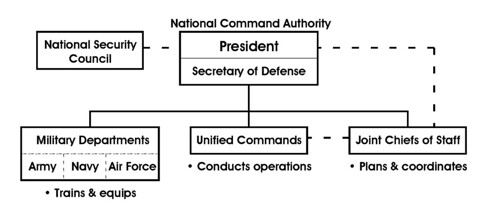
    The current org chart for the Department of Defense, at its highest levels, looks like this:
    DOD org

    I have taken that chart from Wikimedia Commons, but it is an accurate simplification of this org chart (pdf) from the Department of Defense (although DoD does not show the NSC involvement).

    Note that operations occur under the direct command of the President’s Secretary of Defense through the Unified Commands. The Unified Commands can be found here, where there is a map (click on it to expand it) that shows the geographic areas covered by five of the commands. As can be seen on the map, Afghanistan falls under US Central Command (CENTCOM). The other two commands that will be of interest for discussion here are US Joint Forces Command (JFCOM) and US Special Operations Command (SOCOM), two of the four non-geographic commands.

    McChrystal’s current appointment is as the Commander of ISAF (Interantional Security Assistance Force), a “NATO” operation that falls under CENTCOM. That means McChrystal reports directly to General David Petraeus, who heads CENTCOM. Keeping in mind the exceptions to McChrystal’s command noted above for prison operations and special operations, it is very interesting to discover just where JTF-435, Harward’s prisoner operation, is housed. From this news release dated Friday, it is clear that JTF-435 falls under JFCOM. As a part of JFCOM, then, JTF-435, and the prisoner operations under Harward, are well outside McChrystal’s official sphere of command within CENTCOM. Note also that the Ackerman article linked above clearly places JTF-714 within SOCOM, which is the Unified Command to which McRaven, as head of the Joint Special Operations Command, reports. This accounts for the “special operations” exception to McChrystal’s command within Afghanistan.

    But note how this sets up yet another shell game with what the US is doing in Afghanistan. My diary on secret prisons noted how it was most likely that Harward was placed in charge of the prisons we acknowledge, while keeping the secret prisons under the control of special operations, most likely under JTF-714. Now, with Friday’s announcement that McChrystal was clamping down on night raids, the same shell game is playing out. Also from my diary Friday is this quote from Reuters:

    U.S. and NATO troops in Afghanistan will be permitted to carry out raids at night only when there are Afghan security forces present, their commander, U.S. General Stanley McChrystal, ordered on Friday.

    But, since we know that the worst of the night raids are special operations (also almost certainly by JTF-714, following the playbook McChrsytal wrote when he ran it), McChrystal’s order would not apply to special operations forces answering to SOCOM.

    Oh, and lest you get the impression that Harward is somehow in a better place by being in JFCOM rather than SOCOM, I took a look to see who is now commander of JFCOM. It is General James Mattis, who was in the news in 2005, when he uttered these amazing words:

    Lt. Gen. James Mattis, who commanded Marine expeditions in Afghanistan and Iraq, made the comments Tuesday during a panel discussion in San Diego, California.

    “Actually it’s quite fun to fight them, you know. It’s a hell of a hoot,” Mattis said, prompting laughter from some military members in the audience. “It’s fun to shoot some people. I’ll be right up there with you. I like brawling.

    “You go into Afghanistan, you got guys who slap women around for five years because they didn’t wear a veil,” Mattis said. “You know, guys like that ain’t got no manhood left anyway. So it’s a hell of a lot of fun to shoot them.”

    What a poor choice of leaders.

    It is also interesting to note in passing that JFCOM is home to the Joint Personnel Recovery Agency, which houses the old SERE (Survival, Evasion, Resistance, Escape) unit, where trainees were waterboarded as training to resist torture if captured. Note that the crafting of the torture memos relied heavily on claims that practices we used on our own troops in training them could not amount to torture. Is JFCOM using input from JPRA in crafting its prisoner treatment policies in Afghanistan?

    In summary, then, McChrystal can “order” that Afghan personnel be present for night raids, but the night raids that cause the most damage are not under his command. Harward can claim no secret prisons exist under his command, but there is a separate command where they are very likely to exist. JTF-714, following the plans McChrystal developed when he ran it, still seems free to operate in its known free-wheeling way, breaking into homes in the dead of night, striking terror into families, and removing citizens who are held secretly and without access to hearings on whether there is sufficient cause to imprison them.

    At a later date, it is probably worth some digging to look into that third category not commanded by McChrystal, the “some support troops from other nations”. What do they do?

    Tags: , , , , , , ,

  • Next Up For Activist SCOTUS: “Honest Services”

    Justice Antonin Scalia: Newest poster boy for defense lawyers

    Following up on its activist behavior in going out of its way to hear and decide on the Citizens United case, our radically conservative Supreme Court will hear arguments on Monday in the third of a series of cases involving the concept of “honest services” as it appears in fraud statutes. This action appears to echo what bmaz described when he said: “the Roberts court does seem to have a hard on for this issue” with regard to the Citizens United case.

    Here is SCOTUSblog setting the stage for arguments:

    For the third time this Term, the Supreme Court will examine the scope of the controversial 1988 law that makes it a crime to commit fraud that deprives someone, such as one’s company, of “the intangible right of honest services.” It does so in the leading criminal case growing out of the Enron business scandal. This time, however, the Court may confront the constitutionality of that law, since the new case involves a claim that the law is so broadly worded that no one can know what it outlaws, thus making it unconstitutionally vague.

    Here is how Citizens for Responsibility and Ethics in Washington (CREW) frames the arguments in the set of three cases on “honest services”:

    The National Association of Criminal Defense Lawyers, backing defendants in the new cases, says the “honest services” provision of U.S. fraud law is unconstitutionally vague and gives prosecutors unbridled discretion to enforce their own views of what’s illegal. On the other side, the watchdog group Citizens for Responsibility and Ethics in Washington deems the law an invaluable prosecutorial tool against corruption.

    In a remarkable twist, Justice Antonin Scalia is aligned with the defense lawyers. Continuing from the CREW link:

    Justice Antonin Scalia, who complained in February about the law’s indefinite terms, said it “invites abuse by headline-grabbing prosecutors in pursuit of local officials, state legislators and corporate CEOs.” He was the lone dissent as the court declined to hear a dispute over the law’s breadth last term. Since then, the other justices changed their minds and decided to enter the fray.

    Okay, so the strange bedfellows aspect of Scalia suddenly siding with defense lawyers is resolved when we realize that the list of high profile cases where convictions have been won is taken right from the social list of his buddies who support our corporatist states of America. From CREW, again:

    The anti-fraud law at the heart of three disputes before the Supreme Court has been used against such high-profile defendants as lobbyist Jack Abramoff, former Illinois governor George Ryan and his successor, Rod Blagojevich.

    In addition, the other two cases heard on “honest services” this term include the convictions of Conrad Black and former Alaska legislator Bruce Weyhrauch.

    Bringing the Skilling case to SCOTUS on “honest services” seems to me to be especially shaky, since SCOTUSblog reminds us that his conviction under the “honest services” provision applied to only one of the many counts on which he was convicted:

    On May 25, 2006, after the four-month trial, Skilling was convicted of one count of conspiracy to commit securities fraud and wire fraud (the “honest services” charge is keyed to that count), 12 counts of securities fraud, five counts of making false statements to accountants, and one count of insider trading.

    Further, Skilling’s challenge centers more on another aspect of his conviction than it does on the “honest services” issue:

    Much of Skilling’s challenge deals with his claim that he could not possibly have gotten a fair trial in Houston amid what his lawyers call the “devastating impact” of the scandal on the entire city and region, and the resulting “vitriolic” and “blistering” publicity about the accused executives. His attorneys claimed in the petition that “the community passion” stirred up by the case “was as dramatic as any in U.S. criminal trial history.”

    God help us if “too evil to convict” joins “too big to fail”. Fortunately, we have the counterexample of attempting to try KSM in New York City to put up against the Skilling conviction in Houston on that point.

    At any rate, I don’t have sufficient legal training to evaluate whether the language of the “honest services” provision is indeed too vague for consistent application or if what we have here is another example of our very own SCOTUS engaging in behavior that robs the citizens of “honest services” being performed by Supreme Court justices.

    Tags: , , , , ,

  • Washington Post Op-Ed Skews Math to Smear Green Jobs

    General Electric wind turbine at Jiminy Peak, Hancock MA (photo: Swerz via Flickr)

    Friday’s Washington Post provides Op-Ed space to Sunil Sharan, whom they describe in this way:

    The writer, a director of the Smart Grid Initiative at GE from 2008 to 2009, has worked in the clean-energy industry for a decade. The views expressed are his own.

    Sharan titles his piece “The green jobs myth” and then goes on to warn us, in a tone that is ever so serious and with much hand-wringing, that “The facts challenge the prevailing thinking among some policymakers and officials that green jobs are a principal reason for transforming the economy.”

    What does he choose as his example of how the green jobs movement is going to eat jobs, rather than create them? He chooses that central piece of the green movement that we’ve all been talking about, the “smart meter”. [Yeah, that was snark; I had never heard of smart meters before this column, had you?] Through magical math, Sharan then informs us that the installation of smart electric meters is going to cost us 28,000 meter reading jobs.

    But how does he get there? After calculating that installation of the stated goal of 20 million smart meters over the next five years will create 1600 jobs for installing the meters, he then calculates the lost meter reader jobs. The central part of his calculation is here:

    Now let’s consider job losses. It takes one worker today roughly 15 minutes to read a single meter. So in a day, a meter reader can scan about 30 meters, or about 700 meters a month. Meters are typically read once a month, making it the base period to calculate meter-reading jobs. Reading a million meters every month engages about 1,400 personnel. In five years, 20 million manually read meters are expected to disappear, taking with them some 28,000 meter-reading jobs.

    Really? Fifteen minutes to read a single meter and a reader only reads 30 in a day? What planet does Mr. Sharan come from? Just a few seconds with teh Google found this as an alternative for the work load of a meter reader:

    Suczynski is a NIPSCO meter reader.

    /snip/

    Suczynski spends five workdays a week crisscrossing front yards, backyards and side yards from Gary to Crown Point with a sense of proprietary right that even a sworn police officer would hesitate to exercise.

    /snip/

    This time of year, his trek to read 500 or so natural gas and electric meters per day is often through a foot or more of snow and in temperatures down to 0 degrees. That also means the meter is often shrouded in ice, fence gates are frozen shut, and dogs seem edgier than usual.

    Hmmm. Sharan is off by just a bit. What happens to his numbers if a reader is responsible for 500 meters a day instead of 30? That would reduce the jobs lost by a factor of 500 divided by 30, or reduce his estimate of 28,000 jobs lost to 1680 jobs lost. When a realistic workload for meter readers is taken into the calculation, the jobs situation looks to be pretty close to break-even, 1600 created and 1680 lost.

    Thanks for playing, Mr Sharan, and please try again some day when we could all use another laugh.

    Tags: , ,

  • Watching the Nolympics: Patriot Act Extended, Health Care Reform Kabuki

    Thursday’s developments perfectly sum up the completely ineffective nature of Obama and the Democrats: the Patriot Act was extended and there were hours of staged histrionics on health care reform that will go nowhere.

    Here is Reuters describing the Patriot Act extension:

    Legislation to extend expiring provisions of the anti-terror USA Patriot Act won final congressional approval on Thursday, with Democrats unable to add additional civil liberties protections.

    On vote of 315-97, the House of Representatives approved the bill, a day after it cleared the Senate. It now heads to President Barack Obama to sign into law.

    Pity the poor Democrats. They control the White House and huge majorities in both chambers, but they just can’t manage to restore civil liberties taken away by the Republicans under Bush. Those mean Republicans will just say no.

    Also on Thursday there were over seven hours of highly staged “debate” on health care reform. Even though the Olympics are in Vancouver, the Republicans put on a gold medal performance in foot stomping in the Washington Nolympics. I’ve included the exclusive footage I found.

    And again, the Democrats are left muttering to themselves about just how hard it’s going to be to get reform all on their own. They’ve only been trying for a year, and now they don’t even “control” sixty votes in the Senate, so what do we expect from them anyway?


  • FDL Welcomes James Fallows, How America Can Rise Again

    [Welcome James Fallows, and Host Jim White.] [As a courtesy to our guests, please keep comments to the article.  Please take other conversations to a previous thread. – bev]

    How America Can Rise Again (The Atlantic, Jan/Feb 2010)

    In the seventh century BC, the prophet Jeremiah told the people of Israel that their difficulties of the day were justly deserved punishment for their heathen and wicked ways. He also told them, though, that they could return to their chosen status with a renewed dedication to Jehovah. Today, a jeremiad is any warning that current problems are the result of straying from previous standards, but with the promise of restoration to better times ahead if they will follow a suggested corrective course. In How America Can Rise Again, author (and former Jimmy Carter speechwriter) James Fallows explores the question of “whether America is finally going to hell”, but in the tradition of the jeremiad, he offers possibilities for overcoming the massive problems he diagnoses.

    In Fallows’ introduction, we see a decaying US through fresh eyes as he returns from an extended stay in China. The worn roads and bridges as one leaves John F. Kennedy airport evoke the standard recitations of the impending demise of the US:

    “When I was growing up, these bridges and roads and dams were a source of real national pride and achievement,” Stephen Flynn, the president of the Center for National Policy in Washington, who was born in 1960, told me. “My daughter was 6 when the World Trade Center towers went down, 8 when lights went off on the East Coast, 10 when a major U.S. city drowned—I saw things built, and she’s seen them fall apart.”

    Fallows warns us that we’ve been here before and the US has always managed to survive. He also shrugs off the urge to warn us against “falling behind” when comparing the US to other nations and argues that this is a relatively new phenomenon in social warnings. Prior to Sputnik, he explains, the failings were in falling short of expectations, instead of falling behind the achievements of other countries. In the past, the US has survived because it “continually refreshes its connections with the rest of the world—through languages, family, education, business—in a way no other nation does, or will.” These connections depend especially on our openness to immigration, coupled with a university system that serves to attract the greatest minds from around the world.

    So what are the problems we now face? Here is Fallows’ list:

    The main concerns boil down to jobs, debt, military strength, and overall independence. Jobs: Will the rise of other economies mean the decline of opportunities within America, especially for the middle-class jobs that have been the country’s social glue? Debt: Will reliance on borrowed money from abroad further limit the country’s future prosperity, and its freedom of action too? The military: As wealth flows, so inevitably will armed strength. Would an ultimately weaker United States therefore risk a military showdown or intimidation from a rearmed China? And independence in the broadest sense: Would the world respect a threadbare America? Will repressive values rise with an ascendant China—and liberal values sink with a foundering United States? How much will American leaders have to kowtow?

    The bright side, Fallows tells us, is that it is within American power and ability to address these concerns through policy adjustments.

    But the biggest problem we face, according to Fallows, is that our government is stuck in archaic structures that belie the rest of American culture’s ability to renew itself. Fallows notes that “A similarly inflexible business organization would still have a major Whale Oil Division; a military unit would be mainly fusiliers and cavalry.” Short of revolution, he sees no way of fixing these defects and shows us the fruits of partisan gerrymandering: “In a National Affairs article, ‘Who Killed California?,’ Troy Senik pointed out that 153 state or federal positions in California were at stake in the 2004 election. Not a single one changed party.”

    So, Fallows’ description of our sad state is now complete: “What I have been calling ‘going to hell’ really means a failure to adapt: increasing difficulty in focusing on issues beyond the immediate news cycle, and an increasing gap between the real challenges and opportunities of the time and our attention, resources, and best efforts.”

    In the best jeremiad tradition, Fallows then begins to address how America can rise again. His first offering is for “an enlightened military coup”, but, thankfully, he then states that we really can’t hope for that. Next, he proposes that “We could hope to change the basic nature of our democracy, so it fits the times as our other institutions do”, but winds up dismissing something as radical as a new Constitutional Convention when he considers the chaos that would ensue from trying to start over in our currently divided society.

    That brings us down to only two final choices:

    Doing more, or doing less. Trying to work with our flawed governmental system despite its uncorrectable flaws, or trying to contain the damage that system does to the rest of our society. Muddling through, or starving the beast.

    Unsurprisingly, Fallows rejects “starving the beast” and sets out his prescription for “muddling through”, which consists of moving the dialog to basing our decisions on their effects 75 years into the future rather than today. Toward that end, he says, we should rebuild our infrastructure, reinvest in research and address looming environmental challenges and then America can indeed rise again.

    Please welcome Mr. Fallows to our Book Salon and join in the discussion of his timely and compelling article.

  • Math Error of 100-Fold in Amerithrax Investigation Improperly Excluded Suspects “Conclusion Retracted”

    UPDATE: This Washington Post article shows that the Leahy and Daschle letters contained more material than is assumed in this post as it originally appeared. The post improperly assumes that a 0.013 g sample of spores removed for analysis was the entire amount of anthrax material, while the Washington Post article states:

    The Daschle and Leahy letters each contained 1.5 grams of anthrax powder or less

    As a result, the 0.013 g sample would represent about 1% of the anthrax material in the letter, and this accounts for the 100 fold difference in my calculations.

    I apologize for this error and the erroneous conclusions I stated as a result of the error.

    FBI photo of the flask labeled RM R-1029

    Friday afternoon, the FBI released a number of documents in closing the case dubbed “Amerithrax”. Substantial flaws still remain in the FBI’s explanation of the technical analysis on which they concluded that Bruce Ivins was the sole perpetrator of the anthrax attacks of 2001.

    The documents can be found here. Only the 93 page investigative summary and the supporting exhibits are new, and all can be accessed from the Amerithrax page as pdf files.

    On Friday, I briefly discussed the new information derived from the summary relating to the genetic analyses carried out to pinpoint Bruce Ivins’ infamous flask labeled RMR-1029 as the sole source of the material used in the attacks. Significant holes still remain in the FBI’s explanation of the genetic analyses. It is possible that many of these shortcomings could be addressed if the actual reports from the scientists who carried out the work were released. It is my hope that these reports now will be cleared for publishing in peer-reviewed journals so that the evidence can be scrutinized fully.

    In looking further at the investigative summary, I have found what appears to be an error in the analysis of how much material from RMR-1029 would have been required to produce the spores used in the attack letters. The result of this error is an overestimate, by a factor of 100, of how much material from RMR-1029 would have been needed to be used for each letter. Partially because of this overestimate, the FBI excluded as suspects other researchers who received samples from RMR-1029, claiming that they lacked the expertise both to produce such a large volume of material and to then prepare it as attack material. With the smaller estimate, most of the basis for excluding these individuals goes away, as simple procedures could be used to dry such a small amount of material.

    Exhibit F released on Friday is a pdf file of a page from Bruce Ivins’ notebook dated March 17, 1998. This page has the results of Ivins’ analysis of the material labeled RMR-1029. At this point in time, Ivins had approximately one liter of material distributed between two one liter flasks. The photo above is the one flask that remained after the two had been combined due to using a significant amount of material in Ivins’ research developing anthrax vaccines.

    Here is the crucial part of the notebook entry:

    In doing his microscopic analysis, Ivins states clearly that he is working with a 100-fold (or, 1:100) dilution of material from the RMR-1029 flask. He also states that this dilution is at an approximate concentration of 3 X 10⁸ spores per mL. From the information present on this page of the notebook, it is clear that the concentration of spores in RMR-1029 is approximately 3 X 10¹⁰ per mL.

    From Exhibit G, this is Ivins’ analysis of the material he recovered from one of the attack envelopes on October 17, 2001 when the FBI asked him to analyze it. From the date and purity, this is most likely the Leahy envelope:

    Here, we see that Ivins recovered 0.013 grams of powder from the envelope. He suspended this powder in water and then plated it out to determine the concentration of bacteria. He then computed a concentration of 2.1 X 10¹² colony forming units per gram of powder. For spores that are perfectly viable, one spore corresponds to one colony forming unit. That means that 0.013 g of the powder contains 2.7 X 10¹⁰ spores.

    On page 29 of the investigative summary, footnote 15 states this:

    A leading anthrax researcher who assisted the investigation expressed his expert opinion that 100 ml would have been required to create sufficient material to be used in one letter, for a total of 500 ml for the five letters. Nonetheless, we cannot say with certainty how much material was used in the letters.

    One hundred mL of RMR-1029 would be 3 X 10¹² spores, 100-fold more than Ivins recovered from the envelope he analyzed. The only way the opinion of the anthrax researcher makes sense is if they mistakenly took Ivins’ 3 X 10⁸ notation in the notebook as the concentration of spores in RMR-1029, when Ivins clearly states that is the concentration of the diluted material he analyzed.

    The lower concentration makes no sense as the spore concentration of RMR-1029 for several reasons. First, the description of how many large cultures were produced at Dugway and small cultures in Ivins’ lab to produce RMR-1029 would suggest that the purification process resulted in the loss of most of the spores produced, if the lower concentration of RMR-1029 is correct. In other words, the lower concentration for RMR-1029 would mean that the final concentration of RMR-1029 was approximately at or below the concentration of spores one achieves in a standard bacterial culture, even though over a hundred liters of culture were used to produce the one liter purified material in the RMR-1029 flask.

    An alternate explanation for the discrepancy would be if Ivins collected only one percent of the material in the envelope for his analysis, but that would mean that there was so much material in the envelope that it would appear overly stuffed. For example, take a look at this photo which shows a 10 milligram capsule of material opened and emptied. Ivins recovered 13 milligrams of powder from the envelope. If there were 100 times that amount, it would be 1.3 grams of powder, or the equivalent of 130 capsules like the one in the photo. That would be a huge amount of powder to stuff into an envelope along with the letter.

    The bottom line, then, is that only one mL, not 100 mL of RMR-1029 would be required to produce the material in one envelope. On page 30 of the investigative summary, we have this:

    Drying the spores likely would have attracted attention unless the perpetrator accessed the equipment at night. Drying anthrax spores requires either a sophisticated drying machine called a lyophilizer, a speed-vac, or a great deal of time and space to let the spores air-dry – that is, to allow the water to evaporate – in the lab. Because drying anthrax is expressly forbidden by various treaties, overt use of any of these methods, if noticed, would have raised considerable alarm and scrutiny.

    I can see that statement being accurate for someone drying 100 mL of RMR-1029 five times (or 500 mL once), but most of the concerns about equipment and space go away if only 5 mL needs to be dried to produce the attack material without a need to grow and purify a large new culture using the RMR-1029 material as inoculum. Rather than a lyophilizer, simple vacuum filtration or air drying could be used on such a small amount of material, and the procedure could be carried out without attracting much attention.

    From the bottom of page 33 through the bottom of page 38, the investigative summary describes how the hundreds of people with potential access to material from the RMR-1029 flask were excluded as suspects. However, in making these exclusions, the summary relies heavily on the assumption that 100 mL of RMR-1029 itself (or presumably, the equivalent amount from a subculture followed by purification) would have been required to produce the material for one attack envelope and that these personnel could be excluded because they did not have the requisite expertise or access to the requisite equipment. On the other hand, most of those exclusions would seem to be invalid if a suspect merely had to remove only 5 mL of a larger sample and dry it to produce all of the material used in the attacks.

    It appears to me that the FBI has excluded hundreds of potential suspects on the basis of a math error.

    [For some of my previous posts on Amerithrax, click on this archive of my old blog and scroll down.]

  • Obama Quietly Continues Bush’s Disdain for UN

    graphic: Wikimedia

    George W. Bush made no secret of his disregard for the United Nations, railing that “we really don’t need anybody’s permission” just prior to the invasion of Iraq. Bush followed that statement by ordering UN weapons inspectors out of Iraq a few days before the invasion, despite the fact that the head of the effort, Mohamed ElBaradei, would subsequently win a Nobel Peace Prize for the work Bush so unceremoniously ended. In his State of the Union speech in 2004, months after the invasion, Bush doubled down on the permission remark and seemed to specifically rebuke the Security Council when he said “America will never seek a permission slip to defend the security of our country”.

    In addition, Bush continually advocated for reducing US funding of the United Nations and, in a move characterized by David Corn, then of The Nation, as giving the UN “the finger”, Bush nominated UN-hater John Bolton as Ambassador to the UN. As Corn pointed out, Bolton was known for his statement that “If the UN Secretariat building in New York lost ten stories, it wouldn’t make a bit of difference.”

    Despite the fact that Barack Obama was awarded the Nobel Peace Prize for not being George W. Bush, Obama is continuing to disregard the UN on many fronts. Consider the following examples:

    – Last October, the UN Special Rapporteur on Extrajudicial Executions stated that US reliance on missiles fired remotely from drones “may well violate international humanitarian law“. Rather than simply ignoring the warning, Obama instead appears to have gone a step further and now even has US citizens on his list for extrajudicial executions.

    – When the UN’s Goldstone Report found evidence of both Hamas and Israel committing war crimes, Goldstone openly invited the Obama administration to detail its objections to the report. Instead, Obama did nothing while the US House voted 344 to 36 to reject the report as biased against Israel.

    – Despite a report from the UN that the US still maintains secret prisons in Afghanistan and a very dubious denial of them by the US head of detentions in Afghanistan, Obama has put into place a Bush-era denier of prisoners’ rights to head all US policy for prisoners.

    – On Wednesday, the UN announced that it would not participate in relief efforts in the Marjeh area because of US “militarization of humanitarian aid”.

    While not engaging in the openly hostile rhetoric of Bush, Obama has continued Bush’s policy of disregarding UN findings. Are these the actions of an administration pursuing a policy of peace?

    The Preamble to the UN Charter seeks “to establish conditions under which justice and respect for the obligations arising from treaties and other sources of international law can be maintained” as a means to preventing “the scourge of war”. Obama would do well to read the entire Charter and reflect on the US role in the preamble’s goal “to practice tolerance and live together in peace with one another as good neighbours”.

  • UN Refuses to Participate in “Militarization of Humanitarian Aid” in Marjeh Reconstruction

    Participants in Afghan-led initiative Operation Moshtarak (photo: ISAF Media via Flickr)

    The New York Times just reported that the UN will not participate in the reconstruction of Marjeh because of what it sees as the “militarization of humanitarian aid” that is a central feature of General Stanley McChrystal’s “government in a box” plan for the area:

    Senior United Nations officials in Afghanistan on Wednesday criticized NATO forces for what one referred to as “the militarization of humanitarian aid,” and said United Nations agencies would not participate in the military’s reconstruction strategy in Marja as part of its current offensive there.

    “We are not part of that process, we do not want to be part of it,” said Robert Watkins, the deputy special representative of the secretary general, at a news conference attended by other officials to announce the United Nations’ Humanitarian Action Plan for 2010. “We will not be part of that military strategy.”

    The American commander in Afghanistan, Gen. Stanley A. McChrystal, has made the rapid delivery of governmental services, including education, health care and job programs, a central part of his strategy in Marja, referring to plans to rapidly deploy what he has referred to as “a government in a box” once Marja is pacified.

    The Times article also provides a link to this (pdf) joint report by actionaid, Afghanaid, CARE Afghanistan, christian aid, CONCERN Worldwide, Oxfam International and Trocaire, titled “Quick Impact, Quick Collapse: The Dangers of Militarized Aid in Afghanistan“. The report states:

    As political pressures to “show results” in troop contributing countries intensify, more and more assistance is being channelled through military actors to “win hearts and minds” while efforts to address the underlying causes of poverty and repair the destruction wrought by three decades of conflict and disorder are being sidelined. Development projects implemented with military money or through military-dominated structures aim to achieve fast results but are often poorly executed, inappropriate and do not have sufficient community involvement to make them sustainable. There is little evidence this approach is generating stability and, in some cases, military involvement in development activities is, paradoxically, putting Afghan lives further at risk as these projects quickly become targeted by anti-government elements.

    /snip/

    Part of the problem is that the militarized aid approach focuses not on alleviating poverty but on winning the loyalty of Afghans through the provision of aid. In “Commanders’ Guide to Money as a Weapons System,” a US army manual for troops in Afghanistan and Iraq, aid is defined as “a nonlethal weapon” that is utilized to “win the hearts and minds of the indigenous population to facilitate defeating the insurgents.”

    Rather than just leveling criticism, the report goes on to outline an approach that the aid groups believe has a better chance of delivering real assistance to the Afghan people:

    There are no quick fixes in Afghanistan. The militarized aid approach is not working for Afghans, and more of the same is unlikely to yield different results. The unrealistic goal of achieving dramatic, demonstrable development results within the next year has led to a continued emphasis on short-term projects and the same short sightedness that has plagued the international aid effort in Afghanistan since 2001.

    The overemphasis on military issues at the expense of efforts to promote genuine development and good government matters not only because of the resulting human cost, but also because poverty, unemployment and weak, corrupt government are important drivers of conflict. Ultimately, these factors must be effectively addressed if there is to be any sustainable improvement in security and a lasting peace for Afghans.

    The report then lists details of the approach that the aid groups feel will lead to effective relief.

    The photograph at the top of the page is from the ISAF Public Affairs Flickr feed. The ISAF-supplied caption reads:

    Operation Moshtarak is an Afghan-led initiative to assert government authority in the centre of Helmand province. Afghan and ISAF partners are engaging in this counter- insurgency operation at the request of the Government of the Islamic Republic of Afghanistan and the Helmand provincial government.

    The date of the upload is February 17. The photo brings to mind this Reuters report on the “Human Terrain Team” accompanying the forces:

    U.S. military officials say shooting their way to victory will not lead to peace in Afghanistan, and winning the cooperation of Afghan civilians is their most effective weapon.

    Kristin Post, a social scientist working for a Department of Defense “Human Terrain Team,” is about 12 km (8 miles) south of Marjah, and she is looking forward to going into the town, alongside a battalion of Marines, and talking to its residents.

    /snip/

    Post and her team leader John Foldberg work with the Marines before, during and after operations to understand Afghans stuck between insurgents and advancing foreign troops.

    “The population is the prize, it’s the center of gravity,” said Foldberg, a retired Marine.

    “Our job is to get out and interview the local population, the elders, the mullahs, the men and women on the street.”

    I suspect that the photo is from just such a meeting. It appears that the UN and the aid groups on the ground in Afghanistan reject this approach as rushed, ineffective and overly reliant on military support. Only time will tell if this addition of the “Human Terrain Teams” will improve on the current poor record of NATO efforts in Afghanistan humanitarian aid. However, given the cautions from the report, since these teams are from DOD, the prospects are not good.

  • “Little America” in Afghanistan: Is the US Repeating a Failed 1950’s Experiment in Social Engineering?

    Barack Obama and Stanley McChrystal discussing Afghanistan strategy last May. (White House flickr feed)

    Last October, Adam Curtis posted an article on the BBC website that provided a detailed look at the forgotten history of US development efforts in Helmand province. As the NATO offensive heads into its second day there, it is useful to compare the current efforts to what transpired fifty years ago.

    Here is how Curtis opens the piece:

    When you look at footage of the fighting in Helmand today everyone assumes it is being played out against an ancient background of villages and fields built over the centuries.

    This is not true. If you look beyond the soldiers, and into the distance, what you are really seeing are the ruins of one of the biggest technological projects the United States has ever undertaken. Its aim was to use science to try and change the course of history and produce a modern utopia in Afghanistan. The city of Lashkar Gah was built by the Americans as a model planned city, and the hundreds of miles of canals that the Taliban now hide in were constructed by the same company that built the San Francisco Bay Bridge and Cape Canaveral.

    As Curtis works his way through the remarkable history, it is clear that the US attempts at development in Afghanistan that began in the 1950’s were doomed from the start, but political forces kept them in operation:

    But almost immediately things started to go wrong. In 1949 the first, small diversion dam was built. But it raised the level of the water table in the whole area. And that brought salt to the surface.

    The American engineers realised this meant that the whole project probably wouldn’t work. But at that very moment President Truman made a speech promising to give aid to poor countries. It was the start of the Cold War and Truman was going to use development projects and American money to stop countries from becoming communist.

    Curtis also provides a photo of a page from the Morrison Knudsen (the engineering firm that built many of the projects) magazine touting “Little America” in Afghanistan.

    Curtis describes one of the key players in development of the US plan:

    But again all the doubts and worries were overwhelmed because the American technocrats and politicians had become fascinated by a new idea. It was called “Modernization Theory”. It said that there was a way of using science and technology not just to stop countries like Afghanistan going communist, but to actually transform them into democratic capitalist societies like America.

    Modernization Theory had been invented by an ambitious academic at Harvard called Walt Whitman Rostow. He said that if you put the right technologies in place and educated key elites then the countries would inevitably develop into advanced capitalist societies. They would go through a series of logical stages (there were five) until you got what he modestly called “Rostovian Lift-off”.

    In the US strategy review that President Obama conducted, how much of this history of Afghanistan was considered? Again yesterday, the New York Times repeated General McChrystal’s claim that:

    “We’ve got a government in a box, ready to roll in,” General McChrystal said.

    Given the previous concerns expressed by Ambassador Karl Eikenberry about the suitability of the Karzai government as a partner, McChrystal’s claim leaves one wondering about the basis of what is in his box:

    We underestimate how long it will take to restore or establish civilian government. The proposed strategy assumes that once the clearing and holding process has been accomplished in a given area, the rebuilding and transferring to Afghans can proceed apace, followed by a relatively rapid U.S. withdrawal. In reality, the process of restoring Afghan government is likely to be slow and uneven, no matter how many U.S. and other foreign civilian experts are involved. Many areas need not just security but health care, education, justice, infrastructure, and almost every other basic government function. Many have never had these services at all. Establishing them requires trained and honest Afghan officials to replace our own personnel. That cadre of Afghan civilians does not now exist and would take years to build.

    We learn from Reuters that one aspect of the plan for after Marjeh is “cleared” of Taliban depends heavily on social scientists:

    U.S. military officials say shooting their way to victory will not lead to peace in Afghanistan, and winning the cooperation of Afghan civilians is their most effective weapon.

    Kristin Post, a social scientist working for a Department of Defense “Human Terrain Team,” is about 12 km (8 miles) south of Marjah, and she is looking forward to going into the town, alongside a battalion of Marines, and talking to its residents.

    /snip/

    Using civilian academics such as anthropologists and conflict resolution students like Post is a key part of the counter-insurgency, or COIN, doctrine behind Washington’s military engagement in Afghanistan.

    If this approach sounds familiar, consider this revealing snippet from Curtis, where Rostow pops up again, but this time providing strategy for Vietnam:

    By 1965 the Americans were fighting a bitter guerilla war against an unseen enemy, the Vietcong. The Vietcong hid among the thousands of villages in South Vietnam – from which they attacked the Americans. Rostow was convinced that you could use modernization theory to transform the country and defeat the communists.

    He was a supporter of an idea called “Strategic Hamlets. The theory was simple – you took all the “good” Vietnamese out of the villages and resettled them in new planned villages which would be protected by the Americans. There the villagers would be educated by psychologists and special cadres to become new “modern” citizens devoted to democracy.

    Granted, in this case the US approach is to “clear” the Taliban from Marjeh and then build government there, rather than moving the “good” Afghans to a new population center, but the approach appears to be the same. And the meetings with the population of Marjeh, which Post predicted, already have begun (h/t macaquerman for this link):

    Hundreds of Afghan men walked for miles over dusty roads Saturday to hear the Marines explain those angry sounds of war coming from the Taliban stronghold of Marja.

    Nearly 400 elders, farmers and tradesmen attended the open-air meeting called by their tribal leaders. In the distance, artillery boomed and Hellfire missiles exploded as the Marine-led assault on Marja entered its first full day.

    For the U.S., the meeting was part of a strategy to move quickly from the fighting to the establishment of at least the beginnings of a government that answers to President Hamid Karzai, not the Taliban.

    In noting the previous futility of instilling new governments in other countries, David Sanger in the New York Times article linked above notes its repetitive nature (hey, did he read my Groundhog Day post?):

    The problem, of course, is that governments-in-a-box that are ready to roll in can also be rolled out — or rolled over. And the most heated arguments that unfolded during the Afghanistan review pitted those who thought that Mr. Karzai’s government needed one more chance to show it could get it right against those who argued that they had been to this movie before, and it always ended the same way.

    Only time will tell us if we will see the same, sad ending to the movie or if a “Rostovian Lift-off” can be achieved this time. At the very least, it is my fervent hope that this time political considerations will not be allowed override signs of failure. In that regard, it would be very informative to have a fuller understanding of why Eikenberry is widely reported to have set aside his concerns last December to fall in line behind the present strategy.

  • Afghanistan Strategy Based on Assumption That Failed in Iraq

    Marines fight insurgents on road to Marjeh, Helmand Province, Afghanistan (photo: DVIDSHUB via Flickr)

    Back in my early days of graduate school, a cartoon by Sidney Harris seemed to be on almost every laboratory or office billboard I passed. In the cartoon, two scientists are standing in front of a chalkboard filled with complex mathematical expressions except for the very center, where it says “Then a miracle occurs”. [Since my email asking permission to reproduce the cartoon for a post has gone unanswered for more than two days, I must resort to a link.] The caption for the cartoon has one scientist saying to the other “I think you should be more explicit here in step two.”

    That cartoon is a perfect summary of the US strategy in Afghanistan. As we await the start of the assault on Marjeh (and pray that massive civilian casualties do not occur) we are told by virtually every article in the media that this assault is part of the strategy of eliminating insurgents and their violence so that the Afghan government can then provide services. For example, the latest article from AFP notes:

    The US-led counter-insurgency strategy for ending the war is based on the military taking control of areas, then holding them to allow Afghan civilian authorities to build good governance so the Taliban do not return.

    The assumption that Afghan authorities can build good governance seems to me to be the the equivalent of “Then a miracle occurs”. Sadly the “I think you should be more explicit here in step two” is a responsibility that should fall to Congress but which they are abdicating.

    The folly of this belief in miracles is driven home by the example of Iraq, where the same counterinsurgency strategy has been claimed to have been so successful. How well has the miracle of government worked out there, now that violence is down? Here is a Reuters article from today:

    Seven years after the U.S.-led invasion ushered in democracy, Iraqis making do with a few hours of power a day and living amid mounds of rubbish and pools of sewage wonder if they should vote in a March election.

    “We don’t trust the election or the candidates,” Samir Salahuddin, a mechanic in the northern city of Kirkuk, said.

    “I am now searching for kerosene to warm my family during the night, yet we live in a country rich with oil.”

    Could someone please explain to me how this strategy is supposed to work this time when it clearly isn’t working in the last place we applied it?

  • At Many Levels, Obama Reaffirms Bush Admin’s Commitment to Detainee Abuse

    Dep. Asst. Sec'y. for Detainee Affairs William Lietzau (photo: US Dept. of Defense)

    We learn from Spencer Ackerman this morning that yet another top Bush administration official formerly associated with development of torture policies is to be appointed to a position in the Obama administration. The new deputy assistant secretary for detainee affairs is to be William Lietzau, who “previously served as a special adviser to Jim Haynes, the top Pentagon lawyer during Donald H. Rumsfeld’s tenure, when Rumsfeld and Haynes codified torture and indefinite detention as hallmarks of Bush-era terrorism policy.” Ackerman provides an extended discussion on the choice of Lietzau, finding many willing to comment on his energy and abilities as a lawyer, but also notes that there are those who are puzzled that the first architect of the Guantanamo military commissions and a deputy to Haynes, one of the primary developers of torture policy, would be chosen for this important position. I find this passage to be the most important characterization of Lietzau:

    Both Guter and Romig, the former senior military JAGs who clashed with Lietzau’s old boss, Haynes, independently described Lietzau as intellectually “flexible” and willing to faithfully implement the policies of his bosses. “The guy is smart, so he can figure out what the Supreme Court has said” about the due process rights to which detainees are entitled, but “it troubles me the guy can go from one end of spectrum to the other, arguably,” Romig said. “It’s very curious they would take somebody to run [policy on] detainees who was in the position he was in seven or eight years ago.”

    Lietzau is known to be “intellectually flexible” in implementing the policies of those to whom he reports, but as Romig points out, it’s hard to imagine someone now committing to a course that should be diametrically opposed to his previous work. Romig’s dilemma goes away, however, if Lietzau is being brought into his new position to continue policies with very little difference from those of Bush. Adding Lietzau to the existing lineup of Obama administration officials with roles in the war in Afghanistan, detainee policy or the “war on terrorism”, it becomes clear that Obama has chosen to continue the worst of Bush’s policies of detainee abuse.

    The commitment starts at the top, with the horribly wrong choice of Stanley McChrystal to command our forces in Afghanistan. The McChrystal decision was preceded by putting John Brennan into a senior position at the National Security Council after his candidacy to head the CIA was ruined by his association with torture.

    Note also the shaky denial of continued secret prisons in Afghanistan by McChrystal’s hand-picked head of detainee policy in Afghanistan and the shell game the US is playing with Afghan prisons in advance of increased detentions that will result from the surge.

    Taken together, the lineup of personnel who will generate new detainees and the policies under which they will be detained is running our country headlong into the warning from the recent UN special report on secret prisons:

    Secret detention at the same time amounts to an enforced disappearance. If resorted to in a widespread or systematic manner secret detention might reach the threshold of a crime against humanity.

    Obama’s detainee team is now composed of all-stars from the worst Bush offenses. How are we to expect anything other than continued secret detention and abuse? Where is Dawn Johnsen? What is the real reason for Phil Carter’s (the previous deputy assistant secretary for detainee affairs) resignation?