Author: Joe Wilcox

  • Will iPad bomb or be the bomb?

    By Joe Wilcox, Betanews

    I’m now convinced that iPad can’t fail, if for no other reason than the momentum of hype. Too many people believe in iPad. It’s like a religion. But there are measures of success, and I don’t expect iPad will be a fast starter — nor does it need to be. Forrester Research conservatively forecasts Apple selling 3 million iPads this year.

    Apple’s history of new product categories is evidence enough that iPad sales will slowly proceed — after a modest early surge — before really taking off. For example, Macintosh (in 1984), iPod (in 2001) and iPhone (in 2007) all started off modestly. Some overly enthusiastic Mac fans will question any assertion that iPhone sales started off modestly. Hey, but they did compared to what came later. Apple reached 1 million iPhone v1 shipments in 74 days, a number later paled by iPhone 3G and 3GS launches.

    Each of these three products had a surge point, where modestly growing sales dramatically pivoted upward. In 26 years, Macintosh sales surged many times during Apple cofounder Steve Jobs’ two tenures as CEO; they’re too many for this post. For iPod, release of iPod mini (first half 2004) and iPod nano (second half 2005) hugely impacted sales.

    These weren’t singular events, but surrounded by other important Apple business activity. 

    According to Apple 2004 SEC filings:

    Strong iPod sales were experienced in all of the Company’s operating segments during the second quarter of 2004 with unit sales of 807,000, surpassing record units sales in the prior holiday quarter by 10 percent. In addition, iPod sales during the current year were favorably affected by several factors including shipment of the iPod mini which began in the second quarter of 2004; the introduction of Macintosh and Windows compatible models; the Company’s introduction of a new version of the iTunes Music Store in the U.S. for both Macintosh and Windows users in October 2003; and expansion of the Company’s iPod distribution network.

    A 10-percent sales surge over the holiday quarter is quite remarkable. The iPod nano also surged sales ahead. During holiday quarter 2005, the first following launch of iPod nano, Apple shipped 14 millon music players, up 207 percent from 4.6 million units a year earlier.

    These are two of many examples of iPod sales surges, all related to incremental changes made by Apple over the years. For iPhone, the initial surge came following price cuts introduced not long after the smartphone shipped in June 2007. But the biggie came with the introduction of the App Store concurrent with release of iPhone 3G and broadening of international distribution in July 2008.

    I expect iPad to follow a similar pattern. Early sales will be reasonably but not exceptionally good, regardless of how Apple PR might present sales data. As Apple makes incremental changes, including price cuts, increases storage capacity and eventually adds a WebCam, sales surge spurts will follow. But for iPad to succeed on the scale of App Store, iPhone, iPod or iTunes Store, there must come a concurrence — marketing, distribution, pricing, services, etc. — around a single marketable product or service. Apple’s tablet shipments will then either dramatically surge or level off.

    Apple’s Incremental Formula

    Apple’s 21st-Century sales successes follow a clear formula, which surely the company will apply to iPad. Part of that formula I’ve already lightly touched on — feature and distribution expansion — and will let be at that. The rest is nearly all about marketing and maximizing margins.

    Like a graceful dancer, figure skater or gymnast, Apple makes sales success look easy. But for each product category, Apple makes huge investments, particularly in marketing. The company sets a baseline of initial features and customer benefits then improves them incrementally over several product releases.

    Apple’s business is all about incremental improvements based on longstanding and successful retail principles. One of these is the “pay more” principle. There is always someone willing to pay more. Clothing stores use this approach when bringing in cool new wears. Somebody will pay full price to look good — to look cool. Stores maximize early sales from full-price buyers, then generate several new waves of sales through ongoing discounts. Apple’s approach is somewhat similar.

    Apple’s newest, trendiest products — like iPod, iPhone and iPad at their respective launches — tend to be higher priced. The products are perceived to be cool. Early buyers are willing to pay more for cool, and Apple certainly doesn’t discourage them from doing so. The approach allows Apple to maximize margins at the front end. The company then iterates — incrementally improves — the products over time. The process is essential to Apple maximizing margins.

    Some incremental improvements, like release of iPod mini or iPod nano, are larger than others. These products restart the sales process — people paying to be cool.

    There has been fierce debate among technophiles about what iPad is missing, as there was with iPhone. Apple often sets different design and feature priorities than competitors and, as aforementioned, seeks to maximize margins at the front end. From one perspective, early buyers get less than later ones — and often paying more money. That follows the “buy again” principle, that people who bought, say, a first generation iPod will buy again and even again as new features or models release.

    One question to ask: How many people buying iPads this month will buy another when Apple releases a new model?

    Copyright Betanews, Inc. 2010


    Add to digg
    Add to Google
    Add to Slashdot
    Add to Twitter
    Add to del.icio.us
    Add to Facebook
    Add to Technorati


  • Rating three months of personal iPad punditry

    By Joe Wilcox, Betanews

    Tomorrow morning, Apple’s iPad goes on sale. Today is then perhaps a good time for assessing my last three months of prognostications about the tablet. I have not exactly been iPad’s biggest fan, and I’ll admit some of that trepidation is reaction to my journalist peers going so gaga over the device — pretty much sight unseen.

    Earlier today at BoingBoing, Cory Doctorow wrote: “I think that the press has been all over the iPad because Apple puts on a good show, and because everyone in journalism-land is looking for a daddy figure who’ll promise them that their audience will go back to paying for their stuff.” I agree.

    Altimeter Group’s Michael Gartenberg didn’t. He tweeted: “I think that the press is all over the #iPad because it’s a genuinely interesting product. Period.” I responded: “Until this week, ‘generally interesting’ was just hype. I hope iPad succeeds, but, seriously, trade that Kool-Aid for Diet Coke.” His retort: “Use one for a few hours and then we’ll talk :)” Mine: “That’s a very reasonable response. Had iPad v1 shipped with WebCam and 128GB storage, I almost certainly would have preordered.”

    Now it’s time to open my past iPad prognostications to microscopic inspection. I won’t be super hard on myself, so that you can have your fun in comments.

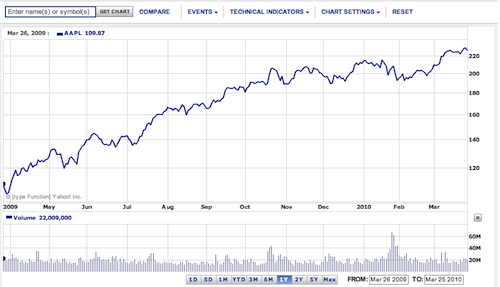
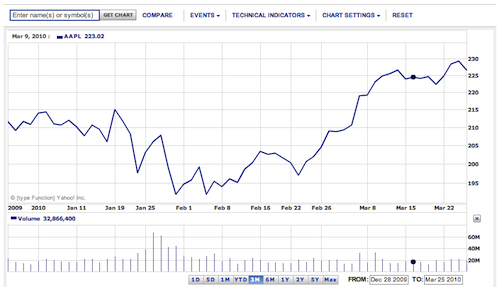
    1) In late December I asked: “Are Apple stock price gains the reason for recent tablet rumors?” Absolutely they were, I assert, and they continue to be as I expressed in last week’s posts: “Be smart, don’t buy into the iPad hype” and “Of course media bias favors Apple.” Apple’s share price has consistently risen with the degree of iPad hype. The stock reached a new 52-week high today, $238.73, before closing at $235.97. Share price is up from $192.06 in late January and $112.71 a year ago.

    2) Early January post “The world doesn’t need an Apple tablet, or any other” stirred up lots of heated discussion. I stand by my reasons, among them the functionality overlap of smartphones below and laptops above. The New York Times is an interesting authority questioning iPad’s consumer appeal, considering the publisher has a prominent — and oft-touted — iPad application. From today’s story, “Doing the iPad Math — Utility + Price + Desire“:

    Many consumers do not understand the device’s purpose, who would want to pay $500 or more for it and why anyone would need another gadget on top of a computer and smartphone. After all, phones are performing an ever-expanding range of functions, as Apple points out in its many iPhone commercials.

    David Pogue expressed similar reservations in his complex iPad review for the Times.

    3) My January post “12 reasons why I won’t buy an iPad” stirred up Betanews readers to comment. I now have a companion in iPad crime. Today at BoingBoing, Cory Doctorow posted: “Why I won’t buy an iPad (and think you shouldn’t, either).” Hell, that reads like one of my snarky headlines. Doctorow sees iPad as more suitable for general consumers than computer aficionados and packing unwanted usage restraints, like DRM that prevents sharing of content like comic books. From the post:

    The real issue isn’t the capabilities of the piece of plastic you unwrap today, but the technical and social infrastructure that accompanies it.

    • If you want to live in the creative universe where anyone with a cool idea can make it and give it to you to run on your hardware, the iPad isn’t for you.
    • If you want to live in the fair world where you get to keep (or give away) the stuff you buy, the iPad isn’t for you.
    • If you want to write code for a platform where the only thing that determines whether you’re going to succeed with it is whether your audience loves it, the iPad isn’t for you.

    Over at Fast Company, Trapani throws harder punches: “Only lemmings with no self-control and excessive disposable income buy first generation Apple products, especially in a new gadget category. When they do, they pay the double the price for immature hardware and software.”

    4) In late February, I asserted: “Apple should ban freebees from the iPad App Store.” Many Betanews commenters called the idea simply idiotic. But today I feel vindicated. The whole point of the idea was to establish iPad App Store as a premium service over its iPhone/iPod touch sibling. Clearly, many developers are taking that approach, although some consumers may feel jilted by the price increases.

    Some random examples: NetNewsWire is free for PC and Mac. It’s free or $4.99 (Premium version) for iPhone and iPod touch, but the iPad app costs $9.99. Scrabble is $2.99 for iPhone and iPod touch and $9.99 for iPad. Brushes is $4.99 for iPhone and iPod touch or $9.99 for iPad. Of course there are zillions of free apps, which I still say is money developers are foolishly flushing away, particularly considering the tiny install base come tomorrow compared to iPhone or iPod touch. Low volume is a different business than high volume. It would be better to charge more — with the larger display reasonable justification — and discount later.

    5) About a month ago I asked, “Who should buy the iPad? Hint: People of a certain age (and that’s not you).” I wrote that Apple CEO Steve Jobs “turned 55 on February 24. He’s a Baby Boomer, and iPad is for his generation and that of his parents. It’s computing made easy, with all the basics covered in a device simply and comfortably handled.”

    Yesterday, Forrester Research analyst Sarah Rotman Epps asserted that “the iPad is the right device for the wrong consumer. We think there’s a fundamental disconnect between the design of the device and the profile of the customer who would most benefit from using it.”

    Epps didn’t peg the geriatric set, as I did, but her profile user is similar to mine: “The casual PC user.” Right, like Gramps, who doesn’t need a complicated computer or hasn’t invested in a lot of tech gear.

    By the way, Forrester expects Apple to sell 3 million iPads this year. Epps writes: “In three years, we’ll look back and marvel not at how many units Apple sold, but at the way Apple changed computing…it’s a road map for where computing is going: Curated, cloud-based experiences that are visual and tactile.” I agree with that.

    Copyright Betanews, Inc. 2010


    Add to digg
    Add to Google
    Add to Slashdot
    Add to Twitter
    Add to del.icio.us
    Add to Facebook
    Add to Technorati


  • What does Steve Jobs’ ‘inner circle’ say about Apple?

    By Joe Wilcox, Betanews

    Over at Digital Inspiration, Amit Agarwal asserts there is an inner circle of 10 journalists that get advance review access to hot new Apple products — ah, like iPad. The first iPad reviews appeared overnight, and many of them are quite favorable. The reviews come just days before iPad goes on sale — Saturday 9 a.m. local time here in the United States.

    Agarwal does an excellent job detailing the three-phase process, who is in the inner circle and what are the benefits to Apple. I won’t repeat what he so astutely explains. Read his post. Too much Web content is the regurgitation of what someone else reported, rather than bloggers or journalists doing original reporting. However, Agarwal graciously gave me permission to use the inner circle graphic he created. If you don’t know who these people are, read Agarwal’s post!

    I want to extend Agarwal’s fine analysis and generate some debate about its meaning here at Betanews. On Twitter, Steve Dieke asked me: “Does ‘inner circle’ = ability to control?” To which I responded: The ‘Inner Circle’ posts reviews that are reblogged everywhere. Apple gets big bang promotion, but somewhat controlled.” Hells, bells. One 140-character-limited tweet isn’t space for proper answer. Hence, the post you are now reading.

    Apple’s approach to early reviews of blazingly new products is old school, and then some. At first glance, the approach seemingly defies all the new social media conventions. But from control and personality perspectives, Apple’s approach is understandable.

    Apple CEO Steve Jobs is a cult of personality. Is it surprising then that Apple has an inner circle of reviewers that happen also to be personalities? It’s not so much about the publications but the reviewers. The 10 people are a veritable Who’s Who list of tech reviewers — all personalities with followings. I don’t mean to diss any of these reviewers, particularly as I respect most of them. I’m just spinning this from an Apple perspective — creating a mini-cult of personalities reflecting the larger one. Apple seeks to maximize the impact of the reviews, which it can only hope will be positive, by choosing respected reviewers. Are they impartial? Surely, Apple hopes not. I hope they are — and find many to be reasonably so.

    Apple's 'inner circle' of reviewers

    Then there is the control issue. Early reviews shape the reaction to new products. Microsoft learned this from Windows Vista. Following the disastrous Windows Vista laptop loaner program, Microsoft couldn’t get a break from reviewers. Microsoft’s wide distribution of loaners backfired in a big way, precipitating negative Vista reviews and persistent negative perceptions the operating system could never shake.

    Now compare to Apple, which sends out early review units of hot, new products to a select few. Apple can better control any damaging reviews and maximize any positive ones. In this era of social media and sharing, the approach seems non-sensical. Isn’t more better? Sure, but the more Apple gets comes from other blogs and news sites sharing the few reviews — even big gadget blogs post about early, hot, new Apple product reviews. So Apple can somewhat filter information, while still getting the social media big bang.

    How big is the bang? By mid-afternoon today, BBC, Barons, CNN, Detroit Free Press, Forbes, PC Magazine and Wall Street Journal were among the major mainstream news organizations with iPad review roundups. Then there are the blogs, the blogs, the blogs. The roundups are everywhere. Everyone wants a chunk of the pageviews iPad review roundups will generate (Oh, yeah, maybe somebody cares about regular readers, too).

    All this information dissemination comes with Apple in the best control it can exert short of giving out no early review units whatsoever. Or so I assert.

    Many companies place tremendous emphasize on social media and networking as part of their marketing efforts. However, Apple isn’t buying into social media, because the company can’t control the image, the perception. Apple’s YouTube site is such good example. After years of abandon, Apple recently started populating its YouTube site with iPad videos. Apple wants people watching but not responding — at least not there. Comments are disabled.

    By the way, it’s my experience Apple typically only activates the inner circler for big product releases. Also, the circle of people with iPads is likely larger than 10 when factoring in analysts and other people — and I’ve heard other reviewers have been getting devices today. The inner circle, as I see it, refers to the select early reviewers with permission to write about the product. Fair disclosure, before some commenter makes an assertion: I wasn’t expecting an iPad review unit from Apple, so this post doesn’t reflect any hard feelings on my part. I’m not jealous of the 10 journalists, nor should be anyone else.

    I’ve done my analysis. Now it’s your turn. What do you think about how Apple handles important product reviews or generally disseminates information? Is the company controlling or not? If controlling, too much or not? Please respond in comments, also adding your own questions to the discussion.

    Copyright Betanews, Inc. 2010


    Add to digg
    Add to Google
    Add to Slashdot
    Add to Twitter
    Add to del.icio.us
    Add to Facebook
    Add to Technorati


  • What 1984 Macintosh marketing reveals about iPad

    By Joe Wilcox, Betanews

    The strangest of role reversals is occurring right now as Apple prepares to release iPad on Saturday. In 1984, Apple needed the media and publishers to promote Macintosh. Twenty-six years later, the media and publishers need — or seem to think they do — Apple and iPad. How strange is that?

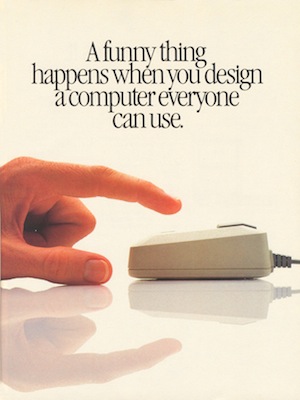
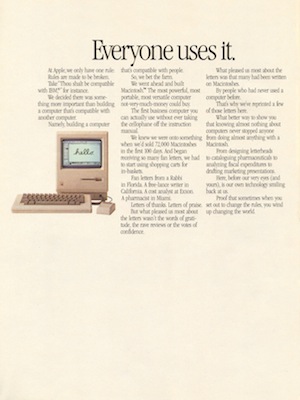
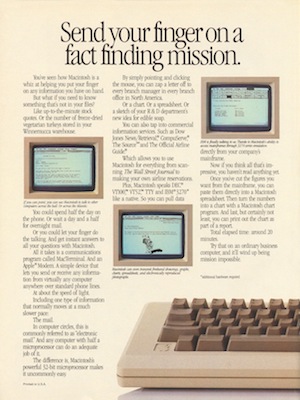
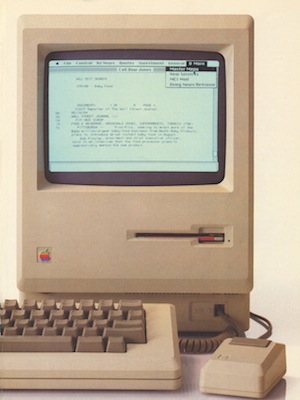
    Apple’s “1984” Super Bowl commercial is legendary advertising. The commercial aired just once on TV, although it lives online in its original form and in many spoofs. But Apple’s Macintosh promotion didn’t stop there. For example, Apple purchased all the ad space — 39 pages — in the Newsweek 1984 election issue. The Graphical User Interface Gallery has scanned and preserved all 39 pages of ads.

    Apple needed the big media splash to launch Macintosh. How strange that with their fortunes waning, it’s big media coming to Apple, hoping that iPad can revive failing print business models. New York Times has an iPad app and Condé Nast reportedly plans to offer six magazinesVanity Fair and Wired among them — on Apple’s tablet.

    According to March 24 Wall Street Journal story “Magazines Use the iPad as Their New Barker“: “Time magazine has signed up Unilever, Toyota Motor, Fidelity Investments and at least three others for marketing agreements priced at about $200,000 apiece for a single ad spot in each of the first eight issues of the magazine’s iPad edition, according to people familiar with the matter.”

    The Journal, which will offer an iPad app for a $17.99 monthly subscription, also is signing up advertisers — six of which have agreed to a $400,000 four-month ad package. “Magazine publishers see the device as crucial to their future as they scour for new ways to make money, with print advertising still under threat,” write WSJ reporters Shira Ovide and Suzanne Vranica.

    Mac Newsweek Ad 1984Mac Newsweek Ad 1984

    Strange Destinies

    While their destinies may once again intertwine, Apple and the media and publishers pursue different paths. Apple is attempting something new, while publishers are doing the same `ol thing. Macintosh was a revolutionary product in its day, as the company hopes iPad will be. Before some smoke-pouring-from-the-ears Betanews commenter can write it, I’ll acknowledge that the slate computer isn’t a new concept, which also can be claimed of the Macintosh in 1984. But, like Macintosh, with iPad Apple is greatly trying to improve the user interface and user experience (UX).

    By comparison, publishers are really trying to apply the print motif they know to a digital medium. The print layout motif hasn’t paid off so well on the Web, but clearly — based on prototypes demoed or leaked — old media and publishers hope to take the familiar and marginally improve it for iPad.

    It’s the only sense I can make of so many publishers committing so much to an untried, unreleased, uncertain product. They know print page layouts, which they can replicate and even improve on a device like iPad. Apple’s slate fits publishers’ comfort zone, which would be the wrong reason for supporting iPad.

    Mac Newsweek Ad 1984Mac Newsweek Ad 1984

    In late-January Advertising Age post “Is the IPad Publishing’s Savior? Pro and Con,” Hill Holliday‘s Ilya Vedrashko expressed:

    This sums up about how I feel about the argument that iPad will single-handedly save traditional periodicals. It’s not enough for the publishers to be thrown a life raft; they will also have to figure out how to last for days without water and how to avoid getting eaten by the sharks (or by each other, for that matter).

    What makes publishers so sure they can do better offering the same motif and means of selling and qualifying ad space? At least on the Web, publishers have tools for analyzing ad reach and effectiveness.

    Apple stays the Marketing Course

    I’ve chided the media and publishers for not adapting — for trying to largely keep but marginally improve the old page-layout motif. Strangely, Apple deserves praise for staying the course somewhere else: Marketing. Macintosh and iPad marketing share a similar aspirational quality. Aspirational marketing defines iPad as much as it did Macintosh 26 years ago. Some comparisons:

    1) Macintosh: “Despite all the amazing technology and engineering genius we’ve put into Macintosh, the most impressive thing just might be what you can get out of it: Magic.”
    iPad: “A magical and revolutionary product at an unbelievable price.”

    2) Macintosh: “A funny thing happens when you design a computer everyone can use. Everyone uses it.”
    iPad: “It’s going to change the way we do the things we do everyday.”

    3) Macintosh: “If you can point, you can use Macintosh, too.”
    iPad: “I don’t have to change myself to fit the product. It fits me.”

    On second thought, maybe Apple hasn’t changed approach that much. Based on original Macintosh and iPad advertising, several UX themes are observable: Magic, simplicity, finger-usage and creativity. If the media and publishers can incorporate some of these concepts into their content apps, perhaps there is hope for them yet. Perhaps.

    [Magazine Ad Scanning Credits: Graphical User Interface Gallery]

    Copyright Betanews, Inc. 2010


    Add to digg
    Add to Google
    Add to Slashdot
    Add to Twitter
    Add to del.icio.us
    Add to Facebook
    Add to Technorati


  • Apple must apply ‘right price, right rights’ model to e-books

    By Joe Wilcox, Betanews

    There are many reasons why iPod and iTunes Store succeeded where competing products failed. But two reasons stand out: Right price, right rights. If iBookstore is to succeed, Apple must apply the same model to e-books and other publications sold there. CEO Steve Jobs and company must seize control of pricing during content negotiations — and, more importantly — rights. There must be a single (and generous), standard usage right for all titles, including magazine and newspapers.

    When Apple launched iPod in October 2001, the “right price, right rights” model was the best possible: Free. Music labels hadn’t locked down CDs with onerous digital rights management mechanisms. Therefore, people could rip music and make their own “mixed tapes” CDs. Meaning — people buying iPod already owned content they could put on the device. Apple wisely chose not to restrict music copying to iPod. The price was free and the rights were unrestricted.

    Other MP3 manufacturers should have benefitted from the same price and rights advantage, but poor PC synchronization plagued many devices. I know. I tested enough competing devices and media playback software in the early “Noughties” to see the problem. By comparison, iPod-iTunes sync worked right from Day One. Apple offered a better user interface — on the device or from the MP3 software.

    When Apple launched iTunes Music Store in April 2003, it did so with uniform pricing and seemingly transparent rights. Singles sold for 99 cents and albums for $9.99. Both prices were magical and right on target, based on consumer surveys conducted by colleagues at JupiterResearch (I was a senior analyst there from 2003-2006). Both prices were lower than CD singles or albums. The rights: Consistent among all tracks with CD burning three times for any playlist and generous copying to iPod.

    By comparison most other digital music stores available then and soon after applied variable pricing and rights mandated by publishers. Varying rights usage — as in how many times a song, album or playlist could be burned/copied to device or not at all — corrupted the user experience. Consumers would buy one song that could be burned once, another song three times and yet another not at all. In my testing of music services and software during the early to mid Noughties, varying rights posed another problem: Synchronization. There were consistent problems syncing DRM content — particularly from different music stores — to music players or burning to CDs. These problems largely contributed to the failure of Microsoft’s PlaysForSure program.

    Apple revolutionized digitally downloaded music by standardizing price and rights for DRM content. Consumers already had consistent pricing and rights from the stuff they owned — or stole from file sharing sites. Apple increased those rights over time, later to five burns per playlist. In February 2007, Jobs called for the end of DRM in an open letter. Publishers would later give broad DRM freedom to Amazon’s competing music store, as leverage against Apple’s growing distribution dominance.

    Today, iTunes music rights are ubiquitous; there is no DRM, so no restrictions. Pricing is variable, however, a concession Apple reportedly made to music labels. In my testing, iTunes Store variable pricing means that buyers pay more than AmazonMP3 store for many singles or albums. I won’t defend the practice, but must point out that Apple could much easier implement variable pricing as a leading music distributor than as one starting out seven years ago. Apple is starting out again, now with e-books.

    Mistakes will Haunt Apple Customers

    The pricing and rights mistakes Apple makes now will haunt iBookstore shelves for years. These apparitions will terrorize consumers browsing the stacks, and no “Ghostbusters” will be able to save them. Apple must get pricing and rights right from Day One, as it did with iPod and iTunes.

    Amazon clearly understands the importance of the “right price, right rights” model — at least applied to e-books. Its approach to selling otherwise free content (like blogs) or newspaper and magazine subscriptions is a more troubled scenario. Until recent, forced renegotiations, Amazon sold popular and new releases for the uniform price of $9.99. Usage rights are consistent, even if restricted compared to physical books. Generous personal usage rights allow buyers to download and redownload e-books pretty much to any device — Kindle, PC/Mac or smartphone — authorized by Amazon’s software. Amazon offers consistent lending rights: None. Consistency helps curtail consumer confusion, but none isn’t enough rights compared to physical books.

    Barnes & Noble offers one-time lending rights for its e-books — kind of. Publishers still control usage rights, which means some titles can’t be digitally lent at all. The rights are restrictive and confusing.

    Apple has opportunity to do for e-books and other e-publications what it did for music. I’m simply stunned that for all the online rumors and speculation about iPad, so little of it is about right price and right rights. Apple has a chance to fundamentally change the e-book/e-pub model, but that won’t likely happen if publishers dictate terms. Amazon was right to seek consistent pricing, either working with publishers or around them. Apple should do better, and out-of-control iPad hype is leverage Jobs and his negotiators should use.

    Apple should be cautious about adopting App Store pricing. Rights are fairly consistent, but developers set prices — or try to. App Store buyers and fierce competition have driven pricing largely to free or 99 cents for the majority of popular applications. Regardless, App Store is a fundamentally different business model. For the market of software applications, there are tens of thousands of competing developers — that despite dominance of a few giants like Microsoft.

    Publishing distribution, including books and music, is largely dominated by a few big publishers or organizations. Microsoft sells software it owns, which people can buy or not from many places. But book and music publishers typically obtain rights to content they didn’t create but can distribute through long-established and limited channels. When moving away from DRM, some music labels initially shut out Apple from DRM-free content. Publishers of the written word have similar clout.

    The time for Apple to lock in the right price and right rights is now. What’s right? It’s probably what publishers won’t want to give: $9.99 for e-book versions of new or popular hardcovers, ubiquitous personal usage rights for any device supporting iBookstore and non-restrictive lending to authorized accounts. Where Apple has DRM today, five authorized PCs/Macs remains the usage rights. Apple should strive for the same usage rights for e-books — and more: Five authorized devices and/or unlimited lending among family members (which could be verified through MobileMe family account).

    So I must ask: What price would you pay for e-books and with what usage rights? Please answer in comments.

    Copyright Betanews, Inc. 2010


    Add to digg
    Add to Google
    Add to Slashdot
    Add to Twitter
    Add to del.icio.us
    Add to Facebook
    Add to Technorati


  • We asked: Did you buy iPad — and you answered!

    By Joe Wilcox, Betanews

    The iPad cometh this Saturday to an Apple Store near you — or in a pretty box delivered to your door. No doubt, this week the rumor mill will again run wild about what to expect. I’ve been wondering about rights usage for ebooks. Can Apple do better than Amazon or Barnes & Noble? That answer is best for a blog post, but not this one.

    March 21 post “Be smart, don’t buy into iPad hype” was 98 percent about blogger, news media and Wall Street bias favoring Apple. I ended the post “by conducting an informal survey, asking simply: Did you buy an iPad?” Nearly all the comments answered that question, rather than address the post’s main topic. That’s perhaps commentary on the topic, my writing, interest in iPad — or all three! I’ve grabbed a sampling of the best comments about preordering iPad. With that introduction, here are your answers to the question: Did you buy an iPad?

    TheLoneDeranger: “My iPad will replace my laptop. It does everything I use a laptop for now, plus it has touchscreen features. It will be better than my laptop for reading books.”

    Maymne: “I’m not buying an iPad, nor do I especially want one…I have an old iPod touch 1G that runs whatever music/games I need and don’t really care for much else.”

    mark_m: “I bought an iPad because I have been waiting for a good multitouch implementation on a good-sized display/touchpad. Apple has shown me that they can do this; none of their competitors has demonstrated this to my satisfaction. Even the closest, Android/Nexus-One, still feels surprisingly clunky compared to the iPhone.”

    rwalrond: “I have not ordered an iPad, but will probably get one for the company in a few months as we decide if we want to create content on it or not. On a personal level, I’m waiting to see how the HP slate turns out before deciding if I want a device like this. I’m thinking I need it when I’m on the road, and I would like to be able to do the same things I can do on my desktop (Yes I still use desktops) so the HP slate may be a better choice for me.”

    Christopher Buckland:

    I find it humorous how a company and its products can totally draw the proverbial line in the sand. Very reminiscent of ‘I’m a Ford man!’, quickly followed by a hearty, Well, I’m a Chevy man!’

    I think the iPad will be a success for one reason: Apple changed the game on everyone else. No longer will tablet PCs be a laptop without a keyboard. They will be big iPhones, or iPhone look-a-likes, or iPhone clones (Thanks nameless Chinese company,) and function the same as their phone cousins, minus the telco thing — ahem…That is what Apple does. They don’t create products for markets, they create markets for products.

    Did I pre-order? Nah. I need a test drive. Buy technology ‘sight unseen?’ Well that is just stupid. What if it sucks? Full refunds are becoming a thing of the past, no need to risk a 15% restocking fee, right?

    Lorenzo Swider: “How is this device better than a $300 Netbook?”

    Mike Robin: “I’ve never been able to afford anything as posh as a Mac, but this may just be in my price range, and their users do appear to be a very jolly crowd.”

    Anastassios Retzios:

    I cannot think of more useless device than a slate, any slate (iPad and the rest). A smartphone can do most of the things I need doing on the road and a convertible tablet/laptop is an excellent instrument for those who have use of finger/stylus input some of the time. In fact, a laptop is far more convenient because of the angle of the screen in watching a movie than any slate. For a ebook readers, LCD screens are simply inappropriate for long-term use. So, to be honest, I cannot see the utility of any slate and more of slates based on phone OSs.

    MGNYC11; “I not only ordered one iPad, but I plan to order another one in a few months when the price drops or the 2.0 version comes out.”

    Kev Payne: Never buying Apple’s tampon, and I will probably heckle anyone I see with one.”

    jweldy:

    I did, I’m a Systems manager. I actually sold two iMacs that I wasn’t using to buy it ‘guilt free’!

    I had originally talked myself out of ordering one, but had a sit down with 3 friends about the pros/cons of the product. I was extremely disappointed by the specs when they first came out, but I read a article someplace (maybe here) that commented on the fact that iPad wasn’t for people like me.

    It was built for people like my mother or niece, people who would never have a traditional computer, but wants to have ease of email, the occasional you tube video, checking the weather, etc…

    But the iPad or any of the other slates coming out this year are an excellent bridge for those of us that do not want for some reason a traditional PC or Mac — like my 82 year old mother who won’t use a computer. Just my 2 cents!

    PDub2: “I don’t see much use for a giant iPod touch. I would definatly consider buying one if it was running the Mac OS, or if I could find any possible use for a giant iPod, but there is not use for a giant iPod, and its not running a real OS so its not worth it.”

    KiltedTim: “I did order one for pickup at my local Apple store…I immediately saw the iPad as what I’d always hoped the PDA would evolve into. It has roughly the same footprint as the Day-Timer I carry now, and is actually about a half pound lighter than the paper planner…I’ve also been a fan of e-books for years…After hours or at lunch, I’ve got a library of entertainment at my fingertips. All this and at $499, I’m not paying significantly more than I did for the Palm TX.”

    Donald Norman:

    If all I had was an underpowered laptop, and was looking for a new device to enhance my life experience – would I turn to the iPad?

    • Its too big to be a ‘take it everywhere’ gaming / productivity device — go iPhone
    • Its size and lack of phone capabilities make it a handicapped communication device — go iPhone
    • Its expense and lack of e-ink make it a poor e-book reader – go Kindle or something — I prefer paper anyway
    • Its size and keyboard make it a frustration as an email / document device — I mean, are there any journalists who are want to blog, let alone craft a published article, using the soft keyboard — Go MacBook Pro
    • It is not robust enough to handle true enterprise class applications or games — go PC

    Comments are open for everyone else who would like to join the “buy” or “not buy” debate.

    Copyright Betanews, Inc. 2010


    Add to digg
    Add to Google
    Add to Slashdot
    Add to Twitter
    Add to del.icio.us
    Add to Facebook
    Add to Technorati


  • Of course media bias favors Apple

    By Joe Wilcox, Betanews

    I have three questions for my Betanews writing colleague Carmi Levy: Do you own a Mac or iPhone? Do you invest in Apple? Did you preorder iPad or plan to buy one next week? For fair disclosure, I am writing this post on a 13-inch MacBook Pro (running Snow Leopard). I don’t own an iPhone (anymore) and I have never invested in Apple (I own no stock whatsoever; I’ll die poorer by my no-conflict-of-interest principles). I ask these questions because he writes: “To set the record straight, from where I sit, the media are not biased toward Apple.”

    Carmi Levy made that — and many other shocking statements — in late Thursday post: “Enough with the Apple bashing!” Eh, what Apple bashing? In my Sunday post, “Be smart, don’t buy into the iPad hype,” I gave clear examples how bloggers, reporters and Wall Street analysts are biased in favor of Apple. My colleague offers no evidence, just innuendo, to support claim that  a “backlash against Apple increases to compensate” for Apple succeeding “where others have failed.”

    My colleague asserts: “Detractors of all things Apple point to initial iPad sales figures as evidence that something is amiss. They claim supporters are manipulating the stats to depict Apple favorably. First off, no one cares about initial sales figures. They may fill editorial space on a slow news day, but they don’t say much about a given device’s long-term chances.”

    If no one cared about early sales figures, why were there so many blog posts or news stories about them? This Google search reveals the enormous number of blogs or news sites following Apple 2.0 post: “Day 1 estimate: 120,000 iPads sold.” This other Google search shows, again, a large number of additional reports following March 15 claim: “150,000 iPads pre-ordered already.” Apparently, lots of people do care, and that’s driven in part by Wall Street’s Apple lovefest. Ongoing rumors about iPad have helped lift Apple’s share price into the stratosphere. Investors have every reason to talk up Apple (OK, except perhaps for nasty short sellers).

    Acts of Faith

    As I write, Apple shares reached another 52-week high today — $231.95. A year ago, Apple shares traded at $109.87. Since early January, Apple shares have rise and fallen — but generally gone up — in tandem with rumors about iPad. The stock actually dipped after the late January iPad announcement (to $192.06) but picked up thereafter (yes, with a few more dips) in tandem with rumors about iPad preorders, preoder availability, rumors about the number of iPad preorders and ongoing rumors about media deals. Rumors, rumors, rumors. Are the majority of these rumor posts or stories negative? Are bloggers, reporters or Wall Street analysts bashing Apple? The majority absolutely are not. The Apple bashing will come later, should iPad fail to meet the expectations set by the hype.

    If anything the news media is obsessed with iPad. March 24 Wall Street Journal story “Magazines Use the iPad as Their New Barker” is a frightening tale of Apple media obsession: “Time magazine has signed up Unilever, Toyota Motor, Fidelity Investments and at least three others for marketing agreements priced at about $200,000 apiece for a single ad spot in each of the first eight issues of the magazine’s iPad edition, according to people familiar with the matter.”

    Apple Shares 3-26-10

    That’s a surprising amount to spend per ad on an untried new media platform with arguably low initial distribution. By the way, Time’s full-page US national rate for print is $287,440 for claimed audience of 19.5 million off a subscription base of 3,372,240. Assuming the rumored first-weekend iPad preorders of 150,000 units are accurate and also subsequent rumors of 10,000 units a day, sales would be about 330,000 units going into launch day — or about 10 percent of Time’s subscriber base. Somebodies at Time and among its advertising customers are putting some big faith in small numbers.

    “Magazine publishers see the device as crucial to their future as they scour for new ways to make money, with print advertising still under threat,” write WSJ reporters Shira Ovide and Suzanne Vranica. There’s desperation and arguably insane business planning.

    Wall Street Journal also is beating on advertisers’ doors, trying to convince them to buy into its iPad app. Ovide and Viranica write:

    Six advertisers, including Coca-Cola and FedEx, have agreed to advertise with the Journal, and a four-month ad package costs $400,000, according to these people. Coke and FedEx declined to comment on terms. The Journal plans to charge subscribers $17.99 a month for iPad subscriptions, according to a person familiar with the matter.

    The Journal plans on charging advertisers less than Time but make readers pay more than they do now: The WSJ Online typically costs $2.87 a week (or about $12.44 a month), but the newspaper is running a $1.99 a week special, or $8.62 a month. So the iPad version will cost almost $10 more a month than the Journal Online. Combined print and online is $2.69 a week — that works out to about $140 a year or $11.67 a month, again less than WSJ for iPad. That is unless WSJ plans to offer online, print or both along with the iPad subscription.

    Kool-Aid Messiah

    What kind of backlash is there in that? I read these media companies’ actions as huge support of Apple’s iPad effort — and with a touch of irrationality, or desperation. Carmi Levy supports his bashing claims by asserting: “Apple-friendly consumers are dismissed as ‘fanboys’ having drunk the Kool-Aid.” Actually this quality has long been assigned to the so-called “Mac faithful,” not mainstream consumers. But that’s not the point. Clearly some media companies and Wall Street analysts have drunk the Kool-Aid, given their seemingly unquestioning faith in the unproven iPad.

    My colleague also states that Apple “CEO Steve Jobs is accused of using his ‘Reality Distortion Field‘ to get customers to buy Apple products without asking so much as a single question.’ The statement is meant as defense of Apple, but I assert the Reality Distortion Field is real. Jobs is a marketing master. Before his recent illness I would categorize a Jobs keynote or new product introduction two ways: When Jobs is having a bad presentation day, people walk out of the venue feeling like if they buy the new “one more thing” product, there lives will be better for it. When Jobs is on fire, making a great presentation, people feel their lives will be worse if they don’t buy the new thing.

    Apple Shares 3-26-10

    Jobs knows how to sell aspiration. Extremely well. That’s what good marketing is all about: Convincing you that greater happiness will come with Product X, Y or Z. Effective marketing often plays off the emotions, not the intellect, and iPad is such a great example. During the late-January product launch, Jobs described iPad as a more intimate way to experience the Web. In Apple’s iPad promotional video, Scott Forstall, senior vice president of iPhone software, makes a nearly identical assertion:  “It just feels right to hold the Internet in your hands as you surf it.” Oh yeah? So people surfing the Web on their iPod touch, iPhone or other smartphone aren’t holding the Web in their hands as they surf it?

    Apple’s iPad Website also describes iPad as a “magical and revolutionary product at an unbelievable price.” Those are loaded, aspirational modifiers. In the iPad promo video, Apple numero uno designer Jony Ive says about the device: “I don’t have to change myself to fit the product. It fits me.” Aspirational marketing is about you and what the product will do for you.

    People who believe this kind of marketing do “drink the Kool-Aid.” They’re rewarded if the marketed product meets or exceeds expectations. There’s reality distortion if the product is less than what the marketing makes it seem; same can be said when bloggers, journalists, media companies and their advertisers or Wall Street analysts are so positive about a product that’s unproven and not even released.

    There’s no Apple backlash. If anything, there’s a new Messiah complex, whether you choose Steve Jobs, iPad or both as savior. Jesus Christ isn’t coming on the clouds from Heaven on April 2nd, not with iPad as second coming. Although, should he or even alien visitors make an appearance next week, perhaps finally something will overshadow out-of-control Apple and iPad hype. Perhaps.

    Copyright Betanews, Inc. 2010


    Add to digg
    Add to Google
    Add to Slashdot
    Add to Twitter
    Add to del.icio.us
    Add to Facebook
    Add to Technorati


  • Windows Phone 7 Series imitates Apple’s iPhone in the worst ways

    By Joe Wilcox, Betanews

    For years, people have accused Microsoft of being an imitator, rather than innovator. Finally there is evidence: The ways Windows Phone 7 Series imitates the very worst of Apple’s iPhone.  Unless there is the strangest of coincidences — like two students having the same wrong answers on a high school history test — Microsoft is imitating Apple, using the same strategy to make the same mistakes. It’s either imitation or incompetence, and out of fairness I assume the former.

    The first imitation is the most baffling: Limited multitasking. Like iPhone, Windows Phone 7 Series will allow multitasking for some of its own applications, but not others. When open but not in use, third-party apps go into a pseudo-off (“dehydrated”) state. By comparison, Google’s Android, Nokia’s Maemo or Symbian OS and Palm’s WebOS all multitask (e.g., run background applications) just fine.

    CNET’s March 8 “Ways Android beats iPhone” expresses my sentiments: “Unlike the iPhone, Android devices like the Nexus One by HTC (pictured here) can multitask and run background processes. And how much do we love that notifications bar? A lot.” As smartphones extend — and someday replace — the PC, multitasking will become a must-have feature.

    Does Microsoft not understand this? People take multitasking for granted on the PC, which will make its absence more  noticeable on the smartphone.

    The Wicked Taskmaster

    Case study: Joe Wilcox. Whenever out and about, I frequently use multiple background applications: Any combination of email, camera, instant messaging, music player or radio, news reader, RSS reader, Twitter or Web browser, among others. Then there are the widgets pulling down live content to the home screen(s). Given the phone’s form factor, there generally can only be one visibly active application. But others run in the background. So it’s possible to talk on the phone (with Bluetooth headset) while taking pictures and sending them to blog, Flickr and Twitter. Surely, other smartphone users reading this post have experienced similar benefits.

    Microsoft’s multitasking — or lack thereof — imitation will look really bad should Apple allow background applications to run on iPhone OS 4.0. Such change would bring iPhone OS on par with other multitasking mobile operating systems and make Windows Phone 7 Series look out of date even before the first devices reach market. Apple has got to do something to chip away at Symbian OS and hold back the Android army. Multitasking would be big.

    To overcome some of the limitations imposed by truncated multitasking but deliver a pseudo-background application experience, Microsoft will follow Apple in another way: Like iPhone, Windows Phone 7 Series will use push notifications. It’s a wild workaround — using push to deliver, say, Facebook, IM or Twitter notifications instead of running the apps or, better, widgets in the background. It’s the difference between sometimes and real time.

    Waste Not, Paste Not

    Another imitation follows something iPhone used to not do but Apple fixed (finally) in iPhone OS 3.x: Copy and paste will be MIA. Windows 7 Phone Series will include a pseudo copy-and-paste feature, that, for example, would “take an address and view it on a map, highlight a term in the browser and do a search or copy a phone number to make a call,” according to a statement from Microsoft. “Instead of the user manually doing a copy and paste in these scenarios, we recognize those situations automatically and make them happen with just one touch.” Right, but what about third-party applications? There’s no copy and paste — pseudo or real — for them?

    That question segues into yet another way Microsoft is imitating Apple. Google and Nokia offer open-source operating systems and applications platforms. Microsoft could copy from their playbook and open the development war chest. But n-o-o-o-o. Microsoft is taking an approach even more closed than Apple. Like Apple, Microsoft is effectively shutting any potential platform competition from third-party developers. Microsoft is doing this by reversing years of development philosophy: Windows 7 Phone Series won’t support native applications. Developers must use the Silverlight runtime for apps and XNA for games. There are claims Flash 10.1 would run natively.

    Microsoft talks big ecosystem with respect to Office, Windows, Windows Server and even Windows Mobile (now called Windows Mobile Classic). What exactly strong Windows Phone 7 Series ecosystem does Microsoft hope to generate without native applications? Mozilla already has cancelled its Fennec browser for Windows Mobile Classic and Windows Phone 7 Series; no native application support is stated reason.  By the way, the Silverlight approach feels like Java in the 1990s. Write once, run anywhere — in this case wherever Silverlight is supported.

    Making Small Sense of Nonsense

    Looked at differently, there’s a strange sensibility to these Windows Phone 7 Series imitations because of how they hang together. From a grand product perspective, why should third-party multitasking be necessary if the only native apps are Microsoft’s? Then there is copy and paste. Last I checked, copy and past isn’t fully supported by Silverlight, which partly would explain limitations imposed on Windows 7 Phone Series developers. Related, as perviously stated: Pseudo copy and paste is for native applications, and they’re only from Microsoft (unless Flash makes the guest list).

    If Microsoft must imitate Apple, how about extending desirable features, like supporting native applications? Apple limits platform competition through the developer terms of agreement. For iPhone developers it’s Apple’s way or the highway. The Windows Phone 7 Series would benefit from imitating Apple’s terms limitations and what Apple, Microsoft (with Windows) and most other major platform developers support: Native applications.

    So what do you think? Is Microsoft imitating Apple? Does multitasking matter? Or is Microsoft treating multitasking just right? Should Windows 7 Phone Series support native apps. Please answer these questions in comments.

    Related Posts:

    One more question: Do you plan on buying a Windows Phone 7 Series smartphone?

    Copyright Betanews, Inc. 2010


    Add to digg
    Add to Google
    Add to Slashdot
    Add to Twitter
    Add to del.icio.us
    Add to Facebook
    Add to Technorati