Author: Joe Wilcox

  • Facebook scores huge branding coup with ‘Like’

    By Joe Wilcox, Betanews

    The most successful brands share several attributes in common. One of the most important: Ownership of a single word that defines the brand. Last week, Facebook made the word “like” its own, in one of the biggest branding coups in decades.

    “Like” is seemingly everywhere this week and associated with Facebook. The social network didn’t just extend the mechanism beyond its territorial borders, but claimed ownership over the word, too. Backed by the social network’s reach and popularity — approaching 500 million subscribers — and Open Graph protocol, the “Like” thumbs-up icon already appears on hundreds of thousands of Web pages outside Facebook. Perhaps then, Facebook’s branding coup is double — not just ‘like’ but the thumbs-up symbol, too.

    I use Tumblr for my Odd Together blog, where the service’s subscribers can like something by clicking a heart. The point: Facebook wasn’t the only social service using a “like” mechanism. By the way, Tumblr rivals Posterous and TypePad have built-in easy support for Facebook Like. Hehe, they like Like.

    Big brands do big business by claiming ownership over a single word. For Volvo it’s “safety.” For, Nike it’s “performance.” For Apple, it’s increasingly “magic.” Barack Obama claimed “change” during his presidential campaign.

    In 2002, Rajendra Srivastava, Emory University Goizueta Business School professor, explained the importance of word ownership. “A brand really lies between the two ears of the consumer. The company owns the physical brand, of course, but the value of the brand really is what it means to the consumer.” What could be more meaningful than like? The word is loaded with positive and personal connotations. “I like you” or “I like this,” with the important emphasis on “I,” which is me (or is that you). Good branding also is about generating good feelings. What could be more good feeling than like, other than perhaps love?

    From a broader branding perspective, word ownership is most potent when it is a verb, meaning there is action behind it. For some brands, like Google or Xerox, the word is the company name replacing a verb. People “Google” instead of “search” or they “Xerox” instead of “copy.” Facebook is never going to be a successful verb, but like already is one.

    Facebook’s Like branding is atypical from a larger marketing perspective. Generally, companies take ownership over a word because they want people to buy something. Facebook wants people to vote for something by Liking it. Around those Likes — and the associated subscriber identities — Facebook is looking to profit from advertising and marketing intelligence services. As good as cookies and other tracking mechanisms are, an identity is much better. Facebook can build demographic profiles around those Likes, which are marketing gold.

    Perhaps the closest atypical word branding campaign to Facebook is Barack Obama’s run for the presidency. How strange, he sought people’s votes, too — wanted more Americans to like him than rival John McCain. The Obama political campaign ran one of the most effective marketing campaigns in US history. Advertising Age named Barack Obama marketer of the year in 2008. In Nov. 5, 2008, AdAge story “What Marketers Can Learn From Obama’s Campaign,” Al Ries explains how Obama came to own “change”. He writes:

    Mr. Obama’s objective was not to communicate the fact that he was an agent of change. In today’s environment, every politician running for the country’s highest office was presenting him or herself as an agent of change. What Mr. Obama actually did was to repeat the ‘change’ message over and over again, so that potential voters identified Mr. Obama with the concept. In other words, he owns the ‘change’ idea in voters’ minds.

    “Change” didn’t come easy. The Obama campaign effectively used social media tools to engage and marshall supporters. In Janaury 2009, PR agency Edelman released report “The Social Pulpit: Barack Obama’s Social Media Toolkit.” The report explains, and to my reading surprisingly effectively, how the Obama campaign converted “everyday people into engaged and empowered volunteers, donors and advocates through social networks, e-mail advocacy, text messaging and online video.” Change was Barack Obama’s message, but social media tools were the means for marshaling volunteers and voters.

    Social media is the other connection to Facebook. An April 1, 2009 FastCompany story explains “How Chris Hughes Helped Launch Facebook and the Barack Obama Campaign.” Hughes created the social networking tools vital to the campaign’s eventual success. Hughes’ now defunct blog offers insight into how volunteers used My.BarackObama.com to establish “35,000 local organizing groups” in all 50 states. Hughes also is one of Facebook’s cofounders.

    Facebook and Barack Obama share somewhat intertwined fates. A Facebook founder created the social networking infrastructure that helped a presidential campaign own the word “change,” and to pull off one of the most successful branding campaigns in American political history. Now Facebook is claiming ownership over “like,” using social networking tools to drive the brand ownership/association. Did Facebook marketers learn something from Hugh’s work on the Obama campaign, or is Facebook CEO Mark Zuckerburg just lucky? He would be the first geek to demonstrate accidental branding brilliance.

    Regardless, Facebook has taken ownership over the word like. Brand marketers around the world wish they could have done something similar. They’ll cash in by association. Facebook Like is going to big marketing.

    Copyright Betanews, Inc. 2010


    Add to digg
    Add to Google
    Add to Slashdot
    Add to Twitter
    Add to del.icio.us
    Add to Facebook
    Add to Technorati


  • Apple closes the revenue, income gap with Microsoft to just $1 billion

    By Joe Wilcox, Betanews

    What a difference 12 months and an accounting change make. As I briefly noted yesterday, only about $1 billion separated Apple from Microsoft results in the first calendar quarter. With so many blogs obsessed about when Apple’s market capitalization might exceed Microsoft’s, perhaps the focus should be on earnings.

    Some people might not understand the significance. The comparisons here are real, because they’re not fudgy market share or market capitalization comparisons. Apple has closed a huge revenue gap on Microsoft and lessened the lead in net income. This year promises the most visceral competition between Apple and Microsoft ever.

    Yesterday, Microsoft announced fiscal 2010 third quarter results: $14.5 billion revenue, $5.17 billion operating income and $4.01 billion net income, or 45 cents a share. On Tuesday, Apple announced fiscal 2010 second quarter results: $13.5 billion revenue and net profit of $3.07 billion, or $3.33 a share. Apple revenue is $1 billion behind Microsoft, while net income trails by a little less — about $940 million.

    The year-ago comparisons show just how far Apple has closed the gap. A year ago, Microsoft reported 13.65 billion revenue, $4.4 billion operating income and $2.98 billion net income, or 33 cents a share. Apple: $9.08 billion revenue and $1.62 billion income, or $1.79 earnings per share. Apple revenue trailed Microsoft by $4.57 billion and net income by $1.36 billion. The bigger gap was obviously revenue.

    In some ways, it’s an, ah, apples and oranges comparison. In fourth calendar quarter 2009, Apple changed its accounting to accomodate a new rule that lets the company realize most iPhone revenue in the given quarter. Before, Apple had to defer that revenue and recognize it over 24 months. Related, Microsoft still defers revenue from annuity licensing, which accounts for about 40 percent of total revenue. Apple gets a big bang that Microsoft defers. However, Microsoft typically realizes about 30 percent deferred revenue per quarter, making differences smaller.

    Still, the $1 billion gap was unthinkable a year ago and unimaginable a half decade ago. In the same calendar quarter of 2005, Microsoft reported revenue of $10.9 billion, operating income of $3.89 billion and net income of $2.98 billion, or 29 cents a share. By comparison, Apple reported $3.24 billion revenue and $290 million net income or 34 cents a share. The difference between the two: $7.01 billion by revenue and $3.6 billion by net income.

    Mac shipments are up from about 1 million units to 2.94 million units over five years (Note: Mac shipments were higher in other recent quarters). In first calendar quarter 2005, Apple shipped 5.3 million iPods compared to 10.9 million in calendar Q1 2010 (which was a decline from recent quarters). But the real difference maker isn’t rocket science: iPhone, which generated $5.5 billion during the recent quarter, or about 41 percent of total Apple revenue — and, of course, the accounting change helped.

    The question: What will happen in second calendar quarter? Or even the third? Wall Street analyst consensus for Microsoft is revenue of $15.24 billion, with an estimate range between $14.59 billion and $15.91 billion. By comparison, consensus on Apple is $13.7 billion with a much broader range of $11.6 billion to $15.08 billion. However, Apple hugely beat the Street during the last two quarters — by $1.46 billion during fiscal Q2. It’s not a stretch of the imagination or reasonable speculation for Apple to close the distance during second calendar quarter or sometime later in 2010.

    Second calendar quarter will be tough competing all the way around. The June quarter is typically Microsoft’s best of the year because of the larger number of annuity license renewals. This year, Microsoft has some spice for the mix: New products launching during second calendar quarter, including Office 2010, and ongoing Windows 7 deployments among businesses. However, much of the annuity licensing revenue will carry forward as deferred revenue.

    Second calendar quarter promises to be big for Apple, too. It’s the beginning of back-to-school buying season, and Apple is banking on iPad and Mac — particularly the tablet — despite public budgets being crimped by the recession’s lingering effects on taxes. Apple upgraded MacBook Pros during the quarter, which should boost laptop shipments. If iPad sales are strong, Apple will likely get a revenue turbo charge but see net income fall. On Tuesday, the company warned that margins would fall to 36 percent from 41.7 percent, in part because of iPad.

    Some people will point out that it’s just one quarter. What about the year? During calendar 2009, Microsoft generated revenue of $58.69 billion. Apple: $41.36 billion. However, for calendar 2010, based on one quarter’s results and analyst estimates for another, Apple has hugely closed the revenue and earnings gap on Microsoft. Because analyst estimates are for fiscal years and Apple’s and Microsoft’s don’t line up, 2010 forecasts are useless for comparison.

    The news media, computer enthusiasts and pundits have railed about Apple-Microsoft competition for years. But for more than two decades Microsoft beat Apple by most every measure. Windows PCs may have the greater market share, but the measure is suddenly outdated. What matters with public companies is revenue and profits. Market capitalization is another measure, but also not a good one because of inflecting differences, like the number of publicly available shares from either company.

    Microsoft has been hugely profitable, but now suddenly so is Apple, by comparison. For all the talk of Microsoft-Apple competition, it’s now starting to manifest in the most meaningful way for any public company: Money.

    Copyright Betanews, Inc. 2010


    Add to digg
    Add to Google
    Add to Slashdot
    Add to Twitter
    Add to del.icio.us
    Add to Facebook
    Add to Technorati


  • Microsoft Q3 2010 by the numbers: Beats the Street, but Apple closes in

    By Joe Wilcox, Betanews

    Recovering IT spending, robust worldwide PC shipments and strong Windows 7 adoption helped Microsoft to beat the Street. The software giant announced fiscal 2010 third quarter earnings, ended March 31, after the Bell, today.

    Microsoft revenue rose 6 percent to $14.5 billion, up from $13.65 billion a year earlier. Operating income: $5.17 billion, up 17 percent. Net income: $4.01 billion, or 45 cents a share. Net income rose by 35 percent and earnings per share by 36 percent year over year. If not for a $305 million deferral related to Office 2010, Microsoft would have reported $14.81 billion revenue.

    For about a year, Microsoft provided no guidance to Wall Street analysts, so there was none for fiscal Q3. Analysts’ average consensus was $14.38 billion revenue and 42 cents earnings per share. Revenue estimates ranged from $13.81 billion to $14.75 billion.

    “Business customers are beginning to refresh their desktops and the momentum of Windows 7 continues to be strong,” Kevin Turner, Microsoft’s chief operating officer, said in a statement. “We are also seeing tremendous interest in our market-leading cloud services for business.”

    Microsoft closed the quarter with $12.3 billion unearned revenue. Annuity license sales grew in the low single digits. The company reported 40 million paid seats for Azure cloud services. During a conference call late this afternoon, Peter Klein, Microsoft’s chief financial officer, predicted “continued strength in hardware shipments,” which would be good for operating system and productivity suite sales. He asserted that across divisions annuity revenue would align with OEM revenue. Klein also emphasized that fiscal fourth quarter is the “season high for our enterprise sales.”

    Coming into the quarter, some analysts and armchair pundits started looking more closely at Apple compared to Microsoft. Unthinkable a year ago, Apple has closed a huge earnings and revenue gap separating it from Microsoft. On Tuesday, Apple announced fiscal 2010 second quarter results: $13.5 billion revenue and net profit of $3.07 billion, or $3.33 a share. In the year ago quarter, Microsoft reported $4.4 billion operating income, $2.98 billion net income or 33 cents a share. Apple: $9.08 billion revenue and $1.62 billion net income or $1.79 earnings per share. Apple made enormous revenue and earnings gains against Microsoft in just one year. The question now isn’t so much if Apple might catch or surpass Microsoft but when.

    Q2 2010 Revenue by Division

    • Windows & Windows Live: $4.2 billion, up 28 percent from $3.5 billion a year earlier.
    • Server & Tools: $3.58 billion, up 2 percent from $3.5 billion a year earlier.
    • Business: $4.24 billion, down 6 percent from $4.5 billion a year earlier.
    • Online Services Business: $56 million, up 12 percent from $50 million a year earlier.
    • Entertainment & Devices: $1.66 billion, up 2 percent from $1.62 billion a year earlier.

    Still, Office and Windows are cash machines, which are getting a boost from recovering PC sales. The really good news came about a week ago from Gartner and IDC, which reported strong double-digit growth in second-quarter worldwide PC shipments. But that wasn’t the big takeaway, particularly for Microsoft. After more than 18 months of sluggish sales, businesses are finally beginning to buy PCs again. For Microsoft, the news likely means an increase in sales of higher-margin professional Windows, which is evident in fiscal Q3 numbers. During the worst of the global economic crisis and the 2008-09 surge in netbook shipments, the sales percentage dramatically shifted to lower-margin consumer Windows.

    By Microsoft estimates, worldwide PC shipments grew by 25 percent to 27 percent, which is inline with numbers from both Gartner and IDC. Netbooks, which typically ship with non-Premium Windows, accounted for 10 percent of shipments. according to Microsoft.

    “With a relatively positive macroeconomic outlook, business demand was more forthcoming,” Mikako Kitagawa, Gartner principal analyst, said in a statement. “Major PC replacement demand driven by Windows 7 will become more apparent in the second half of 2010 and the beginning of 2011.” That’s exactly the kind of forecast Microsoft executives want to hear.

    But that’s the future. The business recovery is still modest compared to consumer sales. In the United States, business PC shipments grew by 10 percent year over year compared to 30 percent for consumers, according to Gartner. There Windows 7, along with aggressive pricing, contributed to unseasonably strong shipments. “Although the first quarter is not typically a strong quarter for the consumer market, growth in the consumer segment was strong,” Kitagawa said in the statement. “The positive economic outlook and affordable system prices drove US consumers to buy more PCs. These purchases either replaced aging PCs or became additions to buyers’ households.”

    Q2 2010 Income by Division

    • Windows & Windows Live: $3.06 billion, up 35 percent from $2.27 billion a year earlier.
    • Server & Tools: $1.26 billion, up 3 percent from $1.22 billion a year earlier.
    • Business: $2.6 billion, down 6 percent from $2.8 billion a year earlier.
    • Online Services Business: Loss of $713 million, up 73 percent from $411 million loss a year earlier.
    • Entertainment & Devices: $165 million, flat from a $41 million loss a year earlier.

    Segment by Segment Results

    Microsoft reports revenue and earnings results for five divisons: Windows & Windows Live, Server & Tools, Business, Online Services and Entertainment & Devices.

    Windows & Windows Live. Revenue rose 29 percent year over year, or by $781 million. The division derives about 80 percent of its Windows revenue from license sales to PC OEMs. OEM license sales increased by 30 percent. OEM premium license mix was 72 percent — 44 percent consumer and 28 percent business. Consumer license sales increased by 35 percent year over year and business licenses by 15 percent.

    Server & Tools. The division is most insulated against economic maladies, because about 50 percent of revenues come from contractual volume-licensing agreements. Product revenue grew 2 percent, or $50 million, buoyed by Windows Server and Enterprise Client-Access License sales. Because of corporate layoffs, Microsoft has seen customers renewing license contracts at lower levels. Annuity license sales were flat year over year, which is somewhat surprising with new products in the pipeline. The division’s services revenue grew by 5 percent, or $34 million. Microsoft put year-over-year server hardware shipment growth in the high teens.

    Business. Microsoft’s other cash cow division reported yet another quarter of revenue declined. Two mitigating factors: 1) A 1 percent decline, or $37 million, in Office 2007 licensing. 2) Deferral of $305 million related to Office 2010 upgrade guarantees. Annuity licensing was flat year over year. However, Microsoft is launching Office 2010 this quarter, which should positively affect Office sales. Incidentally, Office consumer revenue rose 11 percent, or $77 million, buoyed by strong PC shipments.

    Online Services Business. The division’s loss widened, despite ad sales increases. Online advertising revenue rose 19 percent, or by $81 million, to $502 million. Much of the ad sales increases came from search gains.

    Entertainment & Devices. Microsoft shipped 1.5 million Xbox consoles during the quarter, down 12 percent from 1.7 million a year earlier. Non-gaming revenue increased by 14 percent, or $77 million, driven by sales of PC hardware and Windows embedded devices.

    Copyright Betanews, Inc. 2010


    Add to digg
    Add to Google
    Add to Slashdot
    Add to Twitter
    Add to del.icio.us
    Add to Facebook
    Add to Technorati


  • Docs.com: The surest sign yet of Microsoft’s defeat

    By Joe Wilcox, Betanews

    Facebook CEO Mark Zuckerberg made some amazing announcements yesterday, during the f8 conference. Docs.com wasn’t one of them.

    “You can discover, create, and share Microsoft Office documents with your Facebook friends,” according to the service’s Website. What Docs.com really does more is provide Microsoft a lifeline, as the company seeks to maintain the relevance of its Office-Windows-Windows Server applications stack before the rising mobile device-to-cloud applications/services stack. Docs.com is a futile, short-sighted enterprise that acknowledges Microsoft has already lost the new century’s platform wars.

    Facebook: Windows in the Clouds

    For years, I’ve likened Facebook to Windows, blogging in July 2007 that: “Facebook has the potential to become a kind of operating system in the clouds that developers extend and plug into.” At the time, Facebook had 30 million users; the number is closer to 500 million today. In September 2007, I explained further: “Facebook is like Microsoft, only the social networking company’s platform is built on the Internet.”

    More from the September 2007 post:

    Windows is widely regarded as a platform, but that’s a misnomer. The PC is the platform. Windows is nothing without the PC. Windows is a platform, but secondary to the PC platform. Similarly, the Web is a platform (and, yes, arguably secondary to hundreds of thousands of servers). Web 2.0 platform companies like Google operate on the Internet platform.

    But Facebook is different from Google. Facebook is not a Web 2.0 operation; rather it’s more like Desktop 1.0 than Web 2.0. Since May [2007], when Facebook opened up to outside developers, the service increasingly has morphed into an Internet operating system. Like Windows, Facebook is an enclosed platform, and one where people can install applications, post and share digital content and communicate with friends, families or others in ways they might do with Windows on PCs.

    Facebook is also a lot more like Microsoft than it resembles Google, because it’s so-called openness is more of a one-way street. Information goes in, but it doesn’t easily come out. Developers write applications for the one platform, which is different from, say, tapping into Google APIs (application programming interfaces) for use elsewhere. Facebook and Google both take platform approaches, but Facebook’s way is more like Windows than Web 2.0.

    I blogged in December 2009:

    Facebook’s cloud OS, with zillions of applications and more than 350 million subscribers, is now a vortex sucking in seemingly all Internet traffic. Many people who posted to blogs and photo sharing sites are moving their personal information and content to Facebook — like they did Windows a computing generation ago. Facebook has huge customer lock-in potential, because the data is so much more personal than that put into Office and Windows a decade ago.

    Facebook ushers in Web 4.0

    Yesterday, everything changed. Zuckerburg paraded like a young Bill Gates (only with better oration and presence). Facebook’s founder is cocky, arrogant, ruthless and visionary. He outlined a development strategy that would intertwine Facebook into the World Wide Web. It’s brilliant and frightening. Zuckerburg is making the leap from Desktop 1.0 to Web 4.0 — perhaps Platform 3.0 (Mainframe and PC being Nos 1 and 2). Nothing will be the same, if Facebook succeeds — and the company has momentum that’s shock waves should leave Google quaking in their wake.

    According to IDC, there were 1.6 billion Internet users in 2009, with the number expected to reach 2.2 billion by 2013. Facebook will soon have 500 million active subscribers, or — assuming there are no duplicates (unlikely) — nearly one-third the whole population of Internet users. Facebook’s growth far exceeds that of Internet users. In less than three years, the number of Facebook users climbed from 30 million to nearly 500 million. By the way, that 500 million is about half the entire PC install base; many of those Facebook users access the service by mobile device, a market where Microsoft dropped the ball in the end zone.

    Facebook has enormous momentum. Microsoft is aligning its old applications stack with the new one, trying to keep its aging platform on life support just a little longer. Death is inevitable. Deal with it. Yesterday I tweeted: “Docs.com: Old content stack (Office) meets the new one (Facebook). Dunno. There are reasons nature abhors interbreeding of species.” That Microsoft’s FUSE Labs developed Docs.com at all is admission there is a new platform in town.

    Docs.com represents the old content model. Microsoft has good ideas about collaboration, but wrongly binds them to Office. As I asserted in January: “Office is obsolete, or soon will be.” Same can be said about Google Docs. The productivity suite model focuses on how people create content, when along the mobile device-to-cloud applications/services stack the priority is what and where. By aligning Docs.com with Facebook, Microsoft is at least partly dealing with the what and where. But the what still puts too much emphasis on how — meaning productivity suite. Are hundreds of millions of Facebook subscribers creating Word documents or Excel spreadsheets? Do they need to? No and no. They’re sharing photos, videos and messages — none of which requires Office or Docs.com to create. By contrast, Facebook’s Social plugins put the emphasize on the what people create, where they create it and with whom they share it.

    The Facebook in the Mirror

    Things could have been different. Facebook is doing with platforms what Microsoft should have been able to with its applications stack — become part of the very fabric of the Web platform. More startling, chunks of Facebook’s Open Graph vision come from Microsoft’s own HailStorm playbook, such as the single-sign-on concept. Microsoft pitched single-sign-on with Passport a decade ago.

    Facebook also is looking to tie quantifiable information to real user identities, something neither Google nor Microsoft dared to do but were accused of trying. Advertising potential is simply staggering should Facebook successfully leap all the privacy hurdles. Zuckerburg is just arrogant and aggressive enough to try and succeed.

    Docs.com demonstrates much about what is wrong with Microsoft today. The company focuses too much on preserving existing revenue streams when creating newer ones should be the priority. Microsoft’s self-preservation approach compels its developers to bind new technologies to Office or Windows, when they should be set free to embrace standards and help establish others. Microsoft is a follower in a market it once lead.

    Three companies are now positioning for computing dominance — Apple, Facebook and Google. All have a stake in the mobile-to-device applications/services stack. Adobe, IBM, Microsoft, Oracle and Sun were the major players during the desktop-to-server stack’s heyday. Sun declined and Oracle acquired it. Adobe is in early stages of what I predict will later be a suddenly rapid decline. IBM, Microsoft and Oracle are locked in the enterprise, where their computing and informational relevance will slowly decline over the coming decade.

    That Facebook’s Open Graph and other f8 announcements come ahead of Windows Live Wave 4 is foreshadowing. You tell me what Microsoft can launch that will trump what Facebook announced yesterday. Microsoft claims on order of 400 million Live users, a number that seemingly rivals Facebook. But Microsoft subscribers are scattered among disparate Web services. Facebook users are consolidated within a single platform framework, like Windows.

    A few years back, I stood in the pharmacy line behind an old geezer; he complained about buying medicines for his wife. The clerk joked: “Well, you married her for better or worse.” He snarked: “I’ve had the better, now I’ve got the worse!” Microsoft has the worse now, too. Perhaps it’s time for the company to divorce Office and Windows. Sure Microsoft depends on their income, but that won’t last forever.

    Copyright Betanews, Inc. 2010


    Add to digg
    Add to Google
    Add to Slashdot
    Add to Twitter
    Add to del.icio.us
    Add to Facebook
    Add to Technorati


  • Will iPad cannibalize Mac sales?

    By Joe Wilcox, Betanews

    Clearly Apple is preparing for such a circumstance, or that’s my interpretation of last night’s fiscal 2010 second quarter earnings call. The question isn’t if iPad will cannibalize Mac sales but when. If the cannibals are coming, they’ll first strike during back-to-school buying season.

    Apple CFO Peter Oppenheimer tipped off the company’s thinking early in the conference call: “We expect gross margins to be about 36 percent down from 41.7 percent in the March quarter and reflecting approximately $36 million related to stock based compensation expense. We expect about 25 percent of the sequential gross margin decline to be driven by the first quarter of iPad sales.” Whoa, one-quarter?

    “As we said in January when we announced the iPad we have been very aggressive with pricing and are delivering tremendous value to customers,” Oppenheimer asserted. “We think the market for the iPad will be large, and we want to capitalize on our first-mover advantage.”

    There are two intertwined issues related to Oppenheimer’s statements: Mac cannibalization and margins. I’ll start with margins. Whenever Apple launches a new product, the company absorbs additional upfront costs. Apple secrecy means that CEO Steve Jobs announces his “one more thing” product on Day X but availability is Weeks Y or Months Z later. Manufacturing ramps up in earnest after the product announcement, which is atypical of most industries. To get the product from Asia to Western retail, Apple typically absorbs higher upfront airfreight costs.

    This dynamic is one reason why purchasers of new “one more thing” products pay more upfront. Their privilege of being among the first buyers helps to soften the blow Apple’s cockeyed manufacturing and distribution system places on margins. This process is underway now in the United States, and Apple will repeat it in nine additional countries next month.

    Margins Teardown

    Based on various iPad teardowns, the tablet’s base hardware cost ranges from $230 to $300. The teardown by iSuppli puts the $499 iPad product cost around $260 and $348.10 for the $699 model (both are WiFi; 3G models ship next week in the United States). By comparison, Apple makes oodles more on iPhone. Right after iPhone 3GS launched, iSuppli put component cost at around $179. While consumers pay $199 for the smartphone, carrier AT&T subsidizes what Apple charges, which is in the $500-$600 range (ASP is $600, according to Apple, which includes 32GB model). Additionally, falling component prices and economies of scale should put Apple’s iPhone 3GS margins much higher today than June 2009.

    Like iPhone and Mac products, Apple’s base profit for iPad is pretty good. However, the aforementioned higher initial manufacturing and distribution costs sap profits by as much as half (based on my guesstimates). Assuming Oppenheimer is right about iPad demand, greater upfront sales volume would further sap margins, since Apple would pay more to get the product to market before achieving benefits from economies of scale. Higher sales volume would mean lower margins and a lowering of broder Apple margins.

    During yesterday’s Apple conference call, Sanford Bernstein analyst Toni Sacconaghi put startling perspective on Apple’s falling margin guidance and iPad’s contribution to it:

    Let me just switch to one other topic if I may and Peter I think this is probably for you. Bear with me, I’m gonna, I’m gonna just plug through some numbers. You said gross margin is going to decline 600 basis points sequentially in the quarter that would be due to the iPad. So that is 150 basis point negative impact from the iPad.

    If you assume the iPad is 10 points lower gross margin than the company average which is way, way lower than most, you know, third-party tear-down services which it would suggest it basically means for that contribution to be true for your guidance iPad would need to be 15 percent of your revenue or $2 billion. So either iPad is gonna be more than $2 billion in terms of revenue per your guidance for next quarter and have a gross margin that is less than 10 points less than the company average or the gross margins of the iPad are more than 10 points lower than the company average.

    Apple COO Timothy Cook partly dodged, party answered the question, nearly repeating what Oppenheimer said earlier in the call:

    I would point out that when we priced iPad we priced it very aggressively in order to deliver tremendous value to our customers. We think the market size for the iPad is very large, and we want to capitalize on our first mover advantage. So, as we have done in other products, although I am not forecasting it, you can see that we have a good track record of writing down the cost curves with value engineering and volume manufacturing or at least that’s certainly been our experience with other products.

    For iPad to reach 15 percent of revenue, Apple would have to ship 3.3 million units at an average selling price of $600 or 4 million at $500 ASP. The impact on margins would be colossal. But the margin pulldown could be just as strong if Apple shipped 1-2 million iPads, in process cannibalizing some Mac sales.

    Wading the Price Gap

    Until iPad, Apple computer selling prices were quite high, with the $999 white Macbook being entry point for most people to join the elite — some might say elitist — Mac club. In February, I reported that “Nine out of 10 premium PCs sold at retail is a Mac.” Apple sells high and also reaps some of the highest margins in the tech industry. The Mac tablet changes the dynamic. Now, suddenly, the cheapest, functional Mac you can buy is $499, filling a hole between $399 and $999.

    As I explained in a separate late-January post, “iPad fills a gaping hole in the Mac product line between the aforementioned $399 and $999.” Various iPad models sell between $429 and $829.  “Apple now offers portable computers — and that’s how I classify iPhone, iPod touch and iPad along with Macs — ranging from $99 to $2,499. From a pricing strategy perspective, iPad is a brilliant product, because it fills the gap between iPhone/iPod touch and Macbook without price cuts or risk to the Mac’s premium brand status.”

    But there is risk to Mac sales, which would be greater during back-to-school buying season than any other time of year. Suddenly the cheapest Mac that schools can buy costs $499, too. Particularly for K-12 institutions, iPad could be a viable alternative to MacBook, particularly with budgets crimped by the lingering effects of recession on the tax base. Back-to-school buying season would also be the test of iPad’s sales mettle, whether or not the product can succeed or will be doomed to ruin like the Power Mac G4 Cube. Low back-to-school iPad sales would perhaps be worse than many.

    There are positive benefits to consider, as well — schools that: might not buy any Apple product this year, otherwise would purchase Windows PCs or would swap out Macs for Windows computers; because of price. Now they could buy iPad. By whatever measure of increasing sales — higher in general or cannibalizing Mac sales — iPad would crimp Apple margins.

    Yesterday, RBC Capital Markets analyst Mike Abramsky asked the obvious question: “Just wondering why you didn’t see, or whether you expect any touch cannibalization from the iPad and what is your sense or do you think iPad is cannibalizing maybe competitive netbooks?”

    Cook responded:

    I can only tell you in the quarter we finished, Q2 that we finished in March. Although we announced the iPad in January there was nothing obvious in the iPod numbers or the Mac numbers to suggest cannibalization. There is an obvious difference announcing and people know it is coming and it is starting to sell. So that part of the equation we don’t know yet. We will find out. We are thrilled with how the iPad is selling and the enormous response that we have received. We also announced new MacBook Pros that you probably saw last week and the whole line change. So we are also happy about how the Mac business is positioned and the level of product innovation in those notebooks. It is enormous. It is taking battery life up to 10 hours. That is absolutely amazing.

    That’s executive-speak for: “Yeah, we think so but aren’t sure and so don’t want to say for fear of causing a run on Apple shares.” On the one hand, Cook lets be the possibility of cannibalization, while at the same time emphasizing newly upgraded MacBook Pros. The response is oh-so media-trained executive deflection. Media professionals teach executives at companies like Apple to deflect tough questions by ignoring them and shifting focus to strengths.

    Of course, Apple executives expect at least some cannibalization of Macs by iPad. Apple’s iPad pricing tells the story — the aforementioned filling the pricing gap between $399 and $999. Then there is the guidance about margins declines to consider. Cannibalization is inevitable. The questions are: “When?” and “By how much?” Will there be a big surge of iPad orders during back-to-school season or will the lower pricing release pent-up sales among consumers pining for a Mac but unwilling or unable to spend $999? Or both?

    [Editor’s Note: I initially used quotes provided courtesy of Seeking Alpha but corrected them after re-listening to Apple’s FY 2010 Q2 conference call.]

    Copyright Betanews, Inc. 2010


    Add to digg
    Add to Google
    Add to Slashdot
    Add to Twitter
    Add to del.icio.us
    Add to Facebook
    Add to Technorati


  • Apple Q2 2010 by the numbers: Best non-holiday quarter ever

    By Joe Wilcox, Betanews

    Can nothing stop Apple?

    The Cupertino, Calif.-based company’s quarterly earnings again rose high above Wall Street consensus, which already was $600 million to $1 billion above guidance. Today, after the bell, Apple reported $13.5 billion revenue and net profits of $3.07 billion, or $3.33 a share, under the new reporting method implemented last quarter. A year earlier, Apple reported revenue of $9.08 billion and $1.62 billion net quarterly profit, or $1.79 per share. Fiscal 2010 second quarter ended March 27, 2010.

    Three months ago, Apple forecast revenue between $11 billion and $11.4 billion, with earnings per share ranging between $2.06 and $2.18. Analyst estimates were much higher than Apple guidance: $12.04 billion average revenue consensus and $2.45 earnings per share. Apple blew past the Street. Again.

    In a statement, Apple CEO Steve Jobs said: “We’re thrilled to report our best non-holiday quarter ever, with revenues up 49 percent and profits up 90 percent.”

    For fiscal 2010 third quarter, Apple forecasts between $13 billion and $13.4 billion in revenue, with earnings per share ranging between $2.28 and $2.39. Gross margins are projected to be 36 percent, a substantial decline. Apple expects sales of iPad to account for about 25 percent of the gross margins decline. “Customers are loving the iPad,” Apple CFO Peter Oppenheimer said during a conference call late this afternoon. Apple expects to have iPad in nine countries by end of May.

    Tim Cook, Apple’s COO, responded to analyst concerns that either iPad volumes would be higher than expected or margins substantially less than projected. “We priced it very aggressively,” he said. “We think the market size of the iPad is very large, and we want to capitalize on our first-mover advantage.”

    My interpretation: Apple could be anticipating that iPad will cannibalize some Mac sales and/or high iPad sales volume during the back-to-school buying season. “There was nothing obvious in the iPod numbers or the Mac numbers to suggest cannibalization,” Cook said. However, he observed that iPad’s announcement in January may not have affected sales the way the released product might. “That part of the equation, we don’t know yet.”

    Q2 2010 Revenue by Product

    • Desktop: $1.53 billion, up 45 percent from $1.06 billion a year earlier.
    • Portables: $2.23 billion, up 17 percent from $1.8 billion a year earlier.
    • iPod: $1.86 billion, up 12 percent from $1.67 billion a year earlier.
    • Music: $1.33 billion, up 27 percent from $1.05 billion a year earlier.
    • iPhone: $5.5 billion, up 124 percent from $2.43 billion a year earlier.
    • Peripherals: $472 million, up 32 percent from $357 million a year earlier.
    • Software & Services: $634 million, up 1 percent from $626 million a year earlier.

    Apple shipped 2.94 million Macs during the quarter, for 33 percent year-over-year growth. Wall Street consensus was around 2.7 million.

    While Apple posted strong year-over-year results, units and revenue sequentially declined in nearly every segment — not surprising given the holiday quarter’s strong sales. However, Oppenheimer said sequential declines were smaller than is typical.

    Apple’s gross margin was 41.7 percent, up from 39.9 percent a year earlier. International sales accounted for a stunning 58 percent of revenue. Apple ended the quarter with $41.7 billion in cash, up from $39.8 billion three months earlier. Priority for cash is “preservation of capital,” Oppenheimer told financial analysts today.

    Q2 2010 Unit Shipments by Product

    • Desktop: 1.15 million units, up 40 percent from 818,000 units a year earlier.
    • Portables: 1.8 million units, up 28 percent from 1.4 million units a year earlier.
    • iPod: 10.9 million units, down 1 percent from 11 million units a year earlier.
    • iPhone: 8.75 million units, up 131 percent from 3.8 million units a year earlier.

    iPhone. Apple shipped — what company executives really mean by sold — 8.75 million iPhones worldwide during fiscal second quarter. A year earlier, Apple shipped 3.8 million iPhones. Apple shipments into the channel are usually several million units higher than numbers released by Gartner, which measures actual sales. During the quarter, iPhone was available from 151 carriers in 88 countries.

    Wall Street analyst estimates ranged from about 6 million to nearly 9 million units. Revenue rose 124 percent year over year, giving the biggest boost to Apple’s quarter. The smartphone and supporting services accounted for about 41 percent of total Apple revenue.

    Computers. Apple shipped 2.94 million Macs during the quarter, up from 2.6 million units a year earlier. Wall Street consensus ranged from about 2.78 million to 3.4 million shipments worldwide, with consensus around 2.7 million. Oppenheimer said Apple ended the quarter with about three-to-four weeks of inventory in the channel.

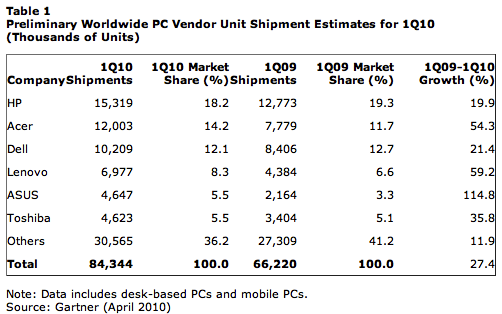
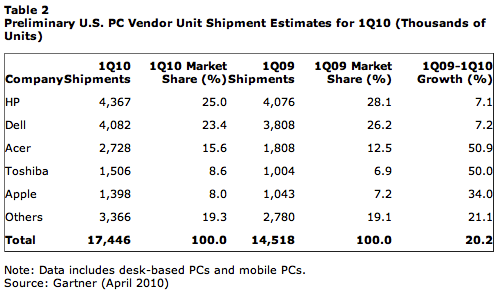
    Last week, Gartner and IDC released preliminary first calendar quarter PC shipment data. In the United States, Apple shipped 1.4 million computers, for 34 percent year-over-year growth, according to Gartner. However, IDC put Apple shipments lower, at 1.1 million, with growth a much lower 8.3 percent.

    Q2 2010 Revenue by Geography

    • Americas: $5 billion, up 26 percent from $3.9 billion a year earlier.
    • Europe: $4.05 billion, up 63 percent from $2.5 billion a year earlier.
    • Japan: $887 million, up 51 percent from $587 million a year earlier.
    • Asia Pacific: $1.89 billion, up 184 percent from $665 million a year earlier.
    • Retail: $1.7 billion, up 22 percent from $1.4 billion a year earlier.

    Apple ranked fifth in the United States, falling yet another place, with 8 percent market share, down 7.2 percent year over year, according to Gartner. But IDC reported that Apple’s market share declined to 6.4 percent, from 7.2 percent. Just two years ago, Apple had risen to third place in US PC shipments. However, despite all the hoopla about increasing Mac sales, Apple US ranking declined, with risk the company might fall back out of the top five in some future quarter.

    Gartner and IDC won’t tabulate Apple’s worldwide ranking until the final figures are released, and generally the information is not publicly available. But the last time I could get data, Q3 2009, Apple ranked No. 7 in worldwide PC market share, according to IDC.

    iPod. Apple shipped 10.9 million iPods during fiscal second quarter, down from 11 million a year earlier. Analyst consensus for Q2 was around 9.4 million units. While units declined, revenue rose 12 percent from a year earlier.  Oppenheimer described iPod growth as the strongest in two years.  Apple ended the quarter with about four-to-six weeks of inventory, on par with projections. The iTunes Store ended the quarter with a library of 12 million songs.

    Q2 2010 Unit Shipments by Geography

    • Americas: 971,000 units, up 20 percent from 809,000 units a year earlier.
    • Europe: 899,000 units, up 37 percent from 658,000 units a year earlier.
    • Japan: 129,000 units, up 18 percent from 109,000 units a year earlier.
    • Asia Pacific: 338,000 units, up 67 percent from 202,000 units a year earlier.
    • Retail: 606,000 units, up 38 percent from 438,000 units a year earlier.

    Retail. Revenue rose 22 percent year over year, with Apple retail stores selling 606,000 units, compared to 434,000 a year earlier. Apple opened three new stores in the quarter, for a total of 286 retail outlets worldwide. There was an average 284 stores open in the quarter, with average revenue of $5.9 million compared to $5.5 million a year earlier. Sales rose by average 8 percent per store. Apple retail stores had 47 million visitors during the quarter up 20 percent from 39.1 million a year earlier. Apple expects to open 40-50 new stores during fiscal 2010.

    Copyright Betanews, Inc. 2010


    Add to digg
    Add to Google
    Add to Slashdot
    Add to Twitter
    Add to del.icio.us
    Add to Facebook
    Add to Technorati


  • Apple should sue Gizmodo over stolen iPhone prototype

    By Joe Wilcox, Betanews

    Gizmodo was wrong to acquire a lost iPhone prototype — quite likely a nearly finished version 4 design — let alone pay to obtain it. Perhaps this marks the distinction between bloggers and journalists. I would have contacted Apple about returning a device so obviously stolen. There is grave difference between obtaining secret information for the public good and what Gizmodo did: Obtain property containing trade secrets belonging to a public company. Gizmodo has violated the public trust and broken the law. Free speech isn’t a right to pay freely for something clearly stolen.

    I typically reserve this kind of treatise on journalistic ethics for my Oddly Together blog, where in late March I posted “The Difference Between Blogging and Journalism.” Betanews founder Nate Mook asked me to write something here about the journalistic and legalistic ethicacy of Gizmodo’s actions. I simply couldn’t refuse.

    Earlier today, long-time Mac journalist Jim Dalrymple and I discussed the story. I asserted then, as I will here, that Gizmodo broke the law by obtaining stolen property and, related, by paying for an unreleased Apple product that disclosed trade secrets. The latter violates good journalistic practice, at the least.

    Gadget geeks’ desire to know doesn’t supplant a company’s right to protect millions of dollars invested in developing a product or preventing millions of dollars lost by the leakage of product designs or plans to competitors. Gizmodo did more than cross the line here. The blog lept a chasm no less wide than the Grand Canyon. The legal ramifications could, and quite probably should, be as deep.

    The flow of events isn’t complicated to follow:

    1. On March 18, someone left in a bar what later appeared to be a next-gen iPhone prototype or near-finished device.

    2. Someone else stole the device. Stolen is appropriate description because the device had been left in a public place — presumably by accident — and clearly belonged to someone else.

    3. Gizmodo obtained the stolen smartphone by paying cash  for it; Gizmodo’s Jason Chen got access to the device around seven days before posting information about it.

    4. Today, Gizmodo posted pics and videos and offered some device teardown that reveals to competitors much about Apple’s plans for the next-gen iPhone.

    5. The phone’s seller sought to profit from the sale of the stolen property, while Gizmodo sought to profit from the pageviews that photos, videos and blog posts would generate.

    [Editor’s Note: This post presumes that the iPhone prototype is the real thing and not a fake.]

    A Clear Case of Theft

    There are two primary questions regarding Gizmodo’s actions. Did it break the law and did it violate good journalistic prudence — assuming anyone would apply ethics to a new media blog. Let’s start with the trade secrets.

    California’s “Uniform Trade Secrets Act” is unambiguous, partly defining “trade secret” as “information, including a formula, pattern, compilation, program, device, method, technique, or process.” The Act uses several definitions of “misappropriation,” of a trade secret with one being: “Acquisition of a trade secret of another by a person who knows or has reason to know that the trade secret was acquired by improper means.”

    An unreleased phone accidentally left in a bar and sold to Gizmodo surely qualifies as acquisition “by improper means.” Proper means would be purchase of the device from Apple, following its public release. What about theft? According to Section 485 of the California Penal Code:

    One who finds lost property under circumstances which give him knowledge of or means of inquiry as to the true owner, and who appropriates such property to his own use, or to the use of another person not entitled thereto, without first making reasonable and just efforts to find the owner and to restore the property to him, is guilty of theft.

    There’s nothing unambiguous about that. According to Gizmodo, Apple software engineer Gray Powell accidentally left the iPhone on a bar stool. The person later obtaining the device sat next him. By my reading of the law, the finder is guilty of theft and likely so is Gizmodo by paying for the Apple smartphone. Estimates range between $5,000-$10,000, but who knows?

    Yellow Blogging

    Gizmodo is part of the Gawker family of, arguably quite successful, Weblogs. On his twitter page, Gawker publisher Nick Denton‘s bio reads: “Gossip merchant,” which says much about the news philosophy behind Gizmodo and other Gawker properties. In a Denton memo to employees last week, he wrote: “The staples of old yellow journalism are the staples of the new yellow journalism: sex; crime; and, even better, sex crime. Remember how Pulitzer got his start: http://en.wikipedia.org/wiki/Yellow_journalism.” I call its reincarnation “yellow blogging,” as gossip and rumor blogsites ruthlessly compete for pageviews — such as the well-publicized competition between Engadget and Gizmodo.

    In the memo, Denton outlined eight attributes that drive pageviews: “Scandal sells”; “the pseudo exclusive”; “drama”; “visuals”; “explainers”; “don’t rubbish the headline”; “parody”; and “inside baseball.” So far, the stolen iPhone story has seven — eight, if I missed parody somewhere. Gizmodo has carefully unfolded the story, like today’s “How Apple Lost the Next iPhone,” over several posts, with supporting pics and videos. Clearly the goal is to maximize pageviews, which have topped 3 million perhaps on their way to 5 million or more.

    In many ways, this post isn’t easy for me to write. I highly respect Denton for his success managing Gawker through the economic downturn and bringing back some of the drive to break stories. But there’s breaking news and breaking the law. It’s not like Gizmodo turned up a whistleblower revealing that iPhone causes brain cancer or that Apple uses 8 year-old boys on the manufacturing line. It’s the difference between what does and does not qualify as free speech or the free press.

    According to the California Uniform Trade Secrets Act:

    Nothing in this section shall be construed to limit, restrict, or otherwise impair, the capacity of persons employed by public entities to report improper government activity, as defined in Section 10542 of the Government Code, or the capacity of private persons to report improper activities of a private business.

    Nowhere does the Act say that journalists may “misappropriate” trade secrets for personal or company gain.

    An Ethics Lesson

    Tech pundit Andy Ihnatko put the right ethical and legal response in the right perspective in a blog post earlier today:

    I would have thought very hard and then gone with my first impulse: return the phone to Apple. If it’s been stolen, then Apple is the victim of a crime and the ethical answer is to side with the victim…If I was told that this phone had been found in a bar, I would have assumed that it had been stolen from Apple. Same result. And if the ‘finder’ wanted some sort of fee for this device, then I would have brought law enforcement into the discussion.

    That kind of situation is so shady that no journalist with an ounce of sense would come anywhere near it. Even if you could get past the professional ethical dilemma and your ethical dilemma as a human being — look, smart people aren’t confused about how to react when someone tries to hand them a knife wrapped in a torn and bloody UPS uniform and asks them to hide it for a couple of weeks. I don’t mind these problems that you have to discuss with your editor. But I try to avoid the sort of problems that result in a conversation with a criminal defense attorney.

    I wholeheartedly agree. But I fall on my ethics as a Roman might fall on his sword. I’m a lowly freelance journalist. Yellow blogging is where the money is. That said, justice may come in the form of Apple’s retribution. Today at TechCrunch, MG Siegler appropriately stated Gizmodo’s legal situation:

    It may be the most high-profile hardware leak of all time from any company. If there has ever been anything that will draw the wrath of Apple’s legal team, this would seem to be it. And yet, if Gizmodo (or its parent, Gawker) have gotten a take-down notice, they haven’t let it be known yet. It’s possible, and likely even probable, that Apple is taking this as something worthy of action much more serious than the fairly common takedown notices the company sends from time to time.

    Apple may have plenty of legal recourse. According to section 3426.3 of the California Uniform Trade Secrets Act:

    A complainant may recover damages for the actual loss caused by misappropriation. A complainant also may recover for the unjust enrichment caused by misappropriation that is not taken into account in computing damages for actual loss.

    Apple has sued over stolen trade secrets before, such as one lawsuit in 2004 against an “unknown individual” for leaks related to the Power Mac G4 Cube. In 2005, Apple sued several bloggers over release of trade secrets. The resulting settlement led to rumor site ThinkSecret’s closure. Surely, Apple would and should take action against the “most high-profile hardware leak of all time from any company.”

    Denton is a new media mogul and cult personality in his own right. Steve Jobs and Apple may find Denton and Gawker to be formidable opponents. Perhaps that’s the win-win Denton sees. He gains scads of pageviews from the iPhone leak, while with a lawsuit opportunity to publish an ongoing blow-by-blow account about the Apple legal skirmish. If there was ever going to be a truly public Apple legal battle, Gawker would be it. Who says blogging doesn’t pay?

    Copyright Betanews, Inc. 2010


    Add to digg
    Add to Google
    Add to Slashdot
    Add to Twitter
    Add to del.icio.us
    Add to Facebook
    Add to Technorati


  • 10 questions to ask before buying iPad

    By Joe Wilcox, Betanews

    On Friday night, I bought an iPad nearly three months after giving 12 reasons why I wouldn’t. An unexpected reason came up: My wife’s MacBook Pro died. I reckoned she could temporarily use the tablet (which cost way less than any new Mac laptop) and give me a chance to better test the device (than using the Apple Store display models). I’m not among Apple’s inner circle of reviewers, nor on any of its other reviewers’ lists. I’d have to buy an iPad to test one and pay the restocking fee should I decide not to keep it. The MacBook Pro failure presented reason to join the iPad Generation.

    Before getting to those 10 questions to ask, first it’s the story of the failed MacBook Pro. I bought the computer used — somewhat scratched and nicked but in excellent operating condition — in summer 2009. Early last week, the laptop started acting strangely, with scrolling display or pixelated frozen screen that required reboot. Thursday, the computer rebooted to kernel panic — Apple’s version of the Windows blue screen of death — every other reboot before freezing up again. So I hauled the ailing laptop into the local Apple Store, expecting prognosis that the graphics chip had failed; I’d already read on the InterWeb that generation of nVidia graphics chip was defective.

    At the Apple Store, the Genius confirmed what I expected but said something I didn’t. The graphics chip is the only part “covered out of warranty,” which in Genius Bar lingo meant free repair. Apple would replace the logic board. After handing over my wife’s vintage 2008 MacBook Pro, I took another look at iPad, which I really wasn’t interesting in buying (Hey, I gave 12 reasons why not, remember?). But I often swap computers, operating systems, cell phones and other gadgets to break up my routine, to minimize falling into habits. The finger-licking-good user interface certainly would disrupt how I normally interact with a computer. So I decided to buy an iPad. What’s 700 bucks between frienemies? But there were none in stock. No problem. An Apple Store employee took my name to reserve one for whenever more shipped in.

    Next day, I got email that my iPad was waiting. Whoa, that was fast. I bought the 64GB WiFi model hours later, using money from my meager tax refund. My wife and I both used the tablet over the weekend, but she less time than either of us expected. About 6:15 Sunday evening, someone from the Apple Store called to say that my wife’s laptop was ready for pick up. Whoa, that was pretty good service. Turnaround was less than 72 hours after I had been told the repair would take five-to-seven days.

    Based on my early iPad usage, I’ve formed some questions potential buyers should ask when considering the big purchase. I’m not ready to review or even recommend iPad, and I may yet return the device. It’s an expensive toy for my budget, fun as iPad may be to use. Now for those questions:

    1. Can you rub your tummy, wave your hand, chew bubblegum and blink your eyes at the same time? If so, iPad isn’t for you. The device is a multitasking-free zone. OK, some Apple applications kind of work at the same time — on par with rubbing your tummy and chewing gum together. But iPad is, for now, mainly a one-thing-at-a-time device, which is one of several reasons why in early March I singled out the 55-and-older set as a viable market segment.

    2. Do you watch videos at places other than YouTube? If so, forget iPad. For me, the device generated scathes of frustration because the browser doesn’t support Adobe Flash. Just try watching videos at MTV.com, Engadget or any (other) WordPress.com site using the built-in video streaming service. They’re Flash-based, baby, so they poop out using iPad’s mobile Safari.

    Apple has gone on the offensive against Flash, and Macheads have joined in, justifying the attack. What a load of crap. For all the BS about Apple protecting the user experience, Flash is all over the Web. The Flash flap is like Apple releasing a digital-only TV four years ago and arguing that analog is inferior and has a monopoly on broadcasting standards. Digital is better, so Apple won’t support analog. This is exactly the kind of argument applied to Flash, ignoring it is the major means by which video is delivered over the Web.

    3. Do you like to eat with your fingers? Then iPad is for you. The Apple demos don’t lie. The tablet is pure finger food. Are you ambidextrous or would you like to be? Apple is a two-handed device, if rightly used. Think “Minority Report” for the kind of sweeping movements that make iPad fun to use and a remarkably more productive tool than mouse and keyboard.

    4. Do you have trouble managing your inbox? I sure as hell do. The mail just piles up for months before I finally get around to deleting and filing. On Saturday night, I cleaned up about six months of @me.com email, using iPad. It was unfraking believable. Using my fingers, I blew through the work in about one-third the time of using keyboard and mouse. Bee-Jesus!

    5. Did you rebuy music or movies you already purchased to get the content in a new format? You know, moving from vinyl to CDs or VHS to DVD or DVD to Blu-ray (or, gasp, defunct HD DVD). If so, you’ll be primed to rebuy many iPod/iPhone touch apps as iPad versions, which typically cost more in the larger formatted size. Not only will you pay twice, but higher price, too. Welcome to the iPad economy!

    6. Do you like to read while sitting on the toilet? Wonderful, iPad is the ideal bathroom reader. You can choose from e-books, magazine apps or the Web —  even watch a TV show or (gasp!) movie if you need that long in there.

    7. Is your music library bigger than a cereal box? Mine is 78GB of music, and video content consumes a little more. The iPad offers storage capacity of 16GB, 32GB or 64GB, which is underwhelming for big content consumers. Since there are no USB ports, digital content stored on portable drives isn’t a real solution either. Streaming music could be an option while you work, but — whoops — Apple prohibits third-party apps like Pandora from doing so.

    8. Have you pined for an Apple laptop but couldn’t justify, or afford, $999 for the white MacBook? Well, well, for half that price iPad could be yours. It’s the cheapest Mac you can buy. The tablet easily provides more than 90 percent of everyday portable PC functionality — better than a Windows netbook, in my testing. But there is the puny storage (16GB) for $499, Flashless browser, no peripheral ports (OK, Apple sells extra-cost camera and VGA adaptors) and singletasking to consider. But if you can live with these compromises, iPad has plenty of appeal. The screen is so beautiful, you will want to lick it (and your fingers, too).

    9. Do you enjoy reading bulky magazines, like Brides or the old Computer Shopper? Then you’ll love iPad for its heft, on the order of a later series Harry Potter book, but, of course, nowhere as thick. The iPad measures 24.28 cm by 18.97 cm by 1.34 cm (9.56 inches by 7.47 inches by .5 inches). The WiFi model is .68 kg (1.5 pounds) and the 3G model .73 kg (1.6 pounds).

    For my tastes, iPad is too large, about as long as a hardcover book and much wider, by about 3 cm. The black border surrounding the viewable part of the screen is about 2 cm around. By removing the border, iPad’s length and width would be about the same as a hardcover book. The iPad doesn’t compare well to ultra-thin, electronic paper screens, making it not nearly as “revolutionary” as advertised. In two or perhaps three years, Apple will unveil an iPad nano that is super thin with smaller dimensions.

    10. Do you travel often by air and find annoying and time wasting the security process of removing your laptop from its bag? Like me, perhaps you worry about notebook theft while going through the security line. If the answer is yes, iPad could save you time and troubles. In the United States, the TSA has deemed iPad as security check-in friendly. You can leave it in your bag. Yesterday, Altimeter Group analyst Michael Gartenberg tweeted: “Going through security with iPad was a breeze. Easiest pass through since 9/11. Nice to lose five pounds that quickly.” That could be you!

    Wrapping up, do you have any questions to ask about iPad or perhaps others you think potential buyers should ask? Please offer them in comments. As for my iPad, I’m still weighing options. If you live in the San Diego area and would settle for a slightly-used Apple tablet, make me a reasonable offer.

    Copyright Betanews, Inc. 2010


    Add to digg
    Add to Google
    Add to Slashdot
    Add to Twitter
    Add to del.icio.us
    Add to Facebook
    Add to Technorati


  • Has Apple gone too far?

    By Joe Wilcox, Betanews

    Pundits are chattering about some, ah, aggressive moves by Apple with customers and partners over the last couple of weeks. Rather than opine on the subject, I’d like to ask you to do so. I’m looking to write a future post with Betanews reader reactions about Apple’s recent actions and to a surprisingly active CEO Steve Jobs — he sure sent out lots of email responses lately; from iPad, perhaps, :).

    I’m most interested in responses from developers and content creators, which are two groups most affected by Apple’s action. I ask anyone who wants to comment anonymously but to be taken seriously — or those people wanting to open a larger dialog — to contact me by email: joewilcox at gmail dot com. Everyone else, please feel free to comment below.

    To set the stage, I’ll lay out some of the issues and reactions already vetted by the Web community. Among the topics:

    1. Apple’s newly revised developer agreement that prohibits cross-compilers and private APIs, effectively shutting out workarounds that might have allowed Adobe Flash and other development platforms on iPhone OS 4.x.

    2. Apple’s very public squabble with Adobe about Flash on iPhone OS 4.x.

    3. Apple’s use of private APIs on iPad, such as for iBooks, that some developers claim give the company unfair advantage over them.

    4. Apple’s position on third-party advertising on iPhone OS 4.x. Apple spokespeople had indicated that third-party advertising would be allowed. But the developer agreement seemingly prohibits the kind of data collection essential to advertising. Apple’s iAd platform operates without the restrictions.

    5. The prohibition of the word “pad” in applications’ names, because Apple has acquired a trademark for “iPad.”

    These moves are unquestionably aggressive, but are they justified? The general consensus among pundits is largely split. Some people argue that Apple has every right to protect its platform, thus keeping the customer experience as pure as possible. Others argue that Apple has overstepped the bounds and looks more and more like Microsoft during the 1990s — dictating terms to customers, developers and partners for its own benefit first. Let’s briefly look at some of the pundit reactions to each of these moves:

    1. Prohibition of Cross-compilers and Private APIs

    Machead John Gruber:

    What Apple does not want is for some other company to establish a de facto standard software platform on top of Cocoa Touch. Not Adobe’s Flash. Not .NET (through MonoTouch). If that were to happen, there’s no lock-in advantage. If, say, a mobile Flash software platform — which encompassed multiple lower-level platforms, running on iPhone, Android, Windows Phone 7, and BlackBerry — were established, that app market would not give people a reason to prefer the iPhone.

    And, obviously, such a meta-platform would be out of Apple’s control…So from Apple’s perspective, changing the iPhone Developer Program License Agreement to prohibit the use of things like Flash CS5 and MonoTouch to create iPhone apps makes complete sense.

    SmugMug CEO Don MacAskill:

    What do I think? I love it. And I’m surprised more developers, end users, business leaders, and general web standards lovers everywhere aren’t posting about how great this is…Finally, finally, someone has stepped up and done something about the de-facto Flash monopoly. Flash has helped the web and HTML standards to stagnate. It’s sorta like a drug…it smashes through web paradigms left and right. Why? Because there’s no competition…

    The iPad is already spurring HTML5 adoption even faster than before. Witness all the video and games sites that are already scrambling to announce and ship their HTML5 interfaces. Bring it on!…Best of all? It weeds out poor developers. And if the iPhone SDK and HTML5 aren’t your thing — go build somewhere else. I’m sure there’ll be another computing revolution in a decade or two that you can ignore yet again.

    2. Apple-Adobe Squabble

    Steve Jobs, in reply to developer Greg Slepak about the Section 3.3.1 changes: “We’ve been there before, and intermediate layers between the platform and the developer ultimately produces sub-standard apps and hinders the progress of the platform.” Jobs also separately replied: “We think John Gruber’s post is very insightful and not negative”; it’s linked in #1 above.

    Adobe platform evangelist Lee Brimelow, responding to Apple’s Flash position:

    What they are saying is that they won’t allow applications onto their marketplace solely because of what language was originally used to create them. This is a frightening move that has no rational defense other than wanting tyrannical control over developers and more importantly, wanting to use developers as pawns in their crusade against Adobe. This does not just affect Adobe but also other technologies like Unity3D…

    Personally I will not be giving Apple another cent of my money until there is a leadership change over there. I’ve already moved most of my book, music, and video purchases to Amazon and I will continue to look elsewhere.

    3. iPad Private APIs

    Tumblr lead developer Marco Arment:

    iBooks’ use of tons of private APIs is frustrating on a few levels, the biggest that it makes all third-party reading-related apps second-class citizens. I won’t be able to offer some features that iBooks has (such as a true brightness control), but my customers will expect them, making my app inferior to Apple’s in key areas.

    This app’s undocumented API use wouldn’t pass the App Store submission process, yet developers need to compete with it for App Store attention. One of the great potential failures of an app-review system is inconsistent or unfair enforcement of the rules…I don’t think Apple would ever implement such a policy for all first-party App Store apps, but I’d love to be proven wrong.

    Commenter Lurch Mojoff, responding to Arment:

    Apple’s own applications have been using APIs and have had capabilities unavailable to third parties since day one. The only difference with iBooks is that the app is distributed through the store, but that is completely orthogonal to the issue of private APIs. I cannot make myself get outraged about this.

    4. iPhone OS 4.x Advertising

    Apple spokesperson Trudy Muller, responding to Wired.com: “Yes, we still allow developers or other advertising companies to serve ads within their apps.”

    Section 3.3.9 of Apple’s newest iPhone OS developer agreement:

    Notwithstanding anything else in this Agreement, Device Data may not be provided or disclosed to a third party without Apple’s prior written consent. Accordingly, the use of third party software in Your Application to collect and send Device Data to a third party for processing or analysis is expressly prohibited.

    All Things Digital’s Peter Kafa interprets: “This doesn’t expressly prohibit ad networks from selling ads, but it prevents them from selling targeted advertising, which is close to the same thing when it comes to mobile devices.”

    5. iPad Trademark

    Steve Jobs in response to AppIdeas founder Chris Ostmo: “It’s just common sense not to use another company’s trademarks in your app name.” Ostmo had earlier received email from Apple telling him to change the names of iPad apps “JournalPad” and “JournalPad: Bible Edition.” Ostmo had written Jobs: “This ruling came about only after we had two apps live in the App Store and had spent tens of thousands of dollars in marketing and getting our apps media exposure.” AppIdeas later acquiesced, choosing new names journal.APP and bibleStudy.APP.

    There are other acts of Apple aggression stirring up discussion for and against the company, like removing Google’s brand from the Web search box in iPhone OS 4.x. Please feel free to comment on any of it. I want you to be the story rather than my sole point of view. I also hope to extend the storytelling beyond punditry and news. Discussion and debate can do just that. So, please, have at it. 🙂

    Copyright Betanews, Inc. 2010


    Add to digg
    Add to Google
    Add to Slashdot
    Add to Twitter
    Add to del.icio.us
    Add to Facebook
    Add to Technorati


  • 3 reasons why the mobile Web will rule by 2015

    By Joe Wilcox, Betanews

    Last month I asked: “Will the smartphone replace the PC in three years?” The answer looks more like five years, or about a half-decade sooner than predicted by Pew Internet in December 2008. I also asked Betanews readers: “Has your smartphone changed your life?

    In preparation for readers’ answers (coming in another post), I offer something meaty: Three indicators about what might happen by 2015 — from the Morgan Stanley “Internet Trends” Webinar, Intel Developer Forum and the Nokia “Everyone Connect” event; all three conferences happened this week. If you’re one of the iPhone-obsessed, either open your mind to fresh ideas or read something else. This post probably isn’t for you.

    Morgan Stanley’s “Internet Trends”

    On April 12, Morgan Stanley popped an 87-deck slide presentation, researched by three of its analysts. Morgan Stanley predicts that the number of mobile Internet users, 1.6 billion, will exceed desktop Internet users by 2015. It’s a seemingly bold statement that actually is consistent with other analyst data, such as an IDC forecast released in December 2009. Morgan Stanley includes non-cellular devices, such as music players and handheld gaming consoles, in its definition of the mobile Internet.

    That said, 3G penetration rapidly rises in most geographies over the next four years. The sweet spot will be achieved this year, according to Morgan Stanley. The financial analyst firm predicts that by 2014, 3G penetration will be: 100 percent in Japan, 92 percent in Western Europe, 74 percent in North America, 40 percent in Eastern Europe, 37 percent in Asia Pacific, 35 percent in Middle East and Africa, and 17 percent in Central and South America. Morgan Stanley predicts global 3G penetration will be 43 percent, or 2.78 billion users, by 2014. The analysts are clear: “3G is key to success of the mobile Internet.”

    In December 2008 blog post “The Mobile Internet is now, not 2020,” in response to the aforementioned Pew report, I asserted: “The transition will happen much sooner. My prediction: Five years — and that’s being overly conservative.” I’ve since stuck to 2015 as the date.

    Atom’s Dual-Core Future

    On April 13, Intel CEO Paul Otellini spoke about the importance of the mobile Internet and development of dual-core atom processors. Atom processors have been most-widely used in netbooks, but they may have another future: Smartphones. Also at IDF, Intel revealed that Google’s Android mobile OS runs on Atom processors. That opens the possibility of future Android Atom smartphones competing with handsets using chips from Arm and Qualcomm.

    During Intel’s April 10 quarterly conference call, executives put lots of perspective around Atom and its importance to the company’s bottom line during the global economic crisis. As netbook sales soared, so did sales of Atom processors. But trends are changing. With the exception of Western Europe, where telco carrier subsidies help lift sales, netbook shipments are slowing. The Atom-netbook goldmine has tapped out its vein. Atom-powered smartphones would be a logical next step, and why not dual-core from a company specializing in low-power consumption processors? Intel plans to ship dual-core Atom processors during this quarter.

    Posting at GigaOM late last night, Stacey Higginbotham smartly writes:

    As more vendors add multiple CPU cores to their chips aimed at mobile devices, the computing gap between a mobile phone and a laptop will close, leaving users to focus on features such as keyboards and screen sizes when choosing their mobile compute device. The real question is when this happens.

    How about 2015, if not sooner? Intel and Nokia are already working together on the MeeGo mobile operating system, which they showed off yesterday. Intel as the world’s largest chip maker and Nokia as the world handset market share leader both have strong incentives to make a hard push into the smartphone-PC-replacement market. For Intel, the gold coming from the mobile Internet vein could be riches indeed. Manufacturers ship about 1.3 billion handsets a year, which is larger than the entire PC install base. Handsets are but one mobile Internet category, as Morgan Stanley analysts so astutely observed.

    Nokia’s Smarter Dumb Phones

    On April 13, Nokia announced three new handsets — the C3, C6 and E5 smartphones. These new mobiles compliment the C5 dump phone that was announced last month. Nokia’s current handset strategy is simple: Bring more smartphone capabilities to dumb phones and add more social sharing features to smartphones. Nokia doesn’t have a handset as sexy as iPhone, but the manufacturer’s reach is large enough this shortcoming isn’t yet detrimental. To date, Apple has sold 85 million iPhones or iPod touches combined. Nokia ships more handsets than that in a single quarter.

    Not everyone can afford to buy an iPhone or fancy Android smartphone. By offering more social capable — and lower-cost — smartphones and making dumb phones smarter, Nokia is looking to preserve huge market share in key geographic regions. According to Morgan Stanley, five countries account for 48 percent of Internet users: The United States, Brazil, Russia, India and China — the latter four are often referred to as BRIC. BRIC is generally considered to be the most important block of emerging markets. In 2009, there were 620 million Internet users in BRIC compared to 238 million in the United States.

    US bloggers and journalists often ignore Nokia when writing about handsets, unless negatively comparing to Apple. Nokia has done poorly getting good carrier-subsidized distribution here, which contributes to the blogging and news reporting blindspot. But Nokia’s BRIC presence is something else. Gartner doesn’t publicly release geographic handset data, but IDC shared it with me once — and not since (I have asked). From October 2009 post “iPhone global success is more marketing myth than reality,” Nokia market share was: 38 percent in Brazil, 41.5 percent in Russia, 56.1 percent in India and 46.1 percent in China. No competitor came even close in any of the countries.

    Something else: Most emerging markets exhibit a past-seen trend — skipping a more established technology in favor of something newer. Cell phones are often the first Internet-capable device used in many emerging markets, not PCs. The question: Will handset owners’ next Internet-capable device be a PC or a smarter smartphone? Judging from Morgan Stanley forecasts, Intel chip positioning and adoption success of Android and iPhone OS, the answer could be the smartphone — and by 2015.

    Nokia has embarked on a save-its-core-markets strategy that syncs well with emerging market trends and its sales success in BRIC. However, despite the strategy’s merits, Nokia may yet lose the handset wars, particularly if Apple or Google establishes a more viable ecosystem around their mobile platforms. Nokia may enrich the mobile Internet experience for billions of handset users (the majority on 2G networks), only to fall away. The smarter dumb phone strategy is good for mobile Internet adoption, regardless of Nokia’s future success.

    Handset competition is fiercer now than ever, and that’s potentially good for accelerating mobile Internet device development, which Morgan Stanley claims already outpaces the desktop Internet’s development (based on progress measured over 11 quarters). If 2015 is too soon for you, no worries. I concede that no one knows the future. Movie “Back to the Future II,” predicted that 30 years from 1985 people would fly rather than drive cars, skateboards would hover and pizza would reconstitute nearly instantly — hot and fresh — from a freeze-dried state. There’s still five years left. Who knows what can still happen? If some of you say smartphones will replace PCs when cars can fly, hehe, you might be right.

    Copyright Betanews, Inc. 2010


    Add to digg
    Add to Google
    Add to Slashdot
    Add to Twitter
    Add to del.icio.us
    Add to Facebook
    Add to Technorati


  • Soaring PC shipments: Good for Microsoft, not as much for Apple

    By Joe Wilcox, Betanews

    PC shipments are briskly growing again, in yet another small sign that economic recovery is possible. Today, Gartner and IDC both released preliminary shipments for first quarter. Gartner put shipment growth at 27.4 percent year over year, while IDC growth figures came in a little lower at 24 percent.

    But the numbers are mixed, surprisingly. While sales soared in EMEA (Europe, Middle East, Africa) and Asia-Pacific “the U.S. and Latin America were slightly lower than what we had expected,” Mikako Kitagawa, Gartner principal analyst, said in a statement. Respectively, PC shipments grew by 24.8 percent, 36.9 percent, 20.2 percent and 35.4 percent. China posted strongest growth — 45.4 percent.

    But double-digit sales growth wasn’t the big takeaway, particularly for Microsoft. After more than 18 months of sluggish sales, businesses are finally beginning to buy PCs again. For Microsoft, the news likely means an increase in sales of higherer-margin professional Windows. During the worst of the global economic crisis and the 2008-09 surge in netbook shipments, the sales percentage dramatically shifted to lower-margin consumer Windows.

    “With a relatively positive macroeconomic outlook, business demand was more forthcoming,” Kitagawa said. “Major PC replacement demand driven by Windows 7 will become more apparent in the second half of 2010 and the beginning of 2011.” That’s exactly the kind of forecast Microsoft executives want to hear.

    But that’s the future. The business recovery is still modest compared to consumer sales. In the United States, business PC shipments grew by 10 percent year over year compared to 30 percent for consumers, according to Gartner. There Windows 7, along with aggressive pricing, contributed to unseasonably strong shipments. “Although the first quarter is not typically a strong quarter for the consumer market, growth in the consumer segment was strong,” Kitagawa said in the statement. “The positive economic outlook and affordable system prices drove US consumers to buy more PCs. These purchases either replaced aging PCs or became additions to buyers’ households.”

    PC Sales Q1 2010

    Worldwide, manufacturers shipped 84.3 million PCs during the quarter, according to Gartner. While HP led with 15.3 million PCs in Q1, every other manufacturer in the top five posted stronger growth — 114.8 percent for ASUS and 59.2 percent for Lenovo, according to Gartner. US PC shipments were 17.4 million units, with Acer and Toshiba both growing about 50 percent. Apple shipped 1.4 million computers, for 34 percent year-over-year growth. However, IDC put Apple shipments lower, at 1.1 million, with growth a much lower 8.3 percent.

    Apple ranked fifth in the United States, falling yet another place, with 8 percent market share, down 7.2 percent year over year, according to Gartner. But IDC reported that Apple’s market share declined to 6.4 percent, from 7.2 percent. Just two years ago, Apple had risen to third place in US PC shipments. However, despite all the hoopla about increasing Mac sales, Apple US ranking declined, with risk the company might fall back out of the top five in some future quarter.

    Gartner and IDC won’t tabulate Apple’s worldwide ranking until the final figures are released, and generally the information is not publicly available. But the last time I could get data, Q3 2009, Apple ranked No. 7 in worldwide PC market share, according to IDC.

    PC sales Q1 2010

    Apple is scheduled to announce second fiscal quarter earnings on April 20. Already, Wall Street consensus is for about 3 million Macs shipped worldwide, which would be on par with the last couple of quarters (3.3 million in the holiday quarter and 3.05 million in calendar Q3 2009). In the year-ago quarter, Apple shipped 2.2 million Macs.

    While these numbers are good Apple-on-Apple, recovery of the larger PC market bodes better for competitors. Increases in business sales, particularly those driven by Windows 7 upgrades, will favor Microsoft and its OEM partners. Apple still plays more strongly to consumers, which in part is by design. While Apple markets Macs to businesses, the focus is more on niches, such as content creators; the broader emphasis is the consumer buyer.

    Additionally, Apple doesn’t much compete for sales below $1,000, where there are larger volumes. So as a measure of unit sales, Apple’s ranking will likely continue to decline. However, Apple likely will continue to maintain high revenue share in the premium PC market, which is about 90 percent at US retail.

    Copyright Betanews, Inc. 2010


    Add to digg
    Add to Google
    Add to Slashdot
    Add to Twitter
    Add to del.icio.us
    Add to Facebook
    Add to Technorati


  • Does Apple demand too much to be cool?

    By Joe Wilcox, Betanews

    Today, Apple upgraded MacBook Pros across the line — 13.3, 15.4 and 17 inch — but I’m not weeping with excitement. Could new MacBook Pros be any less inspiring? The hardware improvements are marginal, “Me-too” upgrades against Windows 7 laptops. New MacBook Pros, like older models, are perceived premium brand at premium pricing delivering maximum margins for Apple. It’s the price people pay to be cool.

    About once a year I stir up this price-vs-value debate, mainly because of entry-model display resolution, system memory and harddrive capacity, for which MacBook Pros are arguably deficient compared to Windows laptops. Apple’s iLife suite is one of the Mac’s main benefits, but the `09 version launched in January 2009. The digital media suite isn’t even keeping feature pace with third-party apps for iPad, iPhone or iPod touch. The point: I expect more from Apple? Shouldn’t you, given what Mac laptops cost?

    According to NPD, the average selling price of Windows notebooks at US retail — including online and brick-and-mortar stores — was $512 in February, down $40 year over year (March numbers release next week). By comparison, Mac notebook ASP was $1,343, down $159 from February 2009. Higher pricing, stronger branding and better retailing increase MacBook Pros’ perceived value among many computer shoppers. Apple also benefits from newness, meaning that for many Windows PC owners (the majority of the market) a Mac is something fresh. They’ve used Windows.

    Then there is the cool factor. People want to belong, to be noticed, to be appreciated. It’s one reason consumers align themselves with celebrities and select brands — or groupie girls chase some rock stars. Right now, Apple’s brand is cool.

    Value vs Price

    To be cool, MacBook Pro buyers pay much more than Windows 7 laptop purchasers. MacBook Pro prices range from $1,199 (for the entry-level 13.3-incher) to $2,299 (for the 17-inch model). Windows 7 notebooks start as low as a few hundred bucks. My ho-hum reaction to today’s upgrades is twofold: Apple offers incremental improvements over existing models, and hardware upgrades — other than battery life — mainly catch up with existing Windows 7 laptops for much more money.

    RAM is a good place to start. The MacBook Pro line is now standardized at 4GB, which finally catches up with most Windows laptops. For notebooks sold at US retail, “most are 4GB and then 3GB,” explained Stephen Baker, NPD’s vice president of industry analyst. “Between the two of them they represent about two-thirds of all Windows notebooks, and three-quarters of total, excluding netbooks.” As measured by memory configuration, Best Buy offers 185 different laptop models, 128 of which come with 4GB of RAM. The 3 1GB portables are netbooks. Among the dozen notebooks with 2GB memory, five are Mac laptops (some of which will be replaced by new models announced today).

    How does storage compare? More than two-thirds of the laptops sold at Best Buy come with harddrives between 300GB and 899GB. Today’s MacBook Pro upgrades leaves the entry 13.3-incher at 250GB, raises the high-end 13.3-incher’s storage from 250GB to 320GB and moves up the entry 15.4-inch model to 500GB. Apple kept Intel Core 2 Duo processors for 13.3-inch MacBook Pro models, but modestly upgraded clockspeeds. The 15-inch and 17-inch models move up to faster Intel Core i5 and i7 processors.

    Over at Engadget, Paul Miller astutely observes that the move to Core “has caused quite the unprecedented wait.” Windows PC manufacturers have long offered i5 and i7 processors, and for considerably less selling price than new MacBook Pros. Apple’s lowest-cost Core i5 model is $1,799 compared to $1,357.98 for the comparably configured HP dv6t model (HP display is slightly larger, screen resolution slightly less and graphics memory four times more). Windows 7 laptops with slightly slower Core i5 clockspeeds (2.26GHz instead of 2.4GHz) can be purchased for under $600.

    Then there is the topic of screen resolution, of which there is some disagreement. I’m dissatisfied with 13.3-inch Mac portable screen resolution, which has stayed at 1280 x 800 for years. By comparison, my 13.1-inch Sony VAIO Z720 has 1600 x 900 resolution, and the display is simply breathtaking.

    “The notebook market has shifted from 16:10 aspect ratio to 16:9,” said John Jacobs, DisplaySearch’s director of Notebook PC Market Research. “The new 16:9 aspect ratio displays at 13.3-inch or 13.4-inch are 1366×768, compared to Apple’s 1280×800. So, more columns, but fewer rows.” So he agreed with me there.

    He emphasized: “When you compare that to the 15.6-inch 1366×768 display, which is the most popular notebook display on the market (about 40 percent market share), Apple is the winner there on both columns and rows…Apple’s resolution is only lower, and only in one dimension (fewer rows) at only one size — 13.3-inch — compared to comparable products from brands that ship the Microsoft OS.”

    Apple’s Logo Advantage

    The slow move to Core i5 and i7 processors and marginality of other upgrades is typical Apple. The company maximizes margins at the front end, by offering a base set of features that deliver the best return on investment. As the product lifecycle progresses, Apple recovers its investment and supply-chain logistics lower production costs, incremental improvements begin. Apple typically starts by improving the hardware for the same price. Later, the company adds better hardware or features and cuts the price. Along the Mac’s lifecycle, Windows PCs comparably come with faster processors, more storage and more graphics memory for considerably less money. Apple’s starting price is always more — $999 for the white MacBook.

    There are many reasons why the strategy works for Apple, such as its tight end-to-end control over Macs, premium branding and fierce price competition among PC manufacturers (something that hurts comparable premium branding). The branding works, and people pay more to be cool.

    There’s a science to branding, for which logos are hugely important. A 2008 Duke University branding study by professors Gavan Fitzsimons, Gráinne Fitzsimons and Tanya Chartrand compared different logos. In a Duke University video, Gavan Fitzsimons explained the study sought to measure “incidental branding” — very short exposure to brand logos. One a typical day the average person is exposed to between 3,000 and 10,000 different brand logo impressions. “We assume that incidental brand exposures do not affect us, but our work demonstrates that even fleeting glimpses of logos can affect us quite dramatically,” he said in a statement.

    Researchers subliminally exposed students to Apple and IBM logos. Those exposed to the Apple logo “had a goal to be creative,” based on a seemingly unrelated additional task using bricks, Chartrand explained in the video. “Apple has worked for many years to develop a brand character associated with nonconformity, innovation and creativity.”

    The studies’ results could easily apply to anything or anyone that people identify with. They inherit characteristics from the thing or person they attach to. Peer influence can magnify the sense of purpose or belonging. Will using an Apple product really make people more creative over time? Certainly they may feel more creative or feel better about themselves for the brand association. By comparison, what feeling does the Windows logo generate? Unfortunately, the study didn’t use the Windows logo, but IBM’s.

    I bring up all this for an important reason: The Mac-vs-Windows PC pricing debate is often heated (at least in BetaNews comments) and unresolved. There are plenty of people looking at configurations and pricing — how much more they could get from a Windows laptop vs a Mac notebook — and expressing bafflement about why anyone would pay more for less. Human beings make many purchase decisions for emotional reasons, about how XYZ product or brand makes them feel.

    Something is working right for Apple, regardless of Windows PC price comparisons. The Mac is but one product with sales momentum, which likely will be reconfirmed when the company next announces earnings — on April 20. According to NPD, US retail Mac laptop unit sales rose 43.3 percent in February year over year. Unit sales for all notebooks rose 33.9 percent and 36.6 percent for Windows laptops (with netbooks removed). Mac notebook sales measured in dollars rose 28.1 percent compared to 24.7 percent for all notebooks or 21.6 percent for Windows portables (with netbooks removed). The point: The whole market is growing double digits, including Windows laptops, which is a major turnaround from early 2009.

    Microsoft is benefitting from the release of Windows 7 and, perhaps more importantly, aggressive and quite good marketing. The “Windows 7 was my idea” advertising campaign is exceptionally good. But unlike Apple, Microsoft doesn’t have a corporate logo. Apple’s recognizable logo covers all products, whereas Microsoft has many logos, with Windows being the more widely recognized. Apple has a brand advantage in the single logo.

    Perhaps the question shouldn’t be “Does Apple demand too much to be cool?” but “Why don’t Microsoft and its Windows PC partners demand more?” Apple doesn’t have a monopoly on premium branding or pricing. Regarding new MacBook Pros, I expected more than Windows 7 laptop “Me-too” from Apple. Other people can debate the price comparisons, and comments below would be a good place to start.

    Copyright Betanews, Inc. 2010


    Add to digg
    Add to Google
    Add to Slashdot
    Add to Twitter
    Add to del.icio.us
    Add to Facebook
    Add to Technorati


  • Microsoft’s next of KIN isn’t iPhone

    By Joe Wilcox, Betanews

    Today’s KIN phone launch should not be compared to iPhone. Anyone doing so should be whacked aside the head. Microsoft isn’t trying to directly compete with Apple’s smartphone but cater to a specific customer segment — Millennials and younger Gen Ys who use technology to socialize with friends or follow celebrities. Microsoft describes KIN as “an experience for the social generation.”

    KIN “knits together a tight community of kindred spirits…who broadcast their lives all the time,” said Robbie Bach, president of Microsoft’s Entertainment and Devices division. Bach introduced KIN during an event early afternoon East Coast time. So there would be no confusion, he made the distinction of Windows Phone 7 being “everything on the phone.” It’s more multipurpose. By comparison, KIN is customized for social media consumers and pulls data from cloud services. “We’re going to crank social up to 11,” Bach said.

    The home screen is all about social sharing and bears slight similarities to the Motoblur skin found on some Motorola Android-based smartphones. From the home screen, KIN users track social connections and updates and also interact with others. One key feature is the KIN Spot, which lets users drag stuff from the screen onto contacts for easy sharing.

    Besides the built-in social sharing functions, the main cloud service feature is KIN Studio online, which essentially records — backups, if you prefer — in a live stream. All activity records on a timeline that can later be reviewed. That feature resonates with how the social generation (e.g., Millennials and younger Gen Ys) socialize.

    “We call it lifecasting,” Bach said. “It’s like publishing a magazine of their life.” From that perspective, KIN Studio promises much, because there is a clear record of the lifecasting via the timeline. “This social phone is about amplifying their lives,” Bach emphasized.

    Robbie Bach, Kin Launch

    Robbie Bach, President of Microsoft’s Entertainment and Devices division

    Three-quarters of US teens ages 12-17 have cell phones, according to Pew Internet. Twenty-seven percent of teens use a cell phone to go online — 55 percent for Americans age 18-29.

    During the early presentation, Bach talked about what the social generation wants in a phone. It’s social, social, social. But Microsoft has talked social for more than five years. In 2005, before Windows Live launched, Microsoft product managers described their approach to online socializing — with friends, family and coworkers forming concentric circles of relationships. Facebook hadn’t publicly launched yet, and MySpace was the big social network. Zune represents Microsoft’s first effort bringing social features to a portable device. The concept was right then and even better as demonstrated today. Besides keeping friends close, many Millennials and younger Gen Ys monitor celebrities on services like Facebook and Twitter. KIN users will be able to track both group separately. It will be interesting to see how Microsoft lets marketing partners tap into celebrity relationships.

    According to a February 2010 Pew Internet report:

    Seventy-three percent of wired American teens now use social networking websites, a significant increase from previous surveys. Just over half of online teens (55 percent) used social networking sites in November 2006 and 65 percent did so in February 2008…

    Young adults act much like teens in their tendency to use these sites. Fully 72 percent of online 18-29 year olds use social networking websites, nearly identical to the rate among teens, and significantly higher than the 39 percent of internet users ages 30 and up who use these sites.

    Microsoft has got the right idea. “They have high demands of the technology, and they’re facile about using it,” Bach said of the social generation.

    KIN ONE

    KIN ONE

    Based on Microsoft’s review of initial features and hardware, KIN, which will initially be available in two models, has huge potential. KIN ONE sports a 5-megapixel camera and the KIN TWO an 8-megapixel camera. KIN Two records video in 720p (See full specs here). Both social handsets also fully support Zune software and service — something too long coming but it’s the right device to start. Additionally, Zune Pass subscriptions will be available on the phone, which at $14.95 a month for unlimited downloads should appeal to teenagers.

    Something else, super important: Microsoft finally, finally, finally has made the big plunge of selectively choosing partners. For years, Microsoft has treated partners as essentially equal. Back in my analyst days, circa 2004, I started recommending that Microsoft play favorites. Microsoft demonstrated some favoritism with Toshiba and first-generation Zune. Today’s announcement is another step forward, with Sharp producing KIN and Verizon acting as sole US distributor. Vodafone is Microsoft’s European distributor. Verizon will begin selling KIN next month, but pricing wasn’t released during Microsoft’s launch event.

    Today’s event had a high brand marketing index. Phrases like “KIN, a phone to navigate your social life,” or describing KIN Studio as a “time machine” are very Apple marketing-like. There was plenty of aspirational, marketing-loaded language. For the target consumer segment, marketing will be as important as the social features. If Verizon advertises KIN anything like the Droid, the phone would launch with more than adequate marketing support. The KIN logo is exceptional, by the way.

    KIN Studio

    KIN Studio

    If there is any comparison to Apple’s smartphone, it’s what KIN does differently that iPhone doesn’t — even with coming release of v4 OS. Microsoft has hit Apple’s weakest point: Social networking. Other than some social gaming features coming with iPhone OS 4, Apple has done little to aggressively embrace the social generation.

    Today’s KIN announcement is much bigger than I expect many Apple-obsessed tech pundits will regard it. Microsoft didn’t invent the concept of social phones, just like Apple didn’t create the tablet concept with iPad. But KIN is as significant a launch as iPad for bursting open a stagnant category. KIN may be the sleeper phone of the year.

    Copyright Betanews, Inc. 2010


    Add to digg
    Add to Google
    Add to Slashdot
    Add to Twitter
    Add to del.icio.us
    Add to Facebook
    Add to Technorati


  • Don’t tell spammers that you’re on vacation

    By Joe Wilcox, Betanews

    Microsoft has made the right decision to temporarily turn off Hotmail’s vacation (e.g., out-of-office) reply feature. Flip the switch off permanently, I say.

    “In our fight against spam, we sometimes have to make hard choices, and we had to make one this week. We discovered that spammers were using Hotmail’s automatic vacation reply feature to send spam from their Hotmail accounts,” Krish Vitaldevara, Windows Live Hotmail lead program manager, blogged late yesterday. I missed the post because of Apple’s iPhone OS 4 launch (I blogged “Apple shows developers the money” and “Clash of the titans: Apple, Google battle for the mobile Web“). I spotted the announcement first at LiveSide about an hour ago.

    Vitaldevara continues: “We decided to temporarily shut off the feature in order to shut down the spam. Of course, we know some of you like and use automatic vacation replies to let people know when you can’t respond to e-mail for a while, and we’ll turn this feature back on as soon as we’ve worked out the best way to prevent it from being misused by spammers.”

    I’m surprised it’s taken so long for this kind of problem to surface. For years I’ve recommended against using out-of-office replies because they reveal to spambots valid email addresses. Two best practices for avoiding spam:

    • Never use out-of-office replies
    • Turn off automatic HTML rendering

    I’m amazed that so few people make the connection between out-of-office replies and spam, considering how much of the crap is anonymously sent. Your vacation reply reveals that the email address is valid, and that can open a torrent of additional spam.

    Automatically loading images is another sure way to validate an email address. Spammers typically include clear gifs — meaning you can’t see them — in HTML email. These images, also known as Web beacons, call back to a server, letting the spammer know the email address is valid. Outlook and most email applications or Web mail services turn off email image rendering by default. But, of course, people turn on the feature because the mail looks prettier.

    Like many other people, my inbox collected porn spam during the late 1990s. Once I disabled automatic image rendering, the porn spam subsided over about six months. I rarely get this kind of spam anymore, and on the rare occasions I do images don’t load anyway. Hey, I’m married and a one-woman guy.

    I applaud Microsoft for making the tough but smart decision about vacation replies. I would encourage the company to go further and help people to change their behavior. There are plenty of better ways to inform people when you’re away, such as status messages on Facebook, IM, LinkedIn, Twitter or Windows Live –heck, even location-based services like Foursquare. The only people who really need to know you’re out of the office or away from home are the people you know. Don’t tell the spammers.

    Copyright Betanews, Inc. 2010


    Add to digg
    Add to Google
    Add to Slashdot
    Add to Twitter
    Add to del.icio.us
    Add to Facebook
    Add to Technorati


  • Apple shows developers the money

    By Joe Wilcox, Betanews

    Earlier today, Apple unveiled its iAd advertising platform as part of iPhone OS 4. Over the next couple of days pundits will rail about Apple competing with Google in advertising. As I explain in the previous post, “Clash of the titans: Apple, Google battle for the open Web,” there is a more fundamental, worldview war underway. Apple isn’t trying to compete with Google so much as make its mobile platform more appealing. The right approach is simple: Make lots of people rich.

    Apple is building out a mobile platform around iPhone OS and extended services. There are right ways to make a platform more appealing, and Apple did just that with today’s announcement. Successful platforms share five common traits:

    1) There are good development tools and APIs for easily making good applications.
    2) There is at least one killer application people really want.
    3) There is breadth of useful applications.
    4) Third parties make lots of money.
    5) There is a robust ecosystem.

    The fourth of these characteristics is the most important. No matter how good the platform, third parties will only support it if they can make money. The classic competing example is Apple versus Microsoft in the 1980s and 1990s.

    Apple retained tight control over its operating system, while Microsoft licensed DOS and later Windows. Microsoft’s approach allowed a huge ecosystem of hardware manufacturers, resellers and software developers to make money. Large businesses saved millions of dollars deploying PC hardware and software (instead of mainframes and terminals) and later generated revenue from new business processes and efficiencies. More third parties made more money supporting Microsoft’s platform than Apple’s. It’s the fundamental reason why the Macintosh lost the PC wars in the 1980s and early 1990s.

    There is a sixth attribute that follows the other five: Scale. Once there is enough third-party support, the platform and extended ecosystem rapidly scales, such that it’s like a tsunami washing away any competitors. From that point, there no longer is choice. Developers will create software and consumers and businesses will buy into the platform. More for businesses than consumers, there also comes a point where it costs more to switch than to stick with the platform. This describes the state of Microsoft’s Office-Windows-Windows Server platform.

    Apple’s app store/iPhone OS platform is remarkable for how quickly third parties supported it, how rapidly they made money from it and how suddenly there is scale — at least around applications. The hardware numbers are good but not great, nearly 86 million iPads, iPhones and iPod touches sold combined. There is no single reason for Apple’s mobile success although products and services released in 2001 are foundational to much of Apple’s late-Noughties gains.

    Logistically, Apple started with the same platform approach that failed in 1980s and 1990s but reimaged it for the 2000s. Like Macintosh, with iPhone, Apple maintains tight control over hardware, software and services. But the company did much better offering an appealing platform for developers and mobile device buyers. Something else: No Microsoft monopoly. Apple didn’t have to compete with an entrenched incombent on handsets the way it did on personal computers. The phone market is highly fragmented (even among Nokia handsets).

    The strategy worked in part by building in a direct mechanism by which developers could make money. Apple provided in App Store ways for developers to easily distribute software, to get paid for their apps and to protect them from rampant piracy. Flipped around, consumers can easily buy, sync and pay for the applications.

    Until today, iPhone OS developers sold their applications or gave them away for free. The problem with free is free. How do developers make money from free stuff? With iAd, Apple will provide developers another way to monetize their applications, which will be more important to content publishers like the New York Times or to developers giving away stuff for free.

    “These developers have to find a way to make some money, and we’d like to help them,” Apple CEO Steve Jobs said during today’s iPhone OS 4 launch event.

    As I explain in the companion post, built-in advertising isn’t direct competition to Google. Apple’s iAd is confined to its mobile platform. However, Apple is offering developers even more ways to make money and on a platform already highly scaled. During today’s iPhone OS 4 event, Hasan Ahmad tweeted to me: “iAd demo — All Android developers just packed their bags and went for the iPhone.” If he’s right, they’ll be looking for the money.

    Copyright Betanews, Inc. 2010


    Add to digg
    Add to Google
    Add to Slashdot
    Add to Twitter
    Add to del.icio.us
    Add to Facebook
    Add to Technorati


  • Clash of the titans: Apple, Google battle for the mobile Web

    By Joe Wilcox, Betanews

    Today marks the beginning of the great Apple-Google war. Contrary to what some other people will write, it’s not advertising competition but something more fundamental. This clash of the titans is about competing worldviews — whether the future mobile Web will be about the browser or applications.

    There have been skirmishes over these opposing worldviews, but Apple’s iAd platform is finally a declaration of war — not because it could compete with Google’s search-based advertising platform but because it provides a better way for mobile applications to make money. Somebody has to pay for all those free mobile apps. Apple will offer developers the advertising platform and give them a 60-percent cut.

    Worldviews Apart

    Businesses fundamentally seek to make money, but corporate cultural worldviews determine the means. Terms like philosophy or principles are often overlooked by bloggers or journalists writing about corporations and competition among them. Perhaps these concepts are more the study of academics, but they shouldn’t be. These operational principles overreaching corporate philosophies shape the worldviews the companies bring to the marketplace.

    In December 2009 post “Google’s ‘Open’ definition: Simply brilliant business, but is it evil?” I explained the differences between Google and Microsoft worldviews. Quickly recapping, Microsoft’s model presumes that companies produce something and are paid for it. The thing produced belongs to the producer. By comparison, Google’s so-called “open” model presumes everything should be free, around which third parties profit indirectly and from things they didn’t necessarily create or control.

    The Apple-Google worldview clash is similar but different. Like Microsoft, Apple’s business is about platforms and applications. Google’s business is about information and services. Apple profits directly from products it develops and sells to businesses or consumers. Google mostly profits indirectly from content or information someone else created. Its intellectual property is tied to the means, not the end.

    In approaching the mobile Web, Apple leverages its strengths as an end-to-end hardware/software developer. By comparison, Google already offers services in the cloud via the browser. Apple’s worldview is more applications-centric while Google’s is more Web-centric. Apple wants to pull computational and informational relevance to applications, while Google seeks to shift relevance to the Web.

    The Problem with Free is Free

    Where these two worldviews clash is the mobile device, such as the smartphone. HTML5 promises rich Internet applications consumable in a browser, which favors Google’s worldview and search-and-advertising business model. Mobile applications favor Apple, which tightly controls the hardware-software platform — and applications development by the APIs it chooses to expose and the terms dictated to developers.

    By comparison — and only by comparison — Apple’s mobile platform is fundamentally more closed than Google’s. Apple’s platform is narrow, built around devices, software and services it controls. Google’s platform is deep, with search and advertising services spanning the Web and an open-source mobile operating system (Android). Google has built a huge economy around search, keywords and advertising.

    Until today, iPhone OS developers sold their applications or gave them away for free. The problem with free is free. How do developers make money from free stuff? There is no pervasive Google search and advertising economy on iPhone OS devices, because most of the activity takes place in applications not in the Web browser. Apple tightly controls the applications stack, which is a Google-free zone. With iAd, Apple will provide developers another way to monetize their applications, which will be more important to content publishers like the New York Times or to developers giving away stuff for free.

    Apple is not interested in the browser-centric mobile Web, regardless of Safari’s presence. During the Q&A following today’s iPhone OS 4 event, Apple CEO Steve Jobs affirmed there would be no support for Adobe Flash or for Java. Their absence reflects Apple’s app-centric approach. Flash and Java belong in the Web-centric world, and Flash is a developer platform. Apple doesn’t want competition from another development platform on iPhone OS devices. The application-centric mobile Web keeps Apple in control.

    Closed vs Open Approaches

    In his April 2 post “Why I won’t buy an iPad (and think you shouldn’t, either)“, Cory Doctorow astutely identifies what’s wrong with Apple’s mobile platform: It’s closed. He writes about Apple’s content lockdown:

    For a company whose CEO professes a hatred of DRM, Apple sure has made DRM its alpha and omega. Having gotten into business with the two industries that most believe that you shouldn’t be able to modify your hardware, load your own software on it, write software for it, override instructions given to it by the mothership (the entertainment industry and the phone companies), Apple has defined its business around these principles. It uses DRM to control what can run on your devices, which means that Apple’s customers can’t take their ‘iContent’ with them to competing devices, and Apple developers can’t sell on their own terms.

    From earlier in the post:

    What does Marvel do to ‘enhance’ its comics [on iPad]? They take away the right to give, sell or loan your comics. What an improvement. Way to take the joyous, marvellous sharing and bonding experience of comic reading and turn it into a passive, lonely undertaking that isolates, rather than unites. Nice one, Misney.

    By comparison, Google’s worldview favors a more open approach to content, information availability and software and services development. The Google free economy (supported by search, keywords and advertising) has turned my industry, journalism, on its head (Man does that hurt!). But information remains free. Rich Internet Applications consumable in any browser are freely available. Software development and cloud services use more open standards and development tools. The majority of this kind of Internet, in its mobile form, is consumed in the Web browser — even as applications’ role increases on Android and competing handsets.

    So, Apple and Google mobile device worldviews differ in two fundamental ways: Closed/tightly controlled versus more open/loosely controled and applications versus browser centricity.

    Which platform wins remains uncertain, despite all the hobgoblining around from Apple defenders insisting it will be iPad/iPhone/iPod touch. There also are hints Google is directionally changing towards Apple. Google is unifying applications and services and offering more mobile apps for different mobile platforms. Google also is integrating apps and services around Android handsets. The winning platform, if one is to dominate will make lots of people rich. While I’ve focused here on Apple and Google as titans, Nokia is still the reigning mobile device maker by a huge margin, Research in Motion dominates the smartphone market and Microsoft is plotting a comeback. There are plenty of platforms in play, but Apple and Google are the most opposing.

    Copyright Betanews, Inc. 2010


    Add to digg
    Add to Google
    Add to Slashdot
    Add to Twitter
    Add to del.icio.us
    Add to Facebook
    Add to Technorati


  • 7 people who are returning their iPads

    By Joe Wilcox, Betanews

    You could be among them, but don’t delay.

    Months of hype built up your expectations — like one of those Internet romances. There’s what you imagined the iPad to be, and now there is the reality. Can you annul this sorry relationship? Yes, within 14 days of purchase and by coughing up a 10-percent restocking fee.

    Don’t worry, you’re not alone. You gave into the peer pressure — “Hell! Everyone was buying iPad.” But there also is a support group of returnees. You can join them, and you can be free. You can reclaim your mind from the “reality distortion field” effects. Other returnees:

    Jeff Jarvis fell out of love with iPad, nearly immediately. On Sunday he tweeted: “After having slept with her (Ms. iPad), I am having morning-after regrets. Sweet and cute but shallow and vapid.” So much for the Internet romance. Ms. iPad looked beautiful on the WebCam and even more so in person. But there’s beauty and there’s depth.

    Jarvis tweeted late yesterday: “I just talked with two people who, like me, are planning to return their iPads.” Tweeted today: “Sitting in the 5th Av Apple Store before a breakfast meeting, reading tweets about me saying on @sternshow that I’m returning my iPad.” To which Story Worldwide CEO Kirk Cheyfitz replied: “Is it better to have loved an iPad and taken it back than never to have loved an iPad at all? (With apologies to Tennyson.)”

    Old media-turned-new-media convert Jarvis has yet to say why he is returning the iPad. Surely the saga will continue playing out on Twitter.

    Michelle Alexandriahates her iPad and is Returning it!” Alexandria has a litany of gripes — from “ridiculous price gouging” e-books to “numerous syncing issues” to “gimped” WiFi-only connection (no 3G model yet). Yesterday, I asserted the necessity of multitasking on mobile devices. Alexandria agrees: “The lack of Multitasking was irritating as heck. While downloading stuff, in the above mentioned apps, the only thing I could do is sit there and stare at the freaking downloading bar.” She’s giving up for now, but not forever:

    I’m fairly certain I’m returning this in the next week or so and going to take the $80 (10 percent of $800) Apple Tax for the privilege of being able to return something. We’re launching a new iPad website so I have to have this thing, but I’m going to wait for the 3G model ??” yeah AT&T sucks, but what else can I do?

    Nick O’Neill announced his qualms in an April 5 blog post:

    Not only did I feel like Steve Jobs’ pawn when I walked into Apple to purchase the device, but I also spent at least 8 hours following my purchase trying to justify the expense. Ironically I find that the majority of tweets on Twitter are attempts to do the exact same thing: justify the purchase after the fact. Unfortunately though, while Steve Jobs may be able to dictate that a few million people should buy a device, I am not a true Apple cult member.

    Today, having returned iPad, he gave some reasons. Apple marketing describes iPad as a “magically and revolutionary product.” But that wasn’t O`Neill’s experience: “It isn’t magical and it isn’t revolutionary.”

    Jerome Nichols confessed his lover’s regret in a tweet reply to CNET’s Molly Wood — not three hours ago: “I literally just walked out of the Apple store after returning my iPad — not impressed, just a big iPod touch.” Wood had tweeted: “Why on earth can’t I edit a Google Doc on iPad? I can edit a spreadsheet, but not a Doc, in either mobile or desktop mode. Augh!” Nichols’ blog nor his Twitter feed explain why he returned his iPad.

    Mike O`Connor returned his iPad “after 3 hours.” He did so with vague uncertainty: “I don’t really know why I returned my iPad after 3 hours. I guess it just didn’t deliver $600+ worth of smiles.” O`Connor rattled off some reasons, nevertheless, such as no Safari plugins, no Adobe Flash and the “whole iTunes/Marketplace sandbox,” which “weirded me out.” Cory Doctorow’s post “Why I won’t buy an iPad (and think you shouldn’t, either)” impacted O’Connor.

    The simplest reason: “Mostly it just wasn’t fun. So I returned it and took the 10% ‘restocking fee’ haircut. 60 bux, for 3 hours, so 20 bux an hour.”

    Marc Mercuri briefly tweeted late yesterday: “Returned my iPad tonight (wanted it for an Azure+iPad demo) because of wifi+constant rebooting. Genius bar was 5 strong with iPad issues.” Mercuri works for Microsoft, but don’t assume that as reason for the return. Wifi problems on a wifi-to-Internet only device is reason enough.

    Nick Ellis bought his iPad on Saturday only to return it — along with a case. He explains why in a post from earlier today:

    I took it home, started playing and something weird happened. I wasn’t blown away. It was cool and all, but I just couldn’t figure out how it fit into my life. It seemed to be an “if” device.

    • If I didn’t already have an iPhone.
    • If I didn’t have a laptop.
    • If I had time to actually read books or watch movies.
    • If I really needed it.

    But I didn’t need it. If anything it was going to complicate my life. One more device to sync, keep charged and clear email from.

    Ellis got a surprisingly good deal. The Apple Store charged no restocking fee (saving him $60) and he had renewed MobileMe for $30 off when purchasing the iPad.

    Wrapping up, are you ready to part with your iPad? Do you want to return it, or perhaps you have already? Go ahead, confess in Comments. You’ll feel better for it.

    Copyright Betanews, Inc. 2010


    Add to digg
    Add to Google
    Add to Slashdot
    Add to Twitter
    Add to del.icio.us
    Add to Facebook
    Add to Technorati


  • Should Microsoft franchise its retail stores?

    By Joe Wilcox, Betanews

    If you believe Mid-March job postings, Microsoft is preparing to launch two new retail stores, in Denver and San Diego, bringing the count to four. That’s not exactly rapid expansion, given two other stores opened in October — Mission Viejo, Calif. and Scottsdale, Arizona. Microsoft has to move more aggressively into retail, if it’s going to rebuild its brand image and establish an appealing digital lifestyle for the twenty-tens.

    The company has an image problem that smart marketing and savvy retailing can repair. Yesterday, at MSNBC, Bill Briggs called Apple “fresh” and Microsoft “frumpy”. The nut graph: “Microsoft, to some, appears a tad flabby in the middle — a Chrysler Town & Country driver with a 9 p.m. bedtime. Apple, in some eyes, looks sleeker and younger — a hipster in ragtop Beemer packed with chic friends sporting mobile toys.”

    Microsoft is getting the marketing part down. Bing and Windows 7 TV commercials are remarkably good (I love the French one, by the way). But marketing alone won’t fix Microsoft’s image problems. All successful brands sell a lifestyle, something companies like Apple, IKEA, Pepsico and even Walmart excel at. Retailing is the other part of the solution. Like Apple and Sony, Microsoft needs retail stores to hawk its products, improve customer satisfaction and sell a lifestyle. That’s not going to happen with a few stores opening every year.

    So why not franchise? Apple wouldn’t do it. But franchising is highly congruous with Microsoft’s long-loving channel ways. Rather than compete with retailers and resellers, Microsoft should make some of them part of the family. The company already has robust channel programs in place. Surely Microsoft could create from that foundation a franchise program faster than the time needed to build 20 or 30 new stores on its own.

    I’m not talking authorized dealers, but real Microsoft Stores. Malls are filled with, say, AT&T or T-Mobile stores and their authorized dealers. They confuse consumers, and the approach is not a clear, clean way to build a lifestyle brand. Like other franchises, the stores would conform to design and operational standards set by the franchiser. Like McDonalds franchises, these Microsoft Stores would be indistinguishable from company-owned shops. Although a smart Microsoft would give franchisees some pricing latitude and perhaps opportunity to offer additional services.

    Microsoft Store Geeks

    Timing is excellent:

    • There is plenty of available retail space — even in shopping malls — presumably for more reasonable prices than, say, two years ago.
    • The Obama Administration is looking for ways to stimulate small business growth; franchising could be good PR as much as good retailing.
    • Microsoft’s financing arm could help worthy franchise applicants to secure financing in these tough-borrowing times, which, again, would be good PR.

    Franchises would offer many benefits to Microsoft:

    1) They would generate additional revenue, in the upfront franchise cost and any cut Microsoft might choose to take from the stores.

    2) Microsoft could rapidly build up its retail presence, assuming there are businesses looking to buy the franchises (Surely there would be).

    3) The company could more rapidly learn what does and what does not work in retailing and apply those lessons to its operations. Microsoft CEO Steve Ballmer claims that running Yahoo search provides scale for improving search queries. The same scale principle can be applied to improving the retail experience.

    Microsoft could (and should) continue building its own stores even as franchisees open others. My advice: Set a target for what number of stores would have enough geographic reach, then end the franchising program. Ideally, Microsoft should want more company stores than franchises. They are but a means to end — scaling the retail operation faster. Microsoft could inform potential franchisees from the start that the program would eventually end. Those folks buying in early could get something not available later on. That would be incentive for them to participate.

    The other option is for Microsoft to build retail stores faster. But at present pace, Microsoft isn’t moving fast enough.

    Copyright Betanews, Inc. 2010


    Add to digg
    Add to Google
    Add to Slashdot
    Add to Twitter
    Add to del.icio.us
    Add to Facebook
    Add to Technorati


  • Hey, Apple, Microsoft, mobile multitasking is a necessity

    By Joe Wilcox, Betanews

    Apple’s “Get a sneak peak into the future of iPhone OS” event, in two days, is reason enough to re-raise the thorny topic of multitasking on smartphones. Apple’s iPhone OS 3.x — on iPad, iPhone and iPod touch — limits running background applications. Microsoft is taking a similar approach with Windows Phone 7 (Thank God, the company dropped “Series” from the name).

    Here’s where I whack aside the head my former analyst colleague, Michael Gartenberg — or you can whack me (in comments) if you agree with him. Gartenberg and I are polarized on the topic of mobile multitasking. He thinks it’s unnecessary, I say it’s a necessity. In March 25 post “Windows Phone 7 Series imitates Apple’s iPhone in the worst ways,” I asserted: “People take multitasking for granted on the PC, which will make its absence more noticeable on the smartphone.” I’d argue that because of applications’ or features’ contextual appeal, running background applications will increase in appeal over time. There are reasons why Google, Nokia or Palm operating systems allow multitasking, and seem to do so without any major hit on battery life (I’ve tested Android, Maemo and Symbian devices, but not WebOS).

    “The idea of multitasking on mobile devices has been a hot topic for years,” Gartenberg explains in March 26 post “Mobile multitasking is mostly a myth.” He continues: “I think it’s a non-issue for the most part, and that Apple and Microsoft are doing the right thing for the mass market by limiting multitask use for third party apps… Multitasking is far more important on the personal computer — whose windowed UI and raw horsepower make it not just a luxury but a necessity — and one way the personal computer trumps the phone.”

    Well, I simply don’t agree, and I wonder about my former colleague’s real opinion (analysts do have clients they might not want to offend). While saying multitasking isn’t necessary, the Altimeter Group partner also longing writes about how much he wants more running background applications:

    There are two use cases that do matter. First are music apps such as Pandora and Rhapsody. I’d love both of those apps to work on the background of my device and using those apps on Android and WebOS phones is a big differentiator. Second, GPS and turn-by-turn direction programs both benefit from the ability to access GPS content while another app is running such as a navigation program. There’s arguments for apps like Twitter as well but I think most of those use cases could easily be handled through things like notifications services to let me know something has happened.

    I agree about streaming apps and turn-by-turn functions but disagree about Twitter. Social media is perhaps the most important case for why running background applications on smartphones is necessary. The core functionality of any handset is communications. Before 2007, communications generally meant telephony or texting. No longer. Google, HTC, Motorola, Nokia and Sony Ericsson incorporate real-time social networking features into their multitasking OS handsets for good reasons. Social sharing contextually extends the mobile phone’s core communications capabilities — as did texting and multimedia messaging earlier in the decade. Push-notifications aren’t enough. Sorry, Apple and Microsoft.

    “What I’d really like to see is Apple and Microsoft figure out some way to allow third parties to do multitasking and run in the background,” Gartenberg wishes. The question he should ask — and everyone else reading this post: Why makers of other smartphone operating systems — and their hardware partners — can allow third-party applications to run in the background? Perhaps more: What’s functionally flawed with Apple and Microsoft hardware/software/services that third-party applications must be prevented from running in the background?

    Gartenberg also asserts that mobile multitasking is not a “mass market case.” Really? Why then do all major US carriers offer a fairly broad selection of multitasking mobiles to consumers? Some of these handsets come with customized UIs, such as Motorola’s MotoBlur, for connecting to social networks in real time. Why also are Canadian and European carriers announcing plans to offer the hot, new Sony Ericsson Xperia X10 subsidized to consumers? The smartphone offers real-time social connections and, of course, allows third-party applications to run in the background.

    Context is key, particularly for Millennials accustomed to doing many things — blogging, gaming, homework, listening to music, social networking and watching videos — at once on PCs. Even more than the PC, the smartphone is highly contextual, with usage changing depending on circumstance and often demanding multiple functions or applications to be available nearly simultaneously. Gartenberg’s turn-by-turn example is a good one, if, say, the user is walking to a destination, streaming from Pandora, searching Google for the nearest coffee shop, using location services to see if any friends are nearby, but suddenly stopping to snap a photo of a llama in the street and then uploading it to Facebook and Twitter. Multitasking mobile operating systems make easier these kinds of rapidly changing contextual scenarios.

    Do you agree with Gartenberg or me — or perhaps neither? Please answer in comments.

    Copyright Betanews, Inc. 2010


    Add to digg
    Add to Google
    Add to Slashdot
    Add to Twitter
    Add to del.icio.us
    Add to Facebook
    Add to Technorati


  • Is iPad really just a proof-of-concept device?

    By Joe Wilcox, Betanews

    Today, Apple announced modest launch-day iPad sales of 300,000 units, which include preorders. On March 26, in post “Of course media bias favors Apple,” I put launch sales at about 330,000 — based in part on over-widely reported rumors. Five days earlier, in post “Be smart, don’t buy into iPad hype,” I warned that bloggers, journalists and Wall Street analysts had gone bonkers over the device, losing some common sense along the way. Piper Jaffray analyst Gene Munster is among them. Over the weekend, he revised first day iPad sales to 600,000-700,000, leading to today’s admission he got it wrong. Munster also lowered full year sales estimates to 4.3 million from 5.6 million. Forrester Research forecasts 3 million iPad shipments.

    Modest initial sales aren’t surprising, even though some Apple watchers will wonder if 300,000 units live up to the hype. As I explained on April 2, modest early sales follow the pattern of most other new-category Apple products, including Macintosh, iPhone, iPod and iTunes Store. Distribution is limited to the United States and the 3G model isn’t yet available, which also mitigate early sales.

    In looking at iPad early sales — and having seen the device closeup at Apple Store — one question comes to mind: Is this a proof-of-concept device? My answer is “Yes!” (Please share your opinion, particularly if you bought an iPad, in comments.) My reasoning:

    1) The v1 device is a misfit, fitting uncomfortably between smartphone and laptop (or even netbook). The iPad replaces neither. Something more is needed.

    2) The primary usage scenario is content consumption, which is closer to consumer electronics devices than to smaller PCs. A future iPad with more powerful graphics and bigger storage could conceivably replace a netbook or laptop; that’s where Apple should take the device. Something more is needed.

    3) Apple has done some remarkably transformative work on the user interface design and user experience (UX). From that perspective, iPad is just a starting place, extending from iPod touch and iPhone. Last week, Forrester Research analyst Sarah Rotman Epps expressed that  “in three years, we’ll look back and marvel not at how many units Apple sold, but at the way Apple changed computing.” Concepts for you as the natural user interface are in place, but something more is needed.

    Proof-of-concept isn’t necessarily negative, as some readers might assume. I’m not saying that it is. For years, a so-called “version 3 syndrome” has followed Microsoft — the idea being the company gets products right on the third try. For example, Windows 1.0 clearly was a proof-of-concept. Windows 3.x got it right. Internet Explorer 2 was another proof-of-concept product — for version 4 (v1 was proof of nothing).

    Companies have to start somewhere with new product categories, and Apple’s development objectives clearly are much larger than the actual v1 slate. Among them:

    • Moving computer users to a new portable PC/device paradigm
    • Establishing a new platform for consuming professionally produced content
    • Transforming how people interact with personal computers and related devices

    Based on those goals, iPad is a work in progress — a proof-of-concept. By getting out the device now, Apple can secure publisher and other content creator relationships, give developers time to create and extend applications, build sustainable mindshare through marketing and iterate iPad improvements over a couple generations.

    The question: Should you pay for proof-of-concept iPad? I consider the original iPhone to be another proof-of-concept device, for which early buyers paid more than those coming later on. The v1 device initially sold for between $499-$599. Apple quickly lowered the v1 price and, again, to $199-$299, when releasing iPhone 3G. The iPhone 3G is still available, for just $99.

    At Fast Company, Gina Trapani asserts: “First-generation Apple products are for suckers. Only lemmings with no self-control and excessive disposable income buy first generation Apple products, especially in a new gadget category. When they do, they pay the double the price for immature hardware and software.”

    Is that you?

    Copyright Betanews, Inc. 2010


    Add to digg
    Add to Google
    Add to Slashdot
    Add to Twitter
    Add to del.icio.us
    Add to Facebook
    Add to Technorati