Author: Joe

  • Reid reaffirms plans for floor debate on bipartisan climate and clean energy jobs bill – Alaska’s Begich on bill’s chances: “I’d give it a 60 percent shot out of 100, which is better than two months ago.”

    The Senate’s top Democrat said yesterday he is still dedicated to spending valuable floor time this year on comprehensive climate and energy legislation, but the three sponsors of the plan may have to go member-by-member in order to deliver a package capable of mustering 60 votes.

    Majority Leader Harry Reid (D-Nev.) said he wants to bring the bill from Sens. John Kerry (D-Mass.), Lindsey Graham (R-S.C.) and Joe Lieberman (I-Conn.) to the floor later this spring or summer.

    “We’re going to really try very hard,” Reid told reporters. Asked if the July 4th recess was his target for the floor debate, he said, “I don’t have a definite time. A lot is waiting until we get the bill. I’ve been pushing very hard to get the bill.”

    Looks like the most important environmental debate of our time very likely will, in fact, be happening this spring and summer, as this E&E Daily (subs. req’d) story today makes clear.

    Lieberman says the bipartisan bill is still on track to be released next week:

    Kerry, Graham and Lieberman are planning to release their bill (which is expected to place different emission limits on different sectors of the economy and expand domestic oil, gas and nuclear power production) next week to coincide with the 40th anniversary of Earth Day on April 22. “There’s some issues we’re closing out, discussing,” Lieberman said. “But we’re making progress, and as far as I’m concerned, we’re still on track to introduce next week.”

    The Senate trio’s path to 60 votes starts with a core of 41 supporters of climate legislation….

    Getting to 60 votes, however, will not be easy:

    Graham said he is not expecting all 60 votes to line up at once on the climate and energy bill, but he predicted the sponsors would get there eventually if enough industry and environmental groups sign off on an overall compromise.

    “How you get to 60 votes is you get people creating a safety net for politicians,” Graham said. “A moderate Democrat or a Republican won’t be able to get on board I don’t think unless you have some business interests speaking out who have never spoken out before. Environmentalists are going to have to be comfortable enough to support the process. Not all of them, but some of them. We’re trying to create a safety net to get to 60 votes.”

    The biggest subset of fence sitters includes 10 Democrats from states with a heavy reliance on coal, oil, natural gas and trade-sensitive industries. Senate aides acknowledge that Kerry, Graham and Lieberman are building their bill around this core group of Democrats, including Sens. Sherrod Brown of Ohio, Debbie Stabenow of Michigan, Mark Begich of Alaska, Robert Byrd of West Virginia and Mary Landrieu of Louisiana.

    To date, several of the fence sitters have praised the Kerry-led process but are waiting to see if what gets introduced comes close to meeting their demands — or whether it is even in the ballpark of what they can negotiate with.

    Brown said in July that I’m not going to be part of a filibuster on climate change,” even if he can’t ultimately support the final bill.

    The conventional wisdom in town is that a comprehensive bill has less than 50% chance of passing, but at least one fence sitter gives it better odds:

    Begich said he has already gotten much of what he wanted when it comes to production of natural gas and oil drilling on the outer continental shelf, as well as revenue sharing for states that agree to offshore oil drilling. “Those three seem to be moving in the right direction,” Begich said, adding that he is waiting to see specifics on money for oil spill research and adaptation.

    Asked if he thought the climate bill had a chance of passing the Senate, Begich said, “I’d give it a 60 percent shot out of 100, which is better than two months ago.”

    The bill seem unlikely to get support from several Dems — Likely ‘no’ votes include some combination of Nelson, Lincoln, Bayh, Dorgan, Landrieu, and Webb.

    So Moderate Republicans will be the key to this bill having any chance:

    Moderate Republicans on the radar of sponsors and the White House include Murkowski and Sens. Judd Gregg of New Hampshire, George LeMieux of Florida, Scott Brown of Massachusetts, Richard Lugar of Indiana, and George Voinovich of Ohio.

    “There’s a path to five or six Republicans,” Obama’s top energy and climate adviser, Carol Browner, recently told The New York Times.

    The Republicans have thus far sent mixed signals about what they expect from the legislative process.

    Gregg, perhaps the biggest GOP target for climate authors, has said he wants to use revenue raised by the program to curb taxes. He also said he is focused on oil security. “My primary interest is in reducing our reliance on foreign energy sources and to stop exporting lots of capital that should be used here,” he said last month.

    LeMieux, appointed last year by Florida Gov. Charlie Crist (R), has been urging the climate bill authors to emphasize nuclear power with faster licensing at the Nuclear Regulatory Commission and push the commercial trucking industry toward natural gas.

    Brown, elected in January, has sidestepped comment on the details of the climate proposal, though Kerry has said he has spoken with his new colleague on the issue.

    Stay tuned for the Battle Royale.

    Related Post:

  • What to do if you’re not getting a data signal on your BlackBerry

    This is something that has happened to me numerous times, so I assume it happens to others with some frequency. It usually happens after I either haven’t used my BlackBerry for a while, or otherwise am coming out of a non-reception zone, like the subway. I’ll see that I have no new emails and think I’m unpopular. Then I’ll try to load a website and wait for the Request bar to fill up, to no avail. What first comes to mind is to do what any good geek would do and pull the battery. That can be a pain, though. Especially on the Tour, which can take forever to boot up.

    (more…)

  • Virginia AG mocks dangers of CO2, telling Tea Partiers to hold their breath and make the EPA happy.

    On Saturday, Virginia Attorney General Ken Cuccinelli attended the Powhatan Taxpayers’ Alliance Tea Party rally to address his beloved base.  Think Progress has the details of his anti-science pandering:

    Cuccinelli reportedly greeted the crowd by saying that it was “great to be with so many people who appreciate the Constitution” and then talked about his challenge to the Environmental Protection Agency’s conclusion that greenhouse gases should be regulated under the Clean Air Act. In particular, the crowd loved when he made fun of the EPA and joked that they could hold their breath for a few seconds and make the EPA “happy”:

    “The Attorney General’s office is a very reactive office. We wouldn’t be suing the EPA if the EPA did not abandon all semblance of science and law to put out its endangerment finding on the CO2. Now, let’s make them all happy just for a moment and everybody just hold your breath,” Cuccinelli waited several seconds before saying “There you go, just a short period of time with no CO2. Now the trees are going protest but at least the EPA will be happy”.

    Cuccinelli is a full-on global warming disinfomer, saying that climate change is “unverifiable and doctored” science. However, environmental and energy groups in Virginia are increasingly pushing back on Cuccinelli’s attempts to dismantle regulations.

    Related posts:


  • Bye-bye, global cooling myth: Hottest March and hottest Jan-Feb-March on record

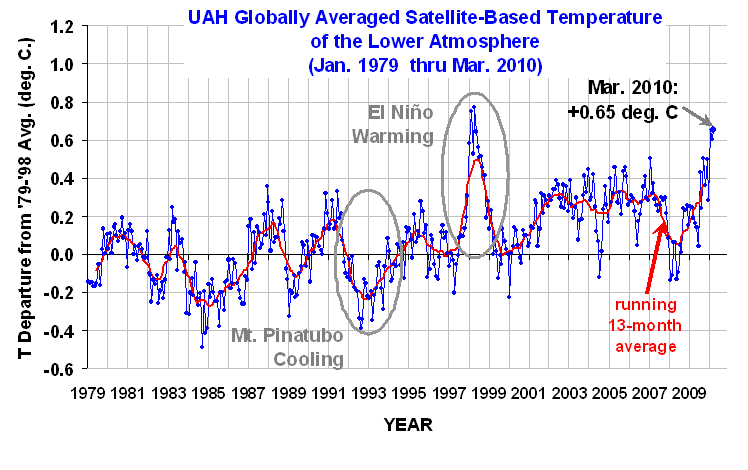
    UAH Spencer March 10

    It was the hottest March in both satellite records (UAH and RSS), and tied for the hottest March on record in the NASA dataset.  It was the hottest (or tied for hottest) January through March in all three records.

    The record temperatures we’re seeing now are especially impressive because we’ve been in “the deepest solar minimum in nearly a century.” It now appears to be over. It’s just hard to stop the march of anthropogenic global warming, well, other than by reducing greenhouse gas emissions, that is.

    NASA’s prediction from last month is standing up:  “It is nearly certain that a new record 12-month global temperature will be set in 2010.″ Actually, NASA made that prediction back in January 2009:

    Given our expectation of the next El Niño beginning in 2009 or 2010, it still seems likely that a new global temperature record will be set within the next 1-2 years, despite the moderate negative effect of the reduced solar irradiance.”

    Of course, there never was any global cooling — see Must-read AP story: Statisticians reject global cooling; Caldeira — “To talk about global cooling at the end of the hottest decade the planet has experienced in many thousands of years is ridiculous.” Indeed, the overwhelming  majority of the warming went right where scientists had predicted — into the oceans (see “How we know global warming is happening”):

    Figure: “Total Earth Heat Content [anomaly] from 1950 (Murphy et al. 2009). Ocean data taken from Domingues et al 2008.”

    NASA’s draft paper reported:  “We conclude that global temperature continued to rise rapidly in the past decade” and “that there has been no reduction in the global warming trend of 0.15-0.20°C/decade that began in the late 1970s.”

    NOAA points out that both satellite data sets show about the same amount of warming as the land-based record, “which increased at a rate near 0.16°C/decade (0.29°F/decade) during the same 30-year period” — once you remove the expected stratospheric cooling from the satellite records (see NOAA discussion here).

    After the endless disinformation-based global cooling stories of the past few years, it’s time for the media to start do some serious fact-based global warming stories.

    The top figure is from Roy Spencer’s blog.

    Related Posts:

  • Is Masters champion Phil Mickelson unwittingly helping ExxonMobil greenwash its anti-science record?

    I’m interested in your thoughts on how much greenwashing this is on a scale of 1 to 10.

    I watch pretty much every major golf tournament.  And that means that I saw some great golf played this weekend at the Masters in Augusta, Georgia, especially by the winner, Phil Mickelson.

    It also means I saw some heart-warming/green-washing commercials pitching the Mickelson ExxonMobil Teachers Academy, which is “designed to provide third- through fifth-grade teachers with the knowledge and skills necessary to motivate students to pursue careers in science and math.”  ExxonMobil explains the rationale:

    Today, in fields like medicine, computing and energy, the U.S. needs more brilliant young minds than ever before. Yet, as the need for brainpower grows, the number of our nation’s young people pursuing careers in these areas is decreasing.  Fortunately, we believe this trend can be reversed, which is why we partnered with professional golfer Phil Mickelson and his wife Amy….

    Yes, the second-biggest fossil-fuel funder of anti-science disinformation, ExxonMobil, whose goal is to convince the public that scientists and the scientific method cannot be trusted, is worried that young people don’t want to pursue science as a career.

    Now, Mickelson is, by appearances and almost all press accounts, a very decent guy (although hagiography is rampant in every sport, including, as we now know, golf).  I suspect he has no clue what ExxonMobil has been doing to help create a hostile climate for science and scientists.

    So, Phil, in the exceedingly unlikely event you read this, it would appear your Academy is designed in part to help us forget that country’s biggest oil company has funneled millions of dollars to fund the disinformation campaigns of the Competitive Enterprise Institute, the American Enterprise Institute, and the Heritage Foundation, all of which continue to advance anti-scientific attacks as I have detailed recently (see posts on Heritage and CEI and AEI).

    Chris Mooney wrote an excellent piece on ExxonMobil’s two-decade anti-scientific campaign a few years ago.  Mooney notes that one anti-science disinformer, Paul Driessen, a senior fellow with the Committee for a Constructive Tomorrow ($252,000 from ExxonMobil) and the Center for the Defense of Free Enterprise ($40,000 in 2003), said in 2005 that he’s “heartened that ExxonMobil and a couple of other groups have stood up and said, ‘this is not science.’ ”  That’s the kind of science education ExxonMobil has been funding for a decade.

    A 2007 Union of Concerned Scientists (UCS) report looked at ExxonMobil’s tobacco industry-like tactics in pushing anti-scientific global warming disinformation (see “Today We Have a Planet That’s Smoking!”).  Like the tobacco industry, ExxonMobil’s goal is to undercut real science and replace it with their phony science.

    The oil giant said it would stop, but that was just another lie (see “Another ExxonMobil deceit: They are still funding climate science deniers despite public pledge“).  Mickelson should read this excellent commentary by award-winning journalist, Eric Pooley, “Exxon Works Up New Recipe for Frying the Planet.“

    ExxonMobil’s funding of virulently anti-science fanatics, carried to its ‘logical’ extreme by the extremists who the disinformation campaign is aimed at, leads to McCarthyism or worse:

    So now ExxonMobil is shocked, shocked, that the number of our nation’s young people pursuing careers in science is decreasing.  That reminds me of Leo Rosten’s famous definition of chutzpah:  “that quality enshrined in a man who, having killed his mother and father, throws himself on the mercy of the court because he is an orphan.”

    Note to ExxonMobil:  You should change your trademarked tagline from “taking on the world’s toughest energy challenges” to “creating the world’s toughest energy challenges.”

    Mickelson, the “good guy” golfer who used to be wild, but now has his act together [unlike that other golfer in the news these days] has no doubt pursued this for the noblest of motives, and the Academy is no doubt providing valuable skills to teachers.  But I don’t think that gives it a free pass from being greenwashing for ExxonMobil.

    What do you think? How much greenwashing is this is on a scale of 1 to 10, with 9 being, say, calling gasoline from the tar sands with a little corn ethanol thrown in “Mother Nature’s Fuel” and 10 being pretty much anything that comes out of the mouth of Massey CEO Don Blankenship.

    h/t to Brad Johnson for the video.

    Related Posts:

  • Send free SMS with Kik

    Remember when texting was all the craze? Parents would get these enormous cell phone bills and wonder how their children could possibly use their phones enough to generate those kinds of fees. Much of it came from text messaging, before carriers offered text messaging bundles. They’ve since done that, and for a while it seemed that everyone was SMSing. Now all I hear from smartphone users is how much they loathe SMS. BlackBerry users in particular tend to prefer BBM, though with OS 5.0 the threaded SMS makes communicating via that medium a bit more palatable. In any case, if you’ve kicked your unlimited SMS plan to the curb, there might be an answer for you. Kik is a service that offers unlimited SMS — though there’s a bit of a catch.

    (more…)

  • BerryBuzz releases another substantial update, v3.0

    When I first reviewed BerryBuzz, I knew it would be an application that our readers would dig. The red blinking LED is so mysterious. It could mean anything, really. BerryBuzz helped take the mystery out of that. Because of the different LED colors and flashing patterns you could determine more specifically what it meant. We then saw a pretty big update from BerryBuzz, and since then I’ve seen a couple of other small tweaks. Over the weekend we heard of a bit more substantial upgrade, one that I’m pretty excited to see.

    (more…)

  • What are your favorite climate and energy soundbites?

    Cover image of Joe Romm's book, Straight Up: America's Fiercest Climate Blogger Takes on the Status Quo Media, Politicians, and Clean Energy SolutionsI will be testifying in front of Congress this week.  And my book, Straight Up, is coming out the following week (click here to buy it).

    That means I’ll be doing a lot of media and trying to hone a simple, effective message for a far broader audience than Climate Progress readers.  I have my own favorite phrases but I’d like to hear from you what you think works both in terms of sound-bites and overall framing.

    Note:  I’m not trying to persuade the unpersuadable.  And the energy message is, I think pretty well understood (see “Messaging 101: ‘Green’ jobs are out, ‘clean energy’ jobs are in“).

    You might take a look at this new messaging report, Climate Communications and Behavior Change:  A Guide for Practitioners just out from The Climate Leadership Initiative.   I don’t agree with everything in it, but it is pretty good, much better than those efforts to try to get people to stop talking about global warming (see EcoAmerica’s phrase ‘our deteriorating atmosphere’ isn’t going to replace ‘global warming’ — and that’s a good thing.)

    We’ve already had a big CP discussion about what is the best phrase to use, given the flaws in both “global warming” and “climate change” (see Is “Global Weirding” here?).  This report floats:

    1. “Rapid climate shift”
    2. “Climate disruption”
    3. “Climate shock”
    4. “Climate breakdown”
    5. “Climate failure”

    Let’s drop the last two, but #1 and #3 have merit.  I’ll probably stick with using many different phrases, including GW and CC.  The report does have some good suggestions for how to phrase basic talking points:

    Carbon dioxide and other pollutants collect in the atmosphere like a thickening blanket, trapping the sun’s heat and causing the planet to warm up.

    What are you thoughts for sound-bites and framing?

    Related Posts:

  • Toles on the coal disaster

    Tom Toles cartoon today is about the other “Safety Warnings” we are ignoring about coal:

    Tom Toles

    Unrestricted burning of fossil fuels just isn’t good for anyone’s safety (see “NRC: Burning fossil fuels costs the U.S. $120 billion a year — not counting mercury or climate impacts!“)

  • Conservative leader Sarah ‘Four Pinocchios’ Palin blames ‘Gore-gate’ for “this snake oil science stuff.” – Ex-gov still proud of her efforts to kill off the polar bears

    Former House Speaker Newt Gingrich has called Palin a conservative leader on energy issues. She has also emerged as a conservative thought leader on climate science.

    Yesterday, at the Southern Republican Leadership Conference (SLRC) 2010 — “the most prominent Republican event outside of the Republican National Convention,” Palin launched into another anti-science diatribe.  TP has the video:

    PALIN: We should create a competitive climate for investment in renewables and alternatives, none of this snake oil science stuff that is based on this global warming, Gore-gate stuff that came down where there was revelation that the scientists, some of these scientists were playing political games. I sued the Feds over this, I sued the Feds over this as Governor for some bogus listing on the ESA, just about got run out of town by the environmentalists. But now we feel a little bit vindicated because we’re realizing through Gore-gate that there was some snake oil science involved over the data collection there … We invented the Internet, unless that was just another Gore-gate thing too.

    Palin is so practiced at repeating falsehoods — even in her supposed area of expertise (energy) — that during last year’s presidential campaign, the Washington Post itself gave her its highest (which is to say lowest) rating of “Four Pinocchios” for continuing to “to peddle bogus [energy] statistics three days after the original error was pointed out by independent fact-checkers.”  Her remarks here contain multiple whoppers.

    Of course, Palin and her conservative allies have never supported creating a competitive climate for investment in renewable alternatives.  Indeed, they have bitterly opposed it:

    Palin has been incoherently attacking climate science by pushing “The Scandal Formerly Known As Climategate” for many, many months — abetted by a media that values sensationalism over substance (see WashPost goes tabloid, publishes second falsehood-filled op-ed by Sarah Palin in five months — on climate science and the hacked emails!).

    But they provide no evidence whatsoever to undercut the ever-strengthening scientific evidence that humans are changing the climate dramatically and face catastrophic impacts if we listen to the do-nothing crowd now led by Sarah Palin:

    • House of Commons exonerates Phil Jones:  Based on their inquiry and evidence, “the scientific reputation of Professor Jones and CRU remains intact. We have found no reason … to challenge the scientific consensus … that ‘global warming is happening [and] that it is induced by human activity’.”

    The “bogus listing on the ESA” is a bit jargony for the normally down-home ex-Gov, but then I suspect she didn’t want to actually explain to the audience in any detail that she sued the Bush administration (!) for listing the polar bear as an endangered species because of the threat warming poses to its primary habitat, the Arctic ice.  Yes, even the Bush’s uber- Conservative Interior Secretary Dirk Kepthorne had to admit the basic case (see Bye-polar Kempthorne: Polar bear IS endangered):

    This is a very widely held scientific view:

    The survival of polar bears as a species is difficult to envisage under conditions of zero summer sea-ice cover,” concludes the 2004 Arctic Climate Impact Assessment, by leading scientists from the eight Arctic nations, including the United States. Another 20 study, by Canadian scientists, agreed:

    [G]iven the rapid pace of ecological change in the Arctic, the long generation time, and the highly specialised nature of polar bears, it is unlikely that polar bears will survive as a species if the sea ice disappears completely.

    Fox put Palin on the wrong show.  They shouldn’t have put her on FoxNews, but in their scifi thriller “Fringe”

  • BBGeekcast: April 9, 2010 – Episode 111

    You’re going to hear plenty of stories regarding RIM’s share of the smartphone market this year. Every time you see something about the iPhone, every time you see something about Android’d rapid growth, someone is thinking up an article about how it will affect the BlackBerry. That’s our main topic of conversation this afternoon.

    So click on over here to hear the BBGeekcast (13 min, 55 sec)

    And don’t forget to subscribe to the podcast so you won’t miss future episodes!

    You can also subscribe to the BBGeekcast in iTunes.

    Highlights include:
    (more…)

  • Climate Progress wins TreeHugger’s “Best Politics Website”

    best_of_green_winner_badge2010_02

    … essential reading for anyone following the politics of the green movement these days….  this is the art of blogging at its best.

    Thanks to everyone who voted for CP for TreeHugger’s Best of Green Awards.

    Here’s TreeHugger’s full award description of this blog:

    The content Joe Romm and crew pump out on Climate Progress is unrelenting in its pursuit of exposing the disinformation on the part of climate change deniers and is essential reading for anyone following the politics of the green movement these days. Though their philosophy is one of incrementalism, they’re insider-y, and we don’t always agree with their analysis, when it comes right down to it, these guys rise to the call of duty, and the green blogosphere would be lacking without them. From detailing the political history of the Koch family and their legacy of anti-environmental obstruction or breaking down the errors in climate change reporting, this is the art of blogging at its best.

    “Incrementalism”?!  Ahh, if only there were 60 Senators who thought the policies advocated here were merely incremental….

    For the record, my philosophy is that we need a WWII-style and WWII-scale effort to avoid catastrophic global warming, but the US political system ain’t there yet, which poses a challenge for all bloggers on the subject.  I appreciate the recognition even more when it comes from those who don’t always agree with my analysis.

    So thank you, TreeHugger!  And kudos to fellow winners, including

  • Official BlackBerry Twitter app now in public beta

    Ever since RIM released the official BlackBerry Twitter client to select users a few months ago, we’ve seen mixed reviews. Some power users don’t appreciate the relative lack of features, while others, myself included, appreciate the push notifications that are integrated with the messages application. It seems that everyone else has been waiting anxiously for this, though, and as of last night the wait is over. You can now download a public beta version of the client. It’s still not complete — and there are some features I really hope they add and change, like pushing just your mentions, rather than all of your friends’ tweets. But it’s still a quality application for the casual Twitter user.

    (more…)

  • Greenwasher of the month: Canada’s Husky Energy sells 10% ethanol blend as “Mother Nature’s Fuel” – And they refine oil from the tar sands!

    Husky

    Americans may not have heard of Husky Energy.  But thanks to an eagle-eyed reader up north who snapped this picture, we all get to see their uber-greenwashing effort.

    Here’s how “Mother Nature” makes her fuel, at least on the Bizarro world of Htrae.

    First, you take some heavy oil or tar sands from Canada.  If you’re a Canadian oil producer, you call tar sands “oil sands” (see Memo to all: They ain’t “oil sands”).  Everyone else can call it the “biggest global warming crime ever seen.” See also Canadian bishop challenges the “moral legitimacy” of tar sands production.

    Then you refine it into gasoline and add “up to 10% ethanol.”  Of course, this is the not ethanol from low-carbon, sustainably grown cellulosic biomass:

    Our “Mother Nature’s Fuel” is made from renewable resources such as wheat and corn.

    Cough!  [Bullshi!t]  Cough!  It’s made from the most environmentally-destructive form of oil known to humankind with a little environmentally-questionable food-based biofuel thrown in.

    Mother Nature needs to hire a good attorney.

  • Must-read Krugman piece: Building a Green Economy – “We know how to limit greenhouse-gas emissions. We have a good sense of the costs — and they’re manageable. All we need now is the political will.”

    Nobelist Paul Krugman has a long piece in the upcoming Sunday NY Times Magazine, basically climate economics 101.

    It is nearly 8000 words, so while you should read the whole thing, I’ll post some of the highlights below.  I’ll also throw some links to the scientific and economic literature that the NYT, in its infinite wisdom/stupidity, refuses to include.

    The essay isn’t primarily about the science, but this is what Krugman has to say on that, starting with the opening paragraph:

    If you listen to climate scientists — and despite the relentless campaign to discredit their work, you should — it is long past time to do something about emissions of carbon dioxide and other greenhouse gases. If we continue with business as usual, they say, we are facing a rise in global temperatures that will be little short of apocalyptic. And to avoid that apocalypse, we have to wean our economy from the use of fossil fuels, coal above all….

    This is an article on climate economics, not climate science. But before we get to the economics, it’s worth establishing three things about the state of the scientific debate.The first is that the planet is indeed warming. Weather fluctuates, and as a consequence it’s easy enough to point to an unusually warm year in the recent past, note that it’s cooler now and claim, “See, the planet is getting cooler, not warmer!” But if you look at the evidence the right way ­— taking averages over periods long enough to smooth out the fluctuations — the upward trend is unmistakable: each successive decade since the 1970s has been warmer than the one before.

    Second, climate models predicted this well in advance, even getting the magnitude of the temperature rise roughly right. While it’s relatively easy to cook up an analysis that matches known data, it is much harder to create a model that accurately forecasts the future. So the fact that climate modelers more than 20 years ago successfully predicted the subsequent global warming gives them enormous credibility.

    Yet that’s not the conclusion you might draw from the many media reports that have focused on matters like hacked e-mail and climate scientists’ talking about a “trick” to “hide” an anomalous decline in one data series or expressing their wish to see papers by climate skeptics kept out of research reviews. The truth, however, is that the supposed scandals evaporate on closer examination, revealing only that climate researchers are human beings, too. Yes, scientists try to make their results stand out, but no data were suppressed. Yes, scientists dislike it when work that they think deliberately obfuscates the issues gets published. What else is new? Nothing suggests that there should not continue to be strong support for climate research.

    And this brings me to my third point: models based on this research indicate that if we continue adding greenhouse gases to the atmosphere as we have, we will eventually face drastic changes in the climate. Let’s be clear. We’re not talking about a few more hot days in the summer and a bit less snow in the winter; we’re talking about massively disruptive events, like the transformation of the Southwestern United States into a permanent dust bowl over the next few decades.

    Now, despite the high credibility of climate modelers, there is still tremendous uncertainty in their long-term forecasts. But as we will see shortly, uncertainty makes the case for action stronger, not weaker. So climate change demands action….

    At this point, the projections of climate change, assuming we continue business as usual, cluster around an estimate that average temperatures will be about 9 degrees Fahrenheit higher in 2100 than they were in 2000. That’s a lot — equivalent to the difference in average temperatures between New York and central Mississippi. Such a huge change would have to be highly disruptive. And the troubles would not stop there: temperatures would continue to rise.

    Furthermore, changes in average temperature will by no means be the whole story. Precipitation patterns will change, with some regions getting much wetter and others much drier. Many modelers also predict more intense storms. Sea levels would rise, with the impact intensified by those storms: coastal flooding, already a major source of natural disasters, would become much more frequent and severe. And there might be drastic changes in the climate of some regions as ocean currents shift. It’s always worth bearing in mind that London is at the same latitude as Labrador; without the Gulf Stream, Western Europe would be barely habitable.

    But there are at least two reasons to take sanguine assessments of the consequences of climate change with a grain of salt. One is that, as I have just pointed out, it’s not just a matter of having warmer weather — many of the costs of climate change are likely to result from droughts, flooding and severe storms. The other is that while modern economies may be highly adaptable, the same may not be true of ecosystems. The last time the earth experienced warming at anything like the pace we now expect was during the Paleocene-Eocene Thermal Maximum, about 55 million years ago, when temperatures rose by about 11 degrees Fahrenheit over the course of around 20,000 years (which is a much slower rate than the current pace of warming). That increase was associated with mass extinctions, which, to put it mildly, probably would not be good for living standards….

    For what the science says we risk if we stay anywhere near our current path of unrestricted emissions, see:

    He has a discussion of the low cost of action:

    Just as there is a rough consensus among climate modelers about the likely trajectory of temperatures if we do not act to cut the emissions of greenhouse gases, there is a rough consensus among economic modelers about the costs of action. That general opinion may be summed up as follows: Restricting emissions would slow economic growth — but not by much. The Congressional Budget Office, relying on a survey of models, has concluded that Waxman-Markey “would reduce the projected average annual rate of growth of gross domestic product between 2010 and 2050 by 0.03 to 0.09 percentage points.” That is, it would trim average annual growth to 2.31 percent, at worst, from 2.4 percent. Over all, the Budget Office concludes, strong climate-change policy would leave the American economy between 1.1 percent and 3.4 percent smaller in 2050 than it would be otherwise.And what about the world economy? In general, modelers tend to find that climate-change policies would lower global output by a somewhat smaller percentage than the comparable figures for the United States. The main reason is that emerging economies like China currently use energy fairly inefficiently, partly as a result of national policies that have kept the prices of fossil fuels very low, and could thus achieve large energy savings at a modest cost. One recent review of the available estimates put the costs of a very strong climate policy — substantially more aggressive than contemplated in current legislative proposals — at between 1 and 3 percent of gross world product.

    Such figures typically come from a model that combines all sorts of engineering and marketplace estimates. These will include, for instance, engineers’ best calculations of how much it costs to generate electricity in various ways, from coal, gas and nuclear and solar power at given resource prices. Then estimates will be made, based on historical experience, of how much consumers would cut back their electricity consumption if its price rises. The same process is followed for other kinds of energy, like motor fuel. And the model assumes that everyone makes the best choice given the economic environment — that power generators choose the least expensive means of producing electricity, while consumers conserve energy as long as the money saved by buying less electricity exceeds the cost of using less power in the form either of other spending or loss of convenience. After all this analysis, it’s possible to predict how producers and consumers of energy will react to policies that put a price on emissions and how much those reactions will end up costing the economy as a whole.

    There are, of course, a number of ways this kind of modeling could be wrong. Many of the underlying estimates are necessarily somewhat speculative; nobody really knows, for instance, what solar power will cost once it finally becomes a large-scale proposition. There is also reason to doubt the assumption that people actually make the right choices: many studies have found that consumers fail to take measures to conserve energy, like improving insulation, even when they could save money by doing so.

    But while it’s unlikely that these models get everything right, it’s a good bet that they overstate rather than understate the economic costs of climate-change action. That is what the experience from the cap-and-trade program for acid rain suggests: costs came in well below initial predictions. And in general, what the models do not and cannot take into account is creativity; surely, faced with an economy in which there are big monetary payoffs for reducing greenhouse-gas emissions, the private sector will come up with ways to limit emissions that are not yet in any model.

    I have links to some of the key literature on this here:

    And of course he discusses what scientific uncertainty means for economic modeling:

    Finally and most important is the matter of uncertainty. We’re uncertain about the magnitude of climate change, which is inevitable, because we’re talking about reaching levels of carbon dioxide in the atmosphere not seen in millions of years. The recent doubling of many modelers’ predictions for 2100 is itself an illustration of the scope of that uncertainty; who knows what revisions may occur in the years ahead. Beyond that, nobody really knows how much damage would result from temperature rises of the kind now considered likely.

    You might think that this uncertainty weakens the case for action, but it actually strengthens it. As Harvard’s Martin Weitzman has argued in several influential papers, if there is a significant chance of utter catastrophe, that chance — rather than what is most likely to happen — should dominate cost-benefit calculations. And utter catastrophe does look like a realistic possibility, even if it is not the most likely outcome.

    Weitzman argues — and I agree — that this risk of catastrophe, rather than the details of cost-benefit calculations, makes the most powerful case for strong climate policy. Current projections of global warming in the absence of action are just too close to the kinds of numbers associated with doomsday scenarios. It would be irresponsible — it’s tempting to say criminally irresponsible — not to step back from what could all too easily turn out to be the edge of a cliff.

    For more on Weitzman, see

    Krugman’s key conclusions are:

    Stern’s moral argument for loving unborn generations as we love ourselves may be too strong, but there’s a compelling case to be made that public policy should take a much longer view than private markets. Even more important, the policy-ramp prescriptions seem far too much like conducting a very risky experiment with the whole planet. Nordhaus’s preferred policy, for example, would stabilize the concentration of carbon dioxide in the atmosphere at a level about twice its preindustrial average. In his model, this would have only modest effects on global welfare; but how confident can we be of that? How sure are we that this kind of change in the environment would not lead to catastrophe? Not sure enough, I’d say, particularly because, as noted above, climate modelers have sharply raised their estimates of future warming in just the last couple of years.So what I end up with is basically Martin Weitzman’s argument: it’s the nonnegligible probability of utter disaster that should dominate our policy analysis. And that argues for aggressive moves to curb emissions, soon….

    If it does, the economic analysis will be ready. We know how to limit greenhouse-gas emissions. We have a good sense of the costs — and they’re manageable. All we need now is the political will.

    Hear!   Hear!

    Related Post:
  • BlackBerry News From The Wire for the Week of 4/5/2010

    The theme of this week, as it seems to be many weeks, is RIM vs. its closest competitors. The iPhone has seen an increasing marketshare, and it’s such a sexy device that people like to predict that it will soon overtake the old, stuffy BlackBerry. Now that Android is gaining traction, pundits have plenty more to discuss. Will Apple and Google soon rid the mobile space of RIM? Hardly. But people will continue to talk about it.

    (more…)

  • Don Blankenship’s record of profits over safety: “Coal pays the bills”

    Don BlankenshipAfter the worst coal mining disaster in at least 25 years, Massey Energy CEO Don Blankenship is facing long-overdue scrutiny for his record of putting coal profits over fundamental safety and health concerns. Blankenship, a right-wing activist millionaire who sits on the boards of the U.S. Chamber of Commerce and the National Mining Association, used his company’s ties to the industry-dominated Bush administration to paper over Massey’s egregious environmental and health violations.

    Massey rewarded Republicans with massive donations after the company avoided paying billions in fines for a 2000 coal slurry disaster in Martin County, three times bigger than the Exxon Valdez. After both mine inspectors and Massey employees got the same message that it was more important to “run coal” than to follow safety rules, a deadly fire broke out in the Aracoma Alma mine in 2006, burning two men alive.  Brad Johnson has the full story of Blankenship’s reckless pursuit of profits over human safety in this TP repost.

    Blankenship was abetted by former employees placed at the highest levels of the federal mine safety system. Massey COO Stanley Suboleski was named a commissioner of the Federal Mine Safety and Health Review Commission in 2003 and was nominated in December 2007 to run the Energy Department’s Office of Fossil Energy. Suboleski is now back on the Massey board. After being rejected twice by the Senate, one-time Massey executive Dick Stickler was put in charge of the MSHA in a recess appointment in October 2006. In the 1990s, Stickler oversaw Massey subsidiary Performance Coal, the operator of the deadly Upper Big Branch Mine, after managing Beth Energy mines, which “incurred injury rates double the national average.” Bush named Stickler acting secretary when the recess appointment expired in January 2008.

    Below are further details of these two past incidents that foretold Blankenship’s latest disaster:

    THE FATAL ARACOMA MINE FIRE

    Aracoma FireBlankenship Branded Deadly Fire At Dangerous Aracoma Mine “Statistically Insignificant.” In the most egregious case of preventable death before the Upper Big Branch explosion, Massey’s Aracoma Coal Co. agreed to “plead guilty to 10 criminal charges, including one felony, and pay $2.5 million in criminal fines” after two workers died in a fire at the Aracoma Alma No. 1 Mine in Melville, West Virginia. Massey also paid $1.7 million in civil fines. The mine “had 25 violations of mandatory health and safety laws” before the fire on January 19, 2006, but Massey CEO Don Blankenship passed the deaths off as “statistically insignificant.” [Logan Banner, 9/1/06; Charleston Gazette, 12/24/08]

    Federal Mine Inspector Who Wanted To Shut Down Mine Told To “Back Off.” Days before fire broke out in the Aracoma mine, a federal mine inspector tried to close down that section of the mine, but “was told by his superior to back off and let them run coal, that there was too much demand for coal.” Massey failed to notify authorities of the fire until two hours after the disaster. [Pittsburgh Post-Gazette, 4/23/06]

    Blankenship Memo: “Coal Pays the Bills.” Three months before the Aracoma mine fire, Massey CEO Don Blankenship sent managers a memo saying, “If any of you have been asked by your group presidents, your supervisors, engineers or anyone else to do anything other than run coal . . . you need to ignore them and run coal. This memo is necessary only because we seem not to understand that the coal pays the bills.” [Logan Banner, 9/1/06]

    THE MARTIN COUNTY COAL-SLURRY DISASTER

    Martin County Slurry DisasterThree Times the Volume of the Exxon Valdez Spill. Massey Energy is the parent of Martin County Coal, responsible for the “nation’s largest man-made environmental disaster east of the Mississippi” until the 2008 Tennesee coal-ash spill In October 2000, a coal slurry impoundment broke through an underground mine shaft and spilled over 300 million gallons of black, toxic sludge into the headwaters of Coldwater Creek and Wolf Creek,” in Martin County, KY. [Lost Mountain, p. 128]

    Site Denied Superfund Status. Bush’s Environmental Protection Agency “determined that the slurry spill was not a release of a hazardous substance” and thus ineligible for Superfund status. [KY EQC]

    Sen. McConnell and Wife Stopped MSHA Investigation. U.S. Secretary of Labor Elaine Chao, wife of Sen. Mitch McConnell (R-KY), oversaw the Mine Safety and Health Administration. Chao “put on the brakes” on the MSHA investigation into the spill by placing a McConnell staffer in charge. In 2002 a $5,600 fine was levied. That September Massey gave $100,000 to the National Republican Senatorial Committee, chaired by McConnell. [Lexington Herald-Leader, 10/2/06, OpenSecrets]

    $2.4 Billion Becomes $20 Million. In May 2007 the EPA filed suit for $2.4 billion against Massey for violating “Clean Water Act more than 4,500 times from the beginning of 2000 to the end of 2006″ in West Virginia and Kentucky, including the Martin County spill. In January 2008 Massey agreed to pay $20 million to settle the case. [Lexington Herald-Leader, 1/18/08]

    Photo credit: Bill Rhodes

    The New York Times reports that the families of coal miners have been registering their displeasure with Blankenship:

    Some of these tensions boiled over around 2 a.m. Tuesday when Mr. Blankenship arrived at the mine to announce the death toll to families who were gathered at the site. Escorted by at least a dozen state and other police officers, according to several witnesses, Mr. Blankenship prepared to address the crowd, but people yelled at him for caring more about profits than miners’ lives.

    Crooks & Liars recalls that Blankenship “spent over $1 million dollars along with other US Chamber buddies like Verizon to sponsor last year’s” right-wing Friends of America” rally in West Virginia.
    Lorelei Scarbro, an activist who fights on behalf of miners’ rights, tells CNN: “Massey Energy’s record speaks for itself. With an enormous amount of violations and previous deaths at this mine, I will leave it to you to decide if this company puts profits before the safety of its workers or views its employees as a disposable commodity.” Scarbro’s husband was a coal miner who died of black lung.
  • Over 3,000 U.S. businesses push new ads for action on climate and clean energy jobs

    A group of 3,000 national and grassroots companies are taking part today in a new national advertising campaign calling for swift action on energy and climate legislation. These businesses, including the groups American Businesses for Clean Energy (ABCE) and the US Climate Action Partnership (USCAP), range from national brands — like Google, Nike and Timberland — to mom-and-pop companies.

    That’s from a press release from American Businesses for Clean Energy.  Here’s more on this groundswell of business support for action on climate change and clean energy jobs:

    Appearing in Maine, Massachusetts, New Hampshire, Ohio, South Carolina and Florida, the print ad, titled “A Question of American Leadership,” calls on Congress to enact bipartisan climate and energy legislation that “…increases our security and limits emissions, as it preserves and creates jobs.”

    The ad unites a broad spectrum of American businesses, faith-based groups, national security organizations, labor unions and environmental NGOs who believe that strong action on climate and energy legislation can lead to an improved economy, job creation and energy security.

    The organizations appearing on the ad represent more than 11 million American jobs and the companies have combined 2009 revenues of over $2.5 trillion.

    With close to 3,000 members, the nonprofit and nonpartisan ABCE is comprised of a diverse group of businesses that support Congressional action to pass clean energy and climate legislation that will significantly reduce greenhouse gas emissions.

    Christopher Van Atten, a spokesperson for American Businesses for Clean Energy said:  “This ad push brings together the best of American businesses large and small to send a clear message to our leaders in Washington: We need action on climate and clean energy starting today. The businesses that are part of ABCE represent a range of views and regions, and we stand united behind the need for comprehensive clean energy legislation that will create jobs, unleash innovation and make our nation more secure, while cutting greenhouse gas emissions.”

    The ad may be viewed and downloaded http://www.climatead.org/.

  • Google Maps for BlackBerry adds voice search, Buzz

    We typically shy away from posting updates to Blackberry applications, mainly because there are so many of them. (Though we are working on a new feature that would help with this.) Some updates, though, provide plenty of substance. The newest Google Maps update is like this. It has added two key features, Buzz layers and voice search, that makes it a much stronger application. As if it weren’t already the best third-party maps application for BlackBerry. You can now get recommendations from other users, and even add your own so that other people can see what you have to say about your favorite haunts.

    (more…)