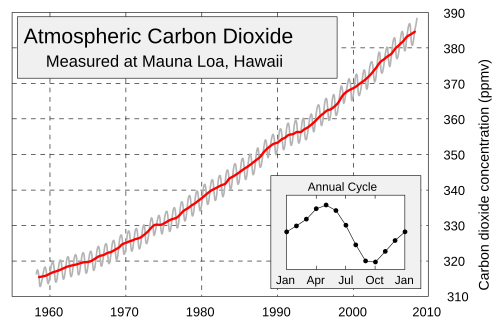
So I was reading a major book review of Ian McEwan’s new satiric novel on climate and energy, Solar, this week and came across this jaw-dropper:
Whether or not carbon dioxide is accumulating in the atmosphere, there’s no denying that novelists are warming up to the subject. From Michael Crichton’s “State of Fear,” which claimed that we’re being hoodwinked by faulty data, to Kim Stanley Robinson’s “Fifty Degrees Below,” which imagined Washington encased in ice, popular fiction about climate change has been as nuanced and illuminating as a shouting match on Fox News.
Now I don’t know what’s sadder about this paragraph. Is it that Ron Charles, the fiction editor for the ever-shrinking “Book World” section of the Washington Post, is simply unaware of the single most established fact in the entire arena of climate science?
Or that not a single person associated with putting together the final product of the Washington Post print piece edition apparently knew this most basic of climate facts.
He was apparently so comfortable in his ignorance that he made this mistake in a paragraph devoted to mocking novelists for writing about climate change in a fashion as unilluminating as Fox News. Indeed, Charles and everyone else who looked at this piece before publication were apparently so comfortable in their ignorance they didn’t even bother to spend 10 seconds running some variant of the phrase “carbon dioxide is accumulating in the atmosphere” through Google.
For the record, carbon dioxide has been accumulating in the atmosphere for a very long time now thanks to human activity. The direct measurement of that CO2 rise led to the single most famous chart of observational data in the entire climate arena, the Keeling Curve of Atmospheric concentrations of carbon dioxide (CO2).
First, this is a reminder to all of us who try to communicate climate science to the general public — or even to the media elite and other opinion makers erroneously labeled the “cognoscenti” — not to take the most basic fact of climate science for granted.
Second, the knowledge that the media itself is constantly making mistakes on the most basic of climate science issues means journalists need to start going to primary sources for every science-related fact they are reporting. Otherwise media coverage will become permanently indistinguishable from the children’s game of Telephone.
Employers in the U.S. created more jobs in March than at any time in the past three years, showing the recovery from the worst recession since the 1930s is broadening and becoming more entrenched.
That’s Bloomberg reporting on new data from the Labor Department, which showed that “payrolls rose by 162,000 workers, the third gain in the past five months.”
But the conventional wisdom, or rather, the conventional ignorance, is that a climate bill will hurt jobs and the economy — even though that isn’t what the public believes, as many recent polls make clear:
That comes from a Allstate/National Journal/Heartland Monitor poll in January, when the economic and jobs picture wasn’t as good as it is today (see “It’s all about Independents — and Independence: Unlike health care reform, the clean air, clean energy jobs bill that cuts oil use and pollution is a bipartisan political winner in every poll”).
On job creation: 50% say the number of jobs will increase, 26% say it will decrease and 26% say it won’t change.
A December AP-Stanford poll focusing primarily on global warming again found the public gets that the climate bill would create jobs and help the economy and/or at least not lose jobs or hurt it (see “Overwhelming US Public Support for Global Warming Action“):
Do You Think That The U.S. Doing Things To Reduce Global Warming In The Future Would Cause There To Be More/Fewer Jobs For People Around The Country?
More jobs 40%
Fewer jobs 23
Would not affect jobs 33
Do You Think That The U.S. Doing Things To Reduce Global Warming In The Future Would Hurt/Help The U.S. Economy?
Help U.S. economy 46%
Hurt U.S. economy 27
Would not affect economy 24
Certainly Republicans understand that the good job news is bad news for their agenda of opposing all of Obama’s new legislative efforts and attacking all of his previous ones, including the stimulus, as failures. Indeed, as Think Progress reported, the Republican National committee immediately responded to the Labor report by releasing a falsehood-filled briefing that claims that the job growth occured “mostly” due to hiring Census workers:
But March Job Growth Is “Disappointment” Because Job Gains Mostly From Census. “CalculatedRisk reports that even if Friday’s employment report shows a gain of 200,000 jobs in March, as expected, it might be viewed as a disappointment: ‘The March report will be distorted by two factors: 1) any bounce back from the snow storms, and 2) the decennial Census hiring that picked up sharply in March. … Also the Census will add something like 100,000 workers to the March report …” (U.S. Bureau of Labor Statistics, www.bls.gov, Accessed 4/2/10; Ben White and Eamon Javers, Politico’s “Morning Money,” 3/30/10)
In fact, TP notes, “the RNC’s claim bears little relation to reality. Of the 162,000 jobs added to the economy last month, 123,000 were in the private sector.” Joel Naroff, the president of Naroff Economic Advisors, wrote in a client note that “the federal government didn’t hire nearly as many Census workers as thought. It was the private sector that stepped up to the plate.” The Census Bureau hired only 48,000 workers.
I watched the report on CNBC this morning, and the analysts were all pleasantly surprised that this job growth came with far less Census hires than expected. The chart at the top illustrating the job gains comes from Speaker Pelosi’s using Bureau of Labor Statistics data.
I would still delay starting the cap until at least 2013, to further undercut any economic attack on the bill. Also, the impacts of the recession have not worked their way through the energy system yet, so the early permit allocations are likely to be too high, which means there really is no environmental benefit in starting the bill in 2012.
Finally, it must be said that conventional wisdom has it that passage of the bipartisan climate and clean energy jobs bill is still a long shot. But conventional wisdom has been wrong so often, and now that we can see the stimulus bill spared the economy from the Bush-Cheney depression and has jumpstarted an economic recovery, there is no longer an excuse that “we can’t pass a climate bill during a recession.”
Last week it was the slider and the 9650. This week we’ve moved onto the Pearl, as expected. We’re on a device cycle now, with a few expected to be released in the near future — though I’m not sure on the slider. Anyway, the Pearl news includes a possible release date, and more.
While our BlackBerrys afford us the ability to work while out of the office, many of us still sit in front of our desks most of the day. This means having the BlackBerry nearby, but seldom used. It might ring every once in a while, or you might get a text message — or even an email from a personal account you don’t check regularly from your work computer. For me, at least, this can sometimes be a problem. I’ll often step out of the office without my BlackBerry and upon my return will not check for text messages or missed calls — my work email is open all the time, so why bother? The guys at BBLeaks reviewed an app that would help me out, and I thought I’d share it with everyone. It’s called Blurts, and if you have Bluetooth on your computer it can be of use to you.
Thank you, everybody. Thank you so much. (Applause.) Please have a seat. I’ve got a few introductions that I want to make very quickly before I start my remarks. First of all, I think that by the end of his tenure we’re going to know that Ken Salazar is one of the finest Secretaries of Interior we’ve ever had. So please give him a big round of applause. (Applause.)
Other members of what we call our green team are here: Steven Chu, our Secretary of Energy; Martha Johnson, the Administrator of the GSA; Nancy Sutley, the CEQ Chair. We’ve got Carol Browner, who’s the White House Energy and Climate Change Director. Please give them a big round of applause. They put in a lot of work. (Applause.)
Governor Martin O’Malley is here, governor of Maryland. (Applause.) Ray Mabus, Secretary of the Navy, is here. (Applause.) Admiral Gary Roughead, Chief of Naval Operations, is here, and we appreciate his outstanding service. Thank you, Gar. (Applause.)
I want to thank Steven Shepro, the base commander here at Andrews, and the leadership that’s present from the Air Force, the Marine Corps, and the Coast Guard.
Ken and I were colleagues in the Senate, and I appointed him because I knew that he would be a faithful and pragmatic steward of our natural resources. And as Secretary, he is changing the way that the Interior Department does business so that we’re responsibly developing traditional sources of energy and renewable sources of energy, from the wind on the high plains to the suns in the desert to the waves off our coasts. And so I’m very grateful to the work that he’s done in culminating in one of the announcements that we’re making today.
It’s also good to see so many members of our Armed Forces here today. Andrews is the home of Air Force One, and I appreciate everything that you do for me and my family. I should point out that you’ve got a 100-percent on-time departure record. (Laughter.) You don’t charge for luggage — (laughter) — so it’s a pretty good deal. And I want to thank you not only for the support that you provide me, but also for the service that you perform to keep our country safe each and every day. So I’m very grateful to all of you.
We’re here to talk about America’s energy security, an issue that’s been a priority for my administration since the day I took office. Already, we’ve made the largest investment in clean energy in our nation’s history. It’s an investment that’s expected to create or save more than 700,000 jobs across America — jobs manufacturing advanced batteries for more efficient vehicles; upgrading the power grid so that it’s smarter and it’s stronger; doubling our nation’s capacity to generate renewable electricity from sources like the wind and the sun.
And just a few months after taking office, I also gathered the leaders of the world’s largest automakers, the heads of labor unions, environmental advocates, and public officials from California and across the country to reach a historic agreement to raise fuel economy standards in cars and trucks. And tomorrow, after decades in which we have done little to increase auto efficiency, those new standards will be finalized, which will reduce our dependence on oil while helping folks spend a little less at the pump.
So my administration is upholding its end of the deal, and we expect all parties to do the same. And I’d also point out this rule that we’re going to be announcing about increased mileage standards will save 1.8 billion — billion barrels of oil overall — 1.8 billion barrels of oil. And that’s like taking 58 million cars off the road for an entire year.
Today, we’re also going to go one step further. In order to save energy and taxpayer dollars, my administration — led by Secretary Chu at Energy, as well as Administrator Johnson at GSA — is doubling the number of hybrid vehicles in the federal fleet, even as we seek to reduce the number of cars and trucks used by our government overall. So we’re going to lead by example and practice what we preach: cutting waste, saving energy, and reducing our reliance on foreign oil.
But we have to do more. We need to make continued investments in clean coal technologies and advanced biofuels. A few weeks ago, I announced loan guarantees to break ground on America’s first new nuclear facility in three decades, a project that will create thousands of jobs. And in the short term, as we transition to cleaner energy sources, we’ve still got to make some tough decisions about opening new offshore areas for oil and gas development in ways that protect communities and protect coastlines.
This is not a decision that I’ve made lightly. It’s one that Ken and I — as well as Carol Browner, my energy advisor, and others in my administration — looked at closely for more than a year. But the bottom line is this: Given our energy needs, in order to sustain economic growth and produce jobs, and keep our businesses competitive, we are going to need to harness traditional sources of fuel even as we ramp up production of new sources of renewable, homegrown energy.
So today we’re announcing the expansion of offshore oil and gas exploration, but in ways that balance the need to harness domestic energy resources and the need to protect America’s natural resources. Under the leadership of Secretary Salazar, we’ll employ new technologies that reduce the impact of oil exploration. We’ll protect areas that are vital to tourism, the environment, and our national security. And we’ll be guided not by political ideology, but by scientific evidence.
That’s why my administration will consider potential areas for development in the mid and south Atlantic and the Gulf of Mexico, while studying and protecting sensitive areas in the Arctic. That’s why we’ll continue to support development of leased areas off the North Slope of Alaska, while protecting Alaska’s Bristol Bay.
There will be those who strongly disagree with this decision, including those who say we should not open any new areas to drilling. But what I want to emphasize is that this announcement is part of a broader strategy that will move us from an economy that runs on fossil fuels and foreign oil to one that relies more on homegrown fuels and clean energy. And the only way this transition will succeed is if it strengthens our economy in the short term and the long run. To fail to recognize this reality would be a mistake.
On the other side, there are going to be some who argue that we don’t go nearly far enough; who suggest we should open all our waters to energy exploration without any restriction or regard for the broader environmental and economic impact. And to those folks I’ve got to say this: We have less than 2 percent of the world’s oil reserves; we consume more than 20 percent of the world’s oil. And what that means is that drilling alone can’t come close to meeting our long-term energy needs. And for the sake of our planet and our energy independence, we need to begin the transition to cleaner fuels now.
So the answer is not drilling everywhere all the time. But the answer is not, also, for us to ignore the fact that we are going to need vital energy sources to maintain our economic growth and our security. Ultimately, we need to move beyond the tired debates of the left and the right, between business leaders and environmentalists, between those who would claim drilling is a cure all and those who would claim it has no place. Because this issue is just too important to allow our progress to languish while we fight the same old battles over and over again.
For decades we’ve talked about how our dependence on foreign oil threatens our economy -– yet our will to act rises and falls with the price of a barrel of oil. When gas gets expensive at the pump, suddenly everybody is an energy expert. And when it goes back down, everybody is back to their old habits.
For decades we’ve talked about the threat to future generations posed by our current system of energy –- even as we can see the mounting evidence of climate change from the Arctic Circle to the Gulf Coast. And this is particularly relevant to all of you who are serving in uniform: For decades, we’ve talked about the risks to our security created by dependence on foreign oil, but that dependence has actually grown year after year after year after year.
And while our politics has remained entrenched along these worn divides, the ground has shifted beneath our feet. Around the world, countries are seeking an edge in the global marketplace by investing in new ways of producing and saving energy. From China to Germany, these nations recognize that the nation that leads the clean energy economy will be the country that leads the global economy. And meanwhile, here at home, as politicians in Washington debate endlessly about whether to act, our own military has determined that we can no longer afford not to.
Some of the press may be wondering why we are announcing offshore drilling in a hangar at Andrews Air Force Base. Well, if there’s any doubt about the leadership that our military is showing, you just need to look at this F-18 fighter and the light-armored vehicle behind me. The Army and Marine Corps have been testing this vehicle on a mixture of biofuels. And this Navy fighter jet — appropriately called the Green Hornet — will be flown for the first time in just a few days, on Earth Day. If tests go as planned, it will be the first plane ever to fly faster than the speed of sound on a fuel mix that is half biomass. The Air Force is also testing jet engines using biofuels and had the first successful biofuel-powered test flight just last week. I don’t want to drum up any kind of rivalry here, but — (laughter.)
Now, the Pentagon isn’t seeking these alternative fuels just to protect our environment; they’re pursuing these homegrown energy sources to protect our national security. Our military leaders recognize the security imperative of increasing the use of alternative fuels, decreasing energy use, reducing our reliance on imported oil, making ourselves more energy-efficient. That’s why the Navy, led by Secretary Mabus, who’s here today, has set a goal of using 50-percent alternative fuels in all planes, vehicles, and ships in the next 10 years. That’s why the Defense Department has invested $2.7 billion this year alone to improve energy efficiency.
So moving towards clean energy is about our security. It’s also about our economy. And it’s about the future of our planet. And what I hope is, is the policies that we’ve laid out — from hybrid fleets to offshore drilling, from nuclear energy to wind energy — underscores the seriousness with which my administration takes this challenge. It’s a challenge that requires us to break out of the old ways of thinking, to think and act anew. And it requires each of us, regardless of whether we’re in the private sector or the public sector, whether we’re in the military or in the civilian side of government, to think about how could we be doing things better, how could we be doing things smarter — so that we are no longer tethered to the whims of what happens somewhere in the Middle East or with other major oil-producing nations.
So I’m open to proposals from my Democratic friends and my Republican friends. I think that we can break out of the broken politics of the past when it comes to our energy policy. I know that we can come together to pass comprehensive energy and climate legislation that’s going to foster new energy — new industries, create millions of new jobs, protect our planet, and help us become more energy independent. That’s what we can do. That is what we must do. And I’m confident that is what we will do.
So thank you very much. And thanks, again, to all of you who are serving in our Armed Services. You are making an enormous contribution, and this is just one example of the leadership that you’re showing.
Washington, DC, April 1 — CBS News has obtained exclusive footage providing irrefutable evidence that so-called “progressive” blogger Joe Romm is in fact an active participant in the Tea Party movement.
In this shocking video, Romm, a physicist and taxidermist who blogs at ClimateProgress.org, is asked by a fellow Tea Partier to “talk tea party talk.” And he does — suggesting Romm is no stranger to Tea Party events:
At a hastily-assembled news conference, Dr. Romm said, “Yes. It’s true. I’ve been to perhaps a dozen Tea Party events in the past year. But at least my events involve actual tea! And yes, I ‘talk tea party talk’. You try saying ‘no’ to a 3-year-old.”
FoxNews commentor Sarah Palin said,”How’s that climaty-progressy thing working out for you now, doctor?” Palin said that she could look at climate change from her home in Alaska, when she wasn’t looking at Russia, that is, but was pretty sure it was not actually caused by her looking. Palin said she suspects climate change is occurring even when she isn’t looking. But, of course, she couldn’t be sure.
In a related story, CBS News has learned that a new study by George Mason University finds that 80% of all Tea Parties are held by little girls.
Two things are clear if you visit America’s leading “science museum” — the National Museum of Natural History. First, the Smithsonian downplays or ignores the risks posed by human-caused climate change in a number of exhibits. Second, the worst of the exhibits is the David H. Koch Hall of Human Origins.
The exhibit’s main theme is that extreme climate change in the past made humans very adaptable, an interesting theory based on limited data and lots of speculation. But its huge flaw is that it it leaves visitors with the distinct impression that human-caused global warming is no big deal — even though our understanding of the grave threat posed by that warming is based on far, far more research and data.
It’s going to take me a few posts to go through this embarrassing episode in the Smithsonian’s history, which raises serious questions about how big polluters may be pursuing yet another strategy to influence how climate science is communicated to the public (see “Can Big Oil buy a watered-down climate exhibit at the London Science Museum?“)
Let’s start with a video that Lee Fang of Think Progress shot of some key exhibit displays, narrated by me:
[Okay, I’m no David Attenborough, but then, this isn’t my exhibit or the BBC’s Life on Earth.]
Let me expand and clarify the points I made in that video.
The exhibit’s major intellectual failing is that it does not distinguish between 1) the evolution of small populations of tens (to perhaps hundreds) of thousands of humans and pre-humans over hundreds of thousands of years to relatively slow, natural climate changes and 2) the completely different challenge we have today: The ability of modern civilization — nearly 7 billion people, going up to 10 billion — to deal with rapid, human-caused climate change over a period of several decades (and ultimately much longer).
The exhibit fails to make clear that while small populations of homo “sapiens” evolved over hundreds of thousands of years of fluctuating climate, the rapid population growth of human civilization occurred during a time of relatively stable climate.
Let’s be clear here. Not only has the atmospheric concentration of CO2 — the principal human-generated greenhouse gas — risen sharply in recent decades, it has risen at a rate that is unprecedented in the past million years (see “Humans boosting CO2 14,000 times faster than nature, overwhelming slow negative feedbacks“). As the author of 2008 study on this subject noted, “the average change in the amount of atmospheric carbon dioxide over the last 600,000 years has been just 22 parts per million by volume.” Humans have run up CO2 levels 100 ppm over the last two centuries. The author added, “Right now we have put the system entirely out of equilibrium.“
But you’d never know any of that from the Smithsonian exhibit. The key figure they use as the basis of their intellectual case, which you can see in the video in two locations, is this reconstruction (from “Survival of the Adaptable,” click to enlarge) :
Caption: “Earth’s Changing Climate and Human Evolution: Earth’s climate has fluctuated between warm and cool over the past ten million years. The ratio of two oxygen isotopes, as measured in cores drilled from the ocean bottom, ranges from about 2.5 to 5.0 parts per million. This measure reflects both worldwide ocean temperature and the amount of glacial ice. Particularly dramatic fluctuations marked the six-million-year period of human evolution.”
Note that in this view, modern humans, who developed in the last couple hundred thousand years, were experiencing fluctuations of 10°C in the swings in and out of the Ice Ages. But on the scale of that figure, the last 10,500 years (”plant and animal domestication,” i.e modern civilization) would be virtually a flat line.
Here is a rough 6,000 year reconstruction that climate scientist Katherine Hayhoe put together from the National Climatic Data Center (NCDC) Paleoclimate archive for her new book, “A Climate for Change,” which you can see in a terrific March presentation:
Pretty bloody stable (until recently) on the scale of the Smithsonian chart.
And it is this stable climate that has coincided with rapid population growth. Here is a chart from the Smithsonian’s exhibit website:
Note: It would have been nice for the Smithsonian to tell readers that the chart did not have a linear scale for time.
Here is a better graph from Wikipedia in which time has a linear scale but population is plotted logarithmically:
The point is, natural “extreme climate shifts” may have been terrific for making humans adaptable, but a relatively stable climate over the last 10,000 years or so is what enabled modern civilization and rapid population growth.
The exhibit does have a couple of displays aimed at future climate change, which I’ll discuss in a later post, but none of them lays out the threat posed by the rapid climate change we now face. The single strongest statement is one panel that says:
The level of CO2 today is the highest since our species evolved. The projected increase over the next century is more than twice that of any time in the past 6 million years and suggests a long-term sea level rise of 6.4 m (21 ft).
The Smithsonian never gives a time frame for sea level rise, and, of course, the key fact in that sentence is not accurate. The projected increase of CO2 emissions just in the first half of this century suggests a long-term sea level rise of 75 to 120 feet, as a major 2009 Science article explains. And 2 years ago James Hansen et al. argued that projected increase of CO2 emissions risks an ice-free planet:
We infer from the Cenozoic data that CO2 was the dominant Cenozoic forcing, that CO2 was only ~450 ppm when Antarctica glaciated, and that glaciation is reversible.
That is, if we stabilize at 450 ppm (or higher) we risk returning the planet to conditions when it was largely ice free, when sea levels were higher by 70 meters — more than 200 feet!
If the overall exhibit were better, this might not be a big deal. But given how lame the whole exhibit is, this error is another black eye.
One of the key displays in the section about the present and future is in the video, a nonsensical interactive video which lets visitors create a “future human” that evolves over millions of years to a variety of changing conditions including a new ice age or living in crowded underground cities because of global warming or even — I kid you not — a future Earth that “smells.”
How much does the exhibit downplay the impact of human-caused emissions? In the part of the exhibit about the present and the future, there is a display that says “Benefits and Costs of our success.” You can see the text online here (near the bottom of the page):
Costs
By settling down and producing our own food, we created:
●piles of waste that form natural breeding grounds for contagious diseases;
●large concentrations of people, enabling diseases to spread and become epidemics;
●domesticated landscapes that displace wild habitats;
●loss of wild species that depend on natural habitats.
Where is the cost: “huge emissions of heat-trapping greenhouse gases that threaten rapid climate change and serious consequences for billions of people”? This is an exhibit about climate change, after all.
So yes, the Smithsonian is pointing out that an unusual episode of extreme climate change nearly wiped out the human race, but essentially ignores the threat posed by comparably extreme climate change today.
If this were just another Smithsonian exhibit, I’d call it a “grave disappointment” and “seriously flawed.” But since it was primarily funded by the billionaire polluter David Koch, who is founder of a vast network of conservative organizations that deny the threat of global warming — with overall funding of disinformers that now exceeds Exxon Mobil – the exhibit puts the credibility of the entire Museum of Natural History and science staff on the line.
Either the exhibit should be completely reworked or they should give Koch’s money back so as not to taint this exhibit. Or both.
According to the Smithsonian Institution, it doesn’t matter how toxic your politics are or how dirty your money is, as long as you give the cash to them. Paleoanthropologist Rick Potts, director of the Smithsonian’s Human Origins Program and curator of anthropology at the National Museum of Natural History, defended pollution scion David H. Koch as a “philanthropist who is deeply interested in science.”
Potts told ThinkProgress why the Smithsonian accepted $15 million from this climate-denial kingpin [video here]:
“David Koch is a philanthropist, who is deeply interested in science. He’s funded the dinosaur halls, for example, in the American Museum of Natural History. He gave a lot of money to the Lincoln Center and its refurbishing. He has a lot of interest in human evolution that goes back to about thirty or forty years. And so, uh, as is true with all Smithsonian policy, our donors have no control over the content of our science or scholarship of our exhibits. And the same is true in this case. We feel very grateful for David Koch’s contributions to helping, I hope, the American public and us being able to bring science to them.”
For related background, which makes clear Koch knew exactly what kind of science he was buying from the Smithsonian, see the Yglesias post, “David Koch, Climate Change, and Human Evolution.”
Hopefully when you read this, relatively early on April 1, no one has yet played a practical joke on you. It’s April Fool’s Day, the time every year when people try to pull ruses ranging from the simplistic to the overly complex. If you’re one who likes a good prank, well, then maybe you’d be interested in an application called Email Anonymously. It does just what the name implies, allowing you to send emails to any address without any way to trace it back to the sender. It’s the equivalent of making a prank phone call with caller ID blocked!
The Northeast has been walloped with record-smashing deluges and flooding.
I have called this type of rapid deluge, “global warming type” record rainfall, since it is one of the most basic predictions of climate science — and it’s an impact that has already been documented to have started, as I’ll discuss.
Of course, in this country, you’ll be hard pressed to find any discussion of global climate change in connection with this deluge. The Today Show ran 3 stories this morning and never mentioned climate change at all. But is it too much to ask after so many in the media mislead the public into thinking that the record snow was somehow evidence against human-caused global warming?
China will tomorrow start ramping up preparations for typhoons, dust storms and other extreme weather disasters as part of a 10-year plan to predict and prevent the worst impacts of climate change….
China has a long history of devastating floods and droughts, but officials said the problems were intensifying.
“It is necessary to respond to the new situation under climate change to avoid and mitigate the losses caused by meteorological disasters,” said Gao Fengtao, deputy director of the state council’s legislative affairs office, as he unveiled the new policy.
In recent years, he said, disasters were characterised by “sudden occurrence, wider variety, greater intensity and higher frequency in the context of global warming”.
Nonetheless, the great Nor’easter of 2010 would appear to easily qualify as a global-warming-type deluge. As uber-meteorologist Jeff Masters noted in his post (quoted above), perhaps remarkably, it has occurred during March, when you wouldn’t normally expect such records to be set. Stu Ostro, Senior Meteorologist at the Weather Channel, made a comparable point about Georgia’s devastating September rainstorms. Of course, Ostro pointed out there was no way to know if global warming had “caused” the record floods, but
Nevertheless, there’s a straightforward connection in the way the changing climate “set the table” for what happened this September in Atlanta and elsewhere. It behooves us to understand not only theoretical expected increases in heavy precipitation (via relatively slow/linear changes in temperatures, evaporation, and atmospheric moisture) but also how changing circulation patterns are already squeezing out that moisture in extreme doses and affecting weather in other ways.
That’s why I use the term global-warming-type deluge — but only when a changing climate “set the table” for something that truly smashes through the record books.
Another remarkable feature of the storm was explained by Steve Scolnik of Capital Climate in his post, which lists all of the major records that were broken:
The NWS [National Weather Service] notes that this is now the 3rd episode of excessive rainfall in the region within the last 3 weeks, an unprecedented occurrence in recorded history.
In Providence, RI, yesterday’s rainfall total of 3.47″ nearly tripled the previous March 29 daily record of 1.19″ set in 1931. The 4.31″ measured so far today also smashes the old daily record of 2.57″.
Note: In the AP photo at the top, an oil slick runs through the Pawtuxet River in Warwick, RI.
Jeff Masters has more of the records:
Record rains from a slow-moving and extremely wet Nor’easter have triggered historic flooding in Rhode Island and Southeastern Massachusetts, with several rivers exceeding their 100-year flood levels. The 16.32″ of rain that has fallen on Providence, Rhode Island, this month is the most rain recorded in any month, besting the previous record of 15.38″ set in October 2005. Blue Hill Observatory in SE Massachusetts also set a record for wettest month ever, with 18.79″ (previous record: 18.78″, August 1955.) Records extend back to 1905 and 1885 at the two sites. The Rhode Island all-time state record for heaviest precipitation in a month was smashed as well, thanks to the 19.62″ observed this March at North Kingstown. The old state record was 16.70″, set at North Foster in October 2005. Many locations in the Northeast recorded their wettest March ever, including New York City and Boston.
This was not one-day weather event over a small area. This was a month-long regional event of staggering proportion. Masters has a figure of “observed precipitation for the month of March” courtesy of NOAA:
Mr. KEVIN TRENBERTH (Scientist, National Center for Atmospheric Research): The fact that the oceans are warmer now than they were, say, 30 years ago, means there’s about, on average, 4 percent more water vapor lurking around over the oceans than there was, say, in the 1970s.
JOYCE: Warmer water means more water vapor rises up into the air. And what goes up, must come down.
Mr. TRENBERTH: So one of the consequences of a warming ocean near a coastline like the East Coast and Washington, D.C., for instance, is that you can get dumped on with more snow, partly as a consequence of global warming.
For completeness’ sake, I’ll quickly run through some of the literature. Regular readers can skip the rest of this post. You can find more here and there’s some terrific technical meteorological analysis here.
In 2004, the Journal of Hydrometeorology published an analysis by NOAA’s National Climatic Data Center that found “Over the contiguous United States, precipitation, temperature, streamflow, and heavy and very heavy precipitation have increased during the twentieth century.”
They found (here) that over the course of the 20th century, the “Cold season (October through April),” saw a 16% increase in “heavy” precipitation events (roughly greater than 2 inches [when it comes as rain] in one day), and a 25% increase in “very heavy” precipitation events (roughly greater than 4 inches in one day)– and a 36% rise in “extreme” precipitation events (those in the 99.9% percentile — 1 in 1000 events). This rise in extreme precipitation is precisely what is predicted by global warming models in the scientific literature.
In fact, the last few decades have seen rising extreme precipitation over the United States in the historical record, according to NCDC’s Climate Extremes Index (CEI):
UPDATE: Here is a plot of the percentage of this country (times two) with much greater than normal proportion of precipitation derived from extreme 1-day precipitation events (where extreme equals the highest tenth percentile of deluges, from NOAA):
Many extremes and their associated impacts are now changing…. Heavy downpours have become more frequent and intense….
It is well established through formal attribution studies that the global warming of the past 50 years is due primarily to human-induced increases in heat-trapping gases.… The increase in heavy precipitation events is associated with an increase in water vapor, and the latter has been attributed to human-induced warming.
In the future, with continued global warming, heat waves and heavy downpours are very likely to further increase in frequency and intensity. Substantial areas of North America are likely to have more frequent droughts of greater severity.
Last year, the U.S. Energy Information Administration report, “Impact of Limitations on Access to Oil and Natural Gas Resources in the Federal Outer Continental Shelf” analyzed the difference between full offshore drilling (Reference Case) and restriction to offshore drilling (OCS limited case). In 2020, there is no impact on gasoline prices (right hand column). In 2030, US gasoline prices would be three cents a gallon lower. Woohoo!
I have previously written about the trivial impact of opening the OCS further to drilling — The oil companies already have access to some 34 billion barrels of offshore oil they have barely begun to develop (see “The cruel offshore-drilling hoax“). I have also written that I thought it inevitable that the Dems would cave on drilling when oil prices started to jump (which hasn’t happened yet thanks primarily to the global recession).
So the only reason for the administration’s policy shift would be to get conservative votes for comprehensive energy reform. As Think Progress explains, that effect seems unlikely:
In the summer of 2008, then-candidate Obama explained that he saw allowing offshore oil drilling as a compromise necessary to “get something done“:
“The Republicans and the oil companies have been really beating the drums on drilling,” Obama said in the Post interview. “And so we don’t want gridlock. We want to get something done.” The freshman Illinois senator and presidential nominee-to-be added: “If, in order to get that passed, we have to compromise in terms of a careful, well thought-out drilling strategy that was carefully circumscribed to avoid significant environmental damage —I don’t want to be so rigid that we can’t get something done.”
During an appearance on MSNBC’s Morning Joe, former Bush official Dan Bartlett said that the move is unlikely to get any Republican votes for an energy bill. While saying that he thinks it is a “shrewd move” that will “demonstrate…that the Democratic Party doesn’t just cater to the extreme aspects of their base,” Bartlett conceded that it will likely not win any Republican votes because “Republicans have made a calculation that cooperating with this administration at this time is not necessary for them to pick up seats:”
BARTLETT: This is a shrewd move by the White House this announcment they’re doing on energy and offshore oil drilling. … These are the things they need to demonstrate to their constituents that the Democratic Party does not just cater to the extreme aspects of their base … Now, do I think that this measure here will help grease the path for a climate change bill and bring Republicans on board? No.Republicans in the Congress have made a calculation that cooperating with this administration at this time is not necessary for them to pick up seats. So if this is more of a legislative maneuever in order to get a broader bill on climate change, unfortunately this is going to come up short.
Indeed, Republicans have thus far indicated that they are unwilling to compromise in exchange for the administration’s lifting of offshore oil drilling bans. House Minority Leader John Boehner (R-OH) immediately “dismissed the president’s plan as not going far enough in opening up U.S. waters for exploration,” even going so far as to accuse Obama of defying “the will of the American people” because he didn’t open up even more territory for offshore drilling. Meanwhile, Chairman of the House Republican Conference and the American Energy Solutions Group Rep. Mike Pence (R-IN) derided the plan as a “smokescreen” and a “feeble attempt to gain votes” for comprehensive energy legislation.
Matt Yglesias writes, “I don’t understand this at all. Increased coastal drilling would be a small price to pay in exchange for actual congressional votes for an overall energy package that shifts us to a low-carbon economy over time. But any price is too high a price to pay in exchange for nothing at all. This isn’t the greatest environmental crime in human history, but it sure does seem like poor legislative strategy.”
Sarah Palin responds with a pair of tweets. In the first, she writes, “Drill, baby, drill.” In the second, she praises Boehner’s response and admonishes Obama for trying to win over conservative votes for an energy overhaul:
Newt Gingrich told the St. Petersburg Times that while he likes the idea of drilling, he thinks Obama is doing it too late. “If he’s going to announce he’s for drilling, he should announce that we’re drilling now. I don’t think the people want a party of manana,” Gingrich said.
For a full set of dismayed quotes from progressives, go to Enviroknow.
UPDATE: If you go to the Department of Interior website, which was difficult to access earlier this afternoon, you’ll see that Obama isn’t actually issuing leases in most of these places but merely allowing some exploratory drilling.
Have you purchased a new BlackBerry device lately? Do you plan to buy one in the future? If so, you’ll probably want to take the information from your old one and transplant it to the new. That way all of your information, applications, and settings stay consistent with your shiny new device. The process is actually pretty simple, involving mostly Desktop Manager. Today we’ll walk you through the process.
Your BlackBerry is cautious by default. It knows that the messages it receives are not native to it, but instead reside in a remote mailbox. When you go to delete a message, then, it asks you what you really want. Do you want to delete the messages as it appears on the handheld, leaving it on the server for viewing from your computer? Or do you want to delete it altogether, obliterating it from the mailbox and thus removing it from any desktop application? Some of you might appreciate that courtesy. If you’re like me, though, and have a hard time remembering when you ever deleted a message just on the handheld, you can take a shortcut to make the process a bit quicker.
We believe that the focus on CRU and Professor Phil Jones, Director of CRU, in particular, has largely been misplaced….
In the context of the sharing of data and methodologies, we consider that Professor Jones’s actions were in line with common practice in the climate science community….
Likewise the evidence that we have seen does not suggest that Professor Jones was trying to subvert the peer review process. Academics should not be criticised for making informal comments on academic papers.
These are quotes from the British House of Commons Science and Technology Committee must-read report on Phil Jones and “the disclosure of climate data from the Climatic Research Unit (CRU) at the University of East Anglia.”
Climatologist Michael Mann called the report an “exoneration” of Jones and said:
Those of us who know Phil personally never had any doubt about this. I’m very pleased to hear that this distinguished panel saw through the dishonest attacks against Phil Jones, and made the correct determination.
The committee’s chair, Phil Willis, Member of Parliament (MP), said in a press conference:
We do believe that Prof Jones has in many ways been scapegoated as a result of what really was a frustration on his part that people were asking for information purely to undermine his research.
The CBS/AP story headlines, “Climategate Researchers Largely Cleared: Investigation Finds No Evidence Supporting Allegations of Tampering with Data or Peer Review Process.
The UK’s Times Onlinestory opens: “The climate scientist at the centre of the row over stolen e-mails has no case to answer and should be reinstated, a crossparty group of MPs says..”
Conclusion 1: The focus on Professor Jones and CRU has been largely misplaced. On the accusations relating to Professor Jones’s refusal to share raw data and computer codes, we consider that his actions were in line with common practice in the climate science community. We have suggested that the community consider becoming more transparent by publishing raw data and detailed methodologies. On accusations relating to Freedom of Information, we consider that much of the responsibility should lie with UEA, not CRU.
Conclusion 2: In addition, insofar as we have been able to consider accusations of dishonesty—for example, Professor Jones’s alleged attempt to “hide the decline”—we consider that there is no case to answer. Within our limited inquiry and the evidence we took, the scientific reputation of Professor Jones and CRU remains intact. We have found no reason in this unfortunate episode to challenge the scientific consensus as expressed by Professor Beddington, that “global warming is happening [and] that it is induced by human activity” It was not our purpose to examine, nor did we seek evidence on, the science produced by CRU. It will be for the Scientific Appraisal Panel to look in detail into all the evidence to determine whether or not the consensus view remains valid.
Conclusion 3: A great responsibility rests on the shoulders of climate science: to provide the planet’s decision makers with the knowledge they need to secure our future. The challenge that this poses is extensive and some of these decisions risk our standard of living. When the prices to pay are so large, the knowledge on which these kinds of decisions are taken had better be right. The science must be irreproachable.
Many other important findings are highlighted throughout the report.
The report expressed concern about how CRU dealt with the Freedom of Information requests and urged more openness and a change in scientific practice:
It is not standard practice in climate science and many other fields to publish the raw data and the computer code in academic papers. We think that this is problematic because climate science is a matter of global importance and of public interest, and therefore the quality and transparency of the science should be irreproachable. We therefore consider that climate scientists should take steps to make available all the data used to generate their published work, including raw data; and it should also be made clear and referenced where data has been used but, because of commercial or national security reasons is not available. Scientists are also, under Freedom of Information laws and under the rules of normal scientific conduct, entitled to withhold data which is due to be published under the peer-review process. In addition, scientists should take steps to make available in full their methodological workings, including the computer codes. Data and methodological workings should be provided via the internet. There should be enough information published to allow verification.
The report was quite tough on the culture that had begun to pervade CRU:
However, a culture of withholding information—from those perceived by CRU to be hostile to global warming—appears to have pervaded CRU’s approach to FOIA requests from the outset. We consider this to be unacceptable.
The Guardian notes that:
The MPs expressed regret that the UK’s deputy information commissioner had made a statement saying, in their words, that “at least some of the requested information should have been disclosed” without his office having conducted a formal investigation. However, they agreed that there was a prima facie case for the university to answer and that the Information Commissioner’s Office should conduct an investigation.
On the matter of the “repeatability and verification” of CRU’s temperature work, the Committee found:
We therefore conclude that there is independent verification, through the use of other methodologies and other sources of data, of the results and conclusions of the Climate Research Unit at the University of East Anglia.
The fact that all the datasets show broadly the same sort of course of instrumental temperature change since the nineteenth century compared to today was why Professor John Beddington, the Government Chief Scientific Adviser, had the confidence to say that human-induced global warming was, in terms of the evidence to support that hypothesis, “unchallengeable”:
“I think in terms of datasets, of the way in which data is analysed, there will always be some degree of uncertainty but when you get a series of fundamentally different analyses on the basic data and they come up with similar conclusions, you get a […] great deal of certainty coming out of it.”
Even if the data that CRU used were not publicly available—which they mostly are—or the methods not published—which they have been—its published results would still be credible: the results from CRU agree with those drawn from other international data sets; in other words, the analyses have been repeated and the conclusions have been verified.
On Jones’ use of the word “trick” in an email about Mann’s Hockey Stick, the Committee found:
“Critics of CRU have suggested that Professor Jones’s use of the word “trick” is evidence that he was part of a conspiracy to hide evidence that did not fit his view that recent global warming is predominately caused by human activity. The balance of evidence patently fails to support this view. It appears to be a colloquialism for a “neat” method of handling data.”
On Jones’ use of the phrase “hide the decline”, the Committee found:
“Critics of CRU have suggested that Professor Jones’s use of the words “hide the decline” is evidence that he was part of a conspiracy to hide evidence that did not fit his view that recent global warming is predominantly caused by human activity. That he has published papers—including a paper in Nature—dealing with this aspect of the science clearly refutes this allegation. In our view, it was shorthand for the practice of discarding data known to be erroneous.”
Kudos to the MPs for their solid report.
No doubt virtually all of the core findings will be ignored by the anti-science crowd, who will continue to push their while conspiracy theories about climate scientists. For CP readers, however, the findings simply reinforce what scientists have been saying about these e-mails from the beginning:
I’ll end with the final paragraph of the Nature editorial from back in December:
In the end, what the UEA e-mails really show is that scientists are human beings — and that unrelenting opposition to their work can goad them to the limits of tolerance, and tempt them to act in ways that undermine scientific values. Yet it is precisely in such circumstances that researchers should strive to act and communicate professionally, and make their data and methods available to others, lest they provide their worst critics with ammunition. After all, the pressures the UEA e-mailers experienced may be nothing compared with what will emerge as the United States debates a climate bill next year, and denialists use every means at their disposal to undermine trust in scientists and science.
If you’re a fan of the BBGeeks Store, especially the mobile version, you’re in luck. MobiHand recently updated the mobile app store to include tons of new options. They dub it a Superstore, and we couldn’t agree more. You can browse the selection by apps, games, themes, and accessories, taking advantage of the multiple subcategories. It will also include the deal of the day section you can see on the storefront. Not convinced? Anyone who downloads the app is entered into a contest where the winner gets a free iPad. Five runners up will get a Blueant V1 Bluetooth headset. They’re also giving away 25 copies of the iBerry theme, Druglord Wars, and Berry Buzz. So go download the app now. It won’t take but a second.
And then, if you want to purchase a game, app, or theme, you can get 20 percent off by using the coupon code *super* at checkout. This will run from now until April 5.
This post originated at BBGeeks.com – home to all things Blackberry! Also a great source of info about AT&T BlackBerry.
Anyone who has specific ideas for marketing the book or knows someone who might need review copy should email me at the address here.
My new book doesn’t come out until the week of April 19th. But you can pre-order it on Amazon.com (click here). You know you want to after getting all these Climate Progress posts for free for so long….
Seriously, though, the timing couldn’t be better for Straight Up: America’s Fiercest Climate Blogger Takes on the Status Quo Media, Politicians, and Clean Energy Solutions. We were always planning for it to come out the week of the 40th anniversary of Earth Day and roughly the same time as when the Senate would start taking up the bipartisan climate and clean energy jobs bill. But now it looks like Graham, Kerry, and Lieberman are going to introduce their bill the same week the book comes out!
The bill should tee off the most important environmental and energy debate of our time. In the book, I put the core issues of the debate — climate science, clean energy solutions, and environmental politics — in perspective.
This post is meant to be the “soft sell.” I’ll be excerpting the book in the coming weeks and doing a big media push around Earth Day week. But Amazon pre-orders do influence how many copies they purchase.
I will say that I am rereading the book now, and it turns out to be more timely and relevant than I had expected.
INTRODUCTION Why I Blog
CHAPTER 1 The Status Quo Media
CHAPTER 2 Uncharacteristically Blunt Scientists
CHAPTER 3 The Clean Energy Solution
CHAPTER 4 Peak Oil? Consider It Solved
CHAPTER 5 The Clean Energy New Deal
CHAPTER 6 The Bush-Cheney Reign of Error
CHAPTER 7 The Right-Wing Disinformation Machine
CHAPTER 8 Diagnosing Someone with Anti-Scientific Syndrome (ASS)
CHAPTER 9 Why Are Progressives So Lousy at Messaging?
CONCLUSION Is the Global Economy a Ponzi Scheme?
Plus there’s an Afterword that discusses Copenhagen and frames the forthcoming Senate debate.
Note: Amazon has been uber-slow in setting up their page — it still doesn’t have the jacket quotes. Also, I believe they have the wrong price (it will be lower), but they have a “Pre-order Price Guarantee” that means when they fix the price (soon, I hope), you’ll get credited.
Do you think that having a price on carbon is crucial?
I do. I absolutely believe a price on carbon is essential — that will send a very important long-term signal. [But] if it’s five years from now, I think it will be truly tragic, because other countries, notably China, are moving ahead so aggressively. They see this as their economic opportunity to lead in the next industrial revolution.
That’s from an interview of Energy Secretary Steven Chu, by Fareed Zakaria of Newsweek and WashPost. Here’s more Q&A with the Nobel Prize-winning physicist:
Q: How would you describe Obama’s energy policy in a few sentences?
A: We look at all the factors and we say, How can we get to the lowest possible level of carbon as quickly as possible and not only at the lowest cost, but with the greatest possible economic opportunity for the U.S.?
When people look at the fiscal stimulus, some say, “If only they’d taken this opportunity to make major investments in energy, science and infrastructure.” Do you believe you are making those investments?
I would say that we are making those investments, though in some areas the effort is just to get something started. The Department of Energy is responsible for the entire energy innovation chain — from basic science research to applied research, to even beginning to help deploy and scale [new technologies]. You fund for a very short period of time — two years, three years maximum — in hopes of opening up something big. So we are saying, “Swing for the fences.” Now if you swing for the fences, you may strike out more. But we want a few home runs.
Is the “smart grid” the Interstate Highway System of the 21st century?
The analogy is very apt. It will take several decades to be able to get this to [work], and the cost will be very large. Before I took this job I [participated in] a National Academy study called “America’s Energy Future.” The total cost, public and private, that I heard was half a trillion dollars or more.
We still overwhelmingly use fossil fuels — renewables, all told, probably add up to 5 percent [of U.S. energy consumption]. What’s a realistic 10-year goal?
We’re at about 4 percent now. President Obama made a target to double that by 2012 and we are on target. I expect that to continue. In 10 years’ time we hope to have carbon capture and sequestration technologies starting to be deployed. Hopefully we’ll have restarted the nuclear industry and we’ll be building several nuclear reactors.
What is the blue-sky technology that you are most hopeful about?
I see the cost of [solar] photovoltaics going down and down. Right now it’s about $4 per watt for full installation. In 10 years’ time, it will certainly be less than $2. If it’s $1 or $1.25 then everyone will put it up without subsidy. What else do I see? A new generation of biofuels that are direct substitutes for gasoline — so, better than ethanol — using agricultural waste: weed straw, rice straw, corn cobs, wood surplus.
If you look at the top 30 companies in battery, wind and solar technology, there are only four American firms on the list. Do you think that will change? Are we going to become the leader in clean energy?
Well, I certainly hope so. We still have a lot of really high-end, innovative stuff. But you also need to send consistent signals to allow that to be deployed at scale. That’s a policy issue — technology policies, R&D policies, incentives for high-value manufacturing. We are very determined. Can we lead the world in the lowest cost? No. But we can lead the world in high-quality stuff that will create quality jobs for Americans. When you look at the cap-and-trade bill that is floating around Congress, is it strong enough to do what you think needs to be done?
This is my belief: Get it going. The Clean Air Act in the early ’90s started slowly. But it got [things] going. The important thing was that the cost ended up being far lower than anybody projected, including the [Environmental Protection Agency], who you might think have a vested interest in trying to lowball the cost. It was four times lower than even the EPA estimate. Once you get it going and start making progress, very clever people start to dream up better solutions. So rather than wait around for a perfect bill that that might be delayed for four or five years, or forever, get it going.
Lately I’ve noticed more and more of my friends using their BlackBerry devices as a music player. The advantage is obvious. Instead of toting around a BlackBerry and an MP3 player, they get the functionality of both in just one device. Heavy listeners might run into power problems, but an extended life battery should help offset that. Part of the iPod’s draw, though, is the selection of external speakers and docks available for it. If the ability to dock your iPod is holding you back from ditching it, check out the available options for docking your BlackBerry.
Republican senators say they can work with Democrats, despite dire predictions that the healthcare fight would make cooperation impossible.
Okay, this story from The Hill isn’t a big shock. But once again, John McCain proved how out of touch he is:
Sen. John McCain (R-Ariz.) warned that using reconciliation to block a GOP filibuster and pass healthcare legislation could destroy the fabric of the Senate, but the explosion that some insiders expected never happened.
Now Republican centrists say they are willing to move forward with Democrats on other issues.
Sen. Olympia Snowe (Maine), the Republican that Democratic leaders consider most likely to join them on future initiatives, says she is still willing to work across the aisle.
Sen. Lindsey Graham (S.C.), who is negotiating with Democrats on energy and immigration reform legislation, has said he will not cut off talks because of the controversial use of reconciliation, which allowed Democrats to move a package of fixes to the healthcare legislation with majority-only votes.
The working order of the Senate appears to have emerged intact.
I met John Denver when I lived in Colorado and worked at Rocky Mountain Institute (in a place he helped build). I’m quite sure he would have approved of this spoof of his classic song: