Author: Jolie O’Dell

  • SXSW 2010 for Noobs

    A ReadWriteWeb Guide

    SXSW 2010 newbie new noobSo, you’ve booked your passage, you’ve made sleeping arrangements, you’ve got your Interactive Badge all lined up and you just can’t wait for the second week of March to roll around. You’re a first-time SXSW attendee!

    We know the feeling: The manic excitement, the trepidation, the wondering which essential knickknack you’ll forget to pack. We were once South By Newbies, too.

    Here’s our list of ten sessions, events and venues you absolutely must hit up on your first foray into South by Southwest Interactive.

    Sponsor

    This is part of a series of ReadWriteWeb guides to SXSW Interactive 2010. If this guide isn’t your cup of tea, be sure to check back for more information soon!

    SXSW SXSWi 2010 noob newbieHow to Not Be a Douchebag at SXSW

    “Aimed at both first-time and long-time attendees to SXSW Interactive, this biting and humorous yet useful panel takes a look at the common actions and behaviors to avoid if you don’t want to be described as ‘doing it wrong.’” This conversation features Ed Hunsinger and Violet Blue (a fan favorite at RWW).

    SXSW SXSWi 2010 noob newbieTechKaraoke

    If music is your bag, head to this second-generation event at Six Lounge for more than five hours of karaoke with a live band. There will also be dancing with DJ Johnny Bravvo in the Tap Room next door and the mellow tunes of The James Moran Band on the upstairs patio.

    SXSW SXSWi 2010 noob newbieReadWriteWeb’s Party

    Of course, we’d love it if you stopped by our party on Sunday night! We’re cohosting with NPR, PBS and a few others at KLRU’s Legendary Austin City Limits Studio. We’ll have live bands, Tex-Mex nosh, margaritas – the quintessential Austin experience. Free shuttles will be available at the Hilton.

    SXSW SXSWi 2010 noob newbieSXSW SARS

    Avoid it like the plague! (Sorry, we saw the pun, and we went for it.)

    “Each year at SXSW, you hear about ‘SXSW SARS’ or ‘SXSW Scurvy.’ Days packed with panels, movies and concerts are exhausting and wear down your immune system. Learn some ways in which you can prepare for and perhaps avoid getting sick at SXSW.” With Jay Goldman.

    SXSW SXSWi 2010 noob newbieSalt Lick Bar-B-Que

    Located about 22 miles outside of Austin, this famous and much-loved restaurant is a favorite of many longtime SXSW attendees – and it’s well worth the drive. We suggest organizing a caravan or hitching a ride with a group that plans to go. It’s also great for those who’d like an hour or two away from the madness in the city. One word of warning: Don’t go on a completely empty stomach. The wait for a table can be a bit long, especially when you’re starving from a day of running around the convention center.

    SXSW SXSWi 2010 noob newbieHow to Rawk SXSW

    “Panels or parties? Sleep or sessions? Veteran SXSW speakers and attendees give their light-hearted insights and tips on making the most of your next few days in geek wonderland.” With Min Jung Kim, Ben Huh, Denise Jacobs and Jeremy Keith.

    SXSW SXSWi 2010 noob newbieThe Driskill

    If you’re the kind of fellow or lady who shuns the big-brand-sponsored, jam-packed, fanboy-fueled blowouts such as take place each spring in Austin, perhaps this hotel lounge will be more to your liking. Often a favored location for impromptu meetups, the Driskill features comfortable seating, agreeable lighting and a more grownup atmosphere for those who take exception to dirt floors and plastic cups.

    SXSW SXSWi 2010 noob newbieSXSW Web Awards

    “The Web Awards Ceremony is the centerpiece of evening activities at the SXSW Interactive Festival and an event not to be missed. Hosted by Doug Benson with special surprises in store for the big ‘lucky 13’!”

    SXSW SXSWi 2010 noob newbieKeynote Interview with Ev Williams

    Three years after his web app hit it big at SXSW 2007, Twitter co-founder Ev Williams takes the main stage to be interviewed by Havas Media Lab director Umair Haque in front of a live audience . All we have to say is that you’d better get there early if you don’t want to get stuck watching a simulcast in an adjacent room!

    SXSW SXSWi 2010 noob newbieSXSW Music

    Yes, you read that right: We’re calling the Music portion of SXSW a must-do for any attendee of SXSW Interactive. Here’s why.

    Each year, a few Music folks come to Austin early, and a few Interactive folks stay late – but those folks are few, indeed. There’s a wonderful opportunity here for our very different crowds to mingle, to make the Web better for musicians and make the experience of music better for online and mobile platforms, and it all begins with conversations.

    Also, even two days of SXSW Music will provide you with enough shows, parties and coincidental meetups to leave you seeing the world through rose-colored glasses for months afterward. So book another day at your hotel and scalp a wristband – you’ll never regret it.

    Those are our SXSW Interaction recommendations for noobs of all stripes. If you’ve got suggestions or feedback, let us know in the comments! See you in Austin, folks!

    Discuss


  • Google Challenges Bing’s Photosynth; Adds User Photos to Street View

    google street viewGoogle Street View has made a few headlines at RWW lately – once for getting itself into hot water in Europe and once, notably, for bringing Street View’s photo-tour features into retail outlets.

    Now, we’ve learned that Street View will also begin to feature user-submitted photographs. According to a recent Google Lat Long blog post, “We began integrating user photos into Street View last year. User photos allow you to view locations from entirely new perspectives, whether through the eyes of a talented photographer with a knack for capturing architectural detail, or simply taken from locations we couldn’t get to… We’re making it easier to navigate through these images in a way that should feel similar to how you’re used to exploring within Street View.”

    Sponsor

    Users can submit pictures from Picasa, Panoramio and Flickr that show different views, times of day or pedestrian-only areas. Here’s an example of what the interface looks like; the square in the top right corner indicates there are user-submitted images for that area.

    street view UGC

    And here is the photo navigation interface. Users can also navigate through photos using new click-and-drag controls to see images from nearby areas, or different angles or crops of the same area.

    street view UGC

    Some have speculated that Google has chosen to highlight and integrate this feature because of competition with Bing. The Next Web recently called Microsoft’s Photosynth, a similar product launched in 2008 and integrated into Bing Maps, “the killer app of the Bing suite” that differentiates Bing from Google in a positive way.

    “The feature,” wrote Jacob Friedman , “displays collections of photos stitched together into a panorama[…] The results, to put it bluntly, can be spectacular.”

    While Google’s offering may not have the 3D-esque quality of Photosynth, allowing for more creative images and photos from a larger geographical area to be shared in Street View is a smart move for the company. Let us know what you think in the comments.

    Discuss


  • Fotobabble: Add Audio to Your Pics

    fotobabble audio photoWe’ve recently come across an app that literally brings its users “talking pictures.”

    Essentially, Fotobabble attaches an audio caption to any image you can upload. It’s a cute, fun way to share and narrate photos with friends, and could even be useful for certain kinds of online businesses – for example, photographers who wanted to explain more information about a particular shot or online retailers who wanted to give potential customers details about a product. Can Fotobabble accomplish these tasks better with audio than conventional text-based captions do now? Read on and tell us what you think.

    Sponsor

    Here’s our example. It took just a few seconds to create.

    Currently, users can choose to share their creations across a wide variety of social networks or email; however, autosharing is not built in. The app is available as a web app for PC/Mac/etc. and as an iPhone app.

    We do wish that Fotobabble would let users audio-caption pics from Facebook, Flickr photo streams or elsewhere on the Web. Ensuring ownership would be easy enough, as well, through Flickr’s API or Facebook Connect.While we’re on that subject, account creation should be possible through Facebook Connect or Twitter OAuth. Ideally, we’d also want to be able to create slide shows and sets or groups of pics.

    What do you think: Can you see yourself using Fotobabble? If so, how would you use it? Let us know what you think in the comments.

    Discuss


  • POLL: What Location-Based Mobile App(s) Will You Use During SXSW?

    foursquare gowalla sxswLast year, Foursquare was called the break-out mobile app of the conference by more than one tech journalist.

    This year, a new contender has appeared – Austin’s native Gowalla. And Brightkite is still hanging on to the LBS community,

    if only by a thread of loyal users – but they still offer more features than some of their better-known competitors.

    Which do you use now? And when your attention is at a premium during one of the year’s most popular geek conferences, which app or apps will you use to collect badges, connect with friends, and find out where the party really is?

    Sponsor

    Gowalla’s main weakness might be that they haven’t yet developed an Android or Blackberry application. WordPress Bible author Aaron Brazell noted that while many see the iPhone as the “Jesus phone,” that doesn’t change the fact that “any company who has a business model built around… iPhone is nucking futs.”

    While many of us use the mobile version of the site and patiently wait for a native app for non-iPhone devices, Foursquare’s been our go-to check-in service for quite some time. And their response to us on Twitter suggests they may see themselves as a comfortable incumbent at this point.

    Both of the services we’ve mentioned also have special, built-in incentives for users at SXSW. Gowalla in particular has announced an interesting promotion. For their flagship “Tiki Room” event, the app will “be scattering hundreds of Tiki Room Digital VIP Passes around downtown Austin. The only way to get yours is to check in with Gowalla at other Austin venues and SXSW events.”

    Last year, Foursquare also had special badges for SXSW, such as “Panel Nerd”, “Karaoke RV” and “Porky” (for BBQ lovers, in particular). They even made a custom badge for attendees of Digg’s party and Diggnation live show.

    And while Brightkite may not have the game mechanics and rewards of other apps, it does give us the ability to upload photos in addition to text when checking into various locations – a tool we’ve found very handy when screening new venues for ambience.

    So, which app or apps will you be using during SXSW? Vote in the poll, and let us know the “why” of your choice in the comments.


    Discuss


  • E-Cards Are Dead… Except on Mother’s Day

    ecardsAfter looking over recent stats from Hitwise Intelligence on the decline of e-cards and the simultaneous rise of social media, we were stopped mid-yawn by this weird little blip on the radar:

    On Mothers’ Day, e-cards show a less drastic YoY decline, and social media visits actually temporarily plunge, showing a 13 percent decrease in site visits between Mothers’ Day 2008 and Mothers’ Day 2009. Do we think Mom isn’t checking her Facebook? Or is it that we consider a more old-fashioned and difficult method of communication more “personal” somehow?

    Sponsor

    We asked a couple Twitter friends about this phenomenon. According to one respondent, if a mom is on Facebook, she’s fair game to start receiving her digital greetings there. On the other end of the spectrum, we were also asked, “Oh my, what happened to paper cards and handwriting?”

    But Mothers’ Day aside, e-cards are definitely a dying breed. Between 2008 and 2009, e-card site visits were down around 30 percent for most holidays. The exceptions were Mothers’ Day, Christmas Eve and Thanksgiving. Christmas Eve and Thanksgiving still showed robust social media use, however.

    It’s also to be noted that most networks have built-in reminder mechanisms for quicly and simply sending greetings to friends, while e-cards sites have to rely on your shoddy memory and sense of guilt to get their traffic.

    What is it about moms that make us abandon the computer to wish them well on their special day?


    Discuss


  • This Game Is Fixed! Democratized Content v. Voting Rings

    TheSixtyOne Seeks to Solve the Problem

    thesixtyone votingIn an interesting move against those who would manipulate traffic on the social web, music site TheSixtyOne is looking for a programmer who can crack the codes of voting rings.

    On sites such as Digg, Reddit and even TheSixtyOne itself, spammers can rig a supposedly democratic system that allows good content to rise to prominence. They do this by having networks of bots that automatically vote for any content they submit. TheSixtyOne hopes that a cleverly written code submission will solve the problem of gamed virality or popularity mechanisms – and they’re looking to hire the hacker who can do it.

    Sponsor

    They’ve added the following problem to their Jobs section for candidates who “want to make [their] application stand out.”

    A social news website called ‘Reddigg’ has hired you as a consultant to help them with a potentially serious problem. Reddiggers submit news articles in hopes that their submission will make it to the front page — an article has a chance of getting posted once it receives enough upvotes.

    Reddigg suspects spammers have found a way to manipulate the system by commanding fake users to regularly vote for their own articles, hence forming ‘voting rings’. You’ve been hired to identify suspected voting rings based on recent user data.

    Your task may not be as straightforward as it seems however. The caveat is that the spammers may have fashioned their sock puppets to act like real users. To create some misdirection, fake users may sometimes withdraw their vote on targeted articles or even vote on articles that they have no association with.

    Kevin Huffman and Alexis Rose, the creators of Reddigg, request that you write a program in Python or C to identify the top five suspected unique voting rings consisting of at least five users for each ring.

    In the past, musician friends have told us that they suspect a certain amount of system-rigging goes on at TheSixtyOne. It’s nice to see that a social media site is trying to put a stop to this kind of behavior instead of allowing its ecosystem to grow in an unhealthy way that serves no one – not end users and not genuinely interesting content creators.

    For more information on TheSixtyOne, check out our previous coverage – its recent redesign makes it one of our favorite apps of the year.

    Discuss


  • Facebook Discloses How Much Money It Makes From Facebook Credits

    facebook creditsOver the past several months, Facebook has been testing and rolling out new features for Facebook Credits – a virtual currency that collected and exchanged users’ real-world money for on-site credits that could be used in many of the site’s applications and social games.

    Since its launch in May 2009, the system has rapidly evolved, and Facebook has now revealed their exact revenue split with game and app developers who integrate Credits. In a blog post today, product marketer Deborah Liu wrote, “Facebook will collect 30 percent of currency spent by users…

    We are committed to investing heavily in the ecosystem and will explore a number of ways to improve the program and increase conversion and net revenue.”

    Sponsor

    This 30% cut is the same percentage that Apple’s App Store takes from developers who submit paid apps and games for users of iPod and iPhone devices, and also the same percentage adopted by the Kindle Store.

    Many of Facebook’s most-used apps are partners in the closed beta for Facebook Credits, including Crowdstar, Playdom, Playfish, RockYou, 6waves and Zynga – makers of the infamous, popular and lucrative game Farmville.

    Also, since last week, some users have been allowed to buy credits using Paypal, making the system even more viable for casual online gaming and social apps. This option has been rolled out so far to a small percentage of users and will be seen by more users within the next few weeks.

    If the Credits program can be successfully rolled out for all users and applications, developers and Facebook are looking at a huge influx of cash – and users risk spending a lot more than just time on the site.

    “By providing a single, cross-application currency,” wrote Liu, “our goal is to making transactions simpler for users, leading to a higher conversion rate for developers.

    “Specifically, our early testing has shown that users paying with Facebook Credits are significantly more likely to complete a purchase than the average Facebook user.” This fact will surely please Facebook’s investors – but what are the implications for Facebook users themselves?

    Are users being manipulated unethically by an enormous and powerful marketing machine into spending more time – and now, more money – on applications of little real value? Or has Facebook simply found yet another way to make an honest buck on the Internet?

    Let us know your thoughts and opinions in the comments.

    Discuss


  • An In-Depth Look at Microsoft’s Spy Guide

    microsoft spy guideWe recently reported that a watchdog site, Cryptome, was removed from the Web for refusing to take down a copy of a Microsoft document.

    This document, called the Microsoft Online Services Global Criminal Compliance Handbook, or “spy guide,” gives details on how law enforcement can grab user data from a wide range of Microsoft services, from Windows Live ID to Xbox Live to Hotmail. Microsoft holds and can reveal a huge amount of data on individuals through their social networking and file-sharing services, too. These data include IP addresses, credit cards, chat logs and much more.

    How does a large corporation balance end user privacy balance with the need to cooperate and comply with law enforcement? Read on to see how Microsoft handles this issue.

    Sponsor

    On the Surface

    After a quick read-through of Microsoft’s guide, everything initially made sense. They’ve got a lot of data – IM logs that can help find missing kids, gaming records that can help return a stolen Xbox, emails that can help track down terrorists.

    There’s an emergency hotline for urgent or life-threatening incidents, “situations like kidnapping, murder threats, bomb threats, terrorism threats, etc.”

    The full list of services includes email, authentication (Windows Live ID), IM, social networking (Windows Live Spaces and MSN Groups), custom domains, online file storage and gaming (Xbox Live). For each service, data is accessible through a series of web interface that allow law enforcement to browse through relevant data in tables or forms.

    And there are procedures for accessing all this information, too. Law enforcement can’t simply ask for the information, according to the document. They have to have a subpoena, a court order or a warrant to gain access to data such as usernames, linked accounts and email address books.

    Digging Deeper

    But after talking to a few sources who have worked in law enforcement (LE) and government agencies – none of whom wanted to be quoted, for obvious reasons – these procedures are a far cry from the day-to-day realities of data access.

    In other words, there’s a reason it’s called a “spy guide.”

    For one thing, federal and LE officers tend to have a much easier time getting access to user data than their corporate conspirators might let on, our sources told us. In ticking time bomb scenarios, this can be a good thing, as quick and unobstructed access to data can save people from imminent harm.

    Where Are All Those Warrants?

    However, we’ve been told by people who have handled such issues that government and LE often request and are given data without having to go through the proper procedures, often because of corporations’ fear of government retribution.

    For example, not too long ago, Sprint was revealed to have complied with 8 million LA requests for GPS data in 2009. This figure doesn’t include any other type of data from anyone other than LE for any network other than Sprint – this is just for LE GPS data requests from Sprint.

    The implications of this are staggering, but the most confounding of them all is that there could not possibly be enough warrants to justify the sum total of requests that digital companies are handed by law enforcement seeking user data. Our sources all confirmed that without question, LE and government officials are often given user data by companies such as Microsoft without having to provide any kind of justification – not legal documents, not proof of criminal activity and not evidence of guilt.

    What About the Fourth Amendment?

    And then, there are the less widely known reasons that LE or federal agencies would gain access to user data – programs such as government data mining or Project Carnivore (which is essentially the wiretapping scandal of the digital sphere). Again, our sources confirmed that LE’s desire to see user data is often the only reason a digital company would need to turn over information – warrantless wiretapping all over again.

    In conclusion, Microsoft’s spy guide does state that certain steps much be taken for law enforcement to access data – steps that require law enforcement to prove that their searches and seizures in the digital world are legally justifiable. Whether or not anecdotal evidence supports this claim we will leave to our readers to judge.

    What the document does show us, however, is the extraordinary breadth and depth of information that Microsoft has and is willing to give to government and law enforcement agencies. And that alone is enough to make us put on our tin foil hats.

    Note: We have contacted Microsoft’s Rapid Response media team with several questions and are awaiting a response.

    Discuss


  • Microsoft Kills Watchdog Website Due to Leaked Documents

    microsoft spy guideDue to Digital Millennium Copyright Act (DMCA) complaints filed by Microsoft, whistleblower website Cryptome [link to a backup version of the site] has been disabled by its ISP, Network Solutions.

    The complaints were due to the fact that Cryptome published a 22-page Microsoft Global Criminal Spy Guide. Microsoft claimed copyright infringement, Cryptome’s editor refused to budge, and the site was taken down this afternoon.

    Cryptome has previously published similar guides from Facebook, AOL, Yahoo and Skype; the site has been threatened but never before actually disabled.

    Sponsor

    The Microsoft document was originally published on Feb. 20. Microsoft demanded that Cryptome remove the PDF, and when the editor refused, Cryptome’s ISP sent a warning: If the document was not removed by Thursday, the site would be disabled. However, the site was taken down Wednesday afternoon.

    The reason Cryptome refused to remove the PDF of Microsoft’s so-called “spy guide” was that editor John Young believed its programs, which make it easier for law enforcement to obtain user data, showed “improper use of copyright to conceal […] violations of trust toward its customers,” according to an interview with Geekosystem.

    “Copyright law is not intended for confidentiality purposes,” he continued.

    “We think all lawful spying arrangements should be made public […] Microsoft should join the others who openly describe [their] procedures.” Young named Cisco as one such company.

    Cindy Cohn of the Electronic Frontier Foundation said in a call today, “We find it troubling that copyright law is being invoked here. Microsoft doesn’t sell this manual. There’s no market for this work. It’s not a copyright issue. John’s copying of it is fair use. We don’t do this anywhere else in speech law.”

    For example, in cases involving libel or trade secrets, said Cohn, “You go to court, you make a case and you get an injunction. You don’t just file a form. DMCA makes censorship easy.”

    Cohn also noted she feels the reason Microsoft actually wants the document removed from the Web is because, for a large corporation with millions of users and an aggressive PR agenda, the document raises concerns and sparks conversations the company would rather not confront.

    “It’s part of a very intense political debate about the role of intermediary companies like Microsoft aiding surveillance for law enforcement. It’s embarrassing for Microsoft for their users to see how much the people who carry their email have arrangements with law enforcement.

    “All of the people who carry our communications are an easy conduit for our government to spy on us, and a lot of people are unhappy about that. It’s a legitimate public debate, and Microsoft doesn’t want to be part of that debate.”

    We hope that Microsoft does, in fact, release their stranglehold on Young and his site and take part in a conversation with their users about how their data can be accessed by others, including law enforcement. We’ve reached out to them for comment and will update this post if and when we hear back.

    In the meantime, let us know your thoughts in the comments.

    UPDATE: Still no word from Microsoft, but here’s that document they really don’t want you (or anyone else) to see. We hope to hear from a Microsoft representative soon to discuss the intentions and implications of this guide.

    Thanks to Glenn Davis of Geekosystem for the tip.

    Discuss


  • Open Thread: Old Fogeys v. Young Whippersnappers, Ageism in Tech

    In the past, we’ve talked a bit about issues of gender and technology, but today, this blog post brought another important aspect of tech and discrimination to our attention.

    We polled some of our friends on Google Buzz and asked whether ageism is something they’ve seen at work or that has effected their lives. And the responses were interesting – although some say they try to be as even-handed as possible, others said that age discrimination exists at both ends of the spectrum, especially when it comes to landing a job.

    Let us know your experiences and opinions in the comments.

    Sponsor

    What Experts Say

    A 2001 article from CIO started a conversation about ageism in IT. The response was dramatic. “Within days of being asked ‘Do CIOs Discriminate Against Older Workers?’ about 200 readers had posted answers; a majority of them gave a resounding yes… workers age 55 and older make up only 6.8 percent of the IT workforce.”

    A couple years later, a 2003 study from the International Journal of Selection and Assessment explored how older and middle-aged programmers fared in the tech workforce. Results showed “that age was negatively associated with both annual salary and job benefits levels.”

    But in 2009, another study showed what could have been seen as a turning tide. “The study, ‘The Coming Entrepreneurship Boom,’ found that… the United States might be on the cusp of an entrepreneurship boom – not in spite of an aging population but because of it… The average age of U.S.-born technology founders when they started their companies was 39.”

    What People on the Ground Say

    Perhaps the graying set are doing well as entrepreneurs, but what about when they apply to be programmers, information architects, web designers or other traditionally “young” jobs?

    In a lively conversation on our Buzz account, Aaron Hayes told us that ageism is alive and well, saying, “I turned 40 this year, and even though I can write Python circles around some… [and] have run several of my own small businesses – somehow, because the metabolic process of my cells has been occurring for several solar rotations beyond a subset of unspoken rules, I can be dismissed by some as a viable candidate for a startup.

    “And this apparently because people that have experience clearly can’t have youthful enthusiasm, or passion.”

    Even though, as Ruggero Domenichini said in the same thread, older employees might have “less ego, nothing to prove, been through failure [and] lived more.”

    And person after person said that they had either hired older programmers and been totally pleased with their fit and performance or – in one case – not hired someone because of age and regretted it ever since.

    What Do You Say?

    We’re interested to know what your experience has been, either as a younger startup exec faced with hiring decisions or as an older programmer working in IT.

    On a personal level, I have a great deal of respect and admiration for the older techies in my life – especially as I begin to earn a few gray hairs of my own. My old-as-dirt dad is a fabulous network engineer, and a lot of the best developers and entrepreneurs I know have lived long enough to have a mature, realistic and stable view of their abilities, the ecosystem and their colleagues.

    And in an amendment of the famous “Never trust anyone over 30” quotation, I’d have to say I’d gladly take the word of a 50-year-old who knew his stuff over a 25-year-old entrepreneur starting his first company. And the hypothetical 25-year-old would do well to take his older colleague’s advice seriously, as well.

    As always, let us know what you think in the comments.

    Discuss


  • How We’ve Decided to Use Buzz

    Hey, RWW friends and fans! As some of you may have noticed, we’ve been tinkering around with our new team Buzz account today. We’ve decided to do something a little bit different with this network, and we really hope you’ll like it.

    We know that a lot of you follow us on Twitter or are our Facebook fans, and sometimes the constant streams of blog posts and observations can be as impersonal as they are informative or interesting.

    Occasionally, you might also catch a duplicate update.

    We’ve decided that the last thing we need to do with Buzz is use it to promote the same stream of blog content – we’re not that desperate, and we know you get that news elsewhere. Here’s how we’re using Google Buzz instead.

    Sponsor

    For conversations! Actual, honest-to-god, open discussions between the RWW team and you, our wonderful readers.

    We’ll ask questions or give opinions there from time to time each day, and we do hope you’ll join us for some friendly debate and fresh perspectives in a real-time setting. We’ve certainly had fun with it, ourselves, already.

    You can also choose to add our blog posts to your Google Buzz stream by choosing Buzz from the Add This widget at the bottom of each post. It looks like this:

    But we won’t be cluttering up our own Buzz stream with bot-like aggregations and self-promotion. As we’ve said, if you want to get RWW news, there are many other platforms well-suited to that.

    Join the ReadWriteWeb team on Buzz for real-time conversations about web technology and social media.

    So, if you’d like to chat with us about any topic under the sun, just follow our new Buzz account and leave us a comment. We welcome all kinds of feedback, and you never know who will reply! We’re really looking forward to getting to you know as individuals in a more casual online environment.

    Let us know what you think in the comments, or just pop over to the Buzz account and tell us all about it.

    Discuss


  • Twitter’s Open Engineering Initiative Gets Official Launch

    twitter engineering open sourceFor the past couple weeks, we’ve been following some interesting developments with Twitter – things that most end users probably would not know or care about.

    As we suspected, the quickly growing company is putting more emphasis on engineering, taking “steps… to make our engineering division more open and transparent,” according to the team’s infrastructure manager, Evan Weaver. “Much of Twitter’s success has been enabled by open-source software, and we want to give back,” he continues. And there’s a lot of giving back going on, from a new blog to new recruiting efforts.

    Read on, and let us know your opinions in the comments.

    Sponsor

    An Open Source Directory

    This new directory lists all the public software that Twitter’s in-house developers have created or contributed to. “Everyone is welcome to use this software for their own projects,” Weaver wrote, “and if the project is Twitter-related, so much the better.”

    The Official Twitter Engineering Blog

    For those interested in the nitty-gritty, day-to-day challenges of developing and maintaining Twitter’s products and features, this blog will keep them up to date. Current posts include information on local trends, capacity issues and uses for Twitter’s translation libraries.

    They’re Hiring!

    The icing on the cake is Twitter’s new recruitment methods. “We’ve updated our job descriptions to better reflect our company culture and the skills we’re looking for,” wrote Weaver. “My team is looking for performance, systems, and Ruby engineers, but the company is hiring across all groups, so check out our full listings.” Twitter also recently launched a recruitment Twitter account, with updates on blog posts and new openings.

    Finally, you can follow Twitter Engineering on Twitter – duh.

    Discuss


  • UK Nixes Internet Ban for P2P Infringement

    In November, we told you about a move in the UK to monitor P2P sharing and permanently ban users who infringed on copyright from using the Internet.

    In our reporting on P2P issues, it’s rare these days to get wind of some good news; today, we’ve learned that this plan to ban would not, in fact, apply to most file-sharing fiends. After one ISP stood up to the government’s proposals by circulating a petition, the government responded favorably, saying, “We are not requiring ISPs to monitor for unlawful file-sharing. Nor are we proposing that ISPs look at what users download in order to combat piracy… We will not terminate the accounts of infringers.”

    Sponsor

    The fear, uncertainty and doubt about the UK’s policy on illegal file-sharing stems from the introduction of the Digital Economy Bill, published on November 20, 2009. The bill “sets out in detail our proposed legislation to tackle on-line copyright infringement, including unlawful peer to peer file-sharing,” according to the government.

    However, UK ISP TalkTalk vigorously objected to some of the measures laid out in the bill and drafted and circulated an e-petition to abandon the idea that illegal P2P file-sharing should result in a permanent ban from the Internet for guilty users.

    “If citizens are innocent until proven guilty,” the petition reads, “ISPs would be forced to monitor internet usage to ensure that no copyrighted material is being transferred. This flagrant disregard for privacy is comparable to forcing the Post Office to search through parcels for photocopied documents or mixtape cassettes. Such requirements would place enormous strain on ISPs whilst failing to prevent the distribution of copyrighted material…

    “Who is punished in the case of shared family connections? The increasing role of the Internet in access to society should not be underestimated. Cutting off households deprives families of education, government services and freedom of speech. We do not see this as a fitting punishment, nor do we believe the breaches in privacy involved to be justifiable under copyright law.”

    The government’s full response states that officials are working with rights holders and media companies to find a balanced and equitable solution to illegal file-sharing – one that includes attractive, legal options for end users to access content, as well.

    The Digital Economy Bill will require ISPs to notify users whose accounts had been flagged by a copyright holder as having been used for illegal file-sharing. “In the cases of the most serious infringers,” reads the response, “if a rights holder obtains a court order, the ISP would have to provide information so that the rights holder can take targeted court action.” As a last resort, the Bill provides for ISPs’ taking technical measures to stop illegal downloading, ranging from bandwidth restriction, daily downloading limits and temporary Internet account suspension.

    All in all, the government hopes to see a 70 percent reduction in illegal P2P downloads.

    It’ll be interesting to see how various national laws and regulations hold up if something like ACTA ends up being passed. In a nutshell, a U.S.-drafted chapter of this treaty on Internet use would require ISPs to police user-generated content, to cut off Internet access for copyright violators and to remove content that is accused of copyright violation without any proof of actual violation – a far cry from the more lenient proposals we’re reading from the UK.

    Let us know what you think in the comments.

    Discuss


  • “Old Guys Dig Young Women” & Other Creepy Facts from OKCupid

    Last year, we ruffled a few feathers when we posted some OKCupid data on dating and race. We’re sure this latest news is going to be equally unpopular, but the data support the conclusions, so here we go.

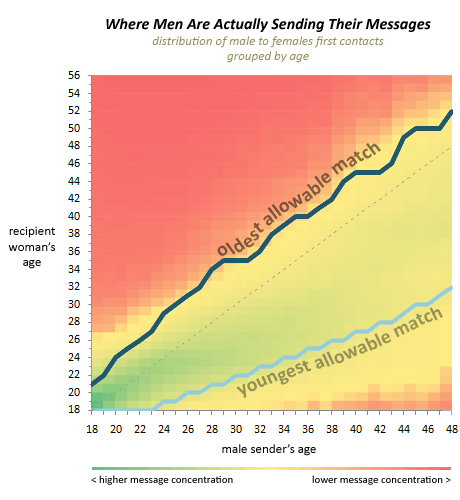
    Women users of the online dating site state a range of preferred ages for partners that is relatively normal, and when it comes to reaching out to other users, they stay pretty strictly within their own self-imposed guidelines. However, men on the site continue to state a preference for 20-something girls well into their later years. And even when male users state a cut-off age, they continue to contact women who are below that age.

    Culture of sexual exploitation or personal preference? Check out the graphs below and let us know what you think in the comments.

    Sponsor

    For starters, OKCupid’s blog states, “Men between 22 and 30 – nearly two-thirds of the male dating pool – focus almost exclusively on women younger than themselves… A man, as he gets older, searches for relatively younger and younger women. Meanwhile his upper acceptable limit hovers only a token amount above his own age.”

    Here’s what that looks like in a graph format:

    Women, on the other hand, display an “admirable openness to both reasonably younger and reasonably older men,” with the exception of early-20s young women who generally prefer to date slightly older young men.

    Here’s where the plot thickens: Stated age preferences are fine and dandy, but how different genders actually interact with potential dates of varying ages belies male users’ statements about who they’re really looking to meet.

    Here’s a heat map overlaid with the women’s stated age preferences. You can see that, with striking regularity, women mean it when they say they want to find a partner within a given age range:

    As you can see, the data show that 29-year-old women generally stop messaging significantly younger men.

    Now, here’s the data on men’s messaging habits:

    The men in this study consistently reached out to the youngest of the women in their preference range – which already heavily favors younger women. Moreover, they don’t cut themselves off at their stated minimum age preference. “No matter what he’s telling himself on his setting page,” reads the OKCupid blog, “a 30-year-old man spends as much time messaging 18- and 19-year-olds as he does women his own age.”

    Taking into account this data about sexual desirability and women’s responses to frank questions about sex acts and exploration, the OKCupid researchers determined a socio-sexual sweet spot for men to consider:

    To some, this graph might look like an episode of Cougartown. But the folks at OKCupid feel that “older” women get a bad rap in the online dating world – one that they don’t necessarily deserve.

    What’s your experience or opinion on the matter? Let us know in the comments.

    Discuss


  • Chinese Hacker Behind Google Attack Found

    U.S. authorities have tracked down the hacker who wrote the code behind the attacks on Google last month.

    The man is a freelance security consultant with ties to the Chinese government and military. The Chinese government had access to his work, although the man stated he “would rather not have uniformed guys looking over his shoulder, but there is no way anyone of his skill level can get away from that kind of thing,” according to one analyst.

    This development makes it even more difficult for the Chinese government to deny involvement in the attacks.

    Sponsor

    The hacker, if he can even be called such, posted bits of his code to a hacking forum as a work in progress. Although this man did write the code, which exploited a security loophole in IE6, he does not work full-time for the government. He didn’t launch the attacks himself, and the U.S. cybersecurity team that tracked him down said that he didn’t want his work to be used for attacks of this nature and magnitude.

    The spyware’s launch was traced to computers at Shanghai Jiaotong University and Lanxiang Vocational School, the first of which counts former government cybersecurity experts among its staff. Both institutions have denied involvement in the attacks.

    As U.S. officials continue their investigation, cybersecurity folks and others familiar with the situation wonder at how this series of attacks positions China in the international sphere. Does this news signal the beginning of a new East v. West cold war? Let us know your thoughts in the comments.

    Discuss


  • Open Thread: Can MySpace Really Make a Comeback?

    For months, we’ve been fielding rumors (and filtering out the facts) about MySpace’s proposed redesign and rebranding.

    Tonight’s report on TechCrunch outlines a few minor details of the overall plan to stop the site’s hemorrhaging users and stem its financial decline. As we’ve known (and as we predicted last year), the site will shift its emphasis from pure social networking to content discovery and recommendation. The site’s tagline is expected to change to “Discover and Be Discovered.”

    But is that really enough to bring users back? What would it take for you to start regularly using MySpace again?

    Sponsor

    Disclosure: The writer of this post has been privy to a great deal of internal information about the redesign due to personal connections in the L.A. and S.F. offices. Because of confidentiality issues and NDAs, much of that information cannot currently be published here. We will do our best to let you know official MySpace news as it breaks.

    With the abrupt firing of CEO Owen Van Natta two weeks ago, we are reminded of his initial duties when he was hired less than a year ago. In addition to dealing with internal politics and negotiating the end of MySpace’s ad deal with Google, Van Natta was expected to give MySpace much-needed boost in the areas of technology, branding and features.

    While it’s unknown exactly how much of the forthcoming “new” MySpace will represent Van Natta’s vision, we do wonder if anything is enough to save that sinking ship. Of course, the site still has a large userbase, particularly in the international market. But what do techies want to see before they start using the site again?

    The outlook isn’t good, to say the least. We conducted an informal poll on Twitter, asking what folks would need to call themselves MySpace users. While a slew of respondents said bribes – from money to puppies to MacBooks – would do the trick, the noble @EricBurgess replied “They couldn’t even pay me.” @_Tycho_ wrote that the site would have to “be easier to use than Facebook, and then convince my friends to all go back on.” A tall order, indeed, and one echoed by several others.

    But usability and attrition/retention aside, many users gave a common ultimatum: MySpace would have to do anything they try – from social networking to content and beyond – better than Pandora, Facebook or Twitter do the same things.

    Granted, in terms of content discovery, Facebook’s not particularly kind on musicians or filmmakers; as evidence, you can check out some of the remaining MySpace users. If you’ve visited the site lately, your list of active friends might look like a wasteland of struggling bands. But is a new content recommendation engine packed with multimedia goodies and intuitive discovery tools enough to regain the public’s love and trust?

    What do you think – is a site redesign enough to make you want to use MySpace again? Can the site succeed as a content platform rather than a social network? Or is MySpace doomed to sink like the Titanic, regardless of the products or features they roll out?

    Let us know your opinions in the comments.

    Discuss


  • Yelp for Religion: ChurchRater Lets Users Review Worship

    What do you get when a Christian pastor, an atheist, a grad student and a lawyer set up a website to criticize churches?

    I swear, this isn’t a bad joke. It’s a very real site, ChurchRater, and it allows anyone with an Internet connection to identify and review church services around the world. Is the site inspiring frank conversations about worship and religion, as its creators intended? Is it allowing sometimes closed or cliqueish communities to see how they appear to outsiders? Or does it, as some users wrote, “trivialize the deep dimensions of spiritual experiences” and “bolster the notion that church is a consumer-oriented proposition”?

    One thing’s for sure: It’s definitely a controversial idea for many who’ve stumbled upon the site. What do you think: Should religion be up for public review?

    Sponsor

    The site began as a rather natural extension of two of the co-founders’ book, Jim and Casper Go to Church. The premise for the book “could be the pilot script for a sitcom: a pastor hires an atheist to help him critique several Christian churches throughout the United States.” Jim Henderson, the pastor, and Matt Casper, the atheist, traveled to several churches around the U.S. to get a fresh perspective on how people worship.

    The website now allows any user to essentially replicate that feedback process.

    Here’s how it works: Users create a profile (what, no Facebook Connect option?) and then have the options of searching for churches, reading reviews and posting reviews and ratings of their own. Churches can also request to be rated, in which case a reviewer is hired and sent to review that church.

    Right now, only Christian denominations are included on the site (Catholic and Protestant); the co-founders have stated they do not intend to add mosques, synagogues or other places of worship to their system. And most of the reviews are for churches inside the U.S. Still, if you’ve ever had the unique experience of living in or around any of the American Protestant subcultures, you know there’s some darn good fodder for reviews there.

    Many of the churches in the site’s database remain unreviewed. The review threads that exist, however, range from informative to entertaining. One well-known megachurch was criticized for its emphasis on showmanship. Another large church was given a terrible review for its unwelcoming congregation and self-important preacher. One pastor got smacked down for giving his own church a five-star rating.

    As interesting and even useful as such reviews can be, however, some of the site’s users take umbrage at its purpose and execution.

    “We live in a world where 1.1 billion people lack access to clean water, over three billion people live in poverty, and children of God are sold into slavery; we have no time to waste rating ‘Sunday shows,’” one wrote.

    “By providing such an open forum,” wrote another, “dirty laundry can be aired (in fact, IS aired) with no means of proving its truthfulness; as such, you become accessories, in all likelihood, to the bearing of false witness, even slander.”

    Still, as a young person who was subjected to an unrelenting Baptist upbringing as well as constant coast-to-coast travel, I can see the value in having such a site. For discriminating church-goers who are looking for a new church home, it’s good to have firsthand and honest feedback on exactly what a given worship service will entail.

    Besides, churchgoers are already “reviewing” churches informally and offline, anyhow. Why not bring these conversations into the light?

    Let us know what you think in the comments.

    Discuss


  • Godfather of Video Blogging Tells All in New Book: Get Seen

    Our good friend Steve Garfield is a terrific fellow and also happens to be one of the Web’s first video bloggers. As part of a series called The New Rules of Social Media, he’s just published a book that lays out a complete roadmap for online video success.

    Essentially, Get Seen is a comprehensive field guide for how to produce, upload, distribute and publicize online video content.

    For businesses using the social Web to grow, it’s particularly useful, as it contains a series of plans and tools for recording and editing video and building a community around that content.

    Sponsor

    The book is detailed without being overly technical, perfect for total noobs as well as for more seasoned folks who simply need to improve their quality and/or visibility. It will guide the reader through every aspect of production, from interview techniques to camera selection.

    It also contains a wealth of information on and interviews with some of the most talented and successful names and faces that make up this ecosystem, from Justine Ezarik to Chris Pirillo. Steve also gets into the many tech companies that make up the world of online video, from scrappy startups like Robo.to to the industry’s Goliath, YouTube.

    Of course, there’s a video overview of the book here:

    Basically, it’s required reading for anyone who wants to use online video for any purposes other than the most casual social interactions. If you’re producing content and looking for eyeballs, particularly if you’re using social media for business purposes, Get Seen is a must-read.

    Discuss


  • Open Thread: The Internet Is Hard

    Earlier today, we had a runaway hit of a post that went viral within a few hours, getting unbelievable pageviews and hundreds of retweets and comments.

    The trouble was, it wasn’t because of the post’s content. Due to some interesting SEO magic, the post was one of the first search results for the term “Facebook login.” As a result, hundreds of confused readers bombed us with angry comments about how much they hated the “new Facebook,” a.k.a. our Facebook Connect comment login.

    We could laugh (and we did), but we could also consider that these are our customers and users – the people we make the Web for.

    How can we balance making the Web simple enough for all users while still creating tech cool enough to satisfy geeks like us? And who says either group – nerds or users – is “normal,” anyway?

    Sponsor

    Here are some valuable lessons we were taught today by the commenters on the thread. We’ll employ the term “user” here to indicate the non-geeky, average person who uses the Web primarily as a way to navigate his or her real life. Feel free to disagree with this terminology or suggest new nomenclature in the comments.

    1. Users don’t care about what you care about.

    This quote from another RWW post pretty much sums it up:

    “Especially in Silicon Valley, where it’s easy for entrepreneurs to isolate themselves in circles with like-minded techies and fellow entrepreneurs, I feel that a huge amount of startup CEOs and designers… make product decisions that appeal to their own interaction behaviour with such applications or what they think their friends will find cool.

    “Building for geeks makes for great customer immersion if you’re building something like (the wonderfully useful) GitHub, but that same process doesn’t work so hot if you’re building a site for middle-aged moms.”

    You and your geek friends != middle aged moms. And your users are often statistically more likely to be middle-aged moms.

    2. Users don’t read your copy or look at your branding.

    Banners, logos, carefully crafted wordsmithery – this is all filler, we’ve found out. Users have been calloused by 15 or so years of surfing through bad ads and marketing babble, and they are unconsciously tuning out everything but the one thing they came to find.

    For example, none of the 200 or so confused Facebook users who commented on our earlier post read the post itself, the huge logo at the top of the page, the many links to non-Facebook-related content or the huge, all-bold paragraph about how ReadWriteWeb is not, in fact, some ill-conceived redesign of Facebook. They simply searched for “Facebook login” and, upon navigating to our site, scrolled until they found the one button they wanted to click. Which brings us to our third assertion.

    3. Users gravitate toward the simple and the familiar.

    A ton of the confused commenters scrolled down far enough to find the Facebook Connect button for logging into the comments section – as evinced by the fact that their Facebook profiles were then linked to their comments.

    I’ve often criticized the ripped-off look of social media UIs, but once a UI becomes familiar, is it not a service to certain types of end users to continue in that vein? Two hackneyed expressions will back me up, one about reinventing wheels and the other about not needing to fix things that aren’t broken.

    As a tech geek of the 12-hours-a-day-online variety, I appreciate innovative and intuitive web interfaces. But a lot of users don’t. Even if it’s simple, it needs to be familiar. Why do you suppose some of our current, deeply entrenched web design elements – from buttons to text blocks – even exist?

    4. Users rule the Internet.

    Finally, this is the reason we’ve stopped mocking the poor folks who left those comments long enough to write this post.

    400 million people now use Facebook, and they don’t all have CS Master’s degrees from Stanford. But if you work in the IT/tech/Internet/online media industries, they do manage to pay your bills. They’re the ones who open emails, click ads, make purchases, sign up for subscriptions and generally take the majority of actions that make our whole ecosystem work.

    And most of them have no idea what a web browser is or how it differs from a search engine or a social network. They’ve chosen to be smart about other things, like building cars or making art or raising families. I’ll bet some of them are terrific dancers. We have to build the Web for them, too.

    As a user, a developer, a designer, a marketer, a startup dude or lady, whatever you happen to be, how do you balance the need to find or create cool tech and apps with the need to build with these kinds of users in mind? Do you get frustrated? Do you get feedback? Do you kill features and make buttons bigger?

    What have been your successes and failures, or where have you learned lessons? We’d love to know, so please tell us in the comments.

    Discuss


  • Twitter Hires Pixar Financial Chief, Preps for More Profitability

    Two months after announcing that the startup managed to turn a profit in 2009, Twitter has announced that it will be hiring Pixar finance head Ali Rowghani as its chief financial officer.

    Twitter’s CEO Evan Williams told Reuters today that the new hire represents the company’s direction toward “creating value for our users and capturing the financial opportunities that result from it.”

    Rowghani will join Twitter officially in March.

    Sponsor

    Last year, Twitter’s search deals with Google and Microsoft made the company around $25 million – about $15 million from Google and $10 million from Microsoft. These two deals were enough to make the company profitable last year. For a fairly young company that offers a simple, free web application for end users, this is quite a feat.

    Other revenue channels include creating a revenue-sharing scheme that would let Twitter share the profits generated by third-party applications. The details of this plan are still under wraps, but Twitter’s platform director Ryan Sarver announced at LeWeb that the company would announce details about this plan early in 2010.

    Other possible sources of revenue are multi-user accounts, which Twitter has been testing internally.

    Twitter has also recently made another high-profile hire, calling on Current TV‘s Robin Sloan to work on media partnerships, covering “everything at the intersection of Twitter and media, from live events on TV to citizen journalism on the web.”

    We’re excited to see how the startup that’s managed to become a cultural zeitgeist within a few short years will continue to grow and profit. Particularly in its early days, many who lived through the dotcom crash were skeptical about the monetization potential of a free web service. Without incorporating advertising – something that no users wanted to see – Twitter has managed to create a sustainable business.

    We can’t wait to see what ideas Rowghani will bring to the table.

    Discuss