Shell Helix Ultra Transparent Car – The Making Of
Please check this amazing transparent car


Shell Helix Ultra Transparent Car – The Making Of
Please check this amazing transparent car
2010 Opel Astra Sport Tourer
Details regarding the 2010 Opel Astra are pretty ambiguous at this time, but the guys over at Auto Motor und Sport have just revealed some new unofficial specs of the upcoming model.
As you can see for yourselves, the car features a low hood and front fascia in order to meet European pedestrian crash safety regulations.
A large grille with aggressive headlights corroborated with fog lamps placed on the outer edges of the front bumper contribute to the sporty appearance of the car.
Technical details are again fairly scarce, but the aforementioned publication says the car will come with a 1.4-liter naturally aspirated petrol unit as standard, with maximum output of around 90 horsepower and CO2 emissions of 120 g/km. In order to bring fuel consumption to the lowest possible level, the
2010 Astra will also boast several technologies aimed at this goal, including a stop/start system to idle the engine while not in motion.
Drivers looking for more performance, will have the option of a supercharged unit that will raise the maximum output level to around 180 horsepower.
A diesel configuration is also likely to join the range, with the aforementioned source claiming a 1.7-liter turbocharged unit has the biggest chances to reach the 2010 Astra.


More EcoBoost™ Engines Will Drive the Future for Ford
The Ford EcoBoost™ engines will power as much as 90 percent of the company’s North American nameplates by 2013.EcoBoost is available now in the Ford Flex and Taurus, and Lincoln MKS and MKT.
EcoBoost will be expanded to 11 global nameplates with the addition of three new variants.

The next three EcoBoost engines include a:
•1.6-liter four-cylinder that will be offered in the European Ford C-Max
•2.0-liter four-cylinder for the next-generation Ford Explorer and Edge
•3.5-liter V6 for the Ford F-150
Ford engineers have upgraded the 3.5-liter EcoBoost V6 for rear-wheel-drive applications. In the F-150, the EcoBoost is expected to deliver best-in-class fuel economy along with the power and towing capability of a V8.
EcoBoost technology combines direct fuel injection, variable cam timing and turbocharging to reduce fuel consumption, CO2 emissions and cut vehicle weight, while giving drivers the performance of a bigger engine.
While Ford is rolling out the first generation of EcoBoost engines, researchers are studying ways to create smaller future EcoBoost engines, while preserving performance and raising fuel economy.
“We are trying to get in front of the pack in leveraging EcoBoost for fuel economy,” Kapp said. “It’s going to be a trend in the industry, and we can’t rest on our laurels for one minute.
We are going to keep wringing more efficiency out of EcoBoost.”
EcoBoost is a key technology that will enable Ford not only to fulfill the company’s goal to be among the leaders in fuel economy in every segment, but also to meet the federal government’s new 35.5 mpg fuel economy standard, which takes effect in 2016.

1886 Mecedes-Benz – The world’s first true automobile
Benz Velo 1894.The origins of the Daimler-Benz company founded through a merger in 1926 date back to the mid-1880s, when Gottlieb Daimler (1834–1900) working with Wilhelm Maybach (1846–1929), and Karl Benz (1844–1929) independently invented the internal combustion engine-powered automobile, in southwestern Germany.

Although they were merely sixty miles apart, these pioneers were unaware of each other’s early work.
Karl Benz had his shop in Mannheim where he invented “the world’s first true automobile powered by an internal combustion engine” in 1885. It had three wheels.
He was granted a patent for his vehicle dated January 29, 1886, for what he called the “Benz Patent Motorwagen.” Among many inventions, Benz patented his first engine in 1879, a high-speed single-cylinder four-stroke engine of his own design which he included in his “integral” design for the Motorwagen patent application.
In 1885, Gottlieb Daimler and design partner Wilhelm Maybach, working in Cannstatt, Stuttgart, were granted a patent dated August 29, 1885 for what is generally recognized as the prototype of the modern gas engine, that they named the “grandfather clock engine.”
On March 8, 1886, Daimler purchased a stagecoach made by Wilhelm Wimpff & Sohn and he and Maybach adapted it to hold this engine, thereby creating a four-wheeled carriage propelled by an engine, as many had before them. The only distinction about this carriage was that it carried an internal combustion engine.
None of many similar attempts to adapt carts, boats, or carriages, in many countries, were propelled by this type of engine. On the official history pages of the Mercedes-Benz Internet site it is referred to as “a carriage — without a drawbar but with the conventional drawbar steering. A carriage without horses…” Daimler and Maybach later purposely built, from scratch, the first four-stroke engine powered automobile with four wheels in 1889. They founded Daimler Motoren Gesellschaft, DMG, in 1890 and sold their first automobile in 1892.

2010 Volkswagen Phaeton
Details with the next generation 2011 Volkswagen Phaeton have surfaced on to the Internet. Sources report that the facelift version 2011 Volkswagen Phaeton will debut at this year’s Auto Show in Beijing which starts April 25th and this revised model comes after 8 years since the company entered the luxury saloon segment.


The 2011 Volkswagen Phaeton will feature a front fascia that resembles the rest of the company’s models, with LED daytime runing lights and taillights and assembly will take place at a new plant in Dresda.
As far as engine options the 2011 Volkswagen Phaeton facelift will be fitted with the new 3.0-litre TFSI V6 unit (both diesel and petrol version) that was recently introduced on the 2011 Audi Q7 at the Auto Show in Leipzig.
Official details and photos with the 2011 Volkswagen Phaeton facelift will get revealed as the debut date approaches.

2011 Porsche Cayenne review video
The journalists from AutoExpress shot this 2011 Porsche Cayenne review video putting the new SUV at work both on- and off-road.

The 2011 Porsche Cayenne has been unveiled back in back in February and it will be put on sale with a price tag starting at 46,400 Euro.
The top of the range 2011 Porsche Cayenne Turbo will go for 96,900 Euro.
The German carmaker will also offer a hybrid version of the 2011 Porsche Cayenne, but this one will set you back 65,900 Euro.

The history of Infiniti
Infiniti is an upscale automaker from Japan. Though most of its vehicles are related to those sold by parent company Nissan, Infiniti looks to achieve a premium status by infusing its cars and SUVs with spirited performance and additional luxury content.

The Infiniti brand was launched for the 1990 model year. Its purpose back then, as it is now, was to create and sell premium vehicles in America that wouldn’t have otherwise fit in with Nissan’s more mainstream image.
In its first full year, Infiniti started out with two luxury cars, the Q45 and the M30; the entry-level G20 was introduced soon after. Initially, the brand’s sales were disappointing, a fact many attribute to some of Infiniti’s poorly received advertising at the time.
The company’s initial campaign aimed to bring about brand awareness with Zen-influenced spots that focused on nature.
However, the ads didn’t show the actual cars, and many believe this omission did no favors for a company that was hoping to have buyers recognize and clamor for its vehicles.
As the 1990s moved along, Infiniti slowly added more vehicles to its lineup. The Q45 found its market (though it was still outsold by competing offerings from Lexus). The car’s 278-horsepower V8 was class-leading in its day.
On top of that, the Q45 offered cutting-edge technology; it was the first vehicle to offer an active suspension system. By the late ’90s, Infiniti had rolled out the QX4, an SUV that was based on the Pathfinder. The sport-ute’s unibody platform gave it a leg up in on-road ride comfort and handling compared to competing truck-based luxury SUVs.
Sales across the Infiniti lineup grew steadily throughout the ’90s. Still, by the end of the decade, the marque fell short of both Lexus and Acura in terms of popularity.
The early 2000s saw Infiniti making a determined effort to sharpen its focus and upgrade its products. Its stated intention was to create vehicles of exceptionally high quality and performance.
The Q45 was redesigned with this goal in mind, but it was the introduction of the entry-level G35 in 2003 that finally gave Infiniti the kick-start it sorely needed. Based on the FM platform, the car, in both sedan and coupe versions, met with immediate sales success. The FX35/FX45 soon followed, a crossover SUV that emphasizes performance, mating sports-car handling with the utility of a wagon.
Today, Infiniti still trails competing marques like BMW, Audi and Lexus in brand recognition and popularity. However, recent improvements in its product line have not gone unnoticed, and the brand has won the respect and praise of buyers and automotive journalists alike.
New Infiniti Essence Concept

2010 Hyundai Tucson
In theory, the SUV was a sensible choice: more room for your cargo, more ground clearance when roads are snowy or unpaved, and more traction when climbing slippery hills.
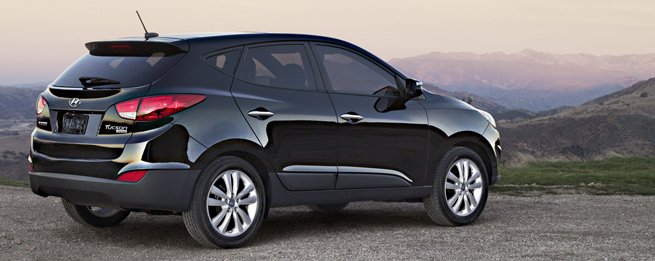
It’s the trade-offs that make traditional midsize SUVs a less ideal choice: poor fuel economy, high purchase price, and difficulty maneuvering and parking.
Small CUVs were a response to these trade-offs, but they went to the other extreme and created trade-offs of their own: cramped interiors, a lack of refinement and a general lack of ruggedness.
To differentiate the Hyundai Tucson from the small CUVs on the road, Hyundai engineers decided the Tucson needed to offer the best of both worlds, combining the rugged utility of an SUV with the maneuverability and refinement of a car. Once you experience it, you’ll understand why the Tucson is the right vehicle for our times.
via Hyundai Official Website

Learn more: Toyota Sienna

2010 Audi R8 V10
One of the best gets even better, as Audi introduces a monster V10 engine for its already stunning R8.

More Horrible Car Wrecks
Keep your eyes and your mind on the road and your hands on the wheel! While you’re driving, it’s more important than anything inside the car, anything inside your mind.

Tunnel Accidents Video

2010 Mini Cooper 50 Camden Edition – Quick Spin – Car and Driver
The special-edition Mini that talks to you: It isn’t annoying, but it also isn’t cheap.

Mercedes-Benz CLS Shooting Break Concept
Mercedes-Benz has unveiled its own take on the four-door coupe with the new Mercedes-Benz four-door Coupe CLS Shooting Break concept.
Following in the footsteps of the Porsche Panamera and Aston Martin Rapide, the Mercedes-Benz CLS Shooting Break concept signals the arrival of a new market segment for the brand.
Due to make its debut at Auto China 2010, the Shooting Break concept features elements introduced with the latest models from the Mercedes stable, including the radiator grille, with the large star and bionic slats from the SLS AMG super sports car.


Crazy Insane VIP car in Japan with strange wheels
Camber and dish combo that needs to be see to be believed. This VIP cruiser scraped and sparked its way more than 150 kilometers back to Tokyo on 4 wheels of rubber no thicker than motorbike tyres. I still have no idea how it was set up to be drivable like this. Insane comes to mind.

5 Supercar drag race
The Ultimate Play Date: Maserati GranTurismo, Audi R8, Ferrari F430, Lamborghini & Mercedes SLR
This is kids-in-candy-store stuff, plain and simple. You can quit looking at the cars on this page and struggling to imagine a narrative hook that logically connects such disparate players as an out-of-production Mercedes-Benz McLaren SLR coupe and a Maserati GranTurismo-both front-engine, rear-drivers, with mid-engine superstars like a spanking new Lambo LP560-4, last year’s Audi R8 4.2 quattro, and a 2007 Ferrari F430. There isn’t one.
This is like a rich collector’s dream garage with all the doors open and all the keys in the ignition. We’re playing with five cool cars that all gasoline-blooded MT readers would give their eye teeth (or $1695, if that’s more convenient) to drive.
So, the best sport car into the world is McLaren Mercedes SLR !

The best BMW concept


Renault Fluence Z.E.
Fluence Z.E. Concept is a statement of Renault’s intention to produce a range of zero-emission vehicles that meet the needs of all types of customer. Fluence Z.E. Concept is a genuine family car which demonstrates that attractive styling, comfort and space can go hand in hand with respect for the environment.
Fluence Z.E. Concept is a genuine family car aimed at customers who want both roominess and style. The styling cues of Fluence Z.E. Concept combine the design language of motoring pleasure with the visual signature of Renault’s range of electric vehicles.
Fluence Z.E. Concept possesses dynamic lines, highlighted by a fluid character line which sweeps from the headlights to the rear shoulders. It is 4,820mm long, has a wide track of 1,672 mm, is well-proportioned and exudes status-enhancing, elegant looks.
Fluence Z.E. Concept’s warmly welcoming and refined interior is based on a combination of flowing forms, the use of soft, supple materials and a mottled ambience.
Passengers are comfortably seated in four enveloping seats robed in light leather upholstery.
The feet rest on a light blue translucent gel mat, while the brake and accelerator pedals, too, are covered in gel for a greater sense of comfort.
When the doors open, the courtesy lighting recalls the luminous blue signature of Renault’s electric vehicle range.
Fluence Z.E. Concept is powered exclusively by an electric motor located near the front axle, in conjunction with a lithium-ion battery positioned between the rear seats and the boot.
Renault’s designers and engineers worked closely together to develop a safe, practical vehicle capable of accommodating a large enough battery to ensure good range (160km), while also providing sufficient carrying capacity to cater for the requirements of an active family (327dm3).
Fluence Z.E. Concept is not respectful of the environment simply because it runs on electricity.
via Renault


