Author: Notre Dame Magazine

  • Online pop quiz

    If you’ve been checking the magazine’s website at least once a week, as a Good Domer should, you know we’ve expanded our reach to movie reviews, a comic strip, up-to-date discussions of topical issues, personal looks at campus events and people, and an ever-expanding and changing array of informative and entertaining features.

    How tuned to the website are you? We take you back to your college days with our pop quiz. And here we provide links to the answers.

    Pop quiz

    Why is Professor Jim Mole the most unusual Notre Dame faculty member of all time? The inside scoop.

    What is the connection between the 1964 movie The Pink Panther and the Winter Olympics? Winter Olympics, past and present.

    Can you read Notre Dame Magazine safely while driving your car? Soon you will be able to listen to Notre Dame students reading articles from the current issue for a magazine podcast. Watch the home page for an announcement of when this is available.

    After 9/11 are we any safer? After 9/11, are we any safer?.

    Who played ND alumnus John Crowley ’92J.D. in the film Extraordinary Measures? Movie review: Extraordinary Measures.

    What did Pope Benedict XVI say at the University of Regensberg that generated a worldwide uproar, and how was he misunderstood? Muslim-Christian relations.

    What famous writer said, “Even today if I see a pen lying discarded on the ground I pick it up and take it home like an abandoned puppy”? ??? at Notre Dame.

    Who is “the fat lady for whom one should shine one’s shoes”? Detachment, Buddy.

    What 80-year-old pop cult phenom has emerged as the “hippest grandmother a college kid could want”? The ??? phenomenon.

    Who said, “Don’t tell me there isn’t enough love in the world to care for all the unwanted babies”? ??? and abortion.


  • No St. Paddy’s Day for the Fighting Irish

    irishcard3

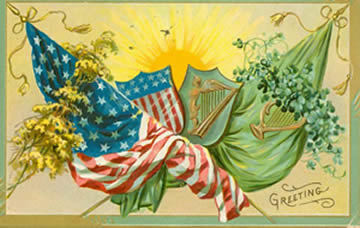
    Each year on March 17 people across the United States celebrate St. Patrick’s Day and their Irishness or faux Irishness, as the case may be. It may come as a surprise, however, that at Notre Dame, the home of the Fighting Irish, the University’s founder, Father Edward Sorin, CSC, actually banned observance of the holiday.

    Although St. Patrick’s Day is a traditional feast day in Ireland, the holiday as we know it is a uniquely Irish-American phenomenon. In the 19th century, however, March 17 raised some interesting tensions for Irish immigrants. Native-born U.S. residents were already suspicious of Irish Catholics, who were viewed as having allegiance to a foreign power — the pope. Celebrations of Irishness were viewed as further evidence that the Irish were not American and were a potential threat. It was to combat this perception that Father Sorin, who famously sponsored Fourth of July celebrations for the South Bend community to prove American loyalty, forbade the observance of St. Patrick’s Day.

    Of course, Irish immigrants have been coming to America since long before there even was a United States. An estimated one-quarter to one-half million people emigrated from Ireland between 1700 and 1820, many of whom were Presbyterians from the Ulster Province of Northern Ireland. Immigration continued to increase in the 19th century, particularly during the famine and post-famine periods. In the decades before the Civil War, an estimated additional 2 million Irish, mainly Catholics from the provinces of Munster and Connacht, came to the United States.

    According to the 2008 census, more than 36 million U.S. residents claim Irish ancestry today. Although individuals and families within particular waves of migration held some commonalities, Irish immigration to America has always been remarkably diverse, including varied religious traditions (such as Anglican, Baptist and Quaker), social classes from all along the economic spectrum, and different occupational backgrounds, both skilled and unskilled.

    Historically, an acute bias existed against the Irish, particularly for Catholics arriving in the late 19th and early 20th centuries. The sheer volume of these immigrants, along with their frequent state of destitution in the post-famine era, caused them to be held in low regard by native Americans. There were tensions that the Irish would replace Yankee workers in mills, a justifiable concern as increasingly cheap foreign labor displaced native-born help. The fear of losing jobs was particularly acute in Indiana. The Know-Nothing Party was a nativist political movement with a strong presence in the state. When Irish as well as German workers came to the Midwest during the building of canals, many citizens joined the Know-Nothing organization and denounced these immigrant laborers

    Irish-American identity has ebbed and flowed throughout history, often in tandem with political and social events in Ireland. Traditionally a feast day in Ireland, St. Patrick’s Day in America with its attendant parades and pageantry became symbols of Irish power and pride, ritual reaffirmations of Irish community solidarity, and vigorous protests against prejudice and the rising tide of nativism in the United States. Frequently hosted by local chapters of the Ancient Order of Hibernians, Clan na Gael or the Knights of Columbus, St. Patrick’s Day events were often tinged with controversy as the leadership of these organizations sought to negotiate the dual loyalties of Irish immigrants to both Ireland and America.

    Second-generation immigrants experienced their mixed allegiances especially acutely as nativists charged that American-born Irish could have only one loyalty, to America. It is important not to oversimplify the complexities of Irish immigrant experiences in the United States. Nevertheless, St. Patrick’s Day has often served an important role in asserting Irish identity.

    Over time, St. Patrick’s Day has become an American holiday. As an amalgam of old world customs and uniquely American traditions, the day continues to be about community — a transatlantic community in which both Ireland and America are celebrated.


    Deborah Rotman is the director of undergraduate studies in Notre Dame’s Department of Anthropology. Since 2006, she has been studying an Irish immigrant neighborhood south of campus known as “Sorinsville.” The neighborhood was developed by Father Sorin in the 1850s as housing for Notre Dame employees. In an effort to better understand the Irish diaspora, for several summers Rotman has taken ND students to Ireland to help her conduct archival research and collect oral histories.


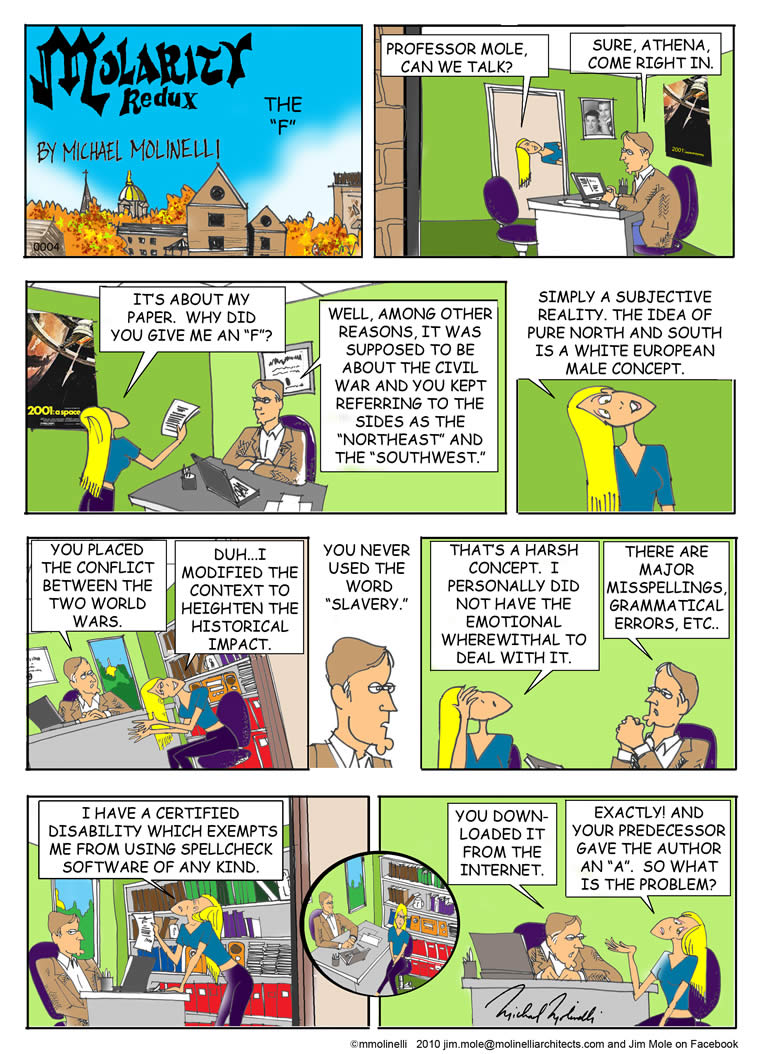
  • Molarity Redux: Demographics

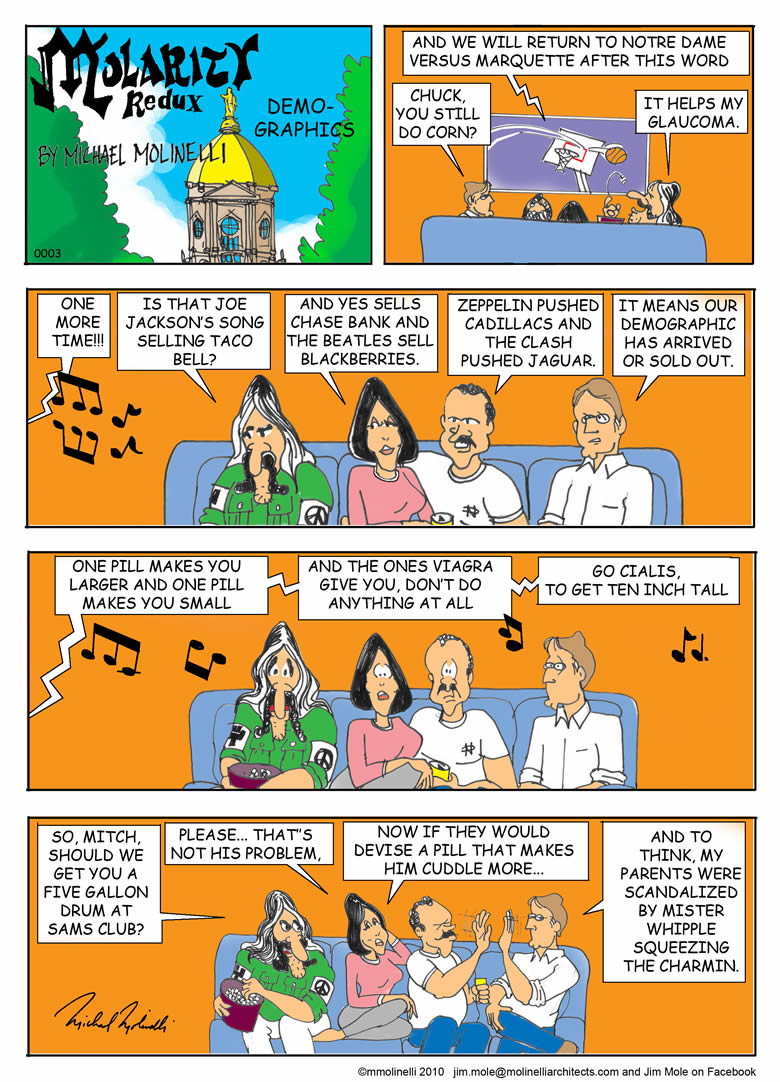
    Welcome back to Molarity Redux, the updated, continuing adventures of Jim Mole and friends.


    molarityredux3a


  • Dreams of sleep

    mgsphoto

    I have awakened in the wee hours of the morning to many sounds: dogs barfing, children barfing, husband snoring, babies crying, cellphones ringing, and the thunk of a 3-year old falling out of his big-boy bed. This morning I woke up to a very distinctive sound, the unmistakable electric hum of a Jedi knight engaging his light saber.

    I open my eyes to a barefoot Jedi in a Power Rangers cape wearing Tyrannosaurus Rex pajamas. It’s 5:30 in the morning, and I’ve got a 3-foot, neon-blue light saber in my face. As I am rethinking my son’s birthday present, the Jedi speaks, “I want my breakfast.”

    “How do you ask?”

    “I want my breakfast, now.”

    “That is not how you ask. Ask nicely.”

    “I want my breakfast now, please.”

    “Get that light saber out of my face.”

    “Ask nicely.”

    “Get that light saber out of my face, NOW, please.”

    As I search for my glasses and trip over the dog, I realize I am tired. How many mornings since my first child was born, I wonder, have I woken up and thought, you know, I just want to go back to bed?

    I have two basic dreams of parenthood. One is that I get to go back to bed. The second is raising well-rounded, happy children who become functioning members of society and take good care of me in my dotage. To get us to this ending, I have made many overt and covert efforts. One is to place inspirational quotes in strategic locations throughout the house.

    In the dining room is a quote from St. Luke’s gospel. In 6-inch decal letters I bought on the Internet it reads: “To those who much is given, much is expected in return.” Once my husband finally noticed, St. Luke only inspired him to say, “How much did you pay for that, because I think I could have addressed it with a Sharpie marker.”

    Consistent with my quote-happy lifestyle and Notre Dame alumnae status, above the back door we exit every morning, I hung a Notre Dame banner that my husband, the anti-Notre Dame fan concedes is not only worth the money but cannot be replicated with a Sharpie marker. “Play Like a Champion Today.”

    He’s okay with the “Play Like a Champion” sign because he believes in it. We both do. And we hope that by our own example, our children will also come to believe that every day is a gift to be opened with joy, energy and the enthusiasm to believe you can change the world, or, at the very least, win the National Championship.

    The only rub is that in all honesty, I often wonder how many Notre Dame athletes exit the tunnel at Notre Dame stadium, smack the “Play like a Champion” sign and think, “You know, all I really want to do is go back to bed.”


    Maraya Steadman, who lives in a Chicago suburb, is a stay-at-home mother of three children. She can be reached at [email protected].


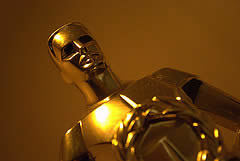
  • The Battle for Oscar: Avatar vs. Hurt Locker

    oscars.jpg

    Of the 10 Academy Award nominees for Best Picture, two films offer the most compelling competitive storyline: Avatar and The Hurt Locker. This isn’t because they’re unquestionably superior to the rest of the nominees (though they did tie for the most total nominations with nine). Instead, their opposition crystallizes intensely held opinions about the state of the American film industry and the meaning bestowed by its most prestigious award. As with earlier heavyweight match-ups (Pulp Fiction vs. Forrest Gump, Saving Private Ryan vs. Shakespeare in Love), money, aesthetics, politics and personalities underpin this Oscar battle.

    First and foremost, this is the Hollywood behemoth against the indie underdog. James Cameron’s science fiction eco-parable Avatar, in which a mining company in pursuit of profit destroys the wondrous habitat of the planet Pandora, embodies U.S. studio filmmaking at its most dominant, from the film’s massive budget (reportedly over $400 million) to its global reach (a record $1.9 billion in worldwide box office gross and counting).

    The Academy likes to reward popular, epic blockbusters (Braveheart, Gladiator, Cameron’s own Titanic ), as if to affirm that Hollywood’s excesses are in the service of the audience, not the industry’s profit motive. That said, Oscar has rewarded modestly budgeted independent cinema frequently since the 1990s (American Beauty, Crash, Slumdog Millionaire). A win for the $11 million The Hurt Locker would signal that, despite the dire economic state of indie filmmaking today and The Hurt Locker’s mere $16 million box office take, the American film industry must support its best artistic work, regardless of its profit potential.

    Indicative of its artistry, The Hurt Locker, an intense film about an Army bomb disposal unit in Iraq, has dominated the various film critic awards. Avatar’s special effects-driven spectacle is certainly revolutionary, but many critics find the film’s story to be highly derivative and shallow. In contrast, The Hurt Locker’s intimate scope and quiet narrative offer the chance to truly contemplate the ideas contained within the images. And while The Hurt Locker’s handheld aesthetic, guided by director Kathryn Bigelow, is not the step forward that Avatar’s fantastical 3-D and CGI effects are, the intensity of the experience prompted by that realistic style can be no less transformative for the spectator. Here the battle rages between rewarding either technological revolution or narrative integrity in filmic storytelling.

    Politically speaking, both films offer messages that speak to Hollywood’s left-leaning constituency; in fact, they are actually united in highlighting the dehumanizing impact of militarism. However, Avatar’s overt moralizing contrasts with The Hurt Locker’s more subtle stance. The Academy has rewarded righteousness in the past (Schindler’s List, Dances With Wolves), but for those disdainful of Avatar’s bombast, The Hurt Locker is the ideal alternative for making a political statement with the Best Picture vote.

    Finally, because this is Hollywood, one has to consider the gossip angle: directors Cameron and Bigelow used to be married. Cameron has a reputation as an egotistical despot, and, perhaps indicative of that, Bigelow is only one among four ex-wives. Bigelow is well-respected for being one of the few female directors to thrive in Hollywood (she’s only the fourth woman ever to receive a Best Director nomination). Thus, a vote for The Hurt Locker would be a call for greater female prominence in the director’s chair; at that same time, it would be a vote against the prospect of Cameron delivering another galling “king of the world” Oscar speech.

    Of course, it’s possible that Inglorious Basterds or one of the other nominees will make this particular cage match moot. But at least until Oscar night on March 7, The Hurt Locker vs. Avatar will remain the most compelling, meaning-laden storyline of the Academy Awards.


    Christine Becker is an associate professor in the Department of Film, Television and Theatre who specializes in the history of film and television. She is the author of It’s the Pictures that Got Small, an analysis of the role of Hollywood film stars in 1950’s television.

    Photo:


  • Unbalanced: The giants, gone

    professors.jpg

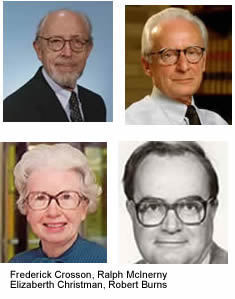
    Like a macabre line-up of dominoes, one after another the giants of Notre Dame fell. Dec. 9: Frederick Crosson, program of liberal studies. January 29: Ralph McInerny, medieval studies. February 4: Elizabeth Christman, American studies. February 5: Robert Burns, history.

    Their service to their University stretched over decades. Their learned papers and books brought light to the shadows. Their gifts to students were immeasurable.

    This dark surfeit of deaths reminded me of something amazing that happened as newspapers began losing their readers. The savvy ones found a rather morbid way to make a little money: Instead of the short, here’s-the-facts list of dates and survivors, many began, for a fee, allowing relatives and friends to write obituary copy.

    Suddenly the death pages of newspapers came alive.

    Often, even recognizing the sadness and loss behind the words, these fond farewells can make me smile. Someone writes: “She enjoyed gardening, traveling and gambling.” Or “Les was a workaholic who loved his family dearly.” Another says, “Your education was limited but your heart was golden and I am so proud to be your son.”

    So it seems only right that the passing of the giants of Notre Dame be best celebrated by those who knew them, those who go beyond the facts to the heart of memory.

    Notre Dame Magazine cannot replace the loss of these much-loved professors. But we can offer the words of those who shared in the joy of their companionship, the sorrow of their departure. And we hope that you, too, will share your thoughts in a virtual world of comforting wakes.


    Carol Schaal is managing editor of Notre Dame Magazine.

  • Bob Burns: May his memory be cherished

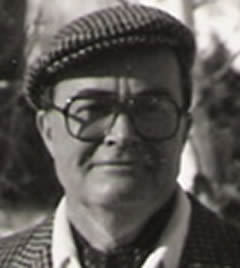
    burns_robert.jpg

    Bob Burns and I were born within three weeks of each other: he in Newark, New Jersey, I on a farm in southern Ohio. That was in 1927. Understandably enough, our paths didn’t cross for many years. In 1957, however, Bob took a position in Notre Dame’s history department, in which I was then a graduate student.

    Since graduate students didn’t socialize very freely with members of the faculty, we didn’t get well acquainted right away. But after I, too, joined the faculty, we saw each regularly. Over time, I came to appreciate what a remarkable person Bob was, and we became close friends. The thing about him that impressed me most was his zest for life, his adventuresome spirit. He was always ready to try something new, to accept additional responsibilities, or to respond to the needs of others.

    On the academic side, that translated into activities over and above his teaching European history to undergraduates and mentoring graduate students in his specialty, Irish history. He served for a time as acting editor of the The Review of Politics, as acting director of the Medieval Institute, and ultimately as acting dean of the College of Arts and Letters, where he had come up through the ranks as assistant dean and then associate dean.

    As an administrator, Bob believed in the hands-on approach. He wanted to get the job done, and had little patience with bureaucratic niceties. Thus in setting up the London program — the accomplishment of which he was most proud — he personally took care of the nitty-gritty organizing that has made it possible for hundreds of Notre Dame students to live and study in a city he loved.

    Bob was always a great talker, a quality his friends appreciated most when he vented his frustration with individuals (or departments) causing problems in the dean’s office. He enlivened many a faculty club luncheon with these tidbits, but we always knew his dire threats of retaliatory action would never be carried out. Bob simply didn’t have a vindictive bone in his body and he never nursed a grudge.

    At our lunches, he learned by listening, too. Most notably, his curiosity was aroused when M.A. Fitzsimons, a senior colleague whom he greatly admired, reminisced about having led a protest against a breach of academic freedom at the University.

    Researching that episode — which set off a storm of adverse publicity in 1943 — got Bob started on what eventually became his fascinating two-volume history of Notre Dame.

    Outside the academic sphere, Bob was always trying new things. He was a Coast Guard veteran, and on arriving in South Bend he bought a small boat, christened it The Sturdy Beggar, and took up sailing on Eagle Lake. Later came flying lessons, which he pursued successfully — but not to the point of buying an airplane! To handle maintenance problems in a newly built house, Bob took courses in plumbing and heating at IVY Tech.

    He continued to employ those skills at the much-loved beachfront cottage in Seabrook, New Hampshire, that he purchased in the 1960s — a wise investment that paid for itself many times over while also serving as the family’s perennial vacation headquarters.

    Bob’s generosity of spirit matched his zest for life. He always wanted others to share in the pleasure he found in new experiences. And many are the things I have done, and places I have been, on his invitation. My life, like that of countless others — and of the University itself — has been enriched by Robert E. Burns. Long may his memory be cherished at Notre Dame.


    Professor emeritus J. Philip Gleason taught American history at Notre Dame from 1959 until his retirement in 1996.


  • Ralph McInerny had our number

    mcinerny.jpg

    I am a fairly undisciplined and compulsive reader, but I sometimes think the number of books Notre Dame’s Ralph McInerny has written exceeds the number of books I have read. Along with the countless volumes of philosophy, literary criticism, cultural criticism and poetry that the late Michael P. Grace Professor of Medieval Studies left behind when he died on January 29, are dozens of potboilers, many of them murder mysteries.

    My favorites among this subset of “McInernia,” are the novels Ralph set at Notre Dame. All of them have groan-inducing puns in their titles, such as On This Rockne, Irish Tenure, Lack of the Irish, Celt and Pepper and the forthcoming Sham Rock. (When it came to resisting puns, Ralph was utterly powerless. He once unblushingly began a lecture on G.K. Chesterton this way: “It takes a lot of gall to talk on Chesterton, and my gall is divided into three parts…”)

    Ralph’s Notre Dame murder mysteries are lavish in local color and character, and he often included thinly disguised friends and colleagues as minor characters. I was always delighted and amused by the good-natured teasing involved in these cameos until, in a couple of the stories, I noticed a character from Notre Dame’s PR office with a name suspiciously like my own.

    “All this guy does is hang out in the back bar of the University Club, drinking, telling cynical jokes and picking fights,” I grumbled to my wife. She replied that she could fondly remember several times we had sat with Ralph in that very room, drinking merlot, joking and gossiping about the peculiarities, splendid and otherwise, of Notre Dame. She gently added that if I didn’t exactly pick fights on those occasions, I did from time to time express vehement and contrary opinions. “In other words,” she shrugged, “Ralph’s got your number.”

    She was right, of course. Nor was mine the only number this incisively witty and wonderfully convivial man had, which is among the reasons he could be such a formidable controversialist. Whether his aforementioned gall was divided or not, he had gall aplenty, and he could be positively gleeful in flushing out, strafing and demolishing an opposing viewpoint, especially if that viewpoint concerned the affairs of the Catholic Church.

    But if he spoke and wrote daggers, he used none. Too honest to shrink from genuine disagreement, Ralph also was too kind to keep an enemy. “I have never doubted the sincerity of those I have called dissenting theologians,” he wrote in his autobiography. “Many of them are friends of mine.”

    Among those sincere believers with whom Ralph could vigorously disagree were many men and women of the Catholic Worker movement. But any of them will tell you they had no better friend than Ralph McInerny.

    During the years since Ralph’s retirement, Notre Dame theologian Michael Baxter, an active member of the Catholic Worker community in South Bend (and a minor character in one of Ralph’s Notre Dame mysteries), was a frequent and welcome visitor at Ralph’s house in Holy Cross Village. They liked to talk about theology and Catholic history, but Ralph would often ask after the affairs of the Catholic Worker houses. Not only the plights and idiosyncrasies of the guests would interest him, but also the grocery, heating and repair bills. Often Ralph would nonchalantly remark, “I can help with that,” scrawl an eye-popping sum on a personal check, and hand it to Baxter, never letting his right hand know what his left hand was doing.

    Charity was perhaps the only activity in which this eminently meticulous philosopher could be so careless.


    Michael Garvey is Notre Dame’s assistant director of public information and communication.


  • A pastoral welcome

    The Notre Dame community officially welcomed its new bishop during a special Mass of Thanksgiving on Tuesday evening, February 9, in the Basilica of the Sacred Heart.

    Kevin C. Rhoades, the ninth bishop of the Diocese of Fort Wayne-South Bend, presided and gave thanks for the voices of the Notre Dame Liturgical Choir descending from the loft and for the hundreds who had gathered for the Mass despite the steady, picturesque snows circling down the basilica spires to blanket the campus in white.

    Rhoades was installed as Bishop John M. D’Arcy’s replacement on January 13. D’Arcy, 77, had led the diocese for 25 years and worked with three University presidents during that span before he formally handed over to Rhoades his duties as shepherd of the area’s 160,000 Catholics.

    This was not a first visit to campus for Rhoades, 52. During his homily, he recalled celebrating Mass in the basilica after Notre Dame’s 2006 home football victory over Penn State. At the time, Rhoades was finishing his second year as the bishop of Harrisburg, Pennsylvania.

    Since his appointment to Fort Wayne-South Bend in late autumn 2009, Rhoades has made several trips to campus. He joined D’Arcy for an appearance at the annual conference of Notre Dame’s Center for Ethics and Culture. During Tuesday’s Mass, he mentioned meetings with the Rev. John I. Jenkins, CSC, the University’s president. Earlier this semester, he celebrated Masses in the chapels of Siegfried Hall and Morrissey Manor.

    Father Jenkins introduced the new bishop to the basilica congregation, saying he hoped Rhoades, a native Pennsylvanian and former rector of the historic Mount Saint Mary’s Seminary in Emmitsburg, Maryland, would feel at home on campus, and not merely like a guest.

    As bishop of Harrisburg, Rhoades was among the 80 U.S. prelates who were publicly critical of the honorary law degree Notre Dame conferred last spring upon President Barack Obama at commencement. But he made his affection and high regard for the University known in his first public appearance as D’Arcy’s named successor. Tuesday night, he appeared quite comfortable in the basilica pulpit as he quoted Pope John Paul II’s view that “bishops should not be seen as external agents, but as participants in the life of the Catholic university.

    “As I undertake my new responsibilities as Bishop of Fort Wayne-South Bend,” he said, “I am very conscious of my . . . responsibility particularly to strengthen and promote the Catholic universities in my diocese and especially to promote and assist in the preservation and strengthening of their Catholic identity.”

    The bishop’s homily reflected on the closely intertwined histories of the University, founded in 1842, and the diocese, erected in 1857. He noted that he shares his birthday, November 26, with the University, since that was the day that Father Sorin and the seven Holy Cross brothers in his party arrived at the original Log Chapel built by the French missionary, Father Stephen Badin.

    Rhoades studied for the priesthood in Rome. He was ordained in 1983 and was first assigned to parish work and Spanish-speaking apostolates in the Harrisburg diocese. In 1986 he returned to Rome and earned degrees in sacred theology and canon law. He later taught courses in these subjects and in Hispanic ministry at Mount Saint Mary’s and was appointed rector of the seminary in 1997, the position he retained until his appointment to Harrisburg in 2004.

    As bishop, Rhoades successfully boosted seminarian recruitment and advocated for stronger parochial schools and improved pastoral outreach to Hispanics.

    Father Jenkins alluded to this latter interest when presenting Rhoades with a welcoming gift: a finely crafted wooden crozier, the curved staff symbolic of a bishop’s role as shepherd of the local Catholic flock. The crozier bears Rhoades’ episcopal coat of arms and its motto, “Veritatem in caritate” or “truth in charity,” as well an image of Our Lady of Guadalupe, patroness of the Americas, created by ND art professor Maria Tomasula.

    “I knew I was going to be receiving a gift,” a visibly grateful Rhoades told the congregation. “I thought it was going to be a Fighting Irish sweatshirt.”

    He added that Jenkins had given him a personal gift the evening before, a framed, black-and-white photo of Notre Dame’s famous replica of the grotto at Lourdes, France, taken around 1900. Rhoades said the gift carried special personal significance for him because he traced his priestly vocation to a visit he had paid to the replica grotto at Mount Saint Mary’s as an undergraduate student in the 1970s. He said he is moved to pray at Notre Dame’s grotto whenever he visits campus.


    John Nagy is an associate editor of Notre Dame Magazine.


  • Pondering the true: A remembrance of Professor Crosson

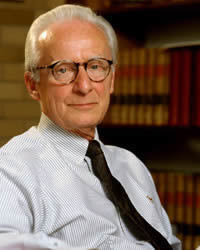
    crossonpix.jpg

    Frederick Crosson, Cavanaugh Professor of the Humanities Emeritus in Notre Dame’s Program of Liberal Studies, died on December 9th at the age of 83. Nearly two years earlier he had suffered a brain-damaging fall that left him confined and weakened in ways that painfully removed him from normal communication with family and friends. In full health, he had not only been a remarkably warm and gregarious person marked by a probing and ranging intellect and a rich spirituality, but also one who especially delighted in the significant exchanges and the specific public trust of academic life.

    Deeply respected and loved by the students who came his way, he was among a handful of the intellectual and moral leaders on the faculty of Notre Dame in the second half of the 20th century.

    Fred was hired and developed as a teacher and scholar in Notre Dame’s Great Books program from 1953 until 1976. He then held the O’Hara Chair in Philosophy before returning to the Program of Liberal Studies as the first Cavanaugh Professor in the Humanities in 1984. He published more than 45 scholarly articles, edited five books and reviewed countless books, the latter especially in his capacity over many years as philosophy and religion reporter for national Phi Beta Kappa’s The Key Reporter. He was elevated in time to the presidency of the Phi Beta Kappa (1997-2000), the first Catholic to hold that office.

    His scholarly interests and publications covered a spectrum that included cybernetics, philosophy of mind, philosophy of science, political philosophy and philosophy of religion, at the center of which was his focused and devoted interest in St. Augustine. He has clearly made a singular contribution to the interpretation of Augustine’s writings.

    During his tenure on the faculty Fred served as dean of the College of Arts and Letters, the first layman to do so in the University’s history. He also served as chair of the Program of Liberal Studies, editor of The Review of Politics and founding director of Notre Dame’s Center for Philosophy of Religion. Outside the University, he served terms as president of the American Catholic Philosophical Association and of the Yves R. Simon Institute. He worked tirelessly over many years for the ideals of liberal education on Phi Beta Kappa’s Committee on Qualifications and with the North Central Association in the accrediting process.

    After his initial studies in philosophy through a master’s degree at the Catholic University of America, Fred went to the University of Paris to study the phenomenological and existential strains in continental philosophy, a journey that he completed in the Ph.D. under A. Robert Caponigri at Notre Dame. In France, Fred became especially interested in the then-recent and continuing Catholic renaissance in French intellectual life. Through that interest he became linked in another way to Notre Dame, where Yves Simon’s presence and Jacques Maritain’s active influence were in place at mid-century.

    Catholics and politics

    Fred revealed himself, as a teacher of political philosophy, in what he once said about Simon. He wrote of Simon’s “genius at bringing into view the critical theoretical questions which lay behind the controversies of our public life.” He noted that Simon showed Catholics “that liberal democracy and its emphasis on freedom was in no way opposed to the Catholic tradition,” and he showed liberals “not only that that tradition could provide a foundation for democracy” but that it also “provided a sounder foundation than did the possessive individualism of some of the classical theories of liberal democracy.”

    Writing on another occasion as editor of The Review of Politics, Fred affirmed the journal’s tradition of looking at political problems “under historical, philosophical and theological perspectives.” He added that “those perspectives require the objectivity of scholarship, but we have never understood objectivity to entail indifference or scholarship to demand neutrality. We continue to work in the traditions of political democracy and of Catholic Christianity.”

    I knew of Fred through his teaching before I met him at Notre Dame in the 1960s. Graduate student associates at the University of Chicago who had done their undergraduate work at Notre Dame spoke of the great impact of his teaching, especially his guided explorations of Aristotle’s Politics. In the same 1960s and before I joined the Program of Liberal Studies and came to know him as a colleague, I saw firsthand his analytical power and skill at directing a seminar in a faculty seminar (Collegiate Seminar faculty of the time) on John Stuart Mill’s On Liberty; he drew remarkable perceptions of that text out of all of us, and I know that in his customary fashion he kept thinking about the argument of that text over the years. More than 20 years later, he published an important article on Mill’s On Liberty.

    His much remembered teaching of Aristotle took place in what has been most often known as the “Politics” tutorial of the Program of Liberal Studies; that course was a quite constant part of Fred’s teaching station in his first 15 years on the faculty.

    Later when he returned to the Program in the 1980s, he frequently took up this station again, and I had precious and regular opportunities to discuss with him illuminating and vexing aspects of the Politics. Fred was, in all his reading and notably with respect to this text, a most perceptive and probing reader from whom one always learned much. I came some time ago to believe that this text, along with his decidedly Christian sense of the common good and personal humility, accounted for his style of citizenship and leadership which I had seen over many years informing his life.

    Fred always had a sense that one had to work hard and tirelessly for the “possible” improvement in a given context and that what one sought had to be critically derived from an understanding of what was truly good. He also took seriously Aristotle’s teaching that a good person would know how to rule and be ruled in turn. He was an exemplary citizen in his various communities from department, University, to the wider republic: he assumed responsibilities at the asking, prepared well for meetings, and contributed in a civil way that elevated discourse and understanding of the common good.

    One of the great themes of Fred’s inquiry and thought was the relationship between faith and reason. This was, of course, bound up with his study of Augustine but seemed to take on new life for him with the appearance in the late 1990s of John Paul II’s Fides et Ratio, which Fred studied carefully (he had made his own index of it) and about which he lectured. He had formulations, no doubt Augustine-inspired, of faith’s assistance to reason that I found notably striking and helpful. While emphasizing that faith seeks understanding, in fact suggesting that faith seeks and understanding finds, that faith is thinking while assenting, he drew attention to how faith extends the horizon for reason and can lead us to look at evidence in a different way.

    The love of Christ

    The depth of Fred’s Christianity and its sacramental nature came out in a conversation that has ever remained with me. Over coffee after attending a lecture together, a lecture that had somehow raised for consideration whether all human relationships were some form, however attenuated, of a contractual utilitarian calculus, we came to ask about the unrequited love manifest in Christ. Was such love simply and entirely beyond the reach of humanity? Where might it be found? Where is it at least approximated?

    After some groping about and a realization that the problem we had come on could clearly put not only politics but also all human relationships deeply at odds with Christianity, Fred drew attention to marital love and the having and nurturing of children as where such love might and sometimes did exist. Here a relationship could be a good in itself. Here too, Fred lived as he thought. Fred was married to Dr. Patricia Crosson and had five children.

    In the five to six years before his death, Fred was especially interested in clarifying Leo Strauss’s teaching on esoteric writing and asking whether and how the esoteric dimension appeared in Christian classical writers like Augustine and Aquinas. This inquiry brought him to distinguish a Christian notion of “latent” meaning over against the esoteric that he saw Strauss opening in our understanding of the great tradition of political philosophy. Such work of Fred’s last stage of life as well as a number of his prize essays over the years, including one previously unpublished, are found in a collection of his essays which he began to prepare for publication in the months before his fall.

    Professor Michael Crowe and Father Nicholas Ayo have edited the collection following Fred’s leads, and Professor Katherine Tillman has provided a significant interpretive introduction to the collection. The book is titled Ten Philosophical Essays in the Christian Tradition, and readers interested in purchasing the book are asked to get on a list for further notification by dropping a line to the office of the Program of Liberal Studies at 215 O’Shaughnessy Hall, Notre Dame, IN 46556 .

    Fred’s specific love, as a teacher, or better, as a facilitator of liberal education, was for the role of being leading questioner in a Great Books seminar. For him the key to deft guidance of discussion was greater and greater understanding of the text while maintaining a sense for what were real questions on the ordinary horizon of the human being and citizen. He emphasized the simple human good and happiness that came from greater understanding of who we are and where we are in time and in the universe.

    I found especially meaningful an observation in his address upon winning the annual Sheedy Teaching Award in the College; the address was picked up by the Chicago Tribune and published on its editorial pages as well as in campus publications. Fred said, “To be better informed, but also to reflect on and to understand that information, is to expand not only our memory banks, but the scope, the articulation, of the everyday world we live in, to enrich the meaningfulness of our daily experience. Learning can help us to see more, to see otherwise, to discern what we never noticed. The more you know the more you can actually see and hear and feel.”

    Good citizenship

    At another time Fred spoke of wanting his students to attain “the skills of discerning and relating, of finding the order and meaning in nature and in culture. To begin to do that, to begin to be able to make for ourselves informed judgments about life and about works of literature, about politics and sociological theories, about what is worth reading and loving and doing, is to begin to free ourselves from being the prisoners of the mass media and the conventional wisdom of our time.” The good of the education Fred encouraged was personal, yet in speaking on behalf of liberal education in various national and campus contexts, he was ever attentive to the bearing on good citizenship in all our communities of such expanded and truly understanding minds. He welcomed and nourished the outstanding student, but Fred never understood his teaching vocation to be centered on further propagating the professorial ranks or professional philosophy.

    In another notable reflection on education, Fred expressed his debt to his students and spoke of his role in a vertical, continuing community. He observed, “I learn along with the students. Sometimes I learn from things that a student remarks on, that I had never thought about before; sometimes the discussion presses me to articulate an issue in a way I had never thought about before. And so in a way, I am the carrier of insights from generation to generation of students, the carrier of gifts, so to speak, to the students who come after this generation.”

    For years now, his students of earlier years have especially looked forward to his appearance as seminar leader on a reunion weekend or in a summer “Return to the Classics” program. One of his students from his early years of teaching has specifically remarked on his reaching out to struggling students and being at that time nearly alone among the faculty who socialized with students. Other undergraduate students who became successful professors in political theory and philosophy noted that Fred taught one “how to teach political philosophy” and that “his combination of personal integrity, intellectual depth and spiritual acuteness was unique,” inspiring me “to become a teacher and to require consistent excellence from myself as well as my students.”

    A gift of learning

    Katherine Kersten, among the very first women to take a Notre Dame bachelor’s degree, herself a mother of four, business woman, lawyer, educator and noted Minneapolis Star Tribune columnist, showed in her comments upon Fred’s death that his students could perceive the full significance of the gift of this man. She observed that “there are few minds like his in the university world today — few with such a broad grasp of the Western tradition and the best that has been thought and said. There are certainly few who can lead students with such love and skill to ponder the good, the true and the beautiful.”

    Susan O’Shaughnessy, one of the nine graduate students whom he supervised through the doctorate, noted that “Fred led with kindness and intellectual appeal. He believed that every human being loved to learn. He believed that academic work was necessarily collaborative.” Such testimony to his work makes it unsurprising that Father Hesburgh, Fred’s “special president” from his first years through his deanship and much of his time active at Notre Dame, speaks of him as “a dream of what one looks for in a Notre Dame faculty member, wise as befits a philosopher and a great teacher, one of the very best.”

    Students and colleagues will especially remember Professor Crosson’s pensive manner, pacing around the room, eyes closing as he was thinking at times to himself and at times aloud as a true philosopher should. He laughed often, not the laughter rupturing an Aristotelian gravitas, but a laughter of joy in the shared understanding he had with many and in his participation in the work of the education. Fulton Sheen perhaps had a grasp of this when he is reputed to have observed that “one weeps most profoundly for others, and one laughs most salvifically to express thanks.”

    During the last two years as we were losing him, Fred did not upon visits feel confident to say much, but his warm smile and handshake upon arriving and departing and occasionally even his words of thanks were a reminder of how generously and lovingly he yet stood among us. It is our turn for a simple thanks to God and his family for sharing him and through him his learning, wisdom and example with so many students and colleagues in the Notre Dame community.


    Walter Nicgorski is a professor in Notre Dame’s Program of Liberal Studies. A classically trained political theorist, he has a special interest in the political thought of Cicero, the American founding, and the practice of moral and liberal education.


  • Molarity Redux: The ‘F’

    Welcome back to Molarity Redux, the updated, continuing adventures of Jim Mole and friends.


    molarityredux2.jpg

  • The Differences Are Similar

    Beware the world’s most threatening religion, a dogmatic, anti-democratic spiritual regime governed by clerical tyrants bent on worldwide domination! Migrants and refugees escaping political repression in their homelands, they cross the ocean determined to exploit the very freedoms they will eventually strive to overturn. Garbed in religious costume to set them apart, these swarthy foreigners huddle in enclaves in our cities and towns.

    Bent on undermining our values and transforming our way of life, they swear allegiance to an authoritarian despot who issues religious edicts that govern virtually every aspect of their lives, from how they are to vote to how many children they are required to have. Their treatment of women is especially barbaric. Among their number are many given to violence, embedded in secret underground networks. Despite their apologists’ denials, the mass of believers is sympathetic to the terrorists and shares their basic political orientation. And make no mistake: the new immigrants seek to establish their own schools, seminaries and “private” religious institutions, which will serve as safe houses and nurseries of radical religion and revolution.

    The reader acquainted with the history of immigration will recognize this rant not as the post-9/11 script of a right-wing talk show host bashing Islam and Muslims, but as the mantra of 19th century nativists decrying the hordes of Roman Catholics invading New York, Boston, Baltimore and points west.

    First came the “unwashed” Irish and, in their wake, the Polish, German, Lithuanian, Slovenian and Italian Catholics who did indeed transform the United States from the 1840s to the 1920s. Throughout this period of intense waves of European migration, the Catholic was the face of the religious “other,” the threatening embodiment of the superstition and mindless submission to authority that had buttressed the monarchies of old Europe, from which the godly had fled.

    To the nativists’ way of thinking, America had been created a nation dedicated to anti-Catholicism, that is, to enshrining and protecting the freedoms of religion, thought, speech and assembly which the Bishop of Rome condemned. They could point to many examples of Catholic obscurantism, not least Mirari Vos (1832), the encyclical of Gregory XVI “on Liberalism and Religious Indifferentism,” which decried “that harmful and never sufficiently denounced freedom to publish any writings whatever and disseminate them to the people, which some dare to demand and promote with so great a clamor.”

    In his spellbinding account of the tensions between Catholicism and American Freedom, Notre Dame historian John T. McGreevy documents a century’s worth of polemics against Catholics. He quotes a Protestant reaction to Pope Pius IX’s condemnation in 1864 of liberalism, church-state separation, democracy and modern science. “The comprehensive lesson [of The Syllabus of Errors . . . is that Romanism is incompatible with Republican institutions. Like slavery, it is a hostile element lodged within the nation, gnawing and burning it like a caustic.”

    The hostility toward Catholics lasted for many generations. In American Freedom and Catholic Power (1950), a best-selling screed on the enduring “Catholic problem,” author Paul Blanshard sought to inspire a “resistance movement” to counter “the antidemocratic social policies of the hierarchy . . . and every intolerant or separatist or un-American feature of those policies.”

    His follow-up, Communism, Democracy and Catholic Power, defined Soviet Communism and Catholicism as parallel threats to American democracy. Blanshard, McGreevy notes, attacked nuns as belonging to “an age when women allegedly enjoyed subjection and reveled in self-abasement” and accused the parochial school of being “the most important divisive instrument in the life of American children.”

    A common devotion

    Perhaps American Catholics aware of their own history can sympathize with ordinary Muslims today. In their insistence on staying true to their traditional codes of conduct, sexual mores and family structures, despite scorn from religious or secular liberals, some Muslims might remind some Catholics of themselves.

    In “clinging” to mosque-going and fasting, prayer five times a day, and enrollment in religious schools, Muslims follow a path trod by generations of American Catholics who accepted the label “defiant” or “superstitious” or “un-American,” rather than abandon their religious devotions. And in refusing to repudiate their religious leaders — even while selectively disobeying, or simply disregarding, certain unpopular or controversial pronouncements — Muslims worldwide are no less orthodox in practicing Islam than millions of Catholics are in their (selective) obedience to authoritative Church teaching.

    In fact, while the tensions between Roman Catholicism and Islam are familiar from the headlines, far less attention has been paid to the convictions, experiences and challenges shared by these two global, monotheistic, mission-centered traditions as they have encountered the modern world. Not least, a scriptural foundation for mutual understanding can be identified in Islam and Catholicism’s common devotion to the God of Abraham, the privileged place in their respective ethical traditions for the prophets of ancient Israel, and the exhortation of both the Qur’an and the New Testament to evangelize, or convert, all nations.

    More important, perhaps, for addressing today’s hot-button political issues is the fact that the theologically and scripturally informed worldviews of Islam and Catholicism constitute a platform for a robust interfaith dialogue and collaboration on matters of social ethics. Unlike many secular groups, Muslims and Catholics embrace a theological anthropology, that is, a view of the human person as created by and oriented toward God. Moreover, they share the moral conviction that the family, not the supposedly autonomous modern individual, is the fundamental social unit.

    From these shared assumptions flow the two traditions’ respective understandings of scriptural imperatives, public responsibility and the “common good.” Thus, for example, a profound moral and religious obligation to the poor and dispossessed has shaped both Islam and Roman Catholicism. Each of these ancient traditions has also developed a sophisticated ethics of war and peace. And each has struggled in the modern era with challenges to religious authority and knowledge posed by science, technology and the rise of modern notions of the individual. Likewise, democratic forms of governance, religious pluralism and the modern concept of human rights have confronted these traditions, demanding a response from within.

    Indeed, it is their confrontation with “modernity” that provides Catholicism and Islam with a fascinating and potentially historic conversation starter. Unlike Protestant Christians, Roman Catholics share with Muslims a historical memory of the ancient and medieval eras — and the precedents they set for themselves and others during ages of faith-driven conquest and political-cultural sovereignty.

    Drawn inexorably into the ominous, alluring, tradition-eroding global whirlwind known variously as “the Age of Reason,” “the Enlightenment” and “secular modernity,” these two religious giants have indeed “clung,” sometimes desperately, to their respective patrimonies. They have been battered and bruised by what the American scholar of Islam Marshall G.S. Hodgson called “the Great Western Transmutation.” But they have also survived and in some ways thrived.

    Unquestionably Catholicism and Islam, both in its major Sunni and Shi’a branches, will play a critical role, separately or together, in determining the fate of the earth in the decades to come. In a time of religious and ethnic violence, deepening poverty for the “bottom billion,” environmental crisis and resource wars, it would seem creative, loving and responsible for Catholics to engage Muslims on many levels.

    Is it possible for these traditions to reflect critically together on the challenges of keeping faith in a supposedly secular age? To discern ways of bridging differences and consolidating areas of agreement? To contribute to the debates on integral human development, freedom and responsibility, genetic engineering, the sanctity of human life and other fundamental ethical issues that loom before us?

    The growing fear

    If Catholics are to develop the sympathy for Muslims that would be necessary to make such a project viable, they will have to overcome the formidable social and cultural barriers thrown up by our sensation-saturated media and the reigning politics of division. The murderous suicide attacks of September 11, 2001, unleashed a new round of American nativism, this one directed against “mobilizing” Muslims both here and abroad. Depressingly long is the list of post-9/11 books, articles, documentaries and blogs, including several published by Catholics, which condemn Islam or Islamism (“political Islam”) in language that could have been lifted from Blanshard.

    Conflating Islam the world religion with the sectarian version promoted by a radical violent minority, these popular works feature titles such as American Jihad: The Terrorists Living Among Us, Islam Unveiled and Onward, Muslim Soldiers. The hysterical and distorted treatments of Islam found in these polemics would make even a self-respecting anti-Catholic blush.

    Take, for example, Inside Islam: A Guide for Catholics, which announces that while Christianity is a faith built on love and an intimate relationship with the living God, Islam preaches intolerance and unstinting obedience to the command that it be spread “by the word or sword.” The authors — Daniel Ali, an Iraqi Kurd and ex-Muslim convert to Christianity, and Robert Spencer, the director of Jihad Watch and a one-man cottage industry of anti-Islamic pulp — claim that Islam is a backward faith that breeds cultural stagnation, the Qur’an a theological hodgepodge that has inspired 14 centuries of violence.

    Such libels do not seem to bother some Catholic reviewers. James V. Schall, S.J., writing in the Homiletic and Pastoral Review, praised the authors for taking seriously “the need to understand what is wrong with Islam’s concept of the world and its practices.” Unless Catholics do so, he opined, “Islam will win. We vastly underestimate both how it can be attractive and how it uses its financial and military or terrorist power to expand its dominion.”

    Dominion. Power. Islam. Few Muslims, however, see themselves as members of a global cabal intent on — or capable of — achieving world dominion. To the contrary, millions of Muslims in Egypt, Algeria, Palestine, Lebanon, Syria, Pakistan, Iraq and Afghanistan see themselves as powerless pawns and victims of a geopolitical game controlled by non-Muslims — or by dictators or terrorists masquerading as Muslims.

    And yet the fear of “Islamic power” grows daily, in Western societies that feel vulnerable to gradual cultural “takeover” via immigration, or, more dramatically, by armed subversion. When I arranged to bring the controversial Islamic intellectual, Tariq Ramadan, to Notre Dame as a tenured professor, the reaction revealed a deep insecurity about our ability to withstand the encounter with the religious “other.” French and Swiss journalists called me to ask: Are you an Islamist? No? Well, do you know that this man would make South Bend the capital of global jihad? I stammered something to the effect that if one person can overwhelm a faculty of 800 academics, over half of whom are practicing Roman Catholics, then either our faith must be lukewarm, indeed, or our resolve flimsy.

    Some colleagues asked if I was aware that some Islamic countries would not respect my religious freedom, would not embrace me as the religious “other” — and would never allow Muslims to convert from Islam to Christianity. Yes, I answered, I am aware.

    I am also aware of the Second Vatican Council’s “Declaration on the Relation of the Church and Non-Christian Religions” (Nostra Aetate):

    The church also has a high regard for the Muslims . . . Over the centuries many quarrels and dissension have arisen between Christians and Muslims. The sacred council now pleads with all to forget the past, and urges that a sincere effort be made to achieve mutual understanding; for the benefit of all, let them together preserve and promote peace, liberty, social justice and moral values.

    Domers who still regard the Second Vatican Council as an authoritative expression of the Church’s Magisterium might therefore be interested in making “a sincere effort . . . to achieve mutual understanding.” That effort could involve listening to how Muslims respond to the litany of accusations leveled against them and their religion.

    To the suspicion that Muslims are inherently violent and inclined toward terrorism, Muslims respond: Stop judging us on the basis of our deviants. Would Christians as a whole wish to be judged on the basis of self-professed Christians who murder abortion doctors — much less by the deeds of an Adolf Hitler or Timothy McVeigh? (The latter are hardly Christian, but then, some so-called “Muslim terrorists” are hardly Muslim.)

    In her book Mecca and Main Street: Muslim Life in America after 9/11, Geneive Abdo reports another typical response to the tendency of some pundits to cluster all Muslims together: We Muslims do not seek a fight with Christians or with Americans: millions of us are Americans! We pay our taxes, observe the laws, raise loving families, and fight and die for the United States. We categorically reject Osama bin Laden, Al Qaeda, the Taliban and every person who commits acts of terror in the name of Islam.

    Indeed, millions of Muslims migrated to the West precisely to escape extremism and violence — whether practiced by the secular state or a religious group. They believed that America offered them the liberty to practice their faith openly, without penalty or harassment, under laws that respect the right of religious freedom.

    Finally, the charge that Muslims seek political domination evokes the following rejoinder. In many places in the world, Muslims are the victims of political domination and state violence. If and when Muslims strike back at their political oppressors, the focus is seldom placed on the provocative political or structural violence practiced by the secular (or religious) state as a matter of policy over many years. Do Muslims have the right to defend themselves against aggression, they ask, or is that only the right of Christians and Jews?

    Muslims also acknowledge the serious problems afflicting their global community. Illustrative is the following passage, from an article, “A Time for Introspection,” published shortly after 9/11 in Q-News, a European Muslim magazine:

    Unfortunately, the West does not know what every Muslim scholar knows; that the worst enemies of Islam are from within. The worst of these are the khawaarij [a fanatical early Muslim sect] who delude others by the deeply dyed religious exterior that they project. . . . The Muslims should be aware that despite the khawaarij adherence to certain aspects of Islam, they are extremists of the worst type. Our Prophet said, peace be upon him, “Beware of extremism in your religion.” . . .

    Our real situation is this: we Muslims have lost a theologically sound understanding of our teaching. Islam has been hijacked by a discourse of anger and the rhetoric of rage. We have allowed for too long our mimbars [pulpits] to become bully pulpits in which people with often recognizable psychopathology use anger — a very powerful emotion — to rile Muslims up, only to leave them feeling bitter and spiteful towards people who in the most part are completely unaware of the conditions in the Muslim world, or the oppressive assaults of some Western countries on Muslim peoples.

    Us vs. Them

    What the writer refers to as a “hijacking” of his religion “by a discourse of anger and the rhetoric of rage” is a phenomenon that has marked subcultures within Islam and Christianity, as well as Judaism, Hinduism and Buddhism, at different points in their respective passages through the modern age. Confronted with a rapidly changing world that has threatened a hallowed way of life, these transnational religions have coped by spinning off modern versions of themselves, designed to contest the supposedly dominant trend, secular modernism (a logic that calls for judging a society’s progress and values without meaningful reference to God or divine revelation).

    All of these tactics distort the received religious tradition in one way or another. Religious fundamentalisms imitate the techno-scientific and militaristic tendencies of secular modernity and adopt its instrumental approach to knowledge. Thus, for example, in order to beat back the “godless” evolutionists, Christian creationists imitate modern science’s emphasis on data and material evidence by trying to “prove” biblical accounts of creation. In doing so, ironically, they reduce the rich religious truths of the Bible to mere scientific formulas — as if Genesis were an edition of Popular Mechanics, a “how God did it” manual.

    Religious modernisms attempt to wed the “spirit” and “values” of the traditional faith to the conclusions of modern science and philosophy. Early modernists like Thomas Jefferson therefore dismissed the New Testament miracle stories as superstition, not science, and transformed Jesus into merely a great ethical teacher with no supernatural powers. The danger in adopting this tactic is that the faith quickly becomes vulnerable to the latest trends in philosophy and science and loses its foundation in time-tested and abiding truths.

    Religious traditionalisms tend to idealize the past, identifying too closely certain previous historical adaptations (for example, the Catholic prohibition against having bodies cremated, in respect for the doctrine of the resurrection of the body) with the living tradition — the ambiguous but vital “argument” about beliefs and practices sustained and developed across generations. Traditionalism confuses an older form with the evolving heart of the faith; the wrong kind of irrelevance is the result.

    Catholics and Muslims have invariably fallen into one or more of these patterns. The result has been a hardening of the lines — an us-versus-them approach, whether liberal-versus-conservative or us-versus-the-world. This is the mentality of the enclave, not the mission.

    Not so thoroughly secular after all

    So Catholics and Muslims also have this in common: they have been tussling for centuries with secular modernity, and the struggle has now reached a decisive moment. That moment is shaped by a new awareness that modern people of faith, whatever their religious tradition, have more in common with one another than they realized. In a world driven in many sectors by people who “do not take God seriously,” believers stand apart and share with one another a divinely inspired vision of reality.

    Moreover, believers share with nonbelievers a concern to address a host of pressing problems threatening basic human security. Whether Christian, Muslim or agnostic, we all struggle to harmonize the incredible technical and material capabilities we now possess — to produce genetically engineered food, forge economic, spiritual or political alliances that span continents, create previously unimaginable forms of life — with hard-earned wisdom about the meaning and destiny of the human person. And — lo and behold! — the “seculars” are waking up to the fact that they are stuck with us believers (to put it negatively) and that we have a crucial contribution to make to the global debate about the way forward for all humanity. In short, they are realizing, the world is not quite as “secular” as they once imagined.

    This situation raises many questions.

    How, for example, do Catholics and Muslims perceive and respond, in their different ways, to the modern endorsement and legal inscription of religious freedom as a universal human right? How does each tradition negotiate the tension between freedom of conscience and the historic mission “to convert all nations”?

    How do Catholics and Muslims resist, accommodate and transform the mounting challenges to their male-centered structures and practices? They exist, after all, in a world that is increasingly intolerant of gender discrimination and supportive of women’s rights.

    What of the internal challenges posed to each tradition by the critical study of scriptures or the shifting locus and stability of religious authority? What has been the impact of the various waves of democratization and “disestablishment” in states previously legitimated by religious power?

    What do Islam and Catholicism, individually or collectively, offer by way of ethical critiques of, or resistance to, secular and scientific definitions of the human person? How do they describe human dignity and human sexuality in light of technical breakthroughs such as stem-cell research, cloning and other forms of genetic engineering? Finally, what might Catholics and Muslims learn from a respectful interrogation of, and dialogue with, other religious and secular ethical traditions that address these complex moral questions?

    A way forward

    To forge a common path forward requires according respect to the religious “other”. This does not mean relaxing claims on religious truth or overlooking the substantive elements of disagreement. Nor does it mean that Islam and Catholicism have pursued or will pursue similar paths in responding to the challenges of secular modernity.

    “The Catholic aggiornamento had the character of an official, relatively uniform, and swift reform from above . . . that could easily be enforced across the Catholic world,” writes the Catholic sociologist José Casanova. “Islam, in contrast, lacks centralized institutions and administrative structures to define and enforce official doctrines and, therefore, the ongoing Muslim [adjustments] to modern global realities and predicaments are likely to be plural, with multiple, diverse and often contradictory outcomes.”

    Genuine hospitality to the other, while respecting differences, nonetheless entails the risk of being transformed by the encounter, even if that transformation is understood as a richer, more compassionate appropriation of one’s own deepest beliefs and convictions. A structured engagement with Muslims and a deeper understanding of Islam’s internal transformations-in-process would provide Catholics with a new window on their own historical journey and contemporary situation within a dynamic global process that is repositioning all the players on the board, not least the major religious traditions.

    Is it possible to read the recent stirrings in Muslim-Catholic relations as an opening to a new phase of constructive interaction? Pope Benedict’s controversial remarks in 2006 at Regensburg, Germany, in which he quoted a Byzantine emperor from the 14th century who had disparaged the Prophet Muhammad, caused an international backlash. But the event also made the Church receptive to constructive Muslim responses to the misunderstanding, such as A Common Word Between Us and You, an affirmation, issued by 138 Muslim scholars and clerics, of the common ground shared by Muslims and Christians in the profession of the love of God and the love of the neighbor.

    These events led to productive conversations, inchoate alliances and, not least, a meeting, hosted by Pope Benedict himself, between 24 Catholic and 24 Muslim scholars and public figures (including Tariq Ramadan).

    Such events, building on Catholic-Muslim dialogues already in place, are a beginning. But the future of Catholic relations with Muslims cannot be left to official dialogue and interactions alone. Rather, other sectors of the Catholic community must take initiative, for the sake of the Church and the world.

    In this respect Catholic institutions of higher education have a significant contribution to make. The ground-clearing task involves the serious study and deeper understanding of the complex “negotiations with modernity” conducted by Catholics and Muslims. A coordinated effort is needed, drawing together the best minds in Catholicism and Islam to reason together, compare notes, forge a way forward on issues where common ground and the common good converge — and, eventually, invite other believers, as well as nonbelievers, into a conversation that could help forge stronger alliances between “the religious” and “the secular.”

    Notwithstanding their different core religious beliefs, Catholicism and Islam do share common challenges, grievances, and at least some fundamental values. Yet the conversation must not be limited to what Catholics can learn from Muslims and what Muslims can learn from Catholics. (This is true despite the fact that Muslims and Catholics alone account for nearly one-third of the world’s population.) Rather, a pressing question for the 21st century is how individuals, groups, institutions and organizations that define themselves as religious or faith-based can identify and strengthen points of convergence, and work to bridge differences with governments, agencies, institutions and individuals that do not.

    Given recent scholarship, as well as events on the ground, it is now possible to contemplate an ongoing and dynamic interaction across various religious and secular traditions. Such collaboration is essential if we are to address economic development, humanitarian assistance, migration and refugee crises, religious and ethnic violence and a host of other challenges facing a rapidly globalizing human community that now clearly merits the name “post-secular.”


    R. Scott Appleby is professor of history and the John M. Regan, Jr., Director of the Kroc Institute for International Peace Studies at Notre Dame. With Patrick Mason he directs a new interdisciplinary research project on Catholic and Muslims in a post-secular age.
  • Muslim-Christian relations: If not brothers, good neighbors

    On September 12, 2006, Pope Benedict returned to the University of Regensburg, where he had been a professor of theology from 1969 to 1977, to give an address to the faculty on faith and reason. In his address Benedict famously (or infamously, if you read the press accounts) drew the faculty’s attention to a 14th century dialogue between the Byzantine emperor Manuel II and a Muslim among the Ottoman Turkish forces who had taken the emperor captive.

    Among other things Pope Benedict quoted Manuel’s comment: “Show me just what Mohammed brought that was new, and there you will find things only evil and inhuman, such as his command to spread by the sword the faith he preached.” With this Manuel meant to counter his opponent’s claim that Islam is the final religion, the religion which completes and corrects Judaism and Christianity.

    Unfortunately, misunderstanding over the pope’s use of the quotation and the ensuing uproar generated so much heat that the light shed by his remarks was missed by most of the public. Benedict, for his part, turned to Manuel’s dialogue in order to address the question of terrorism, a topic of international concern at the time after a series of well-publicized incidents involving Muslim fundamentalists (the September 11 attacks in 2001; the Moscow opera house crisis in 2002; the Beslan [Russia] school hostage crisis in 2004; the London underground attacks of 2005; and the Mumbai train bombings in 2006).

    In Manuel’s dialogue the polemic against Muhammad is a preface to an argument against religious violence. Manuel argues that “God is not pleased by blood — and not acting reasonably is contrary to God’s nature.” On this point Benedict comments that the word “reasonably” in Greek is literally “with the word (logos).” In this light the opening of John’s Gospel, “In the beginning was the Word (logos),” testifies to the importance of reason.

    Thus the first point of Benedict’s address is the necessity of rationality to religious thought. The second point is the necessity of faith – that is, truths known only because God has revealed them. Among other things, Benedict argues that Catholics’ recognition of faith should make them sympathetic to Muslims (and indeed the absence of faith makes it difficult for the secular West to understand Islam). Thus Benedict’s speech, if seen as a whole, is a compelling argument for the importance of faith and reason in Catholic thought.

    Yet most of the mass media, predictably, was concerned only by the quotation on Muhammad. Benedict’s inclusion of this quotation showed him to be, in the media’s view, a maladroit (if not malicious) academic in pope’s clothing. The media’s portrayal of the Regensburg speech soon reached the Islamic world and protests — some violent — followed, to which the pope responded with a series of apologies.

    The letters

    About a month after Benedict’s address, 38 Muslim leaders addressed a letter to him. It acknowledged his apologies and insisted on the peaceful and rational nature of Islam. The following year (October 11, 2007) a group of 138 Muslim leaders, led by the Libyan scholar Aref Ali Nayed, addressed a longer letter not only to the Holy Father but also to Orthodox and Protestant leaders worldwide. Therein they propose to base future Muslim-Christian conversations on love of God and love of neighbor.

    This second letter has since become well-known among those involved with Christian-Muslim relations. Its title, “A Common Word between Us and You,” is a quotation from the third chapter of the Quran (hence the peculiar diction). For the most part Christian leaders responded enthusiastically to it. Three hundred Protestant, Orthodox and Catholics (although no bishops) signed “A Christian Response to ‘A Common Word,’” a document prepared by Yale’s Center for Faith and Culture in 2007.

    The Vatican’s response to “A Common Word” was not immediately forthcoming. However, the pope later invited groups of 24 Muslim and 24 Catholic scholars to a three-day symposium at the Vatican, an event that took place in November 2008 and led to a joint declaration. Few would have predicted that Benedict’s Regensburg speech would lead, eventually, to such an unprecedented meeting of Muslims and Christians.

    To many the Muslim initiative of “A Common Word” and the meeting at the Vatican are of historical importance. They are signs that Christians and Muslims have begun, as the Vatican II document Nostra Aetate puts it, “to forget the past and to work sincerely for mutual understanding.” Yet it seems to me that the lessons to be drawn from this episode are somewhat sobering.

    It is worth noting, among other things, that the phrase, “A Common Word between Us and You” is hardly an invitation to dialogue in Islamic tradition. It comes from a passage in which the Quran refutes Christian claims about Jesus. In 3:51 the Quran has Jesus himself proclaim “God is my Lord and your Lord, so worship Him” (contrast John 10:30: “The Father and I are one.”). The “common word” to which the Quran calls Christians in 3:64 is nothing less than an invitation to abandon Christian teaching on Jesus. The Quran defines it in the following manner: “We shall worship none but God, ascribe no partner to him, and no one shall take another [person] as a Lord.”

    Otherwise the Muslim letter is marked by an apologetical reading of the Quran on questions of religious violence and freedom of religion (for a detailed examination read the observatons by Lutz Richter-Bernburg) Now there is nothing wrong, of course, with Muslims re-evaluating the literal meaning of the Quran or the standard interpretation thereof. The problem with the Muslim letter is that the apologetical reading (i.e. the insistence that the Quran teaches peace and tolerance) is presented as the literal meaning of the Quran. The letter is thus completely out of touch with the teaching of the Quran throughout history and throughout the Islamic world in Friday sermons today. It is little wonder, then, that “A Common Word” has had no noticeable impact there. Christians of Muslim background, for example, still live in fear for their lives in the Islamic world, as do Muslim women who marry Christian men.

    So Christians might learn from this episode that the relationship between Islam and Christianity is not like that between two brothers with different opinions on the same topic. Islam is a religion that has come to replace Christianity, to teach Christians that Jesus was a Muslim who predicted the coming of Muhammad. Christians should not take offence to this claim. This is, after all, the sort of thing that religions do (has not the Church long told Jews to become Christians?).

    But the point is that on religious matters there is no question of reaching a “common” position. Instead Christians and Muslims should strive for two things. First, we should learn to look on the intense devotion in the religious lives of the other with profound and honest admiration. Second, with reference to faith and reason we should learn to live together, if not as brothers, then as good neighbors.


    Gabriel Said Reynolds is an associate professor of Islamic studies and theology at Notre Dame and the author of A Muslim Theologian in the Sectarian Milieu and the editor of The Quran in Its Historical Context.


  • The aftermath: Haitian photo gallery

    ht11.jpg

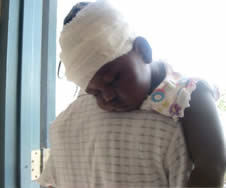
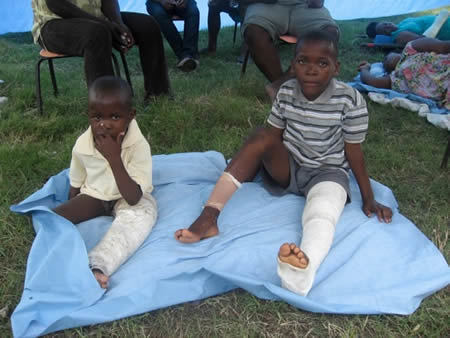
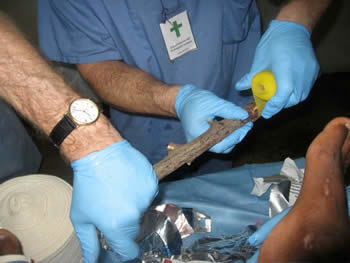
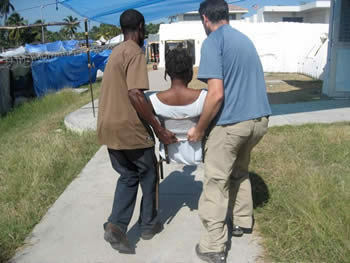
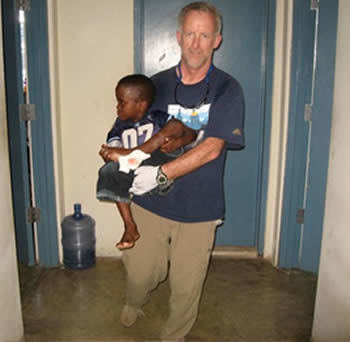
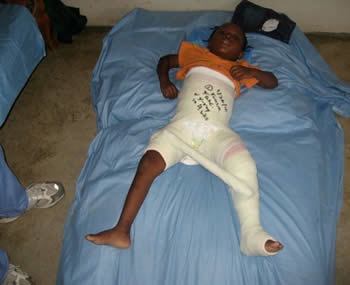
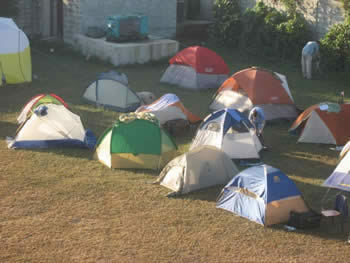
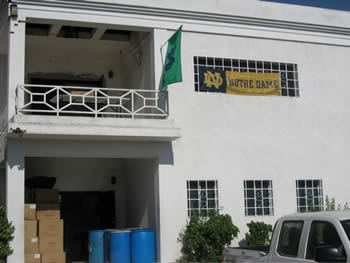
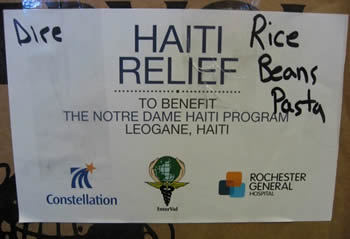
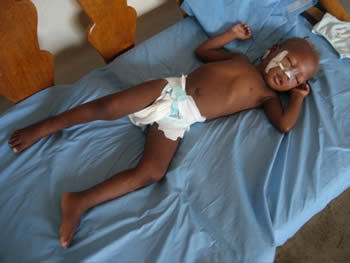
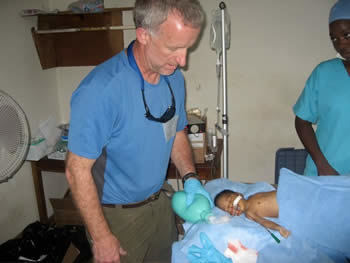
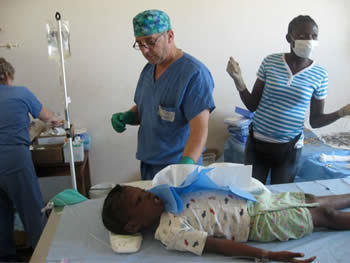
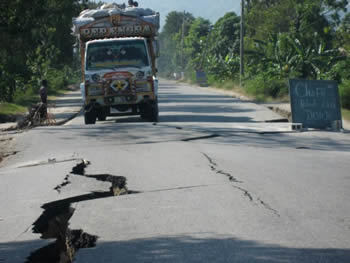
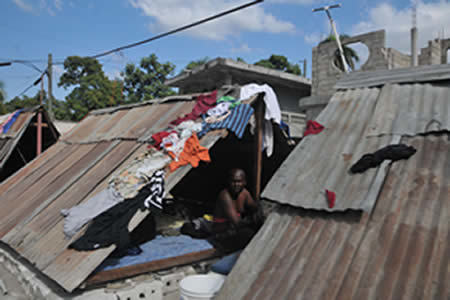
    Dr. Daniel J. Towle, a 1977 graduate of Notre Dame, was among the first response medical team arriving in Haiti. The team was stationed in Leogane, the headquarters of the Notre Dame Haiti project.

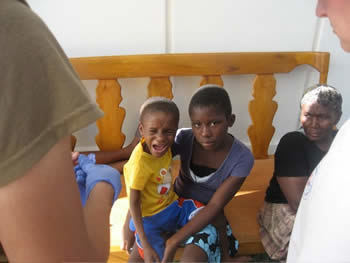
    “Leogane was the epicenter and is 95 percent leveled,” he wrote in an email. “Our three ‘operating rooms’ set up in the nursing school dormitory rooms saw more than 350 patients a day and did 120 surgeries, providing what was reported to be the best care in the entire region of over 200,000, plus those in the mountains brought down to us.” The child pictured on the right suffered a large head laceration, which was surgically repaired.

    Dr. Towle, who has returned to the United States, shares photos from his visit. Other doctors are constantly being rotated in and out of the area.

  • After the quake: Help for Haiti

    haitileogane.jpg

    Dr. Ralph P. Pennino, a 1975 Notre Dame graduate, is among those organizing a major Notre Dame relief effort in Leogane, the site of the ND Haiti program and an area near the epicenter of the Jan. 12 Haitian earthquake.

    Pennino is a Rochester, New York, surgeon and president of InterVol, a nonprofit providing medical care organization that brings supplies to the needy and the underserved worldwide. Within five days of the Jan. 12 earthquake, Intervol brought in medical personnel and 3,000 pounds of necessary supplies to the Notre Dame effort. Pennino and fellow ND graduates Dr. Kevin Olehnik and Dr. Dan Towle arrived in Haiti by air transport donated by two corporations, Tradewinds Aviation and Constellation Brands.

    What follows is Dr. Pennino’s report from the both the United States and Haiti.

    January 19, 2010

    Hello to all,

    It has been a busy week with many ups and down. I am in New York, and tonight the Rochester, New York, community came out to support our efforts. We had more than 50 volunteers come to our warehouse and pack over 150 boxes of medical supplies requested by our friends in Leogane at the Notre Dame Haiti Program. We still have over 500 more ready to go. Added to this are the meds donated from around the country and shipped to Rochester for the relief effort. Many thanks to Pat Leary and Jamie Slandzicki for their contributions.

    We have purchased two reverse osmotic water treatment units, tents and other needed supplies such as iv fluids, tubing, etc from Rochester General Hospital.

    The key connecting point to all these individual points was Constellation Brands — a Rochester- based international company — donating the use of their corporate jets in this relief effort.

    The jets will be packed tomorrow and leave late tomorrow night for the Dominican Republic. There we will transfer docs and assets to U.S. military Black Hawk helicopters for transportation to Haiti and hopefully Leogane. This part is still fluid (a word I come to use routinely) depending on the ground situation. We are determined to get there. Of note, the Canadian troops arrived in Haiti today, which hopefully is a sign of better things to come.

    Six doctors will make the trip — Drs. Olejnik, Towle, Cole, Ellison, Powers and myself. All will stay in Leogane except me. I will return to work on future trip logistics. The main purpose of this group is to deliver the supplies and assess the ground situation for future teams to provide help. At this time we have no idea what to expect.

    Many, many of you want to go and help. Once a stable environment to work with food and water becomes available, we would like to work and set up teams to rotate in/out on a regular basis. There will much work in the months to come. The number of docs, nurses, emts, etc. asking to part of the team is incredible. We want to facilitate all your wishes to do good but in an orderly manner working together and with other aid groups. Long term we would like to see the ND Haiti Program come out stronger to help serve those Haitians in need.

    In addition I believe that they will eventually ask civilian docs, nurses, etc. to help out on the USNS Comfort or other facility. One of the pleasures over the past few weeks was to work with Commander Nobrega and Major Powell at Southern Command. I’ve talked with them at 6 a.m. and midnight in the same day and through the weekend. They are in a difficult situation but always willing to try and help us. I did try to bribe them with tickets to ND-Navy and ND-Army (at Yankee Stadium) in return for our own Black Hawk. Obviously I’m still working on it.

    I’ll keep you all informed of the progress. Again, many thanks to Constellation Brands for connecting all the points of service. Thanks to my home institution RGH and its staff for all the help. Many, many thanks to all the InteVol volunteers working in the warehouse.

    Ralph

    January 22 update

    Hello from Leogane. In brief:

    The Good — The group of docs and supplies (over 3,000 lbs. medical supplies, meds and food collected by InterVol) have all made to the ND residence.

    The bad — Leogane is as bad if not worse than what is reported.

    Our new favorite word is “fluid”. Our trip preparation and final means of transportation illustrates this. Originally the two Constellation Brand planes were to fly us to Santo Domingo and the military was to helicopter us into PAP then ground transport to Leogane. On the night this was planned we could not get final confirmation from South Com and were on a standby basis. We have been networking with other aid groups who are working in Leogane. They set up an air bridge from Santiago, Dominican Republic, to Leogane using Caravan prop plans.

    The problem was there is no airport in Leogane. Haitian director Jean Marc Brissau ’08LLM is working with the U.N. and other aid agencies (more about that later) blocked off an initial section of a road — 1,200 feet — cleared trees and shrubs, etc and now you have instant airport. They are running three shuttles per day of two planes each. Each plane can take about 2,000 to 3,000 pound of weight. Our landing was better than any Disney ride I’ve been on.

    Jean Marc has been doing a great job working with the other aid agencies on the ground and with the U.N. who was here locally before the quake. He is notified by the flight crew when the planes are to arrive. He then coordinates with the U.N. troops, who block off the road and provide crowd control. A small refugee camp is adjacent to the landing site, and crowds of very hungry people come out looking for food and water. The supplies are then loaded into 3-4 trucks from the ND house and Hospital St Croix and transferred back to the residence.

    The trip to the residence took us through central Leogane. Pure devastation!! No earth movers or search groups seen, yet hundreds of collapsed buildings and you know there are people in them.

    The field in front of the ND residence is now become a small town of either homeless people living in tents of small makeshift shelters. Most are afraid to sleep indoors. We had another aftershock last night. We are all meeting inside the residence. I didn’t know some of my friends could run that fast to get outside. One of the volunteers told us about the 4 second rule — you have 4 seconds to get out or ?

    Most impressive is how all the local aid groups who have been working in Leogane for years are now coordinating efforts to work together. Jean Marc and the ND Haiti program folks have really excelled. The ND residence is used for coordination and Internet communication.

    Next to the residence is a nursing school which is still standing. A group of docs working with World Wide Vision, Save the Children and Children’s Nutrition Program turned it into a makeshift hospital. They had one surgeon — Craig from Wisconsin, a spine surgeon — among the group of docs, and he made a makeshift operating room form a dorm room. The conditions are primitive by any standard, but he made it work. The nursing students are helping. They have set up a triage station and pharmacy with a pharmacist from Iowa who has database and inventoried the meds coming in and used. Actually there is a small group from Iowa.

    After being here only a few hours Craig came over and asked for help on a complex hand injury. Patient had an avulsion injury to his wrist with nerve and tendon injury. The wound was already eight days old with little aliens moving in. Two of us in the group do hand surgeries, and we have two anesethiologists who brought some of our favorite drugs for iv sedation and we went to work. He not only lost skin but lacerated his median nerve and four flexor tendons. Something we routinely do in the States but under these conditions.

    Later that night we all got together to talk on how we can we can coordinate efforts. Even though it over a week since the quake, there is little that has made it to Leogane, let along the outside smaller communities. People have no means to get the injured to our makeshift hospital, so they are sending a group out to bring them in — usually by carrying them in a stretcher of blankets. While we need doctors and nurses, it has to be the right ones or they will only burden the overall effort. This is little to no infrastructure and one has to provide everything. Many want to help, but it has to be organized. Various groups on the ground are trying to do this.

    What is critical is getting food and distribution. Unfortunately much of the food is not getting to those who need it the most. Jean Marc is working with the local U.N. contingent to explain how it should be done.

    Medical supplies are starting to come in and the other groups have access to more. What is needed now:

    — electorcautery
    — suction
    — narcotics
    — anesthesia meds – Diprivan, fentanyl, versed, morphine, toradol, ketamine
    — ortho surgical instruments

    Jan. 23 update

    A.M. — Left on the 7:30 prop plane that brought in more of the InterVol supplies (5th plane load) from Santiago. We arrived in Santiago and picked up eight Haitians — four adults and four children — who were flown out of Leogane. This was also arranged by Jean Marc. The Constellation Brand plane’s pilot offered to fly back anyone who we could evacuate. These folk lost their home and had family back in the States. We had a little issue with customs in North Carolina but worked it out. One of the children was a U.S. citizen. We brought them to a private area upon return to Rochester (word leaked out to press) and Ginny Clark from Constellation (who was with all the way to Leogan) arrange transportation to their family in Brooklyn.

    Jan. 31 update

    It has been days since I last wrote and much has happened.

    The first group of docs we brought to Leogane last week has done an incredible job working with the other docs from One World Vision, CNP and the Notre Dame Haiti Program. They have made a makeshift hospital at the nursing school situated next to the ND Resident house. Within one week they had set up three operating rooms with bare essentials, pre op, post op and phase 2 post op. Now don’t get any glamorous ideas that this is similar to home — it isn’t but it works. There is a triage area for new patients coming in run by ER docs, primary care, etc. All are working together.

    InterVol sent a second medical/surgical team of Rochester General Health System physicians and nurses, along with badly needed medical/surgical equipment to Leogane, Haiti last Friday. Much of the surgical equipment, donated by the Rochester General Hospital and its affiliates, along with other Rochester community organizations, was transported from Rochester to Santo Domingo, Dominican Republic. Constellation Brands has again generously donated the use of its planes for this humanitarian mission. These planes have transported over 7,000 lbs. of supplies, equipment and food along with two teams of docs and nurses. Once in Santo Domingo the docs and supplies were transported by prop plane to a road in Leogane (the new Leogane International Airport with curbside plane service. This group will stay until Feb 6 or so. I haven’t figured our exit strategy yet, but as always we have many options and the situation is fluid.

    The group includes:
    Ralph P. Pennino, M.D., plastic surgeon
    Andrew Smith, M.D., plastic surgeon
    Patrick Riggs, M.D., vascular surgeon
    Jeffrey Wasserman, M.D., anesthesiologist
    Paul Cross, D.O., anesthesiologist
    Emmy Branigan, R.N., Rochester General Hospital operating room nurse
    Bill Joyce, InterVol volunteer EMT

    We have affectionately named the new facility Leogane Shock Trauma Hospital —LSTH — with an impressive staff. We have had many deliveries at the LSTH in many different ways. We have the usual childbirth, emergency C-Section and a dramatic front-seat-of-a-car delivery this morning in front of the residence. They got here a little too late. All are well.

    The group has done over 120 cases to date, ranging from fractures to wound-care issues, skin grafts, etc. Part of the problem is these open fractures are now over two weeks old. They need multiple debridements, and then wound closure. Where possible (and if available) they have used external fixation devices. It is an incredible sight to see patients walk home on crutches with their ex fix. There is a small capacity for overnight stays in a tent which has been erected outside the ND residence.

    There is also a unit from Japan’s Self Defense Unit. They have some nice equipment and have been sharing the use of their X-ray (using film processing — not digital so a little slow, but better than nothing).

    Background Information Regarding Leogane, ND Haiti Program and InterVol:
    The ND facility we are staying at is called Residence Filariose. Notre Dame Program has over 10 year history working with other groups (CDC, etc) to prevent lymphatic filariasis. This is a parasitic disease that is transmitted by mosquitoes.

    Ralph

    Feb. 2 update

    It was an eventful day. It started with the usual singing from the refugee camp and ended with a Canadian special observation unit spending the night on our roof checking things out.
    The mornings are peaceful. The air is much cooler and tolerable. The roosters are all doing their thing, and we can’t figure out why they haven’t become dinner. Singing is followed by sunrise.

    This morning the lines for the clinic started early and stretched from the nursing school (aka Leogane Shock Trauma Hospital — LSTH) back to the Notre Dame residence. By the end of the day the medial team had processed over 300 patients with various problems. As I noted prior the doctors and nurses are from many areas in the U.S. working with various NGOs such as World Wide Village and the University of Iowa group, Children’s Nutrition Program, Save the Children and InterVol through the Notre Dame Haiti Program. All are working well together because our end goal is the same.

    Our group is mostly surgery and anesthesia. We got a good workout yesterday. It was would closure day. Most wounds have followed a similar pattern. They are big, located on the lower extremity outer leg or dorsal foot. Back home we would simply use a dermatome and harvest a split graft. It would not take long. We have no dermatome so all grafting was done freehand taking full thickness grafts. This is a laborious and tedious process due to the size of the grafts we had to harvest. Most had to be taken from the lower abdomen and when we closed the donor site it looked as if we did abdominoplasties on our patients. It wasn’t so bad for the older women who had multiple pregnancies but was a little unusual for the children and teenagers. Our biggest concern is post op healing. We have no inpatient capability and patients are sent back home — aka refugee camp — to return for post op wound checks.

    LSTH has become a referral hospital. Word was out about our three makeshift operating rooms and ragtag team of surgeons, anesthesia, nurses, ER docs, primary care, EMTS, pharmacist, and many other groups are sending patients to us to treat. We had three patients sent from a Canadian Field Team for skin grafting. The Canadian Military has set up a mobile 100-bed hospital about a 10-minute car ride from the ND residence. Since they are new, they are mostly empty (that will change). We were visited by their docs and asked if we could admit our post op patients for proper care. Their docs had no problem with it but we had to get an OK from the administrators. This has yet to happen. Hard to believe — we are working in a school with no place to put patients, while this air-conditioned field hospital sits almost empty. What the hell gives! If I had a bus, we’d move the patients and get squatters rights. Hopefully this will change today.

    We don’t need access to their unity for long. A benefactor donated a 50-bed field hospital with one real operating room to World Wide Vision. Their president, Randy Mortensen, was on site yesterday trying to get it set up for our combined group’s use. The problem — we needed a bulldozer to prepare the site or there was a chance they would pull the unit, which is being delivered in over 50 large crates. My first trip to Leogane was over a week ago and despite the 80-90 percent destruction, I have yet to see a bulldozer. A strange thing happened — a bulldozer appeared in the early evening and graded the field.

    We had an urologic emergency this morning requiring the expertise of the 8th member of our group who is from Florida and a fellow Domer (class of 74) — Marty Dineen. We had an older gentlemen with severe abdominal pain, swelling in the lower abdomen and an indwelling urinary catheter that was clotted. Marty quickly analyzed and treated the patient but we still couldn’t answer the long term question — where does he go for further treatment? This is becoming more of an issue as access to health care facilities is little or nil in areas affected by the quake.

    That evening we were visited by a Canadian Observation Team who spent the evening on our roof to observe the community and various refugee areas. They were a great group of guys who let us look through their night vision and thermal camera equipment. It is amazing what you can see in the dark. They left in the morning and were replaced by another unit which spent the day. This type of company we don’t mind.

    Side note – Our water system

    After the quake, safe drinking water was an issue. The first InterVol group working with Jean Marc and the ND Haiti Program was able to bring in two reverse osmosis units, which now provide clean drinking water at the ND residence for all the groups working together.

  • An angry mob and an earthquake

    What follows is a shortened version of Joey Leary’s report from Haiti. Leary, a 2009 Notre Dame graduate, was in the midst of the Jan. 12 Haitian earthquake.

    I moved to Haiti in August 2009 after graduating with a pre-med degree and a minor in anthropology. My anthropology mentor, Professor Karen Richman, lived in Leogane, Haiti, for two years, studying Haitian immigration and vodou. Before I went to Haiti I deferred my medical school acceptance to Lake Erie College of Osteopathic Medicine so I wouldn’t have to reapply.

    While I was in Haiti I volunteered for InterVol and the Notre Dame Haiti Program simultaneously. I had been active in Notre Dame’s Haiti Program to Eliminate Lymphatic Filariasis as an ND undergraduate. Our 2009 valedictorian, Brennan Bollman, was widely recognized for her work with the program in Haiti. I, in many ways, was following in her footsteps.

The Notre Dame Haiti Program had me coordinating ND alumni doctor trips, guest visits, organizing mass hydrocele surgery camps, and collecting public health data on a GPS device. InterVol had me setting up teleconferencing equipment (InterVol donated this equipment to the Notre Dame Haiti Program) and arranging shipments of medical supplies to Notre Dame’s two affiliate hospitals, Hospital St. Croix and Hospital St. Francis de Sales, in Haiti.

I spent my free time shadowing U.S. doctors who came to visit, playing soccer in the streets with friends, playing basketball, dancing on the weekends at the discos, practicing my Haitian Kreyol, and exploring other cities whenever possible.

I arrived at Hotel Montana in Petionville, Port-au-Prince around 9 a.m. on Tuesday, Jan. 12, for the twice yearly meeting of the partner organizations working to eradicate lymphatic filariasis in Haiti. The Notre Dame Haiti Program had a large group that day at the Hotel Montana. The meeting was scheduled to last until 5 p.m., but because the presenters from the CDC couldn’t make it, the meeting concluded early.

Several of us left the Montana at about 4:30 p.m. and headed for Leogane on a route that took us through Port-au-Prince’s largest park, Champs de Mars, which sits adjacent to the National Palace and Parliament. As we drove down a four-lane street adjacent to the Haitian white house/national palace we were thrown into a panic when a mob of 50 to 75 men emerged at the upcoming intersection and began hurling rocks at the nearest cars. The moment that I realized that we were going to be attacked, the shaking began.

The initial earthquake at 4:52 p.m. was reported to be a 7.3 on the Richter scale. This earthquake allegedly lasted 30 seconds, although I only remember the quick moment of confusion that overcame me when I watched at least five buildings collapse simultaneously around the 20-acre or so park. I now realize that had the mob not caused us to come to a stop in the middle of the road we would have been 200 yards further down the road and in between two three-story, buildings that collapsed. Similarly, had the earthquake not occurred, I would have at least had to run from an angry stone-throwing mob for my life.

When the shaking stopped, my world was spinning in a way that I can only compare to the concussion I sustained several years ago, specifically the feeling I had as I regained consciousness. The feeling that something terrible has occurred and help needs to be called for; yet in both cases I had no ability to execute with my body what my mind desired. . . . I managed to get out of the car, carefully avoiding an abandoned jeep slowly rolling by in neutral. My thoughts immediately fixated on the fact that I was alive and lots of people around me were surely dead. My brain, as if in a frantic attempt to keep things this way, began to scheme of other impending threats; namely tsunamis, stampeding, starvation, dehydration, tropical diseases, violent theft, etc.

When my brain finally retook control over my body. I was able to successfully dial my mom’s number. I spoke to her briefly but communicated the essentials: location, state of mind, and love for her. I left a message expressing the same sentiments on my dad’s phone. I texted my friends Kara, Courtney, Meghan, and Marah, to see if they were alive. I only got a response from Marah. It was reassuring to hear from her because I knew she was in Port-au-Prince, but I was troubled to not hear from the others.

Jean Marc, Dr. Desir, Dr. Latagnac, Papiyon, Wilfred and I, huddled together in a part of Champ de Mars park where nothing could fall on us. We made a pact to stay together. Papiyon was sent to drive the car to a safer location after we placed our laptops under the back seats. In the park we weathered several more strong aftershocks while debating things like whether or not a tsunami would actually come, whether or not the president was inside the palace and consequently dead, whether or not it would be safe to spend the night in the park, whether or not we had enough food, water and energy, to walk back to Leogane (40km).

Tsunami fears

Basically the debate was: tsunami versus the possibility of more earthquakes. Our discussion was interrupted by the sound of thousands of people standing up simultaneously around the park and starting to run into the surrounding city towards the mountains. Those who were fleeing were yelling, “The ocean is coming!” in Kreyol. We didn’t run. We hung together by a tree. Our decision was the right one in hindsight. The fact that the ocean never showed up, didn’t change the fact that I felt as though I might be trampled in the stampede.

I was able to convince our little group that it would quickly become lawless and unsafe in Port-au-Prince and we needed to leave as soon as possible under the cover of darkness and while people were not fixated on the obvious affluence amongst our group of dress-suit clad professionals. An opportunistic street vendor nearby allowed us to store up some food for our journey back to Leogane.

We set out from Champs de Mars around 9:30 p.m. in the direction of Hospital St. Francis de Sales, where the Notre Dame Haiti Program has offices and supplies, in order to get much-needed water. We walked rapidly. Eighty percent of the people we encountered were walking into Champ de Mars while we were pushing to walk in the opposite direction.

As it darkened,we walked through streets of rubble, impassable wrecks composed of many cars, screaming women, shouting men, frantic people going in every direction. Fear was almost palpable. I tried to focus on Jean Marc’s back as we walked to Hospital St. Francis de Sales instead of the misery around me.

When we arrived at Hopital St. Francis de Sales the courtyard was filled with injured men and women. They fixated on me as I entered the compound, since more often than not white men in Haiti are doctors. Unfortunately for them I was not a doctor, and the real doctors with me were only focused on one thing: getting back to Leogane to see families. I can’t express how uncomfortable it was to enter that compound of suffering and to ignore it all completely while entering the offices that we went to every week as if nothing had changed.

Priority: water

Entering Hopital St. Francis de Sales was scary. It was the first time I had entered a building since the earthquake. Water was a priority. We had only one 5-gallon drum. I opened it and poured as much as I could into my Nalgene bottle. I drank it all and refilled it. I also urged the others in the group to drink heavily. I selfishly went outside and peed on the wall, hoping to make room for more water as I thought of the 20-mile walk ahead.

When we had finished drinking and provisioning we walked like mad men from that time on. It was so dark I couldn’t see the pavement in many places. This was hazardous because there were large potholes, sometimes 2-feet deep, in the road. The adrenalin was finally getting some action.

The guys stopped after about one hour to buy sodas from a street vendor. I couldn’t believe that the man was still selling his supply and not storing it up for the impending crisis. It was as if he didn’t realize that Haitians like him would be starving and without water in less than a week.

I was still worried about a tsunami and secretly wished we were walking parallel to this street but about one mile further inland but couldn’t get my group to agree. I did insist that we all stop at the U.N. base for a few minutes as we walked by to ask for information. One of the guards told me they hadn’t heard anything. About this time Jean Marc was able to get news, via his phone, of Father Tom Streit, Sarah, Logan, Dr. Milord, and Claudy. It was a relief to know that this bunch was more or less okay.

After the U.N. base, we came upon an unusually large crowd. All the people were saying, “the road is out.” The road was definitely out, with a 30-yard in diameter circular piece of road missing. We decided that we would follow the lead of several others and climb around the sinkhole, using the prison-like window bars of the adjacent buildings to cling to.

After the sinkhole excitement, fatigue started to hit our group hard. Every time a car or truck passed by we had to rush to the side of the street so as not to be hit. We would wave at them to indicate we needed a ride in the direction they were going. I wasn’t very optimistic about our chances of having someone stop for us, but I was wrong. A truck with a flatbed in the back stopped and we all climbed on gratefully. Suddenly a new fear of driving during an aftershock arose in me. I had seen plenty of crashed cars on the 7-mile walk leading up to this point to know that it could be a problem. I held on extra tight as I stood up on the back of the truck. We raced down the road between Carrefour and Leogane, swerving for fallen rocks, hitting bumps that were actually deep cracks.

As we approached Gressier the driver turned off of the main road. He told us he needed to handle something. While we were standing up in the back of his now-stationary truck a strong aftershock ripped through the ground. No one fell off, but we were fortunate to have been parked again. I remember glancing out at the ocean, only 100 feet away, to see if the boats in the bay were rocking in a manner indicative of a tsunami. I was thinking that if I saw a dramatic fluctuation in the water level out there I might have five minutes to scramble up a hillside or at least climb something.

No tsunami arrived. As we stood on the road, parked, changing the car’s tire, it was 11:15 p.m. I again considered ditching the group and running up into the mountains nearby. I had enough chicken from the vendor and water from Hospital St. Francis de Sales to last at least a day. I really thought that each of these aftershocks, not to mention the 7.0 earthquake, could have triggered a tidal surge capable of wiping out the coastal regions. I again chose to stay with the group, but I was very scared.

As we stood there in the middle of the road we decided to try to catch another ride. Our group suggested that I stand in the front because they all agreed that drivers would be more likely to stop for a “blanc” (a white foreigner). A car stopped and its driver agreed to drive us in his van to Leogane. We thanked our first driver and left him to his tire and sped off toward Leogane.

Remarkably all of the bridges between Carrefour and Leogane were still intact. We drove in past the Sri Lankan U.N. base, a pancaked UNPH school, a mostly collapsed Anacauna High School, and more. Remarkably the Union of Voudisants three-story building still stood towering over the roundabout that indicates one’s arrival in Leogane. The van took us to the soccer field, which was being used as a refuge for the displaced and wounded.

Seeking my friends

I jumped out and ran through the pitch black to Hospital St. Croix to look for my best friends Kara and Courtney from the Children’s Nutrition Program, who lived in second-story apartments inside the hospital compound, and Suzie and John Parker, who ran the hospital’s guesthouse and lived on the first floor below them. On the way to Leogane in the van, the radio had broadcast that the hospital had “te crazay net” — “crashed completely.”

I yelled for them as I entered the compound. The whole town was spookily quiet. I heard the voice of Suzie Parker. I wanted to cry. I asked about John, Kara and Courtney. Suzie said she had not heard from Kara and Courtney because they had gone to meetings in Port-au-Prince for the day, but that her husband, John, was all right. I realized that I might not know definitively for weeks about Kara, Courtney or Meghan.

Suzie explained to me how when the earthquake started she was able to run outside but John wasn’t fast enough. He was trapped under a tremendous amount of concrete but, miraculously, was only scratched. Suzie said that two of the Haitian hospital translators who were with her worked for three hours tirelessly with a sledgehammer, breaking open a hole in the concrete to drag him out. The picture of his escape hole is amazing and terrifying.

It was 12:30 am when I looked at my phone again and tried, in vain, to call the States. I tried about every one hour and then turned it off to conserve charge. I wasn’t anticipating seeing electricity for weeks. John and Suzie gladly shared in eating some of my chicken from Champs de Mars. They let me fill up my canteen at their rapidly leaking water pump. They offered to let me snuggle in with them in the courtyard between the collapsed guesthouse, the collapsed apartments, and the still-standing but vacant hospital. I lay down, but my mind was on fire with thoughts of survival, escape, foreign aid, all of my friends in Haiti, family, malaria, clean water, food and more earthquakes.

I sat up most of the night. Life felt like a dream. The stars were beautiful. I saw tons of shooting stars. I wondered why people weren’t screaming in the streets anymore, because I knew there were still hundreds of people trapped in rubble within 500 hundred yards of me. I wondered why I wasn’t out looking for my friends in the streets and was sitting looking up at the sky pathetically. It was so dark, and I was so afraid for everyone I knew. They say fear is paralyzing, but I never experienced it until that night of mental confusion and shock.

The next day I made up for those four hours of inactivity with a vengeance. At 5:30 a.m. the screams and yelling began again.

Part II, I’m not a doctor!


  • I’m not a doctor!

    What follows is a part II of Joey Leary’s report from Haiti. Part 1, An angry mob and an earthquake covered the day of the earthquake and its immediate aftermath.

    I seriously doubt that “the morning after” or any of the details of the entire day of Jan 13 will ever fade from my memory. I stood up and I walked out into the street. It was my first daylight view of the destruction in Leogane. Reports now are saying 80 to 90 percent of the buildings were destroyed.

    I looked out at “Masaje,” the bar across the street from the hospital that was the center of nightlife in the town. I realized I might never see Dominic, Lady, Mckenzie, Ti Frere, or any of the “regulars” there again. I headed for my home (the Notre Dame compound) known to the locals as the CDC and foreigners as The Residence Filarose, on the same route, between the hospital and the Residence Filarose, that I had taken 500 times before.

    Today I had to climb over rubble that had poured into the streets. There were no friendly smiles that morning. Everyone was going somewhere. The streets were swarming. I was almost running toward the Residence Filarose. We had heard from Jean Marc the night before that it had not collapsed, so I wasn’t expecting to find any destruction. I walked past my buddies in the Zoe Club standing listlessly in the street. I gave some of the guys hugs but had to keep walking. By this point I had seen many terrible scenes of people stuck in collapsed buildings, so my eyes focused straight ahead. I didn’t want to see any more. The faces in Port-au-Prince were strange faces. The men and women suffering in Leogane were familiar strangers; girls I had danced with at Eve Andre’s house, guys I had played basketball with at Suren School, English club, Saturday morning soccer, Saturday nights at Praktik, the nursing school, etc.

    I arrived at Belval Plaza and entered the gate. Nearly 200 people had already congregated in the open field surrounding the FISL Nursing School Compound. I saw some of the nursing students I knew sitting around the entrance to their school. Men and women were starting to be be laid out on the ground in front of the front gate. I was amazed to see that the Residence Filarose didn’t have any visible damage, although parts of the cement walls around the compound had fallen. I remembered Father Tom telling me that Residence Filarose was designed to withstand earthquakes. I ran inside to collect my most important things. I was factoring in looters, food provision, possible evacuation, and the immediate need for my first aid kit and scissors.

    I put together a small bag with the essentials, including my wallet, passport, contact information, my U.S. phone and charger, my Haitian phone and charger, two flashlights, my canteen and some power bars. I was hurrying frantically because I knew there could be another tremor and I didn’t want to be inside and because I needed to bring medicines from Hospital St Croix to the nursing school, where all the seriously injured were congregating.

    I set out on my bike, and as I rode past all of the refugees I knew they believed I was abandoning them. This was tough, but compelled me to ride even faster to the hospital for supplies.

    When I arrived back at the hospital courtyard, 15 minutes later, John and Suzie Parker had a group pulling medicines out of the collapsed mini-pharmacy. The building could have collapsed at anytime, but the need for those medications was too great not to take the risk. Dr. Desir, the Notre Dame Haiti Program medical director, showed up with a truck shortly after to help transport even more of the medications to the two improvised field clinics/refugee camps that were forming rapidly in town. I helped him sort supplies but was distracted by the horrendous wounds that were coming in.

    The wounded

    The Cuban doctor from Hospital St. Croix was holding six inches of a screaming boy’s scalp away from his skull so he could scrub the bone with butadiene. I recognized one of the best basketball players from Suren school sitting on a bench waiting for attention. He was insanely good at basketball. A woman came over to me and tugged on my arm and said, “Doctor please help him.” I told her I was not a doctor, but she was almost screaming at me and I remembered him from basketball. He looked fine from my vantage point, so I was expecting to just see some cuts or bruises. The look on his face was one of fear, confusion and utter helplessness.

    When I asked the young man what was wrong with him, he turned his head and exposed a piece of his scalp and skull hanging away from his head, exposing a large chunk of brain that was leaking cerebral fluid down his neck. I wanted to cry, vomit and scream for help all at the same time. I kept my composure and interrupted the Cuban doctor, now suturing the boy’s entire scalp back over his freshly scrubbed cranium, to tell him we had an awful head injury waiting. He shrugged. I left to continue my job organizing meds to transport back to the nursing school, but walked past a little boy with two sharp gashes in his head that penetrated his skull and allowed for a glimpse of his brain, and several others with broken bones, some compound fractures, lying on the ground.

    I headed back to the nursing school on a bike, which is faster than a car in Leogane. When I made it back to the nursing school, the number of refugees and injured seemed to have doubled. The gate leading to the inside of the nursing school was swarming with all sorts of urgent and terrible injuries. Several students were manning the gates to keep people from forcing themselves inside. A group with a stretcher was going around and identifying the worst and most urgent to be let through the gate where Michelle, a visiting U.S. nurse practitioner, was waiting along with 15 to 30 nursing students to do whatever they could to help.

    With the arrival of my supplies and Dr. Desir’s truck, the makeshift clinic came alive with activity. I decided to stock up a supply of water for the makeshift hospital. I grabbed two 5-gallon, buckets and went in search of clean water. I was optimistic about this because I knew that Leogane has had quite a few wells drilled around its community over the recent years. I was happy to find some running water only 200 yards down the road from the Belval Compound. What types of bacteria and parasites were in the water I’m not sure of.

    On my way back from outside struggling with two 50-pound, buckets of water I saw Marah! I still don’t know how she got back to Leogane from Port-au-Prince, but I gave her a hug. She was my best friend at the nursing school, but she had a stoic look on her face and didn’t hug back with much enthusiasm. She said her family was okay. I didn’t ask about her aunt and cousins Fera and Rachel, who she passes the weekends with in Port-au-Prince because I had seen their home and knew that it didn’t stand a good chance.

    After we parted ways, I had to fight my way through the nearly rioting mob of horribly injured and maimed people in order to get my water in the gate. I was exhausted. I spent the next hour giving water to the most seriously injured folks inside the compound. By 8 a.m. there were probably 40 people lying inside the nursing school gates. I found a bottle of ibuprofen in the mound of medical supplies in the center of the lawn, and made one complete sweep of all the patients, giving all those who needed it water and some mild pain-reliever. It probably made people feel better regardless, like a placebo might.

    By 10 a.m. things were getting out of control. Word apparently had traveled all over town that patients were being treated here and we had medications. The number of people at the gate yelling to get in doubled and the number inside probably went up to 60. Only about 10 at any one time were receiving attention from one of the nursing students. At this point I felt I could no longer spend my time distributing water and ibuprofen. People had urgent needs that I could tend to: bones to be splinted, splints to be made, wounds to be scrubbed, bandages to be changed.

    Unskilled surgery

    I began by working at Michele’s side doing whatever she instructed me to do. The next thing I knew I was prescribing amoxicillin (by this I mean digging through a big cardboard box of miscellaneous meds we had dug out of the makeshift pharmacy in the collapsed part of the hospital until I found something useful to hand out) and cutting off the mangled remains of an old woman’s pinky finger while she looked away. Instead of letting it be ravaged by maggots and cause gangrene of her hand, I got the nod from Michele to cut it off. I tried to wash the wound with betadine before I did anything. A piece of string had gotten stuck in the wound and I knew it had to be moved to prevent infection, so I reached into the flayed finger and pulled the string. It wouldn’t come out so I yanked harder. I got it out but it splattered bits of blood all over my face.

    In the meantime the woman wasn’t even moaning. She had a foot swollen three times the size of her other one, but it wasn’t broken when I checked. I tested the scissors on some cloth nearby because they didn’t seem very sharp, and if I was going to do this I wanted to do it fast. Her finger obviously needed to come off, but in good conscience I could not cut someone’s finger off without explaining the situation and asking permission. After all, many Haitians don’t believe in Western medicine, let alone something as invasive as this. I asked permission in Kreyol and she nodded and tried to look away.

    I removed the drawstring from a little bag laying around with my pocket knife. I tied it around the nub even though there was almost no bleeding at this point despite the wound. I was committed now. Other nursing students, some in shock, some helping, paused in amazement or horror at what it seemed I was about to do. Family members of other patients who were screaming at me to help their mother or brother even for just one moment, realized that I WAS F——- BUSY and couldn’t help them right now! I was committed. Even Michele looked over from the bone she was scrubbing. Snip… tendon, snip… flap of skin. It hit the grass. I poured some more betadine on the wound and went looking for antibiotic ointment. One of the nursing students gave me a little container which I squeezed onto a piece of gauze. I later found out that the cream the nurse gave me was antifungal cream and not antibacterial cream, and that we actually had sutures on the other side of the nursing school. I did the best that I could, and this one was very lucky to get a five-day course of amoxicillin.

    As soon as I stood up I was hit with the angry man who spoke broken English. His wife had a broken leg that had not yet been splinted. There was no bleeding, which put her almost at the bottom of the list of urgent patients. I thought he was going to hit me. He was right in my face yelling, “What you gonna do for my wife? You walk by and never see her! You help everyone but me! You can’t do that man!” I tried to ignore him but he was a big guy at his wit’s end. I don’t remember why he stopped hassling me, but someone must have gone to check on his wife.

    The sequence of events of this day is blurry. There wasn’t anything I could say to people to convince them that I wasn’t a doctor. They didn’t care. They saw me cut off that woman’s finger and wrap it up. During this interim period I saw four compound fractures where the tip of the tibia and fibia both tear through the skin of the ankle where it should meet the foot. In all four cases the foot was at an awful 90-degree angle bent inward. Michele explained that all that we could do was scrub the bone, keep it moist, and try to wrap the foot and ankle. She said we would need a doctor or orthopedic surgeon to put the bone back inside the skin.

    It was so awful seeing these patients and knowing immediately that what they needed was so far from being available. Michele tried to teach me how to recognize a pulmonary embolism on a man whose chest and stomach had been crushed. There was nothing we could do for him. I had to tell him in Kreyol for Michele. I watched a girl with the side of her face swollen to four times its normal size seize on the ground. Ironically not far away an unharmed Haitian women was screaming at the sky and shaking her body as if seizing.

    A Red Cross transport plane flew overhead in the distance, which was the first sign of help any of us had seen or heard of. We didn’t know where it was headed.

    Next I was interrupted by a man who had goo oozing from his left swollen eye. I think something may have penetrated it. He spoke perfect English, as some Haitians who have immigrated to the U.S. and returned do. He seemed so resigned, but asked me if he could have some ibuprofen. I gave it to him.

    Michele and I began assessing a screaming 6-year-old girl with a broken femur and a tibia-fibula fracture of the same leg. Her father spoke English and was remarkably calm and appreciative of our attention. Together Michele and I splinted both parts. Michele explained that in order for the femur fractures we were seeing to heal properly the patients needed to be in traction. Since the father spoke English she was able to tell him that because there was no traction available, his daughter would be crippled for the rest of her life. I believe that is exactly how she said it. He just nodded and started to look for a place to move her out of harm’s way.

    I need a doctor!

    I think it was about this time that I bumped into the patient who I really connected with/felt the sorriest for. It was sometime in the afternoon now and I was feeling fatigued and disoriented. As I stood wiping my head and thinking “oh my God,” I got my next call. A frantic young man came over. I went to see and my mouth dropped. In actuality this girl was better off than those bleeding internally or with compound fractures. She had just been pulled from the rubble (approximately 20 hours trapped). She had what I can only compare to a shark bite on her right calf. It was a gaping 1½ foot slash. Part of her muscle was flayed and the entirety of her calf was exposed. Her hands were crushed and horrendously cut. The muscle in her right hand was hanging out of the laceration.

    None of her cuts were bleeding at the moment, whether it be dehydration, clotting or the nature of the injury. I was surprised to note that her left hand had been stitched up. This puzzled me. Who had stitched up one hand but left the other two worse wounds gaping open? (It turns out that my friend would soon recognize her as the girl who they had to turn away from the hospital because there wasn’t anything more they could do for her there.) She was moaning but conscious. She was obviously dehydrated, which was the first thing I told her friend to handle. She also was starving. Her friend gave her some rabbit meat that he had bought from a vendor.

    I was unprepared to handle any of these problems. I searched for someone to help me. Michele was occupied with an internal stomach bleed. The chief 4th-year nursing student said he would be right there but never showed up. I realized that if anything was to be done for this beautiful girl that I might have to do it. I started by rolling her onto her stomach, which was difficult with the state of both hands. I poured water and betadine onto her leg wound, which was starting to dry out. Then, as I began to get desperate for what to do next, a REAL DOCTOR showed up out of nowhere. He said he would be back. He had sutures, gloves, lidocaine, and disinfectant. I have no idea where that stuff came from.

    The doctor used his gloved hand to reach down inside her leg and pull out dried chunks of blood. He snipped away dead pieces of muscle that were starting to get black. He used a damp piece of gauze to rub up and down on the exposed calf muscle. The girl was in agonizing pain. He cut away dead tissue and picked debris out of the inside of her leg. During this time I was holding her down and giving him whatever he asked for. Next he used oversized needles to inject lidocaine into some of the skin around the wounds — probably a little late to do any good — and began to sew up some of the muscle which had torn and recoiled down to her ankle.

    He did a beautiful job. One continuous stitch that connected to the muscle in a number of locations all pulled together to reconnect the muscle. Then he cut the finger off of a rubber glove, opened both ends and put that into the wound to create a drainage opening. He began to sew the skin back around the gastroc. He worked rapidly, starting at the ankle, and working his way up to the center of the calf. Unfortunately three sutures in a row broke and he said he couldn’t close the leg up without steel wire sutures. He had me grip the bare muscle (I had just found my first pair of rubber gloves of the day) and try to force it down under the skin. The suture broke anyway. He started again at the top and worked his way down from the other direction until the sutures started breaking again. Then he stopped and said that was all he could do and disappeared. I began re-sterilizing and wrapping the still-exposed small envelope sized area where the skin was unable to meet over the muscle. I got it covered to the best of my ability and turned my focus to the unsutured hand.

    The doctor had looked at the hand and concluded that the tendons in her wrist had torn and that she would need microscopic surgery to reattach the tendons. I was about to attempt to sew the hand wound up based on all of the times I had watched it done, when a nursing student came over and said that she had learned how to suture. (It was about this time that I looked up and saw my two best friends from the Childrens Nutrition Program! Kara and Courtney, standing there behind me alive! We all had a two-second teary moment, and then it was back to work. They told me to come to the hospital tonight and left.) The nursing student was able to close up the wound while I used some forceps to push the hand muscle back down while she closed the skin over them. The sutures took an hour and the girl was moaning that she just wanted us to stop. It was as if she didn’t care anymore.

    When we were done I remembered the nondescript bag in the mountain of meds, both useful and not, where I had found the amoxicillin for the woman whose finger I had cut off. Sure enough there was some left. I selfishly grabbed three bags, which equated to about two weeks of antibiotics, and gave it to her friend with strict instructions. That was the last I saw from her.

    It was getting dark now and the guards had stopped letting people into the FISL nursing school compound. I helped move the girl with a broken femur and tibia/fibula from earlier outside into the tent village with her father. After that I decided I was done for the day and walked the 100 yards to the Notre Dame building while fighting off tears.

    Joey Leary and many of his friends eventually were evacuated from Haiti. For the full story, see his blog.


  • J.D. Salinger: ‘Detachment, Buddy’

    rye.jpg

    J.D. Salinger died a few days ago. Within the past five years, death has been visiting this generation of authors and artists, including Kurt Vonnegut, Saul Bellow, John Updike, Norman Mailer, Sydney Pollack and Paul Newman. Do we feel the loss? My literature students had never heard of Updike’s Rabbit Angstrom, a literary character who existed for over 40 years in four different novels. My film students had never seen a film with Paul Newman, an actor whose career included nine Oscar nominations. But when I asked a group of sophomores in my American Short Story class if they had read Catcher in the Rye, more than half of them raised their hand. Why? What is it that brings Holden Caulfield into their lives?

    As I listened to them talk about Holden, I realized that I wanted to change the subject just a bit. I wanted to tell them about Seymour Glass and the entire Glass family, characters who appear in Salinger’s short stories, particularly the stories written after Catcher. In these stories Salinger gave a lot of attention to Zen concepts, especially something he came to call “detachment.” Holden doesn’t really fit into these stories because he cared so much, too much. And he felt so helpless. He wanted to catch people before they fell, as they came running through the rye. And this is what I kept hearing from my students. They were telling me how much they liked Holden, what a “nice guy” he was despite all his complaints and criticisms.

    What is this caring that is at the center of Salinger’s fiction? In memory it seems to be so clearly, even simply, Christian. A literal rendering of Christ’s “Suffer the little children unto me.” Of course, Holden never does catch any little children. But he wants to, and that desire leads to so many of his difficulties. For Salinger, apparently, even just feeling the Christian ethic was a dangerous enterprise. Look at all the breakdowns. Holden breaks down, Franny Glass breaks down, Seymour commits suicide, Buddy lives alone as a recluse. In Salinger the alternative to caring too much is to learn from “pure Zen” its “near-doctrine of Detachment.” Buddy sums up a series of examples with the phrase “don’t care a hoot.” But is Detachment a useful remedy for caring too much? Is it better to be detached than to care? In a world filled with “phonies,” Detachment certainly seems to be safer.

    By the end of the book Franny & Zooey, we can see that Franny will apparently recover from her breakdown. Her brother, Zooey, had struggled to detach himself from Franny’s distress. But when he fails to achieve this Detachment he resignedly settles down to talk her through her difficulties. He cares about her well-being and, unlike Holden, Zooey is ultimately able to translate this caring into a helpful act. In his long conversation with Franny he sets out to redefine Christianity for her. At the center of his effort is Christ’s advice that we should “love our neighbor as ourself.” In Salinger’s words this challenging suggestion becomes Zooey’s belief that everyone, including the “fat lady” for whom one should shine one’s shoes, is “Christ himself.”

    But just how does one live as if every person in your life is Christ himself, even the “fat lady”? What does such a caring life look like? For the 20 years during which J.D. Salinger published his writing, he worked hard to give us even a glimpse of the enormity of living such a Christian life. Pick up any of his fiction “if you really want to hear about it.”


    Notre Dame Professor William Krier’s specialty is 20th century American fiction. He has published articles on writers from Henry James to John Barth.

    Photo:

    http://www.flickr.com/photos/jenny-pics/ / CC BY 2.0


  • Molarity Classic – 1

    mol1.jpg

    This is the first cartoon published in The Observer on September 12, 1977. I don’t know if it foretold of the endurance or humor of the strip but it was where it began. The headlines on the cover of The Observer that day were “Students want draft beers, lower prices” and “Morrissey fire ruins rooms.” On the back cover it was “Notre Dame escapes Pitt in opener” because we broke Pitt quarterback Matt Cavanaugh’s wrist in the first quarter. Rusty Lisch was our quarterback; Joe Montana was second string.

  • Gay rights revisited

    Demonstrators gathered in bitterly cold lunchtime temperatures at Notre Dame’s main gate Wednesday, January 27, to advocate for the inclusion of sexual orientation in the University’s non-discrimination policy.

    Some 200 students, faculty and area residents placed thick strips of purple tape over their mouths to symbolize what organizers say is the silence forced upon gay, lesbian and bisexual students by the lack of explicit protection under University policy and the absence of a recognized student organization that represents their interests. Many also wore orange armbands as an evocation of the orange “Gay? Fine By Me” T-shirts that campus activists have donned in recent years.

    The group marched in silence up Notre Dame Avenue toward the Main Building, fronted by a banner displaying images of the Dome in the colors of the rainbow and the slogan “no home under the dome.”

    Organizers say that while student groups have annually petitioned the University administration to add sexual orientation to its policy against discrimination in its education and athletic programs and its admissions, financial aid and employment practices, an additional, more visible action was warranted by an offensive cartoon that ran in the January 13 edition of the student newspaper, The Observer. The cartoon featured a joke making light of violence against sexual minorities. The strip, The Mobile Party, was immediately discontinued and an Observer editor later resigned.

    Standing on the front steps of the Main Building, students led prayer and read the text of a letter addressed from “concerned members of the Notre Dame family” to Rev. John I. Jenkins, CSC, the University’s president. The letter cited “incredible progress” in the status of gay, lesbian and bisexual students at Notre Dame, represented by the 1997 Spirit of Inclusion document and the work of the Core Council for Gay and Lesbian Students, a panel of undergraduates and administrators that advises the University’s vice president for student affairs.

    “However, there is still work to be done,” the letter continued.

    “All of us gathered here are clear examples of God’s presence on earth. Yet as gay students we cannot gather as a recognized student organization. Our human life is precious but is not protected by a clause of non-discrimination. We are asking for a home under the Dome.”

    Administrators have said that an explicit inclusion of sexual orientation in the non-discrimination policy would compromise the University’s ability as a private, Catholic institution to maintain a distinction between sexual orientation and practice according to Catholic doctrine on human sexuality.

    A security guard met the protest’s five student leaders as they approached the Main Building’s front doors intent on delivering the letter to Father Jenkins by hand. The guard said they could not enter.

    When the students returned to the steps to report to the gathering, a group of some three dozen professors stepped forward to press the cause. A representative from the President’s Office soon appeared to receive the letter, and the demonstrators dispersed.

    The following evening, a closed panel of faculty and students addressed the issues raised by the Jan. 13 cartoon.


    John Nagy is an associate editor of Notre Dame Magazine.