Author: Notre Dame Magazine

  • The right to live

    “Abortion opponents.” “Anti-abortion movement.” “Speeches and prayers blasted over loudspeakers.” “Conservative causes such as theirs.” These were the phrases with which a Washington Post story characterized the Jan. 22 March for Life in the next day’s newspaper.

    The story appeared in the Metro section, not the national news section. An Internet version of the story contained a slideshow in which three out of seven photographs featured pro-choice counterdemonstrators, who numbered fewer than 100 in contrast to the tens of thousands of pro-life marchers. The New York Times, ABC, CBS, NBC and NPR said nary a word about the march. Behind all of these journalistic treatments lies a tired and familiar view of the prolife movement as an insular, angry religious enclave that is marching backward against history’s inexorable march towards maximal autonomy and individual rights.

    Here are some alternative phrases to describe the marchers. How about “civil rights activists”? Or “human rights protesters”? Or even a “peace movement”? These terms, I venture, portray the march more accurately as a cousin of Vaclav Havel and the Czechoslovak Velvet Revolution of 1989, of Mahatma Gandhi and his nonviolent marches of the 1920s and 1930s and of the American Civil Rights movement. I predict that the pro-life movement, like these other causes, will one day be viewed by a broad consensus of people as a bright segment of what Dr. Martin Luther King called the long moral arc of the universe that bends towards justice.

    Skeptics will bristle at these comparisons, but in three essentials the pro-life movement belongs in this great tradition.

    First, it is a movement for human rights. Like all human beings, the fetus possesses inalienable human rights, just as do slaves in America, Bosnian Muslims, Rwandan Tutsis and global victims of sex trafficking. Today, unborn persons amount to an entire class of human beings who are excluded from the most basic of all human rights, the right to live. In America more than a million of these humans — the most weak, vulnerable, and voiceless of humans — are killed every year, some 50 million since 1973. Two million are killed every year in India, seven million in China, and more than 42 million worldwide.

    Though leading human rights organizations rarely mention the unborn, their human rights are violated in numbers that far exceed those of the greatest human rights calamities of the post Cold War era, including the genocide in Rwanda and wars in Yugoslavia, Sudan or the Congo. In pleading for the legal protection of the human rights of the unborn, the marchers advocate for nothing other than what is prescribed by the Universal Declaration of Human Rights, international legal covenants and the Declaration of Independence.

    Second, the pro-life movement, like history’s other great protests, is a popular grassroots movement, easily the largest of our time. Thirty-six marches had taken place before this one, and the event has brought some 200,000 marchers (by some estimates) to Washington D.C. annually since 2003. Though other single protest marches have been larger, what other cause can boast such en masse consistency?

    By and large it was a happy march. Clever and colorful banners marked civic groups and church groups from Kansas, California and Pennsylvania. A high proportion of teens and college students exuded the spirit of a youth rally. “Byzanteens for Life,” one group of Orthodox Christians called themselves. Many groups sang hymns; ours sang Notre Dame’s alma mater.

    Inviting a better future

    A third resemblance between the pro-life movement and previous great protests is vaguer but still important: it does not simply denounce injustice but also invites a better future. Just as Dr. King not only condemned racism but also raised the vision of a nation where “little black boys and black girls will be able to join hands with little white boys and white girls as sisters and brothers,” the pro-life movement has followed Pope John Paul II in calling for a “culture of life” where even the least “useful” are valued and protected. Not one message at the march condemned women who had chosen abortion. Featured rather was the “Silent No More” campaign of women who spoke of the devastating impact of abortions on their lives. Thousands of marchers are involved in pregnancy centers that help pregnant women find viable alternatives to abortion.

    Exceptions must be acknowledged. Some voices and some placards were bitter and vituperative. But these were a small minority. What I discovered at the March for Life was not the cause of the angry, the insular and the frightened but rather the cause of Saint Peter Claver, who defended the rights of the slaves in the New World in the 17th century; of William Wilberforce, the English evangelical who pleaded for the end of the slave trade year after year until finally achieving victory in the 19th century; of Gandhi and King and Dorothy Day and Mother Teresa; and indeed of the God who hears the cry of the poor.


    Dan Philpott is a Notre Dame associate professor of political science and peace studies.

  • Thoughts on the Supreme Court ruling

    President Obama and others have criticized the January 21, 2010, Supreme Court decision, which overturns certain restrictions on corporations contributing to political campaigns. We asked Notre Dame Law professors Rick Garnett and Lloyd Mayer for their thoughts on the implications of the court’s decision.

    Supreme Court’s decision misunderstood

    By Rick Garnett

    The Supreme Court’s recent decision in the Citizens United case — in which the court, by a 5-4 vote, struck down certain federal restrictions on “electioneering” and political advertising – has been widely criticized, but seems also to be widely misunderstood, or even misrepresented.

    To some, the decision represents little more than a gift from the “conservative” justices to the Republican Party. In fact, there is nothing particularly “conservative” about the court majority’s view that the First Amendment should prevent the government from regulating the content of political debate and, what’s more, it is not at all clear that the decision will favor one party and its causes more than the other and its. Some corporations will find it in their interest to oppose new banking regulations, others will find it in their interest to support new funds for embryo-destructive research and “green” technologies; some look like the Sierra Club, others look like the Chamber of Commerce.

    Other critics fear that the decision will open the (imagined) floodgates that formerly protected our politics from the baleful influence of “corporate” money, persuasion, and influence. As my colleague, Prof. Lloyd Mayer explains, though, these concerns are probably both premature and overstated. There is no way to keep money out of politics — nor is it clear that we should want to — and it could well be that the Citizens United decision will simply make more transparent what is already happening.
    Still another line of attack, though, has been to charge that the court has, in Dr. Frankenstein-like fashion, confused artificial persons with real ones, that it has — as one political cartoon put it — substituted “We the Corporations” for the Constitution’s “We the People.” As Justice Stevens put it, in his (strongly) dissenting opinion, “corporations have no consciences, no beliefs, no feelings, no thoughts, no desires.” So, why would the court think they enjoy the “freedom of speech” protected by the First Amendment?

    We should think about the matter in another way. The “freedom of speech” is not merely something that people have or exercise individually, in order to express themselves or further their own projects. It is also a practice whereby people associate, affiliate and cooperate in pursuit of shared, long-term goals and goods. The court’s point in Citizens United is not that corporations are “the same as” people; it is, instead, that people often do, and long have, exercised the “freedom of speech” to challenge government, and convince their fellow citizens, using the corporate form. The fact that ideas enter the political conversation through one vehicle — the speech and advertising of associations, groups and corporations — does not make it less worthy of protection than ideas that are promoted by wealthy and powerful individuals such as Oprah Winfrey, Ted Turner or Curt Schilling.

    The court has — correctly, I think — emphasized, in a wide variety of contexts, that a central concern of its First Amendment doctrine should be preventing efforts by government to distort the content of public conversations, and especially of the political debate. Even well-meaning officials, who worry about the corrupting influence of money and about preserving opportunities for those without power to nevertheless be heard, cannot, at the end of the day, be trusted to decide how much speech is too much, or when one speaker has said enough, or which speakers are more authentic and representative than others.

    And so, we should think about the First Amendment not only as something that is held and enjoyed by speakers — individuals and corporations alike — but also as a constraint on government regulation. The First Amendment is not just a right, it is also a rule — a rule that forbids attempts by officials to decide which political messages and speakers are desirable and which are not. In a society committed, as ours is, to the freedom of speech, it is the citizens who are charged with the responsibility of evaluating the persuasiveness and other merits of political arguments. Natural people are, of course, free to discount the advocacy of artificial ones, just as they are free to give short shrift to what they regard as the biased arguments of sports starts, pop singers, media moguls and grandstanding politicians. Governments, however, should not purport to make these decisions for us.

    An authority on Constitutional law, Associate Dean and Professor of Law Rick Garnett served as a clerk to Supreme Court Chief Justice William H. Rehnquist, before joining the Notre Dame faculty.

    Worst-case scenarios from Supreme Court decision unlikely

    By Lloyd Mayer

    The Supreme Court’s much anticipated decision in Citizens United v. FEC did exactly what many free speech advocates hoped and campaign finance reformers feared — it struck down the more than 60-year old federal election law barring corporate spending to support or oppose candidates. The 5-4 decision also implicitly strikes down similar state election law limits, as well as federal and state limits on labor union election spending. The only silver lining for supporters of campaign finance regulations is that the court left in place — by an 8 to 1 margin — the requirement that corporations have to disclose some aspects of such spending publicly.

    The decision was hardly a surprise. Last summer the court ordered re-argument in Citizens United for the express purpose of reconsidering its earlier decision that had upheld the bar on corporate political spending. In some ways the lack of surprise may have been detrimental, in that supporters of campaign finance laws have had months to imagine the worst case scenarios that might result.

    There are several reasons why these worst case scenarios are unlikely. First, the decision does not threaten the longstanding prohibitions on corporate contributions to candidates or probably even the more recent prohibition on such contributions to political parties. The Supreme Court did not disturb the reasoning behind the decisions supporting those prohibitions, which rested on the governmental interest in preventing quid pro quo corruption and the appearance of such corruption. The court instead concluded that when a corporation spends money independently, that is, not in coordination with candidates or parties, no such risk credibly exists.

    Second, corporations were able to engage in a significant amount of election-related spending even before this decision. A majority of states do not prohibit or limit such spending with respect to state and local elections, including California, Florida and Illinois, yet corporate spending has not dominated spending on such elections in those states. The limits on such spending also only applied to communications that “expressly advocated” for the election or defeat of a candidate and to certain other communications aired within a limited time window before an election. Not surprisingly, corporations (and their lawyers) found numerous ways to create ads that did not fall within these limits and yet still sent a clear message to voters.

    The decision therefore does not mean we will suddenly see a flood of election spending by big corporations such as GE or Microsoft. A more likely scenario is that smaller corporations, without the resources needed to legally avoid the prohibitions that Citizens United overturned, may now enter the election arena. Even their spending will likely not be for buying political ads directly, if only to avoid alienating customers and shareholders (since the disclosure provisions survived), but will instead be for contributions to politically active tax-exempt nonprofit organizations such as chambers of commerce and trade associations. What we can therefore expect to see is more election ads from such groups, and from labor unions and nonprofit advocacy organizations.

    The most significant likely effects of this decision will be more subtle. First, the decision will further the shift in electoral power away from candidates and political parties, both of which still face sharp limits on their ability to raise funds for elections, to 527s and other independent groups that now appear to be able to receive unlimited amounts of corporate and union money. Since such groups tend to be more aggressive in their messages than candidates and parties, this shift may increase electoral mudslinging as well the sheer number of ads. Second, the biggest impact of the decision may be on state and local elections where a single corporation or union may be able to swamp candidate and political party spending in a given race.

    At the end of the day, the key question will be whether we the voters, who are the targets of all this spending, will be able to rise to the challenge of filtering this increased volume of messages. Regardless of how much corporations can and do spend, it is up to us as individual citizens, not any corporation or union, to decide which candidates we elect.

    Associate Professor of Law Lloyd Hitoshi Mayer is an expert on election law and nonprofit organizations. His further thoughts on the Citizens United case can be found in an article he wrote previewing the decision, Breaching a Leaking Dam?: Corporate Money and Elections, 4 Charleston Law Review 91 (2009).


  • Molarity Redux: The Coach

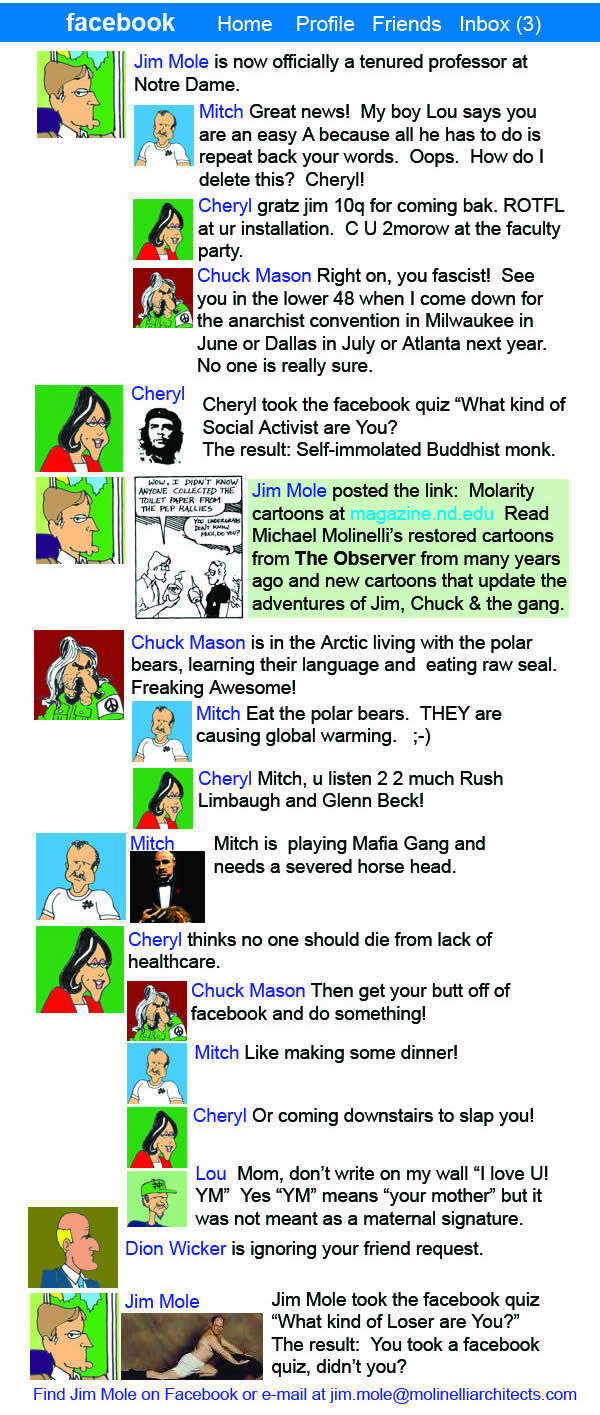
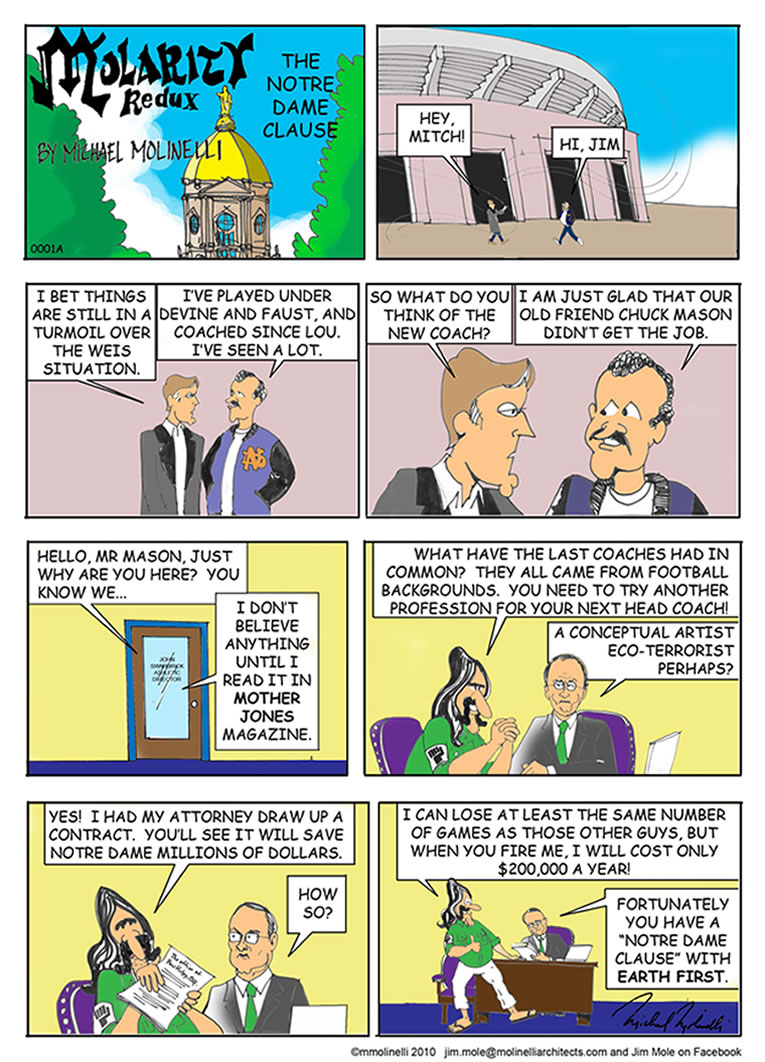
    Welcome to the premiere episode of Molarity Redux, the updated, continuing adventures of Jim Mole and friends.

    This online comic strip will appear here monthly. Molarity Classic, restored cartoons from The Observer of many years ago, will appear here weekly.

    molredux1a.jpg

  • Haitian memories

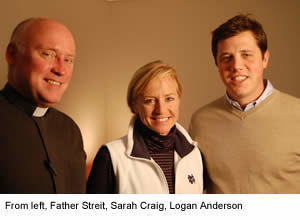
    Three members of Notre Dame’s Haiti Program, a public health effort to eliminate the disease lymphatic filariasis, were attending a meeting at the Hotel Montana in Port-au-Prince when the earthquake struck at 4:53 p.m. local time on January 12. In their own words, they recount what happened next.

    haititrio.jpg

    Rev. Thomas Streit CSC, founder of the Notre Dame Haiti Program

    I feel like I have my second life now. . . .

    There were about 25 us gathered at the Hotel Montana for our semi-annual partners meeting for the Neglected Tropical Disease Initiative in Haiti. Our meeting finished about 3-3:30 and we had set about relaxing after the meeting, talking about some of the issues that were covered. And then we split apart into different groups. I went off to do some emails. The Notre Dame people split off into three different groups. When the earthquake hit we were in three different places on three different rooftop terraces.

    All three groups rode the building down. All of us went down at least two floors. [The worst injury we sustained] for the whole group was that one of our staff people had a double fracture of his leg. When we saw each other we were overjoyed at the miracle of us surviving. Some of our colleagues from a partner organization at the meeting were buried in the building for a few days but [eventually] were found unhurt. Everyone that was associated with the meeting in our partnership has been accounted for, save one.

    . . . I saw so many things that were just horrific. I don’t know what other words to use. People with limbs torn from their body, screaming in pain. Children wandering about, perhaps who just lost their parents. Bodies just stacked up four and five deep, like cordwood.

    Another thing that struck me is that the churches were all gone, places that I’ve prayed in. Places that mean so much, not so much to me but [to]the Haitian people. [Places that were] their source of hope. [I remember] the people at night praying and singing and holding hands as perhaps the only thing they could do. Without food or water, they turned to God.

    There were some who challenged me and said, “Father, the Church fell down on the people as they were praying. The archbishop was killed in the cathedral as he was praying.” And [they said this] with a little bit of a point to it. But those were the exceptions. Faith perdured, but one could easily see why someone’s faith would be shaken.

    I’ve come away with an experience that I did not wish for, would not wish for. But one which has shown me the strength that we have, the human spirit. That spirit so clearly sustained by our belief and our faith.

    Sarah Craig, program manager, the Notre Dame Haiti Program

    The meeting ended, and we decided to hang out at the Hotel Montana for a little bit. Logan Anderson and [some colleagues] and I went to a terrace to have a beer and wait until dinner started. We were sitting outside, looking over the countryside [talking about] how many positive things were happening in Haiti.

    We were sitting there less than 10 minutes when the earthquake hit. We were on the fourth floor and the building around us came down. The railing came down, and we were all thrown down to the ground. The building below us just collapsed and we could feel it going down each floor, down until we ended up somewhere around the first and second floor with the rubble underneath us.

    We looked around to make sure everybody was okay, and the four of us were. The entire hotel complex had fallen and was in ruins. We got up, got organized and decided to start looking for people. The first person ironically we found was Father Tom. He had been right underneath us, but we didn’t know it.

    We gathered and went to an area that was kind of a common meeting area where people were coming out of the building and out of the rubble. There were many injuries including one of our Haitian colleagues, who works for the program. He had a broken leg.

    I have experience as an emergency responder, and so I splinted his leg. I tried to help some other people along the way and did some more makeshift splints out of sticks and torn-up shirts and flags.

    We wanted to get away from the rubble because we didn’t know if it would slide more. So Father Tom and Logan went down the hill and looked for a place, and we found a grassy spot where we bedded down for the night. And more people came who were in our situation.

    So that was the start of the couple-day ordeal of where we were: In the cold huddled together. Just sharing whatever provisions and supplies that people had. People were very generous. Very Haitian style: whatever you had you shared.

    You know you go through your life and wonder what it would be like to come face-to-face with God. I feel as though I had that conversation. I said, well if it’s my time to go, I’ll go. I didn’t think I was ready yet, but that’s not my decision to make.

    And it was at that moment when I had this peace that it wasn’t my time and that’s when the rubble settled. And we walked out of it. And we were constantly praying for all of the people that we didn’t know about and the people that we knew who perished. And that was what was so hard. Knowing that so many people had passed.

    Logan Anderson, financial manager, the Notre Dame Haiti Program

    [After the meeting we went to the fourth-floor room of one of our colleagues from USAid to have a beer before dinner.] The original plan was to be in the room and have the beer. But she had this great terrace next to her room. So [we decided], let’s enjoy it outside. About five minutes after we sat down we felt the shaking.

    At first there was a split second when Sarah and I had this recognition of “what is this?” “Is this a joke?” “Or is this . . .”

    All I remember is being thrown from my chair, being thrown to the ground and feeling the terrace going bang down to the third floor, bang down to the second floor, and then the whole thing shifting forward, tilting forward. And then [we were enveloped in] dust for 30 seconds or maybe a minute. Then everything cleared. After that the focus was “We gotta get out of here.” So we helped each other climb out, and get down to stable ground.

    I remember seeing Father Tom soon afterward. He was the only one I could see other than the three people who had been on the terrace with me. That was a pretty big relief. We met right there and made our way to a safer area. I remember thinking this is something you see on TV, not something you experience.

    Several things stuck out from that night. You could hear the people praying and chanting, and you could hear more buildings going down. And you could hear thousands of people screaming. . . I think that will stick with me for quite a while.


    Photo by Shannon Chapala.


  • Roe and me

    jnagy.jpg

    My mother hung up the phone one afternoon in 1969, sick with the news shared by a mutual friend about an old roommate from their days as Pan Am stewardesses. The woman, once so proud of her pregnancy, had flown to the Caribbean for an abortion. Mom told me recently that she took one look at her first child, my brother Tom, and wept. “I kept thinking if she’d had her baby, he would have been every bit as wonderful as Tom,” she said.

    I don’t need that story to reassure me that my parents never considered an abortion when they found out about me. But I suppose they could have. I was in fact just entering the second trimester when the U.S. Supreme Court handed down Harry Blackmun’s majority opinion in the case of Roe v. Wade.

    They were living in Germany at the time. Dad, building a career as a wire-service journalist, was assigned to UPI’s Bonn bureau. They’d arrived the year before in good financial shape after four life-defining years in New York, London and Moscow. But a financial crisis soon sent the dollar dropping through the floor and the high-end rent on the lease my parents had signed nearly doubled as a percentage of their income. UPI, notoriously stingy even in the best of times, made no effort to help its employees out. The company even maintained its policy of paying reporters in dollars they’d have to exchange.

    The pinch was severe and my parents had to borrow money for living expenses. I’ve marveled at this story my whole life. Now, as a father of five with no skills more marketable than the ability to string sentences together, I can relate.

    UPI found Dad a job in its Washington bureau and my parents made ready to move back to the United States, but their troubles were just beginning. The boy child growing in my mother’s womb had a pair of serious developmental defects detected at birth. What the German doctors thought was a relatively harmless cataract on my left eye was actually a dangerous failure of its primary vitreous to grow. A series of surgeries and eye patches and lens therapies which I endured that first year of my life saved the eye itself but left me sightless on that side.

    At one point, while staying with my mother’s parents in Pittsburgh a blood vessel broke in my eye, causing me severe pain. My grandfather picked me up and soothed me as he alone had been able to do those first few months while we waited for my father to join us, but the damage to the optic nerve was permanent.

    Less serious were my pigeon toes. They simply required surgeries, months of leg casts and then a pair of shoes connected with a bar I was allowed to take off for two blissful hours a day. When I finally took them off one last time in the fall of 1974, I was ready to run.

    So I did. Over time, with the help of medication, cosmetic surgeries and my parents’ tireless nurturing, I learned to cope with one blind eye. Some friends don’t notice my lazy left eye until I mention it. Others admit they found it distressing at first. I still walk into doors when I’m not careful as I did just yesterday while talking to an associate vice president on my way to the elevator. I still walk into my friends if we’re going somewhere fast and I forget to position myself so they’re on my “good” side. I couldn’t hit a baseball after the pitchers started shaving and throwing 70 miles per hour. But to the satisfaction of my driving instructor and the State of Indiana, I can drive.

    Still, I’m haunted. What gave my parents the courage and strength to bring me into this world amidst personal crisis and to love me through that first woeful year, when others under similar circumstances choose abortion? How many babies with defects like mine never get the chance to wear protective glasses before taking them off in high school and quitting basketball in an act of frustrated rebellion?

    Why did my mother’s former roommate change her mind? And why did my mother cry? I don’t know. I’m just glad to be alive.

    I have protested legal abortion since I learned about it in junior high. But I have been heartened over the years to see so many reach the conclusion that this goes even deeper than the intersection of morality and law. Whether Roe is overturned today or never, the lasting cure for abortion is the painstaking, sacrificial work of love and life, of culture and spirit. The joy my parents felt despite my cloudy eye and half-moon feet, like the joy I felt even while my own son spent his first week in that bright incubator, is available to everyone. And it’s eternal.


    John Nagy is an associate editor of Notre Dame Magazine.


  • Movie review: Extraordinary Measures

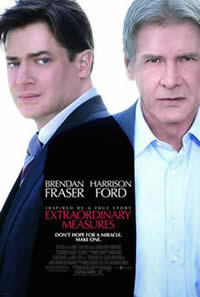
    extraordtrailer.jpg

    Extraordinary Measures, starring Brendan Fraser and Harrison Ford, offers the inspirational story of Notre Dame Law School alumnus John Crowley’s determined fight to advance the medical research needed to save the two youngest of his three children. The children are afflicted with Pompe disease, a rare genetic metabolic disorder that causes progressive muscle weakness.

    In the PG-rated movie, with the clock ticking as his children’s health deteriorates, Crowley (Fraser) reaches out to Dr. Robert Stonehill (Ford, playing a composite of several real scientists), who has the ideas but not the resources needed to develop the life-saving medication. Drawing on Crowley’s business savvy and Stonehill’s scientific genius, the two launch their own a biotech company, though the headstrong men battle each other as much as they do medical obstacles along the way.

    The most commonly expressed reaction to the trailer for Extraordinary Measures is that the film looks more like a disease-of-the-week TV movie than a theatrical motion picture, thus implying that it must be formulaic and mawkish. And Extraordinary Measures is unquestionably formulaic in its coverage of Crowley’s efforts.

    Clearly, the more complex edges of the medical battle at home and in laboratories were smoothed over to fit the story into a Hollywood package. The narrative is structured by such familiar conventions as looming deadlines, reductive obstacles and profit-obsessed Big Pharma villains (until they’re suddenly not so bottom-lined focused, in order to set up the happy ending). However, Extraordinary Measures does admirably succeed in avoiding the saccharine tone of a clichéd Lifetime movie.

    John Crowley has said that the film perfectly captures the emotional spirit of his family’s plight, and the level of humor in the film effectively balances the melodrama inherent to the tale. Credit for the film’s sincerity should also go to the lead actors’ star charisma, even if neither is at his best here. Fraser’s sizable affability effectively transmits Crowley’s devotion, though he strains to display the father’s anguish.

    Ford draws productively on his beloved persona as the irascible maverick, yet he awkwardly flits between two acting modes, deadpan and raging. While the A-list stars’ presence alone raises the film’s profile above that of a television project (as does the experience of seeing it on a big screen) the film’s target audience does have to be one that appreciates the kind of entertainment implied by the trailer, as the movie lacks any edginess or cynicism.

    In that sense, Extraordinary Measures is actually rare both for Hollywood films, which these days are primarily directed at teenage boys, and television, which covets the 18-34 demographic. For that, as well as for its exhibition of John Crowley’s extraordinary efforts, this film should be welcomed. While it is intended as Hollywood entertainment, it is based on a father’s very real struggles to save his children.


    Christine Becker is an associate professor in the Department of Film, Television and Theatre who specializes in the history of film and television. She is the author of It’s the Pictures that Got Small, an analysis of the role of Hollywood film stars in 1950’s television.


  • Haiti, a nation undermined

    The historical situation in Haiti has long been dire, and we need to understand its history if we are to understand how human values, and which ones, come into play. Haiti, once France’s most lucrative colony and born of greed and slavery, became an independent republic 200 years ago. Haitians should have much to celebrate. The country is the birthplace of many values that we celebrate as modern, as it was the first nation in the world to outlaw slavery, the source of vast European profits. A slave revolt, unprecedented and unequaled since, transformed the colony of Saint-Domingue into Latin America’s first sovereign nation.

    Haiti’s second constitution, promulgated in 1805, declared that all citizens, regardless of skin color, were to be known as nègres, prohibited foreign ownership of land and reclaimed as the country’s name the term used by the island’s indigenous people. Haiti meant “high country” to the original inhabitants, millions of Arawak who had almost all died out a century after Columbus landed in 1492.

    Haiti in 1804 had few friends. The small country, in cinders after a decade of war waged successfully against Europe’s greatest powers, was surrounded by the slave economies of Jamaica, Cuba and the southern United States. Its leaders tried to make some friends by helping Simón Bolívar and others cast off colonial rule in the New World. One of the conditions of this assistance was that slavery be abolished in the nascent republics of South America. And Haitian troops, former slaves, marched east to abolish slavery in what is now the Dominican Republic, the nation with which it shares its small island.

    Haiti’s first century as an independent nation was a difficult one. Bolívar did not keep his promise, and he tried to block Haiti’s formal participation in international affairs. The Dominican Republic remains a country in which racism—and dislike of all things Haitian—is tolerated or condoned. Throughout the 19th century, Haiti remained isolated by trade embargoes and the world’s refusal to recognize a country born of a slave revolt. The 20th century was no easier: Gunboat diplomacy was followed, in 1915, by U.S. military occupation. Franklin Roosevelt ended the occupation in 1934, but decades of military and paramilitary dictatorships ensued. Haiti’s first democratic elections were not held until 1990.

    What transpired over the next 14 years is much disputed, but Haiti’s brief experience with democracy is readily documented. We do know this: In spite of a spectacular coup attempt (by Duvaliériste and paramilitary forces) between the elections and the installation of the president-elect, the inauguration of the liberation theologian Jean-Bertrand Aristide took place on February 7, 1991.

    Father Aristide’s government policies reflected liberation theology and the corporal works of mercy: Ambitious programs to promote adult literacy, public health and primary education were quickly launched, as were campaigns to raise the minimum wage (opposed vigorously by Haitian and U.S. factory owners) and to promote land reform (opposed by those with large and often fallow land holdings). Tensions were high, and in September the Aristide government was overthrown by yet another military coup, this one anything but bloodless.

    Thus the modern Haitian military, a creation of the U.S. occupying force in the 1930s, once again took power. (Some will note a certain symmetry here with the recent history of Rwanda. In the case of Haiti, as elsewhere in Latin America, it was the U.S. government and not France that gave assistance and training to the army.) The degree to which the first Bush administration secretly abetted the 1991 coup is much debated and may not be known for years. But there is no doubt that a CIA asset in Haiti formed and led the vicious paramilitary group named FRAPH, credited with many of the murders committed during the years following the coup.

    1992 Haiti was like a burning building from which the only exit was over the Dominican Republic border or across the sea. Tens of thousands of refugees embarked for the United States. The United Nations soon condemned the U.S. policy of forcibly returning Haitian refugees and declared post-coup Haiti “a human-rights nightmare.” Hundreds of thousands of “internal refugees” fled the pro-Aristide urban slums—which were targeted by the military and paramilitary forces—for rural hiding places or the neighboring Dominican Republic, famously hostile to Haitians.

    A change in U.S. policy

    During endless negotiations orchestrated by the United Nations and the Organization of American States the military dictators refused to budge. Then Bill Clinton, who had promised during his U.S. presidential campaign to grant sanctuary to Haitian asylum seekers and to restore constitutional rule to Haiti, took office. But the flood of unwelcome refugees to Florida forced his administration into another strategy—to stanch the flow by stopping military and paramilitary terror in Haiti.

    Instrumental in shaping the policy that eventually led to the re-establishment of constitutional rule in Haiti was John Shattuck, former vice chairman of Amnesty International. He joined the Clinton administration in June 1993 as assistant secretary of state for Democracy, Human Rights and Labor. Within 18 months after Clinton took office, Shattuck recalls, “disaster had struck in Somalia, Rwanda, Haiti, Bosnia and China. Human-rights conflicts were erupting or escalating in virtually every part of the world.”

    Since Haiti is a close neighbor with strong ties to the United States, the crisis in “our backyard,” just then generating huge numbers of refugees, loomed larger than the catastrophe evolving in Rwanda. Clinton, says Shattuck, favored using military force, if necessary, to restore democracy in Haiti. “The strategy had many opponents inside the Beltway, but the president knew it was time to reach over their heads and take it to the public.”

    How did Clinton come to feel so strongly about this matter when Washington’s power elite saw little reason to waste time and energy, or to jeopardize American lives, on account of Haiti? On September 14, 1994, the day before Clinton was to present his proposal to the U.S. public, Shattuck brought him photographs of the atrocities taking place there.

    “I spread my photos of the disfigured faces and bodies of Haitians who had recently been attacked by the FRAPH on a coffee table in the Oval Office,” Shattuck says. “Examining them closely one at a time, the president swore quietly, ‘Those bastards,’ and vowed that Haiti’s reign of terror would be brought to an end. The statistics I summarized for the president spoke for themselves. . . . As I talked, the president stared at the hacked and mutilated bodies of men, women and children trapped on an island ruled by thugs.”

    And so the U.S. military deed was done. Constitutional rule was restored to Haiti in 1994. Not a single American life was lost to hostile fire during the course of the operation.

    But there are many ways to undermine a popular democracy. What followed was a decade of “structural adjustment” programs forced on Haiti by the same international community which had declared that Haitian democracy should be restored. Aristide served out what little was left of his term and became the first Haitian president to hand over power to another elected president.

    Aristide was re-elected by a landslide in 2000. But he pulled little economic weight, since the bulk of his support came from the poor rather than Haiti’s wealthy elite, notoriously reluctant to pay taxes. The “new” U.S. policy gurus on Haiti, who came into the White House with the next Bush administration, were precisely those who’d disparaged the left-leaning Haitian populist during the first Bush administration. A virtual embargo on aid or credits to the cash-poor Aristide government ensued.

    Haiti in 2004 was the most impoverished nation in the hemisphere; the aid embargo was strangling the country. Shortly after its bicentennial celebration, Haiti endured its 33rd coup d’état and lost tens of thousands to violence, floods and epidemic disease.

    Questions and ironies abound. Haiti was the first state in the Western Hemisphere to put into practice the modern notion of rights: the first to proclaim universal equality among the races, the first to offer a sanctuary to oppressed refugees. Then why is Haiti the hemisphere’s most HIV-affected nation? Why does Haiti, the source of much of 18th-century France’s wealth, now stand as one of the poorest and most volatile countries on the face of the earth? Why is political stability so elusive, and why are violence and rights violations so endemic? Why is it so difficult, even when the tools of the trade are made available, to practice good medicine and public health in the Western Hemisphere’s neediest nation?

    We might seek to answer these questions by asking “what went wrong” in Haitian politics and culture. But such narrowly focused investigations give less truthful answers than an attempt to understand Haiti’s history and its place in the modern world economy—the webs of power that link us all. Simply put, Haiti’s poor majority is by no means to blame for the mess it finds itself in, today or at any point in the last 200 years.

    Not all the news from Haiti is bad. I know from my own experience that it is possible to deliver high-quality health care in rural central Haiti, where there are neither paved roads nor electricity. Haiti also can claim to have led the charge against AIDS in the poor world, having launched some of the first integrated prevention-and-care programs. A new funding mechanism, the Global Fund to Fight AIDS, Tuberculosis and Malaria, allowed Haiti to ramp up long-standing efforts to prevent new infections and to improve care for the sick.

    Even as some poor nations seemed ready to concede defeat in the struggle against what had become the world’s leading infectious cause of adult death, Haiti could point to real victories. The corporal works of mercy, at least many of them, helped to promote these victories. But is mercy enough?


    This article was part of the longer piece published in Autumn 2006, If We Fail to Act.

    Paul Farmer is the founding director of Partners in Health, an international charity organization.


  • Blessed are the healers

    Maurice Antoine’s feet are too bloated and misshapen to fit into socks. Wrapped in white muslin cloths, they look like canvas potato sacks on the floor of his shack in Haiti. From his bed, the 48-year-old plops each foot onto the sole of a giant sandal and fastens cargo-size Velcro straps. He stands up, slowly hoists his left leg forward and repeats the same motion with his right. Lumbering like an elephant, he steps out the door and onto a sunny footpath.

    Antoine has elephantiasis, or what Haitians call "Gro Pye’’ — Big Foot. The ailment is an advanced form of lymphatic filariasis, a preventable parasitic disease that affects an estimated 120 million people around the world. Depicted in ancient Egyptian murals, the scourge is thousands of years old. It is especially common in tropical places like Antoine’s town of Leogane, a flat seaside region at the base of soaring mountains. The climate here is perfect for mosquitoes, which spread the disease from one person to another. More than 50 percent of the population is infected.

    Until recently, most people in town assumed they were healthy. After all, they didn’t feel sick, and they didn’t look like Antoine, whose deformities spurred wild speculation. Some wondered if he had kicked a set of voodoo dolls lying on the ground. He, too, wondered if he was cursed. He was a recluse. He says he once went for about seven years without having a lengthy conversation with anyone. “I was ashamed, embarrassed; people did not like to come close to me,” Antoine recalls.
    Things have changed in Leogane. At Hopital Sainte Croix in Antoine’s neighborhood, a team of doctors, scientists and others are developing efficient, cost-effective methods for snuffing out the parasites that cause filariasis among large groups of people. Their work has put Leogane on the front line of a worldwide crusade, the Global Alliance for the Elimination of Lymphatic Filariasis, to eradicate the disease within the next 20 years.

    Last fall, the Haitian team — funded by a partnership that includes the hospital, Notre Dame and the U.S. Centers for Disease Control and Prevention — launched an elaborate public health campaign that dispensed parasite-killing drugs to more than 108,000 people and dispelled the myths that had made Antoine and others like him untouchable for decades.

    That campaign makes a lot of sense to one of the program’s coordinators, Father Thomas Streit, CSC, an assistant professor of biological sciences at Notre Dame who has lived in Haiti intermittently since 1993. Modern science has developed good tools for fighting filariasis, but the disease still poses a threat to an estimated 1.1 billion people around the world. "We can sit in our lab and come up with great solutions,’’ Streit says, “but we have to apply those solutions in the field.”

    A sudden outpouring of good will is one of the reasons Streit and others are optimistic about the potential for finally bringing the appropriate medicines and techniques to the people who need them. Drug companies recently pledged to donate the medicines required for global elimination. Governments are making commitments. And so are private individuals. The Leogane program, for example, received through Notre Dame a $5 million grant from the Bill and Melinda Gates Foundation last year.

    The parasites

    Vanquishing filariasis involves fighting a parasitic worm that lives almost exclusively in the human body. People in Haiti have carried these threadlike parasites since the 17th century.

    The worms lodge in a person’s lymphatic system, a vast network of nodes and vessels that maintains the fragile balance of fluids in the blood and tissue. They live there for years, giving birth to millions of baby worms that circulate in the blood. Filariasis spreads from one person to another when some of these baby worms, known as microfilariae, are picked up by mosquitoes and given to other people. Most people never detect the worms because the parasites don’t disturb bodily functions in any overt way. Others aren’t so lucky.

    Somehow, the full-grown parasites mysteriously disrupt the flow of a person’s lymphatic system. The problem usually starts in areas where the parasites like to nest, the legs, breasts or genitalia. Fever and excessive swelling, caused by an accumulation of fluid, are the first tangible symptoms. Meanwhile, the disruption of lymph flow impedes the work of antibodies trying to help the skin ward off a constant assault of infectious microbes.

    “The microbes will get in there,” Streit says. “They will start forming a little colony. They will take advantage of the fact there’s improper flow. You have to think about the battle between microbes and our own bodies as a war. . . . The parasite disrupts the balance of the war and it sets up that particular part of the body for defeat.”

    Without proper treatment, infections flourish. Scarring follows each infection and elephantiasis sets in. It is disfiguring, disabling and permanent for people like Antoine. “You can’t do surgery on tissue that’s no longer fed by and drained by the circulatory system,” Streit says.

    This is one of the reasons the Global Alliance is coordinating a worldwide effort to kill the parasites before the worms have a chance to cause more elephantiasis cases. Streit and others believe they can stop the disease from spreading, and eventually eliminate it, by medicating everyone whose bloodstream carries baby worms. They want to annihilate all the juvenile worms.

    A complicated campaign

    When Streit came to Leogane in 1993, one of the first projects he got involved with was an attempt to eliminate filariasis from a village situated in the middle of some sugar cane crops on the outskirts of Leogane. Nadine Fredlyng, 13, was one of the first people he worked with. She lived in a cluster of small shacks near an open drainage trough filled with mosquito larvae. Streit counted 210 juvenile parasites in a single drop of her blood. Her siblings also tested positive. Seven out of eight boys in a neighboring family were infected, too. One woman’s leg was swollen with lymph fluid. The program treated Fredlyng and others in her village with annual doses of two drugs that kill only the juvenile worms.

    Five years later, the remaining adult worms are reaching the end of their four-to-eight-year life cycles and dying; no juvenile worms remain to take their place. Streit says the villagers are clearing their bodies of the infection for good and avoiding re-exposure. But lymphatic damage caused by filariasis is still here; keeping it from causing elephantiasis will require careful monitoring and treatment. Still, the program appears to have broken the lineage of parasites that caused suffering for hundreds of years.

    “It’s helping us a lot because the children are not going to get the disease,” says Nadine’s father, 46-year-old Vilsom Fredlyng. Says Nadine, now 18, “I think I’m feeling better now.”

    After the Gates funding arrived, the staff of the informally named Filariasis Program embarked on a bigger and more complicated campaign to bring the same success to the entire region last year. They recruited and trained more than 2,000 volunteers to help distribute medicines at more than 200 different locations in Haiti. They coordinated hundreds of promotional workshops and sponsored other publicity. Both a filariasis song and an announcement by a well-known Haitian comedian aired on four local radio stations. The program treated more than 108,000 people in a span of 16 days last fall. Later this spring, the first 4,000 of these people will be tested.

    Streit is hopeful. Technicians who continually test mosquitoes in the region are finding that the bugs show fewer signs of carrying the parasite.

    The filariasis elimination project continues to grow. About 75 percent of Haiti now has been evaluated for filariasis and other hot zones will soon receive attention. “We were the first ones to distribute medication in the community like that,” says the program’s young administrator, Jean Marc Brissau, “so the world is following.”

    Getting better

    Across the street from the gates of Hopital Saint Croix, Antoine has kept an eye on the developments as he tries to make a living selling candy. Each day, he stands mutely next to a squat wooden stand that displays a couple dozen lollipops and other sugary treats.

    The program’s clinicians have taught him how to make up for the shortcomings of his damaged immune system by keeping his lower extremities impeccably clean. His feet and legs still look like the boots of an astronaut, but they’re smaller than they were about four years ago, and they don’t smell as bad. The worms are long gone. The ostracism has lifted. Throughout town, people understand the biology of his disability.

    Antoine is still a shy man who longs for simple things: A wife and family, a job that could provide a more dependable source of income. Nonetheless, the recent improvements are fueling his confidence.

    “I have big legs,” he says, “but I think I can work.”


    Mark Reynolds is a staff writer for The Providence (Rhode Island) Journal.


  • Haiti backgrounder

    Notre Dame Magazine has through the years run a number of articles about Haiti, from a crusade and scientific research to eliminate one of the country’s scourges — elephantiasis, an advanced form of lymphatic filariasis — to a school where Notre Dame students frequently volunteer to Haiti’s fraught history. We offer these background pieces for those wishing to learn more about the country and Notre Dame’s work there.

    Father Thomas G. Streit, CSC, a Notre Dame assistant research professor of biological sciences, has been working in Haiti since 1993 to combat lymphatic filariasis. Blessed Are the Healers.

    Notre Dame scientists have for years investigated the genetics of mosquitoes, to try to stop the diseases they can spread, including malaria and lymphatic filariasis. The Littlest Killers.

    ND students frequently volunteer at a Catholic school on the outskirts of Port au Prince. They offer A Gift of Hope.

    Update on Louverture Cleary School.

    Throughout the years, Notre Dame has worked on several projects in Haiti, Other Notre Dame Initiatives.

    As part of the longer story, “If We Fail To Act,” Paul Farmer, M.D., founding director of Partners in Health, wrote about the history of Haiti in A Nation Undermined.

    A 2006 Haitian documentary combined the skills of three Notre Dame alums — director Dan Schnorr ‘05, co-director and editor Justin Brandon ’04 and executive producer Brian McElroy ’05 — to showcase members of a rural Haitian community who have taken the cause of development into their own hands. The film is being screened in its entirety to raise support for earthquake relief efforts. See The Road to Fondwa

  • The World Is Their Classroom

    At Notre Dame, ranked among the top of U.S. major research universities in the percentage of students studying abroad and with 80 percent of its students doing volunteer service, education is not an ivory tower enterprise. Plenty of learning takes place in the classrooms and labs, in residence halls and over lunch. But an institution that wants to change the world must be in the world, so the University has stepped up its efforts to provide its students with experiential learning opportunities through internships, research projects and service-learning initiatives — worldwide.

    These programs have taken students to Darfur, Rwanda, Haiti and the Middle East to encounter the effects of violence, injustice, poverty and hatred, and to join the efforts of peace-builders and health-care providers. Engineering faculty and students have gone to Benin in western Africa to bring well-water technology to villages without clean water. Alums and undergrads have gone to Lesotho in southern Africa to build and staff clinics for the youngest victims of AIDS. And MBA students, through a class called “Business on the Front Lines,” have been exploring the role of business in post-war reconstruction efforts, working with Catholic Relief Services in Bosnia and Lebanon.

    The Kellogg Institute’s International Scholars Program enables students to understand international relations from the ground up in a wide array of nations — Ecuador, Namibia, China, Peru, Thailand, Uganda, Nicaragua, China and Ghana. The Kroc Institute’s reach is also global, bringing international students to campus and dispatching them, as students and alums, to some of the world’s most troubled corners.

    Whether fighting disease in sub-Saharan Africa, grappling with immigration issues along the U.S.-Mexican border, staffing schools in Uganda or negotiating social and political stalemates in Latin America, students are learning the ways of the real world through a variety of possibilities. One hub, though, is Notre Dame’s Center for Social Concerns. Long known for its Urban Plunge, its week-long service ventures over fall and spring breaks, and its Summer Service Projects, the center’s International Summer Service Learning Program now sends students to 12 countries in South America, Asia and Africa.

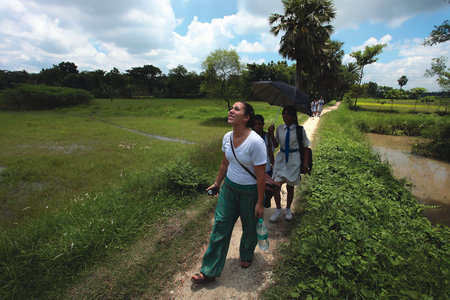
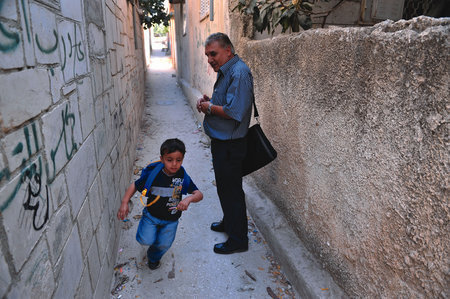
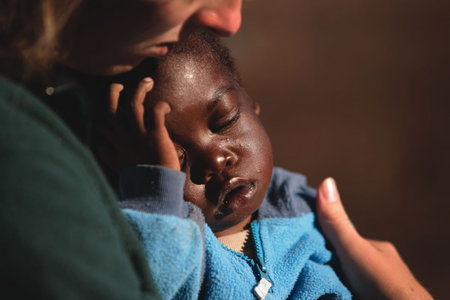
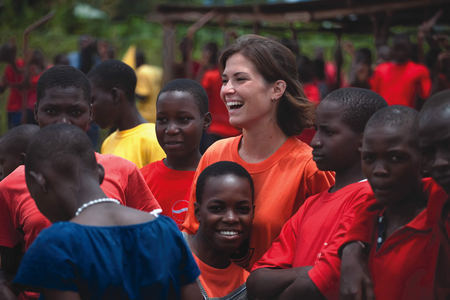
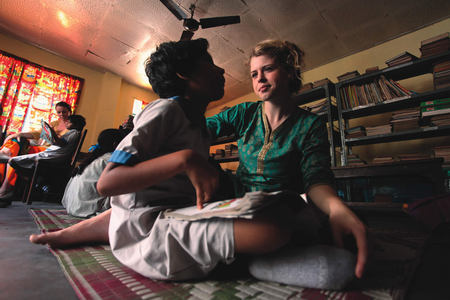
    Notre Dame, which has sent more of its graduates into the Peace Corps than any other Catholic college or university, has a tradition of engagement far beyond its South Bend campus. University photographer Matt Cashore ’94 has visited some of the places students have gone to live and learn. Here are some of the images he’s brought back.

  • Something funny bites again

    molarity1.jpg

    It was a noontime ritual virtually everyone engaged in during the late 1970s and early ’80s at Notre Dame. Whether you were a student, professor, administrator or janitor, it’s likely the first thing you did at lunch each weekday was flip through The Observer to find out what Jim Mole and his buddies were up to.

    Mole was the angst-ridden ND undergraduate everyman “star” of Molarity, the first and, many would argue, best comic strip ever to run in the student newspaper. He also is the alter ego of Michael Molinelli ’82, the clever architecture student who created Molarity. The cartoonist explains that the strip’s strange name refers to a concept in chemistry and synthesizes the first three letters of his last name with the word hilarity. Why chemistry? “Why not?” he says.

    For five years, from 1977 to ’82, the student from Briarcliff Manor, New York, satirized daily life at Notre Dame in a Doonesbury-esque comic. “Something funny that bites” is how this magazine characterized the strip in a 1978 news story.

    Molarity chronicled the adventures/misadventures of Mole and his friends who, among others, include: Mitch, a bench-riding football player with star attitude; Chuck Mason, a throwback campus radical; and Cheryl, Mitch’s superior-in-every-way girlfriend.

    “After taking Psych 101 freshman year, I realized that with Jim, Chuck and Mitch, I had divided my own psyche into id, ego and superego,” Molinelli says. “Jim was my superego. He was worried about how he’s perceived, whether he’s good enough, doing enough. Mitch, on the other hand, is the ego. He’s convinced he’s right and no one else matters. While Chuck is pure id. He just goes off wildly doing whatever he wants to do. And Cheryl is the girl I always wanted to date. She’s sharp, funny, smart. Maybe a little overly preoccupied with her mission in the world, which is to succeed as a woman.”

    Molarity wasn’t an instant success. At first the strip appeared irregularly just to fill holes in the layout. Molinelli credits Steve Odland ’80 — then The Observer’s managing editor and now the CEO of Office Depot — with the break that planted the comic strip in the campus psyche. “Steve had this outrageous concept of ‘why don’t we run these Molarity cartoons every day?’” Despite a fair amount of skepticism among editorial board members, the comic began appearing daily in March 1978 and quickly gained a loyal following.

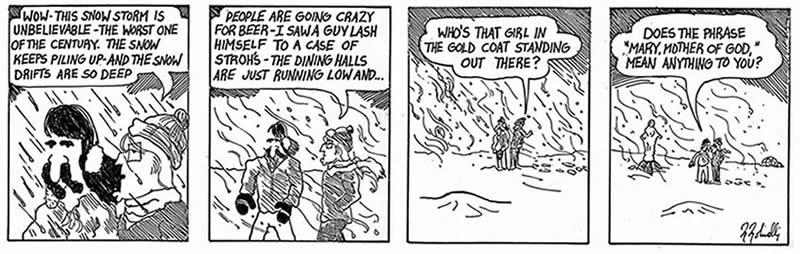
    Molinelli realized people were paying attention when he heard students at lunch discuss a strip he did on the Great Blizzard of ’78, which shut down campus for the first time in memory. In the strip, Jim and Chuck are walking across campus and look across the way to see a figure in the snow. Jim says, “Who’s that girl in the gold coat?” To which Chuck replies, “Does Mary, the mother of God, mean anything to you?”

    The five-year run of Molarity eventually was collected and published in three volumes. The first two books were done by Juniper Press as part of a book publishing course taught by American Studies Professor Elizabeth Christman. Molinelli published the final volume. As of 1983, the books, which sold between 4,000 to 5,000 copies apiece, were said to be the best sellers in bookstore history, with the exception of required text books.

    Life after Molarity has been good, Molinelli says, though not what he or others envisioned. “This is where I’m a severe disappointment for anyone who bought a book. They were all expecting me to be a famous cartoonist. It didn’t happen. But it wasn’t for lack of trying.”

    Molinelli spent the summer after graduation as an intern in the art department of the Cincinnati Enquirer, where he developed a comic featuring Jim Mole, TV news cameraman. Unfortunately, the paper chose not to go forward with the strip. The architect-turned-cartoonist turned back to architecture, where he’s had a successful career designing award-winning commercial and residential buildings.

    He admits the cartooning itch never totally left him. Over the years he’s pitched ideas to syndicates and magazines and did some political cartooning on the side, winning a number of first-place awards from the New York State Press Association before getting fired from his hometown paper. “I guess my political views didn’t sync with the newspaper’s,” he muses.

    In a Summer 2000 Notre Dame Magazine feature, Molinelli reprised his Molarity characters with Jim Mole returning to Notre Dame as a professor. Currently a rumor has been swirling around campus that Professor Mole and his colleagues will continue their adventures in the online version of Notre Dame Magazine.

    It’s true.

    We’re happy Molinelli is scratching the cartoon itch again, and we think you’ll be happy, too.

    Come back to the magazine home page on Jan 14 to see the what the gang is up to on campus these days.


  • Networthy ND

    The staff of Notre Dame Magazine here offers some gems we’ve discovered of blogs, essays and stories by and about Notre Dame graduates and ND events.

    Nicole Kenney, a 2003 graduate of the Notre Dame design program, was featured by Kate Russell of the BBC for having one of “the best sites on the World Wide Web.” Kenney calls it a photo from each day I am 29 years old.

    Brian Doyle, Notre Dame class of 1978, discusses our love of animal mascots in his American Scholar piece, Go-o-o-o Lemmings.

    Better World Books co-founders Xavier Helgesen and Kreece Fuchs, both 2001 ND graduates, were featured in Ode magazine’s 25 Intelligent Optimists who are creating a better tomorrow today.

    Christopher Fenoglio, ND class of 1980, won a first-place award from the Catholic Press Association for his column “Reel Life Journeys, which appears in The Tennessee Register, the diocesan paper of Nashville. Read Reel Life Journeys.

    OK Go shot a video at Notre Dame recently, This Too Shall Pass


    If you know of any links by or about Notre Dame graduates that would be networthy, email the information to Notre Dame Magazine at [email protected].


  • A ‘massive explosion of joy and music’

    okgo.jpg

    Damian Kulash is absolutely right.

    “There are not many people in the world who have the good fortune to be in a position where they can call Dr. Ken Dye and be like, hey, would it be cool if several hundred of your kids came out and made a video with us?”

    Chasing down crazy ideas like calling the director of Notre Dame’s marching band and then trying to shoot a coherent short film in one take with the band and a small army of children is the kind of thing he likes to do when the moment presents itself, say Kulash, the OK Go frontman, while attacking a burrito in the Ricci Band Rehearsal Hall.

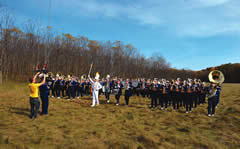
    The inventive rock group got this particular chance in October, working with the students for a week on a music video for their forthcoming single, “This Too Shall Pass.”

    “OK Go is known for their videos,” ND assistant band director Emmett O’Leary says. Their 2007 power-pop hit “Here It Goes Again” may be better known as “the treadmill song” from the one-take clip in which the four musicians perform a tightly choreographed dance ode to hilarity on eight treadmills. It earned the L.A.-based rockers a Grammy for best short-form video. More than 50 million people have watched it on the Internet site YouTube and not a few fans — including the creators of The Simpsons and the Band of the Fighting Irish — parodied the dance.

    Notre Dame’s version, performed once at home and once at the Los Angeles Coliseum, also made the YouTube rounds, which is how OK Go discovered it last year while recording its new album, Of the Blue Colour of the Sky. “From a bird’s eye view, they make two giant treadmills with people walking on it,” Kulash says. “This couldn’t be more up our alley. It’s big, it’s absurd, it’s this massive explosion of joy and music.”

    “It’s neat to serve something into culture and then see someone hit it back in a slightly different way,” adds bassist Tim Nordwind.

    That helps explain OK Go’s latest marketing experiment: Getting other acts to cover their songs before they’re even released. Should you hear — as Kulash puts it — “acrobatic handbellers from California” or mariachis or a section of the nation’s oldest collegiate band playing an OK Go song during the next year, it’s intentional.

    In Notre Dame’s case, asking Dye & Co. to record an arrangement wasn’t enough. Soon the idea of a video in which the two bands perform the song together in a live recording emerged.

    Over fall break, OK Go staked out a field near campus and rehearsed with the student musicians. On the final day, producers added children from South Bend’s Perley Elementary and Good Shepherd Montessori School.

    It required 20-odd tries to lasso the chaos into OK Go’s trademark single take, but it worked.

    The group is tight-lipped about the content of the video, which should pop up on YouTube early this year. They extol O’Leary’s “hot” marching formations, fellow assistant director Matt Merten’s sound recording work and costumes created by senior saxophonist Angelica Hernandez. “What else can I say about it?” Kulash says. “It starts out with the four of us in a field and it ends up with 125 band members and 50 kids from local schools having a giant party.”

    Nordwind was school-age himself 20 years ago when he visited his older brother William ’89, slept in William’s Saint Edward’s Hall room and went to football games. This time he got a charge out of hearing the students play fight songs to keep energy up through rehearsals.

    One of Kulash’s favorite moments was senior drum major Aaron Hernandez marching directly toward the camera. “He’s exactly the stereotype of what that perfect marching band guy is, except he exceeds that expectation somehow,” he says. “Every time I see it I get this little shiver. . . . You could never dial that much style into rock and roll.”


    John Nagy is an associate editor of Notre Dame Magazine.

    Photo by Matt Cashore ’94.


  • Late night with the American pundit

    “Say something more,” the burly taxi driver demanded after I told him the name of the Dublin hotel where I planned to stay.

    “Don’t you know where it is?” I inquired, wondering what he meant.

    “You’re that Yank on the radio,” he responded. Then I knew.

    Americans from the Midwestern heartland never think they have any distinguishing characteristic, linguistically speaking, let alone a defining accent. But several conversations about politics across the Atlantic for Morning Ireland prompted the voice recognition en route from the airport. And, as we made our way to the hotel, the driver provided his broach-no-opposition opinions on all matters political.

    On that trip I discovered that semi-regular duty for the most popular radio news program in a small country means that you keep running into people eager to pose their questions and posit their views, mostly the latter.

    This little-league case of vocal-cord celebrity began serendipitously in 2004 as a result of a Hesburgh Lecture for Notre Dame at Saint Patrick’s College in Dublin. Before the trip, a producer phoned about the talk (a disquisition on that year’s presidential campaign), and he and his colleagues got into the habit of calling to discuss American political events of potential interest to an Irish audience.

    Enlightening as the encounter with a cabbie can be — one other listener upon meeting me unforgettably remarked, “You sound taller than you are” — the on-air segments for the program share certain similarities. With the five-hour time difference, we’re usually conducting these journalistic colloquies at around 3 a.m. in South Bend.

    Wake-up call

    Though this hour might be prime time for a night owl, it’s light-years different for an early bird with an internal clock perpetually set to 5 a.m. To be safe, a producer in Dublin calls a half-hour before every interview to make sure I’m awake, if not alert.

    Radio, I here confess, is the only permissible medium for these productions. Broadcast central is the kitchen table, where (swaddled in robe and nightshirt) I struggle to string one semi-coherent word after another, while holding a telephone to one ear and glancing at my notebook to spot a phrase or point worth raising.

    On occasion, the odd hour can lead to moments of regret, sentences that defy diagramming or the intrusion of emotion. During late spring of 2008, in the pre-dawn morn after a full day of punditry, I got into a brief on-air kerfuffle about the purity of my political analysis. When I asserted my nonpartisan independence with gusto, saying I try mightily to be as fair as possible, one sensitive listener found the defense of my virtue worthy of comment.

    “As an American living in Ireland,” the email began, “I am quite in tune with the rules of conversation here, which are quite different from those in the U.S. People do not cut off the interviewer in the brusque, inappropriate manner in which you did at the beginning of the interview.

    “I was appalled at your initial reaction and comment, which would have been perceived as extremely rude and typically-American-in-a-bad-way here. Given the already strong anti-American feeling, your initial reaction surely added to the conviction here that Americans in general are rude and not at all gracious.”
    Criticism, even at the upper decibel range, serves a purpose, and cools the creator’s temper. But, to be fair, responses aren’t always so thorny. Some are rosier and include thanks for my abandoning sleep to explain the intricacies of America’s democratic dance.

    You still never really know what to expect when you hang up the phone. One day in the high season of the 2008 campaign, I got to my campus office later that morning to find a phone message from another Dublin-based radio outlet.

    That day a channel-switching listener could have received an oral postcard from America both driving to work and driving back home sent from the same person — and probably wondered whether that disembodied speaker was the sole soul keeping up with politics across the Atlantic.

    View from afar

    Another time, a few hours after a report, a television producer with a charming brogue rang to ask if I might be the person who chattered away on Morning Ireland earlier. After providing positive identification, I heard these words: “Could you come to Washington this afternoon for an interview?”

    At that moment (and 600 miles away), I concluded that American geography might not be a required subject in the Irish educational system. Yet as I slouch towards anecdotage, I’ve come to realize what my odd-hour radio days mean. Always unscripted, these extemporaneous exchanges have forced me to reconsider how others view America, our hopelessly complex campaign system and the utter unpredictability of politics.

    Although my light-slumbering, long-suffering wife is certain to file a dissenting opinion, you might even say this trans-Atlantic talking is worth losing sleep over.


    Bob Schmuhl is Walter H. Annenberg-Edmund P. Joyce Professor of American Studies and Journalism at Notre Dame and director of the John W. Gallivan Program in Journalism, Ethics & Democracy.


  • My Yellow, Two-door Crosley

    crosley1.jpg

    National Public Radio’s Car Talk guys, Tom and Ray Magliozzi, asked listeners to vote for “the worst cars of the millennium.” The top three losers were the Yugoslavian Yugo (sold 1985-92),Chevrolet Vega (sold 1971-77) and Ford Pinto (sold 1971-80).

    Not even mentioned was my very first car: the Crosley. What a disappointment — for me, for Frank Lloyd Wright, if only he were alive, and for all who are left of the 70,000 or so people who innocently bought Crosleys in their heyday, the brief span from 1946 to 1952.

    This car was the brainchild of Cincinnati’s Powel Crosley Jr., the man who in the 1920s made radios so inexpensive he became known as “the Henry Ford of radio.” He also built the first car radio, owned Cincinnati’s Station WLW (in its day the world’s most powerful radio station) and the Cincinnati Reds baseball club (in 1935, he made sure they played the first night game), and created the Crosley Shelvador (the first refrigerator with shelves in its door).

    Long before the Volkswagen Beetle arrived here, Crosley was determined to give post-World-War-II America what he was sure we needed: a cheap small car. Shorter and narrower than the VW, his Crosley tracked only 40 inches between its 12-inch diameter wheels. The car was an improvement on his smaller prewar Bantam, a two-cylinder, 13.5-horsepower job without universal joints but with a hand-powered windshield wiper.

    My bright-yellow two-door Crosley convertible seated four. It cost less than $800 and got its promised 50 miles per gallon. The canvas roof was held on by four snap-buttons front and rear and supported by a couple of flimsy metal racks that sat in the edges of the car’s walls, which rose to roof height. The windows didn’t roll up and down, they slid back and forth.

    I bought my Crosley in June 1947 while working in New Brunswick, New Jersey, as a radio announcer. I soon found it helped my work, which included a street-interview program that asked passers-by their opinions on current topics. The Crosley never failed to attract the curious, whom I trapped into talking to my wire recorder, the precursor of the tape recorder.

    July brought a vacation. I headed my Crosley for my hometown in western New York, up through the Delaware Water Gap and Binghamton and Ithaca. Surprise! The Crosley, used to central New Jersey’s flatlands, didn’t like climbing those long hills of the Poconos and New York’s southern tier. It could race along at 55 or 60 mph on the level, then drop right down to 18 or 20 on inclines that ran several miles uphill.

    I reported this to my Crosley dealer. A mechanic showed me how to adjust the tiny needle valve for a richer mixture in the carburetor. Good idea, he said, if you’re where there’s lots of hills. He also noticed the engine didn’t sound quite right, and took off its cover. Yup — a cracked valve. But it was Friday, and the expert on valve jobs wasn’t there. He was busy writing his sermon for Sunday — he was a Presbyterian minister who had somehow become a Crosley buff and worked for the dealer on special assignments. The next week, for $23, he replaced the valve, proudly telling me how he could single-handedly lift out the lightweight four-cylinder COBRA engine (named for its copper-brass alloy). The car had under 3,000 miles on it.

    I met Jean Bramwell, the girl I was destined to marry. Once, while visiting my brother at his school in Connecticut, we three sat chatting after dark in the car. Without warning, his schoolmates picked up the Crosley. I said, “Keep calm,” resisting the temptation to start the engine and put the car in gear in midair. They turned us 90 degrees and set us down.

    My fiancee, my two brothers (one is 6 foot 5, and I’m 6-2½ myself), and I once were parked in front of Manhattan’s Museum of Modern Art. Pedestrians stopped, gawking as we four un-jackknifed out of the Crosley. “We thought you were a circus act,” said one. “Is it going into the museum?” asked another.

    I moved to Buffalo, New York, and a regional radio station. The engine began producing the same kind of knocking the Presbyterian minister had cured. I found the nearest Crosley dealer in North Tonawanda. Another valve job, this one at fewer than 7,000 miles.

    The Crosley had been mine for a year when I drove to New Jersey to pick up my fiancee, thence to Connecticut for my brother’s graduation. On the way, something beneath the gear box began a grinding growl. Next day, after the ceremony, I dropped Jean off in Peekskill, New York, for her train ride back to New Jersey, then headed up the Hudson and west along the Cherry Valley route (no Interstates then, remember) toward Buffalo. As the grinding increased, my speed decreased. At a maximum 30 mph, I plodded 375 miles across New York state through the night and into the dawn.

    The diagnosis in North Tonawanda? My Crosley had burned out its universal joint and drive shaft. I gave the dealer my strong opinion. “Listen,” he said, “did I sell you that car?”

    “No,” I said. “But I wrote a letter and a half to Powel Crosley after the valve job, and I got back a form letter saying to see my authorized dealer, and that’s who you are.” I bought a universal joint and drive shaft and wrote Powel Crosley another letter, telling him lemons were yellow and so was my Crosley. The Crosley company sent me $38.

    Jean and I were married that September in New Jersey. After honeymooning in New York City and before we headed uphill into the Poconos, I adjusted the needle valve for a richer mixture. Somewhere west of Stroudsburg, Pennsylvania, as we rode a curving two-lane highway up a mountainside, the Crosley coughed. It slowed and coughed again. I pulled onto the shoulder as it died.

    Out of gas? No. I raised the hood and looked first at the carburetor, then told Jean I’d return in a minute. I hurried back down the highway to about where the Crosley first coughed. The 18-wheelers zoomed by as I studied the pavement. There it was — just on the edge of the concrete — a tiny T-shape an inch long, threaded at one end, its cross-bar maybe half an inch. I picked up the needle valve, screwed it back into the carburetor, and we drove to Buffalo.

    Winter brought foot-deep snow. No problem once I put old-fashioned chains on the bright red Crosley wheels. But the Buffalo wind drove snowstorms under the edges of the canvas roof. A convertible-roof specialist drilled into the narrow wooden frame that topped the walls and installed four snap buttons on each side — as Cincinnati should have done on the assembly line.

    By now, the 20th century was at mid-point. In Wisconsin, world-famed architect Frank Lloyd Wright, who knew a thing or two about design and who had dreamed of building for the common man in his Usonia community, liked Powel Crosley’s idea of tiny, cheap runabout cars. Obviously, he had not heard about the Crosley needle valve or its drive shaft, universal joint or cracked valves. In 10 minutes at a Madison Crosley dealer, Wright bought a half-dozen — all bright red — for the use of students at his architecture school, Taliesin Fellowship. For the next three or four years, the Wright Crosleys caravanned back and forth between Wisconsin in the summer and Scottsdale, Arizona, where Taliesin West was flourishing, in the winter. The students, young, eager and idealistic, apparently put up with the vagaries and cranky behavior of the Crosleys. Word got around Madison that the mechanics who benefitted from the cars’ steady need of repairs regularly placed tires beside them, then tipped them on their sides to get at the underparts.

    Meantime, the Siberian western New York winter gave my Crosley its finest moment. Under the noontime sun in a cloudless sky at about 5 above zero, my bride and I were driving east toward Rochester. We had just passed through Batavia and were zooming along between high banks of dazzling plowed snow. Suddenly the Crosley shuddered and shook. I pulled over and looked under the hood. Idling, the little engine was bouncing around like a basketball in a too-big box. I stepped back to the door, turned off the engine, ducked under the hood again. A streak of light caught my eye. I looked up at the hood’s underside, seeing sky through a gash 4 inches long and a half inch wide. The metal bent outward. I looked back at the engine. The culprit? The fan, normally four-bladed, now had three blades.

    We shuddered our way back to a gas station. “Is there a Crosley dealer in this town?” I asked.

    “Yeah, turn right at the next corner, then he’s on the left. Can’t miss it.”

    The dealership was announced by a small sign hanging from a bracket on a tree in front of a house. Down a long driveway, we found a barn embellished with signs for Pennzoil, Coca-Cola and Crosley. “You got a fan for that car?” I asked the proprietor, a pipe-smoker in greasy overalls who needed a shave.

    “Git you one from Cincinnati in about two weeks,” he replied.

    “Got a hacksaw?” I asked.

    He took the fan off the engine, cut off one blade, and reinstalled it. As the COBRA purred like its old self, the Crosley dealer asked, “Like your Crosley?”

    I looked him in the eye. “I need that car,” I said, “like I need a hole in the hood.”

    The Crosley ran fine from then on. It was going strong three months later when we traded it for a used Chevy.


    Bernard Ryan Jr. has written, co-written and ghost-written more than 30 books. His Tyler’s Titanic, the story of a boy who finds a way to visit the great wreck, and his biography, The Wright Brothers: Inventors of the Airplane, were published in 2003. He lives in Southbury, Connecticut.


  • In the news with Brian Kelly

    bkelly.jpg

    Brian Kelly was introduced Dec. 11, 2009, as Notre Dame’s new head football coach after leading his Cincinnati Bearcats to an undefeated regular season and second consecutive Big East championship. The 2009 Home Depot Coach of the Year is 171-57-2 in his 19 years as a head coach at Cincy, Central Michigan and Division II Grand Valley State, where he won two national championships.

    The staff of Notre Dame Magazine tracked the media response to the search for a new coach and the hiring and introduction of Brian Kelly. Here we offer a digest of links to the hiring of the University’s 29th football coach, in chronological order. Scroll down to see the most up-to-date link.

    Who will replace Coach Charlie Weis? The ND campus plays the guessing game.

    The Bleacher Report’s Marc Halstead recommends ND hire a guy named Brian Kelly.

    The Onion’s take on the Coach who rejected ND.

    Cincinnati Enquirer, Kelly talks to UC players about ND

    Dec. 11, 2009, news conference: Brian Kelly named 29th head football coach at Notre Dame.

    The Cincinnati Enquirer on Kelly’s leaving UC.

    Cincinnati columnist Paul Daugherty responds to Kelly’s leaving U.C..

    Notre Dame Magazine editor Kerry Temple comments on another new era at ND.

    Eric Hansen of the South Bend Tribune, Brian Kelly living the Notre Dame football dream

    Chicago Sun-Times columnist Rick Morrissey, ND gig no longer a plum job.

    ESPN’s Ivan Maisel, Kelly brings wins, enthusiasm to ND.

    Brian Bennett blog on College Football Nation, Notre Dame hires the right guy.

    In USC’s Conquest Chronicles, USC fan Paragon SC, offers some initial thoughts on Notre Dame’s hiring of Brian Kelly

    Neil Hayes of the Chicago Sun-Times, Kelly bringing what Weis couldn’t, enthusiasm, fun.

    Dennis Dodd of CBSSports.com, Notre Dame gets right man for an immense job.

    Peter Thamel of The New York Times, Kelly is ready for Notre Dame politics.

    SI.com’s Stewart Mandell, Kelly could make major splash in first year as Notre Dame coach.

    Vandals egg Brian Kellys house in Cincinnati.

    WNDU.com, The Kelly family at Notre Dame.

    Kelly outlines plans for the ND team at his introductory press conference.

    Chicago Tribune columnist David Haugh, He assures the faithful, now all he has to do is win.

    Pat of the Blue-Gray Sky (A Notre Dame Scrapbook) comments on Kelly’s plans.

    Chicago Tribune interview with Brian Kelly’s former boss

    Brian Kelly’s pep talk at the Dec. 19 ND basketball game

    Chicago Tribune, Brian Kelly fleshes out plans at Notre Dame.

    Follow Coach Kelly on Twitter

    Bill Simson of the Huge Show, It’s hard not to root for Brian Kelly at Notre Dame.

    Bleacher Report, Cincinnati defection or Notre Dame selection? The root of the debate.