Author: Pan-African News Wire

  • Big Banks Draw Profits From Microloans to Poor

    April 13, 2010

    Big Banks Draw Profits From Microloans to Poor

    By NEIL MacFARQUHAR
    New York Times

    In recent years, the idea of giving small loans to poor people became the darling of the development world, hailed as the long elusive formula to propel even the most destitute into better lives.

    Actors like Natalie Portman and Michael Douglas lent their boldface names to the cause. Muhammad Yunus, the economist who pioneered the practice by lending small amounts to basket weavers in Bangladesh, won a Nobel Peace Prize for it in 2006. The idea even got its very own United Nations year in 2005.

    But the phenomenon has grown so popular that some of its biggest proponents are now wringing their hands over the direction it has taken. Drawn by the prospect of hefty profits from even the smallest of loans, a raft of banks and financial institutions now dominate the field, with some charging interest rates of 100 percent or more.

    “We created microcredit to fight the loan sharks; we didn’t create microcredit to encourage new loan sharks,” Mr. Yunus recently said at a gathering of financial officials at the United Nations. “Microcredit should be seen as an opportunity to help people get out of poverty in a business way, but not as an opportunity to make money out of poor people.”

    The fracas over preserving the field’s saintly aura centers on the question of how much interest and profit is acceptable, and what constitutes exploitation. The noisy interest rate fight has even attracted Congressional scrutiny, with the House Financial Services Committee holding hearings this year focused in part on whether some microcredit institutions are scamming the poor.

    Rates vary widely across the globe, but the ones that draw the most concern tend to occur in countries like Nigeria and Mexico, where the demand for small loans from a large population cannot be met by existing lenders.

    Unlike virtually every Web page trumpeting the accomplishments of microcredit institutions around the world, the page for Te Creemos, a Mexican lender, lacks even one testimonial from a thriving customer — no beaming woman earning her first income by growing a soap business out of her kitchen, for example. Te Creemos has some of the highest interest rates and fees in the world of microfinance, analysts say, a whopping 125 percent average annual rate.

    The average in Mexico itself is around 70 percent, compared with a global average of about 37 percent in interest and fees, analysts say. Mexican microfinance institutions charge such high rates simply because they can get away with it, said Emmanuelle Javoy, the managing director of Planet Rating, an independent Paris-based firm that evaluates microlenders.

    “They could do better; they could do a lot better,” she said. “If the ones that are very big and have the margins don’t set the pace, then the rest of the market follows.”

    Manuel Ramírez, director of risk and internal control at Te Creemos, reached by telephone in Mexico City, initially said there had been some unspecified “misunderstanding” about the numbers and asked for more time to clarify, but then stopped responding.

    Unwitting individuals, who can make loans of $20 or more through Web sites like Kiva or Microplace, may also end up participating in practices some consider exploitative. These Web sites admit that they cannot guarantee every interest rate they quote. Indeed, the real rate can prove to be markedly higher.

    Debating Microloans’ Effects

    Underlying the issue is a fierce debate over whether microloans actually lift people out of poverty, as their promoters so often claim. The recent conclusion of some researchers is that not every poor person is an entrepreneur waiting to be discovered, but that the loans do help cushion some of the worst blows of poverty.

    “The lesson is simply that it didn’t save the world,” Dean S. Karlan, a professor of economics at Yale University, said about microlending. “It is not the single transformative tool that proponents have been selling it as, but there are positive benefits.”

    Still, its earliest proponents do not want its reputation tarnished by new investors seeking profits on the backs of the poor, though they recognize that the days of just earning enough to cover costs are over.

    “They call it ‘social investing,’ but nobody has a definition for social investing, nobody is saying, for example, that you have to make less than 10 percent profit,” said Chuck Waterfield, who runs mftransparency.org, a Web site that promotes transparency and is financed by big microfinance investors.

    Making pots of money from microfinance is certainly not illegal. CARE, the Atlanta-based humanitarian organization, was the force behind a microfinance institution it started in Peru in 1997. The initial investment was around $3.5 million, including $450,000 of taxpayer money. But last fall, Banco de Credito, one of Peru’s largest banks, bought the business for $96 million, of which CARE pocketed $74 million.

    “Here was a sale that was good for Peru, that was good for our broad social mission and advertising the price of the sale wasn’t the point of the announcement,” Helene Gayle, CARE’s president, said. Ms. Gayle described the new owners as committed to the same social mission of alleviating poverty and said CARE expected to use the money to extend its own reach in other countries.

    The microfinance industry, with over $60 billion in assets, has unquestionably outgrown its charitable roots. Elisabeth Rhyne, who runs the Center for Financial Inclusion, said in Congressional testimony this year that banks and finance firms served 60 percent of all clients. Nongovernmental organizations served 35 percent of the clients, she said, while credit unions and rural banks had 5 percent of the clients.

    Private capital first began entering the microfinance arena about a decade ago, but it was not until Compartamos, a Mexican firm that began life as a tiny nonprofit organization, generated $458 million through a public stock sale in 2007, that investors fully recognized the potential for a windfall, experts said.

    Although the Compartamos founders pledged to plow the money back into development, analysts say the high interest rates and healthy profits of Compartamos, the largest microfinance institution in the Western Hemisphere with 1.2 million active borrowers, push up interest rates all across Mexico.

    According to the Microfinance Information Exchange, a Web site known as the Mix, where more than 1,000 microfinance companies worldwide report their own numbers, Compartamos charges an average of nearly 82 percent in interest and fees. The site’s global data comes from 2008.

    But poor borrowers are often too inexperienced and too harried to understand what they are being charged, experts said. In Mexico City, Maria Vargas has borrowed larger and larger amounts from Compartamos over 20 years to expand her T-shirt factory to 25 sewing machines from 5. She is hazy about what interest rate she actually pays, though she considers it high.

    “The interest rate is important, but to be honest, you can get so caught up in work that there is no time to go fill out paperwork in another place,” she said. After several loans, now a simple phone call to Compartamos gets her a check the next day, she said. Occasionally, interest rates spur political intervention. In Nicaragua, President Daniel Ortega, outraged that interest rates there were hovering around 35 percent in 2008, announced that he would back a microfinance institution that would charge 8 to 10 percent, using Venezuelan money.

    There were scattered episodes of setting aflame microfinance branches before a national “We’re not paying” campaign erupted, which was widely believed to be mounted secretly by the Sandinista government. After the courts stopped forcing small borrowers to repay, making international financial institutions hesitant to work with Nicaragua, the campaign evaporated.

    A Push for More Transparency

    The microfinance industry is pushing for greater transparency among its members, but says that most microlenders are honest, with experts putting the number of dubious institutions anywhere from less than 1 percent to more than 10 percent. Given that competition has a pattern of lowering interest rates worldwide, the industry prefers that approach to government intervention. Part of the problem, however, is that all kinds of institutions making loans plaster them with the “microfinance” label because of its do-good reputation.

    Damian von Stauffenberg, who founded an independent rating agency called Microrate, said that local conditions had to be taken into account, but that any firm charging 20 to 30 percent above the market was “unconscionable” and that profit rates above 30 percent should be considered high.

    Mr. Yunus says interest rates should be 10 to 15 percent above the cost of raising the money, with anything beyond a “red zone” of loan sharking. “We need to draw a line between genuine and abuse,” he said. “You will never see the situation of poor people if you look at it through the glasses of profit-making.”

    Yet by that measure, 75 percent of microfinance institutions would fall into Mr. Yunus’s “red zone,” according to a March analysis of 1,008 microlenders by Adrian Gonzalez, lead researcher at the Mix. His study found that much of the money from interest rates was used to cover operating expenses, and argued that tackling costs, as opposed to profits, could prove the most efficient way to lower interest rates.

    Many experts label Mr. Yunus’s formula overly simplistic and too low, a route to certain bankruptcy in countries with high operating expenses. Costs of doing business in Asia and the sheer size of the Grameen Bank he founded in Bangladesh allow for economies of scale that keep costs down, analysts say. “Globally interest rates have been going down as a general trend,” said Ms. Javoy of Planet Rating.

    Many companies say the highest rates reflect the costs of reaching the poorest, most inaccessible borrowers. It costs more to handle 10 loans of $100 than one loan of $1,000. Some analysts fear that a pronounced backlash against high interest rates will prompt lenders to retreat from the poorest customers.

    But experts also acknowledge that banks and others who dominate the industry are slow to address problems.

    Added Scrutiny for Lenders

    Like Mexico, Nigeria attracts scrutiny for high interest rates. One firm, LAPO, Lift Above Poverty Organization, has raised questions, particularly since it was backed by prominent investors like Deutsche Bank and the Calvert Foundation.

    LAPO, considered the leading microfinance institution in Nigeria, engages in a contentious industry practice sometimes referred to as “forced savings.” Under it, the lender keeps a portion of the loan. Proponents argue that it helps the poor learn to save, while critics call it exploitation since borrowers do not get the entire amount up front but pay interest on the full loan.

    LAPO collected these so-called savings from its borrowers without a legal permit to do so, according to a Planet Rating report. “It was known to everybody that they did not have the right license,” Ms. Javoy said.

    Under outside pressure, LAPO announced in 2009 that it was decreasing its monthly interest rate, Planet Rating noted, but at the same time compulsory savings were quietly raised to 20 percent of the loan from 10 percent. So, the effective interest rate for some clients actually leapt to nearly 126 percent annually from 114 percent, the report said. The average for all LAPO clients was nearly 74 percent in interest and fees, the report found.

    Anita Edward says she has borrowed money three times from LAPO for her hair salon, Amazing Collections, in Benin City, Nigeria. The money comes cheaper than other microloans, and commercial banks are virtually impossible, she said, but she resents the fact that LAPO demanded that she keep $100 of her roughly $666 10-month loan in a savings account while she paid interest on the full amount.

    “That is not O.K. by me,” she said. “It is not fair. They should give you the full money.”

    The loans from LAPO helped her expand from one shop to two, but when she started she thought she would have more money to put into the business.

    “It has improved my life, but not changed it,” said Ms. Edward, 30.

    Godwin Ehigiamusoe, LAPO’s founding executive director, defended his company’s high interest rates, saying they reflected the high cost of doing business in Nigeria. For example, he said, each of the company’s more than 200 branches needed its own generator and fuel to run it.

    Until recently, Microplace, which is part of eBay, was promoting LAPO to individual investors, even though the Web site says the lenders it features have interest rates between 18 and 60 percent, considerably less than what LAPO customers typically pay.

    As recently as February, Microplace also said that LAPO had a strong rating from Microrate, yet the rating agency had suspended LAPO the previous August, six months earlier. Microplace then removed the rating after The New York Times called to inquire why it was still being used and has since taken LAPO investments off the Web site.

    At Kiva, which promises on its Web site that it “will not partner with an organization that charges exorbitant interest rates,” the interest rate and fees for LAPO was recently advertised as 57 percent, the average rate from 2007. After The Times called to inquire, Kiva changed it to 83 percent.

    Premal Shah, Kiva’s president, said it was a question of outdated information rather than deception. “I would argue that the information is stale as opposed to misleading,” he said. “It could have been a tad better.”

    While analysts characterize such microfinance Web sites as well-meaning, they question whether the sites sufficiently vetted the organizations they promoted.

    Questions had already been raised about Kiva because the Web site once promised that loans would go to specific borrowers identified on the site, but later backtracked, clarifying that the money went to organizations rather than individuals.

    Promotion aside, the overriding question facing the industry, analysts say, remains how much money investors should make from lending to poor people, mostly women, often at interest rates that are hidden.

    “You can make money from the poorest people in the world — is that a bad thing, or is that just a business?” asked Mr. Waterfield of mftransparency.org. “At what point do we say we have gone too far?”

    Elisabeth Malkin contributed reporting from Mexico City.

  • Scores Killed in China Quake

    Wednesday, April 14, 2010
    07:21 Mecca time, 04:21 GMT

    Scores killed in China quake

    Television images indicate significant damage

    A magnitude 6.9 earthquake has killed at least 67 people in a mountainous rural area in western China, officials and state media say.

    Many others were trapped under houses and troops were dispatched to the area on Wednesday amid fears that many residents could be without shelter in temperatures below freezing.

    The quake and at least three aftershocks – some more than 6.0 in magnitude – that struck the ethnic Tibetan town of Yushu in Qinghai province, on the Tibetan plateau, caused many low, brick buildings to collapse.

    Most of the region’s low residential buildings had fallen, Huang Limin, a government official in Yushu, told state television.

    Zhuo De, a resident of Yushu who spoke by phone from the capital of Qinghai province after contacting his family in Yushu, said “maybe dozens were injured, maybe more – it’s hard to say”.

    “The homes are built with thick walls and are strong, but if they collapsed they could hurt many people inside.”

    People from the Yushu prefecture highway department were frantically trying to dig out colleagues trapped in a collapsed building, Ji Guodong, a department official, said by telephone.

    The quake, with a depth of 10km, was centred in the mountains that divide Qinghai province from the Tibet Autonomous Region.

    The Tibetan plateau is regularly shaken by earthquakes, but casualties are usually minimal because so few people live there.

    The foothills to the south and east of the area are home to herders and Tibetan monasteries, while the area to the north and west is arid and largely empty.

    Source: Agencies

  • Iran Complains to United Nations Over U.S. Nuclear Threat

    Iran complains to U.N. over U.S. nuclear “threat”

    Tue, Apr 13 2010
    By Patrick Worsnip

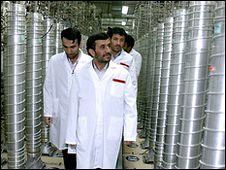
    UNITED NATIONS (Reuters) – Iran complained to the United Nations on Tuesday over what it called a U.S. threat to attack it with atomic weapons, accusing Washington of nuclear blackmail in violation of the U.N. charter.

    President Barack Obama made clear last week that Iran and North Korea, both involved in nuclear disputes with the West, were excluded from new limits on the use of U.S. atomic weapons.

    A letter from Iranian Ambassador Mohammad Khazaee to U.N. Secretary-General Ban Ki-moon and the Security Council and General Assembly presidents called on the United Nations to “strongly oppose the threat of use of nuclear weapons and to reject it.”

    Statements by Obama and other U.S. officials were “tantamount to nuclear blackmail against a non-nuclear-weapon state” and breached U.S. obligations under the U.N. charter to refrain from the threat or use of force, Khazaee said.

    “Such remarks by the U.S. officials display once again the reliance of the U.S. government on (a) militarized approach to various issues, to which the threats of use of nuclear weapons are not a solution at all,” he added.

    They also posed “a real threat to international peace and security and undermine the credibility” of the nuclear Non-Proliferation Treaty, the envoy said.

    Obama is urging other global powers to agree to a fourth round of U.N. sanctions against Iran over its refusal to halt nuclear work that the West suspects is aimed at making bombs, a charge Iran denies.

    He pressed the case for sanctions at a 47-nation nuclear summit in Washington on Tuesday, at which he won pledges from world leaders to take joint action to prevent terrorist groups from getting nuclear weapons.

    But Khazaee said that Iran, as a victim of weapons of mass destruction — a reference to Iraq’s use of poison gas against it in a 1980-88 war — was firmly committed to a world free from such weapons.

    The United States, the only country to have used nuclear weapons — against Japan in World War Two — “continues to illegitimately designate a non-nuclear weapon state as target of its nuclear weapons and contemplates military plans accordingly,” he said.

    U.N. members “should not condone or tolerate such nuclear blackmail in (the) 21st century,” the Iranian envoy said.

    (Editing by Vicki Allen)

  • Michelle Obama Makes Haiti Trip

    Michelle Obama makes Haiti trip

    The First Lady of the United States, Michelle Obama, has made an unannounced visit to Haiti.

    It was her first official trip overseas without US President Barack Obama since he took office last year.

    She spent several hours in the Haitian capital Port-au-Prince, visiting projects set up in the wake of the devastating earthquake in January.

    Mrs Obama then flew on to Mexico for a previously announced visit due to last three days.

    Mrs Obama flew over Port au Prince by helicopter, and was greeted by the Haitian president and his wife by the ruins of the presidential palace.

    She described the destruction she witnessed as “powerful”.

    Next stop was a school where the First Lady clapped along as the children sang and danced to greet her. “Let’s hold hands like good friends,” they sang.

    In one of the buses serving as a classroom, Mrs Obama sat at a small table and painted colourful pictures with the children.

    Mrs Obama then toured a partly ruined college. One woman looking on told me she hoped the visit would focus attention on the plight of Haitians.

    As the US winds down its military presence, Mrs Obama’s visit is meant to underscore the United States long-term commitment to helping the people of Haiti.

    The trip was kept a secret for security reasons.

    The White House said the aim of the visit was to “underscore to the Haitian people and the Haitian government the enduring US commitment to help Haiti recover and rebuild”.

    The BBC’s Laura Trevelyan, who is travelling with Mrs Obama, says US troops who have been helping with the aid effort are leaving and Haitians are wondering what comes next.

    President Obama has previously stated that America will be a reliable partner and will continue to help reconstruction efforts, even though US troops are leaving the area.

    About 230,000 people are believed to have died in the quake.

    More than a million people lost their homes and many are now living in makeshift camps.

    Thousands are being moved to higher ground as the forthcoming rainy season increases the risk of landslides.

    Story from BBC NEWS:
    http://news.bbc.co.uk/go/pr/fr/-/2/hi/in_depth/8618445.stm
    Published: 2010/04/14 01:38:11 GMT

  • Iran Sanctions Will Not Work, Says China

    Iran sanctions will not work: China

    xinhua

    BEIJING. — China said here yesterday sanctions and pressure cannot fundamentally resolve the Iran nuclear issue while reiterating its adherence to a dual-track strategy.

    “China upholds its consistent stance on the Iran nuclear issue. We support the international nuclear non-proliferation system, maintain the peace and stability in the Middle East, oppose Iran having nuclear weapons and support a dual-track strategy,” Foreign Ministry spokesperson Jiang Yu told a regular Press briefing Tuesday afternoon.

    “China has always believed that sanctions and pressure cannot fundamentally resolve the issue, and dialogue and negotiation are the best ways,” she noted. Jiang added the actions taken by the UN Security Council should help ease the situation, and help promote the relevant sides to properly resolve the Iran nuclear issue through dialogue and negotiation.

    In the on-going Nuclear Security Summit, China has called on various parties to continue to step up diplomatic efforts and to actively seek effective ways to resolve the issue through dialogue and negotiation. “China will always actively join in the diplomatic efforts of the international community to resolve this issue,” Jiang said. — Xinhua.

    She told the press China has and will continue to participate in relevant U.N. Security Council discussions and seek diplomatic ways to solve the nuclear issue.

  • United Kingdom Media’s Covert Racism Laid Bare

    UK media’s covert racism laid bare

    By Philip Dzumbunu
    Zimbabwe Herald

    ANYONE who lives in Britain would have been shocked by the way the murder of Eugene Terre’Blanche — the white supremacist and racist leader of Afrikaner Weerstandsbeweging (AWB) — was portrayed in that country’s media.

    It was almost unbelievable!

    Terre’Blanche was an undefiant, divisive person who never repented. After his release from prison for killing a black person, he quipped: ‘‘I was never wrong to honour my heritage and to love my people, and to be there when they called me!’’

    I hear the world’s media descended in droves on Ventersdorp ahead of Terre’Blanche’s funeral on Friday, with guest houses in the normally sleepy North West town inundated with bookings.

    ‘‘We have never experienced anything like this; we have had bookings from journalists in France, Spain, Germany,’’ said the owner of the Ruimte Guest House on the edge of Ventersdorp.

    ‘‘I am sending all my bookings to the other guest houses in town. It’s all journalists and they may have a problem because many of them can’t speak Afrikaans. They’ll need translators to help them get around Ventersdorp.’’

    Terre’Blanche, the evil, racist, far right Boer was beaten and hacked to death on his farm outside Ventersdorp two weeks back after a wage dispute, apparently. The status he was accorded was unbelievable and made a lot of people cringe.

    Sky News and BBC even substituted the return of golfer Tiger Woods and the election campaigns of Prime Minister Gordon Brown, David Cameron and Nick Clegg to televise the death of a man who advocated division in South Africa and the perpetuation of Apartheid.

    What was more interesting was that there was another story running concurrently with the burial of that racist Boer: the story of ANC Youth League president Julius Malema kicking out a British journalist, Jonah Fisher, out of the ANC headquarters for constant interruption as he gave his brief on a recent trip to Zimbabwe.

    The BBC almost crucified Malema for that incident, and remained quiet about Fisher’s uncouth and unbefitting conduct.

    Interestingly, the BBC reported that: ‘‘Terre’Blanche’s killing has unearthed racial tensions in the small town — tensions which are a rarely spoken fact of life in many South African rural farming communities.’’

    Where was the BBC over the last 10 or so years? It wasn’t Terre’Blanche’s killing, but his life, that encouraged ‘‘racial tensions’’ in South Africa.

    One commentator wrote: ‘‘The tone of BBC journalists in Africa has always been to undermine and patronise . . . If you follow the reports of Eugene Terre’Blanche on the BBC website, there is almost a sadness, a sense of regret from his death by the BBC. Suddenly the brute is sanitised and spoken of in almost reverent terms.’’

    British newspapers also warned of ‘‘an impending race war ahead of the 2010 Soccer World Cup’’, because of Terre’Blanche’s murder. Unbelievable!

    Do they think this man was so loved that his killing would almost spark a national crisis? What exactly do they think about South Africa that we do not know? We thought Zimbabwe was the worst country in their eyes.

    The British Daily Star newspaper, under the headline ‘‘World Cup machete threat’’, warned of ‘‘machete gangs roaming the streets’’ of South Africa after Terre’Blanche’s murder.

    The newspaper warned that a ‘‘civil war’’ could erupt and threaten South Africa’s hosting of the World Cup.

    Unfortunately calm returned to Ventersdorp despite the BBC and other media’s scaremongering.

    The racism of the media in Britain has gone unchallenged, unquestioned leaving many minorities without any faith in the media or any voice with which to counter the racial stereotypes it perpetuates.

    One need only glance at the daily British papers to read reports of Yardie drug gangs, fraudulent asylum seekers, foreign prostitute rings, and the perpetually negative portrayal of entire ethnic communities by the media.

    The UK Commission for Racial Equality chair Trevor Phillips talked about tackling the snowy peaks of industry. In the media, particularly the mainstream printed press, there are snowy lowlands with almost all-White newsrooms.

    These newsrooms have fostered a distorted and pernicious public perception of Africans and African countries, especially Zimbabwe.

    President Mugabe spent almost all of his political life called names by the BBC media. From day one, he was called a terrorist for fighting imperialism and colonialism.

    The history of Africans is a centuries old struggle against oppression and discrimination. The BBC and international media have played a key role in perpetuating the effects of this historical oppression and in contributing to Africans’ continuing status as second-class citizens on their own continent.

    As a result, many white people have suffered from a deep uncertainty as to who Africans really are. This has raised doubts, amongst many Africans, about the white man’s value system.

    Indeed, it has also aroused the troubling suspicion that whatever the ‘‘white media’’ reports on Africa is untrue.

    The social, political and economic factors of racism have become more than just a bias. They are also a profitable industry, in which the West will continue to suppress the developing world in order to maximise profits.

    One fact remains: international, especially British media is not as impartial as it claims to be. The world is still a ‘‘white, white world’’.

    Liberation, reactionary movements do not mix

    EDITOR. — The axiom, a friend in need is a friend indeed rings true for Zanu-PF and all other liberation movements around the world that have stood by the party from the days of liberation struggle to date.

    Relations that exist between Zanu-PF and these movements are unshakeable and cannot be broken even by the imperialists who are working day and night to divide us so that they can exploit that division to their advantage.

    Liberation movements that fought and defeated colonialism lead all governments in Sadc, with the exception of a few.

    There is no way these comrades-in-arms can today turn against each other to please the erstwhile coloniser.

    Today liberation movements are under pressure from the West to “reform” — which is Western language for ‘‘forget your history”.

    Cuba has been under illegal US economic sanctions for 50 years for refusing to ‘‘reform’’ and Zimbabwe today is also under a sanctions regime designed to pressure it to depose Zanu-PF.

    The recent visit by ANC Youth League president Cde Julius Malema reaffirms our strong relations as liberation movements.

    Malema came here as a true friend and representative of the ANC.

    He came here as a guest of the liberation movement that helped free his country.

    The noise MDC-T has been making simply because Malema did not include their party on his itinerary is absurd.

    What do they have in common with the ANC that would see Malema visit Harvest House?

    MDC-T’s friends are in the so-called Democratic Alliance for the simple reason that MDC-T represents the interests of the very people who are fighting the ANC and Zanu PF.

    They are trying to force some friendship with the ANC the same way they are trying to force the Chinese Communist Party to be their friends.

    Reactionary movements and liberation parties do not mix, they are like oil and water.

    The joke in town is that MDC-T is so ahistorical that it has sent a message of condolence to the AWB movement in South Africa over the death of the racist Eugene Terre’Blanche who was fighting against black majority rule till his dying day.

    Those are the characters that can come calling at Harvest House not Cde Malema.

    Campion wekwaMereki.

    Harare.

  • Zimbabwe’s New Farmers Defend Their Gains

    Zimbabwe’s new farmers defend their gains

    Under President Robert Mugabe’s land reform programme, some 4,000 white farmers have been driven away and their land given to black farmers. The BBC’s Dan Isaacs talks to Zimbabwe’s new farming class.

    Endy Mhlanga, a war veteran of Zimbabwe’s war of independence, sits with me in the garage of his recently acquired farmhouse.

    A pot of maize meal bubbles on an open fire beside us.

    It is getting dark, but there is no electricity. Power cuts – often lasting days – are a regular feature of life here. And the mosquitoes are descending.

    “As war veterans we are satisfied that the programme of land reform has succeeded,” Mr Mhlanga tells me.

    “It might not be 100%, but now the land is with the people of Zimbabwe.”

    Mr Mhlanga’s farm is on prime agricultural land, but now most of it is lying fallow.

    What was once a large commercial farm now produces nothing for export, and where once there were intensively irrigated fields of wheat and tobacco, rough grassland now stretches into the distance.

    One small field of maize is growing near the farmhouse, a few turkeys cluck their way around an old tennis court, and a dozen or so cattle graze at the bottom of the garden.

    “We have the ability to work on the land,” explains Mr Mhlanga, “but we’re prevented from doing so because of a lack of funding.

    “Investors aren’t forthcoming, so we aren’t able to do much with the land. For us, this is really a silent war.” A decade ago, there were more than 4,000 white-owned farms in Zimbabwe.

    But years of President Mugabe’s land reform programmes have forced these farmers out, markedly changing the Zimbabwean farming scene and jarring the agriculture-based economy.

    Today, there are just a few dozen left, and many of those have now been served with eviction orders.

    As a former secretary-general of the country’s pro-Mugabe war veterans association, Mr Mhlanga was actively involved in those evictions, and now recalls the violent tactics used to force the white farmers to leave.

    “I don’t have any regrets,” he tells me. “Had they agreed to share nicely, none of these troubles would have happened.”

    The collapse in agricultural output across the country has had catastrophic consequences for Zimbabwe’s economy.

    Some four million people have fled the country over the past decade, and although economic conditions have improved recently, the overwhelming majority of those who stayed no longer have formal employment.

    Rose garden

    Johannes Vengesai lost his job when the farm he was working on was occupied by the “war veterans”.

    He was thrown out of his home as well, and he now lives with his family in a disused tobacco silo.

    It is a squatters’ life – he has been threatened with eviction from here too but says he has got nowhere else to go.

    “What bleeds my heart,” says Joseph, a farmer who was evicted from an adjacent citrus farm, “is that if we leave the land lying idle like this, we’re not growing any future for ourselves.” As we look out over thousands of untended citrus trees he explains that all they produce now are shrivelled, bitter lemons.

    “As a country we are losing millions of dollars, and as ordinary Zimbabweans we can no longer afford to send our children to school.”

    But it is a very different country for those who have directly benefited from the land reform.

    At the farmhouse now owned by Stan and Jane Kasakwere, lunch has been set out in the garden under a spreading jacaranda tree. The well-tended lawn sweeps down to a rose garden and swimming pool. Beyond the fence, their land stretches as far as the eye can see.

    Mr and Mrs Kasakwere are supporters of President Mugabe’s Zanu-PF party, and they have been allocated this previously white-owned farm on rich agricultural land.

    It is not long before the lunch talk turns to politics.

    “This is my country, the land is my birthright,” Mrs Kasakwere tells me.

    “I feel sorry for the previous white owners of this farm, but I don’t feel guilty. It’s a tough world.”

    “What Mugabe has done is break the ice,” says Mr Kasakwere.

    “He’s the first African leader to stand up publicly and criticise our former colonial masters. Mugabe is one hell of an African leader.”

    ‘Revolution’

    A minority of well-connected Zimbabweans have benefited from the reforms, but the overwhelming majority are far poorer than they were a decade ago.

    And because of the violent and politicised way it has been carried out, support for President Mugabe has fallen sharply.

    But to challenge the reform process is to be seen as both a colonial puppet and against black empowerment.

    So, despite his lack of popularity, Mr Mugabe’s political opponents have so far found it impossible to defeat him.

    This is why for the time being – and after long and slow deliberation – they have entered into an alliance with Mr Mugabe’s Zanu-PF party.

    It is this unity government that has brought about a degree of economic stability, and a reduction in political violence.

    But the farm invasions have continued to this day, and no political group within this fragile coalition has called for them to be stopped, let alone reversed.

    Back in Harare, it was not hard to track down the owner of one of the abandoned citrus plantations I had visited.

    “You’ve got to understand, that we’ve been through a revolution,” explains Bright Matonga, a former government minister, and currently a Zanu-PF member of parliament.

    “Things have calmed down now, and soon production will pick up.”

    When I asked him about his forlorn citrus tree plantations and the destitute workers living nearby, he blamed a lack of credit available from banks and the “sanctions” being imposed on Zimbabwe.

    “I think, rather than to criticise the land reform process,” he argued, “you have to understand that it had to take place and that it is now irreversible.”

    Story from BBC NEWS:
    http://news.bbc.co.uk/go/pr/fr/-/2/hi/africa/8617684.stm
    Published: 2010/04/13 22:59:44 GMT

  • The Second Assassination of Imam Luqman Ameen Abdullah

    The Second Assassination of Imam Luqman Ameen Abdullah

    Community anger grows over assassination while corporate media attempts to slander martyred Muslim leader

    By Abayomi Azikiwe
    Editor, Pan-African News Wire

    On March 27 a community meeting was held to announce the launching of an independent investigation into the assassination of Detroit Imam Luqman Ameen Abdullah. The event was held at the Historic New Bethel Baptist Church on the city’s west side, just several blocks east of the location of the Masjid al-Haqq where Imam Abdullah served as leader for over two decades.

    Imam Abdullah was shot 20 times by FBI agents on October 28, 2009 during a series of raids carried out by a multi-jurisdictional law enforcement task force that consisted also of police from Dearborn and Detroit. The Masjid al-Haqq had been infiltrated by the FBI for over two years where informants sought unsuccessfully to encourage illegal activities among the members.

    Abdullah and several of his members were lured to a warehouse in neighboring Dearborn under the guise of assisting in the unloading of merchandise. When they arrived the FBI sent in a dog that attacked the imam who was later killed in a hail of bullets.

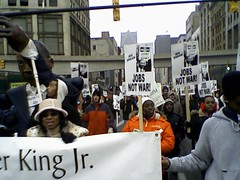
    The rally on March 27 was attended by several hundred local activists and religious leaders from both the Muslim and Christian communities. This event was co-sponsored by the Council on American-Islamic Relations of Michigan (CAIR) and the Detroit Coalition Against Police Brutality (DCAPB), with endorsements from the Michigan Emergency Committee Against War & Injustice (MECAWI) and the Moratorium NOW! Coalition to Stop Foreclosures, Evictions and Utility Shut-offs.

    Ron Scott, spokesperson for the DCAPB chaired the meeting and presentations were made by the Nation of Islam, Delta Sigma Theta Sorority, the Detroit Chapter of the NAACP, CAIR, Congressman John Conyers and MECAWI. Appeals were made for the defense fund to cover legal costs in the cases of 10 others members of the Masjid al-Haqq who are still facing felony charges stemming from the raids of October 28.

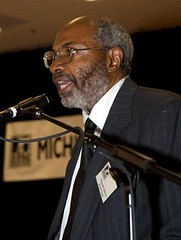
    Imam Dawud Walid, the executive director of CAIR in Michigan, spoke on the problems associated with having the evidence gathered by law enforcement released to the Abdullah family and the general public. The Wayne County Medical Examiner’s report on Imam Abdullah was not issued until February 1 at the request of Dearborn Police Chief Ronald Haddad.

    Imam Walid addressed the efforts to have the 75 autopsy photographs released by the medical examiner which were also held up at the behest of the Dearborn Police. A request for a review of the assassination by the Justice Department has gone unanswered by the United States Attorney General Eric Holder.

    A number of local and national organizations have demanded a Justice Department review of the actions by the FBI including the use of informants in religious organizations. Detroit Congressman John Conyers, the Chair of the House Judiciary Committee, wrote a letter in February to Eric Holder requesting such an investigation.

    Corporate Media Slander on Eve of Release of Photographs

    The much anticipated release of the autopsy and crime scene photographs took place on April 8. There were five photos made public by CAIR that illustrated the brutal nature of the assassination.

    However, just one day prior to the release of the photos, the Detroit News published a front page story that attempted to undermine the growing community support for the Masjid al-Haqq members and the family of Imam Abdullah. The article claimed that in 1980, a 22-year-old Abdullah attempted to grab the revolver of a Livonia police officer during a routine traffic stop. (Detroit News, April 7)

    This April 7 article claims that, “Christopher Thomas, who later became Imam Luqman Ameen Abdullah, struggled with the officer for control of the gun, according to a report prepared soon after the Dec. 5, 1980 arrest by Livonia Police Officer Robert Stevenson, now the city’s police chief. Only after a second officer arrived was Abdullah disarmed, reports show.”

    The article continues saying “The Livonia police reports detail the incident that led to Abdullah’s 1981 conviction for felonious assault on a police officer, for which he served 26 days in jail. They provide another view of the man some supporters have described as a peaceful observer of Islam but a criminal complaint describes as a radical separatist intent on killing police officers.”

    However, it is unlikely that an African-American youth accused and convicted of felonious assault against a suburban Detroit police officer in 1980 would have only served 26 days in jail. Atty. Nabih Ayad, a Canton Township lawyer who is representing the Abdullah family was quoted in the same article as saying that this incident, which is three decades old, has no real bearing on the death of Imam Abdullah.

    Ayad said that the incident was “extremely far-fetched and without any credibility to somehow make a relation between that incident” and what transpired on October 28 when the imam died from multiple gunshot wounds in Dearborn.

    One of the photographs released by CAIR shows the imam handcuffed, lying face down and riddled with bullets. This photograph was published by the local newspapers, however, other more graphic pictures were not printed in the corporate press.

    At a community meeting held by the Detroit Coalition Against Police Brutality on April 11 at the St. Peter’s Episcopal Church downtown, Imam Walid of CAIR presented two other photographs that show deep lacerations to the face of Abdullah from the apparent dog bites.

    The Detroit Free Press stated in an editorial on April 8 that “Efforts to manage community sentiments by withholding information always fail—and often backfire. With many lingering questions about how Abdullah died, Abdullah has become a national and even international figure—and in some circles, a martyr. Meanwhile, law enforcement agencies have lost credibility with many of the Muslim-American groups they are trying to build relationships with in the post 9/11 era.” (Detroit Free Press, April 8)

    CAIR executive director Dawud Walid was quoted in the same Free Press editorial saying “This isn’t going to go away until there are answers.” Numerous organizations have issued letters and passed resolutions decrying the assassination and demanding justice in the case.

    These groups include the NAACP, the Democratic Party 14th District Caucus, MECAWI, the Detroit Board of Police Commissioners, the Congress of Arab-American Organizations, the Michigan Coalition for Human Rights, among others.

    In an interview with the son of Imam Abdullah, Mujahid Carswell, a well-known hip-hop artist, who is also a defendant in the Detroit 10 case, told this writer that the claims made against his father in regard to the purported incident in Livonia in 1980 were unlikely. Mujahid, who is known in the recording world as “Mu”, said that the authorities are attempting to take attention away from the gross injustice done to his father, his family and his followers.

    Both Mujahid and Abdullah’s other son, Omar Regan, who is also a well-known stage and television performer in California, have expressed their appreciation for the work of MECAWI in organizing three demonstrations. The first in response to the assassination, the second during the appearance of Attorney General Holder in Detroit last November and the third after the delayed release of the autopsy report on February 1.

  • Acting President Jonathan Meets Obama to Discuss Oil and Security

    Acting President Jonathan Meets Obama to Discuss Oil and Security

    By Abayomi Azikiwe
    Editor, Pan-African News Wire
    News Analysis

    Acting Nigerian President Goodluck Jonathan met with President Barack Obama on April 11 at the White House as a prelude to the Nuclear Security Summit held in Washington, D.C. Jonathan was appointed by the Nigerian Senate to take over in the absence of President Umaru Yar’Adua, who has been seriously ill for several months.

    The new head of state’s visit comes amid a pivotal point in the country’s history and its relations with the United States. Nigeria still claims to be the leading exporter of crude oil to the U.S. from the African continent, although reports last year indicated that the Southern African nation of Angola had surpassed the West African state in total barrels traded.

    ThisDay newspaper published in Nigeria said that the discussions between Jonathan and Obama centered around efforts to stabilize the political situation in the oil producing region of the Niger Delta and the legislative plans underway to restructure the oil industry inside the country. (ThisDay, April 12)

    ThisDay newspaper noted that “The US is Nigeria’s biggest customer in the international crude oil market and much of its energy security is directly affected by militant activities in the Niger Delta.” In regard to the plans to reshape the oil industry the same article continues that “Multinational oil companies have expressed worries over the revised fiscal regimes which they claim are unfavorable to their operations.”

    The debate surrounding the Petroleum Industry Bill (PIB) has been described as the most extensive overhaul of the petroleum sector since national independence from Britain in 1960. Nigeria’s oil industry has been dominated since 1956 by British, U.S. and European firms who contribute virtually nothing to the development of the country.

    In a April 7 Financial Times article it states that in this debate over the future of oil in Nigeria, Africa’s most populous state, the character of relations with the U.S. will be determined. “The Financial Times says that “At stake are tens of billions of dollars of potential investments, and reforms that could breathe new life into an industry that provides 80 percent of the government’s income and one in eight barrels of crude that the US imports.” (Financial Times, April 7)

    After the ascendancy of Acting President Jonathan, a new cabinet was appointed where some of the ministers under Yar’Adua were reappointed to different portfolios. Diezani Allison-Madueke was reshuffled to the oil ministry where she will be responsible for handling the PIB.

    The Financial Times quotes Osten Olorunsola, Shell’s regional vice-president for gas, in the same above-mentioned article saying that “The PIB is definitely unlikely to pass [through the national assembly] in its current form before the elections (2011). Not passing anything would magnify the overall level of uncertainty.”

    Oil minister Allison-Madueke is a former employee of Royal Dutch Shell where she spent 14 years and rose to become its director of external relations. The Financial Times says that “Some industry groups are said to have lobbied for her appointment, reasoning that her background would make her sympathetic to oil companies’ claims that the bill’s tougher terms would jeopardize $50bn of planned investment.”

    Prior to the visit of Jonathan to the U.S., the two countries signed a Bi-national Commission Agreement, the first of its kind with Africa under the Obama administration. The two states have extensive economic relations in the oil industry.

    In a French Press Agency report it states that “The State Department said bilateral US-Nigerian trade was valued at more than $42 billion dollars in 2008. Nigeria is the United States’largest trading partner in sub-Saharan Africa, thanks in large part to its petroleum industry.

    “Nigerian oil comprises eight percent of US imports, while about half of the oil produced in Nigeria goes to the United States. The United States also is the largest foreign investor in Nigeria, including in the offshore oil and gas industries by Exxon-Mobil and Chevron.” (AFP, April 5)

    Nigeria and U.S. Security Concerns

    Another major item on the agenda during the meeting between Obama and Jonathan was the question of the U.S.’s so-called war on terrorism. Nigeria has been targeted recently because of an incident involving a 23-year-old passenger aboard an airline flight traveling from Amsterdam to Detroit on December 25.

    Umar Farouk Abdulmuttalab was arrested aboard the flight and charged with attempting to ignite explosives on his person. The corporate media reported that Abdulmuttalab had links with al-Qaeda and had traveled to Yemen for meetings and training in explosives.

    Yet Abdulmuttalab’s father had warned the U.S. embassy in Nigeria in regard to concerns involving his son’s behavior. Nonetheless, the former Nigerian student who studied in England, did not have his multiple-entry visa revoked.

    Umaru Abdul-Muttalab, the father of Umar Farouk, is a well-known banker and former high-ranking Nigerian governmental official. According to Nigeria ThisDay, Jonathan met with Umaru Abdul-Muttalab prior to his departure for the United States.

    “Muttalab was believed to have discussed his earlier trip to the U.S. with Jonathan. During that trip, he met with American security officials regarding his son’s failed terror attack and for which the young man is being prosecuted.” (ThisDay, April 9)

    In response to the December 25 incident in Detroit, Nigeria along with numerous other states around the world were targeted by the U.S. for special scrutiny at airports inside the country and those bound for it. There has been strong objections against the listing of Nigerians as possible security threats to the U.S.

    Behind the Nuclear Security Summit

    The meeting held by the Obama administration and representatives of 47 nations is taking place in the aftermath of the signing of a new agreement with Russia. During the signing, Obama made special mention of both Iran and the Democratic People’s Republic of Korea as states posing possible threats to international security resulting from their nuclear programs.

    Iran has maintained that its nuclear programs are strictly for civilian purposes. The DPRK is reported to have developed a limited nuclear weapons capability and has also tested missiles that have drawn protest from the United States and the United Nations Security Council.

    However, the State of Israel, which has been reported to possess nuclear weapons capability, has not been questioned or pressured by the U.S. and other imperialist states about its military intentions. The Prime Minister of Israel Benjamin Netanyahu announced that he would not attend the Nuclear Security Summit due to the intentions of Egypt and Turkey to question the Zionist state over its reported possession of a nuclear arsenal.

    The summit represents another effort on the part of the United States to dictate the terms of nuclear weapons capability. Those states that are allied with the U.S., such as Pakistan and India, are allowed to possess nuclear weapons, whereas nations that take a political line independent of imperialism, are threatened with sanctions and military actions.

  • Small-City Mayor Takes on the Pentagon–War Spending Should Be Spent on Americans, Not on Killing Afghans

    Small-City Mayor Takes on the Pentagon — War Spending Should Be Spent on Americans, Not on Killing Afghans

    By Jo Comerford, Tomdispatch.com
    April 12, 2010
    http://www.alternet.org/story/146408/

    Matt Ryan, the mayor of Binghamton, New York, is sick and tired of watching people in local communities “squabble over crumbs,” as he puts it, while so much local money pours into the Pentagon’s coffers and into America’s wars. He’s so sick and tired of it, in fact, that, urged on by local residents, he’s decided to do something about it. He’s planning to be the first mayor in the United States to decorate the façade of City Hall with a large, digital “cost of war” counter, funded entirely by private contributions.

    That counter will offer a constantly changing estimate of the total price Binghamton’s taxpayers have been paying for our wars in Iraq and Afghanistan since October 2001. By September 30, 2010, the city’s “war tax” will reach $138.6 million — or even more if, as expected, Congress passes an Obama administration request for supplemental funds to cover the president’s “surge” in Afghanistan. Mayor Ryan wants, he says, to put the counter “where everyone can see it, so that my constituents are urged to have a much-needed conversation.”

    In doing so, he’s joining a growing chorus of mayors, including Chicago’s Richard Daley and Boston’s Thomas Menino, who are ever more insistently drawing attention to what Ryan calls the country’s “skewed national priorities,” especially the local impact of military and war spending. With more than three years left in his current term, Ryan has decided to pull out all the stops to reach his neighbors and constituents, all 47,000 of them, especially the near quarter of the city’s inhabitants who currently live below the poverty line and the 9% who are officially unemployed.

    A Hard Hit Rust-Belt City

    Like so many post-industrial rust-belt communities, Binghamton was hard hit by the financial meltdown of 2008 and the Great Recession that followed, though it faired better than a number of similar cities, in part because Ryan, his administration, and the Binghamton City Council are a smart and scrappy crew. No doubt that’s why he earned the New York State Conference of Mayors Public Administration and Management award two years running.

    These days, however, even the smartest and scrappiest of mayors still has to face grim reality. In July 2009, as the city began developing the 2010 budget, Ryan projected a $7 million shortfall. Contributing factors included a likely $700,000 decline in sales tax revenue, ever rising healthcare costs, increased pension contributions to replace funds lost in the market during the collapse of 2008-09, and a $500,000 drop in the return on the city’s investment portfolio.

    With worse times ahead, thanks in part to the projected end of federal stimulus money and a city drained dry of reserves, Ryan has had to face a classically unpalatable choice: raise city sales taxes from 7% to an unheard of 24% or cut city jobs. He chose jobs, as have the vast majority of mayors and governors across the country, eliminating 39 of them. In the process, he sought greater program efficiencies and wrestled with ways to increase city revenues while cutting ever closer to Binghamton’s proverbial bone.

    It was in the context of this kind of local pain that Ryan was stunned to discover just how much of Binghamton’s taxes were going to the military and to our distant wars, and how little was coming back to Binghamton in the form of aid and services. “When I first saw the cost of war numbers and made the connections,” Ryan remarks, “I had to wonder if we’re ever going to get our priorities straight as a nation. It’s like we’re facing an attack on government. As a mayor, I can see so clearly what increased federal spending could do for the people of my city.”

    Ryan’s message doesn’t resonate with all of his constituents — some have walked out on his public appearances — but he’s used to controversy and convinced that Americans had better get their heads straight soon. “People are hurting so bad,” he insists, “that, like it or not, we’re all going to have to look at things seriously if we want our situation to change.”

    Heads should swivel, he thinks, when faced with the $138.6 million Binghamton’s taxpayers are out of pocket since 2001 for the Iraq and Afghan wars. And that’s not even counting the city’s share of the supplemental funds Congress will undoubtedly agree to this spring to cover the Afghan “surge” or the city’s portion of the basic Pentagon budget for the same period.

    For a small city with an annual budget of $81.1 million, $138.6 million would be a hefty sum, even in non-recessionary times. For the same amount of money, Ryan could fund the Binghamton city library for the next 60 years, or pay for a four-year education for 95% of the incoming freshman class at the State University of New York at Binghamton, or offer four years of quality health coverage for everyone in Binghamton 19 or younger, or secure renewable electricity for every home in the city for the next 11 years. If he was feeling really flush, he could fully fund one-third of New York State’s Head Start slots for one year.

    For the same sum, Ryan could also authorize a $2,900 tax refund for every woman, man, and child in Binghamton or pay the salaries of all of Binghamton’s hard-hit public school teachers and staff for about two years.

    For $138.6 million, Mayor Ryan could hire 2,765 public safety officers for a year, or simply refund the 12 police positions cut in the latest budget contraction and guarantee those salaries for the next 230 years. Ridiculous? These days, no one is laughing in Binghamton or other cities like it.

    A Community Starved by War

    As tax day looms on April 15th, Ryan increasingly thinks about where Binghamton’s tax dollars will be heading and dreams about a government system that would have the potential to raise and spend tax revenue in the service of social benefits like affordable healthcare.

    He’s disturbed by how Binghamton’s tax dollars will be distributed and what they will — and won’t — buy for his city. Consider, for instance, where the 2009 taxes paid by a median income Binghamton household actually went. That year, such a household’s income hovered around $30,000 annually, while its members paid approximately $738 in federal income taxes.

    According to the tax-day analysis of the National Priorities Project (NPP), an overwhelming 218 of those dollars went to pay for military expenditures and interest on military-related debt (generated, in part, by current war spending). The next highest amount — $137 — went to healthcare, including Medicare, Medicaid, and the Children’s Health Insurance Program.

    In 2009, $67, nearly 10 cents on every tax dollar, went to an aggregated category of spending NPP has titled “government,” tripling it in a single year, largely thanks to the Troubled Asset Relief Program (TARP), otherwise known as the bank bailout, whose cost every community in America has had to shoulder. Fifty-eight dollars (8.5 cents on every income-tax dollar) went to increased unemployment insurance payments and job-training initiatives, also a rise from the previous year.

    Not surprisingly, the $15 that went to elementary, secondary, higher, and vocational education in 2009 represented a drop from 2008, a loss of a penny on every tax dollar. There’s no way, of course, that Mayor Ryan’s dream of free, quality education from kindergarten to college is likely to happen on but 2% of every individual federal income tax dollar. Nor will we usher in the green techno-revolution that he and President Obama both support, by spending 2.5 cents on every dollar for the combined categories of the environment, energy, and science, and another 1.3 cents of every dollar on transportation.

    “It’s a double whammy,” Ryan says. “We have a revenue problem and a values and priorities problem in this nation.”

    Some desperate city leaders have suggested that the Mayor cut workers’ pensions to help close the city’s budget gap. Matt Ryan doesn’t see that as a solution to anything. “I have secretaries making $25,000 or $30,000. I’m not about to cut their net, such as it is. We have to think long haul. We have to look at fundamental changes if we’re going to make it as a country. We should all be talking about this — all the time.”

    A construction crew will soon arrive to install Binghamton’s “cost of war” counter which will overlook the city’s busiest intersection and spur conversation around tax day. During the three minutes local motorists wait at the nearby traffic light, they can join Mayor Ryan in waving good-bye to $100. And Binghamton as a whole can grapple with spending $49,650 in war costs every day of 2010.

    Jo Comerford is the executive director of the National Priorities Project. Previously, she served as director of programs at the Food Bank of Western Massachusetts and directed the American Friends Service Committee’s justice and peace-related community organizing efforts in western Massachusetts.

  • Somali Resistance Forces Ban BBC Output

    Somali Islamists ban BBC output

    By Peter Greste
    East Africa correspondent, BBC News

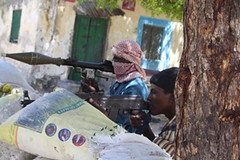
    The Somali Islamist movement al-Shabab has banned the BBC and closed down transmitters broadcasting the Somali language service inside the country.

    Al-Shabab accused the BBC of fighting against Islam and supporting the transitional federal government, which the rebels are fighting to overthrow.

    The group said the BBC had been broadcasting the agenda of crusaders and colonialists against Muslims.

    The BBC said it was strictly impartial and spoke to all sides in the conflict.

    The BBC has been broadcasting its services in Somali, Arabic and English across the country on a series of FM frequencies for at least a decade, and surveys suggest it is one of the most widely listened-to news services in Somalia.

    ‘Strict standards’

    Al-Shabab ordered all of the BBC’s transmitters to be shut down.

    A statement by al-Shabab demanded that any organisation transmitting the BBC, or the Washington-based Voice of America, should cancel their contracts.

    Al-Shabab and its allies control most of southern and central Somalia and all but a few districts of the capital, Mogadishu.

    They have been fighting to establish an Islamist administration of their own in place of the current government.

    The BBC’s broadcasts have been taken off the FM bandwidth, but are still available on shortwave and the internet.

    In response to the statement, the head of BBC Africa, Jerry Timmins, said the organisation spoke to all sides in the conflict, including al-Shabab, adhered to strict standards of impartiality and editorial independence and rejected any suggestion otherwise.

    Story from BBC NEWS:
    http://news.bbc.co.uk/go/pr/fr/-/2/hi/africa/8612654.stm
    Published: 2010/04/09 21:36:05 GMT

  • Somalia Fighting Leaves 19 Dead

    Somalia fighting leaves 19 dead

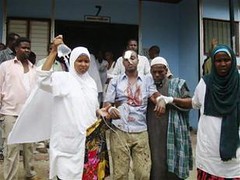
    At least 19 people, many of them civilians, have been killed in an outburst of fighting in the divided Somali capital Mogadishu.

    Thirteen people died when African Union peacekeepers and government forces hit back after a militant attack on a military ceremony.

    Reports say the AU forces used heavy artillery in densely populated areas in what was the worst shelling in months.

    Another six people were killed by roadside bombs near Mogadishu airport.

    “It was indiscriminate shelling,” Ali Muse, head of Mogadishu’s ambulance services, told AFP news agency.

    “Our teams collected the bodies of 16 civilians, while 55 others were injured in the shelling. Several children are among the dead.”

    The shelling started in the afternoon when Islamist fighters fired mortars at the presidential palace and airport during a ceremony commemorating the 50th anniversary of the country’s national army.

    Government troops backed by the AU reportedly responded with heavy artillery fire.

    At the airport, a blast hit a military vehicle, killing two soldiers, said eyewitness Haji Dahir Igale.

    “Afterward local residents and some other government officials rushed to the scene to help the injured and as they gathered the second explosion went off, killing four civilians.”

    Somalia has not had a functioning government in decades and the Islamist rebels control large parts of its territory.

    Story from BBC NEWS:
    http://news.bbc.co.uk/go/pr/fr/-/2/hi/africa/8616861.stm
    Published: 2010/04/13 03:16:32 GMT

  • Sudan Extends National Elections for Two Days

    Sudan extends voting for two days after delays

    KHARTOUM, SUDAN Apr 12 2010 17:49

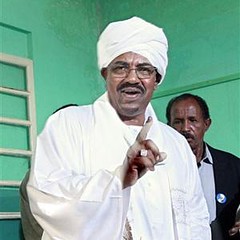
    Sudan’s elections commission on Monday announced a two-day extension to voting until April 16, after many voters experienced delays across Africa’s largest country in the first open elections in 24 years.

    “There is a two-day extension throughout the whole country,” Sudan’s National Elections Commission secretary general Jalal Mohamed Ahmed told Reuters.

    “It is to give more time to the voters,” he added.

    South Sudan’s main party on Sunday asked for a four-day extension in the south, where a mostly illiterate population was grappling with 12 ballot papers and where decades of civil war had devastated infrastructure.

    The complex presidential, legislative and gubernatorial polls, which began on Sunday, are aimed at transforming Sudan from a nation emerging from decades of multiple civil wars to a democracy.

    After a boycott by the main opposition in the north, the vote now looks likely to confirm the 21-year rule of President Omar al-Bashir — the only sitting head of state wanted for war crimes by the International Criminal Court, which alleges he was behind mass murder and rape in Darfur.

    Across the country — even in the capital, Khartoum — voting materials were not delivered to stations, the wrong ballots arrived at many centres and opposition and independent candidates said their names or symbols were either missing or incorrect.

    Many had complained and asked for an extension to the voting to compensate for the delays and resolve the problems. — Reuters

    Source: Mail & Guardian Online
    Web Address: http://www.mg.co.za/article/2010-04-12-sudan-extends-voting-for-two-days-after-delays

  • ANC, COSATU Resume Talks in South Africa

    ANC, Cosatu resume talks

    JOHANNESBURG, SOUTH AFRICA Apr 12 2010 14:54

    The African National Congress (ANC) and its alliance partner, the Congress of South African Trade Unions (Cosatu), resumed bilateral talks on Monday after they were put on hold last week.

    ANC spokesperson Ishmael Mnisi said talks were suspended on Friday after both organisations agreed to do so.

    He denied reports that some top ANC members had snubbed the meeting — with Cosatu sending a delegation of about 30 members and the ANC represented by only five, including secretary general Gwede Mantashe.

    The Sunday Independent reported that Cosatu was upset by this because it felt it was not being taken seriously.

    “There is no such thing,” Mnisi said. “The ANC always wanted to meet with Cosatu … to discuss relations and pursue the programme of action outlined by our election manifesto.”

    The ANC leadership called for an end to public spats in the alliance with the trade union federation and the South African Communist Party after verbal sparring between Cosatu secretary general Zwelinzima Vavi and the ANC.

    ‘Crass materialism’

    Last month Vavi cautioned there were plans to oust ANC president Jacob Zuma and Mantashe before their terms ended in 2012. He sounded a warning over what he termed “crass materialism” and “tender entrepreneurs”, which endangered the ruling party.

    He repeated calls for lifestyle audits of public figures, including politicians not in government. This irked the ANC, which felt its members should not be targeted.

    Vavi charged that materialists and tender entrepreneurs were behind a “small right-wing tendency” in the ANC which, although not supported by most of its leaders, appeared to be silencing them.

    It had been reported that ANC Youth League president Julius Malema held directorships in companies that had benefited from state tenders.

    Cosatu was also frustrated at Zuma’s State of the Nation address, Finance Minister Pravin Gordhan’s budget speech and the approval of Eskom tariff increases.

    The ANC in turn accused Vavi of “grandstanding” and said it felt Cosatu was “veering toward oppositional politics”.

    The ANC’s leadership then met and called for an end to public disputes, the trading of insults and personal attacks.

    An alliance summit scheduled to take place at the beginning of April was postponed for the bilateral talks between the ANC and Cosatu. — Sapa

    Source: Mail & Guardian Online
    Web Address: http://www.mg.co.za/article/2010-04-12-anc-cosatu-resume-talks

  • Response to the NYT Editorial on Southern Comfort and the Confederate Heritage

    Response to the New York Times Editorial on Southern Comfort and the Confederate Heritage

    Dear Mr. Azikiwe:

    I research the neo-Confederate movement. I am a co-editor of
    “Neo-Confederacy: A Critical Introduction,” University of Texas Press, 2008. http://www.utexas.edu/utpress/excerpts/exhagneo.html

    The “New York Times” article you have on your blog actually has a sly
    defense of Confederate “heritage.”

    I note this paragraph in the “Times” article.

    “But after the Supreme Court allowed segregation in Plessy v. Ferguson in 1896, Jim Crow was basically secure. There was less need to rally the troops, and Confederate imagery became associated with the most extreme of the extreme: the Ku Klux Klan.”

    This paragraph is a total falsehood. The Confederate groups promoted white supremacy in the “Confederate Veteran,” the official publication of the United Confederate Veterans, Sons of Confederate Veterans, United Daughters of the Confederacy, and the Confederate Southern Memorial Association. Not only did they promote white supremacy, they also praised the Ku Klux Klan of Reconstruction, and allowed the early 20th century KKK to march in one of their annual reunion parades.

    Confederate imagery was used to promote white supremacy through out the Nadir.

    Confederate “heritage” has always been about white supremacy from the end of the Civil War into the 21st century.

    I am not surprised when the mainstream press to give neo-Confederacy a free pass, but it is disappointing when the African American press, particularly those who pose as critical challengers of the existing system, uncritically accept a free pass for neo-Confederacy.

    Regards,
    Edward H. Sebesta
    Dallas, TX
    http://newtknight.blogspot.com/

    Introduction: Neo-Confederacy and the New Dixie Manifesto (Euan Hague, Edward H. Sebesta, and Heidi Beirich)

    Neo-Confederacy

    Contemporary neo-Confederacy made its first mainstream appearance on 29 October 1995 when the Washington Post published the “New Dixie Manifesto.” The authors were Thomas Fleming and Michael Hill, two of twenty-seven people who had founded a new nationalist organization, the Southern League (later renamed League of the South), on 25 June 1994 in Tuscaloosa, Alabama.

    Identified by the Southern Poverty Law Center’s (SPLC) Mark Potok as the “ideological core” of neo-Confederacy, the League of the South (LS) advocates secession from the United States and the establishment of an independent Confederation of Southern States (CSS). The CSS would contain fifteen states—four states more than seceded to form the Confederate States of America (CSA), which led to the Civil War (1861-65), the additional states being Oklahoma, Missouri, Kentucky, and Maryland.

    The New Dixie Manifesto was a clarion call to arms in which Hill and Fleming described themselves as representing “a new group of Southerners . . . calling for nothing more revolutionary than home rule for the states established by the U.S. Constitution.”

    Comparing “American Southerners” to, amongst others, Scots and Ukrainians, the manifesto charged that the United States had treated “American Southerners” with “exploitation and contempt,” and that a “renewed South” was both necessary and achievable.

    Among its specific points, the manifesto espoused the following:

    -home rule for “Southerners”
    -states’ rights and devolved political power
    -local control over schooling, in opposition to federal desegregation decrees
    -removal of federal funding and initiatives from Southern states
    -a Christian tradition in opposition to modernity
    -support for Confederate symbols

    In addition, the manifesto expressed the following views:

    -that “Southerners” are maligned as “racist” and “anti-immigrant” by hypocritical, prejudicial Northerners
    -that the South should be left alone on the issues of race
    -that race relations are better in Southern states than in Northern ones
    -that the United States is a “multicultural, continental empire” run by elites in Washington, Wall Street, Hollywood, and the Ivy League.

    The New Dixie Manifesto proclaimed that education policies, historical interpretations, federal programs, and opposition to Confederate iconography together constitute efforts to “rob” “Southerners” of their very existence, an active project of discrimination resulting in “cultural genocide.”

    Letters critical of the manifesto soon appeared in the newspaper, one stating that Fleming and Hill had presented “questionable arguments.” Another claimed that the vision of the U.S. South that the manifesto proposed would require a process of “ethnic cleansing” to change the demography of the region, which, like much of the United States, is “polyglot, eclectic, syncretic and generally mixed and messy.” Whether or not by coincidence, the topic was revisited in the newspaper six weeks later on the occasion of the death of Andrew Lytle, one of the Southern (or Nashville) Agrarians.

    The conservative syndicated columnist George Will introduced readers to the heirs of the Agrarians’ intellectual tradition, namely the Southern League and one of its founding directors, Clyde Wilson, a conservative academic at the University of South Carolina and a leading proponent of neo-Confederacy. Will praised the Southern League’s “admirable seriousness about the intellectual pedigree of a particular cultural critique of American modernity,” and told readers how to contact the organization for those who “believe America is becoming too homogenized, that regional differences are being blurred and ancient passions are growing cold.” In addition, Will recommended the League’s publication, Southern Patriot, which “bristles with quirky agitation against ‘Yankee hegemony.’”

    Four months later, on 5 May 1996, National Public Radio’s Weekend Edition broadcast an interview with Southern League president and manifesto co-author Michael Hill. In response to Diane Roberts’s questions about democracy, Hill said:

    You know, the South has never bought into the Jacobin notion of equality. The South has always preferred a natural hierarchy. You’re always going to have some violations of people’s rights, for whatever reason, but we just believe that a natural social order left to evolve organically on its own would be better for everyone.

    Hill’s position, as we review in Chapter 4, is consistent with not only neo-Confederacy, but a nineteenth-century notion of social Darwinism. Explaining the neo-Confederate movement in London’s Guardian newspaper, Roberts later wrote:

    The Southern League [is] a burgeoning organisation of mostly middle-class, often academic, certainly angry, white men. . . . Their mission is to alert like-minded “neo-Confederates” to “heritage violations.” . . . The Southern League’s agenda is, as their board members describe it, “paleo-conservative.” They want the South to return to the “order” it once had before the “disruption” of the Civil Rights Movement.

    Critical of this emergent neo-Confederacy ideology, and exposing some of its more unpalatable tenets, Pulitzer Prize-winning author and journalist Tony Horwitz described neo-Confederacy in his book Confederates in the Attic as a “loosely defined ideology” that pulls together “strains of Thomas Jefferson, John Calhoun, the Nashville Agrarians . . . and other thinkers who idealized Southern planters and yeoman farmers while demonizing the bankers and industrialists of the North.”

    After a conversation with neo-Confederate Manning Williams in Charleston, South Carolina, Horwitz concluded that much of neo-Confederacy’s discourse and ideology was “little more than a clever guide around race and slavery, rather like the slick-tongued defense of the Southern ‘way of life’ made by antebellum orators.”

    Another journalist who has written on neo-Confederacy is Peter Applebome, who, in his book Dixie Rising, identified its proponents:

    In hoary, century-old Confederate organizations and freshly minted, modern-day variations on the same theme, at conferences and Civil War reenactments, in cyber-space and the real world, the South is full of Lost Cause nostalgia, angry manifestos, secessionist verbiage, and assorted movements harking back to various elements of the Dixie of old. . . . The neo-Confederate groups are not a monolith. They range from hard-right and overtly racist politics to a relatively benign mix of monument polishing, history, nostalgia, and agrarian conservatism suspicious of both big government and big business.

    We concur with Applebome’s evaluation, except for his assertion that some of these groups are benign. James W. Loewen and others have demonstrated the perniciousness of monuments to white supremacy throughout the United States: such commemorative efforts, however nostalgic, aid in the construction and maintenance of what geographer Richard Schein identifies as “racialized landscapes—American cultural landscapes that are particularly implicated in racist practice and the perpetuation of (or challenge to) racist social relations.”

    Our sense that Applebome’s identification of the influence of neo-Confederacy is somewhat downplayed in these comments is confirmed just a few pages later. Exploring the close working relationships between advocates of neo-Confederacy, such as Southern Partisan owner Richard Quinn, and high-ranking members of the Republican Party, such as Ronald Reagan and Strom Thurmond, Applebome explains that “it’s hard to know these days where the Confederacy ends and the Republican party begins.”

    Thus neo-Confederacy may be more closely entangled in the corridors of power in the United States than it first appears. In the late 1990s, the Washington Post’s Thomas B. Edsall revealed a series of connections between elected Republican Party officials and the Council of Conservative Citizens (CCC), including Georgia congressman Robert L. Barr Jr.’s keynote speech to the CCC meeting in Charleston on 6 June 1998. After initial denials, Barr admitted he had spoken to the CCC and distanced himself from the group, whose members, Edsall explained, “view intermarriage as a threat to the white race” and propose deporting nonwhites from the United States.

    Edsall described how other leading Republican politicians, including Mississippi senator Trent Lott, North Carolina senator Jesse Helms, and Mississippi governor Kirk Fordice, had ties to the CCC. When the story broke, Lott initially stated that he had “no firsthand knowledge” of the CCC, but evidence emerged that in 1992 Lott had attended the group’s meeting, telling those present in his keynote speech that they “stand for the right principles and the right philosophy.”

    Lott subsequently tried to distance himself from the CCC, members of which confirmed that Edsall’s stories were accurate before articulating their opposition to immigration, racially integrated schools, affirmative action, and their fight to protect “such symbols of southern heritage as Confederate monuments and public displays of the Confederate flag.”

    Despite such mainstream media attention, the debate over neo-Confederacy was perhaps more in evidence in alternative media sources and on the Internet. The focus in such forums often extended beyond neo-Confederate views on race and states’ rights issues. Richard Shumate, writing in Southern Voice in 1994, warned that “some of the people who are leading the charge to preserve Confederate heritage, known collectively as the neo-Confederate movement, are often openly, and passionately, homophobic.”

    Citing the overlapping interests of the Sons of Confederate Veterans (SCV), Georgia’s state representatives, and outspoken conservative leaders such as Pat Robertson and Pat Buchanan, Shumate explained that “while neo-Confederates leaders labor long and hard to veil any racist sentiments among their members (though in many cases, the veil wears pretty thin), disdain for gays and lesbians is, in contrast, often expressed openly and boldly.”

    Writing in the Jewish newspaper Forward in 1995, Ira Stoll reviewed the major magazine of neo-Confederacy, Southern Partisan, a publication of the Foundation for American Education (discussed in Chapter 1). Highlighting its interviews with well-known Republican Party figures such as Trent Lott, Dick Armey, and Phil Gramm, Stoll explained:

    Some experts say the ties between politicians and the neo-Confederate movement offer insight into the Republican attempt to shift power to the states—an effort consistent with Confederate ideas. The Southern Partisan connection, they say, raises the prospect that the new GOP leadership and the presidential candidates may lend credibility to a group tinged with racism and historical carelessness.

    One of Stoll’s experts was Princeton University historian James McPherson, who said: “If this neo-Confederate point of view begins to forge back into the mainstream, it could undercut support for civil rights.” Brian Britt, in the on-line forum Z Magazine, concurred, explaining that neo-Confederacy was a worldview that
    encompasses history, literature, museums, reenactments, monuments, battlefields, and organizations dedicated to the principles and founders of the Confederate States of America. Neo-Confederacy intersects with white supremacy, the Christian Right, the Populist Party, and the states’ rights movement.

    To an increasingly diverse set of Americans, neo-Confederate culture supplies a regionally- and historically-grounded message of right-wing righteousness and urgency. Neo-Confederate culture presents two faces to the world: one of heritage and another of hate. Heritage bespeaks the mythical past of the antebellum South and its valiant defenders, but this gentility often adjoins angry right-wing extremism.

    At the time neo-Confederacy was evidently becoming a factor in U.S. politics. In a hotly contested Senate race in Illinois in 1998, the Republican challenger Peter Fitzgerald defeated incumbent Democrat Carol Moseley-Braun, an African American, but not before a Moseley-Braun campaign advertisement showed Fitzgerald standing beside a Confederate battle flag.

    Fitzgerald “angrily denied Moseley-Braun’s allegation that he [was] associated with neo-Confederate groups such as the Rockford Institute.” In Georgia, congresswoman Cynthia A. McKinney, also an African American, identified her 1996 electoral opponents as “a rag-tag group of neo-Confederates,” and in Alabama, state senator Charles Davidson joined the neo-Confederate League of the South.

    “Make no mistake,” David Goldfield subsequently warned in his book Still Fighting the Civil War, referring to elected officials such as Davidson, “these are not the much-maligned ‘redneck’ elements; these are southern leaders proving that the shelf-life of southern history extends considerably beyond its expiration date.” Examining neo-Confederate magazines like Southern Partisan, Goldfield explained that these publications romanticized the Old South and distorted the events of both the Civil War and Reconstruction, producing a neo-Confederacy that valorized white men, “as well as the racial and gender implications derived from those views.”

    Neo-Confederacy thus was seen to comprise a belief in, and the need for, social hierarchy, be this racial or gendered, with white men being dominant. To this, we contend, should be added hierarchies based on class, religion, and sexuality. Believers in neo-Confederacy, Goldfield explained, “are not fringe people.” Their worldview and activities have “a broader white support in the South, within the Republican Party and among some evangelical Protestants.”

    One of the most sustained encounters with this iteration of neo-Confederacy did not come in the South. The city of Rockford, Illinois, just ninety miles northwest of Chicago, became embroiled in a lawsuit about racial segregation and unequal school funding in the late 1980s.

    Federal Judge P. Michael Mahoney stated that through sophisticated tracking of student performances, school administrators in Rockford had “raise[d] discrimination to an art form,” and ruled that Rockford must desegregate its schools, hire more minority teachers, build new facilities, and implement a host of other requirements.

    Rockford had to levy additional taxes to pay for the costs. These measures attracted the attention of the Rockford Institute and its leader, Thomas Fleming, co-author of the New Dixie Manifesto.

    On 16 February 1998, Fleming and his colleagues hosted a rally denouncing taxation, school integration, and the federal court’s rulings. Alongside school board members at this event was one of the city’s most prominent politicians, Republican congressman Don Manzullo. Exposing Fleming’s neo-Confederate beliefs and founding membership in the League of the South, the Rockford Register Star explained that Fleming “compared the school desegregation case with historical injustices that caused acts of banditry and insurrection.”

    The newspaper subsequently revealed that “three members of the Rockford School Board say they will use whatever stage is offered to denounce court-ordered school taxes and judicial interference in local school systems. To them, it doesn’t matter if the offer is from the founder of a neo-Confederate organization that has been accused of implicit racism.”

    Manzullo stated that he had no knowledge of Fleming’s neo-Confederate connections, although a year earlier, in February 1997, he had criticized the Rockford desegregation ruling in Fleming’s Chronicles magazine. Chastising “activist federal judges,” Manzullo advocated limiting the power of the judiciary to make decisions “that would have the effect of raising taxes.”

    Manzullo again appeared in Chronicles three months prior to attending Fleming’s February 1998 anti-taxation rally, this time attacking the United Nations as an organization that hindered U.S. sovereignty and had “outlived much of its usefulness and overreached its bounds.”

    Manzullo’s claim of ignorance about Fleming thus seems disingenuous, particularly given Fleming’s repeated assertions of his advocacy of neo-Confederacy in the mid-1990s. Writing in the National Review in July 1997, for example, Fleming outlined his reasons for membership in the Southern League (League of the South) and argued that “secession is as American as bootleg whisky and draft riots.”

    After listing numerous secessionist movements in U.S. history, Fleming maintained that “the United States remained, basically, a federal union down to the 1960s, when activist judges and ambitious politicians of both parties decided that the Constitution had outlived its usefulness.”

    It was evident that something was happening in U.S. political culture that was fusing separatism, nationalism, Confederate heritage, and a politics that looked through a lens of race and ethnic identity. This neo-Confederacy, Christopher Centner explained to readers of Skeptic magazine, not only united a range of political positions, but was also pulling together numerous factions whose members often overlapped.

    These included the “heritage defenders” in groups like the Sons of Confederate Veterans and United Daughters of the Confederacy, “agrarian romantics” who positioned themselves as the intellectual heirs of the 1930s Southern Agrarians, libertarians connected with organizations such as the Ludwig von Mises Institute, “Christian soldiers” who voiced a fundamentalist religion and a belief in biblical literalism, and “racists.”

    Researching Neo-Confederacy

    It was this emerging example of nationalism and racially coded politics that led us (Hague, Sebesta, and the Southern Poverty Law Center) to pursue a sustained collaboration examining neo-Confederacy. Our research was first published in 2000, when Sebesta’s essay in Scottish Affairs argued:

    Neo-Confederacy is a reactionary movement with an ideology against modernity conceiving its ideas and politics within a historical framework of the U.S. Civil War (1861-1865) and the history of the American South. This includes more than a states’ rights ideology in opposition to civil rights for African-Americans, other ethnic minorities, women and gays, though it certainly includes all these things. Opposition to civil rights is just a part of a world view desiring a hierarchical society, opposed to egalitarianism and modern democracy.

    Later that year the Southern Poverty Law Center (SPLC), an organization well known for its monitoring of, and legal contests with, militia, patriot, and other racial supremacy groups, identified the League of the South as a “hate group.” This designation by the SPLC was made on the basis of a group’s ideology as expressed in official publications or by the group’s leaders. Hate groups, the SPLC maintains, have beliefs or practices that attack or malign an entire class of people for their immutable characteristics.

    The SPLC argued that the neo-Confederate League of the South, founded by Michael Hill, Thomas Fleming, Clyde Wilson, and others in 1994, is racist in its belief that African Americans are inferior to whites and is therefore a hate group. Further, the SPLC report identified the League of the South at the forefront of a neo-Confederate movement that also included the CCC and sections of the SCV and UDC. It noted that the 1990s neo-Confederacy had precedents in, and connections to, the White Citizens’ Councils of the 1950s and in this most recent version, neo-Confederacy was “unabashedly political and beginning to show its naked racism.”

    This revitalized neo-Confederacy, anthropologist Paul Shackel explains, began to inform numerous debates, most prominently about the placement of Confederate flags in states like South Carolina. It also influenced efforts by the SCV to reinterpret the Civil War as a struggle for national independence and sovereignty, a reinterpretation in which SCV authors “never mention slavery.” When politicians in the South did mention slavery, and condemned it, furious neo-Confederate sympathizers bombarded local media outlets.

    In April 1998, Governor James S. Gilmore III of Virginia criticized slavery in a statement that also proclaimed Confederate Heritage Month. Patrick S. McSweeney, a former chairman of Virginia’s Republican Party, joined the neo-Confederate Heritage Preservation Association (HPA) in disparaging the governor’s remarks. Led in Virginia by R. Wayne Byrd Sr., who stated that Gilmore’s comments were “an insult,” the HPA was formed in 1993 and was, Shackel explains, “one of the first nationwide neo-Confederate organizations to develop in the post-civil rights era.”

    With members in forty-nine states, the HPA actively lobbies state officials, often successfully, to declare Confederate Heritage months. Through these and other similar groups, best-selling political commentator Kevin Phillips noted, “southerners have bred a new cultural and political phenomenon: neo-Confederates,” whose “upsurge goes beyond mere nostalgia.” Although it is this recent neo-Confederacy that forms the major part of our analyses, neo-Confederate activism has a lengthy history in the United States.

    Neo-Confederacy: A Recurrent Practice

    It may be a truism to say that neo-Confederacy is practiced differently by different people in different places at different times. Although the latest version of neo-Confederacy emerged in the mid-1990s, the term “neo-Confederate” has an extensive history.

    James McPherson, for example, has described the efforts of “Neo-Confederate historical committees” operating between the 1890s and 1930s to make sure that history textbooks presented a version of the Civil War in which secession was not rebellion but rather a legal exercise of state sovereignty; the South fought not for slavery but for self-government; the Confederate soldiers fought courageously and won most of the battles against long odds but were finally worn down by overwhelming numbers and resources.

    These committees were drawn from members of the United Daughters of the Confederacy, the United Confederate Veterans, and the Sons of Confederate Veterans. Another historian, Nancy MacLean, has utilized “neo-Confederacy” to identify the reactionary right-wing politics that coalesced in the 1950s in opposition to Supreme Court rulings mandating racial desegregation.

    Both usages are consistent with our own: McPherson’s as it refers to major proponents of neo-Confederate beliefs and the central components of neo-Confederate understandings of the Civil War, and MacLean’s referring to similar actors in conservative politics, whom we examine in Chapter 1.

    Despite these varied attributions of “neo-Confederacy” from the period immediately after the Civil War to the present, there are a number of consistencies in neo-Confederate thought—its racist, patriarchal, heterosexist, classist, and religious undertones—that form the basis of a conservative ideology that centers upon social inequality and the maintenance of a hierarchical society.

    At the core of neo-Confederacy is an active promotion of the political legacy of the short-lived nineteenth century Confederate States of America, comprising states whose secession resulted in the Civil War. Proponents of neo-Confederacy regularly look to these events, the Confederacy’s leadership, and the pre-Civil War “Old South” for theological, philosophical, and cultural precedents and, in many cases, behavioral role models.

    The major ideologues of the recent revival of neo-Confederacy are, as we outline in Chapter 1, almost all activists who identified themselves as paleoconservatives, decided to split from mainstream U.S. conservatism, and solidified their views around a vision of the South as “a priceless and irreplaceable treasure that must be conserved.”

    Hostile toward today’s multicultural society and focused around organizations such as the League of the South and Council of Conservative Citizens, neo-Confederacy can also be said to inform more mainstream heritage organizations such as the Sons of Confederate Veterans and United Daughters of the Confederacy and, arguably, prominent politicians such as Trent Lott and Strom Thurmond. Proponents of neo-Confederacy also overlap with those advocating a racial, white nationalism, such as Jared Taylor and his American Renaissance magazine.

    Outline of the Book

    Neo-Confederacy intertwines a range of political thought, theology, and historical interpretation into a call for the recognition of a specific Southern U.S. culture and various assemblages of what that culture means for the control of people and resources. In this volume, contributors draw on documents published by neo-Confederate activists to explore how neo-Confederate ideology constructs a worldview that we contend is patriarchal, ethnocentric, intolerant, and racist, but a worldview that operates utilizing a complex discourse, a language that at face value appears to laud cultural rights and freedoms, heritage preservation and celebration, local control over institutions, and Christianity.

    Due to the diversity of actors and positions within neo-Confederate organizations, this collection is not intended to be comprehensive. Rather, we hope to illustrate the kinds of activities and politics that permeate this sector of the political right. Our intention is to give readers an understanding of neo-Confederacy, its development and ideologies.

    Further, we demonstrate the convergence of conservative thought with heritage preservation activism, popular commemorative processes, and theological beliefs, which together articulate neo-Confederacy at the start of the twenty-first century.

    Neo-Confederate ideology influences Hollywood movies such as Gods and Generals (2003), college football games and mascots, museum displays, musical and theatrical performances, literature, religious beliefs, statuary and monuments, school textbooks, and multiple other aspects of everyday life in the United States. Many recent books about the role of memory and commemoration in the South note the growing presence of neo-Confederate interpretations of the past.

    When a statue of Abraham and Tad Lincoln was unveiled in Richmond, Virginia, in 2003, for example, the event was attended by “neo-Confederates wav[ing] signs bearing the slogan: ‘Lincoln: Wanted for War Crimes.’” The Southern Poverty Law Center’s “Intelligence Reports” regularly provide details of the latest actions by neo-Confederate sympathizers.

    Two theoretical understandings underpin our collection as a whole. The first, as prominent geographer David Harvey has asserted, is “that no social order can change without the lineaments of the new already being present in the existing state of things.” Neo-Confederacy is an attempt to change the social order. Proponents of neo-Confederacy argue that American cultural, educational, political, and religious practices must be changed, and the ultimate aim of the League of the South, as noted, is the secession of fifteen states to create a new Confederacy.

    Such neo-Confederate contentions, however, did not appear out of the blue with the New Dixie Manifesto in 1995. We have to look to the past to understand the beliefs that coalesced into what became neo-Confederacy in the 1990s.

    As examined in Chapter 1, many neo-Confederates identify themselves as “paleoconservatives” who, believing in what they consider to be authentic conservatism, became disillusioned with the direction that conservative politics took in the 1960s. In terms of religious perspectives, proponents of neo-Confederacy maintain that the Civil War was a theological struggle between orthodox Christian Confederate troops and heretical Union soldiers. This is examined in Chapter 2.

    Chapter 3 traces neo-Confederate understandings of gender and sexuality to the antebellum plantation household in which the white male planter represented the head, and his family and slaves the rest of the body, in an organic conceptualization of gender and race relations. Race is the crux around which neo-Confederacy turns, which is the subject of Chapters 4 and 5.

    Chapter 4 explores the self-image of many neo-Confederates, that of Anglo-Celtic ethnicity. The authors argue that this is a synonym for whiteness and show how in the 1970s and 1980s academics like Grady McWhiney were integral in developing the Celtic South thesis that understands the (white) residents of the Southern states, both past and present, to be Celtic.

    Chapter 5 quotes neo-Confederate authors and publications at length, demonstrating that neo-Confederacy entails hostility toward social equality, multiculturalism, civil rights, school desegregation, affirmative action, and immigration. Utilizing ideas about ethnicity and race, proponents of neo-Confederacy maintain that ethnic and cultural groups are distinct and two or more groups cannot co-exist in the same space on equal terms.

    The second part of the book examines processes of the production of neo-Confederate culture. This pertains to our second theoretical tenet, that culture is not an object that can be simply identified and then described. Rather, culture comprises on-going processes that must be explained. Saying that “culture” is the reason for something does not offer an understanding of how and why an event occurred or a belief developed. Indeed, saying something is “cultural” typically curtails rather than enhances debate.

    Consequently, cultural geographer Don Mitchell argues that when examining cultures, the critical questions to ask are “who produces culture—and to what end? . . . [and] why is it produced” (original emphasis). The result of such questioning is an assessment of how the practices of politics and culture are entwined in a relationship. Thus, our examinations in Part 2 address “the production of [neo-Confederate] ‘culture’ and its use” in promoting and disseminating a neo-Confederate ideology.

    Chapter 6 examines efforts to ensure that the Confederate flag remains flying high over the South, promoted by groups and activists such as the Council of Conservative Citizens, the League of the South, and controversial restaurant owner Maurice Bessinger. Bessinger’s signature barbecue sauce was removed from the shelves of national chain stores like Wal-Mart after revelations about his neo-Confederacy appeared in local newspapers following a dispute that centered on flying the Confederate battle flag without a permit.

    Chapter 7 utilizes theories of nationalism that argue education is central to the reproduction of the idea of a nation. A nation does not just exist; rather, it is continuously reproduced through everyday processes, from the circulation of national heroes on currency and rallying behind national sports stars, to the mundane reproduction of the nation in banal imagery, such as television weather maps that suggest the weather stops at the U.S. borders with Canada and Mexico.

    Inculcating the next generation is always critical to nationalist projects, and the need to perpetuate neo-Confederacy leads proponents to homeschool their children and to teach peers about what they consider to be the truth about U.S. history.

    Chapter 8 identifies the lineaments of current neo-Confederate literature in the nineteenth-century South, examining the fiction and poetry that has become the neo-Confederate curriculum for the educational practices discussed in Chapter 7. Another area of the on-going practice of producing neo-Confederate culture is the subject of Chapter 9: music.

    Here the authors review examples such as Stonewall Country, a musical about Confederate general “Stonewall” Jackson, and performers like the Free South Band, whose CDs are widely available on neo-Confederate web sites.

    The last chapters argue that neo-Confederacy is neither as benign nor as marginalized as some commentators have implied. Chapter 10 is a work of investigative journalism that demonstrates just how far neo-Confederacy has penetrated into mainstream Confederate heritage groups like the Sons of Confederate Veterans.

    Many active Civil War heritage enthusiasts now identify with neo-Confederate ideology. The result is that the SCV, which has almost 30,000 members, including some prominent public figures, now espouses an increasingly activist neo-Confederate political agenda.

    Finally, the afterword looks briefly at the reaction of neo-Confederates to the reelection of President George W. Bush in 2004 and notes the extent to which neo-Confederacy and neo-Confederate publications have moved beyond the South to gain a place within national U.S. conservatism. As proponents of neo-Confederacy establish think tanks like the Abbeville and Stephen D. Lee Institutes, the belief system is attracting members of the Republican Party and mainstream heritage groups like the SCV and UDC.

    Given that these organizations have greater resources, in terms of outreach, membership, and finances, neo-Confederacy is a worldview that is continuing to develop and attract proponents throughout the United States. As a result, we believe it is time for a sustained analysis of neo-Confederacy.

  • Municipal Workers March Countrywide in South Africa

    Municipal workers march countrywide

    JOHANNESBURG, SOUTH AFRICA Apr 12 2010 12:56

    The impact of the nationwide South African Municipal Workers’ Union strike started showing by noon in Johannesburg on Monday, with reports of buses not running in the city.

    Reports on how many people decided to stay away from work, and which other services were affected, were not immediately available. In the meantime, Metrobus advised commuters to make other arrangements until the industrial dispute was resolved.
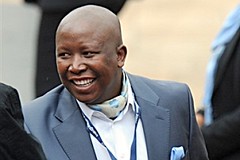
    Emergency services spokesperson Percy Morokane said there was 100% attendance among paramedics and fire-brigade staff.

    “We applaud them for heeding the call to come work,” he said.

    Traffic in the Johannesburg city centre was disrupted as the strikers marched from Newtown to Braamfontein to hand over a memorandum of their demands.

    In Cape Town, early reports said refuse was being collected in most areas, but a fuller picture of the impact of the strike would only be known later, city spokesperson Kylie Hatton said.

    In Durban, Samwu secretary Jaycee Ncanana warned that “no service will be regarded as essential during this strike”.

    The South African Broadcasting Corporation reported in Limpopo that more than 8 000 members of the union would demonstrate outside various municipal offices across the province, according to provincial chairperson Mamaile Manthata.

    Minor incidents

    In Ekurhuleni, east of Johannesburg, the metro said there had been reports of minor incidents, the most common being the alleged intimidation of non-strikers. It warned that anyone from an essential service — such as emergency services, healthcare or water — would face disciplinary action.

    Samwu decided on the no-work-no-pay strike to push for its demand that middle- and lower-income employees’ salaries be re-evaluated and adjusted to market-related amounts.

    Municipalities should no longer hire consulting lawyers to deal with disciplinary cases, which Samwu considered a waste of money, as there was internal capacity to do so.

    It wanted councillors and municipal managers’ remuneration to be evaluated and set, so they could not “waste” money by setting high salaries that were not market related, or award themselves perks that drained municipal coffers.

    Samwu said this would help address corruption, a core concern expressed during service delivery protests.

    The South African Local Government Association (Salga) said while it agreed there were historical flaws in the pay scales, the equality Samwu was seeking would exceed the municipal budgets capped by the Treasury. — Sapa

    Source: Mail & Guardian Online
    Web Address: http://www.mg.co.za/article/2010-04-12-municipal-workers-march-countrywide

  • Confronting the Occupation: Haiti, Neo-Liberalism and the US Occupation

    Confronting the Occupation: Haiti, Neo-liberalism, and the US Occupation

    Written by Kali Akuno
    National Organizer, Malcolm X Grassroots Movement
    Sunday, April 11, 2010

    The three-month marker for the earthquake that devastated Haiti is now upon us. The significance of this marker is not one determined by the Haitian people, but rather by the enemies of the Haitian people and peoples’ movements throughout the world.

    According to Milton Friedman and the intellectual guru’s of neo-liberalism there are critical timelines and stages that must be strictly adhered by to successfully capitalize on a catastrophe and transform a society. The three month marker is one of these critical timelines, and in the words of Friedman himself “ a new administration has some six to nine months in which to achieve major changes; if it does not seize the opportunity to act decisively during that period, it will not have another such opportunity.” Based on experiences in Iraq, Sri Lanka, and New Orleans over the past ten years several things must be in place at the three-month marker in order for the catastrophe to be fully exploited. These include: sufficient military force to contain the population, the dispersal and fragmentation of the affected population to limit its ability to mobilize resistance, and the legislation and implementation of a new policy regime that seeks to privatize nearly everything and eliminate all financial controls.

    One of the central enemies of the Haitian people is the guru’s of the ideology of neo-liberalism. These guru’s are the neo-liberal theoreticians and policy hacks who control Wall Street, the US Federal Reserve, the Bretton Woods institutions – the IMF, World Bank, and WTO, and most of the central banks of the world since the 1990’s. These gurus, most particularly the theoreticians, created a script in the 1970’s to exploit catastrophes, natural and human created, not only for material gain but radically regressive social transformation.

    After waging an incessant ideological war against socialism and communism the theoreticians won critical support amongst the commanders of government and the captains of capital by the early 1980’s and were able to start fully unleashing their fury on the world after the test run of General Augusto Pinochet’s dictatorship in Chile during the 1970’s. This neo-liberal script is a form of what Karl Marx termed “primitive accumulation”, and what David Harvey calls “accumulation by dispossession”, and is becoming popularly known via the works of Naomi Klein as “disaster capitalism” and the “shock doctrine”.

    A key ideological and strategic tool of this neo-liberal script is the concept of “humanitarian interventionism.” Despite how well intentioned this concept sounds, it is a tool developed through the auspices of NATO, under the guiding hand of the US government, to be executed through the UN to allow the imperialist powers to legally and morally interfere in the domestic affairs of weaker nations.

    Stated plainly, it is colonialism dressed in fine linen. As a practice it gained legitimacy after the imperialist induced atrocities in Rwanda, Burundi, and the former Yugoslav republic in the 1990’s to allegedly put an end to crimes against humanity such as ethnic cleansing and genocide. In the wake of these atrocities the UN under the direction of the US and its European allies has executed the doctrine of humanitarian intervention in all of the aforementioned countries and the Congo, Iraq, Somalia, and Haiti.

    The latest imposition of humanitarian interventionism in Haiti was in 2004, after the US overthrow of President Aristide and the Lavalas government, allegedly to restore order and maintain peace. But, this cut was just a deeper penetration of the affliction of neo-liberalism imposed upon Haiti by US imperialism with the willing aid of Haiti’s own decadent ruling class beginning in the 1980’s under the regime of “Baby Doc” Jean-Claude Duvalier.

    The current US occupation (the third since 1915) of Haiti removes the mask of the UN occupation in place since 2004, and is promoted and (sadly) widely unquestioned, in the US and throughout the world, as a “humanitarian operation” allegedly to stabilize the situation in Haiti in order to provide quake relief – which is nothing more than a perpetuation of the long standing racist view of the US government that the Haitian people are incapable of adequately presiding over their own affairs.

    The fact is, with the advancements and refinements in the application of the “shock doctrine” stemming from the occupation of Iraq, the political transformation of Sri Lanka following the Tsunami of 2004, and the social and demographic transformation of New Orleans and the Gulf Coast following Hurricane Katrina in 2005, the US government and transnational capital are seeking to apply a “coup de grace” on the people’s movement in Haiti in order to clear the way to remake it as a neo-liberal paradise.

    Stakes is High

    The stakes at play in the US occupation couldn’t be much higher for the people’s movement and the working and peasant masses of Haiti. Under US military rule the overwhelming bulk of the international relief aid (materials and finances) is centrally controlled by a handful of relief agencies hand picked by the US and the UN, who along with elements of the Haitian elite, control who gets anything and when, and thus turned relief aid into a weapon of social and political control. The major ports of entry into the country and its main transportation arteries are under tight US control restricting people’s ability to organize and mobilize under the ongoing dire circumstances.

    Potential routes of refuge to the US via the sea and the Dominican Republic via land have been effectively closed and legally barred. And the political repression unleashed after the liquidation of the Lavalas government in 2004 by the Haitian ruling class, former military and Tonton Macoute forces, and MINUSTA (the UN Stabilization Mission in Haiti) is intensifying, particularly with the ongoing banning of the Fanmi Lavalas Party from running in upcoming elections. And the hunting down by the US military and mercenary forces of political prisoners associated with the Lavalas movement and government, who were liberated by the collapse of several prison facilities during the January 12th earthquake.

    To top it all off, the Hurricane season is approaching rapidly, and no one, not the US military, the UN and NGO relief agencies, or the Haitian government is prepared to face it and the potential calamities it could bring, particularly as it relates to further displacement, the deepening of food insecurity, and the spread of infectious diseases.

    And these are just the short-term issues posed by the US occupation and the militarization of the relief and reconstruction effort. The long-term issue is the suppression of the people’s movement for self-determination and the imposition of permanent structures of dependency and subservience that the US government and the transnational ruling class are seeking to impose via a prolonged occupation. US imperialism is seeking to do no less to Haiti than it did with the occupation of 1915 – 1934, and that is to remove the threat of social revolution in Haiti and rebuild the Haitian military to serve as a repressive instrument against it in the service of transnational capital.

    The US occupation of Haiti is not just a singular containment initiative. It is also an initiative to further the rollback of progressive social transformation that has swept large parts of Latin America and the Caribbean since the late 1990’s. The first major rollback initiative under Obama’s command was the Honduran coup that successfully ousted President Manuel Zelaya. The second, albeit with far less US intervention, was the election of a right wing government in Chile, under the leadership of billionaire President Sebastian Pinera. The occupation of Haiti is the third and by far the most deeply penetrating of these rollback initiatives.

    With it US imperialism is seeking to contain initiatives like ALBA, which in English translates into the Bolivarian Alliance for the Peoples of our America, initiated and principally led by Venezuelan President Hugo Chavez as an alternative of the FTAA. ALBA, through the solidarity initiatives of the Cuban and Venezuelan governments, was making significant headway in Haiti prior to the earthquake with the creation of rural hospitals and schools and the provisioning of subsidized oil and low-interest development loans. Under the US occupation these initiatives are being stunted and contained in their growth. The greatest rollback threat however, is the occupation itself. It is a stark reminder to the aspiring progressive governments and social movements in Latin American and the Caribbean that as far as US imperialism is concerned the Monroe Doctrine is still in full effect over its historically claimed “backyard”, and that there are limits to the progressive reforms it is willing to tolerate.

    Solidarity and Joint Struggle: What is to be done?

    The US occupation is not just a problem for Haitians, and social movements in Latin America and the Caribbean, it is and must be understood as a problem for the progressive social movement within the US itself. Sadly, the Black Liberation Movement (BLM) has been divided and largely demobilized in relation to Haiti since the 2004 coup, in large part due to differences over how to view, understand, and relate to Fanmi Lavalas and President Aristide. Many have succumbed to accepting the grave distortions and outright lies perpetuated by the US government and right wing and ultra-left Haitian forces against President Aristide, Fanmi Lavalas and the Lavalas Movement.

    This position ignores the popular will of the Haitian masses and distorts the significant contributions of the Lavalas movement and government towards the realization of a participatory democracy and a people-centered path of economic and social development as an alternative to neo-liberalism. Similar dynamics have also occurred within Caribbean and Latino social movements within the US. And for the most part Haiti and the UN, and now, US occupations hardly register at all within the largely white dominated anti-war movement (gaining even less attention than the ongoing occupation of Palestine). Undoubtedly, racism, particularly the long-standing specter of the Black hoards of Haiti, is at play in this sad scenario.

    This situation must change, and the varied forces of the Black Liberation Movement must lead the way. The Haitian masses and popular movement without question are and will continue to fight valiantly to end the US occupation, but they cannot be left to fight on their own. It is incumbent upon the forces of the Black Liberation Movement to organize a multi-national and/or racial anti-imperialist initiative and coalition within the US that fights for the immediate end of the US occupation and the neo-liberal impositions it seeks to impose.

    The initiative must also take a committed stand in support of the demands of the Haitian popular movement that call for the return of Aristide, freedom for political prisoners, reparations and restitution (particularly from France for the brutal Indemnity imposed in 1824), and the cancellation of foreign debt and the negation of their structural adjustment conditionalities. In short, we must seize the opportunity to create our own script to counter neo-liberalism and humanitarian interventionism in support of the people’s struggle for self-determination and sovereignty in Haiti.

    This initiative must be conceived as one of joint struggle. One that is clear on the mutual and reinforcing self-interests of the social movement in Haiti, with its peasant and working class base, and the social movements in the US, and their multi-national, working class base, in the context of the ever increasing interrelated and interdependent capitalist world-system we live in.

    Our actions should not be contingent on charity or (worse) pity. But a firm grasps that as the social movement in Haiti goes, so goes the potential for the social movement in the US, for the allowance of one tyranny is the spawn of a hundred more. As we gather our forces to support the resistance of the Haitian people, and join with it in common struggle against imperialism, we will appear as a new defiant spirit and a force to be reckoned with.

    Kali Akuno is based in Atlanta, GA and works as the Director of Education, Training and Field Operations at the US Human Rights Network (USHRN) and is in the process of writing a book about his experiences organizing in New Orleans and the Gulf Coast after Hurricane Katrina tentatively called “Witness to a Cleansing”.

  • Southern Discomfort: Racism & The Confederacy

    April 11, 2010
    Op-Ed Contributor

    Southern Discomfort

    By JON MEACHAM
    New York Times

    IN 1956, nearly a century after Fort Sumter, Robert Penn Warren went on assignment for Life magazine, traveling throughout the South after the Supreme Court’s school desegregation decisions. Racism was thick, hope thin. Progress, Warren reported, was going to take a while — a long while. “History, like nature, knows no jumps,” he wrote, “except the jump backward, maybe.”

    Last week, Virginia’s governor, Robert McDonnell, jumped backward when he issued a proclamation recognizing April as Confederate History Month. In it he celebrated those “who fought for their homes and communities and Commonwealth” and wrote of the importance of understanding “the sacrifices of the Confederate leaders, soldiers and citizens during the period of the Civil War.”

    The governor originally chose not to mention slavery in the proclamation, saying he “focused on the ones I thought were most significant for Virginia.” It seems to follow that, at least for Mr. McDonnell, the plight of Virginia’s slaves does not rank among the most significant aspects of the war.

    Advertently or not, Mr. McDonnell is working in a long and dispiriting tradition. Efforts to rehabilitate the Southern rebellion frequently come at moments of racial and social stress, and it is revealing that Virginia’s neo-Confederates are refighting the Civil War in 2010.

    Whitewashing the war is one way for the right — alienated, anxious and angry about the president, health care reform and all manner of threats, mostly imaginary — to express its unease with the Age of Obama, disguising hate as heritage.

    If neo-Confederates are interested in history, let’s talk history. Since Lee surrendered at Appomattox, Confederate symbols have tended to be more about white resistance to black advances than about commemoration. In the 1880s and 1890s, after fighting Reconstruction with terrorism and after the Supreme Court struck down the 1875 Civil Rights Act, states began to legalize segregation.

    For white supremacists, iconography of the “Lost Cause” was central to their fight; Mississippi even grafted the Confederate battle emblem onto its state flag.

    But after the Supreme Court allowed segregation in Plessy v. Ferguson in 1896, Jim Crow was basically secure. There was less need to rally the troops, and Confederate imagery became associated with the most extreme of the extreme: the Ku Klux Klan.

    In the aftermath of World War II, however, the rebel flag and other Confederate symbolism resurfaced as the civil rights movement spread. In 1948, supporters of Strom Thurmond’s pro-segregation Dixiecrat ticket waved the battle flag at campaign stops.

    Then came the school-integration rulings of the 1950s. Georgia changed its flag to include the battle emblem in 1956, and South Carolina hoisted the colors over its Capitol in 1962 as part of its centennial celebrations of the war.

    As the sesquicentennial of Fort Sumter approaches in 2011, the enduring problem for neo-Confederates endures: anyone who seeks an Edenic Southern past in which the war was principally about states’ rights and not slavery is searching in vain, for the Confederacy and slavery are inextricably and forever linked.

    That has not, however, stopped Lost Causers who supported Mr. McDonnell’s proclamation from trying to recast the war in more respectable terms. They would like what Lincoln called our “fiery trial” to be seen in a political, not a moral, light. If the slaves are erased from the picture, then what took place between Sumter and Appomattox is not about the fate of human chattel, or a battle between good and evil. It is, instead, more of an ancestral skirmish in the Reagan revolution, a contest between big and small government.

    We cannot allow the story of the emancipation of a people and the expiation of America’s original sin to become fodder for conservative politicians playing to their right-wing base. That, to say the very least, is a jump backward we do not need.

    Jon Meacham, the editor of Newsweek, won the 2009 Pulitzer Prize for biography for “American Lion: Andrew Jackson in the White House.”

  • China Hands Over Revamped Stadium to Zimbabwe

    China hands over revamped stadium to Zimbabwe

    11 Apr 2010 02:05:38 GMT

    BEIJING, April 11 (Reuters) – China has handed over a revamped national stadium to Zimbabwe after refurbishments costing $10 million, state media said on Sunday, in a further sign of Chinese support for a government reviled in the West.

    China first built the 60,000-seat stadium in 1987, but it has been closed for renovations for the past three years, the official Xinhua news agency said.

    “The construction and refurbishment of the stadium cement the traditional friendship between our two countries,” it quoted Chinese ambassador to Zimbabwe, Xin Shunkang, as saying.

    Zimbabwe’s Vice President Joyce Mujuru “thanked China for renovating the stadium and assisting other areas of the Zimbabwean economy”, Xinhua added.

    The stadium has been “transformed into a world-class stadium that met the standards of the Confederation of African Football”, the report said.

    Hailed as a saviour by fanatical supporters and praised throughout Africa for standing up to what many see as bullying by the West, Zimbabwe President Robert Mugabe is hated in equal measure by opponents who accuse him of being a dictator.

    Mugabe denies charges of human rights abuses and insists the West has withheld aid mainly in protest over his controversial seizure of white-owned commercial farms for resettlement among blacks.

    Mugabe has tried to boost economic ties with Asian countries such as China and Malaysia.

    China’s embassy in Zimbabwe in February threw a birthday party for Mugabe.

    Beijing and Chinese companies have pledged tens of billions of dollars to Africa in loans and investments, mostly to secure raw materials for the world’s fastest-growing major economy.

    Rights groups have repeatedly criticised China for propping up dictatorial and corrupt African nations. China counters it offers no-strings aid and that its pledge not to interfere in any country’s internal affairs is welcomed by African nations. (Reporting by Ben Blanchard; Editing by Alex Richardson)

  • Whose Africa Is It Anyway?

    Whose Africa is it anyway?

    Zimbabwe Sunday Mail

    Race relations have sharply deteriorated in Southern Africa in recent years and the main reason for this is clear to any thinking person: racially skewed ownership of the means of economic production.

    Social justice teaches us that it is not poverty, per se, that pushes a long-suffering population to the brink of civil war; rather, it is inequality and exclusion that really stoke tensions in a society.

    To the down-trodden masses in this part of the world, the neo-liberal gospel of “democracy, human rights and rule of law” rings hollow. The people here are sceptical because they have not seen the dividends of globalisation — itself a euphemism for a sinister system that makes the rich richer and the poor poorer. In fact, globalisation is imperialist intrigue under a new guise.

    It has taken a while for the wretched masses in this region to speak out against imperialist exploitation, but a grassroots movement is gaining momentum from the Congo to South Africa and from Angola to Mozambique, and very soon we can expect a full-fledged revolution.

    The revolution this time is not a struggle for political independence; every country in Southern Africa has attained political independence one way or the other. The new struggle is about economic emancipation.

    Julius Malema, the leader of the African National Congress Youth League, was in Zimbabwe last week on a ground-breaking visit that could have far-reaching ramifications for regional politics.

    The symbolism of Malema’s trip was remarkable and its significance is yet to be fully appreciated by a Zanu-PF that has not done much in recent years to hype its liberation credentials.

    Malema’s energetic approach would have prodded the Zanu-PF Youth League into action. Every liberation movement must have a vibrant youth league. Youths are not just “the leaders of tomorrow”; they are the energy of today. No serious mass-mobilisation campaign can be conducted without the active participation of young people.

    To his credit, the ANC Youth League president made no apologies for the shared liberation ethos of Zanu-PF and the ANC. He spoke about South Africa’s experiences vis-à-vis black empowerment, land reform and economic development.

    It is gratifying that the ANC has young leaders who comprehend the imperatives of indigenous economic empowerment. South Africa is a powder keg today.

    Although political apartheid is dead and buried, economic apartheid is alive and kicking.

    Some 4,2 million South Africans live on a dollar a day or less, up from 1,9m in 1996. While poverty is clearly a national problem for that country, inequality is even more catastrophic.

    Look at the raw figures. An average of 52 people are murdered every day and there are 200 000 robberies each year, as well as 55 000 rapes and 500 000 assaults. If you think this is a tragedy, wait and see what happens in a few years’ time if the ANC fails to dismantle the economic apartheid that has firmly taken root since 1994.

    As Africa’s oldest liberation movement, the ANC has a responsibility to assist in reviving other liberation parties on the continent.

    In many a country, the party of liberation lies derelict in the dustbin of history, swept out of power by a Western-sponsored pseudo-opposition party. The Western governments know what they are doing by toppling the liberation movements. They are laying the ground for the re-colonisation of Africa. This is no idle threat.

    Opponents of Zimbabwe’s ongoing economic indigenisation drive are trying to defend Western economic interests at the expense of the dispossessed majority.

    Should we really be surprised that the capitalist masters of the universe and their disingenuous lackeys are feverishly opposed to black economic empowerment? Not at all. They have exploited the masses for too long and are now driven by a warped sense of entitlement.

    Some Western diplomats in Harare have shamelessly sought to defend the indefensible.

    If the Germans think that Zimbabweans deserve a life of perpetual servitude, then they should be told that they are free to take their “investment” elsewhere. Let them understand this.

    We have also seen some elements in the Western-sponsored media — both in Zimbabwe and abroad — passionately defending the subjugation of the black majority. They are clearly off-side and history will give them their marching orders. Everyone knows they are singing for their supper.

    Indigenisation is meant to address the wrongs of colonialism. Left to its devices, liberal capitalism will not even acknowledge the wrongs of colonialism in Africa — let alone correct them.

    Faced with the brutal reality that colonialism created a rich minority and a poor majority, are we saying the Government of Zimbabwe should sit back and do nothing about the unacceptable inequalities we see in our society today? And should we accept this injustice 30 years after our Independence? Certainly not. Black economic empowerment is an integral part of decolonisation.

    It is a matter of justice. History will vindicate this position. If Zimbabweans cannot own the Zimbabwean economy, then which economy will they ever own?