Author: Shirin Samimi-Moore

  • From A-ha to OK Go: A museum exhibit all about the music video

    still_for_web-detail-mainIn the early ‘80s, before MTV turned its attention to reality TV, David Bowie, Madonna and the Pretenders lit up small screens, using a new medium to showcase their songs: the music video. Recently, we’ve seen a resurgence of this art form as cinematographers, musicians and artists join together to supersize their visual creativity. But now, instead of gathering around the TV, we watch on YouTube.

    To celebrate this young art form, the Museum of the Moving Image in Astoria, New York, presents Spectacle: The Music Video, said to be the first-ever museum exhibition all about the evolution of the music video. The exhibit includes more than 300 videos, as well as artifacts and interactive displays, grouped by genre — and videos are further classified by subdivisions like choreography and controversy.

    This exhibition was curated by Jonathan Wells — who’s our go-to curator for interstitial videos at TED — and partner Meg Wells of the global art cooperative Flux.

    Like so many others, Jonathan and Meg cite A-Ha’s “Take on Me” as a pivotal moment in their love for music videos. As Jonathan tells Fast Company, “It was just this magical moment of someone diving into a comic book that really stuck with people. That’s an example of how a video can introduce and break an artist. We have the original illustrations that were done for the video.”

    TED’s own Shanna Carpenter wrote this from the exhibit opening: “It’s an incredible collection — taking you on a sensory journey that starts in teenage nostalgia and progresses to obscure experiments in moral sensibilities, interactive digital experiences and yarn-bombing,” she said. “And, all of it in a crazily chic contemporary museum in Astoria.”

    Find Spectacle: The Music Video at the Museum of the Moving Image, Astoria, New York, April 3-June 16, 2013.

    Can’t make it to Astoria? Watch a TEDx Talk about the making of one of the featured videos: “This Too Shall Pass” by OK Go »

  • The TED Global lineup, as tweeted by you

    TEDGlobalA monk, a “gentleman thief ” and a drones ecologist. These are just a few of the speakers who’ll be at TEDGlobal 2013, themed “Think Again.” Since revealing the speaker lineup yesterday, we’ve noticed a multitude of tweets flooding in. Excitement certainly seems to be brewing. Below, some of the most fascinating tweets — from speakers and members of TED’s global audience alike.

  • TEDWeekends asks: Can trauma be a gift?


    At TED2010, Stacey Kramer told the moving story of the most treasured gift she ever received: a brain tumor the size of a golf ball. Stacey Kramer: The best gift I ever survivedStacey Kramer: The best gift I ever survived Despite the pain, she wouldn’t have traded her experience for anything – because, in the end, it changed her life for the better.

    Kramer’s poignant talk is featured on today’s edition of TEDWeekends on the Huffington Post, as she and other bloggers share stories of turning hardship into gratitude. Here are three powerful stories:

    Harshada Rajani: The Cost of My Catastrophe

    Finding opportunities out of tragedies, making dreams out of nightmares, and discovering gifts out of punishments. Those seem like the great accomplishments of an insightful survivor, but near impossible for a naive fighter. My wonderful life was stolen like a secret, thrown away like garbage, silenced like a sin, for no reason any doctor or priest could come up with. This sounds like nothing more than a harsh tragedy, seems like nothing more than an inescapable nightmare, and feels like nothing more than an unfair punishment, for being a little too happy. I can’t readily see any opportunities, dreams, or gifts in this mess I have to now call my life. But what if I could dig a bit deeper, find in me new levels of maturity, and see this as a gift?

    It’s so much easier to lazily lie in my comfortable bed of bitterness. It’s so much easier to get lost in the jargon of negativity and regret. It’s so much easier to hate the world for doing this to me. But if I consciously choose to look past the simplicity of this as a punishment, I know I can realize the complexity of this as a gift. Read the full essay here »

    Lawrence G. Calhoun: Can Trauma Really Be a Gift?

    Stacey Kramer describes her experience with a brain tumor as a gift. She wouldn’t want to wish serious illness on anyone, but her own illness was a gift nonetheless. Elements of this gift included deeper and more meaningful friendships, a strong sense of love and support, new vitality, and deeper spirituality.

    Stacey’s experience mirrors a body of research of which I’ve been a part for many years. It’s the study of what my colleague Richard Tedeschi and I have called post-traumatic growth. The idea that the struggle with very challenging life circumstances can lead to positive transformation is ancient. It seems to be part of the human condition. Our work suggests that the transformations Stacey experienced are shared, at least in some ways, by many other people facing a wide range of crises. People report changing priorities, having greater appreciation for what life still has to offer, a deepened connection with others and perhaps greater compassion for others who suffer, positive changes in their understanding of spiritual and existential questions, and sometimes a radical change in the direction they choose to take their lives. Read the full essay here »

    Stacey Kramer: How My Brain Tumor Was The Most Unexpected Gift I Received

    Recently, I spoke to a class of at-risk high school kids. These kids, mostly non-white, have faced many different types of challenges. Some come from abusive parents. Some don’t have parents. Some don’t have a bed. Nearly all rely on the donated food they get at school as their daily sustenance. Every one faces economic challenges of varying proportions. For a few, it takes several buses and nearly two hours to get to school.

    These kids are barely making it through high school — at a time when many of my peers’ kids are celebrating acceptances to upper echelon colleges. This school is their last chance. Simply getting to school on a daily basis is a hardship when you don’t have any money or any food. Or anyone to motivate you to do so. Read the full essay here »

  • TED Weekends: Understanding evil

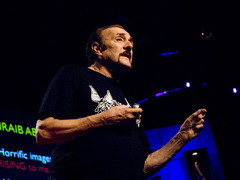
    Phil-ZimbardoPhilip Zimbardo knows evil inside and out. Philip Zimbardo: The psychology of evilPhilip Zimbardo: The psychology of evilHe led the infamous Stanford Prison Experiment of 1971 and was an expert witness at Abu Ghraib, privy to graphic unseen images. At TED2008, Zimbardo explains how easy it is for the good to turn evil, and on the flip side, for inspiration to lead people to heroism.

    Today’s TED Weekends on the Huffington Post features a selection of essays surrounding the ideas brought up in Zimbardo’s talk. Here, three essays to pique your interest.

    Philip Zimbardo: Journeying From Evil to Heroism

    EVIL: How and why do good people turn evil?

    VERSUS

    GOOD: How can ordinary people be inspired to act heroically?

    These two questions have been challenging me since I was a kid, and finally after many decades, I have discovered answers that I need to share with everyone who might care about these fundamental issues of human nature.

    Growing up in poverty in the inner city of the South Bronx, New York City, means that I — like all such kids similarly situated everywhere in the world — was surrounded by evil. There were and are always hustlers, guys who make a living by getting good kids to do bad things for a little money — like steal, run drugs, sell their bodies, and worse. Why did some kids give in and start down that slippery slope of evil, while others resisted and stayed on the right side of that line separating good from evil? Read the full essay »

    Marina Nemat: The Many Faces of Evil

    In 1977, a 21-year-old political prisoner, Ali Moosavi, was tortured in Evin Prison in Tehran, Iran, by SAVAK, the Shah’s secret police. Ali was a devout follower of Ayatollah Khomeini, whom the vast majority of Iranians — including Marxists, Islamists, liberals, seculars, etc. — came to support during the revolution as the only leader who could unite everyone against the monarchy. Ali was hung from a ceiling in a torture room in Evin. He was beaten for hours and then repeatedly electrocuted. He believed in his cause, which, according to him, had to do with bringing justice and democracy to Iran. To many people, he was a hero.

    In 1982, it had been about three years since Iran had become an Islamic republic, but the country was neither free nor democratic. On a daily basis, thousands of young people protested on the streets against the antidemocratic policies of the new regime. Hundreds of protestors were arrested and then tortured in Evin. It was supposed to be shut down with the success of the revolution in 1979, but it wasn’t. In 1980, Ali Moosavi became an interrogator in Evin and tortured teenagers. Read the full essay »

    Sam Sommers: Life, Oversimplified

    Personality is overrated.

    One of our biggest misconceptions about human nature is that the people around us are of consistent, predictable character. When thinking about one another we tend to oversimplify, categorizing each individual as either a good or an evil person, a hero or a coward, and so forth.

    But the reality of our social universe is far more nuanced. People are complicated and compellingly contradictory. Human nature is surprisingly context-dependent.

    Zimbardo makes this case using graphic visual evidence to show us the darkest capabilities of otherwise ordinary individuals. But our tendency to explain away bad behavior as the result of “a few bad apples” isn’t limited to egregious atrocities. In fact, I rely on the very same principles when speaking to corporations and other organizations about, say, the psychology of fraud and unethical behavior. Read the full essay »

  • X marks the spot: The TEDx blog edition

    TEDx-3.8This week, TEDx took a break from posting talks as the team recovered from TED2013. However, their blog kept rolling with some wonderfully unique spins on the conference and more. Here, find some great pieces from the TEDx Blog.

    Dance, tiny robots, dance! The best moments, in GIFS

    robot

    Just now, session 1 of TED2013 ended, but not without first introducing the TED audience to a whole mess of neat robot inventions — from a robot butler to a smartphone pet that makes the Tamagotchi seem ancient.

    One of the highlights was this clip from Bruno Maisonnier’s TEDxConcorde talk, during which he had his tiny humanoid robots — called Nao — do a synchronized dance routine even the coolest b-boys would envy. Here, we GIF the best moments from the tiny Naos breaking it down on stage. See more dancing robots »

    Coffee. Hacking. Indonesia: 5 TEDx Talks on Java

    When you hear the word “java,” you might think of the pesky window that pops up on your computer desktop every few months, begging you to close all browser windows so you can install vital security updates. Or maybe you think of your morning coffee, expertly brewed by your favorite neighborhood barista. Or maybe you see an image even more lovely — the lush greens of Indonesia’s third largest island.

    Whatever it is you’re thinking of — we’ve got a talk for you. So pour your cup of joe, save all tabs, and take a break from your vacation planning to watch these 5 TEDx talks in honor of the word java. Watch the playlist »

    The world comes together for TED2013: TEDxLive events around the globe

    At the end of February, TED2013 went live far beyond the city limits of Long Beach, California. In 60 countries worldwide — excited TED’xers became TEDsters for a day (or night!) — experiencing “The Young. The Wise. The Undiscovered.” in the heart of their communities: inside theaters, schools, local haunts, and cultural centers. These were TEDxLive events — TEDx events centered around a live simulcast of TED2013 in Long Beach.

    In Sidney, British Columbia, Canadian TEDx’ers gathered together to watch day three of TED2013 in a local secondary school for the TEDxSaanichPeninsulaLive event. Organizer Sherry Moir said a moving moment of the day came after 16-year-old Jack Andraka spoke about the new method of detecting pancreatic cancer that he developed when he was only 15. Once he finished speaking, Sherry overheard one of the school’s students say, “He might have saved my dad if he’d only done this at age 12!” Read the full story here »

    TEDx Intern Picks: 5 favorites for February

    It’s that time again — time for another TEDx intern playlist. Today, one of our screening interns provides a glimpse into the vast variety of ideas circling the TEDx community — ideas that confront, surprise, and astound — even when you watch dozens of talks daily. Watch the playlist »

  • 10 more communities turned Inside Out by TED Prize winner JR

    This group of activists from Seoul visited New York City, hoping to raise awareness of “Comfort Women” – some 200,000 Korean women who were forced into prostitution by the Japanese Army during WWII. These women, now elderly, have yet to receive reparations.

    This group of activists from Seoul, Korea, visited New York City, hoping to raise awareness of “Comfort Women” – some 200,000 Korean women who were forced into prostitution by the Japanese Army during WWII. These women, now elderly, have yet to receive reparations.

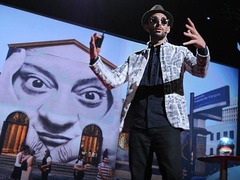
    JR is an artist with a desire to transform our collective streets — from French public houses to Brazilian favelas. As he describes in his talk from TED2011, JR headed to the barrier wall between Israel and the Palestinian territories for his project “Face 2 Face,” JR's TED Prize wish: Use art to turn the world inside outJR's TED Prize wish: Use art to turn the world inside out pasting massive portraits the size of houses on either side of the wall. The goal: to catch both sides off guard with their similarities and give them the experience of relating to the other by staring them straight in the face. JR found that people are thirsty to heal in this way — to be seen and to share a story through a simple image.

    After winning the 2011 TED Prize, JR transformed his mission to a global scale with Inside Out. Through the initiative, any willing participant can send a portrait (or a series of them), and receive the images back as posters, ready to be pasted anywhere with a social purpose in mind. The purposes and messages may vary, but the images hold a common thread. These public exhibits are then documented and shared on the project’s website.

    In August, Inside Out surpassed the goal of dispersing 100,000 posters. But they are hardly stopping there. Below, see images of some recent projects, pasted all around the globe — from Colombia to New Zealand.

    This project went on behind bars in a women’s prison in Medellin, Colombia. The idea was to photograph those incarcerated and interview them about what they plan to do upon release.

    This project went on behind bars in a women’s prison in Medellin, Colombia. The idea was to photograph those incarcerated and interview them about what they plan to do upon release.

    This school in Christchurch, New Zealand, was hit hard by an earthquake, and the community lacks the funds to rebuild it. To increase support, participants of Inside Out pasted posters of the children who attended the school, and their grandparents who -- generations ago -- also studied there.

    This school in Christchurch, New Zealand, was hit hard by an earthquake, and the community lacks the funds to rebuild it. To increase support, participants of Inside Out pasted posters of the children who attended the school, and their grandparents who — generations ago — also studied there.

    This project from Phnom Penh, Cambodia, was undertaken to represent the many different occupations represented in the city, not to mention the diversity to be appreciated there.

    This project from Phnom Penh, Cambodia, was undertaken to represent the many different occupations represented in the city, not to mention the diversity to be appreciated there.

    Cyclists in Utrecht, Germany, began this initiative to share the stories of young bike-riders.

    Cyclists in Utrecht, Germany, began this initiative to share the stories of young bike-riders.

    In Oaxaca de Juarez, Mexico, a group of students pasted the many diverse faces of their community, to instill pride for residents and to help encourage their artistic endeavors.

    In Oaxaca de Juarez, Mexico, a group of students pasted the many diverse faces of their community, to instill pride for residents and to help encourage their artistic endeavors.

    7 - Tokyo

    Some members of Tokyo’s community wanted to give honor to the various volunteers of many fields — their efforts spanning across earthquake relief, domestic abuse counselors and food bank assistants. Their portraits were plastered across the city.

    Amy Lehman runs a floating healthcare clinic along Lake Tanganyika in the Democratic Republic of Congo. Here, in Kigoma, she pasted these posters on the walls of the village.

    Amy Lehman runs a floating healthcare clinic along Lake Tanganyika in the Democratic Republic of Congo. Here, in Kigoma, she pasted these posters on the walls of the village.

    As a form of non-violent protest in Madrid, Spain, these posters were used to display the faces of those who are being harmed by living under corrupt government.

    As a form of non-violent protest in Madrid, Spain, these posters were used to display the faces of those who are being harmed by living under corrupt government.

    In an effort to stand up to bullying, this action, titled “Not in Our Schools,” took place in Palo Alto, California, in order to advocate acceptance in local high schools.

    In an effort to stand up to bullying, this action, titled “Not in Our Schools,” took place in Palo Alto, California, in order to advocate acceptance in local high schools.

    And a bonus video action:

    In the dark of night, these posters of Taiwanese youth were pasted alongside portraits of youth from Mainland China. It’s an expression of hope toward a more united future. These posters were immediately removed by the Chinese public authorities, but not before this footage of the pasting (and subsequent removal) was captured.

  • TED Weekends reimagines education

    ted2013_0035945_d41_4606

    At TED2013, Sugata Mitra accepted the TED Prize for 2013 with a striking talk. Sugata Mitra: Build a School in the CloudSugata Mitra: Build a School in the CloudHis wish: for children to learn about any variety of subjects through self-organized learning. While this bold project will take form with a “School in the Cloud” in India, Mitra encourages members of our community to help with a global paradigm change by creating their own self-organized learning environments and fostering a sense of wonder in children.

    A special edition of TED Weekends presents essays inspired by Mitra’s talk. On Wednesday, we shared five of these great essays. Below, find four more.

    Tom Healy: Seeing Fire in the Clouds

    Last night, as I listened to Dr. Sugata Mitra, TED’s 2013 Wish Prize winner, discuss the experiments in education that led to the invention of the SOLE, his self-organizing learning environment, I thought about the impossible.

    Dr. Mitra has talked in the past about how difficult it is to get good teachers to go, paradoxically, where they are needed the most: low-income and/or rural areas where, simply, people are too poor and the areas are too dangerous, too out of the way to attract the necessary educators. It’s not only difficult, it’s usually impossible. Dr. Mitra is fond of quoting the science fiction writer Arthur C. Clarke: “If children have interest, then education happens.” There’s no fiction in that. Just truth and common sense — that Dr. Mitra has backed with serious science. Read the full essay »

    John McWhorter: Back to the Future

    Sugata Mitra’s inspiration offers promise in returning learning to what humans are programmed for.

    And that is not what we today think of as “school.” The books-and-blackboards model of education will always be most productively engaged by students of two sorts.

    One is the middle-class child from a quiet, book-lined home, in which concentration in solitude is drunk in from toddlerhood.

    The other is the child of driven immigrant families, uniquely dedicated to their children’s making the most of the new circumstances. Read the full essay »

    Jessie Woolley-Wilson: Student-centered, Student-driven

    In order to unlock the human potential of a child, we must first unlock their learning potential. For those of us in the Next Generation Learning community who hope to create a paradigm of learning that is at once student centered and student driven, very engaging and highly effective, Sugata Mitra’s Self Organized Learning Environment (SOLE) is a provocative vision for the future. As an education innovator, optimist, and dreamer, I am captivated by the young children featured in Mitra’s “Hole in the Wall” videos who seem genuinely delighted and undaunted by the perplexing challenges they are asked to solve on their own. I admire the daring experimentation of Mitra’s model and his wish to build a school in the cloud — one that has the potential to serve millions of undeserved children around the globe.

    This is a wish about access. This is a wish about high expectations. This is a wish about hope — about seeing around impediments to the infinite possibilities. Read the full essay »

  • Gallery: The second half of TED2013, in comic form

    Denise Herzing works on understanding the language of dolphins, with the hopes that we may one day be able to communicate with them.

    Denise Herzing works to understand the language of dolphins, with the hopes that we may one day be able to communicate with them. Here’s her talk from session 8.

    A TED Talk is generally an auditory experience. But Fever Picture, a collective of graphic mavens who translate the ideas expressed at conferences into graphic form, have changed that. Earlier this week, they thrilled us with their comic versions of the first half of TED2013. Here, their renderings of the second half of the conference.

    John-McWhorter

    Also during Session 8, linguist John McWhorter shares why the language of texting may be evidence of advanced intelligence, not (as we so often think) the decline of society.

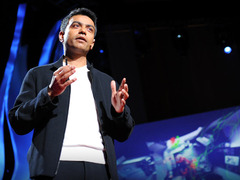
    Ajit Narayanan works to help autistic children communicate through the creation of his app, Free Speech. This uplifting talk was from Session 8.

    Ajit Narayanan works to help autistic children communicate through the creation of his app, Free Speech. This uplifting talk was from Session 8.

    At Session 9, Rose George says it's time to end the taboo over excrement, and start "talking shit." So many are without basic sanitation, which leads to disease, and the potential to harness the gas that poop gives off is exponential.

    In Session 9, Rose George says it’s time to end the taboo over excrement, and start “talking shit.” So many are without basic sanitation, which leads to disease, and the potential to harness the gas that poop gives off is exponential.

    James Lyne, at Session 9, shares the secret lives of cyber criminals -- and what you can do to protect yourself against them.

    James Lyne, also in Session 9, shares the secret lives of cyber criminals — and what you can do to protect yourself against them.

    Anas Aremayaw Anas is an undercover journalist. In Session 9, he shared how he exposes corruption and uncovers injustice.

    Anas Aremayaw Anas is an undercover journalist. In Session 9, he gave a peek at how he exposes corruption and uncovers injustice.

    At Session 10, Hyeonseo Lee talks about her escape from North Korea and her goal to help North Korean refugees.

    In Session 10, Hyeonseo Lee talks about her escape from North Korea and her goal to help North Korean refugees.

    Peter Gabriel, Diana Reiss, Neil Gershenfeld and Vint Cerf discuss the prospects of an interspecies internet during Session 10.

    Peter Gabriel, Diana Reiss, Neil Gershenfeld and Vint Cerf discuss the prospects of an interspecies internet during Session 10.

    Eleanor Longden gave an incredible talk in Session 10, detailing how she came to terms with the voices in her head.

    Eleanor Longden gave an incredible talk in Session 10, detailing how she came to terms with the voices in her head.

    Joshua Prager, in Session 11, told the moving story of a car crash that changed him forever, and his search for the man responsible.

    Joshua Prager told the moving story of a car crash that changed him forever, and his search for the man responsible.

    Daniel-Reisel

    Daniel Reisel shares his experience training the brains of psychopaths at Session 11.

    In session 12, Dan Pallotta delivered a powerhouse talk asking us to think about more than a charity's overhead when judging if its worthy.

    In session 12, Dan Pallotta delivered a powerhouse talk asking us to think about more than a charity’s overhead when judging its worth.

  • TED Weekends listens to outer space

    Honor-HargerHonor Harger isn’t your typical artist. Or your typical astronomer. At the TEDSalon London Spring 2011, Harger shared how she brings these two seemingly unrelated disciplines together — the study of sound and the study of space — to record the songs of planets, moons and quasars.  Honor Harger: A history of the universe in soundHonor Harger: A history of the universe in soundHer talk is called “A history of the universe in sound,” and it is simply a must-see.

    Today’s TED Weekends on the Huffington Post explores the soundtrack of our universe, featuring essays from Harger and others. Below, find excerpts from three for your reading pleasure.

    Honor Harger: Tuning Into the Universe

    Images of space are ubiquitous in our lives. We have been surrounded by stunning portrayals of our own solar system and beyond for generations. But in popular culture, we have no sense of what space sounds like. And indeed, most people associate space with silence.

    There are, of course, perfectly valid scientific reasons for assuming so. Space is a vacuum. But through radio, we can listen to the Sun’s fizzling solar flares, the roaring waves and spitting fire of Jupiter’s stormy interactions with its moon Io, pulsars’ metronomic beats, or the eerie melodic shimmer of a whistler in the magnetosphere. Read the full essay »

    Mario Livio: What Is the Color of the Universe?

    Honor Harger’s TED Talk is on radio astronomy, or, in some sense, the “sound” of the universe (even though radio waves are really electromagnetic radiation, just like light). Can we, however, say what the color of the universe is? To answer this question, we must first establish what we actually mean by the “color of the universe.” A reasonable definition would be to add up all the visible radiation emitted by a very large number of galaxies in a huge cosmic volume, and to determine how all of that light might be perceived by the human eye. This is precisely what astronomers Karl Glazebrook and Ivan Baldry attempted to do in 2002. Using a survey of more than 200,000 galaxies (the “2dF Galaxy Redshift Survey”) and reaching to distances of a few billion light-years, they constructed the distribution of the colors (the spectrum) the eye would see if all that light were to be separated into its components by passing it through a prism.

    Since our universe is expanding, light from distant galaxies is stretched to longer (redder) wavelengths (a phenomenon known as redshift). The farther away the galaxy, the greater the amount of stretching that occurs. Glazebrook and Baldry removed this effect before combining all the light to form a smoothed-out average color. Read the full essay »

    Seth Shostak: Celestial Sound Effects

    Remember the tag line for the 1979 sci-fi flick Alien? It was boldly emblazoned on the film’s advertising posters, and helpfully informed the public that “in space, no one can hear you scream.”

    Well, of course that’s true; at least if you’re floating around without your protective helmet and its built-in walkie-talkie. But then again if you’re bare-headed in space, the fact that no one can hear the noises you’re making is scarcely your biggest problem.

    Nonetheless, there’s a widespread perception that space — which after all, is mostly air-free — is as silent as the shadows. Read the full essay »

  • X marks the spot: This week’s musical TEDx Talks

    Each week, TEDx chooses four of our favorite talks, highlighting just a few of the enlightening speakers from the TEDx community and its diverse constellation of ideas worth spreading. Below, give this week’s talks — all about music — a listen.

    Learn 100 songs in five minutes: Jordan Hume at TEDxMacquarieUniversity
    The structure of music might seem complex and mysterious, but many songs adhere to a simple, timeless pattern, says Jordan Hume. In a five minute piano lesson, he demonstrates the pattern of over 100 different songs, which he says run the gamut from country to hard rock. (Filmed at TEDxMacquarie University)

    The cello — remixed: Ben Sollee at TEDxSanDiego 2012
    Ben Sollee grew up playing the cello — from classical pieces taught in school, to impromptu R&B and fiddle jams with his family. At TEDxSanDiego, he showcases his particular way of using the cello, which blends influences and techniques into a fresh contemporary style. (Filmed at TEDxSanDiego)

    Wine glasses, snifters and Tchaikovsky: Glass Duo at TEDxBratislava
    If you’ve ever performed the old trick of running your finger across a wine glass to make a sound, prepare to be astonished as musicians Anna and Arkadiusz Szafraniecky recreate complex classical pieces using just empty glasses. (Filmed at TEDxBratislava)

    Classical beatboxing: Jonatan Lopez and Man Wei Che at TEDxYouth@BeaconStreet
    Cultures collide as beatboxer Jonatan Lopez (JFlo) and Juilliard-trained bassist Man Wai Che fuse genres into a seamless performance that takes musical collaboration to a whole new level. (Filmed at TEDxYouth@BeaconStreet)

    And below, some highlights from the TEDx blog this week:

  • TED Fellow Hakeem Oluseyi talks sonic booms and asteroids on NBC’s The Ed Show


    As Russian scientists gather fragments of the 10-ton meteor that streaked across the sky on Friday at 33,000 miles per hour, TED Fellow Hakeem Oluseyi took to the airwaves to weigh in on the event.

    Oluseyi is an astrophysicist and teacher determined to bring science to poor classrooms across the world. His work has spanned cosmology, astronomical observation and exoplanets – all of which he shares in the classroom. Oluseyi has also pioneered the One Telescope Project, which aims to bring a telescope to each nation, driven by the idea that space is for everyone — and that understanding it is an endeavor that must be undertaken together, as one earth, rather than nation-by-nation.

    On Friday, Oluseyi was invited on NBC’s The Ed Show to discuss the meteor that exploded over the Chelyabinsk region. In the clip above, he explained the sonic boom as well as the fact that another asteroid — one the size of a football field — just missed our planet.

    Oluseyi also appeared on the National Geographic show Top Secrets: Doomsday and, last December, was interviewed on Evacuate Earth. Look for him next on the Science Channel’s series Alien Encounters: Are We Alone? which will be broadcast on March 5.

  • TED Weekends: Big data gets personal

    big_data_blogAt TED2011, Deb Roy shared his talk, “The birth of a word,” describing when he and his wife, Rupal Patel, brought home their baby boy for the first time. The pair sought to shoot a different kind of home video: in every room of their house, a camera recorded eight to ten hours of footage a day. Deb Roy: The birth of a wordDeb Roy: The birth of a wordAfter three years, Roy had roughly 90,000 hours of video and 140,000 hours of audio. But this wasn’t for sentimental purposes. Instead, they wished to study how a child learns language. The footage became a massive data set for Roy and his research team at MIT. Using unique data visualizations, they were able to track the many subtleties of a child’s learning process that they wouldn’t have been able to do in a lab.

    His team wondered: could this kind of analysis be applied to television or, say, Twitter to discover communication trends?

    These are the kinds of questions that today’s TED Weekends on the Huffington Post explores. Here, three of the great essays that are available now for your reading pleasure. 

    Deb Roy: The Birth of a Word

    Three trajectories came together in 2005 and took me to new frontiers of cognitive science (and subsequently, it turns out, the media industry).

      • The first trajectory: I began to see an unexpected connection between my research in robotics at MIT and theories of how children learn to talk, leading to studies of child language that I did with my wife and collaborator Rupal Patel over the past decade.
      • Second: The era of Big Data was dawning, and the far-fetched idea of video-recording everything that happens in a home had become a practical reality.
      • Third, Rupal and I learned that we were expecting our first child in July 2005.

    This confluence of events sparked an unusual study of child language featured in the first half of my TEDTalk. Read the full essay »

    Gayatri Devi: How Do I Improve My Memory? Forget More!

    Do you know what is essential for a good memory? The ability to forget. To completely and thoroughly forget. Forgetting, like breathing or sleeping, is physiologically normal. This is at odds with our modern compulsion to record and remember everything and is a perfect recipe for anxiety.

    Deb Roy, a cognitive science professor at MIT studying language, recorded 8-10 hours daily of the first three years of his son’s home life. He compiled a quarter million hours of audio and video, creating a 200,000 gigabyte “ultimate memory machine.” (Most computers store about one gigabyte.) Consider how much information each of us is exposed to in 24 hours, on streets, subways, screens and in sleep. Imagine recording and remembering all this. Thankfully, we were never meant to.

    Fact: We are evolutionarily programmed to forget. Our brains evolved over millennia with built-in forgetfulness. Our brain is engineered to remember tastes, smells, voices, touch and visions, not names. Our brain is engineered to solve problems (How do we keep track of cattle? Mathematics; How do I communicate? Language), not remember disjointed facts. A fact not linked to a sense, an emotion, or a concept is quickly forgotten. Read the full essay »

    Ben Hecht: Big Data Gets Personal in U.S. Cities

    Much has already been said about how big data is dramatically changing the way that organizations make decisions. Today, more data is being created from more places than ever before. Blogs, Facebook, YouTube videos, retailer loyalty cards, mobile phones, and sensors on buildings are producing tons of data daily. Private sector companies, in their real-time data warehouses, are storing, analyzing, and harnessing it to help them to better understand their customers, dynamically alter pricing based on real-time demand, and even change their business models. And, increasingly government is putting the wealth of data that it generates to work to increase efficiency, save dollars, and create more proactive policy. But, as Deb Roy highlights in his TED Talk, the true promise is where the numbers and patterns from this data connect and become personal — enabling us to understand and to respond to humanity and the world in ways previously unimaginable. This type of analysis has infinite potential for improving the human condition on an ongoing basis; and strengthening people’s commitment to our democracy. Already, in U.S. cities, we are seeing many promising signs of the transformative personal application of Big Data:

    Mass Personalizing of Government Data and Services: The movement towards open government data in the U.S. has already had huge implications for the relationship between citizen and government. Read the full essay »

  • Hans Rosling shatters the myth of “developed” versus “developing” nations

    Hans Rosling has given nine TED Talks, each sharing a carefully measured dataset to change misconceptions about global issues. Now, the Gates Foundation shares a new demonstration from Rosling. Here, using powerful moving charts, Rosling shatters the fallacy of the “developed” world versus the “developing” world. By looking at the facts, we are able to see that child mortality rates in poorer countries have been steadily decreasing over the past 50 years. Now, those so-called “developing” countries are almost equal to the numbers of the wealthier nations. By 2030, there will be no difference.

    What will persist, however? The perception. “It is only by measuring,” says Rosling, “that we can cross the river of myths.”

  • TED Weekends asks: What do Santa Claus and UFOs have in common?

    UFOSanta Claus and UFOs may indeed have something in common. As Michael Shermer shared at TED2010, they are two things that engage the “belief engine” that is also known as our brains.
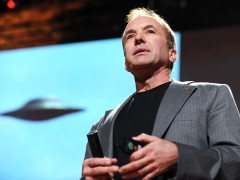
    Michael Shermer: The pattern behind self-deceptionMichael Shermer: The pattern behind self-deception

    In his talk, “The pattern behind self-deception,” Shermer debunks superstitions and urban legends and shares why we are prone to believe in thembecause of our brain’s hardwiring for survival. He explores what is behind our shared desire to believe, even when it means actively deceiving ourselves — and potentially others.

    Today, TED Weekends on the Huffington Post features Shermer’s compelling talk. Below, find some of our favorite essays that accompany it, taking a look at deceptive tendencies.

    Michael Shermer: Why We Deceive Ourselves (Sometimes)

    As the publisher of Skeptic magazine I am often asked what I mean by skepticism, and if I’m skeptical of everything or if I actually believe anything. Skepticism is not a position that you stake out ahead of time and stick to no matter what.

    Consider global warming: Are you a global warming skeptic? Or are you skeptical of the global warming skeptics? In this case, I used to be a global warming skeptic, but now I’m skeptical of the global warming skeptics, which makes me a global warming believer based on the facts as I understand them at the moment. The “at the moment” part is what makes conclusions in science and skepticism provisional.

    Thus, science and skepticism are synonymous, and in both cases it’s okay to change your mind if the evidence changes. It all comes down to this question: What are the facts in support or against a particular claim? Read the full essay » 

    Laura Cococcia: Santa, Self-Deception, and the Survival Instinct

    It takes almost no effort to make a child believe in Santa Claus. Step one? Put some presents under a Christmas tree every year. Step two? Tell the child that Santa Claus put them there. Result? You’ve got a Santa-believer on your hands, and you have evolution to thank for it.

    Belief is the topic of science writer and historian Michael Shermer’s TEDTalk on the patterns and Darwinian instincts behind self-deception. Even as a noted skeptic — in fact, as editor-in-chief of Skeptic magazine — Shermer asserts that belief is the natural human state, and that it is science and reason that seem unnatural to us. During his time on the stage, he pulls away the curtain that divides us from our understanding of why we are prone to believe ultimately illogical, at times fantastical, things.

    Santa Claus and, as we’ll see, his mystical compatriots the Easter Bunny and the Tooth Fairy, are cultural as well as psychological phenomena that serve as apt examples of our propensity for self-deception. However, they aren’t the examples Shermer employs in his explanation. After all, their creation is too recent to represent the development of belief. He must travel a long way back in time. Read the full essay » 

    Laura Kray: What if…

    “Jamal Malik is one question away from winning 20 million rupees. How did he do it? (A) He cheated, (B) He’s lucky, (C) He’s a genius, and (D) It is written.” — Slumdog Millionaire, 2008

    In the opening scene of the critically acclaimed film, a title card appears on the screen to raise the possibility that fate has intervened to guarantee that an uneducated orphan from the slums of Mumbai will defy the odds and become a game show champion. Throughout the film the possibility that Jamalʼs quest would end in failure looms large. Ultimately, the sheer improbability of his success suggests the universe conspired to provide a set of questions that he was uniquely suited to answer. In so doing, Jamal was reunited with Latika, his first and only true love, and his romantic destiny was fulfilled. Viewers are left with the sense that something so improbable could not have happened by chance alone, and the underdogʼs fate must have been written in the stars. Indeed, the filmʼs immense popularity is most likely enhanced by its universally appealing storyline: seemingly random and disconnected events are, in some unfathomable sense, intertwined by fate.

    As a researcher at UC Berkeleyʼs Haas School of Business, I study how people reflect on fateful experiences to construct the story of their lives. Let me ask you, have you ever considered how your life would be different if certain pivotal experiences, or turning points, hadnʼt occurred? The scientific term for reflecting about “what might have been” is counterfactual thinking. It turns out that, rather than immobilizing us with regret, actively “what iffing” can help us to see our destiny more clearly. Even painful experiences, like loss of loved ones, can come to be appreciated for the growth and learning that they brought about by imagining how your life would be different had these events not occurred. Read the full essay » 

  • Google Glass: prototyped using binder clips and clay

    You may have heard of Google Glass — a new venture by Google, where a user wears a head-mounted display (think, futuristic sunglasses) that overlays digital information and images onto the physical world.

    Tom Chi was on the team that developed Google Glass, and spoke about the experience at TEDYouth. In this newly released TED-Ed lesson, “Rapid prototyping Google Glass,” Chi shares how the team greatly sped up their process of creation.

    This method goes by the name of “rapid prototyping,” and it is just what it sounds like. While you might guess that Google Glass took months, even years, to create, the prototype for the headset was made in a single day. And when it came time to take the technology to the next level and prototype projections for the device, Chi’s team did so in just 45 minutes.

    Chi’s team made these prototypes using some very unsophisticated materials– ones that expedited the process and didn’t require overthinking. For the headpiece, Chi used pieces of clay that weighed the same amount as the electronic pieces that would be used in the product. He wrapped the clay in paper and attached it to the modeling wire — and voila, makeshift glasses. From this, he was able to determine how the weight needed to be distributed between the nose and ears on this distinctive headpiece.

    To prototype the projections, Chi’s team used binder clips, hairbands, a white board and chopsticks. Thanks to these materials, the team was able to practice the movements of playing with the projections, and realized that they weren’t something they wanted to include in the final Google Glass product after all.

    “Doing is the best kind of thinking,” says Chi of rapid prototyping, “They teach you to think in school, but I think it’s a little bit overrated.”

    Rapid prototyping isn’t just useful for the scientist, Chi emphasizes, but also for poets, artists and musicians – anyone who feels they want to share something and needs to build an instant framework for it. It’s as simple as using some paper, clay and tape to advance the idea.

    Read more about technology on the TED Blog » 

  • Dust to dust: TED Fellow Adital Ela makes products from compressed dirt

    In this talk from TEDxJerusalem, TED Fellow Adital Ela shares her journey in sustainability. While traveling in India, she came across a chai vendor who sold his tea in small, clay cups that patrons could use and then simply toss on the ground when they were done. These cups didn’t create any waste, because it was earth returning to earth. This sparked a question for Ela: “How can products, like people, come from dust, and return to dust?”

    Ela held this question in her mind for 10 years. Her exploration of it led her across many Middle Eastern countries on a mission to make products out of compressed earth and agricultural waste. A self-proclaimed designer-gatherer, her title is as organic in nature as her found materials.

    Terra-stollsEla’s first product for her line, Terra by Adital Ela, was a stool made from dirt heaps that construction sites had dumped in the forest. Upon sharing this innovation with her father, she learned that she wasn’t the first in her family to make use of the earth this way. Her Iraqi grandmother had made her own oven from dirt turned to clay. This solidified Ela’s mission: to combine her heritage with the science of production for ultimate sustainability.

    Making a Terra stool creates no pollution. It requires no energy and uses only local and organic materials. If a stool is no longer useful, the owner can simply leave it in the garden and let it deteriorate back into the earth. Or they can add water and mold it into another functional object.

    But these stools are only the first step for Ela. She wants to teach this technique for making objects to others. This means not only selling Terra kits, with recipes and molds. She is also preparing to launch a pilot program in Jerusalem of Terra workshops, which she hopes will spread in a franchise-like manner, Eventually, she wonders: could this be a source of income for income deprived communities?

    Read more about TED Fellows and their fascinating projects here » 

  • Charity Tillemann-Dick shares the harrowing story of living between life and death

    At TEDMED 2010, opera singer Charity Tillemann-Dick told the story of a revolutionary, life-changing surgery — a double lung transplant. While a doctor had warned her that she would never sing again, Charity Tillemann-Dick: Singing after a double lung transplantCharity Tillemann-Dick: Singing after a double lung transplantshe revealed what it felt like to get her voice back. “We need to stop letting disease divorce us from our dreams,” she said.

    Now, three years after her first transplant (she has since had another), Tillemann-Dick has given a second talk, “Discourses from the undead,” filmed at TEDxMidAtlantic in December. In the talk above, she takes a stark look at death. sharing the vivid dreams that she had while she was in an unconscious state after her surgery — a time when her doctor said that survival was unlikely. Having “spent many a night in death’s guesthouse,” Tillemann-Dick  shares meaningful lessons that she believes to be from the next world, and gives thanks.

    “While [death’s] sting is real, good can come from it,” she says. “Death is as much a part of life as love, birth and happiness.”

    Far too few people are organ donors, and Tillemann-Dick attributes this not to disregard but to our lack of conversation about death. She says it’s time to talk about death. Will you join her?

  • A chef, a writer, a TV host — TED Fellow Eddie Huang is much more than all three in one

    Eddie-Huang

    Eddie Huang might be the TED Fellows’ first working chef. Then again, he might be a few other things too. Huang “defies description,” according to a feature last week in The New York Times. The profile captures his refusal to be categorized in any manner – be it by his Taiwanese heritage, by his deep love of hip-hop or by his status as a triple-threat chef, writer and television host.

    Yes, Huang is a chef — he pioneered Cheeto-fried chicken and is the chef and co-owner of the New York City Taiwanese bun shop BaoHaus. However, as Huang tells the Times, “I have more to say as a writer than from behind a wok.”

    Huang writes the blog Fresh Off the Boat, where he discusses everything from race representation in shows like Girls to what it was like growing up in suburban Orlando. And tomorrow, Random House will release his memoir, also called Fresh Off the Boat, which fellow chef Anthony Bourdain describes as “mercilessly funny.”

    Last October, Vice launched Huang’s exploratory food and travel show, also titled Fresh Off the Boat — an online series with new segments every week. And to further complicate his classification, Huang was also once a corporate lawyer and, after being laid off, turned to stand-up comedy.

    “My only goal as a comedian was to stomp the life out of the model-minority myth,” Huang tells the Times. “I want to prove you don’t need to have academic syntax to be intelligent.”

    Read lots more about TED Fellows »