Author: Sufiy

  • China, Oil and Lithium: Beijing to mass produce electric cars TNR.v, CZX.v, RM.v, LMR.v, LI.v, WLC.v, F, BYDDY, NSANY, DAI, RNO, GM, HEV, AONE, LUN.to

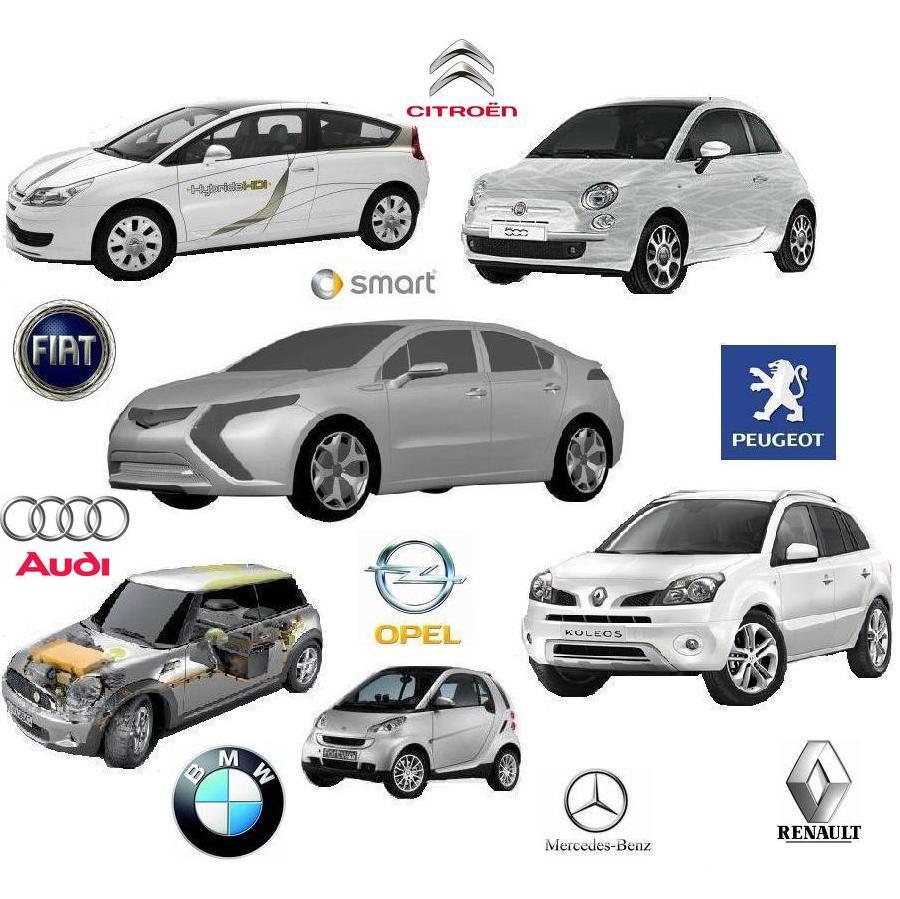
    After groundbreaking Toyota move with Tesla, Daimler is pushing its way into Electric Cars mass market and in Asian market with BYD. Companies have announced a few cooperation ideas before and now it is the time is for the bold action and they are establishing a J/V. Auto Majors are buying time in Electric Car market battle field. Nissan is a clear leader on the pricing side for EV now and GM Volt will be first to market with Range Extender model alongside with BYD. Toyota has lost its time on Soft Hybrid side and Daimler was very cautious with its engagement in Electric Cars as well. Daimler has made an impressive Electric show at Frankfurt Motor Show last year, but real things were among Hybrids and Smart Electric to test the grounds with small town car. This concept model above was still at the prototype level at that time. Now BYD will get premium auto brand, safety and mass production technology and Daimler will get access to batteries, low cost production base and the market.


    Competition for Oil is heating up and aggressive move by China into Electric Cars leaves no other options for US than to follow. In order to keep power China needs gradually improve standard of living, it will bring upside pressure on labor cost. Electrification will not only provide Energy Security to China, but will significantly reduce the cost of its transportation element and provide another opportunity to stay among low cost producers. Situation is completely different to U.S. – they have capital to invest in Electric Mobility CAPEX now and rip the rewards of lower cash cost on transportation side later. We will refer you to the Economics of Electric Cars.
    Recent Ash Cloud events in Europe brought a very sobering sense of the feeling to be grounded. It is amazing how many things are taking for granted. This time it is Ash Cloud – what will happen with oil above 150?
    Electric Cars is the only commercially viable technology today to sustain mobility world wide with rising Oil prices. Lithium is at the heart of Green Mobility revolution – it is an industry adopted standard for batteries and billions of dollars are invested into battery technology and upcoming by the end of this year Electric Cars on a mass market scale. This Bull market is still very young – only a year or so from the beginning after the crash of 2008.”

    The Malay Mail:

    Submitted by amir azree on Friday, May 28th, 2010
    Friday, May 28th, 2010 11:04:00

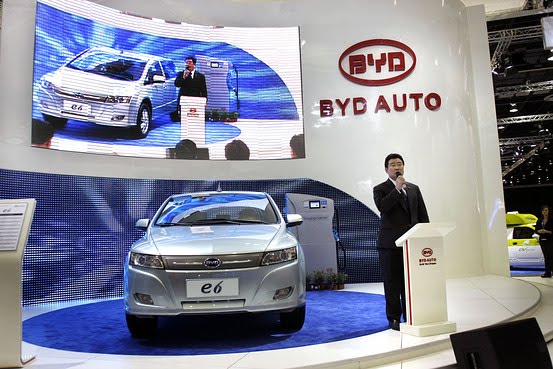
    ENVIRONMENT FRIENDLY: The BYD Auto on show at the company’s factory in Shenzhen
    FRANKFURT: Chinese auto group BYD (Build Your Dreams) and German luxury car maker Daimler announced yesterday a joint venture to mass produce an electric car in China. A new research and development group to be called Shenzhen BYD Daimler New Technology Company will get an initial investment of around US$87 million (RM286m), a Daimler statement said. “We are well-placed with our new joint venture to make the most of China’s enormous potential in electromobility,” Daimler chairman Dieter Zetsche said. Daimler is to bring “knowhow in vehicle architecture and security” to the venture , while BYD will contribute “its competence in batteries and propulsion systems for electric vehicles,” the statement added. The world’s oldest automaker and one of the youngest aim to market the vehicle under a new jointly-owned brand, joining forces to target China’s fast expanding urban market. Around 16 million autos are currently sold across the country each year. Launched just seven years ago, BYD Auto now claims to be the sixth biggest car maker in China and its future plans are focused on electric or hybrid vehicles, building on the experience of its battery-making parent group. The Chinese firm, in which US billionaire Warren Buffett holds a stake of 10 per cent, has already begun to sell its electric E6 model as a taxi in the southern city of Shenzhen and aims to distribute the car in Europe next year.”
  • EVs mass market: $10k Electric car tax break proposed TNR.v, CZX.v, RM.v, LMR.v, WLC.v, LI.v, CLQ.v, SQM, FMC, ROC, NSANY, BYDDY, F, GM,

    DetNews.com:
    Chevy Volt, Nissan Leaf buyers in select cities would get $10K incentive under Senate plan
    David Shepardson / The Detroit News
    Washington — Buyers of the Chevrolet Volt and Nissan Leaf would be eligible for a $10,000 federal tax credit in some cities under a $10 billion Senate plan to boost electric vehicles.
    House and Senate members on Thursday released similar plans intended to make electric vehicles more than niche models.
    The House version would spend $6.6 billion, dedicating $800 million to five “deployment communities” to speed 700,000 plug-in vehicles into use and establish recharging networks. A Senate version would spend about $10 billion and grant $250 million to up to 15 communities.

    The Senate version would extend the current $7,500 tax credit for 200,000 plug-in vehicles per manufacturer to 300,000. And it would boost the credit to $10,000 in those 15 communities.
    That would further reduce the cost of the Volt, which will get up to 40 miles on a charge, and the fully electric Nissan Leaf, which will get up to 100 miles.
    General Motors spokesman Greg Martin praised the bills.
    “We appreciate Congress’ foresight and interest in electric vehicles,” he said. “With the Chevrolet Volt just months away from the showroom, we believe the timing is right to start working on policies that can accelerate early consumer adoption of advanced electric vehicle technologies.”
    Electric vehicles enjoy widespread support across the political spectrum.
    “Republicans and Democrats agree that electrifying our cars and trucks is the single best way to reduce our dependence on oil,” said Sen. Lamar Alexander, R-Tenn., one of the sponsors.
    Both bills would set aside billions more for research into batteries, research and tax credits.
    The Senate bill also would create a $10 million prize for the first manufacturer of a battery that can get 500 miles on a charge.
    Congressional aides have spent several months writing the bills. Members cited the recent Gulf oil spill as a factor in the urgent need to shift vehicles from oil to electric power.
    Rep. Ed Markey, D-Mass., noted that the United States has 2 percent of the world’s oil reserves but consumes 25 percent of the world’s oil.
    “This isn’t a question of if, but when,” Markey said, adding the bill would speed up the widespread use of electric vehicles. “It will drive the creation of jobs, domestic manufacturing and homegrown innovation.”
    The Senate bill would require that one of the 15 deployment communities be a rural area of fewer than 125,000 people and would “reflect diverse populations” and geography.
    The Senate bill sets aside another $2 billion for grants and cost sharing — local communities would have to provide 20 percent of the funding.
    Communities and their business and utility partners would have to apply for inclusion.

  • US Dollar Collapse: Reversal in Confirmation TNR.v, CZX.v, GRC.to, NGQ.v, GBN.v, ASM.v, EPZ.v, KTN.v, FVI.to, MGN, VTR.v, GDX, SLV, HUI, XAU, BTT.v,

    We will speculate on the real events behind the scene on a day of Cyber Meltdown: spectacular Dow Crash by the magnitude of 1000 point in fifteen minutes. We will develop a very strong argument in favour of Inflation and its cost based on PhD Thesis: At what point price of Oil becomes prohibitive to use Helicopters by Ben Bernanke in his open market operations. We will draw some lines on How Lithium, Gold and price of Oil are connected and what it means to be grounded. In the end we will leave you with the question: Where to invest – In Ben Bernanke, Ink Factory, Helicopters, Oil or Gold and Lithium?
    Our memories from 2008 meltdown and the
    last deflation strike in March of last year are still too vivid for us to stay rational amid recent market panic of this week. Was it the fat finger, Cyber Meltdown or revenge of the Government Sachs, which was striped of its Olympus glamour is not so important – the most important message is the reaction of the Market itself and actions of the people in charge to follow.”

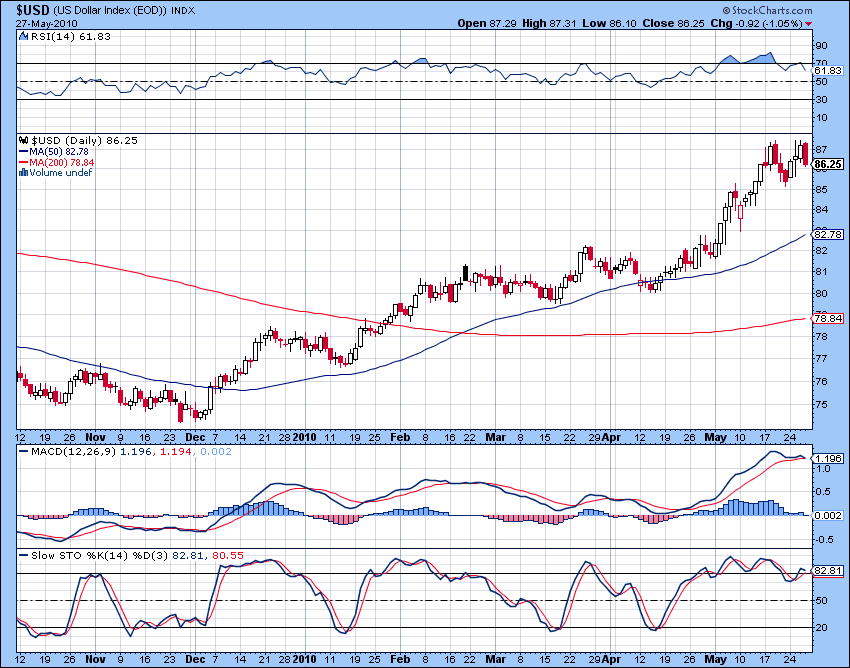
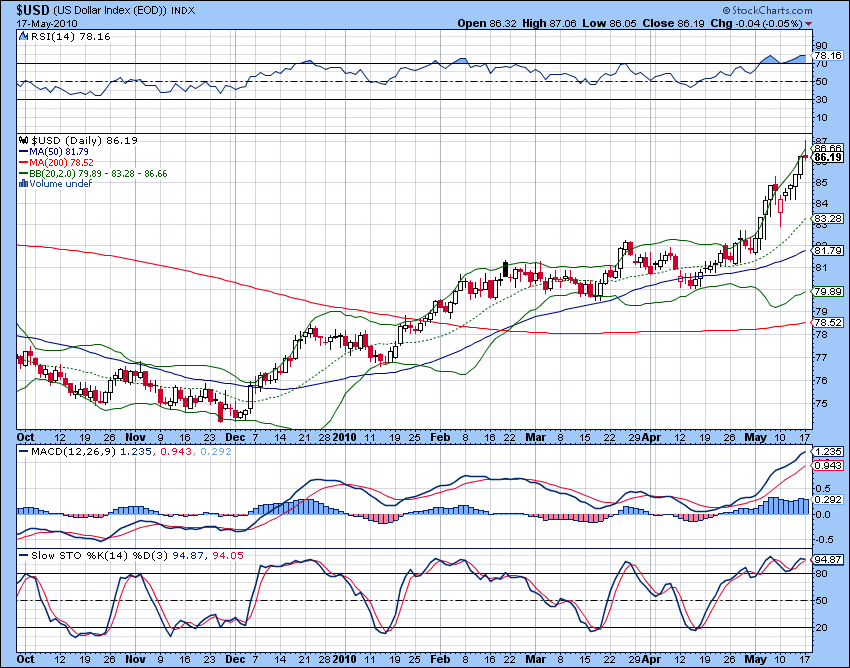
    We have further confirmation of US Dollar Bearish reversal with double Top in the making now. We need to clear 85.17 on the down move to make it decisive. China’s confirmation of confidence in Euro was the last shoe to drop for Green Fellow levitation: as you can see below it was a very expensive exercise. Markets were again in a free fall and they better stop now at the key technical levels. Second Deflation Scare episode is almost over and price will be paid by further debasement of all currencies against the Gold, Silver and Oil amongst other commodities.

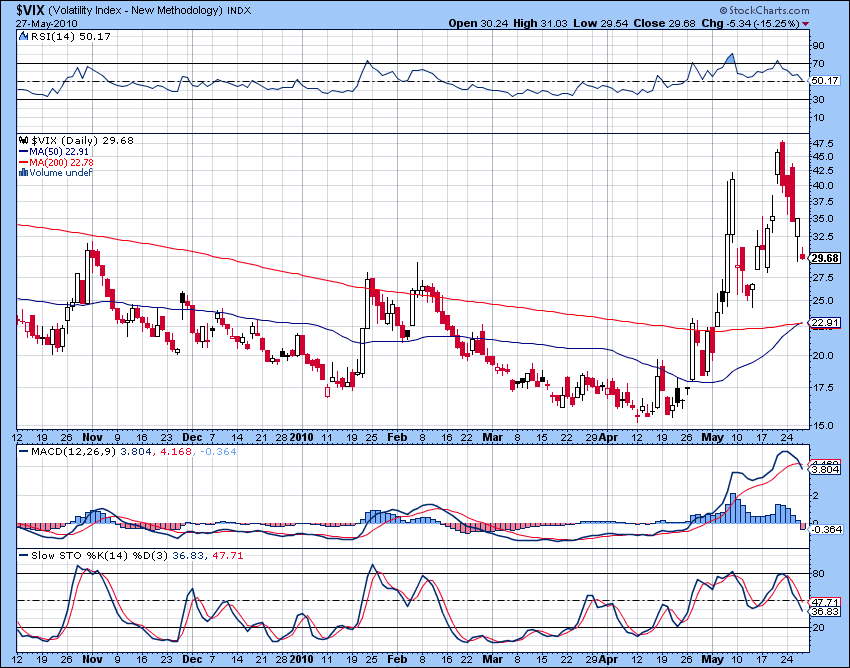
    Dow is in Bullish Reversal now at the key technical level confirming the third test of the lower band of recent trend. We have a very bullish candle two days ago and yesterday the level was retested by late day selling. Today’s action provides another confirmation for Deflation Scare to be subsiding and Euro panic is slowing down with news from China, declining review of SAFE Euro holdings. Fear index below is confirming its Reversal and appetite for Risk assets will be coming back with further improvement in indicators fooled by flood of liquidity provided. Euro bail out with almost 1 Trillion in USD terms and QE on the run have shadowed domestic bills for another 30 billion in Job support program and further requests for capital from bottomless Freddy and Fannie.


    Risk appetite is coming back and this Summer can be really Hot in some sectors, we think that Oil starting from 70 USD now after this Second Deflation Scare on sovereign default will provide necessarily catalyst for the move above 90 USD. Our Lithium play will be enjoying next bull leg up with oil passing north of 80 USD.
    “Recent Oil Spill shows the real price for Oil and leaves no doubt for us that there will be no more cheap oil: offshore drilling is costly now, it will be even more costly later. Relatively cheap Oil is in the hands of state owned companies in not so friendly to U.S. places. Oil squeeze will come from diminishing production rates and rising Inflation. The move will be even more explosive than in the Gold market – in the end only minority of people is effected by the gold price even now, Oil is the underlining of all Western Energy Diet. It is not sustainable. Emerging markets are taking more and more share of world wide production, oil producing countries are spending more at home. If you account all cost to produce, deliver and protect Oil supply to U.S. corp the price is already above 150 USD/barrel.
    Peak Oil and Lithium: Joint Operating Environment 2010
    Please pay attention,
    this report is written by those who knows the Real Price of Oil. If you account all military needed to protect Oil supply lines and cost of wars to get more oil, price will be well above 150 USD/barrel already. Now we all have another problem: there is simply no more oil enough for all. Will future wars for oil be the only answer?”
    Another “liberation” operation like Iraq, this time against Iran will break the camel’s back with no return point. Competition for Oil is heating up and aggressive move by China into Electric Cars leaves no other options for US than to follow. In order to keep power China needs gradually improve standard of living, it will bring upside pressure on labor cost. Electrification will not only provide Energy Security to China, but will significantly reduce the cost of its transportation element and provide another opportunity to stay among low cost producers. Situation is completely different to U.S. – they have capital to invest in Electric Mobility CAPEX now and rip the rewards of lower cash cost on transportation side later. We will refer you to the
    Economics of Electric Cars.
    Recent Ash Cloud events in Europe brought a very sobering sense of the feeling to be grounded. It is amazing how many things are taking for granted. This time it is Ash Cloud – what will happen with oil above 150?
    Electric Cars is the only commercially viable technology today to sustain mobility world wide with rising Oil prices. Lithium is at the heart of Green Mobility revolution – it is an industry adopted standard for batteries and billions of dollars are invested into battery technology and upcoming by the end of this year Electric Cars on a mass market scale. This Bull market is still very young – only a year or so from the beginning after the crash of 2008.
    We will provide you with few links to study the subject further:”
  • TNR Gold Corp. Updates Meeting Date for Approval of Spin-Out of International Lithium Corp. and Record Date TNR.v, CZX.v, NG.to, WLC.v, CLQ.v, RM.v, F

    TNR Gold Corp. Updates Meeting Date for Approval of Spin-Out of International Lithium Corp. and Record Date

    Press Release Source: TNR Gold Corp. On Wednesday May 26, 2010, 8:27 pm EDT
    VANCOUVER, BRITISH COLUMBIA–(Marketwire – May 26, 2010) – TNR Gold Corp. (“TNR” or the “Company”) (TSX VENTURE:TNRNews) is pleased to announce that further to its news release on April 12, 2010, we have changed our meeting date to June 22, 2010 for shareholder approval of the previously announced (April 27, 2009) spin-out of TNR’s lithium and rare metal assets into its wholly-owned subsidiary, International Lithium Corp. (“ILC”) under a court approved plan of arrangement. TNR shareholders of record on the date of the spin-out, planned for July 2010, will receive one share and one fully tradeable warrant of International Lithium Corp. for every 4 shares of TNR held.
    The spin-out is subject to the approval of the TSX Venture Exchange, the B.C. Supreme Court and shareholders of TNR. TNR shareholders were mailed an information circular today describing the key terms of the proposed spin-out with a planned completion within 60 days of the meeting date. The documents, including the signed Arrangement Agreement, were filed on SEDAR on May 25, 2010. We encourage all interested parties to review the Arrangement Agreement and Information Circular in their entirety on our website or SEDAR. A link for this information is as follows:

    ABOUT INTERNATIONAL LITHIUM CORP. / TNR GOLD CORP.
    International Lithium Corp., currently a wholly-owed subsidiary of TNR, is a mineral exploration company diversified geographically and by resource type. With projects spanning the globe from Argentina, USA, Canada, and Ireland, ILC will offer investors the potential upside of rapid advancement of ILC’s lithium brine projects and recognized valuation of ILC’s rare metals pegmatite projects.
    TNR is a diversified metals exploration company focused on identifying and exploring its existing properties and identifying new prospective projects globally. TNR has a total portfolio of 18 projects, of which 9 will be included in the proposed spin-off of International Lithium Corp.
    The recent acquisition of lithium and other rare metals projects in Argentina, Canada, USA and Ireland confirms TNR and ILC’s commitments to generating projects, diversifying their markets, and building shareholder value.
    On behalf of the board,
    Gary Schellenberg, President
    Statements in this press release other than purely historical information, historical estimates should not be relied upon, including statements relating to the Company’s future plans and objectives or expected results, are forward-looking statements. News release contains certain “Forward-Looking Statements” within the meaning of Section 21E of the United States Securities Exchange Act of 1934, as amended. Forward-looking statements are based on numerous assumptions and are subject to all of the risks and uncertainties inherent in the Company’s business, including risks inherent in resource exploration and development. As a result, actual results may vary materially from those described in the forward-looking statements.
    CUSIP: #87260X 109
    SEC 12g3-2(b): Exemption #82-4434
    Neither the TSX Venture Exchange nor its Regulation Services Provider (as that term is defined in the policies of the TSX Venture Exchange) accepts responsibility for the adequacy or accuracy of this release.”
  • Canada Zinc Metals arranges $3-million placement CZX.v, TNR.v, BLS.to, LUN.to, QUA.to, FCX, CUU.v, DON.v, BWR.to, CS.to, BHP, RTP, RIO, IMN.to,

    2010-05-27 07:44 ET – News Release
    Mr. Peeyush Varshney reports
    CANADA ZINC METALS ANNOUNCES NON-BROKERED PRIVATE PLACEMENT
    Canada Zinc Metals Corp. has arranged a private placement of five million units at a price of 60 cents per unit for gross proceeds of up to $3-million.
    Each unit will consist of one common share and one-half share purchase warrant of the company. Each whole warrant will entitle the holder to purchase one additional common share at a price of 80 cents for a period of 18 months from closing.
    A finder’s fee of 7 per cent will be paid on the private placement. The private placement is subject to TSX Venture Exchange approval.
    The proceeds of the private placement are anticipated to be used for further exploration of the Akie Sedex zinc-lead deposit and for working capital purposes.
    About the Akie and Kechika regional properties
    The Akie zinc-lead property is situated within the southernmost part (Kechika trough) of the regionally extensive Paleozoic Selwyn basin, one of the most prolific sedimentary basins in the world for the occurrence of Sedex zinc-lead-silver and stratiform barite deposits.
    Drilling on the Akie property by Inmet Mining Corporation during the period 1994 to 1996 and by Canada Zinc Metals since 2005 has identified a significant body of baritic zinc-lead Sedex mineralization (Cardiac Creek deposit). The deposit is hosted by variably siliceous, fine-grained clastic rocks of the Middle to Late Devonian Gunsteel formation. The company has outlined an NI 43-101-compliant inferred resource of 23.6 million tonnes grading 7.6 per cent zinc, 1.5 per cent lead and 13.0 grams per tonne silver (at a 5-per-cent zinc cut-off grade).
    Two similar deposits, Cirque and Cirque South Cirque, located approximately 20 kilometres northwest of Akie and owned under a joint venture by Teck Resources and Korea Zinc, are also hosted by Gunsteel rocks and have a combined geologic inventory in excess of 50 million tonnes (not 43-101-compliant) grading approximately 10 per cent combined zinc and lead.
    In addition to the Akie property, Canada Zinc Metals controls a large contiguous group of claims which consist of the Kechika regional project. These claims are underlain by geology identical to that on the Akie property (Cardiac Creek deposit) and Cirque. This project includes the 100-per-cent-owned Mt. Alcock property, which has yielded a historic drill intercept of 8.8 metres grading 9.3 per cent zinc and lead, numerous zinc-lead-barite occurrences, and several regional base metal anomalies.
    All of the company’s claims (77,889 hectares), with the exception of a small isolated block (2,293 hectares), are in good standing, under the provisions of the Mineral Tenure Act of British Columbia, until Dec. 8, 2018.”
  • Lithium Batteries Powering Ten Percent of Autos by 2020 TNR.v, CZX.v, RM.v, LMR.v, WLC.v, CLQ.v, LI.v, SQM, FMC, ROC, FCX, BHP, LUN.to, NG.to, NSANY,

    This report continues our quest in Electric Cars adoption rate scenarios:
    As you can see above, explosive growth in some sectors can happen even when economy is slowly growing as a whole. Authors of the Deloitte study very carefully took into consideration a lot of different aspects for adoption of the new technology like Electric Cars. Have they missed something? Maybe not when we are talking about U.S. in a “normal situation”, but we are living in a “New Normal” according to PIMCO. Charts above and below bring us some more dimensions for thoughts. It is growth of Oil consumption in China from 1965 and below is Rate of this Growth compare to other countries. We will bring a new factor into the growth valuation for EVs – what if there is no more Cheap Oil left and how it feels to be grounded? We will address you to the Life After Oil and other thoughts on the Peak Oil.


    LithiumInvestingNews:

    Lithium Batteries Powering Ten Percent of Autos by 2020

    By Dave Brown – Exclusive to LithiumInvestingNews.com

    The Royal Academy of Engineering has issued a report that suggests hybrid and electric cars may grab as much as 10 percent of the European automobile market by 2020. The largest impediments for this forecast appear to be cost hurdles, standardized regulations, and infrastructure investments.
    The report points out that the reserve base represents sufficient lithium for a billion EV batteries, meaning that lithium shortages do not appear imminent and the diversity of possible battery chemistries suggests that a shortage of battery materials is unlikely. In addition to the lithium based batteries, which currently appear to be the industry’s state of the art technological benchmark, energy storage sources might potentially include lead, nickel, sodium, and zinc-based chemistries.
    The report identifies four technical issues: availability of high energy-density batteries at a practical price, feasibility of charging vehicles, infrastructure implementation, and a ’smart grid’ that can recharge millions of electric vehicles using low-carbon electricity. The current contribution of renewable and low-carbon generation to the United Kingdom’s energy supply is one of the lowest in Europe. If the country intends to meet its renewable energy targets, a range of new low-carbon sources will be needed, including new nuclear power stations, wind farms, and tidal barrages.
    Last October, a study conducted by PricewaterhouseCoopers LLP indicated that automobiles manufacturers are set to introduce 42 electric models worldwide by 2012″
  • Powered by Lithium: Nissan CEO Ghosn Sticks With Bullish Electric-Car Forecast TNR.v, CZX.v, RM.v, LMR.v, WLC.v, LI.v, SQM, FMC, ROC, NSANY, BYDDY, F,

    This devise above is the basis for the Next Big Thing and we have it at every home which can afford to buy any car now.


    Now we need these cars to be on the road and drive the market.

    The main open question is: will Electric Cars’ adoption rate be correlated with Washing Machines’ one or will it enjoy more explosive growth like Mobiles with rate of acceleration like iPods on the chart below? First, we will strike brutally and cynically (the way the Wall Street works): how can you compare washing machines and Cars? Even Electric ones? Cars are all about men, their personal social security space with a statement. How many of us discussed washing machines even the best ones? Brutal history about washing machines is that it was for the “best part” – to make her life better, it was not about status and not about statement – so it took 80 years to get to the 80% adoption rate. On a more serious note time has changed: it will not be about him all the time this time and it is not about U.S. only this time, but first back to iPod Moment.”

    WSJ:

    Carlos Ghosn, credited with turning around ailing Nissan a decade ago, said today he’s confident sales of electric cars will account for 10% of the market by 2020. He isn’t worried by naysayers who, he says, are often car makers who simply aren’t prepared to compete in the rising electric segment.
    The Nissan and Renault CEO said in a meeting with Wall Street Journal editors and reporters that the two car companies plan to roll out several electric models in the next few years. If anything, he says, that pace may still be too slow because demand for electrics is almost certain to accelerate once consumers see them in action. His biggest worry: that demand for electric vehicles “will take off faster than expected and we will be under capacity.”
    So why he so bullish on electric cars when many analysts and industry watchers predict they will account for only about 2% of the market in 10 years? Part of the reason is infrastructure. Ghosn says Nissan is pursuing agreements with governments and businesses to install charging stations in parking garages, shopping areas, office parks and elsewhere so drivers won’t have to worry as much about range, a nagging disadvantage for electrics compared with gasoline-powered cars.
    Ghosn also says there are charging systems in development that can cut the time it takes to recharge electric car batteries from hours to minutes. Nissan is focused on the U.S. launch in December of the Leaf, an electric sedan with a range of about 100 miles. Ghosn says the company is in contact with 130,000 “hand raisers” — people who have expressed interest in the Leaf, and 13,000 advance orders for the car. He says these numbers represent individual consumers, not government and corporate fleets.”
  • China will award buyers of green cars with subsidies of up to 60,000 yuan ($8,789) each TNR.v, CZX.v, RM.v, LMR.v, WLC.v, LI.v, CLQ.v, SQM, FMC, ROC,

    Nothing will be left to chance: China has carefully planed and now is executing its strategy in Electric Car space. Now we have another confirmation about State level shift in technology from China.
    Two charts show the dynamic of China’s expansion into auto space reflecting the explosive Oil Consumption Rate of Growth above. This is why it will be not about only U.S. this time, but every move in China will affect U.S.”
    Two most important points from here: Oil Consumption will go up dramatically with declining production, without major State level shift in technology China and India will not be able to bring mobility to its population without suffocating its own people and along the way they will drive prices for Oil above USD150 again.”


    Reuters:

    Mon May 24, 2010 12:23am EDT
    SHANGHAI, May 24 (Reuters) – China will award buyers of green cars with subsidies of up to 60,000 yuan ($8,789) each, the Shanghai Securities News said on Monday, as it steps up efforts to cut emissions in the world’s biggest auto market.
    Stocks Global Markets Cyclical Consumer Goods
    The Chinese government has worked out a plan to subsidise green car buyers and will unveil details by the end of this month, the newspaper said, citing people with knowledge of the matter.
    Subsidies will be based on the performance and energy-savings efficiency of the models, the paper said.
    Maximum subsidies for buyers of pure electric vehicles is 60,000 yuan each, while those for plug-in hybrid and normal hybrid cars are 50,000 yuan and 3,000 yuan respectively, it said.
    Beijing said in December 2009 that it will subsidise green vehicle buyers in five selected cities.
    It will also expand a pilot scheme to subsidise the purchase of clean-energy vehicles for public transport fleets in 13 cities to 20 cities, it said, without giving a timetable or naming the cities. [ID:nTOE5B9033]
    Chinese automakers, unscathed by a savage global downturn, are ramping up efforts to get cleaner, low-emission vehicles on the roads, counting on the green drive to propel them into the top ranks of the global auto industry.
    From leading Chinese auto group SAIC Motor Corp (600104.SS) to rising star Geely Automotive Holding (0175.HK), indigenous players showcased a host of new green vehicles at the 2010 Beijing autoshow in April.
    Foreign automakers are also on the move. In 2011, General Motors [GM.UL] will roll out its Chevy Volt plug-in hybrid in China next year, while Nissan Motor (7201.T) will bring its electric model, Leaf, to the country. ($1=6.826 Yuan) (Reporting by Fang Yan and Jacqueline Wong)
  • Toyota and Tesla: games around Lithium: Why the Japanese automaker is looking for an electric boost. TNR.v, CZX.v, RM.v, LMR.v, WLC.v, CLQ.v, SQM, FMC

    It is a very significant development not only for Tesla, but for Toyota and EV mass market evolution. Tesla has gained more credibility with this move and it is all about Tesla S model mass production. Roadster was making headlines, but not sales numbers. Tesla S promised to be a 5 seater with more than 200 miles range and price tag of 50000USD. It will not be able to compete with Nissan Leaf at USD25000 after federal tax rebate, but it is the move into right direction. Now apart from Mercedes, Tesla can count on Toyota’s expertise in safety, mass production and cost control. Toyota way into EV space is not straight forward, it is the case when actions are more significant than words and sometimes words could be misleading. Toyota announced last September that after years of research they do not see Lithium batteries as a commercial choice for Hybrids at the moment. Lithium juniors crashed with the news hitting the wires. After that surprisingly Toyota place on display a few advanced models of Hybrids and plug-ins with lithium batteries an Frankfurt Motor show 2009. Toyota engineers at the show were talking about clear advantage for use of Lithium batteries. Later 2009 Toyota trading house took a stake in upcoming Lithium developer Orocobre Resources with lithium brine salar in Argentina. Now they have quickly moved into Tesla buying the time and expertise on lithium battery side and controlling systems. It has happen just weeks after the usual bashing of EVs and that Hybrids are the only way in the future.”

    Now we have another EV in the picture – it is Toyota’s concept Plug-In EV with lithium battery. Lithium based battery chemistry is an industry adopted standard now in EV space and Nissan Leaf is the price leader with its price as low as 20000USD after federal and state rebates in some markets. Nissan spent more than 16 years and 5 billion dollars developing with NEC lithium batteries and Electric Cars – Toyota was concentrating on soft hybrids with small batteries and has lost advantage of first mover into the hybrid space. Tesla could bring the battle back close to the US market – where place will be for Tesla S and Toyota EV following the market leaders (as we think) Nissan Leaf and GM Volt.

    Forbes:

    Joann Muller, 05.21.10, 06:32 PM EDT
    Why the Japanese automaker is looking for an electric boost.
    It’s tough to say which company will benefit most from the new partnership between Japanese automotive giant Toyota Motor and American electric car upstart Tesla Motors.
    In a surprise announcement the companies said they will cooperate on the development and production of electric vehicles and components, and that Toyota will buy a $50 million stake in Tesla when it goes public in the near future. Tesla also said it had purchased Toyota’s former NUMMI factory near Silicon Valley.
    The partnership undoubtedly boosts the credibility of Palo Alto, Calif.-based Tesla. Despite lots of hype about its battery-powered sports cars, many people have doubted whether Tesla has the capital or know-how to become anything more than a niche manufacturer. “Toyota must have conducted substantial due diligence before making this investment,” said John O’Dell, senior editor of GreenCarAdvisor.com.
    Toyota, meanwhile, gets to tap into Tesla’s “coolness” factor–a quality sorely missing from the maker of stodgy Camrys and Corollas–and recapture some of its entrepreneurial legacy. “Toyota would like to learn from the challenging spirit, quick decision-making, and flexibility that Tesla has,” said President Akio Toyoda, who has said one reason for Toyota’s current quality woes is that the company has grown too big and sluggish. “By partnering with Tesla, my hope is that all Toyota employees will recall that ‘venture business spirit,’ and take on the challenges of the future.”
    Odd as it might seem for the world’s leading manufacturer of hybrid vehicles, Toyota also has some catching up to do when it comes to fully electric cars. Both Nissan and General Motors plan to introduce plug-in EVs in the U.S. before the end of this year. Toyota, meanwhile, intends to offer a short-range, electric commuter car and a plug-in Prius hybrid in the U.S. in 2012. By teaming up with Tesla, whose current roadster can go 245 miles on a single charge, Toyota said it will have more options. Like other large automakers, Toyota is required in places like California to offer some vehicles that emit little or no tailpipe pollution.
    Perhaps even more important, however, is how the Tesla deal helps Toyota politically.
    First, it softens the public relations blow Toyota suffered in California when it closed the NUMMI factory last month. The plant used to be a joint venture between Toyota and General Motors, but Toyota got stuck with it after GM filed for bankruptcy and a judge terminated their contract. Toyota said it could no longer afford to operate the factory alone.
    “Toyota obviously made a wise political move there,” said Sean McAlinden, chief economist for the Center for Automotive Research.
    United Auto Workers President Ronald Gettelfinger applauded the decision to revive NUMMI, which once employed nearly 5,000 people. “Our union’s hope is that this venture will give first hiring preference to former NUMMI employees who are already trained and highly skilled,” said Gettelfinger.
    Of course, a few thousand electric cars won’t make up for the 400,000 Toyotas and Pontiacs that used to come out of that factory annually under the GM-Toyota joint venture, but it’s a start. “The new Tesla factory will give us plenty of room to grow,” said Chief Executive Elon Musk, without indicating whether UAW workers would get first dibs on newly created jobs.
    Musk said Tesla will ramp up to about 1,000 jobs when it starts production in 2012.
    Toyota’s deal with Tesla ought to play well in Washington, too, where the carmaker is under siege for its handling of sudden acceleration complaints.
    U.S. policy makers have been pushing electric-car technology as a way to reduce the nation’s oil use and its dependence on foreign energy sources. By giving a hand up to an American maker of EVs, Toyota is furthering that objective.”
  • China goes Electric: BYD electric car to be sold in US for $40,000 TNR.v, CZX.v, RM.v, LMR.v, WLC.v, CLQ.v, SQM, FMC, ROC, HEV, AONE, VLNC, F, BYDDY,

    BYD claim a very impressive range on one charge with 300 km. “Super-iron battery is a Lithium Fe one. Nissan Leaf with price around 25000USD after federal tax rebate seems to be the leader on the pricing side. Its range will be around 160 km.

    Competition for Oil is heating up and aggressive move by China into Electric Cars leaves no other options for US than to follow. In order to keep power China needs gradually improve standard of living, it will bring upside pressure on labor cost. Electrification will not only provide Energy Security to China, but will significantly reduce the cost of its transportation element and provide another opportunity to stay among low cost producers. Situation is completely different to U.S. – they have capital to invest in Electric Mobility CAPEX now and rip the rewards of lower cash cost on transportation side later.

    People’s Daily Online:

    Chinese automaker BYD Auto officially delivered 30 pure electric E6 vehicles to the Shenzhen-based Pengcheng Electric Taxi Company on May 17, 2010. As the world’s first pure electric taxis, BYD E6 taxis have attracted wide attention and support from the public. BYD will start selling the E6 in the United States in 2010 for around 40,000 U.S. dollars.
    A BYD E6 electric taxiXia Zhibing, general manager of BYD Auto, said preparations for the BYD E6’s entry into the U.S. market are well under way. One of the tasks of the recently-established BYD North American sales headquarters is to sell the alternative-energy vehicles. Du Guozhong, BYD’s public relations manager, said that BYD E6 has passed all necessary tests including battery safety tests in the United States, and will go on sale in U.S. markets in 2010 for around 40,000 U.S. dollars.BYD E6 is a high-performance SUV-MPV crossover vehicle independently developed by BYD. The car is 4,560 millimeters long, 1,822 millimeters wide and 1,630 millimeters in height, with a wheelbase of 2,830 millimeters. There are only five seats in the spacious car body to ensure passengers plenty of room to sit comfortably. BYD E6 can run up to 300 kilometers on one charge, taking the lead among electric vehicles. Meanwhile, it is the pioneer of eco-friendly vehicles using a rechargeable super-iron battery and a starter battery. The super-iron battery will not cause any harm to the environment and all its chemical substances can be decomposed and absorbed harmlessly in nature, solving environmental problems including secondary resource recovery. Therefore, it is an eco-friendly battery. The super-iron battery can be charged in slow-mode with a 220V power adapter and a 3C adapter in fast charge, filled to 80 percent within 15 minutes. In terms of energy efficiency, BYD E6 consumes around 20 kWh of electricity per 100 kilometers, making it only one-third to one-fourth the cost of fuel-powered cars. In security, the super-iron batteries installed in the E6 have been proven to have excellent safety and will not cause an explosion in high temperatures, high pressure and accidents. Using penetrable side rails, it has good anti-collision performance. In terms of performance, it has a start-up time of less than 10 seconds and its maximum speed is 140 kilometers per hour.Its entry into the U.S. market in 2010 will be a historic moment for BYD Auto. The selling price is expected to decrease once the production and sales volume increases. By People’s Daily Online”
  • US Dollar Collapse: Potential Reversal GDX, HUI, XAU, FXI, TNR.v, CZX.v, GRC.to, GBN.v, EPZ.v, ASM.v, CUU.v, CPG.v, RM.v, LMR.v, GDX, GDL, SLV

    Corporate default was exchanged on sovereign one, all bailouts were not more than transferring obligations from failed banks and other Corporations to the public finance. Bonuses were left with bankers, losses were privatised with public. Now we have on outskirts of Europe with less than 4% of EU GDP fireworks which suppose to end Euro legacy in wain. Do not rush to trash the Euro yet. Sovereign default is very different from corporate one. If the debt is issued in local currency it could be always printed more in order to repay it. U.S. Corp. is living in this space for years, UK is there and Europe will have to decide and move in support of Greece to prevent the run on the bank and collapse of the following PIIGS members.

    The real drama is here above, It is Long Treasuries daily chart and it looks nervous, nobody even talks here about cuts, fiscal discipline and austerity measures. Once Europe is engaged in QE and ECB starts buying sovereign bonds from banks, attention will come back home. Recent spike in prices can be very short lived in a big picture frame.

    Nothing is for certain in these days, but that candle on the chart above can mean reversal and that Green Buck Party is over. Less bad in the end is still bad. Market is ready to forget the Greece and remember California. With all investment banks discounting euro and providing parity forecast, counter rally can be very sharp. Euro below 1.2 means Europe disintegration, there are means to prevent it and intervention is already in the cards.

    On the weekly chart US Dollar looks tired as well and with intervention in Japan and Europe reversal can easily tip the scales – remember in the end it is game to debase all FIAT currencies.
    It was second Deflationary Test with sudden drop in liquidity this time driven by sovereign debt crisis. Call it Run On The Bank among Big Guys. Fifteen minutes made no mistake about the state of the market and economy in deflationary environment – we have seen the future and it is ugly. Deflation spiral means death of financial market by thousand cuts – financial system is insolvent and the only way to run it is to keep liquidity high enough that nobody is testing it to deliver. QE will provide flood of money, debt will be rolled over and by destroying the value of FIAT currencies Debt will be Inflated out in the end. This time it is different – it is not only our theory, but confirmed market action. This time the most important here is that Gold was at almost all time high at the moment of test, Gold was moving up against all currencies and this time in a sharp contrast to the events of 2008 it was sharply up and over 1200 on the day of Market Crash. This new round of QE (when Europe has not even started!) will be going already from this very high base in Gold value and rising Inflation in Commodity and Growth driven economies. We will not go into the debt issue today in details and will only point out that it is a notch under 13 Trillion and in dangerously close proximity to 100% of GDP of U.S.
    After pictures from Greece we do not think that anybody will go there in U.S. Corp. Deflation will be prevented by any means, it is easy and price to pay is not so obvious. Newly printed US Dollars are “free”, but price to drop them is not: you need Oil to keep you helicopters flying and here will be our first conundrum: At what point price of Oil becomes prohibitive to use Helicopters by Ben Bernanke in his open market operations?”
  • Los Azules: TNR Gold Files Full Response to Minera Andes’ Statement of Claim TNR.v, MAI.to, CZX.v, NG.to, LUN.to, ABX, AUY, AEM, BVN, VALE, RTP, FCX,

    In our quest for the new Bulls ignited by Peak Oil and new disruptive transformational technologies we can not avoid old solid Copper play. Electricity is the most convenient form of energy available to us, it could be generated by using different sources, it could be transported and it could be transformed in another form of energy or to power different devices from A/C to iPod. Now we have means to store it, game has been changed in Energy Business with development of lithium batteries powerful enough for mobility applications. Electric cars is the new game in town and we have defined our Lithium Bull on supply side for Energy Storage applications.”
    “More on Los Azules
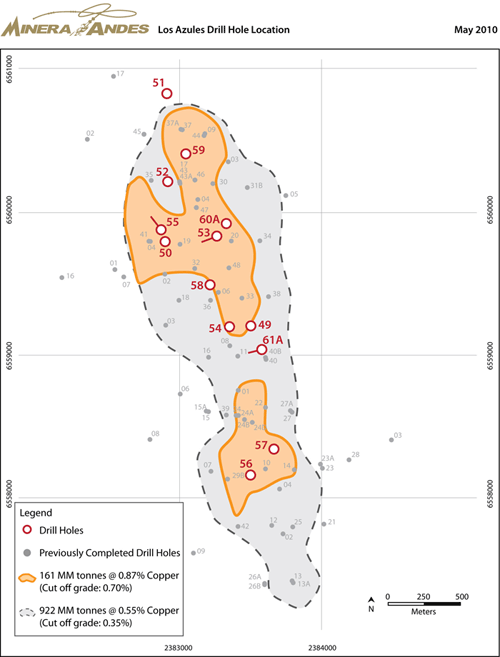
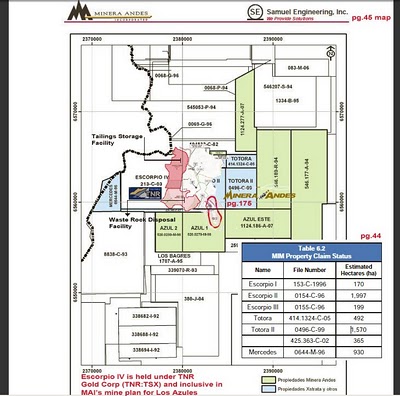
    Value of the prise in the ground at Los Azules is rising with every drill hole. It is very important to see that the best grade was in a step out hole 300m to the North – we have a very big chances of increasing size of the deposit at Los Azules. The step out hole 51 and majority of the High Grade Core of the deposit are located on Xstrata’s part of the property, back in right into which is now the subject of legal dispute between TNR Gold, Xstrata and Minera Andes.”
    Interesting – it is the only comment we can make…now we can finally see the legal position of TNR Gold in this litigation process, history of relationship between Xstrata and Minera Andes and what has happened according to lawyers of TNR Gold behind the curtain. We guess that TNR Gold litigation team with George K. Macintosh, Q.C, from Farris, who signed the Statement of Defence, will not allow any baseless conclusions and they have discovered some evidence to the actions described in article 15. These actions give an interesting interpretation to the true intentions and motivations of the different parties involved in the case if provided statements will be proven to be true in the court. Logic of waiving feasibility study and 5 million dollars in trust account to exercise the back-in right are described in details as well. We will refer you to the legal disclosure in the News Release.
    We have a position in this company, please, do not consider anything as an investment advise, as usual, on this blog.


    Press Release Source: TNR Gold Corp. On Monday May 17, 2010, 11:29 am
    VANCOUVER, BRITISH COLUMBIA–(Marketwire – May 17, 2010) – TNR Gold Corp. (TSX VENTURE:TNRNews) and its wholly-owned subsidiary, Solitario Argentina S.A. (collectively, “TNR“), have filed an Amended Statement of Defence and Counterclaim in the Supreme Court of British Columbia responding in detail to the Statement of Claim filed by Minera Andes Inc. and certain related entities (together, “Minera Andes”).
    As disclosed in our April 23, 2010 press release, TNR notified Minera Andes that it was exercising its back-in right for 25% of certain of the properties constituting the Los Azules project in Argentina (the “Los Azules Project”). Minera Andes is contesting TNR’s ability to exercise its back-in right.
    The Amended Statement of Defence sets out, among other things, TNR’s position as to why the back in clause in the May 2004 Exploration and Option Agreement should be rectified to remove reference to a feasibility study being completed within 36 months, and why the condition linking the timing of the back-in right to the production of a feasibility study was for the sole benefit of TNR and, therefore, could be waived by TNR. TNR has brought a Counterclaim which seeks a positive declaration from the court that TNR’s April 23, 2010 back-in notice is valid and enforceable.
    We encourage interested parties to review the Amended Statement of Defence and Counterclaim in their entirety on our website for a better understating of our position. The link for this information is as follows:
    http://media3.marketwire.com/r/Counterclaim
    ABOUT TNR GOLD
    TNR and International Lithium Corp (“ILC“) are diversified metals exploration companies focused on exploring existing properties and identifying new prospective projects globally. TNR has a portfolio of 18 active projects, of which 9 will be included in the proposed spin-off of International Lithium Corp. For further details of the spin-off please refer to TNR’s April 12, 2010 press release or visit http://www.internationallithium.com/.
    The recent acquisition of lithium, other rare metals and rare-earth elements projects in Argentina, Canada, USA and Ireland confirms the companies’ commitments to generating projects, diversifying its markets, and building shareholder value.
    On behalf of the board,
    Gary Schellenberg, President
    Cautionary Language and Forward-Looking Statements
    This press release includes certain statements that may be deemed “forward-looking statements”. All statements in this discussion, other than statements of historical facts, that address future exploration drilling, exploration activities and events or developments that TNR expects, including the outcome of pending and current litigation, are forward looking statements. Although the Company believes the expectations expressed in such forward looking statements are based on reasonable assumptions, such statements are not guarantees of future performance and actual results or developments may differ materially from those in forward-looking statements. Factors that could cause actual results to differ materially from those in forward-looking statements include metal prices, exploration successes, continued availability of capital and financing, and general economic, market or business conditions. In particular, there are no assurances that TNR will be successful in the current litigation with respect to the Los Azules Project and its back-in right. Accordingly, readers should not place undue reliance on forward-looking statements. This press release and the information contained herein does not constitute an offer of securities for sale in the United States and securities may not be offered or sold in the United States absent registration or exemption from registration.
    In addition, it should be noted that the Statement of Defence and Counterclaim are not intended to be, and should not be interpreted as, sources of factual, business or operational information about TNR or any of its affiliates. The Statement of Defence and Counterclaim contain assertions that have been prepared solely for use in connection with the legal dispute with Minera Andres, have not been proven and should, therefore, not be relied upon.
    CUSIP: #87260X 109
    SEC 12g3-2(b): Exemption #82-4434
    Neither the TSX Venture Exchange nor its Regulation Services Provider accepts responsibility for the adequacy or accuracy of this release.”
  • Lithium market: Rockwood calls for Electrification of U.S. Transportation ROC, TNR.v, CZX.v, LMR.v, RM.v, WLC.v, CLQ.v, HEV, AONE, GM, NSANY, F, FMC,

    Competition for Oil is heating up and aggressive move by China into Electric Cars leaves no other options for US than to follow. In order to keep power China needs gradually improve standard of living, it will bring upside pressure on labor cost. Electrification will not only provide Energy Security to China, but will significantly reduce the cost of its transportation element and provide another opportunity to stay among low cost producers. Situation is completely different to U.S. – they have capital to invest in Electric Mobility CAPEX now and rip the rewards of lower cash cost on transportation side later. We will refer you to the Economics of Electric Cars.

    PRINCETON, N.J., May 17, 2010 (BUSINESS WIRE) — Seifi Ghasemi, chairman and chief executive officer of Rockwood Holdings, Inc. /quotes/comstock/13*!roc/quotes/nls/roc (ROC 27.70, -0.18, -0.65%) ,speaking at an alternative energy conference in Washington D.C., urged policymakers and others to recognize that “electrification of our transportation system is essential for the future .”
    Mr. Ghasemi made his comments at a panel, “Vehicle Electrification, Laying the Groundwork for Mass Adoption,” at the Deutsche Bank Alternative Energy Conference, which included other members of that Coalition. Following is the text of his opening statement:
    “The first point I want to make is why we are convinced electrification of our transportation system is essential for the future,” Mr. Ghasemi said. “Our current way of life, and to some extent, our day-to-day existence is totally dependent on a transportation system which is powered by the internal combustion engine. To maintain this means of transportation, we are dependent on imported oil. This dependence, especially in the last 40 years, has created three significant problems for the United States and the western world in general. They are:
    — national security
    — economic security
    — “environmental sustainability.”
    Mr. Ghasemi’s went on to explain, “On the national security front, we are dependent on oil from very unstable and hostile regions of the world. Therefore, to secure the flow of oil, we are spending billions of dollars to have a military presence in the Persian Gulf and other strategic parts of the world to ensure security of supply. To fuel our current transportation system based on the internal combustion engine, we are paying in treasure and blood. This cannot go on forever.
    “Second, on the issue of economic security, the United States alone spends close to $300-400 billion a year on imported oil to fuel our transportation system. This is a gigantic transfer of wealth to other, mostly hostile regions of the world. Considering our current national debt, this cannot continue for much longer either.
    “The third issue of environmental sustainability is obvious. Gasoline driven cars do pollute,” Mr. Ghasemi said.
    He concluded, “We believe, strongly, that electrification of our transportation system is the only logical solution to the above problems. Nuclear energy, wind power or solar energy alone will not make us free of imported oil. As long as our transportation system is based on the internal combustion engine we will be dependant on imported oil.
    That is why we think electrification of the transportation system is the right way to move forward. Thus, we are very supportive of the actions taken, and policy proposals put forth by the Electrification Coalition.
    “As a leading producer of lithium, we at Rockwood will do our best to ensure an adequate and secure supply of lithium to power the lithium ion batteries for electric cars of the future.”
    Rockwood Holdings is a global producer of specialty chemicals and advanced materials and the largest producer of lithium and lithium compounds. The company is also a founding member of the Electrification Coalition, a nonpartisan group of business leaders committed to promoting policies and actions that facilitate the deployment of electric vehicles on a mass scale in the United States.
    Rockwood Holdings, Inc. is a leading global specialty chemicals and advanced materials company. Rockwood has a worldwide employee base of approximately 9,500 people and annual net sales of approximately $3 billion. The company focuses on global niche segments of the specialty chemicals, pigments and additives and advanced materials markets. For more information on Rockwood, please visit http://www.rocksp.com/.
    The information set forth in this press release contains certain “forward-looking statements” within the meaning of the Private Securities Litigation Reform Act of 1995 concerning the business, operations and financial condition of Rockwood Holdings, Inc. and its subsidiaries and affiliates (“Rockwood”). Words such as “anticipates,” “believes,” “estimates,” “expects,” “forecasts,” “predicts” and variations of such words or expressions are intended to identify forward-looking statements. Although Rockwood believes the expectations reflected in such forward-looking statements are based upon reasonable assumptions, there can be no assurance that its expectations will be realized. “Forward-looking statements” consist of all non-historical information, including any statements referring to the prospects and future performance of Rockwood. Actual results could differ materially from those projected in Rockwood’s forward-looking statements due to numerous known and unknown risks and uncertainties, including, among other things, the “Risk Factors” described in Rockwood’s 2009 Form 10-K on file with the Securities and Exchange Commission. Rockwood does not undertake any obligation to publicly update any forward-looking statement to reflect events or circumstances after the date on which any such statement is made or to reflect the occurrence of unanticipated events.
    SOURCE: Rockwood Holdings, Inc.
  • Gold in South America: Cornerstone Reports Significant Progress on Ecuador Permits CGP.v, AUY, NEM, ABX, TNR.v, BVN, HUI, XAU, GDX, FCX, GG, MAI.to,

    Related News
    Cornerstone and Newmont Propose to Form a Strategic Exploration Alliance in Southern Ecuador
    Primary TargetGoldLocationThe Macara concessions is approximately 75 km2 located near the Ecuador-Peru border. The Strategic Alliance area of influence encompasses approximately 2000 km2.Property InformationThe property hosts gold bearing quartz-tourmaline veins and breccias associated with an intrusive body. Recent work by Sierramin has returned assay values from channel samples up to 23.8 g/t Au over 1.0 m and 7.3 g/t Au over 1.8 m. Chip samples collected during reconnaissance prospecting returned assays of 13.0 g/t Au over 2.0 m (incl. 44.2 g/t Au over 0.5 m) and 8.3 g/t Au over 0.65 m from sulphide bearing quartz veins within shear zones cutting granites.

    Press Release Source: Cornerstone Capital Resources Inc. On Monday May 17, 2010, 8:00 am
    MOUNT PEARL, NEWFOUNDLAND–(Marketwire – May 17, 2010) – Cornerstone Capital Resources Inc. (TSX VENTURE:CGPNews; FRANKFURT:GWNNews; BERLIN:GWNNews; PINK SHEETS:CTNXFNews) reports that it has been issued a number of key permits needed to re-start exploration activities in Ecuador. During the first two weeks of May, Cornerstone received new titles under the January 2009 mining law to 13 of its mineral concessions including the 10 Shyri properties under option to Intrepid Mines Ltd. (see news release October 29, 2009).
    Also issued by the Ecuador Ministry of Environment during this period were the approval of the Environmental Management Plan for the Gama property, part of the Shyri project, and a water permit for drilling at Gama. Cornerstone representatives are meeting with the regulators this week to determine any final steps required to initiate exploration work and will provide updates of further developments. While the permitting process has been a lengthy one under an array of new laws and regulations in Ecuador, the company is encouraged that it is progressing within the current legal framework and expects to have its final permissions in the near future.
    About Cornerstone
    Cornerstone Capital Resources Inc. is a mineral exploration company based in Mount Pearl, Newfoundland and Labrador, Canada, with a diversified portfolio of projects in Canada and Ecuador and a strong technical team that has proven its ability to identify, acquire and advance properties of merit. The company’s business model is based on generating exploration projects whose subsequent development is funded primarily through joint venture partnerships.
    Further information is available on Cornerstone’s website: www.cornerstoneresources.com or for investor, corporate or media inquiries, please see contact information.
    Cautionary Notice:
    Certain statements contained in this press release may be considered as forward-looking. Such forward-looking statements are subject to risks and uncertainties that could cause actual results to differ materially from estimated or implied results. While Cornerstone anticipates that subsequent events may cause its views to change, it expressly disclaims any obligation to update the Forward-Looking Statements contained herein except where outcomes have varied materially from the original statements.
    On Behalf of the Board,
    Colin B. McKenzie, President & CEO
    Neither TSX Venture Exchange nor its Regulation Services Provider (as that term is defined in the policies of the TSX Venture Exchange) accepts responsibility for the adequacy or accuracy of this release.”
  • EV mass market and Lithium Demand: China is Ready for EVs TNR.v, CZX.v, RM.v, LMR.v, LI.v, WLC.v, CLQ.v, SQM, FMC, ROC, HEV, AONE, VLNC, GM, BYDDY,

    Price competition will drive Electric Cars mass market. Chinese companies will have yet to prove that they can claim auto brand properties, but cost wise they are out of competition. Once thousands of engineers working in China on lithium batteries, safety and design of Electric Cars convert quantity into quality this market will take off in iPod fashion.”

    GM Volt:
    China’s automotive fleet is rapidly expanding. Last year the Chinese market overtook the US to become the world largest automotive market, and sales are expected to continue to expand 55% to 13.55 million passenger vehicles per year by 2015.
    The country is currently the third largest consumer of oil in the world with all of Europe a close second and the US number one. As China’s volume of vehicles continue to increase along with economic growth so too will their oil demand. China will pass the US and become the world’s largest oil consumer within a few years and thereafter continue to expand consumption. China is already importing more than 50% of its oil.
    Fortunately, there is already great demand among the Chinese population for electric cars. GM plans to sell the Chevrolet Volt there and several Chinese automakers including BYD have already begun to sell electric cars in the country. Nissan is considering selling the LEAF in China as well.
    A recent poll performed by Ernst and Young revealed that a shocking 60% of Chinese consumers are interested in purchasing a plug-in car. This is five times the rate in the US or any other country.
    The Chinese government has also expressed great interest in promoting plugin cars, to help stave off foreign oil dependence. The government has already designated 20 cities to deploy extensive plugin charging infrastructure, and have set a production goal of 500,000 “new energy” cars by 2015. A massive series of incentives and subsidies to encourage electric car adoption will be announced in July.
    Despite all the obvious benefits, one leading Chinese auto executive isn’t so sure this is a good idea.
    Huang Xiangdong, who is vice president of Guangzhou Automobile Group Corp that has ventures with Honda, noted that 83% of Chinese electricity is produced by burning coal.
    “Battery electric vehicles and plug-in hybrids do not save more energy than conventional cars on a well-to-wheel analysis,” said Huang. “We think in China it’s not the right time to promote pure electric vehicles.”
    While reducing CO2 production is important to some, as in the US, concerns of oil dependence loom large.
    “There are broader benefits of electric vehicles, such as reducing the dependence on foreign oil,” Henry Li, general manager of BYD’s auto export trade division.
    Irrespective of any naysayers, clearly the Chinese electric automotive market is poised to become extremely large and profitable to automakers who are successful there. As the first foreign firm to get a foothold there, GM has much to benefit from selling electric cars there, and much of the company’s future profit could be tied to it.
    “China is currently a larger market by volume than the US,” says GM spokesperson Tom Wilkinson
    “It is probably our second or third most important market and growing faster than either the US or Europe,” he says. “In short, it is pretty important.”
    So although we’d all like to see the exciting new Chevrolet Volt MP5 concept go on sale in the US, it should be fairly apparent why GM chose to unveil it in China. In fact it was actually produced in partnership with venture partner Shanghai Automotive Industry Corp. Anyway the MPV5 according to GM spokesperson Dave Darovitz “is a concept only.”
    “No plans for production,” he adds.
    Source (Detroit News) , (photo from Autoblog)”
  • EV mass market: Brussels Outlines Plans for Electric Cars TNR.v, CZX.v, RM.v, LMR.v, WLC.v, LI.v, CLQ.v, SQM, FMC, ROC ORE.ax, ABN.v, HAO.v, HEV, AONE

    There are Electric Cars, safe technology for reliable batteries and Lithium availible for them: there is no execuse not to start Electric Mobility revolution today.
    EV mass market will be started with standardization for safety and recharging infrastructure for Electric Cars. Hydrogen is lighting years away from mass adoption on cost and needed infrastructure crucial points. All the talk about dirty EVs is the old song from the Oil lobby guys. Electric Car is the only viable alternative to Oil driven CE, which is available today. By the way, every Hydrogen car needs a battery as well. Lithium supply for the batteries is not a question of existence or dependence on anybody’s political will, it is available in safe locations and there is no excuse not to advance Electric Cars now. Last events in Europe reminded about the feeling to be Grounded – with ash this time, how the world is going to live with Oil above 150 USD/barrel?

    Bloombeg Businessweek:

    Brussels Outlines Plans for Electric Cars
    Saying that cross-border standards for safety and rechargers will be critical to the success of electric vehicles, the European Commission has laid out a timetable
    By Leigh Phillips
    The European Commission on Wednesday (28 April) outlined a plan to get electric cars off the drawing board and onto the streets of Europe.
    Central to the EU’s plan for shifting away from the internal combustion engine is developing a series of European standards that everyone will adhere to.
    “Without strong standardisation work, I think it will be difficult to develop a market for electric cars,” said industry commissioner Antonio Tajani.
    “These aren’t just curiosities in motor shows any more. They are being keenly awaited by European citizens. It’s important for citizens to be able to cross borders and still charge their cars.”
    Ensuring that there is a standardised charger is core to the strategy. Brussels does not want citizens to be as frustrated with their green vehicle as they are with a hair dryer in a foreign hotel when they’ve forgotten to buy an adapter.
    The commission hopes to have electrical safety standards outlined by the end of 2010.
    Then, next year, standards for the recharging of cars will be developed, and the following year, 2012, the commission wants to analyse the risks involved when such cars are involved in collisions.
    The commission believes that hydrogen fuel-cell cars are one of “most promising options.”
    Responding to the plan announced today, Ian Williamson, the vice-chair of the UK Hydrogen Association said he was pleased with the strategy: “Hydrogen battery hybrid vehicles will be key to creating a low carbon transport infrastructure throughout Europe because, unlike pure electric vehicles, they offer consumers the same range, speed and fuelling times of conventional vehicles.”
    Green groups cautiously welcomed the news while underscoring that electric cars are only truly green if the electricity used comes from genuinely renewable sources. If the electricity is coming from coal-fired power plants, for example, this is just pushing the carbon emissions away from the vehicle but not tackling the root of the problem, they say.
    “The Commission hasn’t addressed two of the most critical issues, namely ensuring that the extra electricity needed will boost renewable sources and the need for smart meters in every vehicle to keep track of consumption and the carbon intensity of electricity,” said Jos Dings, director of Transport & Environment, a green transit NGO.
    “These two issues will be critical to ensuring that electric cars actually reduce emissions.”
    Provided by EUobserver—For the latest EU related news”
  • Argentina & Mining 101: Los Azules mining plan. TNR.v, CZX.v, MAI.to, ABX, FCX, RTP, BHP, LUN.to, AUY, BVN, FXI, HUI, XAU,

    TNR Gold Corp. has entered into a letter agreement with Cricket Capital Corp. on the Company’s 100% owned Forgan Lake property located 125km northeast of Thunder Bay, OntarioIn addition, the Company has commenced drilling at the Mariana Lithium brine project in Argentina, and it has increased its land position in Nevada to 5,285 hectares through staking and has commenced a geophysical program on its Mud Lake project, Nye County, Nevada. The Company proposed to waive the production of a feasibility study and exercise its right to acquire 25% of the northern half of the properties for Minera Andes’ Los Azules Project in Argentina.
    TNR established June 8, 2010 as a date of the meeting date for shareholder approval of the previously announced spin-out of TNR’s lithium and rare metals assets into its wholly-owned subsidiary, International Lithium Corp. TNR shareholders of record on the date of the spinout, planned for late June or early July, will receive one share and one fully tradable warrant of International Lithium Corp. for every 4 shares of TNR.”
    We have a position in this company, please, do not consider anything as an investment advise, as usual, on this blog.

    Argentina & Mining 101:

    With a grass roots projects developing into a resource, and advancing to pre-feasibility reports and eventual production, it’s a good idea to understand what’s involved in a mining project.
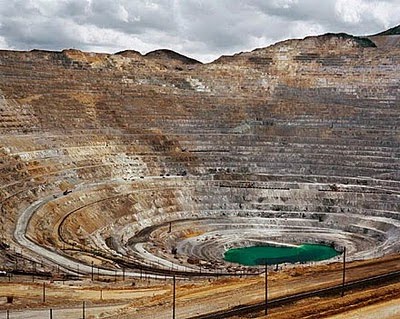
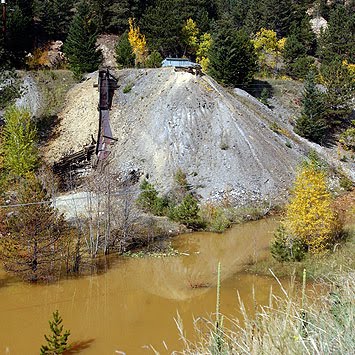
    1. The pit (ore body open pit)(see left image)Congrats, you found high grade % copper, now what?The ideal scenario involves digging a humongous hole in the ground, via a systematic earth removal process such that you create the leftover open pit as shown on the left.
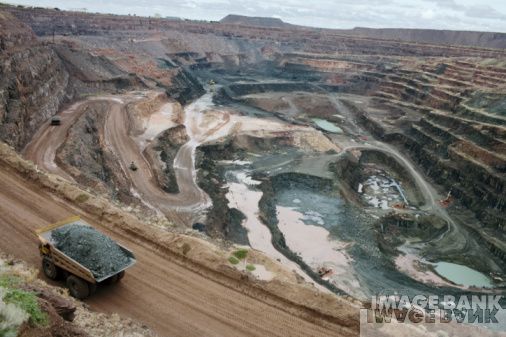
    2. Transport the Ore (heavy rocks)Ore, unprocessed, is worth very little. Naturally, you’d have your precious gold or copper mixed with ordinary rocks and other byproducts. The idea here is to minimize the distance you have to transport these to your processing belt or factory, so you can start crushing and filtering out the valuable bits!As you can see driving heavy duty 500 tonne trucks up these large pits can be quite costly on gas!
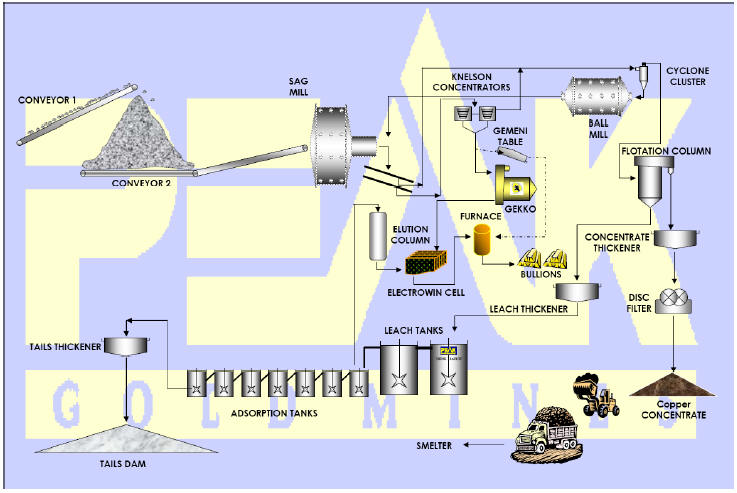
    3. Start refining your ore Once you have the ore at your factory it’s time to fire up the conveyor belt. Crushing, refining, leaching, are all typical ways to separate your high grade minerals from the low-grade rocks. Do this well enough and you should be able to retain 90%+ of your estimated resource from raw ore – that is to say you don’t waste too much in the way of getting rid of minerals within the ore during the separation process! From there it goes through several steps of refinement until you reach a sellable end product for your customers – usually in forms of molly, raw mineral products, and in some cases finished pellets for melting into final products.
    4. Disposal of waste and tailingsWait, you think the government and environmental agencies will let you leave a big hole with waste rocks lying around after you extract the valuable minerals? Not quite! Tailings (also known as slimes, tailings pile, tails, leach residue, or slickens[1]) are the materials left over[2] after the process of separating the valuable fraction from the worthless fraction (gangue) of an ore. To properly dispose of these tailings (often still riddled with chemicals from acid leaching and chemical separation processes), significant efforts are put in to make sure environmental impacts are minimized. Some would argue, tailings and waste process facilities are the single biggest economic barriers to a mine being successful. Further, you’d want to have a site nearby (ideally downhill) where you can, for a low cost, get rid of your tailings and pile them up for isolation processing later…”

  • Energy Report: ‘Cobalt, lithium demand is going to be tremendous’ TNR.v, CZX.v, LMR.v, RM.v, WLC.v, CLQ.v, LI.v, SQM, FMC, ROC, F, HEV, AONE, VLNC,

    Interesting note from Canaccord on Lithium and TNR Gold has been mentioned with International Lithium spin out – company gets onto the radar screens and results from announced exploration programs will drive performance of the new focused Lithium exploration and development play with properties in Argentina, Nevada, Canada and Ireland.”

    CommodityOnline:

    ‘Cobalt, lithium demand is going to be tremendous’
    Published on: April 27, 2010 at 12:10

    In this exclusive interview with The Energy Report, Gordon Monk of Performance Capital Advisers discusses the worldwide movement toward green sources for energy production. Gordon explains how cobalt and lithium are linked to solar and wind power. He also talks about why he prefers primary producers of cobalt to those that obtain cobalt as a byproduct of other operations.
    The Energy Report: Gordon, your focus these days is on moving from conventional energy to green energy. What particular sectors of green energy are you focused on?
    Gordon Monk: There are a number of sectors that I’m interested in. There’s been a tremendous move of capital to wind in recent years. Certainly solar is another area that’s also gaining a lot of attention. One of the areas that I’m focused on right now would be hybrid electric vehicles, specifically the batteries containing cobalt.
    TER: There have been some failures with batteries containing cobalt. Some reports indicate there is a small possibility of those batteries catching fire. Do you have some information that you could share with us on this topic?
    GM: As I understand it, the problems associated with those batteries had to do with overheating. The chemistry was such that the batteries would release a small amount of oxygen, which then creates the chance of possible combustion. There’s been a lot of technology focused on the problem. Modern batteries now are equipped with microchips that control the discharge conditions of batteries. There have also been additives to the batteries which have more or less solved the problem. With the problems being solved, the benefits of using those batteries far outweigh the negatives of the past.
    TER: Do you see cobalt continuing to be used in these types of batteries?
    GM: Oh, absolutely. A report by J.P. Morgan suggests that the current output of around 740,000 units is going to increase to 12.9 million by 2020. So I think that in itself is a pretty strong indication that cobalt is here to stay.
    TER: What do you find interesting about wind and solar companies? Their potential?
    GM: Yes, it falls into the whole movement to green. In recent years there’s just a tremendous focus on the environment and the environmental problems associated with conventional energy. I can speak to oil and gas and coal, the usual culprits. I find solar and wind fascinating because they solve a lot of the problems associated with greenhouse gas emissions. The capital flows that are going into these areas suggest to me that they are here to stay. I think there are tremendous opportunities in the space.
    TER: How is cobalt connected to solar and wind technologies?
    GM: Cobalt plays a role in renewable solar panel technology and wind generation. Cobalt is also used as a super alloy in wind turbines.
    TER: So you see increased demand for cobalt because of wind and solar technologies, in addition to batteries?
    GM: Yes, because of the batteries and because of the green movement in general. Cobalt is not just found in batteries and that’s something that’s key. I think a lot people misunderstand that. Batteries currently account for around 26% of the market for cobalt. Super alloys, which include turbine blades and heat-resistant steel, account for another 23% to 25% of the market. It’s underappreciated about what it can do.
    TER: Cobalt is generally thought of as a byproduct of other operations. Is that correct?
    GM: Yes, that’s right. Cobalt comes as a byproduct from copper, as well as nickel, historically. As I said, only 15% of world production comes from pure cobalt. I’d like to see more, just because it won’t be a slave to other metals in terms of output. So if we can have more primary cobalt producers, things are going to be a lot better from a stability standpoint.
    TER: If the demand for cobalt continues to go up, do you see companies starting to produce cobalt exclusively?
    GM: Yes and no. I think that’s why the opportunity really lies with the primary cobalt producers. That could happen, but when you start taking a look at the percentages of cobalt that are coming out as a byproduct, I don’t really see any scenario where they’d necessarily switch to extracting just to get the cobalt. I think the opportunities again lay with the primaries.
    TER: Looking at green technology, what sort of timeframe do you see before things really start to get active?
    GM: I think the argument can be made that things are already starting to get active in the area. You’re starting to see orders in the billions of dollars for units for these hybrid electric vehicles, HEVs. So I think we’re just getting started in terms of the space right now. It’s a movement. This green movement is unstoppable at this point with all of the focus on the environmental issues. I should also like to point out that I’m one of those who believe that cobalt has a relationship to the price of oil. We’ve seen oil moving up in recent times. That’s an influence on cobalt and on these hybrid electric vehicles. That influence is from a substitution standpoint. That’s only going to increase awareness and I think increase demand for substitutes.
    TER: With the increasing amount of focus on the green technologies, what’s the long-term impact going to be on conventional energy sources?
    GM: That’s a good question. I think conventional is here for a while. It’s just so ingrained in the economies of the world. These movements to green, while they are tiny as compared to consumption, the movements themselves are significant enough where these kinds of metals—cobalt, lithium—they can’t be ignored. Because when you start putting these on a chart, when you look at the demand perspective, it looks like a hockey stick. The demand is just going to be tremendous. It’s going to take a long time to replace conventional, if ever. As long as this green movement is going on, and people start caring about the environment, there’s going to be tremendous up pressure.
    TER: Is that going to increase as governments start instituting more restrictions on conventional sources?
    GM: I think so. It’s not necessarily restrictions on conventional, but rather requirements on hybrid. There have been a number of initiatives in recent times where carbon emissions have to be cut by “x,” or total energy production needs to come from green sources. So it’s not like they’re saying you have to stop. What they’re saying is more that it is going to have to come from these other areas. So, yes, to a certain extent legislative action will play a role.
    TER: Where does the investment opportunity lie for green technologies? Are these companies actually doing a lot of development, or is it that they’re purchased by larger companies?
    GM: You know that’s a very interesting question. If I was a large multinational producer, I’d be looking at replacing my traditional revenue models. If you’ve got the opportunity to do that by acquiring profitable companies in the green tech space I’d absolutely do that. You’re going to see a lot of these companies start off as fledging green producers of energy, and then be acquired by the larger companies as a way of those bigger companies augmenting traditional revenue models. So absolutely there’s going to be lots of pick-ups.
    TER: Are you seeing any opportunities in natural gas? Some people are saying that there simply isn’t enough supply, while others insist there’s really going to be an opportunity going forward. GM: I’m one of those at this point that agree with the supply issues that you’ve mentioned. There’s been technology, like horizontal fracking, which basically makes available a tremendous amount of natural gas from historical traditional sources. So it’s going to take a while for the supply to clear out. That’s sort of the short-term view. I think the long-term view is it’s a cleaner source. We’re going to continue to need power. I look at China as essentially going through the industrial revolution right now, and just barely scraping the surface of what total consumption ultimately will be there. So I don’t think you can really discount any source certainly in the long run.
    TER: Do you consider natural gas a green technology, or more of a conventional energy source? GM: I look at it more as conventional. Just by virtue of it still being a fossil fuel.
    TER: The LME recently issued its first warrants for cobalt. How do you think it’s going to impact cobalt in general?
    GM: I’m glad they did that to cobalt and to moly as well. It’s going to be great for the companies to basically price hedge. You’re able to lock in the price that you sell cobalt for. It smoothes the peaks and valleys of price fluctuations. It adds a level of transparency as well to the metal. Certainly from a tracking standpoint it’s a whole lot easier to find it. It’s a leveler. It’s a hedger. I think it’s a great development for cobalt.
    TER: Lithium and cobalt are linked, of course, because of lithium-cobalt batteries. Lithium has been the hot story in the energy markets. Do you see cobalt creating the same kind of buzz? GM: Yes. I think it’s a matter of awareness. Absolutely lithium has had just a tremendous amount of buzz. There was a while there, when I was a broker, that you’d be seeing little lithium companies spreading up all over the place. The second they had a press release that there was lithium you’d see the price spike. I think that the same potential exists for cobalt, but you know, again, it’s just about awareness. I don’t think people understand how important cobalt is in HEVs, as well as the other uses, such as the super alloys that I mentioned. I think the awareness is going to catch up, and therein lays the opportunity.
    TER: Are there any other energy sectors that you’re keeping an eye on?
    GM: Oil and gas is certainly an area that I’ve had some experience in. I think it’s interesting that we’re creeping up again in the price. We’ll see if that backs off.
    TER: Do you see oil at some point going much higher than it is right now, or getting to the $100 per barrel point again?
    GM: It’s funny how you start hearing those comments as it starts creeping up to $100. I don’t know. I think it’s due for probably a correction to the downside. I have trouble seeing why it is where it is right now.
    TER: China is growing massively in their industrial revolution and requesting a lot of solar investments. What are some interesting plays for investors?
    GM: The China question is interesting to me from an investor standpoint. A lot of the investments you see going on in China involve a lot of private companies being formed, private companies raising money in the solar space. Obviously investors can’t participate in that. Again, it’s almost a cobalt story because these technologies also require large amounts of batteries, and by extension, cobalt. So it’s difficult perhaps to play it directly, but again it comes back to cobalt. TER: Critics complain that a lot of these green technologies, such as solar and wind energy, are only surviving because of government subsidies. Do you agree with that? What happens if those government subsidies are removed?
    GM: Well, it’s a technology question, isn’t it? It’s taken government subsidies to get them to where they are right now, and subsidies are also driving technologies to make them more efficient, which then brings the cost down. It’s a profitability paradigm. We’ve already seen tremendous developments in alternative energies, which are now almost as cost effective when you compare them against the price of, let’s say, oil. We’re going to get to a point where these things are profitable on their own, if they aren’t already. Aside from that there’s this global movement towards green. People want to stop killing the planet, to put it bluntly. So I think all of these technologies that I referenced are here to stay.
    TER: Gordon, we appreciate your input. By arrangement with: http://www.theenergyreport.com/
  • Jay Taylor Watch List “In Our Sights”: TNR Gold corp.: TNR.v, CZX.v, MAI.to, ABX, NG.to, WLC.v, CLQ.v, RM.v, SQM, FMC, ROC, GOOG, AAPL, FCX, RIMM, F


    TNR Gold Corp. is employing the project generator model. For those of you who may not know what a project generator model is, a word of explanation is in order. “Project generators” are companies that pick up early stage exploration ground when there are historical or scientific reasons to believe a property is prospective for a given mineral. Because these properties are obtained at an early stage of development, the cost of obtaining them is very low.As a project generator, TNR then uses its intellectual capital rather than hard currency capital to add value to its shareholders. By carrying out relatively low cost early exploration work, it demonstrates with greater confidence, the potential for a given property to host an economically viable mineral deposit. At that point in time, TNR hopes to bring in other companies that are willing and able to spend considerably more money to explore and advance those prospects toward production. TNR will generally retain a carried interest in those prospects into the future or at least a Net Smelter Return on any future production from the property. The prospect generator model is in theory a less risky model because, if other companies are spending considerable amounts of money, they can reduce the number of shares issued to raise capital.”

    Company update:

    TNR Gold Corp. has entered into a letter agreement with Cricket Capital Corp. on the Company’s 100% owned Forgan Lake property located 125km northeast of Thunder Bay, OntarioIn addition, the Company has commenced drilling at the Mariana Lithium brine project in Argentina, and it has increased its land position in Nevada to 5,285 hectares through staking and has commenced a geophysical program on its Mud Lake project, Nye County, Nevada. The Company proposed to waive the production of a feasibility study and exercise its right to acquire 25% of the northern half of the properties for Minera Andes’ Los Azules Project in Argentina.
    TNR established June 8, 2010 as a date of the meeting date for shareholder approval of the previously announced spin-out of TNR’s lithium and rare metals assets into its wholly-owned subsidiary, International Lithium Corp. TNR shareholders of record on the date of the spinout, planned for late June or early July, will receive one share and one fully tradable warrant of International Lithium Corp. for every 4 shares of TNR.”
    We have a position in this company, please, do not consider anything as an investment advise, as usual, on this blog.