Author: WSJ.com: Real Time Economics

  • Who Is That Guy Next to Volcker?

    Who is that guy pictured next to Paul Volcker on the front page of today’s Wall Street Journal in a photo taken at Tuesday’s Senate Banking Committee hearing?

    Sipa Press
    Anthony J. Dowd, left, and Paul Volcker

    It’s Anthony J. Dowd, who is helping Mr. Volcker with his quest to build walls between banks that take deposits and make loans (inside the federal safety net) and those that trade for their own pockets (to be forced outside the federal safety net.)

    Dowd is a former partner in 18-year-old private-equity firm Charter Oak Capital Partners in Westport, Conn.

    A graduate of the U.S. Military Academy at West Point in 1981 with a B.S. degree in Engineering, he served as an officer in the U.S. Army from 1981 to 1986 and then earned an M.B.A degree in Finance. Subsequently, Mr. Dowd was a Senior Associate with James D. Wolfensohn, Inc., a New York investment banking firm where Mr. Volcker worked for a time after leaving his post as chairman of the Federal Reserve.

    Mr. Dowd joined Charter Oak in the early 1990s, and is now managing general partner of its international unit. He has served on the boards of many Charter Oak’s private investments and currently serves on the Board of Directors of Revere Industries, LLC; American Church Mortgage Company, LLC; Space Optics Research Lab, LLC; Texcel Medical, LLC, and Circle Medical Devices, LLC.


  • R.I.P. CPFF, PDCF, TSLF, AMLF, et al

    In the depths of the financial crisis in 2008 and 2009, the Federal Reserve launched an array of highly unconventional lending programs that placed the central bank in almost every corner of the financial system – from short-term commercial paper lending markets where blue chip companies get cash, to money market mutual funds, to “repo” markets where investment banks satisfy immense daily liquidity needs.

    Today, much to the Fed’s relief, several of these programs were put to rest and nothing bad happened. Stocks and Treasury bond prices rose.

    The programs produced an alphabet soup of funny names, like the Commercial Paper Funding Facility (CPFF), Primary Dealer Credit Facility (PDCF) and Term Securities Lending Facility (TSLF). For the most part, the programs did what the central bank was designed to do when it was created in 1913 — act as a lender of last resort which provides emergency credit to firms during a liquidity crisis. And as it promised it would do last year, the Fed has stopped doing them now that the markets have calmed.

    This is one exit strategy Mr. Bernanke can check off as being executed fairly seamlessly.

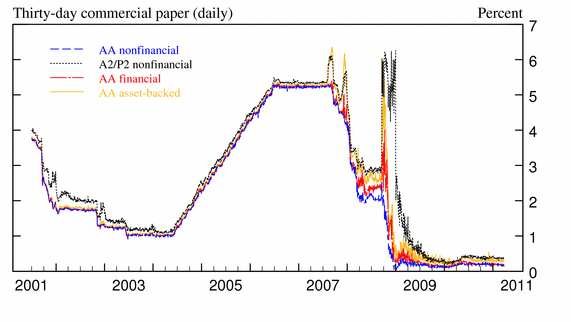
    Some of the programs seem to have worked well. At one point, companies came to the Fed for more than $300 billion in commercial paper loans. But they’ve weaned themselves off of that government credit. In addition, private commercial paper borrowing rates fell sharply after the CPFF program was introduced, easing a burden on borrowers. (Though private issuance is way down, too, so the market doesn’t look completely healed.) Money market mutual funds also have stabilized.

    Meantime, it would be hard to argue that the PDCF and TSLF were rousing successes. They were targeted at investment banks and none of the big five investment banks exist anymore as standalone investment banks. But the programs can’t be blamed for that – the investment banks had problems that not even the Fed’s lending largesse could solve.

    Academics will be debating for years whether these “liquidity” programs have worked as advertised. But give the Fed this: If its many other interventions – like its rescues of American International Group Inc. and Bear Stearns, or its  purchases of mortgage debt or its zero-interest rate policy – all went away as quietly into the night, Ben Bernanke would be a very happy man.


  • Quick Notes From the Volcker Hearing

    Some interesting bits from the Senate Banking Committee hearing with former Federal Reserve Chairman Paul Volcker and Treasury Department Deputy Secretary Neal Wolin:

    1) Mr. Volcker said in response to a question from Sen. Mark Warner (D,. Va.) that Morgan Stanley and Goldman Sachs Group Inc. would have to make a decision if the proprietary trading ban was put in place. He said they would either have to shed their proprietary trading operations or shed their banking licenses.

    2) Mr. Wolin said the White House has not finalized the details of its plan to curb the size of financial institutions going forward.

    “We do not have the details of that fully nailed down. We want to make sure that we get it right. We want to work with the regulators, this committee, in coming forward with this proposal. We don’t think it ought to be a limit that is currently binding.” He said they were still trying to determine the “denominator” in what would be measured to curb a bank’s size.

    3) Mr. Volcker said government officials “need to do some rethinking of Basel 2 with some explicit overall leverage limits. A lot of the Basel 2 stuff has to be clarified and made, I agree, more binding.” He said Basel 2 relied on bank’s internal models and credit rating agencies, and “both of those have been somewhat discredited in the past couple of years.”

    Mr. Wolin quickly stepped in, saying “we do want to go forward with the implementation of Basel 2. We’ve made that clear” to foreign counterparts. But he added that additional leverage constraints would have to be adopted.

    4) Top Republican on the Committee Sen. Richard Shelby of Alabama said:

    “I don’t believe myself that being big is necessarily bad, but I do believe that being big and believing the government is going to bail you out is bad bad.”

    5) Sen. Mike Johanns (R., Neb.) accused the White House of trying to add the Volcker Rule onto an already confusing proposal.

    Mr. Volcker’s response:

    “I tell you sure as I am sitting here, that if banking institutions are protected by the taxpayer and they are given free reign to speculate, I may not live long enough to see the crisis, but my soul is going to come back and haunt you.”


  • Consumer Bankruptcies Remain Elevated

    Consumer bankruptcies jumped 15% from a year earlier as consumers continue to struggle with high debt loads and elevated unemployment, the American Bankruptcy Institute said.

    On a positive note, the 102,254 consumer bankruptcies filed in January represented a 10% decline from December, but filings at the end of last year were abnormally elevated from usual seasonal levels.

    “Consumer filings this year will likely surpass the 1.4 million consumer filings recorded in 2009,” said ABI Executive Director Samuel J. Gerdano. The number of bankruptcies in 2009 was at the highest level since the government revamped rules in 2005, making it more difficult to file for bankruptcy.

    Even amid expectations the unemployment rate will begin to decline this year and home prices appear to be stabilizing, consumers are expected to remain under pressure. Banks have been decreasing their write-offs of nonperforming consumer loans, but if bankruptcies continue to rise that pace of decline may have to slow.


  • Volcker’s Rules

    Not so fast, bankers.

    Former Federal Reserve Chairman Paul Volcker will try to dispel some of the recent complaints made by Wall Street executives in his testimony to the Senate Banking Committee Tuesday.

    Ever since President Barack Obama proposed last month limiting the ability of commercial banks to engage in “proprietary trading,” bankers have complained that the definition of “proprietary trading” is too open to interpretation and vague. Mr. Volcker doesn’t buy it.

    “Every banker I speak with knows very well what ‘proprietary trading’ means and implies,” he will tell the Senate Banking Committee in the afternoon, according to prepared remarks. (Essentially, a bank engages in proprietary trading when it makes bets using its own capital, not a client’s).

    He says “only a handful of large commercial banks — maybe four or five in the United States and perhaps a couple of dozen world-wide — are now engaged in this activity in volume.”

    He also ticks off a list of eight different business practices besides proprietary trading that banks use to make money, such as lending, underwriting corporate and government securities, and managing brokerage accounts. His point: stop your whining, bankers.

    Just as interesting in the testimony is what Mr. Volcker doesn’t say. He doesn’t delve into details of another part of the White House proposal, which would place new constraints on the size of a bank.

    All of these changes must first be approved by Congress, which is one reason Mr. Volcker is headed to Capitol Hill.


  • Groundhog Day 2010: Is the Economy Coming Out of Its Hole

    For the third year in a row groundhog Punxsutawney Phil saw his shadow and headed back to his hole for six more weeks of winter. Does the famous rodent meteorologist tell us anything about the economy?

    His record as an economic forecaster isn’t much worse than some pros. (Associated Press)

    According to CNN, Phil doesn’t have the best record as a weatherman (he’s correct just 39% of the time). During the last two years, he’s had more success as an economic forecaster predicting turning points.

    In 2008, six weeks to the day after the groundhog saw his shadow, Bear Stearns collapsed, signaling a new phase to the credit crisis and the first signs of the Great Panic that sent the economy into a tailspin late that year. In 2009, Phil saw his shadow again, and who could blame him for heading back into his hole? The stock market was still falling, gross domestic product was tumbling and politicians were debating stimulus plans and bank rescues.

    But six weeks later, the thaw had started. The stock market hit its low and that week began a major rally that pushed shares up nearly 19% for the year. Soon, everyone was seeing the green shoots of spring.

    So does Phil seeing his shadow mean we’ll have another turning point for the economy six weeks from now? Probably not. As we said last year, this is all just coincidence.

    But the lesson remains the same. It’s important to remember that a lot can change in the economy in six weeks.


  • Secondary Sources: Jobs, Budget, Inequality

    A roundup of economic news from around the Web.

    • Jobs: On Market Talk, Steven Russolillo notes the potential for public sector job losses. “Keep in mind more layoffs seem poised to manifest in the public sector, with New York City looking like a prime example. Mike Shedlock, an investment advisor for Sitka Pacific Capital Management, compiles a comprehensive list of cities, states and municipalities that are likely facing mass layoffs of public workers in the near term. NY Gov. David Paterson’s proposed 2010-11 budget would cut billions in funding and force thousands of layoffs. Nevada, California, Colorado and Arizona are other examples of states facing budget shortfalls, with job cuts likely on the horizon.” Separately, EconomPic has a great chart today comparing unemployment in European countries with similar rates in U.S. states.
    • Budget: On the Economist’s Free Exchange blog, Greg Ip notes how much government revenue has dropped because of the crisis. ” $2 trillion gone, with nothing to show for it: no new tax cuts, no new domestic programmes, not even new bail-outs: just gone because the economy is delivering up less tax revenue than Mr Obama anticipated a month after taking office. A smaller GDP is only part of the story; the other part is those notorious “technical re-estimates”. For non-geeks, that usually means a dollar of GDP is delivering less revenue than it used to, perhaps because higher-taxed income like bonuses and stock options has fallen more sharply than other income. That lost revenue goes straight to the deficit, which is then compounded with higher interest in later years.” Separately, Ezra Klein highlights Republican Rep. Paul Ryan’s alternative budget plan that seeks to close the deficit largely by privatizing Medicare and Medicaid.
    • Inequality: Jonathan Heathcote, Fabrizio Perri and Gianluca Violante, writing for voxeu, note the effects recessions have on inequality. “The unemployment rate has dominated economic headlines, but recessions raise numerous problems. This column warns that recessions raise earnings inequality and income inequality, absent mitigating government programmes. The current recession has indeed raised such inequality, but consumption inequality has surprisingly declined.”

    Compiled by Phil Izzo


  • Defending AAA Rating a Top Priority for U.K.’s Conservatives

    Posted by Joe Parkinson

    Reuters
    British opposition Conservative finance spokesman George Osborne, center, looks at notes as he travels on the tube in October.

    U.K. opposition Treasury spokesman George Osborne said Tuesday that if elected, a Conservative government should be judged on whether it can defend the country’s AAA credit rating.

    In a speech in London, Osborne also confirmed that the Bank of England would remain independent under a Conservative administration and retain its current 2% inflation target.

    “Judge us by whether we can protect the U.K. credit rating,” Osborne said in a speech in London, adding that this was a “political gamble.”

    “But the economic risk of not setting ourselves this benchmark is not one I am willing to take,” Osborne said.

    Osborne laid out several benchmarks on which a conservative government should be judged including a commitment to raising exports as a percentage of gross domestic product.

    The U.K. expects to have a deficit worth some 12.6% of gross domestic product in the current financial year and ratings agencies have warned the U.K. could see its AAA credit rating downgraded if its deficit reduction plans aren’t tightened.


  • Globalization: Make Love Not War

    If you listen to many exporters and consultants, you’d think further globalization was inevitable. The Internet tightly wraps the world together, after all, and nations have become more and more interdependent. Even the awkward embrace between the U.S. and China — poor-nation creditor and rich-nation borrower — underscores the deepening economic ties.

    But a January paper by economists Daron Acemoglu of Massachusetts Institute of Technology and Pierre Yared of Columbia University, published by the National Bureau of Economic Research, is a reminder that peace is the soil that nourishes trade. The two economists compared the growth of trade between 1988 and 2007 and the growth of militarism over roughly the same time frame and found that countries that experience an above-average increase in military spending are likely to experience a below-average increase in trade.

    “Militarism is negatively associated with trade,” the two authors argue.

    The economists use an increase in military spending or an increase in the size of the military as proxies for “militarism.” Even when they remove from the sample countries actively at war, the findings are the same: more militarism equals less trade growth.

    The authors acknowledge they can’t prove that militarism causes the trade effect; rather they are making a correlation — and a warning. “Globalization is not irreversible,” they say.

    That was certainly the case during the last great epoch of globalization between the end of the Napoleonic wars in 1815 to outbreak of World War I a century later. Trade and investment were among the casualties of the battles in Europe and the Great Depression that followed in the 1930s. Global integration didn’t resume in earnest until the long peace after World War II.


  • Fed’s Emergency Efforts Winding Down Amid Market Approval

    In with a bang, out with a whimper.

    And so it goes for a series of emergency lending programs hatched by the Federal Reserve over the course of the worst financial crisis since the Great Depression. Monday saw the end of initiatives aimed at supporting various parts of the commercial-paper market, where companies get short-term financing, along with programs to ensure key investment banks could get liquidity. Also shuttered: currency swap arrangement the Fed had with other major central banks.

    Over the next several months other emergency lending programs will also make their last stands. The end of these facilities represents a move by policy makers to normalize their relationship with healing financial markets. Emergency aid withdrawn, an eventual tightening in monetary policy will follow.

    As observers judge the now shuttered Fed facilities, they by and large approve, saying the programs were a necessary response to a financial crisis no living policy maker had ever confronted. “The whole was definitely greater than the sum of the parts,” said Lou Crandall, chief economist with Wrightson ICAP.

    Analysts acknowledge evaluating the programs is difficult. Given the chaos the programs were birthed into, and the unique nature of many of these upheavals, grading the effort is a challenge.

    “The Fed implemented these programs in response to market turbulence,” said James Hamilton, an economics professor with the University of California, San Diego. Ultimately, it may be impossible to untangle whether specific markets healed themselves, whether the Fed programs simply put a floor under the pain, or if central bank efforts were the catalyst for a turnaround, he said.

    Several Fed research papers released over recent months have been upbeat and say the central bank offered a valuable helping hand to market participants. And even with the challenge of identifying the programs’ specific successes, many note the Fed’s currency arrangements with other central banks were decidedly worthwhile.

    A recent paper from the New York Fed noted “the dollar swap lines among central banks were effective at reducing the dollar funding pressures abroad and the stresses in money markets.” Others said the arrangements helped hold together the international financial system and mount a critical defense of the dollar’s reserve currency status. The dollar swap arrangements were huge, rivaling the Fed’s other largest efforts, and peaked at nearly $600 billion in late 2008.

    No one expects markets to feel any sting from losing the programs that close Monday. In practical terms, the programs were already over, having been little used for some time. As financial markets have recovered, Wall Street investors have been able to find the money they want privately, at more advantageous terms — a development welcomed by policy makers.

    Some on Wall Street welcomed the end of the commercial-paper programs. They believe that those who were still actively participating in the effort at the end were those who shouldn’t have been issuing short-term debt anyway, given their apparent inability to find an investor other than the Fed to buy their offerings.

    Economists see little chance the emergency efforts will be modified and in some way put back in the Fed’s everyday toolkit. That’s largely because the initiatives only existed to fill gaps highly troubled markets were unable to cover themselves. An open debate may surround the controversial mortgage-buying program that is set to end in March, but nothing like that surrounds the emergency-lending efforts.

    “I would certainly urge against” bringing these programs back, Hamilton said. “We want to be fixing these problems in a way the central bank never again needs to take these actions.”


  • IMF’s Blanchard: Interest Rates Should Stay Low

    Central banks should keep interest rates very low, the International Monetary Fund’s chief economist Olivier Blanchard says in an interview to appear in Tuesday’s edition of French business daily Les Echos.

    “It is essential, and for as long as necessary. So long as there is no recovery in private demand, it is absolutely vital–maybe even beyond 2010,” Blanchard says when asked if central banks should keep rates at very low levels.

    “If that creates bubbles between now and then, different means must be found [to address them], but it is essential for economic activity to start up again,” he says, noting this doesn’t stop central banks withdrawing other monetary policies that don’t involve rate changes.

    Blanchard also warns that European countries like Portugal, Spain and Greece are facing serious budgetary difficulties, which means they will have to make big sacrifices, like salary cuts. But he says the euro zone doesn’t risk falling apart.

    Blanchard also says China needs to let the yuan appreciate to slow down external demand. Blanchard says a rise in the yuan could help address imbalances in world trade, but it wouldn’t be enough to maintain strong growth in rich countries.

    Blanchard says that a recovery in the U.S. would ideally be driven by investment, which is possible if interest rates remain low.


  • After the Tape: ISM Suggests 2010 Momentum, Job Growth

    Note: This column, which originally ran as the Ahead of the Tape, has been updated with the actual figures.

    Friday’s report of 5.7% growth by the U.S. economy in the fourth quarter was a glimpse of what a strong recovery looks like. With unemployment still high, though, many saw the surge as a hollow victory.

    This week, three economic barometers that provide a first look at activity in January could show the recovery has some staying power.

    First up: Monday’s Institute for Supply Management’s manufacturing index, which blew past expectations to a reading of 58.4 in January, the highest in more than five years, compared with 54.9 in December.

    It’s the sixth month in a row above the 50 level that indicates manufacturing growth, and a level of 58.4 corresponds to annualized GDP growth of about 5.5%, suggesting the economy is carrying strong momentum into the first quarter after its best quarterly performance in six years.

    The catch: Is the growth creating jobs? ISM’s manufacturing employment index topped the 50 level for the third time in four months, rising 3.1 points to 53.3 in January, its highest since April 2006.

    But ISM’s service-sector employment gauge has been much slower to recover. In December, ISM’s nonmanufacturing employment index came in at an uninspiring 43.6; the sector employs nearly nine in ten U.S. workers. Economists expect it to remain below 50 when the January report is released Wednesday, though the headline index is likely to cross back into expansion.

    The disappointment could be allayed if Friday’s much-anticipated employment report from the Labor Department shows the nation added jobs in January, after the loss of 85,000 in December and a drop of roughly eight million since the recession began.

    “Our view is companies have gotten so aggressive in cutting hours and payrolls that we’re now going to see some improvement,” says Morgan Stanley chief U.S. economist Richard Berner. The firm expects a gain of 75,000 jobs in January, above the consensus for a flat reading.

    Such a pace of job growth is still only about half of what’s typically needed to keep the unemployment rate from rising. Economists expect unemployment to hit 10.1% in January, its fourth consecutive month at or above 10%.

    If that seems at odds with the economy’s recent strength, keep in mind that the unemployment rate is usually one of the last places recovery shows up.


  • 2011 Budget Sees Slow Growth, Accelerating to 4.3% by 2012

    By Luca Di Leo and Henry J. Pulizzi

    After its severe recession, the U.S. economy is expected to expand by 2.7% in 2010, but that won’t be enough to prevent unemployment from staying high for several more years, the White House said Monday in its fiscal 2011 budget request.

    “Our nation is still experiencing the consequences of a deep and lasting recession, even as we have seen encouraging signs that the turmoil of the past two years is waning,” U.S. President Barack Obama said in his budget message.

    U.S. gross domestic product is seen growing by 3.8% in 2011 and by 4.3% in 2012.

    The forecasts are broadly in line with those made by private sector economists. The latest Wall Street Journal forecasting survey sees the economy growing by around 3% in 2010. The blue chip forecasts mentioned in the budget predict gross domestic product will rise by 2.8% this year and 3.1% in 2011.

    U.S. economic growth surged at the end of 2009, providing further evidence that the country is recovering from its worst recession since the Second World War. Gross domestic product rose by an annualized 5.7% rate October through December, the government’s first estimate of fourth-quarter GDP showed Friday.

    “Unfortunately, even with healthy economic growth there is likely to be an extended period of higher-than-normal unemployment lasting for several years,” the White House said.

    The unemployment rate is seen rising to 10% this year, compared with 9.3% in 2009. Despite the economy’s expansion, the jobless rate is expected to remain high for some time, falling to just 8.2% in 2012.

    Last month, the Congressional Budget Office forecast that the unemployment rate will average 10.1% through 2010 and 9.5% throughout 2011, levels that could dent Democrats’ hopes in this year’s mid-term elections and stymie Obama’s domestic agenda.

    Obama’s budget focuses heavily on tackling the U.S.’s high unemployment level. The president wants to give small businesses that hire new workers or raise wages a tax credit. He also has called for the U.S. to double exports over the next five years, an effort he said would support 2 million jobs.

    Friday will see the release of the January employment report. Economists surveyed by Dow Jones Newswires forecast the unemployment rate is expected to have edged up to 10.1% from 10.0% in December. The jobless rate typically lags the economy as discouraged workers who had given up looking for work re-enter the labor pool.

    The White House noted in its budget that there is usually a lag of one to two quarters before unemployment declines after the resumption of real GDP growth.

    “The increase in unemployment has had devastating effects on American families, and the recovery will not be real for most Americans until the job market also turns around,” the White House said.

    The Federal Reserve last week gave a slightly more upbeat reading of the U.S. economy’s outlook, but left short-term interest rates near zero to help support what it considers a soft recovery. The U.S. central bank repeated a vow that the federal funds rate would stay at a record low for several months at least in the face of high unemployment and low inflation.

    The budget sees the consumer price index rising to 1.9% this year after it fell by 0.3% in 2009. However, inflation is expected to moderate slightly in 2011, with CPI rising by 1.5%. Private sector economists see the consumer price index at +2.1% this year and +2% in 2011.


  • 2011 Budget Proposals to Spur Jobs Creation

    The Obama administration’s fiscal 2011 budget request includes a range of measures aimed at spurring job growth, from extending jobless benefits to the unemployed, investing in infrastructure and increasing loans to small business owners.

    As expected, the budget focuses heavily on the need to repair the moribund jobs market, as the White House seeks to improve the nation’s employment picture heading into the November midterm elections.

    Most of the proposals have been widely trailed by President Barack Obama in his State of the Union address to Congress last week, and his senior advisers on the Sunday talk-show programs.

    They include around $25 billion in increased aid to states to help them avert layoffs, providing loans to community and regional banks to boost capital available to small businesses, and eliminating capital gains tax on investments by small businesses.

    It would extend for another year a refundable income tax credit for 95% of American workers first included in the stimulus plan last year.

    In addition to an extension of unemployment benefits, the budget would also continue a federal subsidy for people who lost their health insurance when they were laid off. It would call for a one-time payment to senior citizens to help them pay for increased costs.

    The budget proposes to boost funding of the International Trade Administration, an agency within the Department of Commerce, to promote exports from small businesses.

    It also includes measures aimed at increasing Americans’ retirement savings, such as making it mandatory for employers to offer access to a retirement account and doubling credits for small firms that establish a retirement plan.

    Almost all of the administration’s job-creation measures will require the cooperation of Congress. The House passed legislation aimed at kick-starting the employment market in December, and the Senate could unveil details of its jobs bill this week, Senate aides said.

    On Sunday, White House Press Secretary Robert Gibbs said he expects the jobs bill the administration supports to cost around $100 billion over the next decade. That’s less than the roughly $150 billion the House-passed legislation would cost, but more than the expected $80 billion cost of the Senate bill.

    A senior House Democratic aide said Monday that House Speaker Nancy Pelosi (D., Calif.) stands ready to work with her counterparts in the Senate and the White House to pass a comprehensive jobs package soon.


  • Secondary Sources: Volcker on Reform, Crisis Lessons, Debt

    A roundup of economic news from around the Web.

    • Volcker on Reform: Writing for the New York Times, Paul Volcker explains the thinking behind regulatory overhaul proposals. ” The specific points at issue are ownership or sponsorship of hedge funds and private equity funds, and proprietary trading — that is, placing bank capital at risk in the search of speculative profit rather than in response to customer needs. Those activities are actively engaged in by only a handful of American mega-commercial banks, perhaps four or five. Only 25 or 30 may be significant internationally. Apart from the risks inherent in these activities, they also present virtually insolvable conflicts of interest with customer relationships, conflicts that simply cannot be escaped by an elaboration of so-called Chinese walls between different divisions of an institution.”
    • Crisis Lessons: University of Chicago’s John Cochrane argues that panic was the hallmark of the crisis. “The signature event of this financial crisis was the “run,” “panic,” “flight to quality,” or whatever you choose to call it, that started in late September of 2008 and receded over the winter. Short-term credit dried up, including the normally straightforward repurchase agreement, inter-bank lending, and commercial papermarkets. If that panic had not occurred, it is likely that any economic contraction following the housing bust would have been no worse than themild 2001 recession that followed the dot-com bust.” See response from Jim Hamilton, Brad DeLong and Robert Waldmann.
    • Low Growth and Debt: Carmen Reinhart and Ken Rogoff write on the Financial Times about government debt. ” Markets are already adjusting to the financial regulation that must follow in the wake of unprecedented taxpayer largesse. Soon they will also wake up to the fiscal tsunami that is following. Governments who have convinced themselves that they have done things so much better than their predecessors had better wake up first. This time is not different.”

    Compiled by Phil Izzo


  • Summers: GDP ‘Favorable,’ but More Effort Needed

    White House economic adviser Lawrence Summers said U.S. fourth-quarter growth figures were “favorable,” but it will take years for the economy to return to its full potential.

    National Economic Council Director Lawrence Summers (AFP/Getty Images)

    The 5.7% rise in gross domestic product “confirms what we’ve recognized for some time, that the president’s policies have moved the economy back from the brink of depression and have created a basis for economic growth,” Summers told Charlie Rose during an live Webcast interview at the annual World Economic Forum at Davos, Switzerland.

    But he said the administration isn’t satisfied, and that President Barack Obama is focused on tackling the “profoundly serious” problems of unemployment and weak income growth for the middle class cited in the State of the Union address.

    “That’s going to take a great deal of more effort in the months, quarters and years ahead,” said Summers, who is director of the National Economic Council.

    When asked about the dollar’s status as a reserve currency, Summers said that’s for the market to determine, but he said he believes the dollar will “have a very central role in the international financial system for a very long time to come.”

    For the dollar to remain a reserve currency, however, U.S. policymakers must pursue measures that create strong fundamentals, the former Treasury secretary said.

    “That’s why the emphasis on budget deficit reduction was such an important component of the president’s State of the Union [on Wednesday],” said Summers.

    The first priority, he added, has to be establishing self-sustainable growth.

    Summers also sees progress in reducing global imbalances, including cutting U.S. borrowing and its trade deficit with China. But he said the rebalancing effort will require “constant vigilance” by the Group of 20 leading nations.

    Defending the administration’s plan to overhaul financial regulations, Summers said the proposals aren’t an attack on banks but an attempt to create a sounder financial system.

    The administration’s latest proposal–to prevent commercial banks from trading on their own accounts or running hedge funds and private equity firms–fits in with the overall effort to reduce risk-taking, he said. The other aspects involve raising capital requirements and closing regulatory loopholes that have allowed financial firms to play off various agencies.

    “We believe that in the context of American system, these kinds of constraints will further serve to reduce risk-taking, without in any way interfering with the ability of these institutions to serve their customers,” said Summers.

    While some financial institutions have played a constructive role in the reform process, there has been some reluctance to change their ways, he said. It doesn’t make sense that banks feel they have enough capital to pay out bonuses but not enough to repay taxpayers for the bailout, he added, referring to the plan to tax big banks.

    “There is an obligation on the part of those who benefitted from the government’s involvement to carefully consider their obligations to all of their stakeholders,” he said, including the overall economy.


  • Wage and Benefits Grow Slower Than Inflation

    Wage and benefit costs, both before and after adjusting for inflation, grew more slowly 2009 than any year since the U.S. government began tracking data in 1982 as double-digit unemployment weakened workers’ ability to command higher pay.

    Over the past 12 months, the cost of wages and benefits for workers other than those employed by the federal government rose 1.5%, according to the Labor Department’s employment cost index. Over the same period, consumer prices rose 2.7%.

    Adjusted for inflation, wages and benefits fell by 1.3% after rising by 2.8% in 2008, the first year of the recession. The inflation-adjusted cost of wages and benefits at the end of 2009 stood just 1.1% higher than at the end of the previous recession in 2001, the Labor Department said.

    The Employment Cost Index measures of the cost of labor free from the influence of changes in compensation caused when high-wage sectors grow more – or less — rapidly than low-wage sectors. Unlike widely cited data on wages, the index includes the cost of benefits, which account for about 30% of total compensation costs.

    Before adjusting for inflation, the index rose 0.5% in the fourth quarter, slightly higher than the 0.4% increase in third quarter. “The weak labor market will help keep inflationary pressures benign, said economist Anika Khan of Wells Fargo Securities. “As such, the Federal Reserve continues to have the flexibility to keep short-term interest rates at the current level.”

    State and local government workers’ compensation in 2009 grew by 2.4%, twice the pace of the 1.2% increases in the private sector. State and local government employees compensation has outpaced private-sector increases for the past several years.

    Private employers’ health insurance costs rose 4.4% in 2009, after increasing by 3.5% the year before. The 2009 increase, though, was the second lowest rate of increase in more than a decade, according to the survey. The Labor Department noted that that this reflects, in part, employers’ reducing their contributions to employees’ health insurance or switching to lower-cost health plans. It added that the data in this part of its quarterly survey isn’t as reliable as the rest of the report.


  • Fed’s Kohn: Banks Need to Prepare for Higher Rates

    The Federal Reserve’s number-two official issued a stern warning to investors, banks and other financial institutions Friday: Don’t be complacent, interest rates are going up at some point and it will cause new market turmoil if you’re not prepared.

    Kohn

    “We are in uncharted waters for monetary policy and the financial markets,” Donald Kohn, vice chairman of the Federal Reserve, said in a speech to bankers at the Federal Deposit Insurance Corporation. Rattling off a long list of uncertainties about the outlook – a rising budget deficit, foreign demand for U.S. debt, the strength of the recovery – Mr. Kohn said bankers need to start preparing now for the risk that interest rates could move swiftly in unexpected directions, most likely up.

    “Many banks, thrifts, and credit unions may be exposed to an eventual increase in short-term interest rates,” he warned, adding that long-term interest rates could also be pushed higher, in part because large government borrowing to fund budget deficits could crowd out private borrowing. Foreign demand for U.S. debt could also narrow if countries with large trade surpluses shrink those surpluses and thus accumulate fewer dollars.

    To counter the financial crisis, the U.S. central bank slashed short-term rates to near zero in December 2008 and said this week it expects them to stay at a record low for at least several more months. But Kohn warned there is considerable uncertainty at the Fed about how to proceed. “Short-term rates will rise at some point, but when, how quickly, and by how much will depend on the outlook for economic activity and inflation,” he said.

    Several factors are behind the Fed’s warning. First, officials are to high alert for new risks building in the financial system after the shocks of 2007 and 2008. Second, Fed officials also don’t want investors to believe that the way forward for interest rates is necessarily predictable and calm. One critique of the Fed’s monetary policy between 2003 and 2005 was that it set out a path of interest rate increases that was too predictable and helped to lull investors into a sense of complacency about risk.

    The Fed’s policy-making arm Wednesday left short-term rates at a record low to support a nascent recovery. But it was slightly more upbeat on the U.S. economy and confirmed plans to stop buying mortgage-backed securities in just over a month. In upgrading its reading of the U.S. economy, the Fed took a tiny step towards increasing interest rates in the future.

    Mr. Kohn said the recent financial crisis had emphasized the need for senior bank managers to actively engage in the measurement and assessment of risk exposures.

    “We have seen too well and too painfully in the past several years, in the largest banks and in the smallest, what happens when systems and management understanding are not commensurate with the risks being taken,” the central banker said.


  • Economists React: Too Soon to Declare ‘Recovery Accomplished’

    Economists and others weigh in on the 5.7% jump in gross domestic product at a seasonally adjusted annual rate.

    • Today’s report that GDP grew at a 5.7% annual rate is good news, but it’s far too early to break out the champagne and declare ‘recovery accomplished.’ Even if this growth rate were to be sustained for 3 years we would still not create enough jobs to climb out of the hole caused by this recession. Worse, this growth will not be sustained. This quarter’s growth was driven largely by a restocking of business inventories that will not be repeated in coming quarters. –Josh Bivens, Economic Policy Institute
    • GDP growth broke to a level above expectations based primarily on stronger than anticipated inventory… While consumer spending, the housing markets, and export growth all played a role, the 3.4% contribution to headline growth from inventory expansions remains easily the biggest factor in today’s GDP release… Also note that much of the inventory improvement was limited to non-durable goods and the auto industry, the latter of which is building inventories with questionable short term sales prospects. This inventory-driven GDP number also calls into question the sustainability of this type of growth–there’s no reason to anticipate that inventories will continue to build aggressively with consumer spending remaining somewhat stagnant. –Guy LeBas, Janney Montgomery Scott
    • Real final sales , GDP minus the impact of inventory adjustments, rose by 2.2% as compared to a long run average of about 2.7%. While today’s reading was better than expectations, we must note that real final sales rose by 5.6% or so on average through 1983. Gross domestic purchases, which measure purchases of both goods and services by U.S. residents wherever they are produced, rose by 5.1% in the quarter. This is a very impressive reading, having averaged 3% dating back to 1975. In 1983 though, this measure averaged 9.35% per quarter. –Dan Greenhaus, Miller Tabak
    • Growth was also healthy beyond the inventory component, however. Real final sales (GDP less the contribution from inventories) rose by 2.2%, up from 1.5% in Q3. We had expected an increase of just 1.1% in final sales, so the report was meaningfully better than expected. Accelerating growth in final sales is the best evidence yet that the economy has turned the corner and is unlikely to slip back into recession. –Zach Pandl, Nomura Global Economics
    • Real final demand went from plunging at a 4%-to-5% pace in fourth quarter 2008 and first quarter 2009 to flattish in the second quarter to 2% growth in the second half of last year. As households’ income situations improve and businesses invest more, we look for the upward momentum to continue in 2010, with gains of around 2.5% in first quarter, 3% in second quarter, and close to 4% in the second half of this year. –Stephen Stanley, RBS
    • Surprisingly, federal, state and local government spending fell (-0.2%) which means the economy’s growth last quarter was powered by consumers and private industry. More Federal fiscal stimulus is in the pipeline for the first half of 2010, but the fourth quarter GDP data shows that the necessary “hand-off” or transition from government stimulus to private sector spending is underway which is essential to sustain the economic expansion! –Stuart Hoffman, PNC
    • The composition of this report will probably cause those analysts carrying fancy growth rates for the first quarter to pare them pack, as the biggest quarterly swing from inventories has likely been seen. Otherwise, the elements of final demand in this report were probably insufficient to change anyone’s mind about their fundamental view of the economy. –Joshua Shapiro, MFR Inc.
    • Big positive story still being overlooked is the gain in equipment & software spending — up 13.3% plus –John Silvia, Wells Fargo
    • The 13.3% rise in equipment investment was the best since the first quarter of 2006. Equipment investment contributed 0.8 percentage point to GDP growth in the fourth quarter (0.5 point more than we had anticipated). The other big upside surprise was in foreign trade. This reflected a much smaller advance in imports than we had expected. The combination of stronger investment and weaker imports suggests that more of the upside in investment was fueled by domestically produced goods than we had assumed. –David Greenlaw, Morgan Stanley
    • At a time when the Fed is moving to end its credit easing policies, the Chinese are tapping on the monetary brakes and the support from the stimulus has passed, the risks to growth later this year are decisively pointed towards the downside. Later today administration officials and some pundits will be tempted to talk up the data, but they do so at their own peril. Those making premature declarations of victory toady may find their credibility challenged when the recovery sputters later this year. –Joseph Brusuelas
    • The good news is that the recession has ended around mid-year and the economy has begun to expand during the second half of the year. Most of the sectors has contributed to economic growth during the quarter. Final sales have increased from the second quarter. The not-so-good news is that most of the growth came from temporary factors such as inventories and government stimulus which can’t be sustained. –Sung Won Sohn, Smith School of Business and Economics
    • All things considered , this was a very strong report and is the first GDP report in 2009 to really elicit any semblance of a ‘wow’ factor. Having said that though, it is quite obvious to us that the rebound during the quarter was not a function of some new-found economic dynamism, but rather it was the slowing pace of inventory liquidation that really dealt the winning hand. The fact that sixty percent of growth can be attributed to this correction suggests the pace of GDP growth going forward will fail to keep pace, though that is not to say growth will stall altogether. –Ian Pollick, TD Securities

    Compiled by Phil Izzo

    Offer your reactions in the comments section.

    Dig into an interactive summary of economists’ forecasts for the coming year from the latest WSJ.com survey.


  • After the Tape: Don’t Ignore the Inventory Effect in GDP

    Note: This column, which originally ran as the Ahead of the Tape, has been updated with the actual GDP figures.

    The 5.7% jump in fourth-quarter gross domestic product was largely a function of slower inventory declines. But that doesn’t mean it’s invalid.

    The Commerce Department said on Friday that GDP rose at 5.7% pace in the fourth quarter, its fastest in three years. Slower liquidation of inventories held in warehouses and stockrooms is contributed about 3.4 percentage points of that growth.

    How so? Production collapsed during the recession as companies sold from their existing inventories but didn’t order new goods, because of uncertainty about future customer demand. These inventory declines dragged on GDP for six consecutive quarters, the longest streak on record since 1948.

    Now that the pace of liquidation is slowing, those changes are showing up as a boost to GDP growth. Some economists prefer to look at final sales to domestic purchasers, a subset of GDP that doesn’t include inventories and trade, to better gauge U.S. economic activity. That category rose at a 3.9% annualized pace in the fourth quarter.

    But inventories shouldn’t be ignored. Eventually, inventory-led production gets factories humming and provides income to workers, which supports consumer spending, the biggest component of GDP.

    “That’s how recoveries become self-sustaining,” says Dean Maki, chief U.S. economist at Barclays Capital. And given the unusually deep inventory cuts during this recession, he adds, “the kick as production simply catches up to sales will be larger in this recovery” than in the recent past.

    Considering the fourth-quarter increase, average GDP growth in the first two quarters after the recession came in above 4%, topping the average 2.3% seen after the past two recessions, according to IHS Global Insight.

    Concerns persist that the economy’s momentum could fade, but there are signs that demand is improving. Consumer spending, for example, rose at a 2.7% annualized rate in the three months through November, excluding auto purchases, which were inflated by the government’s cash-for-clunkers program.

    Inventory-led growth can’t last forever. But it’s a fine way to start.