Category: Energy

  • 6 technologies that could shape the future of energy

    Whether it’s the energy used to light up and warm our homes, or the energy consumed in our gas tanks as we drive down the highway, the vast majority of the world’s energy sources come from fossil fuels. But a new generation of technologies is looking to replace coal and oil with cleaner and more efficient sources, like algae fuel, geothermal power and solar panels. New technology is also making it easier to store energy in next-gen battery technologies, and easier to move around on a better power grid. Here’s a round up of stories we covered this month that demonstrate 6 technologies that could shape the future of energy:

  • 150 Years ago, Scholars Knew the Need of Dense, Not Intermittent, Energy

    W. S. Jevons classic book The Coal Question (1865) explained how coal (and by implication, gas and oil) were uniquely suited for—and indeed, prerequisites for—the machine age. His insights are even more applicable to today’s ultra-reliable, always-on energy requirements than when he first made them nearly 150 years ago. Indeed, it is hard to imagine an Industrial Revolution without reliable energy, and harder to imagine today’s world without plentiful, reliable, affordable energy.

    In the mid-1800s, the world was shifting away from scarce, often unreliable biomass, wind, and hydro energy toward more reliable coal. “[T]he economy of power … consists in withdrawing and using our small fraction of force in a happy mode and moment,” said Jevons in his 1865 classic. With fossil fuels, the unreliability of wind power and water flow was overcome. “The first great requisite of motive power is, that it shall be wholly at our command, to be exerted when, and where, and in what degree we desire,” Jevons explained. “The wind, for instance, as a direct motive power, is wholly inapplicable to a system of machine labour, for during a calm season the whole business of the country would be thrown out of gear.”

    But even if wind were consistent and storable, it was still too little from too much. Jevons explained:

    No possible concentration of windmills … would supply the force required in large factories or iron works. An ordinary windmill has the power of about thirty-four men, or at most seven horses. Many ordinary factories would therefore require ten windmills to drive them, and the great Dowlais Ironworks, employing a total engine power of 7,308 horses, would require no less than 1,000 large windmills!

    Biomass was no escape: “We cannot revert to timber fuel, for ‘nearly the entire surface of our island would be required to grow timber sufficient for the consumption of the iron manufacture alone.’” Neither was geothermal: “The internal heat of the earth … presents an immense store of force, but, being manifested only in the hot-spring, the volcano, or the warm mine, it is evidently not available.”

    Water power had reliability problems compared to coal and locational issues as well. Explained Jevons in 1865:

    When an abundant natural fall of water is at hand, nothing can be cheaper or better than water power. But everything depends upon local circumstances. The occasional mountain torrent is simply destructive. Many streams and rivers only contain sufficient water half the year round and costly reservoirs alone could keep up the summer supply. In flat countries no engineering art could procure any considerable supply of natural water power, and in very few places do we find water power free from occasional failure by drought.

    Furthermore,

    The necessity … of carrying the work to the power, not the power to the work, is a disadvantage in water power, and wholly prevents that concentration of works in one neighbourhood which is highly advantageous to the perfection of our mechanical system. Even the cost of conveying materials often overbalances the cheapness of water power.

    The California/Western U.S. electricity shortages of 2000/2001 was exacerbated by a bad water (hydroelectric) year, a reminder that nature can giveth or taketh away.

    Jevons’s energy-by-energy analysis is as true today as it was when penned in 1865 (just add oil and gas to Jevons’s example.). Coal could be burned continuously and evenly, avoiding the intermittency of wind or sunshine. Coal did not depend on the season or on a weather condition, as did water flow. Coal was storable and transportable. Coal production and combustion needed far less surface area than would a similar amount of renewables. In short, there could not be a return to the chancy, inflexible, dilute energies of the past—which were, ironically, all renewable from a physical viewpoint.

    And today, nearly 150 years later, Jevons’s England—and Europe more generally—is experiencing a coal boom, in part to make intermittent, politically correct-and-subsidized windpower whole to be part of the electricity mix.

    William Stanley Jevons was the first intellectual to question the ability of renewables to serve as primary energies for industrial society. The deep, thorough insight of the father of energy economics remains relevant today.


    Reference: Robert Bradley, Edison to Enron: Energy Markets and Political Strategies (Scrivener/Wiley: 2011), pp. 485–88.

  • How the top kill operation works (if it works)

    From Green Right Now Reports

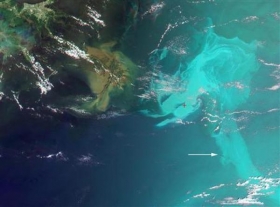
    We’ve had to learn a lot while watching the excruciating efforts to cap the gushing BP oil well deep in the Gulf of Mexico.

    The latest lesson on the chalk board is about deep sea pressures. The water pressure is so great at a mile below the surface  (about 2,640 PSI) that pumping material back into the ruptured oil pipe is an incredibly difficult feat. It calls for a special potion of drilling “mud” of just the right consistency to hold up against the force of the oil gushing out, and yet not freeze before doing its job or collapse at deep sea pressures and temperatures.

    As with all previous attempts to cap the oil well break, this one carries a risk of failure, but also an added risk that it could cause the oil pipe to spring a new leak, unleashing more havoc into gulf waters.

    “The top kill procedure has never before been attempted at these depths and its ultimate success is uncertain,” BP says.

    Here’s a graphic of the “top kill” operation put out by the Deepwater Horizon Response team.

    Bill Nye, the Science Guy, has been on CNN in recent days explaining how this drilling mud can work:

  • Eco-friendly kettle by Kenwood saves 35% energy

    energy_sense_kettle.jpg
    Eco-consciousness is spreading around the globe and designs for eco-friendly products are coming up quickly, with the world finally realizing the need to save energy. This time, it’s kettles that go eco-friendly. This kettle by Kenwood is eco-friendly and with a bit of technology and innovation can save up on energy while heating water for your early morning cup of tea. The technology this kettle uses to heat up water uses 35% less energy, or so Kenwood claims.

    Also, a bit of common sense by the designer Andrew Liszewski, coupled with innovation ensures that you don’t heat more water than you actually require. The kettle is designed with markings to indicate just how much water you’ll need, without heating an excess leading to wastage. You can have one of these eco-friendly kettles for just $70.

    Source

  • Oil spill’s energy lesson for Obama

    Berkeley physics professor Richard Muller, author of the new textbook “Physics and Technology for Future Presidents,” says Barack Obama could learn a lesson from the Gulf of Mexico oil spill.

  • 32 Pivotal Leaders Selected in Cleantech

    Gregory T. Huang wrote:

    Pivotal Leaders, a new Portland, OR-based network of cleantech business leaders, announced this week its 32 top leaders for 2010. They were nominated by the community and selected by their peers, from a pool of more than 600 nominations, as people most likely to lead successful Northwest clean technology companies in the next three to five years. The Pivotal Leaders hail from companies including McKinstry, Microsoft, Pixelworks, PV Powered, EnerG2, Blue Marble Energy, V2Green, GlobalSmartEnergy, and EnergySavvy, and from organizations such as Clean Edge, Climate Solutions, and the Oregon State Legislature. Pivotal Leaders will hold a kick-off event in Seattle in July.


  • Blessing in Disguise

    In times of uncertainty, the natural tendency for people is to look for ways to limit expenses. Whether you’re a recent graduate just venturing into the workforce, whether you are a small business owner who has seen limited economic activity in your shop, or whether you’re the head of a household concerned about the future, you’re probably looking at ways to save money right now.

    As we look for savings in our daily lives, we should start by looking at our everyday activities at home. How can we save water? For example, taking short showers instead of baths conserves water and saves money. How can we save energy? Using energy efficient appliances saves energy and reduces greenhouse gas emissions. How can we generate less waste? How can we reuse what we have? The fact is that all these steps to save money are also green actions. In other words, by saving greenbacks, we are also going green and protecting the environment all in one! Furthermore, many of those green actions can also be taken at the community level as we develop smart strategies for a sustainable future.

    So, as we actively pursue a green lifestyle, why not take a few minutes to share with us how you plan on going green? Visit our Pick5 Web page where you be able to get information on how people from all over the world are joining efforts to become true environmentalists. You won’t have to drive a car nor fly to a faraway destination. The information is just one click away.

    Ultimately, this saving trend may be a blessing in disguise.

    About the author: Lina Younes has been working for EPA since 2002 and chairs EPA’s Multilingual Communications Task Force. Prior to joining EPA, she was the Washington bureau chief for two Puerto Rican newspapers and she has worked for several government agencies.

  • No hay mal que por bien no venga

    En tiempos de incertidumbre, la tendencia natural de las personas es buscar maneras para limitar sus gastos. Independientemente si uno es una persona recién graduada que entra a la fuerza laboral, o un pequeño comerciante que ha visto actividad limitada en sus negocios, o un padre de familia preocupado por el futuro, probablemente usted está buscando maneras de ahorrar dinero ahora mismo.

    A medida que buscamos ahorros en nuestra vida diaria, deberíamos empezar por analizar nuestras actividades cotidianas en nuestro hogar. ¿Cómo podemos ahorrar agua? Por ejemplo, si toma una ducha rápida en vez de un baño de tina conserva agua y ahorra dinero. ¿Cómo podemos ahorrar energía? Si utiliza enseres eléctricos eficientes, puede ahorrar energía y reducir emisiones de gases con efecto invernadero. ¿Cómo podemos generar menos desechos? ¿Cómo podemos reutilizar lo que tenemos? La realidad es que estos pasos sencillos para ahorrar dinero son acciones denominadas como “verdes”. En otras palabras, el ahorrar dinero puede conducir a actividades sostenibles beneficiosas para el medio ambiente simultáneamente. Además muchas de estas acciones verdes tomadas a nivel comunitario pueden fomentar el desarrollo de estrategias inteligentes para el desarrollo sostenible en el futuro.

    Por lo tanto, si quiere emprender un estilo de vida sostenible, ¿por qué no toma un momento para compartir con nosotros lo que planifica hacer? Visite nuestra página Web Pick5 (Elija 5) para obtener información acerca de cómo personas alrededor del mundo se están uniendo a estos esfuerzos como verdaderos ambientalistas. No tiene que manejar un auto ni volar a un destino lejano para llegar. La información está al alcance de sus manos. Sólo haga clic.

    En fin de cuentas, esta tendencia ahorrista puede ser una bendición después de todo. Como reza el dicho, no hay mal que por bien no venga.

    Sobre la autor: Lina M. F. Younes ha trabajado en la EPA desde el 2002 y está a cargo del Grupo de Trabajo sobre Comunicaciones Multilingües. Como periodista, dirigió la oficina en Washington de dos periódicos puertorriqueños y ha laborado en varias agencias gubernamentales.

  • HEEP awards 2009-10 student prizes

    The Harvard Environmental Economics Program (HEEP), a University-wide initiative that seeks to develop innovative answers to today’s complex environmental challenges, recently awarded four prizes to Harvard University students for the best research papers addressing a topic in environmental, energy, or resource economics. HEEP presented one prize for the best undergraduate paper, senior thesis, master’s student paper, and doctoral student paper. Supported by the Enel Endowment for Environmental Economics at Harvard and the James M. and Cathleen D. Stone Foundation, each prize was accompanied by a monetary award.

    To read the full story.

  • U.S. wind industry full of promise but facing turbulence?

    By Barbara Kessler
    Green Right Now

    It’s clear that America wants wind power. At the WINDPOWER 2010 conference in Dallas this week, industry advocates, governors from three states, energy company executives and even a former president all said it: Bring it on.

    Surveys show it too. A March poll commissioned by the American Wind Energy Association found that nearly 90 percent of Americans want the country to develop more wind energy — an approval rating politicians can only dream about.

    The WINDPOWER 2010 convention this week in Dallas attraced more than 20,000 participants

    The WINDPOWER 2010 convention this week in Dallas attraced more than 20,000 participants

    State governments want wind. Those in the windy plains states, especially, and have shown it by enacting Renewable Portfolio Standards (RPS), which set goals or mandates for the state to derive a certain amount of its power from renewable energy. Iowa leads the nation in using the greatest percentage of wind, which accounts for 14 percent of its power. It achieved that by offering loans to wind developers and telling state utilities to buy 105 megawatts of electricity from renewable energy projects. (Farmers had a hand in it, we learned at the WINDPOWER Iowa display, because they were amenable to putting giant wind turbines on their plentiful land and growing corn around them — a harmonic vision that stands in stark contrast to what the oil spill has done to fisherman in the gulf.)

    But it’s not just Iowa or Texas, the state with the most wind farms, that’s knee-deep, or sky-high in wind. By last count, 14 states were in what the AWEA calls the “Gigawatt Club” with more than 1,000 MegaWatts of installed wind capacity.

    States outside the nation’s “wind belt” midsection also stand to benefit. Wisconsin and Pennsylvania have wind-related manufacturing facilities and want more. Coastal states like Maine and Delaware are seeking their own wind operations offshore. Even Ohio’s getting into the act, announcing this week that it will partner with GE to put wind turbines in Lake Erie.

    Wind Platform

    A model of a wind platform (Photo: AWEA)

    Big companies, both U.S. and European, want to develop wind in the U.S. Witness the well-staffed glitzy booths by Siemens, General Electric, Suzlon, Vestas and Gamesa at the WINDPOWER conference; and more importantly their factories and offices on the ground in Colorado, Iowa, Oregon and Pennsylvania. Hundreds of smaller companies that supply everything from nacelle parts to safety harnesses for wind technicians are pushing ahead, building facilities near the big player’s hubs in Kansas, Missouri, Minnesota and West Texas.

    The list goes on. Steelworkers see wind as a way to move into the future by crafting wind blades. Community colleges from Maine to Texas are ramping up programs to train young adults for good-paying, technically skilled wind jobs.

    There’s little apparent downside to this industry that can provide local power and local jobs across the spectrum.

    Consumers stand to win with wind, in spades, by accessing a low-carbon way power their house and their electric cars that won’t skyrocket in price when the base fuel runs out. In fact, considering that wind can reduce carbon pollution, just about everyone is a stakeholder. Compared with coal, it’s night and day – one spews toxic emissions, destroys mountains and buries wilderness in sludge; the other can claim a light footprint. Even the birds killed by wind turbines look like a more tolerable impact (and potentially solvable problem) next to BP’s still-unfolding graphic illustration of the unholy damage wrought by a fossil fuel oopsy.

    Wind even trumps its clean energy competition. It’s more technically evolved than solar power, and doesn’t consume water like solar installations. (Though it’s an eminently compatible buddy for solar, being strong at night while solar pulls daytime duty.) Wind beats nuclear power in many minds because it simply doesn’t carry the risk of environmental catastrophe (You may have seen the Internet spoof about the Massive Air Spill, satirizing the BP situation.)

    And yet, there are clouds on wind’s horizon.

    In America, land of the bargain shopper and the short term gain, wind still costs more than coal power, even with some federal tax incentives in place.

    "Small wind" exhibitors showed wind turbines available to home consumers at WINDPOWER 2010 (Photo: AWEA)

    "Small wind" exhibitors showed wind turbines available to home consumers at WINDPOWER 2010 (Photo: AWEA)

    The difference depends on many factors, not the least of which is how close a customer lives to the windiest parts of the country.

    Wind is new and requires capital investment for turbines. Those turbines are costly to ship, especially when they mostly come from Europe. Wind also faces a host of issues related to getting it from Des Moines to Des Plaines, or Sweetwater to Clear Lake City.

    Billions are needed to update the outdated national grid system – which is most often likened to a horse-and-buggy enterprise in a world of cars and freeways — so that wind can be effectively disseminated. (To read more about the “Smart Grid” see the DOE’s site.)

    Many have said that the energy playing field needs to be leveled by a federal carbon tax or carbon fee, or a cap-and-trade plan, that would put a price on the pollution caused by coal, the nation’s leading source of power for buildings.

    But Congress, it barely needs to be said, has failed to move this ball down that field. Climate bills become mired in endless debates about the methods – Carbon fee? Cap-and-trade? Tax shifting? – as well as the entrenched argument over whether climate change is exaggerated.

    The latest Congressional offering, the Kerry-Lieberman American Power Act, doesn’t even include national targets for renewables, an omission that leaves wind industry leaders shaking their heads.

    The view from above, and ahead

    American wind hit its stride a couple years ago. States had incentives in place, climate change was a concern and some consumers were asking for green power. Installations grew throughout the economic crisis. The U.S. became the world’s leading producer of wind power, surpassing Germany, with current wind installations capable of producing 35,000 Megawatts.

    Gabriel Alonso, CEO Horizon Wind Energy

    Gabriel Alonso, CEO Horizon Wind Energy (Photo: GRN-Network.com)

    But the downturn and “lack of long-term market signals” took a toll, according to the AWEA. Installations were down in the first quarter of 2010, compared to 1Q 2007.

    “Utilities are not seeking long term contracts with wind power,” said Gabriel Alonso, CEO of Houston-based Horizon Wind Energy at a panel discussion of wind executives on Tuesday.

    The high price of wind relative to dipping natural gas prices is one reason. Utilities want to make smart buys and must justify to state regulators that they’re looking out for the consumer, a dynamic that can skew choices in favor of established power sources like coal and natural gas.

    To inject a longer viewpoint into this picture, wind industry leaders want a national Renewal Electricity Standard (RES), to help drive utilities and state regulators toward selecting green, renewable power. The power of wind, with its ability to cut carbon emissions, isn’t fully valued by a simple cost comparison, industry executives said in the panel discussion Tuesday.

    “We should not run our long term policy based on short term realities,” Alonso said. “People are talking about (buying) coal, about cheap gas, but where’s this country heading 20 years from now?”

    Even though Americans say they want wind power, their elected leaders haven’t been consistent in supporting the industry.

    Companies building wind projects have benefited from federal Production Tax Credits (PTCs), which provide 2.1 cent per kilowatt hour (kWh) differential to wind producers. PTCs were a big driver in pushing wind capacity forward. But Congress has kept them on a tight leash. They’re up for renewal every couple of years, next in 2012. Each time PTCs come up for renewal, elected officials debate their merits and inject uncertainty into the wind market.

    Wind executives say that volatility threatens not just wind jobs, but the nation’s competitiveness in wind.

    If the future in the U.S. is murky, then companies will install wind turbines in say, Poland instead, where the business makes sense and the capital investment can be supported, Alonso said.

    Finding the RES-ipe for success

    If the U.S. had a strong RES, preferably one calling for 25 percent of its electricity to come from renewable energy by 2025, it could change the game. (The U.S. Department of Energy has suggested that a more modest RES of 20 percent renewables by 2030 is realistic.)

    A strong RES would demonstrate to utilities and global suppliers that the U.S. will stand behind wind development and keep incentives in place, said Ned Hall, executive vice president of AES and president of AES wind generation, based in Arlington, Va.

    Ned Hall, president AES Wind Energy

    Ned Hall, president AES Wind Energy (Photo:GRN-Network.com)

    AES Wind, which develops and operates power projects around the world, would like to do more business in the United States, but without better “clarity” about the future, 80 percent of its development effort is outside the U.S., Hall said.

    Jens-Peter Saul, CEO and president of Siemens Wind Power, echoed those concerns. “The U.S. is our most important market. We’ve invested in faith.” Germany-based Siemens has built a factory in Iowa and is bringing another online in Colorado.

    “But our supply chain is not following us,’’ Saul said. “America could be a much stronger nation with a RES.”

    In the absence of a RES and stronger federal support, wind operations have been buoyed by the PTCs, state incentives and in some instances, federal TARP money. (Wind is “shovel ready” in many states.)

    But without a plan from the federal government indicating that support will be sustaining, financing and justifying big capital investments becomes trickier.

    Michael Sullivan, senior vice president of NextEra Energy Resources, which operates wind farms in Texas, said the industry needs to show it is striving to achieve all possible efficiencies to make renewables more competitive with traditional power sources.

    He disagrees that a RES is necessary for a stable U.S. market. The industry should focus instead on making steady advances, striving to go from providing 2 to 3 percent of the nation’s power to the next rung of providing 4 percent of U.S. power.

    “Focus on the singles and doubles and put the runs on the board,’’  he said. “If we put a product out there that the public wants to buy” the industry will grow to the appropriate size.

    A RES is not realistic or viable in every state (translation: unwindy Southeastern states for instance) so the wind industry would be better served to spend its energy (no pun intended) on fixing the grid so it can carry wind power to urban centers effectively and accommodate wind’s variable output.

    Just getting the grid up to speed is difficult enough, given the multiple stakeholders, which include hundreds of locally controlled utilities across many states, Sullivan said.

    Wind developers do need the U.S. to subsidize and support grid improvements, the other panelists agreed. In addition to Alonso, Hall, Sullivan and Saul, the panel included Martha Wyrsche, president of Vestas Americas, the U.S. wing of the Danish wind giant.

    Alonso noted that the past decade has brought 11,000 miles of new natural gas pipeline, but only 668 miles of new power transmission lines.

    Why can such a major project be fast-tracked for gas, but not for wind? he asked.

    While the RES could send all the right signals to investors, foreign companies and policymakers, a technologically improved Smart grid, that with interactivity and computerized communications, could truly catch the wind, moving it swiftly to urban centers from rural wind farms.

    “We need transmission,” Alonso said. “Once we access the windiest areas of the country. We all win.”

    Copyright © 2010 Green Right Now | Distributed by GRN Network

  • Coalition of environmental groups calls for a hold on arctic drilling

    From Green Right Now Reports

    As the Obama Administration ponders whether the gulf oil disaster should dictate any changes in the plans for additional offshore oil drilling, a coalition of environment groups is saying no way, baby, no way to drilling in arctic seas.

    They’ve put together an ad campaign that will be running on cable news channels, like CNN and MSNBC, saying that arctic offshore oil drilling is a bad idea and asking the public to weigh in by calling President Obama if they agree.

    Shell Oil plans to put an exploratory well in place off Alaska’s coast this summer, even as the nation’s worst spill unfolds in the gulf. The groups are alarmed because a spill in arctic waters could be worse.

    “Imagine many of the same challenges as the Gulf, plus bitter cold, ice, extreme wind and wave conditions, 24-hour darkness for months out of the year and response equipment for a blowout of this size being weeks away,” notes a statement on behalf of the coalition, which includes the World Wildlife Fund, Defenders of Wildlife, Earthjustice, Sierra Club, National Wildlife Federation, The Wilderness Society, National Audubon Society and the Alaska Wilderness League.

    The ad also has been posted on You Tube:

    Shell says that drilling in the Arctic’s shallow water is less risky than in the Gulf’s deep water. But the coalition notes that at least one report has shown that blowouts are more likely in shallow water; and the cold and ice would make clean up in the arctic extremely difficult.

    “As the Exxon Valdez disaster and the ongoing BP spill have shown us, oil spills devastate environments and communities, and the devastation can last for generations,” said Cindy Shogan, Executive Director for the Alaska Wilderness League. “We need to be sure that we can effectively respond to and clean up an oil spill in the Arctic Ocean before we make this pristine place our next drilling gamble.”

    “The Obama administration needs to know that Americans want a pause on oil drilling in the pristine waters of America’s Arctic Ocean,” said Trip Van Noppen, President of Earthjustice. “…An oil spill in this remote region would have long-lasting impacts for decades, killing whales, seals, fish and birds, and the Native communities that rely on them.”

    When Obama opened several areas of American waters for oil drilling, he included areas in Alaska that many conservationists consider especially sensitive ecologically. Many groups stated their opposition to the exploratory drilling that will be allowed in the Chukchi and Beaufort seas under the Obama offshore drilling policy. Drilling was not authorized for Bristol Bay, a rich source of American seafood.

  • BP readies “top kill” to try to plug well

    Dogged by delays and intense pressure from the Obama administration, BP Plc faces a pivotal day on Wednesday as it attempts a tricky plan to clog the gushing Gulf of Mexico oil well five weeks into the disaster.

    If the “top kill” procedure joins the list of BP failures to plug the leak, U.S. President Barack Obama’s government may have no choice but to take central charge of the response to what is considered the worst oil spill in U.S. history.
    Obama has told aides in recent days to “plug the damn hole” and he will head to the Louisiana Gulf coast on Friday for the second time since the April 20 rig blast that killed 11 and unleashed the oil.

    Despite frustration with BP — which admitted that it may have made a “fundamental mistake” in working on the rig hours before the explosion — the government relies almost exclusively on the energy titan’s deepwater technology.

    Equipped with underwater robots, BP engineers plan on Wednesday to inject heavy drilling fluids into the mile- deep well, a complex maneuver that has never been attempted at such depths.

    Before they try to seal the well, they pumped so-called “mud” into the well head on Tuesday to gauge if the well could be damaged at high pressure
    and augment the leak.

    BP gave the plan a 60 percent to 70 percent chance of halting the leak. Industry experts at the Reuters Global Energy Summit said it is “doable” and has a 50-50 percent chance of working, while playing down concerns of a bigger leak.

    BP has other options if the top kill fails, including the installation of a new dome and a new blow-out preventer over the old one that failed in the rig explosion.

    On the day before the top kill effort, a group of out-of-work charter fishing boat captains gathered in Venice, Louisiana, and tried to be optimistic.

    “I hope it works,” said Larry Hooper. “… I have very, very big doubts but I hope the hell it does.”

    Read more>>

  • The Clean Energy Choice—To Lead or Lag

    Peter Rothstein wrote:

    This month a group of 50 clean energy CEOs, investors and executives from New England traveled to Washington D.C. to deliver a common message to our leaders in the nation’s capitol: comprehensive energy and climate legislation is critical for building the clean energy economy here in New England and across the United States. The Kerry-Lieberman ‘American Power Act’ has the potential to kick-start our shared vision for the nation’s future. It draws upon many elements of the House’s Waxman-Markey legislation and Senate’s Cantwell-Collins proposal to deliver the market signals that will accelerate private sector investment, speed the transition to a clean, sustainable energy future, and create millions of quality jobs in the U.S. And, as we watch the situation unfold in the Gulf of Mexico and are reminded of our dependency on oil, it couldn’t have come at a more critical juncture.

    New England and its business leaders have the ability to effect change. The clean energy sector already includes more than 2,000 Massachusetts companies and 26,000 jobs. It is the fastest growing industry in the region. Clean energy may be the largest opportunity we have ever had to grow new companies, create new jobs and build thriving regional and national economies. However, the clean energy industry in New England is different from its predecessors—textiles, computer hardware and software, Internet business – in scale, timeframes and the amount of investment required.

    By now, many of us have heard the numbers. Energy is a $6 trillion global industry that will grow by tens of trillions of dollars during the next 30 years. But clean energy involves capital-intensive manufacturing or projects that produce commodities such as fuel, electricity or clean materials. This combination requires an alignment of policy and public-sector investment with private capital and entrepreneurial activity. The market dictates that company growth and jobs will disproportionally be placed in regions with clear, long-term policies, pricing signals, and a willingness to adopt early.

    New England already has some of ingredients to drive private investment. Regional policies such as RGGI (the Regional Greenhouse Gas Initiative), state Renewable Portfolio Standards, advanced building codes, utility energy efficiency programs, and other initiatives have contributed to the growth of the sector. Massachusetts clean energy companies have brought in $1.1 billion in venture capital and private investment deals from 2007-2009, trailing only California, according to Bloomberg New Energy Finance data and a recent Clean Edge report.

    Despite our progress, a recent Pew Charitable Trusts study concluded that in 2009, China invested twice as much as the U.S. in clean energy—$34.6 billion versus $18.6 billion. In addition, in relative terms, the UK invested three times more than …Next Page »


  • Energy chief goes geek

    Energy Secretary Steven Chu was the headliner for Rachel Maddow’s “Geek Week” kickoff on Monday. Rachel’s “long introduction” segues into the interview at the 7:30 mark.

  • Wind expo: 3,000 blade signatures & a Great Lakes 1st

    Wearable art! This design was created by artist Rodrigo Jimenez – who also works for GE in our IT department! Rodrigo came up with the 70’s vibe artwork on his own, and we liked it so much we asked if we could put it on thousands of t-shirts that were handed out at each wind blade stop.

    The world’s largest wind energy conference is underway in Dallas, Texas, with the glitterati at the event including former President George W. Bush, singer Elvis Costello, “Seinfeld” star Jason Alexander — and GE’s giant wind blade, now covered with over 3,000 signatures. The 131-foot blade has been stopping in communities across the country to drum up support for a clean energy future as it makes it way to the conference, held by the American Wind Energy Association (AWEA). The big expo was also the forum for the announcement that GE will be providing what’s known as “direct-drive” turbines — the newest gearless technology — for the first offshore, freshwater wind farm in North America. The 20 megawatt wind project — which the developers hope to grow into a 1,000 MW farm — is in the Ohio waters of Lake Erie and marks a major step towards accelerating the deployment of offshore wind in the Great Lakes.

    While the wind blade tour helped raise awareness about the immense possibilities that renewable energy has in the U.S., it also underscored just how big the clean energy economy is in this country – and how it, and the jobs that come with it, can grow exponentially in the near future. In the video below, Chaz Allen, Mayor of Newton, Iowa, talks about the impact in his town.

    Echoing that jobs theme was Ohio Governor Ted Strickland. Describing the newly-announced offshore wind deal, which will use new technology specifically designed for harsh offshore conditions, he said: “Ohio’s greatest potential for creating wind energy is offshore in Lake Erie, and this partnership marks a significant step forward. In Ohio, we have all the right assets to make offshore wind energy successful, including an innovative workforce and the manufacturing strengths that would allow us to build all the component parts for wind turbines. This partnership will not only advance offshore wind technologies, it will also advance Ohio’s economy.”

    A star is born: GE’s blade became a bit of a celebrity in front of the Dallas wind conference.

    And in our final video, GE’s Reporter at Large, Vivek Kemp, caps the 2,436-mile journey with this report from Dallas — and as you can see midway in the video, he’s got a future as a TV weatherman!

    * Read the Lake Erie offshore wind announcement
    * Watch Part 2 of our series: “‘Capture the Wind’ tour: At the fair & atop the tower
    * Watch Part 1: “Capture the Wind tour: Honk if you like green jobs!” on GE Reports
    * Learn more about the tour on http://www.facebook.com/ecomagination

    Learn more in these GE Reports stories:
    * “$450M manufacturing investment powers offshore wind”
    * “Took a whole lot of trying, just to get up that hill
    * “Renewables study: 274,000 jobs can be added
    * “Builder of largest US wind farm inks $1.4B turbine deal

    You can still be a part of the tour by signing the blade virtually and showing your support for a clean energy future.

  • Mingyang Wind Power opens U.S. office in Dallas

    From Green Right Now Reports

    Mingyang Wind Power Industry Group, the third largest wind energy company in China, announced today that it will open a Dallas-based operations office.

    MingyangThe new office will be a hub for the global expansion of the company, which is not government owned. Mingyang is backed by the Industrial and Commercial Bank of China, a major shareholder and recently identified as the largest bank in the world.

    The wind company, which manufactures turbines but also provides engineering and financial services, promotes itself as a “total solutions” wind company, offering a start to finish program to wind developers, a news release said. It promotes its services  and equipment as the most technically advanced available; it’s wind blades are built to withstand extreme temperatures.

    Mingyang, which employes 2,000 people at five locations in China, expects to serve customers in North and South America from its office on Central Expressway in Dallas, and anticipates building manufacturing facilities in cities “like Dallas,” the news release reported.

    “Mingyang chose Dallas for our first operations center outside of China because of its strategic location, employment base, and pro-business environment,” said Wang Song, senior vice president, managing director and one of two founders of Mingyang.

    The company will have a formal announcement at the WINDPOWER 2010 convention currently underway in Dallas.

    Dallas Mayor Tom Leppert welcomed the company during an appearance at WINDPOWER 2010 on Monday. “Mingyang’s new operations in Dallas create a win-win relationship,” Mayor Leppert said.   “Its investment over the long term means local jobs, development of more renewable power, and another step toward national security.  We are excited about supporting the company’s leadership team.  We want Dallas to be Mingyang’s U.S. home.”

  • Greenpeace finds use for spilled BP oil

    From Green Right Now Reports

    Many environmental groups responded to the BP oil disaster in the Gulf of Mexico by calling not just for the clean up at hand, but also for the U.S. revoke its recent approval of offshore drilling in certain arctic regions.

    The gulf calamity raised the spectre of what could be an even worse outcome in the pristine arctic where rescue crews and supplies could be thousands of miles away when/if a spill occurred.

    Greenpeace raises a question about arctic drilling using spilled oil (Photo: Greenpeace)

    Greenpeace raises a question about arctic drilling using spilled oil (Photo: Greenpeace)

    Today, Greenpeace provided a visual for this so-far unanswered plea. Using oil collected from the BP spill, activists painted “Arctic Next?” on a Shell Oil vessel docked in Houston. The drilling supply ship is scheduled to go to Alaska this summer as part of Shell’s exploratory drilling operations there.

    This environmental moment may have been too renegade for some tastes. But Greenpeace is just one of many environmental organizations raising this question. Mainstream groups such as the Natural Resources Defense Council and the World Wildlife Fund, also oppose offshore arctic oil drilling and protested when the Obama Administration opened certain areas for drilling earlier this year. Drilling in remote waters in the fragile arctic region is folly, they say, because rescue and clean up operations would be extremely difficult in that harsh climate.

    A spill in arctic waters would not just add insult to injury to animals already bearing the brunt of climate change as their habitats melt, it could harm seafood supplies that help feed the world.

    “More than half of the fish caught in the United States each year come from the Bering Sea. And nearby, in Russia, the Kamchatka Peninsula’s river systems host the greatest diversity and concentration of salmonoid fish on Earth and produce up to one-quarter of all wild Pacific salmon,” according to the World Wildlife Fund.

    After the BP blowout in the gulf, WWF called on President Obama to reconsider its decision to allow exploratory drilling off Alaska’s North Slope.

    “We’re asking President Obama and Interior Secretary Salazar to affirm that there will be no new drill bits sunk into U.S. waters until we understand what went wrong in the gulf, and can be certain it won’t happen in the Arctic,” said Tom Dillon, WWF’s senior vice president for field programs in a May 4 statement.

    “The Gulf of Mexico has every technology available to cope with an oil spill that is now threatening to cripple the economic and ecological health of the entire gulf region. By comparison, there is no adequate plan and even less equipment for responding to a blowout in the Arctic Ocean. It would be dangerously irresponsible to allow new drilling until we understand what went wrong in the gulf and have safeguards in place to protect the Arctic.”

    Why worry? The Alaskan offshore sites are some 140 miles off the coast in areas that experience gale force winds, moving sea ice, and  protracted darkness — all of which make both drilling and rescue operations riskier.

    “A spill in the Gulf of Mexico is a bit like having a heart attack in New York City where you have every known resource to try and fix it,” said William Eichbaum, WWF’s vice president of marine and arctic policy. “A spill in the Arctic is like having a heart attack at the North Pole. Unless Santa Claus shows up, you’re not going to get help anytime soon.”

  • Other bathtubs – capital

    China is rapidly eliminating old coal generating capacity, according to Technology Review.

    Draining Bathtub

    Coal still meets 70 percent of China’s energy needs, but the country claims to have shut down 60 gigawatts’ worth of inefficient coal-fired plants since 2005. Among them is the one shown above, which was demolished in Henan province last year. China is also poised to take the lead in deploying carbon capture and storage (CCS) technology on a large scale. The gasifiers that China uses to turn coal into chemicals and fuel emit a pure stream of carbon dioxide that is cheap to capture, providing “an excellent opportunity to move CCS forward globally,” says Sarah Forbes of the World Resources Institute in Washington, DC.

    That’s laudable. However, the inflow of new coal capacity must be even greater. Here’s the latest on China’s coal output:

    ChinaCoalOutput

    China Statistical Yearbook 2009 & 2009 main statistical data update

    That’s just a hair short of 3 billion tons in 2009, with 8%/yr growth from ‘07-’09, in spite of the recession. On a per capita basis, US output and consumption is still higher, but at those staggering growth rates, it won’t take China long to catch up.

    A simple model of capital turnover involves two parallel bathtubs, a “coflow” in SD lingo:

    CapitalTurnover

    Every time you build some capital, you also commit to the energy needed to run it (unless you don’t run it, in which case why build it?). If you get fancy, you can consider 3rd order vintaging and retrofits, as here:

    Capital Turnover 3o

    To get fancier still, see the structure in John Sterman’s thesis, which provides for limited retrofit potential (that Gremlin just isn’t going to be a Prius, no matter what you do to the carburetor).

    The basic challenge is that, while it helps to retire old dirty capital quickly (increasing the outflow from the energy requirements bathtub), energy requirements will go up as long as the inflow of new requirements is larger, which is likely when capital itself is growing and the energy intensity of new capital is well above zero. In addition, when capital is growing rapidly, there just isn’t much old stuff around (proportionally) to throw away, because the age structure of capital will be biased toward new vintages.

    Hat tip: Travis Franck

  • Interact With 12 Scientific Game Changers [Science]

    Scientific American put together an interactive piece on 12 events that could drastically change the world, from nuclear exchange to cold fusion to the discovery of other dimensions. Pretty much all the stuff Lost totally prepared us for. More »


  • Can West Virginia afford to get off coal — or can it afford not to?

    (Photo: savecoalrivermountain.org)

    (Photo: savecoalrivermountain.org)

    By Tom Kessler
    Green Right Now

    Coal is deeply woven into every aspect of West Virgina and its people. The fossil fuel is found in 53 of the state’s 55 counties and underground mines produced 97 million tons of coal in 2008. West Virginia’s coal industry provides about 30,000 jobs, including miners, mine contractors, coal preparation plant employees and mine supply companies, according to the state’s Office of Miners’ Health, Safety and Training.

    But amid coal mining accidents and concerns about coal-related pollution, a more vigilant Environmental Protection Agency under the Obama Administration is beginning to put the brakes on the state’s history of widespread mining by slowing the permitting process.

    Those actions have drawn the attention or pro-mining politicians. Last week, the Senate Environment and Public Works Committee released a report outlining the adverse economic and employment impacts of the EPA’s “inability to approve or set discernable (sic) standards” for the approval of coal mining permits in Appalachia. The minority staff report was released by Sen. Jim Inhofe (R-OK), a ranking member of the committee and a leading opponent of global warming legislation.

    The report accuses the Obama Administration of “using the Clean Water Act Section 404 permitting process to dismantle the coal industry in the Appalachian region” and predicts that West Virginia, as well as Kentucky, Ohio, Pennsylvania, Tennessee, Virginia and Alabama, will be hard hit by this “virtual moratorium on permitting.”

    The Federation for American Coal, Energy and Security (FACES of Coal) has jumped into the debate to share its concerns.

    “The EPA is making clear its intentions to destroy jobs and economic security in West Virginia and throughout Appalachia,” Bryan Brown, state coordinator of West Virginia FACES of Coal, said in a statement. “The Senate report acknowledges the job destruction and economic peril EPA’s actions are having on this region. We urge our elected leaders in Washington to continue their efforts to secure coal jobs and our economic future.”

    The Senate report, gathered from information from the EPA along with interviews with permit applicants, found that the 190 coal mining operations tied up at EPA are expected to produce over 2 billion tons of coal (throughout the life of operations) and support roughly 17,806 new and existing jobs as well as 81 small businesses.

    “In this region, coal mining jobs are some of the best paying jobs available. These jobs are critical to the survival of small businesses, and they support other industries and jobs across the state,” Brown said. “The report also verifies that EPA’s actions will cost the state of West Virginia $217 million annually in tax revenue. That is a state budget nightmare.”

    But Environment Defense Fund and other groups say the pro-coal forces have it all wrong. In its own fact sheet, EDF concludes that “a nationwide cap on greenhouse gas emissions would jumpstart a new energy economy in West Virginia and accelerate the growth of good-paying, clean jobs.”

    EDF notes that clean energy “already provides thousands of West Virginia workers with good jobs during hard times.” And Pew Charitable Trusts reports that as of 2007, 332 businesses had generated more than 3,000 West Virginia jobs in the clean energy economy. EDF says that venture capitalists have invested nearly $6 million in West Virginia’s clean energy businesses.

    University of Massachusetts researchers concluded that the American Clean Energy and Security Act, coupled with the clean energy provisions passed in the ARRA stimulus package that Congress passed in February 2009, will drive $150 billion of investment in clean energy nationwide. This investment will create more than 10,000 jobs for West Virginia’s workers.

    EDF sees a huge upside to West Virginia in a clean energy world, noting that the Department of Energy has identified significant, untapped opportunities for key industries in the state to prosper under a clean energy economy. DOE identified at least 1,162 ways for small and medium-sized industrial plants in West Virginia to earn savings from efficiency, with an average payback of only 1.6 years. Only 56% of these opportunities have been implemented.

    A June 2009 report from the National Oceanic and Atmospheric Administration says inaction on global warming will cause significant harm to the Appalachian region. Warming temperatures are predicted to increase the spread of tick-borne diseases such as Lyme disease. Early snow melt will lead to winter flooding, and high temperatures will induce summer drought.

    All of this would be devastating to West Virginia, EDF says, reporting that:

    • West Virginia’s 23,000 farms—which produce over $590 million annually for the state — will lose ground to droughts and agricultural pests. Heat stress will reduce milk output from dairy farms, according to the U.S. Climate Change Science Program.
    • West Virginia’s forest industry—worth about $4 billion annually8—relies on tree species vulnerable to climate change. West Virginia’s valuable spruce forests could disappear, an EPA report says.
    • National Wildlife Federation predicts  that global warming will damage the 29,604 jobs provided by West Virginia’s $1.2 billion hunting, wildlife watching, and angling industries.

    All of this points to one thing that both clean energy advocates and pro-coal forces could agree on: West Virginia will be one of the major crossroads where the future direction of the energy industry is settled.

    Copyright © 2010 Green Right Now | Distributed by GRN Network