Category: Mobile
-
Nokia reportedly plans wave of cheap phones to combat Chinese upstarts
-
Nokia To Go Downmarket At MWC To Better Compete With Huawei And ZTE, Report Says
Windows Phone 8 is Nokia’s big play for the future, but as a result of focusing on those devices and their higher-end target market, the company is giving up ground to firms like Huawei and ZTE with lower end devices. But the Finnish company may be looking to get its budget-friendly groove back with the introduction of new, basic handsets not based on Microsoft’s mobile OS, to be unveiled at MWC next week according to Reuters.
The tails of new models come from “company sources,” according to Reuters, and suggest Nokia will introduce “cut-price” hardware in multiple handsets, as well as a single new Lumia device on Windows Phone 8, but one designed with affordability in mind. Nokia already offers the budget Lumia 620, a $249 smartphone with Microsoft’s latest OS onboard, but that’s still over $200, whereas the average selling price of Nokia mobile phones in general was € 31 in 2012, Reuters notes, with net sales of mobile phones accounting for € 9.44 billion in sales in 2012 for the company.
Nokia has had tremendous success with its Series 40 line of devices, as Natasha noted in an article late last year, but even that market where it has traditionally been strong is under attack from rival manufacturers. Nokia is failing to attract audiences in its traditionally strong markets with even low-cost Lumia handsets. And it’s losing share fast to Huawei and ZTE, which are quickly charging up the ranks of global handset manufacturers thanks to an emphatic focus on lower end devices.
Nokia’s candle is burning at both ends, with the company facing threats in both smartphones and with low-end devices. The company said to “expect a lot of things” in 2013 based on the Series 40 platform at the end of 2012, and it looks likely we’ll see some of those things unveiled at MWC. A revamped Series 4 line could definitely help shore up its shrinking share of the under $100 market, and if a new Lumia can break the $200 barrier, we might see Nokia win back some precious smartphone share as well.
-
Tablets Take Off In 2012 According To Millennial, With Kindle Fire And iPad Mini Seeing Rapid Growth
In a new report from mobile ad platform Millennial Media, the company compiles its data on mobile device share across its network for all of 2012, revealing that tablets in particular accounted for a rising percentage of impressions, with Android devices stepping up their game considerably. The Kindle Fire and Samsung tablets were the big share winners, helping Android slates grab a considerable 41 percent of the tablet mix, compared to 58 percent for Apple.
Millennial didn’t actually break out the overall values of tablet traffic in its 2011 report, but you can see from its February 2011 snapshot that the tablet/e-reader and other category had iOS at 80 percent share, with Android at just 17 percent and other at 3 percent. Android has clearly gained a lot of ground, then, and the main OEMs reaping the benefits of that growth are Samsung, which has 45 percent of the Android tablet share, and Amazon, which managed to acquire 26 percent thanks to the release of the second-generation Kindle Fire line, representing over 500 percent growth from its share in 2011.
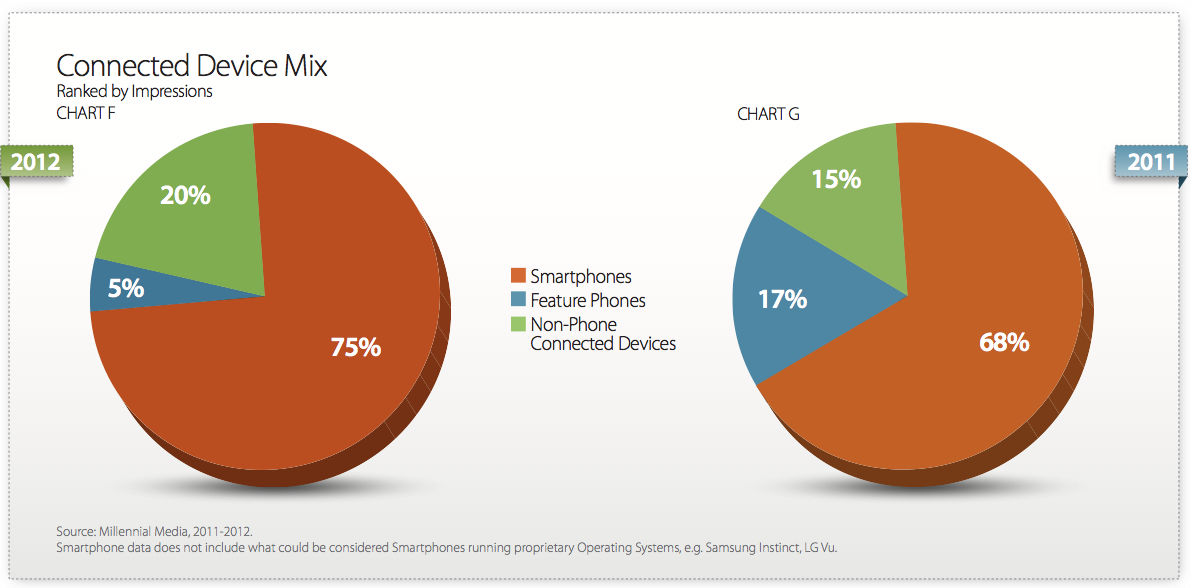
Smartphone share also grew during the year, up from 68 percent to 75 percent, with non-phone connected devices (including tablets) also growing considerably as well, from 15 to 25 percent. The feature phone category gave up tons of ground, going from 17 percent to 5 percent share. Overall OS mix, despite Android’s tablet gains, actually didn’t shift all that much, with Android gaining one percentage point overall in 2012 versus 2011, and iOS losing one. BlackBerry remained steady in third, and Windows Phone gained a single percentage point.
Millennial notes that Android continues to take up more places in the top 20 mobile phones list on its platform, while Apple continues to be the market leader with its devices in each respective category, generating an outsized helping of traffic share from just a few core devices. The iPhone ranks number one among mobile phones, growing its share from 14.67 percent in 2011 to 15.59 percent in 2012. Samsung took over the number two spot from BlackBerry with its Galaxy S line, with 4.24 percent of impressions for 2012, growing 182 percent year-over-year.
The iPad mini was among Apple’s strongest performers, growing its share of impressions at an average daily rate of 28 percent within just weeks of its initial launch. Millennial says that’s a new best for the 7-inch tablet category, eclipsing the rapid 19 percent daily average established by the original Kindle Fire during its launch back in 2011. Overall, the picture that’s shaping up looks like it will see smartphone share start to even out as they eclipse feature phones entirely, with tablets making up an increasingly important piece of the pie, if the trends Millennial is seeing continue.
-
LG unveils Optimus F5, F7 smartphones

-
Orange Ramps Up Own-Brand Range With 3 More Android Handsets, And Its First LTE Device, Has Sights On Windows Phone
Perhaps aware of the tsunami of news that will hit during Mobile World Congress, we are seeing an increasing amount of news releases coming out before the actual event. France Telecom/Orange has already told us about one device — an Android smartphone with Fujitsu aimed at the senior market — and now it is following that up with three more, own-branded, Android handsets aimed squarely at the middle market of smartphone users.
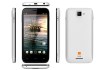
The Lumo (pictured) is the carrier’s first own-branded LTE device; the Nivo is a device aimed at the budget segment; and the San Remo is a large-screened 4.7″ device with a brushed-metal casing. All will be out in selected markets in the first half of this year.
And while each of these devices will come loaded with Android 4.1, Patrick Remy, the VP of devices for France Telecom, also notes that we may soon start seeing own-brand handsets from the carrier not built on Android. “There is no willingness to only have Android devices in this range,” he said. “We believe the best opportunity is with Android right now, but we are looking at other operating systems, specifically Windows Phone, but potentially others.”
On the subject of Firefox OS — the mobile platform being built by Mozilla with other partners — “we are monitoring what is being done there,” says Remy. “We are not announcing any launch of such devices at this point in time, but we are definitely interested in that area and depending on the opportunities, there is a chance for an Orange-branded device among those.”
Remy also admits that Orange’s own-brand smartphone devices do not move the needle when compared to the volumes sold by carriers from smartphone leaders Samsung and Apple. But they are proving to be small hits for the carrier, specifically when targeting users in the mid-market — or “higher-end pay-as-you-go or lower end contract customers,” in Remy’s description.
This naturally means these devices do best in markets where these segments are biggest. “Not Luxembourg,” Remy joked of the very affluent little principality where the carrier offers services. But other markets do quite well. In Spain last year, Orange’s best-selling device was the Monte Carlo, another handset in its own-brand range. Overall sales of this line of devices has grown by 62% over the last year. But it’s telling that there are currently “no plans” for any of these three to be offered in the UK this year.
France Telecom/Orange does not release sales numbers on how well these smartphones do but did note that last year its entire range of own-branded devices — including both feature phones and smartphones — were about 10% of all handset volumes, “and that’s increased a bit to about 12%,” says Remy. He notes that within that proportion smartphones are a “significant part of that.”
Orange has struck deals with Alcatel/TCL, Gigabyte, Huawei and ZTE to make its own-brand devices. The Lumo and Nivo come from Gigabyte, whereas the San Remo is made by Alcatel/TCL, with Huawei and ZTE sitting out in this particular round.
Perhaps more than other European telcos, Orange has over the years dedicated a lot of time and energy to creating devices that are filled with Orange-customized services and the Orange brand. These devices play into that theme, but for now will not be packing as much Orange-punch as they can.
Baidu, for example, which has inked a deal with Orange to provide a customized browser for its devices, will not be making an appearance on the devices for now, although this may be something we will see going forward, says Remy. “They’ll come with our standard suite of services and customization,” he noted. These include customized lock-screens, the ability to port your services when roaming, and links to Orange services specific to your home country.
-
Motorola offers $50 Google Play store credit for new smartphone buyers

-
Amazon Launches Shopping App For Canadian Customers
Amazon.ca has launched a new Shopping app for iPhone, iPad, Android and Windows Phone. The app is presumably like its American counterpart.
“We are excited to further enhance the customer shopping experience in Canada,” said Sam Hall, VP of Mobile Shopping for Amazon. “Customers in Canada can now use the Amazon Mobile App to conveniently shop, browse and buy from anywhere, all while accessing popular features such as Prime, 1-Click ordering, customer reviews and more, right from their mobile devices.”
Here’s a snippet from the announcement:
To make on-the-go shopping a seamless experience, customers can sign up for a new account using the Amazon Mobile App or they can use their existing Amazon.ca username and password to access the same account they view on the Web. Customers using the Amazon Mobile App can access many of the same features as on the Web, including their cart, Wish Lists, payments, 1-Click settings, Prime membership and more, and can shop the full selection of products available on Amazon.ca, including electronics, baby, kitchen, books, movies, music, watches, sporting goods, tools and more.
With the simple click of a button on their mobile devices, customers can have millions of products delivered to their door while benefitting from Free Super Saver Shipping on orders of eligible products over $25 or by taking advantage of Free Two-Day Shipping with Amazon Prime. The Amazon Mobile App for tablets gives users an immersive shopping experience with larger, richer images and easy access to search filters to quickly find what they are looking for.
The app lets users choose between English and French-language shopping.
-
Apple releases second beta for iOS 6.1.3

-
Petition to Make Unlocking Phones Legal Again Crosses Signature Threshold
A petition to make unlocking cellphones legal again has crossed the signature threshold on the White House’s We The People petition site, meaning that it will receive an official response.
Back in January, unlocking new cellphones became illegal via decision from the Library of Congress. It’s still legal to unlock phones purchased before January 26th, but doing so on any device purchased after that cutoff mean you could run afoul of the Digital Millennium Copyright Act. The basis for the reversal of U.S. federal policy was that only software owners (mostly Apple, Google, Microsoft, etc.) shoudl have the rights to unlock handsets.
Of course, many consumers strongly disagree and feel as though it’s their right to do whatever they want with a device once they’ve made the purchase. And that’s the feeling behind the petition.
Here’s the full petition, simply titled “Make Unlocking Cell Phones Legal”:
The Librarian of Congress decided in October 2012 that unlocking of cell phones would be removed from the exceptions to the DMCA.
As of January 26, consumers will no longer be able unlock their phones for use on a different network without carrier permission, even after their contract has expired.
Consumers will be forced to pay exorbitant roaming fees to make calls while traveling abroad. It reduces consumer choice, and decreases the resale value of devices that consumers have paid for in full.
The Librarian noted that carriers are offering more unlocked phones at present, but the great majority of phones sold are still locked.
We ask that the White House ask the Librarian of Congress to rescind this decision, and failing that, champion a bill that makes unlocking permanently legal.
The petition currently has 101,000+ signatures, which means that the White House is required to respond. In mid-January, the White House upped the signature threshold to 100,000 from the previous 25,000, in the hopes of weeding out “joke” petitions and make the process a little more credible.
Before this move, there were dozens upon dozens of petitions that hit their goal but were sitting in limbo, waiting for responses.
-
VMware and Citrix Launch Workforce Mobility Solutions
The mobile device management market continues to heat up, as VMware and Citrix expand product offerings to help manage personal laptops used in the workplace and Bring Your Own Device (BYOD) initiatives.
VMware Horizon Suite
VMware (VMW) unveiled the VMware Horizon Suite, a comprehensive platform for workforce mobility that will connect end users to their data, applications and desktops on any device without sacrificing IT security and control. In addition to updates to Horizon View and Horizon Mirage products, VMware introduced VMware Horizon Suite, which will enable IT organizations to empower users with a secure, easy-to-manage virtual workspace that delivers a consistent, compelling experience across devices.
“Our customers are looking for a comprehensive, enterprise-class solution to empower workers in a world where the proliferation of devices and consumer cloud services have changed user expectations, while putting IT security and governance at risk,” said Boaz Chalamish, senior vice president and general manager, End-User Computing, VMware. “VMware virtualization has helped hundreds of thousands of customers change what is possible in the datacenter, and we believe it can have the same transformative impact in end-user computing. The VMware Horizon™ Suite will help our customers accelerate their journeys from the PC Era to the Multi-Device Era.”
As a unified solution the Horizon suite will combine a desktop virtualization solution with technologies that VMware has built from the ground up to support a mobile, collaborative workforce. Horizon Workspace was also introduced, as a new product that will combine data, applications and desktops into a single aggregated workspace, that can be securely delivered on any device.
Citrix launches XenMobile MDM
Citrix (CTXS) announced XenMobile MDM, an enterprise mobile device management solution that gives users device choice while also enabling IT to meet its management and compliance requirements. XenMobile MDM provides the foundation to address these needs through role-based management, configuration and security of corporate and employee-owned devices. The product is directly integrated with Microsoft Active Directory and public key infrastructure systems, as well as security information and event management tool.
“In today’s complex enterprise mobility environment that includes a mix of corporate and employee-liable devices, companies need solutions that allow them to manage devices, data and apps,” said Stephen Drake, Program VP, Mobile Enterprise at IDC. ”The addition of an MDM solution to the Citrix MAM and data management capabilities create a complete solution. By offering a platform for mobile enterprise management that gives options, Citrix can help give customers the peace of mind that, if their needs change, the platform can adjust.”
In addition to XenMobile MDM, Citrix now also offers a Mobile Solutions Bundle for Enterprise Mobility Management (EMM). The Mobile Solutions Bundle is comprised of XenMobile MDM and CloudGateway and eliminates the need for multiple point solutions from other vendors.
-
IBM’s mobile first plan is really about cloud first. That’s all you need to know
IBM launched its mobile first strategy this morning with several media stories and more fanfare than facts. At the core of the strategy is that IBM (and its customers) have realized that mobile is changing the game in terms of how customers expect to interact with businesses, but also that in putting mobile first they need to change their entire IT to take advantage of it.
As James Governor, an analyst at Redmonk, puts it in his very astute take on IBM’s news:
MobileFirst is a really big deal, because it doesn’t come alone. Mobile first means Cloud First. It also means Social First. It also means Big Data First. API-first. You get the picture. When a customer has a problem they think is a mobile problem, it turns out its a Cloud-hosting problem, and so on. Every mobile engagement IBM does with a client is going to have significant pull through in other areas. In that respect IBM’s mobile commitment is somewhat like its Linux commitment back in the day. IBM won’t make money directly selling a mobile operating system (it will leave that space to the likes of Google), but in associated revenue streams and product lines.
That right there is a point I tried to bring up with Paul Bloom, the Research CTO of IBM Telecom last week when we chatted about the announcement. I was excited about how IBM could pull all of those things together — after all, this is the company that makes billions on middleware — but Bloom was more focused on the telecommunications side of things. And IBM does have an impressive telecom heritage with a history of developing everything from the technologies used on the chips inside some networks to the software pulling the networks together. That doesn’t even count the IBM gear inside telco data centers.
Bloom said that IBM has pulled together roughly 10 acquisitions since 2006 that will help with this effort with a special emphasis on WorkLight, a mobile application development platform, and BigFix, which manages distributed endpoints (like thousands of mobile phones!). Building the underlying infrastructure to support the mobile first world is tough.
Connecting federated apps via APIs and across different platforms is a problem CIOs and developers are just now trying to solve. And making sure those pieces are then delivered in a beautiful and timely fashion to a massive number of different devices with different operating systems and capabilities is like asking a chef to make a meal that will appeal to every human on earth. That IBM is going after this is not unexpected, but it is a tough order.

Related research and analysis from GigaOM Pro:
Subscriber content. Sign up for a free trial.- A near-term outlook for big data
- Connected world: the consumer technology revolution
- The future of mobile: a segment analysis by GigaOM Pro


-
New Google Glass Patent Is The Most Comprehensive Yet For Google’s Face-Based Wearable Computer

The USPTO has published a new patent application today from Google, which describes in comprehensive detail the complete system that would go on to become Google Glass, originally filed in August of 2011. The newly discovered patent describes not only individual components of Glass as we’ve seen previously, but the overall system, including display, frames, image projection and capture, wireless connections, sensors and more.
Some of the technical drawings included in the patent look a lot like the Google Glass we’ve come to know and love from its public appearance adorning sky divers and tech company founders who could be mistaken for jewel thieves. But others depict designs that resemble cheap paper 3D glasses, and hipster specs you might expect to see at Warby Parker. Google is clearly looking at multiple ways to bring Glass to market, aside from the sci-fi style visor it’s been showing around.
The text of the patent gets into extreme technical detail, offering a granular look at how Glass actually functions. It describes how the lens mounted display would operate in relation to the movement of a wearer’s head to keep the projected image consistent, and how objects in the real world can be overlaid with digital images to create augmented reality experiences. It goes into detail about various configurations of glasses arms and where the housing for the ‘brains’ of the device could be located relative to the rest of the glasses apparatus, and talks about building touch-sensitive surfaces into frame to accept user input.
Google also describes the limitations of current wearable tech interfaces in a section on background, which it uses to essentially give a reasoning for its creation of Google Glass. Existing systems were, in a word, deficient according to the company’s filing:
Both head-mounted and heads-up displays can be connected to a video source that receives a video signal that the device can read and convert into the image that they present to the user. The video source can be received from a portable device such as a video player, a portable media player or computers […] The functionality of these types of displays is, however, limited to passive actions wherein the display simply receives information from an external source and presents it to the wearer in limited forms. Accordingly, further advances in wearable devices including displays have been needed.
Some of the more interesting elements from the detailed description of the patent include alternative display methods. We’ve seen the use of lens-mounted displays in the current prototype, but the patent also describes alternatives including “a laser or LED source and scanning system [that] could be used to draw a raster display directly onto the retina of one or more of the user’s eyes.” That sounds a little terrifying but also potentially exciting.
Overall, the patent is primarily about locking down Google’s IP with respect to the Glass project in as technically detailed a manner as possible, but it’s an interesting read for gadget heads or engineers who want to learn more about the nitty gritty background behind Google’s most daring consumer hardware project.
-
This New Apple Patent Could Be The Design For A Radical iWatch With A Wraparound Display

Apple has a number of patents on wearable computing, but a new application spotted by AppleInsider blends some old and some new tech to provide a vision of what it might conceivably look like as a shipping product. The patent in question describes a wrist-mounted flexible screen, built on a support structure that closely resembles the “slap bracelets” children of the nineties will likely recall. When worn, the screen could provide an unbroken display that wraps all the way around the wearer’s wrist.
Apple even uses the slap bracelet directly as an example of how the device would work in its patent filing. Besides provoking nostalgia in people my age, the design would make it possible to use the device in both curled (worn) and flattened forms, acting as a different kind of display in either scenario. When on the wrist, Apple describes a sensor that would allow the watch to recognize where the end is, so that it can manage universal sizing while still wrapping a display around the wrist without any overlapping visuals.
The patent describes some software functionality, which begins to get at what an Apple iWatch might offer that others building smart watches can’t or don’t yet do. It could be used to “adjust the order of a current playlist,” review “a list of recent phone calls,” type out a message reply via a “simple virtual keyboard configuration across the face of the flexible display.” Apple even suggests using it as an input device for controlling and navigating apps like Maps. If you had trouble conceiving how an iWatch might actually revolutionize wearable computing, this patent’s description of features begins to answer that.
Apple’s patent describes making use of solar power and kinetic energy to help prolong battery life, and it includes provisions for a number of other ways to affix it to a user’s wrist, including snaps and velcro, meaning the slap bracelet look could give way to something much more in keeping with traditional watch design. But what’s most interesting is the functionality described in the patent: it shows how Apple, working with its own hardware and software in ways that third-party manufacturers aren’t able to could greatly extend the usefulness of a wrist-mounted, smartphone connected device.
The iWatch is rumored to be in production, with reports from Bloomberg, the New York Times and the Wall Street Journal all surfacing recently. We’ve seen iWatch-related patents before, including ones that describe elements of this slap bracelet system, but this is the most complete patent to date and the timing feels more than coincidental as a result.
-
Mobile Payments Startup SumUp Adds Support For American Express Payments In 8 Of Its 10 European Markets
SumUp, one of the myriad of European mobile card reader startups taking advantage of Square’s continued absence in the region to build out a business, is adding support for American Express. Its mobile card reader system already accepts Mastercard and Visa payments but today the startup said it has signed a deal with American Express to process Amex card payments in all “major regions” in which it operates. Its merchants will be able to start accepting Amex in Q2.
SumUp now operates in 10 European countries. It confirmed to TechCrunch Amex payments will be supported in eight of its markets initially — namely: Germany, France, the UK, Ireland, Italy, the Netherlands, Spain and Austria. The two markets where negotiations are ongoing, with a view to also adding Amex support in future, are Belgium and Portugal.
SumUp also confirmed its per transaction fee remains the same, with no premium for merchants to process Amex. Merchants using SumUp to process a transaction are charged a flat 2.75% per transaction fee.
With the addition of American Express, SumUp said it will be able to accept “more types of cards in more regions than any other mobile point-of-sale technology provider worldwide”. SumUp Co-founder Stefan Jeschonnek said Amex support is a “big deal” for it, and for the tens of thousands of merchants in Europe who use its technology. ”SumUp is about enabling small businesses to grow and for our merchants being able to accept card payments from all the major brands is a big deal,” he added.
Commenting on the tie-up in a statement, Werner Decker, Senior Vice President, American Express, said: “We see SumUp as a smart and convenient way for small businesses to further enable commerce by accepting card payments.”
SumUp added that American Express will also be included as a payment option in its forthcoming consumer payment app — called SumUp Pay — which it demoed at Finovate Europe last week. The app will allow consumers to link their credit card to it and pre-authorise payments with trusted merchants. The payment process does not involve a physical card reader — rather the buyer’s phone is identified as it enters the store, using geofencing technology, and the merchant can then process the payment when the buyer confirms what they want to order.
As yet, there’s no confirmed launch date for SumUp pay.
SumUp’s Amex release follows below.
SumUp to accept American Express
SumUp broadens range of payment options for merchants in major European markets
London – 21th February 2013: SumUp, the company that enables merchants to take debit and credit card payments with their smartphones, has signed a deal with American Express that will allow it to process American Express card payments in all major regions in which it operates. The deal means that SumUp merchants will soon be able to take payments from American Express Card members.
In December 2012, SumUp extended its service to merchants giving it a presence in ten European countries. SumUp’s ability to process American Express payments means that it will accept more types of cards in more regions than any other mobile point-of-sale technology provider worldwide.
Any small business using SumUp will soon be able to accept card payments from all the major card brands for an affordable and transparent fee and without any monthly costs.
Daniel Klein, CEO of SumUp, commented: “It’s extremely frustrating for a merchant when they miss out on making a sale because they can’t accept the type of card a customer wants to use. The only person it’s more frustrating for is the customer who goes away empty-handed. That’s why we’re delighted that we will be able to process American Express card payments on behalf of our merchants and to the advantage of American Express’ thriving and deeply loyal customer base.”
– ENDS –
About SumUp
SumUp is the easiest way for small businesses and sole traders to accept credit and debit card payments securely, even on-the-go.
Using only a free, supremely portable card reader and an app available for iPhone, iPad and Android, artisans, taxi drivers, cafes, restaurants, shops and many other merchants are now able to accept credit and debit card payments anytime, anywhere.
SumUp only takes a fee of 2.75% per transaction made using the SumUp card reader, meaning that businesses no longer have to worry about additional costs, expensive terminals or high monthly fees. The transaction fee is the same for American Express, Visa and MasterCard. SumUp is Europay, MasterCard, and Visa (EMV) compliant and PCI-DSS certified, ensuring that payments are processed in accordance with the highest security standards.
The company was founded in 2011 and already has over 140 employees, and major offices in Berlin, London, Dublin, Madrid, Milan and Amsterdam. SumUp has been available in the UK, Germany, Ireland and Austria since August 2012, in the Netherlands, Spain, and Italy since November 2012, and in France, Portugal, and Belgium since December 2012.
Website: www.sumup.co.uk
-
ZTE to use Nvidia’s latest Tegra 4 chip in next-gen phones
Fresh off the launch of its Tegra 4i chips that integrate a modem and the tegra applciaiton processor, Nvidia is announcing a customer win for its standalone Tegra 4 applciaiton processor. ZTE, the Chinese handset and equipment maker, will produce a smartphone using the Tegra 4 processor and Nvidia’s i500 LTE modem.
The handset is anticipated in the first half of 2013 according to Nvidia, and follows ZTE’s use of Nvidia’s Tegra 2 and 3 processors and Icera modem in earlier phones. It’s also the beginning of handsets designed to wow users with full HD playback and other features that require some serious processing power.
Nvidia isn’t the only company pushing more powerful application processors and flexible modems; ST-Ericsson announced a 3GHz monstrosity today as part of its NovaThor line of integrated chips. While ST-Ericsson is only showing off a prototype, the specs clearly show that it too has visions of faster phones that require a lot of processing power.
The NovaThor also supports a huge variety of mobile radio technologies that make it useful in many geographic areas. For those who want to get technical, the NovaThor L8580 supports downlink speeds up to 150Mbps as well as LTE-FDD, LTE-TDD, HSPA+, GSM and TD-SCDMA. It has up to 17 bands in the same device and a single radio for carrier aggregation, which is what enables it to tune into frequencies in many markets. Like Broadcom’s latest modem, ST-Ericsson and Nvidia are pushing the bar when it comes to building radios that can travel far and wide even if a country uses different frequencies for their LTE deployments.
In many ways the future of phones is the same has it had been, more performance in more places. Technology is awesome.

Related research and analysis from GigaOM Pro:
Subscriber content. Sign up for a free trial.- CES 2012: a recap and analysis
- Who and what to watch in the new era of the living room
- Tablet market to hit over 377 million units by 2016

-
ZTE Aims To Launch The First Tegra 4 Smartphones In China By The End Of 1H 2013

When NVIDIA officially pulled back the curtains on its new Tegra 4 SoC at CES, it had no shortage of praise for the thing — the company referred to it as “the world’s fastest mobile processor” — but there was something missing from the announcement. Who would be using be using it?
Sure, Vizio revealed a 10.1-inch, T4-powered tablet just a day later, but there was nary a phone partnership in sight until tonight. NVIDIA has just announced it is working with the folks at ZTE to launch the first Tegra 4-powered smartphones in China during the first half of this year.
Here’s a quick refresher on the Tegra 4 in case you haven’t been keeping up with the wild and woolly world of mobile systems-on-chips. This particular SoC sports 72 GPU cores, as well a quad-core processor that feature’s ARM Cortex A15 core, and LTE support by way of NVIDIA’s Icera acquisition.
NVIDIA’s deal with ZTE honestly seems like a mixed bag. Don’t get me wrong — the Chinese company is capable of crafting some nice hardware (and we’re sure to see some of it at Mobile World Congress next week), but one can’t help but wonder if NVIDIA would’ve preferred a higher-profile partner to help usher in the age of Tegra. That’s not to say that NVIDIA isn’t getting anything out of this deal though. Far from it, actually — continued buy-in from a notable Chinese OEM will only help NVIDIA strengthen its position in a fast-growing mobile market.
For now, there’s no word on exactly what ZTE devices the Tegra 4 will find itself in, but NVIDIA is awfully fond of throwing the term “superphone” around, so I’d expect something with at least a little bit of wow factor.
Meanwhile, some of rival Qualcomm’s recently revamped chipsets have appeared in high-end hardware — HTC’s new One has a Snapdragon 600 ticking away inside of it, and it may not be alone. Rumor has it that Samsung is having some heat management problems with its newer in-house Exynos chipsets, and is mulling a switch to a Qualcomm SoC for its flagship Galaxy S IV. Couple that with the high-end 800 we saw at CES and the Snapdragon 200 and 400 chipsets that just officially got the nod and NVIDIA’s certainly got a fight on its hands.
-
Forrester: Tablet Ownership In Europe To Rise 4x In 5 Years — 55% Of Region’s Online Adults Will Own One By 2017, Up From 14% In 2012
Analyst Forrester is predicting tablet ownership in Western Europe will quadruple by 2017 – with the percentage of online adults owning a slate projected to increase markedly from less than a fifth (14 per cent) last year to more than half (55 per cent) in 2017. In 2011 the tablet-owner figure stood at just 7 per cent, underlining how quickly digitally connected consumers are adopting slates. ”With double-digit growth in tablet uptake across Western Europe in 2012 and further double-digit growth expected, tablets can no longer be considered a fad,” says Forrester, writing in a new tablet-related research report it’s putting out tomorrow.
The analyst said it expects the consumer-owned installed base of tablets to reach more than 147 million in Western Europe in 2017, up from 33 million in 2012. Its tablet growth forecast is based on a survey of 13,000 consumers in France, Germany, Italy, Netherlands, Spain, Sweden, and the UK. The polled nations with the largest proportion of tablet owners, as a percentage of their total online population, were the Netherlands, with 20 per cent tablet penetration in 2012; Spain with 18 per cent; Italy with 16 per cent; and the U.K. with 15 per cent. France was lowest with just nine per cent.
In a preliminary version of Forrester’s tablet report, seen by TechCrunch, a few observations stand out — including a downward shift in the age-range of the largest group of tablet owners, shifting away from 30- to 40-year-olds to 18- to 24-year-olds. The analyst found a quarter of online adults in the 18- to 24-year-old category owned a tablet in 2012. The shift towards more younger tablet owners may accelerate in future — Forrester points to the rise of “competitively priced” Android powered tablets in the sub-€250 category, such as Amazon’s Kindle Fire and Google’s Nexus 7. And since tablet ownership increases with income, according to Forrester’s findings, and the young are keenest on owning a tablet, then cheaper Android tablets which are half the price of Apple’s iPad are likely to be helping to drive adoption lower down the age range, to users who previously may not have had the disposable income to afford an iPad. As well as Android-powered slates stepping into that pricing vs demand gap, Apple also came out with the smaller, cheaper iPad mini last year. Yet more fuel for the tablet fire.
The living room and the bedroom are the only locations where tablet owners chose their slate over their smartphone
While the young are the keenest on tablets, Forrester said they are by no means the only age-group with an interest. Nearly one in six European online consumers aged 65 or older already owns a tablet, according to the report.
Despite the rise of cheaper slates, price remains a considerable barrier to tablet entry for a big chunk of online European adults — Forrester found that around a third of those polled are not planning on buying a tablet due to price (and regardless of income) — suggesting lots of potential tablet owners still have trouble justifying the purchase of an additional gadget, on top of their smartphone or PC.
When it comes to tablet usage, Forrest found that tablets are unsurprisingly most used in the home — specifically the living room, bedroom and kitchen, whereas smartphones have a much wider and more consistent distribution of usage (as illustrated by the graphic below). The living room and the bedroom are the only two locations where polled tablet owners chose their slate over their smartphone. Or, in other words, the most used gadget is the gadget you have in your pocket.
According to Forrester, the main usage activities for tablets are accessing the Internet, emailing, social networking, playing games, and viewing pictures. It also found that tablets are not the highly personal devices that smartphones are: of the tablet-owners who have a spouse/partner, 63 per cent said they share their tablet with them, while one-third share it with their children — making tablets “a far more social device than smartphones”, according to the analyst.
“Tablets are social devices mostly used in the digital home,” said Thomas Husson, analyst and co-author of the new report, in a statement. “Companies that want to exploit tablet opportunities need to understand they require a differentiated approach from smartphones.”
The report also underlines a ‘halo effect’ for smartphone makers who also sell tablets. Forrester identified a general allegiance among smartphone owners to their phone’s brand when choosing a tablet — especially pronounced for iPhone owners but not limited to Apple’s hardware. The report notes:
While the Apple iPad is the dominant tablet in Western Europe, it is most popular with iPhone owners — a staggering 83% of European iPhone owners who have a tablet opted for an iPad. Similarly, the Samsung Galaxy tablet is most popular with Samsung Galaxy and Wave smartphone owners, and the Windows 7 tablet with owners of Windows-based smartphones.
Tablet owners also tend to own a plethora of other connected gadgets — six others on average, according to Forrester — and are “more technology savvy than non-tablet owners”, a finding that is consistent with an early adopter profile. Forrester links smartphone ownership to tablet ownership as a key driver for slate sales up to now — noting that “the proportion of European smartphone owners who own a tablet (28 per cent) is more than double that of those who aren’t smartphone owners (12 per cent)”.
However the analyst says what’s true for the current crop of (still early adopter) tablet owners, won’t be true as tablet ownership expands to take in a greater proportion of the population. ”We are still in the early-adoption phase of tablet ownership, so the next wave of tablet owners will not be as eager; to convince them to adopt a tablet, marketers will need to stress attributes like accessibility, ease of use, and relevance,” says Forrester.
The analyst believes tablets are likely to expand their usefulness beyond the living room/bedroom in the near future, with usage patterns being shaken up by a variety of factors including enterprise/workplace adoption of tablets; the diversification of form factors (such as smaller tablets and phablets, touchscreen laptops and “netvertibles”, hybrid devices and other new forms); as well as the roll out of 4G cellular services and more cellular data bundles.
Likewise, tablet usage will be dictated by form factor — so usage patterns may also shift, as tablets migrant to other locations. “A tablet with an attachable keyboard will encourage greater usage of email and work-related applications; and while not a pocket-size device, a 7-inch tablet will encourage greater portability,” the report notes.
-
The Nifty MiniDrive Gives Your MacBook Air Or Pro More Internal, Removable Flash Storage

MacBooks are on a straightforward path to becoming closed case devices, with very little in the way of aftermarket expandability options for consumers. Which is why the Nifty MiniDrive Kickstarter project seemed so promising: It’s a microSD card adapter that fits flush with the side of your MacBook Pro or Air, which means you can add up to 64GB of additional flash storage via a port that many people probably only use very occasionally anyway.
It’d be easy to do this yourself if Apple used the kind of spring-loaded, flush-mount SD card slot you see on a lot of Windows PCs, but as it is, when using standard SD cards and adapters, the end protrudes about a third of an inch out of the side of the computer, which means keeping something there permanently will invite disaster if you’re putting it in and out of a bag with any frequency. The Nifty MiniDrive fixes that, with a design that’s custom-fit for the different models of MacBook (there’s an Air version, one for the MacBook Pro and another for the 15-inch Retina Pro).
Removing the card requires a special tool that Nifty ships with each MiniDrive, which is not unlike a SIM-card tray ejector, but with a hook so that it can catch the recessed groove found on the adapter itself. It’s a remarkably effective design, which works well in practice. Losing a MiniDrive tool would mean your drive is stuck in the SD card slot, but you can fashion your own removal tool from a staple or paper clip should it ever come to that, so it isn’t a huge concern. Plus, these are designed to be used mostly by people who don’t require frequent access to that port anyways.
As you can now get microSD cards in capacities ranging up to 64GB, with 128GB possibly to follow soon, that adds a considerable amount of extra disk space in a package that adds almost no weight to your existing setup, and doesn’t change the outside physical profile of your machine. On my 128GB MacBook Air, the Nifty MiniDrive with a $60 64GB microSD Class 10 card gives me 50 percent more storage. And if I fill it up, it’s easy enough to swap out another drive, keeping the first microSD card close at hand in case I need to retrieve something from the archive.
Although only made of plastic and glue (plus the metal connectors), the two Nifty MiniDrives (one for 15-inch Retina Mac and one for 13-inch Air) I have are performing well. They’ve survived multiple removals without incident, the silver finish on their endcaps matches the color of the MacBook’s aluminum case perfectly, and OS X instantly recognizes the drives when inserted. In an age of Wi-Fi cameras and mostly cramped SSD storage, they’re a great little addition to any Mac notebook setup, and should be available to order soon from Nifty’s website.
-
Despite rumored of declining demand, Apple’s iPhone 5 is the No.1 smartphone in the world

-
iPhone Brand Outshines Samsung’s Galaxy As iPhone 5 Becomes Best-Selling Smartphone Globally In Q4, iPhone 4S 2nd — Analyst
Apple’s iPhone 5 became the best selling smartphone globally in Q4, pushing past Samsung’s flagship Galaxy SIII, according to research by Strategy Analytics. The data comes from its Handset Country Share Tracker service. It’s the first time the iPhone 5 sales have topped Galaxy SIII shipments. According to the analyst, a “rich touchscreen, extensive distribution and generous operator subsidies have propelled the iPhone 5 to the top spot”.
Strategy Analytics estimates that 27.4 million iPhone 5 smartphones shipped worldwide during Q4, versus 15.4 million Galaxy SIII units. The iPhone 5′s share of the total global smartphone shipments was 13 per cent in Q4, according to the analyst, while Samsung’s handset captured an estimated seven per cent share.
Comparing the performance of Apple and Samsung’s respective flagships does have drawbacks. The different launch dates of the respective handsets make a direct sales cycle comparison a little unfair, since Apples iPhone 5 launched last September, positioned to fully capitalise on holiday sales, while Samsung’s Galaxy SIII is considerable older, launching back in May. The hype around its successor, the Galaxy SIV, is already cranking up, potentially dampening sales as consumers may be opting to wait for the next generation device — with a launch rumoured as soon as next month.
That said, Apple’s iPhone 4S launched in October 2011 – yet still managed to out-ship Samsung’s 2012 flagship in Q4. Apple shipped an estimated 17.4 million iPhone 4S handsets — two million more than Samsung’s Galaxy SIII shipments for the quarter — making the 4S the second most popular global smartphone model in Q4, with an eight per cent share (the Galaxy SIII was third).
Apple’s iPhone 5 and iPhone 4S together accounted for one in five of all smartphones shipped worldwide in the quarter, according to Strategy Analytics’ data. It described this as ”an impressive performance, given the iPhone portfolio’s premium pricing”, adding that the Galaxy SIII’s global popularity “appears to have peaked”.
Apple’s premium pricing strategy is matched by the use of premium materials in the construction of its handsets — with metal and glass the materials of choice for the iPhone 5 and 4S, rather than the plastic used in the Galaxy SIII. Apple is also able to deliver OS updates over the air, bypassing carrier testing requirements, which frequently impede Android updates — meaning some Android fans may choose to opt for a newer model of smartphone in order to get the latest version of the OS.