Category: News

  • BlackBerry Pearl 3G speeds through FCC with T-Mobile bands

    BlackBerry Pearl 3G FCC

    Following up on our previous reports that the BlackBerry Pearl 3G may not be headed to T-Mobile, it looks like the new consumer-friendly ‘Berry actually will be heading to the No. 4 carrier.  T-Mobile users can finally breath a sigh of relief, because the AWS device passed through the FCC today ready for use on T-Mobile in the U.S. as well as WIND and Mobilicity up in Canada.  Both the 14-key and 20-key versions went through, so BlackBerry fans on T-Mobile will have their choice of keyboards when the device finally lands.  AT&T and T-Mobile have yet to acknowledge the devices so we don’t have any info yet on pricing or availability, but we’ll be sure to keep you updated as we learn more.


  • Don’t Hold Your Breath For the Color Kindle [Blockquote]

    Despite signs that they’re beefing up the Kindle team, Amazon CEO Jeff Bezos says that the company is “still some ways out” from delivering the color Kindle, according to MarketWatch. Not much of a surprise, but a bummer nonetheless. [MarketWatch] More »


  • Six gas mileage myths

    pumping gas

    (Photo: Peter Dazeley)

    Do Americans care about fuel economy as oil spills into the Gulf of Mexico and gasoline hovers around $3 a gallon? You bet they do, though they also have a fair number of misconceptions about how to squeeze a few more miles out of every drop.

    The Consumer Federation of America’s (CFA) most recent survey says that if we had a 50-mile-per-gallon car fleet today, we’d save more oil than the entire proven reserves in the entire Gulf of Mexico. And people care about that.

    According to Jack Gillis, author of The Car Book and a CFA spokesman, 87 percent of respondents said it is “important that the country reduce its consumption of oil,” and 54 percent said it is “very important.”

    An amazing 65 percent of Americans surveyed support a mandated transition to a 50-mpg fuel economy standard by 2025. That’s a tough standard, some 15 mpg better than the ambitious goal set by the Obama Administration (35 mpg by 2016).

    “The expectations of American consumers are reasonable and achievable,” Gillis said in a conference call.” CFA says that Asian carmakers, compared to the U.S. competition, are offering twice as many vehicles with 30 mpg or better. “It’s shocking that so few of today’s cars get more than 30 mpg,” he said.

    Mark Cooper, CFA’s research director, noted that in five years of the group’s polling, the public’s views have stayed remarkably consistent: Americans want less dependence on Middle Eastern oil and higher fuel-economy standards.

    People care about fuel economy, but they’re misinformed about how to actually achieve it. The federal government’s fueleconomy.gov site (very useful to check cars’ mpg) just published the “Top 10 Misconceptions About Fuel Economy.”

    Here are a few big myths:

    • It takes more fuel to start a vehicle than it does to let it idle.
      People are really confused about this one and will leave a car idling for half an hour rather than turn it off and restart. Some kids I know started an anti-idling campaign in the suburbs and are shaming parents into shutting down their cars.

      Idling uses a quarter- to a half-gallon of fuel in an hour (costing you one to two cents a minute). Unless you’re stalled in traffic, turn off the car when stopped for more a few minutes.

    • Vehicles need to be warmed up before they’re driven.
      Pshaw. That is a long-outdated notion. Today’s cars are fine being driven off seconds after they’re started.

    • As a vehicle ages, its fuel economy decreases significantly.
      Not true. As long as it’s maintained, a 10- or 15-year-old car should have like-new mileage. The key thing is maintenance — an out-of-tune car will definitely start to decline mileage-wise.

    • Replacing your air filter helps your car run efficiently.
      Another outdated claim, going back to the pre-1976 carburetor days. Modern fuel-injection engines don’t get economy benefits from a clean air filter.

    • After-market additives and devices can dramatically improve your fuel economy.
      As readers of my story on The Blade recall, there’s not much evidence that these “miracle products” do much more than drain your wallet. Both the Federal Trade Commission and Consumer Reports have weighed in on this. There are no top-secret 100-mpg add-ons out there.

    • Using premium fuel improves fuel economy.
      You might as well write a check to BP if you believe this. Only use premium if your car specifies it.

    Here’s the complete list of myths.

    More from The Daily Green

    Reprinted with permission of Hearst Communications, Inc

    Check out Yahoo! Green on Twitter and Facebook.

  • 12 safe and effective sunscreens

    woman using sunscreen

    (Photo: Jupiter)

    Looking for a sunscreen that effectively protects your skin
    from the sun and doesn’t contain harmful chemicals? It’s not easy to find one,
    according to Environmental Working Group’s (EWG) newly released 2010 sunscreen guide.

    The research and advocacy group recommends only 39 (eight
    percent) of the 500 beach and sport sunscreens it assessed. Why? EWG says many
    sunscreens do not adequately protect your skin from both UVA (which causes
    premature aging, skin cancer, and other skin damage) and UVB (which causes
    sunburn) rays. Plus, several products contain questionable chemicals.

    Unfortunately, some of the healthiest sunscreens on the
    store shelves can be expensive so it’s worth it to shop around for deals. Below
    are the most affordable products that earned the EWG stamp
    of approval
    (calculated based on price per ounce):

    The easiest way to find sunscreens that are safe and
    effective is to use EWG’s
    database
    , which has ratings on over 1,400 products from lotions and sprays
    to lip balms, moisturizers, and makeup with sun protection.

    Here are some shopping tips for those who prefer to do their
    own homework:

    • Higher SPF (sun protection factor) products are not
      necessarily best. In fact, the FDA says these
      numbers can be misleading
      . It is important to remember that the SPF is based solely
      on UVB protection
      so that indicates protection against sunburn-causing rays,
      but has nothing to do with skin-damaging (UVA) rays. There’s concern that high
      SPF products may give people a false sense of security and encourage people
      to stay out in the sun for too long without reapplying sunscreen. EWG recommends sticking to SPF 15 to
      50-plus.
    • Look for sunscreens with zinc, titanium dioxide,
      avobenzene, or Mexoryl SX for the best UVA protection available in the U.S.
    • EWG recommends avoiding oxybenzone
      and vitamin
      A
      (retinyl palmitate) because of potential health concerns.
    • Choose lotions over sprays and powders, which fill the
      air with tiny chemicals that may not be safe to breathe in.
    • Avoid sunscreens that have added insect repellants.
      You’re supposed to apply sunscreen liberally and often because chemicals wash
      off and break down in the sun. In fact, many people do not use enough
      sunscreen to get adequate protection. Use one
      ounce (enough to fill a shot glass)
      and reapply at least every two hours.
      Insect repellants, on the other hand, should be used sparingly.

    Do not rely solely on sunscreen for sun protection. EWG
    points out that there is “no
    consensus that sunscreen use alone prevents skin cancer
    .” It should be used
    as one part of your strategy.

    What else should you do? Limit your time outside in the
    middle of the day when the sun’s rays are most intense and spend as much time
    in the shade as you can. Cover up with tightly woven clothing (you can even buy
    sun-protective
    apparel
    ), a hat, and sunglasses.

    It’s also important to remember that getting some sun has
    health benefits. Sunshine is your body’s main source of vitamin D, an
    essential nutrient that many of us don’t get enough of. Sunscreen can
    inhibit your body’s ability to produce vitamin D. Talk to your doctor about testing your levels and about how
    to get more if you need it.

    Environmental journalist Lori Bongiorno shares green-living tips and product reviews with Yahoo! Green’s users. Send Lori a question or suggestion for potential use in a future column. Her book, Green Greener Greenest: A Practical Guide to Making Eco-smart Choices a Part of Your Life is available on Yahoo! Shopping and Amazon.com.

    Check out Yahoo! Green on Twitter and Facebook.

  • The beast Ford F100

    It’s putting about 470 hp on the ground so far getting it to hook has been a problem but working that issue now along with deciding on color for the new paint job. Buddy of mine had it sat under pine tree for years he restored it half way then I bought it and need to finish it. The process is slow and expensive but it will be worth it when I am finished.

    Source: Cars, Fast Cars, Cool Cars, Sports Cars

  • Best Name For A Disease? | The Loom

    I’m at the American Society for Microbiology Annual Meeting, swimming in a lot of excellent new research. I also just learned about a disease I never heard of before, with a truly awesome name: Burning Mouth Syndrome.

    When I posted this on Twitter, the writer Michael Paul Mason immediately responded with his own favorite: Smoking Stool Syndrome.

    So what’s your favorite?


  • Thailand court charges ousted PM with terrorism

    Photo source or description

    [JURIST] A criminal court in Thailand issued an arrest warrant on Tuesday for ousted [JURIST report] prime minister Thaksin Shinawatra [BBC profile; JURIST news archive] on charges of terrorism. Thaksin is accused of involvement in the the recent political violence [JURIST news archive] in Bangkok, which left more than 80 dead and more than 1,000 injured. Thaksin has been seen as the figurehead of the pro-democracy protesters, United Front for Democracy Against Dictatorship [party website, in Thai], also known as red shirts [BBC backgrounder]. The red shirts’ protests in the capital’s central commercial district paralyzed the country for the past two months, and Thaksin has been repeatedly accused of organizing and financing the campaign. The former prime minster was removed from power in 2006 by a military coup and has been living abroad in Cambodia where the government has refused to extradite [JURIST report] him to Thailand for criminal prosecution. The Thai government hopes that the official charge of terrorism will make foreign governments more malleable in their extradition policies.

    The Thai government’s response to the recent conflict in Bangkok has been criticized by international human rights organizations. Last week, Human Rights Watch (HRW) [advocacy website] expressed concern [JURIST report] about the treatment of anti-government protesters detained during the Bangkok demonstrations. The organization chided the Thai government for enacting a “draconian” emergency decree giving Thai security forces broad power to arrest individuals without formal charges and hold them in secret detention. The decree, which lacks judicial oversight, also prevents detainees from having access to legal counsel or family members. Earlier this month, a Thai court sentenced 27 protesters to six months in prison for violating the emergency decree. Under the strict security law [JURIST report] adopted in anticipation of the protests, the red shirts initially faced up to a year in prison, but their confessions allowed the district court to commute their sentences [AFP report]. During their protests, the red shirts demanded that Prime Minster Vejjajiva Abhisit resign and called for new elections. The Thai government implemented a curfew [JURIST report] in Bangkok and other areas of the country last week in response to violence that erupted when the leader of the red shirts announced an end to the protests. The curfew remains in effect as the government tries to maintain order.

  • Verizon exec hits the gym, loses the unreleased Motorola Shadow instead of weight

    Note to self: keep an eye out for unreleased smartphones in ridiculous places. Hanging out in a random beer garden in Palo Alto? Oh, hello there, fourth-generation iPhone. Hitting the gym? Lookie here, it’s the unreleased Motorola Shadow Android phone for Verizon!

    The tale, as it goes so far: an employee at a Verizon corporate gym in Washington was doing his rounds, and stumbled upon the handset you see above. He unlocked it — presumably to identify who owned it — and spotted a text confirming that the handset was unreleased.

    He snapped a pic and sent it off to Gizmodo, dialed up the person they figured was the owner, and away it went into the hands of an unnamed Verizon employee — but not before the spy-shot taker was allegedly able to confirm the 16 gigs of internal storage, Snapdragon processor, 4.3 inch screen, and the 8 megapixel camera.


  • Google nav or Sprint nav?, Win a EVO 4G, Android apps, Incredible returns, Moto Droid and Froyo


    From the Forums is a great way for you, our readers, to see the hottest topics being discussed. But you must be a registered member and becoming a member is a simple process. So if you have not already already done so, head on over and register now!

    See you in the forums!

    This is a post by Android Central. It is sponsored by the Android Central Accessories Store

  • Which TV Ad Spokesperson Needs To Be Retired Next?

    With the recent announcement that Apple has taken mercy on all TV watchers and finally put a bullet in the head of the “I’m a Mac” ad campaign, along with with McDonald’s’ decision to keep longtime front man Ronald McDonald, in spite of a push to have him put out to pasture, we want to know from you which TV ad character/spokesthing you think should be next in line for retirement.

    To help you along, we’ve whittled it down to a handful of candidates.

    FIrst, there’s the overly enthusiastic, overly made-up Flo, from the Progressive Insurance ads:

    Next, there’s the always-creepy Six Flags old guy, who has only been made creepier this summer by the addition of a pint-sized sidekick, Little Six:

    In spite of a failed sitcom attempt, the Geico Cavemen continue to haunt the airwaves in commercials that have increasingly little to do with car insurance:

    Then there’s Dan Hesse from Sprint, who obviously thinks he’s making a difference with his plain-spoken black and white ads:

    And of course there’s the Burger King, whose ghoulish, unspeaking face is the stuff of nightmares:


  • VIDEO: Nice UI touch from the New York Times. There

    Nice UI touch from the New York Times. There are plenty of ways to approach this problem, but I like this novel solution. It grabs your attention in a way a simple list of articles wouldn’t.

  • Fiat Lancia Coupe and Ypsilon Designs Surface

    Lancia Coupe 1

    There is absolutely no surety whether Fiat will ever go ahead with the production of Lancia Coupe but some mysterious images found on the official site are now hinting at a different probability. Indeed, there wasn’t a single image but a number of images showcasing different designs of the Lancia vehicles. Some familiar designs included the Fulvia and GT Stilnovo, while a couple of designs were seen for the first time. The Ypsilon which is slated for a replacement was also included in the mysterious set of images. It seems that Fiat is in the mood to surprise us in the near future.


  • Clip Of Ben Popken On NPR Talking About Mail-In Gold

    If you didn’t catch Consumerist on NPR last Friday, here’s the clip of me on All Things Considered chatting about mail-in gold buyers:

    Did you know that if you melted all the gold that’s been mined in the world you would just barely fill up two Olympic swimming pools? Maybe the rarity is part of why it drives people to do crazy things, like mail off your jewelry in a plastic bag to a stranger half a country away and trust that you’ll get a good deal.

    Since people historically flock to buy gold in times of economic uncertainty, I think this is a story we’ll keep hearing about for some time to come.

    Solid Gold: Demand Leads To Record Prices [NPR]

  • Epicurious Brings Recipe App to Android

    Award-winning food website, Epicurious.com has dropped their first application into the Android Market today.  The freely available Epicurious’ Recipes & Shopping List: On the Go and In the Kitchen provides users with the ability to browse and search the Epicurious.com database of over 28,000 editor-created and tested recipes.  Further, the app provides step-by-step instructions, a shopping list, and recipe sharing. Oh, there’s also a great little widget that provides the recipe of the day! 

    Features found in Epicurious’ Recipes & Shopping List: On the Go and In the Kitchen:

    • Proven recipes: Over 28,000 professionally tested recipes to ensure a delicious meal. Sources include two of the most respected brands in the business, Gourmet and Bon Appétit, plus web-exclusive recipes from renowned chefs and cookbook authors.
    • Voice Recognition Search: Speak the name of an ingredient or recipe into the phone and instantly receive recipes.
    • Homepage widget: Click here to find out what Epicurious.com’s delicious recipe of the day is.
    • Browse functionality: Browse popular recipe collections, from Weeknight Dinners to Cool Cocktails. Select a recipe collection from the Home screen, then swipe to flip from recipe to recipe.
    • A robust search engine: Swipe through cool icons on the search screen to filter by what’s in your fridge, what’s healthy, what’s in season, and more. Find inspiration browsing by type of dish, main ingredient, cuisine, dietary consideration, dish type, and season or occasion. Or, search recipes by keyword.
    • Saving and sending functionality: Save recipes to your Favorites by tapping the plus sign on any recipe image. E-mail any recipe to yourself or to a friend.
    • Shopping List: Shop on the go by saving recipes to your Shopping List (just tap the plus sign on any recipe image). At the store, check off items as you shop.
    • Cookbook mode: Tap “view recipe” to see the recipe in step-by-step view for easy-to-follow instructions in the kitchen.

    This marks not only the first Epicurious app created for Android but also the first Condé Nast Digital selection as well.  You can find this in the Android Market for all version of Android starting with 1.5 and higher.


    Might We Suggest…

    • “Google Shopper” Hits the Market
      Google Shopper, a new app from Google Labs, hit the market tonight. This new app should cause the developers of ShopSavvy and other barcode reading shopping apps sweat a little bit.

      With Shopper, y…


  • BP had central role in the Exxon Valdez disaster

    The AP drops this bombshell today about the 1989 Exxon Valdez disaster:

    the leader of botched containment efforts  in the critical hours after the tanker ran aground wasn’t Exxon Mobil Corp. It was BP PLC, the same firm now fighting to plug the Gulf leak.

    Pretty scary, when you consider that BP’s undersea volcano of oil is spewing some 2 Exxon Valdezes a week or more.  That said, it bears repeating what 20-year veteran of the Coast Guard Dr. Robert Brulle has written:  “With a spill of this magnitude and complexity, there is no such thing as an effective response.”

    Here’s more from AP:

    BP owned a controlling interest in the Alaska oil industry consortium that was required to write a cleanup plan and respond to the spill two decades ago. It also supplied the top executive of the consortium, Alyeska Pipeline Service Co. Lawsuits and investigations that followed the Valdez disaster blamed both Exxon and Alyeska for a response that was bungled on many levels.

    People who had a front row seat to the Alaska spill tell The Associated Press that BP’s actions in the Gulf suggest it hasn’t changed much at all.

    The Gulf leak has grown to at least 6 million gallons since an oil rig exploded April 20, killing 11, and is almost certain to overtake Valdez as the nation’s worst oil spill.

    “Gallons” is an AP correction from barrels but it is an uber-lowball number (see Expert: Based on video, BP undersea volcano spewing 3 million gallons a day — two Exxon Valdezes a week)

    Watching the current crisis is like reliving the Valdez disaster for an attorney who headed the legal team for the state-appointed Alaska Oil Spill Commission that investigated the 1989 spill.

    “I feel this horrible, sickening feeling,” said Zygmunt Plater, who now teaches law at Boston College.

    The Alaska spill occurred just after midnight on March 24, 1989, when the Exxon Valdez tanker carrying more than 50 million gallons of crude hit a reef after deviating from shipping lanes at the Valdez oil terminal. Years of cost cutting and poor planning led to staggering delays in response over the next five hours, according to the state commission’s report.

    What could have been an oil spill covering a few acres became one that stretched 1,100 miles, said Walter Parker, the commission’s chairman.

    “They were not prepared to respond at all,” Parker said, referring to Alyeska. “They did not have a trained team … The equipment was buried under several feet of snow.”

    The commission’s report dedicated an entire chapter to failures by Alyeska, which was formed by the oil companies to run a pipeline stretching from the Arctic Ocean to the Valdez terminal. BP had the biggest stake in the consortium and essentially ran the first days of containment efforts in Prince William Sound an inlet on the south coast of Alaska.

    “What happened in Alaska was determined by decisions coming from (BP in) Houston,” Plater said.

    Alyeska officials were notified within minutes of the Valdez spill, but it took seven hours for the consortium to get its first helicopter in the air with a Coast Guard investigator. A barge that was supposed to be carrying containment equipment had to be reloaded and did not arrive on the scene until 12 hours after the spill.

    During the spill, Alyeska only had enough booms to surround a single tanker. The few skimmers it had to scoop up oil were out of commission once they filled up because no tank barge was available to handle recovered oil.

    “Exxon quickly realized Alyeska was not responding, so 24 hours into the spill Exxon without consultation said, ‘We’re taking it over,’” said Dennis Kelso, former commissioner of the Alaska Department of Environmental Conservation. “That was not necessarily a bad thing.”

    BP’s role in the Valdez spill has been far less publicized than Exxon’s, in part because the state commission wanted to stay focused and avoid fingerpointing by saying who ran Alyeska in its report. Plater said he now regrets that approach.

    “In retrospect, it could’ve focused attention on BP and created transparency which would’ve changed the internal culture,” he said. “As we see the internal culture appears not to have changed with tragic results.”

    According to Alyeska, BP owned a controlling 50.01 percent share in the consortium in 1989, while a half-dozen other oil companies had smaller stakes. Since then, BP’s share in Alyeska has dropped to 46.9 percent, with the next highest owner Conoco-Phillips Inc. at 28.3 percent. The consortium works like a corporation with owners voting based on their percentage shares.

    Alyeska’s chief executive officer was in 1989, and is currently, a BP employee who’s on the company payroll, said Alyeska spokeswoman Michelle Egan.

    BP spokesman Robert Wine declined by e-mail to comment on the company’s role in the Valdez spill, saying the incident was already examined thoroughly.

    “We can’t add to something that has been so thoroughly and publicly investigated in the past, and the results of which have been so robustly and effectively implemented,” he said.

    Many who observed both disasters say there are striking parallels.

    For example, during BP’s permit process for the Deepwater Horizon, the company apparently predicted a catastrophic spill was unlikely and if it were to happen, the company had the best technology available. Prior to the 1989 spill, Alyeska made a similar case, arguing that such a spill was unlikely and would be “further reduced because the majority of the tankers … are of American registry and all of these are piloted by licensed masters or pilots.”

    Critics say the tools in both spills have been largely the same, as has BP’s lack of preparedness. Then as now, the cleanup tools used across the industry are booms, skimmers and dispersants.

    David Pettit, who helped represent Exxon after the Alaska spill, said he knew BP was the “main player in Alyeska” even though everyone at the time was more focused on Exxon’s role.

    “This is the same company that was drilling in 5,000 feet of water in 2010 knowing that what they had promised … was no more likely to do any good now than it did in 1989,” said Pettit, now a senior attorney at the Natural Resources Defense Council. “It’s the same cleanup techniques.”

    For the Gulf spill, a 100-ton containment box had to be built from scratch and wasn’t deployed until two weeks after the spill, leading some to question why such emergency measures weren’t ready to begin with.

    “If you’ve told the government there’s not a serious risk of a major spill, why should you spend shareholder money building a 100-ton steel box you’ve publicly claimed you don’t think you’ll ever use?” said Pettit.

    Precisely (see BP calls blowout disaster ‘inconceivable,’ ‘unprecedented,’ and unforeseeable).

  • Blog under construction

    We’re in the midst of the big transition to a new look for Cosmic Log, so if you see some strangeness today, remember the classic words of wisdom from Douglas Adams’ “The Hitchhiker’s Guide to the Galaxy”:
    DON’T PANIC!
    Also, you might want to hold off on submitting comments at this point, because they will not automatically be transferred over to the new-look blog. Stay tuned for the Cosmic Log relaunch in a couple of hours.
    P.S.: Happy Towel Day!…(read more)

  • First Drive: 2010 Ford SVT Raptor 6.2 is born to fly

    Filed under: , , ,

    2010 Ford SVT Raptor 6.2 – Click above for high-res image gallery

    Unless you’re a died-in-the-burlap save-the-planet kind of person, you probably think the 2010 Ford SVT Raptor is freakin’ cool. There’s not a factory truck on the planet that can wing across the desert floor with equal ease, grace and unmitigated speed.

    The 2010 Raptor genuinely has no competition In the world of production trucks, but that doesn’t mean it can’t be improved. If you bent the ear of the right Ford engineer, he would admit that the 2010 SVT Raptor was supposed to launch with the 6.2-liter SOHC V8 we’re testing today. The aging 310-horsepower 5.4-liter Triton mill included at launch was never the perfect fit for the radical Raptor. Too tame.

    From the truck’s introduction last Fall, everyone knew the all-new iron-block/aluminum-head 6.2-liter engine would be better. But no one knew how much better until now. Read about our wild test drive (and brief flight) after the ummm… jump.

    Photos by Rex Roy / Copyright (C)2010 Weblogs, Inc. and Ford Motor Company

    Continue reading First Drive: 2010 Ford SVT Raptor 6.2 is born to fly

    First Drive: 2010 Ford SVT Raptor 6.2 is born to fly originally appeared on Autoblog on Tue, 25 May 2010 11:57:00 EST. Please see our terms for use of feeds.

    Permalink | Email this | Comments

  • ‘Lost’ finale now the most downloaded TV show in history!

    The mania surrounding “Lost” continues. It has emerged that the series finale now holds the record of being the most downloaded TV show in the history of TV. The final two episodes, within 20 hours of appearing online, were downloaded some 900,000 times. Quite a bit, yes.

    Many of the downloads came from overseas, and that makes sense: episodes of the show typically don’t air in local markets for some time. Why wait until the local TV network gets around to showing the episodes when you can hop on BitTorrent and watch it just a few hours after ABC in the U.S.?

    The show’s producers did anticipate this, and tried to have the finale air quickly after its U.S. debut. That would explain this little stat: a full 15 percent of downloads come from Australia, where the finale doesn’t air until tonight. Or maybe it already has; I don’t understand time zones. The point is: Australians would rather download the show than wait around till the local TV network decides to air it.

    A staggered release may have worked in the past, but in this day and age, when 720p rips of every TV show are available online within minutes of their U.S. debut, there’s no way you can convince people to wait around.

    Done and done!


  • Making College a Three-Year Experience

    Maybe we should start to call it the best three years of your life. Today we’ve got a spat of articles arguing that some colleges should shrink the bachelors degree requirement by a year, either by adding summer classes or requiring fewer courses. The upsides are fairly straightforward: More students get a chance to go to school, each one pays less tuition, and we shave off some of that infamous debt burden.

    The whip-smart Dylan Matthews over at the Washington Post raises an objection: less time in school means less time to think about your career, which might force even more students to fall into the i-bank/consultant cesspool:

    Tucker’s proposal would speed this process up considerably. Instead of
    having three years to find work they love, or to spend studying
    something they love without concern about its marketability, students
    will have only two. These second-year students will probably have less
    idea of what they want to do, panic more, and be more susceptible to
    the streamlined banking/consulting/recruiting process.

    That’s an interesting concern that I wouldn’t have thought of. I’m not sure I find it all that concerning.

    First, there’s nothing special about the number four (for either high school or college). It’s become a Western norm based on ancient Christian church curricula, and all sorts of college customs have grown up inside the four-year mold, from freshman writing seminars, to fall semesters abroad, to sophomore deadlines for declaring your major. Some of those hallmarks might have to change. But if we’re starting with a clean slate and thinking about efficiently educating young guys and gals for 21st century jobs, we should think about whether it makes sense to start with a four-year bachelors degree as a baseline.

    Second, a truncated college experience wouldn’t necessarily make students “more susceptible to
    the streamlined banking/consulting/recruiting process” because it wouldn’t change much on the recruiting supply side. Investment banks and consultant groups hold a lot of sway over
    college graduates not only because students are feeling wayward, but also
    because they offer awesome salaries, plush benefit packages, a truckload of perks and a clear vertical trajectory in your career. It doesn’t matter if college is one year or seven years. Bain consulting will still proffer a higher salary than a local teacher or reporter. Moreover (disclosure: I have three close high school friends at Bain & Company in Boston) I’m not convinced that a consulting job is a bad first gig out of college. It’s not karmic social work exactly, but it’s challenging, collaborative problem-solving (and some of it is even pro bono!). It’s not a monster.

    The more important question here is about college access and affordability. Relative to everyone else, college graduates have never done better than they are doing right now, as David Leonhardt writes (with graphs!) in the New York Times. And yet many of the jobs with the highest growth capacity in the next decade — like some in health care, education and construction — don’t necessitate the debt burden of four years at a university. We’re due for a major rethink in the education sector, and three-year bachelor degrees deserve a place in the conversation.


    Email this Article
    Add to digg
    Add to Reddit
    Add to Twitter
    Add to del.icio.us
    Add to StumbleUpon
    Add to Facebook


  • Adobe Reader faces its first genuine competition from a free alternative

    By Scott M. Fulton, III, Betanews


    Download Nitro PDF Reader 1.1.1.13 from Fileforum now.
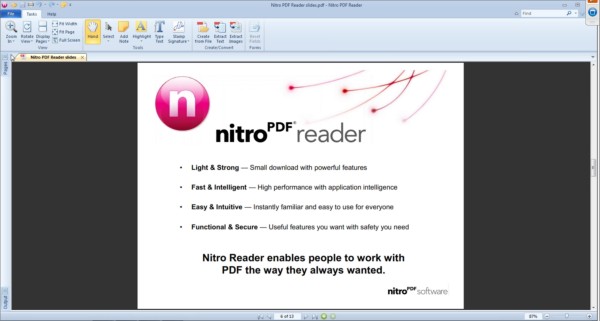

    The new, free Nitro PDF Reader

    Even today, we tend to use the phrase “Adobe PDF” when referring to the Portable Document Format, despite the fact that Adobe released its ownership of the standard into the open community in 2008. The typical opinion has been that releasing PDF as ISO/IEC 32000-1 was more of a symbolic gesture, but that Acrobat would always remain the principal application for creating PDF files.

    But it isn’t a monopoly that users particularly like anymore. A security study last February by security software provider Webroot of its own SMB customers revealed that nearly a quarter believe they are susceptible to cyber-attacks on account of insecure plug-ins including Adobe Reader. That feeling is compounded by raw data from Mozilla providing evidence that as many as half of all Firefox browser crashes are triggered by either Adobe Flash or Adobe Reader — a fact which compelled Mozilla’s engineers to redesign the entire plug-in model for Firefox 3.6.4.

    Today, the makers of what started out as a set of Acrobat plug-ins and later became a commercial alternative to Acrobat itself, are making their first real bid to unseat Adobe as the de facto software provider for PDF. The way Nitro PDF Software is doing this is by releasing today a free alternative to Adobe Reader that replaces the Reader plug-in entirely.

    The replacement will be an application that not only lets users edit the PDF files they download, but type new text at any point into those files, and create new PDF files as well.

    “PDF is all that we do. We live and breathe it. So the next logical step for us was to introduce a free PDF reader, but one that is revolutionary and that the world has been waiting for,” pronounced Gina O’Reilly, Nitro PDF’s senior vice president of marketing, in an interview with Betanews.

    “With Adobe Reader, I’m sure you’re familiar with the typical complaints: It’s bloated, it’s vulnerable to security attacks, but more importantly, it’s simply lacking in functionality. All it is, is a viewer and a printer; and unless you have paid a premium to do anything else, that’s all it does,” O’Reilly continued. “A lot of other options in the market come with some sort of compromise. So in the case of Adobe Reader, that might be a large footprint and annoying reminder updates, [along with] restricted functionality, in the fact that there is none.”
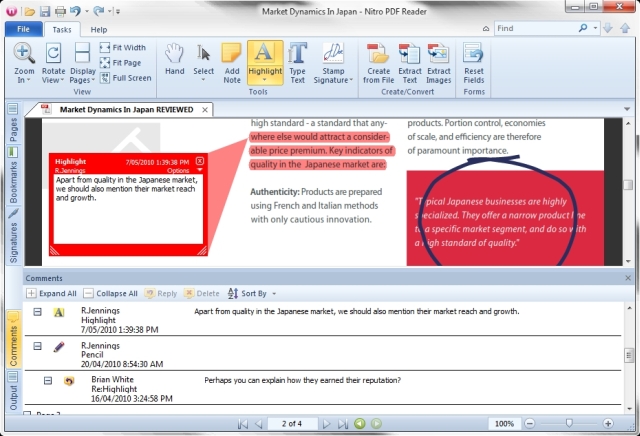
    Multiple collaborators can comment on edits to a PDF document in Nitro PDF Reader.

    Multiple collaborators can comment on edits to a PDF document in Nitro PDF Reader.


    Nitro PDF Reader is a stand-alone application that uses the Ribbon UI functionality made popular by Microsoft Office. If it has any drawbacks over Adobe Reader at all, it’s the fact that it doesn’t view PDF files inside the browser context. Instead, you download PDFs through whatever your browser happens to be, and they appear in the separate Nitro application context.
    But in that context, the application will offer some features that will compete with Acrobat, Adobe’s commercial PDF producer application line, the most obvious being the ability to create and save PDF files from scratch.

    Nitro PDF’s chief product officer Lonn Lorenz — a veteran product manager from Adobe — gave Betanews a demonstration: “Let’s say that I have a file that I want to send around for comment and review. If I zoom in on this page and I want to create a Post-It note…As I put a note in place, it keeps track of who put the note down, what time and date that they added it, and I can add my note to that.
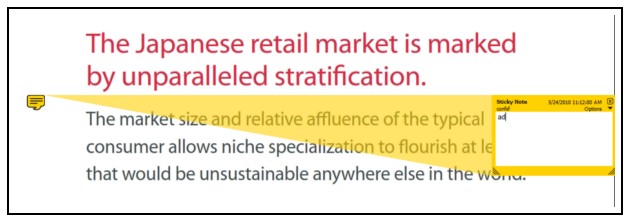
    In Nitro PDF Reader, a user adds a comment to an existing passage, as part of its fully-featured review system.

    “When I send this out to people to get comments back on,” Lorenz continued, “I can just go to the File menu and e-mail this PDF, and it’ll automatically launch your e-mail client, attach this PDF, and you can send it off for review. Once you open this file and see this comment, you could add your own reply. With your reply to this comment, you could start a thread of conversation around this review. You could also use the text highlight tools, where you can highlight, cross out, or underline text…I can actually start to make use of my PDF files. Where the Adobe Reader and other readers are limited in this regard is, I can actually save my file! How simple is that? All the basic functionality in a free product.”

    One feature that I found truly inspiring — something I would literally use every day — is a simple button that lets you stamp a PDF form with a scan of your signature. Many legal firms have gotten into the habit of printing out the final page of a PDF contract, then signing the contract, scanning it back in, and appending it to the PDF, just so the final page can bear a signature. With this feature, Nitro PDF keeps scans of multiple signatures on hand, and you can stamp one and resize it to fit any location on a page.
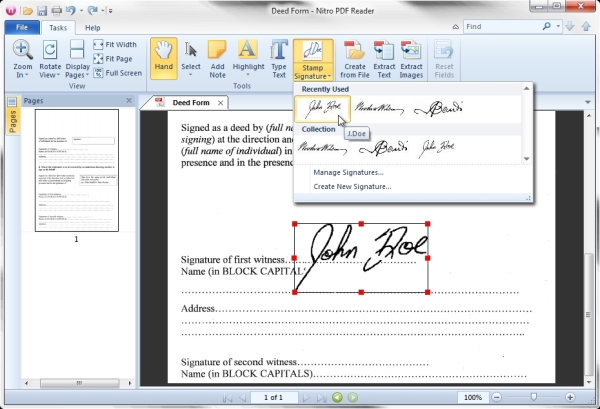
    Nitro PDF Reader enables a fairly simple, though tremendously useful, quick feature: a way to sign any form using a scan of your signature.

    Though it’s too early to declare that Nitro PDF “thought of everything,” it’s clear that during its beta process, its engineers did think ahead. The free Nitro PDF Reader does include the ability to protect files with a simple password, and to embed fonts where necessary (the company’s commercial edition has more extensive options). And to help deter situations where certain PDFs can be maliciously re-engineered, users can selectively block their PDFs from having the ability to make embedded calls to Web sites, with selected exceptions — a kind of localized firewall. Lorenz also told us users will have the ability to turn off JavaScript execution ability and leave it off.

    “What Adobe has potentially made a very grave mistake in doing is not being more proactive in responding to attacks, and not really addressing them in any meaningful way,” argued Nitro PDF’s Gina O’Reilly. “So when we conceptualized Nitro PDF Reader…one of our main goals was to ensure that our product is secure, and that we are responsive. We’re currently working with a third party to get validation for Nitro PDF Reader, so that we can stand up and say…the product stands up, and in the areas that we might not stand up, we will be addressing. We’ve kind of turned the security issue on its head, in that rather than expecting things to happen and then addressing them, we’re trying to get on the forefront with this. It’s very important that our users feel safe and secure when using the product.”

    Copyright Betanews, Inc. 2010


    Add to digg
    Add to Google
    Add to Slashdot
    Add to Twitter
    Add to del.icio.us
    Add to Facebook
    Add to Technorati