Category: News

  • British Scriptwriter Simon Monjack Found Dead

    Simon MonjackThe British Scriptwriter Simon Monjack died of a heart attack at age 39 at his home in Los Angeles after her wife Brittany Murphy died just five months ago because of pneumonia complicated by anemia.

    Monjack was found unconscious last night (9:24 PM) in his bedroom by his mother, Sharon Kathleen Murphy. Unfortunately for his mother, Murphy was announced dead at the scene when emergency services arrived.


    Monjack was the director, producer and writer of the B-movie Two Days, Nine Lives in 2000. He also received credits for the biopic Factory Girl about the actress and model Edie Sedgwick. “Monjack had nothing to do with the ‘Factory Girl’”, Director George Hickenlooper said. The director claims that Monjack somewhat stolen his script.

    Alongside career troubles, Monjack also have Legal troubles as well: Warrants were issued for him in Virginia in 2005 for credit card fraud, Coutts sued Monjack for evicting them from four homes, Monjack spent 9 days in prison in February 2007 for staying in the United States with an expired visa.

    Related posts:

    1. Charlotte Lewis Sexually Abused by Polanski
    2. Lindsay Lohan in court after returning to Los Angeles
    3. Delonte West–Gloria James Affair Confirmed!Calvin Murphy Proved “LeBron James’ Mom’s Affair”

  • OK Go Perform Underwater With Fish Bowls and Snorkels at Maker Faire [Music]

    We love OK Go in these quarters, not least because of their stage antics. The band took to the Maker Faire arena over the weekend, and actually played two songs underwater; snorkeled-heads stuck in fish bowls. More »


    Maker FaireRecreationOutdoorsCraftScuba Diving

  • Hungry Pigeon Festival Fun in Manchester

    Not long to go now until the fabulous Hungry Pigeon Festival hits Manchester for an amazing bank holiday weekend of music – and I for one can’t wait! All this sunny weather is perfect for festivals!

    They have a cracking line up for this year – Athlete will headline the mainstage in Piccadilly Gardens along with The Jessie Rose Trip, Misty’s Big Adventure, Beggar Joe, Manchester Samba School, Propaganda DJs and the hotly tipped All The Damn Kids from Sheffield.


    The great news is that our lovely Outreach team will be heading down this Saturday (29th) to raise awareness about the Robin Hood Tax, as well as enjoying the fantastic line up!

    Do you have just two hours free on Saturday to come and get involved? We want you to come along and enjoy this chance of some free festival fun with Oxfam – no experience necessary and you will get full briefing and costume on the day :) Contact Diane = [email protected] to get your place! See you Saturday!

  • Desert CO2 Cycle

    This is a far more detailed report on an item I posted on in 2008 when first published.  It is worth a revisit.
    The absorption of CO2 by the desert remains poorly understood.  We even need to know the basics as is obvious in the last paragraphs.   Is the process one way?
    Another aspect of these soils is that the soil is in a continuous process of breakdown causing the available surface area to constantly increase.  This is not well understood because the process is slow. Yet a simple cycle of freezing and thawing cracks rock along many crystal faces.  Such rotting of the rock will penetrate many feet into the soils or whatever the till is.
    Knowing that makes the CO2 uptake quite creditable.
    Have Desert Researchers Discovered a Hidden Loop in the
    Carbon Cycle?
    Science 13 June 2008:
    Vol. 320. no. 5882, pp. 1409 – 1410
    DOI: 10.1126/science.320.5882.1409
    Richard Stone
    URUMQI, CHINA–When Li Yan began measuring carbon dioxide (CO2) in western China’s Gubantonggut Desert in 2005, he thought his equipment had malfunctioned. Li, plant ecophysiologist with the Chinese Academy of Sciences’Xinjiang Institute of Ecology and Geography in Urumqi, discovered that his plot was soaking up CO2 at night. His team ruled out the sparse vegetation as the CO2 sink. Li came to a surprising conclusion:
    The alkaline soil of Gubantonggut is socking away large quantities of CO2 in an inorganic form. A CO2-gulping desert in a remote corner of China may not be an isolated phenomenon. Halfway around the world, researchers have found that Nevada‘s Mojave Desert, square meter for square meter, absorbs about the same amount of CO2 as some temperate forests. The two sets of findings suggest that deserts are unsung players in the global carbon cycle. “Deserts are a larger sink for carbon dioxide than had previously been assumed,” says Lynn Fenstermaker, a remote sensing ecologist at the Desert Research Institute (DRI) in Las Vegas, Nevada, and a coauthor of a paper on the Mojave findings published online last April in Global Change Biology.
    The effect could be huge: About 35% of Earth’s land surface, or 5.2 billion hectares, is desert and semiarid ecosystems. If the Mojave readings represent an average CO2 uptake, then deserts and semiarid regions may be absorbing up to 5.2 billion tons of carbon a year–roughly half the amount emitted globally by burning fossil fuels, says John “Jay” Arnone, an ecologist in DRI’s Reno lab and a co-author of the Mojave paper.
    But others point out that CO2 fluxes are notoriously difficult to measure and that it is necessary to take readings in other arid and semiarid regions to determine whether the Mojave and Gubantonggut findings are representative or anomalous.
    For now, some experts doubt that the world’s most barren ecosystems are the long sought missing carbon sink. “I’d be hugely surprised if this were the missing sink. If deserts are taking up a lot of carbon, it ought to be obvious,” says William Schlesinger, a biogeochemist at the Cary Institute of Ecosystem Studies in Millbrook, New York, who in the 1980s was among the first to examine carbon flux in deserts. Nevertheless, he says, both sets of findings are intriguing and “must be followed up.”
    Scientists have long struggled to balance Earth’s carbon books. While atmospheric CO2 levels are rising rapidly, our planet absorbs more CO2 than can be accounted for.
    Researchers have searched high and low for this missing sink. It doesn’t appear to be the oceans or forests–although the capacity of boreal forests to absorb CO2 was long underestimated. Deserts might be the least likely candidate. “You would think that seemingly lifeless places must be carbon neutral, or carbon sources,” says Mojave coauthor Georg Wohlfahrt, an ecologist at the University of Innsbruck in Austria.
    About 20 kilometers north of Urumqi, clusters of shanties are huddled next to fields of hops, cotton, and grapes. Soon after the Communist victory over the Nationalists in 1949,
    soldiers released from active duty were dispatched across rural China, including vast Xinjiang Province, to farm the land. At the edge of the sprawling “222” soldier farm, which is home to hundreds of families, oasis fields end where the Gubantonggut begins.
    The Fukang Station of Desert Ecology, which Li directs, is situated at this transition between ecosystems.
    In recent years, average precipitation has increased in the Gubantonggut, and the dominant Tamarix shrubs are thriving. Li set out to measure the difference in CO2 absorption between oasis and desert soil. An automated flux chamber measured CO2 depletion a few centimeters above the soil in 24-hour intervals on select days in the growing season (from May to October) in 2005 and in 2006. The desert readings ranged from 62 to 622 grams of carbon per square meter per year. Li assumed that Tamarix and a biotic crust of lichen, moss, and cyanobacteria up to 5 centimeters thick are responsible for part of the uptake. To rule out an organic process in the soil, Li’s team put several kilograms in a pressure steam chamber to kill off any life forms and enzymes. CO2 absorption held steady, according to their report, posted online earlier this year in Environmental Geology.
    “The sterilization treatment was impressive,” says biogeochemist Pieter Tans, a climate change expert with the U.S. National Oceanic and Atmospheric Administration in Boulder, Colorado. “They may have found a significant effect, previously neglected, but I would like to see more evidence.” Indeed, the high end of the Urumqi CO2 flux estimates are off the charts. “That’s more carbon uptake than our fastest growing southern forests.
    It’s a huge number. I find it extremely hard to believe,” says Schlesinger, who nonetheless says the Chinese team’s methodology looks sound.
    At first, Li was flummoxed. Then, he says, he realized that deserts are “like a dry ocean.”
    The pH of oceans is falling gradually as they absorb CO2, forming carbonic acid. “I thought, ‘Why wouldn’t this also happen in the soil?’ ” Whereas the ocean has a single surface for gas exchange, Li says, soil is a porous medium with a huge reactive surface area. One question, Tans notes, is why the desert soils would remain alkaline as they absorb CO2. Li suggests that ongoing salinization drives pH in the opposite direction, allowing for continual CO2 absorption. But where the carbon goes–whether it is stowed largely as calcium carbonate or other salts–is unknown, Li says. Schlesinger too is stumped: “It takes a long time for carbonate to build up in the soil,” he says. At the apparent rate of absorption in China, he says, “we’d be up to our ankles in carbon.”
    One possibility, DRI soil chemist Giles Marion speculates, is that at night, CO2 reacts with moisture in the soil and perhaps with dew to form carbonic acid, which dissolves calcium carbonate–a reaction that warmer temperatures would drive in reverse, releasing the CO2 again during the day. (Unlike most minerals, carbonates become more soluble at lower temperatures.) In that case, Marion says, Li’s nighttime absorption would tell only half the story: “I would expect that over a year, there would be no significant increase in soil storage due to this process,” he says, as the dynamic of carbon sequestration in the soil would vary from season to season. Li agrees that this scenario is plausible but notes that his daytime measurements of CO2 flux did not negate the nighttime uptake.
    In any case, other researchers say, absorption alone cannot explain the substantial uptake in the Mojave. Wohlfahrt and his colleagues measured CO2 flux above the loamy sands of the Nevada Test Site, where the United States once tested its nuclear arsenal.
    From March 2005 to February 2007, the desert biome absorbed on average roughly 100 grams of carbon per square meter per year–comparable to temperate forests and grassland ecosystems–the team reported in its Global Change Biology paper.
    Three processes are probably involved in CO2 absorption, Wohlfahrt says: biotic crusts, alkaline soils, and expanded shrub cover due to increased average precipitation. “We currently do not have the data to say where exactly the carbon is going,” he says. Like the Urumqi team, Wohlfahrt and his colleagues observed CO2 absorption at night that cannot be attributed to photosynthesis. “I hope we can corroborate the Chinese findings in the Mojave,” he says. Arnone and others, however, believe that carbon storage in soil is minimal.
    Wohlfahrt suspects biotic crusts play a key role. “People have almost completely neglected what’s going on with the crusts,” he says. Others are not so sure. “I’m mystified by the Mojave work. There is no way that all the CO2 absorption observed in these studies is due to biological crusts, as there are not enough of them active long enough to account for such a large sink,” says Jayne Belnap of the U.S. Geological Survey’s Canyonlands Research Station in Moab, Utah. She and her colleagues have studied carbon uptake in the southern Utah desert, which has similar crust species. “We do not see any such results,” she says.
  • Bijoué: Audio Technica’s diamond-shaped speakers


    Audio-Technica today in Japan announced [JP] diamond-shaped portable speakers, dubbed Bijoué/AT-SPF30, which are especially geared towards female users. Technically, the speakers aren’t special: you’ll get 600mW/φ28mm full range speakers running on two AAA batteries for 33 hours continuously.

    Weighing just 105g, the Bijoué speakers is sized at 78×74×37mm. Audio-Technica doesn’t try to attract geeky female buyers just with the design and size but with a functional hook as well: when opening up the diamond speaker, users will find a small mirror behind the lid.

    In Japan, Audio-Technica plans to sell the Bijoué/AT-SPF30 on June 16 in six different colors: black, brown, white, silver, golden and the inevitable pink (price: $30). If you’re interested but live outside Japan, I suggest contacting import/export specialists Geek Stuff 4 U.


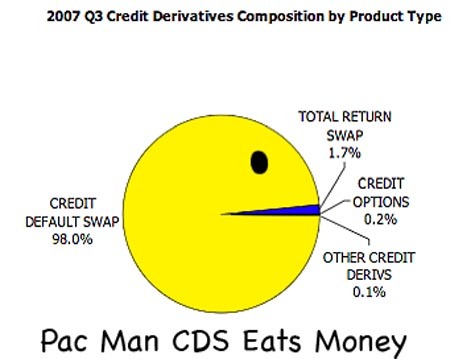
  • Naked Truth on Default Swaps

    In the end we have another round of sophistry hiding the fact that it is all about third parties taking bets on a horse.
    Markets work well as a rule based game.  They fail miserably when rules are constantly changed out by the legal profession to satisfy the financial whims and greed of a client.  This is the creation of non reserve insurance and the losses have been horrific. 
    Obviously a no interest bet opens the door wide to outright insurance fraud because there is no downside.  After all, the perp is hidden offshore.  It would have taken the criminals exactly one sales pitch to figure this one out.
    Naked short selling, now naked insurance all have one thing in common.  The gambler can win if he is able to destroy the victim.  True stock manipulation begins with short selling and its ilk.  Gamblers are proactive in this regard however they cloud their actions.
    The choicest irony was watching Lehman bros scream about the practice as they went down.
    It is completely possible to reform the security trading industry but no one ever would let someone who had a clue near the game.  The victims continue to be citizens and the US economy in general because a huge amount of capital is simply diverted away from its intended destination.
    If a thousand investors decide to support a new energy source with ten million dollars and this money is diverted into a short selling syndicates account and the company is then starved into a profoundly disadvantageous financing that provides only a fraction of the money, while the balance is appropriated by the syndicate, then by most natural measures, a fraud has taken place.
    This is not clearly blocked by the SEC who only squawks once in a while.
    Naked Truth on Default Swaps
    nytimes
    On Thursday May 20, 2010,
    Should people be able to bet on your death? How about your financial failure?
    In the United States Senate, Wall Street won one this week when the Senate voted down a proposal to bar the so-called naked buying of credit-default swaps. If that were the law, you could not use swaps to bet a company would fail. The exception would be if you already had a stake in the company succeeding, such as owning a bond issued by the company.
    On the other side of the Atlantic, Germany announced new rules to bar just such betting — but only if the creditors were euro area governments.
    None of this argument would be taking place if regulators had done their jobs years ago and classified credit-default swaps as insurance.
    As it happened, however, clever people on Wall Street followed the prescription laid down by Humpty Dumpty in Lewis Carroll’s “Through the Looking Glass:”
    “When I use a word,” Humpty Dumpty said, in rather a scornful tone, “it means just what I choose it to mean — neither more nor less.”
    When Alice protested, Humpty Dumpty replied that the issue was “which is to be master — that’s all.”
    The word here is “swap.” It used to mean, well, a swap. In a currency swap, one party will win if one currency rises against another and lose if the opposite happens.
    Credit-default swaps are, in reality, insurance. The buyer of the insurance gets paid if the subject of the swap cannot meet its obligations. The seller of the swap gets a continuing payment from the buyer until the insurance expires. Sort of like an insurance premium, you might say.
    But the people who dreamed up credit-default swaps did not like the word insurance. It smacked of regulation and of reserves that insurance companies must set aside in case there were claims. So they called the new thing a swap.
    In the antiregulatory atmosphere of the times, they got away with it. As Humpty would have understood, Wall Street was master. Because swaps were unregulated, calling insurance a swap meant those who traded in them could make whatever decisions they wished.
    That decision, perhaps more than anything else, enabled the American International Group to go broke — or, more precisely, to fail into the hands of the American government. Had it been forced to set aside reserves, A.I.G. would have stopped selling swaps a lot sooner than it did.
    The decision that swaps were not insurance meant that anyone could buy or sell them — or at least anyone who could find a counterparty.
    Had credit-default swaps been classified as insurance, the concept of “insurable interest” might have been applied. That concept says that you cannot buy insurance on my life, or on my house, unless you have an insurable interest.
    Gary Gensler, the chairman of the Commodities Future Trading Commission, recently laid out the history of that concept. It did not exist until the 18th century, when many people — not just owners of ships or cargos — began buying insurance against ships sinking.
    More ships began sinking, and insurers cried foul.
    The British Parliament outlawed such sales of ship insurance in 1746. Ever since, to buy that insurance you had to have an interest in the ship or its cargo. But it was another 28 years before Parliament extended the idea to life insurance.
    So should it be illegal for me to buy credit-default swaps on companies even if I have no other interest in the company? And if I have an interest, should I be limited to buying only enough insurance to cover my exposure? That is, if I own $100 million in XYZ Corporation bonds, should I be able to buy $1 billion in insurance against an XYZ default?
    To most on Wall Street, the answer is obvious: let markets function. My buying that insurance will probably drive up the price, and serve as a market indication that people are worried about the credit, which is good because it gives a warning to others.
    In any case, it is legal to sell stocks short. That, too, is a way to bet that a company will fail. So what’s the difference?
    One difference is that many people short stocks because they deem them overvalued, not because they think the company will go broke. They can profit even if the company does well, so long as the stock does turn out to have been overvalued.
    Many who despise credit-default swaps argue that they can be used to force companies to fail. The swap market is thin, and even a relatively small purchase can drive up prices. That very movement may make lenders nervous, cause liquidity to dry up and bring on unnecessary bankruptcies.
    There is another, little noticed, possible impact of credit-default swaps. They can undermine bankruptcy laws.
    Normally, a creditor wants to keep a company out of bankruptcy if there is a decent chance it can survive. If it does go broke, the creditor wants to maximize the value of the company anyway, so that more will be available to pay creditors.
    But what happens if a major creditor, who might even control one class of bonds, has a much larger position in credit-default swaps?
    Will he not have interests directly at odds with those of other creditors, since he will do better if the company ends up with less to pay its creditors? Might that creditor seek to, and perhaps be able to, sabotage the company’s best hopes for revival?
    At a minimum, such things should be disclosed, but that gets tricky when one part of a megabank (the one with the bonds) claims it is run independently from the other (the one with the swaps).
    I don’t know whether it is necessary to treat credit-default swaps like insurance and require someone to have an insurable interest before swaps can be purchased.
    The financial reform bill now being debated in the Senate has provisions intended to assure that many of the previous swap abuses are not repeated.
    But I do think Germany’s decision was ill considered. First, it may have little effect if other countries do not join in. Buying a swap in New York or London, rather than Frankfurt, will not be difficult.
    But the more important issue is one of limiting the targets of credit-default swap purchases. If Germany had simply required buyers of credit-default swaps to have an insurable interest, it would have been standing up for a principle.
    By limiting the scope to swaps on debt of euro area governments, the German government sends two signals: it is acting in self-interest, and it is still worried that it may have to finance more bailouts.
    Top of Form
  • Purple Pokeberries Coat Solar


    I am not sure that I believe in the likely efficiency of this protocol.  It sounds like a great story.  The ‘cans’ work best the smaller that they are and that means likely colorants will clog rather than coat.   Of course, this article likely is telling us little or nothing about the practical aspects of this protocol.  Just those pokeberries can provide a convenient dye.
    Red dyes normally deteriorate quickly in the sun so that becomes another issue.
    In short, I can not see how this would work at all.  We will have to wait for more information on this one. 
    Tiny cans acting as quantum wells have been played with and are a promising avenue for solar power.  They would be sealed behind a transparent layer though.  This is not what they seem to be talking about.
    Purple Pokeberries Hold Secret To Affordable Solar Power Worldwide
    by Staff Writers

    Winston-Salem NC (SPX) May 03, 2010

    Pokeberries – the weeds that children smash to stain their cheeks purple-red and that Civil War soldiers used to write letters home – could be the key to spreading solar power across the globe, according to researchers at Wake Forest University’s Center for Nanotechnology and Molecular Materials.

    Nanotech Center scientists have used the red dye made from pokeberries to coat their efficient and inexpensive fiber-based solar cells. The dye acts as an absorber, helping the cell’s tiny fibers trap more sunlight to convert into power.

    Pokeberries proliferate even during drought and in rocky, infertile soil. That means residents of rural Africa, for instance, could raise the plants for pennies. Then they could make the dye absorber for the extremely efficient fiber cells and provide energy where power lines don’t run, said David Carroll, Ph.D., the center’s director.

    “They’re weeds,” Carroll said. “They grow on every continent but Antarctica.”

    Wake Forest University holds the first patent for fiber-based photovoltaic, or solar, cells, granted by the European Patent Office in November. A spinoff company called FiberCell Inc. has received the license to develop manufacturing methods for the new solar cell.

    The fiber cells can produce as much as twice the power that current flat-cell technology can produce. That’s because they are composed of millions of tiny, plastic “cans” that trap light until most of it is absorbed. Since the fibers create much more surface area, the fiber solar cells can collect light at any angle – from the time the sun rises until it sets.

    To make the cells, the plastic fibers are stamped onto plastic sheets, with the same technology used to attach the tops of soft-drink cans. The absorber – either a polymer or a less-expensive dye – is sprayed on. The plastic makes the cells lightweight and flexible, so a manufacturer could roll them up and ship them cheaply to developing countries – to power a medical clinic, for instance.

    Once the primary manufacturer ships the cells, workers at local plants would spray them with the dye and prepare them for installation. Carroll estimates it would cost about $5 million to set up a finishing plant – about $15 million less than it could cost to set up a similar plant for flat cells.

    “We could provide the substrate,” he said. “If Africa grows the pokeberries, they could take it home.
    “It’s a low-cost solar cell that can be made to work with local, low-cost agricultural crops like pokeberries and with a means of production that emerging economies can afford.”
  • On Shelves This Week: May 23 – 29, 2010

    It’s not every month that we get a haul like this one, but here you are, the best pickings of the season sitting in one basket, and in different flavors, too. RPGs, strategy games, racers, adventures, puzzles

  • 2010 Cosworth Subaru Impreza STI CS400 revealed

    2010 Cosworth Subaru Impreza STI CS400Cosworth officially revealed today the Subaru Impreza STI CS400 and announced that the car will go on sale in June. What is so special about this new model?

    Well, the new car delivers an impressive 400 PS (395 bhp) @ 5,750 rpm and is capable to hit 100 km/h (62 mph) in just 3.7 seconds (the standard version of the car carries 300 PS/ 296 bhp @ 6,000 rpm and hits 100 km/h in 5.2 seconds). The new Cosworth Subaru Impreza STI CS400 will include a new brake package with six-pot callipers and 355mm discs at the front, which was developed in cooperation with AP Racing. AP Racing is known as the company producing the brakes for the Bugatti Veyron but is also known as the leading supplier of brake and clutch components to teams in the Formula One but also from the World Rally Championship!

    2010 Cosworth Subaru Impreza STI CS4002010 Cosworth Subaru Impreza STI CS4002010 Cosworth Subaru Impreza STI CS4002010 Cosworth Subaru Impreza STI CS4002010 Cosworth Subaru Impreza STI CS400

    [via evo]

    Source: Car news, Car reviews, Spy shots

  • Simon Monjack Brittany Murphy Husband Dead

    The widower of Brittany Murphy, the actress who died of pneumonia last December, has been found dead in his Hollywood Hills home.

    The Los Angeles Fire Department was called to the property in the Hollywood hills shortly after 9PM on Sunday night, to respond to “an unspecified medical aid request,” according to reports.

    Murphy’s mom Sharon called emergency services after finding the screenwriter unconscious in the master bedroom of the Hollywood Hills property where the Clueless star died in December. He is believed to have suffered a cardiac arrest, although Police Sergeant Louie Lozano tells The Los Angeles Times that the cause of death is still unknown.

    “We have detectives at scene. They are conducting their investigation. Once we have further information, we will provide it.”

    Monjack’s death comes just five months after his wife, 32, died in Monjack’s arms after collapsing in the shower last Dec. 20.

    Monjack spoke of health problems in an interview earlier this year, saying he was taking a lot of medication. “Most of the drugs are mine. I suffer from seizures. I had a heart attack coming back from Puerto Rico last year,” he told The Daily Mirror.

    Monjack — a British-born producer — married actress Brittany Murphy in May 2007 during a private Jewish ceremony in Los Angeles.


  • Teachers Seek $23b- Lifeline or Bailout?

    Education Secretary Arne Duncan is asking lawmakers to put aside “politics and ideology” as they consider a request for $23 billion in “emergency” funding for public schools – a measure Republicans reject as a massive federal bailout for the teachers’ unions.

    The Obama administration is supporting the bill, formally titled the Keep Our Educators Working Act and sponsored by Rep. George Miller (D-CA) and Sen. Tom Harkin (D-IA).  In a letter to House Speaker Nancy Pelosi (D-CA) and Senate Majority Leader Harry Reid (D-NV) dated May 13, Duncan warned that if the bill is not enacted, “millions” of school children will be adversely affected and the ensuing damage will “undermine the groundbreaking reform efforts underway in states and districts all across the country.”

    Find out how much this program costs you by using Fox News’ Taxpayer Calculator.

    “This is a bipartisan issue — politics and ideology, around education, we have to put to the side,” Duncan said during an appearance on “Fox and Friends” on May 21.  “I’m very worried, very worried about anywhere between 100,000 and 300,000 teachers being laid off this year.  We have school districts — due to the horrendous budget times, conditions they’re facing — looking to eliminate summer school this summer, eliminating after-school and extracurricular activities, going to four-day weeks, not five-day school weeks…None of this is good for children.  None of this is good for education.  None of this is good for the economy.  So we are urging Congress to move with a real sense of urgency to pass this legislation.”

    Many Republicans oppose the measure, citing previous federal outlays for education, the size of the federal deficit, and the fact that the bill forces no spending cuts elsewhere in order to pay for itself.

    “Fundamentally, what you’re seeing is the failure of the stimulus,” Rep. Thaddeus McCotter (R-MI), chairman of the Republican House Policy Committee, told Fox News.  “What we’re looking at here in Michigan is 14 percent unemployment; nationally, we’re looking at 9.9 percent.  We’ve seen a spike in jobless claims — all of which was supposed to have been prevented by the trillion dollars this administration already spent to ‘create or save’ jobs.

    “When you look at the overall economy, that is really what undergirds the financing of education in the United States, both at the local level and at the state level.  So as Washington continues to try to go toward emergency measures, three things become patently obvious: One, the stimulus has failed.  Two, they’re delaying the real necessary restructuring of government that is required to have a sustainable tax base that is growing, for educators to be employed.  And third,” McCotter added with a flash of deadpan humor, “given the Democrats’ record number of deficits, debt and spending, there does auger an argument for more math teachers.”

    Education analyst Lindsey Burke of the Heritage Foundation, a conservative think tank in Washington, D.C., said roughly one-third of the $100 billion the Department of Education received in last year’s stimulus bill remains unspent.  She also questions the wisdom of funneling federal taxpayer funds, in any amount, to the public school system as it is presently structured.

    “More federal funding is not going to solve states’ fiscal problems and could in fact exacerbate those problems, by really preventing states from making the difficult budgetary decisions necessary to reduce costs and effect long-term systemic education reform,” Burke told Fox News.  “The real problem within the public education sector has been more and more non-teaching staff positions.  These positions continue to grow and really put a strain on state budgets.  Roughly half of those people employed by the public education sector are in non-teaching positions, and at the same time we see ever-decreasing class sizes.  In the 1960s, class size was about 27:1 student-teacher ratios.  Today those ratios are closer to 15:1….There are things that states could do to reduce costs, and they dont need another bailout from Washington for public education.”

    The Keep Our Educators Working Act has garnered support from some predictable quarters – and opposition from some surprising ones.  Interviewed in Minneapolis during a nationwide tour of beleaguered local school districts, many of which are already laying off teachers and closing down vital programs, Randi Weingarten, herself a former teacher and now president of the 1.4 million-member American Federation of Teachers, told Fox News the $23 billion is urgently needed to avert further “draconian” measures.

    “Nobody is asking for it on an ongoing basis.  We’re asking for it because we see on the ground, in school after school, the consequences of devastating cuts,” Weingarten told Fox News.  “In the ’70s, I watched what happened in New York City when…we lost a generation of kids….You don’t get to ‘do it over’ if you’re five years old.  You’re only five once — and therefore, that’s part of the urgency here.”

    Asked about the $34 million in stimulus funds that the Education Department has purportedly left unspent, Weingarten said that all of the funding that the stimulus intended for public school systems was, in fact, doled out – and done on an “equity basis,” with the most cash-starved school districts first to receive the funding.  “The monies that actually went to avert the direct effects of the greatest recession since the Great Depression were about 50-some-odd billion, of which some went to also ensure that we hired and maintained cops and other civil servants,” Weingarten said.  “The money that was allocated last year was allocated on an equity basis to various different states.  So ultimately we have encouraged states to spend those funds.  But what I am talking about is that the states that have spent it do not have the funds this year to go forward.  And we’re seeing that in state after state in their budget crises.”

    But the Washington Post editorial board urged lawmakers to reject the measure.  In an editorial published May 14 under the headline, “Red Ink in the Classroom,” the Post lamented that last year’s stimulus bill had created among educators “an unfortunate expectation of yet more federal dollars to bail out the states.”  “Should the federal government spend money it doesn’t have to let school systems operate beyond their means?” the editorial asked.  “We might have had a different view of this measure if its sponsors had figured out a way, as they promised with their adoption of pay-go guidelines, to pay for it rather than simply add to the nation’s fast-growing national debt.”

    President Obama has already indicated his support for the Miller-Harkin measure.  Addressing educators at the White House during the annual Teacher of the Year ceremony on April 29, the president claimed the stimulus bill had saved the jobs of 400,000 teachers – a figure higher than Weingarten used, in her interview with Fox News – and said: “I believe these efforts must continue, as states face severe budget shortfalls that put hundreds of thousands of jobs at risk.  We need, and our children need, our teachers in the classroom.”

  • Consumer Groups Praise Financial Reform – But Cautiously

    Sen. Chris Dodd (D-Conn.) (EPA/ZUMApress.com)

    Last week, the Senate passed a sweeping overhaul of the regulation of banks and financial institutions. The bill, authored by Sen. Chris Dodd (D-Conn.), does not just focus on Wall Street firms, changing leverage limits and capital requirements. It focuses on Main Street banks and lenders as well. The bill empowers a new oversight council to create and enforce rules specifically on behalf of regular consumers: the Consumer Financial Protection Agency, housed in the Federal Reserve in the Senate bill and an independent federal agency in the House bill, which now need to be merged.

    Image by: Matt Mahurin

    Image by: Matt Mahurin

    By and large, consumer watchdogs — some of the bill’s fiercest critics and biggest supporters — were happy with the final Dodd legislation. “We are pleased the Senate has passed this momentous bill that will rein in big banks’ reckless behavior and bring transparency to our financial system and protect consumers,” Heather Booth, the consumer advocate and director of the Americans for Financial Reform, said in a statement. “[This bill] ensures the financial system operates to support needs of working families, promotes business growth and economic mobility rather than the interests of the speculators who view the economy as a huge casino.”

    But as the Dodd bill heads to conference committee — where members of Congress will reconcile the Senate financial regulatory reform proposal with the House’s bill, passed last year — consumer advocates have identified loopholes and weak points where a merged bill could be watered down, leaving American workers and families overpaying for financial services or otherwise vulnerable. Consumer advocates primarily cite the purview of the CFPA — the companies it will be able to regulate, and the extent to which it will be able to enforce rules — as the primary yardstick of real reform.

    Travis Plunkett, the legislative director of the Consumer Federation of America, points to investor protections as the “big hole” remaining in the bill. “The House legislation is stronger on making sure that financial professionals are responsible for the advice they give,” he says. But the CFA is also focusing on ensuring a strong, independent CFPA comes from the conference committee process. He named a loophole in the Senate bill regarding the CFPA’s ability to monitor small non-bank lenders, like payday lenders, as problematic. “We’d like to see the House language triumph there,” he said, noting that the difference would amount to millions for low-income Americans.

    The Center for Responsible Lending, a nonpartisan research group, cites whether auto lenders are under the CFPA’s oversight as an issue to watch. The Center estimates that consumers spend $20 billion more a year on their car loans because they borrow through dealerships — whose contracts can be usurious and difficult to understand — rather than banks or credit unions. Kathleen Day, a spokesperson for the organization, notes that the House bill exempts auto lenders from CFPA regulation and that car companies are lobbying hard to keep it that way in the final legislation.

    Sen. Sam Brownback (R-Kans.) attempted to push the same exemption into the Senate bill, but the Senate ultimately did not vote on his amendment. Today, the Senate plans to take a nonbinding “sense of Congress” vote on the measure. “It isn’t binding, but these things are taken into account in conference committee,” Day says. “Currently, the Senate bill is better than the House bill on that, so we don’t want to see a shift there.” Plus, it is a point of hard lobbying. Last year, Ford Motor Company alone made more than $1 billion through its financing arm.

    Day also says the CRL hopes Congress removes a Senate provision allowing small non-bank companies to preview and comment on CFPA rules “before they see the light of day.” “That’s behind the scenes, and would lead to the kind of cozy relationships between regulated companies and regulators that led to this crisis in the first place.”

    Consumer watchdogs also cite preemption — the ability of the federal government to quash strong local rules — as a major issue to watch as the bills are merged. “It [is] really in the weeds,” Day says, “and a hard one to tamper with, but important.”

    Mike Konczal, a fellow at the Roosevelt Institute and specialist in banking regulation, explains that reformers want states to retain the ability to create and enforce strong consumer-protection standards within their borders — and had to fight for the provision in both the House and Senate. “The New Democrats [in the House] could have probably killed the CFPA or at least turned it into a toothless panel,” he says. “But they let it go and then pushed hard [against] pre-emption, which would allow the Office of the Comptroller of Currency” — a primary government banking regulator — “to break state consumer protection laws.”
    Therefore, preserving the ability to police consumer protection at the local level remains a priority for advocacy groups in Washington.

  • Audi S1 pricing: from 28,000 euros?

    Audi A1 new pics

    Pricing of the new Audi S1, sports version of the A1, has been leaked by Audi itself on publishing the A1 price on the Spanish market. The Audi S1 is equipped with the 1.4-litre TFSI engine with 180 hp and 250 Nm of torque, which recently appeared on the Volkswagen Polo GTI and the Skoda Fabia RS. The S1 in Spain will cost 28,360 euros which includes the seven-speed DSG automatic gearbox.

    It seems that Spain tends to have favourable car pricing, meaning the Audi S1 could cost signifcantly more on other European markets, starting from at least 29,000 euros. It will also be interesting to see what is left out of the standard pricing and what is requested in terms of options and additional accessories. While the S1 will be a veritable pocket rocket competing fully with models such as the Mini Cooper and the Fiat 500 Abarth, it’s starting to look a bit pricy.

    Audi A1 new pics Audi A1 new pics Audi A1 new pics Audi A1 new pics

    Source | es.autoblog.com via Autoblog.it


  • Alienware’s 11-Inch M11x Netbook Getting Core i7 Upgrade Next Month? [Laptops]

    Courtesy of a Dell representative who let a little too much information loose in a video interview with Shufflegazine, we now know that its gaming arm Alienware is readying an Intel Core i7 netbook next month. More »


    AlienwareDellLaptopHardwareIntel Core i7

  • Who Won Celebrity Apprentice 2010?

    The 2-hour season finale of The Celebrity Apprentice 2010 last night reveals Bret Michaels as the new Celebrity apprentice.

    The 47-year-old rocker Bret Michaels beats former 21 Jump Street queen Holly Robinson Peete on NBC’s “The Celebrity Apprentice.”

    In last night’s finale, Bret and Holly both lead their teams to create marketing and advertising campaigns for their new flavors of Snapple drink. After completing the task, Michaels invented a Trop-A-Rocka Blend while Peete came up with the Compassionberry Tea. Both finalists won Donald Trump’s heart with their invented tea flavor.

    After Cyndi Lauper performed her new song, “I’m Just a Fool for You,” Donald Trump finally announced Bret Michaels as the third Celebrity Apprentice and awarded the $250,000 bonus check for his charity of choice, the American Diabetes Association.

    Holly Robinson Peete also received a $250,000 bonus check for her own HollyRod Foundation that supports families facing a serious illness.

    American singer Bret Michaels is best known as the lead vocalist of the glam metal band Poison. Besides his band’s booming career, he also have several solo albums.

    Related posts:

    1. Celebrity Apprenctice Winner 2010: After All Sacrifices Everything Comes To An End
    2. Ron Burkle donated a whopping amount of $200,000 to Holly Robinson Peete
    3. $50,000 Donation made by Ron Burkle

  • Biofuels Consortium Targets Technical Hurdles, Legend Films Morphs Into Legend 3D, Fallbrook Technologies Adds Details to IPO Filing, & More San Diego BizTech News

    Bruce V. Bigelow wrote:

    Cleantech was the watchword of the week, with much of the news concerning algae-based biofuels and energy efficiency. Read on to get that and the rest of last week’s biztech news.

    —The new executive director of the National Alliance for Advanced Biofuels and Bioproducts (NAABB), José Olivares, outlined some of the technical challenges that must be solved before algal biofuels production can become an economically viable industry. Olivares came through San Diego to meet with members of the NAABB from UC San Diego, HR BioPetroleum, and Kai BioEnergy.

    Fallbrook Technologies, the San Diego startup developing an energy-efficient, continuously variable transmission, provided new information in a recent fling about the financial risks and funding requirements the company faces. Fallbrook filed for an IPO in February.

    —The San Diego company that Barry Sandrew started in 2001 as Legend Films specialized in providing digital colorization technology for the motion picture industry. But the company has recently reinvented itself as Legend 3D, and now focuses on visual special effects and 3D technology for Hollywood. With studio demand for 3D “dimensionalization” exploding, Legend 3D has 260 employees at its San Diego headquarters and another 700 in Patna, India, and plans to add another 500 there in coming months.

    —After securing a $100,000 grant to get life sciences entrepreneurs to talk with teen-agers about their technology innovations and startup companies, Connect CEO Duane Roth is looking for additional funding to do the same thing with high-tech entrepreneurs. The idea behind the grant from the Biogen Idec Foundation of Cambridge, MA, is to get young people excited about studying science, technology, engineering, and math.

    —Some 1,200 people and more than 70 companies turned out for San Diego Gas & Electric’s 5th Annual Energy Showcase at the downtown convention center. I found a few local startups that are developing innovative technologies.

    UNDERWRITERS AND PARTNERS


  • Mobile Content Bits: iPad’s Hot (Literally), Bambuser-Eurovision, Standard


    iPad overheating

    iPad’s hot: I kept mine in the shade, but others who soaked up the UK’s glorious sunshine this weekend found their iPad didn’t appreciate the near-30 degree temperatures, warning: “iPad needs to cool down before you can use it.” Via GadgetVenue.

    Bambuser: Norway’s NRK, which already inked a deal with the Swedish live mobile video streamer, is giving Bambuser-enabled handsets to entrants in this weekend’s upcoming Eurovision Song Contest.

    Evening Standard: The papaer has a new, free app for iPhone, Symbian, Windows Mobile, BlackBerry and Android, made by Handmark.

  • Which Is The Largest Temple In The World?

    Angkor Wat located at Angkor in Northwestern Cambodia, is the largest temple in the world. Angkor was the Capital of the ancient Khmer Empire. The temple was dedicated to the Hindu God Vishnu by the Khmer king Suryavarman II, who reigned between AD 1131 and 1150.

    The Temple was constructed over a period of 30 years, and illustrates some of the most beautiful examples of Khmer and Hindu art. Covering an area of about 81 hectares, the complex consists of five towers, which are presently shown on the Cambodian national flag. These towers are believed to represent the five peaks of Mount Meru, the Home of Gods and Center of the Hindu Universe. Angkor Wat features the longest continuous bas-relief in the world, which runs along the outer gallery walls, narrating stories from Hindu Mythology.

    With the decline of the Khmer Empire, Angkor Wat was turned into a Buddhist Temple and was continuously maintained, which helped its preservation. In 1992, the UNESCO World Heritage Committee declared the monument, and the whole city of Angkor, a World Heritage Site.

  • Babeorella iPhone App Has Boobs and Sci-Fi Action Aplenty [IPhone Apps]

    Apple may not appreciate “boobie apps” but that hasn’t stopped developers Doublesix from launching the Babeorella iPhone game which takes Jane Fonda’s Barbarella character to a whole ‘nother level of buxomness. More »


    iPhoneHandheldsSmartphonesAppleWallpapers and Themes

  • Fiat Punto es llamado a revisión

    Ultimamente no se libra ningún modelo de pasar por el taller. Hace cuestión de unas horas, Fiat ha comunicado que comenzará a ponerse en contacto con sus clientes que posean un Fiat Punto para que pasen por su taller más cercano.

    Por lo visto, la Unión Europea ha encontrado un fallo que permitiría que el airbag del pasajero se reactivara tras haber sido utilizado a pesar de haber pulsado el botón de desactivación. Este fallo electrónico afecta a todos los modelos que han sido fabricados en el año 2009.

    Tampoco se descarta que este fallo afecte al Fiat Punto Evo aunque aun no se ha confiramdo nada. Como ya es habitual, Fiat asumirá todos los costes que suponga la reparación de dicho problema.

    Related posts:

    1. Fiat Punto, teaser del restyling
    2. Fotos espía del Fiat Grande Punto 2010
    3. Fiat Grande Punto Evo, imágenes oficiales