Oak Ridge, TN – This year, the ORTEC Products Group of AMETEK Advanced
Measurement Technology celebrates 50 years as a major supplier of nuclear detection instruments and systems to the nuclear industry.
Originally named Oak Ridge Technical Enterprises Corporation, ORTEC wasfounded in 1960 by a group of businessmen and scientists from the Oak Ridge National Laboratory interested in developing silicon surface-barrier detectors for detecting atomic
particles. At the time, its founders believed their idea had limited market potential but would “afford them an outlet for fun and provide employment for skilled and retired workers from the Oak Ridge area”.
ORTEC first became known to the nuclear industry beyond Oak Ridge when it exhibited at the IEEE conference in Gatlinburg, TN, near Knoxville, in October 1960.
This year, 50 years later, the IEEE conference again will be held in Knoxville. This time chaired by ORTEC Senior Scientist Dr. Ronald Keyser.
Over the course of its first five decades, ORTEC gained a reputation for developing innovative high-quality and high-performing products for the nuclear industry. Among its first customers were the Argonne and Lawrence Livermore National
Laboratories; General Electric and Philips Petroleum Companies; Iowa State, RiceUniversity, Iowa State University and Texas Christian Universities.
Acquired in 1967 by EG&G, Inc., which later became Perkin Elmer, ORTEC was sold in 2002 to AMETEK, Inc. and is now a unit of its Advanced Measurement Technology division. Today, ORTEC is probably best known for its high-purity
Germanium (HPGe) crystals and ultra-sensitive gamma detectors. It is one of only two manufacturers worldwide with the ability to produce HPGe crystals and manufacture
high-resolution radiation detectors from them.
These detectors are widely used in scientific research, health physics and waste assay. In particular, ORTEC pioneered the use of miniature cryogenic coolers in portable lightweight detectors used by Homeland Security and other agencies to detect and identify potentially harmful nuclear materials.
Virtually every major nuclear facility and research institution now owns one or more of ORTEC’s products. Its nuclear security products are deployed worldwide by government agencies, the military and others to protect against nuclear terror. It also is
a leading supplier of digital signal processing electronics and software associated with high-resolution spectroscopic applications in many fields.
ORTEC next plans to showcase its latest product line at the Health Physics Society June 28-30, in Salt Lake City.
Category: News
-
ORTEC CELEBRATES HALF CENTURY OF SERVICE TO NUCLEAR INDUSTRY
-
Extend the life of your bearings with NTN-SNR greases.
The new range of NTN-SNR greases has been specially developed for bearings and is satisfactory in more than 95% of normal applications.
This extremely high-performance range is available to suit your application and allows you to extend the life of your bearings while lengthening the time between maintenance operations.– UNIVERSAL: General-use grease for industrial and automotive applications.
It provides good mechanical stability, good resistance to water and excellent protection against wear and corrosion.– HEAVY DUTY: Top-quality grease, containing additives for extreme pressures. Multi-purpose, it is intended for heavily loaded intensive applications (steel industry, construction, transport, etc.) It has excellent anti-wear and anti-corrosion properties.
– VIB provides perfect lubrication for parts subject to high-amplitude vibration or impacts. It is recommended for quarries, cement works, agriculture and loaded applications in damp environments such as paper mills, well drilling, etc.
It has excellent resistance to impacts, vibrations and heavy loads. Because of its excellent adhesion and resistance to water, it guarantees long-term lubrication.– HIGH TEMP: The ideal solution for long-term, high-temperature lubrication up to +150°C. It will accept occasional peaks up to 175°C.
It resists high temperatures for a very long time and provides excellent protection against wear and corrosion for ball and roller bearings in horizontal or vertical axes. -
Discover the NTN-SNR infrared thermometer with laser targeting: Laser Temp 301
This infrared thermometer is the ideal tool for troubleshooting and inspections and for checking any temperature.
The Laser Temp 301 combines safety with accuracy: safe remote infrared measurement for burning, dangerous or relatively inaccessible objects and accurate measurement thanks to its contact sensor.
Its measurement range in infrared mode extends from -50°C to +850°C.
With its elaborate optical system, it allows easy and precise measurements on small and remote targets.
Its high degree of accuracy is guaranteed thanks to its excellent distance-to-target ratio of 30:1, adjustable emissivity and serial wire probe.
The measurement response time is very quick (less than 1 second).
Light, ergonomically pistol-shaped and robust for industrial use, it is extremely simple to use and can be easily set for °C or °F operation.
It has numerous options and an internal memory, capable of saving up to 20 measurements. -
Wireless Modbus Network
Turck’s new DX80 from Banner Engineering replaces costly wiring in wide area installations
08/10 – May 11, 2010A scalable wireless network that can monitor and control I/O functions or provide serial communication at up to 56 locations has been introduced by Turck and Banner Engineering. The new SureCross DX80 product line replaces costly wiring in a wide range of industrial, agricultural, power generation, water supply and waste disposal applications. Discrete, serial and analog devices that can be controlled by the network include ultrasonic and photoelectric sensors, pumps, counters, thermocouple and RTD temperature sensors. The remote nodes gather data and transmit control commands between the sensors or other devices and a central Gateway. The Gateway maps inputs from the remote nodes and interfaces with a PLC or HMI via RS-485 modbus or Ethernet/IP.
Designed for applications where wiring is impractical or unaffordable, DX80 nodes and the devices they monitor can be powered by 10-30 VDC, battery or solar panels. This capability can eliminate the need for power wiring as well as control wiring, providing significant cost reduction and ease of installation in situations that cover wide areas. Banner’s unique power management capability and low power consumption enable a node and sensor to operate for years on a single battery power supply. Almost all units have industry standard robust IP67 housings. Models with Intrinsically Safe and Class I Division 2 (Atex Zone 0) approvals are available for extreme environments. Node to gateway transmission range using license-free radio is 3 km at 2.4 GHz. The signal range can be extended by adding DataRadio modules as repeaters.Turck’s new DX80 Industrial Wireless Network from Banner Engineering includes one Gateway and up to 56 remote nodes for I/O monitoring and control
-
Triumph updates 2011 Sprint GT with emphasis on touring over sport
Filed under: Motorcycle
 2011 Triumph Sprint GT – Click above for high-res image gallery
American touring motorcycles, including the Road King from Harley-Davidson or the Vision from Victory, are built for the kind of vast stretches of wide-open roadways America is known for, and such machines are perfect to watching the miles roll by in open-air comfort. For those looking to add some additional sport to their touring rides, though, Triumph has cooked up something that may very well be of interest.
The British motorcycle company has seen fit to update its Sprint sport tourer for the 2011 model year with a 1050cc inline-triple powerplant that puts out 130 horses, five more than before. Anti-lock brakes are standard, as are 8.2-gallon saddlebags and a 12-volt power port. Optional amenities include heated grips, a taller windscreen, gel seats and a large top case for additional storage.
Styling is slightly revised as well, with a smoother fairing, new optics up front and the addition of a single low-mount exhaust in lieu of the previous underseat system. For whatever reason, the name of the bike is now the Sprint GT, not ST. Check it out for yourself in our high-res image gallery below.
Gallery: 2011 Triumph Sprint GT


[Source: Triumph]
Triumph updates 2011 Sprint GT with emphasis on touring over sport originally appeared on Autoblog on Fri, 21 May 2010 10:58:00 EST. Please see our terms for use of feeds.
Read | Permalink | Email this | Comments
-
Screenshot shows Motorola Cliq running Android 2.1

First things first, these screen shots are really easy to fake. Ridiculously easy. With that out of the way, it looks like a settings screen shot is showing a T-Mobile Motorola Cliq running Android 2.1. As in the 2.1 you guys hope and dream for. We know that Motorola has planned for the Cliq to get Android 2.1 in Q2 2010 sometime but as all Android users who’ve been waiting for 2.1 know, you never really know until the update is right there on your phone waiting to download. Maybe it’s T-Mobile and Motorola testing it out? Or a rogue user finding a way to update himself. Hopefully it’s coming soon. Because by the end of today, you guys will all be clamoring for 2.2. What a vicious cycle. [android community]
-
EJILTalk Discussion of ‘The Rise of International Criminal Law’
by Kenneth Anderson
In the category of advertisements for myself … Julian was kind enough to mention that EJILTalk is hosting a discussion of an article of mine called The Rise of International Criminal Law, which appeared in EJIL last year as part of its 20th anniversary issues. It was a relatively short, but wide-ranging essay trying to assess, twenty years on, where ICL has gone and is likely to go, on a whole series of otherwise unrelated issues. EJIL ran a response in the print edition by Amrita Kapur, and in addition responses at the online blog by her and by Brad Roth. I have finally managed to get a response together, which is quite long and will run in three posts. The other responses are linked at the beginning of that post, as well. I have to thank publicly EJILTalk for running such a long response, which in many ways is practically a new essay – but especially Amrita Kapur and Brad Roth for reading so closely and with such nuance my original article. I’m very grateful to them for so much close reading and thought. Below the fold is a bit from my response.
I have no idea what History will bring, and it is possible that the institutions of ICL will consolidate themselves into something resembling what Kapur offers. Or Isaiah, or Tennyson, for that matter, or even the worldwide ummah; others in the world also have eschatological visions. I do not think the historical evidence that it will consolidate itself in these ways is very persuasive at this point, but one can differ about its persuasiveness, of course. But given how long the history of failed attempts here, surely those arguing for today’s version of it ought to be willing to accept a bit more of the burden of proof that this one will succeed? Is that so much to ask?
Then there is ICL’s constant plea for more time. Kapur says this again in her blog response; with respect to R2P, for example: “how much can we realistically expect this early in the reconceptualization process?” Give us more time, on this, on that – in a perhaps overly-accommodating desire not to prejudge historical outcomes, The Rise of International Criminal Law grants lots and lots of time for these institutions to prove themselves. Quite possibly more than it ought. As I tried to suggest (rather gently) in the original article, time turns into something like a universal solvent that, just so long as it is granted, permits the tensions inherent in all these international law and politics agendas to not have to confront each other and, possibly, spark each other to death, because it turns out that some of these projects are not reconcilable one with another, and the result is, what, Alien v Predator? …
Time is what Kapur’s responses most seek. Well, okay, says my article – take your time. But in this reply, perhaps it bears asking, could we have some indication of how much time is too much? How much time must go by, without reaching the happy system of justice promised by ICL, when we are entitled to say, well, it didn’t work?
Surely there is some concern that that “time” is simply a way of forestalling accountability, a way of putting one’s institutions beyond falsifiability. What, even in principle, would demonstrate that the ICL approach to international justice is a mistake? What would represent a fair test? It seems odd that no one seems to raise this in scholarship in which, I would have thought, setting forth tests of success and failure would be an indication of confidence in the long term prospects of the project. Time is something that my article grants – but I hope it is not out of bounds to ask, when does the sense of ‘in time’ become ‘only in the fullness of time’ – which is to say, eschatological?
Maybe time will do its work and institutions will eventually draw close enough to satisfy my quite undemanding and pragmatic standards. The point is, however, maybe they will and maybe they won’t. I don’t think the evidence that they will is persuasive, and moreover I do think – speculatively, sure – that the rise of Asia, China above all, is likely to undermine these institutions. I think it is likely to show them to be a discourse of universalist superstructure built atop the structure of a loose American hegemony that, if it goes into decline, takes much of this stuff with it.
-
In Honor of Pac-Man’s 30th Birthday
The best-known hero of early video games turns 30 today. Because the yella fella figured large in my own transition to young adulthood, so he does in the coming-of-age of Linus Tuttle, the hero of Mamba Point. In honor, here are two short scenes from the final draft — they both made it to the book, but might have changed in copy-editing.
First, a few days into his African experience, Linus gets a wonderful surprise:
After lunch we went home and unpacked our air freight, which was some of our stuff that we needed right away like clothes and dishes. The rest of our stuff was coming later in what they called sea freight. I put everything away really quickly. Mom popped in, and I was worried she was going to see that I’d crammed all my clothes into the drawer without folding them—you could see a sleeve here and there leaking out—but she didn’t.
“We need you in the family room,” she said.
Oh, no. I followed her to the second-biggest bedroom that Mom and Dad had decided would be a family room. I didn’t know what she needed me to do—the TV was already set up, along with the VCR and the Atari.
Wait. We didn’t have an Atari. I’d begged for an Atari back home and my parents said I couldn’t have one because they didn’t want me to go blind or turn into a drooling idiot. There was one now, though—a black box about the size of an encyclopedia, and two joysticks waiting to be used. We even had two games: Pac-Man and Space Invaders. Who needed anything else? I stared at it, stunned. Video games… at home. It was absolutely the greatest thing I could imagine. I looked up and saw Mom and Dad grinning at me.
Law came in, noticed the game, and grinned. “Neat! Thanks!”
“Surprise,” Mom said with a voila gesture.
“Thanks.” I hugged her and Dad, then turned everything on so Law and I could play. I guess Mom and Dad figured moving to Africa meant we needed entertainment more than we needed vision or brains.
I went first, navigating my yellow hero through the maze, chomping dots. It was easier than the arcade version. Pac-Man was faster, and the ghosts were dumber.“When do I get to go?” Law asked.
“When I get eaten.”
“You mean like now?” he asked, taking a swipe at my joystick.
“Knock it off.” I pulled away from him, and barely managed to make my Pac-Man turn the corner instead of sailing into the mouth of the pink ghost.
“How about now?” Law waved his arm in front of the TV.
“Jerk.” I tried to read the screen in between waves of his arm, but missed the chance to nab the apple before it disappeared.
“How about now?” Law covered my eyes from behind.
“No! Argh!” I heard the familiar downward musical spiral and double-blip of a Pac-Man biting the dust.
“You’re such a jerk.” I gave him the joystick anyway, so he could have a try.
“Nah, you go again. It’s more fun to watch you.”
I didn’t argue. I grabbed the joystick and played.
Later, Linus shares the game with some younger Liberian boys he’s befriended:
We went into the family room and I showed them how to navigate the yellow hero through the maze.
“Why do those monsters eat the lemon?” Tokie asked. I started to explain that we were only on the cherry level until I realized he thought Pac-Man was a lemon. Actually, Pac-Man did look like a lemon.
“Those monsters love to eat lemons,” I told him.
“But how come the lemon eats the monsters sometimes?”
“When he eats the power pill, he can eat the monsters.” I showed him how it worked, waiting for the ghosts to get lined up before I steered through the power pill and got all four of them. After that, Tokie was obsessed with eating the ghosts, but couldn’t seem to time it right and kept getting chomped.
“Just eat the dots,” Gambeh told him. “The goal is to eat all the dots.” He was right. It was a rookie mistake, obsessing on the ghosts. Gambeh was better at the game, even clearing the maze once or twice. He loved the teleport chamber where Pac-Man goes off one side of the screen and comes back on the other. “Where am I?” he would ask in the split second when Pac-Man was invisible, then scroll back on to the screen. “Here I am!”
“Does the lemon never get full?” Tokie asked.
“I guess not.” It was some life, wasn’t it? Always on the run and hungry. I felt sorry for the lemon.
Filed under: Mamba Point

-
Pantera’s The Great Southern Trendkill on Rock Band next week
Rock Band has been getting a lot of classic metal tunes as DLC in the past few months, but for next week Harmonix is giving gamers something comparatively more recent: Pantera’s 1996 album, The Great Southern Trendkill.
-
Consumerists Raise $5,113.30

You guys have opened up your hearts and wallets to us mightily, raising $5,113.30. Thanks! Every donation makes you a stakeholder in the future of Consumerist. Every dollar is a vote for independent, non-profit, ad-free blogging, for your right to get what you deserve from in the marketplace, and to mock those who don’t live up to their part of the bargain. We’re ending this drive Monday, let’s give it a last weekend push and see how much closer we can get to $10k! (Today is payday, right? nudge nudge, even just ten bucks gets us closer to our goal) Donatetoconsumerist.com (FAQ)
-
7 July inquests to investigate role of MI5 and police
Via Prison Planet.com » World News
Adam Gabbatt
London Guardian
Friday, May 21, 2010The inquests of the 7 July suicide bombers will investigate the role of MI5 and police prior to the 2005 terrorist attacks, a coroner said today.
Lady Justice Hallett told the royal courts of justice in central London that the hearings into the deaths of the four bombers would not be heard at the same time as those of their 52 victims.
However some survivors of the blasts were disappointed when the coroner refused their request to be able to cross-examine witnesses.
Hallett had been asked to decide what form the inquests would take ahead of the hearings later this year.

Last month counsel for the Security Service and the home secretary said disclosing MI5 files about the four suicide bombers to the families of those killed in the London attacks would be “impossible”. MI5 argued that investigating claims that it could have prevented the atrocities would involve “handing over the keys” to MI5’s Thames House headquarters.
At this morning’s hearing, Hallett admitted there was “some force” in the security service’s argument that the sensitivity of evidence about its intelligence should restrict the inquest’s investigations. However, the coroner said she wanted to “conduct such investigations as are possible”, adding that MI5 had offered its full co-operation.
-
Why Germany's Rescue Plan for European Debt is Doomed
Germany’s Parliament voted today to approve a $185 billion contribution to $1 trillion bailout plan designed to calm the debt crisis sweeping through euro-zone states. Many analysts doubt that the emergency fund will help troubled countries like Greece avoid defaulting on their debt. But the fund could buy time for Greece to manage an “orderly restructuring,” whereby it would agree to pay current boldholders a certain fraction of the promised loans. (Read an explainer of the Greek debt crisis here).
The bailout is horribly unpopular in Germany. But that’s a little ironic, because it’s ultimately designed to save not only Greece and Portugal, but also the entire European Union. It’s essentially a bailout for the euro. And no European country benefits from the euro’s regime more than Germany.
The common take on Europe’s mess is that Greece’s debt crisis might be Europe’s problem, but surely it’s Greece’s fault. The EU didn’t force Greek tax evaders to be evasive. It didn’t force the government to regularly spend 50% of GDP while it collected a little more than a third of domestic product in taxes. The country got drunk on its own red ink. It made its own hangover, right?
Well, Steven Pearlstein spins things differently. The problem isn’t just the profligate peripheral states like Portugal, Italy and Greece. The problem is at the heart of Europe, both metaphorically and geographically speaking. The problem is Germany.
To understand why, you have to understand the German economic machine. Follow the money. Germany is Europe’s leading exporter of goods. It runs a huge trade surplus, which means more money is coming into the country than going out. That should make wages rise, along with the currency value, and Germans should spend their valuable income on products from other countries, shrinking the trade gap. But that’s not happening. Germany’s currency cannot adjust with respect to its European trading partners because they’re all on the same currency. The euro is strangling Germany’s neighbors, who need to devalue their currency so that wages and prices can up to 20%. But it’s also keeping Germany’s trade surplus alive.
Here’s Pearlstein:
What Germans won’t accept is that they wouldn’t have been able to sell
all those beautifully designed cars and well-engineered machine tools
if Greeks and Spaniards and Americans hadn’t been willing to buy those
goods and German banks hadn’t been so willing to lend them the money to
do so. Nor will they accept that German industry was able to thrive
over the past decade because of a common currency and a common monetary
policy that, over time, rendered industry in some neighboring countries
uncompetitive while generating huge real estate bubbles in others.
What’s the solution? Well, we’ll need more than an emergency plan. We’ll need extraordinary action on the part of the European Central Bank. We’ll need the ECB to stop worrying and learn to love expansionary monetary policy. Pearlstein says the European Central Bank needs to do something like the US Federal Reserve did in late 2008: bring down interest rates and buy up assets, like Greek bonds.


European Union – European Central Bank – United States – Greece – Eurozone -
New UK govt to curb CCTV, scrap ID cards, help open source
Via Prison Planet.com » Prison Planet
Nate Anderson
Ars Technica
Friday, May 21, 2010The Britain of today is watched constantly by CCTV cameras, is preparing for a national ID card, slaps a “crown copyright” on most government data, and can now censor websites and eventually boot people off the Internet.
According to the new Liberal Democrat/Tory coalition government, that’s all about to change. The coalition today released its unified policy statement (PDF), and for techies and privacy advocates, there’s lots to like.
- We will scrap the ID card scheme, the National Identity register and the ContactPoint database, and halt the next generation of biometric passports.
- We will outlaw the fingerprinting of children at school without parental permission.
- We will adopt the protections of the Scottish model for the DNA database.
- We will review libel laws to protect freedom of speech.
- We will further regulate CCTV.
- We will end the storage of internet and e-mail records without good reason.
- We will create a level playing field for open-source software and will enable large ICT projects to be split into smaller components.
- We will create a new “right to data” so that government-held datasets can be requested and used by the public, and then published on a regular basis.
- We will introduce measures to ensure the rapid roll-out of superfast broadband across the country. We will ensure that BT and other infrastructure providers allow the use of their assets to deliver such broadband, and we will seek to introduce superfast broadband in remote areas at the same time as in more populated areas. If necessary, we will consider using the part of the TV license fee that is supporting the digital switchover to fund broadband in areas that the market alone will not reach.
That last bit about broadband is a change from current Labour policies, which proposed a (hugely unpopular) 50p per month tax on broadband connections to help fund universal broadband infrastructure. The new proposal draws that money from the already-existing TV license fee.
In addition, the Lib Dems have separately pledged to roll back the worst excesses of the recent Digital Economy bill that brought Web censorship and possible Internet disconnection to the UK. At a party conference over the weekend, they asked ministers to “take all possible steps to ensure the repeal of those sections of the Digital Economy Act 2010 which are inconsistent with the policy motion ‘Freedom, creativity and the internet‘.”
-
Technological advances keep Intel’s Atom a contender in handhelds
By Charles King, E-Commerce Times
 Intel’s next-gen Atom processor-based platform (formerly “Moorestown”) caused quite a stir in the news and among mobile computing aficionados. On the technical side, Intel seems to have delivered the goods. The platform includes Intel’s Atom processor Z6xx Series Family (formerly “Lincroft”), the Platform Controller Hub MP20 (formerly “Langwell”) and a dedicated Mixed Signal IC (MSIC) (formerly “Briertown”).
It adds 3D graphics, video encode and decode, and memory and display controllers into the single system-on-chip (SoC) design. Also included are the MP20 Platform Controller Hub and a dedicated MSIC, integrating power delivery and battery charging, and consolidating a range of analog and digital components.
What does this mean in plain English? That the new Atom platform is simply the best performing solution for handheld computing devices Intel has ever developed.
How much better? Try >50x reduction in idle power, >20x reduction in audio power and 2-3x power reductions in browsing and video compared to the previous-generation Atom (a.k.a., “Menlow”) processor. These efficiencies translate into >10 days of standby, up to two days of audio playback and four to five hours of browsing and video life with common 1500mAh batteries.
Along with power savings, Intel’s new Atom platform offers highly enhanced audio/video features that are critical to consumer experience and satisfaction. How enhanced? Compared to “Menlow,” the new platform delivers 1.5-3x higher compute performance, 2-4x richer graphics, >4x higher JavaScript performance and support for full HD 1080p high-profile video decoding and 720p HD video recording.
Compared to Menlow, Intel hit the ball out of the park with the new Atom, most analysts seemed to agree, but many were less impressed with the platform’s commercial prospects. That was not particularly surprising given the turmoil in the mobile marketplace that began with Microsoft’s February announcement of its Windows Phone 7 Series OS, followed by the weeks of hype leading up to Apple’s April iPad launch and its acquisition of Intrinsity, and HP’s purchase of Palm and the reported cancellation of its Windows 7-based Slate tablet.
Given those events, the conventional wisdom on Intel’s new Atom platform appears to be that 1) Apple’s dominant mindshare in all things mobile makes it the company to beat; 2) close relationships with Apple and smartphone market leader RIM make ARM-based microprocessors virtually unstoppable; and 3) despite impressive improvements, Intel’s new Atom is simply too late to the mobile game to be a viable player.
So is the conventional wisdom particularly wise? I have my doubts. Certainly Apple, as well as leading smartphone vendor RIM, deserves applause for some terrific product and service offerings. Apple, in particular, has seized the public imagination regarding the smartphone and tablet experience to a remarkable extent. Plus, the company’s App Store has defined the critical role a deep application portfolio plays in platform success.
However, recent APD Group research suggests first quarter sales of Android-based phones blew past iPhone sales. If Android’s success continues, it could indicate that Apple’s single-vendor development and manufacturing model faces significant barriers in the global market for handheld computing.
In addition, though the iPad has enjoyed extraordinary sales to date, it is the lone occupant of an essentially nascent market that will be crowded with enticing new products by the holidays. Some of these will almost assuredly be based on the new Intel Atom platform.
What about ARM? Can Intel really hope to prevail against so dominant a competitor? That’s certainly problematic, especially given ARM’s deep client roster. However, the sizable semiconductor investments of one of its most important customers — Apple — could mean future problems for ARM. More importantly, a core (no pun intended) Intel strength is its ability to play the long game, as was clear in the company’s response to AMD’s Opteron processor.
How so? AMD’s singular pursuit of 64-bit x86 computing solutions allowed the company to develop a sizable market and mindshare lead. Though it initially dismissed Opteron, Intel eventually dove into the market with a vengeance and eventually left AMD in its wake. That point is worth remembering in still-evolving markets like mobile computing.
The new Atom platform demonstrates, yet again, Intel’s ability to effectively adapt to changing circumstances by leveraging its considerable intellectual and human capital.
This is not to say that the new Atom platform will be a slam-dunk success. Mobile computing is far less homogeneous than the PC, laptop and server markets, with a technologically diverse vendor ecosystem and highly (some might say wildly) differentiated global customer groups. In other words, it’s a world that will be harder to engage with and work within than the more predictable PC/server networks Intel is used to.
Yet that same world is also populated with dynamic, astute vendors and customers willing to embrace new innovations. Bottom line: Known and unknown challenges aside, I believe the potential opportunities for the new Atom platform are enormous, and worth every bit of Intel’s time, effort and investment.
Charles King is principal analyst for Pund-IT, an IT industry consultancy that emphasizes understanding technology and product evolution, and interpreting the effects these changes will have on business customers and the greater IT marketplace.
This story was originally published on E-Commerce Times.
© 2010 ECT News Network. All rights reserved.
© 2010 BetaNews.com. All rights reserved.
Copyright Betanews, Inc. 2010


Intel Atom – Microsoft – Apple – IPad – IPhone -
Why the Toyota-Tesla Deal Makes Sense
Toyota is interested in the electric car market too. The company announced a new partnership with and sizable equity investment in the young American electric car company Tesla. Although Toyota has had great success with its hybrid vehicles, it had not shown much intention of entering the electric car space — until now. The move is a good one for both automakers.
The two companies “intend to cooperate on the development of electric vehicles, parts, and production system and engineering support,” according to the press release. Toyota will also purchase $50 million in Tesla equity. Additionally, Tesla will purchase an old factory in California that had been formerly used as apart of the now defunct Toyota-GM partnership.
Smart for Toyota
Puts Automaker Immediately into the EV Race
Two of Toyota’s chief competitors — GM and Nissan — are on the verge of releasing mass market plug-in electric vehicles. Toyota’s ability to leverage Tesla’s electric car expertise should significantly condense the time it would have taken Toyota to produce a vehicle of its own. Even though the company still won’t get a new electric car out as quickly as GM and Nissan, there’s little doubt that Toyota will now produce a high-volume electric car before too long.
Cheap Foray into the EV Market
Not only does Toyota now have Tesla’s expertise at its fingertips, but it came relatively cheap. If it were to attempt to develop an electric vehicle platform on its own from scratch, the investment would have been far more significant than the $50 million piece of Tesla it purchased. This also hedges Toyota’s risk: if the electric vehicle market turns out to be a dud with consumers, the company would have wasted a huge investment developing its own expertise and infrastructure.
Helps Public Image
After the accelerator fiasco, Toyota could use a strong dose of good public relations. Since electric cars are associated with environmental protection and green aspirations, it will likely give Toyota’s public image a little boost.
Smart for Tesla
Toyota Is a Partner You Want
In fact, this deal is arguably even better for Tesla than Toyota. The company was created in 2003, and is still a relatively small operation. By trading some of its engineering expertise for some of Toyota’s production and distribution knowledge, its business model should strongly benefit. No auto company has been as successful as Toyota over the past few decades.
Boosts Its Brand
The majority of Americans have probably never heard of Tesla, but almost everyone has heard of Toyota. Tesla should be able to leverage Toyota’s popularity to create greater awareness of its own brand. Although Tesla has focused on luxury electric vehicles up to now, its aspirations to make mass market vehicles will be more easily achieved through better brand recognition.
Helps Sustain Its Growth
This deal should allow Tesla to continue to grow quickly. First, there’s the investment. $50 million might not sound like a huge amount of money for a big automaker, but for a small one, that can go a long way. Moreover, for Tesla this deal is all about expansion. Tesla plans to build its Model S as a higher volume family car than its Roadster. Toyota’s knowledge will help this effort succeed, as the Japanese automaker knows all about manufacturing cheaper vehicles with widespread consumer appeal. But this is just the beginning for Tesla. The Model S will only occupy a small part of the factory — leaving lots of room for additional new models, according to the New York Times.
Partnerships like this aren’t always easy. It’s fairly likely the culture of each firm is quite different. Toyota is an established Japanese automaker, while Tesla is a young American start-up. But if Toyota and Tesla manage to work well together, then they should both reap huge dividends through their cooperation.
Toyota – ModelS – ElectricVehicle – Tesla Motors – Electric car -
Lindsay Lohan Story
Actress Lindsay Lohan missed her probation hearing which was related to her drunken driving case from 2007. An arrest warrant was issued by the court since she missed the hearing but Lindsay who is in France currently avoided arrest after returning from there, she secured a bail of $100,000.

According to Lindsay’s lawyer, she was unable to fly back from France to US for hearing since her passport got stolen. Now she has been totally banned from drinking alcohol with other conditions on her probation.
Lindsay will have to wear a bracelet which is a alcohol monitoring bracelet, and also she should appear for weekly drug tests. When she missed her appointment for hearing, Judge Marsha Revel issued an arrest warrant against Lindsay and she also imposed other conditions on her bail. According to Revel, Lindsay has a history of missing appointments and this is not the first time.
According to some sources, she could have come if she wanted because she had obtained a replacement for her passport which was stolen. She did not come because she did not want to come for the hearing. Earlier she was also sentenced to one day jail and some community service as well.
Related posts:
- Passport Theft Leads To Arrest Warrant – Lindsay Lohan Fails To Appear Before LA Court
- California Judge issued a warrant for the arrest of Lindsay Lohan
- Lindsay Lohan: Stuck in France + Misses a Court Hearing = Arrest Warrant Issued
-
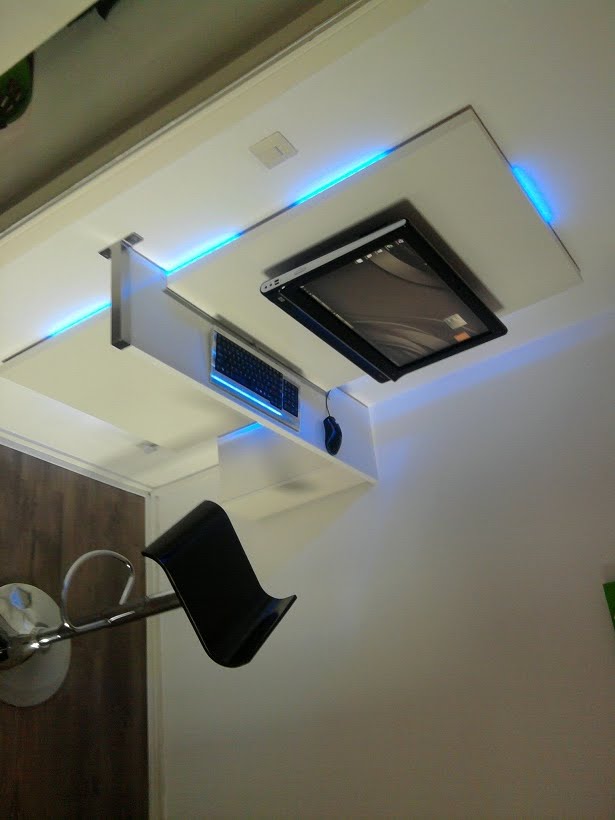
Wall mount computer workstation, pc desk

Materials: Ikea: VIKA AMON tabletop (150 x 75cm), EKBY BJÃRNUM bracket, EKBY JÃRPEN shelf (119 x 28cm), MALM nightstand (white), 2 x DIODER multicolor LED-strips. Non-Ikea: HP Touchsmart600 (computer), Vogel’s Wallmount, 2 x Aluminium decorative strips (100cm), One ordinary shelf bracket, 2 hinges, Enermax Crystal aluminium keyboard
Description: First I made a frame with 4 slats on the back of the tabletop to move it about an inch from the wall. Then I made a hole in the tabletop for the flatscreen-wallmount. (The tabletop isn’t strong enough to hold the screen, so I put the Vogel’s wallmount straight on the concrete wall.) After that I put the DIODER LED-strips on the frame behind the tabletop and hung the tabletop on the wall with wooden slats, a bit like this.




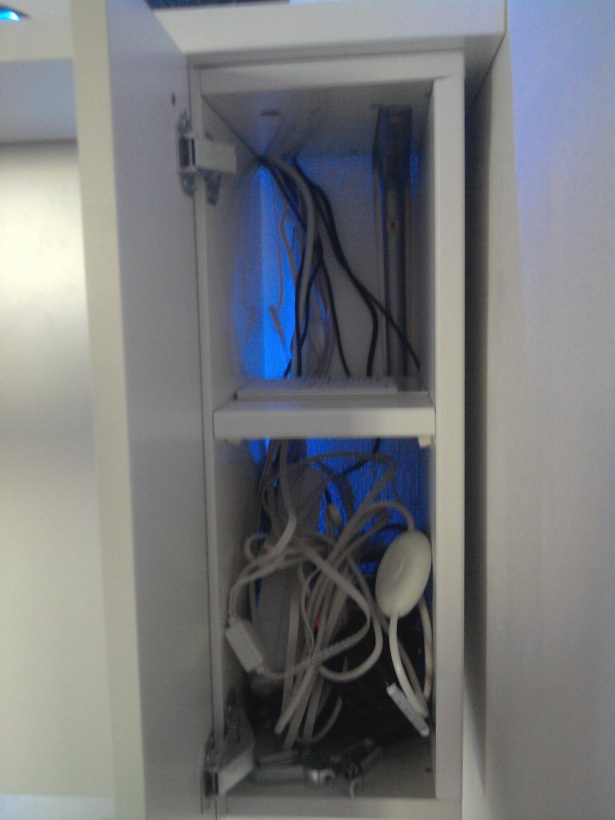
I took the EKBY JÃRPEN shelf and sawed a piece out of it to fit over the tabletop. Then I made a little cupboard for the cables from an old MALM nightstand and screwed it to the EKBY shelf. I made a door in the cupboard with 2 hinges and a little shelf inside.
Then I put the shelf on the wall with one EKBY BJARNUM bracket and one ordinary bracket inside the cupboard.
And as a finishing touch I put the aluminium decorative strips between the EKBY shelf and the tabletop.
I hope you’ll like the result!
~ FritZz81, Netherlands
-
Snoreben – Say Goodbye to Snoring and Hello to a Quiet Comfortable Nights Sleep

The Snoreben is an FDA approved Class 1 Medical Device developed to stop snoring and significantly improve your quality of sleep. It is specially designed to help anyone of any age, who suffers from Obstructive Sleep Apnea, alar collapse (collapsed nostrils), deviated septum (bent nose) and damaged or narrow nostrils and other nasal disorders. The Snoreben is made from medical grade Latex Free Silicone for maximum comfort while sleeping to ensure you receive the much needed quality sleep necessary to wake refreshed and revitalized. This will allow you to carry out daily activities with a clear mind and enjoy a full, healthy and happy lifestyle.
View Snoreben – Say Goodbye to Snoring and Hello to a Quiet Comfortable Nights Sleep Details
-
L.A home of Jesse James for Sale
After two months of Sandra and Jesse’s break up, Sandra moved out of their L.A home and according to the sources Jesse has put his home for sale now. The two story beachfront home was the home for Jesse and Sandra for 5 years since they got married.

According to the source, he bought a house in Austin, Texas and after selling his house in L.A, he will be soon moving to Texas. Sandra and Jesse were spotted in two different locations in Austin the same day. Jesse was with his daughter Chandler in a speed shop and Sandra was with her son Louis in her favorite shops and restaurants.
A friend of Jesse said, Jesse still thinks their (Sandra and Jesse) relationship will get better as the time goes by. He said Jesse’s mind set is still the same and he thinks Sandra will come back to his family soon.
Well, whatever may Jesse think, I think he does not realize what he has done. He betrayed Sandra who loved him and his kids so much. He can never get a woman like Sandra again in his life.
Related posts:
- Jasse James’ Two-story Beachfront Property in California for Sale
- Sandra Bullock and Jesse James Split : Bullocks Leaves Mansion With Her Wardrobe
- Jesse James and Sandra Bullock Split because of Michelle “Bombshell” McGee