With rumors surfacing yesterday about a possible HTC One running a stock Android install, another rumor surfaced that may be more interesting for current owners of the device or those not willing to wait for confirmation of the “Google experience” HTC One. Over on Twitter, developer @LlabTooFer responded to an inquiry about Android 4.2′s availability on the HTC One with “2-3 weeks I think.” @LlabTooFer has been a reliable source of information about HTC software updates in the past.
Along with the rumor about Android 4.2 coming to the HTC One, @LlabTooFer also posted recently about an update that was in the works for last year’s HTC One X which would bring it up to Android 4.2 and Sense 5.0. If all the rumors are true, it looks like HTC is working to bring the Android 4.2 goodies to a large swath of their customers. If they succeed and establish a reputation of quick work to keep devices up to date with Android versions, that could be a positive step in helping them regain some lustre and marketshare.
It’s been a little over a year since Google started teasing something it called “Project Glass.” The futuristic, wearable computer that would change the way that you interact with the world was nothing more than a series of rumors for months before it was “formally introduced” in April 2012. Not known for hardware and not having a current bonafide physical device that was popular among consumers, many opined that this was Google’s way of begging for attention. It might have been, and it definitely worked.
In thirteen months, Glass has gone from Star Trek fantasy to reality. It’s been quite the whirlwind of activity.
The “wearable computing” age is upon us, and it’s been widely reported that Apple was working on a watch, therefore many assumed that Google was working on a similar device to keep up. This was clearly not the case and Google’s co-founder Sergey Brin took special interest in the Glass project and has been leading the charge going back to when prototype weighed around eight pounds in August 2011.
Let’s take a stroll down memory lane, as a lot has happened over the past year in Glassland.
It’s real(ish)
The video from Google itself got sent people’s imaginations into overdrive. It was called “One day…” and gave us a glimpse into the life of a daily user of what Google had up its sleeve. We now know that the “One day…” reference had more to do with what the product could become, not what it would be in its first iteration:
The user experience in this video is aspirational, at best, as the current iteration of Glass is more of a compliment and utility to your day, rather than the augmented reality “enhancer” as this video demonstrates. Still, the elements that make Glass handy are all there, taking calls, getting directions and taking pictures from a new point of view.
It was clear that Glass was getting a lot of attention, both positive and negative, from the start. Even Jon Stewart did a parody about them.
OK, now they’re really real(ish)
Before Google’s I/O developer conference in 2012, Sergey Brin started showing Glass off to folks like Gavin Newsom. This is the first time that we found out that Glass had a trackpad that would let you scroll through its UI, even though we didn’t know what that UI looked like yet.
Even Google CEO Larry Page got into the act, wearing his pair at the Google Zeitgeist event in London. Was Page making important company decisions without us knowing, using his futuristic eyewear? Probably not, but it was cool to think about.
Holy crap, they’re really really real(ish)
At Google I/O 2012, developers sat in the Moscone Center not knowing what to expect from the company that has been using its advertising business to fund all types of cool projects. After all, who would have thought that a search and advertising company could actually pull off something like Gmail? Or a web browser? And now a driving car? A pair of glasses? Crazy talk. Well, on June 27th, 2012, Google fed into that crazy talk with…a crazy stunt.
The man at the helm of Google X and Project Glass, Sergey Brin, pulled off a stunt so memorable, that many of us in attendance still don’t fully understand what we saw.
After that, a bunch of people hopped onto bikes and drove into the keynote auditorium. The audience looked at one another, as if to say, “Did this just really happen?”
After Brin took the stage, we were left to wonder if he would then go into full Oprah mode and tell us all to check under our seats for a pair of Glass that would be our very own. Nope. At I/O 2012, the “Glass Explorer Program” was announced, and the first 2,000 attendees that wanted to pledge to pay $1,500 for the opportunity to develop apps for the Glass platform, could.
There was no date given for when the device would be shipped, but nobody cared. These things were real(er). Think about it, developers signed up to pay $1,500 for a device that they had never even touched. I was one of them, and even I felt silly. There was something about the cadence that Google had been marching to up to I/O that year that felt right.
Bloggers got to try Glass on for a few seconds, but didn’t get to do anything with them. The hypefest was on. Our founder, Michael Arrington, had a fun, and grounded, thought after the announcement:
“I can imagine in a couple of years we’ll all be wearing these at events. Then a couple of years after that maybe we’ll look back and think we all looked like idiots.”
In April, a group of heavyweights in Silicon Valley announced a partnership called “The Glass Collective.” Developers who wanted to build things for Glass, without ads or any means to make actual money, could visit either Google Ventures, Andreessen Horowitz or Kleiner Perkins, and if their project was interesting enough, they could get funding from all three.
It was at that event that Google Glass team member, Steve Lee, let it slip that developers would soon be receiving invitations to pick their pair of Glass up from Mountain View, Los Angeles or New York City. They could have them shipped, but that’s no fun. Glass was officially real.
This “moonshot” that Google had been cooking up in its super-secret X Labs were going to see the light of day, outside of Google’s campus’. People just then started to realize that certain folks would be meandering around town with cameras on their face, and focused solely on how the device would affect them…the ones not wearing the device. The ones not in the “club.” A quick search for the term “Google Glass privacy” shows the same story written by hundreds of reporters, most of them never having worn the device.
I was able to pick up my pair of Glass on April 17th, and it’s interesting to see what the device really is in its current state, as opposed to what we saw in the video released last year. We did a “day in the life” video, showing what I was seeing on the display:
While it’s not as “pretty” as Google’s first teaser video, the elements are all there. In its current state, Glass is a utility that allows you to do some of the things that your smartphone does now. The difference with Glass is that you can do these things hands-free, quicker than before and in a less socially disrupting way.
What’s next for Glass?
For a period of time, we’ll see the same types of stories about how creepy Glass is. At this year’s I/O, none of Google’s executives wore the device on stage or while walking around the Moscone Center. It was its way of turning the “lens” onto developers and saying “It’s time to make this yours.” Still, we heard about people wearing Glass in the bathroom, as if to remind us that not everyone is ready to feed into the hype of the device.
It’s hard to argue with the point that the Glass platform is the most interesting one for developers to iterate upon since Apple’s introduction of the App Store. For the first time in years, these developers are getting a chance to re-imagine their existing services, or build new ones, for a brand new device. Glass isn’t perfect, and will only be as good as the apps that are developed for it.
During this year’s I/O, Twitter, Facebook and a slew of others announced their own Glass apps. The Facebook app is great, while the Twitter app will need more work. As I’ve continued to wear the device while I’m not at the computer, I’m finding myself trying to get away from all of the crazy and unnecessary notifications that I get on my phone and desktop. The Twitter app, for example, sends me mobile updates that I’ve subscribed to, @ replies and direct messages. This simply won’t fly, and Glass users are going to need more granular controls for what pops up on their display. It’s early though, and these are good learning experiences.
No matter what you think about Glass, you have to admit that the past year has been a good one for Google and its fancy, futuristic device. From a secret pet-project to developer-only playground, it will be fascinating to see what happens next in Glassland. There’s no telling when the device will be available for everyday consumers, but I can guarantee that it won’t be until developers have had ample time to explore the possibilities. I do know one thing: If you’re really worried about being spied on by someone wearing Glass, don’t be. You’re not that interesting.
Last night I tweeted a link to this video, about the legendary scientist Nikola Tesla pitching Silicon Valley venture capitalists, and commented that the truth is sometimes funnier that comedy. And I was surprised by the sheer number of people who agreed with that sentiment. I went to sleep thinking about that reaction, and also thinking about it in the context of the decline of long-term thinking in our society.
If Tesla (I assume you know who he is) did indeed walk into a VC meeting, he wouldn’t get the attention or the money for his idea because it wouldn’t fit the time-scale of what venture-capital investments have become. Having followed the business of technology for a long time, I have seen that time-scale get shorter and shorter. I guess it’s the price to be paid for the excesses of the internet bubble of the 1990s.
The Bubble After Effects
During that time the business changed from funding innovation to funding concepts and eventually to projects. The fallout of the internet bubble was that venture-capital firms shifted focus. This shifting time-frame is one of the main reasons we are seeing fewer and fewer investments in hardcore technologies and more of the dollars being shifted to the softer aspects of technology.
Yes, bloggers like me like to harp on the fact that many investors are infected by short-termism. But let’s not forget that some of these folks have taken big risks, and sometimes have failed big, too.
Now many of the investors that aggressively backed cleantech are trying to find a more cautious approach to cleantech that more closely aligns with the traditional short VC time frame. Kleiner Perkins Caufield & Beyers, which lead the charge on cleantech investments only to be left wounded, has recently changed tact in many ways, and in particular to go after social so it can get back into the quick returns on its investments.
That’s the trend that all investors, in some respects are, moving toward. They’re all looking for the next Facebook or the next Twitter, but no one wants to look for the next Juniper or the next Intel or even the next ARM. I am not saying Facebook and Twitter are not great companies and have not scaled dramatically and impacted the world. What I am pointing to is the fact that Silicon Valley funds fewer and fewer silicon companies.
Why are we assuming that we are all done with developing new kinds of chips for uses that we are not even imagining yet? Are we done inventing the routing technologies of the future?
It’s hard to invest in the future
Think of it this way: Had Vinod Khosla not backed Pradeep Sindhu to work on Juniper, we would all be living in Cisco’s vision of the internet future and using its hardware, which it would have made and sold at its own pace and at its own prices. Today, if you need to build a big company like that, you need to have deep pockets. Luckily Andy Bechtolsteim has those and that is why Arista Networks exists and is proving to be a major disrupter.
The point is not to just rant, but to note that there is a lot more innovation to be done. All of today’s stars — from Dropbox to SnapChat to every little hot company that pops up — is built on those basic building blocks, and we have to continue to make better, cheaper and beefier building blocks.
Yes, I understand that there is a chill around chip stocks, and Wall Street investors are showing more interest in pokes than petabyte speeds. I don’t necessarily think that this kind of rational thinking is bad for the investors, but when it comes to fundamental innovation, it points to a a real challenge ahead. And forget what Wall Street thinks, isn’t venture capital really risk capital? Risk, unfortunately, is a four-letter word around these parts these days.
Failure is an option
Elon Musk in front of the frunk
Forget chip startups, does anyone think that the Sand Hill Road firmament could have funded Amazon Web Services, a disruptive economic force, if they had a chance? Probably not. How about the iPhone? The same story. If you look at those two examples, and add Google’s self-driving car, Google Glass and what companies like Tesla are doing, you understand that patience is a virtue. Unfortunately, patience is in short supply in the Valley these days.
A dear friend put it best when he said that Jobs allowed himself the freedom to dream big and most of us need to learn from him and supersize our dreams. While that is true of everyone, the Silicon Valley of 2012 needs to pay heed. Silicon Valley of quick flips, petty jealousies and rampant short-termism needs to remind itself of a greater purpose than a public offering. Change is more than a headline. It takes patience. It is more profound. And it is thinking about more than just us.
Maybe this video is a reminder to all of us that while we might be living in great times, the future is still to be invented.
More about the video: The video is in support of a Kickstarter campaign that hopes to collect enough money to build a statue of Nikola Tesla. While to many Tesla might be a car, in reality Tesla was a scientist who worked on difficult things. As an aside, we at GigaOM are fortunate that our New York offices are in the Radio Wave Building, the very building where Nikola Tesla lived.
We asked Pearce a few questions about his goals for the project and about the future of 3D printing.
John Biggs: Why Printers For Peace?
Joshua Pearce: I think it is clear that low-cost open-source 3D printing has enormous potential to do real good for the world – particularly for the poor as it radically reduces the cost of high-value products like scientific tools and consumer goods. This threatens a lot of entrenched interests because the average Joe can fabricate extremely complex products at home for pennies, which is disruptive to say the least. I have noticed a clear bias in 3D printing news coverage – any advances on the low-end of the spectrum are generally ignored or vilified. The media frenzy about 3D printed guns is actually having terrifying consequences – and I don’t mean the guns. A California senator has already proposed registration, background checks, and licensing for 3D printers!
Michigan Tech and Type A Machines sponsored the contest to get the more positive truth about 3D printers into the conversation. There are over 90,000 open-source 3D printable designs available and only one low-quality gun. We do not want to lose the baby with the bathwater. Our aim is to raise awareness of the power of 3D printing to change the world for the better.
JB: What do you think will happen now that the 3D printed gun is out of the bag? It was inevitable, obviously, but what does it mean?
JP: The 3D printed gun is a red herring. Anyone who wants a gun can make a much better one using more traditional tools found in any machine shop and many garages — or just buy one. I am, however, very concerned that the debate about 3D printed guns will be used to squash the incredible technological development we are seeing in the open-source 3D printing community.
JB: What’s the coolest Printers for Peace project you’ve seen so far?
JP: The contest just opened, but there are some really cool designs already developed that I think would make good starting points for derivatives. I really like some of the small-scale 3D printed windmill designs – and there is a graduate student working on what looks to be a printable recyclebot. I would love to see a reliable 3D printed treadle pump as this is one of the most successful appropriate technologies for lifting rural farmers out of poverty in the developing world.
JB: What’s next? 3D printed bazookas? 3D printed heart stents? Where do you see this headed, in either direction?
JP: I think it is clear that existing manufacturers will continue to move from using high-end 3D printing for rapid prototyping into actual manufacturing creating entirely new classes of jobs (e.g. automobile parts, human body parts, etc.). This is exciting, but not nearly as exciting as what is happening on the low-end of the spectrum. As open-source 3D printable designs continue to grow exponentially the value of owning a 3D printer is climbing as their quality improves and actual costs continue to decline. Thus, low-cost open-source 3D printers will become ubiquitous household items, which people use to make a wide array of consumer goods, replacement parts, and highly customized products. Following shortly after I hope to see recyclebots become similarly widespread – with people recycling their waste plastic inhome to make their own products. The implications for improving human well-being are staggering.
“It is one of the great honors of my life to be able to address this gathering here today,” President Obama told the graduates. He spoke about Morehouse’s history, and “ the unique sense of purpose that this place has always infused — the conviction that this is a training ground not only for individual success, but for leadership that can change the world.”
“Your generation is uniquely poised for success unlike any generation of African Americans that came before it,” President Obama said.
But that doesn’t mean we don’t have work — because if we’re honest with ourselves, we know that too few of our brothers have the opportunities that you’ve had here at Morehouse. In troubled neighborhoods all across this country — many of them heavily African American — too few of our citizens have role models to guide them. Communities just a couple miles from my house in Chicago, communities just a couple miles from here — they’re places where jobs are still too scarce and wages are still too low; where schools are underfunded and violence is pervasive; where too many of our men spend their youth not behind a desk in a classroom, but hanging out on the streets or brooding behind a jail cell.
My job, as President, is to advocate for policies that generate more opportunity for everybody — policies that strengthen the middle class and give more people the chance to climb their way into the middle class. Policies that create more good jobs and reduce poverty, and educate more children, and give more families the security of health care, and protect more of our children from the horrors of gun violence. That's my job. Those are matters of public policy, and it is important for all of us — black, white and brown — to advocate for an America where everybody has got a fair shot in life. Not just some. Not just a few.
There’s plenty of buzz about the concept of making our cities “smarter” — that is, loading them up with sensors and data-driven services to improve efficiency and quality of life. Hell, even Google has taken to loading up its event venues with scores of sensors.
Most of the discussion out there deals with how local governments are working toward this lofty, nebulous goal, but a team called Acrobotics Industries is trying to put the onus on the citizens. To that end the team has kicked off a $50,000 Kickstarter campaign for a small sensor array called the Smart Citizen kit in hopes that people will start collecting and sharing their environmental data with the world.
“There’s a problem with the way current cities were built,” Acrobotic’s COO Francisco Zabala told me. “Beijing’s air quality is insanely bad — we think we have it bad in L.A. — and it’s not getting any better.
The heart (or brain, I guess) of the Smart Citizen project is an Arduino-powered kit that gets tucked away inside (or outside, if you’ve got the right kind of enclosure) of a user’s home to track local environmental variables — think temperature, humidity, air composition, ambient brightness, and sound levels. It’s arguably neat enough to keep tabs on the environmental conditions at your home while you’re not there, but the real value here is when a host of users set up their Smart Citizen sensors and fire up them up en masse.
It’s the team’s hope that Smart Citizen kits will sell widely enough that regular people will be able to get an accurate glance at environmental conditions with a finer sort of granularity than you’d get by firing up, say, the Weather Channel app. For what it’s worth, Zabala concedes that the Smart Citizen project is largely geared toward making people aware of climate change and global warming without getting too political or divisive about it.
“I believe that climate is changing for the worse, but our approach is more personal,” Zabala said. “By raising awareness we’re working toward a solution without banging on people’s heads.”
As it happens, a few of those Smart Citizen kits have already been fired up. A quick look at a demo version of the sensor-tracking website reveals that a handful of the little things are live in Zabala’s native Barcelona — the Smart Citizen team ran an earlier, more local crowdfunding campaign (Zabala called it a “proof of concept run”) that saw a number of users in Spain install and fire up their sensor arrays all around the city. Hovering over a bright blue spot displays the latest environmental data (users can define how often they want those updates to occur), while greyed out units haven’t been fired up lately.
Thanks to how the Smart Citizen kit is constructed, users will eventually be able to monitor more than just the environmental criteria this early kit supports. Zabala said that the Acrobotics team is currently working on swappable daughterboards that will allow the Smart Citizen kit to be used for soil and water testing, too — perfect for you city-dwelling gardeners. If you’re suddenly itching to monitor your surroundings more acutely, you’ll be able to lay claim to a fully constructed Smart Citizen for $155 — the more handy among you can save a little money by springing for the $105 unassembled kit instead.
Alan O’Day, a singer/songwriter who penned several hits for others before finding his own success, has died from complications of cancer. He was 72 years old.
O’Day wrote successful songs for artists like The Righteous Brothers, Cher, and Helen Reddy in the early ’70s before finding his own fanbase with “Undercover Angel” in 1974. Later, he wrote songs for popular television shows, such as the children’s cartoon “The Muppet Babies”.
“Alan continued to write and perform until his last days,” a statement from 1st Phase Records reads. “Alan was a generous man who gave his heart and soul to the music industry.”
‘Undercover Angel’ Singer Alan O’Day Dies at 72 j.mp/12EFki8 via @thr sad to read. Undercover Angel is still a great song.
Christine White, who played the wife of William Shatner’s tormented air-traveler in the “Twilight Zone” episode “Nightmare At 20,000 Feet”, has died. She was 86 years old.
White had more than 50 acting credits under her belt, but perhaps none were so remembered and revered as that of Julia Wilson, whose husband battles a gremlin only he can see on the wing of the plane they’re traveling on in the infamous “Twilight Zone” episode. She also appeared on such popular television shows as “Father Knows Best”, “Alfred Hitchcock Presents”, and “Perry Mason”.
White, who was born in Washington, returned there from New York in order to care for her ailing mother after a long acting career.
Thoughts go out to the family of my Twilight Zone co-star Christine Lamson. MBB
Chris Brown has had some threats made on his life this week, and police are launching an investigation to find the responsible party.
Reportedly, someone called Brown’s lawyer’s office to make the threats, and while it hasn’t been released just what was said, attorney Mark Geragos took them seriously enough to phone police immediately.
Brown has been the subject of much controversy since a violent altercation with former girlfriend Rihanna in 2009, after which he was arrested and she was left bruised and bloodied. Despite a restraining order that would have made it impossible for the two of them to be within 50 yards of one another, they resumed a relationship last year that was widely speculated upon on social media outlets like Twitter. His lawyer, who represented him after the domestic violence incident, says his client has changed only for the better since then.
“He’s grown and matured, and as he would tell you, is still making good music,” he says.
How terrible that he has to live in fear of violence, oh wait. RT@skyyhookradio Chris Brown Gets Death Threats… wp.me/p2bAWr-9Md1
According to a GL Benchmark test, a device with the model number GT-P5200 is going to include a 1.6GHz dual-core Intel Atom Z2560 Clover Trail+ processor working with a PowerVR SGX 544MP GPU. The GT-P5200 name seems to code for the Samsung Galaxy Tab 3 10.1, as the GT-P5100 was the Galaxy Tab 2 10.1.
There were reports earlier this month of the same device running a 1.6GHz processor on the AnTuTu Benchmark site, which matches perfectly with the current information. It is rumored that Samsung is working on three variants of this device, one coming with only WiFi capabilities, one with both 3G and WiFi, and another with 4G LTE and WiFi.
We expect the device to launch with a 10.1-inch screen with a 1280 by 800 resolution. There’s no word yet on when the new Galaxy Tab will launch, and how much it will cost.
We had another busy week at TalkAndroid so here’s a recap of all the top stories. Google I/O was this week, so it’s no surprise that it dominated the headlines. Google officially unveiled their new unified messaging service called Hangouts and their new gaming service called Play Games Services. They also unveiled their new streaming music serviced called Play Music All Access. The only hardware announcement was the Galaxy S 4 Google Edition. All in all, it was an exciting event that featured a lot of new stuff for development, which is what Google I/O is all about. Even though I/O was the focal point for the week, there was still a lot of other news, so it’s time to get caught up and get ready for another exciting week.
Yahoo’s board of directors has agreed to acquire Tumblr for $1.1 billion, the Wall Street Journal and AllThingsD reported Sunday. The deal is expected to be announced Monday.
Tumblr founder David Karp, who owns at least 25 percent of the company, has agreed to stay on for at least four years, according to ATD. The WSJ says Tumblr would remain an independent company.
comScore pegged Tumblr’s worldwide traffic at 117 million visitors in April. The site has raised about $125 million in funding, putting its valuation at $800 million. As my colleague Mathew Ingram points out, the company’s revenues were less than $15 million in 2012, though Karp has estimated they will hit $100 million this year.
Yahoo is holding a press event on Monday afternoon in New York, but hasn’t specified what the event will be about. We’ll be there.
The paradigm hasn’t changed since the advent of software: Applications run, and platforms are what they run on. But the underlying principles of application design and deployment do change every now and then – sometimes drastically, thanks to quantum-leap developments in infrastructure.
For instance, application design principles changed dramatically when the PC, x86 architecture, and client/server paradigm were born in the ’80s. And it happened again with the advent of the web and open-source technology in the mid ’90s. Whenever such abrupt changes arise, application developers are forced to rethink how they build and deploy their software.
Today, we’re seeing a huge leap in infrastructure capability, this time pioneered by Amazon Web Services. It’s clear that to take full advantage of the new cloud infrastructure, applications that run successfully on AWS must be inherently different than applications that were built to run successfully on a corporate server – even a virtualized one. But there are a number of other particular ways in which today’s (and tomorrow’s) cloud applications will need to be designed differently than in the past. Here are the most crucial ones, and how the ways of the old world have been changed in the new one :
Scaling
In the old world, scaling was accomplished by scaling up – to accommodate more users or data, you simply bought a bigger server.
In the new world, scaling is typically done by scaling out. You don’t add a bigger machine, you add multiple machines of the same sort. In the cloud world, those machines are virtual machines, and their instantiations in the cloud are instances.
Resilience
Before, software was seen as unreliable, and resilience was built into the hardware layer.
Today, the underlying infrastructure – the hardware – is seen as the weak link, and it is up to applications to accommodate for this. There is no guarantee that a virtual machine instance will always function. It can disappear at any moment and the application must be prepared for this.
By way of example, Netflix, arguably the most advanced user of the cloud today, has gone the farthest in adopting this new paradigm. They have a process called ChaosMonkey that randomly kills virtual machine instances from underneath the application workloads. Why on earth do they do this on purpose? Because they are ensuring uptime and resilience: By exposing their applications to random loss of instances, they force application developers to build more resilient apps. Brilliant.
Bursting
In the old world – think accounting and payroll applications – the application workload was reasonably stable and predictable. It was known how many users a system had, and how many records they were likely to process at any given moment.
In the new world, we see variable and unpredictable workloads. Today’s software systems have to reach farther out in the world, to consumers and devices that demand services at unpredictable moments and unpredictable loads. To accommodate such unforeseen fluctuations in individual application workloads required a new software architecture. We now have it in the cloud, but clearly it is still in its infancy.
Software variety
In the past we didn’t have much software variety. Each application was written in one language and used one database. Companies standardized on a single, or at least very few operating systems. The software stack was boringly simple and uniform (at least now in retrospect).
In the new world of cloud, the opposite is happening. Within a single application, many different languages can be used, many different libraries and toolkits can be employed, and many different database products can be used. And because in a cloud you can create and spin up you own image, tailored to your and your application’s specific needs, applications within one company must be able to operate under a spectrum of configurations.
From VM to cloud
Even between the relatively new technology of hypervisors and the modern cloud thinking, there are differences. VMware, the pioneer and leader in virtualization, built its hypervisors to essentially behave the way physical machines did before.
But in the cloud world, the virtual machine is not a representation of a physical server; it’s a representation of units of compute. (Steve Bradshaw wrote about this topic in depth.)
User patience
In the old world, users were taught to be patient. The system may have needed a long time to respond to simple retrieval or update requests, and new features were added slowly to the application (if at all).
In the new cloud world, users have no patience. They hardly tolerate latency or wait times, and they look for improvements in the service every week, if not every day. Evidence of this can be found in self-service IT. Rather than file a ticket with IT and wait for a response several days later, users of IT can self-provision the resources they need.
Do these observations rhyme with what you are experiencing and taking action on in your organization? I look forward to comments and debate on this topic.
Marten Mickos is the CEO of Eucalyptus Systems. He previously served as CEO of MySQL AB, which was acquired by Sun Microsystems. He is a member of the board of directors of Nokia.
Have an idea for a post you’d like to contribute to GigaOm? Click here for our guidelines and contact info.
It’s hokey, ridiculous and so far fetched it isn’t even funny. However Hot Wheels is back, and with their reemergence they bring one of the most entertaining little automotive movies of recent times. Four teams; Red, Yellow, Green & Blue compete for the title of “World’s Best Driver”. Some will be eliminated, others will succeed. You won’t know who the victors are though until you watch the full 22-minute flick. Check it out after the jump.
Google I/O, which saw the public launch of Google Compute Engine, also spawned a “I know you are, what am I,” slapfest between two companies that would like to unseat Amazon Web Services as the king of public cloud. Apparently Google CEO Larry Page doesn’t think the company’s “Don’t be Evil” mantra applies to trash talking rivals. And someone should clue in him in that a billionaire whining about how other billionaires have done his company wrong is a tad unseemly. Especially coming as it did after Page bemoaned the “negativity” in press reports about Google technology.
“Every story I read about Google is us versus some other company or some stupid thing. Being negative is not how we make progress. The most important things are not zero sum.” Page said Google struggles “with people like Microsoft,” he said. As for Oracle, which is suing Google over Android’s use of Java, Google has “a difficult relationship with Oracle, including having to appear in court … Money is obviously more important to them than any collaboration.”
In comments emailed to CIO.com, Microsoft responded:
“It’s ironic that Larry is lending his voice to the discussion of interoperability considering his company’s decision — today — to file a cease and desist order to remove the YouTube app from Windows Phone, let alone the recent decision to make it more difficult for our customers to connect their Gmail accounts to their Windows experience.”
So, who’s the winner in this melee? Neither vendor comes out looking good. For Microsoft to complain about Google’s business practices is laughable given its own track record. But for Google to claim it’s not evil while restricting consumer choice is also awful. Consumers might just say a pox on both their houses.
IBM spreads Watson around …
Watson, the natural-language-understanding software that played (and won) at Jeopardy, will be made more broadly available to third-party software makers, IBM CEO Ginny Rometty said last week. Thus Watson technology could be used perhaps even by IBM competitors, to build self-teaching computer systems, according to Bloomberg News.
IBM has made the most possible PR use of Watson capabilities, working to embed that intelligence in medical and other applications. Last week, IBM took its show on the road to Washington D.C. last week to show Congress the progress Watson has made in healthcare applications.
… as SAP doubles down on HANA
German enterprise software giant SAP, in a move you could see coming miles away, said this week that HANA, it’s in-memory analytical database, will be the brains and guts of its ERP software going forward, according to InformationWeek and other outlets.
Running do-or-die ERP and CRM applications on HANA is a big step up from data warehouses because ERP and CRM cannot go down for hours or a day without severe blowback. And yet at the annual SAPPHIRE conference last week SAP announced general availability of its core Business Suite applications on HANA. Or, as CRN put it, it “bet the farm” on HANA.
At this point in its history, Google is like that good friend who is extremely accomplished and successful but who you really, really hope doesn’t fall in love with a relative.
One of Silicon Valley’s greatest contributions to the tech industry is a company that most of us gladly put at the center of our online world every day in some form or another to help us manage our lives, yet it’s a company that makes us a little queasy when we stop to think about the side effects of its relentless push forward. Perhaps that was best evidenced this past week in San Francisco during Google I/O, when Google co-founder and CEO Larry Page took the stage at the end of the company’s seemingly interminable keynote to deliver a heartfelt speech about the role of technology in our lives and Google’s quest to make the world a better place.
“And I’m amazed every day I come to work, the list of things that needs to be done is longer than the day before. And the opportunity of those things is bigger than it was before. And because of that we, as Google, and as an industry–all of you–really only have one percent of what is possible. Probably even less than that.”
As Page spoke, Google’s stock price rose noticeably. It closed the week at an all-time high of $909.19, a price which valued the company at just over $300 billion. While the advertising market that underwrites Google’s ambitions is going through a bit of flux as we switch the center of our online lives from desktop computing to mobile computing, it’s pretty clear from the breadth of products showcased at Google I/O that if even a few of Google’s long-term bets pay off, the company is well-positioned to be a force in technology for decades to come with products that are, at times, remarkably useful.
But then Page kept talking.
First he decried negativity in the tech industry, which while indeed a bit over the top at times, is a pretty silly thing to highlight considering that one of Google’s early goals — once it had established itself as a search superstar in the early 2000s — was to destroy Microsoft’s hammerlock on the tech industry. And one of its more recent goals was to prevent Apple from seizing control of the smartphone market with the iPhone.
That selective memory wasn’t enough. Page proceeded to uncork some of the most truly head-scratching things a Google CEO has ever said, and that’s something considering the pace at which former Google CEO and current Chairman Eric Schmidt used to poorly execute jokes about identity and privacy concerns with a condescending smarmy tone.
“You know, if you look different kinds of laws we make, and things like that, they’re very old. I mean, the laws when we went public were 50 years old. (A) law can’t be right if it’s 50 years old. Like, it’s before the Internet.”
Page did not follow up with a request to dismantle the Bill of Rights, but even casual thoughts that laws predating the Kennedy assassination have no relevance today should raise eyebrows when expressed by one of the world’s richest men, especially one who is sitting on a treasure trove of personally identifiable data. Sure, there are things like copyright laws that make less sense in today’s era, but why not single those out instead painting with such a wide brush?
And then there was this gem:
“There’s many, many exciting and important things you could do that you just can’t do ’cause they’re illegal or they’re not allowed by regulation. And that makes sense, we don’t want our world to change too fast. … I think as technologists we should have some safe places where we can try out some new things and figure out: What is the effect on society? What’s the effect on people? Without having to deploy it into the normal world.”
Imagine: an area of the world set aside for totally unregulated and unsupervised experimentation. What could possibly go wrong?
So stands Google at this moment in its history. It has brought so many wonderful products into our lives, from search and Google Maps to Android and Google Fiber. Yet it is clearly bent on accelerating the pace of change in our world without fully comprehending, as Page’s comments show, the need to avoid fixing things that aren’t broken.
New technologies are always going to have positive and negative effects on society, and it’s our job as consumers, observers, and regulators to sort those out. Perhaps more than any other single company at present, Google is at the forefront of those positive and negative changes; organizing the world’s information and connecting the planet to the web so that personally identifiable databases of one’s likes, dislikes and peccadillos can be served up on a platter to the advertising industry.
That makes Google worth a lot of money. It also makes Google worth a lot of scrutiny. If Page thinks his company and industry is currently beset by what he considers “negativity,” he’s in for a surprise over the next decade.
Little over four weeks ago, during an earnings conference call, departing Microsoft CFO Peter Klein revealed the software giant is working with OEMs on smaller and cheaper Windows tablets. The new fondleslabs are expected to be available in the coming months, but Acer decided to give itself a head start.
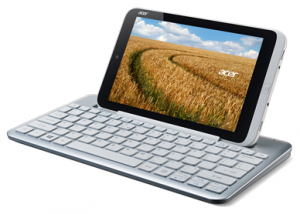
On its Finnish website, Acer unveiled the new Iconia W3 which is touted by the company as the first 8-inch Windows 8-based tablet. The device is powered by Intel’s Atom Z2760 processor (codenamed “Clover Trail“) and Graphics Media Accelerator 3650 GPU (Graphics Processing Unit). The Iconia W3 sports an 8-inch multitouch WXGA display and runs Windows 8 Pro.
The tablet also comes with 2 GB of RAM, 32 GB of internal storage (eMMC) and a 2 MP front-facing camera. Other specs include Wi-Fi 802.11 b/g/n, Bluetooth 4.0 as well as microHDMI and microUSB 2.0 ports.
There is no word on the size of the internal battery, however Acer says that it delivers eight hours of 720p video playback. This suggests that the Iconia W3 can be used for a similar period of time to perform mundane tasks such as web browsing or writing emails.
Acer also offers an optional full-size keyboard dock for the Iconia W3 (pictured above), which is designed to hold the tablet at a comfortable viewing angle and increase productivity for road warriors.
Acer has not provided any details concerning the availability or the price of the Iconia W3.
Ready for a Sunday binge that will make your head spin? Twelve speakers take on our biggest issues: shifting global powers, the value of democracy, climate change, time, the human race. It’s not all bad news, but it’s likely you’ll end up with more questions than answers.
Another week full of tech news means another week of GigaOM podcasts filled with analysis and commentary. Here’s a summary of what you might have missed, along with links to our audio episodes.
On the GigaOM Chrome Show, Chris Albrecht and I chatted with special guest, Joe Marini. As a Google Developer Advocate, Joe is an expert on the Chrome app experience along with the technology behind it such as Packaged Apps and Native Client apps.
Stacey Higginbotham also had a special guest interview this week on the Internet of Things podcast. Adam Dunkels explains how his early IoT coding efforts helped form the basis for LEGO Mindstorms robots and gave him the knowledge to start his latest company, Thingsquare.
Lastly, on the GigaOM Weekly Wrapup show, Tom Krazit, Eliza Kern, Janko Roettgers and I team up to dissect all of the developments at this year’s Google I/O event, ranging from new APIs for Chrome and Android to the new Google Play Music All Access subscription service.
As we’ve reported multiple times before, Samsung has big plans to release multiple variants of their newest flagship, the Galaxy S 4, to serve various purposes. The water and dust proof variant just ran through the GFX Benchmark site and we now have more information on the device including its official name, the Galaxy S 4 J Active. There will be two models of the J Active, one presumably for AT&T (SGH-I537) and another for European markets (GT-I9295).
The J Active will share a lot of similarities with the S 4 including a TouchWiz themed Android 4.2.2, the same gorgeous FHD screen and 2 GB of RAM. One very noticeable difference is the processor. Where the S 4 used either the Snapdragon 600 or Samsung’s own Exynos 5 Octa depending on which version you got, the J Active will pack a quad-core 1.9GHz Qualcomm Snapdragon S4 Plus(MSM8960) processor. While it is an odd decision on Samsung’s part to downgrade the processor and nothing else, the Snapdragon S4 is still a great processor and should do a fine job running the device.
The J Active will join the S 4 Mini and the S 4 Zoom sometime this summer and it will be exciting to see what else Samsung has up its sleeve.




 Yes, bloggers like me like to harp on the fact that many investors are infected by short-termism. But let’s not forget that some of these folks have taken big risks, and sometimes have failed big, too.


 Little over four weeks ago, during an earnings conference call, departing Microsoft CFO Peter Klein revealed the software giant is working with OEMs on


