Category: News

  • Clandestine Photos From Inside Foxconn’s Factory [Suicides]

    The stories by Liu Zhi Yi—the undercover reporter inside Foxconn’s factory in Shenzhen—were depressing. These photos make them even sadder. Gloomy atmosphere, people fighting, and long lines of unemployed trying to get into the 400,000-people factory. More »


    FoxconnShenzhenChinaSuicideAsia

  • The Summer the Euro Died

    The Greek debt crisis is, ultimately, a story about the European Union and the euro that binds its member states in a straitjacket of currency and monetary policy. But what if the euro doesn’t last the year? What if it doesn’t last the summer?

    Reuters blogger Felix Salmon plays Nostradamus on BBC Radio 4, narrating the fateful end of the euro — from the future date of August 2010 — over a soundtrack of war drums, wolf howls, thunder cracks and women screaming (the future of Europe sounds a lot like Bram Stoker’s Dracula).

    In short, the (hyperbolic, but instructive nonetheless) vision goes like so: Germany tries to stop the contagion of Greek debt with a $500 billion bailout fund, the people reject it, and Greece, Spain, Portugal, Italy, and ultimately France decide to go it alone on a new currency — the Neuro. The amounts to default — massive default. The Neuro initially trades around 75 Euro cents, and Europe returns to a system of multiple floating currencies.

    The radio segment ends there, but future prescient installments might highlight the impact of massive default on the continent. The F-PIGS zone would be subject to massive bank runs as depositors freaked about their checking accounts facing 25% devaluation. The defaults would ricochet throughout the European banking system. Much of the defaulted loans are held by other European banks, which means when one country’s government defaults, another country’s banking system totters, requiring its government to spend itself deeper into deficit to save its financial system. In the long run, multiple currencies might make sense for Europe. In the short run, the continent would be lucky to experience only a short double-dip recession.


    Email this Article
    Add to digg
    Add to Reddit
    Add to Twitter
    Add to del.icio.us
    Add to StumbleUpon
    Add to Facebook


    European UnionGreeceMember State of the European UnionGovernmentMultilateral

  • SAT Scores And DNA Testing For Upcoming College Applicants

    sat scoresThose who want to Enroll at UC-Berkeley need more than just transcripts and SAT scores when applying. Applicants will go through cotton swab and 2 bar code stickers. Those who would like to take an DNA test will be given the option to do so. The DNA test will be tested for three genes, its results will reveal how strong one students ability is to resist alcohol and metabolize folic lactose and acid.

    All the information will be kept in a secret database. It is for their own good so one can change lifestyle and diets. In previous enrollments, students have been asked to read journals and books about lifestyle and behaviour.

    “This type of experience is one of the true, unique values of a Berkeley education. We don’t just give you books to read. We involve you in cutting edge issues in the humanities, social sciences and natural sciences. You won’t see this anywhere else in higher education.” Said Mark Schlissel, Dean of the Division of Biological Sciences.

    Questions arise as Universities nowadays require more and more from their students. Not everyone would like your personal DNA to be put in a database, even though they say its kept confidential. Who knows if those DNA data will be used in future testing.

    Related posts:

    1. University of California Berkeley Requires SAT Scores plus DNA Test
    2. AP US History Practice Test!
    3. iPad News: Apple Adds 30,000 Free Books, Paid Titles For $9.99

  • Processed meat consumption increases the risk of heart disease

    Processed meat consumption increases the risk of heart disease

    Scientists at Harvard University analyzed several studies involving more than one million people and found that eating just 50 grams of processed meat a day can increase the risk of diabetes and heart disease.

    By contrast, no processed meats such as steaks, lamb and pork, has less risk of producing any evil in the heart, although both forms of meat have a similar content of fat, say researchers in the journal Circulation.

    According to scientists, as both products have similar amounts of cholesterol and saturated fat, the difference could be in the salt and preservatives that are added to processed meat.

    Processed products include any meat preserved with smoke, salted, such as bacon, sausages, salami, ham and other meats.

    It is known that salt increases blood pressure for some people and this is a key risk factor for coronary heart disease.

    In animal studies have found that the nitrates are used as preservatives may promote atherosclerosis (fatty deposits in arteries) and reduce glucose tolerance, which lead to heart problems and diabetes.

    Team of the School of Public Health at Harvard University who analyzed 20 studies conducted in 10 countries, determined that each portion of 50 grams of processed meat a day was associated with an increase of 42% in the odds of developing coronary disease, and a 19% increase in risk of diabetes.

    “Although this type of long-term observational studies can not prove cause and effect, all studies took into account other risk factors,” says Dr. Dr. Renata Micha, who led the study.

    “Also, lifestyle factors associated with the consumption of unprocessed and processed meat were similar, but only processed meats showed a link with a high risk,” he added. (BBC)

    Related posts:

    1. Unprocessed Meat Better Than Processed Meat
    2. Consumption of processed meats may affect health
    3. Viagra can cause hearing problems

  • Toyota anuncia recall do Lexus por falhas na direção


    Mais um recall está sendo realizado pela Toyota, dessa vez com o Lexus onde 11.500 veículos estão sendo convocados para uma manutenção, devido a problemas no controle do sistema de direção. A versão convocada do Lexus é a LS, que é vendida no Japão, EUA, China e Europa.

    A Toyota declara para a agência EFE, que a maioria dos carros afetados estão concentrados no Japão, e que o recall será realizado em 4.500 unidades. Em outros países, serão um total de 7.000 unidades que realizarão o recall.

    Segundo a montadora, os veículos convocados não possuem a função de controle de direção, que se chama VGRS e que ajusta a resposta do carro ao movimento do volante. Os modelos que foram afetados são: LS 460, LS 460L, LS600h e LS600hL.

    Via | Quatro Rodas


  • The International Space Station’s Speed Limit [Image Cache]

    Just 17,500mph. No safety belt required. Peppers, string beans, and grapes required. In the image, ISS commander Oleg Kotov and NASA astronaut Tracy Caldwell Dyson. More »


    International Space StationNASASpaceTechnologyOleg Kotov

  • Google I/O 2010: Google Wave for Apps and New APIs

    Google Wave is now open to everyone. Any user with a Google account can log into the service, create a new Wave or participate in an existing one. But that’s only half of the news at Google I/O 2010. Google is also introducing Wave for Google Apps. Administrators will now be able to turn on the service for their companies and the tool shou… (read more)

  • Announcing the GigaOM App for the iPhone & iPod touch

    Finally, the big day has arrived. Apple has approved the GigaOM iPhone app — it’s now available via the iTunes store for download. It goes without saying that we’re pretty stoked to be launching this app, which essentially offers a unified experience of all our various properties — from our blogs to our paid subscription service to our events to our real-time Twitter feed. One brand, one app…download it now from the iTunes store. It works both on the iPhone and the iPod touch.

    Many of our readers are already using the iPhone and Android browsers to read what we write, and those numbers keep going up. So it made perfect sense for us to build an app for the iPhone. Importantly, we decided against building an offering that merely mimics the experience of our websites.

    Mobile and the web are two distinct experiences — from the screens to the way we interact with content, the engagement is entirely different. We started with a blank sheet and an idea with which to engage our readers. But that wasn’t all. In order to set guidelines for our app, I turned to the fantastically brilliant mobile guru Tomi T. Ahonen (author of the Communities Dominate Brands blog) and looked at the eight unique characteristics of mobile he lists. They are:

    1. Mobile is personal
    2. Mobile is permanently carried
    3. Mobile is always on
    4. Mobile has a built-in payment channel
    5. Mobile is available at the point of creative impulse
    6. Mobile is most accurate at measuring its audience
    7. Only mobile can capture the social context of consumption
    8. Only mobile can offer augmented reality

    OK so we’re missing the augmented reality features, but you get the point. Based on those abilities, here are the features in our app:

    • Real-time stream of posts 24/7 from across the GigaOM network of seven leading websites, with full user-commenting capabilities
    • Access to the GigaOM Pro research service, including its more than 100 research reports, PDF downloads and the ability to sign up for the service within the app itself
    • Ability to share posts and stories via Twitter, Facebook and email
    • Video posts and live-stream video from GigaOM conferences and events
    • Detailed conference and event information including speaker line-ups, schedules and the ability to purchase event tickets
    • Twitter feeds from across the team of GigaOM writers within the GigaOM Pulse feature
    • Saved articles folder for future viewing of selected items
    • Direct communication channel with our team of writers

    So download it and give it whirl — I hope you’ll give us loads of feedback so we can make it even better!

    Finally, this app never would have been possible without the tireless efforts of three of our team members: our tech Jedi, Chancey Mathews; our director of product, Dan Burke; and our SVP of product & marketing, Dan Silmore. We worked with our friends at Atimi to develop this app and are very grateful for their efforts. Please, if you can, put your hands together and applaud the team that turned my wild idea into an app.

    Now I can finally say: Want GigaOM on the iPhone? Yup, there’s an app for that.


    Alcatel-Lucent NextGen Communications Spotlight — Learn More »

  • FIA considers re-instituting 107% qualification threshold to keep out the riffraff

    Filed under:

    If you’ve been following this year’s Formula One World Championship and wonder how the backmarkers – mostly the new teams that joined the grid for 2010 – have been allowed to compete given their lagging performance, know that the FIA is on top of things.

    According to emerging reports from the F1 paddock, FIA president Jean Todt is considering re-instituting a threshold in qualifying for each grand prix. Known colloquially as the 107% Rule, the measure demands that, in order for any driver to qualify for a grand prix, his or her qualification time has to be within 107% of the time set by the polesitter. The rule was last enforced in 2002, after which it was taken off the books. But in Todt’s eyes, it’s about time to bring it back.

    Since implementing the regulation mid-season would require unanimous approval of all the teams – including those newcomers who’d be most effected by it – the FIA president (and former Ferrari chief) is looking towards bringing it back for next season, which would only require ratification by 70% of the teams. The sport’s commercial director Bernie Ecclestone reportedly supports the idea, but recommends changing the threshold to 105%. For his part, Todt says the measure is not intended to hurt the new teams, but rather force them to get with the program if they wish to compete and not merely fill the grid.

    [Source: ESPN | Image: Fred DuFour/AFP/Getty]

    FIA considers re-instituting 107% qualification threshold to keep out the riffraff originally appeared on Autoblog on Thu, 20 May 2010 08:28:00 EST. Please see our terms for use of feeds.

    Read | Permalink | Email this | Comments

  • 6 Useful Ways to Get More Out of WaveSecure

    This week we’ve highlighted WaveSecure Mobile Security as App of the Week for its awesomeness in finding a lost or stolen phone plus backup capabilities. We recently found 6 useful nuggets on Wavesecure’s blog that will allow you to maximize the app’s features. Let’s get started:

    1. Find your misplaced phone without a PC. Not only can you locate your lost/stolen phone on their website, but you can text it to sound the alarm or do other things like lock, customize screen, locate and even wipe the phone by SMS text from another phone using the following commands:

    Command What It Does
    Lock To lock your phone, send “Secure lock ”. Eg. “Secure lock 123456”
    Customize lock screen To change your lock screen message, send “Secure lock ”. Eg. “Secure lock 123456 Please contact 911 to return”.
    Sound alarm To lock your phone, send “Secure lock alarm ” or with a custom message “Secure lock alarm”. Eg. “Secure lock alarm 123456”
    Locate Send “Secure locate ” for a SMS with a link to track the current location of the phone. Eg. “Secure locate 123456”
    Wipe To erase the phone’s data, send “Secure wipe”. Eg. “Secure wipe 123456”

    2. Automatically backup your data. Schedule backups and forget about it. The app backups up incremental data like contacts and text messages. Plus backups can be done automatically while charging (feature not available for Android 1.5).

    3. Migrate your data to a new phone. One pain in upgrading to new phones is the restoration of contacts, text message, etc. Migration to new devices and even cross platform devices can be done as WaveSecure is on Android, BlackBerry, Symbian S60 and Windows Mobile.

    4. Locate your phone the battery-friendly way. Android phones are notorious for draining batteries. You can control how often the app tracks the phone to conserve some battery power.

    5. Find out who the thief is calling. Say your Droid-baby gets stolen, and the thief swaps the SIM card… no worries, WaveSecure tracks call and text message logs so you get the thief’s number as well as who they have been calling/texting to track down the phone.

    6. Root Your Android Phone, Make WaveSecure Invulnerable. “Rooting” your Android may be a little challenging – but it’s worth the effort! Root version not only makes WaveSecure hard-reset proof, it also enables GPS tracking even if it’s set to be off! NerdGirl has been answering a lot of user inquiries about Rooting in her Ask NerdGirl column, to learn more head on over!

    If you haven’t picked up the app, now you can get it at 20% off the annual $19.90 charge by liking them on Facebook or following on Twitter.

    Hopefully these juicy tips will help you maximize your Android phone. Tell us if you knew about these tips or even your lost/stolen stories using apps like these in the comments below!

    Algadon Free Online RPG. Fully Mobile Friendly.

  • REWORK in the Wild: The Winners

    When REWORK was released we launched a “REWORK in the Wild” promotion. We asked people to upload a photo of their physical (or digital) copy of REWORK. We said we’d pick our favorite and send that person an iPad.

    Check out all the submissions at Flickr.

    The winner(s)

    We were originally going to pick one winner, but we decided to pick three instead. Some people got really creative.


    From Adamsentz


    From Victor “Scott”


    From holmjohnii

    We’ll be in touch with the winners over the next few days.

    Thanks to everyone who submitted a photo. And thanks to everyone who’s read REWORK. We hope you’ve enjoyed it.

  • Dragon Quest IX sets a Guinness World Record

    Dragon Quest IX has officially set a new Guinness World Record. It’s not about sales, though Final Fantasy XIII outstrips it (qjnet/news/final-fantasy-xiii-is-last-years-top-seller-for-square-enix.html) just in Square Enix’s figures. There is, however, more than one way that

  • Oil Spill Update: One Month Later

    One month ago today, the Deepwater Horizon oil rig exploded off the Louisiana coast, causing 11 tragic deaths (and some incredible stories of survival) and what may be the worst environmental disaster of our time. The news from the Gulf is mixed; oil continues gushing from the ocean floor, but has yet to decimate the Gulf coast as severely as some feared. Scientists remain hopeful that they can staunch the leak, despite the fact that initial figures on the amount of oil pouring daily from the sunken tanker were probably gross underestimates. As engineers and scientists continue to try everything from “top hats” to “junk shots” to stop the oil, you can keep up with updates from the US Climate Action Network and here on the RAC Blog. Or, if you prefer, Jon Stewart offers up this concise summary of cleanup efforts thus far.


    There are many ways to help including donating time, energy, and resources to show solidarity with our brothers and sisters in the Gulf Coast region. Jewish Funds for Justice opened their disaster relief fund immediately after the spill began and hopes to be disburse funds to local projects as soon as they are ready to get to work; if you are able, please donate today. You can also look for solidarity events in your community in the coming weeks. We’ll post more opportunities to help here as they arise.

  • Versace announce Unique luxury phone, in name and practise

    Versace Unique Luxury PhoneSo, you’re the kinda person who keeps in shape by doing laps in your money pit. Now, despite the fact that actually having a money pit may set you apart from most other people, I know that you are constantly looking for that special something that truly makes you unique.

    Versace also know this, and have just announced a luxury phone designed especially for you. They’re calling it the “Unique”, because that’s what you are.

    The hand-assembled-in-France device touts an “impossible to scratch” sapphire touchscreen of unknown resolution (not that you care about that anyway), and to my knowledge, this may be the first luxury phone to have a touch interface. I bet you can’t wait to show your buddies at the country club that little technological marvel! I scoff at their Vertus!

    LG provide the innards, which will allow you to call people (over 3G!), check your email, take 5MP flash photos, listen to mp3s, and even watch movies. It may not best an Ally, but don’t Versace believe that it’s what’s on the outside that counts, anyway?

    Now, just in case the purple leather clashes with the interior of your Ferrari, you can rest assured that the phone can also be purchased in black, with your choice of 18k gold or 316L grade stainless steel accents.

    But here’s something interesting: apparently the 5MP camera has both a flash and a netbook! I don’t know what that means, either, but the press release seems adamant. I’ve emphasised it for you, below.

    Oh, the price? If you need to ask…

    Versace announces the launch of Versace Unique

    Seoul (Korea Newswire) May 20, 2010 — Versace, in collaboration with ModeLabs Group, announces the launch of Versace Unique, the first luxury touchscreen and full-featured multimedia creation that will be sold through the most important exclusive watch and fine jewellery networks and Versace flagship boutiques worldwide from early June 2010.

    Versace Unique unites all essential functions for professional and personal use, crafted from the finest materials, hand-assembled in France and built to the uncompromising standards of all the Versace products. The face is constructed from pure high-tech ceramic or handmade lacquers delicately framed with an 18K yellow gold finish or 316L grade stainless steel inlay. The back is wrapped in the finest handcrafted leather, embossed with the Medusa head. The Versace Unique sapphire crystal screen is the largest single piece of this high-tech material ever produced for consumers. Impossible to scratch, smooth and receptive, it provides an ideal conductivity and precision control of the touchphone interface.

    Beneath the precious exterior of Versace Unique lies a world of advanced technology created by LG that guarantees a seamless interface between life and technology, design and usefulness. Versace Unique handles all the duties of a phone, 3G network, client e-mail, media player, full-powered 5-megapixel flash camera and netbook. It features unprecedented Dolby Mobile surround sound technology for high quality in ringtones, MP3 music files and video with 30 hours of playtime.

    Gian Giacomo Ferraris, Chief Executive Officer of Versace Group said: “We are excited about Versace Unique. Our team has worked well with our partners at Modelabs to manufacture a very innovative product which perfectly blends luxury materials, craftsmanship and the advanced technologies of LG. As we move forward in the development of our business, we are particularly happy to be able to strengthen the offer of luxury accessories that complement our core fashion products in line with Versace`s DNA.”

    “The creation of a mobile phone for a luxury brand is first and foremost a matter of passion. At the origin of a new product, a mysterious alchemy takes form between the brand’s creative style and our own know-how allying tradition and innovation whilst at the same time respecting the highest criteria of design, selection of materials, technologies and great attention to appearance. Such is the passion that makes our mobile phones unique,” commented Stéphane Bohbot, ModeLabs CEO.

    For more information please visit: http://www.versace.com/mobile


  • Jobless Claims Unexpectedly Rise

    This morning, the Department of Labor announced that initial jobless claims rose 25,000 week-on-week to 471,000. Economists had expected claims to fall from 444,000 to 440,000, continuing their slow decline. The 25,000 person increase is the largest in three months. The four-week average — which smooths week to week variation — climbed by 3,000 to 453,500.

    The one-week statistic throws cold water on the idea of a fast-moving recovery. Employers are, on aggregate, adding new jobs. Last month, the unemployment rate ticked up from 9.7 to 9.9 percent, but only because more people re-entered or entered the workforce than employers could hire. And yesterday, the Federal Reserve released its April minutes, forecasting a brighter economic outlook. But unemployment and aggregate demand remain extraordinarily weak.

  • New to the App Catalog, 20 May 2010

    What new apps do we love this week? Well of course we love all our children equally, but if we had to play favorites…

    • Blades of Fury is a full 3D fighting game from Gameloft and will let you work out those anger issues
    • TuneWiki Lyrics Search does just what the title suggests and might just tide you over until we get Shazam.
    • Plumber’s Nightmare is a nice ‘connect the pipes’ game, if you’re into that sort of thing (we are).

    All the rest are after the break!

    read more

  • Volkswagen wants to enter Formula 1 with Audi or Porsche

    Vw MonopostReports reveal that Volkswagen wants to enter Formula One and participate as an engine supplier on the condition that the FIA approves use of the ‘world engine’ for 2013.

    When it comes to branding, VW’s motor racing boss Kris Nissen said that it could be an Audi, a Porsche or a VW but that Skoda, Seat or Bentley won’t be well-suited. Nissen had been interviewed during last weekend’s Nurburgring 24 Hour race. Meanwhile, Toyota isn’t keen on returning to formula one in the near future. Toyota had failed to win a single grand prix during its more than $3 billion F1 experience from 2002 until last year. Former team principal Tadashi Yamashina told Automotive News about the “big gap” between formula one and Toyota’s actual car users, one of the reasons why it doesn’t sense the need for returning to the race.

    [via worldcarfans]

    Source: Car news, Car reviews, Spy shots

  • Madigan’s silence speaks volumes

    We told you last week that Southtown- Star columnist Phil Kadner had offered his column as a forum for Illinois House Speaker Michael Madigan to explain why this state is so messed up and what should be done to fix it.

    The response, or lack thereof, was disappointing to Kadner, but not surprising.

    I really didn’t expect Madigan (D-Chicago) to respond. If he ever decides to talk, every newspaper and TV station in the state would cover his news conference.

    But Silent Mike doesn’t think the people of Illinois deserve an explanation.

    Even the governor of Illinois, a member of Madigan’s Democratic Party, appears inept, befuddled and lost as he tries to figure out what the House speaker is going to do.

    Kadner is not a Madigan-hater; pointing out Speaker has done good things, including standing up to utility companies trying to unreasonably jack up rates.

    Also, Madigan was pretty much the only obstacle to Rod Blagojevich’s campaign to destroy Illinois.

    I give Madigan his due. Still, it’s an insult to the taxpayers of this state to keep them in the dark about this financial mess.

    It would harm nothing, as far as I can see, for the speaker to tell us all how he views the current situation and what he sees as the solution.

    Then again, Madigan is a master politician. He must believe it’s to his advantage to say nothing.

    Government runs best in Illinois when the people remain ignorant.

    The Speaker will return, with his colleagues, to Springfield next week.  His actions will probably do most of the talking.

  • Google I/O 2010: Google Wave is Now Open to Everyone

    There were a lot of announcements on the first day of the Google I/O 2010 conference and plenty of interesting new products and technologies. Last year, though, things were a little different, everyone was talking about one thing, Google Wave. The star of the 2009 Google I/O, Google Wave proved to be less kind to the communications platform in… (read more)
  • New Aircraft Design 70% More Fuel Efficient.


    This work is presently conceptual but perhaps timely.  Converting concept to practical aircraft is pretty quick these days so we could see these craft a lot quicker than we are used to.
    The massive fuel savings will serve to drive the present fleet into early obsolescence.  In short, this will be as sharp a conversion as the advent of the 747 in the mid sixties.  And in time, it will drive down the cost of air travel.
    No one can fight a fifty percent fuel saving let alone a 70% fuel saving.
    They are projecting 2035 for these craft.  I think we will see birds as quickly as 2020 simply because the fuel argument is just too compelling.  And it would give Boeing a massive jump on its rivals. Who would swiftly be playing catch up.
    MIT-Led Team Designs Two Airplanes That Would Use 70% Less Fuel Than Current Models
    15 May 2010
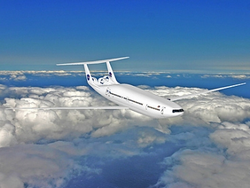
    An MIT-led team has designed an airplane that is estimated to use 70% less fuel than current planes while also reducing noise and emission of NOx. The design was one of two that the team, led by faculty from the Department of Aeronautics and Astronautics, presented to NASA last month as part of a $2.1 million research contract to develop environmental and performance concepts that will help guide the agency’s aeronautics research over the next 25 years.

    Known as “N+3” to denote three generations beyond today’s commercial transport fleet, the research program is aimed at identifying key technologies, such as advanced airframe configurations and propulsion systems, that will enable greener airplanes to take flight around 2035.


    The D “double bubble” series design concept is based on a modified “tube-and-wing” structure that has a very wide fuselage to provide extra lift. The aircraft would be used for domestic flights to carry 180 passengers in a coach cabin roomier than that of a Boeing 737-800. Click to enlarge.


    The H “hybrid wing body” series would replace the 777 class aircraft now used for international flights. The design features a triangular-shaped hybrid wing body aircraft that blends a wider fuselage with the wings for improved aerodyanmics. The large center body creates a forward lift that eliminates the need for a tail to balance the aircraft. The plane is designed to carry 350 passengers. Click to enlarge.
    MIT was the only university to lead one of the six US teams that won contracts from NASA in October 2008. Four teams—led by MIT, Boeing, GE Aviation and Northrop Grumman, respectively—studied concepts for subsonic commercial planes, while teams led by Boeing and Lockheed-Martin studied concepts for supersonic commercial aircraft. MIT team members include Aurora Flight Sciences Corporation and Pratt & Whitney.

    The objective was to develop concepts for, and evaluate the potential of, quieter subsonic commercial planes that would burn 70% less fuel and emit 75% less NOxthan today’s commercial planes. NASA also wanted an aircraft that could take off from shorter runways.

    The MIT team met NASA’s challenge by developing two designs: the 180-passenger D “double bubble” series to replace the Boeing 737 class aircraft, currently used for domestic flights, and the 350 passenger H “hybrid wing body” series to replace the 777 class aircraft now used for international flights.
    The engineers conceived of the D series by reconfiguring the conventional tube-and-wing structure. Instead of using a single fuselage cylinder, they used two partial cylinders placed side by side to create a wider structure whose cross-section resembles two soap bubbles joined together. They also moved the engines from the usual wing-mounted locations to the rear of the fuselage.

    Unlike the engines on most transport aircraft that take in the high-speed, undisturbed air flow, the D-series engines take in slower moving air that is present in the wake of the fuselage. Known as the Boundary Layer Ingestion (BLI), this technique allows the engines to use less fuel for the same amount of thrust, although the design has several practical drawbacks, such as creating more engine stress.

    According to Mark Drela, the Terry L. Kohler Professor of Fluid Dynamics and lead designer of the D series, the design mitigates some of the drawbacks of the BLI technique by traveling about 10% slower than a 737. To further reduce the drag and amount of fuel that the plane burns, the D series features longer, skinnier wings and a smaller tail.
    Not only does the D series meet NASA’s long-term fuel burn, emissions reduction and runway length objectives, but it could also offer large benefits in the near future because the MIT team designed two versions: a higher technology version with 70% fuel-burn reduction, and a version that could be built with conventional aluminum and current jet technology that would burn 50% less fuel and might be more attractive as a lower risk, near-term alternative.

    Carl Burleson, the director of the Federal Aviation Agency’s Office of Environment and Energy, said that in addition to its “really good environmental performance,” the D series is impressive because its bubble design is similar enough to the tube-and-wing structure of current planes that it should be easier to integrate into airport infrastructure than more radical designs. “You have to think about how an airport structure can support it,” he said. “For some other designs, you could have to fundamentally reshape the gates at airports because the planes are configured so differently.

    Although the H series utilizes much of the same technology as the D series, including BLI, a larger design is needed for this plane to carry more passengers over longer distances. The MIT team designed a triangular-shaped hybrid wing body aircraft that blends a wider fuselage with the wings for improved aerodyanmics. The large center body creates a forward lift that eliminates the need for a tail to balance the aircraft.

    The large structure also allows engineers to explore different propulsion architectures for the plane, such as a distributed system of multiple smaller engines. Although the H series meets NASA’s emissions-reduction and runway-length goals, the researchers said they will continue to improve the design to meet more of NASA’s objectives.

    The MIT team expects to hear from NASA within the next several months about whether it has been selected for the second phase of the program, which will provide additional funds to one or two of the subsonic teams in 2011 to research and develop the technologies identified during the first phase. The researchers acknowledge that some propulsion system technology still needs to be explored. They have proposed evaluating the interactions between the propulsion system and the new aircraft using a large-scale NASA wind tunnel. Even if the MIT designs are not chosen for the second phase, the researchers hope to continue to develop them.