The stories coming out of Chinese gadget manufacturer Foxconn keep getting worse. Now, there’s a video clip floating around the Chinese internet that shows a group of guards getting physical with some workers. Updated More »
China – Foxconn – Suicide – Asia – Apple
Category: News
-
Are Clients Really Worried about Goldman?
In the wake of a lawsuit by the SEC and a day-long grilling by the Senate, Goldman Sachs is feeling pretty battered. The New York Times piled it on yesterday, with a sprawling front page article that claims Goldman’s clients are questioning whether to continue doing business with the bank. There’s little doubt that Goldman’s bankers and traders have thick enough skin to handle some criticism from Washington, but if they start losing business, then that’s a real problem. A bank is only as strong as its relationships. Does Goldman really have reason to fear? Probably not.
The Times article uses nearly 3,500 words to argue that Goldman’s clients have lost trust. But it really boils down to four criticisms of the firm. Let’s consider each, then the broader claim that Goldman’s business might be hurt due to its actions over the past few years.
Washington Mutual and New Jersey
Two of the article’s sections make essentially the same argument. First, Goldman underwrote securities for failed bank Washington Mutual and the state of New Jersey. Ultimately, however, Goldman bet against Washington Mutual once it realized the retail bank’s problems. Goldman also advised clients to buy protection against New Jersey’s potential default as the state’s fiscal problems became clearer. Should we be outraged at Goldman treating its clients this way?
There are two points here. First, of course these clients were angry at Goldman: the bank exposed their problems. But wouldn’t it have been worse to recognize their issues and ignore them? Then Goldman would have done a disservice to its hundreds of other clients who it advises, as well as its shareholders.
Second, the division of the firm that underwrites securities is completely separate from its proprietary trading desk and municipal research team. Some years ago, banks were required to put “Chinese walls” up to prevent these groups from colluding. It’s irrelevant to the prop traders and muni researchers who the firm underwrites for — that’s not supposed to affect their actions or opinions.
Auction Rate Securities
Next, the article faults Goldman for its involvement with auction rate securities. Yes, Goldman was wrong to think that these securities would be okay. But then, so was every other investment bank. Virtually all were advising clients to sell auction-rate securities, and all got out as quickly as possible when they realized how poorly the securities would perform as liquidity was drying up.
But the article also blames Goldman for not breaking a contract so to treat one client more favorably regarding its auction rate securities. So the bank should have ignored a contract in order to voluntarily endure losses due to the risk a client agreed to take on? How do you think Goldman shareholders would feel about that decision? Goldman has a fiduciary duty to maximize their profit, which arguably outweighs any desire it has to protect clients form themselves.
Collateral Calls
Is Goldman responsible for the fall of AIG? The article appears to make that utterly wild implication. It criticizes Goldman for requesting collateral to cover mortgage-related losses on assets backing loans it provided to AIG and other firms. Goldman — rightly — recognized the deterioration of these assets. So what exactly was the bank guilty of? Again, it was just hedging its own risk, so to protect its shareholders and profits. Ignoring a bad loan when you can guard against its losses isn’t good customer service: it’s stupid business.
Its Unwritten Principle
This point sort of relates to the last one. The article complains that Goldman has an unwritten 15th principle:
any business in any industry, has potential conflicts and we all have an obligation to manage them effectively
In other words, even though your clients are important, you should not lose sight of the big picture. This isn’t just good business sense; it’s basic common sense. Let’s say you loan your brother your car from time to time. He’s family, arguably the strongest relationship bond possible. But if he develops an alcohol problem and wants to borrow your car to drive to a bar one night, would you let him? Of course not. Similarly, if Goldman realizes a client could cause its shareholders a grave loss, then it must do what it can to prevent that, despite the relationship.
Are Customers Really Growing Weary of Goldman?
The Times piece manages to find five or so past clients of Goldman that no longer wish to work with the bank. But what about the other thousand or so? Is it plausible that all of the bad press will lead the others to question doing business with the firm? Warren Buffett doesn’t think so. He argues that Goldman’s clients understand the bank wears many hats, and that could sometimes conflict with a client’s interest.
The industry sources I spoke with also agreed. One equity analyst at a fund that deals with Goldman in its market-making capacity said his firm has no intention of changing its relationship with the bank due to recent allegations. He doesn’t believe many other firms the bank trades with will either.
The analyst has also observed little impact to Goldman’s underwriting so far. Goldman continues to play a prominent role in recent new issue equity offerings that hit the market, he says. He imagined a worst-case scenario being that Goldman goes from lead manager to co-manager on some deals until Washington turns its microscope off.
Sophisticated clients know what they’re getting when they do business with Goldman: a highly skilled market maker that always keeps its own interest in mind. And that’s okay — every bank that hopes to remain in business is ultimately out for its own interest. But the fact that it cares about its own well being doesn’t mean it can’t also provide excellent service to its clients.


Goldman Sachs – Washington Mutual – New Jersey – Warren Buffett – Business -
Dale Peterson Mocked in Fake Ad
It was bound the happen sooner or later. The inevitable parody video has been cut: Big horse (named Franklin), big gun and big accent included.The spoof website Funny or Die has produced a fake campaign ad after Dale Peterson’s Internet sensation.
In his bid to head up Alabama’s Agriculture Commission, Peterson’s take no prisoners-style (complete with a big horse and big gun) has made him a cyberspace star. That ad has been viewed 800,000 times since Sunday.
Now Funny or Die has spoofed his ad, making fun of Peterson’s walk, talk and gun as well.
Click here to see Funny or Die’s spoof ad.
Here’s an idea.
Original ad: “I’ve been a farmer, a businessman, a cop, a marine during Vietnam, so listen up.”
Spoof ad: “I’ve been a farmer, a cop, a volunteer, I sat people in a movie theater one summer…so listen up.”
-
Opel Astra Sports Tourer spy video
After the first spy shots of the Opel Astra Sports Tourer emerged in March, here is the first spy video of the station wagon model which was taken as the car underwent testing at the Nurburgring. The Astra Sports Tourer will be presented this summer with its official photos, after which its first public debut will be at the 2010 Paris Motor Show in autumn.
The Astra Sports Tourer is similar in the rear to the larger Insignia Sports Tourer model, although it does seem to be a sportier and more aggressive wagon model. The underlying platform is slightly longer than the Astra sedan while the engine range will be exactly that of the Astra five-door model that was recently launched.
The new Opel Astra is certainly enjoying some success and after the Sports Tourer model is presented, we will also see the sports three-door version followed by the Astra cabriolet (to return to a classic soft top model), and another sedan model which will appear under Buick in the US.
Opel Astra Sports Tourer spy shots
-
Queensland nuts need safe haven
Wild Queensland nut trees are vital to the future of a $500 million a year industry but they are officially vulnerable to extinction, with less than three per cent of the remaining range fully protected in national parks or nature reserves, according to new analysis by WWF- Australia.
More widely known as the macadamia nut, the two edible species of wild Queensland nut trees are only found in sub-tropical rainforests stretching from Bundaberg in south-east Queensland to Lismore in northern NSW, an area which has seen rapid development in recent decades.
Analysis by WWF-Australia and Spatial Ecology Laboratory at the University of Queensland has found just 1.3 per cent of the remaining distribution of the smooth Queensland nut (Macadamia integrifolia) and only 2.1 per cent of the rough shelled Queensland nut (Macadamia tetraphylla) is protected inside national parks and nature reserves.
Only about 1000 smooth-shelled and less then 2000 rough-shelled Queensland nut trees remain alive in the wild after 200 years of logging, clearing and development in these now heavily populated regions.
"The Queensland nut is Australia’s only crop developed from a wild native species and the source of a lucrative $500 million industry," Dr Taylor said.
"But despite its strategic economic value and cultural significance, little is being done to bring its remaining natural habitat into nature reserves."
Cultivated Queensland nut trees, even those grown in Australia, all derive from as few as six wild specimens collected from Australia and bred in Hawaii last century.
Without genes for resistance to pests and diseases from wild populations, the narrow gene pool of cultivated trees puts Queensland nut production worldwide at risk of a pest or disease outbreak.
"In 2008 the state government committed to add 4.3 million hectares to the Queensland national parks system by 2020. The Queensland nut is one clear example of the real economic benefits that could result from meeting this promise," Dr Taylor said.
More information
Dr Martin Taylor, WWF-Australia Protected Areas Policy Manager, 0406 384 289
Charlie Stevens, WWF-Australia Media Manager- Qld, 0424 649 689
-
eBuddy downloaded 1 million times from Nokia’s Ovi Store in 3 months
Web and mobile instant messaging (IM) aggregator service provider eBuddy, based in Amsterdam, has announced that its Mobile Messenger app has zoomed past one million downloads in less than three months on Nokia’s Ovi Store.The app has been downloaded by users in more than 203 countries, the company adds – a testament to the global footprint of Nokia.
The app has garnered over 930 reviews on the Ovi Store and a 4/5 star rating. Alternatives on Nokia’s Ovi Store include Nimbuzz and fring.
That said, eBuddy is easily one of the most popular mobile instant messaging applications in the world – it enables millions of users around the world to chat for free in one, aggregated interface across all major IM networks including AIM, Facebook Chat, Google Talk, Hyves, ICQ, MySpace, Windows Live Messenger and Yahoo! Messenger.
In total, eBuddy’s mobile applications have been downloaded over 75 million times, and more than 15 million unique mobile users access eBuddy every month, sending over 7.5 billion messages.
-
Report: GM gives Buick Regal GS the green light
Filed under: Sedan, Performance, Buick, GM
Buick Regal GS concept – Click above for high-res image galleryWhen General Motors debuted the Buick Regal GS at this year’s Detroit Auto Show, they made it very clear that the car on stage, which looked production-ready, was purely a concept – nothing more. Even though the white show car with its beefed up appearance and 20-inch wheels looked like it was ready to roll (it was, after all, a rebadged Opel Insignia OPC), no final decision had been made about whether or not the automaker would actually produce the turbocharged version of the new pride-and-joy Regal sedan. Lest anyone forget, this is an important car for Buick, as it’s charged with attracting a significantly younger crowd of buyers to the brand. The GS would certainly help do the trick, and now, it sounds like all systems are go for the hotter than hot Regal.
The Detroit News reports that Tom Stephens, Vice Chairman of Global Product Development for GM, has confirmed that the Regal GS has been approved for production and that it could hit showrooms at some point next year. If the specs outlined for the Detroit show car are anything to go on, this means that a turbocharged 2.0-liter four will be under the hood, likely producing 255 horsepower and 295 pound-feet of torque. What’s most interesting, though, is that the show car routed this power to all four wheels via a six-speed manual transmission. On top of that goodness, the Regal GS uses a new system called Interactive Drive Control, which allows drivers to choose from normal and sport driving modes, as well as a top-thrill GS mode where the torque split has a stronger rear bias.
If the production car is largely unchanged from the concept we saw back in January, we’ll jump for joy. And while we’re definitely getting our hopes up, we’ll wait until GM issues the official word before we start saving our pennies.
Gallery: Detroit 2010: Buick Regal GS
Gallery: Buick Regal GS Concept
[Source: The Detroit News]
Report: GM gives Buick Regal GS the green light originally appeared on Autoblog on Thu, 20 May 2010 08:57:00 EST. Please see our terms for use of feeds.
Read | Permalink | Email this | Comments
-
Chevrolet switching up ad firms again, adding Goodby Silverstein & Partners to the mix
Chevrolet
About a month ago, General Motors said it will be breaking up with long-time ad agency Campbell-Ewald, a Detroit-based ad agency that has worked for the automaker since 1919. Chevrolet eventually moved its ad account to Publicis Worldwide, a Paris based agency.
New reports say that GM’s new marketing chief, Joel Ewanick, plans to shift primary responsibility for Chevy’s advertising to Goodby, Silverstein & Partners.
According to sources that spoke with AdWeek, the move will undo the decision in April to transfer creative work on Chevrolet to Publicis Worldwide. Ewanick, who was hired by GM earlier this month, used Goodby when he led marketing at Hyundai Motor America.
AdWeek also says that Campbell-Ewald is being rehired for Chevrolet retail and sponsorship work.
Publicis USA CEO Susan Giannino said she has heard nothing and is continuing its work on Chevrolet as planned. Goodby declined to comment.
– By: Kap Shah
Source: Automotive News (Subscription Required)
-
Where Is Bangkok Located?
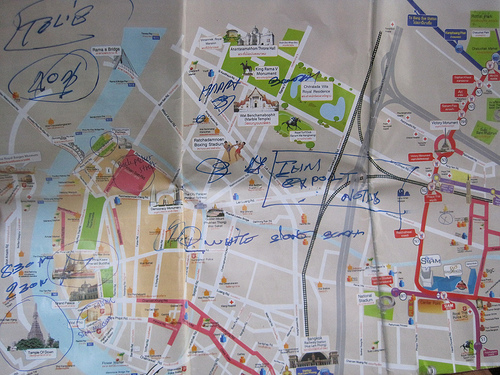
Bangkok is a city located in Thailand. It is located above the mouth of the Chao Phraya River. It is the capital city of the country.
It was established as the capital in 1782 by King Rama I. It has experienced immense growth throughout the years and has developed into a metropolis. It has a population of approximately 6.1 million people. It covers a span of 604 Square Miles. It is the major port for the country.
The city is the only cosmopolitan area in a country of mostly small towns. Bangkok has become a major tourist destination. This has developed as a result of its abundant cultural attractions and full nightlife. It is the center for Thailand’s cultural, financial, and educational endeavors.
-
If You Want Signs of Inflation, You Will Find Signs of Inflation
The core inflation rate is holding steady at 0.9 percent, the lowest rate in 44 years. The United States actually experienced a month of deflation in April. Still, yesterday, The New York Times felt it fitting to warn that the Federal Reserve — all too aware of the above statistics — might be overlooking other data points that suggest creeping inflation and a need to raise interest rates sooner rather than later. The piece warns, “If the Fed is behind the game, there’s a good chance everyone will suffer.”
The first “leading economic indicator” mentioned?
Whole Foods, purveyor of richly priced organic onions and other groceries, last week raised its best estimate for same-store sales growth this year to as much as 7 percent from as little as half that. Its shares have gained 45 percent this year, while those of price-conscious Wal-Mart are down a bit.
The second?
The chief executive of one of America’s biggest banks contends that the strength of the American economy will surprise everyone. The hedge fund manager John A. Paulson has been busy telling investors he is seeing the upward side of a V-shaped recovery. His investments in banks and other economy-driven stocks back up the view.
That is right. The Fed is overlooking the obvious. How could one stroll into one’s local bourgeois purveyor of Kombucha and prosciutto and not think, “Millions of unemployed? Bah! All is well in this kingdom!” And when a Wall Street baron who made billions off of the economy’s collapse promises the recovery is right around the corner — it is, right?
Wrong. There are no signs of imminent inflation. There are many more signs of potentially problematic deflation: The current rate of core consumer prices is below the Federal Reserve’s target, and the central bank is withdrawing its emergency quantitative easing programs and has interest rates as close to zero as possible.
This question of inflation is no academic matter. If the Fed begins fighting inflation, it will begin tightening the money supply and slowing the rate of growth in the economy. That, in turn, will choke off the recovery that the millions and millions of unemployed are counting on. Crying “inflation” too early would be catastrophic for the economy, and yet many economic commentators seem strangely eager to do it.
If The New York Times wants to see signs of inflation, of course it can go out and find them. But improving sales at Whole Foods and the promises of a hedge fund billionaire? I think those are signals the Fed can safely ignore, in lieu of focusing on the horrific economic headline numbers.
-
At last we can talk about foreign policy again
Ed Cairns attended Oxfam’s foreign policy debate on Monday. Whose side did he come down on?
Let’s not be naïve. I never expected any serious discussion about foreign policy in the election. And there wasn’t any. Thank goodness that silence is over. Tonight the BBC’s World Tonight and Chatham House debate Britain’s role in the world. But Oxfam pipped them to the post on Monday with a lively debate, hosted by the BBC’s own Jeremy Bowen, on whether foreign policy can be ethical and in the national interest at the same time.
The last Tory government accused Bowen, reporting from the bloody Bosnian conflict of the 90s, of being a “fully paid up member of the something-must-be-done club”. Oxfam’s Barbara Stocking would be an active member too. But she argued at the debate that we must stop the raping and killing in modern day Srebrenicas not just because it is right – obviously Oxfam’s motive – but also because it raises the UK’s “moral authority”.
The Telegraph’s Mary Riddell argued the same, stating that neither Tories nor Labour have a “monopoly on bad foreign policy,” but the new coalition government could get it right in the future. Just when you thought “ethical foreign policy” was dead, she said, it was back – rebranded as “enlightened self interest” – and because we live in a small world where violence, like climate change, knows no borders.
Academic David Chandler was having none of it. “Moralising makes irrational policy,” he said, claiming the disastrous Iraq war was driven by ethics, not politics – perverse ethics, but ethics.
The Daily Mail’s Peter Oborne had more time for the “something-must-be-done club”. He just thought we should have the sense to know the limits of what can be done.
Who was right? Stocking and Riddell of course. But I’m biased. I work for Oxfam.
Something must be done. But it must be well thought-out and honest. And far more about tough diplomacy than the half-baked invasion of Iraq.
Thank goodness at least that the election is over, and we can talk about these things again.
-
Froyo Today, Gingerbread This Year?
With all the rumors flying around, it’s practically a given that Froyo, the next version of Android, will be launched today at Google I/O. We have a bit more indication that this is the case, as well as news that points to a launch of the next version after that, Gingerbread, later this year.
Adding to the indications (e.g. here and here) that we’ll hear a lot more about Froyo today is the fact that pieces of new code are being dropped into the Android Open Source Project, a fact noticed by Cyanogen and not-quite-confirmed by Google’s Dan Morrill.
As to the timing of Gingerbread’s release, the folks at EuroDroid found a clue in the documentation of WebM, the open media format Google announced yesterday. The WebM FAQ notes that “WebM support in Android is expected in the Gingerbread release (currently planned for Q4, 2010).”
So we learn two things there: Gingerbread is planned for later this year, and it will include support for playing WebM media.
As to version numbers, we’ve heard that Froyo will be 2.2, but it could well be 2.5, making Gingerbread anything from 2.3 to 3.0.
Might We Suggest…
-
IPS appoints new Editor in Chief

IPS is pleased to announce that from the 1st of June 2010, Sanjay Suri will assume the post of Editor in Chief and Diana Cariboni will be the associate Editor in Chief. This decision has come following a six-month transition period, successfully carried out by Suri and Cariboni, with a valuable contribution from Pablo Piacentini, one of the founders of IPS, and the current Director of the IPS Columnist Service.
These last six months, Suri and Cariboni have worked with their colleagues to strengthen the daily editorial quality of IPS copy, initiate a new series of multi-authored global stories and increase the flow of translations between our main languages. Among major events covered in this period, Cariboni led the team that reported from the Copenhagen climate change negotiations and Suri led the team that produced TerraViva at the Beijing + 15 celebrations in New York.
In his announcement IPS Director General Mario Lubetkin noted that Suri and Cariboni are skilled and energetic professionals with all the characteristics to lead the IPS news agency, which is at the heart of our organisation, and was delighted to make these new appointments.
We wish both of them the best of luck with this new challenge, and we know that they will be able to count on the support of all their colleagues at IPS.
-
HTC Hero Owners Upgrading To Android 2.1 BEWARE [Android]
Yesterday we brought the good news to Hero owners that Sprint was pushing out the Android 2.1 firmware update—but before you press yes on that update, make sure you back up all your data. More »
HTC Hero – Sprint – Android – Android 2.1 – Hero -
Drogba continues to be Chelsea’s gold
Didier Drogba continues to affirm Chelsea’s confidence in his abilities with strong performances in his games.
His goal (his 37th this season) in the Chelsea – Portsmouth match-up during the English F.A. final led to Chelsea clinching the championship.
In totally unrelated news (although the female fans will love it), Drogba was spotted at the Cannes Film Festival in an Ozwald Boateng ensemble with Naomi Campbell on his arm.
-
2011 Ford Flex Titanium model commands a premium
2011 Ford Flex Titanium
We recently heard reports on how FoMoCo is still dedicated to the Flex crossover even with the arrival of the next-generation three-row Ford Explorer on the way. Well, to show its dedication and commitment Ford has quality launched the new 2011 For Flex lineup, which now consists of a new trim-level called “Titanium.”
Click here to get prices on the 2011 Ford Flex.
The 2011 Flex Titanium gets most of its packaging content from the Limited model but also adds:
- Charcoal Black leather-trimmed 1st- and 2nd-row seats with Grey Alcantara Suede inserts.
- Perforated leather steering wheel insert with painted Alloy Metallic accents, cruise and audio controls.
- Circle Check appliqué on IP and door inserts.
- Illuminated scuff plates with stainless steel accents.
- Unique blackout treatment for headlamps and tail lamps.
- Fog lamps with black bezel.
- 3-Bar unique black chrome finish grille.
- Black painted skull caps on mirrors.
- Black painted roof.
- Black chrome appliqué on liftgate.
- 20-inch Polished Aluminum Wheels with P255/45R20 A/S BSW tires.
Prices for the 2011 Ford Flex Titanium start at $40,340 when mated to a 3.5L V6 Duratec FWD and $42,190 if you go for AWD. The 2011 Ford Flex Titanium 3.5L EcoBoost V6 (only available with AWD) starts at $45,185. With every single option offered by Ford, the Ford Flex Titanium 3.5L EcoBoost V6 AWD can carry a price tag of $54,152… ouch.
– By: Omar Rana
-
Boosting GE’s ‘company to country’ approach in Brazil
At an event this evening, Brazil’s Central Bank President Henrique Meirelles and GE Chairman and CEO Jeff Immelt will share the Brazilian-American Chamber of Commerce’s Person of the Year Award, which each year honors one Brazilian and one American leader for helping to forge closer ties between the two nations. For the occasion, we asked Joao Geraldo Ferreira, GE CEO of Brazil, to write a guest post on GE’s latest work in the country.
Joao Geraldo Ferreira
GE has been an industrial partner in Brazil for 90 years, playing an increasingly crucial role in helping propel the country’s economic, infrastructure, and energy growth. We’ve been excited to watch GE Brazil grow at an average rate of 12 percent for the last five years, and the opportunities are expanding by the minute. And now Brazil will be host to GE’s fifth Global Research Center, which will offer local research and development services for our major Brazilian industry partners, including Petrobras, the fourth largest energy company in the world; Embraer, the main jet engine manufacturer in Brazil; VALE, the country’s largest mining company and the second largest mining company in the world; and countless other partners throughout Latin America. Locating our next Global Research Center in Brazil is not only about creating jobs and bringing more investments into Brazil. It’s a major part of our “company to country” initiative.
GE is making global efforts to provide more local decision-making, products, and investment opportunities within the countries it serves, and Brazil is a prime example. Later this year, we’ll be opening our first healthcare plant in South America in the city of Contagem, Minas Gerais, where we already have lighting and transportation plants. The plant will initially produce X-ray and mammography equipment, working first to address local demands, then Central and South American needs, and also further export needs as demand and supply capabilities grow.
On the right track: In an op-ed published today in Valor Economico, the main business paper in Brazil, Jeff Immelt said, “I am very optimistic about the partnerships that the U.S. and Brazil are building as Brazil assumes its place on the global stage.” GE’s presence in Brazil stretches back to 1919 — and it was GE that helped light Brazil’s famous “Christ the Redeemer” statute in the 1930s. Pictured above is the GE Transportation plant in Contagem.Believe it or not, we’re also gearing up for the 2016 Summer Olympics, which will be held in Rio de Janeiro. We hope to bring our expertise to the Games in a highly localized way. We were sponsors of the Olympic Games in Beijing two years ago and are sponsoring the Games in London in 2012. While we’ll certainly bring our experience from those two partnerships to bear in Brazil, we hope to develop a partnership in Rio de Janeiro that is inherently Brazilian. Our idea is to create a “Sustainable City,” where we work with government here on the state and federal levels to provide clean technology solutions for energy, water, and healthcare. We’re already meeting with government officials in Rio on a weekly basis to talk about how we can bring sustainable solutions to the Olympics and leave a legacy for the city when the Games are over.
Brazil is one of the countries (Saudi Arabia and Indonesia, for example, are others) where we are pursuing this “company to country” approach. GE may be a global company with global reach, but we also want to be local for the local people. Brazil, which accounts for some 40 percent of our Latin American revenue, is going to be a major proving ground for that initiative.
* Read more stories about Brazil on GE Reports
* Read more Global Research stories on GE Reports
* Read an English version of Jeff Immelt’s op-ed in Valor Economico -
Sprint EVO 4G Reviews Roll In: 4G Nice but Drains Battery
The first reviews of the Sprint EVO 4G are appearing on the web, and I haven’t seen any surprises to knock it off my want list. Sprint and HTC have joined to bring what is undoubtedly the most powerful Android phone, make that smartphone, ever produced. The reviews do a good job showing how smooth and fast the performance is on the EVO. Reviewers also seemed impressed with the 4G performance when coverage was available, although 4G connectivity hits the battery hard.This battery drainage on 4G is what I expected; the Sprint Overdrive modem I use is rated for 3 hours of 4G connectivity and the EVO 4G is working the same way. It’s a given the battery must be hit hard using 4G. Hopefully Sprint and HTC can tweak this battery usage somewhat over time.
The most thorough review I’ve seen of the EVO 4G is by Chris Ziegler of engadget. His video review shows every aspect of the phone’s operation, and he seems impressed with the EVO so far. Other reviews of interest are Sascha Segan’s of PC Magazine and Walt Mossberg’s of the WSJ.
Related research on GigaOM Pro (sub. req’d): To Win In the Mobile Market, Focus On Consumers

-
Android, iPad Ad Requests Surge In April; iPhone Ads Declined Slightly
Ad requests across smartphones using Google’s Android operating system and Apple’s iPad both rose 77 percent between March and April, according to a new report by mobile ad net Millennial Media. Meanwhile, ad requests on the iPhone fell 8 percent during the same period, but the device is still the leader by far, with a 62 percent share of smartphone impressions. And if you add up the numbers since this past January, the iPhone’s ad requests are still up 1.5 percent. Way behind the iPhone at number two is Blackberry maker RIM (NSDQ: RIMM), which had a 17 percent share of mobile ad impressions, and was up 3 percent in April versus March.
Thanks to Google’s OS’ growth, Android maker HTC entered Millennial’s top five ranking of manufacturers for the first time and represented the largest increase within the largest 15 manufacturers in April with a 2.5 percent impression share increase month-over-month.
The rise of Android impressions is related to increasing consumer interest. Last week, Google (NSDQ: GOOG) CEO Eric Schmidt told shareholders that the company’s partners are shipping at least 65,000 handsets with the Google open-source operating system every day.
Meanwhile, advertisers and media companies have been salivating over the revenue possibilities of the iPad, as the device’s sales have exceeded even the most optimistic expectations. Even still, the iPhone has a huge head start in terms of ad impressions, and no one, not even Google, is close to toppling it from its perch at this point. Of course, that could change quickly, depending on when and if Google’s $750 million acquisition for mobile ad net AdMob goes through.
Related
-
ATM pioneer John Shepherd Barron, died
John Shepherd-Barron, creator of the first automated teller machine (ATM), died at tage 84 in Raigmore Hospital, Scotland. He was credited for the design of a machine that used special checks matched with a personal identification number to withdraw cash. Comedy actor Reg Varney was the first person to use the machine in 1967, also made it first in UK. He studied at the University of Edinburg and University of Cambridge and later on worked as a managing director of Dela Rue Instruments. Barron was honored in the New Year’s Honours List in 2005. Puggal notes there are around 2 million teller machines worldwide. Related posts:
- When Will You Trust Me? – PCOS
- Unhealthy Habits Can Take Off 12 Years
- Philippines’ Sends Green Light for Automation