Category: News

  • Twitter for iPhone (Tweetie 3.0) now available

    Twitter iPhone Tweetie 3.0

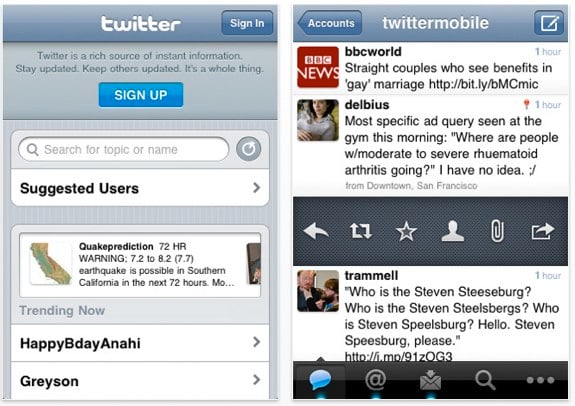
    Tweetie has been pretty much universally recognized as the best iPhone Twitter client since it launched, and Tweetie 2.0 took it to the next level. In fact, it was so good, that Twitter decided to buy the app outright, rather than building their own iPhone app. News soon came that Tweetie would become “Twitter for iPhone” and would be made free (Tweetie sold for $2.99) to anyone who wanted it. Well, today is that day, as Tweetie 3.0 has been released with new features (we’ve got a list of them after the break) and is now simply known as Twitter. It’s full-featured, it’s the official Twitter app for the iPhone, and therefore it will have access to more Twitter resources than any other Twitter app out there. We recommend it highly, and you can download it now.


    Tags:
    ,
    ,
    ,
    ,
    ,
    ,
    ,

    Twitter for iPhone (Tweetie 3.0) now available originally appeared on AppTapper on Wed, May 19, 2010 – 10:18:34


  • Google announces open app store for ‘Installable Web apps’

    By Tim Conneally, Betanews

    Installable Web Apps

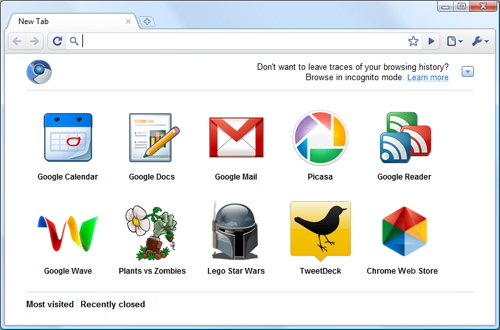
    Google has announced the upcoming availability of the Chrome Web Store, an open marketplace similar to the Android Market or iTunes App Store that deals exclusively in Web Apps.

    Chrome Web Store Icon
    This store doesn’t exist yet, but will open both to developers and to users “later this year.”

    The store will deal in the “installable Web apps,” that are expected to populate both the Google Chrome browser and the forthcoming Chrome OS. They can be run currently, but require a Windows Dev channel release of Google Chrome with a special command line flag.

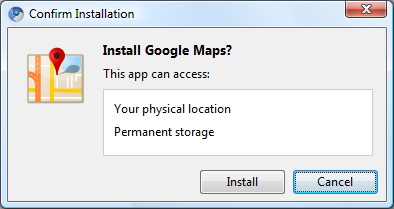
    According to their Google Code listing, “An installed web app could be separated visually from other tabs, could integrate better with the OS, and could be granted increased permissions. This special handling of web apps is exactly what we’re working on in Google Chrome…Installing a web app in Google Chrome is easy and quick, with no restart required. At its simplest, installing a web app is like creating a super-bookmark to it.”

    Installable Web App for Google Maps

    Interested developers can check out the preliminary documentation and join the discussion in the Google Group for Chromium Apps.

    Copyright Betanews, Inc. 2010


    Add to digg
    Add to Google
    Add to Slashdot
    Add to Twitter
    Add to del.icio.us
    Add to Facebook
    Add to Technorati


  • Robert Redford and green groups tell Obama to step up on Gulf oil leak

    by Jonathan Hiskes

    Whither Obama? There’s a
    growing chorus calling for the president to show leadership on the BP oil disaster
    by connecting it to America’s fossil-fuel dependence and the potential
    of clean-energy investment.

    “The silence from the
    White House is deafening,” a Clinton-era White House aide told
    ClimateWire
    . “Clearly without a White House push there does not seem
    to be adequate political momentum” to pass a Senate clean-energy bill.

    Today Thomas Friedman calls the Gulf leak Obama’s 9/11—the biggest opportunity of his presidency to ask
    Americans to invest in nation-building clean-energy infrastructure, an opportunity he is so far squandering. I’ve
    been
    making
    the same
    case
    .

    Yesterday, the Natural Resources Defense Council, League of Conservation
    Voters, and Blue Green Alliance (a labor-enviro partnership) held a press
    event calling for Obama to put clean energy in the national spotlight.

    And actor Robert
    Redford released a cable TV ad with NRDC echoing the same message: “The Gulf
    disaster is more than a terrible oil spill. It’s the product of a failed energy
    policy—one that puts oil-company profits ahead of people and the environment. America needs safe,
    clean and renewable energy—not more oil spills … Tell President Obama to
    lead America toward a clean-energy future.”

    Redford’s accompanying post spells out the situation even
    more:

    The American Power Act,
    drafted by Senators Kerry and Lieberman, is not perfect—but it is a
    significant step toward cutting our dependence on fossil fuels, limiting carbon
    pollution, and encouraging businesses to shift to clean energy sources.

    Unfortunately, the full Senate continues to stall—weighed down by too much infighting and too many special interests. That’s why
    we need the president to assert his voice and leadership by letting the Senate—and the American people—know that he is serious about getting clean
    energy and climate legislation passed this year.

    Quite a spokesman, Mr.
    Redford. Here’s the eye-catching ad:

    Related Links:

    Obama admin overhauls MMS, the agency in charge of offshore drilling

    Rand Paul’s Copenhagen rant and other election notes

    Friedman nails Obama for his timid response to the “environmental 9/11”


  • Finance Jobs Weathering the Storm Better Than Most?

    A rather shocking graphic from Mike Mandel seems to indicated that finance isn’t suffering much during this recession:

    financialjobs.png
    At closer examination, though, I’m not sure how much that means. It’s not very surprising that commercial banking has lost very few jobs; it wasn’t the kind of boomtown that, say structured finance was.  And the “Finance and insurance” category includes Goldman Sachs–but also the millions who labor as claims adjusters and call center operators and actuaries in the insurance industry.  Insurance, unlike structured finance, is labor intensive:  it pays a lot of people a little money, instead of a few people a lot.  And it’s a highly regulated business without the wild swings in either demand or profitability that you see in Wall Street business lines.  Given those facts, the bulk of that “finance and insurance” line probably consists of mostly the latter.

    That isn’t to say that financial workers aren’t surviving surprisingly well, given the carnage some of its employees managed–just that it’s hard to say one way or another using that data.

    Update:  I see Felix Salmon had similar thoughts

    So what’s my theory? If you look at the chart, it turns out that the
    job losses in finance are put into two buckets. There’s “commercial
    banking”, on the one hand, which has had very small job losses: people
    have just as many checking accounts and bank loans as they always did.
    And then there’s “finance and insurance”, which is what we generally
    think of as Wall Street, but which also includes the enormous number of
    employees in the insurance industry. And just like commercial banking,
    the insurance industry is pretty steady, and is going to have seen very
    few job losses indeed. What’s more, it’s probably bigger, in
    terms of total headcount, than the investment-banking industry.

    So assume that insurance has seen even fewer job losses than
    commercial banking, and that it accounts for most of the jobs in
    “finance and insurance” — in that case, the job losses on Wall Street
    alone could be very large indeed to get to that final 7.3% figure.

    Before reading too much into these numbers, then, I’d like to see a
    bit more disaggregation. It might be true that Wall Street hasn’t seen
    condign punishment in terms of job losses. But on the other hand, it
    might not.


    Email this Article
    Add to digg
    Add to Reddit
    Add to Twitter
    Add to del.icio.us
    Add to StumbleUpon
    Add to Facebook


  • Best Buy: Let Us Install The PS3 Version Of Red Dead Redemption

    Reader IfThenElvis has submitted, for your approval, this photo of Best Buy asking you to let them install a PS3 game.

    Discuss.

    5-19-2010 1-47-24 PM.jpg

  • FDA Announces Widespread Investigation Of McNeil After Tylenol Recalls

    Remember the recalled liquid Tylenol and other children’s medicines last month? Or the stinky drugs that were recalled back in January? Or the children’s Tylenol that was recalled last September? The FDA remembers, which is probably why it’s “conducting a company-wide investigation of McNeil Consumer Healthcare’s drug manufacturing practices to determine whether similar problems exist throughout the company.” Also, a date has now been set (May 27) for the House Committee hearing where the CEO and chairman of parent company Johnson & Johnson are expected to testify.

    This is one case where the company has been asking for trouble (meaning government intervention) for a while now–all three recalls in the past nine months have been related to quality control issues at production facilities. ABC News said the FDA met with representatives of McNeil and Johnson & Johnson back in February to “express its concerns about their production practices.” The company reps promised they were taking care of the problem, but two months later McNeil announced its recall of children’s drugs that were potentially contaminated, and a subsequent plant inspection revealed a dirty facility with poor quality-control.

    “FDA ‘actively pursuing’ McNeil Consumer Healthcare” [Drugs Store News]
    FDA Media Update re. McNeil Invesgiation (PDF) [FDA]

  • Blumenthal and Vietnam, the director’s cut

    If a video clip of Richard Blumenthal stating at a 2008 Norwalk event that he served in Vietnam is a smoking gun, the attorney general’s supporters are hoping that the full video might put some of the fire out.

    Early in his speech, Blumenthal clearly states that he served “during the Vietnam era,” although a few minutes later, he makes a reference to “the days that I served in Vietnam.”

    The full clip, first reported by the Associated Press today, is being widely circulated by the Blumenthal campaign, which is clearly relishing this glimmer of positive news. 

    “It shows exactly what he said yesterday,” said Blumenthal spokeswoman Maura Downes, referring to Blumenthal’s admission that he “misspoke” about his record on “a few occasions.”

    “In that same speech, he very clearly stated what his service was,” Downes said.

    And where did the complete, 5 minute, 45 second clip turn up? On Linda McMahon’s YouTube channel. (And not on the New York Times website. The Times broke the story about Blumenthal’s misrepresentation of his military record and gave prominent play to the brief clip but as of 2:34 p.m., the longer version did not appear to be posted on the newspaper’s website.)

    UPDATE: When asked whether the Times intends to post the full video on its website, Spokeswoman Diane C. McNulty said in an email that it is the paper’s policy not to discuss “what will or will not be published in future editions of The New York Times.”

    On larger questions about the paper’s Blumenthal reporting, McNulty said the following:

    “The New York Times in its reporting uncovered Mr. Blumenthal’s long and well established pattern of misleading his constituents about his Vietnam War service, which he acknowledged in an interview with The Times.  Mr. Blumenthal needs to be candid with his constituents about whether he went to Vietnam or not, since his official military records clearly indicate he did not.

    The video doesn’t change our story. Saying that he served ‘during Vietnam’ doesn’t negate his later statement.  It doesn’t indicate one way or the other whether he went to Vietnam.”


  • Roadmap: Integrating Social Technologies with your Corporate Website (Slides)

    A few years ago, I wrote a controversial post suggesting corporate websites were irrelevant.  Why?  Decisions were being made off-domain by customers and peers.  Secondly, many marketers were trying to get customers to go to their corporate website versus joining where they already are, “Fish where the fish are.”

    Today, I’m pleased to see that the thinking –and technology, has emerged, where we’re finding a variety of companies that are integrating social technologies right into the corporate website, bringing the trusted discussions closer to the corporate site.  In fact, I’m kicking off the Gilbane CMS conference in SF as the keynote, and will be sharing this deck live on stage.


    Although the highest state of nirvana (seamless integration) doesn’t yet exist, we should expect there to be very little difference between social technologies and corporate websites as content will assemble on the fly.  I predict URLs won’t matter, as content will be dynamically assembled around the buyer and their context in a variety of devices.  Sure, that’s far out thinking now, but that’s why we have several other stage gates that companies must first go through.

    In fact, use this presentation (loosely modeled after a post of the same topic) as a roadmap for brands, web strategists, and the vendors that serve them.  Feel free to use these slides with attribution.

    Thanks to our head of Research, Christine Tran for her assistance.

    Related Resources

  • SageTV 7 Arrives Tomorrow – New UI, Plugin Manager, and More

    GeekTonic has big news about popular Home Theater PC software, SageTV.  The next version of SageTV – SageTV7 should be available as a public beta sometime tomorrow!
    EPG
    Since CES, we knew a new SageTV version was coming and that it would include a new UI.  I have had the opportunity to preview this new version and thought I’d run through the more significant new features, changes and improvements.

    More Info after the Jump…


    • New User Interface (UI)  – See below for a couple of screen-shots as well as more description on this.
    • Online Plugin Manager – This is really a big improvement over the past method of importing plugins, changing settings files etc.  Think of this as a simple way of viewing what plugins are available, what plugins you have installed, which plugins have updates available etc – all from the UI.  This takes what was a fairly onerous process of installing and setting up a plugin and makes it simple.

    Plugin Manager

    • XBMC Skin (xml) import support – Do you covet one of the beautiful XBMC skins?  SageTV 7 has created a way to automatically import those skins into SageTV 7 and use them as your UI.  It’s not an entirely automatic process and requires some modification, but it makes importing & using the XBMC skins possible without much coding.  The first imported skins should arrive in the near future.
    • Live TV seamless transition between shows – If you’re a SageTV user already you know about this one.  In the past say you were watching a sporting event and it ran past the scheduled end time.  SageTV used to pause playback for a few seconds while it transitioned into the next show causing an annoying irritant to users.  That problem is gone now and you’ll have seamless transitions.
    • BDMV (Blu-ray) folder playback – Blu-ray playback already exists with SageTV 6, but SageTV 7 adds Windows playback improvements (decoders required to be installed)
    • Support for playback of ISO DVD and Blu-ray files on all platforms that support non-ISO playback (requires Virtual Clone Drive (free) to be installed for Windows)
    • Windows Placeshifter uses DirectX 3D rendering instead of OpenGL
    • SageTV recordings now have their full metadata embedded into the video file instead of requiring a separate file to hold that metadata
    • Increased stability of Hauppauge HD-PVR – Enhancements to workaround Hauppauge HDPVR instabilities on Windows
    • DirectShow demux filter for handling MKV, MP4 and FLV media types
    • New ‘Effects’ rendering system with support for more advanced and easier to use animations (layers are no longer needed)
    • Background image loading system allows for faster loading of thumbnails and other image resources w/out interfering with UI responsiveness
    • New Pan/Zoom style slideshow transition effects
    • Automatic conversion of Favorite recordings
    • Removed the need for formatting disks with 64k clusters in order to get optimal disk performance on Windows
    • Significant performance increases for HD200 – you will notice this especially when navigating the UI.  And this allows for more animations in the UI as well.  NOTE: It was pointed out to me by a HD100 user of SageTV 7 that improvements were made that enhance the HD100 performance as well.  He stated that the HD100 is now as fast as the HD200 was with SageTV 6!
    • Support for DVB radio channels
    • Windows 7 compatibility – SageTV worked with Windows 7 already, but now installation on Windows 7 is more seamless.
    • Lots of new API calls and Widget options in the SageTV Studio
    • Various other optimizations and bug fixes  – the complete change log will be included in the official announcement tomorrow.

    New User Interface – Probably on the most-requested list for SageTV developers is a re-write of the user interface.  The SageTV user interface that comes installed in SageTV by default has made many changes over the years, but cosmetically it’s looked and worked about the same.  The SageTV team has made some significant changes in the UI that they hope will please those that liked the old UI the way it was as well as those looking for a more attractive appearance. 
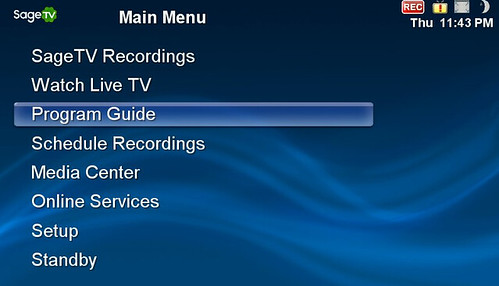
    For comparison, below is the old, default SageTV6 UI:
    Old SageTV 6 Main Menu
    Obviously pretty plain and that’s one reason many SageTV users flocked to the 3rd Party UI, SageMC.
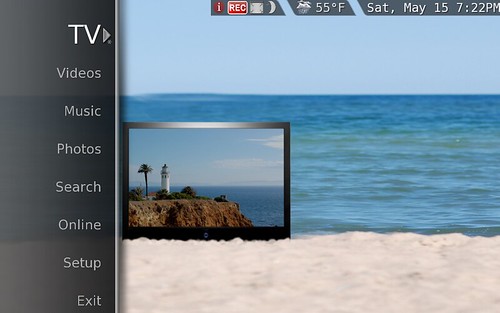
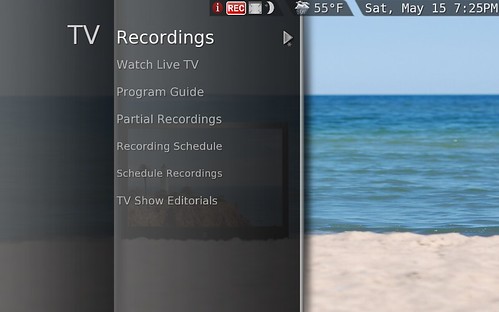
    The screenshot below shows the main menu in it’s pure form.  Included are new animations, improvements to the extender (HD200) firmware to allow for these animations.  I’ll be posting a demo video to show the UI in action later this week as it’s difficult to get the feel for it all with static photos.  Note that this UI is skinnable and background images can easily be changed.  The screen-shots I’m including here are from the current, beta version.
    Main Menu TV
    You can either press select with your remote control to initiate a given function (such as TV) or as you move your cursor (remote control) right, a sub-menu slides open showing additional settings.
    Main Menu TV Submenu
    The entire UI works in a similar, unified way.  You’ll find the menu items and submenu items better organized and easier to navigate compared to the old, UI.  More on the UI later.
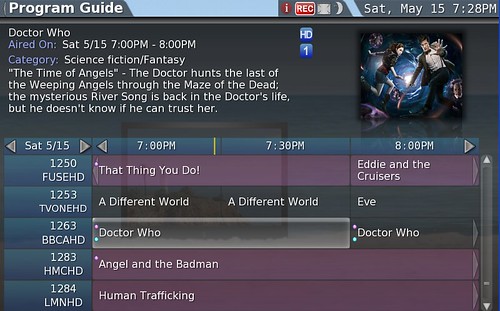
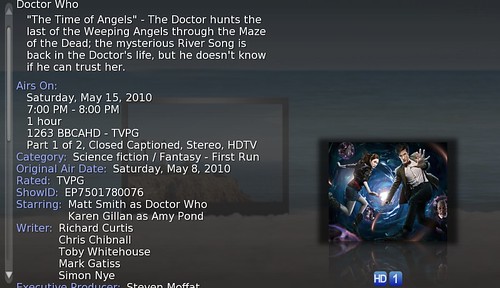
    EPG Program Details

    Many Important Changes “Under-the-hood”

    Many will focus on the new UI, transitions and effects and think that’s the biggest change here – and it is from a purely look & appearance perspective.  But for me it’s also the more subtle, under-the-hood changes that make this version a huge leap forward.  The new plugin manager makes installing and updating add-ons incredibly easy – I can’t stress enough how much of an improvement this is to those that use SageTV.  The changes the SageTV team has made the learning curve so much easier.
    Other non-UI items that are on the list of things I’m really appreciating here include the improved HD-PVR performance, improved HD200 performance (it handles navigation very fast), no more “pause” between shows when watching LiveTV like I used to experience when watching sports, improved Blu-ray functionality, the embedded metadata in the recorded TV file – those sorts of things will be appreciated by those familiar with SageTV 6.
    The other thing you might not notice at first with SageTV7 is the coordination and support that went on behind the scenes between SageTV developers and the third-party add-on developers.  There are three or four significant projects underway that will offer even more functionality and UI choices for SageTV users.  Projects underway include:

    • Project Ortus – A combination UI system and feature-set add-on being developed by a team of developers for SageTV.
    • Project Phoenix – Yet another combination UI system and feature-set add-on being developed by a team of developers for SageTV.  This one includes developers of the well-loved SageMC add-on.
    • SageTV MyMovies – Ever heard of MyMovies?  This add-on will be another port of MyMovies and looks to be very exciting.

    Each of the projects mentioned above have plans to make it to public beta sometime later this year or early next year depending on their progress.  I hope to provide previews of each of these add-ons in the near future on GeekTonic.
    Another important thing to note – the version you will see tomorrow will still be in beta albeit public beta.  This means there will be more changes before it’s completely finished – we know from past experience that SageTV improves and updates on a very frequent schedule.  There will be more good things to come for SageTV users…
    I noticed that there isn’t a new Mac client so far so this new SageTV 7 version is only for Windows and Linux users thus far.

    Upgrade Policy

    • All windows SageTV6 and SageTV6 upgrade licenses purchased on or after 12/1/2009 will be valid for SageTV 7.
    • All prior linux and mac and client and placeshifter and extender licenses will be valid for SageTV7 
    • The trial is reset on the SageTV7 beta. Upgrade licenses on windows are $39.95, and any prior Windows Version of SageTV license qualifies for an upgrade license.

    So everyone who would like to try out SageTV7 on Windows should get the opportunity with the 21-day trial.
    Main Menu Search Submenu
    If you want to be first in line to download the new public beta, subscribe to this thread in the SageTV forums and you’ll get an e-mail.  Of course I’ll have a post up here at GeekTonic letting you know it’s available as well.  I also plan to have a couple of more detailed walk-through’s of the new features and UI for those that are curious so stay tuned!

    Thanks to the guys at SageTV for the special preview for GeekTonic


  • Stamford’s Shapiro Isn’t Running For Re-election

    House Speaker Christopher Donovan, D-Meriden, said he learned that Rep. Jim Shapiro, the co-chairman of the general law committee, is not running for re-election Monday.

    Shapiro, a Democrat from Stamford, is finishing his third term as a state representative. In addition to the general law committee, he serves on the higher education and public safety and security committees.

    He is a corporate attorney and was a former director of legal affairs for Barnes & Noble Inc.

    Before becoming a state lawmaker, Shapiro served on Stamford’s board of representatives for the 11th District. 

    Although he did not say why he is not running again, Shapiro said in a prepared statement that it will be hard for him to leave public service.

    “The satisfaction of doing the right thing and helping so many people is difficult to duplicate in other areas of life,” Shapiro said. “I wouldn’t be surprised if public service lured me back in some capacity sooner or later. However, for right now, this is the best decision for me and my family…”

    Shapiro is one of at least five committee chairmen not running for re-election.

    Rep. Cameron Staples, D-New Haven, co-chairman of the finance, revenue and bonding committee, is not looking to keep his seat. Neither is Rep. Ryan Barry, D-Manchester, co-chairman of the banks committee, and Sen. Mary Ann Handley, D-Manchester, co-chairwoman of the higher education and employment advancement committee. Sen. Jonathan Harris, D-West Hartford, co-chairman of the public health committee, is hoping to secure the Democratic endorsement for secretary of the state this year.

    In addition, the legislature will lose House Majority Leader Denise Merrill, D-Storrs. Merrill also wants the Democratic endorsement for secretary of the state.

  • Your Cash Is No Good At The Apple Store

    If you’re saving up to buy an iPad, don’t do it by sticking your spare cash into an envelope. (Or a sock, for that matter.) As a woman in Palo Alto, Calif. learned, the same “credit or debit cards only” policy that Apple put in place to prevent rampant reselling of iPhones exists for iPads, and no stack of bills can be exchanged for the shiny gadget.

    Being disabled and on a fixed income, Campbell held off on buying a computer until the Apple iPad came along. It was small, mobile and perfect for her needs. So, little by little she saved up the $600 she needed to get one.

    “It took quite a long time for me to just save up this small amount of money to go down and purchase one,” she said. “I had my cash in the backpack and I went up proudly to the counter and told them, ‘I would like to purchase an iPad.’”

    She was at the Apple store in Palo Alto, about to pull out the big wad of cash and take home her first computer. Instead, she received a terrible blow.

    “They said, ‘Sorry, we don’t take cash.’ And, so I looked at her and I said, OK she’s kidding,” Campbell recalled.

    Customers can purchase iPhones with Apple gift cards, but not their plus-sized cousins. Indeed, Apple’s policy makes it difficult for people without bank accounts to buy the iPad–no matter how carefully they saved up for them.

    Cash not always welcome at Apple stores [KGO]

    RELATED:
    Apple Escorts You From The Store For Trying To Purchase An iPhone With Cash
    Your Cash Isn’t Good Enough For Apple’s Precious iPhone

  • Primary Watch: What happened in Arkansas?

    As The Four Seasons said, “Oh, What a Night!”

    Yesterday’s primary elections were marked by big anti-incumbent upsets, and one of the most interesting was the Democratic U.S. Senate contest in Arkansas, where incumbent Sen. Blanche Lincoln received only 45% of the vote, forcing a run-off with upstart challenger Lt. Gov. Bill Halter, who got 43%.

    What happened in Arkansas? Was it, as labor and progressives say, a populist uprising against Lincoln’s conservative and corporate-friendly voting record? Was it part of the overall anti-Washington mood of the masses?

    In reality, Lincoln’s weak showing was due to a variety of factors, some of which offer conflicting lessons

    * THE LABOR FACTOR: Only 4.2% of Arkansas workers belong to unions — the second lowest rate in the country — but labor was a huge factor in mobilizing support for Halter. Prompted by Lincoln’s votes and positions on labor’s key issues like health reform (against), the Employee Free Choice Act (against) and financial reform (all over the place), national unions poured major resources into the race and got results.

    At its peak, AFL-CIO’s Working America had 45 paid staff in Arkansas, and it claims to have contacted 90,000 people and sent 1.75 million pieces of pro-Halter mailers. The Service Employees International Union (SEIU) spent $1.5 million in the state and says it reached another 85,400 in the state.

    In response, Lincoln was left with complaining about the role of unscrupulous “outsiders” (read: carpetbaggers?) in trying to influence voters. But in a race where Halter and Lincoln were separated by less than 5,000 votes, the direct voter contact and media publicity labor was able to generate for Halter was pivotal in enabling him to force a run-off.

    * THE RURAL/URBAN DIVIDE: But the fact that labor flexed its muscle in this race is far different from the conclusion that Politico comes to, which is that liberal “activists” were the reason Halter forced a runoff.

    On the contrary, Arkansas’ progressive Democratic strongholds (such as they are) aren’t what propelled Halter to his strong showing.

    Take, for example, Pulaski County — home of Little Rock, one-third African-American, a key Democratic base and the most voter-rich county in Arkansas. If Halter is a favorite of progressive Democrats, this is just the kind of place he should have won.

    But Lincoln won Pulaski County with 52% of the vote; Halter only got 40%, even though it’s his home base. This suggests the pre-election analysis put forward by Arkansas columnist John Brummet may have held: Whatever their disillusionment with Lincoln, Democratic voters stayed with the known-quantity incumbent against a challenger they viewed as too risky.

    * ANTI-BLANCHE, BUT PRO-WHAT? The fact that Halter beat in Lincoln in conservative, rural districts but lost in the progressive strongholds suggests that something else was at work. The Arkansas Blog credits Republican mischief, or GOP voters who crossed over in the open primary to vote for the Democrat they thought they had the best of chance of beating in November.

    There’s also the reality of Lincoln’s low poll numbers, which drove even conservative Democrats to vote for an ABB (Anyone But Blanche). That “anyone” included D.C. Morrison, the right-wing Democrat who took third place in the primary with 13% of the vote.

    So in the Lincoln vs. Halter runoff, where will the Morrison voters, anti-Blanchites and even the few stray cross-over Republicans (who will be much less of a factor, given that they’ll have no other races of interest) end up?

    There’s no way of telling, but it likely won’t neatly follow the “liberal vs. moderate” narrative the national media wants it to follow.
  • The eyes are a window on the dream world

    During REM sleep, where most dreaming takes place, your eyes move around but it’s never been clear exactly why. A new study just published online by neuroscience journal Brain suggests that they are looking at the ever-changing dream world.

    The first question you might ask is how the researchers knew what the dreamers were looking at. To study this, the project recruited people with a condition called REM sleep behaviour disorder who lack the normal sleep paralysis that keeps us still when we dream.

    In other words, people with REM sleep behaviour disorder act out their dreams. We’ve discussed the fascinating condition before as it gives an outside view to the inner dream life of the affected person.

    In this case, the researchers, led by neuroscientist Laurène Leclair-Visonneau, used electrodes to monitor the eye-muscle movements of 56 patients with REM sleep behaviour disorder and 17 healthy controls in a sleep lab, while also videoing their night-time movements.

    The research team initially looked to see if there was a major difference in rapid eye movements between people with the condition and those without. They found that the groups were statistically indistinguishable – meaning that the sleep disorder wasn’t likely to be affecting the eye-movements themselves.

    Knowing that REM eye-movements were not abnormal in people who acted out their dreams, the team then looked at the video and picked out where patients completed a ‘goal directed action’ while dreaming – such as picking up a dream object or reaching out to touch something.

    By synchronising the videoed actions with the eye muscle recordings during REM sleep the researchers found that the eyes were fixed on the dream target 90% of the time.

    In other words, when the eyes move during REM sleep they are looking at something in the dream world.

    The eyes seem genuinely to be a bridge between the land of dream consciousness and waking life.

    Link to PubMed entry for REM and dreaming study.

  • Undercover Report From Foxconn’s Hell Factory [Suicides]

    Chinese newspaper Southern Weekly sent 20-year-old reporter Liu Zhi Yi undercover in Foxconn’s factory in Shenzhen, China. For 28 days, he experienced dreadful conditions that the factory’s 400,000 employees endure, churning out iPods, iPads, and iPhones for Apple nonstop. More »


  • iPhone OS 4.0 beta 4 reveals AT&T tethering option

    iPhone OS 4.0 AT&T tethering

    So check this out, we’ve been waiting for iPhone tethering since the original device, and when Apple built tethering into iPhone OS 3.0, we figured that was where our dreams would turn to reality—but of course, in the US, this is AT&T we’re dealing with, which means…we are still waiting a year later. However, in the just-released iPhone OS 4.0 beta 4, there’s finally an option to enable tethering, and when you tap it, you are instructed to contact AT&T at 611 or to visit the AT&T website to add tethering to your account.

    Obviously, there’s been progress here. Still, no word from AT&T as to when they will give us tethering. Also interesting that this news comes well after the launch of the iPad 3G, as we’re sure that many iPhone owners that bought the 3G model of the iPad would have just gone with a Wi-Fi model if they knew tethering was around the corner, right?


    Tags:
    ,
    ,
    ,
    ,
    ,
    ,
    ,
    ,
    ,
    ,
    ,
    ,
    ,
    ,

    iPhone OS 4.0 beta 4 reveals AT&T tethering option originally appeared on Gear Live on Wed, May 19, 2010 – 9:59:25


  • Take a moment to call Gov. Quinn

    IEA has issued a “call to action” on legislation awaiting Governor Pat Quinn’s signature.

    IEA members are asked to encourage Gov. Quinn to use his amendatory veto power to make changes to HB6065, which would force a school employee to administer insulin to a student. (Download HB 6065 fact sheet)

    IEA opposed the bill and worked with the Illinois School Nurses Association (a group affiliated with IEA-NEA) to try to defeat the legislation.

    All IEA members are urged to:

    1. Call the Statehouse at 217/782-2000 and ask to be connected to the governor’s office.
    2. Once connected, please state your name and the school where you work.
    3. Ask that the following message be given to the governor:

    “I would like the governor to use his amendatory veto to remove the section of House Bill 6065 that requires ‘Delegated Care Aides’ to administer insulin to students.”

    “Thank you.”

    It is believed that calls from IEA members echoing the message IEA lobbyists and leaders have been delivering on this bill will give the organization the best chance for success.

    Please contact IEA Government Relations with any questions.

  • France Cabinet approves legislation to ban burqa

    Photo source or description

    [JURIST] The French Cabinet on Wednesday approved legislation [materials, in French] that would make it illegal to wear the Islamic burqa [JURIST news archive] or other full face veils in public. Under the bill, women who wear the veil can be required by police to show their face, and, if they refuse, they can be forced to attend citizenship classes or be charged a USD $185 fine. The proposed legislation would also make it a crime [Al Jazeera report] to force a woman to cover her face, with a penalty of one year in prison and a fine of USD $18,555. French President Nicholas Sarkozy [official website, in French] indicated he was pleased with the bill [press release, in French] and that its passage is an important step toward insuring the fundamental value of human dignity, but the proposed legislation has also been met with criticism. Amnesty International [advocacy website] has called on French lawmakers to reject the ban [press release], saying would violate freedom of expression. Others have indicated they will challenge [AP report] the constitutionality of the ban [JURIST report] if the bill becomes law. The legislation is scheduled to be voted on by the National Assembly in July and the Senate [official websites, in French] in September.

    Many jurisdictions are currently considering legislation that would ban the burqa. On Tuesday, hearings began [CBC report] in Quebec’s legislature on a bill introduced in March that would ban women from wearing full face veils from public services. The proposed legislation garnered support from members of the Muslim Canadian Congress [advocacy website] who argue that the law would not violate human rights [JURIST comment] and would promote the ideals of a free and democratic society. Earlier this month, European Parliament [official website] Vice President Silvana Koch-Mehrin [official website, in German] expressed her support for a continent-wide burqa ban [JURIST report]. In April, the Belgian House of Representatives voted 136-0 to approve [JURIST report] a bill that would ban the burqa and other full face veils in public. The proposed legislation [materials, in French] applies to areas “accessible to the public” or areas meant for “public use or to provide public services.” Violators could face a penalty of up to seven days in jail or a fine of 15 to 25 euros. The measure must now go before the Senate.

  • radiotray: online radio player for Ubuntu

    radiotrayJust came across smart ubuntu online radio client — radiotray. As it comes from its name radiotray sits in Ubuntu’s system tray and just plays online radio (see the screenshot taken on my Ubuntu Lucid Lynx). You can of course stop playing or select different channel (there are four channels coming by default). I found this utility useful when working as it doesn’t required to keep in RAM such monster like amarok just for listening the radio. Nice and simple application.

  • Iowa state researchers design structures to prevent power line failures

    The metal poles that carry power lines across the country, which measure up to 12 feet in diameter and 100 feet in height, are built to take whatever blows at them. But transmission poles still can fail under the stress of extreme ice and wind, and they could be vulnerable to an infrastructure attack. When one falls, others are pulled down until heavy dead-end structures stop the cascading collapse. Jon “Matt” Rouse, assistant professor of civil, construction, and environmental engineering at Iowa State University, and civil engineering graduate student Casey Faber designed a pole that not only resists cascading failures but also is cheaper and easier to use. The hinged poles don’t require a crane for installation, and if they’re exposed to an extreme load they could be repaired rather than replaced. They would resist cascading failures so utilities could eliminate expensive dead-end structures. And they would allow power companies to provide better and more reliable service.

    The key to the technology is a new approach to structural design based primarily on deformation ability rather than strength, resulting in a nominally rectangular pole with a built-in hinge near the base. Metal plates on either side of the hinge act as replaceable structural fuses that stretch and buckle when the pole sustains an extreme load, allowing it to deflect while shielding the rest of the pole from damage. Tendon cables run up and down the inside of the pole to resist stretching and keep the pole upright. When a failure occurs, the fuses bend, the hinge pivots, the interior cables tighten, and nearby poles pick up some of the load. The researchers have successfully tested a prototype pole and are working to secure a patent. Utility and power structure industries have expressed interest in their technology, they add.

    Source: PhysOrg.com

  • Google opens Wave to all, adds new features for developers

    By Tim Conneally, Betanews

    Google today began pushing its Wave collaboration tool again, hoping to attract both users and developers with new features.

    Firstly, for users, Google is dropping the “invitation-only” velvet rope from the collaboration tool, and now anybody can sign up just by going to wave.google.com and logging in with their gmail or Google account.

    Just about six months ago, Google opened the beta of Wave to about 100,000 users, and the new tool was swept up by the media and users alike, both of whom struggled to succinctly describe what, exactly, Google Wave was and who it was ideally suited for.

    In the official Wave blog, Stephanie Hannon, Product Manager on the Google Wave Team laid out five situations where Wave comes in handy: Business, Education, Creative Collaboration, Organizations and Conferences, and Journalism, and pushed out a video reminding us why Wave is useful.

    For developers, some announcements about Wave were made during Google I/O today. You can now: run robots on any server (not just in App Engine) in the language of your choice; Use a robot to manipulate and retrieve attachments within a wave; “Wave This,” which lets visitors to your site create waves out of your content; Fetch waves on behalf of users with Wave data APIs.

    Both Wave itself and its APIs are still in Google Labs, because, as Pamela Fox, Developer Relations, on the Google Wave Team said, “We think it’s important to stay flexible when creating a whole new paradigm in web based communication and collaboration. We want to be able to respond to your feedback, and we still have a lot left to do to make the vision a reality.”

    Copyright Betanews, Inc. 2010


    Add to digg
    Add to Google
    Add to Slashdot
    Add to Twitter
    Add to del.icio.us
    Add to Facebook
    Add to Technorati