
Among Android handsets with keyboards, the Droid is the indisputable king. The LG Ally, also on Verizon, doesn’t change this, but it does make buying a Droid tougher to stomach. More »

We were expecting this to hit since the icon was showing in iTunes yesterday, and now the official Twitter for iPhone app has finally landed. The app is an update to Tweetie 2, so users who already owned Tweetie can find the Twitter for iPhone app in the updates section of their device or in iTunes. The icon has changed to display the Twitter bird but the interface of the application looks to be largely unchanged from Tweetie 2. Some new features of Twitter for iPhone include the ability to view top tweets and suggested users, search and view both trends and top tweets without a Twitter account, the ability to retweet from the main action bar, and some other minor tweaks.
Overall, Twitter for iPhone seems like a worthwhile free download for existing Tweetie users as well as other iPhone and iPod Touch owners who have yet to experience Tweetie/Twitter for iPhone. What do you think of Twitter for iPhone? Tell us your thoughts!
With a vote on the financial reform bill in the Senate set to occur in less than an hour, sources indicate that Banking Committee Chairman Chris Dodd (D-CT) has decided not to compromise on derivatives. Yesterday, he introduced a last-minute amendment which would have given a council of regulators and the Treasury Secretary the option to kill a controversial provision that would have forbid banks from dealing derivatives. But now, Bloomberg is reporting that a Senate aide says that he won’t offer the amendment after all. What changed his mind? Here are a few theories.
He Doesn’t Have the Votes With the Compromise
It’s possible that Republicans have decided to band together and vote against the bill, despite the amendment. If that’s the case, then there would be no point in him keeping it. To be sure, the entire purpose of revising the derivatives language was to get Republican votes. If it didn’t accomplish that, then why bother? The vote will fail either way.
He Has the Votes Without the Compromise
On the other hand, he may have determined enough Republicans were on board even without the amendment. If he doesn’t need to compromise for the bill to pass, then why would he? If Republicans were satisfied with the bill as is, then he wouldn’t need this revision.
He’s Protecting Sen. Lincoln
The last-minute introduction of an amendment to water down the derivatives section of the bill was predicted, since it was believed that Democrats were protecting the legislation’s author, Sen. Blanche Lincoln (D-AR), who was enduring a brutal primary battle. She wanted to appear tough on Wall Street to appeal liberal voters. But she didn’t win on Tuesday. Instead, a run-off was forced. That means she still needs protection. If she convinced Democrats that they can’t alter her provision, then Dodd’s compromise might have been put aside.
That final option seems a little unlikely, mostly because passing financial reform is probably a more important priority than protecting one senator, who could instead just argue that she tried to keep the provision but the Democratic leadership overruled her. If the bill does pass without this amendment — and the derivatives spin-off provision is left intact — then it could still be eliminated during the conference process. Perhaps Senate Democrats find that a politically preferable alternative to killing it now? That is, if they have the votes to pass the bill without the compromise. If they don’t, the decision is baffling.


Skiing isn’t just a snow-white adventure sport anymore. It has a touch of green to it now, in Switzerland. A scarcely populated Swiss village, Tenna, has made use of the sun’s energy in the best way possible. Powering a ski lift using solar energy, shows just how much applicability sustainable sources like these, have in our world today. Placed on top of the drag lift, solar panels will harvest the sun’s energy and will be adjustable to track the sun better, and keep the snow away too. The system is expected to harvest around 0,000 kWh per year, of which only 22,000 kWh will be needed for the operation of the lift. The rest will be used to power up homes. The lift, costing AUD$1.27 million for construction will have its funds donated by sponsors and donations. Tenna deserves a pat on the back for setting an example like this.
Source
 No matter how cheap phone calls from landlines and mobiles get, it’s always going to be far more costly than instant messaging, especially when communicating with friends and family abroad. The great thing about instant messaging is that it enables
you to talk to people on a one-to-one basis as well as in groups. Unfortunately, there are so many different
messaging clients available it’s pretty unlikely that all your friends
and family will be using the same one.
Miranda
0.8.23 enables users to communicate with almost anyone, irrespective
of IM network. All status icons are included for other networks and
your contacts are consolidated onto a single list. Unfortunately the
application doesn’t support all advanced features that ship with some IM
tools, but it’s free and you have the convenience of using a
single application.
Miranda
0.8.23 link.

See that? That’s Android 1.6 (or “Andriod”, it seems) and Windows Mobile 6.5, on the same HTC Diamond 2(ish phone). Sure, it’s a knock-off made in China — and sure, it may very well explode into a fiery ball of death mere inches from your face. But if you’re worried about that, than you’re just a.. well, actually, you’re a perfectly reasonable person.
Beyond the hidden fiery-ball-of-death feature, this thing’s actually got some pretty decent specs for a Chinese clone. Tucked behind that 3.2″ display is a 624Mhz processor, 5 megapixel autofocus camera, WiFi, 1650mAh battery, 3.2″ display, 256MB RAM, and a 512MB ROM.
This is where we’d normally link to a product page — but to be honest, I’ve got no idea where the hell to buy one of these online, and it’s sort of hard to link to a Chinese street market.
[Via ClonedInChina]

In a move that probably should have happened a while ago, AT&T just released their myWireless Mobile for Android devices (which is currently only the Motorola Backflip). The AT&T myWireless Mobile app allows users to keep track of their AT&T account by being able to view & pay the bill, view usage for minutes, data, and messaging, and even allows users to add or remove features. It’s pretty much the AT&T website re-packaged in a nice tidy mobile app. You’ll have to sign up for a myWireless account to take advantage of the app but we’d suggest you AT&T Android users do that, there’s nothing better than seeing how many Megabytes of data usage you can squeeze from them. [at&t via phonescoop]

Kicking-off a two-day symposium on “Designing Wildlife Habitats” at Dumbarton Oaks, John Beardsley, Director of Garden and Landscape Studies and convenor of the symposium, said landscape architecture has always had an “art camp” and an “ecology camp.” There are a few like “Frederick Law Olmstead, and, now Michael van Valkenburgh, FASLA, and Kongjian Yu, International ASLA, who straddle the two camps.” However, the ecological principles many landscape architects are applying to their habitat restoration projects may now be “outdated, or even misconstrued.” Increasingly, designers need to be mindful of the “full range” of biodiversity. Landscape architects, Beardsley argued, have been successful with plant diversity, but less so to date with other kinds of biodiversity.
As Beardsley outlined in the symposium brief (see earlier post), the world is now undergoing a new wave of extinctions. To preserve species, landscape architects will need to work with biologists, ecologists, and other scientists to recreate wildlife habitat. This will involve complex issues like ”sizing and spacing habitat patches and ecosystems,” productive habitat creation, and restoration ecology. There may also be trade-offs between preservation and restoration.
Beardsley argued that culture and nature “shouldn’t be separate.” “Wildness can’t be separated from management and stewardship of the environment, or we can’t create an ethical and sustainable relationship.” Furthermore, while designing wildlife habitats, the science can’t be so artful that it’s no longer functional. The model must be “complex, adaptable,” and science can provide a set of parameters.
Lastly, “we must ask why are we recreating habitat? Can these designs be agents of broader ecological change? Are we restoring for educational reasons, or to generate ecosystem services? “Do we value diversity for its own sake?” There are a range of philosophical issues.
To root the conversation in cutting-edge science on biodiversity and ecosystems, and explore the concept of ecosystem services, Shaheed Naeem, Professor of Ecology and Chair, Department of Ecology, Evolution, and Environmental Biology, Columbia University, provided an ecological framework. Naeem, author of a seminal book on ecosystem services,
said “nature is structured to govern the distribution of species. Evolution governs these structures.”
Biodiversity and ecosystem function (BEF) is the framework that enable us to analyze the complex functional distribution of nature. Naeem said there are competing views on biodiversity function, including (1) every species is special, (2) nature is totally chaotic so we can’t tell, and (3) we can lose some species and still maintain appropriate levels of biodiversity. Naeem implied the idea of just discarding some species was a bit simplistic. He used an analogy. “Imagine knowing nothing about a car, and lifting up the hood and pulling out little pieces.” The car may still function for a period of time, but eventually the entire “car system” could break down. Ecosystems, in the same way, are complex machines with inputs and wastes, processes and food chains that are difficult to understand.
Species loss affects ecosystem function. Naeem said recent analyses demonstrate that “preserving as much biodiversity as possible” is the best path. To prove this, ecologists must “bring reality into the system,” and apply real world variables into their models. This involves taking managed or restored ecosystems to a higher-level of biodiversity function.
Getting to a higher-level of biodiversity function means addressing “ecological poverty.” Naeem argued that just as there are very few very rich people and many poor people, in nature, there are very few rare species and many common, poor ones. “It’s a lognormal distribution, not a bell curve.” Relating rare species to rich people, Naeem asked: why should we care about those very rare species if the vast majority are plentiful? “This is where the question of biodiversity lies.”
Most ecosystem functions are invisible, so, it’s actually the poor, invisible, “common” species, which are most plentiful, that “we need to focus most of our attention on preserving.” Poor species are the ones that get out-competed. They have attributes of common species but changing conditions lead to changes in the ecosystem that adversely impact them. Naeem called for a campaign to “champion the rare, special, and poor.”
Naeem argued that humans have managed landscapes for a long time. Even the American grassland, an iconic landscape, has borne human “mixing,” because the original grassland ecology disappeared long ago. The American prarie is more of an “American religion” than a natural system. “Native Americans were managing it eons ago.” So, there is a case that nature can be “disassembled,” broken down into essential components. “We can remix them. Monocultures can be remixed as polycultures, creating new ecosystems that have never existed before.” However, some still say the “soul of nature” is torn down when you start from scratch.
Ecosystem services may provide a way forward for preserving nature’s valuable and often invisible (at least to our eyes) biodiversity and ecosystem functions. Nature is estimated to provide some $38 trillion in services to humans per year, but all of this is largely provided for free. Naeem asked: “What if fungi could send us a bill? What is microbes could unionize? They are working all the time.” To take ecosystem service from a conceptual framework into reality, a price on carbon is needed so the true value of trees, fungi, microbes, and other natural services can be incorporated into existing natural resource markets.
This is part one in a three-part series on the “Designing Wildlife Habitat” symposium recently at Dumbarton Oaks in Washington, D.C.
Image credit: National Geographic


Verizon’s latest netbook nearly completes its collection. The 10.1-inch HP Mini 210 offers the N450 1.66GHz Atom CPU along with 1GB of RAM and a 250GB hard drive. Windows 7 Starter edition powers the netbook and it can be yours for for $149 with a 2-year data contract. Of course $50 more will get a larger screen and Windows Home Premium with the HP Mini 311.
Now the big red V has the Windows XP-powered Gateway LT at the $50 price point, the new HP at $149, and the more potent HP Mini 311 rounding out the group at the $199 mark. Now all Verizon needs is a tablet of some sort. Say, maybe, one by RIM?

Seven of the investment bank’s nine “recommended top trades for 2010” have been money losers for investors who adopted the New York-based firm’s advice, according to data compiled by Bloomberg from a Goldman Sachs research note sent yesterday. Clients who used the tips lost 14 percent buying the Polish zloty versus the Japanese yen, 9.4 percent buying Chinese stocks in Hong Kong and 9.8 percent trading the British pound against the New Zealand dollar.
It just so happens we published the top trades last year.
So, without further ado, we present Goldman’s horrible top trades for 2010.
(Note: these were published in December, 2010)

Goldman writes:
Short S&P 500 Dec10/Dec11 Forward
Starting Variance Swap, at 28.20, Target 21
At current levels, forward variance suggests that the
coming years will be as volatile as 2009. But this past
year was the 8th most volatile year on record (2008 ranks
as number three), and our recent work on the 2004-
template suggests that even in a sluggish recovery and a
range-bound equity market, as macro-driven uncertainty
declines, volatility can continue to moderate.
Realized 1-
month S&P 500 volatility is currently at 16, towards the
low end of Buzz Gregory and team’s near-term macro
driven forecast range of 15-19, and front-month VIX is at
about 25.50. And the upward-sloping term structure has
kept forward variance higher still.
Source: Goldman Sachs: Unveiling Our Top 10 Trades For 2010

Ignore all that political risk, and everything else you might have your head about Putin’s state. Bet on Russia!
Russia’s economic growth profile is among the most
robust in the region. After a steep 9.5% decline in 2009,
Russia’s economic turnaround will be sharp, with GS
economists expecting real GDP to rebound to +4.5% in
2010 and to accelerate towards the end of the year. And
the Russian stock index also has significant commodity
exposure, which we like given our still bullish long-term
view on energy and the broader commodity complex.
Moreover, we expect continued easing in monetary policy
with at least 100bp of further cuts in interest rates this
coming year (compared to +100bp cumulative hikes
priced into the forwards).
Compared with other developed and emerging equity
markets Russian equities have been the laggards in
recouping the losses since last year. Our models suggest
that Russian CDS should compress from 204bp to a fair
value of 150bp, which may also provide a tailwind. In
general, Russian exposure does not seem to be “over-
owned”. We are also exposed to RUB strength relative to
the USD.
Source: Goldman Sachs: Unveiling Our Top 10 Trades For 2010

The pain in the UK pound, and the strength of the New Zealand Dollar have both been overdone. So, time to reverse that trade.
Top Trade #3: Long GBP/NZD at 2.29, target 2.60
In the context of our ‘growth differentiation’ investment
theme, our FX research has been highlighting the need to
look for strong out-of-consensus views. One currency
cross that stands out in this respect is short NZD/GBP.
We are considerably more bullish on Sterling, linked to
stronger cyclical momentum in response to a large easing
in financial conditions. At the same time we expect rates
to rise a lot more slowly in New Zealand than the
consensus.
Beyond the cyclical differentiation relative to consensus,
we think there are additional factors arguing for the NZD
to underperform. Firstly, the positive terms-of-trade
impact on New Zealand has only been about half as large
as in Australia due to the different commodity mix. But
both currencies have performed similarly this year and, in
fact, NZD is at least 5% more overvalued than the AUD.
Secondly, in order to re-balance the economy, the
authorities in New Zealand appear to be considering
dampening domestic demand through tighter fiscal policy
with the explicit aim of weakening the currency.
Source: Goldman Sachs: Unveiling Our Top 10 Trades For 2010

Another similar theme as the UK/Kiwi trade.
Top Trade #4: Pay 2-yr UK Rates vs Australia 1-yr
Forward at -268.5bp, Target -150bp. The UK has
been far closer to the epicentre of the credit crisis than
Australia. But markets expect this macro divergence to
extend and the forwards price policy rates to rise much
faster in Australia than in the UK. This looks too
aggressive to us. Overall financial conditions have eased
far more in the UK than in Australia, the damage to UK
house prices has been smaller than initially feared and
our forecasts envisage a steep acceleration of UK GDP
growth into 2011. We see cumulative tightening of
300bp in the UK by end-2011, starting in mid-2010,
compared with just 125bp in Australia.
updated on a monthly basis.
Source: Goldman Sachs: Unveiling Our Top 10 Trades For 2010

Get ready for strong growth and higher interest rates in Turkey:
Top Trade #5: Pay 2y Rates in Turkey at 8.77%,
Target 12%. Real policy rates in emerging markets are
at record-low levels. This is particularly true in Turkey,
where the market is pricing that real policy rates will
decline from about 1.5% currently (ex-post) to about
1.0% in 12 months. Turkish growth should continue to
recover strongly, while inflation normalises to about 7%
next year. We expect the CBRT to hike by 250bp in the
second half of 2010 from 6.5% currently, more than the
forwards. As tightening begins, we expect the forward
premium to increase. There is a large negative carry and
roll-over cost of 375bp, but we are confident that the
switch in monetary policy will occur in the next few
quarters.
Source: Goldman Sachs: Unveiling Our Top 10 Trades For 2010

Credit default swaps on Irish sovereign debt are still wider than Spain’s. This will coverge.
Source: Goldman Sachs: Unveiling Our Top 10 Trades For 2010

The basic idea: bet on growth rates being wildly different all around the world.
This theme can be implemented in the form of our
Growth Current (Bloomberg ticker: GSCUGROW). As a
reminder, the Currents are tradable long-short baskets of
currencies that aim to capture certain macro themes in the
FX markets. The Growth Current specifically makes its
selection of currencies based essentially on how fast
countries are closing their output gaps. The FX Growth
Current currently contains long positions in INR, IDR,
CNY, AUD, PLN, PHP and short positions in MXN,
RUB, TRY, TWD, HUF, MYR, but given the dynamic
nature of the basket the composition will change
frequently. Currencies currently included in the short
basket could easily appear on the long side later in the
year (see the Global Viewpoint dated July 20, 2009 for
more details on our FX Currents).
Source: Goldman Sachs: Unveiling Our Top 10 Trades For 2010

The final one is another odd pair trade:
Polish growth is currently accelerating strongly, running
at a forecast sequential rate of more than 4%qoq
annualised in the current quarter after 2% qoq annualised
in Q3. Poland has only experienced one single quarter of
negative growth during the crisis. The Polish Zloty is
undervalued to the tune of 14% against the EUR,
according to our GSDEER model. Strong export demand
partly linked to the cheap currency but also linked to the
recovery in Germany has kept the trade account close to
zero despite the strong pick-up in domestic demand.
In sharp contrast, the Japanese Yen is significantly
overvalued. The resulting exceptionally tight financial
conditions in Japan have raised the downside risks to
growth from an already anaemic starting point. Moreover,
the new government appears to focus increasingly in the
negative growth impact from Yen overvaluation, as
signalled by recent MoF communications. We also think
there is reasonable chance that the Bank of Japan
proceeds to quantitative easing measures soon in order to
alleviate economic pressures. This could serve as a
catalyst for JPY weakness.
Now, see what Morgan Stanley says about 2010 >>
Source: Goldman Sachs: Unveiling Our Top 10 Trades For 2010

(Unfortunately we don’t have the exact call ont his one, and are relying on Bloomberg’s report to indicate that it was 9th of the firm’s recommendations.)
Join the conversation about this story »

PRPS has experienced a lot of growth since in the denim industry. With their standards always at a high quality in terms of construction, the brand looks to workwear pieces to evolve their styles for Autumn/Winter 2010. There’s a rugged feel to the collection with torn denim, sherpa lined denim jackets, khaki coats, denim shirts, and plaid tops. PRPS should be a popular mainstay in the denim brand list, especially if your looking towards the more Japanese quality type that true aficionados look for.
Continue reading for more images.


Source: Denim Geek
Filed under: Coupe, Performance, Infiniti, Luxury

For the past two years, Infiniti has been growing its presence in Pebble Beach. The week-long auto extravaganza in August plays host to a number of automaker events, but recently, Infiniti has been taking center stage. For 2010, Nissan’s premium channel isn’t letting up, bringing two M-based models to the party in Pebble, both of which are slated for production.
We don’t have specifics on either model, but in addition to the image above, our sources within Infiniti tell us that the new coupe variants will be extensions of its current lineup, lending credence to recent rumors of an M coupe.
More interestingly, we’ve been told that both models will “extend Infiniti into an area we haven’t been before” and that one of those models will be more “performance oriented.” If that means we can expect some kind of powertrain similar to the Essence Concept that debuted at the Geneva Motor Show last year – a twin-turbo, direct injected V6 putting out over 450 horsepower – consider our interest incredibly piqued.
Both models are set to go on sale in October or November of this year, with the M35 Hybrid arriving sometime toward the end of 2011.
Infiniti bringing two new M-based models to Pebble Beach originally appeared on Autoblog on Wed, 19 May 2010 12:29:00 EST. Please see our terms for use of feeds.
There’s a ton of last-minute changes currently happening to Sen. Chris Dodd’s (D-Conn.) financial regulatory reform bill. Below are my updates on the most important ones.
First: No cloture vote at 2 p.m. The Senate will vote on amendments instead, and the bill will still be up for debate. Notably, this means that Senators can propose and get votes on new amendments, not just secondary or already-offered ones.
Second: Dodd says that he will withdraw his amendment pushing off consideration of Sen. Blanche Lincoln’s (D-Ark.) derivatives language for two years. If adopted, Lincoln’s proposal would go into effect as written.
Third: Read Mike Konczal for an explanation of Sens. Jeff Merkley (D-Ore.) and Carl Levin’s (D-Mich.) amendment on the Volcker Rule. The Dodd bill as-is punts on the question of forcing banks to break up commercial and investment banking functions, though a broad swath of economists, public policy scholars and market experts believe it is one of the better ways to keep banking safe. The Merkley-Levin amendment would more quickly institute a stronger version. Initially, it seemed the amendment would not come up for a vote due to some parliamentary procedural politicking yesterday. (See David Dayen for a run-down.)
Now, Merkley and Levin have tacked their amendment onto Sen. Sam Brownback’s (R-Kans.) amendment exempting automakers from Consumer Financial Protection Agency rulings — basically forcing a vote on their amendment. (Since the cloture vote will not happen today, though, I wonder if Merkley and Levin will not attempt to reapply it as a primary stand-alone amendment.)
Finally: Watch the floor debate here.
Construction on the new office continues.
By Scott M. Fulton, III, Betanews

This afternoon, Google has opted for the most daring option available to it: It is making available both the technology and the source code for the VP8 codec it acquired, in its buyout of On2 Technologies, to a newly formed entity. That entity, the newly formed WebM Project, will then serve as a licensing agent on Google’s behalf for the VP8 video codec, the Vorbis audio codec, and the Matroska multimedia container, for royalty-free use, apparently in both free and commercial video.
At least as extraordinary, if not more so, is the new WebM group’s list of charter supporters, which could be unofficially dubbed the “Everyone Except H.264 Coalition.” Browser makers Mozilla and Opera both appear on this list, along with Adobe, the maker of Flash — the Web’s most prevalent distribution system for streaming video. And on the hardware side, both AMD (parent of ATI) and Nvidia have signed on, along with all the principal players in handheld components: ARM, Freescale, Marvell, TI, and Qualcomm.
Now, not only will VP8 become part of Google’s YouTube experiment with HTML 5 — as the newly launched WebM site confirmed today — but at least three of the world’s top 5 browsers will likely incorporate the WebM portfolio soon, and we can apparently (unless someone pulls that Flash logo off of the WebM site for some reason) expect Adobe Flash to provide the “other” browsers with the WebM support they would lack. It’s a deal that literally sews up all the loose ends, and if it works, would completely unify all opposition against the last holdouts for proprietary video on the Web: Microsoft, Apple, and Intel.
In a statement released this afternoon, a Mozilla spokesperson confirmed that organization’s participation in the project.
“Until today, Theora was the only production-quality codec that was usable under terms appropriate for the open Web,” reads a blog post moments ago from Mozilla chief evangelist Mike Shaver. “Now we can add another, in the form of VP8: providing better bandwidth efficiency than H.264, and designed to take advantage of hardware from mobile devices to powerful multicore desktop machines, it is a tremendous technology to have on the side of the open web. VP8 and WebM promise not only to commoditize state-of-the-art video quality, but also to form the basis of further advances in video for the Web.”
Google developed its license terminology for the VP8 codec in WebM based in large part, it says, on the BSD license. An excerpt reads: “Subject to the terms and conditions of the above License, Google hereby grants to You a perpetual, worldwide, non-exclusive, no-charge, royalty-free, irrevocable (except as stated in this section) patent license to make, have made, use, offer to sell, sell, import, and otherwise transfer this implementation of VP8, where such license applies only to those patent claims, both currently owned by Google and acquired in the future, licensable by Google that are necessarily infringed by this implementation of VP8.”
That means a licensee can indeed sell implementations of commercial software products that include VP8. This is where Google is now playing with fire, as the company’s rights to do so may be challenged, as Betanews learned last month. Rights holders to video technology may claim that neither Google nor anyone else has the right to give away basic concepts that On2 at one time did have, or may have had, the right to sell.

Theo Cote
Lydia Davis, Rensselaer County, New York, May 2009
Dan Chiasson reads from The Collected Stories of Lydia Davis, which he reviewed in the April 29, 2010 issue of The New York Review, and talks to Gabriel Winslow-Yost about accidental greatness, lonely translators, and reading at stoplights.
“Symantec Corp. is close to a deal to acquire a unit of VeriSign Inc. for about $1.3 billion,” the WSJ reports.
Join the conversation about this story »
The European Southern Observatory just released a new image of the spiral galaxy M83, and it’s a pretty cool shot:
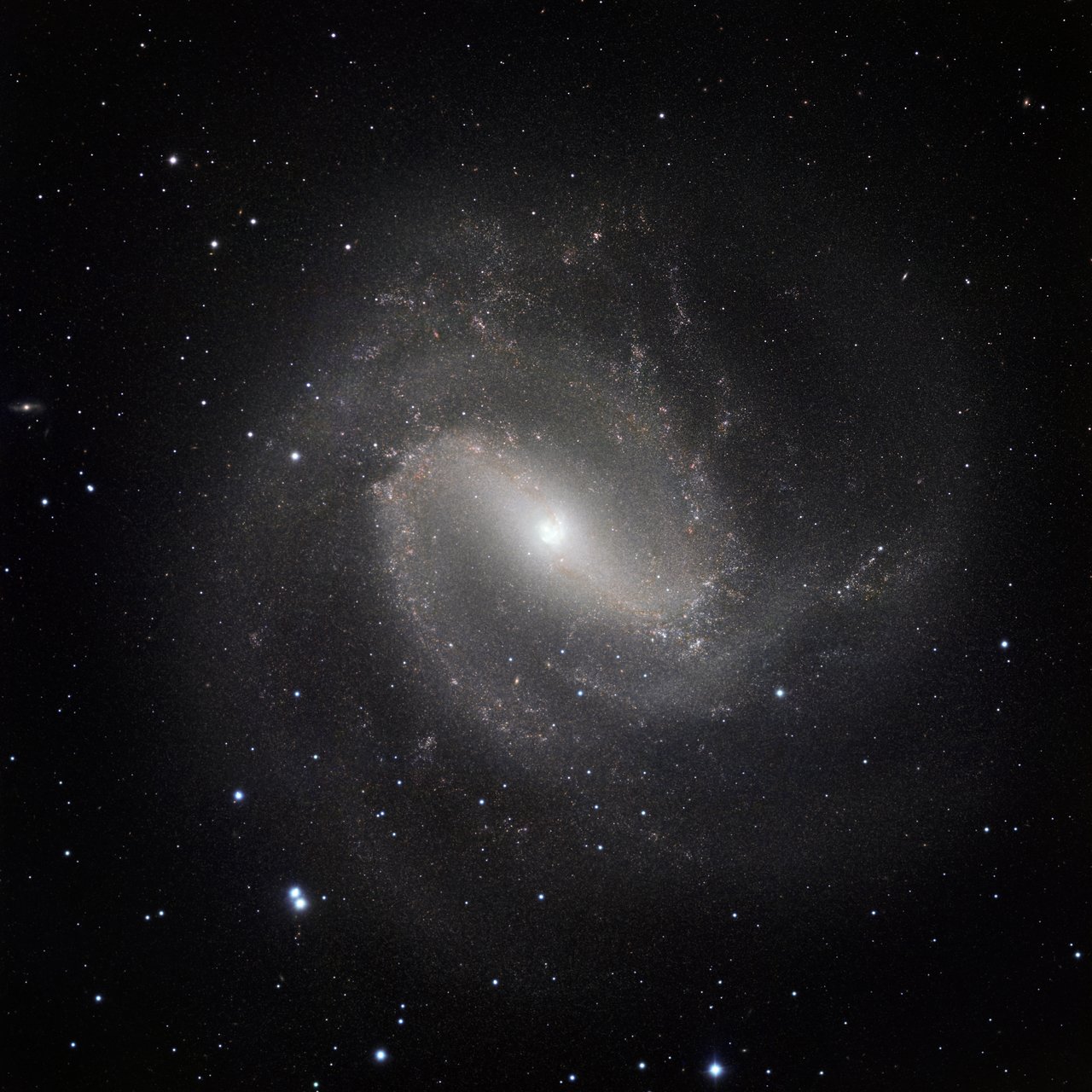
No, this dust is actually composed of complex organic molecules, and they are opaque to visible light. A cloud of dust a few light years across might as well be a concrete wall if you’re trying to look past it with a telescope. Whatever’s behind it is hidden.
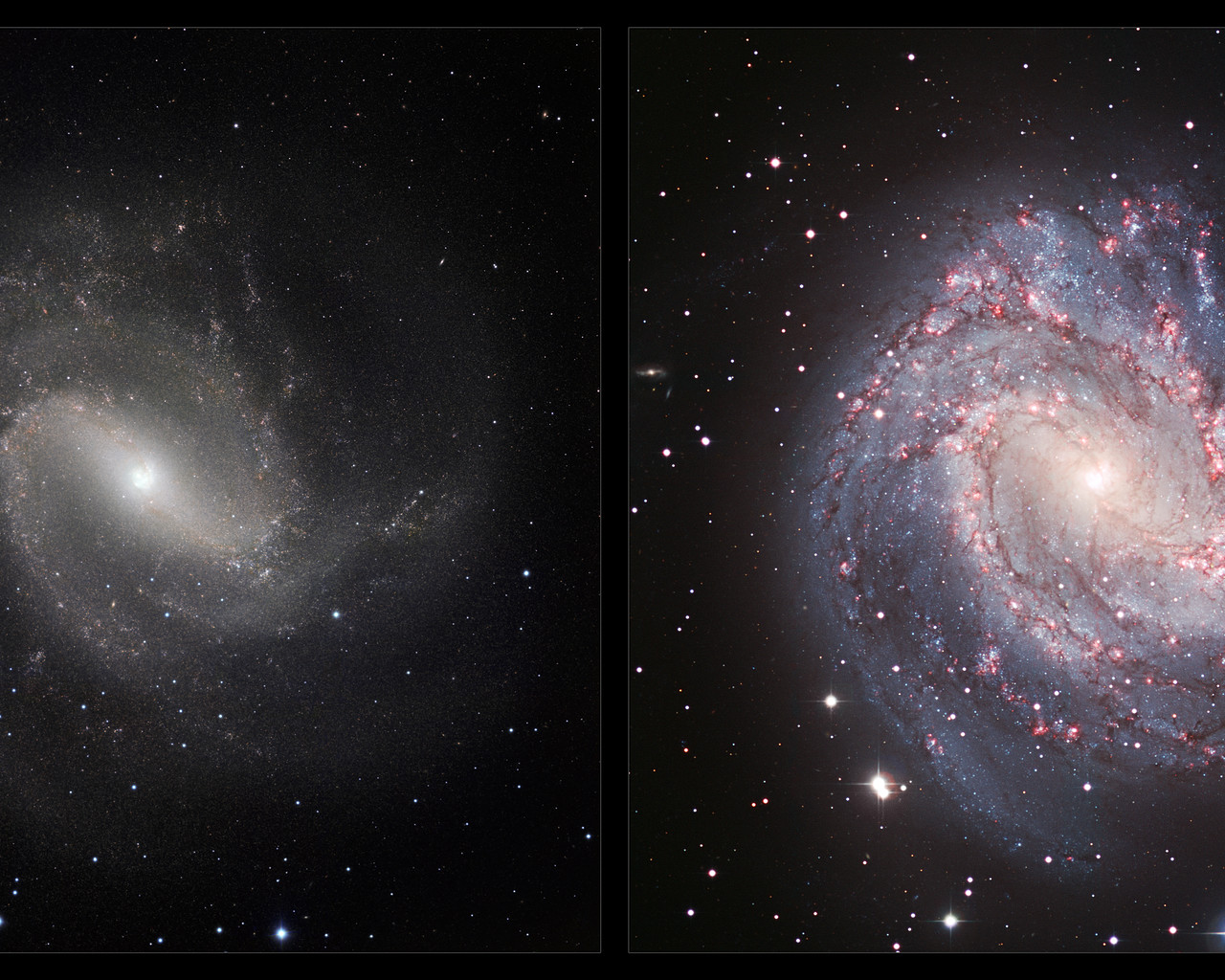
But infrared light has a longer wavelength than visible light, and it passes through that dust. So an image of a galaxy in IR can look a lot different than one taken in visible light. When I first saw the picture above, I didn’t even recognize the galaxy! Mind you, I am a vastly huge astronomy dork, and can recognize dozens of galaxies at a glance (that would sound like bragging if the topic were any different). So to be stumped, even for a moment, when seeing such a picture is disturbing. Here’s a side-by-side shot to show you the difference:
[Again, click to enspiralate, and to get much huger pix.]
See why I was confused? They look pretty different, and not just due to the colors. In the visible light image on the right, the spiral arms are lit up by really hot stars (some many times hotter than the Sun), and the glowy pink and red parts are clouds of gas where stars are being born. The hydrogen in the clouds gets heated up (astronomers call that being “excited”, a gentle reminder that we’re dorks) and emits a lot of light, making them very showy and obvious. Those regions are punctuated by long streamers of darkness, the dust clouds scattered along the arms. They are essentially gone from the IR image on the left! The star forming regions are hard to see as well; they don’t emit nearly as much IR as visible light, so they fade into the background.
I’ll note that just because these images are in the infrared doesn’t mean they’re tracking heat; at least, not like what you normally think of when you think “infrared”. A lot of folks equate IR with heat, but that’s not really the case. When you see images from a thermal camera (like in those awful ghost hunting shows) those are way way farther out than what your eye sees, like at 10 – 20 microns. Objects at human body temperature glow at those wavelengths. The picture of M83 was at 2.2 microns, which is where objects at about 1000°C (1800° F) glow. So in a sense we’re still seeing heat, but from objects much hotter than even an oven set to broil — this IR light is from red stars, like giants and supergiants near the ends of their lives.
Looking in the IR tells us a lot about galaxies, more than we’d know otherwise just looking in the visible part of the spectrum. And while the image from the VLT is pretty cool, I have to admit I like the one in visible light better aesthetically. It’s prettier. And it just goes to show you: we need our dark side. It provides contrast against which to see our warmer side.
Image credits: ESO/M. Gieles. Acknowledgment: Mischa Schirmer
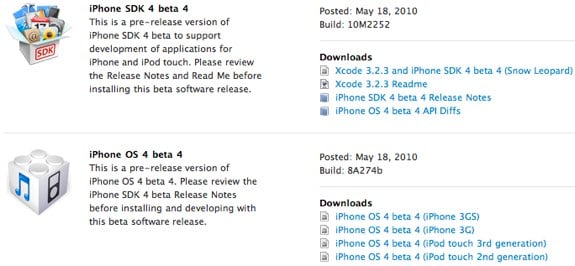
For all you iPhone and iPad devs out there, you can now head on over to the iPhone Developer Portal to grab iPhone OS 4 beta 4, which Apple just released, alongside beta 4 of the SDK. The software build is 8A274b, while the SDK build is 10M2252. Apple is right on time, continuing to deliver iPhone OS 4.0 betas about two weeks apart from each other, every other Tuesday. It should drop down to weekly releases sometime soon here, what with the iPhone Pro rumored to make its debut sometime next month.
Tags:
10m2252,
apple,
ipad,
iphone,
iphone dev center,
iphone os,
iphone os 4.0,
iphone os 4.0 beta,
iphone os 4.0 beta 4,
iphone os 4.0 sdk,
iphone sdk,
software. 8a274b,
Senate Bill No. 1 was vetoed by Gov. M. Jodi Rell today.
The bill, which was pushed heavily by Senate President Pro Tem Donald Williams Jr., D-Brooklyn, would have taxed bonuses received by workers at banks that got federal bailout money under TARP, the Troubled Asset Relief Program. The 8.97 percent temporary tax would have applied to those who received more than $1 million.
The bill would have also suspended the business entity tax for two years for businesses with at least one employee and a net income of under $50,000.
Democrats said revenue from the tax on TARP bonuses would have made up for money lost by suspending the business entity tax. Suspending the entity tax would have helped 46,000 Connecticut businesses, they said.
The legislature’s non-partisan Office of Fiscal Analysis has said that taxing TARP bonuses would bring in only $2.7 million to $4.8 million, altogether, in fiscal years 2010-2011 and 2011-2012. It estimates that fewer than 100 employees in Connecticut will receive qualifying bonuses over the next two years.
Rell said in a prepared statement Tuesday that she agrees that the TARP bonuses are inappropriate, but said that the bill would have triggered an automatic deficit and a long, costly and potentially unwinnable legal battle.
“However well-intentioned, I cannot sign into law a bill that creates an instant budget deficit,” Rell said. “And while–like many people–I am outraged that any business that took a federal bailout would be paying out big bonuses to its executives, the law does not permit us to target individuals with punitive taxes. Many legal experts have warned that this legislation would certainly be challenged as exactly that.”
Williams said Tuesday he was disappointed that Rell vetoed Senate Bill No. 1.
“Small businesses account for the vast majority of new jobs in Connecticut and this initiative would have offered help where it is needed most,” he said. “Our plan to compensate for the tax cut by implementing a temporary surcharge on large Wall Street bank bonuses was fair and legally sound. Unfortunately Republicans have been determined to protect these Wall Street bonuses–their legal argument is simply a smokescreen.”


