Category: News

  • Oil Spill in Gulf Could Wash Ashore by Friday, Officials

    The oil spill resulting from an oil rig explosion last week could be leaking oil at five times the rate previously assumed.

    The leaking BP PLC-owned rig may be spilling into the Gulf of Mexico five times faster than previously thought, the BBC reports.

    On Wednesday crews working on cleanup and damage control conducted controlled burns of the spill, said a Coast Guard spokesman, according to the New York Times. The leaks were discovered late last week after an oil rig exploded days earlier about 50 miles southeast of Venice, Louisiana.

    While it was thought that the damaged rig was leaking about 42,000 gallons of oil per day, the National Oceanic and Atmospheric Administration weather predicts the oil is spreading faster and might reach the U.S. coast by Friday night. The spill is now leaking at a record rate of 210,000 gallons per day and might.

    “Probably the only thing comparable to this is the Kuwait,” Mike Miller, head of Canadian oil well fire-fighting company Safety Boss, told the BBC. “The Exxon Valdez is going to pale in comparison to this as it goes on.” In 1989, the Exxon Valdez oil spill released approximately 11 million gallons into Alaska’s Prince William Sound.

    “If some of the weather conditions continue, the Delta area is at risk,” said Charlie Henry, scientific support coordinator for the National Oceanic and Atmospheric Administration, according to the New York Times.

    And as experts speculate what will happen, the oil slick is moving towards three million acres of Louisiana wetlands and the Mississippi Delta. Louisiana is home to about 40 percent of the United States’ wetlands, and exposure to the contamination could devastate wildlife populations in the area.

    Because BP was leasing the rig when it exploded, the U.S. government has said the corporation is responsible for costs of cleaning up the spill. Currently the company, which is the third largest global energy business, is spending $6 million per day to control the spill and looking at ways to stop the leak, including eventually sealing off the well.

    Meanwhile BP has received permission to drill a relief well in which concrete and heavy fluids could be injected to seal off the leaking well, but this process may take up to 90 days to complete.

    Sources: The New York Times and BBC

  • Actual Analysis: NPD’s Ross Rubin on the formula for making HP + Palm work

    By Scott M. Fulton, III, Betanews

    Banner: Analysis

    For the record, the connection between Hewlett-Packard and Palm, Inc. was not something most of us saw coming, and which very few reputable observers of this industry bet their reputations on.

    In retrospect, one sees now some of the obvious connections we missed then: the fact that Todd Bradley, now chief of HP’s Personal Systems Group, was Jon Rubinstein’s predecessor as CEO of Palm; the fact that HP’s smartphone market share fell last year to below one hundredth of one percent, and yet Bradley was still charged with the task of devising an instant comeback; and the fact that HP’s latest iPaq, announced last December (pictured below) bears so little distinction from a BlackBerry Curve, Samsung BlackJack, or Motorola Q that it may as well be called the “Me2.”

    The HP iPaq Glisten smartphoneBut waving in front of HP’s obvious red flags were several more obvious white ones:

    • Since Mark Hurd took over as CEO, the company has dramatically cut costs, with an emphasis on streamlining operations.
    • While it’s nice to experiment with product categories outside one’s typical bailiwick, HP’s last go-round — its 2006 acquisition of high-class custom computer maker VooDoo PC — resulted in that division’s productivity declining to around that of iPaq.
    • With margins falling in the one-time-goldmine printer (and printing ink) business, the company’s wrestling with a complete makeover of its second most important consumer-facing brand, possibly merging it with the Personal Systems Group (PSG) division that handles PCs.
    • HP’s growth divisions today are services and enterprise technologies, especially now that it’s acquired EDS, and now that it’s championing Dell on almost every front.
    • Finally, the cash-tight HP is already paying almost $3 billion for 3Com, the network technology pioneer that — so ironically now — became Palm’s parent company in 1997 through its acquisition of USRobotics, and then spent six years (1999 – 2005) spinning it off into a separate entity, in such a costly venture that 3Com became ripe for a buyout by HP.

    So HP buying Palm? Nah. No way.

    Anyone listening in yesterday to HP’s hastily arranged analysts’ call might have gotten the impression that just 24 hours earlier, HP execs would have said exactly the same thing — even former Palm CEO Bradley. When asked repeatedly how they plan to make this marriage work, Bradley and VP for Investor Relations Jim Burns indicated they may not actually know the answer to that for several months.

    Veteran smartphone business observer and NPD Executive Director of Industry Analysis Ross Rubin — whose insight is not only 20/20 but often 360 degrees as well — sees some of the coefficients, if not yet the entire formula, for sealing the deal. In an interview with Betanews yesterday, Rubin pointed out the synergies that could make the deal work…provided Palm transforms itself into yet another new kind of brand for an untapped market. Again.

    NPD Executive Director of Industry Analysis Ross RubinIndeed, last week, Rubin was talking with us about the synergies that could make Lenovo + Palm work. “At least some of the factors that we discussed for Lenovo apply to HP,” Rubin told us late yesterday. “So there are all those opportunities to gain entrance into the carrier channel, to beef up what had been a modest smartphone portfolio business, and to gain access to an operating system that can be used on a broader range of devices, including tablets and smartbooks — which HP has either already launched or shown publicly. So all of that holds true.

    “There are some additional synergies between the two companies. Palm is doing quite a bit in terms of cloud backup and cloud services, which of course is an important business for HP. And HP has world-class R&D, global reach, and financial resources. On the conference call, Todd Bradley said that HP will invest heavily, both in the R&D and sales and marketing for Palm.”

    Usually an acquisition target does not announce a revenue shortfall on the morning that the deal is to be done. Palm did, in a move that by noon led veteran observers to believe that any deal — with Lenovo, Huawei, Wal-Mart, anyone — was off the table. Did HP really come up with a miracle solution for Palm in just minutes?

    “When you’re dealing with companies like HP, there has to be some thought given beyond the current quarter,” responded Rubin. “This is certainly an acquisition that is not income positive for HP in the short term.”

    Bradley and Burns did indicate that HP would have to spend more on R&D in the coming months than Palm is spending today. On Bradley’s side, Rubin pointed out, is his experience with just this kind of turnaround: He was credited with picking up the pieces of the otherwise disastrous HP + Compaq buyout, and making that formula work as well. But in so doing, iPaq appeared de-emphasized.

    This is where Ross Rubin perceives an opportunity for Palm to actually help out HP rather than the other way around: giving it retail prominence in markets the iPaq could not crack.

    “PCs aren’t smartphones; on the one hand, they are different channels. HP has developed great expertise in retail distribution,” he reminded us. “That may be more important for smartphones and other kinds of devices powered by webOS moving forward, but it’s certainly a different channel from the carrier channel. The Palm business gives them complementary distribution at the carriers where they haven’t seen a lot of business in the past.”

    Next: The potential of HP + Palm + Microsoft…

    The potential of HP + Palm + Microsoft

    Anyone who thinks HP hasn’t managed, or cannot manage, a software platform on its own has forgotten — or is wholly ignorant of — HP’s success as the master of HP-UX, which makes it the “Face of UNIX” for a big chunk of enterprise customers. When HP uses the single word “Scale” to describe the benefits it can offer Palm, that’s the scale it’s talking about.
    Not a lot of consumers know (or care) about HP-UX. “However, we have seen HP move to try to differentiate its products from other PCs running Windows by doing things such as developing the TouchSmart layer for its all-in-ones, and some of its touchscreen notebooks,” noted Rubin, in his talk yesterday with Betanews. “Perhaps, particularly faced with the prospect of having limited control over the user interface in Windows Phone 7, having access to webOS allows [HP] to define the customer experience a lot better than licensing another operating system might.”

    Wouldn’t HP have had that same opportunity if it had proceeded with what many expected it to do anyway: produce a line of Android phones? “Certainly Android has a lot of momentum in the marketplace right now,” Rubin responded. “There’s one liability with Android: Google has made some moves that might cause a major global company like HP to have some concerns, such as the relationship with the Chinese government, for example, or competing with its own partners as it has with the Nexus One.

    Since neither HP nor anyone else appears to know precisely what its Palm roadmap for the future looks like, it’s fair to say that, at least today, nothing precludes it from continuing to produce the same iPaq phones it was planning to produce anyway — continuing to support Windows Mobile 6.5, or maybe even making that Android phone, despite the risks. This doesn’t have to be bad news for Microsoft, which some may have prematurely perceived as having lost another smartphone partner (after Motorola) to a competitive platform.
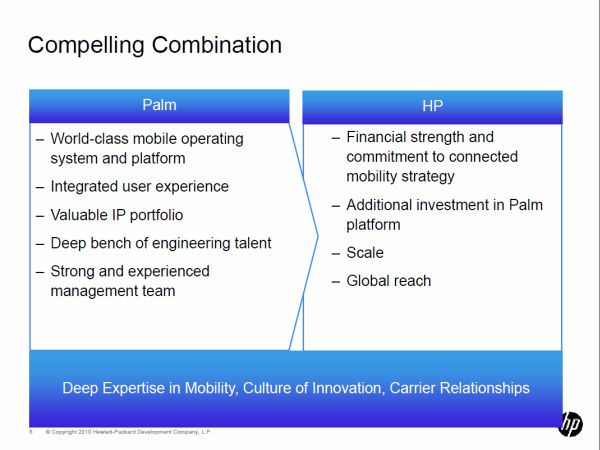
    The formula HP perceives for its synergies with Palm, from an investors presentation April 28, 2010.

    The formula HP perceives for its synergies with Palm, from an investors presentation April 28, 2010.


    This is where NPD’s Ross Rubin perceives a potential opening for Palm and Microsoft, which have partnered before — at the time, rather successfully. Although that partnership began soon after Todd Bradley left Palm, HP’s existing close ties to Microsoft certainly don’t preclude the possibility of HP’s bringing Microsoft back into the Palm picture.

    How could it do that without kicking webOS aside? As Ross Rubin reminded us, Microsoft can make deals, and has made several already, with smartphone makers without binding them to Windows Phone 7.

    “HP has a massive enterprise business, and it’s very strong in several verticals in those industries. That’s part of what is going to drive demand for some of these new kinds of devices. Todd Bradley said a lot of these devices are very product categories, and it remains to be seen how they’ll grow. But while BlackBerry certainly is very strong in the enterprise today…the Exchange group at Microsoft is willing to partner with handset makers other than those using Windows Phone 7 to compete with RIM. A great example of that is the partnership that Microsoft and Nokia have struck — obviously, Nokia not using Microsoft’s operating system in its phones, but using the Exchange ActiveSync architecture. Apple, of course, [is] using Exchange ActiveSync; and Palm today is using it. So BlackBerry very much remains in the crosshairs of Microsoft for a couple of reasons.”

    Extending Exchange ActiveSync technology to webOS would expand Microsoft’s service presence to yet another platform. And services are where platform makers cash in; typically, native platforms are mechanisms for funneling customers to native services (see: iTunes), but if other platforms provide the same funnels, that’s fine, too.

    As HP execs conceded yesterday, they hadn’t really thought about building up services for Palm — for instance, a competitor to iTunes, or to BlackBerry’s enterprise e-mail. With Microsoft’s help, it wouldn’t have to — it could fill in the gaps necessary to make Palm competitive in the enterprise, so that its device offering won’t look as limp and lifeless as the iPaq “Glisten.” If HP can deploy ActiveSync e-mail, and implement a portal to something similar to Microsoft’s Live mobile services, on the webOS cloud platform it’s acquiring from Palm, perhaps with portals to Office apps and Zune.net…everybody’s happy all of a sudden.

    …Okay, okay, maybe we should have seen this coming.

    Copyright Betanews, Inc. 2010


    Add to digg
    Add to Google
    Add to Slashdot
    Add to Twitter
    Add to del.icio.us
    Add to Facebook
    Add to Technorati


  • Mobile Ad Firm Mojiva Gets $7 Million Second VC Round


    Mobile Money Transfer

    Suddenly, there’s a flurry of mobile advertising platform activity. The latest on the pile – Mojiva has landed a $7 million second venture funding round.

    The money will go toward global expansion for its Mobile Ad Serving Technology ad serving platform and its display ad network, the company says.

    The round is led by UV Partners but also comes from Bertelsmann Digital Media Investments, the German media company’s VC wing, which stumped up the bulk of Mojiva’s £3 million first round in 2008.

    Mojiva actually spun off ad serving operations in to a separate subsidiary, mOcean, recently.

    Mojiva claims to reach more than 41 million unique users a month. The company’s main product, its “Self Service Ad Delivery Tooklit” is targeted at advertisers who want to create and manage their own mobile campaigns, and publishers who want to monetize their mobile content through ads on their websites or apps. Mojiva also provides white label versions of its toolkit to ad agencies.


  • A Discussion with Frank Sander about the Multi-Door Courthouse

    As a collaboration between UST School of Law and the Program on Negotiation at Harvard Law School, the following is the transcript of a conversation between the creator of the multi-door courthouse, Harvard Law Professor Frank E.A. Sander, and the executive director and founder of the University of St. Thomas (UST) International ADR [Alternative Dispute Resolution] Research Network, Professor Mariana Hernandez Crespo.

    The UST International ADR Research Network is a research program designed to create inclusive problem-solving models that utilize social capital and consensus-building techniques (i.e., dispute-resolution processes that include the voices of all stakeholders, especially the disenfranchised members of a community). In a pilot project in Brazil, participants examined the different options available to maximize the dispute-resolution process, including the multi-door courthouse conceived by Frank Sander. The multi-door courthouse is an innovative institution that routes incoming court cases to the most appropriate methods of dispute resolution, which saves time and money for both the courts and the participants or litigants. In our Brazilian pilot project, participants met in a virtual forum following the consensus-building methodology designed by Professor Lawrence Susskind of MIT and Harvard Law School. The project was implemented under the direction of Professor Hernandez Crespo, together with a team of Brazilians, global experts and collaborators.

    Click here to dowload the full article.

  • Verizon’s Droid Incredible commercial shows specs, doesn’t show phone

    It’s Verizon’s first commercial for the Droid Incredible. Impressive. Most impressive. [YouTube link]

  • Cape Wind is New Source of U.S. Renewable Energy

    By John Addison (4/29/10)

    The United States now has a new source of clean electricity for homes, buildings, and industrial stationary power and also for the growing use of electricity in rail and electric cars. Wind power is especially available at night when we hope to eventually charge millions of vehicles.

    Global wind energy capacity is increasing by 160% over the coming five years from 155 GW to 409 GW, according to the annual industry forecast presented by the Global Wind Energy Council (GWEC). A growing part of the renewable energy (RE) mix is off-shore wind, popular in Europe for 20 years, but stopped in the U.S. by not-in-my-backyard opposition, or more accurately “not in the view of my expensive ocean front property.”

    Secretary of the Interior Ken Salazar showed political courage on April 28 by approving the Cape Wind renewable energy project on federal submerged lands in Nantucket Sound. He will require the developer of the $1 billion wind farm to agree to additional binding measures to minimize the potential adverse impacts of construction and operation of the facility. Salazar said,” With this decision we are beginning a new direction in our Nation’s energy future, ushering in America’s first offshore wind energy facility and opening a new chapter in the history of this region.”

    The project is a big win for Siemens who will supply 130 3.6 MW towers, outbidding GE, Vestas, and other competitors. Siemens has already sold over 1,000 of these large off-shore turbines. The Cape Wind facility will generate a maximum electric output of 468 megawatts with an average anticipated output of 182 megawatts. At average expected production, Cape Wind could produce enough energy to power more than 200,000 homes in Massachusetts, or charge 200,000 electric cars.

    One-fifth of the offshore wind energy potential of the East Coast is located off the New England coast and Nantucket Sound receives strong, steady Atlantic winds year round. The project includes a 66.5-mile buried submarine transmission cable system, an electric service platform and two 115-kilovolt lines connecting to the mainland power grid. The project would create several hundred construction jobs and be one of the largest greenhouse gas reduction initiatives in the nation, cutting carbon dioxide emissions from conventional power plants by 700,000 tons annually.

    Over one GW of off-shore wind is proposed for other Eastern coastal states, eager to catch-up with the renewable energy use of Western and Central states. For example, due to California’s abundance of wind, solar, and geothermal power, my California utility does not use coal.
    To overcome years of opposition, the number of turbines at Cape Wind has been reduced from 170 to 130, minimizing the visibility of turbines from the Kennedy Compound National Historic Landmark; reconfiguring the array to move it farther away from Nantucket Island; and reducing its breadth to mitigate visibility from the Nantucket Historic District. Translation is that from shore it will take Superman vision to notice the wind turbines 5.2 miles from the mainland shoreline, 13.8 miles from Nantucket Island and 9 miles from Martha’s Vineyard.

    A number of tall structures, including broadcast towers, cellular base station towers, local public safety communications towers and towers for industrial and business uses are already located around the area. Three submarine transmission cable systems already traverse the seabed to connect mainland energy sources to Martha’s Vineyard and Nantucket Island.

    “After almost a decade of exhaustive study and analyses, I believe that this undertaking can be developed responsibly and with consideration to the historic and cultural resources in the project area,” Salazar said. “Impacts to the historic properties can and will be minimized and mitigated and we will ensure that cultural resources will not be harmed or destroyed during the construction, maintenance, and decommissioning of the project.”
    Renewable Energy Reports and Articles

    By John Addison, Publisher of the Clean Fleet Report and conference speaker.

  • Steve Jobs: Why Flash sucks

    By Tim Conneally, Betanews

    Today, just as Adobe released a preview of Flash Player for Mac OS X that features H.264 video decoding, Apple CEO Steve Jobs released a letter called “Thoughts on Flash,” which explains the many reasons why there’s no Flash support on any of Apple’s mobile devices, and why H.264 is a better format.

    The letter is emblematic of Apple’s increasingly verbal approach to the frantically interested but highly misunderstanding public: “Adobe has characterized our decision as being primarily business driven — they say we want to protect our App Store — but in reality it is based on technology issues. Adobe claims that we are a closed system, and that Flash is open, but in fact the opposite is true. Let me explain.”

    Jobs then explains in very plain detail six different reasons why Flash is a technological weakness in Apple’s mobile realm. Those reasons may be broken down into very simple bullet points:

    • Flash is a closed, Adobe-controlled system.
    • H.264 is a “more modern format” for Web video
    • Flash would make iPhones, iPods, and iPads less reliable.
    • H.264 video consumes about half as much battery as Flash video.
    • Flash was not designed for touch interfaces.
    • Flash is cross-platform and not Apple optimized.

    Apple has made these points in the past, just not as a single list straight from the CEO’s own pen.

    Steve Jobs -- iAdJobs concludes his letter by saying, “Flash was created during the PC era — for PCs and mice. Flash is a successful business for Adobe, and we can understand why they want to push it beyond PCs. But the mobile era is about low power devices, touch interfaces and open Web standards — all areas where Flash falls short…New open standards created in the mobile era, such as HTML 5, will win on mobile devices (and PCs too). Perhaps Adobe should focus more on creating great HTML 5 tools for the future, and less on criticizing Apple for leaving the past behind.”

    Don’t be misled, this letter was written with the consumer in mind (specifically, the ones who read the New York Times interview with Google’s Andy Rubin this week.)

    In his interview with the paper, Rubin made a powerful statement about Android and Flash: “[Being open] means not being militant about the things consumers are actually enjoying.”

    Because Google’s Android operating system will offer full Flash 10.1 support in the “Froyo” (2.2) release, Rubin simply said Google is giving people what they want.

    Jobs’ letter, by contrast, is telling the public that “what they want” may not be the best for the iPhone.

    Copyright Betanews, Inc. 2010


    Add to digg
    Add to Google
    Add to Slashdot
    Add to Twitter
    Add to del.icio.us
    Add to Facebook
    Add to Technorati


  • The Huge Economic Policy Error Behind The Current Stock Market Rally

    bernanke bloomberg paulson schumer(This is a guest post from the author’s blog.)

    “The 20th century has been characterized by three developments of great political importance: The growth of democracy, the growth of corporate power, and the growth of corporate propaganda as a means of protecting corporate power against democracy.” Alex Carey

    The strategy of the Bernanke Federal Reserve and of the Obama Administration’s economic team is fairly clear: prevent the bank failures of the 1930’s by propping up the biggest banks with huge infusions of publicly subsidized capital, and hope that they start lending again as the economy recovers. It is a variation of the ‘trickle down’ theory of economics applied to the perceived policy errors of the first Great Depression.

    Bernanke is famously a student of that economic event, even as General Joffre, the architect of the Ligne Maginot, was a student of the first World War. And Larry Summers seems remarkably similar to Marshal Pétain. Timmy is a student of nothing, not even of the tax code he adminsters apparently, except perhaps the art of the useful manservant, a valet.

    Failure number one of course is that the banks that they chose to support are not responsible banks engaged primarily in lending to small business and localized activity. Those banks are the local and regional banks and they are failing in record numbers. The banks they chose to save are those who have heavily contributed to the campaign coffers and job prospects of Washington politicians. Goldman Sachs, for example, is a glorified hedge fund dedicated to speculation and enormous amounts of leverage. One only has to look at the source of their profits to understand what it is that they do.

    Bernanke has (so he thinks) cleverly tied up much of the liquidity with which he has infused the banks as reserves which are paying riskless returns thanks to his innovation in sustained a floor under the ZIRP. But if you look at what he is doing, all Bernanke has done, even in his buying a trillion dollars of bad mortgage debt, is rescue creditors who engaged in reckless speculation during a housing mania that the Greenspan Federal Reserve had fostered.

    The lack of productive investment and genuine stimulus for the real economy is appalling. Bernanke and his colleagues Larry Summers and Tim Geithner would have us believe that they had no choice. But informed and experienced commentators such as William K. Black have told us how they have misrepresented their choices. Their current path seems to lead to a ‘zombie economy’ at best, in which the Banks are doing well, but almost everyone else suffers, particularly the lower and middle classes who obtain their income from the real economy. At worst, the bubble bursts again, and there is another leg down, with greater damage done.

    So what would have worked? The Fed and Treasury could have backed the public instead of the banks. They could have temporarily increased and extended the FDIC coverage to much higher levels to guard against further bank runs, and then started dismantling the Wall Street banks through orderly liquidations. They needed no new laws or tools to do this. And financial reform and higher taxes on those who obtain outsized wealth without productive work would have curtailed a recurrence.

    So why did they do what they did? Are they in league with the banks? Was this some sort of conspiracy? No, I doubt this, although there are far too many secretive aspects to completely dismiss it.

    None of these men have ever held a real economy productive job in their entire lives. They were always the pampered products of the academy, Wall Street, and the government.

    So they took care of their own, because that is their world view. It has been said that the Federal Reserve is the worst place to locate certain aspects of banking regulation, because they have a complete aversion to ever allowing a bank to fail. It runs against their nature. And couple this with a career experience in which the world is viewed through the lens of cost plus management, and privileged power, and their inability to make the tough decisions seems more understandable.

    And the promise of future positions, and large amounts of lobbying money to their friends and mentors and sponsors, and the policy error that is ruining the country seems more understandable.

    So now we have another asset bubble in the making, a new Ponzi scheme in the US equity market fomented by the Wall Street Banks packed with public funds, seeking to drive prices higher, for the apparent reason of obtaining confidence from the public, but with the effect of selling assets at inflated prices to public institutions yet again, with the inevitable collapse to follow when the reality of their value is discovered.

    What a shame. What a disappointing performance for a reform government that promised change that the people could believe in.

    “…surveys show that the usual investors in major rallies – pension funds, hedge funds and retail investors – have not been net buyers of equities. And he says the most likely explanation for this anomaly in the biggest stock market rally since the 1930s is that major investment banks are the anxious buyers.

    “Their buying would appear to be for one of two reasons. Firstly because they think the authorities will prevail in their (so far unsuccessful) efforts to inflate their way out of debt liquidation; or secondly because they are too big to fail and so can afford to take a huge gamble that enough buying will convince others to rush in and buy their inventory of risk assets at even higher prices.”

    Financial Times, Equity Rally Not Driven by the Usual Investors, Financial Times, April 28

    And it should be noted that the Wall Street demimonde, the financial media, the financial commentators regulators and legislators, are widely supportive of this, because they draw they pay and employment prospects from an enlarged financial sector. So they are natural enthusiasts.

    And of course there is the mainstream media, which is generally silent, or simply pleads confusion and ignorance, when things financial are discussed out of deference to their corporate owners, and the difficulties of actually engaging in investigative journalism, rather than acting as a guest host to a competitive debate among lobbyists and ideologues. It is the path of least resistance, and greatest returns. And it leads to an economy that consists of little else besides usury, propaganda, and fraud.

    Why be negative? Better to be playing safe while the New Rome burns.

    Join the conversation about this story »

  • Hydrogen Safety Sensors Top Priority for NREL

    In April 2010, I talked about how the Society of Automotive Engineers (SAE) had developed a set of safety standards for hydrogen refueling stations. Way back in October 2006, I had talked about how commercial gas company Linde was adding an odor to their hydrogen gas at fueling stations (similar to natural gas) so that people would know if there was a leak.

    In January 2010, I talked about how government was struggling to catch up with emerging hydrogen technology as far as safety codes, standards and practices. Mike Strizki, who owns the first solar hydrogen home in New Jersey, found it maddening working with government regulators when he tried to go green with his house.

    Now, scientists and engineers at the National Renewable Energy Laboratory (NREL) have joined forces with Joint Research Centre (JRC) to analyze hydrogen sensor technology.

    Since hydrogen is colorless and odorless by nature, it has been challenging for researchers to come up with sensors that detect and warn of leaks. Linde decided to add odor to hydrogen, but injecting any impurities into hydrogen will also degrade fuel cells.

    So, NREL and JRC are independently testing commercial hydrogen sensors under predetermined protocols and then sharing the results with one another.

    According to William Buttner of NREL’s Hydrogen Technologies and Systems Center, “The first round of testing has been completed, and NREL and JRC have exchanged units for the second round of evaluations. By independently testing the same sensors, both labs gain insight into their respective systems, facilitating improved testing capabilities, protocols, and data analysis.”

    No matter whether it’s using hydrogen fuel inside of cars, at the pump or at the manufacturing plant, H2 sensors are a necessary component when it comes to safety of consumers and company employees. By testing hydrogen sensors using best practices, better safety protocols and requirements can be developed which will let both consumers and handlers breathe a little easier.

  • Sean Kingston Justin Bieber “Eenie Meenie” Music VIDEO

    It’s been nearly three years since Sean Kingston debuted on the music scene with his Summer 2007 smash hit, “Beautiful Girls.” Now the Jamaican-American reggae/hip hop singer is back — and working with cute-as-a-button Canadian heartthrob Justin Bieber. Sean and Justin are putting their voices together on “Eenie Meenie,” the first single off of Kingston’s upcoming third album. The track is also be featured on Justin’s Billboard No. 1 album, My World 2.0.


  • Louisiana shrimpers file lawsuit over U.S. oil spill

    by Agence France-Presse

    An oil spill or olive oil fate?Photo courtesy HeyRocker via FlickrNEW ORLEANS—Two Louisiana shrimpers have filed a lawsuit accusing the operators of the rig behind a Gulf of Mexico oil spill of negligence, seeking millions of dollars in damages.

    The lawsuit, filed in federal court late Wednesday, alleges that “the fire, explosion and resulting oil spill was caused by the joint negligence and fault” of the defendants, a copy of the document read.

    The shrimpers are seeking class-action status on behalf of “all Louisiana residents who live or work in, or derive income from,” the Louisiana coastal zone, and who have sustained damages as a result of the oil spill.

    Defendants in the suit include BP, Transocean, Cameron International, and Lloyds of London, Transocean’s insurers.

    Among other things the plaintiffs are seeking “economic and compensatory damages in amounts to be determined at trial, but not less than five million dollars,” the legal minimum, the document read.

    A BP executive on Thursday agreed with a U.S. government estimate that the oil leak in the Gulf of Mexico could be pumping up to 5,000 barrels a day of crude into the ocean, far more than previously thought.

    The Deepwater Horizon platform sank April 22, two days after a huge explosion that killed 11 workers, and a giant oil slick from the site threatens to pollute Louisiana’s fragile wetlands.

    Among other things, the lawsuit claims that the defendants failed to operate the oil rig properly; failed to properly inspect the rig “to assure that its equipment and personnel were fit for the intended purpose;” acted “in a careless and negligent manner without due regard for the safety of others;” failed to “react to danger signs;” and employed “untrained or poorly trained employees.”

    Furthermore, “the fire, explosion, sinking and resulting oil spill were caused by defective equipment,” and the defendants “knew or should have known of these defects and … are therefore liable for them.”

    Daniel Becnel, a Louisiana-based trial lawyer who filed the suit, saying that the plaintiffs “have a whistle blower on an adjoining rig saying 85 percent of the drilling pipe was not properly inspected” by the U.S. Minerals Management Service.

    “We knew that BP and Transocean, the owner of the Deepwater Horizon weren’t telling the truth,” said Becnel, a veteran industrial accident litigator.

    According to Becnel, the suit was filed “on behalf of all class members who have been adversely affected in Louisiana—fishers, shrimpers, oystermen, and others like … guides into the marshes.”

    Becnel also alleged that the oil slick could wreak havoc on U.S. shipping entering and leaving the Mississippi River.

    Coast Guard Rear Admiral Mary Landry, who is leading the government’s response to the disaster, warned that if the well is not secured the spill could end up being one of the worst in U.S. history.

    Related Links:

    The story of the Gulf of Mexico oil spill [SLIDESHOW]

    Gulf oil spill worse than expected, and getting worser

    The politics of the Gulf oil spill


  • Don’t Let Your Manicurist File Down Your Nerve Function

    Consumer Reports Health medical adviser Orly Avitzur, M.D. has both a medical practice and a lovely set of manicured nails. It’s this combination that gave her unique insight into the possible problems with manicures that are purportedly fancy “gel manicures,” but are actually something else more dangerous entirely.

    And there are plenty of other chemicals to be concerned about. A US Environmental Protection Agency guide, produced to warn nail salon workers, indicates twenty chemicals found in nail glue, polish, hardeners, additives, powders or removers. A medical literature search shows that, in general, several of them—ethyl cyanoacrylate, formalin, toluene, and MMA—have been shown to induce neuropathy and can cause one or more of the following: irritation of the eyes, skin, mucous membranes, respiratory tract, or damage the kidneys or liver.

    Ten warning signs to watch out for:

    • Your salon uses bottles in unmarked containers
    • The technician cannot tell you what’s in the products
    • The products smell unusually strong or have a strange odor
    • Your skin is being abraded or cut
    • The salon is not clean
    • The instruments are not sterilized
    • Licenses for the salon and individual operators are not visibly posted
    • Your skin or nails hurt
    • The gels do not soak off easily in solvents designed to remove acrylics
    • You see swelling, redness or other signs of infection

    Manicures: The price may be higher than it seems [Consumer Reports Health]

  • Terminator Cabaret [Art]

    The mic of Adam Gontier, lead singer of Three Days Grace. When the band inevitably splits for good, it will be destroyed in a molten pool of lava, thumbs up…or just auctioned on eBay for drugs. [Wired] More »


  • The Importance of Mobility: The Hips

    hipPeople are exceedingly mobile these days. We can jet halfway across the world at a moment’s notice, check email on our phones, hop in the car and be in another state in five hours, conduct business from anywhere, transfer schools, and shave while reading the paper on the morning commute. Social mobility, financial mobility, spatial mobility, information mobility. Mobile workforce, mobile phone, Google Mobile. Yeah, clearly, mobility is highly prized.

    What about joint mobility?

    Too many people discount, or even outright ignore, this crucial aspect of physical fitness. Raw strength, speed, and stamina are all important, especially to athletes or weekend warriors, but everyone of any age or fitness level needs the ability to move their limbs and joints through their full range of motion as ordained by nature. That goes for grandmothers, teens, and couch potatoes alike. Though not everyone will be picking up barbells or running sprints or long jumping, we all have to function in a three-dimensional world. We all have space and gravity with which to contend if we’re planning on enjoying and experiencing all life offers, and that’s accomplished by moving through spatiality and against gravity. To thrive in this environment, we require the full, unfettered use of our limbs, joints, and muscles. Losing the shoes is a big step; so is getting strong and fit. One of the biggest, in my opinion, is regaining and maintaining maximum joint mobility.

    “Regaining,” because we are born with joint mobility. Ever watch children play? They’re bendy, flexible little sprites with perfect squat and deadlift form. And they don’t need formal training to get there! Attainment of joint mobility, then, is regaining what was lost, not inventing something new.

    Regaining’s the easy part. You’ve got to maintain your mobility, too, or else you run the risk of misplacing it all over again. Once you learn the mobility exercises, it’s actually really pretty simple to maintain. People generally fail out of sheer forgetfulness or laziness. If you can incorporate mobility drills into your regular warm-ups or daily activities (or even institute them as standalone workouts), maintenance becomes second nature.

    Everyone has to pick up groceries, or walk up stairs, or perform any number of mundane tasks requiring the use of joints and limbs. If those joints and limbs are going to be useful, they have to be mobile. They need a full range of motion.

    And if you are an athlete, mobility is even more important. Strength without the ability to move your body and limbs fully and completely – without the ability to use your strength in the real world – is pointless. Strength development itself suffers without proper joint mobility. The strongest lifters are the ones who move weights (or just themselves) through the full range of motion using compound movements and utilizing healthy, active joints. If you have poor joint mobility, performing quality squats, deadlifts, presses – any compound movement that requires precision and communication between joints and limbs – it’s going to be that much harder, and the risk for injury that much higher.

    Power output and speed will be compromised with poor joint mobility. When you shoot a rubber band, the farther back you pull it, the more tension there is, and the farther it shoots. The greater your joint mobility, the greater your range of motion, and the more tension – and therefore power – you’ll be able to generate.

    Most importantly, maintaining adequate joint mobility keeps our joints healthy. Just as our bones and our muscle fibers require physical stimuli, like load-bearing activities, to maintain strength, density, and to initiate positive structural changes/adaptations, our joints require regular movement and usage to maintain health and mobility. Think of your joints as hinges to a door; if the door is never opened, never used, and subjected to steady environmental or elemental decay without reprieve, that hinge isn’t going to work well. It’s going to rust, and it’ll creak and groan if you’re even able to get it moving. Same thing goes for the sedentary office worker, the bodybuilder who only focuses on pecs and biceps, and the daytime TV watcher. Their joints aren’t being used to their full potential (if at all, in some cases), and their mobility will suffer. Like the Tinman in Oz, their joints will “rust” over and the simplest tasks will become difficult, almost Herculean in extreme cases (and in old age).

    Hip Mobility

    Our joints, limbs, and muscles represent a collective of individual pieces, all working together to move the body, manipulate objects, and propel us through three dimensional space. Mobility in all areas is crucial, but it helps to consider them in segments. After all, different people will have different levels of mobility in different areas of the body. Perhaps the most common mobility deficiency resides in the hips. In my own case, it was a lack of hip mobility that was the proximate cause of my downfall as a runner/triathlete. I basically “seized up” after fifteen years of overuse in a very limited plane of movement.

    People have forgotten (or don’t know) how to use their hips the way evolution designed them to be used. Instead of sitting back with their hips to pick something up, followed by a hip extension (thrust forward) to bring it up, they’ll bend at the waist and lift with the lower back. Picking up a potted plant? You can get away with poor hip mobility – for a while. Picking up a weighted barbell, a child or a bag of peat moss with poor hip mobility using your lower back? That’s an injury waiting to happen.

    We sit too much. I know I do, and it’s especially bad to do so right after working out (yet I still do it sometimes). Sitting impacts hip mobility in two major ways: it weakens the glutes and it shortens the hip flexors. Both your glutes and your hip flexors figure prominently in the activation of your hips, so when they’re weak and/or inactive, the lower back takes over. Now, the lower back, or the lumbar spine, isn’t designed for a ton of activity. It’s mainly there to provide support and stability. It’s the core, after all. But with poor hip mobility brought on by excessive sitting and a weak posterior chain, your hip extension is no longer sufficient, and in comes the lower back. That potted plant is beginning to look a little heavier, eh? And that’s not even mentioning the barbell.

    It’s a shame, because our hips are obviously designed to generate a ton of power. The ligaments, the tendons, the musculature, and the bones in that region are all dense, hardy, and robust – they’re made for activity and mobility – but too many people are selling their hips short. And when that happens, the other joints and muscles (like knees or lumbar spines) have to pick up the slack. It’s an adaptive mechanism that perhaps any multi-limbed animal possesses: the quick substitution for an injured limb/joint by an adjacent one. It’s not meant to be a lasting solution, though. We’re not meant to limp through life using one joint to do another’s prescribed task. It just doesn’t work, and it’s exactly why most people lift with their backs instead of their hips and then complain about back or knee pain.

    Restoring hip mobility will help in several areas. It should reduce or eliminate lower back and/or knee pain stemming from overcompensation. It should improve your power output by allowing you to fully engage your posterior chain in training exercises like squats, deadlifts, kettlebell swings, and any of the Olympic lifts, while making them safer. It should improve the strength and power of your hip extension, extremely vital for performance of the aforementioned lifts, but also for vertical leaps, sprinting, and any basic explosive movement. It will improve your rotational strength; instead of rotating with the lumbar spine (a huge no-no), you’ll generate power with the hips – perfect for throwing a good punch, swinging a golf club, or tossing a big rock at prey. It’ll improve speed, especially sprinting speed.

    Most of all, hip mobility will improve your relationship with the rest of your body. Because the hips are the most common sites of poor mobility, many people are walking around with dysfunctions borne of overcompensation. Fixing hip mobility won’t fix everything, but it will eliminate a major stressor on your system as a whole and allow you to focus on the smaller, but no less important, sites and joints.

    Tomorrow, I’ll discuss methods for regaining and maintaining hip mobility.

    Get Free Health Tips, Recipes and Workouts Delivered to Your Inbox

    Related posts:

    1. The Danger of Muscle Imbalances and the Importance of Symmetry
    2. The Importance of Cooking in the Evolution of the Human Brain
    3. The Importance of Blood Sugar Level

  • Iran Adds 3 Supertankers To Storage Fleet

    Iran Daily reports that the Iranians are increasing oil storage in super-tankers once again – Iran Adds 3 Supertankers To Storage Fleet.

    Iran, OPEC’s second-biggest oil producer, added three supertankers to its fleet of vessels storing crude, matching a similar program in 2008 that helped freight rates to triple, ship tracking data show.

    At least 15 such vessels are idling in the Persian Gulf, Gulf of Oman and Gulf of Suez, according to data from the ships collected by AISLive Ltd. The tankers can store a combined 30 million barrels of oil, more than a week of national output, Bloomberg reported.

    Two years ago, Iran used as many as 15 tankers for storage, constricting vessel supply and helping to more than triple freight rates in less than three months.

    Iran is likely storing oil because of weakening demand as refineries across Asia, accounting for almost two-thirds of global demand for supertankers, carry out maintenance. National Iranian Tanker Co., which operates the supertankers, also has a laden suezmax tanker idling off Iran, ship-tracking data show. A suezmax can hold about 1 million barrels of oil.

    “They don’t want to shut down their production,” said Ole-Rikard Hammer, an analyst at Pareto Securities ASA in Oslo who’s tracked tanker markets for more than two decades. “The refining clients are buying less because of maintenance and the Iranians seem to prefer to keep oil in floating storage.”

    The discount on Iran Heavy crude compared with Oman and Dubai petroleum is at its widest in more than a year, according to data compiled by Bloomberg. The discounts on Iran’s Forozan, Soroush and Norouz crudes have also widened.

    National Iranian Tanker has a fleet of 28 supertankers, according to Lloyd’s Register-Fairplay data on Bloomberg. The remaining 13 carriers are all either moving or have been at their present locations for less than two weeks, according to the tracking data.


  • App Deals: Get Select Glu Mobile Titles For a Steal

    Yes, folks, it’s that time again: time to get some great 3D gaming titles for a fraction of what they normally sell for.  This time around, Glu Mobile has put a few of its titles on sale:

    I don’t know about you all, but if these games keep going on sale like this, I’m going to quickly run out of storage space on my Pre! 

    Thanks to everyone that sent this in!

  • Chevrolet Sail hatchback

    Acaba de ser presentada en Pekín la versión hatchback del Chevrolet Sail. Esta versión ha sido diseñada por la división de Shangai de la propia Chevrolet.

    Sólo estará disponible con una motorización, un motor 4 cilindros 1.2i 16v S-Tec de 87 CV y 115 Nm de par máximo. El motor estará asociado a una caja de cambios manual de 5 velocidades. Toda la motorización está adapatada a la normativa Euro 4 de Europa.

    Este modelo tendrá un precio apróximado de 6.000€, precio que incluirá el equipamiento extra de seguridad (algo a tener muy encuenta).

    Related posts:

    1. Chevrolet Camaro Synergy Special Edition
    2. Chevrolet Agile en Latinoamérica
    3. Chevrolet Agile, vídeo promocional
  • Busy Hyundai reveals next Elantra at Busan show in Korea [w/video]

    Filed under: , , ,

    2011 Hyundai Elantra / Avante – Click above for high-res image gallery

    Hyundai has been very busy lately as it progresses through round two of its 24/7 product renewal program. Just days after unveiling the new Accent/Verna in Beijing, Hyundai has revealed its next generation Elantra/Avante at the Busan Motor Show in South Korea. Like the smaller Accent, the Elantra has picked up the “fluidic sculpture” styling cues of its big brother the Sonata. By virtue of its larger size, the Elantra retains more of the sleeker profile of the Sonata and doesn’t look as stubby as the Accent.

    Like the Sonata, the new Elantra gets a direct injected inline-four, in this case a 1.6-liter based on the Gamma engine family. For the Elantra the GDI 1.6 generates 138 horsepower and 123 pound-feet of torque. In combination with a new six-speed automatic transmission, the Elantra should get about 10 percent better fuel economy.

    The Avante will go on sale in South Korea in the second half of this year and we’d expect to see it state-side with Elantra badges early in 2011. No word yet on whether we will get a hybrid version of the new Elantra. High-res images below, official press release and video available after the jump. Thanks to everyone for the tips!

    [Source: Hyundai]

    Continue reading Busy Hyundai reveals next Elantra at Busan show in Korea [w/video]

    Busy Hyundai reveals next Elantra at Busan show in Korea [w/video] originally appeared on Autoblog on Thu, 29 Apr 2010 10:57:00 EST. Please see our terms for use of feeds.

    Permalink | Email this | Comments

  • How to Cook Steak in Your Beer Cooler | Discoblog

    After years of serving as your faithful companion to ball games and keeping the brewskies frosty at backyard barbecues, your trusty beer cooler now has a new assignment–cooking up a gourmet meal, sous-vide style. For those of you who don’t keep up with high-tech cookery, sous-vide is a method of cooking where food is heated for an extended period at relatively low temperatures. Unlike a slow cooker or Crock pot, the sous-vide process uses airtight plastic bags placed in hot water well below boiling point (usually around 140 Fahrenheit). The idea is to maintain the integrity and flavor of the food without overcooking it (but while still killing any bacteria that may be present). Normally, a sous-vide cooker like the Sous-Vide Supreme would set you back hundreds of dollars, but chef J. Kenzi Lopez-Alt shows us how to use a beer cooler to cook a perfect piece of meat. All you have to do is fill up your beer cooler with water a couple of degrees higher than the temperature you’d like to cook your food at (to account for temperature loss when you add cold food to it), seal your food in a simple plastic Ziplock bag, drop it in, and close …

  • Jennifer Lopez “On The Radio” AUDIO [Donna Summer Cover]

    Have you heard Jennifer Lopez’s newest track, “On The Radio?” Jenny From The Block and French super producer David Guetta give a modern day facelift to disco diva Donna Summer’s 1979 hit on the uptempo club hit.


    Rock It or Drop It?

    Earlier this year, Guetta released “Acapella,” a similarly-designed techno-dance-infused single for R&B golddigger Kelis. Although I’m not a huge fan of JLo’s singing voice (which I sometimes liken to a cluster of cats clawing at a chalkboard), I adore Donna Summer and I love dance anthems, so I’ll definitely be adding this one to my iPod.