Category: News

  • Fear Is Cheap

    Fear gives intelligence to fools, says an old proverb. Turning it around a bit, we might say that lack of fear makes fools of wise men.

    In the market, fear – or lack of same – finds expression in many forms. The Volatility Index, or VIX, is one of them. Known as the “fear gauge,” the VIX bounces up and down based on what people are paying for options on the S&P 500.

    For example, if people are fearful, they tend to buy put options. Put options are like insurance against a fall in price. They pay off if the market falls. When investors pile into put options, they make the price of such options rise, and that pushes the VIX up, too.

    Conversely, when people are not worried, they sell those options – or at least they don’t buy them. So the price falls, and so does the VIX. There has been a lot of that going on in the last year. The VIX recently hit its lowest point in 30 months, as shown by the nearby chart.

    VIX Spikes Above 20

    Fear looks cheap. Given all that is going on in the world, it is remarkable to find investors so complacent. The financial system is still a rather creaky affair. Leverage is still high. Banks remain undercapitalized. The credit cycle has not yet run its full course, as there are still significant credit losses hiding in the cupboards of banks.

    Then there are the governments of the world. The US has awful credit metrics. It is bleeding money and owes huge debts. Most of the 50 states are also bleeding money and have large debts, including giant gaps in unfunded pension liabilities. They are perhaps worse off, because unlike the US government, the states cannot print their own money. Then there is the EU. And Japan.

    There are only a few ways to cure such ills, and none are painless. One thing is for sure: These ills can’t go on forever.

    In the context of all this, fear looks cheap.

    Conveniently, Wall Street has made fear a tradable commodity. One way to play it is through the iPath S&P 500 VIX Short-Term Futures fund. Though a mouthful, it simply aims to mimic the VIX. It trades under the ticker VXX, and started trading only this year. It’s done horribly, as you would expect given the fall in the VIX.

    Yet it could be a nice play should we have another spike in the VIX. If fear should rear its head again, as it undoubtedly will, the VXX ought to prove nice insurance. More than just insurance, it could return three or four times your money, depending on the spike.

    Fear is cheap. Buy some before the price goes up.

    Chris Mayer
    for The Daily Reckoning Australia

    Similar Posts:

  • Mohammad El-Erian And Paul Krugman Both Wildly Gloomy About Spiraling Crisis In Greece

    mohamed el-erian pimco

    The market has been in full-on panic about Greece for awhile now — hence the parabolic spike in short-term rates — and now it seems the wise men of the market are fully on board.

    Felix Salmon points to new pieces from both Mohammad El-Erian and Paul Krugman, both of whom see nothing but bad news right now.

    El-Erian, in so many words, says Greece will default. Krugman is talking about the real possibility of unwinding the euro and ends his piece with: “I think I’ll go hide under the table now.”

    That’s some seriously gloomy language from arguably the most influential public economist in America.

    What’s amazing is that we seem to have a full-on financial crisis in Europe. Yes, Greece itself is small, but Portugal, Spain, and Italy are not small at all. And the the interconnected European banking system isn’t small, and yet for the most part, domestic markets in the US don’t seem all the concerned, which is pretty astounding.

    Meanwhile, the New York Times has a good piece on the political pressures mounting on Angela Merkel. The world wants her to act, but big elections are coming up nex wil month that could upset her coalition, and a Greece bailout will prove toxic.

    Join the conversation about this story »

    See Also:

  • Learning From A Communist

    “Panel will tackle national debt,” says a headline in this week’s Washington Post.

    Would anyone like to bet?

    Who writes these headlines? What are they thinking? Are they thinking at all?

    While the bi-partisan group of bumblers may do something; tackling the national debt – or even slowing it down – is not one of them. It would be going against the tide of modern financial history, which rolls debt into bigger and bigger piles and turns small problems into huge ones.

    Let us look back. What has been the major trend of the entire past 50 or so years? Government has played a larger and larger role in the US and most western democracies. Only in the formerly (and for many, still) communist countries has government been rolled back.

    The communists learned their lessons. They proved that government spending does not make people rich. But now…what’s this…? The US and other countries are greatly increasing the percentage of GDP spent by the government.

    The communists proved that central planning didn’t work. But again, the US and others are now planning their economies more than ever – managing interest rates, directing capital to one industry while denying it to others, raising taxes on this…subsidizing that…regulating everything that moves…

    The communists also proved that state ownership of industry was a bad idea. But the US and others now own banks, insurance companies, almost the entire mortgage business, and one of the world’s largest automakers.

    Perhaps most importantly, almost all the ‘old’ democracies – notably the US – are taking on much more debt. Bankers do stupid things – the feds take over the debt. Homeowners do stupid things – the feds give them more low-cost credit. Politicians do stupid things – and the feds run up even more debt.

    And it’s killing them. They can’t raise enough money through taxation to fund their spending plans, so they have to borrow. And borrowing exposes them to big risks.

    In a few days, America’s first time house buyers’ tax credit program expires. It’s been a great success, say supporters.

    Let’s see, how did it work? According to the news reports, the government gave away $12.6 billion in tax credits. Of course, some people would have bought a house anyway…and could have afforded one without the tax credit.

    Wait…that means that the only additional sales came from people who 1) didn’t really want to buy a house or 2) couldn’t really afford one. According to economists’ estimates, each one of these people cost the feds $30,000 worth of tax credits.

    And according to the results of an audit, $139 million was paid out to people who hadn’t bought a house at all. And one of the people who got the credit was only 4 years old.

    A perfect federal program – it accomplished nothing at great expense…

    And it adds to the debt!

    Yesterday, the Dow sold off 213 points. Gold rose $8. In the aftermarket it soared even more.

    What’s bugging the markets? Debt. Specifically, the debts of Greece…and Portugal…and Spain…

    Last Thursday was “Black Thursday” for Greece. News reports told the world that Greece’s budget problems were bigger than people had thought. Traders dumped Greek bonds.

    Greece’s debt is now ‘junk’…the rating agencies say that if the country is forced to reschedule creditors could get back only 30% of their money. Naturally, lenders are nervous. And investors fear that Greece’s problems are not limited to the Hellenes. Sovereign debt problems are as ‘contagious’ as HIV. All it takes is a little hanky panky of the wrong sort…and you’ve got it!

    Greece’s budget deficit is 8.7% of GDP.

    Portugal’s deficit is the same.

    Spain’s is higher – at 10.4%.

    Where’s the US deficit? Last time we looked it was projected to be as high as 12% of GDP.

    By many measures, the US is actually in WORSE shape than Greece. And the rating agencies have already warned about a possible downgrade of US debt too.

    And by all measures, the US has the biggest pile of debt in the world… Just wait until the sparks hit it. You’ll see the world’s biggest blow-up!

    And more thoughts…

    “Ask me how insurance works.”

    “All right, how does insurance work?”

    “Well, okay, you give me your money…”

    “Is that all there is to it?”

    “Yes.”

    “Is that a joke?”

    “Not exactly…”

    Fire insurance works by sharing out the risk of a fire among hundreds of homeowners. In effect, if one house burns down, the others have already put aside enough money to rebuild it.

    It’s a kind of voluntary socialism…freely collectivizing the risk of a house fire.

    But just because you have fire insurance doesn’t mean you will leave a can of gasoline on the kitchen stove. You know it would be a big pain to replace the house and its contents – even if you were made whole financially. That’s why it works, because it doesn’t change human behavior. So, actuaries can calculate the odds of a fire fairly accurately.

    But suppose you could insure against losses in the stock market? Or suppose you were guaranteed health care…or a comfortable retirement…no matter what you did? Wouldn’t you at least be tempted to live a little? To take chances? To spend a bit more?

    And wouldn’t the whole economy change as a result?

    For the last 50 years – or more – we have been taking part in a vast experiment. What will happen as more and more risks and costs are socialized?

    We already saw what happened in the mortgage market. Bankers used to take their risks one by one… If they thought a man was a good credit risk, they lent him money. Sometimes they were right. Sometimes they were wrong. Being wrong from time to time was just a cost of doing business.

    But then the financial industry collectivized the risk. The banker lent, earned a fee, and then sold the mortgage on to Wall Street, where it was securitized, packaged and resold. What was the consequence? Well, mortgage lenders stopped worrying about individual risks. They changed their behavior and stopped using their own judgment. All they wanted was to close the folder, collect their fees, and move the paper on. Soon, they were lending without asking questions – using low-doc, IO mortgages. House buyers changed their behavior too. Easy mortgage credit pushed up demand…which pushed up prices. Pretty soon, the whole town was on fire.

    But then the feds stepped in and collectivize the risk even further. Now, Fannie Mae and Freddie Mac are arms of the US Federal Government. And now we’re all partners in the insurance company! Now, when houses burn down WE ALL have to pay.

    We’ve seen what happened when government collectivized other parts of the financial system too. You can collect Social Security whether you saved for your retirement or not. And you could get unemployment compensation whether you saved for a rainy day or not. And you can get food stamps whether you tried to find a job or not.

    And now, if you’re a major Wall Street bank, you can get a bailout from Washington whether you deserve it or not.

    How about that? The feds have spread the risk around so much that everybody pays for everybody else’s mistakes.

    Is that a good system, or what? Government insures everybody against everything. Only the government doesn’t have any more money…

    ..So, then you give your money to government…

    ..and that’s all there is to it.

    Regards,

    Bill Bonner
    for The Daily Reckoning Australia

    Similar Posts:

  • H. Stewart Parker Joins WBBA

    Luke Timmerman wrote:

    H. Stewart Parker, the founder and longtime CEO of Seattle-based Targeted Genetics, has agreed to join the Washington Biotechnology & Biomedical Association as a part-time commercialization adviser to local life sciences researchers and entrepreneurs. Parker, who has inspired and mentored a generation of biotech professionals in Seattle, resigned from Targeted Genetics in November 2008 after the company suffered a number of setbacks. In a December interview, she said she was itching to return to biotech. “We are thrilled to have Stewart join us,” said WBBA president Chris Rivera, in a statement.

    UNDERWRITERS AND PARTNERS


  • More Extend and Pretend

    “Euro debt crisis deepens as ‘contagion’ spreads from Greece to Spain,” lead today’s Independent. And now you get the feeling that policy makers only have a couple of bullets left in their gun to prevent a bigger panic in the market. Of course, maybe it just feels that way because of the drumbeat of coverage in the media. But what is the likelihood of the Greek debt crisis becoming a “contagion” across Europe and beyond?

    Well the simple matter is that many nations have been living beyond their means and investors are beginning to doubt governments are good credit risks. That’s saying something, when governments can simply confiscate from the public the money needed to pay bond holders. But debt-to-GDP levels are now so high across the Western world that bond investors (and ratings agencies) are having serious doubts.

    The credits ratings analysts at Standard and Poor’s have been busy. A day after downgrading Greek and Portuguese debt, the analysts downgraded Spanish debt too. And now words like “viral” and “contagion” are…uh…spreading like…a disease.

    “The contagion from a Greek default could also spread to much larger economies where the public finances are also fragile, including the U.K. and, perhaps the biggest risk of all, Japan,”said Julian Jessop, chief international economist at Capital Economics. Jessop somehow left out the U.S, which is astonishing given that the U.S. Treasury Department will auction US$129 billion in new debt this week. Yields on 2-year, 10-year and 30-year U.S. debt all rose (and prices fell).

    But now the metaphors get complicated. You’re going to start hearing a lot of commentators say that this is a crisis of confidence. But when is the last time you stopped a cold with a strong sense of self belief?

    To say the sovereign debt crisis is just a crisis of confidence is to ignore Europe’s (and Japan’s, and the U.K.’s, and America’s) failing fiscal welfare state model. This model is not surviving its first contact with the inevitable math of demography, where you have more pensioners and rising health care costs and fewer tax receipts.

    That’s why it’s not a question of confidence. It’s a question of debt default. Who’s going to go first?

    The alternative being contemplated is a kind of firebreak engineered by the IMF and the European Central Bank. These organisations would draw “a line in the sand” and provide a large line of credit or loan guarantees to all the troubled nations of Europe. And how much would THAT cost?

    According to the good people at Goldman Sachs and JP Morgan, about €600, or A$857 billion. That seems like a lot of money. And that seems like a big gamble. You try and restore confidence by putting a trillion dollars on the table and saying, “Look at THAT!”

    But that looks more like bravado than real self-confidence. So it looks like we’ll see how durable the common currency project is. And in the meantime, that ought to mean more U.S. dollar and gold strength. In fact, with so many governments in so many places printing so much money, it shouldn’t surprise you to see a whole basket of commodities benefit…for now.

    However this just pushes out into time and amplifies in size the next phase of the crisis. It’s all, at heart, a debt crisis. And before it’s over we reckon there will be both collapsing asset values AND hyperinflation. But we’ve been over that ground before so we won’t rehash it here.

    And as bad as the problems in Europe and America and Japan could get, the biggest threat to Australia – by far – is the deflation of China’s credit bubble. It’s the proverbial elephant in the room. It’s the one most important assumption about Australia’s fiscal and economic forecasts that is not seriously examined or rigorously questioned…mostly because what might result if China runs off the rails is too scary to think about.

    But it IS worth thinking about. And planning for. Because whether you like it or not, it is coming anyway. China’s story is inextricably linked with the great credit bubble of the last twenty years. Investment has given way to speculation and credit growth has fuelled a construction boom, all of which has been very good for Australian resource stocks. But for how much longer?

    Dan Denning
    for The Daily Reckoning Australia

    Similar Posts:

  • A gentle hands-on with Mozilla’s first browser for Android

    By Tim Conneally, Betanews

    Fennec for Android homescreen iconAndroid apps crash. There’s no other way to say it. If you spend a lot of time installing and testing new apps on Android devices, you know it.
    So when Mozilla officially rolled out its first public version of the Fennec mobile browser for Android with various warnings that it is a very early “pre-alpha,” with experimental features that could require hard resets, I thought I knew what I was in for.

    Despite those warnings, Mozilla has actually created a version of Fennec for Android 2.0+ that is relatively stable for something so new. I used it all day today and it never crashed.

    Now, we’ve tested Fennec since it was only an Alpha release on Maemo in late 2008; and the first beta of that version launched just over one year ago, so Fennec is not exactly a brand spanking new concept here. But according to Mozilla’s Vladimir Vukicevic, “About three months ago we had nothing working or even building on Android.”

    The problem is that it’s stable like a tank…meaning it’s also big and slow.

    “Memory usage of this build isn’t great — in many ways it’s a debug build, and we haven’t really done a lot of optimization yet,” Vukicevic said yesterday. “This could cause some problems with large pages, especially on low memory devices like the Droid.”

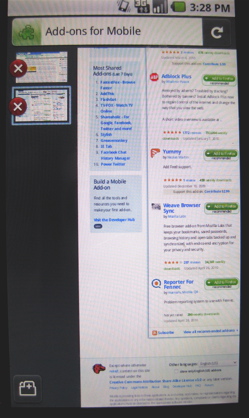
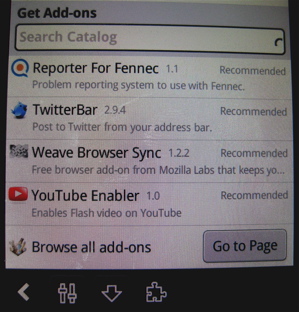
    Fennec for Android suggested add-ons

    This alpha build consumes a giant 31.67 MB of space, where the Opera 5 Mini Beta takes up only 1.8 MB. With Mozilla’s trademark add-ons, Fennec can grow to even greater size. And yes, it is quite slow.

    That said, there are a few major things to note about Fennec for Android 2.0.

    Design

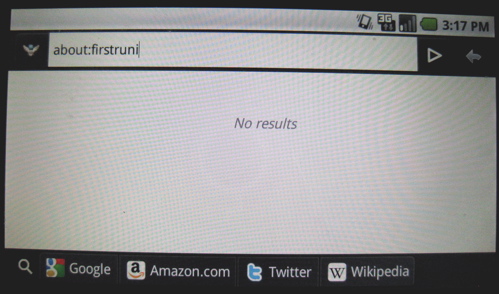
    Blank home screen, landscape, with add-ons, Fennec Alpha on Android

    When you open Fennec, all you get is the multi-purpose address bar across the top which has the Wyld Stallyns-esque title of “Awesome Bar.” It can be a search field, address bar, or even a status update field with the proper add-ons.

    The navigation and favorites bar runs down the far right side of the browser.

    To access either browser tabs or the navigation buttons, you have to scroll to the far left or far right of the screen. When you first load a page, it’s zoomed out to fit the browser so these controls are just out of view and accessible with a slight drag of the finger. But when you zoom in, it takes a bit more pulling to get to the sides. Zooming is quite unreliable at this point and it is so far only accessible by erratically double-tapping. On the Motorola Droid, the “back” and “menu” buttons have no effect on the browser at all, and the Alt key does not change the text over to the secondary keyboard. There is no soft key support on the Droid. Nexus One users can expect the virtual keyboard, however.

    Browser tabs run down the left side of the screen on Fennec for Android

    Weave Sync

    This browser add-on for Firefox is essentially the same as Opera Link. It takes your bookmarks, saved passwords, open tabs, and browsing history and keeps them synched and encrypted between your desktop and your mobile device. With the Fennec Alpha, this is enabled, but as an experimental feature.

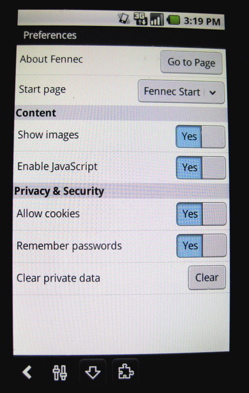
    Fennec Alpha for Android Settings

    Though Weave Sync is problematic and perhaps the number one complaint about the alpha thus far, it can be made to work.

    HTML 5

    I spent a good deal of time on HTML5demos this afternoon with Fennec, and found that it supports the following HTML 5 tags: geolocation, canvas, offline, events, and postMessage (both same domain and cross-domain) like Android’s native browser.

    An SQL database query repeatedly hangs, where Android’s native browser loads it up quite quickly.

    Interestingly, though, Fennec supports the contentEditable tag which enables rich in-browser text editing. This was heretofore unsupported by any of Android’s available browsers.

    It’s Android or Nothing

    Now that Maemo has morphed into Meego, and development on Firefox for Windows Mobile has been halted, the only mobile platform that Mozilla is actively supporting with Fennec is Android. Tristan Nitot, president of Mozilla Europe, said versions for iPhone and BlackBerry are not likely to ever come to fruition, and development on Symbian platforms is uncertain at present.

    Fennec for Android alpha download link

    To download Mozilla’s Fennec alpha directly onto your Android 2.0+ device, simply scan the QR code above. Custom ROM images are not supported with the present build and only a few Android devices have been thoroughly tested, so compatibility still varies.

    Copyright Betanews, Inc. 2010


    Add to digg
    Add to Google
    Add to Slashdot
    Add to Twitter
    Add to del.icio.us
    Add to Facebook
    Add to Technorati


  • Google’s good news: Microsoft cannibalizes Yahoo search share

    By Joe Wilcox, Betanews

    Microsoft sure is gaining search share fast. Too bad it’s cannibalizing Yahoo rather than gaining on Google.

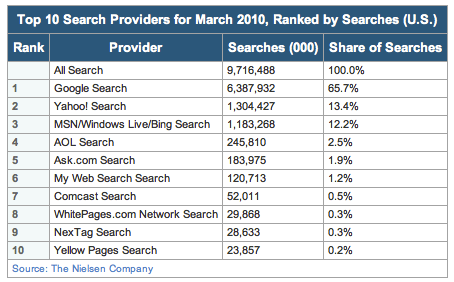
    Today, Nielsen released March 2010 US search share numbers, and, whoa, are they good news-bad news for Microsoft. The good news: Microsoft search share is 12.2 percent. The bad news: Microsoft closed the gap on Yahoo to within 1.2 percent. Yahoo’s search share is 13.4 percent.

    A year ago, these gains would have been great cheering within the hallowed halls of Microsoft’s campus. But Yahoo is Microsoft’s new search partner. The two companies announced the deal, which will eventually hand over responsibility for Yahoo search to Microsoft, in July 2009. Cannibalization is not good for Yahoo, either. How can Yahoo make gobs of money from its Microsoft-powered search deal if Microsoft gobbles up search share?

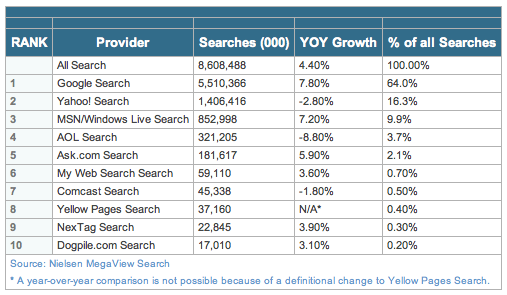
    How much Pac-Man-like gobbling is that? According to Nielsen, in April 2009, Yahoo’s US search share was a healthier 16.3 percent, while Microsoft had 9.9 percent share. Microsoft’s month-on-month search share increases — cannibalization of Yahoo share — are much stronger in 2010 than December 2009. More problematic, Microsoft gains are taking nothing from Google. In April 2009, Microsoft and Yahoo had combined search share of 26.2 percent. March 2010: 25.6 percent. Google: 64 percent in April 2009 and 65.7 percent in March 2010. But the gains aren’t all cannibalization. Microsoft also appears to be nipping search share from some smaller search engines.

    For more perspective, Nielsen also released number of searches. Americans conducted 9.72 billion searches last month. Microsoft-Yahoo combined, for March 2010: About 2.5 billion searches. Google: 6.5 billion. Microsoft-Yahoo combined April 2009: 2.26 billion searches. Google: 5.5 billion searches. So searches at Microhoo were lower 11 months earlier, but search share higher.

    March 2010 US Search Share

    Oh, yeah, Bing advertising is helping Microsoft to convert search users. Too bad, most are coming from Microsoft’s new search partner and not its arch rival. In July 2009 post “Microsoft-Yahoo deal is Google’s Christmas-in-July present,” I warned that the search agreement would likely lead to search cannibalization. But even before the deal is complete, Microsoft is gobble, gobble, gobbling share because of its marketing, branding and search service success with Bing.

    Cannibalization already could be seen when the companies announced the search agreement. I wrote in July 2009:

    Further cannibalization is inevitable, and there is likely to be heaps of it. Matters would have been worse had Microsoft bought Yahoo and consolidated all search under a single brand. My prediction: Combined Microsoft-Yahoo share will be less than 20 percent within 12 months of the deal’s closing — and that’s my being somewhat generous so that I don’t get totally flamed in comments.

    Microsoft already is reaping benefits from its newfound search share. During fiscal 2010 third quarter, online advertising revenue rose 19 percent, or by $81 million, to $502 million. The company attributed most of the advertising sales increases to search share gains.

    April 2009 Search Share

    Increasing search cannibalization creates quandaries for both Microsoft and Yahoo. Microsoft is in process of logistically assuming responsibility for Yahoo search, with end of calendar year the target for US completion. But at the rate Yahoo is bleeding search share to its partner, will Microsoft end up paying too much to integrate with Yahoo search and for TAC (traffic acquisition costs)? Then there is Yahoo’s responsibility for premium search advertising for both services to consider.

    Then there is the larger question of whether Microsoft should have cut a deal with Yahoo at all. Perhaps the money would have been better spent improving Bing and buying more advertising. After all, Microsoft has made remarkable gains organically.

    More number crunching is warranted. This post is late-day posting. I want to go through the numbers fresh and also ask for analyst comments about the overall value or cost to either Microsoft or Yahoo.

    Copyright Betanews, Inc. 2010


    Add to digg
    Add to Google
    Add to Slashdot
    Add to Twitter
    Add to del.icio.us
    Add to Facebook
    Add to Technorati


  • Bonus PalmCast: HP Buys Palm


    A bonus PalmCast: Dieter, Derek, Keith, and Phil Nickinson talk about the big news that HP is buying Palm.

    Thanks to everybody for writing and calling in!

    read more

  • GM vai lançar Agile Easytronic somente em 2012

    O Agile Easytronic será lançado já como modelo 2013 e terá o sistema eletrônico adaptado no motor 1.4 Econo.flex.
    Atualmente o Easytronic só está disponível na Meriva 1.8. Parece muito tempo para se instalar o sistema automatizado no modelo, já que o Easytronic não é um item novo na Chevrolet.
    A GM também esclareceu que houve um erro na configuração do site do Agile, onde no configurador do modelo apareciam dados da Meriva Easytronic.  
  • Dead Space 2 trailer leaked

    Here’s your first look at the upcoming trailer of highly anticipated sci-fi survival horror sequel, Dead Space 2. Watch the teaser after the jump.
     

  • Toyota pode levar multa e Corolla ainda não se vende em Minas

    A Toyota poderá ser multada em R$3 milhões por não ter feito o recall do Corolla quando o problema no acelerador foi detectado mundialmente.
    A montadora terá 10 dias para apresentar sua defesa e caso não convença a Justiça, deverá ser aplicada a multa.
    Além disso, o Corolla continua tendo suas vendas proibidas no Estado de Minas Gerais, onde ocorreram os casos de colisão devido à aceleração indevida.
  • HTC Slider Passes Through FCC With AT&T 3G

    Well, look what we have here! The above HTC Android handset has just passed through the FCC with AT&T 3G bands.  Yippee!  I have got to be honest, I am loving the form factor, looks a lot like an HTC Touch Pro 2.  Typing on an Android version of the Touch Pro 2 makes me drool just thinking about it.  What do you guys think? Nice form factor?  Let us know in the comments!

    Source: Android Cenral

    Might We Suggest…

    • Rumor: HTC Desire to AT&T, Legend to Sprint
      The two new Android handsets from HTC, the Legend and Desire, appear to have their US destinations already mapped out.  According to Boy Genius Report, the Desire will be headed for AT&T when it a…


  • HP Palm acquisition: Here comes the spurious lawsuit

    Well, if you can’t chase ambulances, you might as well chase acquisition announcements. Howard G. Smith is a lawyer in Bensalem, PA and he’s apparently looking to file a case against Palm and/or HP regarding the proposed acquisition.

    Smith contends that the proposed price of $5.70 per share undervalues the stock and does a disservice to stockholders, given that the stock has been as high as $13.58 within the past few months. He’s even going so far as to suggest that Palm "failed to shop the Company to other potential buyers," which seems patently false given the hints dropped in Rubinstein’s letter to Palm employees.

    We’re calling lawsuit troll on this one – but it does raise an interesting point that we haven’t addressed in our flurry of posts about HP buying Palm: do you think that $5.70 per share / $1.2 billion is a fair price?

    Thanks to @5xBEAR for the tip!

  • Palm Acquired By Hewlett Packard For $1.2 Billion USD

    Found under: Palm, HP, Hewlett Packard, WebOS, Acquired, Jon Rubinstein,

    And the big news is in Hewlett Packard announced earlier today that Palm will be acquired by them the acquired price is 1.2 billion USD. so far the acquisition has been approved by the boards of both HP and Palm though nothing can happen until everything has been approved by regulators.It doesnt appear this acquisition will cause any job loss or any major shake up at Palm CEO Jon Rubinstein will continue to on at the company working on WebOS and whatever else. Hewlett Packard is on

    Read More

    Read more in mobile format

  • The Buzzinator Will Tear Woody Apart [Mods]

    After modding the toy Millennium Falcon, Peter Clute decided to combine Buzz Lightyear with the Terminator, resulting in a zombie nightmare for kids and yours truly. I wish Toy Stoy 3 included this character. More »


  • Tea Party activists plan to crash Joe Lieberman’s Greenwich fundraiser for Harry Reid

    The fundraiser is scheduled for 5 p.m. Sunday at the home of Jill and Dan Ciporin and Tea Party activists affiliated with the group Right Principles plan to protest outside.

    “We intend to give [Reid and Lieberman] the appropriate welcome out front,” states an email from Right Principles founder Bob MacGuffie. “Please bring signs appropriate for Lieberman and Reid.”
    The house is located on a country road just off the Merritt Parkway, but there’s an elementary school parking lot about a half mile away, so protesters plan to park there and be shuttled over to the fundraiser location, according to MacGuffie’s email.
    “We plan on arriving at 4 p.m. so we are there for the guests arriving as well as Dingy Harry when he arrives,” MacGuffie says.
  • The confusions of definitions across borders | Gene Expression

    blackheadofstateJust reading this article in Slate, How To Throw an Election:

    On paper, that’s what Sudan’s 21-year civil war was all about. More than 2 million people died in that terrible religious-themed conflict between the Muslim, Arab-led north and the pagan and Christian black south. In reality, almost no one in the south bought the unity line except their charismatic (and autocratic) leader, John Garang. Garang, a favorite of the West, negotiated Sudan’s 2005 peace treaty, the Comprehensive Peace Agreement, that finally ended the war. The document was essentially written to ensure he would be elected Sudan’s first black president.

    How is it that the current president of Sudan (picture to the left) isn’t black, but Barack Hussein Obama is black? I’m in the category of people who think the world “race” has some utility and maps onto real patterns of human variation, but sometimes it’s just funny. The distinction between the Arabs of Sudan and blacks of Sudan is kind of weird, because Arab is not a race, and Arabs can be of any race theoretically (there are even Arabs in Yemen’s Hadhramaut who have a lot of Malaysian ancestry because of international trade), though generally they are of the olive persuasion. Perhaps the Sudanese Arab elite wouldn’t want to be identified as black because that isn’t particularly prestigious, but they’d certainly be identified as such in other Arab countries. Anwar Sadat was the subject of some racist attitudes within Egyptian society because of his Sudanese ancestry (his mother was Nubian) and his dark skin.

    Anyway, my amusement was mostly the fact that they went with this text, and, added a picture of a man who most Americans would identify as black but noted implicitly that he wasn’t black. American journalists are generally punctilious about following the rule of hyodescent when it comes to Americans, even when those individuals object to this framing, such as Tiger Woods (who is twice as Asian ancestrally as he is black). But I guess in an international context they will bend more. It reminded me of stories that Afro-Arabs were often allowed to stay at “whites only” facilities in the USA when segregation was the norm because they were foreign.

    Note: Hypodescent isn’t just an American issue. There are controversies about a new biopic of Alexandre Dumas where he is played by Gérard Depardieu. Some people wanted a non-white actor cast because Dumas’ mother was mixed-race. But of course Dumas was mostly white, and he seems to basically looked like a white guy. France of the 19th century was not the American South of the 19th century, and a drop of black blood did not make you persona non grate within white society. If you want real accuracy, perhaps cast Wentworth Miller as a young Dumas, he’s a white-looking mixed-race actor.

    Image Credit: Slate & Whitehouse.gov

  • Kindle Update Coming: Collections, PDF Pan/Zoom, New Fonts, Facebook & Twitter

    Kindle on the bookshelf

    A post on the Mobileread forums pointed me to an Amazon announcement posted today about a new firmware (software) update for the Kindle and Kindle DX.  Based on the announcement, the update will go to a select group of beta testers first, and then move out to all Kindle users by late May 2010.

    New Firmware Features Include:

    • Collections: Organize your books and documents into one or more collections.  Sounds like some sort of “tag” implementation to me although it could be a way to sort your books and other materials by folder – something users have asked for repeatedly.
    • PDF Pan and Zoom: Zoom into PDFs and pan around to easily view small print and detailed tables or graphics.  – This will be a nice addition.  PDF viewing on the Kindle before this was less than ideal.
    • Password Protection: Password protect your Kindle when you’re not using it – I’m not sure how many have asked for this one, but I guess some will find it useful.
    • More Fonts & Improved Clarity: Enjoy two new larger font sizes and sharper fonts for an even more comfortable reading experience – A welcome addition.  The more fonts and size options the better.
    • Facebook & Twitter Posts: Share book passages with friends on Facebook and Twitter directly from your Kindle. – I’m not so sure how many Kindle owners will use this, but hey, why not.
    • Popular Highlights: See what the Kindle community thinks are the most interesting passages in the books you’re reading – This one sounds interesting.  I’ll have to try it out to know if its useful or not though.

    The official Amazon announcement is at Amazon.com.  I’m hoping we’ll see a price reduction as the next big news item from Amazon.


  • Porsche convoca recall do Panamera em todo o mundo

    O problema no superesportivo alemão está nos cintos de segurança, que podem estender mais do que o devido em caso de colisão, podendo provocar ferimentos graves nos ocupantes.
    O primeiro Porsche com quatro portas do mundo, o Panamera já se tornou um sucesso pelo mundo, sendo produzidos até agora 11.324 unidades.
    Todas as unidades produzidas estão envolvidas no processo de recall. O Panamera tem motores V6 3.5 e V8. 4.8 com 300 cv e 400 cv, respectivamente.
    No Brasil, o Panamera é oferecido em três versões cujos preços variam entre R$549 mil e R$749 mil.
  • One Big Wall Street Journal Lie

    by Kevin Jon Heller

    Whoops, spoke too soon about the WSJ’s anti-ICC editorial.  It does indeed contain a lie — and its a doozy:

    What’s more, no amount of reform of the founding treaty will change the ICC’s inherent flaw. The ICC is a child of the doctrine of “universal jurisdiction,” which holds that courts can adjudicate crimes committed anywhere in the world.

    As anyone who has spent five minutes reading the Rome Statue knows, the Court is based on two forms of jurisdiction: territorial and active-nationality.  Both of which the U.S. uses and accepts that other states may use.  Proposals to base the ICC on universal jurisdiction were soundly rejected during the drafting of the Rome Statute.

    Not that the Editorial Board of the WSJ cares.  In the absence of facts, lies suit them just fine.