Congratulations to A. Coogan of NY who won a BlackBerry Bold 9700 for AT&T on Wednesday April 28, 2010 at 3:48PM. Stay tuned for a picture and quote from our latest winner!
Congratulations to A. Coogan of NY who won a BlackBerry Bold 9700 for AT&T on Wednesday April 28, 2010 at 3:48PM. Stay tuned for a picture and quote from our latest winner!
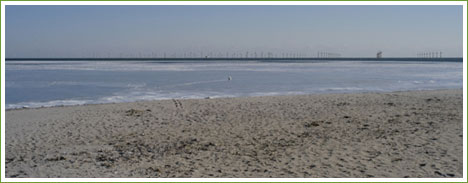
U.S. Secretary of the Interior Ken Salazar has approved the Cape Wind offshore wind farm project! In addition to giving the go-ahead, Salazar outlined a few tweaks to incorporate the concerns of those who have opposed the project.
It’s hard to believe it’s been nine years since the first announcement of the project in the Nantucket Sound. Some residents of the surrounding area, including Wampanoag Indian tribes and the late Sen. Kennedy, have opposed the project because they believe it would obstruct their views (and disrupt spiritual rituals and ancient burial sites of the Indians).
But environmentalists around the country and five East Coast governors all rallied for its approval, and in the end, the U.S. is finally getting its first offshore wind farm. The wind farm will have a capacity of 420 MW — enough to meet 75 percent of Cape Cod and the Islands’ electricity needs.
The U.S. leads the world in wind energy capacity, but we’ve lagged behind other countries, especially in Europe, that have forged ahead with offshore wind.
Why is this a big deal? Because offshore wind is stronger, more consistent and near coastal population centers, meaning more power generation, less gaps in electricity and no need for huge transmission networks (like those needed to distribute wind energy generated in the middle of the country).
via Boston Globe
The 2012 Hyundai Veloster Concept has evolved thoroughly since the first time it was showcased three years ago at the 2007 Seoul Motor Show. The hatchback variant that is headed to the production floor and will start selling next year, was spied (again) testing and the cameras managed to get a shot of the interior along with the heavily clad exterior that hardly revealed anything.

Despite the heavy camouflage, the lighting units the center-mounted exhaust and the sloping roofline were all evident. On the inside the spy images reveal a symmetrical dash with a prominent center stack. The 2012 Veloster features a Dimension audio system, heated seats, a push-button ignition, chrome door handles, a large LCD display and a smallish steering wheel.


Engine speculations for the Veloster include a naturally-aspirated 1.6L four-banger capable of churning 121hp and 155Nm of torque. A turbocharged variant will also be offered and that will render 175 horses. [via WCF]

» iPhone users are downloading Opera Mini but not many of them are actually using it. [GigaOm]
» Verizon and Vodafone (NYSE: VOD) may not be the only Kin providers—AT&T (NYSE: T) and T-Mobile may offer the Microsoft (NSDQ: MSFT) phone next. [Gizmodo]
» PayPal adds checkout functionality for goods and services sold through iPhone apps. [Mobile Entertainment]
» ESPN’s live three-day telecast of the 2019 NFL Draft garnered 20.1 million visits, up 40 percent from last year, and 9.2 million video starts, up 47 percent. [Release]
As the Senate dithers on clean energy reform, every branch of the government — Congress, the Obama administration, and the courts — is investigating the oil rig explosion off the coast of Louisiana that has killed 11 workers and left three in critical condition. Brad Johnson has the story in this Wonk Room repost.
The obliterated hulk of the Deepwater Horizon rig has sunk to the ocean floor, the shattered drilling apparatus now leaking thousands of gallons of oil into the Gulf. Attempts to shut down the leaks by underwater robot have failed, so authorities are considering building an underwater dome and setting the growing oil slick ablaze before it reaches shore. The rig is owned and operated by BP America and Transocean Limited.
Administration officials Secretary of Homeland Security Janet Napolitano and Secretary of the Interior Ken Salazar announced the “the next steps for the investigation that is underway into the causes of the April 20 explosion that left 11 workers missing, three critically injured, and an ongoing oil spill that the responsible party and federal agencies are working to contain and clean up.” There is a joint investigation by the U.S. Coast Guard (under Napolitano) and the Minerals and Mining Service (under Salazar) into the explosion’s death and destruction.
In the House of Representatives, energy committee chair Henry Waxman (D-CA) and oversight subcommittee chair Bart Stupak (D-MI) launched an investigation into “the adequacy of the companies’ risk management and emergency response plans for accidental oil and gas releases at the Deepwater Horizon drilling rig and other offshore deep water or ultra-deep water drilling facilities.” In letters to BP America CEO Lamar McKay and Transocean CEO Steven Newman, the lawmakers cite the “apparent lack
of an adequate plan to contain the spreading environmental damage” and request documents by May 14.In the Senate, Sen. Frank Lautenberg (D-NJ), Sen. Bob Menendez (D-NJ), and Sen. Bill Nelson (D-FL) have called for a joint hearing by the Senate commerce and energy committees to oversee the efforts by the federal agencies involved (NOAA, MMS, and the Coast Guard).
A lawsuit has been filed in the federal courts by the wife of one of the victims, charging Transocean, BP America, and Halliburton with negligence. Halliburton “was engaged in cementing operations of the well and well cap,” which may have failed and caused the explosion.
In 2005, an explosion at BP’s Texas City Refinery killed 15 workers. In response to safety violations at that facility, the Occupational Safety & Health Administration levied a record fine of $87 million against BP, which BP promptly challenged in court. Since 2006, there have been 509 fires resulting in at least two fatalities and 12 injuries on rigs in the Gulf of Mexico.
If this doesn’t give somebody pause, there’s something wrong. I have always said it would need to be far enough, clean enough and safe enough. I’m not sure this was far enough, I’m pretty sure it wasn’t clean enough and it doesn’t sound like it was safe enough.’

HP ha comprado Palm por 1200 millones de dólares en lo que supone su movimiento estratégico para volver al mundo móvil. Desde luego, HP no estaba en las quinielas para hacerse con Palm cuya estrategia de desarrollar un sistema propio – WebOs con la Palm Pre – no le ha servido para hacerse con una cuota de mercado significativa. Se esperaba que el comprador fuese alguno de los actores con presencia, pero que careciese de un sistema propio establecido: HTC, por ejemplo.
Que HP decida volver al mundo móvil no debería parecer extraño: es donde hay más negocio ahora y en el futuro, no sólo en vender dispositivos sino en todo el ecosistema de aplicaciones, tiendas y servicios. Lo interesante es que lo haga comprando Palm y su sistema propietario, que si bien está bien resuelto para el usuario, carece de una comunidad de desarrolladores. Contrasta con la estrategia de sus rivales Dell y Acer, que se apoyan en Android – y dentro de no mucho en Windows Phone Series 7 – como puerta de entrada, algo que definitivamente parece más asequible no sólo para hacer móviles sino también tablets y productos intermedios entre el telefono y el ultra-portátil. Aunque viendo la pobre experiencia que ofrece hoy día HP con Android en el Compaq Airlife 100 está claro que necesitan ayuda para construir una experiencia táctil aceptable.
Anuncio oficial, Hp.com
PD: ¿alguien echaba de menos las iPaq?

2010 Hurst Ford Racing Mustang Challenge Pace Car
Hurst Performance Vehicle has once again unveiled a special-edition Mustang built to serve as the official pace car for the 2010 Racing Mustang Challenger Series. The 2010 Hurst Mustang pace car will debut during the Ford Racing Mustang Challenge race event in Virginia International Raceway on April 25, 2010.
Click here to get prices on the 2011 Ford Mustang.
“Hurst has a history of creating unique, high-quality, emotionally-charged muscle cars and the 2010 Hurst Ford Racing Mustang Challenge pace car is no different,” said Nate Shelton, Chairman of Hurst Performance Vehicles. “We are so proud to have yet another opportunity to set the pace for others to follow and give something back to a deserving organization.”
The 2010 Hurst Ford Racing Mustang Challenge Pace Car rides on Force T/A KDW tires for maximum performance and attitude, 20″ Hurst polished, forged aluminum wheels and a Hurst Competition/Plus shifter with a black T-handle.
The special-edition model pushes 550-hp, or 200-hp more than the FR500S race Mustangs, courtesy of the Ford Racing polished supercharger, Ford Racing FR500S stainless-steel cat-back exhaust and K&N filter.
Hit the jump for the press release for more details


Press Release:
2010 Hurst Ford Racing Mustang Challenge Pace Car to DEBUT at Virginia international Raceway on April 25
Highly Collectible Pace Car to Benefit the Austin Hatcher Foundation for Pediatric Cancer
Irvine, Calif. (April 20, 2010) – Hurst Performance Vehicles, a company responsible for some of the most iconic pace cars in racing history, will once again debut a special-edition Mustang built to serve as the official pace car for the 2010 Ford Racing Mustang Challenge Series.
The 2010 Hurst Mustang pace car will debut during the Ford Racing Mustang Challenge race at Virginia International Raceway on April 25, 2010.
After its run with the Ford Racing Mustang Challenge, this unique and highly-collectible Pace Car will make special appearances at the Hot Rod Power Tour, at numerous Larry H. Miller dealerships across the country and even at SEMA, before being auctioned for charity in January 2011. Proceeds of the auction will benefit the Austin Hatcher Foundation for Pediatric Cancer, formed to support research towards the diagnosis, treatment and development of a cure for pediatric cancer, and to provide support and hope to children and families undergoing treatment, as well as those who have lost children due to cancer. Through Hatch’s house of hope, the Austin Hatcher Foundation provides a landmark group of educational, emotional and social skills development programs essential to help cancer stricken children and their families succeed within their community.
Additionally, the 2010 Hurst pace car’s paint scheme and likeness will be used to create promotional items sold by the Ford Racing Mustang Challenge Series at various race events and online, including a run of limited edition replica skins for their Miller Cup Pinewood Car kits. As one of several ongoing initiatives to support the Austin Hatcher Foundation, Mustang Challenge has integrated a fund-raising Miller Cup Pinewood Derby car race into the season-ending championship banquet at Miller Motorsports Park.
Larry H. Miller Dealership Group has confirmed that it will partner with Hurst Performance to donate the vehicle for this project. Other partners of the project include Whelen Engineering, Ford Racing, BFGoodrich Tires. Motorsports artist and Roger Warrick will create original art for promotional items.
The stunning Hurst Ford Racing Mustang Challenge Pace Car comes equipped with 20″ BFGoodrich g-Force™ T/A®KDW tires for maximum performance and attitude, 20″ Hurst polished, forged aluminum wheels and a Hurst Competition/Plus shifter with a black T-handle.
The engine pounds out 550-horsepower, or nearly 200-horsepower more than the FR500S race Mustangs, and 542 lb.-ft of torque, courtesy of the Ford Racing polished supercharger, Ford Racing FR500S stainless-steel cat-back exhaust and K&N filter. With its race bred Ford Racing suspension, this car is sure to keep people straining just to see it zoom by. And to stop all this power, the car is equipped with an upgraded braking system featuring 14″ rotors and 4-piston calipers, also from Ford Racing.
“The Austin Hatcher Foundation is proud to be partnering with Hurst Performance, the Larry H. Miller Dealership Group, Whelen Engineering, BFGoodrich Tires, Ford Racing and the Ford Racing Mustang Challenge Series to sponsor the 2010 Hurst Ford Racing Mustang Challenge Pace Car,” said Jim Osborn MD, Chairman of the Austin Hatcher Foundation. “The Foundation’s focus is on empowering families faced with pediatric cancer to thrive, and we hope to bring excitement to these families through Hurst’s history of unique muscle cars.”
Other signature Hurst details include a traditional Hurst black on gold paint scheme, a Hurst leather interior with contrast top-stitching and embroidered logos, Hurst-logoed floor mats and a Hurst AIR-SPEED rear deck spoiler.
– By: Omar Rana

I keep thinking entries will wind down as we reach the end of this contest, but you guys keep sending in more and more epic videos. The latest batch (and it’s not the last batch) comprises robots, electrocution, the Black Crowes, free credit reports and an old myTouch 3G that’s no longer loved. Check ’em out after the break. And remember that you have until 12:01 a.m. Saturday to get me your entry. Good luck!
(And for those who keep asking, we’re going to compile all of the videos onto a single page and rig up some voting, early next week sometime. Stay tuned.)
Alexa Ray Joel is the new face and hair of Prell Shampoo (They still make that?!), but the resume-boosting gig isn’t the only new thing taking up residence in Alexa’s life these days. Look closely at the 24-year-old celebuspawn and you may notice something distinctly different about her once prominent nose.
Alexa, an aspiring singer and the only daughter of iconic supermodel Christie Brinkley and musician Billy Joel, underwent rhinoplasty — that’s Hollwood speak for “a nose job” — earlier this month, and the brunette says she never felt better after seeing the finished product, crafted by NYC-based plastic surgeon Dr. Norman M. Rowe.
“I was thinking about getting this for years,” says Alexa, whose looks have made her the target of ridicule on the blogosphere for years. “I was self-conscious of pictures taken from the side. To some people that’s vain, but at the end of the day, we all want to feel pretty,” she adds. “Would I do anything else to my body? No. It’s not ten procedures like Heidi Montag. For me, that’s a little extreme, but to each her own.”
Alexa notes that she is in good health since being hospitalized following an alleged overdose last December.
2011 Kia Optima Sedan Unveiled in NY: Offered with 2.4L, 2.0 Turbo and Hybrid Powertrains
The next generation Kia Optima is set to make its world premiere at the 2010 New York International Auto Show.

“The next generation of Kia Optima possesses the power to surprise,” says Peter Schreyer, Kia’s Chief Design Officer. “It’s a car that people will simply not expect from Kia – and that’s exactly what we set out to achieve.”
The saloon exudes an athletic confidence from every angle – its raked roofline, high and pronounced shoulder line of its sculpted flanks and its extended wheelbase are complemented by flared wheelarches and a shallow glasshouse that create a saloon with a muscular, self-assured stance.
The striking visage of the car features a new interpretation of Kia’s bold ‘tiger’ family face that’s edged by piercing projector headlamps.
Following the theme of recent model revisions, new Kia Optima is longer, lower and wider than before, the Kia’s coupe-like profile is enhanced by the sweeping chrome arc that flows from A to C pillar, a distinctive design motif that visually lowers the car further still and enhances its cab-backwards proportions.
“For this car we started with a clean sheet and worked to achieve an exterior design with a European feeling and stance,” explains Gregory Guillaume, Chief Designer, Kia Europe. To help achieve this, the exterior was designed by his team in Frankfurt. The interior was created by the design team in California.
The new D-segment offering is spacious, and with class-leading levels of safety and luxury equipment, the intelligently configured and driver-oriented cabin underlines a newfound poise and presence.
“This new model embodies Kia’s confident new design direction,” says Schreyer. “It’s a global car with individual appeal.”
Kia Optima Sedan Photo Gallery


Kia Optima 2011 – New York Auto Show 2010
Building on momentum established in 2009 with three new products, record U.S. market share and the opening of Kia Motors’ first automotive assembly plant on U.S. soil, Kia Motors America (KMA) unveiled four all-new vehicles during a press conference at the New York International Auto Show: the 2011 Optima midsize sedan, Forte five-door compact, and the Sportage and Sorento SX compact CUVs.

 Who needs poppy plants to produce morphine? Last month scientists said they’d isolated the genes those plants use to synthesize the narcotic chemical and made it themselves in a lab. Now, in a study in the Proceedings of the National Academy of Sciences, another team has suggested that we mammals might possess the pathway to create our own morphine.
Because we have receptors for the opiate in our brains (which makes it such an effective and addictive painkiller), and because morphine traces show up in our urine, scientists had long wondered if animals could produce the drug themselves. But studies using living animals yielded inconclusive results because of possible contamination from external sources of morphine in their food or in the environment [Nature]. In addition, the body breaks down and changes morphine, which complicates the task.
To sort out this mess, researchers injected mice with tetrahydropapaveroline (THP). Human brain cells have this chemical, and plants use it to make morphine. After the injection, mice started to turn the THP into salutaridine. In morphine-producing poppy plants salutaridine is then converted to thebaine, which undergoes further reactions to become morphine. The researchers show that mice can also do that chemical conversion, as well as others needed to generate morphine [Science News].
“This paper seems to be one of the most definitive I’ve seen,” says Chris Evans, a neurobiologist and expert on opioid drugs at the University of California, Los Angeles. “They’ve convincingly shown that there’s a pathway there which could possibly produce morphine” [Nature News]. But to what end? This study simply showed that the morphine-producing pathway is possible; it didn’t find traces in tissue. Thus, it can’t say for sure that mammals do produce morphine naturally, nor for what it would be used. Pain relief seems the obvious answer, since that’s the most common use of plant-created morphine, but the scientists don’t know if the body could make enough for that purpose.
The other outstanding question is: Did animals and plants evolve these pathways separately, or do parts of it date all the way back to simple common ancestors before the kingdom split? Coauthor Meinhart Zenk is leaning toward independent evolution, because the early parts of the process are different.
Related Content:
80beats: The Poppy’s Secret: Scientists Find the Genes That Make Morphine
80beats: To Help Heroin Addicts, Give Them… Prescription Heroin?
80beats: A Prompt Dose of Morphine Could Cut PTSD Risk for Wounded Soldiers
DISCOVER: The Biology of Addiction
DISCOVER: Vital Signs, all our medical mysteries
Image: flickr / Evil Erin

Filed under: Etc., Europe, Government/Legal, Bugatti

We’re thinking this young man is likely to receive more than five minutes in time out for his 1.8 million euro “mistake,” but then again, it isn’t every parent that lets their 20 year-old son drive the family Veyron (assuming he had permission in the first place). It’s also important to note that it really doesn’t pay to drive too fast in northern Europe outside of select derestricted portions of the Autobahn. Here in the States, reckless driving can carry the same weight as a drunk driving arrest, but chances are your vehicle won’t be confiscated.
[Source: Dutch Daily News]
Report: Dutch driver gets Bugatti Veyron confiscated for doing 50 mph over. He’s 20. originally appeared on Autoblog on Wed, 28 Apr 2010 14:30:00 EST. Please see our terms for use of feeds.
Read | Permalink | Email this | Comments

For five years, the people at BrandZ (you know they’re in branding because of the “Z”) have been evaluating customer opinion and awareness of various global brands, and then putting a dollar value on that evaluation for their annual Top 100 Most Valuable Global Brands report. Here are the top 10 brands on the BrandZ list.
1. Google
“Google is now the number 1 brand by far with a value of $114.3 billion, on the strength of a 32 percent compounded annual growth rate since 2006, when Google ranked number 7, with a brand value of $37.4 billion.”
2. IBM
“The IBM brand experienced 24 percent compounded annual growth rate during the past five years and now, with a value of $86.3 billion, ranks second in the BrandZ Top 100, having advanced from position number 8.”
3. Apple
“Apple, now ranked number 3, with a brand value of $83.2 billion, moved up 26 places [over a five-year period] from number 29.”
4. Microsoft
Microsoft remained unchanged from 2008 with a value of $76.4 billion.
5. Coca Cola
With a value of $67.98 billion, the Coca Cola brand remains the top beverage brand by a long shot. The closest on the list is Budweiser at #38. Pepsi ranked #58 on the list.
6. McDonald’s
The Golden Arches slipped just 1% from last year’s value, but it was still the only fast food restaurant in the top 50. Subway, the only other fast food brand on the list was ranked #64.
7. Marlboro
At a value of $57 billion, the Marlboro brand actually increased in value by 15% over the previous year.
8. China Mobile
The world’s largest mobile network is also the highest-rated non-U.S. brand on the list.
9. General Electric
GE’s brand value slipped 25% from the previous year, but it was still enough to keep the brand in the top 10.
10. Vodafone
The UK-based mobile carrier is the highest-ranking European brand on the top 100.
Other brands of note:
*Walmart barely missed out on the top 10, with a #13 ranking.
*BMW, at #25, is the highest-ranking automobile manufacturer, edging out Toyota — the world’s largest car maker — which ranked 26th.
*The highest-ranking U.S.-based bank on the list is Wells Fargo at #30, with Bank of America coming in at #37 on the list.
*While Comcast may be America’s largest cable company — and the Worst Company In America for 2010 — it is nowhere on the top 100 list. Perhaps the Xfinity rebranding is needed after all?
Click here to download the entire report [PDF]
World’s Top 10 Brands [Chicago Tribune]
 As a big fan of car-sharing networks — I ditched my car last year and am a City CarShare customer — I absolutely heart this idea: Spride Share, a car-sharing network where regular car owners can rent out their vehicles to drivers, is coming out of stealth today. The startup is being led by one of the earliest greentech investors out there: Sunil Paul, who founded early-stage investment firm Spring Ventures and was an early investor in Nanosolar (here’s a Q&A I ran with Paul when I launched Earth2Tech three years ago).
The company also has an advisory board that a who’s who of Internet and transportation innovators, including Reid Hoffman, founder and chairman, LinkedIn; Mark Pincus, CEO, Zynga; Dan Kammen, director, UC Berkeley Institute of Transportation Studies; and Rick Hutchinson, CEO, City CarShare. The company says it will be able save car owners money on the cost of owning a vehicle and will enable people who don’t own a vehicle to have another car-as-a-service option. The company will use the web and social networking to deliver this distributed model of car sharing.
Spride Share is looking to grab ahold of the recent surge in car-sharing networks. According to Frost & Sullivan, the number of drivers using car-sharing networks increased 117 percent between 2007 and 2009 in North America. Within five years, the firm expects to see 4.4 million people in North America and 5.5 million people in Europe signing up for services like the one from Zipcar, more than tripling membership from 2009.
However, the big hitch right now for Spride Share is that current insurance law isn’t too friendly when it comes to people renting out personal vehicles (a startup called RelayRides that’s working with a similar idea for distributed car sharing has taken out a $1 million insurance policy to supplement a car owner’s coverage in case a user damages their car). So the service isn’t available now and might not be available until the law changes. On that end, the startup, along with City CarShare, has been working with California State Assembly member Dave Jones (D-Sacramento) to create Assembly Bill 1871, which would change insurance law to permit remuneration for personal vehicle sharing. The company asks you to support the bill on its site and is holding a press conference on the subject today.
If the service becomes available, Spride Share says it is free for vehicle owners to join, and they can make an estimated $2,000-$7,200 per week depending on how many hours per week their cars are rented out. Spride Share plans to use a similar style communications service as Zipcar and City CarShare, with a key fob to open up the door and log in the user (the key fob system takes four hours to install, says the company), and the service sounds familiar as well with penalties for dirty cars and late returns.
For more on vehicles and IT check out GigaOM Pro (subscription required):
Report: IT Opportunities in Electric Vehicle Management
Mobility on Demand Takes Aim at Transport Networks’ “Last Mile”
Electric Vehicles Give “Mobility as a Service” a Jumpstart


Gordon Brown’s gaffe today in calling an old woman a bigot for her opinions on Eastern Europeans belies bigger problems for a party now faced with becoming obsolete.
The rise of the Liberal Democrats, through leader Nick Clegg’s masterful performances in the country’s first televised debates, is putting pressure on a Labour Party which has been considered the only other since the 1920s.
Then, the Liberal Party lost its opposition place due to a rise in the upstart Labour Party, which better represented the country’s growing electorate after World War I.
Now, the Liberal Democrats are making moves in the polls, either in the lead or right behind the Conservatives. Their supporters are growing, and many are coming from the country’s middle ground, where Labour has claimed dominance since the rise of Tony Blair in the late 1990s.
In the event of a coalition government, the Liberal Democrats may choose to work with the Conservatives leaving Labour outside government for the first time since 1997.
But the party would also require the Conservatives to change rules on how MPs are voted for, potentially making the system proportionally representative. In a new election, which could be called as early as the fall, the Liberal Democrats could win a majority or even place second, with Labour falling to third.
Labour then wouldn’t even be chief opposition party, and could face a series of high profile defections to the Liberal Democrats.
It has happened before…
Join the conversation about this story »
[JURIST] A US subcommittee heard testimony Wednesday on the use of unmanned predator drone strikes. The National Security and Foreign Affairs Subcommittee of the House Committee on Oversight and Government Reform held a hearing on the legality of unmanned targeting. In his opening remarks, subcommittee chair John Tierney (D-MA) said:
The use of unmanned weapons to target individuals – and, for that matter, the targeting of individuals in general – raises many complex legal questions. We must examine who can be a legitimate target, where that person can be legally targeted, and when the risk of collateral damage is too high. We must ask whether it makes a difference if the military carries out an attack, or whether other government entities such as the Central Intelligence Agency may legally conduct such attacks. We must ensure that the Administration’s understanding of the authorities granted to it by Congress do not exceed what Congress intended.The American Civil Liberties Union (ACLU), which has consistently opposed the use of unmanned targeting, sent a letter to President Barack Obama Wednesday, urging an end to the program.Last month, State Department Legal Adviser Harold Koh defended the legality of the use of unmanned drones. Earlier in March, the ACLU filed suit seeking information related to the US government’s use of unmanned drones. The ACLU alleges that the drones have been used by the military and CIA for unlawful killings in Afghanistan, Iraq, and Pakistan. The ACLU also cites troubling reports indicating that US citizens may be targeted and killed by unmanned drones. In October, UN Special Rapporteur on extrajudicial, summary or arbitrary executions Philip Alston noted that the use of unmanned drones by the US to carry out attacks in Pakistan and Afghanistan may be illegal. Alston said, “he onus is really on the government of the United States to reveal more about the ways in which it makes sure that arbitrary executions, extrajudicial executions, are not in fact being carried out through the use of these weapons.” Alston criticized the US policy in a report to the UN General Assembly’s human rights committee that was presented as part of a larger demand that no state be free from accountability.
In 1987, on her first day at her new job in Washington, D.C., Carol Steiker was handed two giant notebooks by her predecessor and was told, “The boss really cares a lot about this.”
Her new boss was U.S. Supreme Court Justice Thurgood Marshall, and what he cared passionately about was opposing the death penalty. As a result, Steiker, his new clerk, became well-versed in issues related to capital punishment, and in the intervening years has come to care deeply about the topic herself.
A group of graduating Harvard Law School (HLS) students listened to parting advice on Wednesday (April 21) from Steiker, who has made studying and teaching classes on capital punishment a large part of her life’s work. The professor took part in the last of four discussion sessions sponsored by the School’s 3L class marshals that let HLS scholars offer the departing class some final words of wisdom.
“I promise you, there is nothing more satisfying than to work on something … that you care passionately about,” said Steiker, who delivered a talk she titled “Why I Am Against the Death Penalty, and Why You Should Be Against Something Too.” The Howard J. and Katherine W. Aibel Professor of Law described her opposition to the penalty in both procedural and moral terms, and encouraged audience members to “find their inner indignation and harness it for good.”
In the procedural realm, recalling the campaign of former presidential hopeful Michael Dukakis, she noted that capital punishment has become a “hot-button political issue,” and that intense pressure is put on elected officials to support it. Steiker said that many observers felt Dukakis’ presidential hopes were dashed when he famously remarked during a 1988 debate that he wouldn’t back the death penalty even if his wife were murdered.
“It’s hard to overstate how the death penalty has played such a potent role in politics.”
Steiker also called funding for capital defense in the United States “horribly inadequate,” and said there “is just simply no will to correct this.”
Governments face major demands on their budgets in areas such as health care and education, so passing appropriation or tax bills for lawyers to defend hardened criminals is not a priority for state and local officials, said Steiker.
Additionally, recent legal changes have drastically limited the review of state death penalty convictions at the federal level, essentially eliminating an important backstop, she said.
On moral grounds, Steiker, who frequently debates death penalty proponents, worried in part that extreme punishments done in the name of the “public” and “justice” would have a “wearing effect on certain crucial aspects of human nature,” including “the ability to identify — have compassion with — other people, especially people who are different from the way we view ourselves. … We need to protect [these] sensibilities and capacities that are central to moral agency.”
But turning the audience into death penalty abolitionists wasn’t the goal of her talk, said Steiker. Her aim, she said, was to convince listeners to find their own passion, and to use their “enormous talents, energies, and excellent educations” in pursuing it.
There is tremendous suffering and injustice in the world, said Steiker, and “you are among the people in the world most equipped to make a difference.”
by Bruce Nilles
Last night I debated the role of coal in our country’s energy future with Peabody Energy VP of Government Relations Fred Palmer on the campus of Washington University in St. Louis.
The debate took place in front of more than 500 students and community members at Graham Chapel on campus, and was watched live online by nearly 4,700 additional interested observers.
Here are four minutes of highlights:
If you want to watch the full debate, click here.
The debate was a great conversation about the dangers presented by coal and there was frank dialogue between Mr. Palmer and I about important issues. Unfortunately, when trying to make the case in favor of a dirty and dangerous source of power like coal, Mr. Palmer strayed from the truth. There were two factual errors in particular I wanted to mention here.
If you go to minute five of the full length debate video, you’ll hear Mr. Palmer talk about how Peabody Energy cares about safety. If that’s true, then why does his company operate one of the coal mines with the most safety violations in the U.S.? From a Business Week article:
Peabody’s Air Quality No. 1 coal mine in Knox County, Indiana, tops the U.S. in citations, with 1,419. The company’s operation in Saline County, Illinois, has accumulated 1,217 citations, according to (Mine Safety and Health Administration) data.
The Knox County mine has more than twice the number of citations as the Upper Branch mine in West Virginia that was the site of the terribly sad mining disaster earlier this month. This track record of unsafe mines certainly does not support Mr. Palmer’s claims that Peabody cares about safety.
Later in the debate, Mr. Palmer said that it is safer to work in mine than to work at Wal-Mart. I have to disagree, and I think most Americans would, too, especially after reading this article in USA Today about how “(d)ays missed because of serious injuries in the nation’s mines have spiked sharply this decade.”
Mr. Palmer’s second inaccurate statement last night was that Peabody has not participated in mountaintop removal coal mining since he’s been there. Mountaintop removal is the irresponsible practice where mining companies blow the tops off mountains to reach a thin seam of coal and then, to minimize waste disposal costs, dump millions of tons of waste rock into the valleys below, causing permanent damage to the ecosystem and landscape.
Despite Mr. Palmer’s claim that Peabody does not partake in this hazardous mining practice, the facts show that he joined Peabody in 2001, and up until 2007, Peabody owned mountaintop removal coal mines in West Virginia and Kentucky.
Our country can do better than coal, and our college campuses for sure can do better than coal. I really enjoyed the time spent talking to the students at Washington University about the need to switch from coal to clean energy, and about not believing the “green” coal babble the industry is spouting now.
I was also inspired to see so many young people at the debate last night who believe that our nation can and should be powered by clean energy. We even got a great example of that belief today when the Obama administration approved the Cape Wind offshore wind project in Massachusetts. These students are a great reminder that our future is bright.
After the debate, this bright future was highlighted by student and debate organizer, Arielle Klagsbrun. “Our struggle to remove coal’s influence from our campus is a struggle going on all across America, and we will succeed,” Arielle said in a press release the students put out earlier today. “In six years, our generation, the millennial generation, will make up one-third of the voting population. We are not asking for an end to coal, we are ending it.”
Related Links:
Obama blandly invokes ‘American Dream’ in tribute to miners who were denied it
More lessons from Wales for moving beyond coal


